

IEC 60534-1:2023
(Main)Industrial-process control valves - Part 1: Control valve terminology and general considerations
General Information
- Abstract
IEC 60534-1:2023 applies to all types of industrial-process control valves (hereinafter referred to as control valves). This document establishes a partial basic terminology list and provides guidance on the use of all other parts of IEC 60534.
- Status
- Published
- Publication Date
- 22-May-2023
- Technical Committee
- SC 65B - Measurement and control devices
- Drafting Committee
- WG 9 - TC 65/SC 65B/WG 9
- Current Stage
- PPUB - Publication issued
- Start Date
- 23-May-2023
- Completion Date
- 26-May-2023
Buy Documents
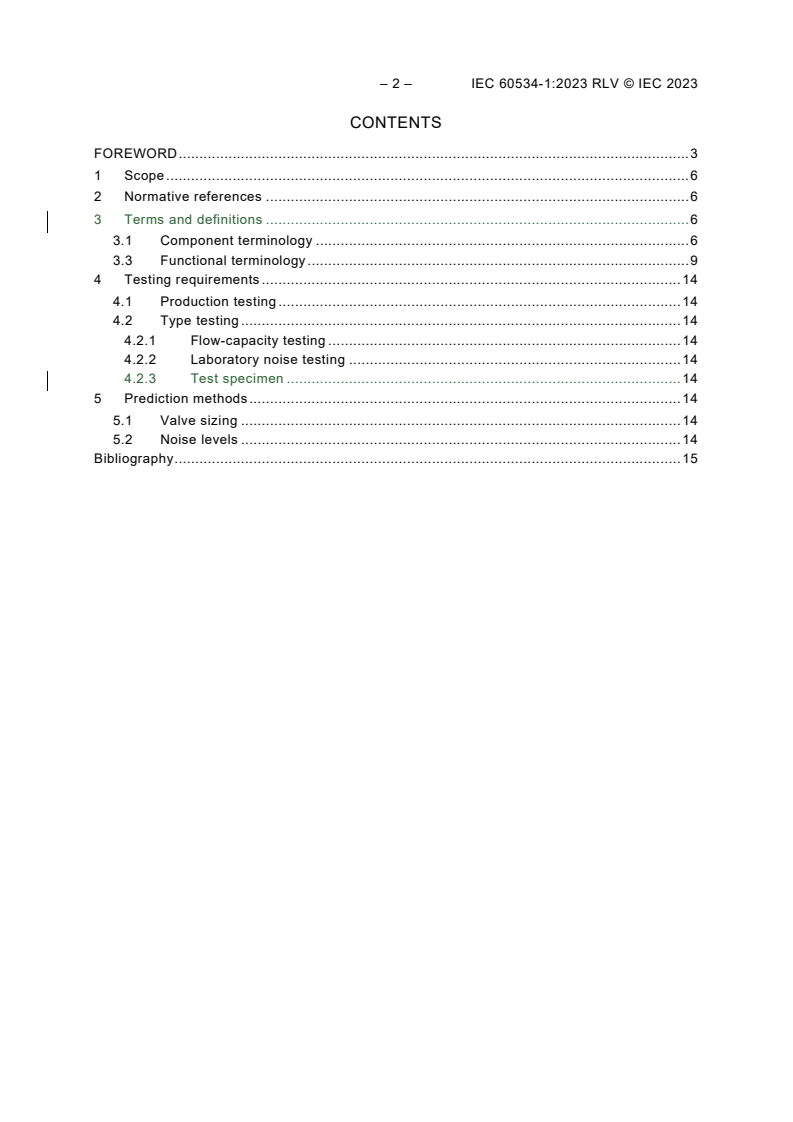
IEC 60534-1:2023 RLV - Industrial-process control valves - Part 1: Control valve terminology and general considerations Released:5/23/2023
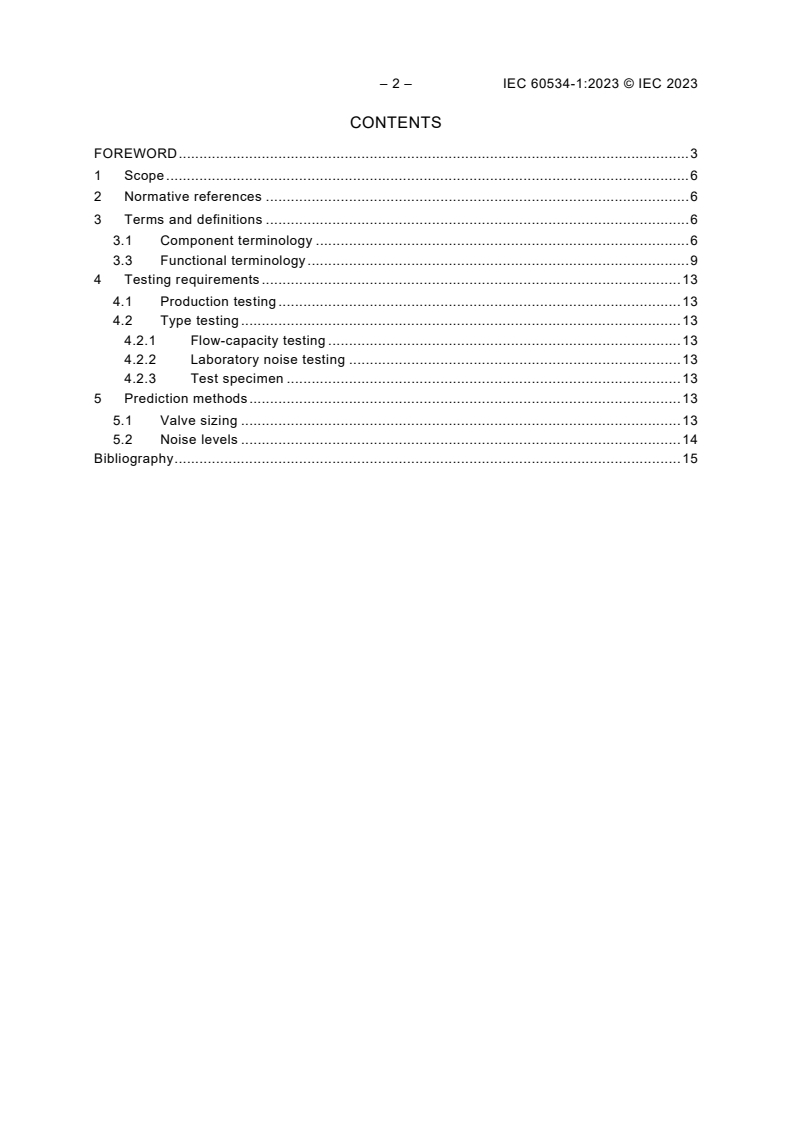
IEC 60534-1:2023 - Industrial-process control valves - Part 1: Control valve terminology and general considerations Released:5/23/2023
Overview
IEC 60534-1:2023 - Industrial-process control valves - Part 1: Control valve terminology and general considerations - is the fourth edition of the IEC foundational standard for control valves. It applies to all types of industrial-process control valves and provides a partial basic terminology list plus guidance for using the remainder of the IEC 60534 series. This edition updates and clarifies definitions to harmonize with current industry terminology.
Key topics
- Scope and purpose
- Establishes core terms and definitions for control valves, valve components and function (e.g., body, bonnet, trim, closure member, actuator).
- Guides interpretation and application of the other parts of IEC 60534.
- Component and functional terminology
- Definitions cover linear and rotary closure members (globe, diaphragm, gate, ball, butterfly, plug), valve trim, seats, stem/shaft, actuators, yoke, fittings and end connections (flanged, threaded, welded).
- Testing and measurement
- Outlines testing categories referenced in the series: production testing, type testing (including flow-capacity and laboratory noise testing) and test specimen considerations.
- Prediction methods
- References methods for valve sizing and noise level prediction, which are detailed in other parts of the 60534 series.
- Standards structure and references
- Provides normative linkage to other IEC 60534 parts (flow capacity, dimensions, inspection/testing, marking, mounting, data sheets, noise, response measurements).
Practical applications
IEC 60534-1:2023 is a practical reference for:
- Valve manufacturers - to ensure consistent terminology in product design, documentation and conformity with the IEC 60534 family.
- Process, mechanical and control engineers - to specify valves correctly, interpret datasheets and perform valve sizing and noise assessments using related parts of the series.
- Testing laboratories and quality teams - to align production and type testing practices and to understand test specimen requirements.
- Procurement and asset owners - to write clear procurement specifications and evaluate vendor documentation consistently.
- Standards writers and educators - as the authoritative vocabulary when producing specifications, training materials or technical reports.
Related standards
- IEC 60534 (all parts) family - detailed flow-capacity, dimensions, inspection, marking, positioner mounting, data sheets, noise measurement and prediction, and response measurement parts are directly linked to Part 1.
- IEC Electropedia and IEC webstore resources are referenced for terminological and publication updates.
IEC 60534-1:2023 is essential when you need consistent, industry-aligned control valve terminology, and when you are applying the technical testing, sizing and noise prediction methods defined elsewhere in the IEC 60534 series.
Relations
- Effective Date
- 05-Sep-2023
Buy Documents
IEC 60534-1:2023 RLV - Industrial-process control valves - Part 1: Control valve terminology and general considerations Released:5/23/2023
IEC 60534-1:2023 - Industrial-process control valves - Part 1: Control valve terminology and general considerations Released:5/23/2023
Get Certified
Connect with accredited certification bodies for this standard

DVS-ZERT GmbH
German welding certification society.
Institut za varilstvo d.o.o. (Welding Institute)
Slovenia's leading welding institute since 1952. ISO 3834, EN 1090, pressure equipment certification, NDT personnel, welder qualification. Only IIW Au
CARES (UK Certification Authority for Reinforcing Steels)
UK certification for reinforcing steels and construction.
Sponsored listings
Frequently Asked Questions
IEC 60534-1:2023 is a standard published by the International Electrotechnical Commission (IEC). Its full title is "Industrial-process control valves - Part 1: Control valve terminology and general considerations". This standard covers: IEC 60534-1:2023 applies to all types of industrial-process control valves (hereinafter referred to as control valves). This document establishes a partial basic terminology list and provides guidance on the use of all other parts of IEC 60534.
IEC 60534-1:2023 applies to all types of industrial-process control valves (hereinafter referred to as control valves). This document establishes a partial basic terminology list and provides guidance on the use of all other parts of IEC 60534.
IEC 60534-1:2023 is classified under the following ICS (International Classification for Standards) categories: 23.060.40 - Pressure regulators; 25.040.40 - Industrial process measurement and control. The ICS classification helps identify the subject area and facilitates finding related standards.
IEC 60534-1:2023 has the following relationships with other standards: It is inter standard links to IEC 60534-1:2005. Understanding these relationships helps ensure you are using the most current and applicable version of the standard.
IEC 60534-1:2023 is available in PDF format for immediate download after purchase. The document can be added to your cart and obtained through the secure checkout process. Digital delivery ensures instant access to the complete standard document.
Standards Content (Sample)
IEC 60534-1 ®
Edition 4.0 2023-05
REDLINE VERSION
INTERNATIONAL
STANDARD
colour
inside
Industrial-process control valves –
Part 1: Control valve terminology and general considerations
All rights reserved. Unless otherwise specified, no part of this publication may be reproduced or utilized in any form
or by any means, electronic or mechanical, including photocopying and microfilm, without permission in writing from
either IEC or IEC's member National Committee in the country of the requester. If you have any questions about IEC
copyright or have an enquiry about obtaining additional rights to this publication, please contact the address below or
your local IEC member National Committee for further information.
IEC Secretariat Tel.: +41 22 919 02 11
3, rue de Varembé info@iec.ch
CH-1211 Geneva 20 www.iec.ch
Switzerland
About the IEC
The International Electrotechnical Commission (IEC) is the leading global organization that prepares and publishes
International Standards for all electrical, electronic and related technologies.
About IEC publications
The technical content of IEC publications is kept under constant review by the IEC. Please make sure that you have the
latest edition, a corrigendum or an amendment might have been published.
IEC publications search - webstore.iec.ch/advsearchform IEC Products & Services Portal - products.iec.ch
The advanced search enables to find IEC publications by a Discover our powerful search engine and read freely all the
variety of criteria (reference number, text, technical publications previews. With a subscription you will always have
committee, …). It also gives information on projects, replaced access to up to date content tailored to your needs.
and withdrawn publications.
Electropedia - www.electropedia.org
IEC Just Published - webstore.iec.ch/justpublished
The world's leading online dictionary on electrotechnology,
Stay up to date on all new IEC publications. Just Published
containing more than 22 300 terminological entries in English
details all new publications released. Available online and once
and French, with equivalent terms in 19 additional languages.
a month by email.
Also known as the International Electrotechnical Vocabulary
(IEV) online.
IEC Customer Service Centre - webstore.iec.ch/csc
If you wish to give us your feedback on this publication or need
further assistance, please contact the Customer Service
Centre: sales@iec.ch.
IEC 60534-1 ®
Edition 4.0 2023-05
REDLINE VERSION
INTERNATIONAL
STANDARD
colour
inside
Industrial-process control valves –
Part 1: Control valve terminology and general considerations
INTERNATIONAL
ELECTROTECHNICAL
COMMISSION
ICS 23.060.40; 25.040.40 ISBN 978-2-8322-7065-3
– 2 – IEC 60534-1:2023 RLV © IEC 2023
CONTENTS
FOREWORD . 3
1 Scope . 6
2 Normative references . 6
3 Terms and definitions . 6
3.1 Component terminology . 6
3.3 Functional terminology . 9
4 Testing requirements . 14
4.1 Production testing . 14
4.2 Type testing . 14
4.2.1 Flow-capacity testing . 14
4.2.2 Laboratory noise testing . 14
4.2.3 Test specimen . 14
5 Prediction methods . 14
5.1 Valve sizing . 14
5.2 Noise levels . 14
Bibliography . 15
INTERNATIONAL ELECTROTECHNICAL COMMISSION
____________
INDUSTRIAL-PROCESS CONTROL VALVES –
Part 1: Control valve terminology and general considerations
FOREWORD
1) The International Electrotechnical Commission (IEC) is a worldwide organization for standardization comprising
all national electrotechnical committees (IEC National Committees). The object of IEC is to promote international
co-operation on all questions concerning standardization in the electrical and electronic fields. To this end and
in addition to other activities, IEC publishes International Standards, Technical Specifications, Technical Reports,
Publicly Available Specifications (PAS) and Guides (hereafter referred to as “IEC Publication(s)”). Their
preparation is entrusted to technical committees; any IEC National Committee interested in the subject dealt with
may participate in this preparatory work. International, governmental and non-governmental organizations liaising
with the IEC also participate in this preparation. IEC collaborates closely with the International Organization for
Standardization (ISO) in accordance with conditions determined by agreement between the two organizations.
2) The formal decisions or agreements of IEC on technical matters express, as nearly as possible, an international
consensus of opinion on the relevant subjects since each technical committee has representation from all
interested IEC National Committees.
3) IEC Publications have the form of recommendations for international use and are accepted by IEC National
Committees in that sense. While all reasonable efforts are made to ensure that the technical content of IEC
Publications is accurate, IEC cannot be held responsible for the way in which they are used or for any
misinterpretation by any end user.
4) In order to promote international uniformity, IEC National Committees undertake to apply IEC Publications
transparently to the maximum extent possible in their national and regional publications. Any divergence between
any IEC Publication and the corresponding national or regional publication shall be clearly indicated in the latter.
5) IEC itself does not provide any attestation of conformity. Independent certification bodies provide conformity
assessment services and, in some areas, access to IEC marks of conformity. IEC is not responsible for any
services carried out by independent certification bodies.
6) All users should ensure that they have the latest edition of this publication.
7) No liability shall attach to IEC or its directors, employees, servants or agents including individual experts and
members of its technical committees and IEC National Committees for any personal injury, property damage or
other damage of any nature whatsoever, whether direct or indirect, or for costs (including legal fees) and
expenses arising out of the publication, use of, or reliance upon, this IEC Publication or any other IEC
Publications.
8) Attention is drawn to the Normative references cited in this publication. Use of the referenced publications is
indispensable for the correct application of this publication.
9) Attention is drawn to the possibility that some of the elements of this IEC Publication may be the subject of patent
rights. IEC shall not be held responsible for identifying any or all such patent rights.
This redline version of the official IEC Standard allows the user to identify the changes
made to the previous edition IEC 60534-1:2005. A vertical bar appears in the margin
wherever a change has been made. Additions are in green text, deletions are in
strikethrough red text.
– 4 – IEC 60534-1:2023 RLV © IEC 2023
IEC 60534-1 has been prepared by subcommittee 65B: Measurement and control devices, of
IEC technical committee 65: Industrial-process measurement, control and automation. It is an
International Standard.
This fourth edition cancels and replaces the third edition published in 2005. This edition
constitutes a technical revision.
This edition includes the following significant technical changes with respect to the previous
edition:
a) update of the definitions given in IEC 60534-1 in order to harmonize them with current
terminology;
b) addition of terms common to individual standards in the 60534 series; and
c) further clarification in existing definitions.
The text of this standard is based on the following documents:
Draft Report on voting
65B/1228/FDIS 65B/1235/RVD
Full information on the voting for its approval can be found in the report on voting indicated in
the above table.
The language used for the development of this International Standard is English.
This document was drafted in accordance with ISO/IEC Directives, Part 2, and developed in
accordance with ISO/IEC Directives, Part 1 and ISO/IEC Directives, IEC Supplement, available
at www.iec.ch/members_experts/refdocs. The main document types developed by IEC are
described in greater detail at www.iec.ch/publications.
IEC 60534 consists of the following parts, under the general title Industrial-process control
valves:
Part 1: Control valve terminology and general considerations
Part 2-1: Flow capacity – Sizing equations for fluid flow under installed conditions
Part 2-3: Flow capacity – Test procedures
Part 2-4: Flow capacity – Section Four: Inherent flow characteristics and rangeability
Part 3-1: Dimensions – Face-to-face dimensions for flanged, two-way, globe-type, straight
pattern and centre-to-face dimensions for flanged, two-way, globe-type, angle
pattern control valves
Part 3-2: Dimensions – Face-to-face dimensions for rotary control valves except butterfly
valves
Part 3-3: Dimensions – End-to-end dimensions for buttweld, two-way, globe-type, straight
pattern control valves
Part 4: Inspection and routine testing
Part 5: Marking
Part 6-1: Mounting details for attachment of positioners to control valves – Section 1:
Positioner mounting on linear actuators
Part 6-2: Mounting details for attachment of positioners to control valves – Positioner
mounting on rotary actuators
Part 7: Control valve data sheet
Part 8-1: Noise considerations – Section One: Laboratory measurement of noise generated
by aerodynamic flow through control valves
Part 8-2: Noise considerations – Section 2: Laboratory measurement of noise generated by
hydrodynamic flow through control valves
Part 8-3: Noise considerations – Control valve aerodynamic noise prediction method
Part 8-4: Noise considerations – Section 4: Prediction of noise generated by hydrodynamic
flow
Part 9: Test procedure for response measurements from step inputs
The committee has decided that the contents of this document will remain unchanged until the
stability date indicated on the IEC website under webstore.iec.ch in the data related to the
specific document. At this date, the document will be
• reconfirmed,
• withdrawn,
• replaced by a revised edition, or
• amended.
IMPORTANT – The "colour inside" logo on the cover page of this document indicates that it
contains colours which are considered to be useful for the correct understanding of its
contents. Users should therefore print this document using a colour printer.
– 6 – IEC 60534-1:2023 RLV © IEC 2023
INDUSTRIAL-PROCESS CONTROL VALVES –
Part 1: Control valve terminology and general considerations
1 Scope
This part of IEC 60534 applies to all types of industrial-process control valves (hereinafter
referred to as control valves). This document establishes a partial basic terminology list and
provides guidance on the use of all other parts of IEC 60534.
2 Normative references
The following documents are referred to in the text in such a way that some or all of their content
constitutes requirements of this document. For dated references, only the edition cited applies.
For undated references, the latest edition of the referenced document (including any
amendments) applies.
IEC 60534 (all parts), Industrial-process control valves
3 Terms and definitions
For the purposes of this document, the following terms and definitions apply.
ISO and IEC maintain terminological databases for use in standardization at the following
addresses:
• IEC Electropedia: available at http://www.electropedia.org/
• ISO Online browsing platform: available at http://www.iso.org/obp
3.1 Component terminology
3.1.1
control valve
power-operated device that changes the fluid flow rate in a process control system
Note 1 to entry: It The device assembly consists of a valve connected to an actuator that is capable of changing
the position of a closure member in the valve in response to a signal from the controlling system.
3.1.1.1
control valve with a linear motion closure member
valve that contains a closure member that moves in a line perpendicular to the seating plane
3.1.1.1.1
diaphragm valve
valve in which a flexible closure member isolates the line fluid from the actuating mechanism
and provides a seal to the atmosphere
3.1.1.1.2
gate valve
valve whose closure member is a flat gate that moves in a direction parallel to the plane of the
seat
3.1.1.1.3
globe (angle) valve
valve in which the closure member moves in a direction perpendicular to the plane of the seat(s)
Note 1 to entry: This definition is applicable to both straight and angle pattern control valves.
3.1.1.2
control valve with a rotary motion closure member
valve that contains a closure member that is rotated into or away from a seat to modulate flow
3.1.1.2.1
ball valve
valve with a closure member that is a sphere with an internal passage wherein the centre of the
spherical surface is coincident with the axis of the shaft
3.1.1.2.2
segmented ball valve
valve with a closure member that is a segment of a sphere wherein the centre of the spherical
surface is coincident with the axis of the shaft
3.1.1.2.3
butterfly valve
valve with a circular body and a rotary motion disk closure member, pivotally supported by its
shaft
Note 1 to entry: The shaft and/or closure member may be centred or offset.
3.1.1.2.3.1
fluted vane butterfly valve
butterfly valve which has flutes (grooves) on the face(s) of the disk
Note 1 to entry: These flutes are intended to shape the flow stream without altering the seating line or seating
surface.
3.1.1.2.4
plug valve
valve with a closure member that is cylindrical or conical, with an internal passage
3.1.1.2.5
eccentric plug valve
valve with an eccentric closure member that may be in the shape of a spherical or conical
segment
Note 1 to entry: Not every control valve can be exclusively categorized as linear or rotary as defined above.
3.2
valve
assembly forming a pressure retaining envelope containing a closure member for changing the
flow rate of the process fluid
3.2.1.1
valve body
part of the valve which is the main pressure retaining boundary and provides the fluid-flow
passageways and the pipe-connecting ends
3.2.1.2
bonnet
portion of the valve which closes an opening in the body and through which passes the stem
connecting the closure member to the actuator
– 8 – IEC 60534-1:2023 RLV © IEC 2023
3.2.1.3
end connection
valve body configuration provided to make a pressure tight joint to the pipe carrying the fluid to
be controlled
3.2.1.3.1
flanged ends
end connections incorporating flanges which allow pressure seals by mating with corresponding
flanges on the piping
3.2.1.3.2
flangeless ends
end connections where no flanges are incorporated on the valve body and installation is
accomplished by clamping the valve between the pipe flanges
Note 1 to entry: Valve body ends incorporate facings which mate with corresponding facings on flanges attached
to the connecting piping. Installation is accomplished by clamping the valve between the pipe flanges
3.2.1.3.3
threaded ends
end connections incorporating threads, either male or female
3.2.1.3.4
welded ends
end connections where valve body ends have been prepared for welding to the line pipe or
other fittings
Note 1 to entry: Such connections may be of the butt-weld or socket-weld types
3.2.1.4
valve trim
functional components of the valve, excluding the body, bonnet and blind head (if present),
which are in contact with the fluid
3.2.1.4.1
independent flow passage
flow passage where the exiting flow is not affected by the exiting flow from adjacent flow
passages
3.2.1.4.2
valve seats
corresponding sealing surfaces within a control valve which make full contact when the control
valve is in the closed position
3.2.1.4.3
seat ring
part assembled in the valve body to provide a removable valve seat
3.2.1.4.4
closure member
movable part of the valve which is positioned in the flow path to restrict the flow through the
valve
Note 1 to entry: A closure member may be a plug, ball, disk, vane, gate, diaphragm, etc.
3.2.1.4.5
valve stem (or shaft)
component extending through the bonnet which connects the actuator to, and positions, the
closure member
Note 1 to entry: For rotary valves, the word shaft should be used in place of stem.
3.2.2
actuator
device or mechanism which transforms a signal into a corresponding movement controlling the
position of the internal regulating mechanism (closure member) of the control valve
Note 1 to entry: The signal or energizing force may be pneumatic, electric, hydraulic, or any combination thereof.
3.2.2.1
actuator power unit
that part of the actuator which coverts fluid, electrical, thermal or mechanical energy into
actuator stem motion to develop thrust or torque
3.2.2.2
yoke
structure which rigidly connects the actuator power unit to the valve. It can be an integral part
of the bonnet or actuator
3.2.2.3
actuator stem
component which transmits motion from the actuator power unit to the valve stem (or shaft)
3.2.3
fitting
any device such as a reducer, expander, elbow, T-piece, or bend which is either close-coupled
or attached direct to an end connection of a control valve
3.3 Functional terminology
3.3.1
nominal size
DN
alphanumeric designation of size for components of a pipework system, which is used for
reference purposes. It comprises, comprised of the letters DN followed by a dimensionless
whole number which is related direct to physical size, in millimetres, of the bore or outside
diameter of the end connections
Note 1 to entry: It is designated by the letters DN followed by a number from the following series: 10; 15; 20; 25;
32; 40; 50; 65; 80; 100; 125; 150; 200; 250; 300; 350; 400; etc.
Note 2 to entry: The number following the letters DN does not represent a measurable value and should not be
used for calculation purposes except where specified in the relevant standard.
Note 3 to entry: The definition of nominal size is in accordance with ISO 6708.
3.3.2
nominal pressure
PN
alphanumerical designation of pressure which is a convenient rounded number for reference
purposes
Note 1 to entry: All equipment of the same nominal size (DN) designated by the same PN number shall have
compatible mating dimensions
Note 2 to entry: The maximum allowable pressure depends upon materials, design and working temperatures and
should be selected from the pressure/temperature rating tables in the appropriate standards.
Note 3 to entry: It is designated by the letters PN followed by the appropriate reference number from the following
series: 2,5; 6; 10; 16; 20; 25; 40; 50; etc. (see ISO 7268 and EN 61333 1333).
Note 4 to entry: The definition of nominal pressure is in accordance with ISO 7268.
– 10 – IEC 60534-1:2023 RLV © IEC 2023
3.3.3
NPS
numeric designation of size for components of a pipework system, which is used for reference
purposes. It comprises, comprised of the letters NPS followed by a dimensionless number and
related to nominal size DN as follows:
DN 10 15 20 25 32 40 50 65 80 100
NPS 3/8 ½ ¾ 1 1 ¼ 1 ½ 2 2 ½ 3 4
Note 1 to entry: For NPS greater than 4, the equivalence is DN = 25 times NPS.
3.3.4
class
convenient round number used to designate pressure-temperature ratings according to
appropriate standards
Note 1 to entry: It is designated by the word Class followed by the appropriate reference number from the following
series: 125; 150; 250; 300; 600; 900; 1500; 2500.
3.3.5
closure member position
3.3.5.1
closed position
position of the closure member when a continuous surface or line of contact is established with
the valve seat
Note 1 to entry: For non-seating valves, the closed position is obtained when the flow passageway is minimum.
3.3.5.2
travel
displacement of the closure member from the closed position
3.3.5.3
rated travel
displacement of the closure member from the closed position to the designated full open
position
3.3.5.4
relative travel, h
ratio of the travel at a given opening to the rated travel
3.3.5.5
over-travel
displacement of the actuator stem, or shaft, beyond the closed position
Note 1 to entry: For some valve designs, over-travel may occur as the closure member moves to a mechanical stop
position after full exposure of the flow restricting orifice(s).
3.3.6
flow coefficient
basic coefficient used to state the flow capacity of a control valve under specified conditions
Note 1 to entry: Flow coefficients in current use are K and C depending upon the system of units
v v
Note 2 to entry: It will be noted that the dimensions and units on each of the following defined flow coefficients are
different. However, it is possible to relate these flow coefficients numerically. This relationship is as follows:
K
v
= 0,865 (1)
C
v
Note 3 to entry: The flow coefficient definitions for K and C include some units, nomenclature, and temperature
v v
values which are not consistent with other parts of IEC 60534. These inconsistencies are limited to this subclause
and are only used to show the unique relationships traditionally used in the control valve industry. These
inconsistencies do not affect the other parts of IEC 60534.
3.3.6.1
flow coefficient, K
v
flow coefficient K in cubic metres per hour is a special volumetric flow rate in cubic metres per
v
hour (capacity) through a valve at a specified travel and in the following conditions:
Δp
– the static pressure loss ( ) across the valve is 10 Pa (1 bar),
k
v
– the fluid is water within a temperature range of 278 K to 313 K (5 ºC to 40 ºC),
– the unit of the volumetric flow rate is the cubic metre per hour
Note 1 to entry: More information can be found in IEC 60534-2-1.
The value of K can be obtained from test results with the help of the following equation:
v
∆p ρ
k
v
K = Q (2)
v
∆p ρ
w
where
Q is the measured volumetric flow rate in m /h;
∆p is the static pressure loss of 10 Pa (see above);
k
v
∆p is the measured static pressure loss across the valve in Pa;
ρ is the density of the fluid in kg/m ;
3 3
ρ is the density of water (see above) in kg/m (1 000 kg/m ).
w
Equation (2) is valid when the flow is turbulent, no cavitation or flashing occurs, and the DN
(NPS) of the valve is equal to the DN (NPS) of the pipe
3.3.6.2
flow coefficient, C
v
the flow coefficient C is a non-SI control valve coefficient which is in widespread use worldwide.
v
Numerically, C is represented as the number of US gallons of water, within a temperature
v
range of 40 ºF to 100 ºF, that will flow through a valve in 1 min when a pressure drop of 1 psi
exists. For conditions other than these, C can be obtained using the following equation:
v
∆p
ρ
Cv
C = Q (3)
v
∆p ρ
w
where
Q is the measured volumetric flow rate in US gallons per minute (1 US gallon per minute =
–5 3
6,309 × 10 m /s);
3 3
ρ is the density of the flowing fluid in pounds per cubic foot (1 lb/ft = 16,018 kg/m );
ρ is the density of water within a temperature range of 40 ºF to 100 ºF (4 ºC to 38 ºC) in
w
pounds per cubic foot;
∆p is the measured static pressure loss across the valve in psi (1 psi = 6894,8 Pa);
∆p = 1 psi.
Cv
– 12 – IEC 60534-1:2023 RLV © IEC 2023
Equation (3) is valid when the flow is turbulent and no cavitation or flashing occurs
non-SI control valve coefficient which is in widespread use worldwide, represented numerically
as the number of US gallons of water, that will flow through a valve in 1 min under the following
conditions:
– The static pressure loss (Δp ) across the valve is 1 psi (0,0689 bar),
C
v
– the fluid is water within a temperature range of 40 ºF to 100 ºF (4 °C to 38 °C),
– the unit of the volumetric flow rate is US gallons per minute
Note 1 to entry: More information can be found in IEC 60534-2-1.
3.6.3
rated flow coefficient
value of the flow coefficient at the rated travel
3.3.6.4
relative flow coefficient, Φ
ratio of the flow coefficient at a relative travel to the rated flow coefficient
3.3.7
rated valve capacity
rate of flow of a fluid (compressible or incompressible) that will pass through a valve at the
rated travel under stated conditions
3.3.8
valve style modifier, F
d
ratio of the hydraulic diameter of a single flow passage to the diameter of a circular orifice, the
area of which is equivalent to the sum of areas of all identical flow passages at a given travel
3.3.9
seat leakage
rate of flow of a fluid (compressible or incompressible) passing through an assembled valve in
the closed position under specified test conditions (specifications for seat leakage
classifications are contained in IEC 60534-4)
3.3.10
inherent flow characteristic
relationship between the relative flow coefficient, Φ, and the corresponding relative travel, h,
independent of the means of actuation (see IEC 60534-2-4)
3.3.10.1
ideal inherent linear flow characteristic
characteristic in which equal increments of relative travel, h, yield equal increments of relative
flow coefficient, Φ
Mathematically
Φ = Φ + mh (2)
o
where
Φ is the relative flow coefficient corresponding to h = 0,
o
m is the slope of the straight line.
3.3.10.2
ideal inherent equal percentage flow characteristic
characteristic by which equal increments of relative travel, h, yield equal percentage increments
of the relative flow coefficient, Φ
Mathematically
nh
Φ = Φ e (3)
o
where
Φ is the relative flow coefficient corresponding to h = 0;
o
n is the slope of the inherent equal percentage flow characteristic when log Φ is plotted
e
against h. Thus when Φ = 1, h = 1 and n = log (1/Φ ).
e 0
3.3.11
installed flow characteristic
relationship between the flow rate and the closure member travel as it is moved from the closed
position to rated travel as the pressure drop across the valve is influenced by the varying
process conditions
3.3.12
inherent rangeability
ratio of the largest flow coefficient to the smallest flow coefficient within specified deviations
(see IEC 60534-2-4)
3.3.13
installed rangeability
ratio between maximum and minimum flow passing through a control valve under actual
operating conditions and where the slope of the installed flow characteristic stays within limits
specified by the user
3.3.14
choked flow
limiting, or maximum, flow condition which either incompressible or compressible fluids can
reach in passing through control valves. With either type of fluid and with fixed inlet (upstream)
conditions, choked flow is evidenced by the failure of increasing pressure differentials to
produce further increases in the flow rate
limiting, or maximum, flow rate which either incompressible or compressible fluids can reach in
passing through a control valve for a fixed set of upstream conditions, valve geometry and
relative travel
Note 1 to entry: Under this condition further increase in pressure differential no longer produces a corresponding
increase in mass flow rate through the control valve.
3.3.15
critical differential pressure ratio
maximum ratio of differential pressure to inlet absolute pressure that is effective in all valve
sizing equations for compressible fluids. Choked flow as defined in 4.13 occurs when this
maximum ratio has been reached
difference between upstream and downstream static pressure, divided by the upstream
absolute pressure, at which choked flow (as defined in 3.2.13) occurs for compressible fluids.
The value is dependent on the specific fluid and valve style (see IEC 60534-2-1)
– 14 – IEC 60534-1:2023 RLV © IEC 2023
3.3.16
dead band
finite range of values of the input variable within which a variation of the input variable does not
produce any measurable change in the output variable
3.3.17
acoustical efficiency, η
ratio of the stream power converted into sound power propagating downstream to the stream
power of the mass flow
3.3.18
peak frequency, f
p
frequency at which the internal sound pressure is maximum
4 Testing requirements
4.1 Production testing
Minimum requirements for production test routines are given in IEC 60534-4, which also
delineates a basis for inspecting control valves at a manufacturer’s premises. Additional
requirements shall be subject to normal negotiation depending upon the severity of the hazards
expected, the service duty involved, and the design of the control valve to be used.
4.2 Type testing
4.2.1 Flow-capacity testing
For the purpose of evaluating control valve capacity, testing shall follow the procedures given
in IEC 60534-2-3. These tests provide the information necessary for the determination of flow
coefficients and related factors for both compressible and incompressible fluids which, in turn,
permit prediction of gas, vapour or liquid flow rates under installed conditions.
4.2.2 Laboratory noise testing
Laboratory testing for the purpose of determining sound pressure levels shall follow the
procedures given in IEC 60534-8-1 for gases and IEC 60534-8-2 for liquids.
4.2.3 Test specimen
Any valve or combination of valve, reducer, expander, or other fittings for which test data are
required. All parts/accessories necessary to operate the specimen properly shall be included.
5 Prediction methods
5.1 Valve sizing
The determination of a control valve size, required for a given flow rate under specified pressure
and temperature conditions, shall be carried out in accordance with IEC 60534-2-1. The
prediction of the flow rate achievable for a specific size and style of control valve under specified
pressure and temperature conditions shall be carried out by the corresponding procedures in
this standard.
5.2 Noise levels
The sound pressure level to be expected at a point adjacent to an individual control valve when
operating under specified conditions of pressure and temperature shall be determined using
the procedure given in IEC 60534-8-3 for compressible fluids and IEC 60534-8-4 for
incompressible fluids.
Bibliography
IEC 61987-21:2015, Industrial-process measurement and control – Data structures and
elements in process equipment catalogues – Part 21: List of Properties (LOP) of automated
valves for electronic data exchange – Generic structures
ISO 6708:1995, Pipework components – Definition and selection of DN (nominal size)
ISO 7268:1983, Pipe components – Definition of nominal pressure
Amendment 1:1984
EN 61333:1998, Marking on U and E ferrite cores
EN 1333:2006, Flanges and their joints – Pipework components – Definition and selection of
PN
___________
IEC 60534-1 ®
Edition 4.0 2023-05
INTERNATIONAL
STANDARD
NORME
INTERNATIONALE
Industrial-process control valves –
Part 1: Control valve terminology and general considerations
Vannes de régulation des processus industriels –
Partie 1: Terminologie des vannes de régulation et considérations générales
– 2 – IEC 60534-1:2023 © IEC 2023
CONTENTS
FOREWORD . 3
1 Scope . 6
2 Normative references . 6
3 Terms and definitions . 6
3.1 Component terminology . 6
3.3 Functional terminology . 9
4 Testing requirements . 13
4.1 Production testing . 13
4.2 Type testing . 13
4.2.1 Flow-capacity testing . 13
4.2.2 Laboratory noise testing . 13
4.2.3 Test specimen . 13
5 Prediction methods . 13
5.1 Valve sizing . 13
5.2 Noise levels . 14
Bibliography . 15
INTERNATIONAL ELECTROTECHNICAL COMMISSION
____________
INDUSTRIAL-PROCESS CONTROL VALVES –
Part 1: Control valve terminology and general considerations
FOREWORD
1) The International Electrotechnical Commission (IEC) is a worldwide organization for standardization comprising
all national electrotechnical committees (IEC National Committees). The object of IEC is to promote international
co-operation on all questions concerning standardization in the electrical and electronic fields. To this end and
in addition to other activities, IEC publishes International Standards, Technical Specifications, Technical Reports,
Publicly Available Specifications (PAS) and Guides (hereafter referred to as “IEC Publication(s)”). Their
preparation is entrusted to technical committees; any IEC National Committee interested in the subject dealt with
may participate in this preparatory work. International, governmental and non-governmental organizations liaising
with the IEC also participate in this preparation. IEC collaborates closely with the International Organization for
Standardization (ISO) in accordance with conditions determined by agreement between the two organizations.
2) The formal decisions or agreements of IEC on technical matters express, as nearly as possible, an international
consensus of opinion on the relevant subjects since each technical committee has representation from all
interested IEC National Committees.
3) IEC Publications have the form of recommendations for international use and are accepted by IEC National
Committees in that sense. While all reasonable efforts are made to ensure that the technical content of IEC
Publications is accurate, IEC cannot be held responsible for the way in which they are used or for any
misinterpretation by any end user.
4) In order to promote international uniformity, IEC National Committees undertake to apply IEC Publications
transparently to the maximum extent possible in their national and regional publications. Any divergence between
any IEC Publication and the corresponding national or regional publication shall be clearly indicated in the latter.
5) IEC itself does not provide any attestation of conformity. Independent certification bodies provide conformity
assessment services and, in some areas, access to IEC marks of conformity. IEC is not responsible for any
services carried out by independent certification bodies.
6) All users should ensure that they have the latest edition of this publication.
7) No liability shall attach to IEC or its directors, employees, servants or agents including individual experts and
members of its technical committees and IEC National Committees for any personal injury, property damage or
other damage of any nature whatsoever, whether direct or indirect, or for costs (including legal fees) and
expenses arising out of the publication, use of, or reliance upon, this IEC Publication or any other IEC
Publications.
8) Attention is drawn to the Normative references cited in this publication. Use of the referenced publications is
indispensable for the correct application of this publication.
9) Attention is drawn to the possibility that some of the elements of this IEC Publication may be the subject of patent
rights. IEC shall not be held responsible for identifying any or all such patent rights.
IEC 60534-1 has been prepared by subcommittee 65B: Measurement and control devices, of
IEC technical committee 65: Industrial-process measurement, control and automation. It is an
International Standard.
This fourth edition cancels and replaces the third edition published in 2005. This edition
constitutes a technical revision.
This edition includes the following significant technical changes with respect to the previous
edition:
a) update of the definitions given in IEC 60534-1 in order to harmonize them with current
terminology;
b) addition of terms common to individual standards in the 60534 series; and
c) further clarification in existing definitions.
– 4 – IEC 60534-1:2023 © IEC 2023
The text of this standard is based on the following documents:
Draft Report on voting
65B/1228/FDIS 65B/1235/RVD
Full information on the voting for its approval can be found in the report on voting indicated in
the above table.
The language used for the development of this International Standard is English.
This document was drafted in accordance with ISO/IEC Directives, Part 2, and developed in
accordance with ISO/IEC Directives, Part 1 and ISO/IEC Directives, IEC Supplement, available
at www.iec.ch/members_experts/refdocs. The main document types developed by IEC are
described in greater detail at www.iec.ch/publications.
IEC 60534 consists of the following parts, under the general title Industrial-process control
valves:
Part 1: Control valve terminology and general considerations
Part 2-1: Flow capacity – Sizing equations for fluid flow under installed conditions
Part 2-3: Flow capacity – Test procedures
Part 2-4: Flow capacity – Section Four: Inherent flow characteristics and rangeability
Part 3-1: Dimensions – Face-to-face dimensions for flanged, two-way, globe-type, straight
pattern and centre-to-face dimensions for flanged, two-way, globe-type, angle
pattern control valves
Part 3-2: Dimensions – Face-to-face dimensions for rotary control valves except butterfly
valves
Part 3-3: Dimensions – End-to-end dimensions for buttweld, two-way, globe-type, straight
pattern control valves
Part 4: Inspection and routine testing
Part 5: Marking
Part 6-1: Mounting details for attachment of positioners to control valves – Section 1:
Positioner mounting on linear actuators
Part 6-2: Mounting details for attachment of positioners to control valves – Positioner
mounting on rotary actuators
Part 7: Control valve data sheet
Part 8-1: Noise considerations – Section One: Laboratory measurement of noise generated
by aerodynamic flow through control valves
Part 8-2: Noise considerations – Section 2: Laboratory measurement of noise generated by
hydrodynamic flow through control valves
Part 8-3: Noise considerations – Control valve aerodynamic noise prediction method
Part 8-4: Noise considerations – Section 4: Prediction of noise generated by hydrodynamic
flow
Part 9: Test procedure for response measurements from step inputs
The committee has decided that the contents of this document will remain unchanged until the
stability date indicated on the IEC website under webstore.iec.ch in the data related to the
specific document. At this date, the document will be
• reconfirmed,
• withdrawn,
• replaced by a revised edition, or
• amended.
– 6 – IEC 60534-1:2023 © IEC 2023
INDUSTRIAL-PROCESS CONTROL VALVES –
Part 1: Control valve terminology and general considerations
1 Scope
This part of IEC 60534 applies to all types of industrial-process control valves (hereinafter
referred to as control valves). This document establishes a partial basic terminology list and
provides guidance on the use of all other parts of IEC 60534.
2 Normative references
The following documents are referred to in the text in such a way that some or all of their content
constitutes requirements of this document. For dated references, only the edition cited applies.
For undated references, the latest edition of the referenced document (including any
amendments) applies.
IEC 60534 (all parts), Industrial-process control valves
3 Terms and definitions
For the purposes of this document, the following terms and definitions apply.
ISO and IEC maintain terminological databases for use in standardization at the following
addresses:
• IEC Electropedia: available at http://www.electropedia.org/
• ISO Online browsing platform: available at http://www.iso.org/obp
3.1 Component terminology
3.1.1
control valve
power-operated device that changes the fluid flow rate in a process control system
Note 1 to entry: The device assembly consists of a valve connected to an actuator that is capable of changing the
position of a closure member in the valve in response to a signal from the controlling system.
3.1.1.1
control valve with a linear motion closure member
valve that conta
...
IEC 60534-1 ®
Edition 4.0 2023-05
INTERNATIONAL
STANDARD
NORME
INTERNATIONALE
Industrial-process control valves –
Part 1: Control valve terminology and general considerations
Vannes de régulation des processus industriels –
Partie 1: Terminologie des vannes de régulation et considérations générales
All rights reserved. Unless otherwise specified, no part of this publication may be reproduced or utilized in any form
or by any means, electronic or mechanical, including photocopying and microfilm, without permission in writing from
either IEC or IEC's member National Committee in the country of the requester. If you have any questions about IEC
copyright or have an enquiry about obtaining additional rights to this publication, please contact the address below or
your local IEC member National Committee for further information.
Droits de reproduction réservés. Sauf indication contraire, aucune partie de cette publication ne peut être reproduite ni
utilisée sous quelque forme que ce soit et par aucun procédé, électronique ou mécanique, y compris la photocopie et
les microfilms, sans l'accord écrit de l'IEC ou du Comité national de l'IEC du pays du demandeur. Si vous avez des
questions sur le copyright de l'IEC ou si vous désirez obtenir des droits supplémentaires sur cette publication, utilisez
les coordonnées ci-après ou contactez le Comité national de l'IEC de votre pays de résidence.
IEC Secretariat Tel.: +41 22 919 02 11
3, rue de Varembé info@iec.ch
CH-1211 Geneva 20 www.iec.ch
Switzerland
About the IEC
The International Electrotechnical Commission (IEC) is the leading global organization that prepares and publishes
International Standards for all electrical, electronic and related technologies.
About IEC publications
The technical content of IEC publications is kept under constant review by the IEC. Please make sure that you have the
latest edition, a corrigendum or an amendment might have been published.
IEC publications search - webstore.iec.ch/advsearchform IEC Products & Services Portal - products.iec.ch
The advanced search enables to find IEC publications by a Discover our powerful search engine and read freely all the
variety of criteria (reference number, text, technical publications previews. With a subscription you will always have
committee, …). It also gives information on projects, replaced access to up to date content tailored to your needs.
and withdrawn publications.
Electropedia - www.electropedia.org
IEC Just Published - webstore.iec.ch/justpublished
The world's leading online dictionary on electrotechnology,
Stay up to date on all new IEC publications. Just Published
containing more than 22 300 terminological entries in English
details all new publications released. Available online and once
and French, with equivalent terms in 19 additional languages.
a month by email.
Also known as the International Electrotechnical Vocabulary
(IEV) online.
IEC Customer Service Centre - webstore.iec.ch/csc
If you wish to give us your feedback on this publication or need
further assistance, please contact the Customer Service
Centre: sales@iec.ch.
A propos de l'IEC
La Commission Electrotechnique Internationale (IEC) est la première organisation mondiale qui élabore et publie des
Normes internationales pour tout ce qui a trait à l'électricité, à l'électronique et aux technologies apparentées.
A propos des publications IEC
Le contenu technique des publications IEC est constamment revu. Veuillez vous assurer que vous possédez l’édition la
plus récente, un corrigendum ou amendement peut avoir été publié.
Recherche de publications IEC - Découvrez notre puissant moteur de recherche et consultez
webstore.iec.ch/advsearchform gratuitement tous les aperçus des publications. Avec un
La recherche avancée permet de trouver des publications IEC abonnement, vous aurez toujours accès à un contenu à jour
en utilisant différents critères (numéro de référence, texte, adapté à vos besoins.
comité d’études, …). Elle donne aussi des informations sur les
projets et les publications remplacées ou retirées. Electropedia - www.electropedia.org
Le premier dictionnaire d'électrotechnologie en ligne au monde,
IEC Just Published - webstore.iec.ch/justpublished
avec plus de 22 300 articles terminologiques en anglais et en
Restez informé sur les nouvelles publications IEC. Just
français, ainsi que les termes équivalents dans 19 langues
Published détaille les nouvelles publications parues.
additionnelles. Egalement appelé Vocabulaire
Disponible en ligne et une fois par mois par email.
Electrotechnique International (IEV) en ligne.
Service Clients - webstore.iec.ch/csc
Si vous désirez nous donner des commentaires sur cette
publication ou si vous avez des questions contactez-nous:
sales@iec.ch.
IEC Products & Services Portal - products.iec.ch
IEC 60534-1 ®
Edition 4.0 2023-05
INTERNATIONAL
STANDARD
NORME
INTERNATIONALE
Industrial-process control valves –
Part 1: Control valve terminology and general considerations
Vannes de régulation des processus industriels –
Partie 1: Terminologie des vannes de régulation et considérations générales
INTERNATIONAL
ELECTROTECHNICAL
COMMISSION
COMMISSION
ELECTROTECHNIQUE
INTERNATIONALE
ICS 23.060.40; 25.040.40 ISBN 978-2-8322-6855-1
– 2 – IEC 60534-1:2023 © IEC 2023
CONTENTS
FOREWORD . 3
1 Scope . 6
2 Normative references . 6
3 Terms and definitions . 6
3.1 Component terminology . 6
3.3 Functional terminology . 9
4 Testing requirements . 13
4.1 Production testing . 13
4.2 Type testing . 13
4.2.1 Flow-capacity testing . 13
4.2.2 Laboratory noise testing . 13
4.2.3 Test specimen . 13
5 Prediction methods . 13
5.1 Valve sizing . 13
5.2 Noise levels . 14
Bibliography . 15
INTERNATIONAL ELECTROTECHNICAL COMMISSION
____________
INDUSTRIAL-PROCESS CONTROL VALVES –
Part 1: Control valve terminology and general considerations
FOREWORD
1) The International Electrotechnical Commission (IEC) is a worldwide organization for standardization comprising
all national electrotechnical committees (IEC National Committees). The object of IEC is to promote international
co-operation on all questions concerning standardization in the electrical and electronic fields. To this end and
in addition to other activities, IEC publishes International Standards, Technical Specifications, Technical Reports,
Publicly Available Specifications (PAS) and Guides (hereafter referred to as “IEC Publication(s)”). Their
preparation is entrusted to technical committees; any IEC National Committee interested in the subject dealt with
may participate in this preparatory work. International, governmental and non-governmental organizations liaising
with the IEC also participate in this preparation. IEC collaborates closely with the International Organization for
Standardization (ISO) in accordance with conditions determined by agreement between the two organizations.
2) The formal decisions or agreements of IEC on technical matters express, as nearly as possible, an international
consensus of opinion on the relevant subjects since each technical committee has representation from all
interested IEC National Committees.
3) IEC Publications have the form of recommendations for international use and are accepted by IEC National
Committees in that sense. While all reasonable efforts are made to ensure that the technical content of IEC
Publications is accurate, IEC cannot be held responsible for the way in which they are used or for any
misinterpretation by any end user.
4) In order to promote international uniformity, IEC National Committees undertake to apply IEC Publications
transparently to the maximum extent possible in their national and regional publications. Any divergence between
any IEC Publication and the corresponding national or regional publication shall be clearly indicated in the latter.
5) IEC itself does not provide any attestation of conformity. Independent certification bodies provide conformity
assessment services and, in some areas, access to IEC marks of conformity. IEC is not responsible for any
services carried out by independent certification bodies.
6) All users should ensure that they have the latest edition of this publication.
7) No liability shall attach to IEC or its directors, employees, servants or agents including individual experts and
members of its technical committees and IEC National Committees for any personal injury, property damage or
other damage of any nature whatsoever, whether direct or indirect, or for costs (including legal fees) and
expenses arising out of the publication, use of, or reliance upon, this IEC Publication or any other IEC
Publications.
8) Attention is drawn to the Normative references cited in this publication. Use of the referenced publications is
indispensable for the correct application of this publication.
9) Attention is drawn to the possibility that some of the elements of this IEC Publication may be the subject of patent
rights. IEC shall not be held responsible for identifying any or all such patent rights.
IEC 60534-1 has been prepared by subcommittee 65B: Measurement and control devices, of
IEC technical committee 65: Industrial-process measurement, control and automation. It is an
International Standard.
This fourth edition cancels and replaces the third edition published in 2005. This edition
constitutes a technical revision.
This edition includes the following significant technical changes with respect to the previous
edition:
a) update of the definitions given in IEC 60534-1 in order to harmonize them with current
terminology;
b) addition of terms common to individual standards in the 60534 series; and
c) further clarification in existing definitions.
– 4 – IEC 60534-1:2023 © IEC 2023
The text of this standard is based on the following documents:
Draft Report on voting
65B/1228/FDIS 65B/1235/RVD
Full information on the voting for its approval can be found in the report on voting indicated in
the above table.
The language used for the development of this International Standard is English.
This document was drafted in accordance with ISO/IEC Directives, Part 2, and developed in
accordance with ISO/IEC Directives, Part 1 and ISO/IEC Directives, IEC Supplement, available
at www.iec.ch/members_experts/refdocs. The main document types developed by IEC are
described in greater detail at www.iec.ch/publications.
IEC 60534 consists of the following parts, under the general title Industrial-process control
valves:
Part 1: Control valve terminology and general considerations
Part 2-1: Flow capacity – Sizing equations for fluid flow under installed conditions
Part 2-3: Flow capacity – Test procedures
Part 2-4: Flow capacity – Section Four: Inherent flow characteristics and rangeability
Part 3-1: Dimensions – Face-to-face dimensions for flanged, two-way, globe-type, straight
pattern and centre-to-face dimensions for flanged, two-way, globe-type, angle
pattern control valves
Part 3-2: Dimensions – Face-to-face dimensions for rotary control valves except butterfly
valves
Part 3-3: Dimensions – End-to-end dimensions for buttweld, two-way, globe-type, straight
pattern control valves
Part 4: Inspection and routine testing
Part 5: Marking
Part 6-1: Mounting details for attachment of positioners to control valves – Section 1:
Positioner mounting on linear actuators
Part 6-2: Mounting details for attachment of positioners to control valves – Positioner
mounting on rotary actuators
Part 7: Control valve data sheet
Part 8-1: Noise considerations – Section One: Laboratory measurement of noise generated
by aerodynamic flow through control valves
Part 8-2: Noise considerations – Section 2: Laboratory measurement of noise generated by
hydrodynamic flow through control valves
Part 8-3: Noise considerations – Control valve aerodynamic noise prediction method
Part 8-4: Noise considerations – Section 4: Prediction of noise generated by hydrodynamic
flow
Part 9: Test procedure for response measurements from step inputs
The committee has decided that the contents of this document will remain unchanged until the
stability date indicated on the IEC website under webstore.iec.ch in the data related to the
specific document. At this date, the document will be
• reconfirmed,
• withdrawn,
• replaced by a revised edition, or
• amended.
– 6 – IEC 60534-1:2023 © IEC 2023
INDUSTRIAL-PROCESS CONTROL VALVES –
Part 1: Control valve terminology and general considerations
1 Scope
This part of IEC 60534 applies to all types of industrial-process control valves (hereinafter
referred to as control valves). This document establishes a partial basic terminology list and
provides guidance on the use of all other parts of IEC 60534.
2 Normative references
The following documents are referred to in the text in such a way that some or all of their content
constitutes requirements of this document. For dated references, only the edition cited applies.
For undated references, the latest edition of the referenced document (including any
amendments) applies.
IEC 60534 (all parts), Industrial-process control valves
3 Terms and definitions
For the purposes of this document, the following terms and definitions apply.
ISO and IEC maintain terminological databases for use in standardization at the following
addresses:
• IEC Electropedia: available at http://www.electropedia.org/
• ISO Online browsing platform: available at http://www.iso.org/obp
3.1 Component terminology
3.1.1
control valve
power-operated device that changes the fluid flow rate in a process control system
Note 1 to entry: The device assembly consists of a valve connected to an actuator that is capable of changing the
position of a closure member in the valve in response to a signal from the controlling system.
3.1.1.1
control valve with a linear motion closure member
valve that contains a closure member that moves in a line perpendicular to the seating plane
3.1.1.1.1
diaphragm valve
valve in which a flexible closure member isolates the line fluid from the actuating mechanism
and provides a seal to the atmosphere
3.1.1.1.2
gate valve
valve whose closure member is a flat gate that moves in a direction parallel to the plane of the
seat
3.1.1.1.3
globe valve
valve in which the closure member moves in a direction perpendicular to the plane of the seat(s)
Note 1 to entry: This definition is applicable to both straight and angle pattern control valves.
3.1.1.2
control valve with a rotary motion closure member
valve that contains a closure member that is rotated into or away from a seat to modulate flow
3.1.1.2.1
ball valve
valve with a closure member that is a sphere with an internal passage wherein the centre of the
spherical surface is coincident with the axis of the shaft
3.1.1.2.2
segmented ball valve
valve with a closure member that is a segment of a sphere wherein the centre of the spherical
surface is coincident with the axis of the shaft
3.1.1.2.3
butterfly valve
valve with a circular body and a rotary motion disk closure member, pivotally supported by its
shaft
Note 1 to entry: The shaft and/or closure member may be centred or offset.
3.1.1.2.3.1
fluted vane butterfly valve
butterfly valve which has flutes (grooves) on the face(s) of the disk
Note 1 to entry: These flutes are intended to shape the flow stream without altering the seating line or seating
surface.
3.1.1.2.4
plug valve
valve with a closure member that is cylindrical or conical, with an internal passage
3.1.1.2.5
eccentric plug valve
valve with an eccentric closure member that may be in the shape of a spherical or conical
segment
Note 1 to entry: Not every control valve can be exclusively categorized as linear or rotary as defined above.
3.2
valve
assembly forming a pressure retaining envelope containing a closure member for changing the
flow rate of the process fluid
3.2.1.1
valve body
part of the valve which is the main pressure retaining boundary and provides the fluid-flow
passageways and the pipe-connecting ends
3.2.1.2
bonnet
portion of the valve which closes an opening in the body and through which passes the stem
connecting the closure member to the actuator
– 8 – IEC 60534-1:2023 © IEC 2023
3.2.1.3
end connection
valve body configuration provided to make a pressure tight joint to the pipe carrying the fluid to
be controlled
3.2.1.3.1
flanged ends
end connections incorporating flanges which allow pressure seals by mating with corresponding
flanges on the piping
3.2.1.3.2
flangeless ends
end connections where no flanges are incorporated on the valve body and installation is
accomplished by clamping the valve between the pipe flanges
Note 1 to entry: Valve body ends incorporate facings which mate with corresponding facings on flanges attached
to the connecting piping.
3.2.1.3.3
threaded ends
end connections incorporating threads, either male or female
3.2.1.3.4
welded ends
end connections where valve body ends have been prepared for welding to the line pipe or
other fittings
Note 1 to entry: Such connections may be of the butt-weld or socket-weld types
3.2.1.4
valve trim
functional components of the valve, excluding the body, bonnet and blind head (if present),
which are in contact with the fluid
3.2.1.4.1
independent flow passage
flow passage where the exiting flow is not affected by the exiting flow from adjacent flow
passages
3.2.1.4.2
valve seats
corresponding sealing surfaces within a control valve which make full contact when the control
valve is in the closed position
3.2.1.4.3
seat ring
part assembled in the valve body to provide a removable valve seat
3.2.1.4.4
closure member
movable part of the valve which is positioned in the flow path to restrict the flow through the
valve
Note 1 to entry: A closure member may be a plug, ball, disk, vane, gate, diaphragm, etc.
3.2.1.4.5
valve stem (or shaft)
component extending through the bonnet which connects the actuator to, and positions, the
closure member
Note 1 to entry: For rotary valves, the word shaft should be used in place of stem.
3.2.2
actuator
device or mechanism which transforms a signal into a corresponding movement controlling the
position of the internal regulating mechanism (closure member) of the control valve
Note 1 to entry: The signal or energizing force may be pneumatic, electric, hydraulic, or any combination thereof.
3.2.2.1
actuator power unit
that part of the actuator which coverts fluid, electrical, thermal or mechanical energy into
actuator stem motion to develop thrust or torque
3.2.2.2
yoke
structure which rigidly connects the actuator power unit to the valve. It can be an integral part
of the bonnet or actuator
3.2.2.3
actuator stem
component which transmits motion from the actuator power unit to the valve stem (or shaft)
3.2.3
fitting
any device such as a reducer, expander, elbow, T-piece, or bend which is either close-coupled
or attached direct to an end connection of a control valve
3.3 Functional terminology
3.3.1
nominal size
DN
alphanumeric designation of size for components of a pipework system, which is used for
reference purposes, comprised of the letters DN followed by a dimensionless whole number
which is related direct to physical size, in millimetres, of the bore or outside diameter of the end
connections
Note 1 to entry: It is designated by the letters DN followed by a number from the following series: 10; 15; 20; 25;
32; 40; 50; 65; 80; 100; 125; 150; 200; 250; 300; 350; 400; etc.
Note 2 to entry: The number following the letters DN does not represent a measurable value and should not be
used for calculation purposes except where specified in the relevant standard.
Note 3 to entry: The definition of nominal size is in accordance with ISO 6708.
3.3.2
nominal pressure
PN
alphanumerical designation of pressure which is a convenient rounded number for reference
purposes
Note 1 to entry: All equipment of the same nominal size (DN) designated by the same PN number shall have
compatible mating dimensions
Note 2 to entry: The maximum allowable pressure depends upon materials, design and working temperatures and
should be selected from the pressure/temperature rating tables in the appropriate standards.
Note 3 to entry: It is designated by the letters PN followed by the appropriate reference number from the following
series: 2,5; 6; 10; 16; 20; 25; 40; 50; etc. (see ISO 7268 and EN 1333).
Note 4 to entry: The definition of nominal pressure is in accordance with ISO 7268.
– 10 – IEC 60534-1:2023 © IEC 2023
3.3.3
NPS
numeric designation of size for components of a pipework system, which is used for reference
purposes, comprised of the letters NPS followed by a dimensionless number and related to
nominal size DN as follows:
DN 10 15 20 25 32 40 50 65 80 100
NPS 3/8 ½ ¾ 1 1 ¼ 1 ½ 2 2 ½ 3 4
Note 1 to entry: For NPS greater than 4, the equivalence is DN = 25 times NPS.
3.3.4
class
convenient round number used to designate pressure-temperature ratings according to
appropriate standards
Note 1 to entry: It is designated by the word Class followed by the appropriate reference number from the following
series: 125; 150; 250; 300; 600; 900; 1500; 2500.
3.3.5
closure member position
3.3.5.1
closed position
position of the closure member when a continuous surface or line of contact is established with
the valve seat
Note 1 to entry: For non-seating valves, the closed position is obtained when the flow passageway is minimum.
3.3.5.2
travel
displacement of the closure member from the closed position
3.3.5.3
rated travel
displacement of the closure member from the closed position to the designated full open
position
3.3.5.4
relative travel, h
ratio of the travel at a given opening to the rated travel
3.3.5.5
over-travel
displacement of the actuator stem, or shaft, beyond the closed position
Note 1 to entry: For some valve designs, over-travel may occur as the closure member moves to a mechanical stop
position after full exposure of the flow restricting orifice(s).
3.3.6
flow coefficient
basic coefficient used to state the flow capacity of a control valve under specified conditions
Note 1 to entry: Flow coefficients in current use are K and C depending upon the system of units
v v
Note 2 to entry: It will be noted that the dimensions and units on each of the following defined flow coefficients are
different. However, it is possible to relate these flow coefficients numerically. This relationship is as follows:
K
v
= 0,865 (1)
C
v
Note 3 to entry: The flow coefficient definitions for K and C include some units, nomenclature, and temperature
v v
values which are not consistent with other parts of IEC 60534. These inconsistencies are limited to this subclause
and are only used to show the unique relationships traditionally used in the control valve industry. These
inconsistencies do not affect the other parts of IEC 60534.
3.3.6.1
flow coefficient, K
v
special volumetric flow rate in cubic metres per hour (capacity) through a valve at a specified
travel and in the following conditions:
– the static pressure loss (Δp ) across the valve is 10 Pa (1 bar),
k
v
– the fluid is water within a temperature range of 278 K to 313 K (5 ºC to 40 ºC),
– the unit of the volumetric flow rate is the cubic metre per hour
Note 1 to entry: More information can be found in IEC 60534-2-1.
3.3.6.2
flow coefficient, C
v
non-SI control valve coefficient which is in widespread use worldwide, represented numerically
as the number of US gallons of water, that will flow through a valve in 1 min under the following
conditions:
– The static pressure loss (Δp ) across the valve is 1 psi (0,0689 bar),
C
v
– the fluid is water within a temperature range of 40 ºF to 100 ºF (4 °C to 38 °C),
– the unit of the volumetric flow rate is US gallons per minute
Note 1 to entry: More information can be found in IEC 60534-2-1.
3.3.6.3
rated flow coefficient
value of the flow coefficient at the rated travel
3.3.6.4
relative flow coefficient, Φ
ratio of the flow coefficient at a relative travel to the rated flow coefficient
3.3.7
rated valve capacity
rate of flow of a fluid (compressible or incompressible) that will pass through a valve at the
rated travel under stated conditions
3.3.8
valve style modifier, F
d
ratio of the hydraulic diameter of a single flow passage to the diameter of a circular orifice, the
area of which is equivalent to the sum of areas of all identical flow passages at a given travel
3.3.9
seat leakage
rate of flow of a fluid (compressible or incompressible) passing through an assembled valve in
the closed position under specified test conditions (specifications for seat leakage
classifications are contained in IEC 60534-4)
3.3.10
inherent flow characteristic
relationship between the relative flow coefficient, Φ, and the corresponding relative travel, h,
independent of the means of actuation (see IEC 60534-2-4)
– 12 – IEC 60534-1:2023 © IEC 2023
3.3.10.1
ideal inherent linear flow characteristic
characteristic in which equal increments of relative travel, h, yield equal increments of relative
flow coefficient, Φ
Mathematically
Φ = Φ + mh (2)
o
where
Φ is the relative flow coefficient corresponding to h = 0,
o
m is the slope of the straight line.
3.3.10.2
ideal inherent equal percentage flow characteristic
characteristic by which equal increments of relative travel, h, yield equal percentage increments
of the relative flow coefficient, Φ
Mathematically
nh
Φ = Φ e (3)
o
where
Φ is the relative flow coefficient corresponding to h = 0;
o
n is the slope of the inherent equal percentage flow characteristic when log Φ is plotted
e
against h. Thus when Φ = 1, h = 1 and n = log (1/Φ ).
e 0
3.3.11
installed flow characteristic
relationship between the flow rate and the closure member travel as it is moved from the closed
position to rated travel as the pressure drop across the valve is influenced by the varying
process conditions
3.3.12
inherent rangeability
ratio of the largest flow coefficient to the smallest flow coefficient within specified deviations
(see IEC 60534-2-4)
3.3.13
installed rangeability
ratio between maximum and minimum flow passing through a control valve under actual
operating conditions and where the slope of the installed flow characteristic stays within limits
specified by the user
3.3.14
choked flow
limiting, or maximum, flow rate which either incompressible or compressible fluids can reach in
passing through a control valve for a fixed set of upstream conditions, valve geometry and
relative travel
Note 1 to entry: Under this condition further increase in pressure differential no longer produces a corresponding
increase in mass flow rate through the control valve.
3.3.15
critical differential pressure ratio
difference between upstream and downstream static pressure, divided by the upstream
absolute pressure, at which choked flow (as defined in 3.2.13) occurs for compressible fluids.
The value is dependent on the specific fluid and valve style (see IEC 60534-2-1)
3.3.16
dead band
finite range of values of the input variable within which a variation of the input variable does not
produce any measurable change in the output variable
3.3.17
acoustical efficiency, η
ratio of the stream power converted into sound power propagating downstream to the stream
power of the mass flow
3.3.18
peak frequency, f
p
frequency at which the internal sound pressure is maximum
4 Testing requirements
4.1 Production testing
Minimum requirements for production test routines are given in IEC 60534-4, which also
delineates a basis for inspecting control valves at a manufacturer’s premises. Additional
requirements shall be subject to normal negotiation depending upon the severity of the hazards
expected, the service duty involved, and the design of the control valve to be used.
4.2 Type testing
4.2.1 Flow-capacity testing
For the purpose of evaluating control valve capacity, testing shall follow the procedures given
in IEC 60534-2-3. These tests provide the information necessary for the determination of flow
coefficients and related factors for both compressible and incompressible fluids which, in turn,
permit prediction of gas, vapour or liquid flow rates under installed conditions.
4.2.2 Laboratory noise testing
Laboratory testing for the purpose of determining sound pressure levels shall follow the
procedures given in IEC 60534-8-1 for gases and IEC 60534-8-2 for liquids.
4.2.3 Test specimen
Any valve or combination of valve, reducer, expander, or other fittings for which test data are
required. All parts/accessories necessary to operate the specimen properly shall be included.
5 Prediction methods
5.1 Valve sizing
The determination of a control valve size, required for a given flow rate under specified pressure
and temperature conditions, shall be carried out in accordance with IEC 60534-2-1. The
prediction of the flow rate achievable for a specific size and style of control valve under specified
pressure and temperature
...