

IEC TR 63042-100:2016
(Main)UHV AC transmission systems - Part 100: General information
General Information
- Abstract
IEC TR 63042-100:2016(E), which is a Technical Report, specifies the reference for the standards and guidelines for UHV AC transmission systems. This document provides an overview of these standards as well as guidelines.
- Status
- Published
- Publication Date
- 13-Dec-2016
- Technical Committee
- TC 122 - UHV AC transmission systems
- Current Stage
- PPUB - Publication issued
- Start Date
- 14-Dec-2016
- Completion Date
- 28-Aug-2026
Overview
IEC TR 63042-100:2016 - UHV AC transmission systems, Part 100: General information is a Technical Report that provides a structured reference to the standards and guidelines applicable to ultra-high-voltage (UHV) AC transmission systems. Published by the IEC Technical Committee 122, this report gives an organized overview of planning, design, construction, commissioning, operation and environmental aspects for UHV AC networks (including equipment and systems for voltages exceeding 800 kV).
Key Topics and Requirements
The report acts as a roadmap to the technical issues and standardization references that apply to UHV AC systems. Major topics covered include:
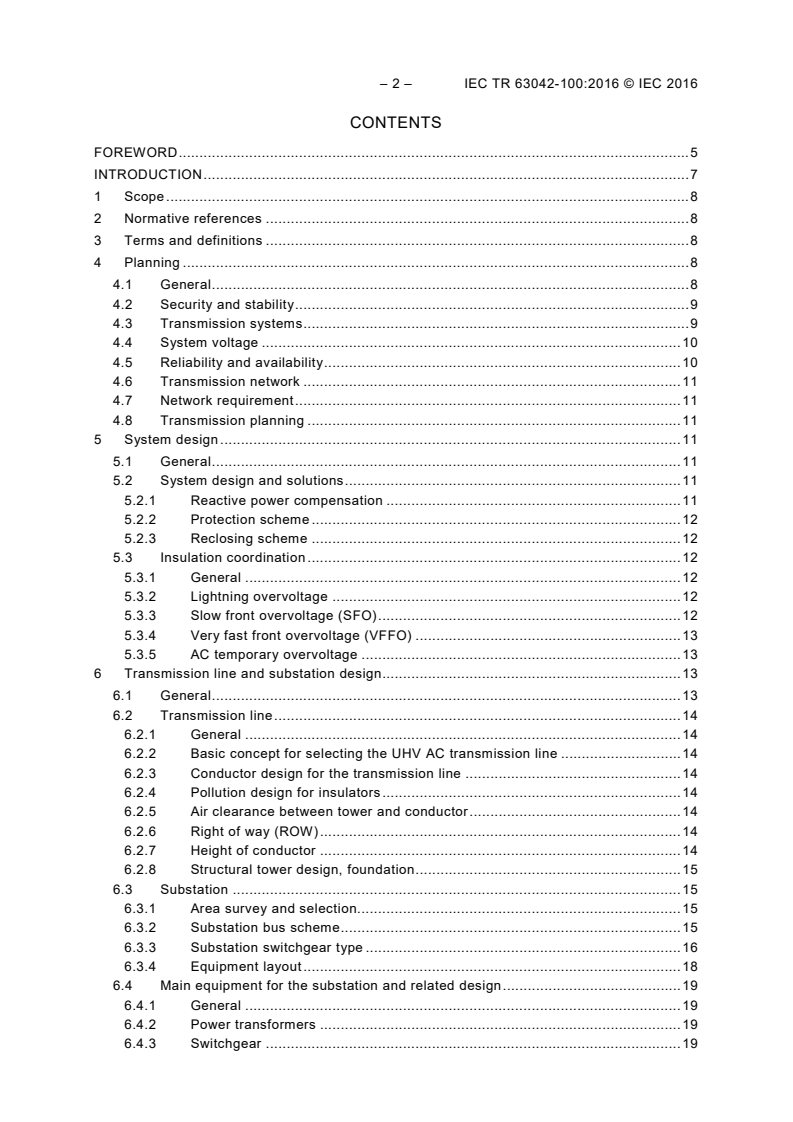
- Planning: security, stability, reliability, availability, transmission planning and network requirements.
- System design: reactive power compensation, protection and reclosing schemes, insulation coordination.
- Insulation coordination: treatment of lightning overvoltage, slow-front overvoltage (SFO), very-fast-front overvoltage (VFFO) and AC temporary overvoltages.
- Transmission line design: conductor selection, air clearances, right-of-way (ROW), tower structural design and foundations.
- Substation design: site selection, bus schemes, switchgear types (GIS, hybrid, AIS), equipment layout, tertiary circuits and auxiliary systems.
- Main equipment: power transformers, switchgear considerations, air clearances and seismic performance.
- Construction & commissioning: on-site assembly, stringing, quality control and commissioning methodology.
- Operation & maintenance: routines specific to UHV transmission lines and substations.
- Environmental considerations: EMF, electrostatic/ electromagnetic induction, corona-related audible noise and radio interference, earthing and disaster-prevention design.
The report also includes comparative tables (for example, switchgear types and lightning fault behavior) and illustrative figures for bus schemes and commissioning procedures.
Practical Applications
IEC TR 63042-100:2016 is practical for:
- Establishing the overall framework for UHV AC project requirements and harmonizing referenced standards.
- Guiding preliminary design choices (line configuration, substation topology, insulation and surge protection strategy).
- Informing environmental impact assessments and mitigation for EMF, noise and radio interference.
- Framing contractual specifications, procurement lists and acceptance/commissioning tests.
This report is particularly useful when defining system-level requirements before detailed design and when coordinating multiple detailed IEC standards across a UHV project.
Who should use this standard
- Transmission system planners and grid operators
- Utilities and independent power producers
- EPC contractors and design consultants
- Substation and transmission equipment manufacturers
- Regulators and environmental assessors
- R&D teams and academic researchers in high-voltage systems
Related Standards
Refer to other parts of the IEC 63042 series and relevant IEC high-voltage standards for specific prescriptive requirements. For the latest editions and normative references consult the IEC webstore (webstore.iec.ch).
Get Certified
Connect with accredited certification bodies for this standard

IMQ S.p.A. (Certification)
Italian electrical product certification.

SLG Prüf- und Zertifizierungs GmbH
German testing and certification body.

UL Solutions
Global safety science company with testing, inspection and certification.
Sponsored listings
Frequently Asked Questions
IEC TR 63042-100:2016 is a technical report published by the International Electrotechnical Commission (IEC). Its full title is "UHV AC transmission systems - Part 100: General information". This standard covers: IEC TR 63042-100:2016(E), which is a Technical Report, specifies the reference for the standards and guidelines for UHV AC transmission systems. This document provides an overview of these standards as well as guidelines.
IEC TR 63042-100:2016(E), which is a Technical Report, specifies the reference for the standards and guidelines for UHV AC transmission systems. This document provides an overview of these standards as well as guidelines.
IEC TR 63042-100:2016 is classified under the following ICS (International Classification for Standards) categories: 29.240.01 - Power transmission and distribution networks in general. The ICS classification helps identify the subject area and facilitates finding related standards.
IEC TR 63042-100:2016 is available in PDF format for immediate download after purchase. The document can be added to your cart and obtained through the secure checkout process. Digital delivery ensures instant access to the complete standard document.
Standards Content (Sample)
IEC TR 63042-100 ®
Edition 1.0 2016-12
TECHNICAL
REPORT
UHV AC transmission systems –
Part 100: General information
All rights reserved. Unless otherwise specified, no part of this publication may be reproduced or utilized in any form
or by any means, electronic or mechanical, including photocopying and microfilm, without permission in writing from
either IEC or IEC's member National Committee in the country of the requester. If you have any questions about IEC
copyright or have an enquiry about obtaining additional rights to this publication, please contact the address below or
your local IEC member National Committee for further information.
IEC Central Office Tel.: +41 22 919 02 11
3, rue de Varembé Fax: +41 22 919 03 00
CH-1211 Geneva 20 info@iec.ch
Switzerland www.iec.ch
About the IEC
The International Electrotechnical Commission (IEC) is the leading global organization that prepares and publishes
International Standards for all electrical, electronic and related technologies.
About IEC publications
The technical content of IEC publications is kept under constant review by the IEC. Please make sure that you have the
latest edition, a corrigenda or an amendment might have been published.
IEC Catalogue - webstore.iec.ch/catalogue Electropedia - www.electropedia.org
The stand-alone application for consulting the entire The world's leading online dictionary of electronic and
bibliographical information on IEC International Standards, electrical terms containing 20 000 terms and definitions in
Technical Specifications, Technical Reports and other English and French, with equivalent terms in 15 additional
documents. Available for PC, Mac OS, Android Tablets and languages. Also known as the International Electrotechnical
iPad. Vocabulary (IEV) online.
IEC publications search - www.iec.ch/searchpub IEC Glossary - std.iec.ch/glossary
The advanced search enables to find IEC publications by a 65 000 electrotechnical terminology entries in English and
variety of criteria (reference number, text, technical French extracted from the Terms and Definitions clause of
committee,…). It also gives information on projects, replaced IEC publications issued since 2002. Some entries have been
and withdrawn publications. collected from earlier publications of IEC TC 37, 77, 86 and
CISPR.
IEC Just Published - webstore.iec.ch/justpublished
Stay up to date on all new IEC publications. Just Published IEC Customer Service Centre - webstore.iec.ch/csc
details all new publications released. Available online and If you wish to give us your feedback on this publication or
also once a month by email. need further assistance, please contact the Customer Service
Centre: csc@iec.ch.
IEC TR 63042-100 ®
Edition 1.0 2016-12
TECHNICAL
REPORT
UHV AC transmission systems –
Part 100: General information
INTERNATIONAL
ELECTROTECHNICAL
COMMISSION
ICS 29.240.01 ISBN 978-2-8322-3791-5
– 2 – IEC TR 63042-100:2016 © IEC 2016
CONTENTS
FOREWORD . 5
INTRODUCTION . 7
1 Scope . 8
2 Normative references . 8
3 Terms and definitions . 8
4 Planning . 8
4.1 General . 8
4.2 Security and stability . 9
4.3 Transmission systems . 9
4.4 System voltage . 10
4.5 Reliability and availability . 10
4.6 Transmission network . 11
4.7 Network requirement . 11
4.8 Transmission planning . 11
5 System design . 11
5.1 General . 11
5.2 System design and solutions . 11
5.2.1 Reactive power compensation . 11
5.2.2 Protection scheme . 12
5.2.3 Reclosing scheme . 12
5.3 Insulation coordination . 12
5.3.1 General . 12
5.3.2 Lightning overvoltage . 12
5.3.3 Slow front overvoltage (SFO) . 12
5.3.4 Very fast front overvoltage (VFFO) . 13
5.3.5 AC temporary overvoltage . 13
6 Transmission line and substation design. 13
6.1 General . 13
6.2 Transmission line . 14
6.2.1 General . 14
6.2.2 Basic concept for selecting the UHV AC transmission line . 14
6.2.3 Conductor design for the transmission line . 14
6.2.4 Pollution design for insulators . 14
6.2.5 Air clearance between tower and conductor . 14
6.2.6 Right of way (ROW) . 14
6.2.7 Height of conductor . 14
6.2.8 Structural tower design, foundation . 15
6.3 Substation . 15
6.3.1 Area survey and selection. 15
6.3.2 Substation bus scheme . 15
6.3.3 Substation switchgear type . 16
6.3.4 Equipment layout . 18
6.4 Main equipment for the substation and related design . 19
6.4.1 General . 19
6.4.2 Power transformers . 19
6.4.3 Switchgear . 19
6.4.4 Air clearance . 19
6.4.5 Seismic performance . 20
6.4.6 Tertiary circuit . 20
6.4.7 Substation electrical auxiliary system . 20
6.5 Control and protection and communication . 20
7 Construction . 20
7.1 General . 20
7.2 Transmission line . 21
7.2.1 Transportation and preparing work at site . 21
7.2.2 Foundation . 21
7.2.3 Assembling of tower . 21
7.2.4 Stringing . 21
7.2.5 Quality control . 21
7.3 Substation . 21
7.3.1 Transportation . 21
7.3.2 Installation . 21
8 Commissioning . 22
9 Operation and maintenance . 22
9.1 Transmission lines . 22
9.2 Substations . 23
9.2.1 General . 23
9.2.2 Operation . 23
9.2.3 Maintenance . 23
10 Environmental considerations . 24
10.1 Transmission lines . 24
10.1.1 General . 24
10.1.2 EMF . 24
10.1.3 Electrostatic induction. 24
10.1.4 Electromagnetic induction . 25
10.1.5 Audible noise with corona discharge . 25
10.1.6 Radio interference with corona discharge . 25
10.1.7 Wind noise . 25
10.1.8 Environmental impact . 25
10.2 Substations . 25
10.2.1 Earthing design . 25
10.2.2 Electrostatic-induction design . 25
10.2.3 Audible noise mitigation design . 26
10.2.4 Disaster-prevention design . 26
Bibliography . 27
Figure 1 – Bus scheme . 16
Figure 2 – General method of commissioning on site . 22
Figure 3 – Basic way of considering operation and maintenance of UHV AC
substations . 24
Table 1 – AC three-phase systems having a highest voltage for equipment exceeding
800 kV . 10
Table 2 – Comparison of lightning fault between UHV and 550 kV systems . 10
– 4 – IEC TR 63042-100:2016 © IEC 2016
Table 3 – Substation switchgears’ comparison (GIS, Hybrid-IS, and AIS) . 17
Table 4 – The principle technology designs for substations (their components and bays)
............................................................................................................................................. 18
INTERNATIONAL ELECTROTECHNICAL COMMISSION
____________
UHV AC TRANSMISSION SYSTEMS –
Part 100: General information
FOREWORD
1) The International Electrotechnical Commission (IEC) is a worldwide organization for standardization comprising
all national electrotechnical committees (IEC National Committees). The object of IEC is to promote
international co-operation on all questions concerning standardization in the electrical and electronic fields. To
this end and in addition to other activities, IEC publishes International Standards, Technical Specifications,
Technical Reports, Publicly Available Specifications (PAS) and Guides (hereafter referred to as “IEC
Publication(s)”). Their preparation is entrusted to technical committees; any IEC National Committee interested
in the subject dealt with may participate in this preparatory work. International, governmental and non-
governmental organizations liaising with the IEC also participate in this preparation. IEC collaborates closely
with the International Organization for Standardization (ISO) in accordance with conditions determined by
agreement between the two organizations.
2) The formal decisions or agreements of IEC on technical matters express, as nearly as possible, an international
consensus of opinion on the relevant subjects since each technical committee has representation from all
interested IEC National Committees.
3) IEC Publications have the form of recommendations for international use and are accepted by IEC National
Committees in that sense. While all reasonable efforts are made to ensure that the technical content of IEC
Publications is accurate, IEC cannot be held responsible for the way in which they are used or for any
misinterpretation by any end user.
4) In order to promote international uniformity, IEC National Committees undertake to apply IEC Publications
transparently to the maximum extent possible in their national and regional publications. Any divergence
between any IEC Publication and the corresponding national or regional publication shall be clearly indicated in
the latter.
5) IEC itself does not provide any attestation of conformity. Independent certification bodies provide conformity
assessment services and, in some areas, access to IEC marks of conformity. IEC is not responsible for any
services carried out by independent certification bodies.
6) All users should ensure that they have the latest edition of this publication.
7) No liability shall attach to IEC or its directors, employees, servants or agents including individual experts and
members of its technical committees and IEC National Committees for any personal injury, property damage or
other damage of any nature whatsoever, whether direct or indirect, or for costs (including legal fees) and
expenses arising out of the publication, use of, or reliance upon, this IEC Publication or any other IEC
Publications.
8) Attention is drawn to the Normative references cited in this publication. Use of the referenced publications is
indispensable for the correct application of this publication.
9) Attention is drawn to the possibility that some of the elements of this IEC Publication may be the subject of
patent rights. IEC shall not be held responsible for identifying any or all such patent rights.
The main task of IEC technical committees is to prepare International Standards. However, a
technical committee may propose the publication of a technical report when it has collected a
different kind of data from that which is normally published as an International Standard, for
example “state of the art”.
The technical report IEC 63042-100 was prepared by IEC Technical Committee 122: UHV AC
transmission systems.
The text of this technical report is based on the following documents:
Enquiry draft Report on voting
122/29/DTR 122/31A/RVC
Full information on the voting for the approval of this technical report can be found in the
report on voting indicated in the above table.
– 6 – IEC TR 63042-100:2016 © IEC 2016
This document has been drafted in accordance with the ISO/IEC Directives, Part 2.
A list of all parts in the IEC 63042 series, published under the general title UHV AC
transmission systems, can be found on the IEC website.
The committee has decided that the contents of this document will remain unchanged until the
stability date indicated on the IEC website under "http://webstore.iec.ch" in the data related to
the specific document. At this date, the document will be:
• reconfirmed,
• withdrawn,
• replaced by a revised edition, or
• amended.
A bilingual version of this publication may be issued at a later date.
INTRODUCTION
UHV AC transmission systems are capable of transmitting large amounts of electric power.
However, if a failure occurs in a UHV AC system, the system influence can be severe from the
viewpoints of reliability and overall security of the supply of the power system. Most UHV AC
substations are located far from city areas, with large equipment in size and mass installed.
Equipment is transported over long distances from where it is manufactured and tested to
where it is installed and commissioned. Also, the installation time of equipment is generally
longer compared with lower voltage classes. For UHV AC transmission lines, the design of
insulation is an important aspect due to non-linearity effect.
Therefore, securing the reliability, availability, and environmental aspects are crucial issues.
Standards and/or applications guidance, as relevant, in the following aspects of UHV AC
transmission systems exceeding 800 kV are necessary:
a) planning (guidance);
b) design;
c) technical requirements (exclusively systems-related);
d) construction;
e) commissioning;
f) reliability;
g) availability (continuity of power supply, % availability);
h) operation;
i) maintenance.
This document describes both specific issues to UHV AC transmission systems and common
issues of UHV AC and lower voltage transmission systems because it is very easy to
understand UHV AC transmission systems as a whole.
In this Technical Report, minimum items or requirements for the standards and guidelines for
each step of UHV AC transmission systems are described.
– 8 – IEC TR 63042-100:2016 © IEC 2016
UHV AC TRANSMISSION SYSTEMS –
Part 100: General information
1 Scope
This part of IEC 63042, which is a Technical Report, specifies the reference for the standards
and guidelines for UHV AC transmission systems. This document provides an overview of
these standards as well as guidelines.
This document is developed to clarify standardization items and/or guideline items for UHV
AC transmission systems. It describes the items to be considered for each stage of planning,
design, construction, commissioning, operation, and maintenance during the development of
IEC publications for UHV AC transmission systems.
NOTE Based on this IEC/TR 63042-100, TC 122 will prepare the standards and guidelines for UHV AC
transmission systems, but it is not limited by the framework of the TR. A systematic approach is necessary for the
preparation of systems-oriented specifications such as those for planning, design, technical requirements,
construction, commissioning, reliability, availability, operation, and maintenance.
2 Normative references
The following documents are referred to in the text in such a way that some or all of their
content constitutes requirements of this document. For dated references, only the edition
cited applies. For undated references, the latest edition of the referenced document (including
any amendments) applies.
IEC 60038, IEC standard voltages
IEC 60071-1, Insulation co-ordination – Part 1: Definitions, principles and rules
3 Terms and definitions
For the purposes of this document, the following terms and definitions apply.
ISO and IEC maintain terminological databases for use in standardization at the following
addresses:
• IEC Electropedia: available at http://www.electropedia.org/
• ISO Online browsing platform: available at http://www.iso.org/obp
3.1
UHV AC
the highest voltage of the AC transmission system exceeding 800 kV
Note 1 to entry: UHV stands for Ultra High Voltage.
4 Planning
4.1 General
Large scale power sources have been developed. It is important to transmit the electric power
efficiently from these power sources to consumption areas. Moreover, the network
enhancement might decrease the system stability and worsen fault current problems. To
prevent such problems in existing high voltage transmission systems, multiple transmission
lines and switchyards might be necessary due to the shortage of transmission
capacity/improvement of the system stability. As a result, large facility investment will be
required and inference of transmission losses will be considerable.
To solve the above-mentioned problems, the UHV AC transmission system was developed,
which can transmit a large amount of electric power by minimum transmission lines effectively
and in a stable way.
For example, a UHV AC transmission line can transmit three or four times a larger quantity of
electric power than a 550 kV transmission line.
The UHV AC transmission system has many advantages such as:
– decrease of right of way (ROW);
– improvement of fault current condition and system stability;
– formulation of network with high reliability;
– increase of redundancy for the system enhancement;
– reduction of environmental impact.
Some countries have introduced a UHV AC system to their grid as follows:
a) Use Case 1
Case 1 had developed UHV AC transmission systems in the 1980s and started its
operation in 2009. UHV AC transmission systems were selected to achieve energy bulk
transmission to distant areas to serve a large capacity economically and efficiently.
To improve the transmission capacity, series capacitors are used. By using them, the
transmission capacity is increased from 3 000 MW to 5 000 MW.
b) Use Case 2
Case 2 has developed UHV AC transmission systems since 1973. The power transmission
capability in the power system is often constrained by power system stability because the
bulk power transmission is larger than the surge impedance loading (SIL).
Additionally, special schemes for system control are applied. Problematic contingencies
such as a permanent fault on both circuits of a double-circuit transmission line, or delays
in fault clearance for any reason, have a very small probability of occurrence, but have a
severe impact on the synchronous stability of a bulk power transmission system. Such
severe contingencies may result in a loss of synchronism and the subsequent cascading
outages. As a means of preventing such system-wide loss of synchronism, the following
emergency relaying schemes are employed in the bulk power transmission system:
– generator tripping relays for preventing loss of synchronism;
– load shedding relays for preventing overloading;
– generation tripping and/or load shedding relays for maintaining system frequency.
4.2 Security and stability
As a UHV AC transmission line has to transmit a large amount of power over a long distance,
a disturbance, such as a faulty event, may give significant influence to the whole system.
Therefore, the redundancy and stability for the network system should be considered from the
operational viewpoint.
4.3 Transmission systems
It should be determined whether the transmission system is UHV AC or UHV DC, considering
the benefit of the transmission system. In general, UHV AC is used in power grids.
– 10 – IEC TR 63042-100:2016 © IEC 2016
4.4 System voltage
In the case of an installation of the higher voltage class, “twice or three times as high as
existing voltage class” is generally selected due to efficiency and expandability. In addition, it
is important to consider future demands, power development plans, situation of the site of
power plants, and technological, economical, and environmental aspects.
It is especially desirable to choose an existing voltage level in IEC standard voltages,
considering the technological and economical aspects. Table 1 shows the highest voltage
defined in IEC 60038 standard.
Table 1 – AC three-phase systems having a highest voltage
for equipment exceeding 800 kV
Highest voltage for equipment
kV
1 100
1 200
In the process of transmission voltage determination, short circuit current, power flow, stability,
and voltage control with reactive power compensation are technically investigated confirming
the main specifications of the power transmission system. The cost is compared between
UHV and other voltage classes, where future system expansion is also considered.
4.5 Reliability and availability
To form the network system, reliability is one of the most important key factors. Particularly,
for UHV, high reliability is required because it is used to transmit electric power from an
important power source, and it is used as a main transmission system.
Until now, many field tests have been carried out and the reliability of each facility has been
sufficiently verified in the countries where UHV AC transmission systems are installed.
As for the operating facilities, various operation records are reported. One circuit fault of a
UHV AC transmission line is smaller than two circuit faults of a 550 kV transmission line. In
this regard, the UHV AC transmission system also shows high availability. The UHV AC
system has a developed technology to keep high reliability.
Table 2 shows the comparison of lightning fault between UHV and 550 kV systems.
Table 2 – Comparison of lightning fault between UHV and 550 kV systems
Unit: Number of fault/year/ 100 km
550 kV UHV
System
double circuits double circuits
a
One circuit failure 0,013 Less than 0,001
b
Two circuit failure 0,005 Less than 0,001
Estimated by the single-phase re-closing:
a
3 lines to earth fault
b
4 lines to earth fault
Reference: this table is calculated by TEPCO Power Grid, Inc.
4.6 Transmission network
The main objective of UHV AC transmission systems is to transmit a large amount of power
over a long distance in a stable way. Various considerations should be taken into account in
the network configuration to keep the reliability. In one case, ring transmission route is
adopted and internetworking is operated radially to solve the fault current issues and control
the power flow easily. In another case, multi-outer ring lines will be planned to supply large
amounts of power to distributed load centres.
4.7 Network requirement
As for the formulation of UHV AC transmission systems, it is desirable to clarify the number of
transmission routes and the capacity of transmission lines and substations to a certain degree
to consider future system configuration. The network components should be determined by
considering the long term power development plan as well as system stability, voltage stability,
power flow, and fault current.
4.8 Transmission planning
High reliability is one of the most important requirements. The higher the installed voltage
level is, the larger the accident influence is. Therefore, a high reliability is expected in the
main part of the system.
When the system is enhanced, compliance with the grid code is a requirement. It is also
necessary to consider local issues such as the restriction among the regional systems and the
basic concept for the redundancy whether one route with two lines or two routes are required.
When UHV AC transmission system is planned to be installed and a grid code must be
formulated or revised to meet installation of UHV, it is recommended to refer to the cases
used in other countries.
5 System design
5.1 General
The introduction of a higher voltage class has the above-mentioned advantages, but the
facilities become large due to the transmission capacity. For example, if the design is based
on the conventional concept, the UHV tower would be 1,5 times as high as the 550 kV tower.
Then, it is important to reduce the size of the facilities and devices from an economic point of
view.
This is realized by suppressing the overvoltage level.
As the UHV AC transmission line has a much larger charging capacity and the unbalance
between the charging capacities of each phase also increases, it is necessary to grasp the
technical issues and to formulate the plan to solve them.
5.2 System design and solutions
5.2.1 Reactive power compensation
An appropriate amount of reactive power supply should be planned and installed in the UHV
AC transmission system to meet the system voltage regulation requirements.
The capacity, type, and location of the reactive power compensator should be selected to
improve the power transmission capacity and the system stability.
Based on the study, the appropriate installation of shunt reactor or shunt capacitor should be
determined considering the total reactive power balance of the system.
– 12 – IEC TR 63042-100:2016 © IEC 2016
Series capacitors can improve the system stability to increase the transmission capacity.
5.2.2 Protection scheme
The basic concept of the protection scheme is to grasp the fault condition, to remove the fault
point as quickly as possible, and then to minimize that influence. Since the UHV AC system
requires a high reliability, it is desirable to adopt protection systems with high performance of
speed, accuracy, and reliability.
In particular, the following protection systems should be considered:
– transmission line protection relay;
– back-up protection of a transmission line;
– transformer protection relay;
– bus protection relay, etc.
5.2.3 Reclosing scheme
In a UHV AC system forming a skeleton of a bulk power system as well as in an existing bulk
power system, the fast multi-phase auto-reclosing scheme is a key technology to minimize the
possibility of losing both circuits on the double circuit transmission line.
In a UHV AC system, the fast secondary arc extinction is evaluated as difficult without
applying special equipment because higher voltage is induced electrostatically from sound
phases.
To reduce the secondary arc, a 4-legged reactor or a high-speed earthing switch (HSES) is
recommended as a countermeasure for the secondary arc. In the case of a long line (more
than 200 km) that is necessary for compensation by reactor, the 4-legged reactor could make
the efficient and compact UHV AC substation construction. However, it is necessary to pay
attention to the resonant over-voltage during reclosing and to examine the recovery voltage at
the time of extinguishing the secondary arc. Compared with 4-legged reactor, the HSES can
extinguish the secondary arc in any system condition. It is necessary to consider the
coordinated operation of HSES and circuit breaker.
5.3 Insulation coordination
5.3.1 General
The insulation design requires the information of both facility configuration and overvoltage
analysis on the transmission system. This realizes the proper insulation coordination for UHV
transmission systems. Specific UHV countermeasures to suppress the overvoltages are
adopted for the rational design of UHV facilities.
5.3.2 Lightning overvoltage
It is recommended first to analyze the waveform of the lightning surge entering the UHV AC
substation under various circuit-conditions with surge arresters. Second, based on the results
of overvoltage analysis, it is also recommended to determine the lightning impulse withstand
voltage (LIWV) based on IEC 60071-1 from an economical point of view. Especially in UHV
transmission systems, direct lightning overvoltage should be considered due to large lightning
current and long duration of wave tail.
5.3.3 Slow front overvoltage (SFO)
Earth-fault overvoltage is one of the slow front overvoltages. Since the maximum voltage
appears most likely in the middle of the overhead line, there is no effective measure for
suppressing the earth-fault overvoltage in the substation. Therefore, earth-fault overvoltage is
the lowest target of the SFO insulation level.
Other SFOs are caused by the switching of a circuit breaker. Closing resistors are widely
applied for suppressing the closing surge of a circuit breaker. To reduce a SFO further, a
measure for suppressing interrupting overvoltage, such as opening resistors, is required. As a
new technology, the control switching also emerged. The SFO insulation level should be
determined in coordination with the application of the suppressing method of SFO.
5.3.4 Very fast front overvoltage (VFFO)
The very fast front overvoltage, caused by re-strikes and pre-strikes which occur during the
switching operation of a disconnector, have a very high frequency. This overvoltage is not
expected to be suppressed by surge arresters.
Therefore, the surge level may exceed the level of the lightning surge or fast front overvoltage
(FFO).
In particular, in case of gas insulated switchgear (GIS), the surge propagates and reflects
repeatedly on the very little attenuating pipe-sheathed busbar. Since the reduced insulation
level is adopted for UHV GIS based on the application of surge arrester with low protective
level, different countermeasures could be applied to mitigate the effect of very fast front
overvoltage (VFFO).
The frequency of the surge on the air insulated conductors decreases because of the low
surge propagation speed compared with GIS. It is reported that some examples of VFFO
analysis for a Hybrid IS substation indicated lower VFFO compared with GIS.
VFFO is a very fast oscillating surge, which may affect the insulation performance of winding
equipment such as transformers and winding type potential transformers. The influence to the
secondary system should also be considered.
Therefore, in case of UHV class, the probability for the VFFO to affect the whole system
becomes more important.
To reduce the level of VFFO, various measures have been applied. Disconnector with resistor
is one example.
5.3.5 AC temporary overvoltage
By studying the withstand capacity of transmission facilities (mainly arresters), overvoltage
levels such as overvoltage including frequency increase when load shedding is carried out
due to loss of transmission route or AC overvoltage occurs due to the Feranti effect,
necessary countermeasures are determined.
6 Transmission line and substation design
6.1 General
UHV is the highest system voltage for the AC transmission systems. It is necessary to
consider carefully any related items concerning specification, design, dimension, structure,
manufacturing, testing, transportation, on-site assembling, on-site testing, inspection,
commissioning, quality, reliability, and so forth. The basic idea of main components for the
UHV AC transmission system is described in Subclauses 6.2 to 6.5.
– 14 – IEC TR 63042-100:2016 © IEC 2016
6.2 Transmission line
6.2.1 General
The transmission line is the most important component in a UHV AC transmission system, so
it should have enough reliability against weather conditions, geology, topography, and
environmental impact.
6.2.2 Basic concept for selecting the UHV AC transmission line
Considering that the construction of a UHV AC transmission line needs a large-scale
development, the route of a UHV AC transmission line should be selected based on the
comprehensive deliberations on the following items:
a) being straight;
b) complying various regulations;
c) avoiding areas where a transmission line is not suitable, such as:
– terrain and geology such as landslide, steep terrain, and fault;
– natural protected areas, habitats of endangered or rare species of animals and plants,
and burial sites of cultural material;
– densely populated areas, passing through steep mountains or crossing large rivers;
– severe environmental conditions such as heavy pollution, thunderstorm, heavy snow,
and strong wind;
d) areas which are under consideration for construction and maintenance.
6.2.3 Conductor design for the transmission line
It is crucial for the UHV AC transmission line to reduce the occurrence of the corona noise
generating from the wire caused by its high-voltage. The corona level should be set in
consideration of the power transmission capacity, the transmission losses, and the accepted
level for the nearby residential area as well as the boundary level. The size and the number of
conductors are selected based on the corona level.
6.2.4 Pollution design for insulators
Pollution degree for insulators should be selected based on the distance from the coast.
Pollution degree should be based on the actual state of a site.
6.2.5 Air clearance between tower and conductor
The basic concept of insulation design for a transmission line is to withstand switching
overvoltage and temporary overvoltage which occur within the power system. The air
clearance, which is determined by switching overvoltage, has saturated characteristics to the
overvoltage level at the UHV class. Therefore, air clearance of UHV AC transmission is
designed shorter by the effective mitigation of switching overvoltage, such as closing (and/or
opening) resistor and surge arrester with a low protective level. The clearances to be
maintained under swing conditions due to the wind of insulator strings and conductors are
designed, considering the probability of simultaneous occurrence of various conditions of
overvoltage and wind conditions.
6.2.6 Right of way (ROW)
ROW should be determined by air clearances and regulations.
6.2.7 Height of conductor
The height of the conductor is determined according to the electric field regulation in each
country.
6.2.8 Structural tower design, foundation
The compact design for UHV AC transmission towers and foundations is necessary to
increase the reliability of the transmission system and to decrease construction cost.
6.3 Substation
6.3.1 Area survey and selection
UHV AC substation is different from the following existing substations:
– increasing required areas and amounts of assembling units;
– increasing difficulty of construction because people are keen on protecting the
environment. UHV equipment is larger than lower voltage class. Transportation and on-
site assembling affect the environment during construction;
– locating severe condition areas such as the back side of the mountain because the
selection of a UHV AC transmission line route depends on the location of power
generation plants.
Especially for the UHV AC transmission system, the survey and selection of areas should be
carried out based on the following considerations:
a) keeping consistent with the transmission line;
b) securing the transportation routes for heavy equipment;
– design of the UHV equipment under the transportation restriction; form and weight
based on the preliminary transportation condition survey (railways, roads, bridges);
– appropriate transportation routes selection considering construction cost, construction
period, and land acquisition.
c) natural environmental harmony;
– preservation of the natural environment should be considered during the process of
designing to consider construction;
– the risk management for a natural disaster (collapse, salt contamination, and damage
caused by wind and snow).
d) social environmental harmony;
– satisfying the requirements which the local community and laws and regulations
request.
6.3.2 Substation bus scheme
The bus scheme is an important part in a highly reliable UHV AC substation. Therefore, the
bus scheme should be determined considering the flexibility of the system operation, outage
area during a failure, and maintenance of equipment.
Figure 1 shows two examples of bus schemes.
– 16 – IEC TR 63042-100:2016 © IEC 2016
IEC
a) 1·1/2 CB bus
IEC
b) Doubler bus 4 Bus-Tie
Figure 1 – Bus scheme
6.3.3 Substation switchgear type
For UHV equipment, there are three types of switchgears: GIS type, Hybrid-IS type, and Air
Insulated Switchgear (AIS) type.
a) GIS (Gas Insulated Switchgear)
Switchgear with bays fully made from GIS technology components.
Only external HV connections to overhead or cable lines or to transformers, reactors, and
capacitors can have an external insulation.
b) Hybrid -IS (Hybrid Insulated Switchgear)
Switchgear with bays made from a mix of GIS and AIS technology components. This
switchgear consists of some bays made of AIS technology components, or made either of GIS
technology components only or of a mix of AIS and GIS components.
c) AIS (Air Insulated Switchgear)
Switchgear with bays fully made from AIS technology compo
...