

IEC 61400-1:2005
(Main)Wind turbines - Part 1: Design requirements
General Information
- Abstract
Specifies essential design requirements to ensure the engineering integrity of wind turbines. Provides an appropriate level of protection against damage from all hazards during the planned lifetime. Is concerned with all subsystems of wind turbines such as control and protection mechanisms, internal electrical systems, mechanical systems and support structures. Applies to wind turbines of all sizes. See IEC 61400-2 for small wind turbines.
This publication is of high relevance for Smart Grid.
- Status
- Published
- Publication Date
- 02-Feb-2016
- Technical Committee
- TC 88 - Wind energy generation systems
- Drafting Committee
- MT 1 - TC 88/MT 1
- Current Stage
- DELPUB - Deleted Publication
- Start Date
- 08-Feb-2019
- Completion Date
- 28-Aug-2026
Buy Documents
IEC 61400-1:2005 - Wind turbines - Part 1: Design requirements Released:8/31/2005


IEC 61400-1:2005+AMD1:2010 CSV - Wind turbines - Part 1: Design requirements Released:4/15/2014


IEC 61400-1:2005+AMD1:2010 CSV/COR1:2016 - Corrigendum 1 - Wind turbines - Part 1: Design requirements Released:2/3/2016

IEC 61400-1:2005 - Wind turbines - Part 1: Design requirements Released:8/31/2005


IEC 61400-1:2005+AMD1:2010 CSV - Wind turbines - Part 1: Design requirements Released:4/15/2014
Overview
IEC 61400-1:2005 - Wind turbines - Part 1: Design requirements defines essential design requirements to ensure the engineering integrity and safety of wind turbines throughout their planned lifetime. It addresses all subsystems (control and protection, internal electrical systems, mechanical systems and support structures) and applies to wind turbines of all sizes (see IEC 61400-2 for small wind turbines). The standard provides design principles, load and assessment methods, and guidance for achieving an appropriate level of protection against damage from environmental, electrical and mechanical hazards. This publication is also highly relevant for Smart Grid integration due to its electrical system and grid-connection requirements.
Key Topics
- Scope and normative references: Establishes applicability and related documents required for correct use.
- Design methodology and safety classes: Framework for design methods, classification of safety-critical components and quality assurance.
- External conditions & wind classes: Definition of wind turbine classes, wind, turbulence and other environmental loading relevant to siting and design.
- Structural design & loads: Load case definitions, load calculation methods, ultimate limit state and fatigue analysis approaches.
- Control & protection systems: Requirements for functional control, protection functions, braking and safe shutdown.
- Mechanical systems: Design guidance for gearboxes, yaw/pitch systems, bearings and mechanical protections.
- Electrical system: Requirements for internal electrical systems, protection devices, earthing, lightning protection and power quality considerations important for grid connection.
- Site-specific assessment: Procedures for topography, wake effects, soil and earthquake assessment, and site-related load extrapolation.
- Assembly, commissioning, maintenance: Requirements for installation, documentation, commissioning, operation and maintenance to ensure safety and reliability.
- Informative annexes: Annex A–G cover turbine class S parameters, turbulence and wake models, earthquake assessment, MCP wind prediction, load extrapolation and fatigue analysis.
Applications
Who uses IEC 61400-1:2005 and why:
- Wind turbine manufacturers - for design and validation of turbines to meet international safety and performance expectations.
- Structural, mechanical and electrical engineers - to define loads, select components and design control/protection systems.
- Project developers and site assessors - to perform site-specific assessments, wake and wind resource analysis.
- Certification bodies and regulators - to evaluate compliance, type-certify turbines and set procurement/specification criteria.
- Grid operators and Smart Grid integrators - for assessing power quality, protection coordination and safe grid connection.
Practical uses include design verification, certification testing, procurement specification, fatigue life prediction, and planning for reliable grid integration.
Related Standards
- IEC 61400-2 - Small wind turbines (see scope note).
- Refer to normative references listed within IEC 61400-1 for electrical, structural and testing standards used in conjunction with this document.
Relations
- Effective Date
- 05-Sep-2023
- Effective Date
- 05-Sep-2023
- Effective Date
- 05-Sep-2023
Buy Documents
IEC 61400-1:2005 - Wind turbines - Part 1: Design requirements Released:8/31/2005
IEC 61400-1:2005+AMD1:2010 CSV - Wind turbines - Part 1: Design requirements Released:4/15/2014
IEC 61400-1:2005+AMD1:2010 CSV/COR1:2016 - Corrigendum 1 - Wind turbines - Part 1: Design requirements Released:2/3/2016
IEC 61400-1:2005 - Wind turbines - Part 1: Design requirements Released:8/31/2005
IEC 61400-1:2005+AMD1:2010 CSV - Wind turbines - Part 1: Design requirements Released:4/15/2014
Get Certified
Connect with accredited certification bodies for this standard

DNV
DNV is an independent assurance and risk management provider.

Lloyd's Register
Lloyd's Register is a global professional services organisation specialising in engineering and technology.
DNV Energy Systems
Energy and renewable energy certification.
Sponsored listings
Frequently Asked Questions
IEC 61400-1:2005 is a standard published by the International Electrotechnical Commission (IEC). Its full title is "Wind turbines - Part 1: Design requirements". This standard covers: Specifies essential design requirements to ensure the engineering integrity of wind turbines. Provides an appropriate level of protection against damage from all hazards during the planned lifetime. Is concerned with all subsystems of wind turbines such as control and protection mechanisms, internal electrical systems, mechanical systems and support structures. Applies to wind turbines of all sizes. See IEC 61400-2 for small wind turbines. This publication is of high relevance for Smart Grid.
Specifies essential design requirements to ensure the engineering integrity of wind turbines. Provides an appropriate level of protection against damage from all hazards during the planned lifetime. Is concerned with all subsystems of wind turbines such as control and protection mechanisms, internal electrical systems, mechanical systems and support structures. Applies to wind turbines of all sizes. See IEC 61400-2 for small wind turbines. This publication is of high relevance for Smart Grid.
IEC 61400-1:2005 is classified under the following ICS (International Classification for Standards) categories: 27.180 - Wind turbine energy systems. The ICS classification helps identify the subject area and facilitates finding related standards.
IEC 61400-1:2005 has the following relationships with other standards: It is inter standard links to IEC 61400-1:2005/AMD1:2010, IEC 61400-1:1999, IEC 61400-1:2019. Understanding these relationships helps ensure you are using the most current and applicable version of the standard.
IEC 61400-1:2005 is available in PDF format for immediate download after purchase. The document can be added to your cart and obtained through the secure checkout process. Digital delivery ensures instant access to the complete standard document.
Standards Content (Sample)
INTERNATIONAL IEC
STANDARD 61400-1
Third edition
2005-08
Wind turbines –
Part 1:
Design requirements
Reference number
Publication numbering
As from 1 January 1997 all IEC publications are issued with a designation in the
60000 series. For example, IEC 34-1 is now referred to as IEC 60034-1.
Consolidated editions
The IEC is now publishing consolidated versions of its publications. For example,
edition numbers 1.0, 1.1 and 1.2 refer, respectively, to the base publication, the
base publication incorporating amendment 1 and the base publication incorporating
amendments 1 and 2.
Further information on IEC publications
The technical content of IEC publications is kept under constant review by the IEC,
thus ensuring that the content reflects current technology. Information relating to
this publication, including its validity, is available in the IEC Catalogue of
publications (see below) in addition to new editions, amendments and corrigenda.
Information on the subjects under consideration and work in progress undertaken
by the technical committee which has prepared this publication, as well as the list
of publications issued, is also available from the following:
• IEC Web Site (www.iec.ch)
• Catalogue of IEC publications
The on-line catalogue on the IEC web site (www.iec.ch/searchpub) enables you to
search by a variety of criteria including text searches, technical committees
and date of publication. On-line information is also available on recently issued
publications, withdrawn and replaced publications, as well as corrigenda.
• IEC Just Published
This summary of recently issued publications (www.iec.ch/online_news/ justpub)
is also available by email. Please contact the Customer Service Centre (see
below) for further information.
• Customer Service Centre
If you have any questions regarding this publication or need further assistance,
please contact the Customer Service Centre:
Email: custserv@iec.ch
Tel: +41 22 919 02 11
Fax: +41 22 919 03 00
INTERNATIONAL IEC
STANDARD 61400-1
Third edition
2005-08
Wind turbines –
Part 1:
Design requirements
IEC 2005 Copyright - all rights reserved
No part of this publication may be reproduced or utilized in any form or by any means, electronic or
mechanical, including photocopying and microfilm, without permission in writing from the publisher.
International Electrotechnical Commission, 3, rue de Varembé, PO Box 131, CH-1211 Geneva 20, Switzerland
Telephone: +41 22 919 02 11 Telefax: +41 22 919 03 00 E-mail: inmail@iec.ch Web: www.iec.ch
PRICE CODE
Commission Electrotechnique Internationale XC
International Electrotechnical Commission
МеждународнаяЭлектротехническаяКомиссия
For price, see current catalogue
– 2 – 61400-1 IEC:2005
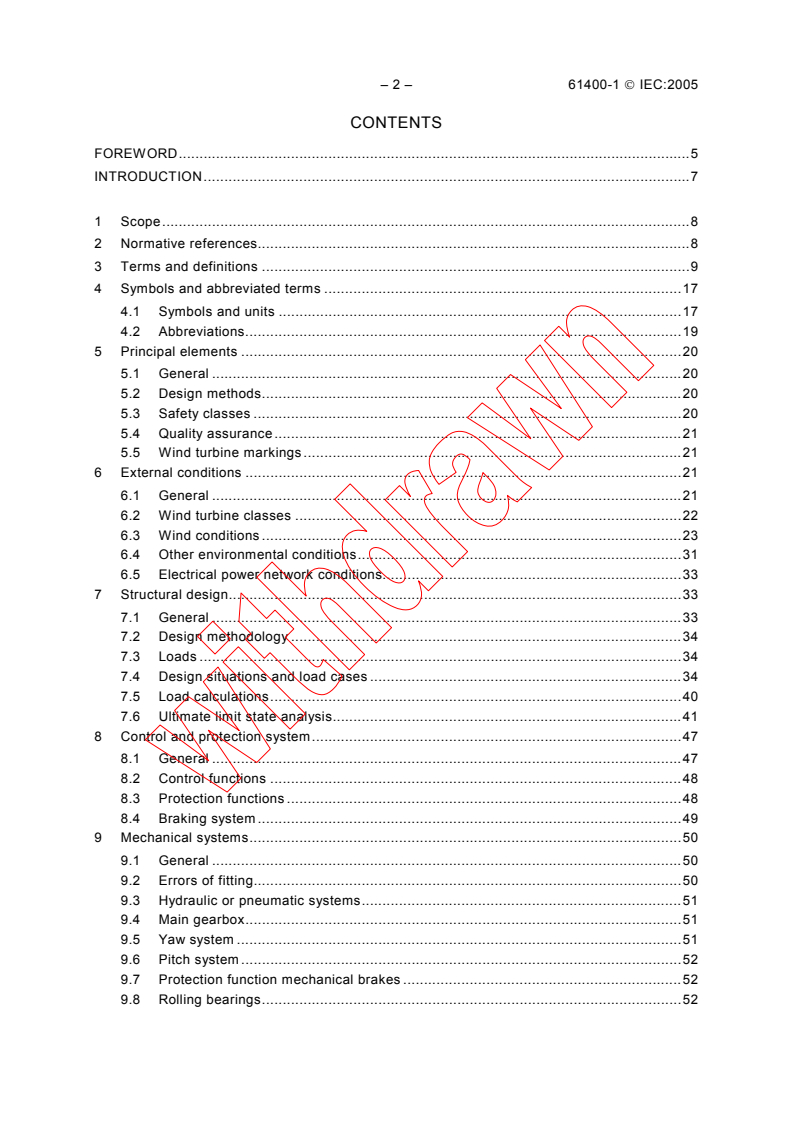
CONTENTS
FOREWORD.5
INTRODUCTION.7
1 Scope.8
2 Normative references.8
3 Terms and definitions .9
4 Symbols and abbreviated terms .17
4.1 Symbols and units .17
4.2 Abbreviations.19
5 Principal elements .19
5.1 General .19
5.2 Design methods.19
5.3 Safety classes .20
5.4 Quality assurance.20
5.5 Wind turbine markings .20
6 External conditions .21
6.1 General .21
6.2 Wind turbine classes .21
6.3 Wind conditions .22
6.4 Other environmental conditions.31
6.5 Electrical power network conditions.32
7 Structural design.33
7.1 General .33
7.2 Design methodology .33
7.3 Loads .33
7.4 Design situations and load cases .34
7.5 Load calculations.39
7.6 Ultimate limit state analysis.39
8 Control and protection system.45
8.1 General .45
8.2 Control functions .45
8.3 Protection functions .46
8.4 Braking system .47
9 Mechanical systems.47
9.1 General .47
9.2 Errors of fitting.48
9.3 Hydraulic or pneumatic systems.48
9.4 Main gearbox.48
9.5 Yaw system .49
9.6 Pitch system .49
9.7 Protection function mechanical brakes .49
9.8 Rolling bearings.49
61400-1 IEC:2005 − 3 −
10 Electrical system.50
10.1 General .50
10.2 General requirements for the electrical system .50
10.3 Protective devices.50
10.4 Disconnect devices .50
10.5 Earth system.50
10.6 Lightning protection.51
10.7 Electrical cables.51
10.8 Self-excitation.51
10.9 Protection against lightning electromagnetic impulse .51
10.10 Power quality .51
10.11 Electromagnetic compatibility.51
11 Assessment of a wind turbine for site-specific conditions.52
11.1 General .52
11.2 Assessment of the topographical complexity of the site .52
11.3 Wind conditions required for assessment .52
11.4 Assessment of wake effects from neighbouring wind turbines.53
11.5 Assessment of other environmental conditions .54
11.6 Assessment of earthquake conditions .54
11.7 Assessment of electrical network conditions.55
11.8 Assessment of soil conditions .55
11.9 Assessment of structural integrity by reference to wind data .56
11.10 Assessment of structural integrity by load calculations with reference to site
specific conditions .57
12 Assembly, installation and erection .57
12.1 General .57
12.2 Planning .58
12.3 Installation conditions.58
12.4 Site access .58
12.5 Environmental conditions .58
12.6 Documentation.59
12.7 Receiving, handling and storage.59
12.8 Foundation/anchor systems.59
12.9 Assembly of wind turbine .59
12.10 Erection of wind turbine.59
12.11 Fasteners and attachments .59
12.12 Cranes, hoists and lifting equipment.60
13 Commissioning, operation and maintenance .60
13.1 General .60
13.2 Design requirements for safe operation, inspection and maintenance .60
13.3 Instructions concerning commissioning .61
13.4 Operator’s instruction manual.62
13.5 Maintenance manual.63
– 4 – 61400-1 IEC:2005
Annex A (normative) Design parameters for describing wind turbine class S .65
Annex B (informative) Turbulence models .66
Annex C (informative) Assessment of earthquake loading.72
Annex D (informative) Wake and wind farm turbulence .73
Annex E (informative) Prediction of wind distribution for wind turbine sites by measure-
correlate-predict (MCP) methods.76
Annex F (informative) Statistical extrapolation of loads for ultimate strength analysis .78
Annex G (informative) Fatigue analysis using Miner’s rule with load extrapolation .81
Bibliography .85
Figure 1a –Turbulence standard deviation for the Normal Turbulence Model (NTM) .25
Figure 1b – Turbulence intensity for the Normal Turbulence Model (NTM).25
Figure 2 – Example of extreme operating gust.27
Figure 3 – Example of extreme direction change magnitude .28
Figure 4 – Example of extreme direction change .28
Figure 5 – Example of extreme coherent gust amplitude for ECD.29
Figure 6 –Direction change for ECD .30
Figure 7 – Example of direction change transient.30
Figure 8 – Examples of extreme positive and negative vertical wind shear, wind profile
before onset (t = 0, dashed line) and at maximum shear (t = 6 s, full line). .31
Figure 9 – Example of wind speeds at rotor top and bottom, respectively, illustrate the
transient positive wind shear .31
Figure D.1 – Configuration – Inside a wind farm with more than 2 rows.75
Figure F.1 – Exceedance probability for largest out-of-plane blade bending load in 10 min
(normalized by mean bending load at rated wind speed). .80
Table 1 – Basic parameters for wind turbine classes.22
Table 2 – Design load cases .35
Table 3 – Partial safety factors for loads γ .42
f
Table 4 – Terrain complexity indicators .52
Table B.1 – Turbulence spectral parameters for the Kaimal model.70
61400-1 IEC:2005 − 5 −
INTERNATIONAL ELECTROTECHNICAL COMMISSION
___________
WIND TURBINES –
Part 1: Design requirements
FOREWORD
1) The International Electrotechnical Commission (IEC) is a worldwide organization for standardization comprising
all national electrotechnical committees (IEC National Committees). The object of IEC is to promote
international co-operation on all questions concerning standardization in the electrical and electronic fields. To
this end and in addition to other activities, IEC publishes International Standards, Technical Specifications,
Technical Reports, Publicly Available Specifications (PAS) and Guides (hereafter referred to as “IEC
Publication(s)”). Their preparation is entrusted to technical committees; any IEC National Committee interested
in the subject dealt with may participate in this preparatory work. International, governmental and non-
governmental organizations liaising with the IEC also participate in this preparation. IEC collaborates closely
with the International Organization for Standardization (ISO) in accordance with conditions determined by
agreement between the two organizations.
2) The formal decisions or agreements of IEC on technical matters express, as nearly as possible, an international
consensus of opinion on the relevant subjects since each technical committee has representation from all
interested IEC National Committees.
3) IEC Publications have the form of recommendations for international use and are accepted by IEC National
Committees in that sense. While all reasonable efforts are made to ensure that the technical content of IEC
Publications is accurate, IEC cannot be held responsible for the way in which they are used or for any
misinterpretation by any end user.
4) In order to promote international uniformity, IEC National Committees undertake to apply IEC Publications
transparently to the maximum extent possible in their national and regional publications. Any divergence
between any IEC Publication and the corresponding national or regional publication shall be clearly indicated in
the latter.
5) IEC provides no marking procedure to indicate its approval and cannot be rendered responsible for any
equipment declared to be in conformity with an IEC Publication.
6) All users should ensure that they have the latest edition of this publication.
7) No liability shall attach to IEC or its directors, employees, servants or agents including individual experts and
members of its technical committees and IEC National Committees for any personal injury, property damage or
other damage of any nature whatsoever, whether direct or indirect, or for costs (including legal fees) and
expenses arising out of the publication, use of, or reliance upon, this IEC Publication or any other IEC
Publications.
8) Attention is drawn to the Normative references cited in this publication. Use of the referenced publications is
indispensable for the correct application of this publication.
9) Attention is drawn to the possibility that some of the elements of this IEC Publication may be the subject of
patent rights. IEC shall not be held responsible for identifying any or all such patent rights.
International Standard IEC 61400-1 has been prepared by IEC technical committee 88: Wind
turbines.
This third edition cancels and replaces the second edition published in 1999. It constitutes a
technical revision.
The main changes with respect to the previous edition are listed below:
– the title has been changed to “Design requirements” in order to reflect that the standard
presents safety requirements rather than requirements for safety or protection of personnel;
– wind turbine class designations have been adjusted and now refer to reference wind speed
and expected value of turbulence intensities only;
– turbulence models have been expanded and include an extreme turbulence model;
– gust models have been adjusted and simplified;
– 6 – 61400-1 IEC:2005
– design load cases have been rearranged and amended;
– the inclusion of turbulence simulations in the load calculations is emphasised and a scheme
for extreme load extrapolation has been specified;
– the partial safety factors for loads have been adjusted and simplified;
– the partial safety factors for materials have been amended and specified in terms of
material types and component classes;
– the requirements for the control and protection system have been amended and clarified in
terms of functional characteristics;
– a new clause on assessment of structural and electrical compatibility has been introduced
with detailed requirements for assessment, including information on complex terrain,
earthquakes and wind farm wake effects.
The text of this standard is based on the following documents:
FDIS Report on voting
88/228/FDIS 88/232/RVD
Full information on the voting for the approval of this standard can be found in the report on
voting indicated in the above table.
This publication has been drafted in accordance with the ISO/IEC Directives, Part 2.
IEC 61400 consists of the following parts under the general title Wind turbine generator
systems:
Part 1: Design requirements
Part 2: Design requirements for small wind turbines
Part 11: Acoustic noise measurement techniques
Part 12: Wind turbine power performance testing
Part 13: Measurement of mechanical loads
Part 14: Declaration of apparent sound power level and tonality values
Part 21: Measurement and assessment of power quality characteristics of grid connected
wind turbines
Part 23: Full-scale structural testing of rotor blades
Part 24: Lightning protection
The committee has decided that the contents of this publication will remain unchanged until the
maintenance result date indicated on the IEC web site under "http://webstore.iec.ch" in the data
related to the specific publication. At this date, the publication will be
• reconfirmed;
• withdrawn;
• replaced by a revised edition, or
• amended.
A bilingual version of this publication may be issued at a later date.
61400-1 IEC:2005 − 7 −
INTRODUCTION
This part of IEC 61400 outlines minimum design requirements for wind turbines and is not
intended for use as a complete design specification or instruction manual.
Any of the requirements of this standard may be altered if it can be suitably demonstrated that
the safety of the system is not compromised. This provision, however, does not apply to the
classification and the associated definitions of external conditions in Clause 6.Compliance with
this standard does not relieve any person, organization, or corporation from the responsibility
of observing other applicable regulations.
The standard is not intended to give requirements for wind turbines installed offshore, in
particular for the support structure. A future document dealing with offshore installations is
under consideration.
– 8 – 61400-1 IEC:2005
WIND TURBINES –
Part 1: Design requirements
1 Scope
This part of IEC 61400 specifies essential design requirements to ensure the engineering
integrity of wind turbines. Its purpose is to provide an appropriate level of protection against
damage from all hazards during the planned lifetime.
This standard is concerned with all subsystems of wind turbines such as control and protection
mechanisms, internal electrical systems, mechanical systems and support structures.
This standard applies to wind turbines of all sizes. For small wind turbines IEC 61400-2 may be
applied.
This standard should be used together with the appropriate IEC and ISO standards mentioned
in Clause 2.
2 Normative references
The following referenced documents are indispensable for the application of this document. For
dated references, only the edition cited applies. For undated references, the latest edition of
the referenced document (including any amendments) applies.
IEC 60204-1:1997, Safety of machinery – Electrical equipment of machines – Part 1: General
requirements
IEC 60204-11:2000, Safety of machinery – Electrical equipment of machines – Part 11:
Requirements for HV equipment for voltages above 1 000 V a.c. or 1 500 V d.c. and not
exceeding 36 kV
IEC 60364 (all parts), Electrical installations of buildings
IEC 60721-2-1:1982, Classification of environmental conditions – Part 2: Environmental
conditions appearing in nature. Temperature and humidity
IEC 61000-6-1:1997, Electromagnetic compatibility (EMC) – Part 6: Generic standards –
Section 1: Immunity for residential, commercial and light-industrial environments
IEC 61000-6-2:1999, Electromagnetic compatibility (EMC) – Part 6: Generic standards –
Section 2: Immunity for industrial environments 15
IEC 61000-6-4:1997, Electromagnetic compatibility (EMC) – Part 6: Generic standards –
Section 4: Emission standard for industrial environments
IEC 61024-1:1990, Protection of structures against lightning – Part 1: General principles
IEC 61312-1:1995, Protection against lightning electromagnetic impulse – Part 1: General
principle
IEC 61400-21:2001, Wind turbine generator systems – Part 21: Measurement and assessment
of power quality characteristics of grid connected wind turbines
61400-1 IEC:2005 − 9 −
IEC 61400-24: 2002, Wind turbine generator systems – Part 24: Lightning protection
ISO 76:1987, Rolling bearings – Static load ratings
ISO 281:1990, Rolling bearings – Dynamic load ratings and rating life
ISO 2394:1998, General principles on reliability for structures
ISO 2533:1975, Standard Atmosphere
ISO 4354:1997, Wind actions on structures
ISO 6336 (all parts), Calculation of load capacity of spur and helical gears
ISO 9001:2000, Quality management systems – Requirements
3 Terms and definitions
For the purposes of this document, the following terms and definitions apply.
3.1
annual average
mean value of a set of measured data of sufficient size and duration to serve as an estimate of
the expected value of the quantity. The averaging time interval should be a whole number of
years to average out non-stationary effects such as seasonality
3.2
annual average wind speed
V
ave
wind speed averaged according to the definition of annual average
3.3
auto-reclosing cycle
event with a time period, varying from approximately 0,01 s to a few seconds, during which a
breaker released after a grid fault is automatically reclosed and the line is reconnected to the
network
3.4
blocking (wind turbines)
use of a mechanical pin or other device (other than the ordinary mechanical brake) that cannot
be released accidentally to prevent movement, for instance of the rotor shaft or yaw
mechanism
3.5
brake (wind turbines)
device capable of reducing the rotor speed or stopping rotation
NOTE The brake may operate on, for example, aerodynamic, mechanical or electrical principles.
3.6
characteristic value
value having a prescribed probability of not being attained (i.e. an exceedance probability of
less than or equal to a prescribed amount)
– 10 – 61400-1 IEC:2005
3.7
complex terrain
surrounding terrain that features significant variations in topography and terrain obstacles that
may cause flow distortion
3.8
control functions (wind turbines)
functions of the control and protection system that based on information about the condition of
the wind turbine and/or its environment, adjust the turbine in order to maintain it within its
operating limits
3.9
cut-in wind speed
V
in
lowest wind speed at hub height at which the wind turbine starts to produce power in the case
of steady wind without turbulence
3.10
cut-out wind speed
V
out
highest wind speed at hub height at which the wind turbine is designed to produce power in the
case of steady wind without turbulence
3.11
design limits
maximum or minimum values used in a design
3.12
dormant failure
failure of a component or system which remains undetected during normal operation
3.13
downwind
in the direction of the main wind vector
3.14
electrical power network
particular installations, substations, lines or cables for the transmission and distribution of
electricity
NOTE The boundaries of the different parts of this network are defined by appropriate criteria, such as
geographical situation, ownership, voltage, etc.
3.15
emergency shutdown (wind turbines)
rapid shutdown of the wind turbine triggered by a protection function or by manual intervention
3.16
environmental conditions
characteristics of the environment (wind, altitude, temperature, humidity, etc.) which may affect
the wind turbine behaviour
3.17
external conditions (wind turbines)
factors affecting operation of a wind turbine, including the environmental conditions
(temperature, snow, ice, etc.) and the electrical network conditions
61400-1 IEC:2005 − 11 −
3.18
extreme wind speed
value of the highest wind speed, averaged over t s, with an annual probability of exceedance of
1/N ("recurrence period": N years)
NOTE In this standard recurrence periods of N = 50 years and N = 1 year and averaging time intervals of t = 3 s
and t = 10 min are used. In popular language, the less precise term survival wind speed is often used. In this
standard, however, the turbine is designed using extreme wind speeds for design load cases.
3.19
fail-safe
design property of an item which prevents its failures from resulting in critical faults
3.20
gust
temporary change in the wind speed
NOTE A gust may be characterised by its rise-time, its magnitude and its duration.
3.21
horizontal axis wind turbine
wind turbine whose rotor axis is substantially horizontal
3.22
hub (wind turbines)
fixture for attaching the blades or blade assembly to the rotor shaft
3.23
hub height (wind turbines)
z
hub
height of the centre of the swept area of the wind turbine rotor above the terrain surface. (see
3.51, swept area)
3.24
idling (wind turbines)
condition of a wind turbine that is rotating slowly and not producing power
3.25
inertial sub-range
frequency interval of the turbulence spectrum, where eddies – after attaining isotropy –
undergo successive break-up with negligible energy dissipation
NOTE At a typical 10 m/s wind speed, the inertial sub-range is roughly from 0, 2 Hz to 1 kHz.
3.26
limit state
state of a structure and the loads acting upon it, beyond which the structure no longer satisfies
the design requirement
[ISO 2394, modified]
NOTE The purpose of design calculations (i.e. the design requirement for the limit state) is to keep the probability
of a limit state being reached below a certain value prescribed for the type of structure in question (see ISO 2394).
3.27
logarithmic wind shear law
see 3.62
– 12 – 61400-1 IEC:2005
3.28
mean wind speed
statistical mean of the instantaneous value of the wind speed averaged over a given time
period which can vary from a few seconds to many years
3.29
nacelle
housing which contains the drive-train and other elements on top of a horizontal axis wind
turbine tower
3.30
network connection point (wind turbines)
cable terminals of a single wind turbine or, for a wind power station, the connection point to the
electrical bus of the site power collection system
3.31
network loss
loss of network for period exceeding any ride through provision in the turbine control system
3.32
normal shutdown (wind turbines)
shutdown in which all stages are under the control of the control system
3.33
operating limits
set of conditions defined by the wind turbine designer that govern the activation of the control
and protection system
3.34
parked wind turbine
depending on the design of the wind turbine, parked refers to the turbine being either in a
standstill or an idling condition
3.35
power collection system (wind turbines)
electric system that collects the power from one or more wind turbines. It includes all electrical
equipment connected between the wind turbine terminals and the network connection point
3.36
power law for wind shear
see 3.62
3.37
power output
power delivered by a device in a specific form and for a specific purpose
NOTE (wind turbines) The electric power delivered by a wind turbine
3.38
protection functions (wind turbine)
functions of the control and protection system which ensure that a wind turbine remains within
the design limits
61400-1 IEC:2005 − 13 −
3.39
rated power
quantity of power assigned, generally by a manufacturer, for a specified operating condition of
a component, device or equipment
NOTE (wind turbines) Maximum continuous electrical power output which a wind turbine is designed to achieve
under normal operating and external conditions.
3.40
rated wind speed
V
r
minimum wind speed at hub height at which a wind turbine's rated power is achieved in the
case of steady wind without turbulence
3.41
Rayleigh distribution
P
R
probability distribution function, see 3.63
3.42
reference wind speed
V
ref
basic parameter for wind speed used for defining wind turbine classes. Other design related
climatic parameters are derived from the reference wind speed and other basic wind turbine
class parameters (see Clause 6)
NOTE A turbine designed for a wind turbine class with a reference wind speed V , is designed to withstand
ref
climates for which the extreme 10 min average wind speed with a recurrence period of 50 years at turbine hub
height is lower than or equal to V .
ref
3.43
rotationally sampled wind velocity
wind velocity experienced at a fixed point of the rotating wind turbine rotor
NOTE The turbulence spectrum of a rotationally sampled wind velocity is distinctly different from the normal
turbulence spectrum. While rotating, the blade cuts through a wind flow that varies in space. Therefore, the
resulting turbulence spectrum will contain sizeable amounts of variance at the frequency of rotation and harmonics
of the same.
3.44
rotor speed (wind turbines)
rotational speed of a wind turbine rotor about its axis
3.45
roughness length
z
extrapolated height at which the mean wind speed becomes zero if the vertical wind profile is
assumed to have a logarithmic variation with height
3.46
scheduled maintenance
preventive maintenance carried out in accordance with an established time schedule
3.47
site data
environmental, seismic, soil and electrical network data for the wind turbine site. Wind data
shall be the statistics of 10 min samples unless otherwise stated
– 14 – 61400-1 IEC:2005
3.48
standstill
condition of a wind turbine that is stopped
3.49
support structure (wind turbines)
part of a wind turbine comprising the tower and foundation
3.50
survival wind speed
popular name for the maximum wind speed that a construction is designed to withstand
NOTE In this standard, the expression is not used. Design conditions instead refer to extreme wind speed
(see 3.18).
3.51
swept area
projected area perpendicular to the wind direction that a rotor will describe during one complete
rotation
3.52
turbulence intensity
I
ratio of the wind speed standard deviation to the mean wind speed, determined from the same
set of measured data samples of wind speed, and taken over a specified period of time
3.53
turbulence scale parameter
Λ
wavelength where the non-dimensional, longitudinal power spectral density is equal to 0,05
NOTE The wavelength is thus defined as Λ =V /f , where f S (f )/σ = 0,05
1 hub 0 0 1 0 1
3.54
turbulence standard deviation
σ
standard deviation of the longitudinal component of the turbulent wind velocity at hub height
3.55
ultimate limit state
limit states which generally correspond to maximum load carrying capacity
[ISO 2394, modified]
3.56
unscheduled maintenance
maintenance carried out, not in accordance with an established time schedule, but after
reception of an indication regarding the state of an item
3.57
upwind
in the direction opposite to the main wind vector
3.58
vertical axis wind turbine
wind turbine whose rotor axis is vertical
61400-1 IEC:2005 − 15 −
3.59
Weibull distribution
P
W
probability distribution function, see 3.63
3.60
wind farm
see 3.61
3.61
wind power station
group or groups of wind turbines, commonly called a wind farm
3.62
wind profile – wind shear law
mathematical expression for assumed wind speed variation with height above ground
NOTE Commonly used profiles are the logarithmic profile (equation 1) or the power law profile (equation 2).
ln(z/ )
z 0
V(z) = V(z ). (1)
r
ln(/ )
z z
r0
z
α
V(z)= V( ).( ) (2)
z
r
z
r
where
V(z) is the wind speed at height z;
z is the height above ground;
z is a reference height above ground used for fitting the profile;
r
z is the roughness length;
α is the wind shear (or power law) exponent
3.63
wind speed distribution
probability distribution function, used to describe the distribution of wind speeds over an
extended period of time
NOTE Often used distribution functions are the Rayleigh, P (V ), and the Weibull, P (V ), functions.
R o W o
PV()=−1 exp −π V/2V
()
R0 0 ave
(3)
k
PV()1=−exp −()V/C
W0 0
1
C Γ(1+ )
with = k (4)
V
ave
C π /2, if k = 2
where
P(V ) is the cumulative probability function, i.e. the probability that V
0 o
V is the wind speed (limit);
V is the average value of V;
ave
– 16 – 61400-1 IEC:2005
C is the scale parameter of the Weibull function;
k is the shape parameter of the Weibull function;
Γ is the gamma function.
Both C and k can be evaluated from real data. The Rayleigh function is identical to the Weibull
function if k = 2 is chosen and C and V satisfy the condition stated in (equation 4) for k = 2.
ave
The distribution functions express the cumulative probability that the wind speed is lower than
V . Thus (P(V ) – P(V )), if evaluated between the specified limits V and V , will indicate the
0 1 2 1 2
fraction of time that the wind speed is within these limits. Differentiating the distribution
functions yield the corresponding probability density functions
3.64
wind shear
variation of wind speed across a plane perpendicular to the wind direction
3.65
wind shear exponent
α
also commonly known as power law exponent, see 3.62
3.66
wind speed
V
at a specified point in space it is the speed of motion of a minute amount of air surrounding the
specified point
NOTE It is also the magnitude of the local wind velocity (vector) (see 3.69).
3.67
wind turbine generator system (wind turbine)
system which converts kinetic energy in the wind into electrical energy
3.68
wind turbine site
the location of an individual wind turbine either alone or within a wind farm
3.69
wind velocity
vector pointing in the direction of motion of a minute amount of air surrounding the point of
consideration, the magnitude of the vector being equal to the speed of motion of this air
"parcel" (i.e. the local wind speed)
NOTE The vector at any point is thus the time derivative of the position vector of the air "parcel" moving through
the point.
3.70
wind turbine electrical system
all electrical equipment internal to the wind turbine, up to and including the wind turbine
terminals, including equipment for earthing, bonding and communications. Conductors local to
the wind turbine, which are intended to provide an earth termination network specifically for the
wind turbine, are included
3.71
wind turbine terminals
point or points identified by the wind turbine supplier at which the wind turbine may be
connected to the power collection system. This includes connection for the purposes of
transferring energy and communications
61400-1 IEC:2005 − 17 −
3.72
yawing
rotation of the rotor axis about a vertical axis (for horizontal axis wind turbines only)
3.73
yaw misalignment
horizontal deviation of the wind turbine rotor axis from the wind direction
4 Symbols and abbreviated terms
4.1 Symbols and units
C scale parameter of the Weibull distribution function [m/s]
C turbulence structure correction parameter
CT
C thrust coefficient
T
Coh coherence function
D rotor diameter [m]
–1
f frequency [s ]
f design value for material strength [-]
d
f characteristic value for material strength [-]
k
F design value for loads [-]
d
F characteristic value for loads [-]
k
I expected value of hub-height turbulence intensity at a 10 min average
ref
wind speed of 15 m/s [-]
I effective turbulence intensity [-]
eff
k shape parameter of the Weibull distribution function [-]
K modified Bessel function [-]
L isotropic turbulence integral scale parameter [m]
L coherence scale parameter [m]
e
L velocity component integral scale parameter [m]
k
m Wöhler curve exponent [-]
n counted number of fatigue cycles in load bin i [-]
i
N(.) is the number of cycles to failure as a function of the stress (or strain)
indicated by the argument (i.e. the characteristic S-N curve) [-]
N recurrence period for extreme situations [years]
p survival probability [-]
P (V ) Rayleigh probability distribution, i.e. the probability that V
R 0 0
P (V ) Weibull probability distribution [-]
W 0
r magnitude of separation vector projection [m]
s the stress (or strain) level associated with the counted number of
i
cycles in bin i [-]
S (f) power spectral density function for the longitudinal wind velocity
component [m /s]
S one-sided velocity component spectrum [m /s]
k
– 18 – 61400-1 IEC:2005
T gust characteristic time [s]
t time [s]
V wind speed [m/s]
V(z) wind speed at height z [m/s]
V annual average wind speed at hub height [m/s]
ave
V extreme coherent gust magnitude over the whole rotor swept area [m/s]
cg
V expected extreme wind speed (averaged over three seconds), with a
eN
recurrence time interval of N years. V and V for 1 year and
e1 e50
50 years, respectively [m/s]
V largest gust magnitude with an expected recurrence period of 50 years
gust
[m/s]
V wind speed at hub height [m/s]
hub
V cut-in wind speed [m/s]
in
V limit wind speed in wind speed distribution model [m/s]
V cut-out wind speed [m/s]
out
V rated wind speed [m/s]
r
V reference wind speed [m/s]
ref
V(y,z,t) longitudinal wind velocity component to describe transient horizontal
wind shear [m/s]
V(z,t) longitudinal wind velocity component to describe transient variation for
extreme gust and shear conditions [m/s]
x, y, z co-ordinate system used for the wind field description; along wind
(longitudinal), across wind (lateral) and height respectively [m]
z hub height of the wind turbine [
...
IEC 61400-1 ®
Edition 3.1 2014-04
CONSOLIDATED
VERSION
colour
inside
Wind turbines –
Part 1: Design requirements
All rights reserved. Unless otherwise specified, no part of this publication may be reproduced or utilized in any form
or by any means, electronic or mechanical, including photocopying and microfilm, without permission in writing from
either IEC or IEC's member National Committee in the country of the requester. If you have any questions about IEC
copyright or have an enquiry about obtaining additional rights to this publication, please contact the address below or
your local IEC member National Committee for further information.
IEC Central Office Tel.: +41 22 919 02 11
3, rue de Varembé Fax: +41 22 919 03 00
CH-1211 Geneva 20 info@iec.ch
Switzerland www.iec.ch
About the IEC
The International Electrotechnical Commission (IEC) is the leading global organization that prepares and publishes
International Standards for all electrical, electronic and related technologies.
About IEC publications
The technical content of IEC publications is kept under constant review by the IEC. Please make sure that you have the
latest edition, a corrigenda or an amendment might have been published.
IEC Catalogue - webstore.iec.ch/catalogue Electropedia - www.electropedia.org
The stand-alone application for consulting the entire The world's leading online dictionary of electronic and
bibliographical information on IEC International Standards, electrical terms containing more than 30 000 terms and
Technical Specifications, Technical Reports and other definitions in English and French, with equivalent terms in 14
documents. Available for PC, Mac OS, Android Tablets and additional languages. Also known as the International
iPad. Electrotechnical Vocabulary (IEV) online.
IEC publications search - www.iec.ch/searchpub IEC Glossary - std.iec.ch/glossary
The advanced search enables to find IEC publications by a More than 55 000 electrotechnical terminology entries in
variety of criteria (reference number, text, technical English and French extracted from the Terms and Definitions
committee,…). It also gives information on projects, replaced clause of IEC publications issued since 2002. Some entries
and withdrawn publications. have been collected from earlier publications of IEC TC 37,
77, 86 and CISPR.
IEC Just Published - webstore.iec.ch/justpublished
Stay up to date on all new IEC publications. Just Published IEC Customer Service Centre - webstore.iec.ch/csc
details all new publications released. Available online and If you wish to give us your feedback on this publication or
also once a month by email. need further assistance, please contact the Customer Service
Centre: csc@iec.ch.
IEC 61400-1 ®
Edition 3.1 2014-04
CONSOLIDATED
VERSION
colour
inside
Wind turbines –
Part 1: Design requirements
INTERNATIONAL
ELECTROTECHNICAL
COMMISSION
ICS 27.180 ISBN 978-2-8322-1525-8
IEC 61400-1 ®
Edition 3.1 2014-04
REDLINE VERSION
colour
inside
Wind turbines –
Part 1: Design requirements
– 2 – IEC 61400-1:2005
+AMD1:2010 CSV IEC 2014
CONTENTS
FOREWORD . 5
INTRODUCTION . 7
1 Scope . 8
2 Normative references . 8
3 Terms and definitions . 9
4 Symbols and abbreviated terms . 17
4.1 Symbols and units . 17
4.2 Abbreviations . 19
5 Principal elements . 20
5.1 General . 20
5.2 Design methods . 20
5.3 Safety classes . 20
5.4 Quality assurance . 20
5.5 Wind turbine markings . 21
6 External conditions . 21
6.1 General . 21
6.2 Wind turbine classes . 21
6.3 Wind conditions . 23
6.4 Other environmental conditions . 31
6.5 Electrical power network conditions . 33
7 Structural design . 33
7.1 General . 33
7.2 Design methodology . 33
7.3 Loads . 33
7.4 Design situations and load cases . 34
7.5 Load calculations . 39
7.6 Ultimate limit state analysis . 40
8 Control and protection system . 47
8.1 General . 47
8.2 Control functions . 47
8.3 Protection functions . 48
8.4 Braking system . 49
9 Mechanical systems . 49
9.1 General . 49
9.2 Errors of fitting . 49
9.3 Hydraulic or pneumatic systems . 50
9.4 Main gearbox . 50
9.5 Yaw system . 50
9.6 Pitch system . 51
9.7 Protection function mechanical brakes . 51
9.8 Rolling bearings . 51
+ AMD1:2010 CSV IEC 2014
10 Electrical system . 52
10.1 General . 52
10.2 General requirements for the electrical system . 52
10.3 Protective devices . 52
10.4 Disconnect devices . 52
10.5 Earth system . 53
10.6 Lightning protection . 53
10.7 Electrical cables . 53
10.8 Self-excitation . 53
10.9 Protection against lightning electromagnetic impulse . 53
10.10 Power quality . 53
10.11 Electromagnetic compatibility . 54
11 Assessment of a wind turbine for site-specific conditions . 54
11.1 General . 54
11.2 Assessment of the topographical complexity of the site . 54
11.3 Wind conditions required for assessment . 55
11.4 Assessment of wake effects from neighbouring wind turbines . 56
11.5 Assessment of other environmental conditions . 56
11.6 Assessment of earthquake conditions . 57
11.7 Assessment of electrical network conditions . 58
11.8 Assessment of soil conditions . 58
11.9 Assessment of structural integrity by reference to wind data . 58
11.10 Assessment of structural integrity by load calculations with reference to
site specific conditions . 60
12 Assembly, installation and erection . 60
12.1 General . 60
12.2 Planning . 61
12.3 Installation conditions . 61
12.4 Site access . 61
12.5 Environmental conditions . 61
12.6 Documentation . 62
12.7 Receiving, handling and storage . 62
12.8 Foundation/anchor systems . 62
12.9 Assembly of wind turbine . 62
12.10 Erection of wind turbine . 62
12.11 Fasteners and attachments . 62
12.12 Cranes, hoists and lifting equipment . 63
13 Commissioning, operation and maintenance . 63
13.1 General . 63
13.2 Design requirements for safe operation, inspection and maintenance . 63
13.3 Instructions concerning commissioning . 64
13.4 Operator’s instruction manual . 65
13.5 Maintenance manual . 66
– 4 – IEC 61400-1:2005
+AMD1:2010 CSV IEC 2014
Annex A (normative) Design parameters for describing wind turbine class S . 68
Annex B (informative) Turbulence models . 69
Annex C (informative) Assessment of earthquake loading . 74
Annex D (informative) Wake and wind farm turbulence . 75
Annex E (informative) Prediction of wind distribution for wind turbine sites by
measure-correlate-predict (MCP) methods . 78
Annex F (informative) Statistical extrapolation of loads for ultimate strength analysis. 80
Annex G (informative) Fatigue analysis using Miner’s rule with load extrapolation . 91
Annex H (informative) Contemporaneous loads . 94
Bibliography . 99
Figure 1 – Normal turbulence model (NTM) . 26
Figure 2 – Example of extreme operating gust. 28
Figure 3 – Example of extreme direction change magnitude . 29
Figure 4 – Example of extreme direction change . 29
Figure 5 – Example of extreme coherent gust amplitude for ECD . 29
Figure 6 – Direction change for ECD . 30
Figure 7 – Example of direction change transient . 30
Figure 8 – Examples of extreme positive and negative vertical wind shear, wind profile
before onset (t = 0, dashed line) and at maximum shear (t = 6 s, full line). . 31
Figure 9 – Example of wind speeds at rotor top and bottom, respectively, illustrate the
transient positive wind shear . 31
Figure D.1 – Configuration – Inside a wind farm with more than 2 rows . 77
Figure F.1 – Exceedance probability for largest out-of-plane blade bending load in 10
min (normalized by mean bending load at rated wind speed). .
Table 1 – Basic parameters for wind turbine classes . 22
Table 2 – Design load cases . 35
Table 3 – Partial safety factors for loads γ . 43
f
Table 4 – Terrain complexity indicators . 55
Table 5 – Minimum required safety factor S and S for the yaw gear system . 51
H F
Table B.1 – Turbulence spectral parameters for the Kaimal model . 73
Table D.1 – Number of nearest wind turbine to be considered . 75
Table F.1 – Parameters needed to establish binomial-based confidence intervals . 86
Table F.2 – Short-term load exceedance probabilities as a function of hub-height wind
speed for different wind turbine classes for use with the IFORM procedure . 88
Table H.1 – Extreme loading matrix . 94
+ AMD1:2010 CSV IEC 2014
INTERNATIONAL ELECTROTECHNICAL COMMISSION
___________
WIND TURBINES –
Part 1: Design requirements
FOREWORD
1) The International Electrotechnical Commission (IEC) is a worldwide organization for standardization comprising
all national electrotechnical committees (IEC National Committees). The object of IEC is to promote
international co-operation on all questions concerning standardization in the electrical and electronic fields. To
this end and in addition to other activities, IEC publishes International Standards, Technical Specifications,
Technical Reports, Publicly Available Specifications (PAS) and Guides (hereafter referred to as “IEC
Publication(s)”). Their preparation is entrusted to technical committees; any IEC National Committee interested
in the subject dealt with may participate in this preparatory work. International, governmental and non-
governmental organizations liaising with the IEC also participate in this preparation. IEC collaborates closely
with the International Organization for Standardization (ISO) in accordance with conditions determined by
agreement between the two organizations.
2) The formal decisions or agreements of IEC on technical matters express, as nearly as possible, an
international consensus of opinion on the relevant subjects since each technical committee has representation
from all interested IEC National Committees.
3) IEC Publications have the form of recommendations for international use and are accepted by IEC National
Committees in that sense. While all reasonable efforts are made to ensure that the technical content of IEC
Publications is accurate, IEC cannot be held responsible for the way in which they are used or for any
misinterpretation by any end user.
4) In order to promote international uniformity, IEC National Committees undertake to apply IEC Publications
transparently to the maximum extent possible in their national and regional publications. Any divergence
between any IEC Publication and the corresponding national or regional publication shall be clearly indicated in
the latter.
5) IEC itself does not provide any attestation of conformity. Independent certification bodies provide conformity
assessment services and, in some areas, access to IEC marks of conformity. IEC is not responsible for any
services carried out by independent certification bodies.
6) All users should ensure that they have the latest edition of this publication.
7) No liability shall attach to IEC or its directors, employees, servants or agents including individual experts and
members of its technical committees and IEC National Committees for any personal injury, property damage or
other damage of any nature whatsoever, whether direct or indirect, or for costs (including legal fees) and
expenses arising out of the publication, use of, or reliance upon, this IEC Publication or any other IEC
Publications.
8) Attention is drawn to the Normative references cited in this publication. Use of the referenced publications is
indispensable for the correct application of this publication.
9) Attention is drawn to the possibility that some of the elements of this IEC Publication may be the subject of
patent rights. IEC shall not be held responsible for identifying any or all such patent rights.
This Consolidated version of IEC 61400-1 bears the edition number 3.1. It consists of
the third edition (2005-08) [documents 88/228/FDIS and 88/232/RVD] and its amendment
1 (2010-10) [documents 88/374/FDIS and 88/378/RVD]. The technical content is identical
to the base edition and its amendment.
In this Redline version, a vertical line in the margin shows where the technical content
is modified by amendment 1. Additions and deletions are displayed in red, with
deletions being struck through. A separate Final version with all changes accepted is
available in this publication.
This publication has been prepared for user convenience.
– 6 – IEC 61400-1:2005
+AMD1:2010 CSV © IEC 2014
International Standard IEC 61400-1 has been prepared by IEC technical committee 88: Wind
turbines.
The main changes with respect to the previous edition are listed below:
– the title has been changed to “Design requirements” in order to reflect that the standard
presents safety requirements rather than requirements for safety or protection of personnel;
– wind turbine class designations have been adjusted and now refer to reference wind speed
and expected value of turbulence intensities only;
– turbulence models have been expanded and include an extreme turbulence model;
– gust models have been adjusted and simplified;
– design load cases have been rearranged and amended;
– the inclusion of turbulence simulations in the load calculations is emphasised and a scheme
for extreme load extrapolation has been specified;
– the partial safety factors for loads have been adjusted and simplified;
– the partial safety factors for materials have been amended and specified in terms of
material types and component classes;
– the requirements for the control and protection system have been amended and clarified in
terms of functional characteristics;
– a new clause on assessment of structural and electrical compatibility has been introduced
with detailed requirements for assessment, including information on complex terrain,
earthquakes and wind farm wake effects.
This publication has been drafted in accordance with the ISO/IEC Directives, Part 2.
A list of all parts of IEC 61400 series, under the general title Wind turbine generator systems,
can be found on the IEC website.
The committee has decided that the contents of the base publication and its amendment will
remain unchanged until the stability date indicated on the IEC web site under
"http://webstore.iec.ch" in the data related to the specific publication. At this date, the
publication will be
• reconfirmed;
• withdrawn;
• replaced by a revised edition, or
• amended.
The contents of the corrigendum of February 2016 have been included in this copy.
IMPORTANT – The “colour inside” logo on the cover page of this publication indicates
that it contains colours which are considered to be useful for the correct understanding
of its contents. Users should therefore print this publication using a colour printer.
+ AMD1:2010 CSV IEC 2014
INTRODUCTION
This part of IEC 61400 outlines minimum design requirements for wind turbines and is not
intended for use as a complete design specification or instruction manual.
Any of the requirements of this standard may be altered if it can be suitably demonstrated
that the safety of the system is not compromised. This provision, however, does not apply to
the classification and the associated definitions of external conditions in Clause 6.
Compliance with this standard does not relieve any person, organization, or corporation from
the responsibility of observing other applicable regulations.
The standard is not intended to give requirements for wind turbines installed offshore, in
particular for the support structure. A future document dealing with offshore installations is
under consideration.
– 8 – IEC 61400-1:2005
+AMD1:2010 CSV IEC 2014
WIND TURBINES –
Part 1: Design requirements
1 Scope
This part of IEC 61400 specifies essential design requirements to ensure the engineering
integrity of wind turbines. Its purpose is to provide an appropriate level of protection against
damage from all hazards during the planned lifetime.
This standard is concerned with all subsystems of wind turbines such as control and
protection mechanisms, internal electrical systems, mechanical systems and support
structures.
This standard applies to wind turbines of all sizes. For small wind turbines IEC 61400-2 may
be applied.
This standard should be used together with the appropriate IEC and ISO standards
mentioned in Clause 2.
2 Normative references
The following referenced documents are indispensable for the application of this document.
For dated references, only the edition cited applies. For undated references, the latest edition
of the referenced document (including any amendments) applies.
IEC 60204-1:1997, Safety of machinery – Electrical equipment of machines – Part 1: General
requirements
IEC 60204-11:2000, Safety of machinery – Electrical equipment of machines – Part 11:
Requirements for HV equipment for voltages above 1 000 V a.c. or 1 500 V d.c. and not
exceeding 36 kV
IEC 60364 (all parts), Low-voltage electrical installations of buildings
IEC 60364-5-54, Electrical installations of buildings – Part 5-54: Selection and erection of
electrical equipment – Earthing arrangements, protective conductors and protective bonding
conductors
IEC 60721-2-1:1982, Classification of environmental conditions – Part 2: Environmental
conditions appearing in nature. Temperature and humidity
IEC 61000-6-1:1997, Electromagnetic compatibility (EMC) – Part 6-1: Generic standards –
Section 1: Immunity for residential, commercial and light-industrial environments
IEC 61000-6-2:1999, Electromagnetic compatibility (EMC) – Part 6-2: Generic standards –
Section 2: Immunity for industrial environments
IEC 61000-6-4:1997, Electromagnetic compatibility (EMC) – Part 6-4: Generic standards –
Section 4: Emission standard for industrial environments
IEC 61024-1:1990, Protection of structures against lightning – Part 1: General principles
+ AMD1:2010 CSV IEC 2014
IEC 61312-1:1995, Protection against lightning electromagnetic impulse – Part 1: General
principle
IEC 61400-2, Wind turbines – Part 2: Design requirements for small wind turbines
IEC 61400-21:2001, Wind turbines generator systems – Part 21: Measurement and
assessment of power quality characteristics of grid connected wind turbines
IEC 61400-24: 2002, Wind turbines generator systems – Part 24: Lightning protection
IEC 62305-3, Protection against lightning – Part 3: Physical damage to structures and life
hazard
IEC 62305-4, Protection against lightning – Part 4: Electrical and electronic systems within
structures
ISO 76:1987 2006, Rolling bearings – Static load ratings
ISO 281:1990, Rolling bearings – Dynamic load ratings and rating life
ISO 2394:1998, General principles on reliability for structures
ISO 2533:1975, Standard Atmosphere
ISO 4354:1997, Wind actions on structures
ISO 6336-2 (all parts), Calculation of load capacity of spur and helical gears –
Part 2: Calculation of surface durability (pitting)
ISO 9001:2000, Quality management systems – Requirements
ISO 6336-3:2006, Calculation of load capacity of spur and helical gears – Part 3: Calculation
of tooth bending strength
ISO 81400-4, Wind turbines – Part 4: Design and specification of gearboxes
3 Terms and definitions
For the purposes of this document, the following terms and definitions apply.
3.1
annual average
mean value of a set of measured data of sufficient size and duration to serve as an estimate
of the expected value of the quantity. The averaging time interval should be a whole number
of years to average out non-stationary effects such as seasonality
3.2
annual average wind speed
V
ave
wind speed averaged according to the definition of annual average
3.3
auto-reclosing cycle
event with a time period, varying from approximately 0,01 s to a few seconds, during which a
breaker released after a grid fault is automatically reclosed and the line is reconnected to the
network
– 10 – IEC 61400-1:2005
+AMD1:2010 CSV IEC 2014
3.4
blocking (wind turbines)
use of a mechanical pin or other device (other than the ordinary mechanical brake) that
cannot be released accidentally to prevent movement, for instance of the rotor shaft or yaw
mechanism
3.5
brake (wind turbines)
device capable of reducing the rotor speed or stopping rotation
NOTE The brake may operate on, for example, aerodynamic, mechanical or electrical principles.
3.6
characteristic value
value having a prescribed probability of not being attained (i.e. an exceedance probability of
less than or equal to a prescribed amount)
3.7
complex terrain
surrounding terrain that features significant variations in topography and terrain obstacles
that may cause flow distortion
3.8
control functions (wind turbines)
functions of the control and protection system that based on information about the condition
of the wind turbine and/or its environment, adjust the turbine in order to maintain it within its
operating limits
3.9
cut-in wind speed
V
in
lowest wind speed at hub height at which the wind turbine starts to produce power in the case
of steady wind without turbulence
3.10
cut-out wind speed
V
out
highest wind speed at hub height at which the wind turbine is designed to produce power in
the case of steady wind without turbulence
3.11
design limits
maximum or minimum values used in a design
3.12
dormant failure
failure of a component or system which remains undetected during normal operation
3.13
downwind
in the direction of the main wind vector
3.14
electrical power network
particular installations, substations, lines or cables for the transmission and distribution of
electricity
+ AMD1:2010 CSV IEC 2014
NOTE The boundaries of the different parts of this network are defined by appropriate criteria, such as
geographical situation, ownership, voltage, etc.
3.15
emergency shutdown (wind turbines)
rapid shutdown of the wind turbine triggered by a protection function or by manual
intervention
3.16
environmental conditions
characteristics of the environment (wind, altitude, temperature, humidity, etc.) which may
affect the wind turbine behaviour
3.17
external conditions (wind turbines)
factors affecting operation of a wind turbine, including the environmental conditions
(temperature, snow, ice, etc.) and the electrical network conditions
3.18
extreme wind speed
value of the highest wind speed, averaged over t s, with an annual probability of exceedance
of 1/N ("recurrence period": N years)
NOTE In this standard recurrence periods of N = 50 years and N = 1 year and averaging time intervals of t = 3 s
and t = 10 min are used. In popular language, the less precise term survival wind speed is often used. In this
standard, however, the turbine is designed using extreme wind speeds for design load cases.
3.19
fail-safe
design property of an item which prevents its failures from resulting in critical faults
3.20
gust
temporary change in the wind speed
NOTE A gust may be characterised by its rise-time, its magnitude and its duration.
3.21
horizontal axis wind turbine
wind turbine whose rotor axis is substantially horizontal
3.22
hub (wind turbines)
fixture for attaching the blades or blade assembly to the rotor shaft
3.23
hub height (wind turbines)
z
hub
height of the centre of the swept area of the wind turbine rotor above the terrain surface (see
3.51, swept area)
3.24
idling (wind turbines)
condition of a wind turbine that is rotating slowly and not producing power
– 12 – IEC 61400-1:2005
+AMD1:2010 CSV IEC 2014
3.25
inertial sub-range
frequency interval of the turbulence spectrum, where eddies – after attaining isotropy –
undergo successive break-up with negligible energy dissipation
NOTE At a typical 10 m/s wind speed, the inertial sub-range is roughly from 0, 2 Hz to 1 kHz.
3.26
limit state
state of a structure and the loads acting upon it, beyond which the structure no longer
satisfies the design requirement
[ISO 2394, modified]
NOTE The purpose of design calculations (i.e. the design requirement for the limit state) is to keep the probability
of a limit state being reached below a certain value prescribed for the type of structure in question (see 2.2.9 of
ISO 2394).
3.27
logarithmic wind shear law
see 3.62
3.28
mean wind speed
statistical mean of the instantaneous value of the wind speed averaged over a given time
period which can vary from a few seconds to many years
3.29
nacelle
housing which contains the drive-train and other elements on top of a horizontal axis wind
turbine tower
3.30
network connection point (wind turbines)
cable terminals of a single wind turbine or, for a wind power station, the connection point to
the electrical bus of the site power collection system
3.31
network loss
loss of network for period exceeding any ride through provision in the turbine control system
3.32
normal shutdown (wind turbines)
shutdown in which all stages are under the control of the control system
3.33
operating limits
set of conditions defined by the wind turbine designer that govern the activation of the control
and protection system
3.34
parked wind turbine
depending on the design of the wind turbine, parked refers to the turbine being either in a
standstill or an idling condition
+ AMD1:2010 CSV IEC 2014
3.35
power collection system (wind turbines)
electric system that collects the power from one or more wind turbines. It includes all
electrical equipment connected between the wind turbine terminals and the network
connection point
3.36
power law for wind shear
see 3.62
3.37
power output
power delivered by a device in a specific form and for a specific purpose
NOTE (wind turbines) The electric power delivered by a wind turbine.
3.38
protection functions (wind turbine)
functions of the control and protection system which ensure that a wind turbine remains
within the design limits
3.39
rated power
quantity of power assigned, generally by a manufacturer, for a specified operating condition
of a component, device or equipment
NOTE (wind turbines) Maximum continuous electrical power output which a wind turbine is designed to achieve
under normal operating and external conditions.
3.40
rated wind speed
V
r
minimum wind speed at hub height at which a wind turbine's rated power is achieved in the
case of steady wind without turbulence
3.41
Rayleigh distribution
P
R
probability distribution function, see 3.63
3.42
reference wind speed
V
ref
basic parameter for wind speed used for defining wind turbine classes. Other design related
climatic parameters are derived from the reference wind speed and other basic wind turbine
class parameters (see Clause 6)
NOTE A turbine designed for a wind turbine class with a reference wind speed V , is designed to withstand
ref
climates for which the extreme 10 min average wind speed with a recurrence period of 50 years at turbine hub
height is lower than or equal to V .
ref
3.43
rotationally sampled wind velocity
wind velocity experienced at a fixed point of the rotating wind turbine rotor
NOTE The turbulence spectrum of a rotationally sampled wind velocity is distinctly different from the normal
turbulence spectrum. While rotating, the blade cuts through a wind flow that varies in space. Therefore, the
resulting turbulence spectrum will contain sizeable amounts of variance at the frequency of rotation and harmonics
of the same.
– 14 – IEC 61400-1:2005
+AMD1:2010 CSV IEC 2014
3.44
rotor speed (wind turbines)
rotational speed of a wind turbine rotor about its axis
3.45
roughness length
z
extrapolated height at which the mean wind speed becomes zero if the vertical wind profile is
assumed to have a logarithmic variation with height
3.46
scheduled maintenance
preventive maintenance carried out in accordance with an established time schedule
3.47
site data
environmental, seismic, soil and electrical network data for the wind turbine site. Wind data
shall be the statistics of 10 min samples unless otherwise stated
3.48
standstill
condition of a wind turbine that is stopped
3.49
support structure (wind turbines)
part of a wind turbine comprising the tower and foundation
3.50
survival wind speed
popular name for the maximum wind speed that a construction is designed to withstand
NOTE In this standard, the expression is not used. Design conditions instead refer to extreme wind speed
(see 3.18).
3.51
swept area
projected area perpendicular to the wind direction that a rotor will describe during one
complete rotation
3.52
turbulence intensity
I
ratio of the wind speed standard deviation to the mean wind speed, determined from the
same set of measured data samples of wind speed, and taken over a specified period of time
3.53
turbulence scale parameter
Λ
wavelength where the non-dimensional, longitudinal power spectral density is equal to 0,05
NOTE The wavelength is thus defined as Λ =V /f , where f S (f )/σ = 0,05.
1 hub 0 0 1 0 1
3.54
turbulence standard deviation
standard deviation of the longitudinal component of the turbulent wind velocity at hub height
+ AMD1:2010 CSV IEC 2014
3.55
ultimate limit state
limit states which generally correspond to maximum load carrying capacity
[2.2.10 of ISO 2394, modified]
3.56
unscheduled maintenance
maintenance carried out, not in accordance with an established time schedule, but after
reception of an indication regarding the state of an item
3.57
upwind
in the direction opposite to the main wind vector
3.58
vertical axis wind turbine
wind turbine whose rotor axis is vertical
3.59
Weibull distribution
P
W
probability distribution function, see 3.63
3.60
wind farm
see 3.61
3.61
wind power station
group or groups of wind turbines, commonly called a wind farm
3.62
wind profile – wind shear law
mathematical expression for assumed wind speed variation with height above ground
NOTE Commonly used profiles are the logarithmic profile (equation 1) or the power law profile (equation 2).
ln(z/ )
z 0
V(z) = V(z ). (1)
r
ln(/ )
zzr 0
z
α
V(z)= V( ).( ) (2)
zr
zr
where
V(z) is the wind speed at height z;
z is the height above ground;
z is a reference height above ground used for fitting the profile;
r
z is the roughness length;
α is the wind shear (or power law) exponent
3.63
wind speed distribution
probability distribution function, used to describe the distribution of wind speeds over an
extended period of time
NOTE Often used distribution functions are the Rayleigh, P (V ), and the Weibull, P (V ), functions.
R o W o
– 16 – IEC 61400-1:2005
+AMD1:2010 CSV IEC 2014
PV( )=1−−exp p V / 2V
( )
R 0 0 ave
(3)
k
PV( )=1−−exp V / C
( )
W0 0
1
C Γ(1+ )
k
with = (4)
V
ave
C p /2, if k = 2
where
P(V ) is the cumulative probability function, i.e. the probability that V
0 o
V is the wind speed (limit);
V is the average value of V;
ave
C is the scale parameter of the Weibull function;
k is the shape parameter of the Weibull function;
Γ is the gamma function.
Both C and k can be evaluated from real data. The Rayleigh function is identical to the
Weibull function if k = 2 is chosen and C and V satisfy the condition stated in (equation 4)
ave
for k = 2.
The distribution functions express the cumulative probability that the wind speed is lower
than V . Thus (P(V ) – P(V )), if evaluated between the specified limits V and V , will
0 1 2 1 2
indicate the fraction of time that the wind speed is within these limits. Differentiating the
distribution functions yield the corresponding probability density functions
3.64
wind shear
variation of wind speed across a plane perpendicular to the wind direction
3.65
wind shear exponent
α
also commonly known as power law exponent, see 3.62
3.66
wind speed
V
at a specified point in space it is the speed of motion of a minute amount of air surrounding
the specified point
NOTE It is also the magnitude of the local wind velocity (vector) (see 3.69).
3.67
wind turbine generator system (wind turbine)
system which converts kinetic energy in the wind into electrical energy
3.68
wind turbine site
the location of an individual wind turbine either alone or within a wind farm
3.69
wind velocity
vector pointing in the direction of motion of a minute amount of air surrounding the point of
consideration, the magnitude of the vector being equal to the speed of motion of this air
"parcel" (i.e. the local wind speed)
+ AMD1:2010 CSV IEC 2014
NOTE The vector at any point is thus the time derivative of the position vector of the air "parcel" moving through
the point.
3.70
wind turbine electrical system
all electrical equipment internal to the wind turbine, up to and including the wind turbine
terminals, including equipment for earthing, bonding and communications. Conductors local
to the wind turbine, which are intended to provide an earth termination network specifically
for the wind turbine, are included
3.71
wind turbine terminals
point or points identified by the wind turbine supplier at which the wind turbine may be
connected to the power collection system. This includes connection for the purposes of
transferring energy and communications
3.72
yawing
rotation of the rotor axis about a vertical axis (for horizontal axis wind turbines only)
3.73
yaw misalignment
horizontal deviation of the wind turbine rotor axis from the wind direction
4 Symbols and abbreviated terms
4.1 Symbols and units
C scale parameter of the Weibull distribution function [m/s]
C turbulence structure correction parameter
CT
C thrust coefficient
T
Coh coherence function
D rotor dia
...
COR1:2016 IEC 2016
INTERNATIONAL ELECTROTECHNICAL COMMISSION
COMMISSION ÉLECTROTECHNIQUE INTERNATIONALE
____________
IEC 61400-1 IEC 61400-1
Edition 3.1 2014-04 Edition 3.1 2014-04
Wind turbines – Eoliennes –
Part 1: Design requirements Partie 1: Exigences de conception
CO RRI G ENDU M 1
NOTE This corrigendum concerns only NOTE Ce corrigendum ne concerne que
the Final version of IEC 61400-1 CSV, la Version finale de l’IEC 61400-1 CSV,
which was published in 2014-04. publiée en 2014-04.
7.6.2.1 Partial safety factors for loads 7.6.2.1 Facteurs de sécurité partielle
des charges
In the
...
IEC 61400-1
Edition 3.0 2005-08
INTERNATIONAL
STANDARD
NORME
INTERNATIONALE
Wind turbines –
Part 1: Design requirements
Eoliennes –
Partie 1: Exigences de conception
All rights reserved. Unless otherwise specified, no part of this publication may be reproduced or utilized in any form or by
any means, electronic or mechanical, including photocopying and microfilm, without permission in writing from either IEC or
IEC's member National Committee in the country of the requester.
If you have any questions about IEC copyright or have an enquiry about obtaining additional rights to this publication,
please contact the address below or your local IEC member National Committee for further information.
Droits de reproduction réservés. Sauf indication contraire, aucune partie de cette publication ne peut être reproduite
ni utilisée sous quelque forme que ce soit et par aucun procédé, électronique ou mécanique, y compris la photocopie
et les microfilms, sans l'accord écrit de la CEI ou du Comité national de la CEI du pays du demandeur.
Si vous avez des questions sur le copyright de la CEI ou si vous désirez obtenir des droits supplémentaires sur cette
publication, utilisez les coordonnées ci-après ou contactez le Comité national de la CEI de votre pays de résidence.
IEC Central Office
3, rue de Varembé
CH-1211 Geneva 20
Switzerland
Email: inmail@iec.ch
Web: www.iec.ch
About the IEC
The International Electrotechnical Commission (IEC) is the leading global organization that prepares and publishes
International Standards for all electrical, electronic and related technologies.
About IEC publications
The technical content of IEC publications is kept under constant review by the IEC. Please make sure that you have the
latest edition, a corrigenda or an amendment might have been published.
ƒ Catalogue of IEC publications: www.iec.ch/searchpub
The IEC on-line Catalogue enables you to search by a variety of criteria (reference number, text, technical committee,…).
It also gives information on projects, withdrawn and replaced publications.
ƒ IEC Just Published: www.iec.ch/online_news/justpub
Stay up to date on all new IEC publications. Just Published details twice a month all new publications released. Available
on-line and also by email.
ƒ Electropedia: www.electropedia.org
The world's leading online dictionary of electronic and electrical terms containing more than 20 000 terms and definitions
in English and French, with equivalent terms in additional languages. Also known as the International Electrotechnical
Vocabulary online.
ƒ Customer Service Centre: www.iec.ch/webstore/custserv
If you wish to give us your feedback on this publication or need further assistance, please visit the Customer Service
Centre FAQ or contact us:
Email: csc@iec.ch
Tel.: +41 22 919 02 11
Fax: +41 22 919 03 00
A propos de la CEI
La Commission Electrotechnique Internationale (CEI) est la première organisation mondiale qui élabore et publie des
normes internationales pour tout ce qui a trait à l'électricité, à l'électronique et aux technologies apparentées.
A propos des publications CEI
Le contenu technique des publications de la CEI est constamment revu. Veuillez vous assurer que vous possédez
l’édition la plus récente, un corrigendum ou amendement peut avoir été publié.
ƒ Catalogue des publications de la CEI: www.iec.ch/searchpub/cur_fut-f.htm
Le Catalogue en-ligne de la CEI vous permet d’effectuer des recherches en utilisant différents critères (numéro de référence,
texte, comité d’études,…). Il donne aussi des informations sur les projets et les publications retirées ou remplacées.
ƒ Just Published CEI: www.iec.ch/online_news/justpub
Restez informé sur les nouvelles publications de la CEI. Just Published détaille deux fois par mois les nouvelles
publications parues. Disponible en-ligne et aussi par email.
ƒ Electropedia: www.electropedia.org
Le premier dictionnaire en ligne au monde de termes électroniques et électriques. Il contient plus de 20 000 termes et
définitions en anglais et en français, ainsi que les termes équivalents dans les langues additionnelles. Egalement appelé
Vocabulaire Electrotechnique International en ligne.
ƒ Service Clients: www.iec.ch/webstore/custserv/custserv_entry-f.htm
Si vous désirez nous donner des commentaires sur cette publication ou si vous avez des questions, visitez le FAQ du
Service clients ou contactez-nous:
Email: csc@iec.ch
Tél.: +41 22 919 02 11
Fax: +41 22 919 03 00
IEC 61400-1
Edition 3.0 2005-08
INTERNATIONAL
STANDARD
NORME
INTERNATIONALE
Wind turbines –
Part 1: Design requirements
Eoliennes –
Partie 1: Exigences de conception
INTERNATIONAL
ELECTROTECHNICAL
COMMISSION
COMMISSION
ELECTROTECHNIQUE
PRICE CODE
INTERNATIONALE
XC
CODE PRIX
ICS 27.180 ISBN 2-8318-8161-7
– 2 – 61400-1 © IEC:2005
CONTENTS
FOREWORD.5
INTRODUCTION.7
1 Scope.8
2 Normative references.8
3 Terms and definitions .9
4 Symbols and abbreviated terms .17
4.1 Symbols and units .17
4.2 Abbreviations.19
5 Principal elements .20
5.1 General .20
5.2 Design methods.20
5.3 Safety classes .20
5.4 Quality assurance.21
5.5 Wind turbine markings .21
6 External conditions .21
6.1 General .21
6.2 Wind turbine classes .22
6.3 Wind conditions .23
6.4 Other environmental conditions.31
6.5 Electrical power network conditions.33
7 Structural design.33
7.1 General .33
7.2 Design methodology .34
7.3 Loads .34
7.4 Design situations and load cases .34
7.5 Load calculations.40
7.6 Ultimate limit state analysis.41
8 Control and protection system.47
8.1 General .47
8.2 Control functions .48
8.3 Protection functions .48
8.4 Braking system .49
9 Mechanical systems.50
9.1 General .50
9.2 Errors of fitting.50
9.3 Hydraulic or pneumatic systems.51
9.4 Main gearbox.51
9.5 Yaw system .51
9.6 Pitch system .52
9.7 Protection function mechanical brakes .52
9.8 Rolling bearings.52
61400-1 © IEC:2005 – 3 –
10 Electrical system.53
10.1 General .53
10.2 General requirements for the electrical system .53
10.3 Protective devices.53
10.4 Disconnect devices .53
10.5 Earth system.53
10.6 Lightning protection.54
10.7 Electrical cables.54
10.8 Self-excitation.54
10.9 Protection against lightning electromagnetic impulse .54
10.10 Power quality .54
10.11 Electromagnetic compatibility.55
11 Assessment of a wind turbine for site-specific conditions.55
11.1 General .55
11.2 Assessment of the topographical complexity of the site .55
11.3 Wind conditions required for assessment .56
11.4 Assessment of wake effects from neighbouring wind turbines.57
11.5 Assessment of other environmental conditions .57
11.6 Assessment of earthquake conditions .58
11.7 Assessment of electrical network conditions.59
11.8 Assessment of soil conditions .59
11.9 Assessment of structural integrity by reference to wind data .59
11.10 Assessment of structural integrity by load calculations with reference to site
specific conditions .60
12 Assembly, installation and erection .61
12.1 General .61
12.2 Planning .62
12.3 Installation conditions.62
12.4 Site access.62
12.5 Environmental conditions .62
12.6 Documentation.63
12.7 Receiving, handling and storage.63
12.8 Foundation/anchor systems.63
12.9 Assembly of wind turbine .63
12.10 Erection of wind turbine.63
12.11 Fasteners and attachments .63
12.12 Cranes, hoists and lifting equipment.64
13 Commissioning, operation and maintenance .64
13.1 General .64
13.2 Design requirements for safe operation, inspection and maintenance .64
13.3 Instructions concerning commissioning .65
13.4 Operator’s instruction manual.66
13.5 Maintenance manual.68
– 4 – 61400-1 © IEC:2005
Annex A (normative) Design parameters for describing wind turbine class S .69
Annex B (informative) Turbulence models .70
Annex C (informative) Assessment of earthquake loading.76
Annex D (informative) Wake and wind farm turbulence .77
Annex E (informative) Prediction of wind distribution for wind turbine sites by measure-
correlate-predict (MCP) methods.80
Annex F (informative) Statistical extrapolation of loads for ultimate strength analysis .82
Annex G (informative) Fatigue analysis using Miner’s rule with load extrapolation .85
Bibliography .90
Figure 1 – Normal turbulence model (NTM) .26
Figure 2 – Example of extreme operating gust.28
Figure 3 – Example of extreme direction change magnitude .29
Figure 4 – Example of extreme direction change .29
Figure 5 – Example of extreme coherent gust amplitude for ECD.29
Figure 6 – Direction change for ECD .30
Figure 7 – Example of direction change transient.30
Figure 8 – Examples of extreme positive and negative vertical wind shear, wind profile
before onset (t = 0, dashed line) and at maximum shear (t = 6 s, full line). .31
Figure 9 – Example of wind speeds at rotor top and bottom, respectively, illustrate the
transient positive wind shear .31
Figure D.1 – Configuration – Inside a wind farm with more than 2 rows .79
Figure F.1 – Exceedance probability for largest out-of-plane blade bending load in 10
min (normalized by mean bending load at rated wind speed).84
Table 1 – Basic parameters for wind turbine classes.23
Table 2 – Design load cases .36
Table 3 – Partial safety factors for loads γ .44
f
Table 4 – Terrain complexity indicators .56
Table B.1 – Turbulence spectral parameters for the Kaimal model.74
61400-1 © IEC:2005 – 5 –
INTERNATIONAL ELECTROTECHNICAL COMMISSION
___________
WIND TURBINES –
Part 1: Design requirements
FOREWORD
1) The International Electrotechnical Commission (IEC) is a worldwide organization for standardization comprising
all national electrotechnical committees (IEC National Committees). The object of IEC is to promote
international co-operation on all questions concerning standardization in the electrical and electronic fields. To
this end and in addition to other activities, IEC publishes International Standards, Technical Specifications,
Technical Reports, Publicly Available Specifications (PAS) and Guides (hereafter referred to as “IEC
Publication(s)”). Their preparation is entrusted to technical committees; any IEC National Committee interested
in the subject dealt with may participate in this preparatory work. International, governmental and non-
governmental organizations liaising with the IEC also participate in this preparation. IEC collaborates closely
with the International Organization for Standardization (ISO) in accordance with conditions determined by
agreement between the two organizations.
2) The formal decisions or agreements of IEC on technical matters express, as nearly as possible, an international
consensus of opinion on the relevant subjects since each technical committee has representation from all
interested IEC National Committees.
3) IEC Publications have the form of recommendations for international use and are accepted by IEC National
Committees in that sense. While all reasonable efforts are made to ensure that the technical content of IEC
Publications is accurate, IEC cannot be held responsible for the way in which they are used or for any
misinterpretation by any end user.
4) In order to promote international uniformity, IEC National Committees undertake to apply IEC Publications
transparently to the maximum extent possible in their national and regional publications. Any divergence
between any IEC Publication and the corresponding national or regional publication shall be clearly indicated in
the latter.
5) IEC provides no marking procedure to indicate its approval and cannot be rendered responsible for any
equipment declared to be in conformity with an IEC Publication.
6) All users should ensure that they have the latest edition of this publication.
7) No liability shall attach to IEC or its directors, employees, servants or agents including individual experts and
members of its technical committees and IEC National Committees for any personal injury, property damage or
other damage of any nature whatsoever, whether direct or indirect, or for costs (including legal fees) and
expenses arising out of the publication, use of, or reliance upon, this IEC Publication or any other IEC
Publications.
8) Attention is drawn to the Normative references cited in this publication. Use of the referenced publications is
indispensable for the correct application of this publication.
9) Attention is drawn to the possibility that some of the elements of this IEC Publication may be the subject of
patent rights. IEC shall not be held responsible for identifying any or all such patent rights.
International Standard IEC 61400-1 has been prepared by IEC technical committee 88: Wind
turbines.
This third edition cancels and replaces the second edition published in 1999. It constitutes a
technical revision.
The main changes with respect to the previous edition are listed below:
– the title has been changed to “Design requirements” in order to reflect that the standard
presents safety requirements rather than requirements for safety or protection of personnel;
– wind turbine class designations have been adjusted and now refer to reference wind speed
and expected value of turbulence intensities only;
– 6 – 61400-1 © IEC:2005
– turbulence models have been expanded and include an extreme turbulence model;
– gust models have been adjusted and simplified;
– design load cases have been rearranged and amended;
– the inclusion of turbulence simulations in the load calculations is emphasised and a scheme
for extreme load extrapolation has been specified;
– the partial safety factors for loads have been adjusted and simplified;
– the partial safety factors for materials have been amended and specified in terms of
material types and component classes;
– the requirements for the control and protection system have been amended and clarified in
terms of functional characteristics;
– a new clause on assessment of structural and electrical compatibility has been introduced
with detailed requirements for assessment, including information on complex terrain,
earthquakes and wind farm wake effects.
This bilingual version, published in 2007-03, corresponds to the English version.
The text of this standard is based on the following documents:
FDIS Report on voting
88/228/FDIS 88/232/RVD
Full information on the voting for the approval of this standard can be found in the report on
voting indicated in the above table.
The French version of this standard has not been voted upon.
This publication has been drafted in accordance with the ISO/IEC Directives, Part 2.
A list of all parts of IEC 61400 series, under the general title Wind turbine generator systems,
can be found on the IEC website.
The committee has decided that the contents of this publication will remain unchanged until the
maintenance result date indicated on the IEC web site under "http://webstore.iec.ch" in the data
related to the specific publication. At this date, the publication will be
• reconfirmed;
• withdrawn;
• replaced by a revised edition, or
• amended.
61400-1 © IEC:2005 – 7 –
INTRODUCTION
This part of IEC 61400 outlines minimum design requirements for wind turbines and is not
intended for use as a complete design specification or instruction manual.
Any of the requirements of this standard may be altered if it can be suitably demonstrated that
the safety of the system is not compromised. This provision, however, does not apply to the
classification and the associated definitions of external conditions in Clause 6. Compliance with
this standard does not relieve any person, organization, or corporation from the responsibility
of observing other applicable regulations.
The standard is not intended to give requirements for wind turbines installed offshore, in
particular for the support structure. A future document dealing with offshore installations is
under consideration.
– 8 – 61400-1 © IEC:2005
WIND TURBINES –
Part 1: Design requirements
1 Scope
This part of IEC 61400 specifies essential design requirements to ensure the engineering
integrity of wind turbines. Its purpose is to provide an appropriate level of protection against
damage from all hazards during the planned lifetime.
This standard is concerned with all subsystems of wind turbines such as control and protection
mechanisms, internal electrical systems, mechanical systems and support structures.
This standard applies to wind turbines of all sizes. For small wind turbines IEC 61400-2 may be
applied.
This standard should be used together with the appropriate IEC and ISO standards mentioned
in Clause 2.
2 Normative references
The following referenced documents are indispensable for the application of this document. For
dated references, only the edition cited applies. For undated references, the latest edition of
the referenced document (including any amendments) applies.
IEC 60204-1:1997, Safety of machinery – Electrical equipment of machines – Part 1: General
requirements
IEC 60204-11:2000, Safety of machinery – Electrical equipment of machines – Part 11:
Requirements for HV equipment for voltages above 1 000 V a.c. or 1 500 V d.c. and not
exceeding 36 kV
IEC 60364 (all parts), Electrical installations of buildings
IEC 60721-2-1:1982, Classification of environmental conditions – Part 2: Environmental
conditions appearing in nature. Temperature and humidity
IEC 61000-6-1:1997, Electromagnetic compatibility (EMC) – Part 6: Generic standards –
Section 1: Immunity for residential, commercial and light-industrial environments
IEC 61000-6-2:1999, Electromagnetic compatibility (EMC) – Part 6: Generic standards –
Section 2: Immunity for industrial environments
IEC 61000-6-4:1997, Electromagnetic compatibility (EMC) – Part 6: Generic standards –
Section 4: Emission standard for industrial environments
IEC 61024-1:1990, Protection of structures against lightning – Part 1: General principles
61400-1 © IEC:2005 – 9 –
IEC 61312-1:1995, Protection against lightning electromagnetic impulse – Part 1: General
principle
IEC 61400-21:2001, Wind turbine generator systems – Part 21: Measurement and assessment
of power quality characteristics of grid connected wind turbines
IEC 61400-24: 2002, Wind turbine generator systems – Part 24: Lightning protection
ISO 76:1987, Rolling bearings – Static load ratings
ISO 281:1990, Rolling bearings – Dynamic load ratings and rating life
ISO 2394:1998, General principles on reliability for structures
ISO 2533:1975, Standard Atmosphere
ISO 4354:1997, Wind actions on structures
ISO 6336 (all parts), Calculation of load capacity of spur and helical gears
ISO 9001:2000, Quality management systems – Requirements
3 Terms and definitions
For the purposes of this document, the following terms and definitions apply.
3.1
annual average
mean value of a set of measured data of sufficient size and duration to serve as an estimate of
the expected value of the quantity. The averaging time interval should be a whole number of
years to average out non-stationary effects such as seasonality
3.2
annual average wind speed
V
ave
wind speed averaged according to the definition of annual average
3.3
auto-reclosing cycle
event with a time period, varying from approximately 0,01 s to a few seconds, during which a
breaker released after a grid fault is automatically reclosed and the line is reconnected to the
network
3.4
blocking (wind turbines)
use of a mechanical pin or other device (other than the ordinary mechanical brake) that cannot
be released accidentally to prevent movement, for instance of the rotor shaft or yaw
mechanism
– 10 – 61400-1 © IEC:2005
3.5
brake (wind turbines)
device capable of reducing the rotor speed or stopping rotation
NOTE The brake may operate on, for example, aerodynamic, mechanical or electrical principles.
3.6
characteristic value
value having a prescribed probability of not being attained (i.e. an exceedance probability of
less than or equal to a prescribed amount)
3.7
complex terrain
surrounding terrain that features significant variations in topography and terrain obstacles that
may cause flow distortion
3.8
control functions (wind turbines)
functions of the control and protection system that based on information about the condition of
the wind turbine and/or its environment, adjust the turbine in order to maintain it within its
operating limits
3.9
cut-in wind speed
V
in
lowest wind speed at hub height at which the wind turbine starts to produce power in the case
of steady wind without turbulence
3.10
cut-out wind speed
V
out
highest wind speed at hub height at which the wind turbine is designed to produce power in the
case of steady wind without turbulence
3.11
design limits
maximum or minimum values used in a design
3.12
dormant failure
failure of a component or system which remains undetected during normal operation
3.13
downwind
in the direction of the main wind vector
3.14
electrical power network
particular installations, substations, lines or cables for the transmission and distribution of
electricity
NOTE The boundaries of the different parts of this network are defined by appropriate criteria, such as
geographical situation, ownership, voltage, etc.
61400-1 © IEC:2005 – 11 –
3.15
emergency shutdown (wind turbines)
rapid shutdown of the wind turbine triggered by a protection function or by manual intervention
3.16
environmental conditions
characteristics of the environment (wind, altitude, temperature, humidity, etc.) which may affect
the wind turbine behaviour
3.17
external conditions (wind turbines)
factors affecting operation of a wind turbine, including the environmental conditions
(temperature, snow, ice, etc.) and the electrical network conditions
3.18
extreme wind speed
value of the highest wind speed, averaged over t s, with an annual probability of exceedance of
1/N ("recurrence period": N years)
NOTE In this standard recurrence periods of N = 50 years and N = 1 year and averaging time intervals of t = 3 s
and t = 10 min are used. In popular language, the less precise term survival wind speed is often used. In this
standard, however, the turbine is designed using extreme wind speeds for design load cases.
3.19
fail-safe
design property of an item which prevents its failures from resulting in critical faults
3.20
gust
temporary change in the wind speed
NOTE A gust may be characterised by its rise-time, its magnitude and its duration.
3.21
horizontal axis wind turbine
wind turbine whose rotor axis is substantially horizontal
3.22
hub (wind turbines)
fixture for attaching the blades or blade assembly to the rotor shaft
3.23
hub height (wind turbines)
z
hub
height of the centre of the swept area of the wind turbine rotor above the terrain surface (see
3.51, swept area)
3.24
idling (wind turbines)
condition of a wind turbine that is rotating slowly and not producing power
– 12 – 61400-1 © IEC:2005
3.25
inertial sub-range
frequency interval of the turbulence spectrum, where eddies – after attaining isotropy –
undergo successive break-up with negligible energy dissipation
NOTE At a typical 10 m/s wind speed, the inertial sub-range is roughly from 0, 2 Hz to 1 kHz.
3.26
limit state
state of a structure and the loads acting upon it, beyond which the structure no longer satisfies
the design requirement
[ISO 2394, modified]
NOTE The purpose of design calculations (i.e. the design requirement for the limit state) is to keep the probability
of a limit state being reached below a certain value prescribed for the type of structure in question (see ISO 2394).
3.27
logarithmic wind shear law
see 3.62
3.28
mean wind speed
statistical mean of the instantaneous value of the wind speed averaged over a given time
period which can vary from a few seconds to many years
3.29
nacelle
housing which contains the drive-train and other elements on top of a horizontal axis wind
turbine tower
3.30
network connection point (wind turbines)
cable terminals of a single wind turbine or, for a wind power station, the connection point to the
electrical bus of the site power collection system
3.31
network loss
loss of network for period exceeding any ride through provision in the turbine control system
3.32
normal shutdown (wind turbines)
shutdown in which all stages are under the control of the control system
3.33
operating limits
set of conditions defined by the wind turbine designer that govern the activation of the control
and protection system
3.34
parked wind turbine
depending on the design of the wind turbine, parked refers to the turbine being either in a
standstill or an idling condition
61400-1 © IEC:2005 – 13 –
3.35
power collection system (wind turbines)
electric system that collects the power from one or more wind turbines. It includes all electrical
equipment connected between the wind turbine terminals and the network connection point
3.36
power law for wind shear
see 3.62
3.37
power output
power delivered by a device in a specific form and for a specific purpose
NOTE (wind turbines) The electric power delivered by a wind turbine.
3.38
protection functions (wind turbine)
functions of the control and protection system which ensure that a wind turbine remains within
the design limits
3.39
rated power
quantity of power assigned, generally by a manufacturer, for a specified operating condition of
a component, device or equipment
NOTE (wind turbines) Maximum continuous electrical power output which a wind turbine is designed to achieve
under normal operating and external conditions.
3.40
rated wind speed
V
r
minimum wind speed at hub height at which a wind turbine's rated power is achieved in the
case of steady wind without turbulence
3.41
Rayleigh distribution
P
R
probability distribution function, see 3.63
3.42
reference wind speed
V
ref
basic parameter for wind speed used for defining wind turbine classes. Other design related
climatic parameters are derived from the reference wind speed and other basic wind turbine
class parameters (see Clause 6)
NOTE A turbine designed for a wind turbine class with a reference wind speed V , is designed to withstand
ref
climates for which the extreme 10 min average wind speed with a recurrence period of 50 years at turbine hub
height is lower than or equal to V .
ref
3.43
rotationally sampled wind velocity
wind velocity experienced at a fixed point of the rotating wind turbine rotor
NOTE The turbulence spectrum of a rotationally sampled wind velocity is distinctly different from the normal
turbulence spectrum. While rotating, the blade cuts through a wind flow that varies in space. Therefore, the
resulting turbulence spectrum will contain sizeable amounts of variance at the frequency of rotation and harmonics
of the same.
– 14 – 61400-1 © IEC:2005
3.44
rotor speed (wind turbines)
rotational speed of a wind turbine rotor about its axis
3.45
roughness length
z
extrapolated height at which the mean wind speed becomes zero if the vertical wind profile is
assumed to have a logarithmic variation with height
3.46
scheduled maintenance
preventive maintenance carried out in accordance with an established time schedule
3.47
site data
environmental, seismic, soil and electrical network data for the wind turbine site. Wind data
shall be the statistics of 10 min samples unless otherwise stated
3.48
standstill
condition of a wind turbine that is stopped
3.49
support structure (wind turbines)
part of a wind turbine comprising the tower and foundation
3.50
survival wind speed
popular name for the maximum wind speed that a construction is designed to withstand
NOTE In this standard, the expression is not used. Design conditions instead refer to extreme wind speed
(see 3.18).
3.51
swept area
projected area perpendicular to the wind direction that a rotor will describe during one complete
rotation
3.52
turbulence intensity
I
ratio of the wind speed standard deviation to the mean wind speed, determined from the same
set of measured data samples of wind speed, and taken over a specified period of time
3.53
turbulence scale parameter
Λ
wavelength where the non-dimensional, longitudinal power spectral density is equal to 0,05
NOTE The wavelength is thus defined as Λ =V /f , where f S (f )/σ = 0,05.
1 hub 0 0 1 0 1
61400-1 © IEC:2005 – 15 –
3.54
turbulence standard deviation
σ
standard deviation of the longitudinal component of the turbulent wind velocity at hub height
3.55
ultimate limit state
limit states which generally correspond to maximum load carrying capacity
[ISO 2394, modified]
3.56
unscheduled maintenance
maintenance carried out, not in accordance with an established time schedule, but after
reception of an indication regarding the state of an item
3.57
upwind
in the direction opposite to the main wind vector
3.58
vertical axis wind turbine
wind turbine whose rotor axis is vertical
3.59
Weibull distribution
P
W
probability distribution function, see 3.63
3.60
wind farm
see 3.61
3.61
wind power station
group or groups of wind turbines, commonly called a wind farm
3.62
wind profile – wind shear law
mathematical expression for assumed wind speed variation with height above ground
NOTE Commonly used profiles are the logarithmic profile (equation 1) or the power law profile (equation 2).
ln(z/ )
z 0
V(z) = V(z ). (1)
r
ln(/ )
z z
r0
z
α
V(z)= V( ).( ) (2)
z
r
zr
where
V(z) is the wind speed at height z;
z is the height above ground;
z is a reference height above ground used for fitting the profile;
r
z is the roughness length;
– 16 – 61400-1 © IEC:2005
α is the wind shear (or power law) exponent
3.63
wind speed distribution
probability distribution function, used to describe the distribution of wind speeds over an
extended period of time
NOTE Often used distribution functions are the Rayleigh, P (V ), and the Weibull, P (V ), functions.
R o W o
⎡⎤
PV()=−1 exp −π V/2V
()
R0 0 ave
⎣⎦
(3)
k
⎡⎤
PV()1=−exp −()V/C
W0 0
⎣⎦
⎧ 1 ⎫
C Γ(1+ )
⎪ ⎪
with = k (4)
V ⎨ ⎬
ave
⎪ ⎪
C π /2, if k = 2
⎩ ⎭
where
P(V ) is the cumulative probability function, i.e. the probability that V
0 o
V is the wind speed (limit);
V is the average value of V;
ave
C is the scale parameter of the Weibull function;
k is the shape parameter of the Weibull function;
Γ is the gamma function.
Both C and k can be evaluated from real data. The Rayleigh function is identical to the Weibull
function if k = 2 is chosen and C and V satisfy the condition stated in (equation 4) for k = 2.
ave
The distribution functions express the cumulative probability that the wind speed is lower than
V . Thus (P(V ) – P(V )), if evaluated between the specified limits V and V , will indicate the
0 1 2 1 2
fraction of time that the wind speed is within these limits. Differentiating the distribution
functions yield the corresponding probability density functions
3.64
wind shear
variation of wind speed across a plane perpendicular to the wind direction
3.65
wind shear exponent
α
also commonly known as power law exponent, see 3.62
3.66
wind speed
V
at a specified point in space it is the speed of motion of a minute amount of air surrounding the
specified point
NOTE It is also the magnitude of the local wind velocity (vector) (see 3.69).
3.67
wind turbine generator system (wind turbine)
system which converts kinetic energy in the wind into electrical energy
61400-1 © IEC:2005 – 17 –
3.68
wind turbine site
the location of an individual wind turbine either alone or within a wind farm
3.69
wind velocity
vector pointing in the direction of motion of a minute amount of air surrounding the point of
consideration, the magnitude of the vector being equal to the speed of motion of this air
"parcel" (i.e. the local wind speed)
NOTE The vector at any point is thus the time derivative of the position vector of the air "parcel" moving through
the point.
3.70
wind turbine electrical system
all electrical equipment internal to the wind turbine, up to and including the wind turbine
terminals, including equipment for earthing, bonding and communications. Conductors local to
the wind turbine, which are intended to provide an earth termination network specifically for the
wind turbine, are included
3.71
wind turbine terminals
point or points identified by the wind turbine supplier at which the wind turbine may be
connected to the power collection system. This includes connection for the purposes of
transferring energy and communications
3.72
yawing
rotation of the rotor axis about a vertical axis (for horizontal axis wind turbines only)
3.73
yaw misalignment
horizontal deviation of the wind turbine rotor axis from the wind direction
4 Symbols and abbreviated terms
4.1 Symbols and units
C scale parameter of the Weibull distribution function [m/s]
C turbulence structure correction parameter
CT
C thrust coefficient
T
Coh coherence function
D rotor diameter [m]
–1
f frequency [s ]
f design value for material strength [-]
d
f characteristic value for material strength [-]
k
F design value for loads [-]
d
F characteristic value for loads [-]
k
I expected value of hub-height turbulence intensity at a 10 min average
ref
wind speed of 15 m/s [-]
I effective turbulence intensity [-]
eff
– 18 – 61400-1 © IEC:2005
k shape parameter of the Weibull distribution function [-]
K modified Bessel function [-]
L isotropic turbulence integral scale parameter [m]
L coherence scale parameter [m]
e
L velocity component integral scale parameter [m]
k
m Wöhler curve exponent [-]
n counted number of fatigue cycles in load bin i [-]
i
N(.) is the number of cycles to failure as a function of the stress (or strain)
indicated by the argument (i.e. the characteristic S-N curve) [-]
N recurrence period for extreme situations [years]
p survival probability [-]
P (V
...
IEC 61400-1 ®
Edition 3.1 2014-04
CONSOLIDATED
VERSION
VERSION
CONSOLIDÉE
colour
inside
Wind turbines –
Part 1: Design requirements
Eoliennes –
Partie 1: Exigences de conception
All rights reserved. Unless otherwise specified, no part of this publication may be reproduced or utilized in any form
or by any means, electronic or mechanical, including photocopying and microfilm, without permission in writing from
either IEC or IEC's member National Committee in the country of the requester. If you have any questions about IEC
copyright or have an enquiry about obtaining additional rights to this publication, please contact the address below or
your local IEC member National Committee for further information.
Droits de reproduction réservés. Sauf indication contraire, aucune partie de cette publication ne peut être reproduite
ni utilisée sous quelque forme que ce soit et par aucun procédé, électronique ou mécanique, y compris la photocopie
et les microfilms, sans l'accord écrit de l'IEC ou du Comité national de l'IEC du pays du demandeur. Si vous avez des
questions sur le copyright de l'IEC ou si vous désirez obtenir des droits supplémentaires sur cette publication, utilisez
les coordonnées ci-après ou contactez le Comité national de l'IEC de votre pays de résidence.
IEC Central Office Tel.: +41 22 919 02 11
3, rue de Varembé Fax: +41 22 919 03 00
CH-1211 Geneva 20 info@iec.ch
Switzerland www.iec.ch
About the IEC
The International Electrotechnical Commission (IEC) is the leading global organization that prepares and publishes
International Standards for all electrical, electronic and related technologies.
About IEC publications
The technical content of IEC publications is kept under constant review by the IEC. Please make sure that you have the
latest edition, a corrigenda or an amendment might have been published.
IEC Catalogue - webstore.iec.ch/catalogue Electropedia - www.electropedia.org
The stand-alone application for consulting the entire The world's leading online dictionary of electronic and
bibliographical information on IEC International Standards, electrical terms containing more than 30 000 terms and
Technical Specifications, Technical Reports and other definitions in English and French, with equivalent terms in 15
documents. Available for PC, Mac OS, Android Tablets and additional languages. Also known as the International
iPad. Electrotechnical Vocabulary (IEV) online.
IEC publications search - www.iec.ch/searchpub IEC Glossary - std.iec.ch/glossary
The advanced search enables to find IEC publications by a More than 60 000 electrotechnical terminology entries in
variety of criteria (reference number, text, technical English and French extracted from the Terms and Definitions
committee,…). It also gives information on projects, replaced clause of IEC publications issued since 2002. Some entries
and withdrawn publications. have been collected from earlier publications of IEC TC 37,
77, 86 and CISPR.
IEC Just Published - webstore.iec.ch/justpublished
Stay up to date on all new IEC publications. Just Published IEC Customer Service Centre - webstore.iec.ch/csc
details all new publications released. Available online and If you wish to give us your feedback on this publication or
also once a month by email. need further assistance, please contact the Customer Service
Centre: csc@iec.ch.
A propos de l'IEC
La Commission Electrotechnique Internationale (IEC) est la première organisation mondiale qui élabore et publie des
Normes internationales pour tout ce qui a trait à l'électricité, à l'électronique et aux technologies apparentées.
A propos des publications IEC
Le contenu technique des publications IEC est constamment revu. Veuillez vous assurer que vous possédez l’édition la
plus récente, un corrigendum ou amendement peut avoir été publié.
Catalogue IEC - webstore.iec.ch/catalogue Electropedia - www.electropedia.org
Application autonome pour consulter tous les renseignements
Le premier dictionnaire en ligne de termes électroniques et
bibliographiques sur les Normes internationales,
électriques. Il contient plus de 30 000 termes et définitions en
Spécifications techniques, Rapports techniques et autres
anglais et en français, ainsi que les termes équivalents dans
documents de l'IEC. Disponible pour PC, Mac OS, tablettes
15 langues additionnelles. Egalement appelé Vocabulaire
Android et iPad.
Electrotechnique International (IEV) en ligne.
Recherche de publications IEC - www.iec.ch/searchpub
Glossaire IEC - std.iec.ch/glossary
Plus de 60 000 entrées terminologiques électrotechniques, en
La recherche avancée permet de trouver des publications IEC
en utilisant différents critères (numéro de référence, texte, anglais et en français, extraites des articles Termes et
comité d’études,…). Elle donne aussi des informations sur les Définitions des publications IEC parues depuis 2002. Plus
projets et les publications remplacées ou retirées. certaines entrées antérieures extraites des publications des
CE 37, 77, 86 et CISPR de l'IEC.
IEC Just Published - webstore.iec.ch/justpublished
Service Clients - webstore.iec.ch/csc
Restez informé sur les nouvelles publications IEC. Just
Published détaille les nouvelles publications parues. Si vous désirez nous donner des commentaires sur cette
Disponible en ligne et aussi une fois par mois par email. publication ou si vous avez des questions contactez-nous:
csc@iec.ch.
IEC 61400-1 ®
Edition 3.1 2014-04
CONSOLIDATED
VERSION
VERSION
CONSOLIDÉE
colour
inside
Wind turbines –
Part 1: Design requirements
Eoliennes –
Partie 1: Exigences de conception
INTERNATIONAL
ELECTROTECHNICAL
COMMISSION
COMMISSION
ELECTROTECHNIQUE
INTERNATIONALE
ICS 27.180 ISBN 978-2-8322-2262-1
IEC 61400-1 ®
Edition 3.1 2014-04
REDLINE VERSION
VERSION REDLINE
colour
inside
Wind turbines –
Part 1: Design requirements
Eoliennes –
Partie 1: Exigences de conception
– 2 – IEC 61400-1:2005
+AMD1:2010 CSV IEC 2014
CONTENTS
FOREWORD . 5
INTRODUCTION . 7
1 Scope . 8
2 Normative references . 8
3 Terms and definitions . 9
4 Symbols and abbreviated terms . 17
4.1 Symbols and units . 17
4.2 Abbreviations . 19
5 Principal elements . 20
5.1 General . 20
5.2 Design methods . 20
5.3 Safety classes . 20
5.4 Quality assurance . 20
5.5 Wind turbine markings . 21
6 External conditions . 21
6.1 General . 21
6.2 Wind turbine classes . 21
6.3 Wind conditions . 23
6.4 Other environmental conditions . 31
6.5 Electrical power network conditions . 33
7 Structural design . 33
7.1 General . 33
7.2 Design methodology . 33
7.3 Loads . 33
7.4 Design situations and load cases . 34
7.5 Load calculations . 39
7.6 Ultimate limit state analysis . 40
8 Control and protection system . 47
8.1 General . 47
8.2 Control functions . 47
8.3 Protection functions . 48
8.4 Braking system . 49
9 Mechanical systems . 49
9.1 General . 49
9.2 Errors of fitting . 49
9.3 Hydraulic or pneumatic systems . 50
9.4 Main gearbox . 50
9.5 Yaw system . 50
9.6 Pitch system . 51
9.7 Protection function mechanical brakes . 51
9.8 Rolling bearings . 51
10 Electrical system . 52
10.1 General . 52
+ AMD1:2010 CSV IEC 2014
10.2 General requirements for the electrical system. 52
10.3 Protective devices . 52
10.4 Disconnect devices . 52
10.5 Earth system . 53
10.6 Lightning protection . 53
10.7 Electrical cables . 53
10.8 Self-excitation . 53
10.9 Protection against lightning electromagnetic impulse . 53
10.10 Power quality . 53
10.11 Electromagnetic compatibility . 54
11 Assessment of a wind turbine for site-specific conditions . 54
11.1 General . 54
11.2 Assessment of the topographical complexity of the site . 54
11.3 Wind conditions required for assessment . 55
11.4 Assessment of wake effects from neighbouring wind turbines . 56
11.5 Assessment of other environmental conditions . 56
11.6 Assessment of earthquake conditions . 57
11.7 Assessment of electrical network conditions . 58
11.8 Assessment of soil conditions . 58
11.9 Assessment of structural integrity by reference to wind data . 58
11.10 Assessment of structural integrity by load calculations with reference to site
specific conditions . 60
12 Assembly, installation and erection . 60
12.1 General . 60
12.2 Planning . 61
12.3 Installation conditions . 61
12.4 Site access . 61
12.5 Environmental conditions . 61
12.6 Documentation . 62
12.7 Receiving, handling and storage . 62
12.8 Foundation/anchor systems . 62
12.9 Assembly of wind turbine . 62
12.10 Erection of wind turbine . 62
12.11 Fasteners and attachments . 63
12.12 Cranes, hoists and lifting equipment . 63
13 Commissioning, operation and maintenance . 63
13.1 General . 63
13.2 Design requirements for safe operation, inspection and maintenance . 63
13.3 Instructions concerning commissioning . 64
13.4 Operator’s instruction manual . 65
13.5 Maintenance manual . 67
– 4 – IEC 61400-1:2005
+AMD1:2010 CSV IEC 2014
Annex A (normative) Design parameters for describing wind turbine class S . 68
Annex B (informative) Turbulence models . 69
Annex C (informative) Assessment of earthquake loading . 74
Annex D (informative) Wake and wind farm turbulence . 75
Annex E (informative) Prediction of wind distribution for wind turbine sites by
measure-correlate-predict (MCP) methods . 78
Annex F (informative) Statistical extrapolation of loads for ultimate strength analysis. 80
Annex G (informative) Fatigue analysis using Miner’s rule with load extrapolation . 92
Annex H (informative) Contemporaneous loads . 97
Bibliography . 100
Figure 1 – Normal turbulence model (NTM) . 26
Figure 2 – Example of extreme operating gust. 28
Figure 3 – Example of extreme direction change magnitude . 29
Figure 4 – Example of extreme direction change . 29
Figure 5 – Example of extreme coherent gust amplitude for ECD . 29
Figure 6 – Direction change for ECD . 30
Figure 7 – Example of direction change transient . 30
Figure 8 – Examples of extreme positive and negative vertical wind shear, wind profile
before onset (t = 0, dashed line) and at maximum shear (t = 6 s, full line). . 31
Figure 9 – Example of wind speeds at rotor top and bottom, respectively, illustrate the
transient positive wind shear . 31
Figure D.1 – Configuration – Inside a wind farm with more than 2 rows . 77
Figure F.1 – Exceedance probability for largest out-of-plane blade bending load in 10
min (normalized by mean bending load at rated wind speed) .
Table 1 – Basic parameters for wind turbine classes . 22
Table 2 – Design load cases . 35
Table 3 – Partial safety factors for loads γ . 43
f
Table 4 – Terrain complexity indicators . 55
Table 5 – Minimum required safety factor S and S for the yaw gear system . 51
H F
Table B.1 – Turbulence spectral parameters for the Kaimal model . 73
Table D.1 – Number of nearest wind turbine to be considered . 76
Table F.1 – Parameters needed to establish binomial-based confidence intervals . 88
Table F.2 – Short-term load exceedance probabilities as a function of hub-height wind
speed for different wind turbine classes for use with the IFORM procedure . 90
Table H.1 – Extreme loading matrix . 97
+ AMD1:2010 CSV IEC 2014
INTERNATIONAL ELECTROTECHNICAL COMMISSION
___________
WIND TURBINES –
Part 1: Design requirements
FOREWORD
1) The International Electrotechnical Commission (IEC) is a worldwide organization for standardization comprising
all national electrotechnical committees (IEC National Committees). The object of IEC is to promote
international co-operation on all questions concerning standardization in the electrical and electronic fields. To
this end and in addition to other activities, IEC publishes International Standards, Technical Specifications,
Technical Reports, Publicly Available Specifications (PAS) and Guides (hereafter referred to as “IEC
Publication(s)”). Their preparation is entrusted to technical committees; any IEC National Committee interested
in the subject dealt with may participate in this preparatory work. International, governmental and non-
governmental organizations liaising with the IEC also participate in this preparation. IEC collaborates closely
with the International Organization for Standardization (ISO) in accordance with conditions determined by
agreement between the two organizations.
2) The formal decisions or agreements of IEC on technical matters express, as nearly as possible, an
international consensus of opinion on the relevant subjects since each technical committee has representation
from all interested IEC National Committees.
3) IEC Publications have the form of recommendations for international use and are accepted by IEC National
Committees in that sense. While all reasonable efforts are made to ensure that the technical content of IEC
Publications is accurate, IEC cannot be held responsible for the way in which they are used or for any
misinterpretation by any end user.
4) In order to promote international uniformity, IEC National Committees undertake to apply IEC Publications
transparently to the maximum extent possible in their national and regional publications. Any divergence
between any IEC Publication and the corresponding national or regional publication shall be clearly indicated in
the latter.
5) IEC itself does not provide any attestation of conformity. Independent certification bodies provide conformity
assessment services and, in some areas, access to IEC marks of conformity. IEC is not responsible for any
services carried out by independent certification bodies.
6) All users should ensure that they have the latest edition of this publication.
7) No liability shall attach to IEC or its directors, employees, servants or agents including individual experts and
members of its technical committees and IEC National Committees for any personal injury, property damage or
other damage of any nature whatsoever, whether direct or indirect, or for costs (including legal fees) and
expenses arising out of the publication, use of, or reliance upon, this IEC Publication or any other IEC
Publications.
8) Attention is drawn to the Normative references cited in this publication. Use of the referenced publications is
indispensable for the correct application of this publication.
9) Attention is drawn to the possibility that some of the elements of this IEC Publication may be the subject of
patent rights. IEC shall not be held responsible for identifying any or all such patent rights.
This Consolidated version of IEC 61400-1 bears the edition number 3.1. It consists of
the third edition (2005-08) [documents 88/228/FDIS and 88/232/RVD] and its amendment
1 (2010-10) [documents 88/374/FDIS and 88/378/RVD]. The technical content is identical
to the base edition and its amendment.
In this Redline version, a vertical line in the margin shows where the technical content
is modified by amendment 1. Additions and deletions are displayed in red, with
deletions being struck through. A separate Final version with all changes accepted is
available in this publication.
This publication has been prepared for user convenience.
– 6 – IEC 61400-1:2005
+AMD1:2010 CSV © IEC 2014
International Standard IEC 61400-1 has been prepared by IEC technical committee 88: Wind
turbines.
The main changes with respect to the previous edition are listed below:
– the title has been changed to “Design requirements” in order to reflect that the standard
presents safety requirements rather than requirements for safety or protection of personnel;
– wind turbine class designations have been adjusted and now refer to reference wind speed
and expected value of turbulence intensities only;
– turbulence models have been expanded and include an extreme turbulence model;
– gust models have been adjusted and simplified;
– design load cases have been rearranged and amended;
– the inclusion of turbulence simulations in the load calculations is emphasised and a scheme
for extreme load extrapolation has been specified;
– the partial safety factors for loads have been adjusted and simplified;
– the partial safety factors for materials have been amended and specified in terms of
material types and component classes;
– the requirements for the control and protection system have been amended and clarified in
terms of functional characteristics;
– a new clause on assessment of structural and electrical compatibility has been introduced
with detailed requirements for assessment, including information on complex terrain,
earthquakes and wind farm wake effects.
The French version of this standard has not been voted upon.
This publication has been drafted in accordance with the ISO/IEC Directives, Part 2.
A list of all parts of IEC 61400 series, under the general title Wind turbine generator systems,
can be found on the IEC website.
The committee has decided that the contents of the base publication and its amendment will
remain unchanged until the stability date indicated on the IEC web site under
"http://webstore.iec.ch" in the data related to the specific publication. At this date, the
publication will be
• reconfirmed,
• withdrawn,
• replaced by a revised edition, or
• amended.
The contents of the corrigendum of February 2016 have been included in this copy.
IMPORTANT – The 'colour inside' logo on the cover page of this publication indicates
that it contains colours which are considered to be useful for the correct understanding
of its contents. Users should therefore print this document using a colour printer.
+ AMD1:2010 CSV IEC 2014
INTRODUCTION
This part of IEC 61400 outlines minimum design requirements for wind turbines and is not
intended for use as a complete design specification or instruction manual.
Any of the requirements of this standard may be altered if it can be suitably demonstrated
that the safety of the system is not compromised. This provision, however, does not apply to
the classification and the associated definitions of external conditions in Clause 6.
Compliance with this standard does not relieve any person, organization, or corporation from
the responsibility of observing other applicable regulations.
The standard is not intended to give requirements for wind turbines installed offshore, in
particular for the support structure. A future document dealing with offshore installations is
under consideration.
– 8 – IEC 61400-1:2005
+AMD1:2010 CSV IEC 2014
WIND TURBINES –
Part 1: Design requirements
1 Scope
This part of IEC 61400 specifies essential design requirements to ensure the engineering
integrity of wind turbines. Its purpose is to provide an appropriate level of protection against
damage from all hazards during the planned lifetime.
This standard is concerned with all subsystems of wind turbines such as control and
protection mechanisms, internal electrical systems, mechanical systems and support
structures.
This standard applies to wind turbines of all sizes. For small wind turbines IEC 61400-2 may
be applied.
This standard should be used together with the appropriate IEC and ISO standards
mentioned in Clause 2.
2 Normative references
The following referenced documents are indispensable for the application of this document.
For dated references, only the edition cited applies. For undated references, the latest edition
of the referenced document (including any amendments) applies.
IEC 60204-1:1997, Safety of machinery – Electrical equipment of machines – Part 1: General
requirements
IEC 60204-11:2000, Safety of machinery – Electrical equipment of machines – Part 11:
Requirements for HV equipment for voltages above 1 000 V a.c. or 1 500 V d.c. and not
exceeding 36 kV
IEC 60364 (all parts), Low-voltage electrical installations of buildings
IEC 60364-5-54, Electrical installations of buildings – Part 5-54: Selection and erection of
electrical equipment – Earthing arrangements, protective conductors and protective bonding
conductors
IEC 60721-2-1:1982, Classification of environmental conditions – Part 2: Environmental
conditions appearing in nature. Temperature and humidity
IEC 61000-6-1:1997, Electromagnetic compatibility (EMC) – Part 6-1: Generic standards –
Section 1: Immunity for residential, commercial and light-industrial environments
IEC 61000-6-2:1999, Electromagnetic compatibility (EMC) – Part 6-2: Generic standards –
Section 2: Immunity for industrial environments
IEC 61000-6-4:1997, Electromagnetic compatibility (EMC) – Part 6-4: Generic standards –
Section 4: Emission standard for industrial environments
IEC 61024-1:1990, Protection of structures against lightning – Part 1: General principles
+ AMD1:2010 CSV IEC 2014
IEC 61312-1:1995, Protection against lightning electromagnetic impulse – Part 1: General
principle
IEC 61400-2, Wind turbines – Part 2: Design requirements for small wind turbines
IEC 61400-21:2001, Wind turbines generator systems – Part 21: Measurement and
assessment of power quality characteristics of grid connected wind turbines
IEC 61400-24: 2002, Wind turbines generator systems – Part 24: Lightning protection
IEC 62305-3, Protection against lightning – Part 3: Physical damage to structures and life
hazard
IEC 62305-4, Protection against lightning – Part 4: Electrical and electronic systems within
structures
ISO 76:1987 2006, Rolling bearings – Static load ratings
ISO 281:1990, Rolling bearings – Dynamic load ratings and rating life
ISO 2394:1998, General principles on reliability for structures
ISO 2533:1975, Standard Atmosphere
ISO 4354:1997, Wind actions on structures
ISO 6336-2 (all parts), Calculation of load capacity of spur and helical gears –
Part 2: Calculation of surface durability (pitting)
ISO 9001:2000, Quality management systems – Requirements
ISO 6336-3:2006, Calculation of load capacity of spur and helical gears – Part 3: Calculation
of tooth bending strength
ISO 81400-4, Wind turbines – Part 4: Design and specification of gearboxes
3 Terms and definitions
For the purposes of this document, the following terms and definitions apply.
3.1
annual average
mean value of a set of measured data of sufficient size and duration to serve as an estimate
of the expected value of the quantity. The averaging time interval should be a whole number
of years to average out non-stationary effects such as seasonality
3.2
annual average wind speed
V
ave
wind speed averaged according to the definition of annual average
3.3
auto-reclosing cycle
event with a time period, varying from approximately 0,01 s to a few seconds, during which a
breaker released after a grid fault is automatically reclosed and the line is reconnected to the
network
– 10 – IEC 61400-1:2005
+AMD1:2010 CSV IEC 2014
3.4
blocking (wind turbines)
use of a mechanical pin or other device (other than the ordinary mechanical brake) that
cannot be released accidentally to prevent movement, for instance of the rotor shaft or yaw
mechanism
3.5
brake (wind turbines)
device capable of reducing the rotor speed or stopping rotation
NOTE The brake may operate on, for example, aerodynamic, mechanical or electrical principles.
3.6
characteristic value
value having a prescribed probability of not being attained (i.e. an exceedance probability of
less than or equal to a prescribed amount)
3.7
complex terrain
surrounding terrain that features significant variations in topography and terrain obstacles
that may cause flow distortion
3.8
control functions (wind turbines)
functions of the control and protection system that based on information about the condition
of the wind turbine and/or its environment, adjust the turbine in order to maintain it within its
operating limits
3.9
cut-in wind speed
V
in
lowest wind speed at hub height at which the wind turbine starts to produce power in the case
of steady wind without turbulence
3.10
cut-out wind speed
V
out
highest wind speed at hub height at which the wind turbine is designed to produce power in
the case of steady wind without turbulence
3.11
design limits
maximum or minimum values used in a design
3.12
dormant failure
failure of a component or system which remains undetected during normal operation
3.13
downwind
in the direction of the main wind vector
3.14
electrical power network
particular installations, substations, lines or cables for the transmission and distribution of
electricity
+ AMD1:2010 CSV IEC 2014
NOTE The boundaries of the different parts of this network are defined by appropriate criteria, such as
geographical situation, ownership, voltage, etc.
3.15
emergency shutdown (wind turbines)
rapid shutdown of the wind turbine triggered by a protection function or by manual
intervention
3.16
environmental conditions
characteristics of the environment (wind, altitude, temperature, humidity, etc.) which may
affect the wind turbine behaviour
3.17
external conditions (wind turbines)
factors affecting operation of a wind turbine, including the environmental conditions
(temperature, snow, ice, etc.) and the electrical network conditions
3.18
extreme wind speed
value of the highest wind speed, averaged over t s, with an annual probability of exceedance
of 1/N ("recurrence period": N years)
NOTE In this standard recurrence periods of N = 50 years and N = 1 year and averaging time intervals of t = 3 s
and t = 10 min are used. In popular language, the less precise term survival wind speed is often used. In this
standard, however, the turbine is designed using extreme wind speeds for design load cases.
3.19
fail-safe
design property of an item which prevents its failures from resulting in critical faults
3.20
gust
temporary change in the wind speed
NOTE A gust may be characterised by its rise-time, its magnitude and its duration.
3.21
horizontal axis wind turbine
wind turbine whose rotor axis is substantially horizontal
3.22
hub (wind turbines)
fixture for attaching the blades or blade assembly to the rotor shaft
3.23
hub height (wind turbines)
z
hub
height of the centre of the swept area of the wind turbine rotor above the terrain surface (see
3.51, swept area)
3.24
idling (wind turbines)
condition of a wind turbine that is rotating slowly and not producing power
– 12 – IEC 61400-1:2005
+AMD1:2010 CSV IEC 2014
3.25
inertial sub-range
frequency interval of the turbulence spectrum, where eddies – after attaining isotropy –
undergo successive break-up with negligible energy dissipation
NOTE At a typical 10 m/s wind speed, the inertial sub-range is roughly from 0, 2 Hz to 1 kHz.
3.26
limit state
state of a structure and the loads acting upon it, beyond which the structure no longer
satisfies the design requirement
[2.2.9 of ISO 2394, modified]
NOTE The purpose of design calculations (i.e. the design requirement for the limit state) is to keep the probability
of a limit state being reached below a certain value prescribed for the type of structure in question (see 2.2.9 of
ISO 2394).
3.27
logarithmic wind shear law
see 3.62
3.28
mean wind speed
statistical mean of the instantaneous value of the wind speed averaged over a given time
period which can vary from a few seconds to many years
3.29
nacelle
housing which contains the drive-train and other elements on top of a horizontal axis wind
turbine tower
3.30
network connection point (wind turbines)
cable terminals of a single wind turbine or, for a wind power station, the connection point to
the electrical bus of the site power collection system
3.31
network loss
loss of network for period exceeding any ride through provision in the turbine control system
3.32
normal shutdown (wind turbines)
shutdown in which all stages are under the control of the control system
3.33
operating limits
set of conditions defined by the wind turbine designer that govern the activation of the control
and protection system
3.34
parked wind turbine
depending on the design of the wind turbine, parked refers to the turbine being either in a
standstill or an idling condition
+ AMD1:2010 CSV IEC 2014
3.35
power collection system (wind turbines)
electric system that collects the power from one or more wind turbines. It includes all
electrical equipment connected between the wind turbine terminals and the network
connection point
3.36
power law for wind shear
see 3.62
3.37
power output
power delivered by a device in a specific form and for a specific purpose
NOTE (wind turbines) The electric power delivered by a wind turbine.
3.38
protection functions (wind turbine)
functions of the control and protection system which ensure that a wind turbine remains
within the design limits
3.39
rated power
quantity of power assigned, generally by a manufacturer, for a specified operating condition
of a component, device or equipment
NOTE (wind turbines) Maximum continuous electrical power output which a wind turbine is designed to achieve
under normal operating and external conditions.
3.40
rated wind speed
V
r
minimum wind speed at hub height at which a wind turbine's rated power is achieved in the
case of steady wind without turbulence
3.41
Rayleigh distribution
P
R
probability distribution function, see 3.63
3.42
reference wind speed
V
ref
basic parameter for wind speed used for defining wind turbine classes. Other design related
climatic parameters are derived from the reference wind speed and other basic wind turbine
class parameters (see Clause 6)
NOTE A turbine designed for a wind turbine class with a reference wind speed V , is designed to withstand
ref
climates for which the extreme 10 min average wind speed with a recurrence period of 50 years at turbine hub
height is lower than or equal to V .
ref
3.43
rotationally sampled wind velocity
wind velocity experienced at a fixed point of the rotating wind turbine rotor
NOTE The turbulence spectrum of a rotationally sampled wind velocity is distinctly different from the normal
turbulence spectrum. While rotating, the blade cuts through a wind flow that varies in space. Therefore, the
resulting turbulence spectrum will contain sizeable amounts of variance at the frequency of rotation and harmonics
of the same.
– 14 – IEC 61400-1:2005
+AMD1:2010 CSV IEC 2014
3.44
rotor speed (wind turbines)
rotational speed of a wind turbine rotor about its axis
3.45
roughness length
z
extrapolated height at which the mean wind speed becomes zero if the vertical wind profile is
assumed to have a logarithmic variation with height
3.46
scheduled maintenance
preventive maintenance carried out in accordance with an established time schedule
3.47
site data
environmental, seismic, soil and electrical network data for the wind turbine site. Wind data
shall be the statistics of 10 min samples unless otherwise stated
3.48
standstill
condition of a wind turbine that is stopped
3.49
support structure (wind turbines)
part of a wind turbine comprising the tower and foundation
3.50
survival wind speed
popular name for the maximum wind speed that a construction is designed to withstand
NOTE In this standard, the expression is not used. Design conditions instead refer to extreme wind speed
(see 3.18).
3.51
swept area
projected area perpendicular to the wind direction that a rotor will describe during one
complete rotation
3.52
turbulence intensity
I
ratio of the wind speed standard deviation to the mean wind speed, determined from the
same set of measured data samples of wind speed, and taken over a specified period of time
3.53
turbulence scale parameter
Λ
wavelength where the non-dimensional, longitudinal power spectral density is equal to 0,05
NOTE The wavelength is thus defined as Λ =V /f , where f S (f )/σ = 0,05.
1 hub 0 0 1 0 1
3.54
turbulence standard deviation
standard deviation of the longitudinal component of the turbulent wind velocity at hub height
+ AMD1:2010 CSV IEC 2014
3.55
ultimate limit state
limit states which generally correspond to maximum load carrying capacity
[2.2.10 of ISO 2394, modified]
3.56
unscheduled maintenance
maintenance carried out, not in accordance with an established time schedule, but after
reception of an indication regarding the state of an item
3.57
upwind
in the direction opposite to the main wind vector
3.58
vertical axis wind turbine
wind turbine whose rotor axis is vertical
3.59
Weibull distribution
P
W
probability distribution function, see 3.63
3.60
wind farm
see 3.61
3.61
wind power station
group or groups of wind turbines, commonly called a wind farm
3.62
wind profile – wind shear law
mathematical expression for assumed wind speed variation with height above ground
NOTE Commonly used profiles are the logarithmic profile (equation 1) or the power law profile (equation 2).
ln(z/ )
z 0
V(z) = V(z ). (1)
r
ln(/ )
zzr 0
z
α
V(z)= V( ).( ) (2)
zr
zr
where
V(z) is the wind speed at height z;
z is the height above ground;
z is a reference height above ground used for fitting the profile;
r
z is the roughness length;
α is the wind shear (or power law) exponent
3.63
wind speed distribution
probability distribution function, used to describe the distribution of wind speeds over an
extended period of time
NOTE Often used distribution functions are the Rayleigh, P (V ), and the Weibull, P (V ), functions.
R o W o
...