

IEC TR 63042-303:2021
(Main)UHV AC transmission systems - Part 303: Guideline for the measurement of UHV AC transmission line power frequency parameters
General Information
- Abstract
IEC TR 63042-303:2021(E) specifies measurement methods of UHV AC transmission line power frequency parameters. These measured parameters mainly include sequence parameters, mutual parameters between double-circuit lines, phase parameters and some other related parameters.
- Status
- Published
- Publication Date
- 06-Apr-2021
- Technical Committee
- TC 122 - UHV AC transmission systems
- Drafting Committee
- WG 3 - TC 122/WG 3
- Current Stage
- PPUB - Publication issued
- Start Date
- 07-Apr-2021
- Completion Date
- 06-May-2021
Overview
IEC TR 63042-303:2021 provides comprehensive guidelines for the measurement of power frequency parameters in ultra-high-voltage (UHV) AC transmission lines. Developed by the International Electrotechnical Commission (IEC), this technical report is a vital reference for grid operators, utility engineers, and technical experts engaged in the design, commissioning, and operation of UHV AC transmission systems. The focus is on accurate field measurement of key parameters such as sequence parameters, mutual parameters between double-circuit lines, phase parameters, and several associated characteristics. Collecting reliable data on these parameters is crucial for power system modeling, system analysis, and the overall reliability of the electrical power grid.
Key Topics
Measurement of Power Frequency Parameters
Guidelines cover the methods for measuring both main sequence (positive and zero-sequence) and phase parameters, including impedance, capacitance, and mutual coupling between circuits.Measurement Items
The standard addresses the following essential parameters:- Positive- and zero-sequence impedance and capacitance
- Mutual impedance and coupling capacitance (especially between double-circuit lines)
- Self-impedance and self-capacitance of each phase
- Induced voltage and current
- Insulation resistance and phase verification
- DC resistance
Measurement Methods
- One-terminal and two-terminal synchronous measurement methods
- The use of offset frequency technique to minimize interference and improve accuracy
- Conversion methodologies for test data to standard power frequency values
Instrument Requirements
Specifies the accuracy, synchronization, and technical capabilities required for current transformers, voltage transformers, and special measuring instruments used in UHV line testing.Safety and Measurement Conditions
Emphasizes the importance of weather conditions, terminal configurations, and strict adherence to safety protocols during all measurements, including the handling of induced voltages and currents.
Applications
UHV AC Transmission System Design and Commissioning
Accurate measurement of power frequency parameters is essential for modeling transmission lines, verifying engineering designs, and ensuring safe operation of large-scale UHV AC projects.Grid Modeling and System Analysis
The standardized measurement process enables grid operators to develop more precise network models for load flow studies, fault analysis, and electromagnetic compatibility assessments.Operation and Maintenance
Field-verified parameters help with ongoing system monitoring, maintenance planning, and troubleshooting, leading to enhanced grid reliability and asset longevity.Cross-border and Interconnected Systems
Consistent measurement standards support integration with neighboring grids and ensure reliable data exchange for international or regional transmission networks.
Related Standards
IEC 63042 Series
IEC TR 63042-303:2021 forms part of the IEC 63042 series, which sets a comprehensive framework for UHV AC transmission systems.IEC Guide 115:2007
Provides guidance on the application of uncertainty of measurement to conformity assessment, referenced for ensuring measurement quality in line parameter testing.IEC Electropedia (IEV)
Serves as a terminology resource for electrotechnical terms relevant to UHV AC transmission systems.IEC 61000-2-4:2002
Recommends harmonic distortion limits for power quality in networks, relevant to the specification of measurement instruments.
IEC TR 63042-303:2021 is an indispensable guideline for the accurate field measurement of UHV AC transmission line power frequency parameters, fostering improved system design, operation, and safe, reliable integration into modern power grids.
Get Certified
Connect with accredited certification bodies for this standard

IMQ S.p.A. (Certification)
Italian electrical product certification.

SLG Prüf- und Zertifizierungs GmbH
German testing and certification body.

UL Solutions
Global safety science company with testing, inspection and certification.
Sponsored listings
Frequently Asked Questions
IEC TR 63042-303:2021 is a technical report published by the International Electrotechnical Commission (IEC). Its full title is "UHV AC transmission systems - Part 303: Guideline for the measurement of UHV AC transmission line power frequency parameters". This standard covers: IEC TR 63042-303:2021(E) specifies measurement methods of UHV AC transmission line power frequency parameters. These measured parameters mainly include sequence parameters, mutual parameters between double-circuit lines, phase parameters and some other related parameters.
IEC TR 63042-303:2021(E) specifies measurement methods of UHV AC transmission line power frequency parameters. These measured parameters mainly include sequence parameters, mutual parameters between double-circuit lines, phase parameters and some other related parameters.
IEC TR 63042-303:2021 is classified under the following ICS (International Classification for Standards) categories: 29.240.20 - Power transmission and distribution lines. The ICS classification helps identify the subject area and facilitates finding related standards.
IEC TR 63042-303:2021 is available in PDF format for immediate download after purchase. The document can be added to your cart and obtained through the secure checkout process. Digital delivery ensures instant access to the complete standard document.
Standards Content (Sample)
IEC TR 63042-303 ®
Edition 1.0 2021-04
TECHNICAL
REPORT
UHV AC transmission systems –
Part 303: Guideline for the measurement of UHV AC transmission line power
frequency parameters
All rights reserved. Unless otherwise specified, no part of this publication may be reproduced or utilized in any form
or by any means, electronic or mechanical, including photocopying and microfilm, without permission in writing from
either IEC or IEC's member National Committee in the country of the requester. If you have any questions about IEC
copyright or have an enquiry about obtaining additional rights to this publication, please contact the address below or
your local IEC member National Committee for further information.
IEC Central Office Tel.: +41 22 919 02 11
3, rue de Varembé info@iec.ch
CH-1211 Geneva 20 www.iec.ch
Switzerland
About the IEC
The International Electrotechnical Commission (IEC) is the leading global organization that prepares and publishes
International Standards for all electrical, electronic and related technologies.
About IEC publications
The technical content of IEC publications is kept under constant review by the IEC. Please make sure that you have the
latest edition, a corrigendum or an amendment might have been published.
IEC publications search - webstore.iec.ch/advsearchform IEC online collection - oc.iec.ch
The advanced search enables to find IEC publications by a Discover our powerful search engine and read freely all the
variety of criteria (reference number, text, technical publications previews. With a subscription you will always
committee, …). It also gives information on projects, replaced have access to up to date content tailored to your needs.
and withdrawn publications.
Electropedia - www.electropedia.org
IEC Just Published - webstore.iec.ch/justpublished
The world's leading online dictionary on electrotechnology,
Stay up to date on all new IEC publications. Just Published
containing more than 22 000 terminological entries in English
details all new publications released. Available online and
and French, with equivalent terms in 18 additional languages.
once a month by email.
Also known as the International Electrotechnical Vocabulary
(IEV) online.
IEC Customer Service Centre - webstore.iec.ch/csc
If you wish to give us your feedback on this publication or
need further assistance, please contact the Customer Service
Centre: sales@iec.ch.
IEC TR 63042-303 ®
Edition 1.0 2021-04
TECHNICAL
REPORT
UHV AC transmission systems –
Part 303: Guideline for the measurement of UHV AC transmission line power
frequency parameters
INTERNATIONAL
ELECTROTECHNICAL
COMMISSION
ICS 29.240.20 ISBN 978-2-8322-9646-2
– 2 – IEC TR 63042-303:2021 © IEC 2021
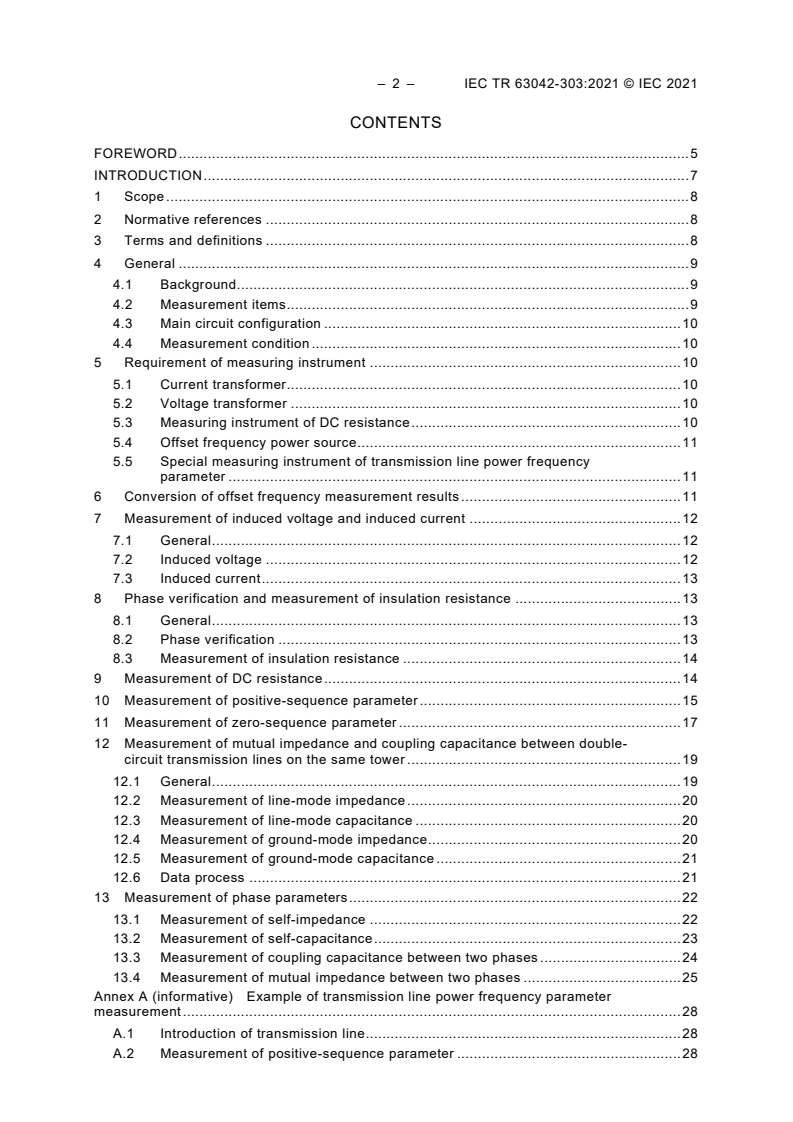
CONTENTS
FOREWORD . 5
INTRODUCTION . 7
1 Scope . 8
2 Normative references . 8
3 Terms and definitions . 8
4 General . 9
4.1 Background. 9
4.2 Measurement items . 9
4.3 Main circuit configuration . 10
4.4 Measurement condition . 10
5 Requirement of measuring instrument . 10
5.1 Current transformer. 10
5.2 Voltage transformer . 10
5.3 Measuring instrument of DC resistance . 10
5.4 Offset frequency power source . 11
5.5 Special measuring instrument of transmission line power frequency
parameter . 11
6 Conversion of offset frequency measurement results . 11
7 Measurement of induced voltage and induced current . 12
7.1 General . 12
7.2 Induced voltage . 12
7.3 Induced current . 13
8 Phase verification and measurement of insulation resistance . 13
8.1 General . 13
8.2 Phase verification . 13
8.3 Measurement of insulation resistance . 14
9 Measurement of DC resistance . 14
10 Measurement of positive-sequence parameter . 15
11 Measurement of zero-sequence parameter . 17
12 Measurement of mutual impedance and coupling capacitance between double-
circuit transmission lines on the same tower . 19
12.1 General . 19
12.2 Measurement of line-mode impedance . 20
12.3 Measurement of line-mode capacitance . 20
12.4 Measurement of ground-mode impedance . 20
12.5 Measurement of ground-mode capacitance . 21
12.6 Data process . 21
13 Measurement of phase parameters . 22
13.1 Measurement of self-impedance . 22
13.2 Measurement of self-capacitance . 23
13.3 Measurement of coupling capacitance between two phases . 24
13.4 Measurement of mutual impedance between two phases . 25
Annex A (informative) Example of transmission line power frequency parameter
measurement . 28
A.1 Introduction of transmission line . 28
A.2 Measurement of positive-sequence parameter . 28
A.2.1 Measured data . 28
A.2.2 Calculation results . 28
A.3 Measurement of zero-sequence parameter . 29
A.3.1 Measured data . 29
A.3.2 Calculation results . 29
A.4 Measurement of phase parameter . 29
A.4.1 General . 29
A.4.2 Capacitance matrix . 30
A.4.3 Impedance matrix . 30
Annex B (informative) Derivation process of measurement and calculation for
coupling capacitance between two phases . 31
Annex C (informative) Safety precautions . 34
Bibliography . 35
Figure 1 – Measurement of induced voltage . 12
Figure 2 – Measurement of induced voltage . 13
Figure 3 – Measurement of induced current . 13
Figure 4 – Phase verification . 14
Figure 5 – Measurement of insulation resistance . 14
Figure 6 – Measurement of DC resistance . 15
Figure 7 – Measurement of positive-sequence parameter . 16
Figure 8 – Measurement of zero-sequence parameter . 18
Figure 9 – Measurement of line-mode impedance . 20
Figure 10 – Measurement of line-mode capacitance . 20
Figure 11 – Measurement of ground-mode impedance . 21
Figure 12 – Measurement of ground-mode capacitance . 21
Figure 13 – Measurement of self-impedance by two-terminal synchronous
measurement method . 22
Figure 14 – Measurement of self-capacitance by two-terminal synchronous
measurement method . 23
Figure 15 – Measurement of coupling capacitance between two phases . 24
Figure 16 – Measurement of mutual impedance between two phases . 26
Figure B.1 – The π-equivalent circuit of 3-phase system during measurement . 31
Table 1 – Calculation method of positive-sequence parameters . 17
Table 2 – The calculation method of zero-sequence parameters . 18
Table 3 – Calculation process and equations of parameters per unit length of double-
circuit lines on the same tower . 22
Table 4 – The calculation of self-impedance . 23
Table 5 – The calculation of self-capacitance . 24
Table A.1 – Measured data of transmission line I . 28
Table A.2 – Positive-sequence parameters of transmission line I . 28
Table A.3 – DC resistance of line I . 29
Table A.4 – Measured data of transmission line I . 29
Table A.5 – Zero-sequence parameters of transmission line I . 29
– 4 – IEC TR 63042-303:2021 © IEC 2021
Table A.6 – The capacitance matrix of transmission line I and II . 30
Table A.7 – The resistance matrix of transmission line I and II . 30
Table A.8 – The reactance matrix of transmission line I and II . 30
INTERNATIONAL ELECTROTECHNICAL COMMISSION
____________
UHV AC TRANSMISSION SYSTEMS –
Part 303: Guideline for the measurement of UHV AC
transmission line power frequency parameters
FOREWORD
1) The International Electrotechnical Commission (IEC) is a worldwide organization for standardization comprising
all national electrotechnical committees (IEC National Committees). The object of IEC is to promote
international co-operation on all questions concerning standardization in the electrical and electronic fields. To
this end and in addition to other activities, IEC publishes International Standards, Technical Specifications,
Technical Reports, Publicly Available Specifications (PAS) and Guides (hereafter referred to as “IEC
Publication(s)”). Their preparation is entrusted to technical committees; any IEC National Committee interested
in the subject dealt with may participate in this preparatory work. International, governmental and non-
governmental organizations liaising with the IEC also participate in this preparation. IEC collaborates closely
with the International Organization for Standardization (ISO) in accordance with conditions determined by
agreement between the two organizations.
2) The formal decisions or agreements of IEC on technical matters express, as nearly as possible, an international
consensus of opinion on the relevant subjects since each technical committee has representation from all
interested IEC National Committees.
3) IEC Publications have the form of recommendations for international use and are accepted by IEC National
Committees in that sense. While all reasonable efforts are made to ensure that the technical content of IEC
Publications is accurate, IEC cannot be held responsible for the way in which they are used or for any
misinterpretation by any end user.
4) In order to promote international uniformity, IEC National Committees undertake to apply IEC Publications
transparently to the maximum extent possible in their national and regional publications. Any divergence
between any IEC Publication and the corresponding national or regional publication shall be clearly indicated in
the latter.
5) IEC itself does not provide any attestation of conformity. Independent certification bodies provide conformity
assessment services and, in some areas, access to IEC marks of conformity. IEC is not responsible for any
services carried out by independent certification bodies.
6) All users should ensure that they have the latest edition of this publication.
7) No liability shall attach to IEC or its directors, employees, servants or agents including individual experts and
members of its technical committees and IEC National Committees for any personal injury, property damage or
other damage of any nature whatsoever, whether direct or indirect, or for costs (including legal fees) and
expenses arising out of the publication, use of, or reliance upon, this IEC Publication or any other IEC
Publications.
8) Attention is drawn to the Normative references cited in this publication. Use of the referenced publications is
indispensable for the correct application of this publication.
9) Attention is drawn to the possibility that some of the elements of this IEC Publication may be the subject of
patent rights. IEC shall not be held responsible for identifying any or all such patent rights.
IEC TR 63042-303 has been prepared by IEC technical committee 122: UHV AC transmission
systems. It is a Technical Report.
The text of this Technical Report is based on the following documents:
DTR Report on voting
122/105/DTR 122/112/RVDTR
Full information on the voting for its approval can be found in the report on voting indicated in
the above table.
The language used for the development of this Technical Report is English.
– 6 – IEC TR 63042-303:2021 © IEC 2021
This document was drafted in accordance with ISO/IEC Directives, Part 2, and developed in
accordance with ISO/IEC Directives, Part 1 and ISO/IEC Directives, IEC Supplement,
available at www.iec.ch/members_experts/refdocs. The main document types developed by
IEC are described in greater detail at www.iec.ch/standardsdev/publications.
A list of all parts in the IEC 63042 series, published under the general title UHV AC
transmission systems, can be found on the IEC website.
The committee has decided that the contents of this document will remain unchanged until the
stability date indicated on the IEC website under "http://webstore.iec.ch" in the data related to
the specific document. At this date, the document will be
• reconfirmed,
• withdrawn,
• replaced by a revised edition, or
• amended.
INTRODUCTION
AC transmission line power frequency parameters are important basic data used for various
power system's calculations and applications, including engineering design verification,
commissioning, and operation.
Due to the complication of the geological conditions along the corridor of long distance UHV
AC transmission lines, it is difficult to obtain accurate transmission line power frequency
parameters through theoretical analysis and calculation. To obtain the accurate power
frequency parameters, a field measurement is necessary.
This document provides the guidance for measurement of UHV AC transmission lines power
frequency parameters which include sequence parameters and phase parameters, etc. The
measurement conditions, measurement methods, data process methods, safety requirements,
etc. are described.
– 8 – IEC TR 63042-303:2021 © IEC 2021
UHV AC TRANSMISSION SYSTEMS –
Part 303: Guideline for the measurement of UHV AC
transmission line power frequency parameters
1 Scope
This part of IEC 63042 specifies measurement methods of UHV AC transmission line power
frequency parameters. These measured parameters mainly include sequence parameters,
mutual parameters between double-circuit lines, phase parameters and some other related
parameters.
2 Normative references
The following documents are referred to in the text in such a way that some or all of their
content constitutes requirements of this document. For dated references, only the edition
cited applies. For undated references, the latest edition of the referenced document (including
any amendments) applies.
IEC Guide 115:2007, Application of uncertainty of measurement to conformity assessment
activities in the electrotechnical sector
3 Terms and definitions
For the purposes of this document, the following terms and definitions apply.
ISO and IEC maintain terminological databases for use in standardization at the following
addresses:
• IEC Electropedia: available at http://www.electropedia.org/
• ISO Online browsing platform: available at http://www.iso.org/obp
3.1
offset frequency method
method that can measure the parameter of transmission line by applying a test power source
with a frequency offset from the power frequency
3.2
source terminal
terminal of a transmission line, at which a power source is applied for the parameter
measurement
3.3
ending terminal
terminal opposite to the source terminal of a transmission line
3.4
one-terminal measurement method
measurement method, at which only source terminal is measured
3.5
two-terminal synchronous measurement method
measurement method at which both source terminal and ending terminal are measured
synchronously
3.6
phase parameter
type of power frequency parameters, which characterize electric and magnetic coupling
characteristic for single phase or between two phases, including self-impedance, mutual
impedance, self-capacitance and coupling capacitance
3.7
induced voltage
voltage caused by the electromagnetic or electrostatic effect of adjacent energized lines or
equipment
3.8
induced current
electric current resulting from the displacement of charge carriers due to an induced voltage
[SOURCE: IEC 60050-121:2008, 121-11-29]
4 General
4.1 Background
Due to the complication of the geological conditions along the corridor of long distance UHV
AC transmission lines, where soil resistivity and transmission tower size vary, it is difficult to
obtain accurate transmission line power frequency parameters through theoretical analysis
and calculation. To obtain the accurate power frequency parameters, field measurement is
necessary. However, the accuracy of field measurement is influenced by measurement
methods due to the distributed characteristic and electromagnetic coupling of UHV AC lines.
Therefore, appropriate measurement methods are important to obtain accurate power
frequency parameters. In this document, different measurement methods are applied to
acquire accurate parameters.
4.2 Measurement items
The recommended parameters which need to be measured are as follows:
• positive-sequence impedance,
• positive-sequence capacitance,
• zero-sequence impedance,
• zero-sequence capacitance,
• mutual impedance and coupling capacitance between double-circuit lines,
• self-impedance of one phase,
• self-capacitance of one phase,
• mutual impedance between two phases,
• coupling capacitance between two phases,
• induced voltage and induced current,
• phase verification and insulation resistance,
• DC resistance.
– 10 – IEC TR 63042-303:2021 © IEC 2021
4.3 Main circuit configuration
Disconnectors at the two terminals of the transmission line should be open during
measurement.
Parallel with the transmission line, connected equipment should be disconnected, such as
shunt reactors and capacitive transformer.
Series reactors and capacitors used in the transmission line shall be bypassed.
If the transmission line to be measured is composed of overhead lines, cables or gas-
insulated lines (GIL), it is recommended to measure the parameters of the overhead lines,
cables or GIL, separately.
To eliminate the resistance of the connecting lines for test, two connecting lines, i.e. voltage
and current connecting lines, can be applied. If only one connecting line is applied, the
obtained line resistance should be reduced by the connecting line resistance. The
measurement system should be reliably connected to the substation earthing system.
4.4 Measurement condition
Close attention should be paid to the weather condition along the line during the
measurement. The measurement should be stopped if the weather is not suitable for
measurement.
Ambient temperature of measuring instrument: −10 °C to +40 °C, relative humidity: ≤ 85 %.
Before starting the measurements, check that all temporary grounding connections have been
removed. No work may be done on the lines during the measurements. Make sure that this
rule is followed. All local and international safety regulations shall be known and strictly
observed. Safety precautions are given in Annex C.
5 Requirement of measuring instrument
5.1 Current transformer
Uncertainty of current transformer (CT) should be equal to or better than 0,5 %. It is obtained
based on the method of IEC Guide 115.
5.2 Voltage transformer
Uncertainty of voltage transformer (VT) should be equal to or better than 0,5 %. It is obtained
based on the method of IEC Guide 115.
5.3 Measuring instrument of DC resistance
The instrument to measure the DC resistance of a transmission line can be a special
instrument or the combination of a DC power source, a DC voltmeter and a DC ammeter.
If the DC resistance measurement meter is used, its uncertainty should be equal to or better
than 0,5 %.
If the combination of a DC resistance, a DC power source, a DC voltmeter and a DC ammeter
is used, the uncertainty of the DC voltmeter and ammeter should be equal to or better than
0,5 %.
5.4 Offset frequency power source
The offset frequency power source should be capable of supplying sinusoidal signals at a
single frequency that can be adjustable. Normally, the power source should generate a
sinusoidal signal at f – Δf or f + Δf , where Δf is usually less than 10 Hz, such as 2,5 Hz, 5 Hz
or 7,5 Hz.
NOTE ± 5 Hz are two typical values of frequency offset; the frequency of test power source can thus be 45 Hz or
55 Hz for a 50 Hz system.
The total harmonic distortion for the voltage output of offset frequency power source should
be within 3 %. It is recommended by IEC 61000-2-4:2002.
5.5 Special measuring instrument of transmission line power frequency parameter
The instrument should meet the requirement as follows:
• The measuring instruments at the source and ending terminals should have the function of
synchronous phasor measurement and be capable of sampling single-phase and three-
phase voltage and current phasors which include amplitude and phase angle of voltage
and current.
• For each measurement, all the measured voltage and current phasors take a GPS PPS as
a reference; phase angle of voltage or current is the difference between the measured
voltage or current phasor and the reference. The magnitude of voltage or current is
amplitude.
• The synchronization error of sampling between the source terminal and ending terminal
should be less than 100 ns.
• The measuring instrument should be capable of eliminating signal aliasing and leakage.
• The measuring instrument should be capable of completing data analysis and calculation
according to the prescribed method.
6 Conversion of offset frequency measurement results
If there are no induced voltage and induced current on the measured line at power frequency,
a power frequency test power source can be directly used.
If there are induced voltage and induced current on the measured line at power frequency, an
offset frequency test power source should be used to eliminate the power frequency
interference. The offset frequency measurement method is usually used to measure UHV
transmission line power frequency parameters. However, the parameters measured by using
offset frequency method need to be converted to the parameters at power frequency.
Generally, the two frequencies f – Δf and f + Δf will be selected for the measurement.
The procedure of offset frequency measurement is as follows:
• Firstly, replace the frequency of power source f by f – Δf, measure and calculate
parameters of the transmission lines at frequency f – Δf according to the procedures and
equations.
• Secondly, replace the frequency of power source f by f + Δf, measure and calculate
parameters at frequency f + Δf according to the procedures and equations.
• Finally, calculate the impedance parameters at power frequency f by
xx
ff-Δ f +Δf
z=r+=jx r + r / 22+ j πf + / 2 (1)
( )
f f f f-Δf f +Δf
2π ff−∆ 2π f+∆f
( ) ( )
– 12 – IEC TR 63042-303:2021 © IEC 2021
where
f is the power frequency;
j is the imaginary unit;
z is the impedance at frequency f;
f
r is the resistance at frequency f;
f
r is the resistance at frequency f – Δf;
f-Δf
r is the resistance at frequency f + Δf;
f+Δf
x is the reactance at frequency f;
f
x is the reactance at frequency f – Δf;
f-Δf
x is the is the reactance at frequency f + Δf;
f-Δf
y=g+=j2πfc g + g / 2+ j2πf c + c / 2 (2)
( ) ( )
f f f f−∆f f+∆f f−∆f f+∆f
where
y is the admittance at frequency f;
f
j is the imaginary unit;
g is the conductance at frequency f;
f
g is the conductance at frequency f – Δf;
f-Δf
g is the conductance at frequency f + Δf;
f+Δf
c is the capacitance at frequency f;
f
c is the capacitance at frequency f – Δf;
f-Δf
c is the capacitance at frequency f + Δf.
f-Δf
7 Measurement of induced voltage and induced current
7.1 General
Induced voltages and currents on the line to be measured can endanger the health of the
workers and destroy the measuring instruments. Therefore, the measurement of the induced
voltage and current should be the first task of parameter measurement.
7.2 Induced voltage
Induced voltage of three phases should be measured when transmission line is earthed and
open-circuit at the ending terminal separately.
As shown in Figure 1, earth the three phases at the ending terminal and disconnect the three
phases at the source terminal and measure the induced voltage of each phase at the source
terminal by a voltmeter through voltage divider.
Figure 1 – Measurement of induced voltage
As shown in Figure 2, disconnect the three phases at both terminals and measure the induced
voltage of each phase at the source terminal by a voltmeter through voltage divider.
Figure 2 – Measurement of induced voltage
7.3 Induced current
As shown in Figure 3,earth the three phases at the two terminals, and measure the
grounding current of each phase and the total current of the three phases at the source
terminal by the ammeter.
Figure 3 – Measurement of induced current
8 Phase verification and measurement of insulation resistance
8.1 General
Phase verification is used to verify whether the phase labels at two terminals are consistent,
and the insulation resistance measurement is applied to obtain the external insulation
condition of transmission line. An insulation resistance meter which measuring voltage range
is not less than 5 kV can be used as measuring instrument.
8.2 Phase verification
As shown in Figure 4, earth phase a at the ending terminal and disconnect the other phases
at the two terminals. Measure the insulation resistance of each phase at the source terminal
by the insulation resistance meter. If the insulation resistance of any phase is equal to zero,
this phase label is verified to be phase a.
Repeat the same procedure for verification of the other line phases.
– 14 – IEC TR 63042-303:2021 © IEC 2021
Figure 4 – Phase verification
8.3 Measurement of insulation resistance
As shown in Figure 5, disconnect phase a at both terminals. In order to decrease the induced
voltage during measurement, earth the other phases at the source terminal and disconnect
them at the ending terminal. Measure the insulation resistance of phase a by the insulation
resistance meter at the source terminal.
Repeat the same procedure for insulation resistance measurement of the other line phases.
Figure 5 – Measurement of insulation resistance
If a voltage transformer is connected to the transmission line, the voltage transformer shall be
disconnected from the line during measurement.
9 Measurement of DC resistance
As shown in Figure 6, disconnect the line to be measured at the source terminal and earth at
the ending terminal. Apply a DC power source between phase a and phase b, and measure
the DC voltage U and the DC current I . In order to decrease the induced voltage during
ab ab
measurement, generally earth the measured line at the ending terminal or earth one of the
measured two phases at any terminal.
Apply a DC power source between the corresponding phases, and repeat the same
measurement procedures for measurement of U , U , I and I .
ca bc ca bc
The DC resistance of each phase is then given by the Equations (3) to (5).
Figure 6 – Measurement of DC resistance
U UU
ab ca bc
R= ( + − )/ 2 (3)
a
I II
ab ca bc
U UU
ab bc ca
R= ( + − )/ 2 (4)
b
I II
ab bc ca
U UU
bc ca ab
R= ( +− )/ 2 (5)
c
I II
bc ca ab
where
R is the DC resistance of phase a;
a
R is the DC resistance of phase b;
b
R is the DC resistance of phase c.
c
The measurement result should be converted to the DC resistance at 20 °C by Equation (6).
R
(6)
R =
1+−()ϑ 20 β
where
is the average temperature of environment between the source terminal and the ending
terminal in °C;
ß is the temperature coefficient of the resistance of the conductor in 1/°C,
for aluminium ß = 0,003 6 (1/°C);
R is the measured resistance.
10 Measurement of positive-sequence parameter
One terminal measurement method can be used to measure the positive sequence
parameters.
Generally, the ending terminal currents are zero when the three phases are disconnected at
the ending terminal, and the ending terminal voltages are zero when three phases are earthed
at the ending terminal. Therefore, voltages and currents should be measured at the source
terminal when the three phases at the ending terminal are disconnected, and when the lines
at the ending terminal are earthed separately. Combined with the conditions mentioned above,
positive-sequence impedance and capacitance of the lines can be calculated by transmission
– 16 – IEC TR 63042-303:2021 © IEC 2021
line equations [3] . As shown in Figure 7 a) and Figure 7 b), the measurement procedures are
as follows.
Firstly, the three phases should be disconnected at the ending terminal and then a three-
phase test power source should be applied to the three phases at the source terminal.
Measure the three phase voltages U , U , and U and currents I , I , and I at the
a1 b1 c1 a1 b1 c1
source terminal.
NOTE U represents the voltage phasor of phase a, which includes amplitude and phase angle of the voltage.
a1
The symbol a′ represents the phase a at the ending terminal.
Secondly, the three phases should be earthed at the ending terminal and then a three-phase
test power source should be applied to the three phases at the source terminal. Measure the
three phase voltages U , U , and U and currents I , I , and I at the source terminal.
a2 b2 c2 a2 b2 c2
Calculate the positive-sequence component U from U , U , and U , I from I , I ,
1,1 a1 b1 c1 1,1 a1 b1
and I , U from U , U , and U , I from I , I , and I .
c1 1,2 a2 b2 c2 1,2 a2 b2 c2
a) The line at the ending terminal is disconnected
b) The line at the ending terminal is earthed
Figure 7 – Measurement of positive-sequence parameter
Positive-sequence impedance and capacitance can be calculated according to the equations
in Table 1.
___________
Figures in square brackets refer to the Bibliography.
Table 1 – Calculation method of positive-sequence parameters
Calculation of positive-sequence
parameters
Measured voltage and current U , I U , I
1,1 1,1 1,2 1,2
UU
11,,1 2
Characteristic impedance Z =
c1,
II
11,,1 2
UI
1,,2 11
arcoth
Propagation coefficient
I U
1,,2 11
λ =
L
Positive-sequence impedance zZ λ
1 c1, 1
Positive-sequence resistance rz= Re
( )
Positive-sequence reactance x = Im( z)
Positive-sequence admittance y =λ /Z
1 1 c1,
Im y
( )
Positive-sequence capacitance
c =
ω
NOTE ω = 2 π f represents the angular frequency; L represents the length of transmission line.
Example of transmission line power frequency parameter measurement is given in Annex A.
11 Measurement of zero-sequence parameter
The zero-sequence parameters can be also measured by one-terminal measurement method
which is the same as for positive-sequence parameters, and calculated by transmission line
equations. As shown in Figure 8 a) and Figure 8 b), the measurement procedure is as follows.
Firstly, the three phases should be disconnected at the ending terminal and then a single
phase source should be applied to the three phases shorted at the source terminal. Measure
the single phase voltage U and current I at the source terminal.
0,1 0,1
Secondly, the three phases should be earthed at the ending terminal and then a single phase
test power source should be applied to the three phases connected at the source terminal.
Measure the single phase voltage U and current I at the source terminal.
0,2 0,2
For double-circuit transmission lines on the same tower, when measuring the zero-sequence
parameter of one circuit transmission line, the two terminals of the other transmission line
should be disconnected.
– 18 – IEC TR 63042-303:2021 © IEC 2021
a) The line at the ending terminal is disconnected
b) The line at the ending terminal is earthed
Figure 8 – Measurement of zero-sequence parameter
Zero-sequence impedance and capacitance can be calculated according to the equations in
Table 2.
Table 2 – The calculation method of zero-sequence parameters
Calculation of zero-sequence
parameters
Measured voltage and current U , I U , I
0,1 0,1 0,2 0,2
UU
01,,0 2
Characteristic impedance Z =
c0,
I I
01,,0 2
UI
0,,2 01
arcoth
Propagation coefficient
IU
0,2 01,
λ =
L
Zero-sequence impedance zZ= λ
0 c,0 0
Zero-sequence resistance rz= Re( )
Zero-sequence reactance x = Im z
( )
Zero-sequence admittance y =λ /Z
0 0 c0,
Im y
( )
Zero-sequence capacitance c =
ω
12 Measurement of mutual impedance and coupling capacitance between
double-circuit transmission lines on the same tower
12.1 General
The measurement principle of the coupling parameters between the double-circuit lines on the
same tower is mainly based on the two-phase AC system and its phase-mode transformation.
The phase-mode transformation between phase parameter and mode parameter for two-
phase systems is given in [4]:
z zz+ (7)
0 sm
z = z -z (8)
1 sm
c cc+ (9)
0 sm
c = c -c (10)
1 sm
where
z is the ground-mode impedance;
is the line-mode impedance;
z
c is the ground-mode capacitance;
is the line-mode capacitance;
c
z is the self-impedance of one phase;
s
z is the mutual impedance between two phases;
m
c is the self-capacitance of one phase;
s
c is the minus of the coupling capacitance between two phases.
m
Therefore, z and c are given by
m m
z z− z/ 2 (11)
( )
m 01
c c− c/ 2 (12)
( )
m 01
If three phases of each circuit of the double-circuit lines on the same tower are regarded as
one phase, double-circuit lines on the same tower can be regarded as two phases of one line.
Therefore, the line-mode and ground-mode parameters of two phases of one line can be
measured, and the mutual impedance and coupling capacitance between double-circuit lines
can be calculated based on the measured line-mode and ground-mode parameters according
to Equations (11) and (12). The measurement procedures are described in [5].
=
=
=
=
– 20 – IEC TR 63042-303:2021 © IEC 2021
12.2 Measurement of line-mode impedance
For each circuit of the measured double-circuit lines, connect three phases of each circuit at
the source terminal and short all phases of the double-circuit lines at the ending terminal.
Apply a two-phase test power source with identical voltage amplitudes and symmetrical phase
angles at the source terminal of the double-circuit lines. Measure the voltages U and
1,SC
U and the currents I and I at the source terminal, as shown in Figure 9.
2,SC 1,SC 2,SC
NOTE The symmetrical phase angles mean that the difference of phase angles between the two phases is 180°.
Figure 9 – Measurement of line-mode impedance
12.3 Measurement of line-mode capacitance
For each circuit of the measured double-circuit lines, connect the three phases of each circuit
at the source terminal and disconnect all phases at the ending terminal. Apply a two-phase
test power source with identical voltage amplitudes and symmetrical phase angles at the
source terminal of the double-circuit lines. Measure the voltages U and U , and the
1,OC 2,OC
currents I and I at the source terminal, as shown in Figure 10.
1,OC 2,OC
Figure 10 – Measurement of line-mode capacitance
12.4 Measurement of ground-mode impedance
Connect all phases of the two lines at the source terminal and earth all phases of the two
lines at the ending terminal.
Apply a single-phase test power source at the source terminal. Measure voltage U and
0,SC
current I at the source terminal, as shown in Figure 11.
0,SC
Figure 11 – Measurement of ground-mode impedance
12.5 Measurement of ground-mode capacitance
Connect all phases of the two lines at the source terminal and disconnect all phases of the
two lines at the ending terminal. Apply a single-phase test power source at the source
terminal. Measure voltage U and current I at the source terminal, as shown in
0,OC 0,OC
Figure 12.
Figure 12 – Measurement of ground-mode capacitance
12.6 Data process
Coupling parameter calculation of double-circuit lines on the same tower is shown in Table 3.
– 22 – IEC TR 63042-303:2021 © IEC 2021
Table 3 – Calculation process and equations of parameters
per unit length of double-circuit lines on the same tower
Line-mode parameters Ground-mode parameters
UU− UU−
U U
1,oc 2,oc 1,sc 2,sc 0,oc 0,sc
Z = Z = Z =
Z =
1,1-2,oc 0,oc 0,cs
1,,1−2 sc
II− I / 2 I / 2
II−
1,oc 2,oc 0,oc 0,sc
1,sc 2,sc
Characteristic impedance Z = Z Z Z = ZZ
c,11,−2 11,,−−2 oc 11,,2 sc c,0 0,oc 0,sc
Z Z
1,1−2,oc 0,oc
arcoth arcoth
Propagation coefficient
Z Z
1,1−2,sc 0,sc
λ = λ =
1 0
L L
zZ= λ zZ= λ
Impedance per unit length
1 c,,11−2 1 0 c0, 0
Admittance per unit length y =λ / Z y =λ / Z
1 1 c,,11−2 0 0 c0,
Mutual impedance
z (zz− )/ 2
m 01
between double-circuit
Coupling capacitance
c Im yy− / 2
( )
m 01
between double-circuit
NOTE L represents the length of transmission line.
13 Measurement of phase parameters
13.1 Measurement of self-impedance
The self-impedance of one phase is generated by the loop formed through one phase ground.
In order to eliminate the influence of the other phases during measurement, the other phases
at the two terminals should be disconnected. Two-terminal synchronous measurement method
is used to obtain the accurate self-impedance [6].
As shown in Figure 13, earth the phase to be measured a of the double-circuit transmission
line on the same tower at the ending te
...