

IEC 62127-3:2007
(Main)Ultrasonics - Hydrophones - Part 3: Properties of hydrophones for ultrasonic fields up to 40 MHz
General Information
- Abstract
IEC 62127-3:2007 specifies relevant hydrophone characteristics. This standard is applicable to hydrophones employing piezoelectric sensor elements, designed to measure the pulsed and continuous wave ultrasonic fields generated by ultrasonic equipment; hydrophones used for measurements made in water; and hydrophones with or without an associated pre-amplifier. IEC 62127-1, IEC 62127-2 and IEC 62127-3 are being published simultaneously. Together these cancel and replace IEC 60866:1987, IEC 61101:1991, IEC 61102:1991, IEC 61220:1993 and IEC 62092:2001. The French version of this standard has not been voted upon.
- Status
- Published
- Publication Date
- 27-May-2013
- Technical Committee
- TC 87 - Ultrasonics
- Drafting Committee
- WG 8 - TC 87/WG 8
- Current Stage
- DELPUB - Deleted Publication
- Start Date
- 19-Dec-2022
- Completion Date
- 08-Nov-2019
Buy Documents
IEC 62127-3:2007 - Ultrasonics - Hydrophones - Part 3: Properties of hydrophones for ultrasonic fields up to 40 MHz Released:8/23/2007
IEC 62127-3:2007 - Ultrasonics - Hydrophones - Part 3: Properties of hydrophones for ultrasonic fields up to 40 MHz Released:8/23/2007
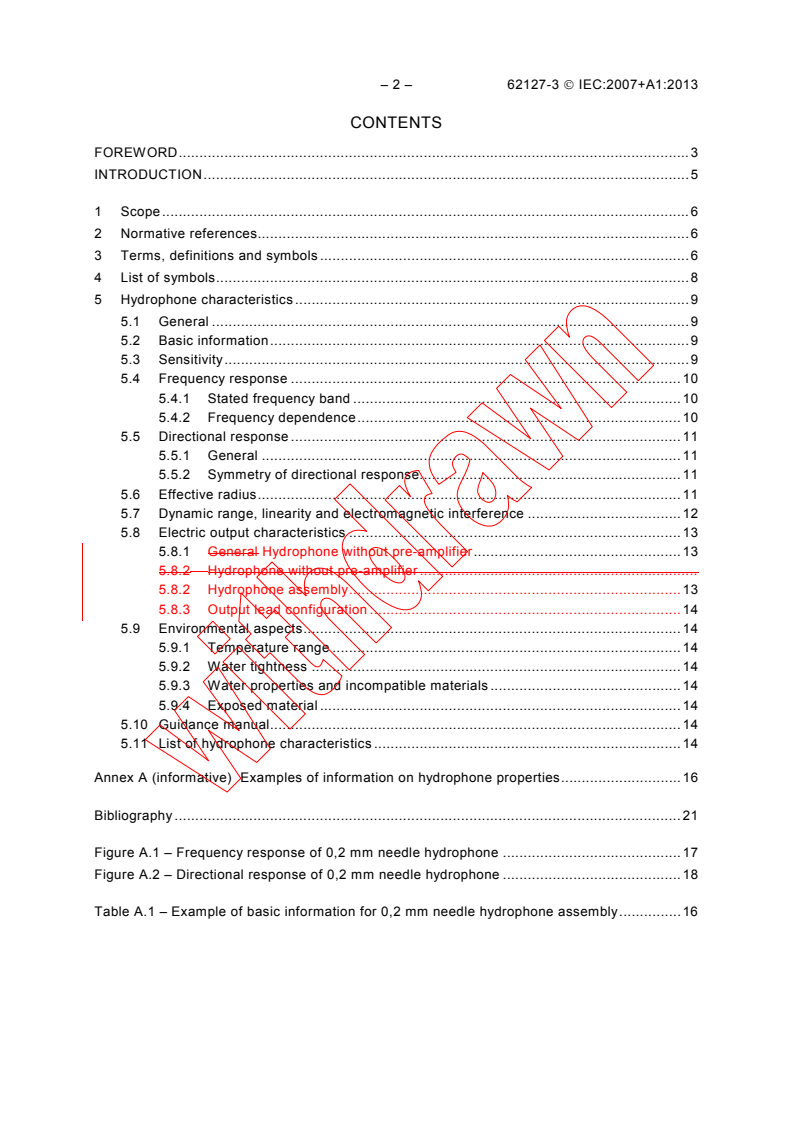
IEC 62127-3:2007+AMD1:2013 CSV - Ultrasonics - Hydrophones - Part 3: Properties of hydrophones for ultrasonic fields up to 40 MHz Released:5/28/2013
Overview
IEC 62127-3:2007, titled Ultrasonics – Hydrophones – Part 3: Properties of hydrophones for ultrasonic fields up to 40 MHz, is an international standard developed by the International Electrotechnical Commission (IEC). This standard specifies the relevant properties and performance characteristics required for hydrophones that utilize piezoelectric sensor elements and are designed to measure pulsed and continuous ultrasonic fields generated by ultrasonic equipment. The standard applies specifically to hydrophones intended for measurements conducted in water, with or without an associated pre-amplifier.
By consolidating and replacing several earlier standards, IEC 62127-3:2007 provides a harmonized framework for evaluating hydrophone specifications, supporting accuracy and consistency in ultrasonic field measurements up to 40 MHz.
Key Topics
- Hydrophone Characteristics: Establishes definitions for sensitivity (open-circuit and loaded), frequency response, directional response, effective radius, and electric output characteristics.
- Measurement Conditions: Outlines the requirements for reporting physical properties of the hydrophone, sensitivity values, frequency dependence, and calibration conditions.
- Directional Response and Symmetry: Specifies methods for measuring and documenting the hydrophone’s angular response to ultrasound, including the symmetry of response and implications for accuracy.
- Dynamic Range and Linearity: Details the required dynamic range for hydrophones, defines linearity criteria, and notes environmental factors such as electromagnetic interference.
- Electric Output and Pre-amplifiers: Requires documentation of output impedance, load conditions, and calculations for sensitivity corrections based on circuit configurations.
- Environmental Considerations: Covers water tightness, temperature ranges, and material compatibility necessary for ensuring measurement reliability.
- Guidance Manual and Reporting: Includes recommendations for a guidance manual detailing hydrophone use, calibration intervals, and uncertainty statements.
Applications
IEC 62127-3:2007 is widely applicable for:
- Medical Ultrasonic Equipment: Ensures reliable measurement of ultrasonic fields for diagnostic and therapeutic devices such as ultrasound imaging, lithotripsy, HIFU, and physiotherapy equipment.
- Research and Product Development: Supports laboratory and industrial R&D by providing consistent benchmarks for hydrophone characterization.
- Quality Control: Facilitates mapping and validation of ultrasonic fields in cleaning baths, transmission measurement systems, and reflection-based measurement setups (e.g., Doppler flowmeters).
- Calibration and Standardization Labs: Essential for accredited labs performing calibration and verification of hydrophone performance in compliance with international standards.
The standard is critical for professionals in medical engineering, acoustics research, and industrial ultrasonic applications, ensuring that hydrophone measurements are consistent, reproducible, and interoperable across different equipment and laboratories.
Related Standards
To ensure comprehensive understanding and proper application of hydrophones for ultrasonic field measurement, IEC 62127-3:2007 should be used in conjunction with:
- IEC 62127-1: Ultrasonics – Hydrophones – Part 1: Measurement and characterization of medical ultrasonic fields up to 40 MHz
- IEC 62127-2: Ultrasonics – Hydrophones – Part 2: Calibration for ultrasonic fields up to 40 MHz
These parts together provide a complete framework for hydrophone selection, calibration, and performance verification up to 40 MHz, contributing to improved safety, quality assurance, and regulatory compliance in the usage of ultrasonic measurement equipment.
The IEC 62127 series supersedes earlier standards such as IEC 60866:1987, IEC 61101:1991, IEC 61102:1991, IEC 61220:1993, and IEC 62092:2001, ensuring that users benefit from the most current and consolidated guidance on ultrasonic hydrophone properties.
Relations
- Effective Date
- 05-Sep-2023
- Effective Date
- 05-Sep-2023
- Effective Date
- 05-Sep-2023
Buy Documents
IEC 62127-3:2007 - Ultrasonics - Hydrophones - Part 3: Properties of hydrophones for ultrasonic fields up to 40 MHz Released:8/23/2007
IEC 62127-3:2007 - Ultrasonics - Hydrophones - Part 3: Properties of hydrophones for ultrasonic fields up to 40 MHz Released:8/23/2007
IEC 62127-3:2007+AMD1:2013 CSV - Ultrasonics - Hydrophones - Part 3: Properties of hydrophones for ultrasonic fields up to 40 MHz Released:5/28/2013
Get Certified
Connect with accredited certification bodies for this standard

BSMI (Bureau of Standards, Metrology and Inspection)
Taiwan's standards and inspection authority.
Sponsored listings
Frequently Asked Questions
IEC 62127-3:2007 is a standard published by the International Electrotechnical Commission (IEC). Its full title is "Ultrasonics - Hydrophones - Part 3: Properties of hydrophones for ultrasonic fields up to 40 MHz". This standard covers: IEC 62127-3:2007 specifies relevant hydrophone characteristics. This standard is applicable to hydrophones employing piezoelectric sensor elements, designed to measure the pulsed and continuous wave ultrasonic fields generated by ultrasonic equipment; hydrophones used for measurements made in water; and hydrophones with or without an associated pre-amplifier. IEC 62127-1, IEC 62127-2 and IEC 62127-3 are being published simultaneously. Together these cancel and replace IEC 60866:1987, IEC 61101:1991, IEC 61102:1991, IEC 61220:1993 and IEC 62092:2001. The French version of this standard has not been voted upon.
IEC 62127-3:2007 specifies relevant hydrophone characteristics. This standard is applicable to hydrophones employing piezoelectric sensor elements, designed to measure the pulsed and continuous wave ultrasonic fields generated by ultrasonic equipment; hydrophones used for measurements made in water; and hydrophones with or without an associated pre-amplifier. IEC 62127-1, IEC 62127-2 and IEC 62127-3 are being published simultaneously. Together these cancel and replace IEC 60866:1987, IEC 61101:1991, IEC 61102:1991, IEC 61220:1993 and IEC 62092:2001. The French version of this standard has not been voted upon.
IEC 62127-3:2007 is classified under the following ICS (International Classification for Standards) categories: 01 - GENERALITIES. TERMINOLOGY. STANDARDIZATION. DOCUMENTATION; 17.140.50 - Electroacoustics. The ICS classification helps identify the subject area and facilitates finding related standards.
IEC 62127-3:2007 has the following relationships with other standards: It is inter standard links to IEC 62092:2001, IEC 62127-3:2007/AMD1:2013, IEC 62127-3:2022. Understanding these relationships helps ensure you are using the most current and applicable version of the standard.
IEC 62127-3:2007 is available in PDF format for immediate download after purchase. The document can be added to your cart and obtained through the secure checkout process. Digital delivery ensures instant access to the complete standard document.
Standards Content (Sample)
IEC 62127-3
Edition 1.0 2007-08
INTERNATIONAL
STANDARD
Ultrasonics – Hydrophones –
Part 3: Properties of hydrophones for ultrasonic fields up to 40 MHz
All rights reserved. Unless otherwise specified, no part of this publication may be reproduced or utilized in any form
or by any means, electronic or mechanical, including photocopying and microfilm, without permission in writing from
either IEC or IEC's member National Committee in the country of the requester.
If you have any questions about IEC copyright or have an enquiry about obtaining additional rights to this publication,
please contact the address below or your local IEC member National Committee for further information.
IEC Central Office
3, rue de Varembé
CH-1211 Geneva 20
Switzerland
Email: inmail@iec.ch
Web: www.iec.ch
About the IEC
The International Electrotechnical Commission (IEC) is the leading global organization that prepares and publishes
International Standards for all electrical, electronic and related technologies.
About IEC publications
The technical content of IEC publications is kept under constant review by the IEC. Please make sure that you have the
latest edition, a corrigenda or an amendment might have been published.
ƒ Catalogue of IEC publications: www.iec.ch/searchpub
The IEC on-line Catalogue enables you to search by a variety of criteria (reference number, text, technical committee,…).
It also gives information on projects, withdrawn and replaced publications.
ƒ IEC Just Published: www.iec.ch/online_news/justpub
Stay up to date on all new IEC publications. Just Published details twice a month all new publications released. Available
on-line and also by email.
ƒ Electropedia: www.electropedia.org
The world's leading online dictionary of electronic and electrical terms containing more than 20 000 terms and definitions
in English and French, with equivalent terms in additional languages. Also known as the International Electrotechnical
Vocabulary online.
ƒ Customer Service Centre: www.iec.ch/webstore/custserv
If you wish to give us your feedback on this publication or need further assistance, please visit the Customer Service
Centre FAQ or contact us:
Email: csc@iec.ch
Tel.: +41 22 919 02 11
Fax: +41 22 919 03 00
IEC 62127-3
Edition 1.0 2007-08
INTERNATIONAL
STANDARD
Ultrasonics – Hydrophones –
Part 3: Properties of hydrophones for ultrasonic fields up to 40 MHz
INTERNATIONAL
ELECTROTECHNICAL
COMMISSION
PRICE CODE
S
ICS 17.140.50 ISBN 2-8318-9278-3
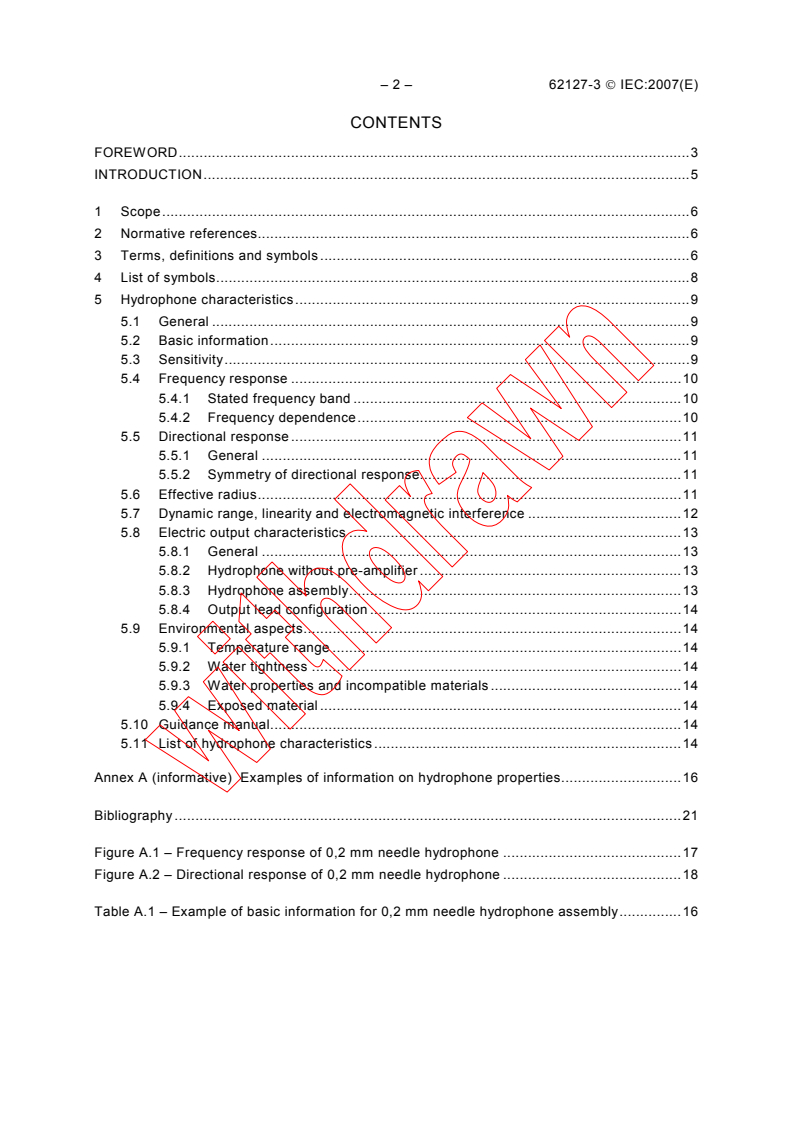
– 2 – 62127-3 © IEC:2007(E)
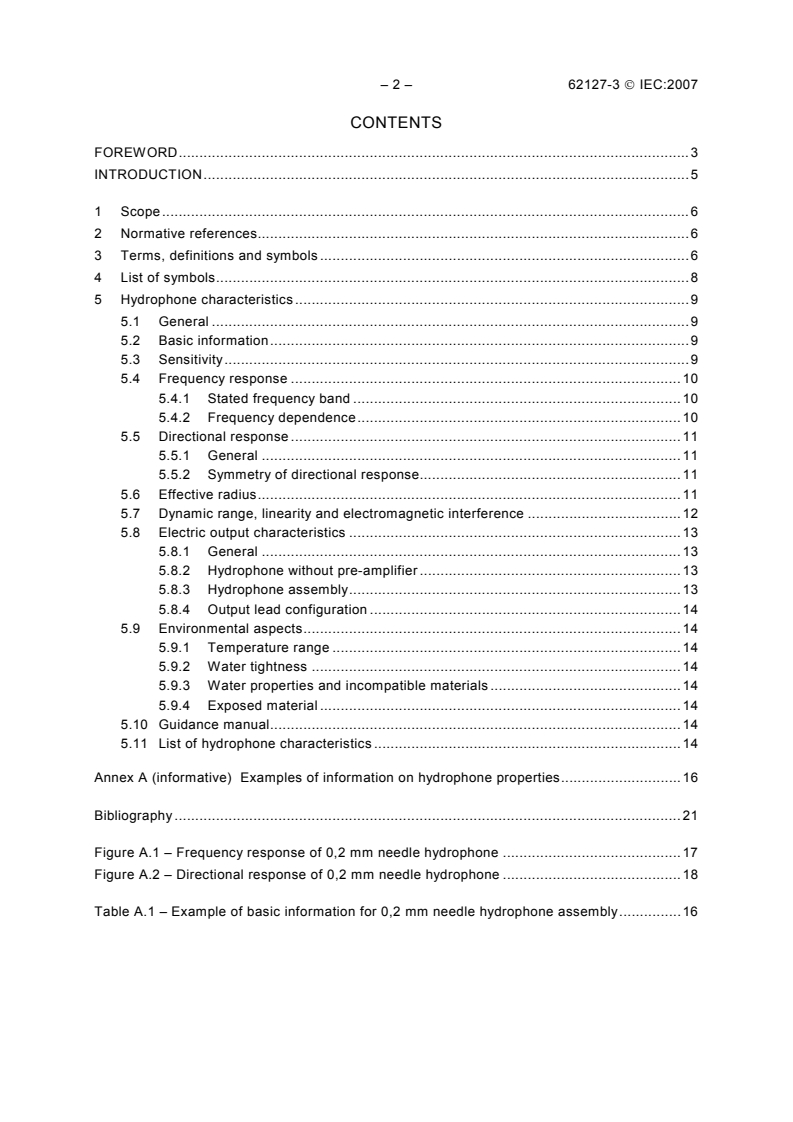
CONTENTS
FOREWORD.3
INTRODUCTION.5
1 Scope.6
2 Normative references.6
3 Terms, definitions and symbols .6
4 List of symbols.8
5 Hydrophone characteristics.9
5.1 General .9
5.2 Basic information.9
5.3 Sensitivity.9
5.4 Frequency response .10
5.4.1 Stated frequency band .10
5.4.2 Frequency dependence.10
5.5 Directional response .11
5.5.1 General .11
5.5.2 Symmetry of directional response.11
5.6 Effective radius.11
5.7 Dynamic range, linearity and electromagnetic interference .12
5.8 Electric output characteristics .13
5.8.1 General .13
5.8.2 Hydrophone without pre-amplifier .13
5.8.3 Hydrophone assembly.13
5.8.4 Output lead configuration .14
5.9 Environmental aspects.14
5.9.1 Temperature range .14
5.9.2 Water tightness .14
5.9.3 Water properties and incompatible materials .14
5.9.4 Exposed material .14
5.10 Guidance manual.14
5.11 List of hydrophone characteristics .14
Annex A (informative) Examples of information on hydrophone properties.16
Bibliography .21
Figure A.1 – Frequency response of 0,2 mm needle hydrophone .17
Figure A.2 – Directional response of 0,2 mm needle hydrophone .18
Table A.1 – Example of basic information for 0,2 mm needle hydrophone assembly.16
62127-3 © IEC:2007(E) – 3 –
INTERNATIONAL ELECTROTECHNICAL COMMISSION
____________
ULTRASONICS – HYDROPHONES –
Part 3: Properties of hydrophones for ultrasonic fields up to 40 MHz
FOREWORD
1) The International Electrotechnical Commission (IEC) is a worldwide organization for standardization comprising
all national electrotechnical committees (IEC National Committees). The object of IEC is to promote
international co-operation on all questions concerning standardization in the electrical and electronic fields. To
this end and in addition to other activities, IEC publishes International Standards, Technical Specifications,
Technical Reports, Publicly Available Specifications (PAS) and Guides (hereafter referred to as “IEC
Publication(s)”). Their preparation is entrusted to technical committees; any IEC National Committee interested
in the subject dealt with may participate in this preparatory work. International, governmental and non-
governmental organizations liaising with the IEC also participate in this preparation. IEC collaborates closely
with the International Organization for Standardization (ISO) in accordance with conditions determined by
agreement between the two organizations.
2) The formal decisions or agreements of IEC on technical matters express, as nearly as possible, an international
consensus of opinion on the relevant subjects since each technical committee has representation from all
interested IEC National Committees.
3) IEC Publications have the form of recommendations for international use and are accepted by IEC National
Committees in that sense. While all reasonable efforts are made to ensure that the technical content of IEC
Publications is accurate, IEC cannot be held responsible for the way in which they are used or for any
misinterpretation by any end user.
4) In order to promote international uniformity, IEC National Committees undertake to apply IEC Publications
transparently to the maximum extent possible in their national and regional publications. Any divergence
between any IEC Publication and the corresponding national or regional publication shall be clearly indicated in
the latter.
5) IEC provides no marking procedure to indicate its approval and cannot be rendered responsible for any
equipment declared to be in conformity with an IEC Publication.
6) All users should ensure that they have the latest edition of this publication.
7) No liability shall attach to IEC or its directors, employees, servants or agents including individual experts and
members of its technical committees and IEC National Committees for any personal injury, property damage or
other damage of any nature whatsoever, whether direct or indirect, or for costs (including legal fees) and
expenses arising out of the publication, use of, or reliance upon, this IEC Publication or any other IEC
Publications.
8) Attention is drawn to the Normative references cited in this publication. Use of the referenced publications is
indispensable for the correct application of this publication.
9) Attention is drawn to the possibility that some of the elements of this IEC Publication may be the subject of
patent rights. IEC shall not be held responsible for identifying any or all such patent rights.
International Standard IEC 62127-3 has been prepared by IEC technical committee 87:
Ultrasonics
IEC 62127-1, IEC 62127-2 and IEC 62127-3 are being published simultaneously. Together
these cancel and replace IEC 60866:1987, IEC 61101:1991, IEC 61102:1991, IEC 61220:1993
and IEC 62092:2001.
The text of this standard is based on the following documents:
Enquiry draft Report on voting
87/354/CDV 87/373/RVC
Full information on the voting for the approval of this standard can be found in the report on
voting indicated in the above table.
This publication has been drafted in accordance with the ISO/IEC Directives, Part 2.
– 4 – 62127-3 © IEC:2007(E)
A list of all parts of IEC 62127 series, published under the general title Ultrasonics –
Hydrophones, can be found on the IEC website.
NOTE Words in bold in the text are defined in Clause 3.
The committee has decided that the contents of this publication will remain unchanged until the
maintenance result date indicated on the IEC website under "http://webstore.iec.ch" in the data
related to the specific publication. At this date, the publication will be
• reconfirmed,
• withdrawn,
• replaced by a revised edition, or
• amended.
A bilingual version of this publication may be issued at a later date.
62127-3 © IEC:2007(E) – 5 –
INTRODUCTION
The spatial and temporal distribution of acoustic pressure in an ultrasonic field in a liquid
medium is commonly determined using miniature ultrasonic hydrophones. The properties of
these hydrophones have been dealt with in a number of IEC standards in various aspects.
The purpose of this part of IEC 62127 is to bring together all these specifications and to
establish a common standard on the properties of ultrasonic hydrophones. The main
hydrophone application in this context is the measurement of ultrasonic fields emitted by
medical diagnostic equipment in water. Other medical applications are field measurements for
therapy equipment such as that used in lithotripsy, high-intensity focused ultrasound (HIFU)
and physiotherapy. Hydrophones are also used extensively in non-medical applications for both
product development and quality control including:
– mapping of the ultrasound field within ultrasonic cleaning baths;
– characterization of acoustic fields used in transmission measurement systems (e.g.
ultrasonic spectrometers, ultrasonic attenuation meters and velocimeters);
– characterization of acoustic fields used in reflection measurement systems (e.g. Doppler
flowmeters).
While the term "hydrophone" can be used in a wider sense, it is understood here as referring
to miniature piezoelectric hydrophones. It is this instrument type that is used today in various
areas of ultrasonics and, in particular, to quantitatively characterize the field structure of
medical diagnostic instruments. With regard to other pressure sensor types, such as those
based on fibre optics, some of the requirements of this standard are applicable to these as well
but others are not. If in the future these other "hydrophone" types gain more importance in
field measurement practice, their properties will have to be dealt with in a revised version of
this standard or in a separate one.
Underwater hydrophones as covered by IEC 60500 and IEC 60565 are not included in this
standard, although there is an overlap in the frequency ranges. Underwater hydrophones are
used in natural waters, even in the ocean, and this leads to different technical concepts and
requirements. In addition, the main direction of acoustic incidence in underwater applications is
typically at right angles to the hydrophone axis, whereas it is assumed in this standard that it
is in the direction of the hydrophone axis.
In the past, ultrasonic hydrophones have been applied almost exclusively as amplitude
sensors. At present a change can be seen and it is increasingly considered useful to have
additional phase information, which, however, is only possible if the phase characteristics of
the hydrophone have been determined during calibration. In this standard, therefore,
requirements are specified for the amplitude aspect of the hydrophone sensitivity, and
recommendations are provided for the phase aspect, as an option to be considered.
– 6 – 62127-3 © IEC:2007(E)
ULTRASONICS – HYDROPHONES –
Part 3: Properties of hydrophones for ultrasonic fields up to 40 MHz
1 Scope
This part of IEC 62127 specifies relevant hydrophone characteristics.
This standard is applicable to:
– hydrophones employing piezoelectric sensor elements, designed to measure the pulsed
and continuous wave ultrasonic fields generated by ultrasonic equipment;
– hydrophones used for measurements made in water;
– hydrophones with or without an associated pre-amplifier.
2 Normative references
The following referenced documents are indispensable for the application of this document. For
dated references, only the edition cited applies. For undated references, the latest edition of
the referenced document (including any amendments) applies.
IEC 62127-1, Ultrasonics – Hydrophones – Part 1: Measurement and characterization of
medical ultrasonic fields up to 40 MHz
IEC 62127-2, Ultrasonics – Hydrophones – Part 2: Calibration for ultrasonic fields up to 40 MHz
3 Terms, definitions and symbols
For the purposes of this document, the terms and definitions given in IEC 62127-1,
IEC 62127-2 and the following apply.
3.1
directional response
description, generally presented graphically, of the response of a hydrophone, as a function of
direction of propagation of the incident plane sound wave, in a specified plane through the
reference centre and at a specified frequency
NOTE Definition adopted from IEC 60565:2006.
3.2
effective hydrophone radius
a , a , a
h h3 h6
radius of a stiff disc receiver hydrophone that has a predicted directional response function
with an angular width equal to the observed angular width
NOTE 1 The angular width is determined at a specified level below the peak of the directional response function.
For the specified levels of 3 dB and 6 dB, the radii are denoted by a and a respectively.
h3 h6
NOTE 2 The radius is usually the function of frequency. For representative experimental data, see [1].
NOTE 3 The effective hydrophone radius is expressed in metres (m).
62127-3 © IEC:2007(E) – 7 –
3.3
electric load impedance
Z
L
complex electric input impedance (consisting of a real and an imaginary part) to which the
hydrophone or hydrophone assembly output is connected or is to be connected
NOTE The electric load impedance is expressed in ohms (Ω).
3.4
end-of-cable
specification that relates to the end of the integral output cable if the hydrophone or
hydrophone assembly is provided with such a cable; if the hydrophone or hydrophone
assembly is not provided with an integral output cable, the specification relates to the output
connector firmly connected with the hydrophone or hydrophone assembly, not to an extra
cable
3.5
end-of-cable loaded sensitivity
end-of-cable loaded sensitivity of a hydrophone or hydrophone assembly
M
L
ratio of the instantaneous voltage at the end of any integral cable or output connector of a
hydrophone or hydrophone assembly, when connected to a specified electric load
impedance, to the instantaneous acoustic pressure in the undisturbed free field of a plane
wave in the position of the reference centre of the hydrophone if the hydrophone were
removed
NOTE End-of-cable loaded sensitivity is expressed in volts per pascal (V/Pa).
3.6
end-of-cable open-circuit sensitivity
end-of-cable open-circuit sensitivity of a hydrophone
M
c
ratio of the instantaneous, open-circuit voltage at the end of any integral cable or output
connector of a hydrophone to the instantaneous acoustic pressure in the undisturbed free
field of a plane wave in the position of the reference centre of the hydrophone if the
hydrophone were removed
NOTE 1 End-of-cable open-circuit sensitivity is expressed in volts per pascal (V/Pa).
NOTE 2 This corresponds to the free field sensitivity as defined in IEC 60565:2006, 3.15.
3.7
free field
sound field in a homogeneous and isotropic medium in which the effects of boundaries are
negligible
NOTE Definition adopted from IEC 60565:2006, 3.13.
3.8
hydrophone geometrical radius
geometrical radius of a hydrophone active element
a
g
radius defined by the dimensions of the active element of a hydrophone
NOTE The hydrophone geometrical radius is expressed in metres (m).
3.9
hydrophone
transducer that produces electric signals in response to waterborne acoustic signals
[IEV 801-32-26]
– 8 – 62127-3 © IEC:2007(E)
3.10
hydrophone assembly
combination of hydrophone and hydrophone pre-amplifier
3.11
hydrophone axis
nominal symmetry axis of the hydrophone active element
NOTE Unless stated otherwise (explicitly and quantitatively) by the manufacturer, it is understood for the purposes
of this standard that this is given by the apparent geometrical symmetry axis of the hydrophone.
3.12
hydrophone pre-amplifier
active electronic device connected to, or to be connected to, a particular hydrophone and
reducing its output impedance
NOTE 1 A hydrophone pre-amplifier requires a supply voltage (or supply voltages).
NOTE 2 The hydrophone pre-amplifier may have a forward voltage transmission factor of less than one, i.e. it
need not necessarily be a voltage amplifier in the strict sense.
3.13
reference centre
point on or near a hydrophone about which its acoustic receiving sensitivity is defined
NOTE 1 Unless stated otherwise (explicitly and quantitatively) by the manufacturer, it is understood for the
purposes of this standard that this is given by the geometrical centre of the front surface of the hydrophone active
element.
NOTE 2 Definition adopted from IEC 60565, 3.25.
3.14
uncertainty
parameter, associated with the result of a measurement, that characterizes the dispersion of
the values that could reasonably be attributed to the measurand
NOTE 1 See the ISO Guide to the Expression of Uncertainty in Measurement [2], 2.2.3
NOTE 2 Definition adopted from IEC 62127-1.
4 List of symbols
a hydrophone geometrical radius
g
a effective hydrophone radius (a , a : with special reference to a 3 dB or 6 dB
h h3 h6
definition, respectively)
c speed of sound in a medium
f frequency
M general symbol for the complex hydrophone sensitivity, M=⏐M⏐ being its modulus and
arg(M) being its argument (= phase angle)
M end-of-cable open-circuit sensitivity
c
M end-of-cable loaded sensitivity
L
Z complex electric output impedance of a hydrophone or hydrophone assembly
h
Z electric load impedance
L
θ angle of incidence of an ultrasonic wave with respect to the hydrophone axis (θ , θ :
3 6
with special reference to 3 dB and 6 dB defined levels)
62127-3 © IEC:2007(E) – 9 –
5 Hydrophone characteristics
5.1 General
For a full characterization of the hydrophone performance in the frequency range of this
standard, the following information is required. Examples of information on hydrophone
characteristics are provided in Annex A.
5.2 Basic information
The following shall be briefly stated:
– the basic physical principles of the transduction process, the type of sensor material
involved, the form and geometrical dimensions (diameter, thickness) of the hydrophone
active element and the needle diameter in case of a needle hydrophone;
– the configuration and design of the hydrophone;
– whether or not a pre-amplifier is associated with the hydrophone; if the pre-amplifier can
be disconnected from the hydrophone, clear information shall be given as to which pre-
amplifier type belongs to which hydrophone type;
– the nominal direction of ultrasonic incidence in relation to the hydrophone.
NOTE The last point is important, as it has been found in the literature [3] that even with membrane
hydrophones, the response might change upon reversal of the ultrasonic propagation direction in relation to the
hydrophone.
The following should be briefly stated:
– the frequency of the fundamental thickness resonance of the hydrophone active element;
– the size and weight of the hydrophone;
– in the case of a membrane hydrophone, the acoustic reflection and transmission factor
(preferably as a function of frequency).
General note relating to 5.3 and 5.4: if phase information is available, the phase angle (which
equals the argument of the complex hydrophone sensitivity) should be stated in addition to the
sensitivity (which equals the modulus of the complex hydrophone sensitivity), as well as the
frequency dependence of the phase angle in addition to the frequency dependence of the
sensitivity.
5.3 Sensitivity
The end-of-cable sensitivity of the hydrophone or hydrophone assembly shall be stated in
V/Pa or in decimal submultiples, or as a logarithmic level in dB with reference to a stated
sensitivity value.
If a pre-amplifier contributes to the sensitivity value given, this shall be stated.
It shall be stated whether the sensitivity value given is understood as the end-of-cable open-
circuit sensitivity or as the end-of-cable loaded sensitivity. In the latter case, the relevant
electric loading conditions shall be stated, i.e. the electric load impedance, in order to obtain
the stated sensitivity.
The uncertainty of the stated sensitivity shall be given.
The frequency interval over which the sensitivity is given and over which the uncertainty
applies shall be stated. For the purposes of this standard, sensitivity and uncertainty values
may be given separately for several frequency intervals.
– 10 – 62127-3 © IEC:2007(E)
The methods by which the sensitivity and its uncertainty have been obtained shall be
described.
The temperature dependence of the sensitivity shall be given. The hydrophone sensitivity shall
be stated as a function of the water temperature, at least over the temperature range 19 °C to
25 °C, or the particular water temperature to which the stated sensitivity relates, shall be stated
together with the temperature coefficient of the sensitivity.
A recommended calibration period shall be provided in the instructions for use. This
recommendation shall be followed, unless otherwise stated by specific device application
standards.
NOTE 1 A calibration period of one year will be appropriate in most cases.
The reference centre shall be stated if the sensitivity does not relate to the geometrical centre
of the front surface of the hydrophone active element.
NOTE 2 This is particularly important for any phase considerations.
The direction of acoustic incidence shall be stated if the sensitivity does not relate to an
incidence in the direction of the hydrophone axis.
5.4 Frequency response
5.4.1 Stated frequency band
The frequency band claimed for the hydrophone or hydrophone assembly shall be stated by
giving the lower frequency limit and the upper frequency limit. The end-of-cable sensitivity of
the hydrophone or hydrophone assembly shall be constant over the stated frequency band
with a tolerance which shall also be stated.
5.4.2 Frequency dependence
The end-of-cable sens
...
IEC 62127-3 ®
Edition 1.0 2007-08
INTERNATIONAL
STANDARD
NORME
INTERNATIONALE
Ultrasonics – Hydrophones –
Part 3: Properties of hydrophones for ultrasonic fields up to 40 MHz
Ultrasons – Hydrophones –
Partie 3: Propriétés des hydrophones pour les champs ultrasoniques
jusqu’à 40 MHz
All rights reserved. Unless otherwise specified, no part of this publication may be reproduced or utilized in any form
or by any means, electronic or mechanical, including photocopying and microfilm, without permission in writing from
either IEC or IEC's member National Committee in the country of the requester.
If you have any questions about IEC copyright or have an enquiry about obtaining additional rights to this publication,
please contact the address below or your local IEC member National Committee for further information.
Droits de reproduction réservés. Sauf indication contraire, aucune partie de cette publication ne peut être reproduite ni
utilisée sous quelque forme que ce soit et par aucun procédé, électronique ou mécanique, y compris la photocopie et les
microfilms, sans l'accord écrit de la CEI ou du Comité national de la CEI du pays du demandeur.
Si vous avez des questions sur le copyright de la CEI ou si vous désirez obtenir des droits supplémentaires sur cette
publication, utilisez les coordonnées ci-après ou contactez le Comité national de la CEI de votre pays de résidence.
IEC Central Office Tel.: +41 22 919 02 11
3, rue de Varembé Fax: +41 22 919 03 00
CH-1211 Geneva 20 info@iec.ch
Switzerland www.iec.ch
About the IEC
The International Electrotechnical Commission (IEC) is the leading global organization that prepares and publishes
International Standards for all electrical, electronic and related technologies.
About IEC publications
The technical content of IEC publications is kept under constant review by the IEC. Please make sure that you have the
latest edition, a corrigenda or an amendment might have been published.
Useful links:
IEC publications search - www.iec.ch/searchpub Electropedia - www.electropedia.org
The advanced search enables you to find IEC publications The world's leading online dictionary of electronic and
by a variety of criteria (reference number, text, technical electrical terms containing more than 30 000 terms and
committee,…). definitions in English and French, with equivalent terms in
It also gives information on projects, replaced and additional languages. Also known as the International
withdrawn publications. Electrotechnical Vocabulary (IEV) on-line.
IEC Just Published - webstore.iec.ch/justpublished Customer Service Centre - webstore.iec.ch/csc
Stay up to date on all new IEC publications. Just Published If you wish to give us your feedback on this publication
details all new publications released. Available on-line and or need further assistance, please contact the
also once a month by email. Customer Service Centre: csc@iec.ch.
A propos de la CEI
La Commission Electrotechnique Internationale (CEI) est la première organisation mondiale qui élabore et publie des
Normes internationales pour tout ce qui a trait à l'électricité, à l'électronique et aux technologies apparentées.
A propos des publications CEI
Le contenu technique des publications de la CEI est constamment revu. Veuillez vous assurer que vous possédez
l’édition la plus récente, un corrigendum ou amendement peut avoir été publié.
Liens utiles:
Recherche de publications CEI - www.iec.ch/searchpub Electropedia - www.electropedia.org
La recherche avancée vous permet de trouver des Le premier dictionnaire en ligne au monde de termes
publications CEI en utilisant différents critères (numéro de électroniques et électriques. Il contient plus de 30 000
référence, texte, comité d’études,…). termes et définitions en anglais et en français, ainsi que
Elle donne aussi des informations sur les projets et les les termes équivalents dans les langues additionnelles.
publications remplacées ou retirées. Egalement appelé Vocabulaire Electrotechnique
International (VEI) en ligne.
Just Published CEI - webstore.iec.ch/justpublished
Service Clients - webstore.iec.ch/csc
Restez informé sur les nouvelles publications de la CEI.
Just Published détaille les nouvelles publications parues. Si vous désirez nous donner des commentaires sur
Disponible en ligne et aussi une fois par mois par email. cette publication ou si vous avez des questions
contactez-nous: csc@iec.ch.
IEC 62127-3 ®
Edition 1.0 2007-08
INTERNATIONAL
STANDARD
NORME
INTERNATIONALE
Ultrasonics – Hydrophones –
Part 3: Properties of hydrophones for ultrasonic fields up to 40 MHz
Ultrasons – Hydrophones –
Partie 3: Propriétés des hydrophones pour les champs ultrasoniques
jusqu’à 40 MHz
INTERNATIONAL
ELECTROTECHNICAL
COMMISSION
COMMISSION
ELECTROTECHNIQUE
PRICE CODE
INTERNATIONALE
CODE PRIX S
ICS 17.140.50 ISBN 978-2-83220-137-4
– 2 – 62127-3 IEC:2007
CONTENTS
FOREWORD . 3
INTRODUCTION . 5
1 Scope . 6
2 Normative references. 6
3 Terms, definitions and symbols . 6
4 List of symbols . 8
5 Hydrophone characteristics . 9
5.1 General . 9
5.2 Basic information . 9
5.3 Sensitivity . 9
5.4 Frequency response . 10
5.4.1 Stated frequency band . 10
5.4.2 Frequency dependence . 10
5.5 Directional response . 11
5.5.1 General . 11
5.5.2 Symmetry of directional response. 11
5.6 Effective radius . 11
5.7 Dynamic range, linearity and electromagnetic interference . 12
5.8 Electric output characteristics . 13
5.8.1 General . 13
5.8.2 Hydrophone without pre-amplifier . 13
5.8.3 Hydrophone assembly . 13
5.8.4 Output lead configuration . 14
5.9 Environmental aspects . 14
5.9.1 Temperature range . 14
5.9.2 Water tightness . 14
5.9.3 Water properties and incompatible materials . 14
5.9.4 Exposed material . 14
5.10 Guidance manual . 14
5.11 List of hydrophone characteristics . 14
Annex A (informative) Examples of information on hydrophone properties . 16
Bibliography . 21
Figure A.1 – Frequency response of 0,2 mm needle hydrophone . 17
Figure A.2 – Directional response of 0,2 mm needle hydrophone . 18
Table A.1 – Example of basic information for 0,2 mm needle hydrophone assembly . 16
62127-3 IEC:2007 – 3 –
INTERNATIONAL ELECTROTECHNICAL COMMISSION
____________
ULTRASONICS – HYDROPHONES –
Part 3: Properties of hydrophones for ultrasonic fields up to 40 MHz
FOREWORD
1) The International Electrotechnical Commission (IEC) is a worldwide organization for standardization comprising
all national electrotechnical committees (IEC National Committees). The object of IEC is to promote
international co-operation on all questions concerning standardization in the electrical and electronic fields. To
this end and in addition to other activities, IEC publishes International Standards, Technical Specifications,
Technical Reports, Publicly Available Specifications (PAS) and Guides (hereafter referred to as “IEC
Publication(s)”). Their preparation is entrusted to technical committees; any IEC National Committee interested
in the subject dealt with may participate in this preparatory work. International, governmental and non-
governmental organizations liaising with the IEC also participate in this preparation. IEC collaborates closely
with the International Organization for Standardization (ISO) in accordance with conditions determined by
agreement between the two organizations.
2) The formal decisions or agreements of IEC on technical matters express, as nearly as possible, an international
consensus of opinion on the relevant subjects since each technical committee has representation from all
interested IEC National Committees.
3) IEC Publications have the form of recommendations for international use and are accepted by IEC National
Committees in that sense. While all reasonable efforts are made to ensure that the technical content of IEC
Publications is accurate, IEC cannot be held responsible for the way in which they are used or for any
misinterpretation by any end user.
4) In order to promote international uniformity, IEC National Committees undertake to apply IEC Publications
transparently to the maximum extent possible in their national and regional publications. Any divergence
between any IEC Publication and the corresponding national or regional publication shall be clearly indicated in
the latter.
5) IEC provides no marking procedure to indicate its approval and cannot be rendered responsible for any
equipment declared to be in conformity with an IEC Publication.
6) All users should ensure that they have the latest edition of this publication.
7) No liability shall attach to IEC or its directors, employees, servants or agents including individual experts and
members of its technical committees and IEC National Committees for any personal injury, property damage or
other damage of any nature whatsoever, whether direct or indirect, or for costs (including legal fees) and
expenses arising out of the publication, use of, or reliance upon, this IEC Publication or any other IEC
Publications.
8) Attention is drawn to the Normative references cited in this publication. Use of the referenced publications is
indispensable for the correct application of this publication.
9) Attention is drawn to the possibility that some of the elements of this IEC Publication may be the subject of
patent rights. IEC shall not be held responsible for identifying any or all such patent rights.
International Standard IEC 62127-3 has been prepared by IEC technical committee 87:
Ultrasonics
IEC 62127-1, IEC 62127-2 and IEC 62127-3 are being published simultaneously. Together
these cancel and replace IEC 60866:1987, IEC 61101:1991, IEC 61102:1991, IEC 61220:1993
and IEC 62092:2001.
This bilingual version (2012-06) corresponds to the monolingual English version, published in
2007-08.
– 4 – 62127-3 IEC:2007
The text of this standard is based on the following documents:
Enquiry draft Report on voting
87/354/CDV 87/373/RVC
Full information on the voting for the approval of this standard can be found in the report on
voting indicated in the above table.
The French version of this standard has not been voted upon.
This publication has been drafted in accordance with the ISO/IEC Directives, Part 2.
A list of all parts of IEC 62127 series, published under the general title Ultrasonics –
Hydrophones, can be found on the IEC website.
NOTE Words in bold in the text are defined in Clause 3.
The committee has decided that the contents of this publication will remain unchanged until the
maintenance result date indicated on the IEC website under "http://webstore.iec.ch" in the data
related to the specific publication. At this date, the publication will be
• reconfirmed,
• withdrawn,
• replaced by a revised edition, or
• amended.
62127-3 IEC:2007 – 5 –
INTRODUCTION
The spatial and temporal distribution of acoustic pressure in an ultrasonic field in a liquid
medium is commonly determined using miniature ultrasonic hydrophones. The properties of
these hydrophones have been dealt with in a number of IEC standards in various aspects.
The purpose of this part of IEC 62127 is to bring together all these specifications and to
establish a common standard on the properties of ultrasonic hydrophones. The main
hydrophone application in this context is the measurement of ultrasonic fields emitted by
medical diagnostic equipment in water. Other medical applications are field measurements for
therapy equipment such as that used in lithotripsy, high-intensity focused ultrasound (HIFU)
and physiotherapy. Hydrophones are also used extensively in non-medical applications for
both product development and quality control including:
– mapping of the ultrasound field within ultrasonic cleaning baths;
– characterization of acoustic fields used in transmission measurement systems (e.g.
ultrasonic spectrometers, ultrasonic attenuation meters and velocimeters);
– characterization of acoustic fields used in reflection measurement systems (e.g. Doppler
flowmeters).
While the term "hydrophone" can be used in a wider sense, it is understood here as referring
to miniature piezoelectric hydrophones. It is this instrument type that is used today in various
areas of ultrasonics and, in particular, to quantitatively characterize the field structure of
medical diagnostic instruments. With regard to other pressure sensor types, such as those
based on fibre optics, some of the requirements of this standard are applicable to these as well
but others are not. If in the future these other "hydrophone" types gain more importance in
field measurement practice, their properties will have to be dealt with in a revised version of
this standard or in a separate one.
Underwater hydrophones as covered by IEC 60500 and IEC 60565 are not included in this
standard, although there is an overlap in the frequency ranges. Underwater hydrophones are
used in natural waters, even in the ocean, and this leads to different technical concepts and
requirements. In addition, the main direction of acoustic incidence in underwater applications is
typically at right angles to the hydrophone axis, whereas it is assumed in this standard that it
is in the direction of the hydrophone axis.
In the past, ultrasonic hydrophones have been applied almost exclusively as amplitude
sensors. At present a change can be seen and it is increasingly considered useful to have
additional phase information, which, however, is only possible if the phase characteristics of
the hydrophone have been determined during calibration. In this standard, therefore,
requirements are specified for the amplitude aspect of the hydrophone sensitivity, and
recommendations are provided for the phase aspect, as an option to be considered.
– 6 – 62127-3 IEC:2007
ULTRASONICS – HYDROPHONES –
Part 3: Properties of hydrophones for ultrasonic fields up to 40 MHz
1 Scope
This part of IEC 62127 specifies relevant hydrophone characteristics.
This standard is applicable to:
– hydrophones employing piezoelectric sensor elements, designed to measure the pulsed
and continuous wave ultrasonic fields generated by ultrasonic equipment;
– hydrophones used for measurements made in water;
– hydrophones with or without an associated pre-amplifier.
2 Normative references
The following referenced documents are indispensable for the application of this document. For
dated references, only the edition cited applies. For undated references, the latest edition of
the referenced document (including any amendments) applies.
IEC 62127-1, Ultrasonics – Hydrophones – Part 1: Measurement and characterization of
medical ultrasonic fields up to 40 MHz
IEC 62127-2, Ultrasonics – Hydrophones – Part 2: Calibration for ultrasonic fields up to 40 MHz
3 Terms, definitions and symbols
For the purposes of this document, the terms and definitions given in IEC 62127-1,
IEC 62127-2 and the following apply.
3.1
directional response
description, generally presented graphically, of the response of a hydrophone, as a function of
direction of propagation of the incident plane sound wave, in a specified plane through the
reference centre and at a specified frequency
NOTE Definition adopted from IEC 60565:2006.
3.2
effective hydrophone radius
a , a , a
h h3 h6
radius of a stiff disc receiver hydrophone that has a predicted directional response function
with an angular width equal to the observed angular width
NOTE 1 The angular width is determined at a specified level below the peak of the directional response function.
For the specified levels of 3 dB and 6 dB, the radii are denoted by a and a respectively.
h3 h6
NOTE 2 The radius is usually the function of frequency. For representative experimental data, see [1].
NOTE 3 The effective hydrophone radius is expressed in metres (m).
62127-3 IEC:2007 – 7 –
3.3
electric load impedance
Z
L
complex electric input impedance (consisting of a real and an imaginary part) to which the
hydrophone or hydrophone assembly output is connected or is to be connected
NOTE The electric load impedance is expressed in ohms (Ω).
3.4
end-of-cable
specification that relates to the end of the integral output cable if the hydrophone or
hydrophone assembly is provided with such a cable; if the hydrophone or hydrophone
assembly is not provided with an integral output cable, the specification relates to the output
connector firmly connected with the hydrophone or hydrophone assembly, not to an extra
cable
3.5
end-of-cable loaded sensitivity
end-of-cable loaded sensitivity of a hydrophone or hydrophone assembly
M
L
ratio of the instantaneous voltage at the end of any integral cable or output connector of a
hydrophone or hydrophone assembly, when connected to a specified electric load
impedance, to the instantaneous acoustic pressure in the undisturbed free field of a plane
wave in the position of the reference centre of the hydrophone if the hydrophone were
removed
NOTE End-of-cable loaded sensitivity is expressed in volts per pascal (V/Pa).
3.6
end-of-cable open-circuit sensitivity
end-of-cable open-circuit sensitivity of a hydrophone
M
c
ratio of the instantaneous, open-circuit voltage at the end of any integral cable or output
connector of a hydrophone to the instantaneous acoustic pressure in the undisturbed free
field of a plane wave in the position of the reference centre of the hydrophone if the
hydrophone were removed
NOTE 1 End-of-cable open-circuit sensitivity is expressed in volts per pascal (V/Pa).
NOTE 2 This corresponds to the free field sensitivity as defined in IEC 60565:2006, 3.15.
3.7
free field
sound field in a homogeneous and isotropic medium in which the effects of boundaries are
negligible
NOTE Definition adopted from IEC 60565:2006, 3.13.
3.8
hydrophone geometrical radius
geometrical radius of a hydrophone active element
a
g
radius defined by the dimensions of the active element of a hydrophone
NOTE The hydrophone geometrical radius is expressed in metres (m).
3.9
hydrophone
transducer that produces electric signals in response to waterborne acoustic signals
[IEV 801-32-26]
– 8 – 62127-3 IEC:2007
3.10
hydrophone assembly
combination of hydrophone and hydrophone pre-amplifier
3.11
hydrophone axis
nominal symmetry axis of the hydrophone active element
NOTE Unless stated otherwise (explicitly and quantitatively) by the manufacturer, it is understood for the purposes
of this standard that this is given by the apparent geometrical symmetry axis of the hydrophone.
3.12
hydrophone pre-amplifier
active electronic device connected to, or to be connected to, a particular hydrophone and
reducing its output impedance
NOTE 1 A hydrophone pre-amplifier requires a supply voltage (or supply voltages).
NOTE 2 The hydrophone pre-amplifier may have a forward voltage transmission factor of less than one, i.e. it
need not necessarily be a voltage amplifier in the strict sense.
3.13
reference centre
point on or near a hydrophone about which its acoustic receiving sensitivity is defined
NOTE 1 Unless stated otherwise (explicitly and quantitatively) by the manufacturer, it is understood for the
purposes of this standard that this is given by the geometrical centre of the front surface of the hydrophone active
element.
NOTE 2 Definition adopted from IEC 60565, 3.25.
3.14
uncertainty
parameter, associated with the result of a measurement, that characterizes the dispersion of
the values that could reasonably be attributed to the measurand
NOTE 1 See the ISO Guide to the Expression of Uncertainty in Measurement [2], 2.2.3
NOTE 2 Definition adopted from IEC 62127-1.
4 List of symbols
a hydrophone geometrical radius
g
a effective hydrophone radius (a , a : with special reference to a 3 dB or 6 dB
h h3 h6
definition, respectively)
c speed of sound in a medium
f frequency
M general symbol for the complex hydrophone sensitivity, M=M being its modulus and
arg(M) being its argument (= phase angle)
M end-of-cable open-circuit sensitivity
c
M end-of-cable loaded sensitivity
L
Z complex electric output impedance of a hydrophone or hydrophone assembly
h
Z electric load impedance
L
θ angle of incidence of an ultrasonic wave with respect to the hydrophone axis (θ , θ :
3 6
with special reference to 3 dB and 6 dB defined levels)
62127-3 IEC:2007 – 9 –
5 Hydrophone characteristics
5.1 General
For a full characterization of the hydrophone performance in the frequency range of this
standard, the following information is required. Examples of information on hydrophone
characteristics are provided in Annex A.
5.2 Basic information
The following shall be briefly stated:
– the basic physical principles of the transduction process, the type of sensor material
involved, the form and geometrical dimensions (diameter, thickness) of the hydrophone
active element and the needle diameter in case of a needle hydrophone;
– the configuration and design of the hydrophone;
– whether or not a pre-amplifier is associated with the hydrophone; if the pre-amplifier can
be disconnected from the hydrophone, clear information shall be given as to which pre-
amplifier type belongs to which hydrophone type;
– the nominal direction of ultrasonic incidence in relation to the hydrophone.
NOTE The last point is important, as it has been found in the literature [3] that even with membrane
hydrophones, the response might change upon reversal of the ultrasonic propagation direction in relation to the
hydrophone.
The following should be briefly stated:
– the frequency of the fundamental thickness resonance of the hydrophone active element;
– the size and weight of the hydrophone;
– in the case of a membrane hydrophone, the acoustic reflection and transmission factor
(preferably as a function of frequency).
General note relating to 5.3 and 5.4: if phase information is available, the phase angle (which
equals the argument of the complex hydrophone sensitivity) should be stated in addition to the
sensitivity (which equals the modulus of the complex hydrophone sensitivity), as well as the
frequency dependence of the phase angle in addition to the frequency dependence of the
sensitivity.
5.3 Sensitivity
The end-of-cable sensitivity of the hydrophone or hydrophone assembly shall be stated in
V/Pa or in decimal submultiples, or as a logarithmic level in dB with reference to a stated
sensitivity value.
If a pre-amplifier contributes to the sensitivity value given, this shall be stated.
It shall be stated whether the sensitivity value given is understood as the end-of-cable open-
circuit sensitivity or as the end-of-cable loaded sensitivity. In the latter case, the relevant
electric loading conditions shall be stated, i.e. the electric load impedance, in order to obtain
the stated sensitivity.
The uncertainty of the stated sensitivity shall be given.
The frequency interval over which the sensitivity is given and over which the uncertainty
applies shall be stated. For the purposes of this standard, sensitivity and uncertainty values
may be given separately for several frequency intervals.
– 10 – 62127-3 IEC:2007
The methods by which the sensitivity and its uncertainty have been obtained shall be
described.
The temperature dependence of the sensitivity shall be given. The hydrophone sensitivity shall
be stated as a function of the water temperature, at least over the temperature range 19 °C to
25 °C, or the particular water temperature to which the stated sensitivity relates, shall be stated
together with the temperature coefficient of the sensitivity.
A recommended calibration period shall be provided in the instructions for use. This
recommendation shall be followed, unless otherwise stated by specific device application
standards.
NOTE 1 A calibration period of one year will be appropriate in most cases.
The reference centre shall be stated if the sensitivity does not relate to the geometrical centre
of the front surface of the hydrophone active element.
NOTE 2 This is particularly important for any phase considerations.
The direction of acoustic incidence shall be stated if the sensitivity does not relate to an
incidence in the direction of the hydrophone axis.
5.4 Frequency response
5.4.1 Stated frequency band
The frequency band claimed for the hydrophone or hydrophone assembly shall be stated by
giving the lower frequency limit and the upper frequency limit. The end-of-cable sensitivity of
the hydrophone or hydrophone assembly shall be constant over the stated frequency band
with a tolerance which shall also be stated.
5.4.2 Frequency dependence
The end-of-cable sensitivity or sensitivity level of the hydrophone or hydrophone assembly
as a function of frequency shall be stated either graphically or as a list of values and over a
frequency range containing at least the frequency band claimed under 5.4.1. If it is given as a
list of values or as discrete points in a graph, the frequency distance between adjacent points
should be low enough so that all important details of the frequency dependence are shown and
the sensitivity level does not vary by more than ±1 dB between adjacent points.
The frequency response may be given in terms of absolute sensitivity values or in a relative
representation, relative with reference to the absolute sensitivity of the hydrophone or
hydrophone assembly at a certain frequency. In the case of the relative representation, the
reference sensitivity and the frequency to which it applies shall be stated.
The statement of the frequency response shall refer to the same conditions (i.e. loaded or
open-circuit output of the hydrophone or hydrophone assembly) as the sensitivity statement
in accordance with 5.3.
If the uncertainty of the sensitivity values in the frequency response representation differs
from the general uncertainty assessment of 5.3, this shall be clearly stated and the new or
additional uncertainty shall be given. If the frequency response is presented graphically only,
the additional uncertainty due to reading the graph shall be less than 10 % of the total
uncertainty listed.
If the frequency response is given as a list of absolute sensitivity values (end-of-cable, loaded
or open-circuit), the sensitivity statement in accordance with 5.3 may be omitted.
NOTE 1 The frequency response might depend on the electric load conditions.
62127-3 IEC:2007 – 11 –
NOTE 2 If, in a practical application, the hydrophone or hydrophone assembly is used with subsequent
electronic components such as an amplifier, oscilloscope, etc., the frequency response of the whole system will
also be, of course, influenced by the frequency response of these additional components.
5.5 Directional response
5.5.1 General
The directional response of the hydrophone shall be stated at both the lower and upper
limits of the frequency band claimed under 5.4.1. The determination method used shall also be
stated. The directional response shall also be stated at the geometric mean of the lower and
upper frequency limits, and close to the fundamental thickness resonance if this resonance is
inside the claimed frequency band.
The directional response should be measured by rotating the hydrophone about an axis,
which passes through the reference centre and which is perpendicular to the hydrophone
axis, at least from −35° up to +35° (with the hydrophone axis as reference), or at least from
the first left-hand minimum to the first right-hand minimum, whichever of the angular spans is
the greater. If this method is used, this shall be done twice, namely about two rotational axes
perpendicular to each other. If, in the plane perpendicular to its axis, a hydrophone has a
certain distinct direction (for example that of the electric leads in the case of a membrane
hydrophone), the rotational axes should be in this direction and perpendicular to it. If the
active element is non-circular, one of the rotational axes shall be in the direction of the largest
dimension. The directions of the rotational axes shall be identified on the hydrophone using a
mark or in the accompanying literature.
The measurement of the directional response shall be carried out in an almost plane wave
ultrasonic field.
If the active element is irregular in shape, or has more than two symmetry axes, the
directional response should be measured around additional axes.
Each of the resulting directional responses obtained from the measurements shall be stated.
5.5.2 Symmetry of directional response
If, in any of the directional response results obtained, the angle between the direction of
maximum response and the hydrophone axis is greater than 1/10 of the angular difference
between the left-hand −6 dB direction and the right-hand −6 dB direction, this shall be stated
and the deviation-of-axis angle shall be given. The sensitivity level in the direction of the
hydrophone axis shall be not lower than the maximum in any other direction minus 2 dB.
The symmetry of any directional response should be such that if a normalized sensitivity level
of –6 dB occurs for some particular direction subtending a certain angle to the direction of
maximum sensitivity (0 dB), then the sensitivity level measured on the opposite side subtending
the same angle to the direction of maximum sensitivity shall be within the range –6 dB ± 3 dB.
NOTE Problems in field measurement practice will arise if the direction of maximum hydrophone response varies
significantly with frequency.
5.6 Effective radius
From the directional response results obtained in accordance with 5.5, a value for the
effective radius of the hydrophone active element shall be derived and stated as follows, and
again at the frequencies given in 5.4.1
If, in the directional response considered, the angular difference between the left-hand −3 dB
direction and the right-hand −3 dB direction is 2θ and the angular difference between the left-
hand −6 dB direction and the right-hand −6 dB direction is 2θ , the following formulas for the
effective radii shall apply under the assumption of circular geometry:
– 12 – 62127-3 IEC:2007
a = 1,62 c/(2π f sinθ ) (1)
h3 3
and
a = 2,22 c/(2π f sinθ ) (2)
h6 6
where
f is the relevant ultrasonic frequency of the particular measurement; and
c is the speed of sound in the liquid medium at the particular temperature.
The resulting effective radius associated with the directional response considered shall be
calculated as the average of a and a .
h3 h6
If the active element is circular, the effective radius of the hydrophone shall be given as the
average of the two effective radii obtained at the two orthogonal rotational axes. If the active
element is non-circular, the highest of the effective radii obtained from the various directional
responses shall be given as the effective radius of the hydrophone. If, in the latter case, the
theoretical relation between the directional response and the effective radius is known for
that particular shape, this formula shall be used; otherwise equation (1) and equation (2) shall
be used as an approximation.
NOTE The radius is usually a function of the frequency. For representative experimental data see [3].
5.7 Dynamic range, linearity and electromagnetic interference
The dynamic range of the hydrophone or hydrophone assembly, i.e. the pressure amplitude
range in which the hydrophone or hydrophone assembly can be used, shall be stated.
This range shall meet at least the following conditions:
a) no mechanical or electrical damage to the hydrophone or hydrophone assembly;
b) no output saturation;
c) the output signal shall be above the noise level.
NOTE 1 "Output saturation" means that a non-zero pressure increment at the hydrophone does not lead to a
voltage change.
NOTE 2 The noise level might depend on electromagnetic interference and might thus vary with the
electromagnetic conditions at the place of measurement. Ideally, it might be possible to give a noise level
representing all other sources of noise except electromagnetic interference.
The linear range of the hydrophone or hydrophone assembly, i.e. the pressure amplitude
range in which the hydrophone or hydrophone assembly behaves in a linear way according
to the condition below, shall be stated.
The condition is as follows. If, on a plot of end-of-cable output voltage against free field
acoustic pressure amplitude, a straight line can be drawn through the origin in such a way that
over a certain pressure range the actual voltage values do not deviate from the straight line by
more than ±10 %, this range is the linear range of the hydrophone or hydrophone assembly.
This shall be the case for any frequency within the frequency band claimed under 5.4.1.
Information or advice on how to minimize the effects of electromagnetic interference shall be
provided.
62127-3 IEC:2007 – 13 –
5.8 Electric output characteristics
5.8.1 General
The end-of-cable complex electric output impedance, Z , of the hydrophone or hydrophone
h
assembly shall be stated as a function of frequency. This can be done by giving the real and
the imaginary part or by giving the values of the electrical components (such as resistance and
capacitance) of an equivalent network. In the latter case, the type of network shall be clearly
stated (e.g. the resistance being in series or parallel to the capacitance).
The relation between the complex end-of-cable loaded sensitivity and the complex end-of-
cable open-circuit sensitivity will depend on Z and Z and is given by
h L
M = M {Z /(Z +Z )} (3)
L c L h L
with the moduli being given by
1 2
2 2
Re Z + Im Z
L L
M = M (4)
L c
2 2
[ReZ + ReZ ] + [ImZ + ImZ ]
h L h L
where
M is the end-of-cable loaded sensitivity;
L
M is the end-of-cable open-circuit sensitivity;
c
"Re" and "Im" are the real and imaginary parts of the relevant quantity.
Equation (3) and equation (4) may be used for calculating correction factors if the actual
electric load impedance does not agree with the conditions stated in connection with the
sensitivity values given.
NOTE Equation (3) and equation (4) apply to a frequency domain consideration. In practical hydrophone
applications with ultrasonic pulses, time domain considerations (temporal convolution and deconvolution) would
need to be taken into account.
5.8.2 Hydrophone without pre-amplifier
For a hydrophone without a pre-amplifier, the hydrophone end-of-cable sensitivity can be
stated as either loaded sensitivity or open-circuit sensitivity.
If the end-of-cable sensitivity is stated as loaded sensitivity, the relevant electric load
conditions (electric load impedance or equivalent network components) to which the
sensitivity values relate shall be stated. If the hydrophone is used under different load
conditions, the sensitivity shall be corrected in accordance with equation (4).
If the end-of-cable sensitivity is given as open-circuit sensitivity and if the hydrophone output
is connected to a finite electric load impedance, the sensitivity shall be corrected in
accordance with equation (4).
5.8.3 Hydrophone assembly
For a hydrophone assembly, the end-of-cable sensitivity shall be stated as loaded sensitivity,
and the relevant electric load conditions (electric load impedance or equivalent network
components) to which the sensitivity values relate shall be stated. If the hydrophone
– 14 – 62127-3 IEC:2007
assembly is used under different load conditions, the sensitivity needs to be corrected in
accordance with equation (4).
5.8.4 Output lead configuration
The basic configuration of the output leads shall be explained, such as whether it is differential
output (floating) or unsymmetric output, i.e. single output and the ground.
5.9 Environmental aspects
5.9.1 Temperature range
The permitted operating and storage temperature range for the hydrophone or hydrophone
assembly shall be stated by the manufacturer.
5.9.2 Water tightness
It shall be stated which parts of the hydrophone or hydrophone assembly are waterproof and
which are not. Limitations, if any, on the duration of water immersion (possibly as a function of
temperature) shall be stated.
5.9.3 Water properties and incompatible materials
Limitations, if any, on the water conductivity shall be stated. The water conditions (for example
conductivity, gas content) to which all the quantitative statements of hydrophone properties
refer to shall be stated.
Limitations on incompatible materials (e.g. liquids, solutes) shall be stated.
5.9.4 Exposed material
Types of material (e.g. metal, rubber, casting resin, etc.) exposed to the liquid in which the
hydrophone is allowed to be used shall be stated. All exposed hydrophone parts shall be
made from corrosion-compatible and corrosion-resistant materials. In particular, the use of a
variety of metals for exposed components should be avoided to avert the possible occurrence
of galvanic corrosion.
Exposed metal parts of the hydrophone housing and electrostatic shield shall be connected to
the cable screen.
5.10 Guidance manual
A detailed guidance manual shall be provided with the hydrophone or hydrophone assembly.
In addition to the information specified in 5.2 to 5.9, the manual should include the following:
– a drawing that shows the geometrical shape and size of the hydrophone or hydrophone
assembly;
– guidance on the proper and safe use of the hydrophone or hydrophone assembly,
including soak time, temperature range and maximum ultrasonic pressure;
– typical impedance plot and amplifier gain plot (if applicable) as a function of frequency.
5.11 List of hydrophone characteristics
The required information on hydrophone properties is summarized according to the following
list:
– basic information, such as the acoustically active material, geometrical dimensions and
whether or not a pre-amplifier is included;
62127-3 IEC:2007 – 15 –
– hydrophone sensitivity;
– frequency response (of the sensitivity);
– directional response and effective radius;
– dynamic range and linear range;
– electric output impedance and lead configuration;
– environmental aspects.
– 16 – 62127-3 IEC:2007
Annex A
(informative)
Examples of information on hydrophone properties
A.1 General
This annex provides sample information on a 0,2 mm needle hydrophone that is designed to
be used in conjunction with a submersible hydrophone pre-amplifier. Wherever acoustic
properties of the hydrophone are stated, they relate to the hydrophone/pre-amplifier
combination (hydrophone assembly).
NOTE The material given in this annex is only a demonstration of how the information is to be presented and does
not mean an endorsement of a specific product.
A.2 Basic information
Table A.1 – Example of basic information for 0,2 mm needle hydrophone assembly
Required characteristic information Example 0,2 mm needle hydrophone
Transduction method Piezoelectric conversion
Sensor material Polyvinylidenefluoride (PVDF)
Active element geometrical dimensions Diameter 0,2 mm, thickness 9 µm
Piezo-film thickness resonance frequency 63 MHz
Typical sensitivity at 3 MHz 50 nV/Pa (further data in A.3)
Outer diameter of needle shaft 0,5 mm
Weight of hydrophone 1,5 g
Length of hydrophone Overall: 55 mm, needle shaft: 35 mm
Pre-amplifier Hydrophone to be used in conjunction with a submersible
pre-amplifier with generic model number NNNN
Nominal output impedance
50 Ω
Orientation in use Needle tip pointing directly towards the acoustic source
A.3 Sensitivity and frequency response
Figure A.1 shows the end-of-cable loaded sensitivity for the needle hydrophone used in
conjunction with its appropriate pre-amplifier, when loaded by 50 Ω.
This frequency response graph was obtained by substitution calibration and follows the method
described by Smith and Bacon [4]. It made use of an ultrasonic source that produced a highly
shocked waveform containing a wide harmonic content. This calibration used an acoustic
source with a fundamental frequency of 1 MHz. This provided a source waveform with a
significant ultrasonic energy signal at integer
...
IEC 62127-3 ®
Edition 1.1 2013-05
INTERNATIONAL
STANDARD
NORME
INTERNATIONALE
colour
inside
Ultrasonics – Hydrophones –
Part 3: Properties of hydrophones for ultrasonic fields up to 40 MHz
Ultrasons – Hydrophones –
Partie 3: Propriétés des hydrophones pour les champs ultrasoniques
jusqu’à 40 MHz
All rights reserved. Unless otherwise specified, no part of this publication may be reproduced or utilized in any form
or by any means, electronic or mechanical, including photocopying and microfilm, without permission in writing from
either IEC or IEC's member National Committee in the country of the requester.
If you have any questions about IEC copyright or have an enquiry about obtaining additional rights to this publication,
please contact the address below or your local IEC member National Committee for further information.
Droits de reproduction réservés. Sauf indication contraire, aucune partie de cette publication ne peut être reproduite ni
utilisée sous quelque forme que ce soit et par aucun procédé, électronique ou mécanique, y compris la photocopie et les
microfilms, sans l'accord écrit de la CEI ou du Comité national de la CEI du pays du demandeur.
Si vous avez des questions sur le copyright de la CEI ou si vous désirez obtenir des droits supplémentaires sur cette
publication, utilisez les coordonnées ci-après ou contactez le Comité national de la CEI de votre pays de résidence.
IEC Central Office Tel.: +41 22 919 02 11
3, rue de Varembé Fax: +41 22 919 03 00
CH-1211 Geneva 20 info@iec.ch
Switzerland www.iec.ch
About the IEC
The International Electrotechnical Commission (IEC) is the leading global organization that prepares and publishes
International Standards for all electrical, electronic and related technologies.
About IEC publications
The technical content of IEC publications is kept under constant review by the IEC. Please make sure that you have the
latest edition, a corrigenda or an amendment might have been published.
Useful links:
IEC publications search - www.iec.ch/searchpub Electropedia - www.electropedia.org
The advanced search enables you to find IEC publications The world's leading online dictionary of electronic and
by a variety of criteria (reference number, text, technical electrical terms containing more than 30 000 terms and
committee,…). definitions in English and French, with equivalent terms in
It also gives information on projects, replaced and additional languages. Also known as the International
withdrawn publications. Electrotechnical Vocabulary (IEV) on-line.
IEC Just Published - webstore.iec.ch/justpublished Customer Service Centre - webstore.iec.ch/csc
Stay up to date on all new IEC publications. Just Published If you wish to give us your feedback on this publication
details all new publications released. Available on-line and or need further assistance, please contact the
also once a month by email. Customer Service Centre: csc@iec.ch.
A propos de la CEI
La Commission Electrotechnique Internationale (CEI) est la première organisation mondiale qui élabore et publie des
Normes internationales pour tout ce qui a trait à l'électricité, à l'électronique et aux technologies apparentées.
A propos des publications CEI
Le contenu technique des publications de la CEI est constamment revu. Veuillez vous assurer que vous possédez
l’édition la plus récente, un corrigendum ou amendement peut avoir été publié.
Liens utiles:
Recherche de publications CEI - www.iec.ch/searchpub Electropedia - www.electropedia.org
La recherche avancée vous permet de trouver des Le premier dictionnaire en ligne au monde de termes
publications CEI en utilisant différents critères (numéro de électroniques et électriques. Il contient plus de 30 000
référence, texte, comité d’études,…). termes et définitions en anglais et en français, ainsi que
Elle donne aussi des informations sur les projets et les les termes équivalents dans les langues additionnelles.
publications remplacées ou retirées. Egalement appelé Vocabulaire Electrotechnique
International (VEI) en ligne.
Just Published CEI - webstore.iec.ch/justpublished
Service Clients - webstore.iec.ch/csc
Restez informé sur les nouvelles publications de la CEI.
Just Published détaille les nouvelles publications parues. Si vous désirez nous donner des commentaires sur
Disponible en ligne et aussi une fois par mois par email. cette publication ou si vous avez des questions
contactez-nous: csc@iec.ch.
IEC 62127-3 ®
Edition 1.1 2013-05
INTERNATIONAL
STANDARD
NORME
INTERNATIONALE
colour
inside
Ultrasonics – Hydrophones –
Part 3: Properties of hydrophones for ultrasonic fields up to 40 MHz
Ultrasons – Hydrophones –
Partie 3: Propriétés des hydrophones pour les champs ultrasoniques
jusqu’à 40 MHz
INTERNATIONAL
ELECTROTECHNICAL
COMMISSION
COMMISSION
ELECTROTECHNIQUE
INTERNATIONALE
ICS 11.040.50 ISBN 978-2-8322-0850-2
– 2 – 62127-3 IEC:2007+A1:2013
CONTENTS
FOREWORD . 3
INTRODUCTION . 5
1 Scope . 6
2 Normative references. 6
3 Terms, definitions and symbols . 6
4 List of symbols . 8
5 Hydrophone characteristics . 9
5.1 General . 9
5.2 Basic information . 9
5.3 Sensitivity . 9
5.4 Frequency response . 10
5.4.1 Stated frequency band . 10
5.4.2 Frequency dependence . 10
5.5 Directional response . 11
5.5.1 General . 11
5.5.2 Symmetry of directional response. 11
5.6 Effective radius . 11
5.7 Dynamic range, linearity and electromagnetic interference . 12
5.8 Electric output characteristics . 13
5.8.1 General Hydrophone without pre-amplifier . 13
5.8.2 Hydrophone without pre-amplifier .
5.8.2 Hydrophone assembly . 13
5.8.3 Output lead configuration . 14
5.9 Environmental aspects . 14
5.9.1 Temperature range . 14
5.9.2 Water tightness . 14
5.9.3 Water properties and incompatible materials . 14
5.9.4 Exposed material . 14
5.10 Guidance manual . 14
5.11 List of hydrophone characteristics . 14
Annex A (informative) Examples of information on hydrophone properties . 16
Bibliography . 21
Figure A.1 – Frequency response of 0,2 mm needle hydrophone . 17
Figure A.2 – Directional response of 0,2 mm needle hydrophone . 18
Table A.1 – Example of basic information for 0,2 mm needle hydrophone assembly . 16
62127-3 IEC:2007+A1:2013 – 3 –
INTERNATIONAL ELECTROTECHNICAL COMMISSION
____________
ULTRASONICS – HYDROPHONES –
Part 3: Properties of hydrophones for ultrasonic fields up to 40 MHz
FOREWORD
1) The International Electrotechnical Commission (IEC) is a worldwide organization for standardization comprising
all national electrotechnical committees (IEC National Committees). The object of IEC is to promote
international co-operation on all questions concerning standardization in the electrical and electronic fields. To
this end and in addition to other activities, IEC publishes International Standards, Technical Specifications,
Technical Reports, Publicly Available Specifications (PAS) and Guides (hereafter referred to as “IEC
Publication(s)”). Their preparation is entrusted to technical committees; any IEC National Committee interested
in the subject dealt with may participate in this preparatory work. International, governmental and non-
governmental organizations liaising with the IEC also participate in this preparation. IEC collaborates closely
with the International Organization for Standardization (ISO) in accordance with conditions determined by
agreement between the two organizations.
2) The formal decisions or agreements of IEC on technical matters express, as nearly as possible, an international
consensus of opinion on the relevant subjects since each technical committee has representation from all
interested IEC National Committees.
3) IEC Publications have the form of recommendations for international use and are accepted by IEC National
Committees in that sense. While all reasonable efforts are made to ensure that the technical content of IEC
Publications is accurate, IEC cannot be held responsible for the way in which they are used or for any
misinterpretation by any end user.
4) In order to promote international uniformity, IEC National Committees undertake to apply IEC Publications
transparently to the maximum extent possible in their national and regional publications. Any divergence
between any IEC Publication and the corresponding national or regional publication shall be clearly indicated in
the latter.
5) IEC provides no marking procedure to indicate its approval and cannot be rendered responsible for any
equipment declared to be in conformity with an IEC Publication.
6) All users should ensure that they have the latest edition of this publication.
7) No liability shall attach to IEC or its directors, employees, servants or agents including individual experts and
members of its technical committees and IEC National Committees for any personal injury, property damage or
other damage of any nature whatsoever, whether direct or indirect, or for costs (including legal fees) and
expenses arising out of the publication, use of, or reliance upon, this IEC Publication or any other IEC
Publications.
8) Attention is drawn to the Normative references cited in this publication. Use of the referenced publications is
indispensable for the correct application of this publication.
9) Attention is drawn to the possibility that some of the elements of this IEC Publication may be the subject of
patent rights. IEC shall not be held responsible for identifying any or all such patent rights.
This consolidated version of IEC 62127-3 consists of the first edition (2007) [documents
87/354/CDV and 87/373/RVC] and its amendment 1 (2013) [documents 87/530/FDIS and
87/535/RVD]. It bears the edition number 1.1.
The technical content is therefore identical to the base edition and its amendment and
has been prepared for user convenience. A vertical line in the margin shows where the
base publication has been modified by amendment 1. Additions and deletions are
displayed in red, with deletions being struck through.
– 4 – 62127-3 IEC:2007+A1:2013
International Standard IEC 62127-3 has been prepared by IEC technical committee 87:
Ultrasonics.
The French version of the standard has not been voted upon.
This publication has been drafted in accordance with the ISO/IEC Directives, Part 2.
A list of all parts of IEC 62127 series, published under the general title Ultrasonics –
Hydrophones, can be found on the IEC website.
NOTE Words in bold in the text are defined in Clause 3.
The committee has decided that the contents of the base publication and its amendment will
remain unchanged until the maintenance result date indicated on the IEC website under
"http://webstore.iec.ch" in the data related to the specific publication. At this date, the
publication will be
• reconfirmed,
• withdrawn,
• replaced by a revised edition, or
• amended.
IMPORTANT – The “colour inside” logo on the cover page of this publication indicates
that it contains colours which are considered to be useful for the correct understanding
of its contents. Users should therefore print this publication using a colour printer.
62127-3 IEC:2007+A1:2013 – 5 –
INTRODUCTION
The spatial and temporal distribution of acoustic pressure in an ultrasonic field in a liquid
medium is commonly determined using miniature ultrasonic hydrophones. The properties of
these hydrophones have been dealt with in a number of IEC standards in various aspects.
The purpose of this part of IEC 62127 is to bring together all these specifications and to
establish a common standard on the properties of ultrasonic hydrophones. The main
hydrophone application in this context is the measurement of ultrasonic fields emitted by
medical diagnostic equipment in water. Other medical applications are field measurements for
therapy equipment such as that used in lithotripsy, high-intensity focused ultrasound (HIFU)
and physiotherapy. Hydrophones are also used extensively in non-medical applications for
both product development and quality control including:
– mapping of the ultrasound field within ultrasonic cleaning baths;
– characterization of acoustic fields used in transmission measurement systems (e.g.
ultrasonic spectrometers, ultrasonic attenuation meters and velocimeters);
– characterization of acoustic fields used in reflection measurement systems (e.g. Doppler
flowmeters).
While the term "hydrophone" can be used in a wider sense, it is understood here as referring
to miniature piezoelectric hydrophones. It is this instrument type that is used today in various
areas of ultrasonics and, in particular, to quantitatively characterize the field structure of
medical diagnostic instruments. With regard to other pressure sensor types, such as those
based on fibre optics, some of the requirements of this standard are applicable to these as well
but others are not. If in the future these other "hydrophone" types gain more importance in
field measurement practice, their properties will have to be dealt with in a revised version of
this standard or in a separate one.
Underwater hydrophones as covered by IEC 60500 and IEC 60565 are not included in this
standard, although there is an overlap in the frequency ranges. Underwater hydrophones are
used in natural waters, even in the ocean, and this leads to different technical concepts and
requirements. In addition, the main direction of acoustic incidence in underwater applications is
typically at right angles to the hydrophone axis, whereas it is assumed in this standard that it
is in the direction of the hydrophone axis.
In the past, ultrasonic hydrophones have been applied almost exclusively as amplitude
sensors. At present a change can be seen and it is increasingly considered useful to have
additional phase information, which, however, is only possible if the phase characteristics of
the hydrophone have been determined during calibration. In this standard, therefore,
requirements are specified for the amplitude aspect of the hydrophone sensitivity, and
recommendations are provided for the phase aspect, as an option to be considered.
– 6 – 62127-3 IEC:2007+A1:2013
ULTRASONICS – HYDROPHONES –
Part 3: Properties of hydrophones for ultrasonic fields up to 40 MHz
1 Scope
This part of IEC 62127 specifies relevant hydrophone characteristics.
This standard is applicable to:
– hydrophones employing piezoelectric sensor elements, designed to measure the pulsed
and continuous wave ultrasonic fields generated by ultrasonic equipment;
– hydrophones used for measurements made in water;
– hydrophones with or without an associated pre-amplifier.
2 Normative references
The following referenced documents are indispensable for the application of this document. For
dated references, only the edition cited applies. For undated references, the latest edition of
the referenced document (including any amendments) applies.
IEC 62127-1, Ultrasonics – Hydrophones – Part 1: Measurement and characterization of
medical ultrasonic fields up to 40 MHz
IEC 62127-2, Ultrasonics – Hydrophones – Part 2: Calibration for ultrasonic fields up to 40 MHz
3 Terms, definitions and symbols
For the purposes of this document, the terms and definitions given in IEC 62127-1,
IEC 62127-2 and the following apply.
3.1
directional response
description, generally presented graphically, of the response of a hydrophone, as a function of
direction of propagation of the incident plane sound wave, in a specified plane through the
reference centre and at a specified frequency
NOTE Definition adopted from IEC 60565:2006.
3.2
effective hydrophone radius
a , a , a
h h3 h6
radius of a stiff disc receiver hydrophone that has a predicted directional response function
with an angular width equal to the observed angular width
NOTE 1 The angular width is determined at a specified level below the peak of the directional response function.
For the specified levels of 3 dB and 6 dB, the radii are denoted by a and a respectively.
h3 h6
NOTE 2 The radius is usually the function of frequency. For representative experimental data, see [1].
NOTE 3 The effective hydrophone radius is expressed in metres (m).
62127-3 IEC:2007+A1:2013 – 7 –
3.3
electric load impedance
Z
L
complex electric input impedance (consisting of a real and an imaginary part) to which the
hydrophone or hydrophone assembly output is connected or is to be connected
NOTE The electric load impedance is expressed in ohms (Ω).
3.4
end-of-cable
specification that relates to the end of the integral output cable if the hydrophone or
hydrophone assembly is provided with such a cable; if the hydrophone or hydrophone
assembly is not provided with an integral output cable, the specification relates to the output
connector firmly connected with the hydrophone or hydrophone assembly, not to an extra
cable
3.5
end-of-cable loaded sensitivity
end-of-cable loaded sensitivity of a hydrophone or hydrophone assembly
M
L
ratio of the instantaneous voltage at the end of any integral cable or output connector of a
hydrophone or hydrophone assembly, when connected to a specified electric load
impedance, to the instantaneous acoustic pressure in the undisturbed free field of a plane
wave in the position of the reference centre of the hydrophone if the hydrophone were
removed
NOTE End-of-cable loaded sensitivity is expressed in volts per pascal (V/Pa).
3.6
end-of-cable open-circuit sensitivity
end-of-cable open-circuit sensitivity of a hydrophone
M
c
ratio of the instantaneous, open-circuit voltage at the end of any integral cable or output
connector of a hydrophone to the instantaneous acoustic pressure in the undisturbed free
field of a plane wave in the position of the reference centre of the hydrophone if the
hydrophone were removed
NOTE 1 End-of-cable open-circuit sensitivity is expressed in volts per pascal (V/Pa).
NOTE 2 This corresponds to the free field sensitivity as defined in IEC 60565:2006, 3.15.
3.7
free field
sound field in a homogeneous and isotropic medium in which the effects of boundaries are
negligible
NOTE Definition adopted from IEC 60565:2006, 3.13.
3.8
hydrophone geometrical radius
geometrical radius of a hydrophone active element
a
g
radius defined by the dimensions of the active element of a hydrophone
NOTE The hydrophone geometrical radius is expressed in metres (m).
3.9
hydrophone
transducer that produces electric signals in response to waterborne acoustic signals
[IEV 801-32-26]
– 8 – 62127-3 IEC:2007+A1:2013
3.10
hydrophone assembly
combination of hydrophone and hydrophone pre-amplifier
3.11
hydrophone axis
nominal symmetry axis of the hydrophone active element
NOTE Unless stated otherwise (explicitly and quantitatively) by the manufacturer, it is understood for the purposes
of this standard that this is given by the apparent geometrical symmetry axis of the hydrophone.
3.12
hydrophone pre-amplifier
active electronic device connected to, or to be connected to, a particular hydrophone and
reducing its output impedance
NOTE 1 A hydrophone pre-amplifier requires a supply voltage (or supply voltages).
NOTE 2 The hydrophone pre-amplifier may have a forward voltage transmission factor of less than one, i.e. it
need not necessarily be a voltage amplifier in the strict sense.
3.13
reference centre
point on or near a hydrophone about which its acoustic receiving sensitivity is defined
NOTE 1 Unless stated otherwise (explicitly and quantitatively) by the manufacturer, it is understood for the
purposes of this standard that this is given by the geometrical centre of the front surface of the hydrophone active
element.
NOTE 2 Definition adopted from IEC 60565, 3.25.
3.14
uncertainty
parameter, associated with the result of a measurement, that characterizes the dispersion of
the values that could reasonably be attributed to the measurand
NOTE 1 See the ISO Guide to the Expression of Uncertainty in Measurement [2], 2.2.3
NOTE 2 Definition adopted from IEC 62127-1.
4 List of symbols
a hydrophone geometrical radius
g
a effective hydrophone radius (a , a : with special reference to a 3 dB or 6 dB
h h3 h6
definition, respectively)
c speed of sound in a medium
f frequency
M general symbol for the complex hydrophone sensitivity, M=M being its modulus and
arg(M) being its argument (= phase angle)
M end-of-cable open-circuit sensitivity
c
M end-of-cable loaded sensitivity
L
Z complex electric output impedance of a hydrophone or hydrophone assembly
h
Z electric load impedance
L
θ angle of incidence of an ultrasonic wave with respect to the hydrophone axis (θ , θ :
3 6
with special reference to 3 dB and 6 dB defined levels)
62127-3 IEC:2007+A1:2013 – 9 –
5 Hydrophone characteristics
5.1 General
For a full characterization of the hydrophone performance in the frequency range of this
standard, the following information is required. Examples of information on hydrophone
characteristics are provided in Annex A.
NOTE Determination methods are covered in IEC 62127-2.
5.2 Basic information
The following shall be briefly stated:
– the basic physical principles of the transduction process, the type of sensor material
involved, the form and geometrical dimensions (diameter, thickness) of the hydrophone
active element and the needle diameter in case of a needle hydrophone;
– the configuration and design of the hydrophone;
– whether or not a pre-amplifier is associated with the hydrophone; if the pre-amplifier can
be disconnected from the hydrophone, clear information shall be given as to which pre-
amplifier type belongs to which hydrophone type;
– the nominal direction of ultrasonic incidence in relation to the hydrophone.
NOTE The last point is important, as it has been found in the literature [3] that even with membrane
hydrophones, the response might change upon reversal of the ultrasonic propagation direction in relation to the
hydrophone.
The following should be briefly stated:
– the frequency of the fundamental thickness resonance of the hydrophone active element;
– the size and weight of the hydrophone;
– in the case of a membrane hydrophone, the acoustic reflection and transmission factor
(preferably as a function of frequency).
General note relating to 5.3 and 5.4: if phase information is available, the phase angle (which
equals the argument of the complex hydrophone sensitivity) should be stated in addition to the
sensitivity (which equals the modulus of the complex hydrophone sensitivity), as well as the
frequency dependence of the phase angle in addition to the frequency dependence of the
sensitivity.
5.3 Sensitivity
The end-of-cable sensitivity of the hydrophone or hydrophone assembly shall be stated in
V/Pa or in decimal submultiples, or as a logarithmic level in dB with reference to a stated
sensitivity value.
If a pre-amplifier contributes to the sensitivity value given, this shall be stated.
It shall be stated whether the sensitivity value given is understood as the end-of-cable open-
circuit sensitivity or as the end-of-cable loaded sensitivity. In the latter case, the relevant
electric loading conditions shall be stated, i.e. the electric load impedance, in order to obtain
the stated sensitivity.
The uncertainty of the stated sensitivity shall be given.
The frequency interval over which the sensitivity is given and over which the uncertainty
applies shall be stated. For the purposes of this standard, sensitivity and uncertainty values
may be given separately for several frequency intervals.
– 10 – 62127-3 IEC:2007+A1:2013
The methods by which the sensitivity and its uncertainty have been obtained shall be
described.
The temperature dependence of the sensitivity shall be given. The hydrophone sensitivity shall
be stated as a function of the water temperature, at least over the temperature range 19 °C to
25 °C, or the particular water temperature to which the stated sensitivity relates, shall be stated
together with the temperature coefficient of the sensitivity.
A recommended calibration period shall be provided in the instructions for use. This
recommendation shall be followed, unless otherwise stated by specific device application
standards.
NOTE 1 A calibration period of one year will be appropriate in most cases.
The reference centre shall be stated if the sensitivity does not relate to the geometrical centre
of the front surface of the hydrophone active element.
NOTE 2 This is particularly important for any phase considerations.
The direction of acoustic incidence shall be stated if the sensitivity does not relate to an
incidence in the direction of the hydrophone axis.
5.4 Frequency response
5.4.1 Stated frequency band
The frequency band claimed for the hydrophone or hydrophone assembly shall be stated by
giving the lower frequency limit and the upper frequency limit. The end-of-cable sensitivity of
the hydrophone or hydrophone assembly shall be constant over the stated frequency band
with a tolerance which shall also be stated.
5.4.2 Frequency dependence
The end-of-cable sensitivity or sensitivity level of the hydrophone or hydrophone assembly
as a function of frequency shall be stated either graphically or as a list of values and over a
frequency range containing at least the frequency band claimed under 5.4.1. If it is given as a
list of values or as discrete points in a graph, the frequency distance between adjacent points
should be low enough so that all important details of the frequency dependence are shown and
the sensitivity level does not vary by more than ±1 dB between adjacent points.
The frequency response may be given in terms of absolute sensitivity values or in a relative
representation, relative with reference to the absolute sensitivity of the hydrophone or
hydrophone assembly at a certain frequency. In the case of the relative representation, the
reference sensitivity and the frequency to which it applies shall be stated.
The statement of the frequency response shall refer to the same conditions (i.e. loaded or
open-circuit output of the hydrophone or hydrophone assembly) as the sensitivity statement
in accordance with 5.3.
If the uncertainty of the sensitivity values in the frequency response representation differs
from the general uncertainty assessment of 5.3, this shall be clearly stated and the new or
additional uncertainty shall be given. If the frequency response is presented graphically only,
the additional uncertainty due to reading the graph shall be less than 10 % of the total
uncertainty listed.
If the frequency response is given as a list of absolute sensitivity values (end-of-cable, loaded
or open-circuit), the sensitivity statement in accordance with 5.3 may be omitted.
NOTE 1 The frequency response might depend on the electric load conditions.
62127-3 IEC:2007+A1:2013 – 11 –
NOTE 2 If, in a practical application, the hydrophone or hydrophone assembly is used with subsequent
electronic components such as an amplifier, oscilloscope, etc., the frequency response of the whole system will
also be, of course, influenced by the frequency response of these additional components.
5.5 Directional response
5.5.1 General
The directional response of the hydrophone shall be stated at both the lower and upper
limits of the frequency band claimed under 5.4.1. The determination method used shall also be
stated. The directional response shall also be stated at a frequency which agrees within
± 15 % with the geometric mean of the lower and upper frequency limits, and at a frequency
close to the fundamental thickness resonance if this resonance is inside the claimed frequency
band.
The directional response should be measured by rotating the hydrophone about an axis,
which passes through the reference centre and which is perpendicular to the hydrophone
axis, at least from −35° up to +35° (with the hydrophone axis as reference), or at least from
the first left-hand minimum to the first right-hand minimum, whichever of the angular spans is
the greater. If this method is used, this shall be done twice, namely about two rotational axes
perpendicular to each other. If, in the plane perpendicular to its axis, a hydrophone has a
certain distinct direction (for example that of the electric leads in the case of a membrane
hydrophone), the rotational axes should be in this direction and perpendicular to it. If the
active element is non-circular, one of the rotational axes shall be in the direction of the largest
dimension. The directions of the rotational axes shall be identified on the hydrophone using a
mark or in the accompanying literature.
The measurement of the directional response shall be carried out in an almost plane wave
ultrasonic field.
If the active element is irregular in shape, or has more than two symmetry axes, the
directional response should be measured around additional axes.
Each of the resulting directional responses obtained from the measurements shall be stated.
5.5.2 Symmetry of directional response
If, in any of the directional response results obtained, the angle between the direction of
maximum response and the hydrophone axis is greater than 1/10 of the angular difference
between the left-hand −6 dB direction and the right-hand −6 dB direction, this shall be stated
and the deviation-of-axis angle shall be given. The sensitivity level in the direction of the
hydrophone axis shall be not lower than the maximum in any other direction minus 2 dB.
The symmetry of any directional response should be such that if a normalized sensitivity level
of –6 dB occurs for some particular direction subtending a certain angle to the direction of
maximum sensitivity (0 dB), then the sensitivity level measured on the opposite side subtending
the same angle to the direction of maximum sensitivity shall be within the range –6 dB ± 3 dB.
NOTE Problems in field measurement practice will arise if the direction of maximum hydrophone response varies
significantly with frequency.
5.6 Effective radius
From the directional response results obtained in accordance with 5.5, a value for the
effective radius of the hydrophone active element shall be derived and stated as follows, and
again at the frequencies given in 5.4.1
If, in the directional response considered, the angular difference between the left-hand −3 dB
direction and the right-hand −3 dB direction is 2θ and the angular difference between the left-
– 12 – 62127-3 IEC:2007+A1:2013
hand −6 dB direction and the right-hand −6 dB direction is 2θ , the following formulas for the
effective radii shall apply under the assumption of circular geometry:
= 1,62 c/(2π f sinθ ) (1)
a
h3 3
and
a = 2,22 c/(2π f sinθ ) (2)
h6 6
where
f is the relevant ultrasonic frequency of the particular measurement; and
c is the speed of sound in the liquid medium at the particular temperature.
The resulting effective radius associated with the directional response considered shall be
calculated as the average of a and a .
h3 h6
If the active element is circular, the effective radius of the hydrophone shall be given as the
average of the two effective radii obtained at the two orthogonal rotational axes. If the active
element is non-circular, the highest of the effective radii obtained from the various directional
responses shall be given as the effective radius of the hydrophone. If, in the latter case, the
theoretical relation between the directional response and the effective radius is known for
that particular shape, this formula shall be used; otherwise equation (1) and equation (2) shall
be used as an approximation.
NOTE The radius is usually a function of the frequency. For representative experimental data see [3].
5.7 Dynamic range, linearity and electromagnetic interference
The dynamic range of the hydrophone or hydrophone assembly, i.e. the pressure amplitude
range in which the hydrophone or hydrophone assembly can be used, shall be stated.
This range shall meet at least the following conditions:
a) no mechanical or electrical damage to the hydrophone or hydrophone assembly;
b) no output saturation;
c) the output signal shall be above the noise level.
NOTE 1 "Output saturation" means that a non-zero pressure increment at the hydrophone does not lead to a
voltage change.
NOTE 2 The noise level might depend on electromagnetic interference and might thus vary with the
electromagnetic conditions at the place of measurement. Ideally, it might be possible to give a noise level
representing all other sources of noise except electromagnetic interference.
The linear range of the hydrophone or hydrophone assembly, i.e. the pressure amplitude
range in which the hydrophone or hydrophone assembly behaves in a linear way according
to the condition below, shall be stated.
The condition is as follows. If, on a plot of end-of-cable output voltage against free field
acoustic pressure amplitude, a straight line can be drawn through the origin in such a way that
over a certain pressure range the actual voltage values do not deviate from the straight line by
more than ±10 %, this range is the linear range of the hydrophone or hydrophone assembly.
This shall be the case for any frequency within the frequency band claimed under 5.4.1.
Information or advice on how to minimize the effects of electromagnetic interference shall
should be provided.
62127-3 IEC:2007+A1:2013 – 13 –
5.8 Electric output characteristics
5.8.1 General Hydrophone without pre-amplifier
The end-of-cable complex electric output impedance, Z , of the hydrophone or hydrophone
h
assembly shall be stated as a function of frequency. This can be done by giving the real and
the imaginary part or by giving the values of the electrical components (such as resistance and
capacitance) of an equivalent network. In the latter case, the type of network shall be clearly
stated (e.g. the resistance being in series or parallel to the capacitance).
The relation between the complex end-of-cable loaded sensitivity and the complex end-of-
cable open-circuit sensitivity will depend on Z and Z and is given by
h L
M = M {Z /(Z +Z )} (3)
L c L h L
with the moduli being given by
1 2
2 2
Re Z + Im Z
L L
M = M (4)
L c
2 2
[ReZ + ReZ ] + [ImZ + ImZ ]
h L h L
where
M is the end-of-cable loaded sensitivity;
L
M is the end-of-cable open-circuit sensitivity;
c
"Re" and "Im" are the real and imaginary parts of the relevant quantity.
Equation (3) and equation (4) may be used for calculating correction factors if the actual
electric load impedance does not agree with the conditions stated in connection with the
sensitivity values given.
NOTE Equation (3) and equation (4) apply to a frequency domain consideration. In practical hydrophone
applications with ultrasonic pulses, time domain considerations (temporal convolution and deconvolution) would
need to be taken into account.
5.8.2 Hydrophone without pre-amplifier
For a hydrophone without a pre-amplifier, the hydrophone end-of-cable sensitivity can be
stated as either loaded sensitivity or open-circuit sensitivity.
If the end-of-cable sensitivity is stated as loaded sensitivity, the relevant electric load
conditions (electric load impedance or equivalent network components) to which the
sensitivity values relate shall be stated. If the hydrophone is used under different load
conditions, the sensitivity shall be corrected in accordance with equation (4).
If the end-of-cable sensitivity is given as open-circuit sensitivity and if the hydrophone output
is connected to a finite electric load impedance, the sensitivity shall be corrected in
accordance with equation (4).
5.8.35.8.2 Hydrophone assembly
For a hydrophone assembly, the end-of-cable sensitivity shall be stated as loaded sensitivity,
and the relevant electric load conditions (electric load impedance or equivalent network
components) to which the sensitivity values relate shall be stated. If the hydrophone
– 14 – 62127-3 IEC:2007+A1:2013
assembly is used under different load conditions, the sensitivity needs to be corrected in
accordance with equation (4).
5.8.45.8.3 Output lead configuration
The basic configuration of the output leads shall be explained, such as whether it is differential
output (floating) or unsymmetric output, i.e. single output and the ground.
5.9 Environmental aspects
5.9.1 Temperature range
The permitted operating and storage temperature range for the hydrophone or hydrophone
assembly shall be stated by the manufacturer.
5.9.2 Water tightness
It shall be stated which parts of the hydrophone or hydrophone assembly are waterproof and
which are not. Limitations, if any, on the duration of water immersion (possibly as a function of
temperature) shall be stated.
5.9.3 Water properties and incompatible materials
Limitations, if any, on the water conductivity shall be stated. The water conditions (for example
conductivity, gas content) to which all the quantitative statements of hydrophone properties
refer to shall be stated.
Limitations on incompatible materials (e.g. liquids, solutes) shall be stated.
5.9.4 Exposed material
Types of material (e.g. metal, rubber, casting resin, etc.) exposed to the liquid in which the
hydrophone is allowed to be used shall be stated. All exposed hydrophone parts shall be
made from corrosion-compatible and corrosion-resistant materials. In particular, the use of a
variety of metals for exposed components should be avoided to avert the possible occurrence
of galvanic corrosion.
Exposed metal parts of the hydrophone housing and electrostatic shield shall be connected to
the cable screen.
5.10 Guidance manual
A detailed guidance manual shall be provided with the hydrophone or hydrophone assembly.
In addition to the information specified in 5.2 to 5.9, the manual should include the following:
– a drawing that shows the geometrical shape and size of the hydrophone or hydrophone
assembly;
– guidance on the proper and safe use of the hydrophone or hydrophone assembly,
including soak time, temperature range and maximum ultrasonic pressure;
– typical impedance plot and amplifier gain plot (if applicable) as a function of frequency.
5.11 List of hydrophone characteristics
The required information on hydrophone properties is summarized according to the following
list:
– basic information, such as the acoustically active material, geometrical dimensions and
whether or not a pre-amplifier is included;
62127-3 IEC:2007+A1:2013 – 15 –
– hydrophone sensitivity;
– frequency response (of the sensitivity);
– directional response and effective radius;
– dynamic range and linear range;
– electric output impedance and lead configuration;
– environmental aspects.
– 16 – 62127-3 IEC:2007+A1:2013
Annex A
(informative)
Examples of information on hydrophone properties
A.1 General
This annex provides sample information on a 0,2 mm needle hydrophone that is designed to
be used in conjunction with a submersible hydrophone pre-amplifier. Wherever acoustic
properties of the hydrophone are stated, they relate to the hydrophone/pre-amplifier
combination (hydrophone assembly).
NOTE The material given in this annex is only a demonstration of how the information is to be presented and does
not mean an endorsement of a specific product.
A.2 Basic information
Table A.1 – Example of basic information for 0,2 mm needle hydrophone assembly
Required characteristic information Example 0,2 mm needle hydrophone
Transduction method Piezoelectric conversion
Sensor material Polyvinylidenefluoride (PVDF)
Active element geometrical dimensions Diameter 0,2 mm, thickness 9 µm
Piezo-film thickness resonance frequency 63 MHz
Typical
...