

IEC 62909-1:2025
(Main)Bi-directional grid-connected power converters - Part 1: General and safety requirements
General Information
- Abstract
IEC 62909-1:2025 specifies general and safety aspects of bi-directional grid-connected power converters (GCPC), consisting of a grid-side inverter with two or more types of DC power ports on the application side with system voltages not exceeding 1 000 V AC or 1 500 V DC.
This document can also be used for the special case of a multiple DC power port GCPC used in an application requiring only one DC power port.
This document considers general aspects such as terminology, specifications, performance, system architecture, as well as safety requirements.
This document does not cover:
- uninterruptible power supply (UPS) systems, which fall under the scope of the IEC 62040 series,
- power conversion equipment for use in photovoltaic systems, which fall under the scope of the IEC 62109 series, and
- bi-directional power converters to charge or discharge the batteries located within electric vehicles or in the charging station, which fall under the scope of the IEC 61851 series.
NOTE 1 The external system (e.g. energy management system, utility operations system) is not defined in this document.
NOTE 2 The power converter sub-system case for use in electrical energy storage systems is currently covered by this document but will be covered by the IEC 63285 series (under preparation).
NOTE 3 Annex A provides examples of GCPCs. These examples contain GCPCs covered and not covered by this document.
This second edition includes the following significant technical changes with respect to the previous edition:
a) the title has been changed by adding the wording "and safety";
b) the scope has been changed in order to clarify the bi-directional grid-connected power converters (GCPCs) covered by this document.
- Status
- Published
- Publication Date
- 01-Jul-2025
- Technical Committee
- SC 22E - Stabilized power supplies
- Drafting Committee
- WG 8 - TC 22/SC 22E/WG 8
- Current Stage
- PPUB - Publication issued
- Start Date
- 02-Jul-2025
- Completion Date
- 25-Jul-2025
Buy Documents
IEC 62909-1:2025 - Bi-directional grid-connected power converters - Part 1: General and safety requirements Released:7/2/2025
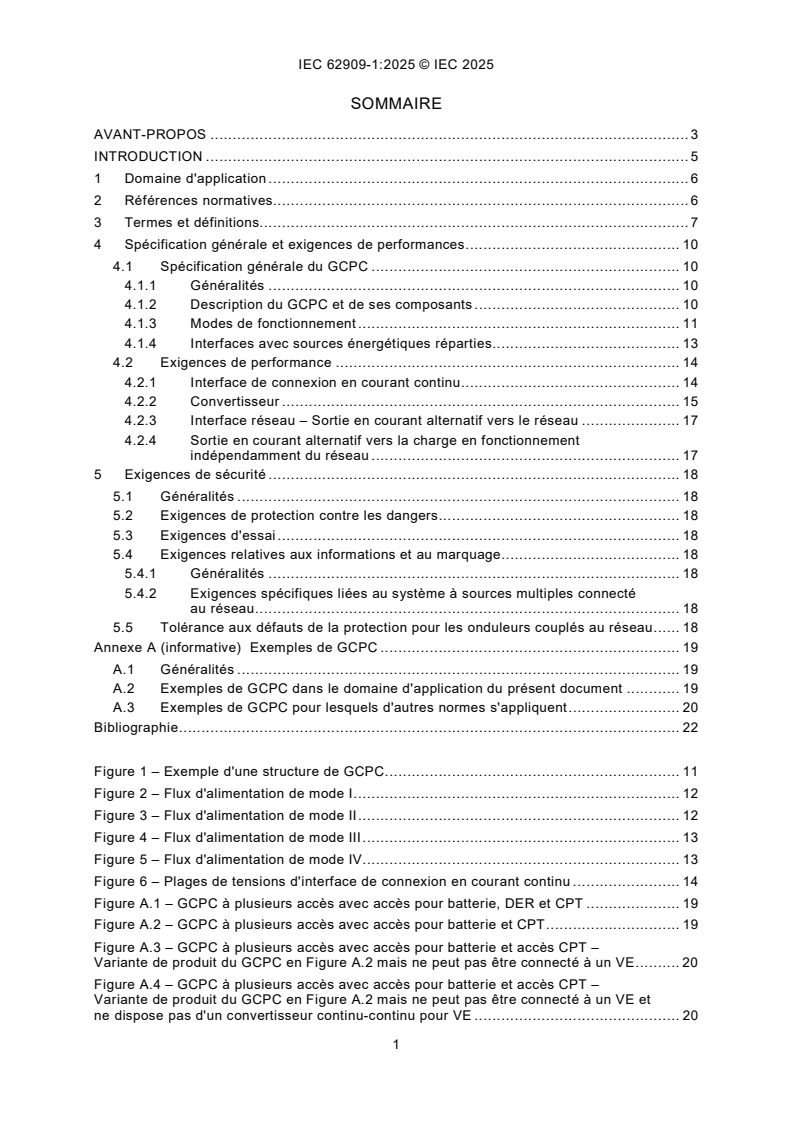
IEC 62909-1:2025 - Convertisseurs de puissance connectés aux réseaux bidirectionnels - Partie 1: Exigences générales et de sécurité Released:7/2/2025
IEC 62909-1:2025 - Bi-directional grid-connected power converters - Part 1: General and safety requirements Released:7/2/2025
Overview
IEC 62909-1:2025 - "Bi-directional grid-connected power converters - Part 1: General and safety requirements" defines the general and safety aspects of multi‑port bi‑directional grid‑connected power converters (GCPC). It applies to GCPCs that combine a grid‑side inverter with two or more types of DC power ports for application‑side connections, with system voltages up to 1 000 V AC or 1 500 V DC. The standard addresses terminology, system architecture, specification and performance requirements, safety, testing and marking. It also clarifies scope changes in the 2025 edition (title expanded to include “and safety”).
Key topics and requirements
- Scope and terminology
- Definitions for GCPC, DC power port, DC‑connection interface, grid‑interactive inverter and related terms.
- General specification and performance
- Requirements for DC‑connection interfaces and converter performance, AC grid interface behavior and AC output under grid‑independent operation.
- Operating modes and power‑flow diagrams for common GCPC configurations.
- System architecture
- Description of component relationships (DC/DC converters, internal DC bus, grid‑side inverter) and interfaces to distributed energy sources.
- Safety and hazard protection
- General safety objectives, fault‑tolerance of protection functions for grid‑interactive inverters, and hazard‑protection tests.
- Test, marking and information
- Type test requirements, performance verification and mandatory information/marking (including requirements specific to multiple‑source systems).
- Informative examples
- Annex A illustrates GCPC variants that are covered or not covered by the document to aid product classification.
Practical applications and users
IEC 62909-1:2025 is intended for:
- Manufacturers of multi‑port inverters and converter subsystems designing products that interface batteries, distributed energy resources (DERs) and other DC sources to the grid.
- System integrators and installers implementing distributed energy and home/commercial energy‑management systems that use GCPCs.
- Test laboratories and certification bodies performing type testing, safety assessment and compliance verification.
- Utilities and asset owners assessing interoperability, safety and grid‑behavior of bidirectional converters in distributed energy and storage projects.
The standard supports safe, interoperable transfer between DC storage/generation and AC grids - a foundation for residential and commercial energy management, battery energy storage and DER aggregation.
Related standards
- IEC 62109 series - photovoltaic power converter safety (PV-specific)
- IEC 61851 series - EV charging systems (vehicle/charger coupling)
- IEC 62040 series - UPS systems
- IEC 62477-1 - safety for power electronic converter systems
- IEC TS 62786-1 and the forthcoming IEC 63285 series - related grid‑connection and energy storage converter topics
Keywords: bi‑directional grid‑connected power converters, GCPC, safety requirements, DC power ports, grid‑interactive inverter, IEC 62909-1.
Relations
- Revises
IEC 62909-1:2017 - Bi-directional grid connected power converters - Part 1: General requirements - Effective Date
- 05-Sep-2023
Buy Documents
IEC 62909-1:2025 - Bi-directional grid-connected power converters - Part 1: General and safety requirements Released:7/2/2025
IEC 62909-1:2025 - Convertisseurs de puissance connectés aux réseaux bidirectionnels - Partie 1: Exigences générales et de sécurité Released:7/2/2025
IEC 62909-1:2025 - Bi-directional grid-connected power converters - Part 1: General and safety requirements Released:7/2/2025
Get Certified
Connect with accredited certification bodies for this standard

IMQ S.p.A. (Certification)
Italian electrical product certification.

SLG Prüf- und Zertifizierungs GmbH
German testing and certification body.

UL Solutions
Global safety science company with testing, inspection and certification.
Sponsored listings
Frequently Asked Questions
IEC 62909-1:2025 is a standard published by the International Electrotechnical Commission (IEC). Its full title is "Bi-directional grid-connected power converters - Part 1: General and safety requirements". This standard covers: IEC 62909-1:2025 specifies general and safety aspects of bi-directional grid-connected power converters (GCPC), consisting of a grid-side inverter with two or more types of DC power ports on the application side with system voltages not exceeding 1 000 V AC or 1 500 V DC. This document can also be used for the special case of a multiple DC power port GCPC used in an application requiring only one DC power port. This document considers general aspects such as terminology, specifications, performance, system architecture, as well as safety requirements. This document does not cover: - uninterruptible power supply (UPS) systems, which fall under the scope of the IEC 62040 series, - power conversion equipment for use in photovoltaic systems, which fall under the scope of the IEC 62109 series, and - bi-directional power converters to charge or discharge the batteries located within electric vehicles or in the charging station, which fall under the scope of the IEC 61851 series. NOTE 1 The external system (e.g. energy management system, utility operations system) is not defined in this document. NOTE 2 The power converter sub-system case for use in electrical energy storage systems is currently covered by this document but will be covered by the IEC 63285 series (under preparation). NOTE 3 Annex A provides examples of GCPCs. These examples contain GCPCs covered and not covered by this document. This second edition includes the following significant technical changes with respect to the previous edition: a) the title has been changed by adding the wording "and safety"; b) the scope has been changed in order to clarify the bi-directional grid-connected power converters (GCPCs) covered by this document.
IEC 62909-1:2025 specifies general and safety aspects of bi-directional grid-connected power converters (GCPC), consisting of a grid-side inverter with two or more types of DC power ports on the application side with system voltages not exceeding 1 000 V AC or 1 500 V DC. This document can also be used for the special case of a multiple DC power port GCPC used in an application requiring only one DC power port. This document considers general aspects such as terminology, specifications, performance, system architecture, as well as safety requirements. This document does not cover: - uninterruptible power supply (UPS) systems, which fall under the scope of the IEC 62040 series, - power conversion equipment for use in photovoltaic systems, which fall under the scope of the IEC 62109 series, and - bi-directional power converters to charge or discharge the batteries located within electric vehicles or in the charging station, which fall under the scope of the IEC 61851 series. NOTE 1 The external system (e.g. energy management system, utility operations system) is not defined in this document. NOTE 2 The power converter sub-system case for use in electrical energy storage systems is currently covered by this document but will be covered by the IEC 63285 series (under preparation). NOTE 3 Annex A provides examples of GCPCs. These examples contain GCPCs covered and not covered by this document. This second edition includes the following significant technical changes with respect to the previous edition: a) the title has been changed by adding the wording "and safety"; b) the scope has been changed in order to clarify the bi-directional grid-connected power converters (GCPCs) covered by this document.
IEC 62909-1:2025 is classified under the following ICS (International Classification for Standards) categories: 29.200 - Rectifiers. Convertors. Stabilized power supply. The ICS classification helps identify the subject area and facilitates finding related standards.
IEC 62909-1:2025 has the following relationships with other standards: It is inter standard links to IEC 62909-1:2017. Understanding these relationships helps ensure you are using the most current and applicable version of the standard.
IEC 62909-1:2025 is available in PDF format for immediate download after purchase. The document can be added to your cart and obtained through the secure checkout process. Digital delivery ensures instant access to the complete standard document.
Standards Content (Sample)
IEC 62909-1 ®
Edition 2.0 2025-07
INTERNATIONAL
STANDARD
Bi-directional grid-connected power converters –
Part 1: General and safety requirements
ICS 29.200 ISBN 978-2-8327-0522-3
All rights reserved. Unless otherwise specified, no part of this publication may be reproduced or utilized in any form or
by any means, electronic or mechanical, including photocopying and microfilm, without permission in writing from either
IEC or IEC's member National Committee in the country of the requester. If you have any questions about IEC copyright
or have an enquiry about obtaining additional rights to this publication, please contact the address below or your local
IEC member National Committee for further information.
IEC Secretariat Tel.: +41 22 919 02 11
3, rue de Varembé info@iec.ch
CH-1211 Geneva 20 www.iec.ch
Switzerland
About the IEC
The International Electrotechnical Commission (IEC) is the leading global organization that prepares and publishes
International Standards for all electrical, electronic and related technologies.
About IEC publications
The technical content of IEC publications is kept under constant review by the IEC. Please make sure that you have the
latest edition, a corrigendum or an amendment might have been published.
IEC publications search - IEC Products & Services Portal - products.iec.ch
webstore.iec.ch/advsearchform Discover our powerful search engine and read freely all the
The advanced search enables to find IEC publications by a
publications previews, graphical symbols and the glossary.
variety of criteria (reference number, text, technical With a subscription you will always have access to up to date
committee, …). It also gives information on projects, content tailored to your needs.
replaced and withdrawn publications.
Electropedia - www.electropedia.org
IEC Just Published - webstore.iec.ch/justpublished The world's leading online dictionary on electrotechnology,
Stay up to date on all new IEC publications. Just Published containing more than 22 500 terminological entries in English
details all new publications released. Available online and and French, with equivalent terms in 25 additional languages.
once a month by email. Also known as the International Electrotechnical Vocabulary
(IEV) online.
IEC Customer Service Centre - webstore.iec.ch/csc
If you wish to give us your feedback on this publication or
need further assistance, please contact the Customer
Service Centre: sales@iec.ch.
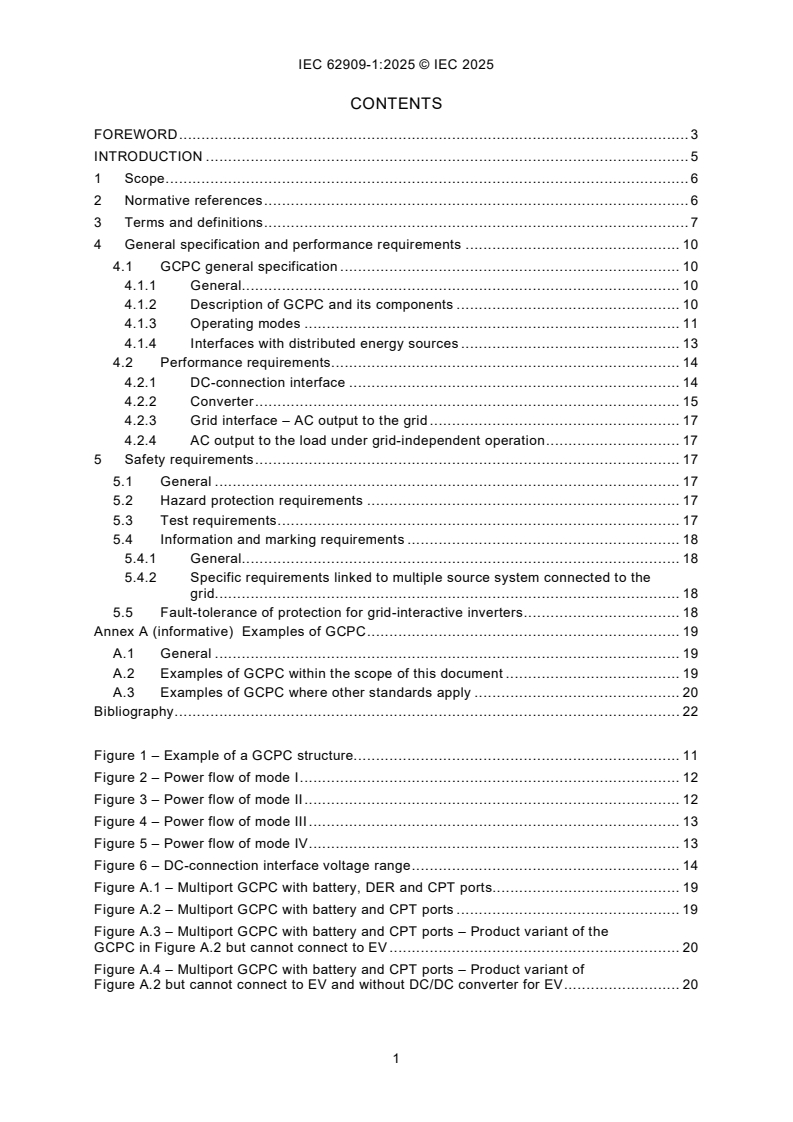
CONTENTS
FOREWORD . 3
INTRODUCTION . 5
1 Scope . 6
2 Normative references . 6
3 Terms and definitions . 7
4 General specification and performance requirements . 10
4.1 GCPC general specification . 10
4.1.1 General. 10
4.1.2 Description of GCPC and its components . 10
4.1.3 Operating modes . 11
4.1.4 Interfaces with distributed energy sources . 13
4.2 Performance requirements . 14
4.2.1 DC-connection interface . 14
4.2.2 Converter . 15
4.2.3 Grid interface – AC output to the grid . 17
4.2.4 AC output to the load under grid-independent operation . 17
5 Safety requirements . 17
5.1 General . 17
5.2 Hazard protection requirements . 17
5.3 Test requirements . 17
5.4 Information and marking requirements . 18
5.4.1 General. 18
5.4.2 Specific requirements linked to multiple source system connected to the
grid. 18
5.5 Fault-tolerance of protection for grid-interactive inverters . 18
Annex A (informative) Examples of GCPC . 19
A.1 General . 19
A.2 Examples of GCPC within the scope of this document . 19
A.3 Examples of GCPC where other standards apply . 20
Bibliography . 22
Figure 1 – Example of a GCPC structure. 11
Figure 2 – Power flow of mode I . 12
Figure 3 – Power flow of mode II . 12
Figure 4 – Power flow of mode III . 13
Figure 5 – Power flow of mode IV . 13
Figure 6 – DC-connection interface voltage range . 14
Figure A.1 – Multiport GCPC with battery, DER and CPT ports. 19
Figure A.2 – Multiport GCPC with battery and CPT ports . 19
Figure A.3 – Multiport GCPC with battery and CPT ports – Product variant of the
GCPC in Figure A.2 but cannot connect to EV . 20
Figure A.4 – Multiport GCPC with battery and CPT ports – Product variant of
Figure A.2 but cannot connect to EV and without DC/DC converter for EV . 20
Figure A.5 – Equipment in scope of IEC 61851 series: GCPC with a CPT port . 20
Figure A.6 – Equipment in scope of IEC 63285 series: GCPC with a battery port . 21
Figure A.7 – Equipment in scope of the IEC 62109 series: multiport Bi-directional PEC . 21
Table 1 – Alphabetical list of terms . 7
INTERNATIONAL ELECTROTECHNICAL COMMISSION
____________
Bi-directional grid-connected power converters -
Part 1: General and safety requirements
FOREWORD
1) The International Electrotechnical Commission (IEC) is a worldwide organization for standardization comprising
all national electrotechnical committees (IEC National Committees). The object of IEC is to promote international
co-operation on all questions concerning standardization in the electrical and electronic fields. To this end and
in addition to other activities, IEC publishes International Standards, Technical Specifications, Technical Reports,
Publicly Available Specifications (PAS) and Guides (hereafter referred to as "IEC Publication(s)"). Their
preparation is entrusted to technical committees; any IEC National Committee interested in the subject dealt with
may participate in this preparatory work. International, governmental and non-governmental organizations liaising
with the IEC also participate in this preparation. IEC collaborates closely with the International Organization for
Standardization (ISO) in accordance with conditions determined by agreement between the two organizations.
2) The formal decisions or agreements of IEC on technical matters express, as nearly as possible, an international
consensus of opinion on the relevant subjects since each technical committee has representation from all
interested IEC National Committees.
3) IEC Publications have the form of recommendations for international use and are accepted by IEC National
Committees in that sense. While all reasonable efforts are made to ensure that the technical content of IEC
Publications is accurate, IEC cannot be held responsible for the way in which they are used or for any
misinterpretation by any end user.
4) In order to promote international uniformity, IEC National Committees undertake to apply IEC Publications
transparently to the maximum extent possible in their national and regional publications. Any divergence between
any IEC Publication and the corresponding national or regional publication shall be clearly indicated in the latter.
5) IEC itself does not provide any attestation of conformity. Independent certification bodies provide conformity
assessment services and, in some areas, access to IEC marks of conformity. IEC is not responsible for any
services carried out by independent certification bodies.
6) All users should ensure that they have the latest edition of this publication.
7) No liability shall attach to IEC or its directors, employees, servants or agents including individual experts and
members of its technical committees and IEC National Committees for any personal injury, property damage or
other damage of any nature whatsoever, whether direct or indirect, or for costs (including legal fees) and
expenses arising out of the publication, use of, or reliance upon, this IEC Publication or any other IEC
Publications.
8) Attention is drawn to the Normative references cited in this publication. Use of the referenced publications is
indispensable for the correct application of this publication.
9) IEC draws attention to the possibility that the implementation of this document may involve the use of (a)
patent(s). IEC takes no position concerning the evidence, validity or applicability of any claimed patent rights in
respect thereof. As of the date of publication of this document, IEC had not received notice of (a) patent(s), which
may be required to implement this document. However, implementers are cautioned that this may not represent
the latest information, which may be obtained from the patent database available at https://patents.iec.ch. IEC
shall not be held responsible for identifying any or all such patent rights.
IEC 62909-1 has been prepared by subcommittee 22E: Stabilized power supplies, of IEC
technical committee 22: Power electronic systems and equipment. It is an International
Standard.
This second edition replaces the first edition published in 2017. This edition constitutes a
technical revision.
This edition includes the following significant technical changes with respect to the previous
edition:
a) the title has been changed by adding the wording "and safety";
b) the scope has been changed in order to clarify the bi-directional grid-connected power
converters (GCPCs) covered by this document.
The text of this International Standard is based on the following documents:
Draft Report on voting
22E/288/FDIS 22E/292/RVD
Full information on the voting for its approval can be found in the report on voting indicated in
the above table.
The language used for the development of this International Standard is English.
This document was drafted in accordance with ISO/IEC Directives, Part 2, and developed in
accordance with ISO/IEC Directives, Part 1 and ISO/IEC Directives, IEC Supplement, available
at www.iec.ch/members_experts/refdocs. The main document types developed by IEC are
described in greater detail at www.iec.ch/publications.
A list of all parts in the IEC 62909 series, published under the general title Bi-directional grid-
connected power converters, can be found on the IEC website.
The committee has decided that the contents of this document will remain unchanged until the
stability date indicated on the IEC website under webstore.iec.ch in the data related to the
specific document. At this date, the document will be
– reconfirmed,
– withdrawn, or
– revised.
INTRODUCTION
The solution to global warming and fossil fuel depletion requires an expansion of renewable
energy and the spread of distributed energy sources. For example, energy management
systems are especially suited to increasing energy-usage efficiency and reducing power
consumption of residential and commercial.
In order to optimize the power consumption within the home power management, it is important
to optimally combine electricity generation with rechargeable energy storage such as electric
vehicles and battery systems. This optimization is accomplished, in part, by providing an
efficient transfer between DC and AC electricity to accommodate storage batteries. The
IEC 62909 series describes a bi-directional grid-connected power converter (GCPC) efficiently
connected to sources of power generation and energy storage.
This document provides common general and safety requirements independent of special
characteristics of individual applications.
1 Scope
This part of IEC 62909 specifies general and safety aspects of bi-directional grid-connected
power converters (GCPC), consisting of a grid-side inverter with two or more types of DC power
ports on the application side with system voltages not exceeding 1 000 V AC or 1 500 V DC.
This document can also be used for the special case of a multiple DC power port GCPC used
in an application requiring only one DC power port.
This document considers general aspects such as terminology, specifications, performance,
system architecture, as well as safety requirements.
This document does not cover
– uninterruptible power supply (UPS) systems, which fall under the scope of the IEC 62040
series,
– power conversion equipment for use in photovoltaic systems, which fall under the scope of
the IEC 62109 series, and
– bi-directional power converters to charge or discharge the batteries located within electric
vehicles or in the charging station, which fall under the scope of the IEC 61851 series.
NOTE 1 The external system (e.g. energy management system, utility operations system) is not defined in this
document.
NOTE 2 The power converter sub-system case for use in electrical energy storage systems is currently covered by
this document but will be covered by the IEC 63285 series .
NOTE 3 Annex A provides examples of GCPCs. These examples contain GCPCs covered and not covered by this
document.
2 Normative references
The following documents are referred to in the text in such a way that some or all of their content
constitutes requirements of this document. For dated references, only the edition cited applies.
For undated references, the latest edition of the referenced document (including any
amendments) applies.
IEC 60038:2009, IEC standard voltages
IEC 60038:2009/AMD1:2021
IEC 60146-2:1999, Semiconductor converters - Part 2: Self-commutated semiconductor
converters including direct d.c. converters
IEC 62040-3:2021, Uninterruptible power systems (UPS) - Part 3: Method of specifying the
performance and test requirements
IEC 62109-1:2010, Safety of power converters for use in photovoltaic power systems - Part 1:
General requirements
IEC 62477-1:2022, Safety requirements for power electronic converter systems and equipment
- Part 1: General
IEC TS 62786-1:2023, Distributed energy resources connection with the grid - Part 1: General
requirements
___________
Under preparation.
3 Terms and definitions
For the purposes of this document, the following terms and definitions apply.
ISO and IEC maintain terminological databases for use in standardization at the following
addresses:
– IEC Electropedia: available at https://www.electropedia.org/
– ISO Online browsing platform: available at https://www.iso.org/obp
Table 1 provides an alphabetical cross-reference listing of terms.
Table 1 – Alphabetical list of terms
Term Term Term
Term Term Term
number number number
bi-directional grid-independent
3.1 3.9 hot plug 3.16
inverter operation
DC-connection 3.2 grid-interactive inverter 3.10 ripple voltage 3.17
interface
DC power port 3.3 grid isolation 3.11 start-up maximum 3.18
current
DC/DC converter 3.4 installation 3.12 system 3.19
distributed energy 3.5 modulation index 3.13 system voltage 3.20
sources
grid 3.6 nominal operation voltage 3.14 type test 3.21
range
grid connection 3.7 power electronic 3.15
converter
bi-directional grid- 3.8
connected power
converter
3.1
bi-directional inverter
equipment capable of converting active electrical power from AC to DC and DC to AC
3.2
DC-connection interface
internal system DC bus between DC/DC converter and bi-directional inverter, or between DC
power port and bi-directional inverter
3.3
DC power port
interface between the DC/DC converter and distributed energy sources or, in the case where
the DC-connection interface is directly connected to distributed energy sources without DC/DC
converter, between the DC-connection interface and the distributed energy sources
3.4
DC/DC converter
equipment that converts one DC voltage to another DC voltage
3.5
distributed energy sources
DC power sources either generating or storing electricity near the consuming area
EXAMPLE Photovoltaic cells, fuel cells, wind and water power generators, primary batteries, accumulators (e.g. in
electrical vehicles).
3.6
grid
installations and plant provided for the purpose of generating, transmitting and distributing
electricity
[SOURCE: IEC 60050-601:1985, 601-01-01, modified – The defined terms "electric power
system" and "electricity supply system" have been replaced with "grid".]
3.7
grid connection
distributed energy sources' connection to the grid through a GCPC
3.8
bi-directional grid-connected power converter
grid-connected power converter
GCPC
power converter with multiple DC power ports connected to an AC mains power distribution
network or other AC mains installation and used in a power generating system
3.9
grid-independent operation
electricity supply through a GCPC to an AC load during grid isolation
3.10
grid-interactive inverter
inverter or inverter function intended to export power to the grid
Note 1 to entry: Also commonly referred to as "grid-connected", "grid-tied", "utility-interactive". Power exported can
be in excess of the local load but this is not necessarily the case.
3.11
grid isolation
disconnection of a GCPC from the grid
3.12
installation
apparatus or set of devices associated in a given location to fulfil specified purposes, including
all means for their satisfactory operation
[SOURCE: IEC 60050-151:2001, 151-11-26, modified – The words "and/or apparatuses" have
been rem
...
IEC 62909-1 ®
Edition 2.0 2025-07
NORME
INTERNATIONALE
Convertisseurs de puissance connectés aux réseaux bidirectionnels –
Partie 1: Exigences générales et de sécurité
ICS 29.200 ISBN 978-2-8327-0522-3
Droits de reproduction réservés. Sauf indication contraire, aucune partie de cette publication ne peut être reproduite ni
utilisée sous quelque forme que ce soit et par aucun procédé, électronique ou mécanique, y compris la photocopie et
les microfilms, sans l'accord écrit de l'IEC ou du Comité national de l'IEC du pays du demandeur. Si vous avez des
questions sur le copyright de l'IEC ou si vous désirez obtenir des droits supplémentaires sur cette publication, utilisez
les coordonnées ci-après ou contactez le Comité national de l'IEC de votre pays de résidence.
IEC Secretariat Tel.: +41 22 919 02 11
3, rue de Varembé info@iec.ch
CH-1211 Geneva 20 www.iec.ch
Switzerland
A propos de l'IEC
La Commission Electrotechnique Internationale (IEC) est la première organisation mondiale qui élabore et publie des
Normes internationales pour tout ce qui a trait à l'électricité, à l'électronique et aux technologies apparentées.
A propos des publications IEC
Le contenu technique des publications IEC est constamment revu. Veuillez vous assurer que vous possédez l’édition la
plus récente, un corrigendum ou amendement peut avoir été publié.
Recherche de publications IEC - IEC Products & Services Portal - products.iec.ch
webstore.iec.ch/advsearchform Découvrez notre puissant moteur de recherche et consultez
La recherche avancée permet de trouver des publications gratuitement tous les aperçus des publications, symboles
IEC en utilisant différents critères (numéro de référence, graphiques et le glossaire. Avec un abonnement, vous aurez
texte, comité d’études, …). Elle donne aussi des toujours accès à un contenu à jour adapté à vos besoins.
informations sur les projets et les publications remplacées
ou retirées. Electropedia - www.electropedia.org
Le premier dictionnaire d'électrotechnologie en ligne au
IEC Just Published - webstore.iec.ch/justpublished monde, avec plus de 22 500 articles terminologiques en
Restez informé sur les nouvelles publications IEC. Just anglais et en français, ainsi que les termes équivalents
Published détaille les nouvelles publications parues. dans 25 langues additionnelles. Egalement appelé
Disponible en ligne et une fois par mois par email. Vocabulaire Electrotechnique International (IEV) en ligne.
Service Clients - webstore.iec.ch/csc
Si vous désirez nous donner des commentaires sur cette
publication ou si vous avez des questions contactez-
nous: sales@iec.ch.
SOMMAIRE
AVANT-PROPOS . 3
INTRODUCTION . 5
1 Domaine d'application . 6
2 Références normatives . 6
3 Termes et définitions. 7
4 Spécification générale et exigences de performances . 10
4.1 Spécification générale du GCPC . 10
4.1.1 Généralités . 10
4.1.2 Description du GCPC et de ses composants . 10
4.1.3 Modes de fonctionnement . 11
4.1.4 Interfaces avec sources énergétiques réparties . 13
4.2 Exigences de performance . 14
4.2.1 Interface de connexion en courant continu . 14
4.2.2 Convertisseur . 15
4.2.3 Interface réseau – Sortie en courant alternatif vers le réseau . 17
4.2.4 Sortie en courant alternatif vers la charge en fonctionnement
indépendamment du réseau . 17
5 Exigences de sécurité . 18
5.1 Généralités . 18
5.2 Exigences de protection contre les dangers . 18
5.3 Exigences d'essai . 18
5.4 Exigences relatives aux informations et au marquage . 18
5.4.1 Généralités . 18
5.4.2 Exigences spécifiques liées au système à sources multiples connecté
au réseau . 18
5.5 Tolérance aux défauts de la protection pour les onduleurs couplés au réseau . 18
Annexe A (informative) Exemples de GCPC . 19
A.1 Généralités . 19
A.2 Exemples de GCPC dans le domaine d'application du présent document . 19
A.3 Exemples de GCPC pour lesquels d'autres normes s'appliquent . 20
Bibliographie . 22
Figure 1 – Exemple d'une structure de GCPC . 11
Figure 2 – Flux d'alimentation de mode I . 12
Figure 3 – Flux d'alimentation de mode II . 12
Figure 4 – Flux d'alimentation de mode III . 13
Figure 5 – Flux d'alimentation de mode IV . 13
Figure 6 – Plages de tensions d'interface de connexion en courant continu . 14
Figure A.1 – GCPC à plusieurs accès avec accès pour batterie, DER et CPT . 19
Figure A.2 – GCPC à plusieurs accès avec accès pour batterie et CPT . 19
Figure A.3 – GCPC à plusieurs accès avec accès pour batterie et accès CPT –
Variante de produit du GCPC en Figure A.2 mais ne peut pas être connecté à un VE . 20
Figure A.4 – GCPC à plusieurs accès avec accès pour batterie et accès CPT –
Variante de produit du GCPC en Figure A.2 mais ne peut pas être connecté à un VE et
ne dispose pas d'un convertisseur continu-continu pour VE . 20
Figure A.5 – Matériels dans le domaine d'application de la série IEC 61851: GCPC
avec un accès CPT . 20
Figure A.6 – Matériels dans le domaine d'application de la série IEC 63285: GCPC
avec un accès pour batterie . 21
Figure A.7 – Matériels dans le domaine d'application de la série IEC 62109: CEP à
plusieurs accès unidirectionnels . 21
Tableau 1 – Liste alphabétique des termes . 7
COMMISSION ÉLECTROTECHNIQUE INTERNATIONALE
____________
Convertisseurs de puissance connectés aux réseaux bidirectionnels -
Partie 1: Exigences générales et de sécurité
AVANT-PROPOS
1) La Commission Électrotechnique Internationale (IEC) est une organisation mondiale de normalisation composée
de l'ensemble des comités électrotechniques nationaux (Comités nationaux de l'IEC). L'IEC a pour objet de
favoriser la coopération internationale pour toutes les questions de normalisation dans les domaines de
l'électricité et de l'électronique. À cet effet, l'IEC – entre autres activités – publie des Normes internationales,
des Spécifications techniques, des Rapports techniques, des Spécifications accessibles au public (PAS) et des
Guides (ci-après dénommés "Publication(s) de l'IEC"). Leur élaboration est confiée à des comités d'études, aux
travaux desquels tout Comité national intéressé par le sujet traité peut participer. Les organisations
internationales, gouvernementales et non gouvernementales, en liaison avec l'IEC, participent également aux
travaux. L'IEC collabore étroitement avec l'Organisation Internationale de Normalisation (ISO), selon des
conditions fixées par accord entre les deux organisations.
2) Les décisions ou accords officiels de l'IEC concernant les questions techniques représentent, dans la mesure du
possible, un accord international sur les sujets étudiés, étant donné que les Comités nationaux de l'IEC intéressés
sont représentés dans chaque comité d'études.
3) Les Publications de l'IEC se présentent sous la forme de recommandations internationales et sont agréées
comme telles par les Comités nationaux de l'IEC. Tous les efforts raisonnables sont entrepris afin que l'IEC
s'assure de l'exactitude du contenu technique de ses publications; l'IEC ne peut pas être tenue responsable de
l'éventuelle mauvaise utilisation ou interprétation qui en est faite par un quelconque utilisateur final.
4) Dans le but d'encourager l'uniformité internationale, les Comités nationaux de l'IEC s'engagent, dans toute la
mesure possible, à appliquer de façon transparente les Publications de l'IEC dans leurs publications nationales
et régionales. Toutes divergences entre toutes Publications de l'IEC et toutes publications nationales ou
régionales correspondantes doivent être indiquées en termes clairs dans ces dernières.
5) L'IEC elle-même ne fournit aucune attestation de conformité. Des organismes de certification indépendants
fournissent des services d'évaluation de conformité et, dans certains secteurs, accèdent aux marques de
conformité de l'IEC. L'IEC n'est responsable d'aucun des services effectués par les organismes de certification
indépendants.
6) Tous les utilisateurs doivent s'assurer qu'ils sont en possession de la dernière édition de cette publication.
7) Aucune responsabilité ne doit être imputée à l'IEC, à ses administrateurs, employés, auxiliaires ou mandataires,
y compris ses experts particuliers et les membres de ses comités d'études et des Comités nationaux de l'IEC,
pour tout préjudice causé en cas de dommages corporels et matériels, ou de tout autre dommage de quelque
nature que ce soit, directe ou indirecte, ou pour supporter les coûts (y compris les frais de justice) et les dépenses
découlant de la publication ou de l'utilisation de cette Publication de l'IEC ou de toute autre Publication de l'IEC,
ou au crédit qui lui est accordé.
8) L'attention est attirée sur les références normatives citées dans cette publication. L'utilisation de publications
référencées est obligatoire pour une application correcte de la présente publication.
9) L'IEC attire l'attention sur le fait que la mise en application du présent document peut entraîner l'utilisation d'un
ou de plusieurs brevets. L'IEC ne prend pas position quant à la preuve, à la validité et à l'applicabilité de tout
droit de brevet revendiqué à cet égard. À la date de publication du présent document, l'IEC n'a pas reçu
notification qu'un ou plusieurs brevets pouvaient être nécessaires à sa mise en application. Toutefois, il y a lieu
d'avertir les responsables de la mise en application du présent document que des informations plus récentes
sont susceptibles de figurer dans la base de données de brevets, disponible à l'adresse https://patents.iec.ch.
L'IEC ne saurait être tenue pour responsable de ne pas avoir identifié de tels droits de brevets.
L'IEC 62909-1 a été établie par le sous-comité 22E: Alimentations stabilisées, du comité
d'études 22 de l'IEC: Systèmes et équipements électroniques de puissance. Il s'agit d'une
Norme internationale.
Cette deuxième édition remplace la première édition parue en 2017. Cette édition constitue une
révision technique.
Cette édition inclut les modifications techniques majeures suivantes par rapport à l'édition
précédente:
a) le titre a été modifié par l'ajout de la mention "et exigences de sécurité";
b) le domaine d'application a été modifié afin de préciser les convertisseurs de puissance
connectés aux réseaux bidirectionnels (GCPC) couverts par le présent document.
Le texte de cette Norme internationale est issu des documents suivants:
Projet Rapport de vote
22E/288/FDIS 22E/292/RVD
Le rapport de vote indiqué dans le tableau ci-dessus donne toute information sur le vote ayant
abouti à son approbation.
La langue employée pour l'élaboration de cette Norme internationale est l'anglais.
Ce document a été rédigé selon les Directives ISO/IEC, Partie 2, il a été développé selon les
Directives ISO/IEC, Partie 1 et les Directives ISO/IEC, Supplément IEC, disponibles sous
www.iec.ch/members_experts/refdocs. Les principaux types de documents développés par
l'IEC sont décrits plus en détail sous www.iec.ch/publications.
Une liste de toutes les parties de la série IEC 62909, publiées sous le titre général
Convertisseurs de puissance connectés aux réseaux bidirectionnels, se trouve sur le site web
de l'IEC.
Le comité a décidé que le contenu de ce document ne sera pas modifié avant la date de stabilité
indiquée sur le site web de l'IEC sous webstore.iec.ch dans les données relatives au document
recherché. À cette date, le document sera
– reconduit,
– supprimé, ou
– révisé.
INTRODUCTION
Le réchauffement climatique et l'appauvrissement des combustibles fossiles exigent de
développer les énergies renouvelables et les sources énergétiques réparties. Les systèmes de
gestion de l'énergie conviennent, par exemple, particulièrement à l'augmentation de l'efficacité
énergétique et à la réduction de la consommation d'énergie pour les secteurs résidentiel et
commercial.
Afin d'optimiser la consommation d'énergie dans le cadre de la gestion de l'énergie domestique,
il est important de combiner de manière optimale la production d'électricité avec un système de
stockage de l'énergie rechargeable tel qu'un véhicule électrique ou un système de batteries.
Cette optimisation est obtenue, en partie, par la mise en place d'un transfert efficace entre
l'électricité en courant continu et en courant alternatif, qui permet d'utiliser des accumulateurs.
La série IEC 62909 décrit un convertisseur de puissance connecté au réseau bidirectionnel
(GCPC) connecté de manière efficace aux sources de production et de stockage d'énergie.
Le présent document fournit des exigences générales et des exigences de sécurité communes
qui ne dépendent pas des caractéristiques spécifiques des applications individuelles.
1 Domaine d'application
La présente partie de l'IEC 62909 spécifie les aspects généraux et les aspects de sécurité des
convertisseurs de puissance connectés aux réseaux bidirectionnels (GCPC), composés d'un
onduleur côté réseau avec plusieurs types d'accès d'alimentation en courant continu côté
application avec des tensions systèmes qui ne dépassent pas 1 000 V en courant alternatif ou
1 500 V en courant continu.
Le présent document peut également être utilisé dans le cas particulier qui consiste à utiliser
un GCPC équipé de plusieurs accès d'alimentation en courant continu dans une application qui
ne nécessite qu'un seul accès d'alimentation en courant continu.
Le présent document traite des aspects généraux tels que la terminologie, les spécifications,
les performances, l'architecture système ainsi que les exigences de sécurité.
Le présent document ne couvre pas
– les systèmes d'alimentation sans interruption (ASI), qui relèvent du domaine d'application
de la série IEC 62040,
– les équipements de conversion de puissance utilisés dans les systèmes photovoltaïques,
qui relèvent du domaine d'application de la série IEC 62109, ni
– les convertisseurs de puissance bidirectionnels avec un seul accès utilisés pour la charge
et la décharge de batteries installées dans des véhicules électriques ou dans la borne de
charge, qui relèvent du domaine d'application de la série IEC 61851.
NOTE 1 Le système externe (par exemple, système de gestion de l'énergie, système d'exploitation des services
publics) n'est pas défini dans le présent document.
NOTE 2 Le cas du sous-système de convertisseur de puissance utilisé dans les systèmes de stockage de l'énergie
électrique est actuellement couvert par le présent document, mais il relèvera de la série IEC 63285.
NOTE 3 L'Annexe A présente des exemples de GCPC. Ces exemples comprennent des GCPC couverts et des
GCPC non couverts par le présent document.
2 Références normatives
Les documents suivants sont cités dans le texte de sorte qu'ils constituent, pour tout ou partie
de leur contenu, des exigences du présent document. Pour les références datées, seule
l'édition citée s'applique. Pour les références non datées, la dernière édition du document de
référence s'applique (y compris les éventuels amendements).
IEC 60038:2009, Tensions normales de l'IEC
IEC 60038:2009/AMD1:2021
IEC 60146-2:1999, Convertisseurs à semiconducteurs - Partie 2: Convertisseurs autocommutés
à semiconducteurs y compris les convertisseurs à courant continu directs
IEC 62040-3:2021, Alimentations sans interruption (ASI) - Partie 3: Méthode de spécification
des performances et exigences d'essai
IEC 62109-1:2010, Sécurité des convertisseurs de puissance utilisés dans les systèmes
photovoltaïques - Partie 1: Exigences générales
___________
En cours d’élaboration.
IEC 62477-1:2022, Exigences de sécurité applicables aux systèmes et matériels électroniques
de conversion de puissance - Partie 1: Généralités
IEC TS 62786-1:2023, Distributed energy resources connection with the grid - Part 1: General
requirements
3 Termes et définitions
Pour les besoins du présent document, les termes et définitions suivants s'appliquent.
L'ISO et l'IEC tiennent à jour des bases de données terminologiques destinées à être utilisées
en normalisation, consultables aux adresses suivantes:
– IEC Electropedia: disponible à l'adresse https://www.electropedia.org/
– ISO Online browsing platform: disponible à l'adresse https://www.iso.org/obp
Le Tableau 1 fournit une liste de référence alphabétique des différents termes utilisés.
Tableau 1 – Liste alphabétique des termes
Numéro Numéro Numéro
Terme du Terme du Terme du
terme terme terme
onduleur 3.1 fonctionnement 3.9 connexion à chaud 3.16
bidirectionnel indépendamment du
réseau
interface de 3.2 onduleur couplé au 3.10 tension d'ondulation 3.17
connexion en réseau
courant continu
accès de puissance 3.3 isolation du réseau 3.11 courant de démarrage 3.18
en courant continu maximal
convertisseur 3.4 installation 3.12 système 3.19
continu-continu
sources 3.5 indice de modulation 3.13 tension du réseau 3.20
énergétiques
réparties
réseau (d'énergie) 3.6 plage de tensions de 3.14 essai de type 3.21
électrique fonctionnement
nominales
raccordement au 3.7 convertisseur 3.15
réseau électronique de
puissance
convertisseur de 3.8
puissance connecté
au réseau
bidirectionnel
3.1
onduleur bidirectionnel
matériel capable de convertir une puissance électrique active de courant alternatif en courant
continu et de courant continu en courant alternatif
3.2
interface de connexion en courant continu
bus en courant continu de système interne entre le convertisseur continu-continu et l'onduleur
bidirectionnel ou entre l'accès d'alimentation en courant continu et l'onduleur bidirectionnel
3.3
accès de puissance en courant continu
interface entre le convertisseur continu-continu et les sources énergétiques réparties ou, dans
le cas où l'interface de connexion en courant continu est directement connectée aux sources
énergétiques réparties sans convertisseur continu-continu, entre l'interface de connexion en
courant continu et les sources énergétiques réparties
3.4
convertisseur continu-continu
matériel qui convertit une tension en courant continu en une autre tension en courant continu
3.5
sources énergétiques réparties
sources d'alimentation en courant continu qui génèrent ou qui stockent de l'électricité à
proximité de la zone de consommation
EXEMPLES Cellules photovoltaïques, piles à combustible, générateurs de puissance éolienne et hydroélectrique,
batteries primaires, accumulateurs (par exemple, dans les véhicules électriques).
3.6
réseau (d'énergie) électrique
ouvrages et matériels destiné à produire, transporter et distribuer de l'énergie électrique
[SOURCE: IEC 60050-601:1985, 601-01-01, modifié – En anglais les termes définis "electric
power system" et "electricity supply system" ont été remplacés par "grid".]
3.7
raccordement au réseau
connexion des sources énergétiques réparties au réseau au moyen d'un GCPC
3.8
convertisseur de puissance connecté au réseau bidirectionnel
convertisseur de puissance connecté au réseau
GCPC
convertisseur de puissance avec plusieurs accès d'alimentation en courant continu connecté à
un réseau de distribution électrique en courant alternatif ou à une autre installation
d'alimentation en courant alternatif, et utilisé dans un système de production d'énergie
électrique
3.9
fonctionnement indépendamment du réseau
fourniture d'électricité au moyen d'un GCPC à une charge en courant alternatif lors d'une
isolation du réseau
3.10
onduleur couplé au réseau
onduleur ou fonction d'onduleur destiné(e) à exporter l'énergie vers le réseau
Note 1 à l'article: En anglais, on le désigne également communément sous les termes "grid-connected" (connecté
au réseau), "grid-tied" (couplé au réseau), "utility-interactive" (couplé au réseau public). La puissance exportée peut
ou peut ne pas être supérieure à la charge locale.
3.11
isolation du réseau
déconnexion d'un GCPC du réseau
3.12
installation
appareil unique ou ensemble de dispositifs ou d'appareils associés en vue d'une application
déterminée et situés en un emplacement donné, y compris les moyens nécessaires à leur
fonctionnement correct
[SOURCE: IEC 60050-151:2001, 151-11-26, modifié – Les mots "ou d'appareils" ont été
supprimés.]
3.13
indice de modulation
rapport entre la tension côté réseau et la tension de l'interface de connexion en courant continu
de l'onduleur bidirectionnel:
√
mU ×
LL
U
DC
où
m est l'indice de modulation;
U est la valeur efficace de la tension entre phases côté réseau;
LL
U est la tension de l'interface de connexion en courant continu
DC
3.14
plage de tensions de fonctionnement nominales
plage de tensions de l'interface de connexion en courant continu dans laquelle les
convertisseurs électriques de puissance d'un GCPC fonctionnent normalement
3.15
convertisseur électronique de puissance
PEC
dispositif ou partie de dispositif destiné à la con
...
IEC 62909-1 ®
Edition 2.0 2025-07
INTERNATIONAL
STANDARD
NORME
INTERNATIONALE
Bi-directional grid-connected power converters –
Part 1: General and safety requirements
Convertisseurs de puissance connectés aux réseaux bidirectionnels –
Partie 1: Exigences générales et de sécurité
ICS 29.200 ISBN 978-2-8327-0522-3
All rights reserved. Unless otherwise specified, no part of this publication may be reproduced or utilized in any form or
by any means, electronic or mechanical, including photocopying and microfilm, without permission in writing from either
IEC or IEC's member National Committee in the country of the requester. If you have any questions about IEC copyright
or have an enquiry about obtaining additional rights to this publication, please contact the address below or your local
IEC member National Committee for further information.
Droits de reproduction réservés. Sauf indication contraire, aucune partie de cette publication ne peut être reproduite ni
utilisée sous quelque forme que ce soit et par aucun procédé, électronique ou mécanique, y compris la photocopie et
les microfilms, sans l'accord écrit de l'IEC ou du Comité national de l'IEC du pays du demandeur. Si vous avez des
questions sur le copyright de l'IEC ou si vous désirez obtenir des droits supplémentaires sur cette publication, utilisez
les coordonnées ci-après ou contactez le Comité national de l'IEC de votre pays de résidence.
IEC Secretariat Tel.: +41 22 919 02 11
3, rue de Varembé info@iec.ch
CH-1211 Geneva 20 www.iec.ch
Switzerland
About the IEC
The International Electrotechnical Commission (IEC) is the leading global organization that prepares and publishes
International Standards for all electrical, electronic and related technologies.
About IEC publications
The technical content of IEC publications is kept under constant review by the IEC. Please make sure that you have the
latest edition, a corrigendum or an amendment might have been published.
IEC publications search - IEC Products & Services Portal - products.iec.ch
webstore.iec.ch/advsearchform Discover our powerful search engine and read freely all the
The advanced search enables to find IEC publications by a publications previews, graphical symbols and the glossary.
variety of criteria (reference number, text, technical With a subscription you will always have access to up to date
committee, …). It also gives information on projects, content tailored to your needs.
replaced and withdrawn publications.
Electropedia - www.electropedia.org
IEC Just Published - webstore.iec.ch/justpublished The world's leading online dictionary on electrotechnology,
Stay up to date on all new IEC publications. Just Published containing more than 22 500 terminological entries in English
details all new publications released. Available online and and French, with equivalent terms in 25 additional languages.
Also known as the International Electrotechnical Vocabulary
once a month by email.
(IEV) online.
IEC Customer Service Centre - webstore.iec.ch/csc
If you wish to give us your feedback on this publication or
need further assistance, please contact the Customer
Service Centre: sales@iec.ch.
A propos de l'IEC
La Commission Electrotechnique Internationale (IEC) est la première organisation mondiale qui élabore et publie des
Normes internationales pour tout ce qui a trait à l'électricité, à l'électronique et aux technologies apparentées.
A propos des publications IEC
Le contenu technique des publications IEC est constamment revu. Veuillez vous assurer que vous possédez l’édition la
plus récente, un corrigendum ou amendement peut avoir été publié.
Recherche de publications IEC - IEC Products & Services Portal - products.iec.ch
webstore.iec.ch/advsearchform Découvrez notre puissant moteur de recherche et consultez
La recherche avancée permet de trouver des publications gratuitement tous les aperçus des publications, symboles
IEC en utilisant différents critères (numéro de référence, graphiques et le glossaire. Avec un abonnement, vous aurez
texte, comité d’études, …). Elle donne aussi des toujours accès à un contenu à jour adapté à vos besoins.
informations sur les projets et les publications remplacées
ou retirées. Electropedia - www.electropedia.org
Le premier dictionnaire d'électrotechnologie en ligne au
IEC Just Published - webstore.iec.ch/justpublished monde, avec plus de 22 500 articles terminologiques en
Restez informé sur les nouvelles publications IEC. Just anglais et en français, ainsi que les termes équivalents
Published détaille les nouvelles publications parues. dans 25 langues additionnelles. Egalement appelé
Disponible en ligne et une fois par mois par email. Vocabulaire Electrotechnique International (IEV) en ligne.
Service Clients - webstore.iec.ch/csc
Si vous désirez nous donner des commentaires sur cette
publication ou si vous avez des questions contactez-
nous: sales@iec.ch.
CONTENTS
FOREWORD . 3
INTRODUCTION . 5
1 Scope . 6
2 Normative references . 6
3 Terms and definitions . 7
4 General specification and performance requirements . 10
4.1 GCPC general specification . 10
4.1.1 General. 10
4.1.2 Description of GCPC and its components . 10
4.1.3 Operating modes . 11
4.1.4 Interfaces with distributed energy sources . 13
4.2 Performance requirements . 14
4.2.1 DC-connection interface . 14
4.2.2 Converter . 15
4.2.3 Grid interface – AC output to the grid . 17
4.2.4 AC output to the load under grid-independent operation . 17
5 Safety requirements . 17
5.1 General . 17
5.2 Hazard protection requirements . 17
5.3 Test requirements . 17
5.4 Information and marking requirements . 18
5.4.1 General. 18
5.4.2 Specific requirements linked to multiple source system connected to the
grid. 18
5.5 Fault-tolerance of protection for grid-interactive inverters . 18
Annex A (informative) Examples of GCPC . 19
A.1 General . 19
A.2 Examples of GCPC within the scope of this document . 19
A.3 Examples of GCPC where other standards apply . 20
Bibliography . 22
Figure 1 – Example of a GCPC structure. 11
Figure 2 – Power flow of mode I . 12
Figure 3 – Power flow of mode II . 12
Figure 4 – Power flow of mode III . 13
Figure 5 – Power flow of mode IV . 13
Figure 6 – DC-connection interface voltage range . 14
Figure A.1 – Multiport GCPC with battery, DER and CPT ports. 19
Figure A.2 – Multiport GCPC with battery and CPT ports . 19
Figure A.3 – Multiport GCPC with battery and CPT ports – Product variant of the
GCPC in Figure A.2 but cannot connect to EV . 20
Figure A.4 – Multiport GCPC with battery and CPT ports – Product variant of
Figure A.2 but cannot connect to EV and without DC/DC converter for EV . 20
Figure A.5 – Equipment in scope of IEC 61851 series: GCPC with a CPT port . 20
Figure A.6 – Equipment in scope of IEC 63285 series: GCPC with a battery port . 21
Figure A.7 – Equipment in scope of the IEC 62109 series: multiport Bi-directional PEC . 21
Table 1 – Alphabetical list of terms . 7
INTERNATIONAL ELECTROTECHNICAL COMMISSION
____________
Bi-directional grid-connected power converters -
Part 1: General and safety requirements
FOREWORD
1) The International Electrotechnical Commission (IEC) is a worldwide organization for standardization comprising
all national electrotechnical committees (IEC National Committees). The object of IEC is to promote international
co-operation on all questions concerning standardization in the electrical and electronic fields. To this end and
in addition to other activities, IEC publishes International Standards, Technical Specifications, Technical Reports,
Publicly Available Specifications (PAS) and Guides (hereafter referred to as "IEC Publication(s)"). Their
preparation is entrusted to technical committees; any IEC National Committee interested in the subject dealt with
may participate in this preparatory work. International, governmental and non-governmental organizations liaising
with the IEC also participate in this preparation. IEC collaborates closely with the International Organization for
Standardization (ISO) in accordance with conditions determined by agreement between the two organizations.
2) The formal decisions or agreements of IEC on technical matters express, as nearly as possible, an international
consensus of opinion on the relevant subjects since each technical committee has representation from all
interested IEC National Committees.
3) IEC Publications have the form of recommendations for international use and are accepted by IEC National
Committees in that sense. While all reasonable efforts are made to ensure that the technical content of IEC
Publications is accurate, IEC cannot be held responsible for the way in which they are used or for any
misinterpretation by any end user.
4) In order to promote international uniformity, IEC National Committees undertake to apply IEC Publications
transparently to the maximum extent possible in their national and regional publications. Any divergence between
any IEC Publication and the corresponding national or regional publication shall be clearly indicated in the latter.
5) IEC itself does not provide any attestation of conformity. Independent certification bodies provide conformity
assessment services and, in some areas, access to IEC marks of conformity. IEC is not responsible for any
services carried out by independent certification bodies.
6) All users should ensure that they have the latest edition of this publication.
7) No liability shall attach to IEC or its directors, employees, servants or agents including individual experts and
members of its technical committees and IEC National Committees for any personal injury, property damage or
other damage of any nature whatsoever, whether direct or indirect, or for costs (including legal fees) and
expenses arising out of the publication, use of, or reliance upon, this IEC Publication or any other IEC
Publications.
8) Attention is drawn to the Normative references cited in this publication. Use of the referenced publications is
indispensable for the correct application of this publication.
9) IEC draws attention to the possibility that the implementation of this document may involve the use of (a)
patent(s). IEC takes no position concerning the evidence, validity or applicability of any claimed patent rights in
respect thereof. As of the date of publication of this document, IEC had not received notice of (a) patent(s), which
may be required to implement this document. However, implementers are cautioned that this may not represent
the latest information, which may be obtained from the patent database available at https://patents.iec.ch. IEC
shall not be held responsible for identifying any or all such patent rights.
IEC 62909-1 has been prepared by subcommittee 22E: Stabilized power supplies, of IEC
technical committee 22: Power electronic systems and equipment. It is an International
Standard.
This second edition replaces the first edition published in 2017. This edition constitutes a
technical revision.
This edition includes the following significant technical changes with respect to the previous
edition:
a) the title has been changed by adding the wording "and safety";
b) the scope has been changed in order to clarify the bi-directional grid-connected power
converters (GCPCs) covered by this document.
The text of this International Standard is based on the following documents:
Draft Report on voting
22E/288/FDIS 22E/292/RVD
Full information on the voting for its approval can be found in the report on voting indicated in
the above table.
The language used for the development of this International Standard is English.
This document was drafted in accordance with ISO/IEC Directives, Part 2, and developed in
accordance with ISO/IEC Directives, Part 1 and ISO/IEC Directives, IEC Supplement, available
at www.iec.ch/members_experts/refdocs. The main document types developed by IEC are
described in greater detail at www.iec.ch/publications.
A list of all parts in the IEC 62909 series, published under the general title Bi-directional grid-
connected power converters, can be found on the IEC website.
The committee has decided that the contents of this document will remain unchanged until the
stability date indicated on the IEC website under webstore.iec.ch in the data related to the
specific document. At this date, the document will be
– reconfirmed,
– withdrawn, or
– revised.
INTRODUCTION
The solution to global warming and fossil fuel depletion requires an expansion of renewable
energy and the spread of distributed energy sources. For example, energy management
systems are especially suited to increasing energy-usage efficiency and reducing power
consumption of residential and commercial.
In order to optimize the power consumption within the home power management, it is important
to optimally combine electricity generation with rechargeable energy storage such as electric
vehicles and battery systems. This optimization is accomplished, in part, by providing an
efficient transfer between DC and AC electricity to accommodate storage batteries. The
IEC 62909 series describes a bi-directional grid-connected power converter (GCPC) efficiently
connected to sources of power generation and energy storage.
This document provides common general and safety requirements independent of special
characteristics of individual applications.
1 Scope
This part of IEC 62909 specifies general and safety aspects of bi-directional grid-connected
power converters (GCPC), consisting of a grid-side inverter with two or more types of DC power
ports on the application side with system voltages not exceeding 1 000 V AC or 1 500 V DC.
This document can also be used for the special case of a multiple DC power port GCPC used
in an application requiring only one DC power port.
This document considers general aspects such as terminology, specifications, performance,
system architecture, as well as safety requirements.
This document does not cover
– uninterruptible power supply (UPS) systems, which fall under the scope of the IEC 62040
series,
– power conversion equipment for use in photovoltaic systems, which fall under the scope of
the IEC 62109 series, and
– bi-directional power converters to charge or discharge the batteries located within electric
vehicles or in the charging station, which fall under the scope of the IEC 61851 series.
NOTE 1 The external system (e.g. energy management system, utility operations system) is not defined in this
document.
NOTE 2 The power converter sub-system case for use in electrical energy storage systems is currently covered by
this document but will be covered by the IEC 63285 series .
NOTE 3 Annex A provides examples of GCPCs. These examples contain GCPCs covered and not covered by this
document.
2 Normative references
The following documents are referred to in the text in such a way that some or all of their content
constitutes requirements of this document. For dated references, only the edition cited applies.
For undated references, the latest edition of the referenced document (including any
amendments) applies.
IEC 60038:2009, IEC standard voltages
IEC 60038:2009/AMD1:2021
IEC 60146-2:1999, Semiconductor converters - Part 2: Self-commutated semiconductor
converters including direct d.c. converters
IEC 62040-3:2021, Uninterruptible power systems (UPS) - Part 3: Method of specifying the
performance and test requirements
IEC 62109-1:2010, Safety of power converters for use in photovoltaic power systems - Part 1:
General requirements
IEC 62477-1:2022, Safety requirements for power electronic converter systems and equipment
- Part 1: General
IEC TS 62786-1:2023, Distributed energy resources connection with the grid - Part 1: General
requirements
___________
Under preparation.
3 Terms and definitions
For the purposes of this document, the following terms and definitions apply.
ISO and IEC maintain terminological databases for use in standardization at the following
addresses:
– IEC Electropedia: available at https://www.electropedia.org/
– ISO Online browsing platform: available at https://www.iso.org/obp
Table 1 provides an alphabetical cross-reference listing of terms.
Table 1 – Alphabetical list of terms
Term Term Term
Term Term Term
number number number
bi-directional grid-independent
3.1 3.9 hot plug 3.16
inverter operation
DC-connection 3.2 grid-interactive inverter 3.10 ripple voltage 3.17
interface
DC power port 3.3 grid isolation 3.11 start-up maximum 3.18
current
DC/DC converter 3.4 installation 3.12 system 3.19
distributed energy 3.5 modulation index 3.13 system voltage 3.20
sources
grid 3.6 nominal operation voltage 3.14 type test 3.21
range
grid connection 3.7 power electronic 3.15
converter
bi-directional grid- 3.8
connected power
converter
3.1
bi-directional inverter
equipment capable of converting active electrical power from AC to DC and DC to AC
3.2
DC-connection interface
internal system DC bus between DC/DC converter and bi-directional inverter, or between DC
power port and bi-directional inverter
3.3
DC power port
interface between the DC/DC converter and distributed energy sources or, in the case where
the DC-connection interface is directly connected to distributed energy sources without DC/DC
converter, between the DC-connection interface and the distributed energy sources
3.4
DC/DC converter
equipment that converts one DC voltage to another DC voltage
3.5
distributed energy sources
DC power sources either generating or storing electricity near the consuming area
EXAMPLE Photovoltaic cells, fuel cells, wind and water power generators, primary batteries, accumulators (e.g. in
electrical vehicles).
3.6
grid
installations and plant provided for the purpose of generating, transmitting and distributing
electricity
[SOURCE: IEC 60050-601:1985, 601-01-01, modified – The defined terms "electric power
system" and "electricity supply system" have been replaced with "grid".]
3.7
grid connection
distributed energy sources' connection to the grid through a GCPC
3.8
bi-directional grid-connected power converter
grid-connected power converter
GCPC
power converter with multiple DC power ports connected to an AC mains power distribution
network or other AC mains installation and used in a power generating system
3.9
grid-independent operation
electricity supply through a GCPC to an AC load during grid isolation
3.10
grid-interactive inverter
inverter or inverter function intended to export power to the grid
Note 1 to entry: Also commonly referred to as "grid-connected", "grid-tied", "utility-interactive". Power exported can
be in excess of the local load but this is not necessarily the case.
3.11
grid isolation
disconnection of a GCPC from the grid
3.12
installation
apparatus or set of devices associated in a given location to fulfil specified purposes, including
all means for their satisfactory operation
[SOURCE: IEC 60050-151:2001, 151-11-26, modified – The words "and/or apparatuses" have
been removed.]
3.13
modulation index
ratio of the grid side voltage to DC-connection interface voltage of bi-directional inverter:
√
mU ×
LL
U
DC
where
m is the modulation index;
U is the RMS value of the line-to-line grid side voltage;
LL
U is the DC-connection interface voltage
DC
3.14
nominal operation voltage range
DC-connection interface voltage range in which power electric converters in a GCPC normally
operate
3.15
power electronic converter
PEC
device or part thereof for the purpose of electronic power conversion, including signalling,
measurement, control circuitries and other parts, if essential for the power conversion function
Note 1 to entry: In this document, a PEC represents a "bi-directional inverter" or a "DC/DC converter".
[SOURCE: IEC 62477-1:2022, 3.55, modified – Note 1 to entry has been added.]
3.16
hot plug
connection of a PEC when a GCPC is operating and when power is flowing
3.17
ripple voltage
alternating voltage component of the voltage on the DC side of the GCPC
[SOURCE: IEC 60050-551:1998, 551-17-27, modified – The words "a converter" have been
replaced with "the GCPC", and the domain "on the DC side" has been removed.]
3.18
start-up maximum current
maximum current consumed by a GCPC during the time interval between the start of the GCPC
and reaching the nominal operation voltage range of the DC-connection interface
3.19
system
set of interrelated and/or interconnected independent elements
[SOURCE: IEC 62477-1:2022, 3.75, modified – Note 1 to entry has been deleted.]
3.20
system voltage
voltage used to determine insulation requirements
[SOURCE: IEC 62477-1:2022, 3.76, modified – Note 1 to entry has been deleted.]
=
3.21
type test
conformity test made on one or more items representative of the production
[SOURCE: IEC 60050-151:2001, 151-16-16]
4 General specification and performance requirements
4.1 GCPC general specification
4.1.1 General
The description of GCPC, its components, operating modes and interfaces are provided in
Clause 4.
4.1.2 Description of GCPC and its components
Typically, a GCPC is connected after the main circuit breaker in an end-user's distribution board,
managing energy flow to and from the grid. It has two or more energy sources for generating or
charging and discharging. A GCPC can decrease local power consumption by optimizing the
direction and amount of power or giving backup electricity upon power failure of the grid.
A GCPC is an equipment which connects multiple types of distributed energy sources to a single
AC mains power port connected to a distribution board which is connected to the grid, and/or
AC loads. The DC power port voltage shall not exceed 1 500 V. The AC mains power port
voltage shall not exceed 1 000 V according to IEC 60038:2009 and
IEC 60038:2009/AMD1:2021.
A GCPC consists of the following components:
a) two or more DC/DC converters, each connected to a unidirectional or bi-directional
distributed energy source; in special cases, a GCPC may have only one DC/DC converter;
b) one DC-connection interface which connects every DC/DC converter in parallel with the
bi-directional inverter;
c) one bi-directional inverter connected to the grid, an AC load or both;
d) control function to realize interaction or cooperation among bi-directional inverter, DC/DC
converters and/or external equipment.
Distributed energy sources can be connected to DC-connection interface directly. In this case,
the port connected to the DC-connection interface is also called the DC power port (see 3.3).
An example of GCPC is shown in Figure 1.
Annex A provides examples of GCPCs. These examples contain GCPCs covered and not
covered by this document.
NOTE 1 The PC status is defined as follows:
PC = c: connected
PC = r: reverse power transmission
PC = d: disconnected
NOTE 2 The point of connection is the reference point where the user's electrical installation is connected to the
grid. Power flows through this point to and from the grid, unless it is disconnected.
Figure 1 – Example of a GCPC structure
4.1.3 Operating modes
Control signals can select the following four modes.
– Mode I: GCPC transfers power from multiple distributed energy sources to the grid, AC
loads, or both. This mode may include simultaneous charging from distributed energy
sources to other distributed energy sources. This mode may also include simultaneous
power supply to the AC load from both distributed energy sources and the grid (an example
of mode I is shown in Figure 2).
– Mode II: GCPC transfers power from the grid to multiple distributed energy sources. This
mode may include simultaneous charging from distributed energy sources to other
distributed energy sources (an example of mode II is shown in Figure 3).
– Mode III: GCPC transfers power from distributed energy sources to other distributed energy
sources, when the bi-directional inverter is inactive (an example of mode III is shown in
Figure 4).
– Mode IV: GCPC transfers power from multiple distributed energy sources to AC load under
grid-independent operation. This mode may include simultaneous charging from distributed
energy sources to other distributed energy sources, when the bi-directional inverter is
isolated from the grid (an example of mode IV is shown in Figure 5).
NOTE 1 For each mode, refer to local codes for proper grid connection.
NOTE 2 Figure 2 to Figure 4 state that one GCPC is connected to the point of connection or the distribution board.
Figure 2 – Power flow of mode I
Figure 3 – Power flow of mode II
Figure 4 – Power flow of mode III
Figure 5 – Power flow of mode IV
4.1.4 Interfaces with distributed energy sources
Each DC power port shall comply with the requirements defined for the connected distributed
energy source.
4.2 Performance requirements
4.2.1 DC-connection interface
4.2.1.1 Definition of voltage and voltage range
The DC-connection interface voltage range shall be as showed in Figure 6.
Key
U DC-connection interface rated voltage
N
U upper limit of nominal operation voltage
dNM
U lower limit of nominal operation voltage
dNmin
U upper limit of allowable operation voltage
dM
U lower limit of allowable operation voltage
dmin
U withstand voltage
M
Figure 6 – DC-connection interface voltage range
4.2.1.2 Nominal operation voltage range
DC-connection interface rated voltage and nominal operation voltage range shall be specified
by the GCPC manufacturer. Output voltage of the power electronic converters to DC-connection
interface shall be within the nominal operation voltage range.
In case that the distributed energy source is connected directly to DC-connection interface, the
output voltage of distributed energy source shall be within the nominal operation voltage range.
The following items shall be considered:
a) upper and lower limits of the adjustable voltage range;
b) upper and lower limit of transients range, and voltage change rate (dV/dt);
c) ripple voltage range (peak-to-peak) and frequency;
d) ratio of output voltage to input voltage;
e) inconvenience due to combining various control (detection) accuracy and performance;
f) modulation index.
For upper and lower limit of transients range, IEC 62477-1:2022, A.5.5, IEC 62109-1:2010,
7.3.2.6.4, and IEC 60146-2:1999, 5.5.2, shall be applied. Also, the manufacturer and installer
shall agree to voltage transients due to hot plug.
For ripple voltage range (peak-to-peak) and frequency, IEC 62477-1:2022, A.5.4,
IEC 62109-1:2010, 7.3.2.6.3, and IEC 60146-2:1999, 5.5.2, shall be applied.
Nominal operation voltage range shall be designed to prevent having a harmful influence on
supply reliability of power system and electric power quality.
NOTE For system electric power quality, see 4.2.4, or refer to local codes for the grid connection.
4.2.1.3 Allowable operation voltage range
When there is deviation outside the allowable operation voltage range, GCPC shall stop its
operation at the protection level and operating time specified by its manufacturer.
IEC 60146-2:1999, 5.5.2, may be applied.
4.2.1.4 Withstand voltage
To prevent possible damage of the equipment or other devices connected to the DC-connection
interface, the withstand voltage shall be specified by the manufacturer in the documentation.
In case that the distributed energy source is connected directly to DC-connection interface, the
DC power port connected to DC-connection interface shall follow the requirement defined in the
previous paragraph.
4.2.1.5 Current limit value
Current limit value at DC-connection interface for each PEC shall be specified by GCPC
manufacturer.
In case that the distributed energy source is connected directly to DC-connection interface, the
DC power port connected to DC-connection interface shall follow the requirement defined in the
previous paragraph.
4.2.2 Converter
4.2.2.1 General
4.2.2.1.1 Overview
The common requirements for converters are described in 4.2.2.1.
4.2.2.1.2 Start-up maximum current
Start-up maximum current shall satisfy one of the following requirements a) or b).
a) Maximum start-up current provided by each PEC to the DC-connection interface before
lower limit of allowable operation voltage, U , is reached shall be stated clearly.
dmin
b) In case that the distributed energy source is connected directly to DC-connection interface,
the DC power port connected to DC-connection interface shall follow the requirement
defined in 4.2.2.1.2 a) above.
NOTE If the start-up maximum current is not stated clearly, it is not possible to design a GCPC product.
4.2.2.1.3 Behaviour at voltage under the lower limit
Behaviour at voltage under the lower limit shall satisfy one of the following requirements a) or
b).
a) A PEC shall not malfunction or be damaged when supplied by voltages under the lower limit
of the allowable operation voltage of DC-connection interface.
b) In case that the distributed energy source is connected directly to DC-connection interface,
the DC power port connected to DC-connection interface shall follow the requirement
defined in 4.2.2.1.3 a) above.
4.2.2.1.4 Current limit function
Current limit function shall satisfy one of the following requirements a) or b).
a) Each PEC shall have a current limit function which keeps current of DC-connection interface
within the value specified by its manufacturer under normal operation.
b) In case that the distributed energy source is connected directly to DC-connection interface,
the DC power port connected to DC-connection interface shall follow the requirement
defined in 4.2.2.1.4 a) above.
4.2.2.1.5 Protective function at DC-connection interface junction
Protective function at DC-connection interface junction shall satisfy one of the following
requirements a) or b).
a) The manufacturer shall specify the maximum short-circuit current rating in accordance with
IEC 62477-1:2022, 4.3.2, where each occurrence of "PECS" is replaced with "GCPC", at the
DC-connection interface for the coordination and selection of an overcurrent protection
device. The protection mechanism shall detect any fault current between the lines, or any
DC lines and earth of the DC-connection interface, and protect against hazardous
conditions.
b) In case that the distributed energy source is connected directly to DC-connection interface,
the DC power port connected to DC-connection interface shall follow the requirement
defined in 4.2.2.1.4 a) above.
See IEC 62477-1:2022, 5.2.4.4 and 5.2.4.5, for tests, except each occurrence of "PECS" is
replaced with "GCPC".
4.2.2.2 DC/DC converter – Current limiting during an abrupt change of DC-
connection interface voltage
The output current of each DC/DC converter to DC-connection interface shall remain within the
limits specified by its manufacturer during changes of DC-connection interface voltage,
including those caused by short-circuit.
In case that the distributed energy source is connected directly to DC-connection interface, the
output current to DC power port from the distributed energy source shall remain within the limits
specified by its manufacturer during changes of DC-connection interface voltage, including
those caused by short-circuit.
4.2.2.3 Bi-directional inverter
4.2.2.3.1 Abrupt change of DC voltage at mode I
The bi-directional inverter shall operate smoothly during an abrupt change of DC input voltage,
and the transients in its AC current on the system side shall be within a range specified by its
manufacturer.
4.2.2.3.2 External fault
The inverter shall protect against hazardous conditions caused by an external failure on the
grid side (AC) between lines, line and neutral, and line and earth, in accordance with
IEC 62477-1:2022, 4.3.2.4, where each occurrence of "PECS" is replaced with "GCPC".
4.2.3 Grid interface – AC output to the grid
Unless the local grid code requirements state otherwise, IEC TS 62786-1:2023 shall apply.
4.2.4 AC output to the load under grid-independent operation
4.2.4.1 Conditions for the GCPC to supply a load
A GCPC conforming to this document shall be capable of supplying any load (single or three
phase, as applicable) that is compatible with the output characteristics of the GCPC as declared
by the manufacturer.
4.2.4.2 Characteristics to be declared by the manufacturer
The manufacturer shall declare the AC output characteristics of the GCPC including the voltage
waveform characteristic (voltage wave form S or X) and dynamic output performance
classification under the linear load step application and the non-linear load step application
defined in IEC 62040-3:2021, 5.3.4.4.1.
The declaration is made in accordance with the following coding:
B CC
where
B is the voltage waveform characteristic describing the steady-state waveform of the voltage
when operating in mode IV;
CC is the dynamic output performance describing the voltage variation caused by
st
– the linear load step application (1 character), and
nd
– the non-linear load step application (2 character).
Compliance with the voltage waveform classification and the dynamic output performance
declared are verified by performing the electrical type tests described in IEC 62040-3:2021,
6.4.2.3 and 6.4.2.10, where "UPS" and "stored energy mode" are replaced with "GCPC" and
"mode IV" respectively, and by observations that test results obtained are within the limits of
applicable S or X characteristics and applicable curve 1, 2 or 3.
5 Safety requirements
5.1 General
The provisions of IEC 62477-1:2022, Clause 3, shall apply, except each occurrence of "PECS"
is replaced with "GCPC".
5.2 Hazard protection requirements
The provisions of IEC 62477-1:2022, Clause 4, shall apply, except each occurrence of "PECS"
is replaced with "GCPC".
5.3 Test requirements
The provisions of IEC 62477-1:2022, Clause 5, shall apply, except each occurrence of "PECS"
is replaced with "GCPC".
5.4 Information and marking requirements
5.4.1 General
The provisions of IEC 62477-1:2022, Clause 6, shall apply, except each occurrence of "PECS"
is replaced with "GCPC".
5.4.2 Specific requirements linked to multiple source system connected to the grid
The manufacturer shall perform a risk analysis dedicated to their product specificity oriented on
the multiple source conditions and shall describe the protections implemented to mitigate those
risks. For information on risk assessment of the GCPC, refer to IEC 62477-1:2022, Annex R.
5.5 Fault-tolerance of protection for grid-interactive inverters
The provisions of IEC 62109-2:2011, 4.4.4.15, may apply, except each occurrence of "grid-
interactive inverter" is replaced with "GCPC".
Annex A
(informative)
Examples of GCPC
A.1 General
The scope of this document is limited to GCPC with multiple DC power ports, as well as with
single DC power port in special cases. Nevertheless, parts of GCPC with multiple ports are also
covered by other product standards for the respective single application or combinations of it.
To avoid conflicts and misunderstandings, Annex A provides examples of products with multiple
decentralized power sources with the allocation to the respective product standard.
A.2 Examples of GCPC within the scope of this document
Figure A.1 to Figure A.4 show examples of GCPC within the scope of this document.
NOTE The CPT port is a conductive power transfer port according to IEC 61851-23.
Figure A.1 – Multiport GCPC with battery, DER and CPT ports
`
NOTE The CPT port is a conductive power transfer port according to IEC 61851-23.
Figure A.2 – Multiport GCPC with battery and CPT ports
NOTE The CPT port is a conductive power transfer port according to IEC 61851-23.
Figure A.3 – Multiport GCPC with battery and CPT ports –
Product variant of the GCPC in Figure A.2 but cannot connect to EV
NOTE 1 This is an unconventional case, where a multi-input GCPC is only partially equipped with DC/DC
converters.
NOTE 2 Electric vehicle charger equipment without power converter stages is not covered by the scope of this
document. Such equipment typically connects the CPT port with the AC mains power port by means of a switching
device like a contactor.
NOTE 3 The CPT port is a conductive power transfer port according to IEC 61851-23.
Figure A.4 – Multiport GCPC with battery and CPT ports – Product variant
of Figure A.2 but cannot connect to EV and without DC/DC converter for EV
A.3 Examples of GCPC where other standards apply
Figure A.5 to Figure A.7 show examples of GCPC where other standards apply.
Figure A.5 – Equipment in scope of IEC 61851 series: GCPC with a CPT port
NOTE UPS according to the IEC 62040 series is not covered by the scope of this document.
Figure A.6 – Equipment in scope of IEC 63285 series: GCPC with a battery port
Figure A.7 – Equipment in scope of the IEC 62109 series: multiport Bi-directional PEC
Bibliography
IEC 60050-151, International Electrotechnical Vocabulary (IEV) - Part 151: Electrical and
magnetic devices, available at www.electropedia.org
IEC 60050-601, International Electrotechnical Vocabulary (IEV) - Part 601: Generation,
transmission and distribution of electricity – General, available at www.electropedia.org
IEC 60050-811, International Electrotechnical Vocabulary (IEV) - Part 811: Electric traction,
available at www.electropedia.org
IEC 61851 (all parts), Electric vehicle conductive charging system
IEC 61851-23:2023, Electric vehicle conductive charging system - Part 23: DC electric vehicle
supply equipment
IEC 62040 (all parts), Uninterruptible power systems (UPS)
IEC 62040-1:2017, Uninterruptible power systems (UPS) - Part 1: Safety requirements
IEC 62109 (all parts), Safety of power converters for use in photovoltaic power systems
IEC 62109-2:2011, Safety of power converters for use in photovoltaic power systems - Part 2:
Particular requirements for inverters
IEC 63285-3, Energy storage power converter (ESPC) sub-system for use in electrical energy
storage systems (EESS) - Part 3: Method of specifying the performance and test requirements
___________
___________
Under preparation. Stage at the time of publication: IEC/ACD 63285-3:2025.
SOMMAIRE
AVANT-PROPOS . 3
INTRODUCTION . 5
1 Domaine d'application . 6
2 Références normatives . 6
3 Termes et définitions. 7
4 Spécification générale et exigences de performances . 10
4.1 Spécification générale du GCPC . 10
4.1.1 Généralités .
...