

IEC 61326-1:2020
(Main)Electrical equipment for measurement, control and laboratory use - EMC requirements - Part 1: General requirements
General Information
- Abstract
IEC 61326:2020 specifies requirements for immunity and emissions regarding electro¬magnetic compatibility (EMC) for electrical equipment, operating from a supply or battery of less than 1 000 V AC or 1 500 V DC or from the circuit being measured. Equipment intended for professional, industrial-process, industrial-manufacturing and educational use is covered by this part. It includes equipment and computing devices for
- measurement and test;
- control;
- LABORATORY use;
- accessories intended for use with the above (such as sample handling equipment),
intended to be used in industrial and non-industrial locations.
- Status
- Published
- Publication Date
- 25-Oct-2020
- Technical Committee
- SC 65A - System aspects
- Drafting Committee
- WG 4 - TC 65/SC 65A/WG 4
- Current Stage
- PPUB - Publication issued
- Start Date
- 26-Oct-2020
- Completion Date
- 13-Nov-2020
Buy Documents
IEC 61326-1:2020 RLV - Electrical equipment for measurement, control and laboratory use - EMC requirements - Part 1: General requirements Released:10/26/2020
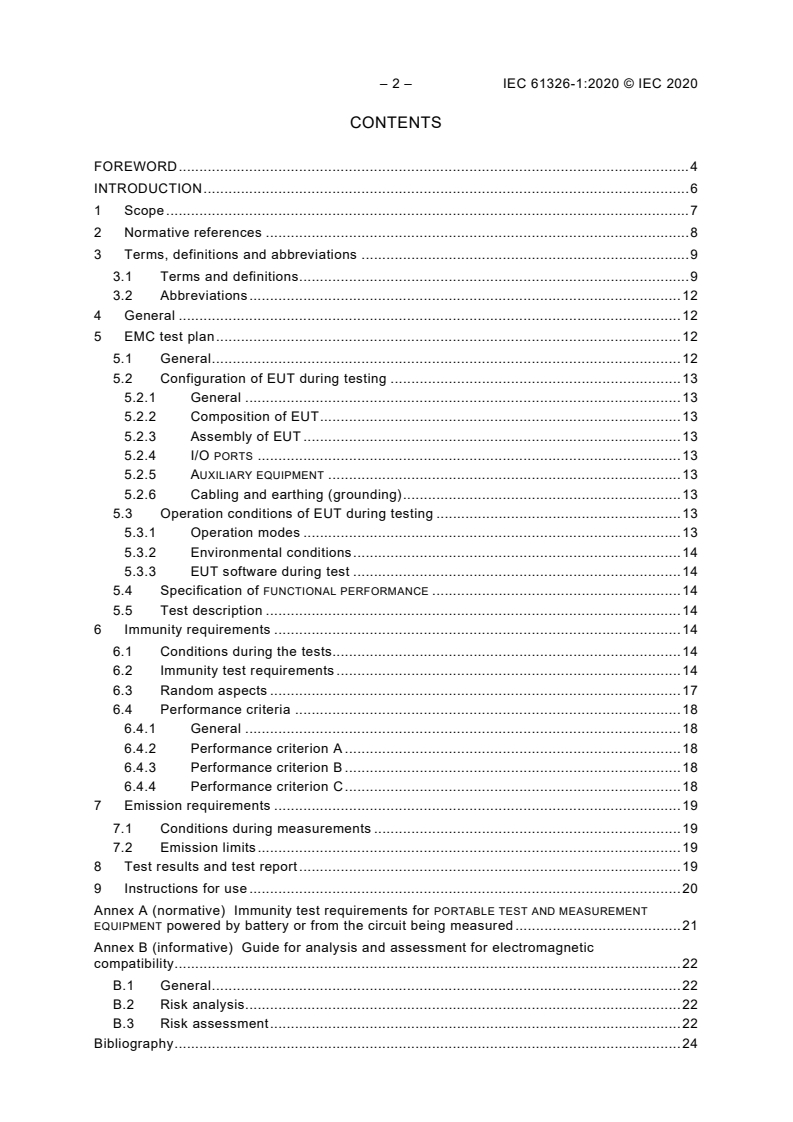
IEC 61326-1:2020 - Electrical equipment for measurement, control and laboratory use - EMC requirements - Part 1: General requirements Released:10/26/2020
Overview
IEC 61326-1:2020 - Electrical equipment for measurement, control and laboratory use - EMC requirements - Part 1: General requirements - defines general electromagnetic compatibility (EMC) requirements for measurement, control and laboratory equipment. It applies to equipment operating from supplies < 1 000 V AC or < 1 500 V DC or powered from the circuit under measurement and covers professional, industrial-process, industrial-manufacturing and educational uses. The standard addresses both immunity and emissions so equipment performs reliably in its intended electromagnetic environment and does not unduly disturb nearby systems.
Key topics and technical requirements
- Scope and equipment types: measurement and test instruments, control devices, laboratory apparatus, accessories (e.g., sample handling), and some computing devices where applicable.
- EMC test plan: configuration of the equipment under test (EUT), composition and assembly, I/O ports, auxiliary equipment, cabling and earthing (grounding), and operational modes during testing.
- Immunity requirements: specified test levels and procedures for different electromagnetic environments. The standard defines three environment types (e.g., basic, industrial, controlled) with associated immunity test tables and includes performance criteria A, B and C for post‑test functional assessment.
- Emission requirements: measurement conditions and emission limits (references and alignment with CISPR where applicable) to limit unwanted radiated and conducted emissions.
- Portable equipment: Annex A contains specific immunity test requirements for portable test and measurement instruments powered by battery or the circuit being measured.
- Test results and documentation: guidance on test reporting, specification of functional performance and instructions for safe use.
- Risk-based guidance: informative annex and guidance for EMC analysis and risk assessment during design and installation.
Practical applications and who uses this standard
IEC 61326-1:2020 is essential for:
- Design engineers developing measurement, control and laboratory equipment to ensure EMC compliance.
- Manufacturers and product managers preparing products for industrial and non-industrial markets.
- Test laboratories and compliance officers implementing EMC test plans, performing immunity and emissions testing, and producing test reports.
- Integrators and system designers who must ensure components operate reliably in complex electromagnetic environments.
- Purchasing/specification teams selecting equipment suitable for specific electromagnetic environments.
Practical benefits include reduced field failures due to interference, clearer documentation for conformity assessment, and guidance on choosing appropriate immunity levels and mitigation measures (shielding, filtering, grounding).
Related standards
- IEC 61326 series (other parts for specific equipment)
- IEC TR 61000-2-5 (guidance on electromagnetic environments)
- CISPR standards (emission limits and measurement techniques)
- Relevant ITE/industry-specific EMC standards (when computing devices are involved)
Keywords: IEC 61326-1:2020, EMC requirements, electromagnetic compatibility, immunity testing, emissions limits, measurement control laboratory equipment, portable test equipment, EMC test plan.
Relations
- Effective Date
- 09-Feb-2026
- Effective Date
- 05-Sep-2023
Buy Documents
IEC 61326-1:2020 RLV - Electrical equipment for measurement, control and laboratory use - EMC requirements - Part 1: General requirements Released:10/26/2020
IEC 61326-1:2020 - Electrical equipment for measurement, control and laboratory use - EMC requirements - Part 1: General requirements Released:10/26/2020
Get Certified
Connect with accredited certification bodies for this standard

DVS-ZERT GmbH
German welding certification society.

ANCE
Mexican certification and testing association.
BSMI (Bureau of Standards, Metrology and Inspection)
Taiwan's standards and inspection authority.
Sponsored listings
Frequently Asked Questions
IEC 61326-1:2020 is a standard published by the International Electrotechnical Commission (IEC). Its full title is "Electrical equipment for measurement, control and laboratory use - EMC requirements - Part 1: General requirements". This standard covers: IEC 61326:2020 specifies requirements for immunity and emissions regarding electro¬magnetic compatibility (EMC) for electrical equipment, operating from a supply or battery of less than 1 000 V AC or 1 500 V DC or from the circuit being measured. Equipment intended for professional, industrial-process, industrial-manufacturing and educational use is covered by this part. It includes equipment and computing devices for - measurement and test; - control; - LABORATORY use; - accessories intended for use with the above (such as sample handling equipment), intended to be used in industrial and non-industrial locations.
IEC 61326:2020 specifies requirements for immunity and emissions regarding electro¬magnetic compatibility (EMC) for electrical equipment, operating from a supply or battery of less than 1 000 V AC or 1 500 V DC or from the circuit being measured. Equipment intended for professional, industrial-process, industrial-manufacturing and educational use is covered by this part. It includes equipment and computing devices for - measurement and test; - control; - LABORATORY use; - accessories intended for use with the above (such as sample handling equipment), intended to be used in industrial and non-industrial locations.
IEC 61326-1:2020 is classified under the following ICS (International Classification for Standards) categories: 17.220.20 - Measurement of electrical and magnetic quantities; 25.040.40 - Industrial process measurement and control; 33.100.20 - Immunity. The ICS classification helps identify the subject area and facilitates finding related standards.
IEC 61326-1:2020 has the following relationships with other standards: It is inter standard links to EN ISO 15883-1:2025, IEC 61326-1:2012. Understanding these relationships helps ensure you are using the most current and applicable version of the standard.
IEC 61326-1:2020 is available in PDF format for immediate download after purchase. The document can be added to your cart and obtained through the secure checkout process. Digital delivery ensures instant access to the complete standard document.
Standards Content (Sample)
IEC 61326-1 ®
Edition 3.0 2020-10
REDLINE VERSION
INTERNATIONAL
STANDARD
colour
inside
Electrical equipment for measurement, control and laboratory use –
EMC requirements –
Part 1: General requirements
All rights reserved. Unless otherwise specified, no part of this publication may be reproduced or utilized in any form
or by any means, electronic or mechanical, including photocopying and microfilm, without permission in writing from
either IEC or IEC's member National Committee in the country of the requester. If you have any questions about IEC
copyright or have an enquiry about obtaining additional rights to this publication, please contact the address below or
your local IEC member National Committee for further information.
IEC Central Office Tel.: +41 22 919 02 11
3, rue de Varembé info@iec.ch
CH-1211 Geneva 20 www.iec.ch
Switzerland
About the IEC
The International Electrotechnical Commission (IEC) is the leading global organization that prepares and publishes
International Standards for all electrical, electronic and related technologies.
About IEC publications
The technical content of IEC publications is kept under constant review by the IEC. Please make sure that you have the
latest edition, a corrigendum or an amendment might have been published.
IEC publications search - webstore.iec.ch/advsearchform Electropedia - www.electropedia.org
The advanced search enables to find IEC publications by a The world's leading online dictionary on electrotechnology,
variety of criteria (reference number, text, technical containing more than 22 000 terminological entries in English
committee,…). It also gives information on projects, replaced and French, with equivalent terms in 16 additional languages.
and withdrawn publications. Also known as the International Electrotechnical Vocabulary
(IEV) online.
IEC Just Published - webstore.iec.ch/justpublished
Stay up to date on all new IEC publications. Just Published IEC Glossary - std.iec.ch/glossary
details all new publications released. Available online and 67 000 electrotechnical terminology entries in English and
once a month by email. French extracted from the Terms and Definitions clause of
IEC publications issued since 2002. Some entries have been
IEC Customer Service Centre - webstore.iec.ch/csc collected from earlier publications of IEC TC 37, 77, 86 and
If you wish to give us your feedback on this publication or CISPR.
need further assistance, please contact the Customer Service
Centre: sales@iec.ch.
IEC 61326-1 ®
Edition 3.0 2020-10
REDLINE VERSION
INTERNATIONAL
STANDARD
colour
inside
Electrical equipment for measurement, control and laboratory use –
EMC requirements –
Part 1: General requirements
INTERNATIONAL
ELECTROTECHNICAL
COMMISSION
ICS 17.220.20; 25.040.40; 33.100.20 ISBN 978-2-8322-8994-5
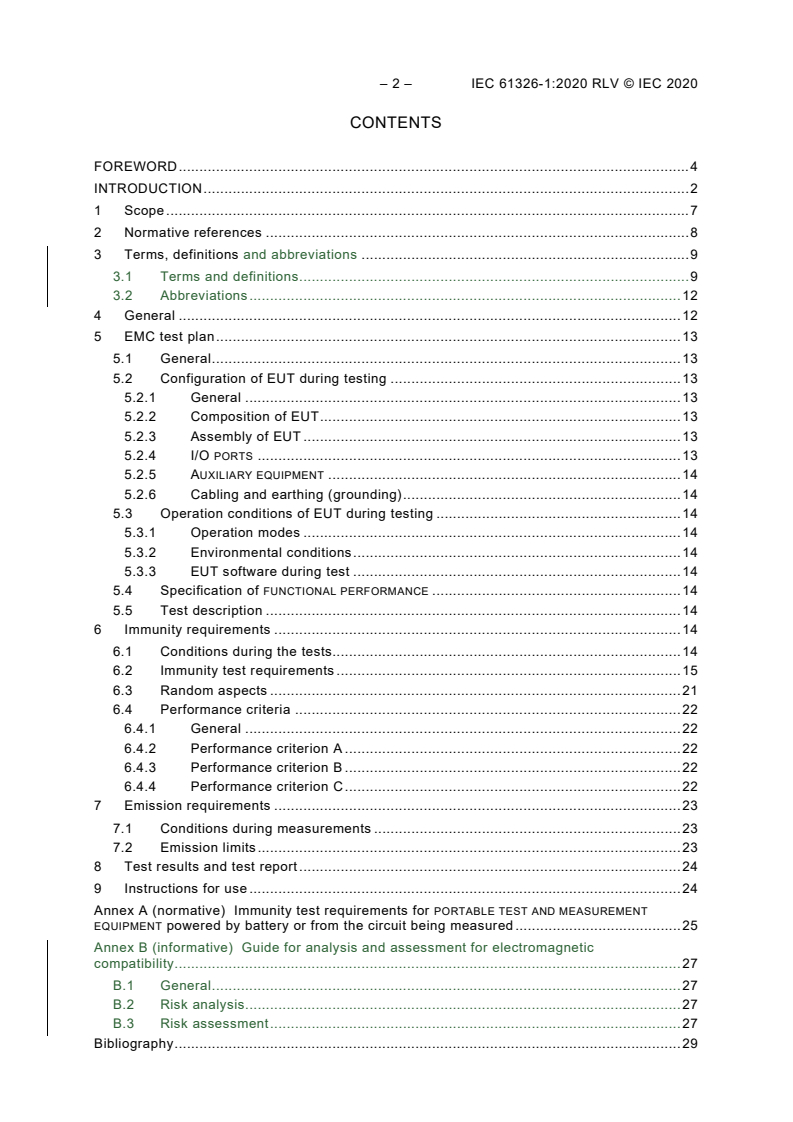
– 2 – IEC 61326-1:2020 RLV © IEC 2020
CONTENTS
FOREWORD . 4
INTRODUCTION . 2
1 Scope . 7
2 Normative references . 8
3 Terms, definitions and abbreviations . 9
3.1 Terms and definitions . 9
3.2 Abbreviations . 12
4 General . 12
5 EMC test plan . 13
5.1 General . 13
5.2 Configuration of EUT during testing . 13
5.2.1 General . 13
5.2.2 Composition of EUT . 13
5.2.3 Assembly of EUT . 13
5.2.4 I/O PORTS . 13
5.2.5 AUXILIARY EQUIPMENT . 14
5.2.6 Cabling and earthing (grounding) . 14
5.3 Operation conditions of EUT during testing . 14
5.3.1 Operation modes . 14
5.3.2 Environmental conditions . 14
5.3.3 EUT software during test . 14
5.4 Specification of FUNCTIONAL PERFORMANCE . 14
5.5 Test description . 14
6 Immunity requirements . 14
6.1 Conditions during the tests. 14
6.2 Immunity test requirements . 15
6.3 Random aspects . 21
6.4 Performance criteria . 22
6.4.1 General . 22
6.4.2 Performance criterion A . 22
6.4.3 Performance criterion B . 22
6.4.4 Performance criterion C . 22
7 Emission requirements . 23
7.1 Conditions during measurements . 23
7.2 Emission limits . 23
8 Test results and test report . 24
9 Instructions for use . 24
Annex A (normative) Immunity test requirements for PORTABLE TEST AND MEASUREMENT
EQUIPMENT powered by battery or from the circuit being measured . 25
Annex B (informative) Guide for analysis and assessment for electromagnetic
compatibility. 27
B.1 General . 27
B.2 Risk analysis. 27
B.3 Risk assessment . 27
Bibliography . 29
Figure 1 – Examples of ports . 11
Table 1 – Immunity test requirements for equipment intended to be used in a BASIC
ELECTROMAGNETIC ENVIRONMENT . 16
Table 2 – Immunity test requirements for equipment intended to be used in an
INDUSTRIAL ELECTROMAGNETIC ENVIRONMENT . 18
Table 3 – Immunity test requirements for equipment intended to be used in a
CONTROLLED ELECTROMAGNETIC ENVIRONMENT . 20
Table A.1 – Immunity test requirements for PORTABLE TEST AND MEASUREMENT
EQUIPMENT . 25
– 4 – IEC 61326-1:2020 RLV © IEC 2020
INTERNATIONAL ELECTROTECHNICAL COMMISSION
____________
ELECTRICAL EQUIPMENT FOR MEASUREMENT,
CONTROL AND LABORATORY USE –
EMC REQUIREMENTS –
Part 1: General requirements
FOREWORD
1) The International Electrotechnical Commission (IEC) is a worldwide organization for standardization comprising
all national electrotechnical committees (IEC National Committees). The object of IEC is to promote
international co-operation on all questions concerning standardization in the electrical and electronic fields. To
this end and in addition to other activities, IEC publishes International Standards, Technical Specifications,
Technical Reports, Publicly Available Specifications (PAS) and Guides (hereafter referred to as “IEC
Publication(s)”). Their preparation is entrusted to technical committees; any IEC National Committee interested
in the subject dealt with may participate in this preparatory work. International, governmental and non-
governmental organizations liaising with the IEC also participate in this preparation. IEC collaborates closely
with the International Organization for Standardization (ISO) in accordance with conditions determined by
agreement between the two organizations.
2) The formal decisions or agreements of IEC on technical matters express, as nearly as possible, an international
consensus of opinion on the relevant subjects since each technical committee has representation from all
interested IEC National Committees.
3) IEC Publications have the form of recommendations for international use and are accepted by IEC National
Committees in that sense. While all reasonable efforts are made to ensure that the technical content of IEC
Publications is accurate, IEC cannot be held responsible for the way in which they are used or for any
misinterpretation by any end user.
4) In order to promote international uniformity, IEC National Committees undertake to apply IEC Publications
transparently to the maximum extent possible in their national and regional publications. Any divergence
between any IEC Publication and the corresponding national or regional publication shall be clearly indicated in
the latter.
5) IEC itself does not provide any attestation of conformity. Independent certification bodies provide conformity
assessment services and, in some areas, access to IEC marks of conformity. IEC is not responsible for any
services carried out by independent certification bodies.
6) All users should ensure that they have the latest edition of this publication.
7) No liability shall attach to IEC or its directors, employees, servants or agents including individual experts and
members of its technical committees and IEC National Committees for any personal injury, property damage or
other damage of any nature whatsoever, whether direct or indirect, or for costs (including legal fees) and
expenses arising out of the publication, use of, or reliance upon, this IEC Publication or any other IEC
Publications.
8) Attention is drawn to the Normative references cited in this publication. Use of the referenced publications is
indispensable for the correct application of this publication.
9) Attention is drawn to the possibility that some of the elements of this IEC Publication may be the subject of
patent rights. IEC shall not be held responsible for identifying any or all such patent rights.
This redline version of the official IEC Standard allows the user to identify the changes
made to the previous edition. A vertical bar appears in the margin wherever a change
has been made. Additions are in green text, deletions are in strikethrough red text.
International Standard IEC 61326-1 has been prepared by subcommittee 65A: System
aspects, of IEC technical committee 65: Industrial-process measurement, control and
automation.
This third edition cancels and replaces the second edition, published in 2012. This edition
constitutes a technical revision.
This edition includes the following significant technical changes with respect to the previous
edition:
– the immunity test levels and performance criteria have been reviewed;
– requirements for portable test and measurement equipment have been clarified and
amended;
– the description of the electromagnetic environments has been improved.
The text of this International Standard is based on the following documents:
FDIS Report on voting
65A/975/FDIS 65A/985/RVD
Full information on the voting for the approval of this International Standard can be found in
the report on voting indicated in the above table.
This document has been drafted in accordance with the ISO/IEC Directives, Part 2.
In this document, the following print types are used:
• Terms used throughout this document which have been defined in Clause 3: SMALL
CAPITALS
A list of all parts of the IEC 61326 series under the general title Electrical equipment for
measurement, control and laboratory use – EMC requirements, can be found on the IEC
website.
The committee has decided that the contents of this document will remain unchanged until the
stability date indicated on the IEC website under "http://webstore.iec.ch" in the data related to
the specific document. At this date, the document will be
• reconfirmed,
• withdrawn,
• replaced by a revised edition, or
• amended.
IMPORTANT – The 'colour inside' logo on the cover page of this publication indicates
that it contains colours which are considered to be useful for the correct
understanding of its contents. Users should therefore print this document using a
colour printer.
– 6 – IEC 61326-1:2020 RLV © IEC 2020
INTRODUCTION
Instruments and equipment within the scope of this document may often be geographically
widespread and hence operate under a wide range of environmental conditions.
The limitation of undesired electromagnetic emissions ensures that no other equipment
installed nearby is unduly influenced by the equipment under consideration. The limits are
more or less specified by, and therefore taken from, IEC and International Special Committee
on Radio Interference (CISPR) publications.
However, the equipment should function without undue degradation in an electromagnetic
environment typical for the locations where it is intended to be operated. In this respect, the
document specifies three different types of electromagnetic environment and the levels for
immunity. More detailed information about issues related to electromagnetic environments are
given in IEC TR 61000-2-5. Special risks, involving for example nearby or direct lightning
strikes, circuit-breaking, or exceptionally high electromagnetic radiation in close proximity, are
not covered.
Complex electric and/or electronic systems should require EMC planning in all phases of their
design and installation, taking into consideration the electromagnetic environment, any
special requirements, and the severity of failures.
This part of IEC 61326 specifies the EMC requirements that are generally applicable to all
equipment within its scope. For certain types of equipment, these requirements will be
supplemented or modified by the special requirements of one, or more than one, particular
part IEC 61326-2 (all parts). These should be read in conjunction with the IEC 61326-1
requirements.
ELECTRICAL EQUIPMENT FOR MEASUREMENT,
CONTROL AND LABORATORY USE –
EMC REQUIREMENTS –
Part 1: General requirements
1 Scope
This part of IEC 61326 specifies requirements for immunity and emissions regarding electro-
magnetic compatibility (EMC) for electrical equipment, operating from a supply or battery of
less than 1 000 V AC or 1 500 V DC or from the circuit being measured. Equipment intended
for professional, industrial-process, industrial-manufacturing and educational use is covered
by this part. It includes equipment and computing devices for
– measurement and test;
– control;
– LABORATORY use;
– accessories intended for use with the above (such as sample handling equipment),
intended to be used in industrial and non-industrial locations.
Computing devices and assemblies and similar equipment within the scope of information
technology equipment (ITE) and complying with applicable ITE EMC standards may can be
used in systems within the scope of this part of IEC 61326 without additional testing, if they
are suitable for the intended electromagnetic environment.
It is generally considered that this product family standard takes precedence over the
corresponding generic EMC standards.
The following equipment is covered by this document.
a) Electrical measurement and test equipment
This is equipment which, by electrical means, measures, indicates or records one or more
electrical or non-electrical quantities, also non-measuring equipment such as signal
generators, measurement standards, power supplies and transducers.
b) Electrical control equipment
This is equipment which controls one or more output quantities to specific values, with
each value determined by manual settings, by local or remote programming, or by one or
more input variables. This includes industrial process measurement and control (IPMC)
equipment, which consists of devices such as:
– process controllers and regulators;
– programmable controllers;
– power supply units for equipment and systems (centralized or dedicated);
– analogue/digital indicators and recorders;
– process instrumentation;
– transducers, positioners, intelligent actuators, etc.
c) Electrical laboratory equipment
This is equipment which measures, indicates monitors or analyses substances, or is used
to prepare materials, and includes In Vitro Diagnostic (IVD) equipment. This equipment
– 8 – IEC 61326-1:2020 RLV © IEC 2020
may also be used in areas other than laboratories, for example self-test IVD equipment
may be used in the home.
c) Electrical LABORATORY equipment, including In Vitro Diagnostic (IVD) medical equipment
This is equipment used to prepare or analyse materials, or measure, indicate or monitor
physical quantities. This equipment might also be used in areas other than laboratories.
d) Equipment a), b) or c) as above when being equipped with components having radio
functionality, for example for wireless communication.
Equipment within the scope of this document might be operated in different electromagnetic
environments; depending on the electromagnetic environment different emission and immunity
test requirements are applicable.
This document considers three types of electromagnetic environments:
• BASIC ELECTROMAGNETIC ENVIRONMENT;
• INDUSTRIAL ELECTROMAGNETIC ENVIRONMENT;
• CONTROLLED ELECTROMAGNETIC ENVIRONMENT.
Corresponding immunity test requirements are described in Clause 6.
In terms of emission requirements, equipment shall be classified in Class A or Class B
equipment, as per the requirements and procedure of CISPR 11. The corresponding emission
requirements are described in Clause 7.
The specified emission and immunity requirements aim at achieving electromagnetic
compatibility between equipment covered in this document and other equipment that might
operate at locations with electromagnetic environments considered in this document.
Guidance for an assessment concerning the risk for achieving EMC is given in Annex B.
2 Normative references
The following documents are referred to in the text in such a way that some or all of their
content constitutes requirements of this document. For dated references, only the edition
cited applies. For undated references, the latest edition of the referenced document (including
any amendments) applies.
IEC 60050-161:1990, International Electrotechnical Vocabulary (IEV) – Part 161:
Electromagnetic compatibility
IEC 60050-161:1990/AMD1:1997
IEC 60050-161:1990/AMD2:1998
IEC 60050-161:1990/AMD3:2014
IEC 60050-161:1990/AMD4:2014
IEC 60050-161:1990/AMD5:2015
IEC 60050-161:1990/AMD6:2016
IEC 60050-161:1990/AMD7:2017
IEC 60050-161:1990/AMD8:2018
(available at )
IEC 61000-3-2:20052018, Electromagnetic compatibility (EMC) – Part 3-2: Limits – Limits for
harmonic current emissions (equipment input current ≤16 A per phase)
Amendment 1:2008
Amendment 2:2009
IEC 61000-3-3:20082013, Electromagnetic compatibility (EMC) – Part 3-3: Limits – Limitation
of voltage changes, voltage fluctuations and flicker in public low-voltage supply systems, for
equipment with rated current ≤16 A per phase and not subject to conditional connection
IEC 61000-3-3:2013/AMD1:2017
IEC 61000-3-11:20002017, Electromagnetic compatibility (EMC) – Part 3-11: Limits –
Limitation of voltage changes, voltage fluctuations and flicker in public low-voltage supply
systems –Equipment with rated current ≤75 A and subject to conditional connection
IEC 61000-3-12:2011, Electromagnetic compatibility (EMC) – Part 3-12: Limits – Limits for
harmonic currents produced by equipment connected to public low-voltage systems with input
current >16 A and ≤75 A per phase
IEC 61000-4-2:2008, Electromagnetic compatibility (EMC) – Part 4-2: Testing and
measurement techniques – Electrostatic discharge immunity test
IEC 61000-4-3:2006, Electromagnetic compatibility (EMC) – Part 4-3: Testing and
measurement techniques – Radiated, radio-frequency, electromagnetic field immunity test
IEC 61000-4-3:2006/AMD1:2007
IEC 61000-4-3:2006/AMD2:2010
IEC 61000-4-4:20042012, Electromagnetic compatibility (EMC) – Part 4-4: Testing and
measurement techniques – Electrical fast transient/burst immunity test
Amendment 1:2010
IEC 61000-4-5:20052014, Electromagnetic compatibility (EMC) – Part 4-5: Testing and
measurement techniques – Surge immunity test
IEC 61000-4-5:2014/AMD1:2017
IEC 61000-4-6:20082013, Electromagnetic compatibility (EMC) – Part 4-6: Testing and
measurement techniques – Immunity to conducted disturbances, induced by radio-frequency
fields
IEC 61000-4-8:2009, Electromagnetic compatibility (EMC) – Part 4-8: Testing and
measurement techniques – Power frequency magnetic field immunity test
IEC 61000-4-11:20042020, Electromagnetic compatibility (EMC) – Part 4-11: Testing and
measurement techniques – Voltage dips, short interruptions and voltage variations immunity
tests for equipment with input current up to 16 A per phase
CISPR 11:20092015, Industrial, scientific and medical equipment – Radio-frequency
disturbance characteristics – Limits and methods of measurement
Amendment 1:2010
CISPR 11:2015/AMD1:2016
CISPR 11:2015/AMD2:2019
3 Terms, definitions and abbreviations
3.1 Terms and definitions
For the purposes of this document, the terms and definitions given in IEC 60050-161 and the
following apply.
ISO and IEC maintain terminological databases for use in standardization at the following
addresses:
• IEC Electropedia: available at http://www.electropedia.org/
• ISO Online browsing platform: available at http://www.iso.org/obp
– 10 – IEC 61326-1:2020 RLV © IEC 2020
3.1.1
basic electromagnetic environment
environment existing at locations characterized by being supplied directly at low voltage from
the public mains network
EXAMPLES
– residential properties, for example houses, apartments;
– retail outlets, for example shops, supermarkets;
– business premises, for example offices, banks;
– areas of public entertainment, for example cinemas, public bars, dance halls;
– outdoor locations, for example petrol stations, car parks, amusement and sports centres;
– light-industrial locations, for example workshops, laboratories, service centres.
3.1.2
class A equipment
equipment suitable for use in all establishments locations other than domestic those allocated
in residential environments and those directly connected to a low voltage power supply
network which supplies buildings used for domestic purposes
[SOURCE: derived from CISPR 11:20092015, 5.32]
3.1.3
class B equipment
equipment suitable for use in domestic establishments locations in residential environments
and in establishments directly connected to a low voltage power supply network which
supplies buildings used for domestic purposes
[SOURCE: derived from CISPR 11:20092015, 5.32]
3.1.4
controlled electromagnetic environment
environment usually characterized by recognition and control of EMC threats by users of the
equipment or by design of the installation
3.5
d.c. distribution network
local d.c. electricity supply network in the infrastructure of a certain site or building intended
for connection to the d.c. power port of any type of equipment
3.1.5
enclosure port
physical boundary of equipment through which electromagnetic fields may radiate or impinge
3.1.6
functional performance
operational performance characteristics specified by the manufacturer of the equipment,
defining the ability of equipment to achieve the intended functions
Note 1 to entry: Characteristics can be based on the related technical documentation.
3.1.7
industrial electromagnetic environment
environment existing at locations characterized by a separate power network, in most cases
supplied from a high- or medium-voltage transformer, dedicated for the supply of installations
feeding manufacturing or similar plants with one or more of the following conditions:
– frequent switching of heavy inductive or capacitive loads;
– high currents and associated magnetic fields;
– presence of Industrial, Scientific and Medical (ISM) equipment (for example, welding
machines)
3.1.8
laboratory
test and measurement area
area that is specifically used for analysis, testing and servicing and where equipment is
operated by trained personnel
3.1.9
long-distance lines
lines within a building which are longer than 30 m, or which leave the building (including lines
of outdoor installations)
3.1.10
port
any particular interface of the specific device equipment or system with the external
electromagnetic environment
EXAMPLE See Figure 1 for an example of Equipment Under Test (EUT).
Note 1 to entry: I/O PORTS are input, output or bi-directional, measurement, control, or data PORTS.
Note 2 to entry: Within this document, PORTS intended to be connected with earth potential for functional reasons
(functional earth PORTS) are considered as I/O PORTS.
Note 3 to entry: Within this document, the protective earth PORT (if any) is considered as part of the POWER PORT.
Figure 1 – Examples of ports
3.1.11
power port
port at which a conductor or cable, carrying the electrical input/output power needed for the
operation (functioning), is connected to the equipment
3.12
portable (measuring) instrument
measuring instrument designed to be easily carried by hand and to be connected and
disconnected by the user
[SOURCE: IEC 60050-300:2001, 312-02-18]
3.1.12
portable test and measurement equipment
test and/or measuring equipment designed to be easily carried by hand and to be connected
and disconnected by the user
3.1.13
type test
conformity test made on one or more items representative of the production
[SOURCE: IEC 60050-151:2001, 151-16-16]
– 12 – IEC 61326-1:2020 RLV © IEC 2020
3.1.14
auxiliary equipment
equipment necessary to provide the equipment under test (EUT) with the signals required for
normal operation and equipment to verify the performance of the EUT
3.1.15
performance level
specified operation of equipment under conditions of intended use
3.1.16
degradation (in performance)
an undesired departure in the operational performance of any device, equipment or system
from its intended performance
Note 1 to entry: The term "degradation" can apply to temporary or permanent failure.
[SOURCE: IEC 60050-161:1990, 161-01-19]
3.1.17
loss of performance
operation of equipment outside a specified PERFORMANCE LEVEL
3.1.18
loss of function
operation of equipment with one (or more) of the equipment’s function unusable
3.2 Abbreviations
AE AUXILIARY EQUIPMENT
EMC electromagnetic compatibility
ESD electrostatic discharge
EUT equipment under test
I/O input/output
RF radio frequency
UPS uninterruptable power supply
4 General
Equipment and systems within the scope of this document can be subjected to various kinds
of electromagnetic disturbances, conducted by sources of which include power, measurement
or control lines or those radiated from the environment. The types and levels of disturbances
depend on the particular conditions in which the systems, subsystems or equipment are
installed and operated.
Equipment and individual devices of a system within the scope of this document can also be a
source of electromagnetic disturbances over a wide frequency range. These disturbances can
be conducted through power and signal lines, or be directly radiated, and can affect the
performance of other equipment, or influence the external electromagnetic environment.
For emissions, the objective of the requirements given in this document is to ensure that the
disturbances generated by the equipment and systems, when operated normally, do not
exceed a level which could prevent other systems from operating as intended. The emission
limits are considered in 7.2.
The manufacturer shall give information that emissions, which exceed the levels required by
this standard, can occur when equipment is connected to a test object.
NOTE 1 Higher immunity levels, different number of tests and different performance criteria than those specified
can be necessary for particular applications (for example, when reliable operation of the equipment is essential for
safety) or when the equipment is intended for use in harsher electromagnetic environments. Also, additional tests
and different performance criteria can be necessary for particular applications.
NOTE 2 In special cases, for example when highly susceptible equipment is being used in close proximity near
the EUT, additional mitigation measures may could have to be employed to reduce the influencing electromagnetic
emission further below the specified limits.
NOTE 3 The manufacturer may select to perform all tests on either a single EUT or more than
one divide the tests among multiple EUTs. If the latter, each test result shall be traceable to
the EUT tested. The testing sequence is optional.
5 EMC test plan
5.1 General
An EMC test plan shall be established prior to testing. At a minimum, it shall contain , as a
minimum, the elements given defined in 5.2 to 5.5.
It may be determined from consideration of the electrical characteristics and usage of a
particular item of equipment that some tests are inappropriate and therefore unnecessary. In
such cases, the decision not to test shall be recorded in the EMC test plan.
5.2 Configuration of EUT during testing
5.2.1 General
LABORATORY equipment often consists of systems with no fixed
Measurement, control and
configuration. The kind, number and installation of different subassemblies within the equip-
ment may vary from system to system. Thus, it is reasonable, and also recommended, not to
test every possible arrangement.
To realistically simulate EMC conditions (related both to emission and immunity), the
equipment assembly shall represent a typical installation as specified by the manufacturer.
TYPE TESTS under normal conditions as specified by the
Such tests shall be carried out as
manufacturer.
5.2.2 Composition of EUT
All devices equipment, racks, modules, boards, etc. significant to EMC and belonging to the
EUT shall be documented. If relevant, the software version shall be documented.
5.2.3 Assembly of EUT
If an EUT has a variety of internal and external configurations, the TYPE TESTS shall be made
with one or more typical configurations that represent normal use in the intended
environment. All types of modules shall be tested at least once. The rationale for this
selection shall be documented in the EMC test plan.
PORTS
5.2.4 I/O
Where there are multiple I/O PORTS, which are all of the same type, connecting a cable to just
PORTS is sufficient, provided that it can be shown that the additional cables
one of those
would not affect the results significantly.
If not otherwise specified in more specific parts of the IEC 61326 series, electrostatic
discharges shall not be applied to inner pins of plug-in ports or cable connectors (but to
connected connectors accessible during the intended use of the EUT).
– 14 – IEC 61326-1:2020 RLV © IEC 2020
5.2.5 AUXILIARY EQUIPMENT
When a variety of devices equipment is provided for use with the EUT, at least one of each
type of device equipment shall be selected to simulate actual operating conditions. AUXILIARY
devices EQUIPMENT may be simulated.
5.2.6 Cabling and earthing (grounding)
The cables and earth (ground) shall be connected to the EUT in accordance with the
manufacturer's specifications. There shall be no additional earth connections.
5.3 Operation conditions of EUT during testing
5.3.1 Operation modes
A selection of representative operation modes shall be made, taking into account that not all
functions, but only the most typical functions of the electronic equipment can be tested. The
estimated worst-case operating modes for normal application shall be selected.
5.3.2 Environmental conditions
The tests shall be carried out within the manufacturer’s specified environmental operating
range (for example, ambient temperature, humidity, atmospheric pressure), and within the
rated ranges of supply voltage and frequency. The requirements of IEC 61000-4-2 for
environmental conditions shall take precedence over those of the EUT specification
(for example the humidity requirements for ESD).
5.3.3 EUT software during test
The software/firmware and its version used for simulating the different modes of the operation
of the EUT shall be documented. This software shall represent the estimated worst-case
operating mode for normal application.
5.4 Specification of FUNCTIONAL PERFORMANCE
For immunity tests, FUNCTIONAL PERFORMANCE for each operating mode and test shall be
specified, where possible, as quantitative values, as well as for non-operational states such
as ‘standby’ or ‘battery charging’, when an unintended change of state could occur through
electromagnetic disturbances. If that is not possible, the FUNCTIONAL PERFORMANCE should be
described in the test plan with supporting justification.
5.5 Test description
Each test to be applied shall be specified in the EMC test plan. The description of the tests,
the test methods, the characteristics of the tests, and the test set-ups are given in the basic
standards, which are referred to in 6.2 and 7.2. Additional information needed for the practical
implementation of the tests is given in this document. The contents of the referenced
standards need not be reproduced in the test plan. In some cases, the EMC test plan shall
specify the application in detail.
NOTE Not all known disturbance phenomena have been specified for testing purposes in this document, but only
those which are considered as most critical.
6 Immunity requirements
6.1 Conditions during the tests
The configuration of the EUT and the modes of operation used during the tests execution of
each test shall be precisely noted in the test report.
Tests shall be applied to the relevant PORTS in accordance with Table 1, Table 2 or Table 3,
as applicable.
The tests shall be conducted in accordance with the basic standards. The tests shall be
carried out one at a time. If additional measures not described in the basic standards are
required, these measures and their rationale shall be documented in the test report.
The tests shall be conducted in accordance with the basic standards listed in the relevant
table for one phenomenon at a time. If additional test conditions or configurations not
described in the basic standards are required, these conditions or configurations, and their
rationale, shall be documented in the test report.
6.2 Immunity test requirements
Table 1 gives the immunity requirements for equipment intended to be used in a BASIC
ELECTROMAGNETIC ENVIRONMENT.
Table 2 gives the immunity requirements for equipment intended to be used in an INDUSTRIAL
.
ELECTROMAGNETIC ENVIRONMENT
Table 3 gives the immunity requirements for equipment intended to be used in a CONTROLLED
ELECTROMAGNETIC ENVIRONMENT.
Annex A gives the immunity requirements for PORTABLE TEST AND MEASUREMENT EQUIPMENT
that is powered by battery or from the circuit being measured.
The performance criteria A, B, and C that are mentioned in the following tables are described
in 6.4.
– 16 – IEC 61326-1:2020 RLV © IEC 2020
Table 1 – Immunity test requirements for equipment
intended to be used in a BASIC ELECTROMAGNETIC ENVIRONMENT
Perform-
Basic
Port Phenomenon Test value ance
standard
criterion
Enclosure Electrostatic discharge (ESD) IEC 61000-4-2 4 kV contact discharge B
8 kV air discharge B
Electromagnetic field IEC 61000-4-3 3 V/m (80 MHz to 1 GHz) A
3 V/m (1,4 GHz to 2 GHz) A
1 V/m (2,0 GHz to 2,7 GHz) A
f
3 A/m (50 Hz, 60 Hz)
Power frequency magnetic field IEC 61000-4-8 A
AC power Voltage dip IEC 61000-4-11 0 % during half cycle B
0 % during 1 cycle B
(including protective
e
C
70 % during 25/30 cycles
earth)
e
Short interruptions
IEC 61000-4-11 0 % during 250/300 cycles
C
Burst
IEC 61000-4-4 1 kV (5/50 ns, 5 kHz)
B
Surge a) b)
IEC 61000-4-5 0,5 kV /1 kV
B
Conducted RF
IEC 61000-4-6 3 V (150 kHz to 80 MHz)
A
d, g
DC power Burst IEC 61000-4-4 1 kV(5/50 ns, 5 kHz) B
(including protective B
a b
Surge IEC 61000-4-5 0,5 kV /1 kV
earth)
A
Conducted RF IEC 61000-4-6 3 V (150 kHz to 80 MHz)
d
I/O signal/control Burst IEC 61000-4-4 0,5 kV (5/50 ns, 5 kHz) B
(including functional
B
b, c
earth ) Surge IEC 61000-4-5 1 kV
A
d
Conducted RF IEC 61000-4-6 3 V (150 kHz to 80 MHz)
I/O signal/control Burst IEC 61000-4-4 1 kV(5/50 ns, 5 kHz) B
connected directly
a b
to mains supply Surge IEC 61000-4-5 0,5 kV /1 kV B
Conducted RF IEC 61000-4-6 3 V (150 kHz to 80 MHz) A
a
Line to line.
b
Line to ground.
c
Only in the case of long-distance lines (see 3.10).
d
Only in the case of lines >3 m.
e
For example “25/30 cycles" means "25 cycles for 50 Hz test" or "30 cycles for 60 Hz test”.
f
Only to magnetically sensitive equipment. CRT display interference is allowed above 1 A/m.
g
DC connections between parts of equipment/system which are not connected to a d.c. distribution network are
treated as I/O signal/control ports.
Perform-
PORT Phenomenon Basic standard Test value ance
criterion
ENCLOSURE ESD IEC 61000-4-2 ±4 KV contact discharge B
±8 KV air discharge B
Electromagnetic field IEC 61000-4-3 3 V/m (80 MHz to 1 GHz; A
a
1,4 GHz to 6 GHz)
Power frequency IEC 61000-4-8 3 A/m (50 Hz, 60 Hz) A
b
magnetic field
AC power Burst IEC 61000-4-4 ±1 kV (5 kHz or 100 kHz) B
(including
Surge IEC 61000-4-5 ±0,5 kV line-to-line B
protective earth) ±1 kV line-to-ground B
Conducted RF IEC 61000-4-6 3 V (150 kHz to 80 MHz) A
Voltage dip IEC 61000-4-11 0 % during half cycle B
0 % during 1 cycle B
c
70 % during 25/30 cycles C
c
Short interruptions IEC 61000-4-11 0 % during 250/300 cycles C
d, e
DC power Burst IEC 61000-4-4 ±1 kV (5 kHz or 100 kHz) B
(including Surge IEC 61000-4-5 ±0,5 kV line-to-line B
protective earth) ±1 kV line-to-ground B
Conducted RF IEC 61000-4-6 3 V (150 kHz to 80 MHz) A
e d
I/O signal/control Burst IEC 61000-4-4 ±0,5 kV (5 kHz or 100 kHz) B
f
(including
Surge IEC 61000-4-5 ±1 kV line-to-ground B
functional earth)
d
Conducted RF IEC 61000-4-6 3 V (150 kHz to 80 MHz) A
e d
I/O signal/control Burst IEC 61000-4-4 ±1 kV (5 kHz or 100 kHz) B
f
connected directly
Surge IEC 61000-4-5 ±0,5 kV line-to-line B
to mains supply
±1 kV line-to-ground B
d
Conducted RF IEC 61000-4-6 3 V (150 kHz to 80 MHz) A
a
In case testing is performed also in the frequency range from 1 GHz to 1,4 GHz, the same test level is
recommended.
b
Only to magnetically sensitive equipment.
c
For example, "25/30 cycles" means "25 cycles for 50 Hz test" or "30 cycles for 60 Hz test".
d
Only in the case of lines >3 m.
e
DC POWER PORTS intended to be connected to a low voltage DC supply (≤ 60 V), where secondary circuits
(isolated from the AC mains supply) are not subject to transient overvoltages (i.e. reliably-grounded,
capacitively-filtered DC secondary circuits) shall be regarded as I/O signal/control PORTS.
f
Only in the case of LONG-DISTANCE LINES.
– 18 – IEC 61326-1:2020 RLV © IEC 2020
Table 2 – Immunity test requirements for equipment intended
to be used in an INDUSTRIAL ELECTROMAGNETIC ENVIRONMENT
Port Phenomenon Basic standard Test value Perform-
ance
criterion
Enclosure Electrostatic discharge (ESD) IEC 61000-4-2 4 kV contact discharge B
8 kV air discharge B
Electromagnetic field IEC 61000-4-3 10 V/m (80 MHz to 1 GHz) A
3 V/m (1,4 GHz to 2 GHz) A
1 V/m (2,0 GHz to 2,7 GHz) A
e
Power frequency magnetic field IEC 61000-4-8 30 A/m (50 Hz, 60 Hz) A
AC power Voltage dip IEC 61000-4-11 0 % during 1 cycle B
g
C
40 % during 10/12 cycles
(including
C
g
70 % during 25/30 cycles
protective earth)
C
g
Short interruptions IEC 61000-4-11 0 % during 250/300 cycles
B
Burst IEC 61000-4-4
2 kV(5/50 ns, 5 kHz)
B
a b
Surge IEC 61000-4-5
1 kV /2 kV
A
f
Conducted RF IEC 61000-4-6 3 V (150 kHz to 80 MHz)
f
DC power Burst IEC 61000-4-4 2 kV (5/50 ns, 5 kHz) B
a b
(including Surge IEC 61000-4-5 1 kV /2 kV B
pr
...
IEC 61326-1 ®
Edition 3.0 2020-10
INTERNATIONAL
STANDARD
NORME
INTERNATIONALE
Electrical equipment for measurement, control and laboratory use –
EMC requirements –
Part 1: General requirements
Matériel électrique de mesure, de commande et de laboratoire –
Exigences relatives à la CEM –
Partie 1: Exigences générales
All rights reserved. Unless otherwise specified, no part of this publication may be reproduced or utilized in any form
or by any means, electronic or mechanical, including photocopying and microfilm, without permission in writing from
either IEC or IEC's member National Committee in the country of the requester. If you have any questions about IEC
copyright or have an enquiry about obtaining additional rights to this publication, please contact the address below or
your local IEC member National Committee for further information.
Droits de reproduction réservés. Sauf indication contraire, aucune partie de cette publication ne peut être reproduite
ni utilisée sous quelque forme que ce soit et par aucun procédé, électronique ou mécanique, y compris la photocopie
et les microfilms, sans l'accord écrit de l'IEC ou du Comité national de l'IEC du pays du demandeur. Si vous avez des
questions sur le copyright de l'IEC ou si vous désirez obtenir des droits supplémentaires sur cette publication, utilisez
les coordonnées ci-après ou contactez le Comité national de l'IEC de votre pays de résidence.
IEC Central Office Tel.: +41 22 919 02 11
3, rue de Varembé info@iec.ch
CH-1211 Geneva 20 www.iec.ch
Switzerland
About the IEC
The International Electrotechnical Commission (IEC) is the leading global organization that prepares and publishes
International Standards for all electrical, electronic and related technologies.
About IEC publications
The technical content of IEC publications is kept under constant review by the IEC. Please make sure that you have the
latest edition, a corrigendum or an amendment might have been published.
IEC publications search - webstore.iec.ch/advsearchform Electropedia - www.electropedia.org
The advanced search enables to find IEC publications by a The world's leading online dictionary on electrotechnology,
variety of criteria (reference number, text, technical containing more than 22 000 terminological entries in English
committee,…). It also gives information on projects, replaced and French, with equivalent terms in 16 additional languages.
and withdrawn publications. Also known as the International Electrotechnical Vocabulary
(IEV) online.
IEC Just Published - webstore.iec.ch/justpublished
Stay up to date on all new IEC publications. Just Published IEC Glossary - std.iec.ch/glossary
details all new publications released. Available online and 67 000 electrotechnical terminology entries in English and
once a month by email. French extracted from the Terms and Definitions clause of
IEC publications issued since 2002. Some entries have been
IEC Customer Service Centre - webstore.iec.ch/csc collected from earlier publications of IEC TC 37, 77, 86 and
If you wish to give us your feedback on this publication or CISPR.
need further assistance, please contact the Customer Service
Centre: sales@iec.ch.
A propos de l'IEC
La Commission Electrotechnique Internationale (IEC) est la première organisation mondiale qui élabore et publie des
Normes internationales pour tout ce qui a trait à l'électricité, à l'électronique et aux technologies apparentées.
A propos des publications IEC
Le contenu technique des publications IEC est constamment revu. Veuillez vous assurer que vous possédez l’édition la
plus récente, un corrigendum ou amendement peut avoir été publié.
Recherche de publications IEC - Electropedia - www.electropedia.org
webstore.iec.ch/advsearchform Le premier dictionnaire d'électrotechnologie en ligne au
La recherche avancée permet de trouver des publications IEC monde, avec plus de 22 000 articles terminologiques en
en utilisant différents critères (numéro de référence, texte, anglais et en français, ainsi que les termes équivalents dans
comité d’études,…). Elle donne aussi des informations sur les 16 langues additionnelles. Egalement appelé Vocabulaire
projets et les publications remplacées ou retirées. Electrotechnique International (IEV) en ligne.
IEC Just Published - webstore.iec.ch/justpublished Glossaire IEC - std.iec.ch/glossary
Restez informé sur les nouvelles publications IEC. Just 67 000 entrées terminologiques électrotechniques, en anglais
Published détaille les nouvelles publications parues. et en français, extraites des articles Termes et Définitions des
Disponible en ligne et une fois par mois par email. publications IEC parues depuis 2002. Plus certaines entrées
antérieures extraites des publications des CE 37, 77, 86 et
Service Clients - webstore.iec.ch/csc CISPR de l'IEC.
Si vous désirez nous donner des commentaires sur cette
publication ou si vous avez des questions contactez-nous:
sales@iec.ch.
IEC 61326-1 ®
Edition 3.0 2020-10
INTERNATIONAL
STANDARD
NORME
INTERNATIONALE
Electrical equipment for measurement, control and laboratory use –
EMC requirements –
Part 1: General requirements
Matériel électrique de mesure, de commande et de laboratoire –
Exigences relatives à la CEM –
Partie 1: Exigences générales
INTERNATIONAL
ELECTROTECHNICAL
COMMISSION
COMMISSION
ELECTROTECHNIQUE
INTERNATIONALE
ICS 17.220.20; 25.040.40; 33.100.20 ISBN 978-2-8322-8947-1
– 2 – IEC 61326-1:2020 © IEC 2020
CONTENTS
FOREWORD . 4
INTRODUCTION . 6
1 Scope . 7
2 Normative references . 8
3 Terms, definitions and abbreviations . 9
3.1 Terms and definitions . 9
3.2 Abbreviations . 12
4 General . 12
5 EMC test plan . 12
5.1 General . 12
5.2 Configuration of EUT during testing . 13
5.2.1 General . 13
5.2.2 Composition of EUT . 13
5.2.3 Assembly of EUT . 13
5.2.4 I/O PORTS . 13
5.2.5 AUXILIARY EQUIPMENT . 13
5.2.6 Cabling and earthing (grounding) . 13
5.3 Operation conditions of EUT during testing . 13
5.3.1 Operation modes . 13
5.3.2 Environmental conditions . 14
5.3.3 EUT software during test . 14
5.4 Specification of FUNCTIONAL PERFORMANCE . 14
5.5 Test description . 14
6 Immunity requirements . 14
6.1 Conditions during the tests. 14
6.2 Immunity test requirements . 14
6.3 Random aspects . 17
6.4 Performance criteria . 18
6.4.1 General . 18
6.4.2 Performance criterion A . 18
6.4.3 Performance criterion B . 18
6.4.4 Performance criterion C . 18
7 Emission requirements . 19
7.1 Conditions during measurements . 19
7.2 Emission limits . 19
8 Test results and test report . 19
9 Instructions for use . 20
Annex A (normative) Immunity test requirements for PORTABLE TEST AND MEASUREMENT
EQUIPMENT powered by battery or from the circuit being measured . 21
Annex B (informative) Guide for analysis and assessment for electromagnetic
compatibility. 22
B.1 General . 22
B.2 Risk analysis. 22
B.3 Risk assessment . 22
Bibliography . 24
Figure 1 – Examples of ports . 11
Table 1 – Immunity test requirements for equipment intended to be used in a BASIC
ELECTROMAGNETIC ENVIRONMENT . 15
Table 2 – Immunity test requirements for equipment intended to be used in an
INDUSTRIAL ELECTROMAGNETIC ENVIRONMENT . 16
Table 3 – Immunity test requirements for equipment intended to be used in a
CONTROLLED ELECTROMAGNETIC ENVIRONMENT . 17
Table A.1 – Immunity test requirements for PORTABLE TEST AND MEASUREMENT
EQUIPMENT . 21
– 4 – IEC 61326-1:2020 © IEC 2020
INTERNATIONAL ELECTROTECHNICAL COMMISSION
____________
ELECTRICAL EQUIPMENT FOR MEASUREMENT,
CONTROL AND LABORATORY USE –
EMC REQUIREMENTS –
Part 1: General requirements
FOREWORD
1) The International Electrotechnical Commission (IEC) is a worldwide organization for standardization comprising
all national electrotechnical committees (IEC National Committees). The object of IEC is to promote
international co-operation on all questions concerning standardization in the electrical and electronic fields. To
this end and in addition to other activities, IEC publishes International Standards, Technical Specifications,
Technical Reports, Publicly Available Specifications (PAS) and Guides (hereafter referred to as “IEC
Publication(s)”). Their preparation is entrusted to technical committees; any IEC National Committee interested
in the subject dealt with may participate in this preparatory work. International, governmental and non-
governmental organizations liaising with the IEC also participate in this preparation. IEC collaborates closely
with the International Organization for Standardization (ISO) in accordance with conditions determined by
agreement between the two organizations.
2) The formal decisions or agreements of IEC on technical matters express, as nearly as possible, an international
consensus of opinion on the relevant subjects since each technical committee has representation from all
interested IEC National Committees.
3) IEC Publications have the form of recommendations for international use and are accepted by IEC National
Committees in that sense. While all reasonable efforts are made to ensure that the technical content of IEC
Publications is accurate, IEC cannot be held responsible for the way in which they are used or for any
misinterpretation by any end user.
4) In order to promote international uniformity, IEC National Committees undertake to apply IEC Publications
transparently to the maximum extent possible in their national and regional publications. Any divergence
between any IEC Publication and the corresponding national or regional publication shall be clearly indicated in
the latter.
5) IEC itself does not provide any attestation of conformity. Independent certification bodies provide conformity
assessment services and, in some areas, access to IEC marks of conformity. IEC is not responsible for any
services carried out by independent certification bodies.
6) All users should ensure that they have the latest edition of this publication.
7) No liability shall attach to IEC or its directors, employees, servants or agents including individual experts and
members of its technical committees and IEC National Committees for any personal injury, property damage or
other damage of any nature whatsoever, whether direct or indirect, or for costs (including legal fees) and
expenses arising out of the publication, use of, or reliance upon, this IEC Publication or any other IEC
Publications.
8) Attention is drawn to the Normative references cited in this publication. Use of the referenced publications is
indispensable for the correct application of this publication.
9) Attention is drawn to the possibility that some of the elements of this IEC Publication may be the subject of
patent rights. IEC shall not be held responsible for identifying any or all such patent rights.
International Standard IEC 61326-1 has been prepared by subcommittee 65A: System
aspects, of IEC technical committee 65: Industrial-process measurement, control and
automation.
This third edition cancels and replaces the second edition, published in 2012. This edition
constitutes a technical revision.
This edition includes the following significant technical changes with respect to the previous
edition:
– the immunity test levels and performance criteria have been reviewed;
– requirements for portable test and measurement equipment have been clarified and
amended;
– the description of the electromagnetic environments has been improved.
The text of this International Standard is based on the following documents:
FDIS Report on voting
65A/975/FDIS 65A/985/RVD
Full information on the voting for the approval of this International Standard can be found in
the report on voting indicated in the above table.
This document has been drafted in accordance with the ISO/IEC Directives, Part 2.
In this document, the following print types are used:
• Terms used throughout this document which have been defined in Clause 3: SMALL
CAPITALS
A list of all parts of the IEC 61326 series under the general title Electrical equipment for
measurement, control and laboratory use – EMC requirements, can be found on the IEC
website.
The committee has decided that the contents of this document will remain unchanged until the
stability date indicated on the IEC website under "http://webstore.iec.ch" in the data related to
the specific document. At this date, the document will be
• reconfirmed,
• withdrawn,
• replaced by a revised edition, or
• amended.
– 6 – IEC 61326-1:2020 © IEC 2020
INTRODUCTION
Instruments and equipment within the scope of this document may often be geographically
widespread and hence operate under a wide range of environmental conditions.
The limitation of undesired electromagnetic emissions ensures that no other equipment
installed nearby is unduly influenced by the equipment under consideration. The limits are
more or less specified by, and therefore taken from, IEC and International Special Committee
on Radio Interference (CISPR) publications.
However, the equipment should function without undue degradation in an electromagnetic
environment typical for the locations where it is intended to be operated. In this respect, the
document specifies three different types of electromagnetic environment and the levels for
immunity. More detailed information about issues related to electromagnetic environments are
given in IEC TR 61000-2-5. Special risks, involving for example nearby or direct lightning
strikes, circuit-breaking, or exceptionally high electromagnetic radiation in close proximity, are
not covered.
Complex electric and/or electronic systems should require EMC planning in all phases of their
design and installation, taking into consideration the electromagnetic environment, any
special requirements, and the severity of failures.
This part of IEC 61326 specifies the EMC requirements that are generally applicable to all
equipment within its scope. For certain types of equipment, these requirements will be
supplemented or modified by the special requirements of one, or more than one, particular
part IEC 61326-2 (all parts). These should be read in conjunction with the IEC 61326-1
requirements.
ELECTRICAL EQUIPMENT FOR MEASUREMENT,
CONTROL AND LABORATORY USE –
EMC REQUIREMENTS –
Part 1: General requirements
1 Scope
This part of IEC 61326 specifies requirements for immunity and emissions regarding electro-
magnetic compatibility (EMC) for electrical equipment, operating from a supply or battery of
less than 1 000 V AC or 1 500 V DC or from the circuit being measured. Equipment intended
for professional, industrial-process, industrial-manufacturing and educational use is covered
by this part. It includes equipment and computing devices for
– measurement and test;
– control;
– LABORATORY use;
– accessories intended for use with the above (such as sample handling equipment),
intended to be used in industrial and non-industrial locations.
Computing devices and assemblies and similar equipment within the scope of information
technology equipment (ITE) and complying with applicable ITE EMC standards can be used in
systems within the scope of this part of IEC 61326 without additional testing, if they are
suitable for the intended electromagnetic environment.
It is generally considered that this product family standard takes precedence over the
corresponding generic EMC standards.
The following equipment is covered by this document.
a) Electrical measurement and test equipment
This is equipment which, by electrical means, measures, indicates or records one or more
electrical or non-electrical quantities, also non-measuring equipment such as signal
generators, measurement standards, power supplies and transducers.
b) Electrical control equipment
This is equipment which controls one or more output quantities to specific values, with
each value determined by manual settings, by local or remote programming, or by one or
more input variables. This includes industrial process measurement and control (IPMC)
equipment, which consists of devices such as:
– process controllers and regulators;
– programmable controllers;
– power supply units for equipment and systems (centralized or dedicated);
– analogue/digital indicators and recorders;
– process instrumentation;
– transducers, positioners, intelligent actuators, etc.
c) Electrical LABORATORY equipment, including In Vitro Diagnostic (IVD) medical equipment
This is equipment used to prepare or analyse materials, or measure, indicate or monitor
physical quantities. This equipment might also be used in areas other than laboratories.
– 8 – IEC 61326-1:2020 © IEC 2020
d) Equipment a), b) or c) as above when being equipped with components having radio
functionality, for example for wireless communication.
Equipment within the scope of this document might be operated in different electromagnetic
environments; depending on the electromagnetic environment different emission and immunity
test requirements are applicable.
This document considers three types of electromagnetic environments:
• BASIC ELECTROMAGNETIC ENVIRONMENT;
• INDUSTRIAL ELECTROMAGNETIC ENVIRONMENT;
• CONTROLLED ELECTROMAGNETIC ENVIRONMENT.
Corresponding immunity test requirements are described in Clause 6.
In terms of emission requirements, equipment shall be classified in Class A or Class B
equipment, as per the requirements and procedure of CISPR 11. The corresponding emission
requirements are described in Clause 7.
The specified emission and immunity requirements aim at achieving electromagnetic
compatibility between equipment covered in this document and other equipment that might
operate at locations with electromagnetic environments considered in this document.
Guidance for an assessment concerning the risk for achieving EMC is given in Annex B.
2 Normative references
The following documents are referred to in the text in such a way that some or all of their
content constitutes requirements of this document. For dated references, only the edition
cited applies. For undated references, the latest edition of the referenced document (including
any amendments) applies.
IEC 60050-161:1990, International Electrotechnical Vocabulary (IEV) – Part 161:
Electromagnetic compatibility
IEC 60050-161:1990/AMD1:1997
IEC 60050-161:1990/AMD2:1998
IEC 60050-161:1990/AMD3:2014
IEC 60050-161:1990/AMD4:2014
IEC 60050-161:1990/AMD5:2015
IEC 60050-161:1990/AMD6:2016
IEC 60050-161:1990/AMD7:2017
IEC 60050-161:1990/AMD8:2018
(available at )
IEC 61000-3-2:2018, Electromagnetic compatibility (EMC) – Part 3-2: Limits – Limits for
harmonic current emissions (equipment input current ≤16 A per phase)
IEC 61000-3-3:2013, Electromagnetic compatibility (EMC) – Part 3-3: Limits – Limitation of
voltage changes, voltage fluctuations and flicker in public low-voltage supply systems, for
equipment with rated current ≤16 A per phase and not subject to conditional connection
IEC 61000-3-3:2013/AMD1:2017
IEC 61000-3-11:2017, Electromagnetic compatibility (EMC) – Part 3-11: Limits – Limitation of
voltage changes, voltage fluctuations and flicker in public low-voltage supply systems –
Equipment with rated current ≤75 A and subject to conditional connection
IEC 61000-3-12:2011, Electromagnetic compatibility (EMC) – Part 3-12: Limits – Limits for
harmonic currents produced by equipment connected to public low-voltage systems with input
current >16 A and ≤75 A per phase
IEC 61000-4-2:2008, Electromagnetic compatibility (EMC) – Part 4-2: Testing and
measurement techniques – Electrostatic discharge immunity test
IEC 61000-4-3:2006, Electromagnetic compatibility (EMC) – Part 4-3: Testing and
measurement techniques – Radiated, radio-frequency, electromagnetic field immunity test
IEC 61000-4-3:2006/AMD1:2007
IEC 61000-4-3:2006/AMD2:2010
IEC 61000-4-4:2012, Electromagnetic compatibility (EMC) – Part 4-4: Testing and measure-
ment techniques – Electrical fast transient/burst immunity test
IEC 61000-4-5:2014, Electromagnetic compatibility (EMC) – Part 4-5: Testing and
measurement techniques – Surge immunity test
IEC 61000-4-5:2014/AMD1:2017
IEC 61000-4-6:2013, Electromagnetic compatibility (EMC) – Part 4-6: Testing and
measurement techniques – Immunity to conducted disturbances, induced by radio-frequency
fields
IEC 61000-4-8:2009, Electromagnetic compatibility (EMC) – Part 4-8: Testing and
measurement techniques – Power frequency magnetic field immunity test
IEC 61000-4-11:2020, Electromagnetic compatibility (EMC) – Part 4-11: Testing and
measurement techniques – Voltage dips, short interruptions and voltage variations immunity
tests for equipment with input current up to 16 A per phase
CISPR 11:2015, Industrial, scientific and medical equipment – Radio-frequency disturbance
characteristics – Limits and methods of measurement
CISPR 11:2015/AMD1:2016
CISPR 11:2015/AMD2:2019
3 Terms, definitions and abbreviations
3.1 Terms and definitions
For the purposes of this document, the terms and definitions given in IEC 60050-161 and the
following apply.
ISO and IEC maintain terminological databases for use in standardization at the following
addresses:
• IEC Electropedia: available at http://www.electropedia.org/
• ISO Online browsing platform: available at http://www.iso.org/obp
3.1.1
basic electromagnetic environment
environment existing at locations characterized by being supplied directly at low voltage from
the public mains network
EXAMPLES
– residential properties, for example houses, apartments;
– retail outlets, for example shops, supermarkets;
– business premises, for example offices, banks;
– 10 – IEC 61326-1:2020 © IEC 2020
– areas of public entertainment, for example cinemas, public bars, dance halls;
– outdoor locations, for example petrol stations, car parks, amusement and sports centres;
– light-industrial locations, for example workshops, laboratories, service centres.
3.1.2
class A equipment
equipment suitable for use in all locations other than those allocated in residential
environments and those directly connected to a low voltage power supply network which
supplies buildings used for domestic purposes
[SOURCE: derived from CISPR 11:2015, 5.2]
3.1.3
class B equipment
equipment suitable for use in locations in residential environments and in establishments
directly connected to a low voltage power supply network which supplies buildings used for
domestic purposes
[SOURCE: derived from CISPR 11:2015, 5.2]
3.1.4
controlled electromagnetic environment
environment usually characterized by recognition and control of EMC threats by users of the
equipment or by design of the installation
3.1.5
enclosure port
physical boundary of equipment through which electromagnetic fields may radiate or impinge
3.1.6
functional performance
operational performance characteristics defining the ability of equipment to achieve the
intended functions
Note 1 to entry: Characteristics can be based on the related technical documentation.
3.1.7
industrial electromagnetic environment
environment existing at locations characterized by a separate power network, in most cases
supplied from a high- or medium-voltage transformer, dedicated for the supply of installations
feeding manufacturing or similar plants with one or more of the following conditions:
– frequent switching of heavy inductive or capacitive loads;
– high currents and associated magnetic fields;
– presence of Industrial, Scientific and Medical (ISM) equipment (for example, welding
machines)
3.1.8
laboratory
test and measurement area that is specifically used for analysis, testing and servicing and
where equipment is operated by trained personnel
3.1.9
long-distance lines
lines within a building which are longer than 30 m, or which leave the building (including lines
of outdoor installations)
3.1.10
port
any particular interface of the specific equipment or system with the external electromagnetic
environment
EXAMPLE See Figure 1 for an example of Equipment Under Test (EUT).
Note 1 to entry: I/O PORTS are input, output or bi-directional, measurement, control, or data PORTS.
Note 2 to entry: Within this document, PORTS intended to be connected with earth potential for functional reasons
(functional earth PORTS) are considered as I/O PORTS.
Note 3 to entry: Within this document, the protective earth PORT (if any) is considered as part of the POWER PORT.
Figure 1 – Examples of ports
3.1.11
power port
port at which a conductor or cable, carrying the electrical input/output power needed for the
operation (functioning), is connected to the equipment
3.1.12
portable test and measurement equipment
test and/or measuring equipment designed to be easily carried by hand and to be connected
and disconnected by the user
3.1.13
type test
conformity test made on one or more items representative of the production
[SOURCE: IEC 60050-151:2001, 151-16-16]
3.1.14
auxiliary equipment
equipment necessary to provide the equipment under test (EUT) with the signals required for
normal operation and equipment to verify the performance of the EUT
3.1.15
performance level
specified operation of equipment under conditions of intended use
3.1.16
degradation (in performance)
an undesired departure in the operational performance of any device, equipment or system
from its intended performance
Note 1 to entry: The term "degradation" can apply to temporary or permanent failure.
[SOURCE: IEC 60050-161:1990, 161-01-19]
– 12 – IEC 61326-1:2020 © IEC 2020
3.1.17
loss of performance
operation of equipment outside a specified PERFORMANCE LEVEL
3.1.18
loss of function
operation of equipment with one (or more) of the equipment’s function unusable
3.2 Abbreviations
AE AUXILIARY EQUIPMENT
EMC electromagnetic compatibility
ESD electrostatic discharge
EUT equipment under test
I/O input/output
RF radio frequency
UPS uninterruptable power supply
4 General
Equipment and systems within the scope of this document can be subjected to various kinds
of electromagnetic disturbances, sources of which include power, measurement or control
lines or those radiated from the environment. The types and levels of disturbances depend on
the particular conditions in which the systems, subsystems or equipment are installed and
operated.
Equipment within the scope of this document can also be a source of electromagnetic
disturbances over a wide frequency range. These disturbances can be conducted through
power and signal lines, or be directly radiated, and can affect the performance of other
equipment, or influence the external electromagnetic environment.
For emissions, the objective of the requirements given in this document is to ensure that the
disturbances generated by the equipment and systems, when operated normally, do not
exceed a level which could prevent other systems from operating as intended. The emission
limits are considered in 7.2.
NOTE 1 Higher immunity levels than those specified can be necessary for particular applications (for example,
when reliable operation of the equipment is essential for safety) or when the equipment is intended for use in
harsher electromagnetic environments. Also, additional tests and different performance criteria can be necessary
for particular applications.
NOTE 2 In special cases, for example when highly susceptible equipment is being used near the EUT, additional
mitigation measures could have to be employed to reduce the influencing electromagnetic emission further below
the specified limits.
The manufacturer may select to perform all tests on either a single EUT or divide the tests
among multiple EUTs. If the latter, each test result shall be traceable to the EUT tested. The
testing sequence is optional.
5 EMC test plan
5.1 General
An EMC test plan shall be established prior to testing. At a minimum, it shall contain the
elements defined in 5.2 to 5.5.
It may be determined from consideration of the electrical characteristics and usage of a
particular item of equipment that some tests are inappropriate and therefore unnecessary. In
such cases, the decision not to test shall be recorded in the EMC test plan.
5.2 Configuration of EUT during testing
5.2.1 General
Measurement, control and LABORATORY equipment often consists of systems with no fixed
configuration. The kind, number and installation of different subassemblies within the equip-
ment may vary from system to system. Thus, it is reasonable, and also recommended, not to
test every possible arrangement.
To realistically simulate EMC conditions (related both to emission and immunity), the
equipment assembly shall represent a typical installation as specified by the manufacturer.
Such tests shall be carried out as TYPE TESTS under normal conditions as specified by the
manufacturer.
5.2.2 Composition of EUT
All equipment, racks, modules, boards, etc. significant to EMC and belonging to the EUT shall
be documented. If relevant, the software version shall be documented.
5.2.3 Assembly of EUT
If an EUT has a variety of internal and external configurations, the TYPE TESTS shall be made
with one or more typical configurations that represent normal use in the intended
environment. All types of modules shall be tested at least once. The rationale for this
selection shall be documented in the EMC test plan.
5.2.4 I/O PORTS
Where there are multiple I/O PORTS, which are all of the same type, connecting a cable to just
one of those PORTS is sufficient, provided that it can be shown that the additional cables
would not affect the results significantly.
5.2.5 AUXILIARY EQUIPMENT
When a variety of equipment is provided for use with the EUT, at least one of each type of
equipment shall be selected to simulate actual operating conditions. AUXILIARY EQUIPMENT
may be simulated.
5.2.6 Cabling and earthing (grounding)
The cables and earth (ground) shall be connected to the EUT in accordance with the
manufacturer's specifications. There shall be no additional earth connections.
5.3 Operation conditions of EUT during testing
5.3.1 Operation modes
A selection of representative operation modes shall be made, taking into account that not all
functions, but only the most typical functions of the electronic equipment can be tested. The
estimated worst-case operating modes for normal application shall be selected.
– 14 – IEC 61326-1:2020 © IEC 2020
5.3.2 Environmental conditions
The tests shall be carried out within the manufacturer’s specified environmental operating
range (for example, ambient temperature, humidity, atmospheric pressure), and within the
rated ranges of supply voltage and frequency. The requirements of IEC 61000-4-2 for
environmental conditions shall take precedence over those of the EUT specification
(for example the humidity requirements for ESD).
5.3.3 EUT software during test
The software/firmware and its version used for the operation of the EUT shall be documented.
This software shall represent the estimated worst-case operating mode for normal application.
FUNCTIONAL PERFORMANCE
5.4 Specification of
For immunity tests, FUNCTIONAL PERFORMANCE for each operating mode and test shall be
specified, where possible, as quantitative values, as well as for non-operational states such
as ‘standby’ or ‘battery charging’, when an unintended change of state could occur through
electromagnetic disturbances. If that is not possible, the FUNCTIONAL PERFORMANCE should be
described in the test plan with supporting justification.
5.5 Test description
Each test to be applied shall be specified in the EMC test plan. The description of the tests,
the test methods, the characteristics of the tests, and the test set-ups are given in the basic
standards, which are referred to in 6.2 and 7.2. Additional information needed for the practical
implementation of the tests is given in this document. The contents of the referenced
standards need not be reproduced in the test plan. In some cases, the EMC test plan shall
specify the application in detail.
NOTE Not all known disturbance phenomena have been specified for testing purposes in this document, but only
those which are considered as most critical.
6 Immunity requirements
6.1 Conditions during the tests
The configuration of the EUT and the modes of operation used during the execution of each
test shall be precisely noted in the test report.
Tests shall be applied to the relevant PORTS in accordance with Table 1, Table 2 or Table 3.
The tests shall be conducted in accordance with the basic standards listed in the relevant
table for one phenomenon at a time. If additional test conditions or configurations not
described in the basic standards are required, these conditions or configurations, and their
rationale, shall be documented in the test report.
6.2 Immunity test requirements
Table 1 gives the immunity requirements for equipment intended to be used in a BASIC
ELECTROMAGNETIC ENVIRONMENT.
Table 2 gives the immunity requirements for equipment intended to be used in an INDUSTRIAL
ELECTROMAGNETIC ENVIRONMENT.
Table 3 gives the immunity requirements for equipment intended to be used in a CONTROLLED
ELECTROMAGNETIC ENVIRONMENT.
Annex A gives the immunity requirements for PORTABLE TEST AND MEASUREMENT EQUIPMENT
that is powered by battery or from the circuit being measured.
The performance criteria A, B, and C that are mentioned in the following tables are described
in 6.4.
Table 1 – Immunity test requirements for equipment
BASIC ELECTROMAGNETIC ENVIRONMENT
intended to be used in a
Perform-
PORT Phenomenon Basic standard Test value ance
criterion
ENCLOSURE ESD IEC 61000-4-2 ±4 KV contact discharge B
±8 KV air discharge B
Electromagnetic field IEC 61000-4-3 3 V/m (80 MHz to 1 GHz; A
a
1,4 GHz to 6 GHz)
Power frequency IEC 61000-4-8 3 A/m (50 Hz, 60 Hz) A
b
magnetic field
AC power Burst IEC 61000-4-4 ±1 kV (5 kHz or 100 kHz) B
(including
Surge IEC 61000-4-5 ±0,5 kV line-to-line B
protective earth) ±1 kV line-to-ground B
Conducted RF IEC 61000-4-6 3 V (150 kHz to 80 MHz) A
Voltage dip IEC 61000-4-11 0 % during half cycle B
0 % during 1 cycle B
c
70 % during 25/30 cycles C
c
Short interruptions IEC 61000-4-11 0 % during 250/300 cycles C
d, e
DC power Burst IEC 61000-4-4 ±1 kV (5 kHz or 100 kHz) B
(including Surge IEC 61000-4-5 ±0,5 kV line-to-line B
protective earth) ±1 kV line-to-ground B
Conducted RF IEC 61000-4-6 3 V (150 kHz to 80 MHz) A
e d
I/O signal/control Burst IEC 61000-4-4 ±0,5 kV (5 kHz or 100 kHz) B
f
(including
Surge IEC 61000-4-5 ±1 kV line-to-ground B
functional earth)
d
Conducted RF IEC 61000-4-6 3 V (150 kHz to 80 MHz) A
e d
I/O signal/control Burst IEC 61000-4-4 ±1 kV (5 kHz or 100 kHz) B
f
connected directly
Surge IEC 61000-4-5 ±0,5 kV line-to-line B
to mains supply
±1 kV line-to-ground B
d
Conducted RF IEC 61000-4-6 3 V (150 kHz to 80 MHz) A
a
In case testing is performed also in the frequency range from 1 GHz to 1,4 GHz, the same test level is
recommended.
b
Only to magnetically sensitive equipment.
c
For example, "25/30 cycles" means "25 cycles for 50 Hz test" or "30 cycles for 60 Hz test".
d
Only in the case of lines >3 m.
e
DC POWER PORTS intended to be connected to a low voltage DC supply (≤ 60 V), where secondary circuits
(isolated from the AC mains supply) are not subject to transient overvoltages (i.e. reliably-grounded,
capacitively-filtered DC secondary circuits) shall be regarded as I/O signal/control PORTS.
f
Only in the case of LONG-DISTANCE LINES.
– 16 – IEC 61326-1:2020 © IEC 2020
Table 2 – Immunity test requirements for equipment intended
to be used in an INDUSTRIAL ELECTROMAGNETIC ENVIRONMENT
Perform-
PORT Phenomenon Basic standard Test value ance
criterion
ENCLOSURE ESD IEC 61000-4-2 ±4 kV contact discharge B
±8 kV air discharge B
Electromagnetic field IEC 61000-4-3 10 V/m (80 MHz to 1 GHz) A
a
3 V/m (1,4 GHz to 6 GHz) A
Power frequency magnetic IEC 61000-4-8 30 A/m (50 Hz, 60 Hz) A
b
field
AC power Burst IEC 61000-4-4 ±2 kV (5 kHz or 100 kHz) B
(including
Surge IEC 61000-4-5 ±1 kV line-to-line B
protective earth)
±2 kV line-to-ground B
Conducted RF IEC 61000-4-6 3 V (150 kHz to 80 MHz), A
see NOTE
Voltage dip IEC 61000-4-11 0 % during 1 cycle B
c
40 % during 10/12 cycles C
c
70 % during 25/30 cycles C
c
Short interruptions IEC 61000-4-11 0 % during 250/300 cycles C
d, e
DC power Burst IEC 61000-4-4 ±2 kV (5 kHz or 100 kHz) B
(including
Surge IEC 61000-4-5 ±1 kV line-to-line B
protective earth)
±2 kV line-to-ground B
Conducted RF IEC 61000-4-6 3 V (150 kHz to 80 MHz) A
see NOTE
e d
I/O signal/control Burst IEC 61000-4-4 ±1 kV (5 kHz or 100 kHz) B
f
Surge IEC 61000-4-5 ±1 kV line-to-ground B
(including
functional earth)
d
Conducted RF IEC 61000-4-6 3 V (150 kHz to 80 MHz) A
see NOTE
e d
I/O signal/control Burst IEC 61000-4-4 ±2 kV (5 kHz or 100 kHz) B
f
(connected directly
Surge IEC 61000-4-5 ±1 kV line-to-line B
to mains supply)
±2 kV line-to-ground B
d
Conducted RF IEC 61000-4-6 3 V (150 kHz to 80 MHz) A
see NOTE
NOTE Equipment considered in this table is typically used in industrial installations with the cabling arranged on
metallic structures. This reduces coupling of electromagnetic fields into cables and hence justifies a lower
immunity level compared to that given in the generic immunity standard IEC 61000-6-2. The level of 3 V is used
for more than 15 years without immunity issues and hence proved to be sufficient.
a
In case testing is performed also in the frequency range from 1 GHz to 1,4 GHz, the same test level as above
1,4 GHz is recommended.
b
Only to magnetically sensitive equipment.
c
For example, “25/30 cycles" means "25 cycles for 50 Hz test" or "30 cycles for 60 Hz test”.
d
Only in the case of lines > 3 m.
e
DC power PORTS intended to be connected to a low voltage DC supply (≤ 60 V), where secondary circuits
(isolated from the AC mains supply) are not subject to transient overvoltages (i.e. reliably-grounded,
capacitively-filtered DC secondary circuits) shall be regarded as I/O signal/control PORTS.
f
Only in the case of LONG-DISTANCE LINES.
...