

IEC 62493:2015
(Main)Assessment of lighting equipment related to human exposure to electromagnetic fields
General Information
- Abstract
IEC 62493:2015 applies to the assessment of lighting equipment related to human exposure to electromagnetic fields. The assessment consists of the induced internal electric field for frequencies from 20 kHz to 10 MHz and the specific absorption rate (SAR) for frequencies from 100 kHz to 300 MHz around lighting equipment. This second edition cancels and replaces the first edition published in 2009. This edition constitutes a technical revision. This edition includes the following significant technical changes with respect to the previous edition:
a) identification of lighting product types deemed to comply with the standard without the need for test;
b) deletion of the need for CISPR-15-compliance as a prerequisite for IEC 62493 compliance;
c) inclusion of the consequences of the ICNIPR 2010 guidelines for (up to 100 kHz);
d) adding some guidance to the Van der Hoofden test head method to improve reproducibility of results;
e) inclusion of compliance demonstration method for products having intentional radiators.
- Status
- Published
- Publication Date
- 14-Jun-2022
- Technical Committee
- TC 34 - Lighting
- Current Stage
- PPUB - Publication issued
- Start Date
- 10-Mar-2015
- Completion Date
- 31-Mar-2015
Buy Documents

IEC 62493:2015+AMD1:2022 CSV - Assessment of lighting equipment related to human exposure to electromagnetic fields Released:6/15/2022
IEC 62493:2015 - Assessment of lighting equipment related to human exposure to electromagnetic fields Released:3/10/2015
Overview
IEC 62493:2015 is the International Electrotechnical Commission (IEC) standard dedicated to the assessment of lighting equipment concerning human exposure to electromagnetic fields (EMF). This standard covers critical frequency ranges from 20 kHz to 300 MHz and establishes evaluation methods for the induced internal electric field and the specific absorption rate (SAR) near lighting devices. The 2015 edition of IEC 62493 replaces the previous 2009 version, incorporating significant technical updates to ensure state-of-the-art compliance and safety guidance for manufacturers and regulatory professionals.
Key Topics
Human Exposure Assessment
IEC 62493 specifies measurement and evaluation techniques for determining the safety of lighting equipment regarding EMF exposure. It focuses on:- Induced Internal Electric Field: Measured in lighting equipment emissions from 20 kHz to 10 MHz.
- Specific Absorption Rate (SAR): Evaluated for frequencies between 100 kHz and 300 MHz to assess thermal effects on human tissue.
Updated Compliance Requirements
Notable technical revisions in this edition include:- Identification of lighting product types that comply without requiring additional testing.
- Removal of the previous prerequisite for compliance with CISPR-15.
- Integration of the International Commission on Non-Ionizing Radiation Protection (ICNIRP) guidelines updated in 2010, specifically relevant to frequencies up to 100 kHz.
- Enhanced guidance on the Van der Hoofden test head measurement method to improve reproducibility and accuracy of results.
- Procedures for demonstrating compliance for lighting equipment featuring intentional radiators (devices emitting radio waves by design).
Measurement Techniques
The standard outlines the Van der Hoofden test, which uses a specialized head-shaped probe for assessing electric fields induced by lighting equipment. It details setup requirements, ambient conditions for testing, measurement distances, and instrumentation accuracy.Assessment of Intentional Radiators
IEC 62493 includes specific procedures for assessing lighting devices that incorporate intentional radio frequency transmitters. This ensures that both unintentional and intentional emissions are adequately evaluated for safety.
Applications
Lighting Equipment Manufacturers
Utilize IEC 62493 to design, test, and certify lighting products, ensuring compliance with international EMF exposure limits while maintaining product safety and market acceptance.Regulatory Authorities
Employ the standard as a benchmark to evaluate lighting products' safety related to electromagnetic field exposure, supporting enforcement of health and safety regulations.Testing Laboratories
Apply the standardized measurement methods, including the Van der Hoofden test, to perform consistent and accurate EMF exposure assessments on lighting devices.Product Designers and Engineers
Reference this standard during product development to minimize EMF emissions and meet human health safety guidelines effectively.
Related Standards
CISPR-15 – Previously linked as a prerequisite, this standard addresses electromagnetic disturbances from lighting equipment but is no longer mandatory for IEC 62493 compliance.
ICNIRP Guidelines (2010 & 2020 Revisions) – International guidelines for limiting exposure to non-ionizing radiation; IEC 62493 aligns with these for frequencies up to 100 kHz and integrates updated safety thresholds.
IEEE EMF Standards – Complementary guidance on electromagnetic field exposure; some assessment methods and limits referenced in IEC 62493 align with IEEE recommendations.
EMF Product Standards for Base Stations and Body-Worn Equipment – Used in assessing radiation from intentional radiators, integrated within the IEC 62493 framework for comprehensive safety evaluation.
Keywords: IEC 62493, electromagnetic fields, lighting equipment safety, human exposure assessment, induced electric field, specific absorption rate, EMF standards, Van der Hoofden test, intentional radiators, ICNIRP guidelines, CISPR-15, lighting EMF compliance.
Relations
- Effective Date
- 05-Sep-2023
- Effective Date
- 05-Sep-2023
Buy Documents
IEC 62493:2015+AMD1:2022 CSV - Assessment of lighting equipment related to human exposure to electromagnetic fields Released:6/15/2022
IEC 62493:2015 - Assessment of lighting equipment related to human exposure to electromagnetic fields Released:3/10/2015
Get Certified
Connect with accredited certification bodies for this standard

IMQ S.p.A. (Certification)
Italian electrical product certification.

SLG Prüf- und Zertifizierungs GmbH
German testing and certification body.

UL Solutions
Global safety science company with testing, inspection and certification.
Sponsored listings
Frequently Asked Questions
IEC 62493:2015 is a standard published by the International Electrotechnical Commission (IEC). Its full title is "Assessment of lighting equipment related to human exposure to electromagnetic fields". This standard covers: IEC 62493:2015 applies to the assessment of lighting equipment related to human exposure to electromagnetic fields. The assessment consists of the induced internal electric field for frequencies from 20 kHz to 10 MHz and the specific absorption rate (SAR) for frequencies from 100 kHz to 300 MHz around lighting equipment. This second edition cancels and replaces the first edition published in 2009. This edition constitutes a technical revision. This edition includes the following significant technical changes with respect to the previous edition: a) identification of lighting product types deemed to comply with the standard without the need for test; b) deletion of the need for CISPR-15-compliance as a prerequisite for IEC 62493 compliance; c) inclusion of the consequences of the ICNIPR 2010 guidelines for (up to 100 kHz); d) adding some guidance to the Van der Hoofden test head method to improve reproducibility of results; e) inclusion of compliance demonstration method for products having intentional radiators.
IEC 62493:2015 applies to the assessment of lighting equipment related to human exposure to electromagnetic fields. The assessment consists of the induced internal electric field for frequencies from 20 kHz to 10 MHz and the specific absorption rate (SAR) for frequencies from 100 kHz to 300 MHz around lighting equipment. This second edition cancels and replaces the first edition published in 2009. This edition constitutes a technical revision. This edition includes the following significant technical changes with respect to the previous edition: a) identification of lighting product types deemed to comply with the standard without the need for test; b) deletion of the need for CISPR-15-compliance as a prerequisite for IEC 62493 compliance; c) inclusion of the consequences of the ICNIPR 2010 guidelines for (up to 100 kHz); d) adding some guidance to the Van der Hoofden test head method to improve reproducibility of results; e) inclusion of compliance demonstration method for products having intentional radiators.
IEC 62493:2015 is classified under the following ICS (International Classification for Standards) categories: 29.020 - Electrical engineering in general; 29.140.99 - Other standards related to lamps. The ICS classification helps identify the subject area and facilitates finding related standards.
IEC 62493:2015 has the following relationships with other standards: It is inter standard links to IEC 62493:2015/AMD1:2022, IEC 62493:2009. Understanding these relationships helps ensure you are using the most current and applicable version of the standard.
IEC 62493:2015 is available in PDF format for immediate download after purchase. The document can be added to your cart and obtained through the secure checkout process. Digital delivery ensures instant access to the complete standard document.
Standards Content (Sample)
IEC 62493 ®
Edition 2.1 2022-06
CONSOLIDATED VERSION
INTERNATIONAL
STANDARD
NORME
INTERNATIONALE
colour
inside
Assessment of lighting equipment related to human exposure to
electromagnetic fields
Évaluation d’un équipement d’éclairage relativement à l’exposition humaine
aux champs électromagnétiques
All rights reserved. Unless otherwise specified, no part of this publication may be reproduced or utilized in any form
or by any means, electronic or mechanical, including photocopying and microfilm, without permission in writing from
either IEC or IEC's member National Committee in the country of the requester. If you have any questions about IEC
copyright or have an enquiry about obtaining additional rights to this publication, please contact the address below or
your local IEC member National Committee for further information.
Droits de reproduction réservés. Sauf indication contraire, aucune partie de cette publication ne peut être reproduite
ni utilisée sous quelque forme que ce soit et par aucun procédé, électronique ou mécanique, y compris la photocopie
et les microfilms, sans l'accord écrit de l'IEC ou du Comité national de l'IEC du pays du demandeur. Si vous avez des
questions sur le copyright de l'IEC ou si vous désirez obtenir des droits supplémentaires sur cette publication, utilisez
les coordonnées ci-après ou contactez le Comité national de l'IEC de votre pays de résidence.
IEC Secretariat Tel.: +41 22 919 02 11
3, rue de Varembé info@iec.ch
CH-1211 Geneva 20 www.iec.ch
Switzerland
About the IEC
The International Electrotechnical Commission (IEC) is the leading global organization that prepares and publishes
International Standards for all electrical, electronic and related technologies.
About IEC publications
The technical content of IEC publications is kept under constant review by the IEC. Please make sure that you have the
latest edition, a corrigendum or an amendment might have been published.
IEC publications search - webstore.iec.ch/advsearchform IEC Products & Services Portal - products.iec.ch
The advanced search enables to find IEC publications by a Discover our powerful search engine and read freely all the
variety of criteria (reference number, text, technical publications previews. With a subscription you will always
committee, …). It also gives information on projects, replaced have access to up to date content tailored to your needs.
and withdrawn publications.
Electropedia - www.electropedia.org
IEC Just Published - webstore.iec.ch/justpublished
The world's leading online dictionary on electrotechnology,
Stay up to date on all new IEC publications. Just Published
containing more than 22 300 terminological entries in English
details all new publications released. Available online and
and French, with equivalent terms in 19 additional languages.
once a month by email.
Also known as the International Electrotechnical Vocabulary
(IEV) online.
IEC Customer Service Centre - webstore.iec.ch/csc
If you wish to give us your feedback on this publication or
need further assistance, please contact the Customer Service
Centre: sales@iec.ch.
A propos de l'IEC
La Commission Electrotechnique Internationale (IEC) est la première organisation mondiale qui élabore et publie des
Normes internationales pour tout ce qui a trait à l'électricité, à l'électronique et aux technologies apparentées.
A propos des publications IEC
Le contenu technique des publications IEC est constamment revu. Veuillez vous assurer que vous possédez l’édition la
plus récente, un corrigendum ou amendement peut avoir été publié.
Recherche de publications IEC - IEC Products & Services Portal - products.iec.ch
webstore.iec.ch/advsearchform Découvrez notre puissant moteur de recherche et consultez
La recherche avancée permet de trouver des publications IEC gratuitement tous les aperçus des publications. Avec un
en utilisant différents critères (numéro de référence, texte, abonnement, vous aurez toujours accès à un contenu à jour
comité d’études, …). Elle donne aussi des informations sur adapté à vos besoins.
les projets et les publications remplacées ou retirées.
Electropedia - www.electropedia.org
IEC Just Published - webstore.iec.ch/justpublished
Le premier dictionnaire d'électrotechnologie en ligne au
Restez informé sur les nouvelles publications IEC. Just
monde, avec plus de 22 300 articles terminologiques en
Published détaille les nouvelles publications parues.
anglais et en français, ainsi que les termes équivalents dans
Disponible en ligne et une fois par mois par email.
19 langues additionnelles. Egalement appelé Vocabulaire
Electrotechnique International (IEV) en ligne.
Service Clients - webstore.iec.ch/csc
Si vous désirez nous donner des commentaires sur cette
publication ou si vous avez des questions contactez-nous:
sales@iec.ch.
IEC 62493 ®
Edition 2.1 2022-06
CONSOLIDATED VERSION
INTERNATIONAL
STANDARD
NORME
INTERNATIONALE
colour
inside
Assessment of lighting equipment related to human exposure to
electromagnetic fields
Évaluation d’un équipement d’éclairage relativement à l’exposition humaine
aux champs électromagnétiques
INTERNATIONAL
ELECTROTECHNICAL
COMMISSION
COMMISSION
ELECTROTECHNIQUE
INTERNATIONALE
ICS 29.020; 29.140.99 ISBN 978-2-8322-3931-5
IEC 62493 ®
Edition 2.1 2022-06
CONSOLIDATED VERSION
REDLINE VERSION
VERSION REDLINE
colour
inside
Assessment of lighting equipment related to human exposure to
electromagnetic fields
Évaluation d’un équipement d’éclairage relativement à l’exposition humaine
aux champs électromagnétiques
– 2 – IEC 62493:2015+AMD1:2022 CSV
© IEC 2022
CONTENTS
FOREWORD . 6
INTRODUCTION . 8
1 Scope . 9
2 Normative references . 9
3 Terms, definitions, physical quantities, units and abbreviations . 10
3.1 Terms and definitions . 10
3.2 Physical quantities and units . 12
3.3 Abbreviations . 13
4 Limits . 13
4.1 General . 13
4.2 Unintentional radiating part of lighting equipment . 13
4.2.1 General . 13
4.2.2 Lighting equipment deemed to comply with the Van der Hoofden test
without testing . 14
4.2.3 Application of limits. 14
4.3 Intentional radiating part of lighting equipment . 14
5 General requirements Van der Hoofden test . 15
5.1 Measurand . 15
5.2 Supply voltage and frequency . 15
5.3 Measurement frequency range . 16
5.4 Ambient temperature. 16
5.5 Measurement equipment requirements. 16
5.6 Measurement instrumentation uncertainty . 18
5.7 Test report . 18
5.8 Evaluation of results . 18
6 Measurement procedure for the Van der Hoofden test . 18
6.1 General . 18
6.2 Operating conditions . 19
6.2.1 Operating conditions for lighting equipment . 19
6.2.2 Operating conditions for specific lighting equipment . 19
6.2.3 Operating conditions for lighting equipment with intentional radiators . 19
6.3 Measurement distance . 19
6.4 Measurement set-up . 19
6.4.1 General . 19
6.4.2 Measurement set-up for specific lighting equipment . 20
6.5 Location of measurement test head . 20
6.6 Calculation of the results . 21
7 Assessment procedure intentional radiators. 21
7.1 General . 21
7.2 Low-power exclusion method . 21
7.2.1 General . 21
7.2.2 Determination of the total radiated power . 21
7.2.3 Determination of the low-power exclusion level . 21
7.2.4 Summation of multiple transmitters . 22
7.3 Application of the EMF product standard for body worn-equipment . 22
7.4 Application of the EMF product standard for base stations . 22
© IEC 2022
7.5 Application of another EMF standard . 22
Annex A (normative) Measurement distances . 24
Annex B (informative) Location of measurement test head . 25
Annex C (informative) Exposure limits . 30
C.1 General . 30
C.2 ICNIRP basic restrictions . 30
C.2.1 ICNIRP 1998 Basic restrictions - SAR . 30
C.2.2 ICNIRP 2010 Basic restrictions – Internal electric field . 30
C.2.3 Changes introduced by ICNIRP 2020 with respect to ICNIRP 1998 and
ICNIRP 2010 . 30
C.3 IEEE . 31
Annex D (informative) Rationale measurement and assessment method . 32
D.1 General . 32
D.2 Induced internal electric field . 32
D.2.1 General . 32
D.2.2 Induced electric field due to the magnetic field; E (f ,d ) . 34
eddy i loop
D.2.3 Induced electric field due to the electric field; E (f ,d) . 39
cap i
D.3 Thermal effects from 100 kHz to 300 GHz . 42
D.3.1 General . 42
D.3.2 The 100 kHz to 30 MHz contribution to the thermal effects . 43
D.3.3 The 30 MHz to 300 MHz contribution to the thermal effects . 44
D.3.4 Overall conclusion for the contribution to thermal effects . 45
Annex E (normative) Practical internal electric-field measurement and assessment
method . 46
E.1 Measurement of induced internal electric field. 46
E.2 Calculation program . 46
E.3 Compliance criterion for the Van der Hoofden head test . 47
Annex F (normative) Protection network . 48
F.1 Calibration of the protection network . 48
F.2 Calculation of the theoretical characteristic of the protection network . 49
Annex G (informative) Measurement instrumentation uncertainty . 51
Annex H (informative) Equipment deemed to comply . 53
Annex I (informative) Intentional radiators . 55
I.1 General . 55
I.2 Intentional radiators in lighting equipment . 55
I.3 Properties of antennas in lighting applications . 55
I.4 Exposure assessment approach. 61
I.4.1 General . 61
I.4.2 Determination of average total radiated power P . 61
int,rad
I.4.3 Determination of the low-power exclusion level P . 62
max
I.5 Multiple transmitters in a luminaire . 62
I.6 Exposure to multiple luminaires . 63
I.7 References in Annex I . 63
Bibliography . 65
Figure 1 – Compliance routes and pass/fail criteria for lighting equipment . 15
Figure 2 – The Van der Hoofden test head . 17
– 4 – IEC 62493:2015+AMD1:2022 CSV
© IEC 2022
Figure 3 – Example of a protection circuit . 17
Figure 4 – Measurement set-up . 20
Figure 5 – Compliance demonstration procedure for the intentional-transmitter part of
the lighting equipment . 23
Figure B.1 – Location of measurement point in the transverse direction of lighting
equipment – side view . 25
Figure B.2 – Location of measurement points in the longitude direction of lighting
equipment – side view . 25
Figure B.3 – Location of measurement points in the longitude direction of lighting
equipment; in the direction of illumination . 26
Figure B.4 – Location of measurement point for lighting equipment with rotationally
symmetrical dimensions . 26
Figure B.5 – Location of measurement point for lighting equipment with rotationally
symmetrical dimensions; in the direction of illumination . 27
Figure B.6 – Location of measurement point for lighting equipment with the same
dimensions in the x- and y- axis . 27
Figure B.7 – Location of measurement point(s) for lighting equipment with single
capped lamp (360° illumination) . 28
Figure B.8 – Location of measurement points for lighting equipment with a remote
controlgear . 28
Figure B.9 – Location of measurement point for an independent electronic converter . 29
Figure B.10 – Location of measurement point(s) for an uplighter (floor
standing/suspended) . 29
Figure D.1 – Overview measurement and assessment method . 32
Figure D.2 – Distances of the head, loop and measurement set-up . 34
Figure D.3 – Maximum current in the 2 m LLA as function of the frequency . 36
Figure D.4 – Induced internal electric field and associated limit levels . 38
Figure D.5 – Example of magnetic-field test result using the LLA . 39
Figure D.6 – Distances of the head and measurement set-up . 40
Figure D.7 – Plot of Equation (D.20) . 41
Figure D.8 – Example of the CM-current measured using a conducted emission test . 44
Figure F.1 – Test set-up for normalization of the network analyser . 48
Figure F.2 – Test set-up for measurement of the voltage division factor using a
network analyser . 49
Figure F.3 – Calculated theoretical characteristic for the calibration of the protection
network . 50
Figure H.1 – Flow chart to determine applicability deemed to comply without F factor
measurement . 54
Figure I.1 – Luminaire with a transmitting antenna in a room. 57
Figure I.2 – Impact of a conducting ceiling/plane . 58
Figure I.3 – Electric field of a small electrical dipole: analytical formula vs far-field
approximation . 59
Figure I.4 – Electric field as a function of distance, antenna gain and input power (far-
field approximation) . 60
Figure I.5 – Impact of pulsed signals on the average exposure . 61
Table 1 – Physical quantities and units . 12
Table 2 – Receiver or spectrum analyser settings . 16
© IEC 2022
Table A.1 – Lighting equipment and measurement distances . 24
Table C.1 – Basic restrictions for general public exposure to time varying electric and
magnetic fields for frequencies between 100 kHz and 10 300 GHz. 30
Table C.2 – Basic restrictions for general public exposure to time varying electric and
magnetic fields for frequencies up to 10 MHz . 30
Table C.3 – IEEE basic restrictions (BR) for the general public . 31
Table C.4 – IEEE basic restrictions (BR) between 100 kHz and 3 GHz for the general
public . 31
Table D.1 – Induced internal electric field calculations . 35
Table D.2 – Calculation main contributions . 41
Table D.3 – Frequency steps for the amplitude addition that equals 1,11 times B . 42
Table D.4 – Frequency steps for the power addition that equals 0,833 times B . 43
Table D.5 – Field strength limits according to CISPR 15 . 45
Table E.1 – Conductivity as a function of frequency (see Table C.1 of IEC 62311:2007) . 47
Table G.1 – Uncertainty calculation for the measurement method described in Clauses
5 and 6 in the frequency range from 20 kHz to 10 MHz . 51
Table G.2 – Comments and information to Table G.1 . 52
Table I.1 – Overview of wireless radio technologies that might be applied in lighting
systems . 56
– 6 – IEC 62493:2015+AMD1:2022 CSV
© IEC 2022
INTERNATIONAL ELECTROTECHNICAL COMMISSION
____________
ASSESSMENT OF LIGHTING EQUIPMENT RELATED
TO HUMAN EXPOSURE TO ELECTROMAGNETIC FIELDS
FOREWORD
1) The International Electrotechnical Commission (IEC) is a worldwide organization for standardization comprising
all national electrotechnical committees (IEC National Committees). The object of IEC is to promote
international co-operation on all questions concerning standardization in the electrical and electronic fields. To
this end and in addition to other activities, IEC publishes International Standards, Technical Specifications,
Technical Reports, Publicly Available Specifications (PAS) and Guides (hereafter referred to as “IEC
Publication(s)”). Their preparation is entrusted to technical committees; any IEC National Committee interested
in the subject dealt with may participate in this preparatory work. International, governmental and non-
governmental organizations liaising with the IEC also participate in this preparation. IEC collaborates closely
with the International Organization for Standardization (ISO) in accordance with conditions determined by
agreement between the two organizations.
2) The formal decisions or agreements of IEC on technical matters express, as nearly as possible, an international
consensus of opinion on the relevant subjects since each technical committee has representation from all
interested IEC National Committees.
3) IEC Publications have the form of recommendations for international use and are accepted by IEC National
Committees in that sense. While all reasonable efforts are made to ensure that the technical content of IEC
Publications is accurate, IEC cannot be held responsible for the way in which they are used or for any
misinterpretation by any end user.
4) In order to promote international uniformity, IEC National Committees undertake to apply IEC Publications
transparently to the maximum extent possible in their national and regional publications. Any divergence
between any IEC Publication and the corresponding national or regional publication shall be clearly indicated in
the latter.
5) IEC itself does not provide any attestation of conformity. Independent certification bodies provide conformity
assessment services and, in some areas, access to IEC marks of conformity. IEC is not responsible for any
services carried out by independent certification bodies.
6) All users should ensure that they have the latest edition of this publication.
7) No liability shall attach to IEC or its directors, employees, servants or agents including individual experts and
members of its technical committees and IEC National Committees for any personal injury, property damage or
other damage of any nature whatsoever, whether direct or indirect, or for costs (including legal fees) and
expenses arising out of the publication, use of, or reliance upon, this IEC Publication or any other IEC
Publications.
8) Attention is drawn to the Normative references cited in this publication. Use of the referenced publications is
indispensable for the correct application of this publication.
9) Attention is drawn to the possibility that some of the elements of this IEC Publication may be the subject of
patent rights. IEC shall not be held responsible for identifying any or all such patent rights.
This consolidated version of the official IEC Standard and its amendment has been
prepared for user convenience.
IEC 62493 edition 2.1 contains the second edition (2015-03) [documents 34/222/FDIS
and 34/228/RVD] and its amendment 1 (2022-06) [documents 34/827/CDV and
34/906/RVC].
In this Redline version, a vertical line in the margin shows where the technical content
is modified by amendment 1. Additions are in green text, deletions are in strikethrough
red text. A separate Final version with all changes accepted is available in this
publication.
© IEC 2022
International Standard IEC 62493 has been prepared by IEC technical committee 34: Lamps
and related equipment.
This second edition constitutes a technical revision.
This edition includes the following significant technical changes with respect to the previous
edition:
a) identification of lighting product types deemed to comply with the standard without the
need for test;
b) deletion of the need for CISPR-15-compliance as a prerequisite for IEC 62493 compliance;
c) inclusion of the consequences of the ICNIRP 2010 guidelines for (up to 100 kHz);
d) adding some guidance to the Van der Hoofden test head method to improve reproducibility
of results;
e) inclusion of compliance demonstration method for products having intentional radiators.
This publication has been drafted in accordance with the ISO/IEC Directives, Part 2.
A list of all parts in the IEC 62493 series, published under the general title Assessment of
lighting equipment related to human exposure to electromagnetic fields, can be found on the
IEC website.
The exposure limits given in Annex C (informative) are for information only; they do not
comprise an exhaustive list and are valid only in certain regions of the world. It is the
responsibility of users of this standard to ensure that they use the current version of the limit
values specified by the applicable national authorities.
The committee has decided that the contents of the base publication and its amendment will
remain unchanged until the stability date indicated on the IEC web site under webstore.iec.ch
in the data related to the specific publication. At this date, the publication will be
• reconfirmed,
• withdrawn,
• replaced by a revised edition, or
• amended.
IMPORTANT – The 'colour inside' logo on the cover page of this publication indicates
that it contains colours which are considered to be useful for the correct
understanding of its contents. Users should therefore print this document using a
colour printer.
– 8 – IEC 62493:2015+AMD1:2022 CSV
© IEC 2022
INTRODUCTION
This International Standard establishes a suitable evaluation method for the influence of the
electromagnetic fields in the space around the equipment mentioned in the scope, and
defines standardized operating conditions and measurement distances.
This standard is designed to assess, by measurements and/or calculations, electromagnetic
(EM) fields and their potential effect on the human body by reference to exposure levels of the
general public given by ICNIRP:1998 2020 [1] , ICNIRP 2010 [2], IEEE C95.1:2005 [3] and
IEEE C95.6:2002 [4]. The exposure levels with which to comply are basic restrictions (both
ICNIRP- and IEEE-based).
Based on the lighting equipment operating properties, the frequency range of the applicable
basic restrictions can be limited as follows:
• internal electric field between 20 kHz and 10 MHz;
• specific absorption rate (SAR) between 100 kHz and 300 MHz;
• power density is outside the scope.
NOTE Operating frequencies of lighting equipment are higher than 20 kHz to avoid audible noise and infrared
interference. Frequency contributions above 300 MHz can be neglected.
This standard is not meant to supplant definitions and procedures specified in exposure
standards, but it is aimed at supplementing the procedure already specified for compliance
with exposure.
___________
Numbers in square brackets refer to the Bibliography.
© IEC 2022
ASSESSMENT OF LIGHTING EQUIPMENT RELATED
TO HUMAN EXPOSURE TO ELECTROMAGNETIC FIELDS
1 Scope
This International Standard applies to the assessment of lighting equipment related to human
exposure to electromagnetic fields. The assessment consists of the induced internal electric
field for frequencies from 20 kHz to 10 MHz and the specific absorption rate (SAR) for
frequencies from 100 kHz to 300 MHz around lighting equipment.
Included in the scope of this standard are:
– all lighting equipment with a primary function of generating and/or distributing light
intended for illumination purposes, and intended either for connection to the low voltage
electricity supply or for battery operation; used indoor and/or outdoor;
– lighting part of multi-function equipment where one of the primary functions of this is
illumination;
– independent auxiliaries exclusively for the use with lighting equipment;
– lighting equipment including intentional radiators for wireless communication or control.
Excluded from the scope of this standard are:
– lighting equipment for aircraft and airfields;
– lighting equipment for road vehicles; (except lighting used for the illumination of passenger
compartments in public transport)
– lighting equipment for agriculture;
– lighting equipment for boats/vessels;
– photocopiers, slide projectors;
– apparatus for which the requirements of electromagnetic fields are explicitly formulated in
other IEC standards.
NOTE The methods described in this standard are not suitable for comparing the fields from different lighting
equipment.
This standard does not apply to built-in components for luminaires such as electronic
controlgear.
2 Normative references
The following documents, in whole or in part, are normatively referenced in this document and
are indispensable for its application. For dated references, only the edition cited applies. For
undated references, the latest edition of the referenced document (including any
amendments) applies.
IEC 62209-2:2010, Human exposure to radio frequency fields from hand-held and body-
mounted wireless communication devices – Human models, instrumentation, and procedures
– Part 2: Procedure to determine the specific absorption rate (SAR) for wireless
communication devices used in close proximity to the human body (frequency range of 30
MHz to 6 GHz)
IEC 62232:2011, Determination of RF field strength and SAR in the vicinity of
radiocommunication base stations for the purpose of evaluating human exposure
IEC 62311:2007, Assessment of electronic and electrical equipment related to human
exposure restrictions for electromagnetic fields (0 Hz – 300 GHz)
– 10 – IEC 62493:2015+AMD1:2022 CSV
© IEC 2022
IEC 62479:2010, Assessment of the compliance of low-power electronic and electrical
equipment with the basic restrictions related to human exposure to electromagnetic fields
(10 MHz to 300 GHz)
CISPR 16-1-1, Specification for radio disturbance and immunity measuring apparatus and
methods. Part 1-1: Radio disturbance and immunity measuring apparatus – Measuring
apparatus
3 Terms, definitions, physical quantities, units and abbreviations
3.1 Terms and definitions
For the purposes of this document the following terms and definitions apply.
3.1.1
ballast
unit inserted between the supply and one or more discharge lamps which by means of
inductance, capacitance, or a combination of inductance and capacitance, serves mainly to
limit the current of the lamp(s) to the required value
Note 1 to entry: It may also include means for transforming the supply voltage and arrangements that help
provide starting voltage and pre-heating current.
3.1.2
basic restriction
basic limitations
restrictions on exposure to time-varying electric, magnetic and electromagnetic fields that are
based on established biological effects and including a safety factor
Note 1 to entry: The basic restriction is the maximum level that should not be exceeded under any conditions.
3.1.3
built-in lamp controlgear
lamp controlgear generally designed to be built into a luminaire, a box, an enclosure or the
like and not intended to be mounted outside a luminaire, etc. without special precautions
Note 1 to entry: The controlgear compartment in the base of a road lighting column is considered to be an
enclosure.
3.1.4
compliance factor
F
factor determined using the Van der Hoofden head test method that represents the measured
(weighted and summed) induced internal electric field due to the external electric field in the
frequency range 20 kHz to 10 MHz
Note 1 to entry: See Annex D and Annex E.
3.1.5
electronic controlgear
mains-supplied a.c./d.c. to a.c./d.c. invertor including stabilizing elements for starting and
operating one or more lamps, generally at high frequency
Note 1 to entry: All kinds of igniters, starters, switches, dimmers (including phase control units e.g. triac, GTO)
and sensors are not considered as electronic controlgear.
3.1.6
exposure
exposure occurs whenever and wherever a person is subjected to electric, magnetic or
electromagnetic fields or to contact currents other than those originating from physiological
processes in the body and other natural phenomena
3.1.7
exposure distance
typical distance between lighting equipment and a person under normal conditions of use
© IEC 2022
3.1.8
fluorescent lamp
discharge lamp of the low pressure mercury type in which most of the light is emitted by one
or several layers of phosphors excited by the ultraviolet radiation from the discharge
Note 1 to entry: These lamps are frequently tubular and, in GB are then usually called fluorescent tubes.
3.1.9
high-intensity discharge lamp
HID lamp
electric discharge lamp in which the light-producing arc is stabilized by wall temperature and
the arc has a bulb wall loading in excess of 3 W/cm
Note 1 to entry: HID lamps include groups of lamps known as high pressure mercury, metal halide and high
pressure sodium lamps.
Note 2 to entry: This note applies to the French language only.
3.1.10
high-pressure lamp
high intensity discharge lamp in which the major portion of the light is produced, directly or
indirectly, by radiation from mercury or sodium vapour operating at relatively high levels of
partial pressure
3.1.11
independent auxiliary
auxiliaries consisting of one or more separate elements designed so that it can be mounted
separately outside a luminaire, with protection according to the marking of the auxiliaries and
without any additional enclosure
EXAMPLE: Examples are dimmers, transformers and convertors for incandescent lamps or LED light sources,
ballasts for discharge lamps (including fluorescent lamps) and semi-luminaires for compact fluorescent lamps,
incandescent lamps or LED light sources
Note 1 to entry: This may consist of a built-in auxiliary housed in a suitable enclosure which provides all the
necessary protection according to its markings.
3.1.12
independent lamp controlgear
independent electronic converter
lamp controlgear consisting of one or more separate elements so designed that it can be
mounted separately outside a luminaire, with protection according to the marking of the lamp
controlgear and without any additional enclosure
Note 1 to entry: This may consist of a built-in lamp controlgear housed in a suitable enclosure that provides all
the necessary protection according to its markings.
3.1.13
integral lamp controlgear
lamp controlgear which forms a non-replaceable part of a luminaire and which cannot be
tested separately from the luminaire
3.1.14
intentional radiator
any device that is designed to produce electromagnetic fields on purpose in order to provide
functions such as wireless communication, control, detection, etc.
Note 1 to entry: Devices that are designed to only receive electromagnetic fields from other sources are not
considered as intentional radiators. For example, near field communication (NFC) transducers are not considered
as intentional radiators.
3.1.15
lamp controlgear
one or more components between the supply and one or more lamps which may serve to
transform the supply voltage, limit the current of the lamp(s) to the required value, provide
starting voltage and preheating current, prevent cold starting, correct power factor or reduce
radio interference
– 12 – IEC 62493:2015+AMD1:2022 CSV
© IEC 2022
3.1.16
light emitting diode
LED
solid state device embodying a p-n junction, emitting optical radiation when excited by an
electric current
Note 1 to entry: This note applies to the French language only.
3.1.17
lighting equipment
equipment with a primary function of generating and/or regulating and/or distributing optical
radiation by electric light source(s)
3.1.18
low-pressure lamp
discharge lamp in which the light is produced by radiation from sodium vapour or mercury
3.1.19
measurement distance
distance between the lighting equipment and the external surface of the measurement test-
head
Note 1 to entry: See Annex A.
3.1.20
measurement point
position and location of the measurement test head relative to the lighting equipment
3.1.21
organic light emitting diode
OLED
light emitting semiconductor that has an electroluminescent zone made of organic compounds
consisting of a cathode, an anode, and organic electroluminescent layers
Note 1 to entry: This note applies to the French language only.
3.1.22
self-ballasted lamp
unit which can be dismantled without being permanently damaged, provided with a lamp cap
and incorporating a light source and additional elements necessary for starting and for stable
operating of the light source
3.2 Physical quantities and units
For the purposes of this document the following physical quantities and units given in Table 1
apply.
Table 1 – Physical quantities and units
Quantity Symbol Unit Dimension
Conductivity σ Siemens per metre S/m
Current density J Ampere per square metre
A/m
Electric field strength E Volt per metre V/m
Frequency f Hertz Hz
Magnetic field strength H Ampère per metre A/m
2 2
Magnetic flux density B Tesla
T (Wb/m , Vs/m )
Power P Watt W
Current I Ampere A
© IEC 2022
3.3 Abbreviations
For the purposes of this document the following abbreviations apply.
a.c. alternating current
BR basic restriction
CISPR Comité International Spécial des Perturbations Radioélectriques
d.c. direct current
DUT device under test
EIRP equivalent isotropically radiated power
EMF electromagnetic field
EMI electromagnetic interference
ERP effective radiated power
GTO gate turn off
HID high intensity discharge
ICNIRP International Commission on Non-Ionizing Radiation Protection
IEC International Electrotechnical Commission
IEEE Institute of Electrical and Electronics Engineers
IR Infrared
LED light emitting diode
LLA large loop antenna
NWA network analyser
OLED organic light emitting diode
PRF pulse repetition frequency
RF radio frequency
r.m.s. root mean square
SAR specific absorption rate
UV ultraviolet
WBA whole-body average
4 Limits
4.1 General
The basic restrictions or reference levels for the general public of either IEEE C95.1-2005 or
ICNIRP 1998 (ICNIRP 2020 and ICNIRP 2010) are used, see Annex C.
NOTE Reference levels have been taken from ICNIRP publications however, basic restrictions of IEEE and
ICNIRP are essentially the same.
Lighting equipment shall comply with the Van der Hoofden test limit (4.2.3), unless it is
inherently compliant (4.2.2). If equipped with intentional radiators, it shall also pass the
assessment procedure for intentional radiators (4.3). An overview of the routes to
demonstrate compliance against these limits is given in Figure1.
4.2 Unintentional radiating part of lighting equipment
4.2.1 General
This subclause 4.2 applies for lighting equipment, excluding the intentional radiating part (as
far as applicable).
– 14 – IEC 62493:2015+AMD1:2022 CSV
© IEC 2022
4.2.2 Lighting equipment deemed to comply with the Van der Hoofden test without
testing
Lighting equipment is dee
...
IEC 62493 ®
Edition 2.0 2015-03
INTERNATIONAL
STANDARD
NORME
INTERNATIONALE
colour
inside
Assessment of lighting equipment related to human exposure to electromagnetic
field
Évaluation d’un équipement d’éclairage relativement à l'exposition humaine aux
champs électromagnétiques
All rights reserved. Unless otherwise specified, no part of this publication may be reproduced or utilized in any form
or by any means, electronic or mechanical, including photocopying and microfilm, without permission in writing from
either IEC or IEC's member National Committee in the country of the requester. If you have any questions about IEC
copyright or have an enquiry about obtaining additional rights to this publication, please contact the address below or
your local IEC member National Committee for further information.
Droits de reproduction réservés. Sauf indication contraire, aucune partie de cette publication ne peut être reproduite
ni utilisée sous quelque forme que ce soit et par aucun procédé, électronique ou mécanique, y compris la photocopie
et les microfilms, sans l'accord écrit de l'IEC ou du Comité national de l'IEC du pays du demandeur. Si vous avez des
questions sur le copyright de l'IEC ou si vous désirez obtenir des droits supplémentaires sur cette publication, utilisez
les coordonnées ci-après ou contactez le Comité national de l'IEC de votre pays de résidence.
IEC Central Office Tel.: +41 22 919 02 11
3, rue de Varembé Fax: +41 22 919 03 00
CH-1211 Geneva 20 info@iec.ch
Switzerland www.iec.ch
About the IEC
The International Electrotechnical Commission (IEC) is the leading global organization that prepares and publishes
International Standards for all electrical, electronic and related technologies.
About IEC publications
The technical content of IEC publications is kept under constant review by the IEC. Please make sure that you have the
latest edition, a corrigenda or an amendment might have been published.
IEC Catalogue - webstore.iec.ch/catalogue Electropedia - www.electropedia.org
The stand-alone application for consulting the entire The world's leading online dictionary of electronic and
bibliographical information on IEC International Standards, electrical terms containing more than 30 000 terms and
Technical Specifications, Technical Reports and other definitions in English and French, with equivalent terms in 15
documents. Available for PC, Mac OS, Android Tablets and additional languages. Also known as the International
iPad. Electrotechnical Vocabulary (IEV) online.
IEC publications search - www.iec.ch/searchpub IEC Glossary - std.iec.ch/glossary
The advanced search enables to find IEC publications by a More than 60 000 electrotechnical terminology entries in
variety of criteria (reference number, text, technical English and French extracted from the Terms and Definitions
committee,…). It also gives information on projects, replaced clause of IEC publications issued since 2002. Some entries
and withdrawn publications. have been collected from earlier publications of IEC TC 37,
77, 86 and CISPR.
IEC Just Published - webstore.iec.ch/justpublished
Stay up to date on all new IEC publications. Just Published IEC Customer Service Centre - webstore.iec.ch/csc
details all new publications released. Available online and If you wish to give us your feedback on this publication or
also once a month by email. need further assistance, please contact the Customer Service
Centre: csc@iec.ch.
A propos de l'IEC
La Commission Electrotechnique Internationale (IEC) est la première organisation mondiale qui élabore et publie des
Normes internationales pour tout ce qui a trait à l'électricité, à l'électronique et aux technologies apparentées.
A propos des publications IEC
Le contenu technique des publications IEC est constamment revu. Veuillez vous assurer que vous possédez l’édition la
plus récente, un corrigendum ou amendement peut avoir été publié.
Catalogue IEC - webstore.iec.ch/catalogue Electropedia - www.electropedia.org
Application autonome pour consulter tous les renseignements
Le premier dictionnaire en ligne de termes électroniques et
bibliographiques sur les Normes internationales,
électriques. Il contient plus de 30 000 termes et définitions en
Spécifications techniques, Rapports techniques et autres
anglais et en français, ainsi que les termes équivalents dans
documents de l'IEC. Disponible pour PC, Mac OS, tablettes
15 langues additionnelles. Egalement appelé Vocabulaire
Android et iPad.
Electrotechnique International (IEV) en ligne.
Recherche de publications IEC - www.iec.ch/searchpub
Glossaire IEC - std.iec.ch/glossary
Plus de 60 000 entrées terminologiques électrotechniques, en
La recherche avancée permet de trouver des publications IEC
en utilisant différents critères (numéro de référence, texte, anglais et en français, extraites des articles Termes et
comité d’études,…). Elle donne aussi des informations sur les Définitions des publications IEC parues depuis 2002. Plus
projets et les publications remplacées ou retirées. certaines entrées antérieures extraites des publications des
CE 37, 77, 86 et CISPR de l'IEC.
IEC Just Published - webstore.iec.ch/justpublished
Service Clients - webstore.iec.ch/csc
Restez informé sur les nouvelles publications IEC. Just
Published détaille les nouvelles publications parues. Si vous désirez nous donner des commentaires sur cette
Disponible en ligne et aussi une fois par mois par email. publication ou si vous avez des questions contactez-nous:
csc@iec.ch.
IEC 62493 ®
Edition 2.0 2015-03
INTERNATIONAL
STANDARD
NORME
INTERNATIONALE
colour
inside
Assessment of lighting equipment related to human exposure to electromagnetic
field
Évaluation d’un équipement d’éclairage relativement à l'exposition humaine aux
champs électromagnétiques
INTERNATIONAL
ELECTROTECHNICAL
COMMISSION
COMMISSION
ELECTROTECHNIQUE
INTERNATIONALE
ICS 29.020, 29.140 ISBN 978-2-8322-2348-2
– 2 – IEC 62493:2015 © IEC 2015
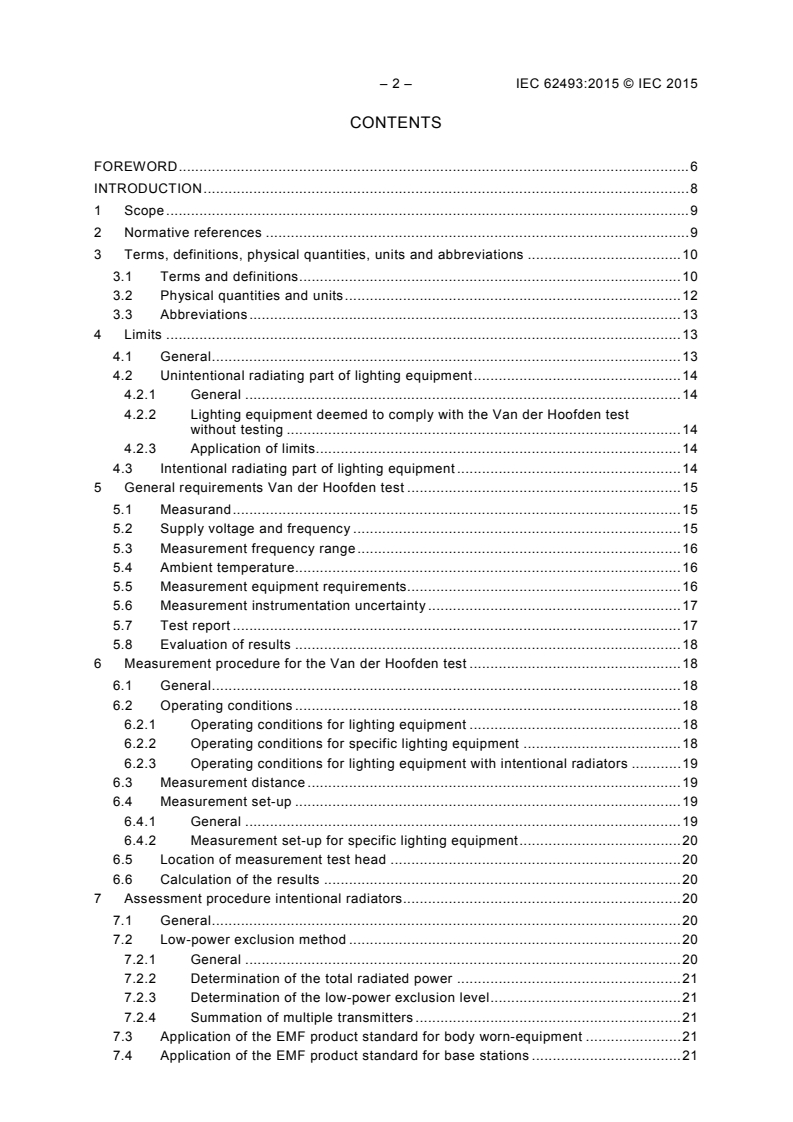
CONTENTS
FOREWORD . 6
INTRODUCTION . 8
1 Scope . 9
2 Normative references . 9
3 Terms, definitions, physical quantities, units and abbreviations . 10
3.1 Terms and definitions . 10
3.2 Physical quantities and units . 12
3.3 Abbreviations . 13
4 Limits . 13
4.1 General . 13
4.2 Unintentional radiating part of lighting equipment . 14
4.2.1 General . 14
4.2.2 Lighting equipment deemed to comply with the Van der Hoofden test
without testing . 14
4.2.3 Application of limits. 14
4.3 Intentional radiating part of lighting equipment . 14
5 General requirements Van der Hoofden test . 15
5.1 Measurand . 15
5.2 Supply voltage and frequency . 15
5.3 Measurement frequency range . 16
5.4 Ambient temperature. 16
5.5 Measurement equipment requirements. 16
5.6 Measurement instrumentation uncertainty . 17
5.7 Test report . 17
5.8 Evaluation of results . 18
6 Measurement procedure for the Van der Hoofden test . 18
6.1 General . 18
6.2 Operating conditions . 18
6.2.1 Operating conditions for lighting equipment . 18
6.2.2 Operating conditions for specific lighting equipment . 18
6.2.3 Operating conditions for lighting equipment with intentional radiators . 19
6.3 Measurement distance . 19
6.4 Measurement set-up . 19
6.4.1 General . 19
6.4.2 Measurement set-up for specific lighting equipment . 20
6.5 Location of measurement test head . 20
6.6 Calculation of the results . 20
7 Assessment procedure intentional radiators. 20
7.1 General . 20
7.2 Low-power exclusion method . 20
7.2.1 General . 20
7.2.2 Determination of the total radiated power . 21
7.2.3 Determination of the low-power exclusion level . 21
7.2.4 Summation of multiple transmitters . 21
7.3 Application of the EMF product standard for body worn-equipment . 21
7.4 Application of the EMF product standard for base stations . 21
7.5 Application of another EMF standard . 21
Annex A (normative) Measurement distances . 23
Annex B (informative) Location of measurement test head . 24
Annex C (informative) Exposure limits . 29
C.1 General . 29
C.2 ICNIRP . 29
C.2.1 ICNIRP 1998 . 29
C.2.2 ICNIRP 2010 . 29
C.3 IEEE . 29
Annex D (informative) Rationale measurement and assessment method . 31
D.1 General . 31
D.2 Induced internal electric field . 31
D.2.1 General . 31
D.2.2 Induced electric field due to the magnetic field; E (f ,d ) . 33
eddy i loop
D.2.3 Induced electric field due to the electric field; E (f ,d) . 38
cap i
D.3 Thermal effects from 100 kHz to 300 GHz . 41
D.3.1 General . 41
D.3.2 The 100 kHz to 30 MHz contribution to the thermal effects . 42
D.3.3 The 30 MHz to 300 MHz contribution to the thermal effects . 43
D.3.4 Overall conclusion for the contribution to thermal effects . 44
Annex E (normative) Practical internal electric-field measurement and assessment
method . 45
E.1 Measurement of induced internal electric field. 45
E.2 Calculation program . 45
E.3 Compliance criterion for the Van der Hoofden head test . 46
Annex F (normative) Protection network . 47
F.1 Calibration of the protection network . 47
F.2 Calculation of the theoretical characteristic of the protection network . 48
Annex G (informative) Measurement instrumentation uncertainty . 50
Annex H (informative) Equipment deemed to comply . 52
Annex I (informative) Intentional radiators . 54
I.1 General . 54
I.2 Intentional radiators in lighting equipment . 54
I.3 Properties of antennas in lighting applications . 54
I.4 Exposure assessment approach. 60
I.4.1 General . 60
I.4.2 Determination of average total radiated power P . 60
int,rad
I.4.3 Determination of the low-power exclusion level P . 61
max
I.5 Multiple transmitters in a luminaire . 61
I.6 Exposure to multiple luminaires . 62
I.7 References in Annex I . 62
Bibliography . 64
Figure 1 – Compliance routes and pass/fail criteria for lighting equipment . 15
Figure 2 – The Van der Hoofden test head . 16
Figure 3 – Example of a protection circuit . 17
– 4 – IEC 62493:2015 © IEC 2015
Figure 4 – Measurement set-up . 19
Figure 5 – Compliance demonstration procedure for the intentional-transmitter part of
the lighting equipment . 22
Figure B.1 – Location of measurement point in the transverse direction of lighting
equipment – side view . 24
Figure B.2 – Location of measurement points in the longitude direction of lighting
equipment – side view . 24
Figure B.3 – Location of measurement points in the longitude direction of lighting
equipment; in the direction of illumination . 25
Figure B.4 – Location of measurement point for lighting equipment with rotationally
symmetrical dimensions . 25
Figure B.5 – Location of measurement point for lighting equipment with rotationally
symmetrical dimensions; in the direction of illumination . 26
Figure B.6 – Location of measurement point for lighting equipment with the same
dimensions in the x- and y- axis . 26
Figure B.7 – Location of measurement point(s) for lighting equipment with single
capped lamp (360° illumination) . 27
Figure B.8 – Location of measurement points for lighting equipment with a remote
controlgear . 27
Figure B.9 – Location of measurement point for an independent electronic converter . 28
Figure B.10 – Location of measurement point(s) for an uplighter (floor
standing/suspended) . 28
Figure D.1 – Overview measurement and assessment method . 31
Figure D.2 – Distances of the head, loop and measurement set-up . 33
Figure D.3 – Maximum current in the 2 m LLA as function of the frequency . 35
Figure D.4 – Induced internal electric field and associated limit levels . 37
Figure D.5 – Example of magnetic-field test result using the LLA . 38
Figure D.6 – Distances of the head and measurement set-up . 39
Figure D.7 – Plot of Equation (D.20) . 39
Figure D.8 – Example of the CM-current measured using a conducted emission test . 43
Figure F.1 – Test set-up for normalization of the network analyser . 47
Figure F.2 – Test set-up for measurement of the voltage division factor using a
network analyser . 48
Figure F.3 – Calculated theoretical characteristic for the calibration of the protection
network . 49
Figure H.1 – Flow chart to determine applicability deemed to comply without F factor
measurement . 53
Figure I.1 – Luminaire with a transmitting antenna in a room. 56
Figure I.2 – Impact of a conducting ceiling/plane . 57
Figure I.3 – Electric field of a small electrical dipole: analytical formula vs far-field
approximation . 58
Figure I.4 – Electric field as a function of distance, antenna gain and input power (far-
field approximation) . 59
Figure I.5 – Impact of pulsed signals on the average exposure . 60
Table 1 – Physical quantities and units . 13
Table 2 – Receiver or spectrum analyser settings . 16
Table A.1 – Lighting equipment and measurement distances . 23
Table C.1 – Basic restrictions for general public exposure to time varying electric and
magnetic fields for frequencies between 100 kHz and 10 GHz . 29
Table C.2 – Basic restrictions for general public exposure to time varying electric and
magnetic fields for frequencies up to 10 MHz . 29
Table C.3 – IEEE basic restrictions (BR) for the general public . 30
Table C.4 – IEEE basic restrictions (BR) between 100 kHz and 3 GHz for the general
public . 30
Table D.1 – Induced internal electric field calculations . 34
Table D.2 – Calculation main contributions . 40
Table D.3 – Frequency steps for the amplitude addition that equals 1,11 times B . 41
Table D.4 – Frequency steps for the power addition that equals 0,833 times B . 42
Table D.5 – Field strength limits according to CISPR 15 . 43
Table E.1 – Conductivity as a function of frequency (see Table C.1 of IEC 62311:2007) . 46
Table G.1 – Uncertainty calculation for the measurement method described in Clauses
5 and 6 in the frequency range from 20 kHz to 10 MHz . 50
Table G.2 – Comments and information to Table G.1 . 51
Table I.1 – Overview of wireless radio technologies that might be applied in lighting
systems . 55
– 6 – IEC 62493:2015 © IEC 2015
INTERNATIONAL ELECTROTECHNICAL COMMISSION
____________
ASSESSMENT OF LIGHTING EQUIPMENT RELATED
TO HUMAN EXPOSURE TO ELECTROMAGNETIC FIELDS
FOREWORD
1) The International Electrotechnical Commission (IEC) is a worldwide organization for standardization comprising
all national electrotechnical committees (IEC National Committees). The object of IEC is to promote
international co-operation on all questions concerning standardization in the electrical and electronic fields. To
this end and in addition to other activities, IEC publishes International Standards, Technical Specifications,
Technical Reports, Publicly Available Specifications (PAS) and Guides (hereafter referred to as “IEC
Publication(s)”). Their preparation is entrusted to technical committees; any IEC National Committee interested
in the subject dealt with may participate in this preparatory work. International, governmental and non-
governmental organizations liaising with the IEC also participate in this preparation. IEC collaborates closely
with the International Organization for Standardization (ISO) in accordance with conditions determined by
agreement between the two organizations.
2) The formal decisions or agreements of IEC on technical matters express, as nearly as possible, an international
consensus of opinion on the relevant subjects since each technical committee has representation from all
interested IEC National Committees.
3) IEC Publications have the form of recommendations for international use and are accepted by IEC National
Committees in that sense. While all reasonable efforts are made to ensure that the technical content of IEC
Publications is accurate, IEC cannot be held responsible for the way in which they are used or for any
misinterpretation by any end user.
4) In order to promote international uniformity, IEC National Committees undertake to apply IEC Publications
transparently to the maximum extent possible in their national and regional publications. Any divergence
between any IEC Publication and the corresponding national or regional publication shall be clearly indicated in
the latter.
5) IEC itself does not provide any attestation of conformity. Independent certification bodies provide conformity
assessment services and, in some areas, access to IEC marks of conformity. IEC is not responsible for any
services carried out by independent certification bodies.
6) All users should ensure that they have the latest edition of this publication.
7) No liability shall attach to IEC or its directors, employees, servants or agents including individual experts and
members of its technical committees and IEC National Committees for any personal injury, property damage or
other damage of any nature whatsoever, whether direct or indirect, or for costs (including legal fees) and
expenses arising out of the publication, use of, or reliance upon, this IEC Publication or any other IEC
Publications.
8) Attention is drawn to the Normative references cited in this publication. Use of the referenced publications is
indispensable for the correct application of this publication.
9) Attention is drawn to the possibility that some of the elements of this IEC Publication may be the subject of
patent rights. IEC shall not be held responsible for identifying any or all such patent rights.
International Standard IEC 62493 has been prepared by IEC technical committee 34: Lamps
and related equipment.
This second edition cancels and replaces the first edition published in 2009. This edition
constitutes a technical revision.
This edition includes the following significant technical changes with respect to the previous
edition:
a) identification of lighting product types deemed to comply with the standard without the
need for test;
b) deletion of the need for CISPR-15-compliance as a prerequisite for IEC 62493 compliance;
c) inclusion of the consequences of the ICNIRP 2010 guidelines for (up to 100 kHz);
d) adding some guidance to the Van der Hoofden test head method to improve reproducibility
of results;
e) inclusion of compliance demonstration method for products having intentional radiators.
The text of this standard is based on the following documents:
FDIS Report on voting
34/222/FDIS 34/228/RVD
Full information on the voting for the approval of this standard can be found in the report on
voting indicated in the above table.
This publication has been drafted in accordance with the ISO/IEC Directives, Part 2.
A list of all parts in the IEC 62493 series, published under the general title Assessment of
lighting equipment related to human exposure to electromagnetic fields, can be found on the
IEC website.
The exposure limits given in Annex C (informative) are for information only; they do not
comprise an exhaustive list and are valid only in certain regions of the world. It is the
responsibility of users of this standard to ensure that they use the current version of the limit
values specified by the applicable national authorities.
The committee has decided that the contents of this publication will remain unchanged until
the stability date indicated on the IEC web site under "http://webstore.iec.ch" in the data
related to the specific publication. At this date, the publication will be
• reconfirmed,
• withdrawn,
• replaced by a revised edition, or
• amended.
IMPORTANT – The 'colour inside' logo on the cover page of this publication indicates
that it contains colours which are considered to be useful for the correct
understanding of its contents. Users should therefore print this document using a
colour printer.
– 8 – IEC 62493:2015 © IEC 2015
INTRODUCTION
This International Standard establishes a suitable evaluation method for the influence of the
electromagnetic fields in the space around the equipment mentioned in the scope, and
defines standardized operating conditions and measurement distances.
This standard is designed to assess, by measurements and/or calculations, electromagnetic
(EM) fields and their potential effect on the human body by reference to exposure levels of the
general public given by ICNIRP:1998 [1] , ICNIRP 2010 [2], IEEE C95.1:2005 [3] and
IEEE C95.6:2002 [4]. The exposure levels with which to comply are basic restrictions (both
ICNIRP- and IEEE-based).
Based on the lighting equipment operating properties, the frequency range of the applicable
basic restrictions can be limited as follows:
• internal electric field between 20 kHz and 10 MHz;
• specific absorption rate (SAR) between 100 kHz and 300 MHz;
• power density is outside the scope.
NOTE Operating frequencies of lighting equipment are higher than 20 kHz to avoid audible noise and infrared
interference. Frequency contributions above 300 MHz can be neglected.
This standard is not meant to supplant definitions and procedures specified in exposure
standards, but it is aimed at supplementing the procedure already specified for compliance
with exposure.
___________
Numbers in square brackets refer to the Bibliography.
ASSESSMENT OF LIGHTING EQUIPMENT RELATED
TO HUMAN EXPOSURE TO ELECTROMAGNETIC FIELDS
1 Scope
This International Standard applies to the assessment of lighting equipment related to human
exposure to electromagnetic fields. The assessment consists of the induced internal electric
field for frequencies from 20 kHz to 10 MHz and the specific absorption rate (SAR) for
frequencies from 100 kHz to 300 MHz around lighting equipment.
Included in the scope of this standard are:
– all lighting equipment with a primary function of generating and/or distributing light
intended for illumination purposes, and intended either for connection to the low voltage
electricity supply or for battery operation; used indoor and/or outdoor;
– lighting part of multi-function equipment where one of the primary functions of this is
illumination;
– independent auxiliaries exclusively for the use with lighting equipment;
– lighting equipment including intentional radiators for wireless communication or control.
Excluded from the scope of this standard are:
– lighting equipment for aircraft and airfields;
– lighting equipment for road vehicles; (except lighting used for the illumination of passenger
compartments in public transport)
– lighting equipment for agriculture;
– lighting equipment for boats/vessels;
– photocopiers, slide projectors;
– apparatus for which the requirements of electromagnetic fields are explicitly formulated in
other IEC standards.
NOTE The methods described in this standard are not suitable for comparing the fields from different lighting
equipment.
This standard does not apply to built-in components for luminaires such as electronic
controlgear.
2 Normative references
The following documents, in whole or in part, are normatively referenced in this document and
are indispensable for its application. For dated references, only the edition cited applies. For
undated references, the latest edition of the referenced document (including any
amendments) applies.
IEC 62209-2:2010, Human exposure to radio frequency fields from hand-held and body-
mounted wireless communication devices – Human models, instrumentation, and procedures
– Part 2: Procedure to determine the specific absorption rate (SAR) for wireless
communication devices used in close proximity to the human body (frequency range of 30
MHz to 6 GHz)
IEC 62232:2011, Determination of RF field strength and SAR in the vicinity of
radiocommunication base stations for the purpose of evaluating human exposure
IEC 62311:2007, Assessment of electronic and electrical equipment related to human
exposure restrictions for electromagnetic fields (0 Hz – 300 GHz)
– 10 – IEC 62493:2015 © IEC 2015
IEC 62479:2010, Assessment of the compliance of low-power electronic and electrical
equipment with the basic restrictions related to human exposure to electromagnetic fields
(10 MHz to 300 GHz)
CISPR 16-1-1, Specification for radio disturbance and immunity measuring apparatus and
methods. Part 1-1: Radio disturbance and immunity measuring apparatus – Measuring
apparatus
3 Terms, definitions, physical quantities, units and abbreviations
3.1 Terms and definitions
For the purposes of this document the following terms and definitions apply.
3.1.1
ballast
unit inserted between the supply and one or more discharge lamps which by means of
inductance, capacitance, or a combination of inductance and capacitance, serves mainly to
limit the current of the lamp(s) to the required value
Note 1 to entry: It may also include means for transforming the supply voltage and arrangements that help
provide starting voltage and pre-heating current.
3.1.2
basic restriction
basic limitations
restrictions on exposure to time-varying electric, magnetic and electromagnetic fields that are
based on established biological effects and including a safety factor
Note 1 to entry: The basic restriction is the maximum level that should not be exceeded under any conditions.
3.1.3
built-in lamp controlgear
lamp controlgear generally designed to be built into a luminaire, a box, an enclosure or the
like and not intended to be mounted outside a luminaire, etc. without special precautions
Note 1 to entry: The controlgear compartment in the base of a road lighting column is considered to be an
enclosure.
3.1.4
compliance factor
F
factor determined using the Van der Hoofden head test method that represents the measured
(weighted and summed) induced internal electric field due to the external electric field in the
frequency range 20 kHz to 10 MHz
Note 1 to entry: See Annex D and Annex E.
3.1.5
electronic controlgear
mains-supplied a.c./d.c. to a.c./d.c. invertor including stabilizing elements for starting and
operating one or more lamps, generally at high frequency
Note 1 to entry: All kinds of igniters, starters, switches, dimmers (including phase control units e.g. triac, GTO)
and sensors are not considered as electronic controlgear.
3.1.6
exposure
exposure occurs whenever and wherever a person is subjected to electric, magnetic or
electromagnetic fields or to contact currents other than those originating from physiological
processes in the body and other natural phenomena
3.1.7
exposure distance
typical distance between lighting equipment and a person under normal conditions of use
3.1.8
fluorescent lamp
discharge lamp of the low pressure mercury type in which most of the light is emitted by one
or several layers of phosphors excited by the ultraviolet radiation from the discharge
Note 1 to entry: These lamps are frequently tubular and, in GB are then usually called fluorescent tubes.
3.1.9
high-intensity discharge lamp
HID lamp
electric discharge lamp in which the light-producing arc is stabilized by wall temperature and
the arc has a bulb wall loading in excess of 3 W/cm
Note 1 to entry: HID lamps include groups of lamps known as high pressure mercury, metal halide and high
pressure sodium lamps.
Note 2 to entry: This note applies to the French language only.
3.1.10
high-pressure lamp
high intensity discharge lamp in which the major portion of the light is produced, directly or
indirectly, by radiation from mercury or sodium vapour operating at relatively high levels of
partial pressure
3.1.11
independent auxiliary
auxiliaries consisting of one or more separate elements designed so that it can be mounted
separately outside a luminaire, with protection according to the marking of the auxiliaries and
without any additional enclosure
EXAMPLE: Examples are dimmers, transformers and convertors for incandescent lamps or LED light sources,
ballasts for discharge lamps (including fluorescent lamps) and semi-luminaires for compact fluorescent lamps,
incandescent lamps or LED light sources
Note 1 to entry: This may consist of a built-in auxiliary housed in a suitable enclosure which provides all the
necessary protection according to its markings.
3.1.12
independent lamp controlgear
independent electronic converter
lamp controlgear consisting of one or more separate elements so designed that it can be
mounted separately outside a luminaire, with protection according to the marking of the lamp
controlgear and without any additional enclosure
Note 1 to entry: This may consist of a built-in lamp controlgear housed in a suitable enclosure that provides all
the necessary protection according to its markings.
3.1.13
integral lamp controlgear
lamp controlgear which forms a non-replaceable part of a luminaire and which cannot be
tested separately from the luminaire
3.1.14
intentional radiator
any device that is designed to produce electromagnetic fields on purpose in order to provide
functions such as wireless communication, control, detection, etc.
3.1.15
lamp controlgear
one or more components between the supply and one or more lamps which may serve to
transform the supply voltage, limit the current of the lamp(s) to the required value, provide
starting voltage and preheating current, prevent cold starting, correct power factor or reduce
radio interference
– 12 – IEC 62493:2015 © IEC 2015
3.1.16
light emitting diode
LED
solid state device embodying a p-n junction, emitting optical radiation when excited by an
electric current
Note 1 to entry: This note applies to the French language only.
3.1.17
lighting equipment
equipment with a primary function of generating and/or regulating and/or distributing optical
radiation by electric light source(s)
3.1.18
low-pressure lamp
discharge lamp in which the light is produced by radiation from sodium vapour or mercury
3.1.19
measurement distance
distance between the lighting equipment and the external surface of the measurement test-
head
Note 1 to entry: See Annex A.
3.1.20
measurement point
position and location of the measurement test head relative to the lighting equipment
3.1.21
organic light emitting diode
OLED
light emitting semiconductor that has an electroluminescent zone made of organic compounds
consisting of a cathode, an anode, and organic electroluminescent layers
Note 1 to entry: This note applies to the French language only.
3.1.22
self-ballasted lamp
unit which can be dismantled without being permanently damaged, provided with a lamp cap
and incorporating a light source and additional elements necessary for starting and for stable
operating of the light source
3.2 Physical quantities and units
For the purposes of this document the following physical quantities and units given in Table 1
apply.
Table 1 – Physical quantities and units
Quantity Symbol Unit Dimension
Conductivity σ Siemens per metre S/m
Current density J Ampere per square metre
A/m
Electric field strength E Volt per metre V/m
Frequency f Hertz Hz
H
Magnetic field strength Ampère per metre A/m
2 2
Magnetic flux density B Tesla
T (Wb/m , Vs/m )
Power P Watt W
Current I Ampere A
3.3 Abbreviations
For the purposes of this document the following abbreviations apply.
a.c. alternating current
BR basic restriction
CISPR Comité International Spécial des Perturbations Radioélectriques
d.c. direct current
DUT device under test
EIRP equivalent isotropically radiated power
EMF electromagnetic field
EMI electromagnetic interference
ERP effective radiated power
GTO gate turn off
HID high intensity discharge
ICNIRP International Commission on Non-Ionizing Radiation Protection
IEC International Electrotechnical Commission
IEEE Institute of Electrical and Electronics Engineers
IR Infrared
LED light emitting diode
LLA large loop antenna
NWA network analyser
OLED organic light emitting diode
PRF pulse repetition frequency
RF radio frequency
r.m.s. root mean square
SAR specific absorption rate
UV ultraviolet
WBA whole-body average
4 Limits
4.1 General
The basic restrictions or reference levels for the general public of either IEEE C95.1-2005 or
ICNIRP 1998 and ICNIRP 2010 are used, see Annex C.
– 14 – IEC 62493:2015 © IEC 2015
Lighting equipment shall comply with the Van der Hoofden test limit (4.2.3), unless it is
inherently compliant (4.2.2). If equipped with intentional radiators, it shall also pass the
assessment procedure for intentional radiators (4.3). An overview of the routes to
demonstrate compliance against these limits is given in Figure1.
4.2 Unintentional radiating part of lighting equipment
4.2.1 General
This subclause 4.2 applies for lighting equipment, excluding the intentional radiating part (as
far as applicable).
4.2.2 Lighting equipment deemed to comply with the Van der Hoofden test without
testing
Lighting equipment is deemed to comply with the requirements of this standard without testing
if it fulfils one of the following inherent-compliance conditions:
1) it contains no electronic controlgear;
2) it is incandescent-lamp technology, including halogen;
3) it is a LED-light-source technology;
4) it is an OLED light-source technology;
5) it is high-pressure discharge lamp technologies;
6) it is based on low-pressure discharge lamp technologies with an exposure distance larger
than or equal to 50 cm (according to Table A.1);
7) it is an independent auxiliary.
The background and rationale for these conditions is given in the inform
...