

IEC TS 62404:2007
(Main)Logic digital integrated circuits - Specification for I/O interface model for integrated circuit (IMIC version 1.3)
General Information
- Abstract
Standardize the electrical modeling of input signals, output signals, power supply and ground terminals of integrated circuits, in order to provide for analysis of electrical characteristics of equipment
- Status
- Published
- Publication Date
- 19-Feb-2007
- Technical Committee
- SC 47A - Integrated circuits
- Drafting Committee
- WG 2 - TC 47/SC 47A/WG 2
- Current Stage
- PPUB - Publication issued
- Start Date
- 20-Feb-2007
- Completion Date
- 31-Dec-2006
Overview
IEC TS 62404:2007 - Logic digital integrated circuits (IMIC v1.3) defines a standardized I/O interface model for integrated circuits to support accurate electrical analysis at chip, package and module levels. The Technical Specification standardizes the electrical modeling of input/output signals, power supply and ground terminals so that simulators and EDA tools can analyze signal integrity, power/ground bounce and board-level electrical behavior without exposing vendor proprietary process parameters.
Key points:
- Model language: extended SPICE-style circuit descriptions.
- Hierarchy: separate, interoperable IC, package and module model files.
- Device representation: non-linear devices expressed in 1D/2D/3D table formats and equivalent circuits.
- Relation to IBIS: complements and extends IBIS (IEC 62014‑1) by covering power/ground currents, internal circuitry and package/module effects.
Key topics and requirements
- Model structure and delivery: Defines data structures and file elements for IC model files, package model files and module model files to allow independent generation and exchange.
- Circuit description rules: Extended SPICE syntax and unified description rules to model simple and complex buffers, power/ground interconnects and package parasitics.
- Device equivalents and characteristics: Includes diagrams and tables for diodes, MOS (NMOS/PMOS) and bipolar equivalents, plus grid-based characteristic data for non-linear behavior.
- Levels of modeling: Introduces modeling levels so that users can exchange only the level of detail required for a given analysis (e.g., fast system-level versus detailed transistor-level).
- Simulation compatibility: Focus on producing netlists and models suitable for circuit-level simulation of printed circuit boards and I/O buffers.
- Interoperability with IBIS: Provides means to derive IBIS data from IMIC models and to overcome IBIS limitations for power/ground and multi-stage buffer effects.
Applications
- Signal integrity analysis (rise/fall waveforms, crosstalk)
- Power integrity and power/ground bounce simulation
- Board- and module-level circuit simulation including package parasitics
- EMI/EMC pre-compliance modeling where richer internal-device or package detail is needed
- Generation of vendor-supplied models for EDA tools while protecting proprietary process details
Who uses this standard
- Semiconductor manufacturers and device vendors preparing I/O models
- EDA and simulator tool developers implementing modeling support
- PCB, module and system designers performing SI/PI/EMI analysis
- Signal integrity and power integrity engineers requiring accurate I/O and package behavior
Related standards
- IEC 62014-1 (IBIS) - Input/Output Buffer Information Specification: referenced normative standard; IMIC is designed to complement and extend IBIS capabilities.
Keywords: IEC TS 62404:2007, IMIC version 1.3, I/O interface model, integrated circuit modeling, extended SPICE, package model, module model, signal integrity, power/ground bounce, IBIS, electrical modeling.
Frequently Asked Questions
IEC TS 62404:2007 is a technical specification published by the International Electrotechnical Commission (IEC). Its full title is "Logic digital integrated circuits - Specification for I/O interface model for integrated circuit (IMIC version 1.3)". This standard covers: Standardize the electrical modeling of input signals, output signals, power supply and ground terminals of integrated circuits, in order to provide for analysis of electrical characteristics of equipment
Standardize the electrical modeling of input signals, output signals, power supply and ground terminals of integrated circuits, in order to provide for analysis of electrical characteristics of equipment
IEC TS 62404:2007 is classified under the following ICS (International Classification for Standards) categories: 31.200 - Integrated circuits. Microelectronics. The ICS classification helps identify the subject area and facilitates finding related standards.
IEC TS 62404:2007 is available in PDF format for immediate download after purchase. The document can be added to your cart and obtained through the secure checkout process. Digital delivery ensures instant access to the complete standard document.
Standards Content (Sample)
TECHNICAL IEC
SPECIFICATION TS 62404
First edition
2007-02
Logic digital integrated circuits –
Specification for I/O interface model
for integrated circuit (IMIC version 1.3)
Reference number
IEC/TS 62404:2007(E)
Publication numbering
As from 1 January 1997 all IEC publications are issued with a designation in the
60000 series. For example, IEC 34-1 is now referred to as IEC 60034-1.
Consolidated editions
The IEC is now publishing consolidated versions of its publications. For example,
edition numbers 1.0, 1.1 and 1.2 refer, respectively, to the base publication, the
base publication incorporating amendment 1 and the base publication incorporating
amendments 1 and 2.
Further information on IEC publications
The technical content of IEC publications is kept under constant review by the IEC,
thus ensuring that the content reflects current technology. Information relating to
this publication, including its validity, is available in the IEC Catalogue of
publications (see below) in addition to new editions, amendments and corrigenda.
Information on the subjects under consideration and work in progress undertaken
by the technical committee which has prepared this publication, as well as the list
of publications issued, is also available from the following:
• IEC Web Site (www.iec.ch)
• Catalogue of IEC publications
The on-line catalogue on the IEC web site (www.iec.ch/searchpub) enables you to
search by a variety of criteria including text searches, technical committees
and date of publication. On-line information is also available on recently issued
publications, withdrawn and replaced publications, as well as corrigenda.
• IEC Just Published
This summary of recently issued publications (www.iec.ch/online_news/ justpub)
is also available by email. Please contact the Customer Service Centre (see
below) for further information.
• Customer Service Centre
If you have any questions regarding this publication or need further assistance,
please contact the Customer Service Centre:
Email: custserv@iec.ch
Tel: +41 22 919 02 11
Fax: +41 22 919 03 00
TECHNICAL IEC
SPECIFICATION TS 62404
First edition
2007-02
Logic digital integrated circuits –
Specification for I/O interface model
for integrated circuit (IMIC version 1.3)
© IEC 2007 ⎯ Copyright - all rights reserved
No part of this publication may be reproduced or utilized in any form or by any means, electronic or
mechanical, including photocopying and microfilm, without permission in writing from the publisher.
International Electrotechnical Commission, 3, rue de Varembé, PO Box 131, CH-1211 Geneva 20, Switzerland
Telephone: +41 22 919 02 11 Telefax: +41 22 919 03 00 E-mail: inmail@iec.ch Web: www.iec.ch
PRICE CODE
Commission Electrotechnique Internationale XB
International Electrotechnical Commission
МеждународнаяЭлектротехническаяКомиссия
For price, see current catalogue
– 2 – TS 62404 © IEC:2007(E)
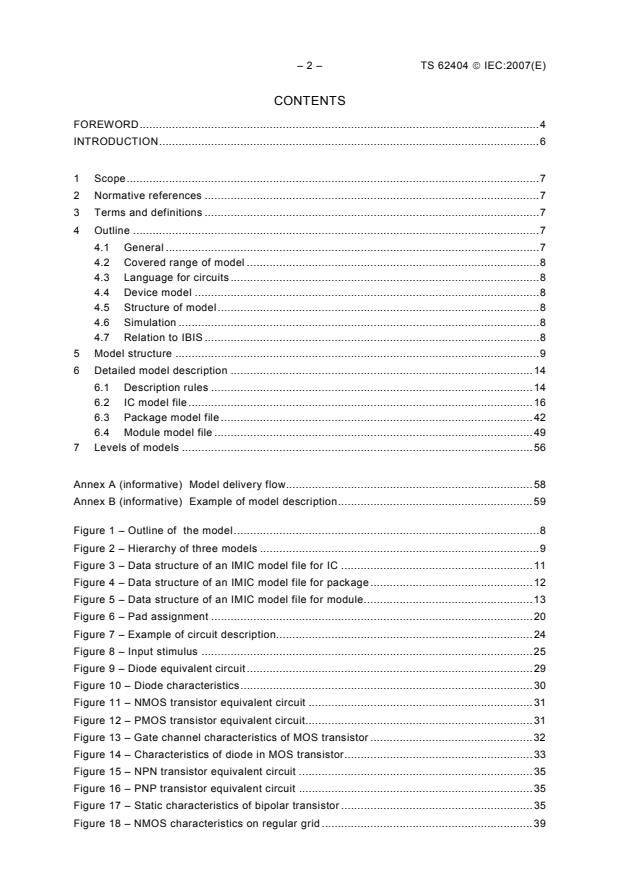
CONTENTS
FOREWORD.4
INTRODUCTION.6
1 Scope.7
2 Normative references .7
3 Terms and definitions .7
4 Outline .7
4.1 General .7
4.2 Covered range of model .8
4.3 Language for circuits .8
4.4 Device model .8
4.5 Structure of model.8
4.6 Simulation .8
4.7 Relation to IBIS .8
5 Model structure .9
6 Detailed model description .14
6.1 Description rules .14
6.2 IC model file.16
6.3 Package model file .42
6.4 Module model file .49
7 Levels of models .56
Annex A (informative) Model delivery flow.58
Annex B (informative) Example of model description.59
Figure 1 – Outline of the model.8
Figure 2 – Hierarchy of three models .9
Figure 3 – Data structure of an IMIC model file for IC .11
Figure 4 – Data structure of an IMIC model file for package.12
Figure 5 – Data structure of an IMIC model file for module.13
Figure 6 – Pad assignment .20
Figure 7 – Example of circuit description.24
Figure 8 – Input stimulus .25
Figure 9 – Diode equivalent circuit.29
Figure 10 – Diode characteristics.30
Figure 11 – NMOS transistor equivalent circuit .31
Figure 12 – PMOS transistor equivalent circuit.31
Figure 13 – Gate channel characteristics of MOS transistor .32
Figure 14 – Characteristics of diode in MOS transistor.33
Figure 15 – NPN transistor equivalent circuit .35
Figure 16 – PNP transistor equivalent circuit .35
Figure 17 – Static characteristics of bipolar transistor .35
Figure 18 – NMOS characteristics on regular grid .39
TS 62404 © IEC:2007(E) – 3 –
Figure 19 – MOS transistor model with two-terminal model .39
Figure 20 – Relationship between inner terminals and equivalent circuits of package .46
Figure 21 – Relationship between outer terminals and equivalent circuits of package .47
Figure 22 – Example of module circuit .53
Figure 23 – Example of signal source of module .55
Figure A.1 – Delivery flow of model files .58
Figure B.1 – IC structure.59
Figure B.2 – Equivalent circuit .59
Table 1 – Elements of model structures .10
Table 2 – Levels of models .57
Table 3 – Required elements of model for each level .57
– 4 – TS 62404 © IEC:2007(E)
INTERNATIONAL ELECTROTECHNICAL COMMISSION
____________
LOGIC DIGITAL INTEGRATED CIRCUITS –
SPECIFICATION FOR I/O INTERFACE MODEL
FOR INTEGRATED CIRCUIT
(IMIC version 1.3)
FOREWORD
1) The International Electrotechnical Commission (IEC) is a worldwide organization for standardization comprising
all national electrotechnical committees (IEC National Committees). The object of IEC is to promote
international co-operation on all questions concerning standardization in the electrical and electronic fields. To
this end and in addition to other activities, IEC publishes International Standards, Technical Specifications,
Technical Reports, Publicly Available Specifications (PAS) and Guides (hereafter referred to as “IEC
Publication(s)”). Their preparation is entrusted to technical committees; any IEC National Committee interested
in the subject dealt with may participate in this preparatory work. International, governmental and non-
governmental organizations liaising with the IEC also participate in this preparation. IEC collaborates closely
with the International Organization for Standardization (ISO) in accordance with conditions determined by
agreement between the two organizations.
2) The formal decisions or agreements of IEC on technical matters express, as nearly as possible, an international
consensus of opinion on the relevant subjects since each technical committee has representation from all
interested IEC National Committees.
3) IEC Publications have the form of recommendations for international use and are accepted by IEC National
Committees in that sense. While all reasonable efforts are made to ensure that the technical content of IEC
Publications is accurate, IEC cannot be held responsible for the way in which they are used or for any
misinterpretation by any end user.
4) In order to promote international uniformity, IEC National Committees undertake to apply IEC Publications
transparently to the maximum extent possible in their national and regional publications. Any divergence
between any IEC Publication and the corresponding national or regional publication shall be clearly indicated in
the latter.
5) IEC provides no marking procedure to indicate its approval and cannot be rendered responsible for any
equipment declared to be in conformity with an IEC Publication.
6) All users should ensure that they have the latest edition of this publication.
7) No liability shall attach to IEC or its directors, employees, servants or agents including individual experts and
members of its technical committees and IEC National Committees for any personal injury, property damage or
other damage of any nature whatsoever, whether direct or indirect, or for costs (including legal fees) and
expenses arising out of the publication, use of, or reliance upon, this IEC Publication or any other IEC
Publications.
8) Attention is drawn to the Normative references cited in this publication. Use of the referenced publications is
indispensable for the correct application of this publication.
9) Attention is drawn to the possibility that some of the elements of this IEC Publication may be the subject of
patent rights. IEC shall not be held responsible for identifying any or all such patent rights.
The main task of IEC technical committees is to prepare International Standards. In
exceptional circumstances, a technical committee may propose the publication of a technical
specification when
• the required support cannot be obtained for the publication of an International Standard,
despite repeated efforts, or
• the subject is still under technical development or where, for any other reason, there is the
future but no immediate possibility of an agreement on an International Standard.
Technical specifications are subject to review within three years of publication to decide
whether they can be transformed into International Standards.
IEC 62404, which is a technical specification, has been prepared by subcommittee 47A:
Integrated circuits, of IEC technical committee 47: Semiconductor devices.
TS 62404 © IEC:2007(E) – 5 –
The text of this technical specification is based on the following documents:
Enquiry draft Report on voting
47A/746/DTS 47A/751/RVC
Full information on the voting for the approval of this technical specification can be found in
the report on voting indicated in the above table.
This publication has been drafted in accordance with the ISO/IEC Directives, Part 2.
A bilingual version of this publication may be issued at a later date.
The committee has decided that the contents of this publication will remain unchanged until
the maintenance result date indicated on the IEC web site under "http://webstore.iec.ch" in
the data related to the specific publication. At this date, the publication will be
• transformed into an International standard,
• reconfirmed,
• withdrawn,
• replaced by a revised edition, or
• amended.
– 6 – TS 62404 © IEC:2007(E)
INTRODUCTION
With an increase in speed of electronic systems, it becomes necessary to accurately predict
electrical performance including noise in electronic systems with integrated circuits.
Simulators have been used for this purpose. Simulators need accurate models for describing
electrical properties of integrated circuits. Semiconductor manufacturers and/or suppliers are
required by their users to prepare device models for various simulation tools, some of which
are not compatible with SPICE. In addition, since SPICE models contain proprietary process
parameters, a non-disclosure agreement is typically required to obtain these from the vendor.
IBIS (I/O Buffer Interface Specification) has been proposed as a model for integrated circuits,
which, approved as IEC 62014-1, has the following features:
• since electrical properties of I/O buffers are described in table format, disclosure of
proprietary information such as process parameters is drastically reduced;
• it is easy to get IBIS models that are supported by many simulation tools;
• a public domain tool can convert SPICE models into IBIS models.
However, IBIS models seem to have the following problems:
• the modeling of power and ground currents is insufficient for accurate power and ground
bounce analysis;
• since an IBIS model has only the final stage at output and input, it is difficult to model the
effect of loading on circuit boards on output and input waveforms. The fixed model taken
by IBIS has little flexibility for describing other circuitry;
• in order to simulate EMI with accuracy, more information such as material constant and
three-dimensional structures is needed.
TS 62404 © IEC:2007(E) – 7 –
LOGIC DIGITAL INTEGRATED CIRCUITS –
SPECIFICATION FOR I/O INTERFACE MODEL
FOR INTEGRATED CIRCUIT
(IMIC version 1.3)
1 Scope
The following items are considered to standardize the electrical modeling of input signals,
output signals, power supply and ground terminals of integrated circuits, in order to provide
for analysis of electrical characteristics of equipment.
1) To standardize in order to solve current problems and in order to extend capabilities of
analysis, on the basis of results of the past standardization activities.
2) To define more flexible description rules for electric circuits in order to provide more
accurate analysis of printed circuit board.
3) To introduce the concept of modeling levels to exchange relevant data for each application.
4) To enhance electrical modeling for packages and modules.
2 Normative references
The following referenced documents are indispensable for the application of this document.
For dated references, only the edition cited applies. For undated references, the latest edition
of the referenced document (including any amendments) applies.
IEC 62014-1:2001, Electronic design automation libraries – Part 1: Input/output buffer
information specifications (IBIS version 3.2)
3 Terms and definitions
Under consideration
4 Outline
4.1 General
The outline of this model is shown in Figure 1.
– 8 – TS 62404 © IEC:2007(E)
Package
Chip
Input Signal
Signal Pin (Output)
Signal Pin (Input)
Buffer
Buffer
Power Pin
Power Pin
Ground Pin
Ground Pin
Signal Pin (Output)
Signal Pin (Input)
Buffer
Buffer
Input Signal
Characterized by table format
Characterized by table format
IEC 180/07
Figure 1 – Outline of the model
4.2 Covered range of model
The model is described as circuits covering the whole or a part of the I/0 buffers and the
package.
4.3 Language for circuits
The circuits shall be described in extended SPICE format. The structure allows describing
simple buffers, complex buffers, power and ground lines, packages and complex memory
module boards in a unified format.
4.4 Device model
The characteristics of non-linear devices redescribed in one-dimensional, two-dimensional or
three-dimensional table format.
4.5 Structure of model
The data of the model consists of integrated circuit, package and module portions. Therefore
each portion can be generated independently.
4.6 Simulation
The netlist of printed circuit board and the I/O buffer model defined by this specification
provides accurate circuit simulation results.
4.7 Relation to IBIS
Tools that can extract IBIS data from this model are possible to develop.
TS 62404 © IEC:2007(E) – 9 –
5 Model structure
The model shall describe the inside of ICs, packages and module boards as shown in Figure
2.
The models of IC, package and module board consist of the elements given in Table 1.
The data structures of IC, package and module board models are shown in Figure 3, Figure 4,
and Figure 5, respectively.
Package model
IC model Module model
Module
Module
IEC 181/07
Figure 2 – Hierarchy of three models
– 10 – TS 62404 © IEC:2007(E)
Table 1 – Elements of model structures
File Element Description
IC model file Header IC type, model version, model level.
External terminals IC external terminals (package pins).
Pad assignment Connection between IC pads and package inner
terminals.
Circuit description Internal circuits and their connections.
Input stimulus assignment Internal circuits and their stimuli to generate output
waveforms.
Input stimulus Input waveforms.
Device model Characteristics of non-linear circuits in one-
dimensional, two-dimensional and three-
dimensional table data. Non-linear devices are
transistors, diodes and so on.
Package model reference Name of the package model to be used.
Package model Header Package name, model version, model level.
file
Model name List of models in package circuit model.
Inner terminal Cross-reference between internal terminals and
package internal circuit model.
Outer terminal Cross-reference between external circuit and
package internal circuit model.
Circuit description Internal circuits and their connections.
Device model Characteristics of non-linear circuits in one-
dimensional, two-dimensional and three-
dimensional table data. Non-linear devices are
transistors, diodes and so on.
Structure Material, position, three-dimensional structures.
Module model Header Module name, model version, model level.
file
External terminals External terminals (pins) of module.
Circuit description Internal circuits and their connections.
Signal source Internal circuits and their terminals to generate
output waveforms at corresponding external
terminals.
Device model Characteristics of non-linear circuits in one-
dimensional, two-dimensional and three-
dimensional table data. Non-linear devices are
transistors, diodes and so on.
IC/Module model reference Names of IC/module model files and model names
to be used.
Structure Material, position, three-dimensional structures.
TS 62404 © IEC:2007(E) – 11 –
IC model file
xxx.IMC
Note:(*)denotes repeated description
Start of IC model
(*)
[IC]
No. of ICs
IC name
Header part IC name
[NAME]
IMIC version
[IMIC_VER] IMIC version
Model level
Model level
[LEVEL]
Creation date
Creation date
[DATE]
Model explanation
Model explanation
[NOTES]
Copyright
Copyright indication
[COPYRIGHT]
Manufacturer name
Manufacturer name
[MANUFACTURER]
Terminal part
Terminal names of IC
[TERMINAL]
Pad assignment part
Interconnection of chip pads and package inner terminals
[PAD_ASSIGNMENT]
High speed model
Circuit description part
(*)
Circuit Description of chip
[FAST]
[CONNECTION]
No. of elements
Typical speed model
Circuit Description of chip
(*)
[TYP]
No. of elements
Low speed model
Circuit Description of chip
(*)
[SLOW]
End of circuit description part
No. of elements
[END_CONNECTION]
Terminal name
Stimulus assignment part Stimulus for rising
(*) (*)
Circuit instance
[TERMINAL]
[STIMULUS_ASSIGNMENT] [RISING]
No. of
No. of
instances
terminals (*) Waveform
No. of
group name
End of stimulus assignment part
groups
[END_STIMULUS_ASSIGNMENT]
Stimulus for falling
(*)
Circuit instance
[FALLING] No. of
instances
(*) Waveform
Stimulus part
No. of
Stimulus name group name
(*)
[STIMULUS] groups
No. of
stimulus
High speed waveform
Waveform
Source
(*)
[FAST]
definition part
No. of
description
[WAVE_DEF] sources
Normal speed waveform
Source
(*)
[TYP]
description
End of waveform def. No. of
sources
[END_WAVE_DEF]
Low speed waveform Source
(*)
[SLOW]
description
No. of
sources
Device model part
High speed model
(*) Device model description
[DEVICE_DEF] [FAST]
No. of models
Typical speed model
(*)
Device model description
[TYP]
No. of models
End of device model part Low speed model
(*)
Device model description
[SLOW]
[END_DEVICE_DEF]
No. of models
Package model
Package model file name
reference part
[COMPONENT]
Package name
Package model name
End of IC model
[END_IC]
IEC 182/07
Figure 3 – Data structure of an IMIC model file for IC
– 12 – TS 62404 © IEC:2007(E)
Package
model file
xxx.PKG
Note:(*)denotes repeated description
Start of package model
(*)
[PACKAGE]
No. of packages
Package name
Header part Package name
[NAME]
IMIC version
IMIC version
[IMIC_VER]
Model level
Model level
[LEVEL]
Model index
(*) Model name
[MODEL_INDEX]
No. of models
Maximum Frequency
Chip size
Creation date
Creation date
[DATE]
Model explanation
Model explanation
[NOTES]
Copyright
Copyright indication
[COPYRIGHT]
Manufacturer name
Manufacturer
[MANUFACTURER]
Model Model name
Model name
(*)
[MODEL_NAME]
description
No. of models
part
Correspondence of inner terminals and
Inner terminal part
(*)
[INNER_TERMINAL] package circuit
No. of
inner terminals
Correspondence of outer terminals and
Outer terminal part
(*)
package circuit
[OUTER_TERMINAL]
No. of
outer terminals
Circuit description High speed model
(*)
Circuit description
[FAST]
part
No. of elements
[CONNECTION]
Typical speed model
(*)
Circuit description
[TYP]
No. of elements
Low speed model
(*)
Circuit description
[SLOW]
End of circuit
No. of elements
description part
[END_CONNECTION]
Device model part High speed model Device model
(*)
[FAST]
[DEVICE_DEF]
description
No. of models
Typical speed model
Device model
(*)
[TYP]
description
No. of models
Low speed model
Device model
(*)
[SLOW]
description
No. of models
End of device model part
[END_DEVICE_DEF]
(*)
Shape of package
Shape part
No. of shapes
End of package model
IEC 183/07
[END_PACKAGE]
Figure 4 – Data structure of an IMIC model file for package
TS 62404 © IEC:2007(E) – 13 –
Module
board model
file
xxx.MDL
Note:(*)denotes repeated description
Start of module model
(*)
[MODULE]
No. of modules
Module name
Header part Module name
[NAME]
IMIC version
IMIC version
[IMIC_VER]
Model level
Model level
[LEVEL]
Creation date
Creation date
[DATE]
Model explanation
Model explanation
[NOTES]
Copyright
Copyright indication
[COPYRIGHT]
Manufacturer
Manufacturer name
[MANUFACTURER]
Terminal part
Terminal names of module
[TERMINAL]
Circuit description part High speed model
(*)
Circuit description of module
[CONNECTION]
[FAST]
No. of elements
Typical speed model
(*)
Circuit description of module
[TYP]
No. of elements
High speed model
(*)
Circuit description of module
[SLOW]
No. of elements
End of circuit description part
[END_CONNECTION]
Signal source part
(*) Terminal name of module
[SIGNAL_SOURCE]
No. of terminals
Source definition
(*)
Circuit instance
[SOURCE_DEF]
No. of sources
Terminal name
Device model part
High speed model
Device model description
(*)
[DEVICE_DEF]
[FAST]
No. of models
Typical speed model
(*)
Device model description
[TYP]
No. of models
High speed model
(*) Device model description
[SLOW]
No. of models
End of device model part
[END_DEVICE_DEF]
IC/module model reference part
(*) IC/module model file name
[COMPONENT]
No. of ICs/modules
IC/module name
(*)
Shape part Shape of board
No. of shapes
End of module model
[END_MODULE]
IEC 184/07
Figure 5 – Data structure of an IMIC model file for module
– 14 – TS 62404 © IEC:2007(E)
6 Detailed model description
6.1 Description rules
6.1.1 Characters
Recognition of characters in the model files is case insensitive. For instance, ‘M’ and ‘m’ are
treated as the same character. It is recommended that all upper case or all lower case
characters may be used.
6.1.2 Available characters
6.1.2.1 Available characters
A, B, C, D, E, F, G, H, I, J, K, L, M, N, O, P, Q, R, S, T, U, V, W, X, Y, Z, 1, 2, 3, 4, 5, 6, 7, 8,
9, 0, +, -, /, #, !, <, >, _ and %
6.1.2.2 Special characters
6.1.2.2.1 General
[ ]: Keywords
“ ‘: Equations
. : File Extension
Space, TAB: Delimiter
6.1.2.2.2 Example of equations
‘2.0*1+3’
“log(x)+2.3”
6.1.3 Keywords
6.1.3.1 General
Keywords shall be enclosed in square brackets, [ ], and shall be described from column 1 of
the line. Tab or space cannot be used within [ ]. The detailed description shall be described
on the same line and/or the following lines as the keyword. There are three types of keyword
format:
6.1.3.2 Type-1
The detailed descriptions shall be placed between [keyword] line and [END_keyword] line.
Example:
[IC]
....
[END_IC]
6.1.3.3 Type-2
The detailed descriptions shall be placed next to the [keyword] line. There is no
[END_keyword] line.
TS 62404 © IEC:2007(E) – 15 –
Example:
[TERMINAL]
SUBCKT ALVCH16244 SIG1 SIG2 SIG3 SIG4 SIG5 SIG6 SIG7 REFG
6.1.3.4 Type-3
[keyword] shall be followed by the detailed descriptions on the same line. There is no
[END_keyword] line.
Example:
[NAME] ALVCH16244
6.1.4 Numbers and numerical values
6.1.4.1 General
The decimal sign shall be “.” (full-stop or period) on the line instead of “,” (comma), against
1)
for the purpose of computer processing.
6.6.8.1 of ISO/IEC Directives, Part 2, 2004
A scaling factor or scientific notation may be allowed. Either scaling factor or exponential
expression may be used.
6.1.4.2 Scaling factor
12 9 6 3
T (tera) : 10 G (giga) : 10 MEG, X (mega) : 10 K (kilo): 10
-3 -6 -9 -12
M (milli) : 10 U (micro): 10 N (nano): 10 P (pico): 10
-15
F (femto) : 10
6.1.4.3 Scientific notation
Scientific notation shall use “E”.
6.1.4.4 Examples
1.3X=1.3E6=1300K=1300E3=1300000
0.5U=5E-7=500N=500E-9=0.0000005
6.1.5 Comment
When the first letter on the line is asterisk “∗”, the rest of text on the line is deemed as a
comment. When “$” appears anywhere on the line, the rest of text on the line is deemed as a
comment.
6.1.6 Continuous lines
Any statement beginning with “+” is considered to be a continuation of the previous statement.
___________
)
ISO/IEC Directives, Part 2, 2004: Rules for the structure and drafting of International Standards
– 16 – TS 62404 © IEC:2007(E)
6.1.7 Reserved node names
The reserved node names for ideal reference ground are 0, GND, GND! and GROUND.
Therefore, these node names cannot be used as signal names.
6.1.8 Order of descriptions
Descriptions in the file shall be ordered as shown in Figures 3, 4, and 5, where items at the
top of a solid vertical line are to be described at the beginning, and items at the bottom are to
be described at the end. Items along horizontal line may appear in any order with respect to
each other.
6.2 IC model file
6.2.1 File name
6.2.1.1 General
The name of the model file starts with any alphabetical or numerical characters, with .IMC as
an extension.
6.2.1.2 Example
ALVCH16244.IMC
NOTE The limitation of file name length (number of characters) depends on operating system.
6.2.2 Start and end of model description
6.2.2.1 General
The description of one model shall be represented as the single IC model.
6.2.2.2 Start of IC model description
6.2.2.2.1 Description
[IC]
6.2.2.2.2 Explanation
The contents of the model follow with this description.
6.2.2.3 End of IC model description
6.2.2.3.1 Description
[END_IC]
6.2.2.3.2 Explanation
The description of the IC model shall be terminated by this keyword.
6.2.3 Header
6.2.3.1 General
IC type, model level etc. shall be described as the beginning statement of IC model.
TS 62404 © IEC:2007(E) – 17 –
6.2.3.2 IC type
6.2.3.2.1 Description
[NAME] arbitrary text
6.2.3.2.2 Explanation
This indicates the IC type identifier, which includes Product Number and/or Name.
This is used by simulators to assign the correct model for an IC in a design.
6.2.3.2.3 Example
[NAME] ALVCH16244
6.2.3.3 Model version
6.2.3.3.1 Description
[IMIC_VER] arbitrary text
6.2.3.3.2 Explanation
The version number of the IMIC specification shall be described. Currently, only version 1.3 is
available. Parsers shall follow the appropriate syntax rules for the entire IC model.
6.2.3.3.3 Example
[IMIC_VER] 1.3
6.2.3.4 Model level
6.2.3.4.1 Description
[LEVEL] Integer
6.2.3.4.2 Explanation
Level 1: SI (Signal Integrity) model for the analysis of signal noise.
Level 2: PI (Power Integrity) model for the analysis of power noise including signal noise.
Level 3: EMI (Electromagnetic Interference) model for the analysis of conducted
electromagnetic emission noise. This level is not available in this version.
Detailed specification is explained in Clause 7.
6.2.3.4.3 Example
[LEVEL] 2
6.2.3.5 Date
6.2.3.5.1 Description
[DATE] date
– 18 – TS 62404 © IEC:2007(E)
6.2.3.5.2 Explanation
The model release date is described using any of the following formats.
– Day / Month name / Year Example: 23MAR98
– Month name Day, Year Example: MARCH 23, 1998
6.2.3.5.3 Example
[DATE] 23MAR98
6.2.3.6 Explanation of model
6.2.3.6.1 Description
[NOTES]
Arbitrary notes concerning the model shall be described if appropriate. This may be used for
explanations of the origin, usage, and testing of the model, for example.
6.2.3.6.2 Explanation
Any comments can be described on the lines following [NOTES].
6.2.3.6.3 Example
[NOTES]
ELECTRICAL MODEL FOR ALVCH16244
6.2.3.7 Copyright
6.2.3.7.1 Description
[COPYRIGHT] arbitrary text
6.2.3.7.2 Explanation
Copyright holder and related terms shall be stated.
6.2.3.7.3 Example
[COPYRIGHT] COPYRIGHT 1998, ZYX CORP., ALL RIGHTS RESERVED
6.2.3.8 Manufacturer
6.2.3.8.1 Description
[MANUFACTURER] arbitrary text
6.2.3.8.2 Explanation
Manufacturer is declared here.
6.2.3.8.3 Example
[MANUFACTURER] ZYX CORP.
TS 62404 © IEC:2007(E) – 19 –
6.2.4 Terminals
6.2.4.1 General
The external terminals of IC shall be defined. The external terminals are equivalent to the IC
pins.
6.2.4.2 Description
[TERMINAL]
Arbitrary text
6.2.4.3 Explanation
The external terminals of the IC are defined.
The data begin on the line following [TERMINAL].
Signal names of external terminals at [PAD_ASSIGNMENT] shall be described.
The IC type name follows the string ".SUBCKT", and the names of terminals follow that.
6.2.4.4 Example
[TERMINAL]
.SUBCKT ALVCH16244 SIG1 SIG2 SIG3 SIG4 SIG5 SIG6 SIG7 REFG
6.2.5 Pad assignment (see Figure 6)
6.2.5.1 General
The interconnections between chip pads and package inner terminals shall be described.
6.2.5.2 Description
[PAD_ASSIGNMENT]
Arbitrary text
6.2.5.3 Explanation
6.2.5.4 General
The interconnections between chip pads and package inner terminals are described.
The data begin on the line following [PAD_ASSIGNMENT].
Signal names of package inner terminals that are connected to chip pads shall be coincident
with the signal names of the corresponding chip pads in “.SUBCKT" statement in
[CONNECTION].
The data are given as subcircuit instance statements, starting with "X".
The subcircuit name of the top level ".SUBCKT" in [CONNECTION] shall appear after the
terminal names at the end of this statement.
Following SPICE conventions, use of a particular node name (also known as a signal name)
on both the chip instance and the package instance signifies a connection between these
terminals.
– 20 – TS 62404 © IEC:2007(E)
NOTE If a chip pad is not connected to any package pad, the chip pad terminal shall be connected to signal
"NO_CONNECTION". If a package inner terminal is not connected to any chip pad, the inner terminal shall be
connected to signal "NO_CONNECTION".
6.2.5.5 Example
In the example below, the signal “SIG1I” is the first terminal of the CHIP connection to the first
terminal of the PACKAGE.
[PAD_ASSIGNMENT]
XCHIP SIG1I SIG2I SIG3I SIG4I SIG5I SIG6I CHIP
XPACKAGE SIG1I SIG2I SIG3I SIG4I SIG5I SIG6I
+ SIG1 SIG2 SIG3 SIG4 SIG5 SIG6 SIG7 REFG PACKAGE
[CONNECTION]
SUBCKT CHIP PAD1 PAD2 PAD3 PAD4 PAD5 PAD6
ENDS CHIP
[CONNECTION]
SUBCKT PACKAGE L1I L2I L3I L4I L5I L6I
+ LEAD1 LEAD2 LEAD3 LEAD4 LEAD5 LEAD6 LEAD7 REFG
ENDS PACKAGE
Package
Chip
LEAD1
L1I L4I
SIG1 PAD1 PAD4 LEAD4
SIG1I SIG4I
SIG4
Buffer Buffer
LEAD5
SIG5
LEAD2
L2I L5I
SIG2I SIG5I
SIG2 PAD5
LEAD5
SIG6
PAD2
LEAD3
PAD6
L3I L6I
PAD3
LEAD7
SIG3I SIG6I
SIG3
SIG7
Buffer Buffer
REFG
REFG
IEC 185/07
Figure 6 – Pad assignment
6.2.6 Circuit description (see example in Figure 7)
6.2.6.1 General
The elements of the internal circuit and their interconnections shall be described.
6.2.6.2 Description
[CONNECTION]
[FAST]
[TYP]
TS 62404 © IEC:2007(E) – 21 –
[SLOW]
[END_CONNECTION]
6.2.6.3 Explanation
6.2.6.3.1 General
The elements of internal circuit and their interconnections shall be described. The description
is terminated with [END_CONNECTION].
Circuit descriptions with keywords are described after [CONNECTION].
These keywords are optional.
[FAST] Circuit description for the highest speed.
[TYP] Circuit description for typical speed.
[SLOW] Circuit description for the lowest speed.
The internal circuit of the chip contains the pad capacitance model statements.
The top level description of the internal circuit shall be described between “.SUBCKT” and
“.ENDS”.
“.SUBCKT” shall be described together with subcircuit name of the top level circuit and pad
signal names.
“.ENDS” shall be described together with subcircuit name of the top level circuit.
The general circuit description is as follows.
Element_Name [Value] [Model_Name] <[Parameter = Parameter_Value]>
Where, < > indicates repeatable, and [ ] indicates optional.
Available elements include the following: resistor, capacitor, inductor, mutual inductor, diode,
MOS transistor, bipolar transistor, voltage-controlled voltage source, current-controlled
current source, voltage-controlled current source, current-controlled voltage source, lossless
transmission line, independent voltage source, independent current source, subcircuit call,
and subcircuit description. The first character of each element statement denotes the element
type. The model name shall be defined in the device description.
Each element description is as follows.
6.2.6.3.2 Resistor
Rxxxxxxx node1 node2 value or model_name
Where unit of value is ohm.
6.2.6.3.3 Capacitor
Cxxxxxxx node1 node2 value or model_name
Where unit of value is (F) Farad.
– 22 – TS 62404 © IEC:2007(E)
6.2.6.3.4 Self-inductor
Lxxxxxxx node1 node2 value
Where unit of value is (H) Henry.
6.2.6.3.5 Mutual-inductor
Kxxxxxxx lname1 lname2 Coupling_coefficient
Where lname1 and lname2 are self-inductance names.
6.2.6.3.6 Diode
Dxxxxxxx node1 node2 model_name AREA=area_factor
6.2.6.3.7 MOS transistor
Mxxxxxxx node1 node2 node3 node4 model_name L=gate_length W=gate_width
[+ AD=drain_diffusion_area AS=source_diffusion_area]
[+ PD=perimeter_of_drain_junction PS=perimeter_of_source_junction]
[+ NRD=number_of_squares_of_drain_diffusion]
[+ NRS=number_of_squares_of_source_diffusion]
Where the units of gate_length, gate_width, perimeter_of_drain_junction,
perimeter_of_source_junction are meters, and those of drain_diffusion_area and
source_diffusion_area are m .
AD, AS, PD, PS, NRD and NRS are optional. The default value for these is 0,0.
These values are not necessarily coincident with the real size of any chip dimension.
Characteristics of individual transistors will be calculated by using equations with dependence
of L, W, AD, AS, PD and PS, which are defined in the device model description.
It will be described in detail in 6.2.8.3.3.
6.2.6.3.8 Bipolar transistor
Qxxxxxxx node1 node2 node3 model_name AREA=area_factor
6.2.6.3.9 Voltage-controlled voltage source
Exxxxxxx node1 node2 POLY=n
Where cnode1 and cnode2 are controlling nodes and k is the list of polynomial coefficients.
6.2.6.3.10 Current-controlled current source
Fxxxxxxx node1 node2 POLY=n
Where vname are voltage sources and k is the list of polynomial coefficients.
6.2.6.3.11 Voltage-controlled current source
Gxxxxxxx node1 node2 POLY=n
Where cnode1 and cnode2 are controlling nodes and k is the list of polynomial coefficients.
TS 62404 © IEC:2007(E) – 23 –
6.2.6.3.12 Current-controlled voltage source
Hxxxxxxx node1 node2 POLY=n
Where vname are voltage sources and k is the list of polynomial coefficients.
6.2.6.3.13 Lossless transmission line
Txxxxxxx node1 node2 node3 node4 Z0=characteristic_impedance TD=transmission_delay
6.2.6.3.14 Independent voltage source
6.2.6.3.14.1 General
Vxxxxxxx node1 node2 [tranfun] [DC=]dcvalue [AC=acmag, [acphase]]
Where dcvalue is a value of DC voltage source, acmag is a magnitude value of AC voltage and
acphase is a phase value of AC voltage.
Where tranfun is functional description of transient voltage source described below:
6.2.6.3.14.2 Pulse source function
PULSE v1 v2 [td [tr [tf [pw [per]]]]]
Where v1 is initial value, v2 is pulse plateau value, td is delay time, tr is duration of the onset
ramp, tf is duration of the recovery ramp, pw is pulse width, and per is pulse repetition period.
6.2.6.3.14.3 Sinusoidal source function
SIN vo va [freq [td [θ [ϕ]]]]
Where vo is voltage or current offset value, va is voltage or current amplitude, freq is
frequency, td is delay time, θ is damping factor, and ϕ is phase delay time.
6.2.6.3.14.4 Exponential source function
EXP v1 v2 [td [τ1 [td2 [τ2]]]]
Where v1 is initial voltage or current value, v2 is pulsed value of voltage or current, td is rise
delay time, td2 is fall delay time, τ1 is rise time constant and τ2 is fall time constant.
6.2.6.3.14.5 Piecewise linear source function
PWL t1 v1 [t2 v2 t3 v3 …] [R [=repeat]] [TD=delay]
Where vn (n=1, 2, …) is voltage or current values, tn (n=1, 2, …) is segment time, repeat is
the starting time of the waveform, which is to be repeated, and delay is delay time. R causes
the function to repeat.
6.2.6.3.14.6 Single-frequency FM source function
SFFM vo va [fc [mdi [fs]]]
Where vo is voltage or current offset value, va is voltage or current amplitude, fc is carrier
frequency, mdi is modulation index value and fs is single frequency.
– 24 – TS 62404 © IEC:2007(E)
6.2.6.3.15 Independent current source
Ixxxxxxx node1 node2 [tranfun] [DC=]dcvalue [AC=acmag, [acphase]]
Where dcvalue is a value of DC current source, acmag is a magnitude value of AC current and
acphase is a phase value of AC current.
Where tranfun is functional description of transient current source described in 6.2.6.3.14.
6.2.6.3.16 Subcircuit call
Xxxxxxxx subcircuit_name
6.2.6.3.17 Subcircuit definition
.SUBCKT subcircuit_name
6.2.6.4 Example
[CONNECTION]
[TYP]
CHIP
.SUBCKT CHIP OUT1 OUT2 VCC GND0 SUB
VCC2
X1
R1 VCC2 VCC1 1.0
IN1
C1 Buffer
OUT1
R2 VCC1 VCC3 1.2
R1 GND2
R3
R3 GND2 GND1 1.1
R5
VCC1
VCC
R4 GND1 GND3 0.9
R6
GND1
R5 VCC1 VCC 0.5
R2
GND0
R6 GND1 GND0 0.5
R4
VCC3
C1 VCC2 SUB 1P
X2
Buffer
C2 VCC3 SUB 1P C2 OUT2
IN2
GND3
X1 IN1 OUT1 VCC2 GND2 BUFFER
SUB
X2 IN2 OUT2 VCC3 GND3 BUFFER
.ENDS CHIP
VCC
.SUBCKT BUFFER IN OUT VCC GND0
M1
M1 IN OUT VCC VCC PMOS L=1U W=10U
D1
M2 IN OUT GND0 GND0 NMOS L=1U W=10U
IN
OUT
D1 OUT VCC D AREA=2
D2 GND0 OUT D
D2
.ENDS BUFFER
M2
[END_CONNECTION]
GND0
IEC 186/07
Figure 7 – Example of circuit description
NOTE The grounds of internal circuits of ICs are connected to package ground terminals.
6.2.7 Input stimulus (see Figure 8)
6.2.7.1 General
In order to describe the effect of loading on the output waveforms of buffer circuits, the input
stimuli shall be defined both for rising and falling edges of the output buffer circuits.
TS 62404 © IEC:2007(E) – 25 –
v v
CHIP
VCC2
X1
t t
IN1
C1 Buffer1
OUT1
Output Waveform
Input Waveform
R1 GND2
R3
R5
VCC1
VCC
R6
GND1
v
R2
GND
R4
VCC3
X2
t
Buffer2
C2
OUT2
Output Waveform
GND3
SUB
v
VCC
PIN
M1
D1
t
Input Waveform
OUT
NIN
D2
v
M2
GND0 BUFFER2
t
IEC 187/07
Input Waveform
Figure 8 – Input stimulus
6.2.7.2 Input stimulus assignment
6.2.7.2.1 Description
[STIMULUS_ASSIGNMENT]
[TERMINAL] External terminal name of IC
[RISING]
[FALLING]
[END_STIMULUS_ASSIGNMENT]
6.2.7.2.2 Explanation
Thi
...