

IEC 62040-4:2013
(Main)Uninterruptible power systems (UPS) - Part 4: Environmental aspects - Requirements and reporting
General Information
- Abstract
IEC 62040-4:2013 specifies the process and requirements to declare the environmental aspects concerning uninterruptible power systems (UPS), with the goal of promoting reduction of any adverse environmental impact during a complete UPS life cycle. This product standard is harmonized with the applicable generic and horizontal environmental standards and contains additional details relevant to UPS. This standard applies to movable, stationary and fixed UPS that deliver single or three-phase fixed frequency a.c. output voltage not exceeding 1 000 V a.c. and that present, generally through a d.c. link, an energy storage system and specified in IEC 62040 product standards for UPS.
- Status
- Withdrawn
- Publication Date
- 28-Apr-2013
- Withdrawal Date
- 12-Jan-2026
- Technical Committee
- SC 22H - Uninterruptible power systems (UPS)
- Drafting Committee
- WG 5 - TC 22/SC 22H/WG 5
Overview
The IEC 62040-4:2013 standard, titled Uninterruptible Power Systems (UPS) – Part 4: Environmental Aspects – Requirements and Reporting, is a critical reference developed by the International Electrotechnical Commission (IEC). It focuses on the environmental declaration process and requirements related to UPS products. With the increasing global emphasis on sustainability and environmental protection, this standard provides a harmonized framework aimed at minimizing adverse environmental impacts throughout the entire UPS product life cycle-from production and use to end-of-life treatment.
This standard applies to various UPS types including movable, stationary, and fixed systems delivering single or three-phase fixed-frequency AC output voltage up to 1000 V. It supports compliance with generic environmental standards while adding details specific to UPS technology, particularly those with DC energy storage systems.
Key Topics
Environmental Declaration Process
IEC 62040-4 defines a structured process for declaring environmental aspects related to UPS equipment. This includes:
- Identifying environmental aspects that interact with air, water, land, natural resources, and biological ecosystems.
- Reporting essential environmental requirements to ensure transparency about materials, substances, manufacture, use, and disposal stages.
- Supporting regulatory compliance by aligning with generic and horizontal environmental standards and industry best practices.
Essential Requirements
The standard establishes clear requirements for manufacturers and suppliers to provide environmental information covering:
- Manufacturer details and product description including packaging.
- Use of hazardous and restricted substances.
- Environmental considerations during the UPS use phase.
- Plans and practices for waste management and end-of-life treatment, including recycling and disposal.
Environmental Impact and Life Cycle Focus
IEC 62040-4 encourages a life cycle perspective, ensuring environmental impacts are evaluated from raw material extraction through to product disposal or recycling. It emphasizes the importance of:
- Life cycle assessment (LCA) for UPS products.
- Managing hazardous substances to reduce environmental damage.
- Incorporating environmentally conscious design and manufacturing processes.
Applications
This standard is essential for various stakeholders in the UPS industry and related fields:
- Manufacturers and Suppliers: To develop environmentally responsible UPS products, demonstrate compliance with international environmental regulations, and effectively communicate environmental information in product documentation.
- Regulators and Certification Bodies: To evaluate UPS products against environmental requirements and promote sustainability within the power protection sector.
- Purchasers and End Users: To make informed decisions based on standardized environmental information, supporting procurement policies aligned with sustainability goals.
- Environmental Auditors and Consultants: To assess environmental impacts and help organizations establish or enhance environmental management systems related to UPS products.
IEC 62040-4 aids in minimizing environmental footprints while facilitating consistent reporting formats, thereby streamlining supply chain communication and regulatory compliance efforts.
Related Standards
To fully implement and complement IEC 62040-4 requirements, users should also consider associated standards within the UPS and environmental management domain:
- IEC 62040-1 – UPS Safety Requirements
- IEC 62040-2 – Electromagnetic Compatibility (EMC) Requirements for UPS
- IEC 62040-3 – Method of Specifying UPS Performance and Test Requirements
- IEC 62474 – Material Declaration for Electrotechnical Industry Products (material disclosure supporting hazardous substance management)
- ISO 14001 – Environmental Management Systems, key for integrating IEC 62040-4 environmental declarations into organizational practices
- ISO 14040 – Environmental Management – Life Cycle Assessment Principles and Framework
By adhering to IEC 62040-4 alongside these related standards, organizations boost sustainability, reduce environmental risks, and enhance transparency throughout the UPS product life cycle.
Keywords: IEC 62040-4, uninterruptible power systems, UPS, environmental aspects, environmental declaration, life cycle assessment, hazardous substances, environmental impact, sustainable UPS, environmental reporting, IEC standards, product life cycle, IEC 62474, environmental management system.
Get Certified
Connect with accredited certification bodies for this standard

BSI Group
BSI (British Standards Institution) is the business standards company that helps organizations make excellence a habit.

Bureau Veritas
Bureau Veritas is a world leader in laboratory testing, inspection and certification services.

DNV
DNV is an independent assurance and risk management provider.
Sponsored listings
Frequently Asked Questions
IEC 62040-4:2013 is a standard published by the International Electrotechnical Commission (IEC). Its full title is "Uninterruptible power systems (UPS) - Part 4: Environmental aspects - Requirements and reporting". This standard covers: IEC 62040-4:2013 specifies the process and requirements to declare the environmental aspects concerning uninterruptible power systems (UPS), with the goal of promoting reduction of any adverse environmental impact during a complete UPS life cycle. This product standard is harmonized with the applicable generic and horizontal environmental standards and contains additional details relevant to UPS. This standard applies to movable, stationary and fixed UPS that deliver single or three-phase fixed frequency a.c. output voltage not exceeding 1 000 V a.c. and that present, generally through a d.c. link, an energy storage system and specified in IEC 62040 product standards for UPS.
IEC 62040-4:2013 specifies the process and requirements to declare the environmental aspects concerning uninterruptible power systems (UPS), with the goal of promoting reduction of any adverse environmental impact during a complete UPS life cycle. This product standard is harmonized with the applicable generic and horizontal environmental standards and contains additional details relevant to UPS. This standard applies to movable, stationary and fixed UPS that deliver single or three-phase fixed frequency a.c. output voltage not exceeding 1 000 V a.c. and that present, generally through a d.c. link, an energy storage system and specified in IEC 62040 product standards for UPS.
IEC 62040-4:2013 is classified under the following ICS (International Classification for Standards) categories: 13.020.99 - Other standards related to environmental protection; 29.060.20 - Cables; 29.200 - Rectifiers. Convertors. Stabilized power supply; 91.140.90 - Lifts. Escalators. The ICS classification helps identify the subject area and facilitates finding related standards.
IEC 62040-4:2013 is available in PDF format for immediate download after purchase. The document can be added to your cart and obtained through the secure checkout process. Digital delivery ensures instant access to the complete standard document.
Standards Content (Sample)
IEC 62040-4 ®
Edition 1.0 2013-04
INTERNATIONAL
STANDARD
NORME
INTERNATIONALE
Uninterruptible power systems (UPS) –
Part 4: Environmental aspects – Requirements and reporting
Alimentations sans interruption (ASI) –
Partie 4: Aspects environnementaux – Exigences et déclaration
All rights reserved. Unless otherwise specified, no part of this publication may be reproduced or utilized in any form
or by any means, electronic or mechanical, including photocopying and microfilm, without permission in writing from
either IEC or IEC's member National Committee in the country of the requester.
If you have any questions about IEC copyright or have an enquiry about obtaining additional rights to this publication,
please contact the address below or your local IEC member National Committee for further information.
Droits de reproduction réservés. Sauf indication contraire, aucune partie de cette publication ne peut être reproduite ni
utilisée sous quelque forme que ce soit et par aucun procédé, électronique ou mécanique, y compris la photocopie et les
microfilms, sans l'accord écrit de la CEI ou du Comité national de la CEI du pays du demandeur.
Si vous avez des questions sur le copyright de la CEI ou si vous désirez obtenir des droits supplémentaires sur cette
publication, utilisez les coordonnées ci-après ou contactez le Comité national de la CEI de votre pays de résidence.
IEC Central Office Tel.: +41 22 919 02 11
3, rue de Varembé Fax: +41 22 919 03 00
CH-1211 Geneva 20 info@iec.ch
Switzerland www.iec.ch
About the IEC
The International Electrotechnical Commission (IEC) is the leading global organization that prepares and publishes
International Standards for all electrical, electronic and related technologies.
About IEC publications
The technical content of IEC publications is kept under constant review by the IEC. Please make sure that you have the
latest edition, a corrigenda or an amendment might have been published.
Useful links:
IEC publications search - www.iec.ch/searchpub Electropedia - www.electropedia.org
The advanced search enables you to find IEC publications The world's leading online dictionary of electronic and
by a variety of criteria (reference number, text, technical electrical terms containing more than 30 000 terms and
committee,…). definitions in English and French, with equivalent terms in
It also gives information on projects, replaced and additional languages. Also known as the International
withdrawn publications. Electrotechnical Vocabulary (IEV) on-line.
IEC Just Published - webstore.iec.ch/justpublished Customer Service Centre - webstore.iec.ch/csc
Stay up to date on all new IEC publications. Just Published If you wish to give us your feedback on this publication
details all new publications released. Available on-line and or need further assistance, please contact the
also once a month by email. Customer Service Centre: csc@iec.ch.
A propos de la CEI
La Commission Electrotechnique Internationale (CEI) est la première organisation mondiale qui élabore et publie des
Normes internationales pour tout ce qui a trait à l'électricité, à l'électronique et aux technologies apparentées.
A propos des publications CEI
Le contenu technique des publications de la CEI est constamment revu. Veuillez vous assurer que vous possédez
l’édition la plus récente, un corrigendum ou amendement peut avoir été publié.
Liens utiles:
Recherche de publications CEI - www.iec.ch/searchpub Electropedia - www.electropedia.org
La recherche avancée vous permet de trouver des Le premier dictionnaire en ligne au monde de termes
publications CEI en utilisant différents critères (numéro de électroniques et électriques. Il contient plus de 30 000
référence, texte, comité d’études,…). termes et définitions en anglais et en français, ainsi que
Elle donne aussi des informations sur les projets et les les termes équivalents dans les langues additionnelles.
publications remplacées ou retirées. Egalement appelé Vocabulaire Electrotechnique
International (VEI) en ligne.
Just Published CEI - webstore.iec.ch/justpublished
Service Clients - webstore.iec.ch/csc
Restez informé sur les nouvelles publications de la CEI.
Just Published détaille les nouvelles publications parues. Si vous désirez nous donner des commentaires sur
Disponible en ligne et aussi une fois par mois par email. cette publication ou si vous avez des questions
contactez-nous: csc@iec.ch.
IEC 62040-4 ®
Edition 1.0 2013-04
INTERNATIONAL
STANDARD
NORME
INTERNATIONALE
Uninterruptible power systems (UPS) –
Part 4: Environmental aspects – Requirements and reporting
Alimentations sans interruption (ASI) –
Partie 4: Aspects environnementaux – Exigences et déclaration
INTERNATIONAL
ELECTROTECHNICAL
COMMISSION
COMMISSION
ELECTROTECHNIQUE
PRICE CODE
INTERNATIONALE
Q
CODE PRIX
ICS 13.020.99; 29.200 ISBN 978-2-83220-784-0
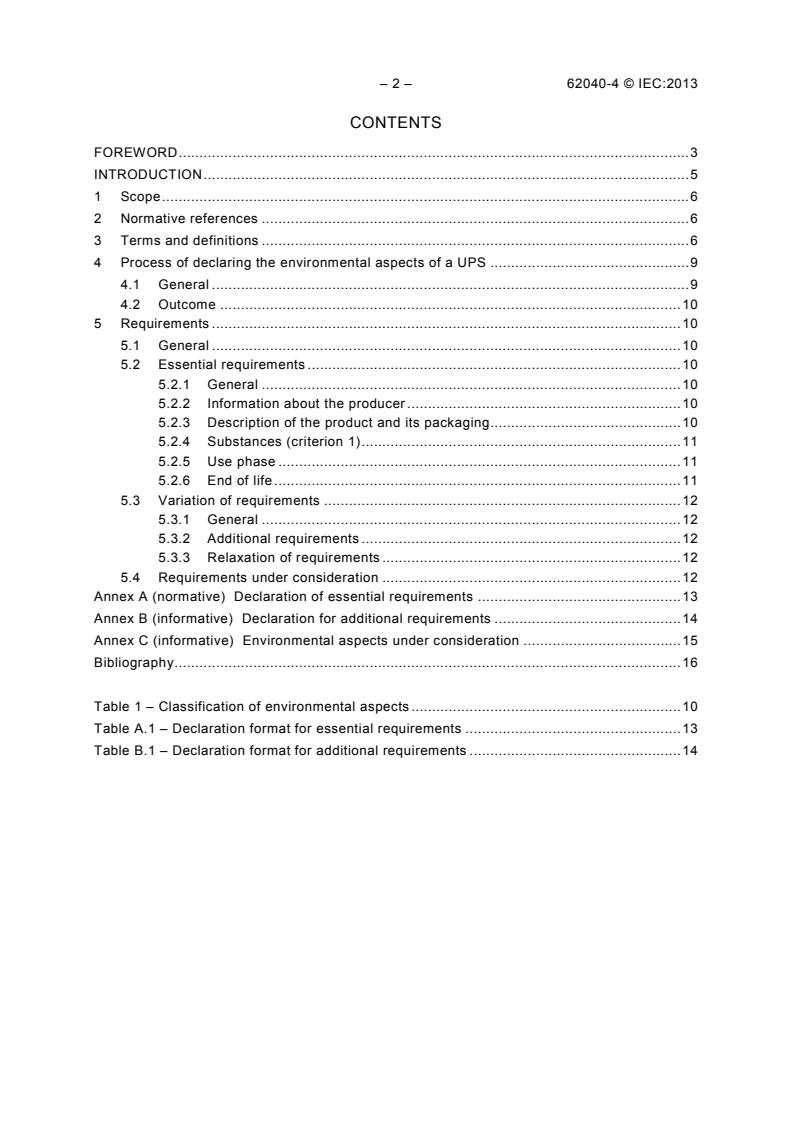
– 2 – 62040-4 © IEC:2013
CONTENTS
FOREWORD . 3
INTRODUCTION . 5
1 Scope . 6
2 Normative references . 6
3 Terms and definitions . 6
4 Process of declaring the environmental aspects of a UPS . 9
4.1 General . 9
4.2 Outcome . 10
5 Requirements . 10
5.1 General . 10
5.2 Essential requirements . 10
5.2.1 General . 10
5.2.2 Information about the producer . 10
5.2.3 Description of the product and its packaging . 10
5.2.4 Substances (criterion 1) . 11
5.2.5 Use phase . 11
5.2.6 End of life . 11
5.3 Variation of requirements . 12
5.3.1 General . 12
5.3.2 Additional requirements . 12
5.3.3 Relaxation of requirements . 12
5.4 Requirements under consideration . 12
Annex A (normative) Declaration of essential requirements . 13
Annex B (informative) Declaration for additional requirements . 14
Annex C (informative) Environmental aspects under consideration . 15
Bibliography . 16
Table 1 – Classification of environmental aspects . 10
Table A.1 – Declaration format for essential requirements . 13
Table B.1 – Declaration format for additional requirements . 14
62040-4 © IEC:2013 – 3 –
INTERNATIONAL ELECTROTECHNICAL COMMISSION
______________
UNINTERRUPTIBLE POWER SYSTEMS (UPS) –
Part 4: Environmental aspects –
Requirements and reporting
FOREWORD
1) The International Electrotechnical Commission (IEC) is a worldwide organization for standardization comprising
all national electrotechnical committees (IEC National Committees). The object of IEC is to promote
international co-operation on all questions concerning standardization in the electrical and electronic fields. To
this end and in addition to other activities, IEC publishes International Standards, Technical Specifications,
Technical Reports, Publicly Available Specifications (PAS) and Guides (hereafter referred to as “IEC
Publication(s)”). Their preparation is entrusted to technical committees; any IEC National Committee interested
in the subject dealt with may participate in this preparatory work. International, governmental and non-
governmental organizations liaising with the IEC also participate in this preparation. IEC collaborates closely
with the International Organization for Standardization (ISO) in accordance with conditions determined by
agreement between the two organizations.
2) The formal decisions or agreements of IEC on technical matters express, as nearly as possible, an international
consensus of opinion on the relevant subjects since each technical committee has representation from all
interested IEC National Committees.
3) IEC Publications have the form of recommendations for international use and are accepted by IEC National
Committees in that sense. While all reasonable efforts are made to ensure that the technical content of IEC
Publications is accurate, IEC cannot be held responsible for the way in which they are used or for any
misinterpretation by any end user.
4) In order to promote international uniformity, IEC National Committees undertake to apply IEC Publications
transparently to the maximum extent possible in their national and regional publications. Any divergence
between any IEC Publication and the corresponding national or regional publication shall be clearly indicated in
the latter.
5) IEC itself does not provide any attestation of conformity. Independent certification bodies provide conformity
assessment services and, in some areas, access to IEC marks of conformity. IEC is not responsible for any
services carried out by independent certification bodies.
6) All users should ensure that they have the latest edition of this publication.
7) No liability shall attach to IEC or its directors, employees, servants or agents including individual experts and
members of its technical committees and IEC National Committees for any personal injury, property damage or
other damage of any nature whatsoever, whether direct or indirect, or for costs (including legal fees) and
expenses arising out of the publication, use of, or reliance upon, this IEC Publication or any other IEC
Publications.
8) Attention is drawn to the Normative references cited in this publication. Use of the referenced publications is
indispensable for the correct application of this publication.
9) Attention is drawn to the possibility that some of the elements of this IEC Publication may be the subject of
patent rights. IEC shall not be held responsible for identifying any or all such patent rights.
International Standard IEC 62040-4 has been prepared by subcommittee 22H: Uninterruptible
power systems (UPS), of IEC technical committee 22: Power electronic systems and
equipment.
The text of this standard is based on the following documents:
FDIS Report on voting
22H/157/FDIS 22H/162/RVD
Full information on the voting for the approval of this standard can be found in the report on
voting indicated in the above table.
This publication has been drafted in accordance with the ISO/IEC Directives, Part 2.
A list of all parts in the IEC 62040 series, published under the general title Uninterruptible
power systems, can be found on the IEC website.
– 4 – 62040-4 © IEC:2013
The committee has decided that the contents of this publication will remain unchanged until
the stability date indicated on the IEC web site under "http://webstore.iec.ch" in the data
related to the specific publication. At this date, the publication will be
• reconfirmed,
• withdrawn,
• replaced by a revised edition, or
• amended.
62040-4 © IEC:2013 – 5 –
INTRODUCTION
The publication of this product standard for environmental information of UPS is intended to
become a reference document for regulators, manufacturers, purchasers, certifying bodies
and users, so that the goal of promoting reduction of the environmental impact during a
complete UPS life cycle is achieved.
This standard provides assistance to:
– determine essential environmental parts of environmental standards, regulations, code of
conducts, agreements, and other requirements applicable to UPS to ensure compliance
and avoid need of interpretation,
– respond to customer requirements by communicating environmental information in a
standardized way,
– minimize reporting requirements by focusing on main applicable environmental
requirements,
– anticipate upcoming environmental regulations and environmental programs applicable to
UPS by proposing a standard that provides compliance requirements,
– standardize the transmission of environmental information in the supply chain,
– report and communicate environmental information to be used as a reference for
measuring environmental progress between one generation of product and the next.
– 6 – 62040-4 © IEC:2013
UNINTERRUPTIBLE POWER SYSTEMS (UPS) –
Part 4: Environmental aspects –
Requirements and reporting
1 Scope
This part of the IEC 62040 series specifies the process and requirements to declare the
environmental aspects concerning uninterruptible power systems (UPS), with the goal of
promoting reduction of any adverse environmental impact during a complete UPS life cycle.
This product standard is harmonized with the applicable generic and horizontal environmental
standards and contains additional details relevant to UPS.
This standard applies to movable, stationary and fixed UPS that deliver single or three-phase
fixed frequency a.c. output voltage not exceeding 1 000 V a.c. and that present, generally
through a d.c. link, an energy storage system and specified in IEC 62040 product standards
for UPS (Part 1: Safety, Part 2: EMC and Part 3: Test and performance).
The following applications are excluded from the scope:
– conventional a.c. input and output distribution boards;
– d.c. distribution boards and their associated switches (e.g. switches for batteries, rectifier
output or inverter input);
– stand-alone static transfer systems (STS) specified in IEC 62310 product standards for
STS (Part 1: Safety, Part 2: EMC and Part 3: Test and performance);
– systems wherein the output voltage is derived from a rotating machine.
2 Normative references
The following documents, in whole or in part, are normatively referenced in this document and
are indispensable for its application. For dated references, only the edition cited applies. For
undated references, the latest edition of the referenced document (including any
amendments) applies.
IEC 62040-3:2011, Uninterruptible power systems (UPS) – Part 3: Method of specifying the
performance and test requirements
IEC 62474:2012, Material Declaration for Products of and for the Electrotechnical Industry
(available at http://std.iec.ch/iec62474)
3 Terms and definitions
For the purpose of this document, the following terms and definitions apply.
3.1
end of life
life cycle stage of a product starting when it is removed from its intended use phase
3.2
end of life treatment
any operations after a waste has been handed over to a facility for recovery or preparation for
disposal
62040-4 © IEC:2013 – 7 –
Note 1 to entry: This includes dismantling, material separation and disposal.
3.3
use phase
life cycle stage of a product starting when it has been put into service and finishing at end of
life
3.4
recycling
processing of waste materials for the original purpose or for other purposes, excluding energy
recovery
[SOURCE: ISO 15270:2008,3.30, modified]
3.5
environment
surroundings in which an organization operates, including air, water, land, natural resources,
flora, fauna, humans and their interrelation
[SOURCE: ISO 14001:2004, 3.5]
3.6
environmental aspect
element of an organization's activities, products or services that can interact with the
environment
[SOURCE: ISO 14001:2004, 3.6]
3.7
environmental impact
any change to the environment, whether adverse or beneficial, wholly or partially resulting
from an organization's environmental aspects
[SOURCE: ISO 14001:2004, 3.17]
3.8
environmental management system
part of the overall management system that includes organizational structure, planning
activities, responsibilities, practices, procedure, processes, and resources for developing,
implementing, achieving, reviewing and maintaining the environmental policy
[SOURCE: ISO 14001:2004, 3.8, modified]
3.9
life cycle
consecutive and interlinked stages of a product system, from raw material acquisition or
generation from natural resources to final disposal
[SOURCE: ISO 14040:2006,3.1]
3.10
life cycle assessment
LCA
compilation and evaluation of the inputs, outputs and the potential environmental impacts of a
product system throughout its life cycle
[SOURCE: ISO 14040:2006, 3.2]
– 8 – 62040-4 © IEC:2013
3.11
substance
chemical element and its compounds in the natural state or obtained by any manufacturing
process, including any additive necessary to preserve its stability and any impurity deriving
from the process used, but excluding any solvent which may be separated without affecting
the stability of the substance or changing its composition
[SOURCE: United Nations’ Globally Harmonized System of Classification and Labeling
(GHS):2011, modified]
3.12
hazardous substances
substance or preparation that can adversely impact the environment with immediate or
retarded effect
Note 1 to entry: This definition also applies to preparation.
[SOURCE: IEC Guide 109:2003, 3.6, modified]
3.13
material
substance or mixture within a product or product part
3.14
mixture
solution composed of two or more substances in which they do not react
3.15
uninterruptible power system
UPS
combination of convertors, switches and energy storage devices (such as batteries),
constituting a power system for maintaining continuity of load power in case of input power
failure
[SOURCE: IEC 62040-3:2011, 3.1.1]
3.16
raw material
primary or secondary material that is used to manufacture a product
Note 1 to entry: Primary raw material includes commercially produced virgin materials, such as iron ore and wood
pulp, used for the manufacturing of products. Secondary raw material includes recycled materials used in the
manufacture.
[SOURCE: ISO 14040:2006, 3.15]
3.17
waste
substances or objects which the holder intends or is required to dispose of
Note 1 to entry: Definition obtained from the Basel Convention on the Control of Transboundary Movements of
Hazardous Wastes and Their Disposal (22 March 1989), but is not limited to hazardous waste in this International
Standard.
3.18
greenhouse gas
GHG
gaseous constituent of the atmosphere, both natural and anthropogenic, that absorbs and
emits radiation at specific wavelengths within the spectrum of infrared radiation emitted by the
earth's surface, the atmosphere, and clouds
62040-4 © IEC:2013 – 9 –
Note 1 to entry: GHGs include carbon dioxide (CO ), methane (CH ), nitrous oxide (N O), hydrofluorocarbons
2 4 2
(HFCs), perfluorocarbons (PFCs) and sulfur hexafluoride (SF ).
[SOURCE: ISO 14064-1:2006, 2.1]
3.19
greenhouse gas emission
total mass of a GHG released to the atmosphere over a specified period of time
[SOURCE: ISO 14064-1:2006, 2-5]
3.20
packaging
material that is used to protect or contain a product during transportation, storage, marketing
or use
Note 1 to entry: For the purposes of this International Standard, the term "packaging" also includes any item that
is physically attached to, or included with, a product or its container for the purpose of marketing the product or
communicating information about the product.
[SOURCE: ISO 14021:1999, 3.1.10]
3.21
acoustic noise
unintentional and undesirable sound
3.22
representative UPS
UPS within a range where the information declared for that UPS applies to all the UPS of the
range
3.23
component
part that comes from a manufacturing facility and which can be an amalgam of various
manufacturing processes and of raw materials
3.24
recyclability rate
sum of recyclable masses of all parts divided by the total mass multiplied by 100 %
3.25
eco-solutions
products or services allowing reduction of environmental impacts of a system in which they
are a component
[SOURCE: IEC/PAS 62545:2008, 3.1.16]
4 Process of declaring the environmental aspects of a UPS
4.1 General
The process of declaring the environmental aspects of a UPS consists of identifying those
aspects arising when UPS compliance is verified against the requirements specified in Clause
5. The environmental aspects shall be assessed for the representative UPS when applicable
and otherwise for each UPS.
NOTE The reporting procedure detailed in this standard is aligned with IEC/PAS 62545.
– 10 – 62040-4 © IEC:2013
4.2 Outcome
The outcome of the process is the identification of the environmental impact during a
complete UPS life cycle. Compliance with each requirement shall be reported – refer to Annex
A and to Annex B.
5 Requirements
5.1 General
This clause specifies the requirements concerning environmental aspects applying to UPS
covered by this standard. The environmental aspects are classified as listed in Table 1.
Table 1 – Classification of environmental aspects
Environmental aspects Suggested format
of declaration
Clause Classification
(clause of annex)
5.2 Essential Mandatory A.2
5.3.2 Additional Voluntary B.2
5.2 Essential requirements
5.2.1 General
The following subclauses represent the essential requirements.
5.2.2 Information about the producer
The following information shall be declared by the UPS manufacturer:
– location of manufacturing plant(s),
– certification status of manufacturing plant(s) in regard to applicable environmental
management system, e.g. ISO 14001, EMAS etc.
5.2.3 Description of the product and its packaging
The following information shall be declared by the UPS manufacturer:
• model (manufacturer’s reference and, if model is a representative UPS, the range of UPS),
• UPS configuration (see Annex A of IEC 62040-3:2011),
• UPS performance classification (see 5.3.4. of IEC 62040-3:2011),
• product dimensions,
• mass without energy storage system e.g. batteries,
• mass of energy storage system if incorporated in the UPS,
• mass and material(s) of packaging (e.g. cardboard, plastic, wood, metal):
– product packaging: first layer of packaging in contact with the product;
– group packaging: packaging gathering several products into a single package, if
applicable;
– transportation packaging: packaging used for transportation if different from product or
group packaging.
NOTE Further information can be found in Table D.1, of IEC 62040-3:2011.
62040-4 © IEC:2013 – 11 –
5.2.4 Substances (criterion 1)
Substances contained in the UPS and listed in IEC 62474 as criterion 1 (substances that are
currently regulated) shall be declared by the UPS manufacturer.
NOTE 1 This requirement facilitates compliance with laws and regulations applying to substances in a particular
IEC member country, e.g. REACH.
NOTE 2 IEC 62474 correlates each reportable substance with typical products containing the same. For guidance
and subject to confirmation from the UPS manufacturer, the following substances are generally not present in a
UPS:
– azocolourants and azodyes which form certain aromatic amines – used for textiles and leathers;
– cobalt dichloride – used for pneumatic panels to indicate water contamination;
– dimethyl furfumarate (DMF) – used for mould prevention treatment of electronic leather seats;
– formaldehyde – used for textiles.
NOTE 3 The data format described in 6.2 of IEC 62474:2012 represents one method of declaring substances. The
full list of reportable substances to be considered is given in IEC 62474 available at http://std.iec.ch/iec62474.
5.2.5 Use phase
The following information shall be declared by the UPS manufacturer:
– UPS efficiency in accordance with IEC 62040-3;
– acoustic noise in accordance with IEC 62040-3.
NOTE Further information can be found in Table D.1 of IEC 62040-3:2011.
5.2.6 End of life
The UPS manufacturer shall provide information to facilitate end of life treatment, e.g.
dismantling, disposing, and recycling instructions shall be provided. This information shall
include a list of materials and components requiring selective treatment upon end of life.
For recyclability purposes, the manufacturer shall declare if the UPS and its packaging
contains any of the following parts:
– parts containing polychlorinated biphenyls (PCB),
– parts containing mercury, such as switches or backlighting lamps,
– batteries,
– printed circuit boards if larger than 10 cm ,
– toner cartridges, liquid and pasty, as well as colour toner,
– plastic containing regulated flame retardants,
– part containing asbestos,
– cathode ray tubes,
– chlorofluorocarbons (CFC), hydrochlorofluorocarbons (HCFC) or hydrofluorocarbons
(HFC), hydrocarbons (HC),
– gas discharge lamps,
– liquid crystal displays (together with their casing where appropriate) of a surface greater
than 100 cm and all those back-lighted with gas discharge lamps,
– external electric cables supplied with the UPS e.g. detachable or fixed cords,
– components containing refractory ceramic fibres,
– components containing radioactive substances,
– electrolytic capacitors of height > 25 mm and diameter > 25 mm or proportionately similar
volume.
– 12 – 62040-4 © IEC:2013
NOTE This requirement facilitates compliance with laws and regulations for waste from electrical and electronic
equipment, e.g. EU WEEE directive and EU Battery Directive (2006/66/EC).
5.3 Variation of requirements
5.3.1 General
5.3 describes variations of requirements that manufacturers and purchasers may, under
certain conditions, agree on. Such variations may consist of additional or of relaxed
environmental aspects to be declared for a particular scope of supply.
5.3.2 Additional requirements
5.3.2.1 General
Notwithstanding that the UPS is deemed complying with this standard when complying with
the essential requirements specified, additional environmental requirements can be
considered as a result of a voluntary decision by the UPS manufacturer, by regulation, or by
UPS application in environmentally sensitive areas. The following subclauses represent such
additional requirements.
5.3.2.2 Recyclability rate of the product and its packaging
The UPS manufacturer can provide the recyclability rate of the product and of its packaging
5.3.2.3 Life cycle assessment
The UPS manufacturer can provide a life cycle assessment in accordance with ISO 14040.
NOTE Relevant adverse environmental impacts caused by the UPS relate to the expected energy consumption to
produce components for manufacture, to manufacture, to distribute, to install, to use and to end the life (to
distribute means to ship a UPS from the factory to the customer using normal transportation means).
5.3.2.4 Substances (criteria 2 and 3)
The status of the substances contained in the UPS and listed in IEC 62474 as criterion 2
(substances forecasted to become regulated but with no effective date) and as criterion 3
(substances declared for information only) can be declared by the UPS manufacturer.
The full list of reportable substances to be considered is given in IEC 62474, database
available at http://std.iec.ch/iec62474.
NOTE The data format described in 6.2 of IEC 62474:2012 represents one method of declaring substances.
5.3.3 Relaxation of requirements
Where not infringing local regulations, manufacturers and purchasers may agree on the
relaxation of particular essential environmental requirements inferred by conditions prescribed
in this standard. Such a relaxation can be necessary when application of the essential
requirements result in conflict with specified performance requirement(s).
EXAMPLE The relaxation may consist of:
– omitting selected information in a declaration pertaining to applications wherein proprietary information is not
to be publicly disclosed;
– the UPS manufacturer being required to use substances or material different from that declared for their
standard UPS product; this can include applications wherein cables are required to be different; an explanatory
note should accompany the standard declaration.
5.4 Requirements under consideration
Annex C lists environmental aspects referenced for future consideration and for which no
current requirements apply.
62040-4 © IEC:2013 – 13 –
Annex A
(normative)
Declaration of essential requirements
A.1 General
This annex summarises the contents required for reporting compliance with the essential
requirements of 5.2 and presents a suggested reporting format in Clause A.2
A.2 Declaration format for essential requirements
Essential requirements shall be declared according to Table A.1.
Table A.1 – Declaration format for essential requirements
Subclause
Declared environmental aspect Manufacturer’s
IEC 62040-4
declared value
Location of manufacturing plant(s)
5.2.2
Environmental management system
(certification status and name of system)
Model (manufacturer’s reference)
VA
Power, rated – apparent
W
– active
Representative UPS __Yes, __No
Range of UPS covered by representative UPS (if applicable)
UPS configuration
Performance classification
5.2.3
mm
Dimensions (height × width × depth)
Mass kg
Mass of batteries (if integrated) kg
Battery technology
Product packaging (mass, material)
Group packaging, if applicable (mass, material)
Transportation packaging , if applicable (mass, material)
5.2.4 Substances – Criterion 1
UPS efficiency
5.2.5
Acoustic noise
End of life information (It is recommended to indicate
5.2.6
location of the part(s) on a picture or drawing)
– 14 – 62040-4 © IEC:2013
Annex B
(informative)
Declaration for additional requirements
B.1 General
This annex summarises the contents required for reporting compliance with the additional
requirements detailed in 5.3.2 and presents a suggested reporting format in Clause B.2.
B.2 Declaration format for additional requirements
Additional requirements shall be declared according to Table B.1.
Table B.1 – Declaration format for additional requirements
Subclause Manufacturer’s
Declared environmental aspect
IEC 62040-4 declared value
5.3.2.2 Recyclable material, (percentage by mass, calculation method)
– in product
– in packaging
5.3.2.3 Life cycle assessment
Substances
5.3.2.4 – criterion 2
– criterion 3
62040-4 © IEC:2013 – 15 –
Annex C
(informative)
Environmental aspects under consideration
C.1 General
This annex describes environmental aspects referenced for future consideration and for which
no current requirements apply.
C.2 Environmental aspects for future consideration
The following aspects will be considered in future editions of IEC 62040-4:
a) material contents according to IEC 62474 for assessing the impact of raw material
consumption during use and end of life stages;
b) greenhouse gas emission assessment of the UPS in accordance with a standard
recognized by IEC and including the generation of emissions during the UPS use and
manufacturing life cycle phases;
c) recycling and re-use assessment;
NOTE 1 Assessment method to be determined once the proposed merger of IEC 62650 and IEC/TR 62635 is
completed.
d) focus beyond energy consumption with respect to life cycle assessment e.g. resource use,
natural resource depletion;
e) eco-solutions and their design.
Eco-solutions may be integral to the UPS design consisting for example, of functions including
efficiency, maintenance or disposal facilities being implemented.
NOTE 2 Examples include UPS supporting functions that offer significant contribution to reduction of energy
consumptions in buildings, plants, etc.
NOTE 3 IEC 62430:2009 can be consulted for further consideration.
—————————
Under consideration.
– 16 – 62040-4 © IEC:2013
Bibliography
IEC 62040-1:2008, Uninterruptible power systems (UPS) – Part 1: General and safety
requirements for UPS
Amendment 1:2013
IEC 62040-2:2005, Uninterruptible power systems (UPS) – Part 2: Electromagnetic
compatibility (EMC) requirements
IEC 62310-1:2005, Static transfer systems (STS) – Part 1: General and safety requirements
IEC 62310-2:2006, Static transfer systems (STS) – Part 2: Electromagnetic compatibility
(EMC) requirements
IEC 62310-3:2008, Static transfer systems (STS) – Part 3: Method for specifying performance
and test requirements
IEC 62430:2009, Environmentally conscious design for electrical and electronic products
IEC 62535:2008, Insulating liquids – Test method for detection of potentially corrosive sulphur
in used and unused insulating oil
IEC/PAS 62545:2008, Environmental information on Electrical and Electronic Equipment
(EIEEE)
IEC/TR 62635, Guidelines for end-of-life information provided by manufacturers and recyclers
and for recyclability rate calculation of electrical and electronic equipment
IEC 62650 , Communication formats on recycling for electrotechnical equipment between
manufacturers and recyclers
IEC Guide 109:2012, Environmental aspects – Inclusion in electrotechnical product standards
ISO 9000:2000, Quality management systems – Fundamentals and vocabulary
ISO 14001:2004, Environmental management systems – Requirements with guidance for use
ISO 14020:2000, Environmental labels and declarations – General principles
ISO 14024:1999, Environmental labels and declarations – Type I environmental labelling –
Principles and procedures
ISO 14025:2000, Environmental labels and declarations – Type III environmental declarations
ISO 14040:2006, Environmental management – Life cycle assessment – Principles and
framework
ISO 14062:2002, Environmental management – Integrating environmental aspects into
product design and development
ISO 14064-1, Ed. 1.0, Greenhouse gases – Part 1: Specification with guidance at the
organization level for quantification and reporting of greenhouse gas emissions and removals
—————————
Under consideration.
62040-4 © IEC:2013 – 17 –
ISO 15270:2008, Plastics – Guidelines for the recovery and recycling of plastics waste
European Code of Conduct on energy efficiency and quality of AC Uninterruptible Power
Systems (UPS)
http://re.jrc.ec.europa.eu/energyefficiency/html/standby_initiative.htm
Energy Star – UPS specification & test method
http://www.energystar.gov/ia/partners/prod_development/new_specs/downloads/uninterruptibl
e_power_supplies/UPS_V1_Draft3_ES_Specification.pdf
Basel Convention on the Control of Transboundary Movements of Hazardous Wastes and
Their Disposal (22 March 1989), http://www.basel.int/
Directive 67/548/EEC of 27 June 1967 on the approximation of laws, regulations and
administrative provisions relating to the classification, packaging and labeling of dangerous
substances Directive
Directive 1999/45/EC of the European Parliament and of the Council of 31 May 1999
concerning the approximation of laws, regulations and administrative provisions of the
Member States relating to the classification, packaging and labeling of dangerous
preparations
Directive 2011/65/EU of the European Parliament and of the Council of 8 June 2011 on the
restriction of the use of certain hazardous substances in electrical and electronic equipment
(RoHS)
Directive 2002/96/EC of the European Parliament and of the Council of 27 January 2003 on
waste electrical and electronic equipment (WEEE)
Regulation (EC) No 1907/2006 of the European Parliament and of the Council of 18
December 2006 concerning the Registration, Evaluation, Authorisation and Restriction of
Chemicals (REACH)
EMAS Eco-Management and Audit Scheme
http://ec.europa.eu/environment/emas/index_en.htm
WEEE Directive: Waste of Electric and Electronic Equipment 2012/19/EU
http://ec.europa.eu/environment/waste/weee/index_en.htm
Battery directive 2006/66/EC on batteries and accumulators and waste batteries and
accumulators
http://ec.europa.eu/environment/waste/batteries/index.htm
_____________
– 18 – 62040-4 © CEI:2013
SOMMAIRE
AVANT-PROPOS . 19
INTRODUCTION . 21
1 Domaine d'application . 22
2 Références normatives . 22
3 Termes et définitions . 22
4 Processus de déclaration des aspects environnementaux d'une ASI . 26
4.1 Généralités . 26
4.2 Résultat . 26
5 Exigences. 26
5.1 Généralités . 26
5.2 Exigences indispensables . 26
5.2.1 Généralités . 26
5.2.2 Informations sur le producteur . 26
5.2.3 Description du produit et de son emballage . 26
5.2.4 Substances constituant le produit (critère 1) . 27
5.2.5 Phase d'utilisation . 27
5.2.6 Fin de vie . 27
5.3 Variation des exigences . 28
5.3.1 Généralités . 28
5.3.2 Exigences complémentaires . 28
5.3.3 Exemption d'exigence . 29
5.4 Exigences à l'étude . 29
Annexe A (normative) Déclaration des exigences indispensables . 30
Annexe B (informative) Déclaration des exigences complémentaires . 31
Annexe C (informative) Aspects environnementaux à l'étude . 32
Bibliographie . 33
Tableau 1 – Classification des aspects environnementaux . 26
Tableau A.1 – Format de déclaration pour les exigences indispensables . 30
Tableau B.1 – Format de déclaration pour les exigences complémentaires . 31
62040-4 © CEI:2013 – 19 –
COMMISSION ÉLECTROTECHNIQUE INTERNATIONALE
______________
ALIMENTATIONS SANS INTERRUPTION (ASI) –
Partie 4: Aspects environnementaux –
Exigences et déclaration
AVANT-PROPOS
1) La Commission Electrotechnique Internationale (CEI) est une organisation mondiale de normalisation
composée de l'ensemble des comités électrotechniques nationaux (Comités nationaux de la CEI). La CEI a
pour objet de favoriser la coopération internationale pour toutes les questions de normalisation dans les
domaines de l'électricité et de l'électronique. A cet effet, la CEI – entre autres activités – publie des Normes
internationales, des Spécifications techniques, des Rapports techniques, des Spécifications accessibles au
public (PAS) et des Guides (ci-après dénommés "Publication(s) de la CEI"). Leur élaboration est confiée à des
comités d'études, aux travaux desquels tout Comité national intéressé par le sujet traité peut participer. Les
organisations internationales, gouvernementales et non gouvernementales, en liaison avec la CEI, participent
également aux travaux. La CEI collabore étroitement avec l'Organisation Internationale de Normalisation (ISO),
selon des conditions fixées par accord entre les deux organisations.
2) Les décisions ou accords officiels de la CEI concernant les questions techniques représentent, dans la mesure
du possible, un accord international sur les sujets étudiés, étant donné que les Comités nationaux de la CEI
intéressés sont représentés dans chaque comité d’études.
3) Les Publications de la CEI se présentent sous la forme de recommandations internationales et sont agréées
comme telles par les Comités nationaux de la CEI. Tous les efforts raisonnables sont entrepris afin que la CEI
s'assure de l'exactitude du contenu technique de ses publications; la CEI ne peut pas être tenue responsable
de l'éventuelle mauvaise utilisation ou interprétation qui en est faite par un quelconque utilisateur final.
4) Dans le but d'encourager l'uniformité internationale, les Comités nationaux de la CEI s'engagent, dans toute la
mesure possible, à appliquer de façon transparente l
...