

IEC 60598-1:2014/AMD1:2017
(Amendment)Amendment 1 - Luminaires - Part 1: General requirements and tests
General Information
- Abstract
- Status
- Published
- Publication Date
- 14-Sep-2017
- Technical Committee
- SC 34D - Luminaires
- Drafting Committee
- WG 1 - TC 34/SC 34D/WG 1
- Current Stage
- DELPUB - Deleted Publication
- Start Date
- 31-Aug-2020
- Completion Date
- 28-Aug-2026
Overview
IEC 60598-1:2014/AMD1:2017 is the first amendment to the 8th edition of the international standard IEC 60598-1, which addresses general requirements and tests for luminaires. Published by the International Electrotechnical Commission (IEC), this amendment updates and refines key provisions related to the safety, performance, marking, and testing of luminaires used in electrical lighting systems. The standard ensures globally harmonized criteria for luminaire design, manufacture, and evaluation, enhancing product safety, reliability, and compatibility.
This amendment is crucial for manufacturers, testing laboratories, and regulatory authorities involved in the lighting industry, offering clarifications and additional normative references for constant voltage and constant current luminaire operations.
Key Topics
General Test Requirements and Verification
Updated test procedures reflecting IEC guidelines for luminaire safety and performance have been revised to align with contemporary technology and safety practices.New Normative References
Incorporates updated IEC standards addressing cables, insulation coordination, and connecting devices:- IEC 60228: Conductors of insulated cables
- IEC 60664-4: Insulation coordination – high-frequency voltage stress considerations
- IEC 60998-2-1 and IEC 60998-2-2: Requirements for connecting devices for household low-voltage circuits
Key Definitions Added
Introduction of precise terminologies like rated constant input voltage, rated constant input current, ignition voltage, and equivalent transformed peak voltage to clearly define electrical parameters affecting luminaire controlgear and operation.Marking Requirements
Enhanced marking specifications include:- Rated input constant voltage and current markings
- Maximum rated light source input power
- Identification of extra-low voltage direct current (DC) leads for polarity using color coding or labels
- Additional safety warnings for luminaires with light sources classified with specific illuminance thresholds (e.g., “Do not stare at the operating light source”)
Information for Luminaire Design
Establishes requirements for supplying technical information essential for selecting appropriate controlgear. This ensures luminaires are safely operated under constant voltage or constant current controlgear, considering insulation requirements and maximum permissible voltages.Terminal and Connection Specifications
Outlines requirements for connecting leads (tails), terminal blocks, and installation instructions to guarantee proper and safe luminaire wiring. Packaging must indicate when terminal blocks are not supplied, emphasizing qualified installation.Mechanical Fixings and Suspension Tests
Clarifies tests for clip-mounted luminaires, including pull-force tests on mounting supports, ensuring secure fixture installation and user safety.Mounting on Flammable Surfaces
Luminaires equipped with adaptors for track mounting must comply with direct mounting requirements on normally flammable surfaces for enhanced fire safety.
Applications
Luminaire Manufacturers
Can use the updated IEC 60598-1 amendment as a guideline to ensure compliance with international safety and performance standards for their lighting products. The detailed marking and information requirements assist in producing products that are both safe and user-friendly.Testing and Certification Bodies
The amendment provides updated test methods and new normative references, enabling testing organizations to apply consistent and current evaluation criteria for luminaire certification.Electrical Installers and Maintenance Personnel
Clear marking and wiring instructions support safe installation and maintenance of luminaires, reducing the risk of electrical hazards.Lighting Designers and Engineers
The standard aids in designing luminaires compatible with specified controlgear, ensuring optimal performance, compatibility, and user safety.
Related Standards
- IEC 60228:2004 – Conductors of insulated cables
- IEC 60664-4:2005 – Insulation coordination for equipment within low-voltage systems – Part 4: Consideration of high-frequency voltage stress
- IEC 60998-2-1 and IEC 60998-2-2 – Connecting devices for low-voltage household circuits with screw-type and screwless-type clamping units respectively
- IEC 61347-1:2015 – Lamp controlgear general and safety requirements (referenced for voltage and current definitions)
- IEC/TR 62778 – Guidance on photobiological safety of lamps and lamp systems relevant to illuminating luminaires
This amendment to IEC 60598-1 strengthens the framework for luminaire safety and performance, facilitating better harmonization across the lighting industry. Compliance ensures protection for users, efficient product design, and smooth regulatory acceptance worldwide.
Keywords: IEC 60598-1 amendment, luminaires general requirements, luminaire testing, luminaire marking, electrical safety standards, luminaire controlgear, constant voltage luminaires, constant current luminaires, IEC lighting standards, luminaire installation safety
Relations
- Effective Date
- 05-Sep-2023
- Effective Date
- 05-Sep-2023
Get Certified
Connect with accredited certification bodies for this standard

IMQ S.p.A. (Certification)
Italian electrical product certification.

SLG Prüf- und Zertifizierungs GmbH
German testing and certification body.

UL Solutions
Global safety science company with testing, inspection and certification.
Sponsored listings
Frequently Asked Questions
IEC 60598-1:2014/AMD1:2017 is a standard published by the International Electrotechnical Commission (IEC). Its full title is "Amendment 1 - Luminaires - Part 1: General requirements and tests". This standard covers: Amendment 1 - Luminaires - Part 1: General requirements and tests
Amendment 1 - Luminaires - Part 1: General requirements and tests
IEC 60598-1:2014/AMD1:2017 is classified under the following ICS (International Classification for Standards) categories: 29.140.40 - Luminaires. The ICS classification helps identify the subject area and facilitates finding related standards.
IEC 60598-1:2014/AMD1:2017 has the following relationships with other standards: It is inter standard links to IEC 60598-1:2014, IEC 60598-1:2020. Understanding these relationships helps ensure you are using the most current and applicable version of the standard.
IEC 60598-1:2014/AMD1:2017 is available in PDF format for immediate download after purchase. The document can be added to your cart and obtained through the secure checkout process. Digital delivery ensures instant access to the complete standard document.
Standards Content (Sample)
IEC 60598-1 ®
Edition 8.0 2017-09
INTERNATIONAL
STANDARD
NORME
INTERNATIONALE
colour
inside
A MENDMENT 1
AM ENDEMENT 1
Luminaires –
Part 1: General requirements and tests
Luminaires –
Partie 1: Exigences générales et essais
IEC 60598-1:2014-05/AMD1:2017-09(en-fr)
All rights reserved. Unless otherwise specified, no part of this publication may be reproduced or utilized in any form
or by any means, electronic or mechanical, including photocopying and microfilm, without permission in writing from
either IEC or IEC's member National Committee in the country of the requester. If you have any questions about IEC
copyright or have an enquiry about obtaining additional rights to this publication, please contact the address below or
your local IEC member National Committee for further information.
Droits de reproduction réservés. Sauf indication contraire, aucune partie de cette publication ne peut être reproduite
ni utilisée sous quelque forme que ce soit et par aucun procédé, électronique ou mécanique, y compris la photocopie
et les microfilms, sans l'accord écrit de l'IEC ou du Comité national de l'IEC du pays du demandeur. Si vous avez des
questions sur le copyright de l'IEC ou si vous désirez obtenir des droits supplémentaires sur cette publication, utilisez
les coordonnées ci-après ou contactez le Comité national de l'IEC de votre pays de résidence.
IEC Central Office Tel.: +41 22 919 02 11
3, rue de Varembé Fax: +41 22 919 03 00
CH-1211 Geneva 20 info@iec.ch
Switzerland www.iec.ch
About the IEC
The International Electrotechnical Commission (IEC) is the leading global organization that prepares and publishes
International Standards for all electrical, electronic and related technologies.
About IEC publications
The technical content of IEC publications is kept under constant review by the IEC. Please make sure that you have the
latest edition, a corrigenda or an amendment might have been published.
IEC Catalogue - webstore.iec.ch/catalogue Electropedia - www.electropedia.org
The stand-alone application for consulting the entire The world's leading online dictionary of electronic and
bibliographical information on IEC International Standards, electrical terms containing 20 000 terms and definitions in
Technical Specifications, Technical Reports and other English and French, with equivalent terms in 16 additional
documents. Available for PC, Mac OS, Android Tablets and languages. Also known as the International Electrotechnical
iPad. Vocabulary (IEV) online.
IEC publications search - www.iec.ch/searchpub IEC Glossary - std.iec.ch/glossary
The advanced search enables to find IEC publications by a 65 000 electrotechnical terminology entries in English and
variety of criteria (reference number, text, technical French extracted from the Terms and Definitions clause of
committee,…). It also gives information on projects, replaced IEC publications issued since 2002. Some entries have been
and withdrawn publications. collected from earlier publications of IEC TC 37, 77, 86 and
CISPR.
IEC Just Published - webstore.iec.ch/justpublished
Stay up to date on all new IEC publications. Just Published IEC Customer Service Centre - webstore.iec.ch/csc
details all new publications released. Available online and If you wish to give us your feedback on this publication or
also once a month by email. need further assistance, please contact the Customer Service
Centre: csc@iec.ch.
A propos de l'IEC
La Commission Electrotechnique Internationale (IEC) est la première organisation mondiale qui élabore et publie des
Normes internationales pour tout ce qui a trait à l'électricité, à l'électronique et aux technologies apparentées.
A propos des publications IEC
Le contenu technique des publications IEC est constamment revu. Veuillez vous assurer que vous possédez l’édition la
plus récente, un corrigendum ou amendement peut avoir été publié.
Catalogue IEC - webstore.iec.ch/catalogue Electropedia - www.electropedia.org
Application autonome pour consulter tous les renseignements Le premier dictionnaire en ligne de termes électroniques et
bibliographiques sur les Normes internationales, électriques. Il contient 20 000 termes et définitions en anglais
Spécifications techniques, Rapports techniques et autres et en français, ainsi que les termes équivalents dans 16
documents de l'IEC. Disponible pour PC, Mac OS, tablettes langues additionnelles. Egalement appelé Vocabulaire
Android et iPad. Electrotechnique International (IEV) en ligne.
Recherche de publications IEC - www.iec.ch/searchpub Glossaire IEC - std.iec.ch/glossary
La recherche avancée permet de trouver des publications IEC 65 000 entrées terminologiques électrotechniques, en anglais
en utilisant différents critères (numéro de référence, texte, et en français, extraites des articles Termes et Définitions des
comité d’études,…). Elle donne aussi des informations sur les publications IEC parues depuis 2002. Plus certaines entrées
projets et les publications remplacées ou retirées. antérieures extraites des publications des CE 37, 77, 86 et
CISPR de l'IEC.
IEC Just Published - webstore.iec.ch/justpublished
Restez informé sur les nouvelles publications IEC. Just Service Clients - webstore.iec.ch/csc
Published détaille les nouvelles publications parues. Si vous désirez nous donner des commentaires sur cette
Disponible en ligne et aussi une fois par mois par email. publication ou si vous avez des questions contactez-nous:
csc@iec.ch.
IEC 60598-1 ®
Edition 8.0 2017-09
INTERNATIONAL
STANDARD
NORME
INTERNATIONALE
colour
inside
A MENDMENT 1
AM ENDEMENT 1
Luminaires –
Part 1: General requirements and tests
Luminaires –
Partie 1: Exigences générales et essais
INTERNATIONAL
ELECTROTECHNICAL
COMMISSION
COMMISSION
ELECTROTECHNIQUE
INTERNATIONALE
ICS 29.140.40 ISBN 978-2-8322-4746-4
– 2 – IEC 60598-1:2014/AMD1:2017
© IEC 2017
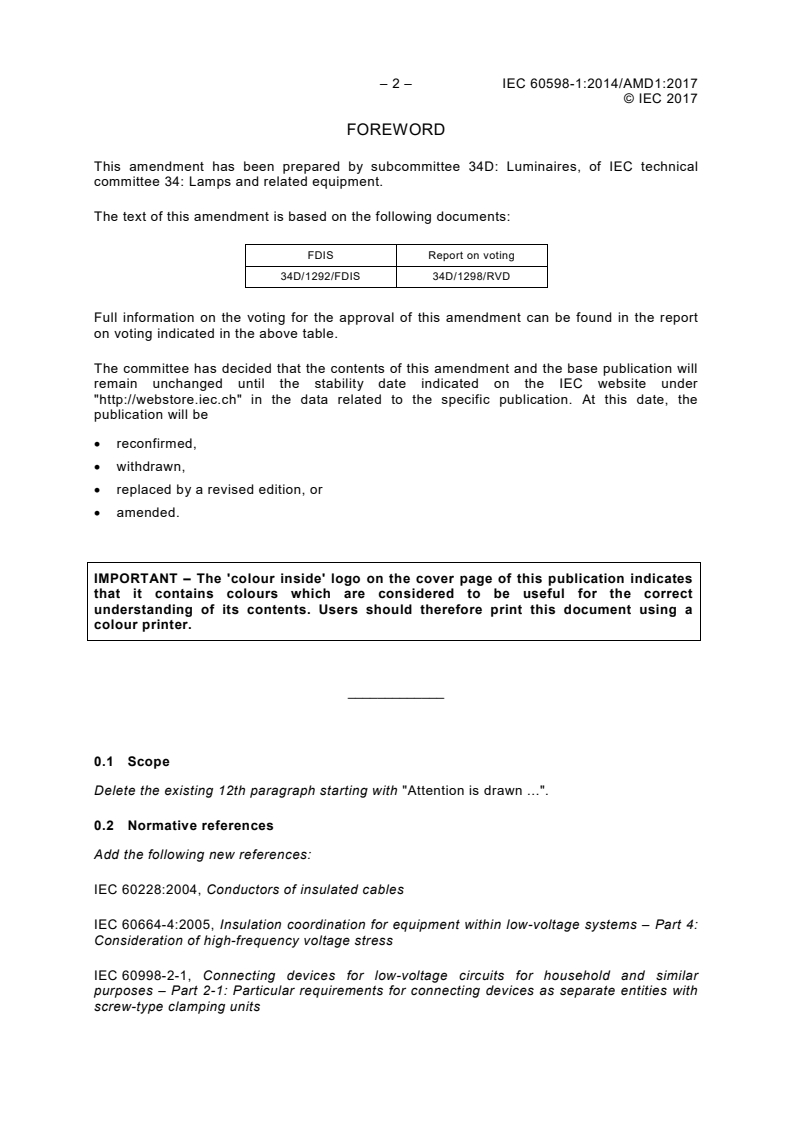
FOREWORD
This amendment has been prepared by subcommittee 34D: Luminaires, of IEC technical
committee 34: Lamps and related equipment.
The text of this amendment is based on the following documents:
FDIS Report on voting
34D/1292/FDIS 34D/1298/RVD
Full information on the voting for the approval of this amendment can be found in the report
on voting indicated in the above table.
The committee has decided that the contents of this amendment and the base publication will
remain unchanged until the stability date indicated on the IEC website under
"http://webstore.iec.ch" in the data related to the specific publication. At this date, the
publication will be
• reconfirmed,
• withdrawn,
• replaced by a revised edition, or
• amended.
IMPORTANT – The 'colour inside' logo on the cover page of this publication indicates
that it contains colours which are considered to be useful for the correct
understanding of its contents. Users should therefore print this document using a
colour printer.
_____________
0.1 Scope
Delete the existing 12th paragraph starting with "Attention is drawn .".
0.2 Normative references
Add the following new references:
IEC 60228:2004, Conductors of insulated cables
IEC 60664-4:2005, Insulation coordination for equipment within low-voltage systems – Part 4:
Consideration of high-frequency voltage stress
IEC 60998-2-1, Connecting devices for low-voltage circuits for household and similar
purposes – Part 2-1: Particular requirements for connecting devices as separate entities with
screw-type clamping units
© IEC 2017
IEC 60998-2-2, Connecting devices for low-voltage circuits for household and similar
purposes – Part 2-2: Particular requirements for connecting devices as separate entities with
screwless-type clamping units
0.4 General test requirements and verification
0.4.2
Delete the existing fourth paragraph starting with "In accordance with IEC guidelines ."
0.6 List of parts of IEC 60598-2
Add, after the existing Clause 0.6, a new Clause 0.7 as follows:
0.7 Information for luminaire design in light sources standards
0.7.1 In accordance with IEC guidelines, IEC standards are divided into those covering
either safety or performance.
0.7.2 In light source safety standards, “information for luminaire design” is given for the safe
operation of light sources; this shall be regarded as normative when testing luminaires to this
standard.
0.7.3 In light source performance standards, “information for luminaire design” is given for
the correct performance of light sources; this shall be regarded as informative when testing
luminaires to this standard. Testing of light source performance is not required as part of the
type test approval for luminaires.
1.2 Terms and definitions
Add, after 1.2.11, the following new entry:
1.2.11.1
rated constant input voltage
input voltage or voltages assigned by the manufacturer for luminaires not equipped with
controlgear
Note 1 to entry: The rated constant input voltage of the luminaire corresponds to the rated output voltage of the
constant voltage controlgear.
Add, after 1.2.12, the following new entry:
1.2.12.1
rated constant input current
input current or currents assigned by the manufacturer for luminaires not equipped with
controlgear
Note 1 to entry: The rated constant input current of the luminaire corresponds to the rated output current for
constant current controlgear.
Add, after 1.2.43, the following new entries:
1.2.43.1
maximum working peak output voltage
Û
out
maximum repetitive occurring peak working voltage between the output terminals or between
the output terminals and earth, during normal or abnormal operating condition and with
transients neglected
[SOURCE: IEC 61347-1:2015, 3.45]
– 4 – IEC 60598-1:2014/AMD1:2017
© IEC 2017
1.2.43.2
ignition voltage
peak voltage applied to ignite a discharge lamp
[SOURCE: IEC 61347-1:2015, 3.46]
1.2.43.3
ignition pulse voltage
peak ignition voltage with a total duration of ≤ 750 µs (summation of all pulses durations)
within 10 ms with the duration time (width) of each pulse being measured at the level of 50 %
of the maximum absolute peak value
Note 1 to entry: Ignition pulse waveforms, which are considered as ignition pulse voltage, should not contain any
dominant frequency above 30 kHz or should be usually highly damped (after 20 μs the peak voltage level should be
less than one half of the maximum peak voltage). For the assessment of the dominant frequency
IEC 60664-4:2005, Annex E should be consulted.
[SOURCE: IEC 61347-1:2015, 3.46.1]
1.2.43.4
equivalent transformed peak voltage
U
p
transformed output peak voltage, which is converted for the worst case peak voltage with its
related frequency into an ignition pulse voltage
Note 1 to entry: The value of the declared equivalent transformed output peak voltage is the essential parameter
for selecting the associated components.
Note 2 to entry: See 1.2.43.3.
[SOURCE: IEC 61347-1:2015, 3.47 , modified – notes 3 and 4 have been deleted.]
1.2.88.1
replaceable light source
In the definition, delete the words "according to IEC 60061"
Add, at the end of Clause 1.2, the following new entries:
1.2.92
connecting leads
tails
Internal wiring of luminaires intended to be connected to fixed wiring through separate
terminals which are to be enclosed inside the luminaire or connecting box
1.2.93
rated value
value of a quantity used for specification purposes, established under standard test conditions
as declared by the manufacturer or responsible vendor
[SOURCE: IEC 62504:2014, 3.33, modified – the note has been deleted.]
1.2.94
input power
electrical power consumed by the luminaire
3.2 Marking on luminaires
Table 3.1 – Marking
Add, in the second column, after marking 3.2.21, the following new markings:
© IEC 2017
f
3.2.25 Rated input constant voltage
g
3.2.26 Rated input constant current and value of U
out
Add, after table footnote "e", the following new table footnotes:
f
3.2.25 for constant voltage operation of the luminaire.
g
3.2.26 for constant current operation of the luminaire.
Insert, in the second column, between markings 3.2.7 and 3.2.9, the following new marking:
3.2.8.2 Rated input power
3.2.2
Add, at the end of 3.2.2, the following new text:
Where marking is provided in accordance with 3.2.25 or 3.2.26, additional marking of the
rated voltage is not required.
3.2.8
Replace 3.2.8 with the following new Subclause 3.2.8:
3.2.8 Luminaires shall be marked with information for the maximum rated light source power
or maximum input power according to 3.2.8.1, 3.2.8.2 and 3.2.8.3.
3.2.8.1 Luminaires for tungsten filament lamps shall be marked with the maximum rated
wattage and number of lamps.
Marking of maximum rated wattage for luminaires for tungsten filament lamps with more than
one lampholder may be in the form:
"n × MAX. W", n being the number of lampholders.
3.2.8.2 Luminaires designed for non-replaceable or non-user replaceable light sources shall
be marked with the rated input power of the luminaire.
NOTE The intention of the marking with the rated input power is to give guidance to installers. This standard does
not specify a test for the input power.
3.2.8.3 For all other luminaires, the rated wattage of the lamp or the designation as indicated
on the lamp data sheet of the type or types of lamp for which the luminaire is designed.
Where the lamp wattage alone is insufficient, the number of lamps and the type shall also be
given.
3.2.12
Replace the existing paragraph between NOTE 2 and NOTE 3 with the following new text:
Leads (tails) and terminations used for the connection to extra low voltage d.c. supplies shall
indicate their intended connection choosing one of the below mentioned combination:
– 6 – IEC 60598-1:2014/AMD1:2017
© IEC 2017
Table 3.2 – Identification of extra low voltage d.c. leads and terminations
Positive Negative
“+” “-“
a a
Colour coded red Colour coded black
a
Use of labels or sleeving fixed to the leads to give one of the above identification is acceptable.
3.2.23
Replace the last paragraph with the following new text:
In addition, luminaires incorporating replaceable or non-user replaceable light sources that
have been classified as having a threshold illuminance E condition in accordance with
thr
IEC/TR 62778 and which are directly visible during luminaire maintenance shall be marked
with the warning symbol “Do not stare at the operating light source” (see Figure 1). This
marking shall be visible as detailed by condition ‘a’ of Clause 3.2 and Table 3.1.
Add, at the end of Clause 3.2 the following new subclauses:
3.2.25 Rated constant input voltage when a luminaire is operated from a constant voltage
controlgear not provided with the luminaire.
3.2.26 Rated constant input current when the luminaire is operated from a constant current
controlgear not provided with the luminaire. Luminaires supplied with constant current shall
also be marked with the highest allowed U value of the controlgear.
out
3.3 Additional information
3.3.4
Delete the text of 3.3.4 and replace it with:
Not used
3.3.21
Delete, in the second dashed list item, the symbol IEC 60417-6042 and its associated text
Add, at the end of Clause 3.3, the following new subclauses:
3.3.23 Luminaires delivered without controlgear shall be provided with the necessary
information for the selection of the appropriate component (in particular the maximum wiring
distance and size between controlgear and luminaire), together with the highest allowed U
out
value of the controlgear and the maximum U or equivalent peak voltage U where pulse
p p
voltages are used. In addition, the classification of insulation of the external controlgear that
has been maintained between LV supply and secondary output shall be provided if there is a
need for at least basic insulation.
– For luminaires that require no insulation between LV supply and output of the external
controlgear no additional information is required.
– For luminaires that require basic insulation between the primary and secondary part of the
controlgear the substance of the following information is required:
External controlgear shall provide at least basic insulation between LV supply and output
– For luminaires that are not classified as Class III but require double or reinforced
insulation between the primary and secondary part of the controlgear the substance of the
following information is required:
© IEC 2017
External controlgear shall provide at least double or reinforced insulation between LV
supply and output
– For luminaires that are classified as Class III, an indication that the controlgear shall be
SELV is required.
3.3.24 Where the terminal block is not supplied with the luminaire, the packaging shall
contain the following wording:
"Terminal block not included. Installation must be performed by a qualified person.”
4.7 Terminals and supply connections
4.7.3
Replace the second paragraph with the following new text:
Connecting leads (tails) shall comply with the requirements of Clause 5.3.
4.14 Suspensions, fixings and means of adjustment
4.14.1
Replace the eighth paragraph ("Test E: For clip-mounted luminaires") with the following new
text:
Test E: For clip-mounted luminaires: A pull is applied to the cable without jerk for 1 min in the
most unfavourable direction in normal use. During the test, the clip is mounted on standard
test “shelves” made of ordinary window glass, one with a nominal thickness of 10 mm and one
with the maximum thickness onto which the clip can be mounted. For this test, the thickness
of the test shelf is increased by multiples of 10 mm. The clip shall not fall off the glass at a
pull of 20 N.
4.16 Luminaires for mounting on normally flammable surfaces
Add, at the end of Clause 4.16, the following new text:
Because of their application, luminaires which are provided with an adaptor for mounting on a
track shall meet the requirements for direct mounting on normally flammable surfaces.
5.2 Supply connection and other external wiring
5.2.1
Replace, in the first paragraph, the four dashed list items with the following new text:
a) fixed luminaires:
– devices for the connection of luminaires;
– terminals; plugs for engagement with socket-outlets;
– connecting leads (tails);
Where the luminaire is delivered with connecting leads (tails) and without a means of
connection to the supply, the manufacturer of the luminaire shall specify which terminal
block may be used which shall conform to IEC 60998-2-1 or IEC 60998-2-2; either the
terminal block to be used shall be specified or the following shall be defined:
• the type of terminal (screw/screwless);
• number of terminals;
• rated voltage;
– 8 – IEC 60598-1:2014/AMD1:2017
© IEC 2017
• rated connecting capacity;
• any necessary preparation of the ends of conductors
• any fixing method.
The requirements of 4.6, 4.7.1, 4.7.2, 4.10.1, 11.2, 12 and 13.2 shall be applied.
– supply cords;
– adapters for engagement with supply tracks;
– appliance inlets;
– installation couplers;
b) portable luminaires:
– supply cords; with plugs; appliance inlets;
c) track-mounted luminaires:
– adaptors or connectors;
d) semi-luminaires:
– Edison screw or bayonet cap.
Replace the second paragraph with the following new text:
Portable luminaires intended for wall mounting and incorporating a junction box and cord
anchorage may be delivered without a supply cord, if instructions for mounting are enclosed
with the luminaire.
5.2.2
Replace Table 5.1 with the following new Table 5.1:
Table 5.1 – Supply cord
Luminaire Rubber PVC No insulation
c c
Ordinary class I luminaires 60245 IEC 89 60227 IEC 52
c c
Ordinary class II luminaires 60245 IEC 53 60227 IEC 52
c a c
Luminaires other than ordinary class I and II 60245 IEC 57 60227 IEC 52
c
Portable rough service luminaires 60245 IEC 66
Class III or with SELV circuits luminaires Un-insulated
b
conductor
a.c.: U ≤ 25 V
d.c.: U ≤ 60V
Class III or with SELV circuits luminaires Unsheathed basic insulated conductor
a.c.: 25 V < U ≤ 50 V
d.c.: 60 V < U ≤ 120 V
a
For indoor use only.
b
In accordance with IEC 60364 uninsulated conductors are not allowed in certain special installations and
locations e.g. IEC 60364-7-701 “Locations containing a bath or shower”.
c
For supply voltages greater than 250 V, higher voltage grade cables and cords than those given in the above
table may be necessary.
Replace the existing fourth paragraph with the following new text:
To provide adequate mechanical strength, the nominal cross-sectional area of the conductors
of external wiring, for example supply cord and inter-connecting cables, shall be not less than
specified in Table 5.3.
© IEC 2017
Table 5.3 – Wiring dimension
2 i
Condition Minimum nominal conductor cross-section (mm )
Ordinary luminaire Other than ordinary
luminaire
General 0,75 1,0
Declared to be “For indoor use only”, in accordance
0,75 0,75
with 3.3.18.
When luminaire is provided with a 10/16 A socket-
1,5 1,5
outlet.
Class III luminaires or SELV circuits connections
a,c a,c
between parts of other luminaire types, with 2 A 0,4 0,4
maximum rated current.
Class III luminaires or SELV circuits connections
between parts of other luminaire types, with 2 A
a,b,c a,b,c
0,2 0,2
maximum rated current, consisting of cables with two
or more conductors.
Conductors connected to SELV control gear that limits
d,e,g,h d,f,g,h
< 0,2(No minimum) < 0,2 (No minimum)
output current to maximum 2 A.
a
provided that current-carrying capacity and mechanical properties are adequate.
b
able to withstand the normal and short circuit current provided by the associated control gear.
c
compliance is checked by inspection and by the test in 5.2.10.
d
selected in relation to maximum available current, compliance is checked by the test in 5.4.1.
e
control gear output voltage under load does not exceed 25 V r.m.s. or 60 V ripple free DC and no-load voltage
does not exceed 35 V peak or 60 V ripple free DC.
f
control gear output voltage not exceeding 12 V r.m.s. or 30 V ripple free DC.
g
to check mechanical properties, the conductor assembly, fixed to the luminaire, shall be subjected to the test
in 5.2.10.3.
h
the minimum insulation thickness shall be selected to withstand the voltage stress occurring, see Table X.1.
i
IEC 60228 specifies that the requirement associated with nominal conductor cross-section is a maximum
resistance value not a physical measure of the area. For nominal sizes of 0,5 mm2 and above, these values
are listed in the standard. For lower cross-sections the resistance value needs to be calculated accordingly.
5.3 Internal wiring
5.3.1.1
Replace the first paragraph with the following new text:
For wiring including connecting leads (tails) which is directly connected to the fixed wiring, for
example via a terminal block, and where the disconnection from the mains is relied upon by
the external protection device(s), the following is applicable:
Replace, in the second paragraph, the introductory sentence to the list with the following new
text:
For normal operating currents 2 A and higher:
5.3.1.2
Replace the first dashed list item with the following new text:
– the minimum cross-sectional area may be less than 0,4 mm if overheating of the wire
conductor insulation is prevented under normal and short circuit operating conditions in
accordance with the tests of 5.4;
Add, at the end of the second dashed list item, the following new text:
– 10 – IEC 60598-1:2014/AMD1:2017
© IEC 2017
, see Table X.1.
Add, at the end of 5.3.1.2, the following new text:
– the current limit rating of the protection device shall be a proven characteristic of the
device used.
NOTE See also Clause 0.5.
5.3.7
Add, at the end of 5.3.7, the following new Clause 5.4:
5.4 Test to determine suitability of conductors having a reduced cross-sectional area
To determine suitability of conductors having a reduced cross-sectional area, connected to
controlgear that limits the current to 2 A, the following test shall be conducted:
a) disconnect the conductors being evaluated as close as practical to the lights source in the
luminaire and attach a resistive load using minimum 1 mm cross section test leads; these
leads shall be routed out of the luminaire in a manner that will have the least impact on
temperatures within the luminaire;
b) adjust the resistive load to measure the maximum output current of the control gear,
maximum measured current shall not exceed 2,5 A;
c) with the resistive load set to draw maximum output current, conduct the thermal test in
accordance with 12.4. (see Figure 33);
d) the resistive load is then set to 0 Ω (short circuit) and the thermal test repeated in
accordance with 12.4 (see Figure 33);
In no case shall the temperature of the luminaire wiring insulation exceed the limits stated in
Table 12.2 nor shall there be any indication of damage to luminaire wiring.
© IEC 2017
IEC
Key
1 Control gear 6 External wiring
2 Thermocouple thermal measuring system 7 Internal wiring
3 Luminaire 8 Test leads
4 Lightsource 9 Resistive load
5 Current meter
NOTE Control gear can be internal to the luminaire.
Resistive load is adjustable and capable of presenting 0 Ω resistance.
Figure 33 – Test to determine suitability of conductors
having a reduced cross-sectional area
9.2 Tests for ingress of dust, solid objects and moisture
9.2.3
Replace 9.2.3 with the following new Subclause 9.2.3:
9.2.3 Drip-proof luminaires
9.2.3.1 Drip-proof luminaires (second characteristic IP numeral 1) are subjected for 10 min
+0,5
to an artificial rainfall of 1 mm/min, falling vertically from a height of 200 mm above the top
of the luminaire.
9.2.3.2 Drip-proof luminaires (second characteristic IP numeral 2) are subjected for 10 min
+0,5
to an artificial rainfall of 3 mm/min, falling vertically from a height of 200 mm above the
top of the luminaire, when the luminaire is in the most onerous position and tilted at any angle
up to 15° on either side of the vertical.
– 12 – IEC 60598-1:2014/AMD1:2017
© IEC 2017
SECTION 11
Replace Section 11 with the following new Section 11:
SECTION 11: CREEPAGE DISTANCES AND CLEARANCES
11.1 General
Section 11 specifies minimum requirements for creepage distances and clearances in
luminaires.
NOTE 1 The way in which creepage distances and clearances are measured is specified in IEC 60664-1.
NOTE 2 The calculation method and the structure of the creepage distances and clearances are taken from
IEC 60664-1:2007 and IEC 60664-4.
NOTE 3 Annex U provides information about values for impulse withstand category III.
11.2 Creepage distances and clearances
11.2.1 General
Parts detailed in Table M.1 shall be adequately spaced. Creepage distances and clearances
shall be not less than the values given in Tables 11.1.A, 11.1.B and 11.2. Creepage distances
shall not be less than the required minimum clearance.
No values are specified for working voltages below 25 V r.m.s. and 60 V d.c. as the test
voltage of Table 10.2 is considered sufficient.
Distances between current-carrying parts of opposite polarity shall comply with the
requirements for basic insulation.
The minimum distances specified are based on the following parameters:
– for use up to 2 000 m above sea level;
– pollution degree 2 where normally only non-conductive pollution occurs, but occasionally a
temporary conductivity caused by condensation is to be expected;
– equipment of impulse withstand category II which is energy-consuming equipment to be
supplied from the fixed installation.
For details of pollution degrees or impulse withstand categories, IEC 60664-1 should be
consulted.
Compliance is checked by measurements made with and without conductors of the largest
cross section connected to the terminals of the luminaires. Internal wiring terminals of
luminaires shall be checked with actual conductors supplied with the luminaire fitted.
The contribution to the creepage distance of any groove less than 1 mm wide is limited to its
width.
A creepage or a clearance distance may be split into several parts. Any air gap less than
1 mm wide is ignored in calculating the total distances, unless the total clearance is less than
3 mm where one third of the air gap width shall be taken into account.
For luminaires provided with an appliance inlet, the measurements are made with an appro-
priate connector inserted.
Distances through slots or openings in external parts of insulating material are measured with
metal foil in contact with the accessible surface. The foil is pushed into corners and similar
© IEC 2017
places by means of the standard test finger specified in IEC 60529, but it is not pressed into
openings.
Reductions for creepage distances and clearances are allowed for luminaires which are (or
have parts) protected against pollution by the use of coating or potting, if the requirements
given in Annex P of IEC 61347-1:2015 are fulfilled.
The values in Table 11.1.A and 11.1.B do not apply to components for which separate IEC
publications exist, but do apply to mounting and accessibility distances to the component
when it is incorporated in the luminaire.
Creepage distances at a supply terminal shall be measured from the live part in the terminal
to any accessible metal parts, and the clearance shall be measured between incoming supply
wiring and accessible metal parts, i.e. from a bare conductor of the largest cross section to
the metal parts which can be accessible. At the internal wiring side of the terminal, the
clearance shall be measured between live parts of the terminal and accessible metal parts
(see Figure 24).
NOTE The measurements of the clearances from supply and from internal wiring differ because the luminaire
manufacturer does not have control over the length of insulation removed from the supply wiring by the installer.
When creepage distances and clearances are determined at bushings, cord anchorages, wire
carriers or clips, the measurement shall be made with the cable fitted.
11.2.2 Creepage distances
The minimum values for creepage distances are listed in Table 11.1.A
For the dimensioning of the creepage distances the r.m.s. values of the working voltage shall
be taken into account. In the case of an insulated circuit the requirements of Clause 4.31 and
Annex X shall be taken into consideration to find the working voltage.
The values of Table 11.1.A are valid for voltages with a frequency below 30 kHz. For higher
frequencies the following requirements shall apply.
– If the voltage and/or frequency requires higher creepage distances, the information
provided by the control gear manufacturer shall be followed, see footnote “c” of
Table 11.1.A.
– If the luminaire is used in combination with or together with components or devices other
than controlgear covered by the IEC 61347 series and which produces frequency above
30 kHz, the requirements of IEC 60664-4 shall be applied.
– 14 – IEC 60598-1:2014/AMD1:2017
© IEC 2017
Table 11.1.A – Minimum creepage distances for a.c. sinusoidal voltages
up to 30 kHz (to be used in conjunction with Annex M)
RMS working voltage not exceeding
Distances
V
mm
50 150 250 500 750 1 000
b c
Creepage distances
a
– Basic or supplementary insulation PTI
0,6 0,8 1,3 2,5 3,8 5,0
≥ 600
< 600 1,2 1,6 2,5 5 7,6 10
d
a
- 1,6 2,6 5,0 7,6 10
– Reinforced insulation PTI ≥ 600
d
- 3,2 5,0 10 16 20
< 600
a
PTI (proof tracking index) in accordance with IEC 60112.
b
For creepage distances, the equivalent d.c. voltage is equal to the r.m.s. value of the sinusoidal a.c. voltage.
Linear interpolation between columns is allowed.
c
In the case of combination of voltage and frequency which require higher creepage than the values required
in this table, the control gear is marked with the details of this combination (Û and frequency f ) – see
out Uout
IEC 61347-1: 2015, 7.1, item w). For details and the required values for creepage see IEC 61347-1:2015,
16.2.2.
d
Values under consideration.
In the case of creepage distances to parts not energized, or not intended to be earthed, where
tracking cannot occur, the values specified for material with PTI ≥ 600 shall apply for all
materials (independent of the real PTI).
For creepage distances subjected to working voltages of less than 60 s duration, the values
specified for materials with PTI ≥ 600 shall apply for all materials.
For creepage distances not liable to contamination by dust or moisture, the values specified
for material with PTI ≥ 600 shall apply (independent of the real PTI).
11.2.3 Clearances
The minimum values for clearances are listed in Tables 11.1.B and 11.2. Table 11.1.B shall
be applied to all circuits taking into consideration the transient coming from the mains supply.
Table 11.2 is applicable to circuits where peak voltages are generated by the equipment
(internally or externally)
The values of Tables 11.1.B and 11.2 are valid for voltages having a frequency below 30 kHz.
For higher frequencies the following requirements shall apply:
– If the voltage and/or the frequency requires higher clearance than the value in Tables
11.1.B and 11.2, the equivalent peak voltage (U ) provided by the control gear
p
manufacturer shall be used. The U is directly comparable to the values given in
p
Table 11.2. The U may be different for the evaluation of basic/supplementary and
p
reinforced insulation.
– If luminaire is used in combination with or together with components or devices other than
control gear covered by the IEC 61347 series and which produces frequency above
30 kHz, the requirements of IEC 60664-4 shall be applied.
© IEC 2017
Table 11.1.B – Minimum clearance for working voltages
(to be used in conjunction with Annex M)
RMS working voltage not exceeding
Distances
V
mm
50 150 300 600 1 000
Clearances with mains supply transients according to
b
impulse withstand category II
– Basic or supplementary insulation 0,2 0,5 1,5 3 5,5
– Reinforced insulation 0,2 1,5 3 5,5 8
a b
Clearances without mains supply transients
– Basic or supplementary insulation 0,2 0,2 0,2 0,2 0,7
– Reinforced insulation 0,2 0,2 0,2 0,6 1,6
a
The values in this row are applicable to circuits where it is ensured that they are free from transient (e.g.
battery circuits).
b
For clearances, the equivalent d.c. voltage is equal to the peak of the a.c. voltage. Interpolation between
columns is not allowed, if transient according to the impulse withstand category II have to be considered for
the main supply.
Minimum clearance distances for ignition pulse voltages and equivalent peak voltage (U ) are
p
given in Table 11.2.
Table 11.2 – Minimum distances for ignition pulse voltages
or equivalent peak voltage U
p
Rated ignition pulse voltage or equivalent peak voltage U
p
kV
2,0 2,5 3,0 4,0 5,0 6,0 8,0 10 12
Minimum 1 1,5 2 3 4 5,5 8 11 14
a
clearance in mm (basic
and supplementary
insulation)
Minimum 2,2 3,0 3,8 6,0 8,0 10,4 15 19,4 24
a
clearance in mm
(reinforced insulation)
Rated ignition pulse voltage or equivalent peak voltage U
p
kV
15 20 25 30 40 50 60 80 100
Minimum 18 25 33 40 60 75 90 130 170
a
clearance in mm
Minimum 31,4 44 60 72 98 130 162 No values
a
clearance in mm available
(reinforced insulation)
NOTE The distances in Table 11.2 are derived from IEC 60664-1:2007, Table F2, case A, inhomogeneous field
conditions.
a
Linear interpolation between columns is allowed.
For distances subjected to both sinusoidal voltage as well as non-sinusoidal pulses, the
minimum required distance shall be not less than the highest value indicated in Tables 11.1.A,
11.1.B and 11.2.
– 16 – IEC 60598-1:2014/AMD1:2017
© IEC 2017
12.3.1 Test
Add, at the end of item d), the following new text:
For luminaires for constant voltage or constant current operation not equipped with
controlgear the test shall be performed with 1,1 times the rated input constant voltage or rated
input constant current as appropriate.
12.4.1 Test
Add, at the end of item d), the following new text:
For luminaires for constant voltage or constant current operation not equipped with
controlgear the test shall be performed with 1,1 times the rated input constant voltage or rated
input constant current as appropriate.
12.5.1 Test
Add, at the end of item b), the following new text:
For luminaires for constant voltage or constant current operation not equipped with
controlgear the test shall be performed with 1,1 times the rated input constant voltage or rated
input constant current as appropriate.
15.6.3.2.5
Figure 2
Replace Figure 2 with the following new Figure 2:
Width for each line
Connecting
10 10 leads (tails)
on luminaire
Fixed wiring
IEC
Figure 2 – Terminal block arrangement for installation
test for luminaires with connecting leads (tails)
Annex R
Replace Annex R with the following new Annex R:
© IEC 2017
Annex R
(normative)
Schedule of amended clauses and subclauses containing more
serious/critical requirements which call for products to be retested
The schedule of clauses and subclause given in Annex R details the requirements of this
amendment to IEC 60598-1 with respect to the previous edition (including all amendments).
These requirements may call for products to be retested when updating product certification.
Retesting may not be required in all cases.
Edition 7.0 (2008) to Edition 8.0 (2014)
Clause 4.28: Fixing of thermal sensing controls
Clause 10.3: Touch current, protective conductor current and electric burn
Subclause 12.5.2: Thermal test (abnormal condition) ignitors marked t + x
c
Subclause 3.2.12: Marking of earths
Subclauses 3.2.23 and 4.24.2: Retinal blue light hazard
Subclause 3.3.22, Clause 4.31: Insulation between circuits
Clauses 4.32 and 10.2: Over voltage protective devices
Subclause 8.2.1 and Annex M: Access to basic insulation
Edition 8.0 (2014) to Edition 8 (2014) and Amendment 1 (20XX)
Section 11: Creepage and clearance distances for high frequency (> 30 kHz) and pulse
voltages
Section 3, Section 12: Luminaires delivered without controlgear
Subclause 3.2.8: Rated input power for luminaires used with non-replaceable or non-user
replaceable light sources
Subclause 9.2.3: IPX2 luminaires
– 18 – IEC 60598-1:2014/AMD1:2017
© IEC 2017
Annex T
Replace Annex T with the following new Annex T:
Annex T
(Void)
Annex U
Replace Annex U with the following new Annex U:
© IEC 2017
Annex U
(informative)
Creepage and clearance distances for luminaires with a higher
degree of availability (impulse withstand category III)
U.1 General
Clearance limits detailed in Section 11 of this standard have been established with reference
to the IEC 60664 series and based on impulse withstand category II. This level of impulse
withstand category is considered appropriate to normal usage of luminaires covered under the
scope of IEC 60598 standards. Annex U details the more onerous requirements of the
IEC 60664 series which would allow luminaires to have a higher overvoltage capability for an
impulse withstand category III should a higher degree of impulse withstand category be
requested.
U.2 Requirements for impulse withstand category III
Increased clearance requirements for impulse withstand category III are given in Table U.1.
These limits are applied in place of those given in Table 11.1.B should a rating of impulse
withstand category III be requested.
Creepage limits remains those required in 11.2.2, taking into account that creepage distances
shall not be less than the required minimum clearance.
For details of pollution degrees or impulse withstand categories, IEC 60664-1 should be
consulted.
The minimum distances specified are based on the following parameters:
– for use up to 2 000 m above sea level;
– pollution degree 2 where normally only non-conductive pollution occurs but occasionally a
temporary conductivity caused by condensation is to be expected;
– equipment of impulse withstand category III which is equipment in fixed installations and
for cases where the reliability and the availability of the equipment is subject to special
requirements.
Table U.1 – Minimum clearance distances for a.c. sinusoidal
working voltages Impulse withstand category III
RMS working voltage not exceeding
Distances
V
mm
50 150 300 600 1 000
Clearances with mains supply transients according to
b
impulse withstand category III
– Basic and supplementary insulation 0,2 1,5 3,0 5,5 8,0
– Reinforced insulation 0,5 3,0 5,5 8,0 14
a b
Clearances without mains supply transients
– Basic or supplementary insulation 0,2 0,2 0,2 0,2 0,7
– Reinforced insulation 0,2 0,2 0,2 0,6 1,6
a
The values in this row are applicable to circuits where it is ensured that they are free from transient (e.g.
battery circuits).
b
For clearances, the equivalent d.c. voltage is equal to the peak of the a.c. voltage. Interpolation between
columns is not allowed.
– 20 – IEC 60598-1:2014/AMD1:2017
© IEC 2017
Annex X
In the first paragraph, replace "(see 4.30 and Figure X.1)" with the following new text:
(see 4.31 and Figure X.1)
Bibliography
Add the following new reference:
IEC 60664 (all parts), Insulation coordination for equipment within low-voltage systems
___________
– 22 – IEC 60598-1:2014/AMD1:2017
© IEC 2017
AVANT-PROPOS
Le présent amendement a été établi par le sous-comité 34D:Luminaires, du comité d'études
34 de l'IEC: Lampes et équipements associés.
Le texte de cet amendement est issu des documents suivants:
FDIS Rapport de vote
34D/1292/FDIS 34D/1298/RVD
Le rapport de vote indiqué dans le tableau ci-dessus donne toute information sur le vote ayant
abouti à l'approbation de cet amendement.
Le comité a décidé que le contenu de cet amendement et de la publication de base ne sera
pas modifié avant la date de stabilité indiquée sur le site web de l'IEC sous
"http://webstore.iec.ch" dans les données relatives à la publication recherchée. A cette date,
la publication sera
• reconduite,
• supprimée,
• remplacée par une édition révisée, ou
• amendée.
IMPORTANT – Le logo "colour inside" qui se trouve sur la page de couverture de cette
publication indique qu'elle contient des couleurs qui sont considérées comme utiles à
une bonne compréhension de son contenu. Les utilisateurs devraient, par conséquent,
imprimer cette publication en util
...