

IEC 62823:2015
(Main)Thyristor valves for thyristor controlled series capacitors (TCSC) - Electrical testing
General Information
- Abstract
IEC 62823:2015 defines routine and type tests on thyristor valves used in thyristor controlled series capacitor (TCSC) installations for a.c. power transmission. The tests specified in this standard are based on air insulated valves operating in capacitive boost mode or bypass mode.
- Status
- Published
- Publication Date
- 03-Dec-2019
- Drafting Committee
- MT 34 - TC 22/SC 22F/MT 34
- Current Stage
- PPUB - Publication issued
- Start Date
- 20-Aug-2015
- Completion Date
- 15-Sep-2015
Buy Documents
IEC 62823:2015 - Thyristor valves for thyristor controlled series capacitors (TCSC) - Electrical testing Released:8/20/2015

IEC 62823:2015+AMD1:2019 CSV - Thyristor valves for thyristor controlled series capacitors (TCSC) - Electrical testing Released:12/4/2019
Overview
IEC 62823:2015 is an international standard published by the International Electrotechnical Commission (IEC) that specifies the electrical testing requirements for thyristor valves used in Thyristor Controlled Series Capacitors (TCSC). This standard outlines the routine and type tests essential to ensure the operational safety and performance of air-insulated thyristor valves, which are critical components in AC power transmission systems. These valves operate primarily in capacitive boost or bypass modes within TCSC installations.
The document provides comprehensive guidelines on test conditions, procedures, and criteria for evaluating the electrical performance and robustness of TCSC thyristor valves. IEC 62823:2015 supports manufacturers, testing laboratories, and electrical utilities in validating equipment reliability under normal and fault conditions, helping to enhance grid stability and efficiency.
Key Topics
Scope of Testing: Defines routine and type testing methodologies specific to TCSC thyristor valves, emphasizing electrical tests for dielectric strength, switching performance, and fault tolerance.
Valve Operation and Waveforms: Details the operational modes of thyristor valves-including capacitive boost mode and bypass mode-and analyzes the characteristic current and voltage waveforms to inform testing parameters.
Dielectric Testing: Specifies AC dielectric tests and impulse tests between valve terminals and enclosures to verify insulation integrity and resistance to overvoltages.
Operational Tests: Includes requirements for firing and extinction behavior tests to ensure reliable valve switching and control during normal and transient conditions.
Fault Current Tests: Defines testing under fault conditions with and without subsequent blocking to validate valve endurance and fault handling capabilities.
Electromagnetic Disturbance Immunity: Establishes test procedures to assess valve insensitivity to electromagnetic interference, which is crucial for stable operation in high-voltage environments.
Routine and Visual Inspections: Covers routine quality assurance checks such as visual inspection, connection verification, partial discharge testing, and cooling system pressure tests.
Test Criteria and Performance Documentation: Provides criteria for successful testing outcomes at both valve level and overall assembly, along with guidelines for reporting and documenting test results.
Annexes: Supplementary information on TCSC operating conditions, rating considerations, power oscillation damping, subsynchronous resonance mitigation, and fault tolerance of valve components.
Applications
IEC 62823:2015 is essential for:
Manufacturers of Thyristor Valves and TCSC Systems: To perform standardized testing ensuring compliance and quality control before releasing equipment to market.
Utility Companies and Power Transmission Operators: For verifying equipment reliability, maintenance planning, and approvals needed for integration of TCSC solutions to improve grid stability and reactive power compensation.
Testing Laboratories: Providing accredited electrical testing services aligned with international standards for TCSC thyristor valves.
Consulting Engineers and System Designers: To design and specify TCSC equipment meeting recognized performance and safety criteria necessary for high-voltage AC transmission systems.
Using this standard mitigates risks associated with electrical faults, enhances equipment lifespan, and supports the deployment of advanced reactive power control technologies in modern electrical grids.
Related Standards
IEC 60146 Series: Semiconductor converters, including guidelines for thyristor valve assemblies used in power electronics.
IEC 61000 Series: Electromagnetic compatibility (EMC) standards relevant for disturbance immunity tests.
IEC 60871: Series capacitors for AC power systems, providing complementary requirements.
IEC 62052-11: Electricity metering equipment testing, applicable for monitoring TCSC control systems.
IEC 60480: Guide on the selection of insulating oils for electrical equipment, relevant for maintenance of valve insulation.
By aligning with IEC 62823:2015 and related standards, stakeholders ensure comprehensive assessment, reliable performance, and international acceptance of thyristor valves for TCSC applications in power transmission.
Relations
- Effective Date
- 05-Sep-2023
Buy Documents
IEC 62823:2015 - Thyristor valves for thyristor controlled series capacitors (TCSC) - Electrical testing Released:8/20/2015
IEC 62823:2015+AMD1:2019 CSV - Thyristor valves for thyristor controlled series capacitors (TCSC) - Electrical testing Released:12/4/2019
Get Certified
Connect with accredited certification bodies for this standard

IMQ S.p.A. (Certification)
Italian electrical product certification.

SLG Prüf- und Zertifizierungs GmbH
German testing and certification body.

UL Solutions
Global safety science company with testing, inspection and certification.
Sponsored listings
Frequently Asked Questions
IEC 62823:2015 is a standard published by the International Electrotechnical Commission (IEC). Its full title is "Thyristor valves for thyristor controlled series capacitors (TCSC) - Electrical testing". This standard covers: IEC 62823:2015 defines routine and type tests on thyristor valves used in thyristor controlled series capacitor (TCSC) installations for a.c. power transmission. The tests specified in this standard are based on air insulated valves operating in capacitive boost mode or bypass mode.
IEC 62823:2015 defines routine and type tests on thyristor valves used in thyristor controlled series capacitor (TCSC) installations for a.c. power transmission. The tests specified in this standard are based on air insulated valves operating in capacitive boost mode or bypass mode.
IEC 62823:2015 is classified under the following ICS (International Classification for Standards) categories: 29.240.99 - Other equipment related to power transmission and distribution networks. The ICS classification helps identify the subject area and facilitates finding related standards.
IEC 62823:2015 has the following relationships with other standards: It is inter standard links to IEC 62823:2015/AMD1:2019. Understanding these relationships helps ensure you are using the most current and applicable version of the standard.
IEC 62823:2015 is available in PDF format for immediate download after purchase. The document can be added to your cart and obtained through the secure checkout process. Digital delivery ensures instant access to the complete standard document.
Standards Content (Sample)
IEC 62823 ®
Edition 1.0 2015-08
INTERNATIONAL
STANDARD
NORME
INTERNATIONALE
colour
inside
Thyristor valves for thyristor controlled series capacitors (TCSC) – Electrical
testing
Valves à thyristors pour condensateurs série commandés par thyristors (CSCT)
– Essai électrique
All rights reserved. Unless otherwise specified, no part of this publication may be reproduced or utilized in any form
or by any means, electronic or mechanical, including photocopying and microfilm, without permission in writing from
either IEC or IEC's member National Committee in the country of the requester. If you have any questions about IEC
copyright or have an enquiry about obtaining additional rights to this publication, please contact the address below or
your local IEC member National Committee for further information.
Droits de reproduction réservés. Sauf indication contraire, aucune partie de cette publication ne peut être reproduite
ni utilisée sous quelque forme que ce soit et par aucun procédé, électronique ou mécanique, y compris la photocopie
et les microfilms, sans l'accord écrit de l'IEC ou du Comité national de l'IEC du pays du demandeur. Si vous avez des
questions sur le copyright de l'IEC ou si vous désirez obtenir des droits supplémentaires sur cette publication, utilisez
les coordonnées ci-après ou contactez le Comité national de l'IEC de votre pays de résidence.
IEC Central Office Tel.: +41 22 919 02 11
3, rue de Varembé Fax: +41 22 919 03 00
CH-1211 Geneva 20 info@iec.ch
Switzerland www.iec.ch
About the IEC
The International Electrotechnical Commission (IEC) is the leading global organization that prepares and publishes
International Standards for all electrical, electronic and related technologies.
About IEC publications
The technical content of IEC publications is kept under constant review by the IEC. Please make sure that you have the
latest edition, a corrigenda or an amendment might have been published.
IEC Catalogue - webstore.iec.ch/catalogue Electropedia - www.electropedia.org
The stand-alone application for consulting the entire The world's leading online dictionary of electronic and
bibliographical information on IEC International Standards, electrical terms containing more than 30 000 terms and
Technical Specifications, Technical Reports and other definitions in English and French, with equivalent terms in 15
documents. Available for PC, Mac OS, Android Tablets and additional languages. Also known as the International
iPad. Electrotechnical Vocabulary (IEV) online.
IEC publications search - www.iec.ch/searchpub IEC Glossary - std.iec.ch/glossary
The advanced search enables to find IEC publications by a More than 60 000 electrotechnical terminology entries in
variety of criteria (reference number, text, technical English and French extracted from the Terms and Definitions
committee,…). It also gives information on projects, replaced clause of IEC publications issued since 2002. Some entries
and withdrawn publications. have been collected from earlier publications of IEC TC 37,
77, 86 and CISPR.
IEC Just Published - webstore.iec.ch/justpublished
Stay up to date on all new IEC publications. Just Published IEC Customer Service Centre - webstore.iec.ch/csc
details all new publications released. Available online and If you wish to give us your feedback on this publication or
also once a month by email. need further assistance, please contact the Customer Service
Centre: csc@iec.ch.
A propos de l'IEC
La Commission Electrotechnique Internationale (IEC) est la première organisation mondiale qui élabore et publie des
Normes internationales pour tout ce qui a trait à l'électricité, à l'électronique et aux technologies apparentées.
A propos des publications IEC
Le contenu technique des publications IEC est constamment revu. Veuillez vous assurer que vous possédez l’édition la
plus récente, un corrigendum ou amendement peut avoir été publié.
Catalogue IEC - webstore.iec.ch/catalogue Electropedia - www.electropedia.org
Application autonome pour consulter tous les renseignements
Le premier dictionnaire en ligne de termes électroniques et
bibliographiques sur les Normes internationales,
électriques. Il contient plus de 30 000 termes et définitions en
Spécifications techniques, Rapports techniques et autres
anglais et en français, ainsi que les termes équivalents dans
documents de l'IEC. Disponible pour PC, Mac OS, tablettes
15 langues additionnelles. Egalement appelé Vocabulaire
Android et iPad.
Electrotechnique International (IEV) en ligne.
Recherche de publications IEC - www.iec.ch/searchpub
Glossaire IEC - std.iec.ch/glossary
Plus de 60 000 entrées terminologiques électrotechniques, en
La recherche avancée permet de trouver des publications IEC
en utilisant différents critères (numéro de référence, texte, anglais et en français, extraites des articles Termes et
comité d’études,…). Elle donne aussi des informations sur les Définitions des publications IEC parues depuis 2002. Plus
projets et les publications remplacées ou retirées. certaines entrées antérieures extraites des publications des
CE 37, 77, 86 et CISPR de l'IEC.
IEC Just Published - webstore.iec.ch/justpublished
Service Clients - webstore.iec.ch/csc
Restez informé sur les nouvelles publications IEC. Just
Published détaille les nouvelles publications parues. Si vous désirez nous donner des commentaires sur cette
Disponible en ligne et aussi une fois par mois par email. publication ou si vous avez des questions contactez-nous:
csc@iec.ch.
IEC 62823 ®
Edition 1.0 2015-08
INTERNATIONAL
STANDARD
NORME
INTERNATIONALE
colour
inside
Thyristor valves for thyristor controlled series capacitors (TCSC) – Electrical
testing
Valves à thyristors pour condensateurs série commandés par thyristors (CSCT)
– Essai électrique
INTERNATIONAL
ELECTROTECHNICAL
COMMISSION
COMMISSION
ELECTROTECHNIQUE
INTERNATIONALE
ICS 29.240.99 ISBN 978-2-8322-2860-9
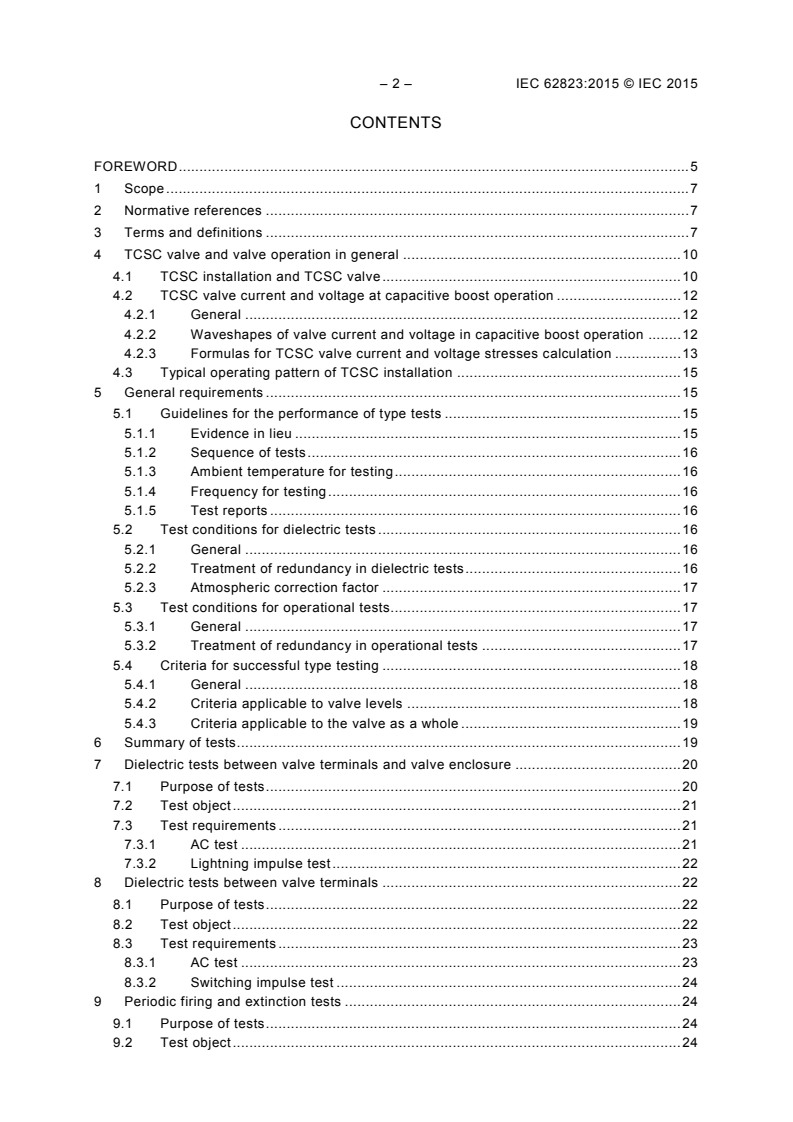
– 2 – IEC 62823:2015 © IEC 2015
CONTENTS
FOREWORD . 5
1 Scope . 7
2 Normative references . 7
3 Terms and definitions . 7
4 TCSC valve and valve operation in general . 10
4.1 TCSC installation and TCSC valve . 10
4.2 TCSC valve current and voltage at capacitive boost operation . 12
4.2.1 General . 12
4.2.2 Waveshapes of valve current and voltage in capacitive boost operation . 12
4.2.3 Formulas for TCSC valve current and voltage stresses calculation . 13
4.3 Typical operating pattern of TCSC installation . 15
5 General requirements . 15
5.1 Guidelines for the performance of type tests . 15
5.1.1 Evidence in lieu . 15
5.1.2 Sequence of tests . 16
5.1.3 Ambient temperature for testing . 16
5.1.4 Frequency for testing . 16
5.1.5 Test reports . 16
5.2 Test conditions for dielectric tests . 16
5.2.1 General . 16
5.2.2 Treatment of redundancy in dielectric tests . 16
5.2.3 Atmospheric correction factor . 17
5.3 Test conditions for operational tests . 17
5.3.1 General . 17
5.3.2 Treatment of redundancy in operational tests . 17
5.4 Criteria for successful type testing . 18
5.4.1 General . 18
5.4.2 Criteria applicable to valve levels . 18
5.4.3 Criteria applicable to the valve as a whole . 19
6 Summary of tests . 19
7 Dielectric tests between valve terminals and valve enclosure . 20
7.1 Purpose of tests . 20
7.2 Test object . 21
7.3 Test requirements . 21
7.3.1 AC test . 21
7.3.2 Lightning impulse test . 22
8 Dielectric tests between valve terminals . 22
8.1 Purpose of tests . 22
8.2 Test object . 22
8.3 Test requirements . 23
8.3.1 AC test . 23
8.3.2 Switching impulse test . 24
9 Periodic firing and extinction tests . 24
9.1 Purpose of tests . 24
9.2 Test object . 24
9.3 Test requirements . 25
9.3.1 General . 25
9.3.2 Maximum continuous capacitive boost test . 25
9.3.3 Maximum temporary capacitive boost test . 26
9.3.4 Minimum capacitive boost test . 26
9.3.5 Operation at bypass. 27
10 Fault current tests . 29
10.1 Purpose of tests . 29
10.2 Test object . 29
10.3 Test requirements . 29
10.3.1 Fault current without subsequent blocking . 29
10.3.2 Fault current with subsequent blocking . 29
11 Test for valve insensitivity to electromagnetic disturbance . 30
11.1 Purpose of tests . 30
11.2 Test object . 30
11.3 Test requirements . 30
12 Testing of special features . 30
12.1 Purpose of tests . 30
12.2 Test object . 31
12.3 Test requirements . 31
13 Routine tests . 31
13.1 General . 31
13.2 Visual inspection . 31
13.3 Connection check . 31
13.4 Voltage grading circuit check . 31
13.5 Voltage withstand check . 31
13.6 Partial discharge tests . 31
13.7 Check of auxiliaries . 32
13.8 Firing check . 32
13.9 Cooling system pressure test . 32
14 Presentation of type test results . 32
Annex A (informative) TCSC valve operating and rating considerations . 33
A.1 Overview. 33
A.2 TCSC characteristics . 33
A.3 Operating range . 34
A.4 Reactive power rating . 35
A.5 Power oscillation damping (POD) . 35
A.6 SSR mitigation . 35
A.7 Harmonics . 36
A.8 Control interactions between TCSCs in parallel lines . 36
A.9 Operating range, overvoltages and duty cycles . 36
A.9.1 Operating range . 36
A.9.2 Transient overvoltages . 36
A.9.3 Duty cycles . 37
Annex B (informative) Valve component fault tolerance. 38
Bibliography . 39
– 4 – IEC 62823:2015 © IEC 2015
Figure 1 – Typical connection and nomenclature of a TCSC installation . 11
Figure 2 – TCSC subsegment . 11
Figure 3 – TCSC steady state waveforms for control angle α and conduction interval σ . 12
Figure 4 – Thyristor valve voltage in a TCSC . 13
Figure 5 – Example of operating range diagram for TCSC . 15
Figure A.1 – TCSC power frequency steady state apparent reactance characteristics
according to Formula (A.1) with λ = 2,5 . 34
Table 1 – Valve level faults permitted during type tests . 19
Table 2 – List of tests . 20
Table A.1 – Peak and RMS voltage relationships . 33
INTERNATIONAL ELECTROTECHNICAL COMMISSION
____________
THYRISTOR VALVES FOR THYRISTOR CONTROLLED
SERIES CAPACITORS (TCSC) – ELECTRICAL TESTING
FOREWORD
1) The International Electrotechnical Commission (IEC) is a worldwide organization for standardization comprising
all national electrotechnical committees (IEC National Committees). The object of IEC is to promote
international co-operation on all questions concerning standardization in the electrical and electronic fields. To
this end and in addition to other activities, IEC publishes International Standards, Technical Specifications,
Technical Reports, Publicly Available Specifications (PAS) and Guides (hereafter referred to as “IEC
Publication(s)”). Their preparation is entrusted to technical committees; any IEC National Committee interested
in the subject dealt with may participate in this preparatory work. International, governmental and non-
governmental organizations liaising with the IEC also participate in this preparation. IEC collaborates closely
with the International Organization for Standardization (ISO) in accordance with conditions determined by
agreement between the two organizations.
2) The formal decisions or agreements of IEC on technical matters express, as nearly as possible, an international
consensus of opinion on the relevant subjects since each technical committee has representation from all
interested IEC National Committees.
3) IEC Publications have the form of recommendations for international use and are accepted by IEC National
Committees in that sense. While all reasonable efforts are made to ensure that the technical content of IEC
Publications is accurate, IEC cannot be held responsible for the way in which they are used or for any
misinterpretation by any end user.
4) In order to promote international uniformity, IEC National Committees undertake to apply IEC Publications
transparently to the maximum extent possible in their national and regional publications. Any divergence
between any IEC Publication and the corresponding national or regional publication shall be clearly indicated in
the latter.
5) IEC itself does not provide any attestation of conformity. Independent certification bodies provide conformity
assessment services and, in some areas, access to IEC marks of conformity. IEC is not responsible for any
services carried out by independent certification bodies.
6) All users should ensure that they have the latest edition of this publication.
7) No liability shall attach to IEC or its directors, employees, servants or agents including individual experts and
members of its technical committees and IEC National Committees for any personal injury, property damage or
other damage of any nature whatsoever, whether direct or indirect, or for costs (including legal fees) and
expenses arising out of the publication, use of, or reliance upon, this IEC Publication or any other IEC
Publications.
8) Attention is drawn to the Normative references cited in this publication. Use of the referenced publications is
indispensable for the correct application of this publication.
9) Attention is drawn to the possibility that some of the elements of this IEC Publication may be the subject of
patent rights. IEC shall not be held responsible for identifying any or all such patent rights.
International Standard IEC 62823 has been prepared by subcommittee 22F: Power electronics
for electrical transmission and distribution systems, of IEC technical committee 22: Power
electronic systems and equipment.
The text of this standard is based on the following documents:
CDV Report on voting
22F/342/CDV 22F/354A/RVC
Full information on the voting for the approval of this standard can be found in the report on
voting indicated in the above table.
This publication has been drafted in accordance with the ISO/IEC Directives, Part 2.
– 6 – IEC 62823:2015 © IEC 2015
The committee has decided that the contents of this publication will remain unchanged until
the stability date indicated on the IEC web site under "http://webstore.iec.ch" in the data
related to the specific publication. At this date, the publication will be
• reconfirmed,
• withdrawn,
• replaced by a revised edition, or
• amended.
IMPORTANT – The 'colour inside' logo on the cover page of this publication indicates
that it contains colours which are considered to be useful for the correct
understanding of its contents. Users should therefore print this document using a
colour printer.
THYRISTOR VALVES FOR THYRISTOR CONTROLLED
SERIES CAPACITORS (TCSC) – ELECTRICAL TESTING
1 Scope
This International Standard defines routine and type tests on thyristor valves used in thyristor
controlled series capacitor (TCSC) installations for AC power transmission.
The tests specified in this International Standard are based on air insulated valves operating
in capacitive boost mode or bypass mode. For other types of valve and for a valve operating
in inductive boost mode, the test requirements and acceptance criteria are agreed between
purchaser and supplier.
2 Normative references
The following documents, in whole or in part, are normatively referenced in this document and
are indispensable for its application. For dated references, only the edition cited applies. For
undated references, the latest edition of the referenced document (including any
amendments) applies.
IEC 60060-1:2010, High-voltage test techniques – Part 1: General definitions and test
requirements
IEC 60071-1, Insulation co-ordination – Part 1: Definitions, principles and rules
IEC 60071-2, Insulation co-ordination – Part 2: Application guide
IEC 60270, High-voltage test techniques – Partial discharge measurements
3 Terms and definitions
For the purposes of this document, the following terms and definitions apply.
3.1
thyristor valve
electrically and mechanically combined assembly of thyristor levels, complete with all
connections, auxiliary components and mechanical structures, which can be connected in
series with each phase of the reactor of a TCSC
3.2
valve section
electrical assembly, comprising a number of thyristors and other components, which exhibits
prorated electrical properties of a complete valve
Note 1 to entry: This term is mainly used to define a test object for valve testing purposes.
3.3
thyristor level
part of a valve comprising an anti-parallel connected pair of thyristors together
with their immediate auxiliaries, and reactor, if any
– 8 – IEC 62823:2015 © IEC 2015
3.4
redundant thyristor levels, pl
maximum number of thyristor levels in the thyristor valve that may be short-circuited,
externally or internally, during service without affecting the safe operation of the thyristor
valve as demonstrated by type tests and which, if and when exceeded, would require either
the shutdown of the thyristor valve to replace the failed thyristors or the acceptance of
increased risk of failures
3.5
valve arrester
arrester connected across a valve
3.6
valve electronics
VE
electronic circuits at valve potential(s) that perform control functions
Note 1 to entry: This note applies to the French language only.
3.7
valve interface electronics unit
electronic unit which provides an interface between the control equipment, at earth potential,
and the valve electronics or valve devices
Note 1 to entry: Valve interface electronics units, if used, are typically located at earth potential close to the
valve(s).
Note 2 to entry: The term “valve base electronics” (VBE) is also used to designate this unit.
3.8
thyristor-controlled series capacitor bank
TCSC bank
assembly of thyristor valves, reactor(s), capacitors, and associated auxiliaries, such as
structures, support insulators, switches, and protective devices, with control equipment
required for a complete operating installation
3.9
TCSC reactor
one or more reactors connected in series with the thyristor valve
SEE: Figure 1, item 4.
3.10
valve enclosure
platform-mounted enclosure containing thyristor valve(s) with associated valve cooling and
electronic hardware
3.11
temporary overload
short-term overload capability of the TCSC at rated frequency and ambient temperature range
SEE: Figure 5.
Note 1 to entry: Temporary overload is typically of several seconds duration, less than 10 s.
3.12
valve protective firing
means of protecting the thyristors from excessive voltage by firing them at a predetermined
voltage
3.13
line current
i
L
power frequency line current
SEE: Figure 2.
3.14
rated current
I
N
RMS line current (I ) at which the TCSC should be capable of continuous operation with rated
L
reactance (X ) and rated voltage (U )
N N
3.15
valve current
i
V
current through the thyristor valve
SEE: Figure 2.
3.16
bypass current
current flowing through the thyristor valve in parallel with the series capacitor, when the series
capacitor is bypassed
3.17
capacitor voltage
U
C
voltage across the TCSC
SEE: Figure 2.
3.18
nominal reactance
X
N
nominal power frequency reactance for each phase of the TCSC with nominal boost factor
3.19
rated TCSC voltage
U
N
power frequency voltage across each phase of the TCSC that can be continuously controlled
at nominal reactance (X ), rated current (I ), nominal power frequency, and ambient
N N
temperature range
3.20
apparent reactance
X(α)
TCSC apparent power frequency reactance as a function of thyristor control angle (α)
SEE: Figure 3, Figure A.1 and Formula A.1.
3.21
rated capacitance
C
N
capacitance value for which the TCSC capacitor has been designed
– 10 – IEC 62823:2015 © IEC 2015
3.22
physical reactance
X
C
power frequency reactance for each phase of the TCSC bank with thyristors blocked and a
capacitor internal dielectric temperature of 20 °C
X = 1 (ω ⋅ C )
C N N
3.23
boost factor
k
B
the ratio of apparent reactance X(α) divided by physical reactance X
C
k = X(α) / X
B C
3.24
conduction interval
σ
part of a half of a power frequency cycle during which a thyristor valve is in the conducting
state
σ = 2β
SEE: Figure 3.
3.25
control angle
α
time expressed in electrical angular measure from the capacitor voltage (U ) zero crossing to
C
the starting of current conduction through the thyristor valve
SEE: Figure 3.
3.26
internal fault
line fault occurring within the protected line section containing the series TCSC subsegment
3.27
external fault
line fault occurring outside the protected line section containing the series TCSC subsegment
4 TCSC valve and valve operation in general
4.1 TCSC installation and TCSC valve
Transmission line series reactance can be compensated by combinations of fixed series
capacitors (FSC) and TCSC based controllable segments, as shown in Figure 1. A TCSC
subsegment uses a thyristor-controlled reactor (TCR) in parallel with a capacitor bank with the
rated capacitance C , as shown in Figure 2. The thyristor valve used in this TCSC
N
subsegment is a TCSC valve (See Figure 1, item 5).
Phase Phase
12 12
2 14
13 13
IEC
Key
1 TCSC unit 8 Discharge current limiter, if applicable
2 Additional TCSC unit when required 9 Bypass switch
3 TCSC capacitor 10 Bypass gap
4 TCSC reactor 11 External bypass disconnector
5 TCSC thyristor valve 12 External isolating switch
6 TCSC subsegment 13 External earth switch
7 Capacitor arrester 14 Additional FSC unit when required
Figure 1 – Typical connection and nomenclature of a TCSC installation
U
C
i i
L C
Capacitor (C)
Arrester
i
V
TCSC reactor (L)
Thyristor valve
IEC
Figure 2 – TCSC subsegment
– 12 – IEC 62823:2015 © IEC 2015
4.2 TCSC valve current and voltage at capacitive boost operation
4.2.1 General
Even if a TCSC valve can be, theoretically, operated in an inductive boost mode, this
operation is not used in practice in a TCSC installation due to the system compensation need
and other limitations. Capacitive boost operation mode is a used operation mode of a TCSC
valve.
4.2.2 Waveshapes of valve current and voltage in capacitive boost operation
At a sinusoidal line current and voltage (see Figure 3 a)), the capacitive boost operating of a
TCSC valve leads to a deformed sinusoidal current flow through the capacitor bank, C, and
TCSC valve (see Figure 3 b)). This current boosts the fundamental frequency voltage drop
across the TCSC subsegment.
The waveform of the thyristor valve voltage in a TCSC is shown in Figure 4.
2,0 2,0
Boosting factor = 1,0 Boosting factor ≈ 2,0
1,5 1,5
i = i + i
C L V
i
L
i
V
1,0 1,0
i
L
0,5 0,5
β
σ
0,0
0,0
α
α
-0,5
-0,5
-1,0 -1,0
U at α = 145º
U at α = 180º
C C
-1,5 -1,5
-2,0 -2,0
0 90 180 270 360 0 90 180 270 360
Electric angle (º)
Electric angle (º)
IEC IEC
a) Capacitor bank voltage U b) Capacitor bank voltage U
C C
and current i at a = 180° and current i at a = 145°
L C
Figure 3 – TCSC steady state waveforms for
control angle α and conduction interval σ
Normalized units (peak)
Normalized units (peak)
Valve voltage
0,5
–0,5
–1
60 120 180 240 300 360
0,75
0,5
0,25
20 25 30 35 40 45 50 55 60
IEC
Figure 4 – Thyristor valve voltage in a TCSC
4.2.3 Formulas for TCSC valve current and voltage stresses calculation
4.2.3.1 Capacitive boost operation mode
In TCSC capacitive boost operation mode, the TCSC valve current follows the formulation
below:
λ ⋅ i cos β
n L
i = (−1) ⋅ ⋅ cosω ⋅ t − ⋅cos λ ⋅ω ⋅ t , n⋅π − β ≤ ω ⋅t ≤ n⋅π + β
v N N N
cos λ ⋅ β
λ −1
i = 0 n⋅π + β < ω ⋅t < (n + 1)⋅π − β
v N
n = 0, 1, 2, 3, …
where
λ is the ratio of TCSC subsegment LC branch natural frequency and AC system power
frequency, λ = ;
ω ⋅ L ⋅ C
N
i is the AC system line current;
L
ω nominal angle frequency of AC system;
N
β is half of the maximum conduction angle of TCSC valves in one direction for capacitive
boost at i .
L
– 14 – IEC 62823:2015 © IEC 2015
The rate of current change, di/dt, at thyristor turn-on and turn-off derives as follows:
λ ⋅ i
cos β
di
L
v
= ⋅ ω ⋅ sin β − ω ⋅ ⋅ sin(λ ⋅ β )
N N
dt π 2
cos(λ ⋅ β )
ω ⋅t = + β λ −1
N
The peak current through the TCSC valve is equal to:
λ ⋅ i cos β
L
i = ⋅ 1−
v_peak
cos(λ ⋅ β )
λ −1
The capacitor voltage, U , at thyristor turn-on and turn-off instants is equal to:
C_N
λ ⋅ i
L
U = ⋅ X ⋅ [sin β − λ ⋅cos β ⋅ tan(λ ⋅ β )]
C_N 0
λ −1
where
X is the TCSC subsegment LC branch impedance:
L
X = ,
C
where
L is the inductance of TCSC subsegment LC branch (Figure 2);
C is the capacitance of TCSC subsegment LC branch (Figure 2).
The capacitor voltage peak, appearing on the TCSC valve, is equal to:
λ ⋅(cos β ⋅ tan(λ ⋅ β ) − λ ⋅ sin β )
U = λ ⋅ i ⋅ X ⋅ 1+
P L 0
λ −1
The capacitive boost factor of the TCSC subsegment is equal to:
2 2
( )
2 λ 2 ⋅cos β sin 2 ⋅ β
k = 1+ ⋅ ⋅ ⋅ [λ ⋅ tan(λ ⋅ β )− tan β ]− β −
B
2 2
π β
λ −1 λ −1
4.2.3.2 Bypass operation mode
In TCSC bypass operation mode the TCSC valve is full conduction and the valve conducts a
power frequency sinusoidal waveform bypass current equal to:
i = ⋅ i
bypass L
1− ω ⋅ L ⋅ C
N
The capacitor voltage at bypass operation follows the formula below:
−i
L
U =
C
(λ −1)⋅ω ⋅ C
N
4.3 Typical operating pattern of TCSC installation
See Figure 5.
0,5
0,0
C3 A3 B3
-0,5
C1
A1
B1
-1,0
-1,5
-2,0
-2,5
-3,0
C2 A2 B2
-3,5
0 0,2 0,4 0,6 0,8 1,0 1,2 1,4 1,6 1,8 2,0
Line current (p.u.)
IEC
Continuous capacitive boost operation area
Temporary capacitive boost operation area
Continuous bypass operation
Temporary bypass operation
Figure 5 – Example of operating range diagram for TCSC
5 General requirements
5.1 Guidelines for the performance of type tests
5.1.1 Evidence in lieu
5.1.1.1 General
Each design of valve shall be subjected to the type tests specified in this International
Standard. If the valve is demonstrably similar to the one previously tested, the supplier may,
in lieu of performing a type test, submit a test report of a previous type test for consideration
by the purchaser.
Boosting factor (p.u.)
– 16 – IEC 62823:2015 © IEC 2015
5.1.1.2 Test object
The tests described apply to the valve (or valve sections), the valve structure and those parts
of the coolant distribution system and firing and monitoring circuits which are contained within
the valve structure or connected between the valve structure and platform. Other equipment,
such as valve control and protection and valve interface electronics units may be essential for
demonstrating the correct function of the valve during the tests but are not in themselves the
subject of the valve tests.
Certain type tests may be performed either on a complete valve or on valve sections, as
indicated in Table 2. For those type tests on valve sections, the total number of valve sections
tested shall be at least as many as the number in a complete valve.
The same valve sections shall be used for all type tests unless otherwise stated.
5.1.2 Sequence of tests
Prior to commencement of type tests, the valve, valve sections and/or the components of
them should be demonstrated to have withstood the routine tests to ensure proper
manufacture.
The type tests specified can be carried out in any order.
5.1.3 Ambient temperature for testing
The tests shall be performed at the prevailing ambient temperature of the test facility, unless
otherwise specified.
5.1.4 Frequency for testing
AC dielectric tests can be performed at either 50 Hz or 60 Hz. For operational tests, specific
requirements regarding the frequency for testing are given in 5.3.1.
5.1.5 Test reports
At the completion of the type tests, the supplier shall provide type test reports in accordance
with Clause 14.
5.2 Test conditions for dielectric tests
5.2.1 General
Dielectric tests shall be performed on a completely assembled valve.
The valve shall be assembled with all auxiliary components except for the valve arrester, if
used. Unless otherwise specified, the valve electronics shall be energized. The cooling and
insulating fluids in particular shall be in a condition that represents service conditions such as
conductivity, except for the flow rate and anti-freezing media content, which can be reduced.
If any object or device external to the structure is necessary for proper representation of the
stresses during the test, it shall also be present or simulated in the test. Metallic parts of the
valve structure which are not part of the test shall be shorted together and connected to
enclosure earth in a manner appropriate to the test in question.
5.2.2 Treatment of redundancy in dielectric tests
All dielectric tests on a complete valve shall be carried out with redundant thyristor levels
short-circuited, except where otherwise indicated.
5.2.3 Atmospheric correction factor
When specified in the relevant clause, atmospheric correction shall be applied to the test
voltages in accordance with IEC 60060-1. The reference conditions to which correction shall
be made are the following.
– Pressure:
If the insulation coordination of the tested part of the thyristor valve is based on standard
rated withstand voltages according to IEC 60071-1, correction factors are only applied for
site altitudes a exceeding 1 000 m. Hence, if the altitude of the site at which the
s
equipment will be installed is less than 1 000 m, then the standard atmospheric air
pressure (b = 101,3 kPa) shall be used with no correction for altitude. If a > 1 000 m,
0 s
then the standard procedure according to IEC 60060-1 is used except that the reference
atmospheric pressure b is replaced by the atmospheric pressure corresponding to an
altitude of 1 000 m (b ).
1 000m
If the insulation coordination of the tested part of the thyristor valve is not based on
standard rated withstand voltages according to IEC 60071-1, then the standard procedure
according to IEC 60060-1 is used with the reference atmospheric pressure b
(b = 101,3 kPa).
– Temperature:
design maximum valve hall air temperature (°C).
– Humidity:
design minimum valve hall absolute humidity (g/m ).
The values to be used shall be specified by the supplier.
5.3 Test conditions for operational tests
5.3.1 General
Where possible, a complete thyristor valve should be tested. Otherwise the tests may be
performed on thyristor valve sections. The choice depends mainly upon the thyristor valve
design and the test facilities available. Where tests on the thyristor valve sections are
proposed, the tests specified in this International Standard are valid for thyristor valve
sections containing five or more series-connected thyristor levels. If tests on thyristor valve
sections with fewer than five thyristor levels are proposed, additional test safety factors shall
be agreed upon. Under no circumstances shall the number of series-connected thyristor
levels in a thyristor valve section be less than three.
Operational tests may be performed at a power frequency different from the service
frequency, e.g. 50 Hz instead of 60 Hz or vice versa. Some operational stresses such as
switching losses or I t of short-circuit current are affected by the actual power frequency
during tests. When this situation occurs, the test conditions shall be reviewed and appropriate
changes made to ensure that the valve stresses are at least as severe as they would be if the
tests were performed at the service frequency.
The coolant shall be in a condition representative of service conditions. Flow and
temperature, in particular, shall be set to the most unfavourable values appropriate to the test
in question. Anti-freezing media content should, preferably, be equivalent to the service
condition; however, where this is not practicable, a correction factor agreed between the
supplier and the purchaser shall be applied. Unless otherwise specified, the thyristor junction
temperature during operational tests shall not be less than the temperature in service.
5.3.2 Treatment of redundancy in operational tests
For operational tests, redundant valve levels shall not be short-circuited. The test voltages
used shall be adjusted by means of a scaling factor k :
n
– 18 – IEC 62823:2015 © IEC 2015
N
tut
k =
n
N − N
t r
where
N is the number of series thyristor levels in the test object;
tut
N is the total number of series thyristor levels in the valve;
t
N is the total number of redundant series thyristor levels in the valve.
r
5.4 Criteria for successful type testing
5.4.1 General
Experience in industry shows that, even with the most careful design of valves, it is not
possible to avoid occasional random failures of thyristor level components during service
operation. Even though these failures may be stress-related, they are considered random to
the extent that the cause of failure or the relationship between failure rate and stress cannot
be predicted or is not amenable to precise quantitative definition. Type tests subject valves or
valve sections, within a short time, to multiple stresses that generally correspond to the worst
stresses that can be experienced by the equipment not more than a few times during the life
of the valve. Considering the above, the criteria for successful type testing set out below
therefore permit a small number of thyristor levels to fail during type testing, providing that the
failures are rare and do not show any pattern that is indicative of inadequate design.
5.4.2 Criteria applicable to valve levels
The following criteria are applicable to valve levels.
a) If, following a type test as listed in Clause 6, the number of failed thyristor levels is greater
than the value specified in column 2 of Table 1, then the valve shall be deemed to have
failed the type tests.
b) If, following a type test, one thyristor level (or more if still within the limit in column 2 of
Table 1) has become short-circuited, then the failed level(s) shall be restored and this
type test repeated.
c) If the cumulative number of short-circuited thyristor levels during all type tests exceeds
the number given in column 3 of Table 1, then the valve shall be deemed to have failed
the type test programme.
d) When type tests are performed on valve sections, the criteria for acceptance above also
apply since the number of valve sections tested shall be not less than the number of
sections in a complete valve (see 5.1.1.2).
e) The valve or valve sections shall be checked after each type test to determine whether or
not any thyristor levels have become short-circuited. Failed thyristors or auxi
...
IEC 62823 ®
Edition 1.1 2019-12
CONSOLIDATED VERSION
INTERNATIONAL
STANDARD
NORME
INTERNATIONALE
colour
inside
Thyristor valves for thyristor controlled series capacitors (TCSC) –
Electrical testing
Valves à thyristors pour condensateurs série commandés par thyristors (CSCT) –
Essai électrique
All rights reserved. Unless otherwise specified, no part of this publication may be reproduced or utilized in any form
or by any means, electronic or mechanical, including photocopying and microfilm, without permission in writing from
either IEC or IEC's member National Committee in the country of the requester. If you have any questions about IEC
copyright or have an enquiry about obtaining additional rights to this publication, please contact the address below or
your local IEC member National Committee for further information.
Droits de reproduction réservés. Sauf indication contraire, aucune partie de cette publication ne peut être reproduite
ni utilisée sous quelque forme que ce soit et par aucun procédé, électronique ou mécanique, y compris la photocopie
et les microfilms, sans l'accord écrit de l'IEC ou du Comité national de l'IEC du pays du demandeur. Si vous avez des
questions sur le copyright de l'IEC ou si vous désirez obtenir des droits supplémentaires sur cette publication, utilisez
les coordonnées ci-après ou contactez le Comité national de l'IEC de votre pays de résidence.
IEC Central Office Tel.: +41 22 919 02 11
3, rue de Varembé info@iec.ch
CH-1211 Geneva 20 www.iec.ch
Switzerland
About the IEC
The International Electrotechnical Commission (IEC) is the leading global organization that prepares and publishes
International Standards for all electrical, electronic and related technologies.
About IEC publications
The technical content of IEC publications is kept under constant review by the IEC. Please make sure that you have the
latest edition, a corrigendum or an amendment might have been published.
IEC publications search - webstore.iec.ch/advsearchform Electropedia - www.electropedia.org
The advanced search enables to find IEC publications by a The world's leading online dictionary on electrotechnology,
variety of criteria (reference number, text, technical containing more than 22 000 terminological entries in English
committee,…). It also gives information on projects, replaced and French, with equivalent terms in 16 additional languages.
and withdrawn publications. Also known as the International Electrotechnical Vocabulary
(IEV) online.
IEC Just Published - webstore.iec.ch/justpublished
Stay up to date on all new IEC publications. Just Published IEC Glossary - std.iec.ch/glossary
details all new publications released. Available online and 67 000 electrotechnical terminology entries in English and
once a month by email. French extracted from the Terms and Definitions clause of
IEC publications issued since 2002. Some entries have been
IEC Customer Service Centre - webstore.iec.ch/csc collected from earlier publications of IEC TC 37, 77, 86 and
If you wish to give us your feedback on this publication or CISPR.
need further assistance, please contact the Customer Service
Centre: sales@iec.ch.
A propos de l'IEC
La Commission Electrotechnique Internationale (IEC) est la première organisation mondiale qui élabore et publie des
Normes internationales pour tout ce qui a trait à l'électricité, à l'électronique et aux technologies apparentées.
A propos des publications IEC
Le contenu technique des publications IEC est constamment revu. Veuillez vous assurer que vous possédez l’édition la
plus récente, un corrigendum ou amendement peut avoir été publié.
Recherche de publications IEC - Electropedia - www.electropedia.org
webstore.iec.ch/advsearchform Le premier dictionnaire d'électrotechnologie en ligne au
La recherche avancée permet de trouver des publications IEC monde, avec plus de 22 000 articles terminologiques en
en utilisant différents critères (numéro de référence, texte, anglais et en français, ainsi que les termes équivalents dans
comité d’études,…). Elle donne aussi des informations sur les 16 langues additionnelles. Egalement appelé Vocabulaire
projets et les publications remplacées ou retirées. Electrotechnique International (IEV) en ligne.
IEC Just Published - webstore.iec.ch/justpublished Glossaire IEC - std.iec.ch/glossary
Restez informé sur les nouvelles publications IEC. Just 67 000 entrées terminologiques électrotechniques, en anglais
Published détaille les nouvelles publications parues. et en français, extraites des articles Termes et Définitions des
Disponible en ligne et une fois par mois par email. publications IEC parues depuis 2002. Plus certaines entrées
antérieures extraites des publications des CE 37, 77, 86 et
Service Clients - webstore.iec.ch/csc CISPR de l'IEC.
Si vous désirez nous donner des commentaires sur cette
publication ou si vous avez des questions contactez-nous:
sales@iec.ch.
IEC 62823 ®
Edition 1.1 2019-12
CONSOLIDATED VERSION
INTERNATIONAL
STANDARD
NORME
INTERNATIONALE
colour
inside
Thyristor valves for thyristor controlled series capacitors (TCSC) –
Electrical testing
Valves à thyristors pour condensateurs série commandés par thyristors (CSCT) –
Essai électrique
INTERNATIONAL
ELECTROTECHNICAL
COMMISSION
COMMISSION
ELECTROTECHNIQUE
INTERNATIONALE
ICS 29.240.99 ISBN 978-2-8322-7704-1
IEC 62823 ®
Edition 1.1 2019-12
CONSOLIDATED VERSION
REDLINE VERSION
VERSION REDLINE
colour
inside
Thyristor valves for thyristor controlled series capacitors (TCSC) –
Electrical testing
Valves à thyristors pour condensateurs série commandés par thyristors (CSCT) –
Essai électrique
– 2 – IEC 62823:2015+AMD1:2019 CSV
© IEC 2019
CONTENTS
FOREWORD . 5
1 Scope . 7
2 Normative references . 7
3 Terms and definitions . 7
4 TCSC valve and valve operation in general . 10
4.1 TCSC installation and TCSC valve . 10
4.2 TCSC valve current and voltage at capacitive boost operation . 13
4.2.1 General . 13
4.2.2 Waveshapes of valve current and voltage in capacitive boost operation . 13
4.2.3 Formulas for TCSC valve current and voltage stresses calculation . 15
4.3 Typical operating pattern of TCSC installation . 17
5 General requirements . 18
5.1 Guidelines for the performance of type tests . 18
5.1.1 Evidence in lieu . 18
5.1.2 Sequence of tests . 19
5.1.3 Ambient temperature for testing . 19
5.1.4 Frequency for testing . 19
5.1.5 Test reports . 19
5.2 Test conditions for dielectric tests . 19
5.2.1 General . 19
5.2.2 Treatment of redundancy in dielectric tests . 19
5.2.3 Atmospheric correction factor . 19
5.3 Test conditions for operational tests . 20
5.3.1 General . 20
5.3.2 Treatment of redundancy in operational tests . 20
5.4 Criteria for successful type testing . 21
5.4.1 General . 21
5.4.2 Criteria applicable to valve levels . 21
5.4.3 Criteria applicable to the valve as a whole . 22
6 Summary of tests . 22
7 Dielectric tests between valve terminals and valve enclosure . 23
7.1 Purpose of tests . 23
7.2 Test object . 24
7.3 Test requirements . 24
7.3.1 AC test . 24
7.3.2 Lightning impulse test . 25
8 Dielectric tests between valve terminals . 25
8.1 Purpose of tests . 25
8.2 Test object . 26
8.3 Test requirements . 26
8.3.1 AC test . 26
8.3.2 Switching impulse test . 27
9 Periodic firing and extinction tests . 28
9.1 Purpose of tests . 28
9.2 Test object . 28
© IEC 2019
9.3 Test requirements . 28
9.3.1 General . 28
9.3.2 Maximum continuous capacitive boost test . 28
9.3.3 Maximum temporary capacitive boost test . 29
9.3.4 Minimum capacitive boost test . 30
9.3.5 Operation at bypass. 31
10 Fault current tests . 32
10.1 Purpose of tests . 32
10.2 Test object . 32
10.3 Test requirements . 32
10.3.1 Fault current without subsequent blocking . 32
10.3.2 Fault current with subsequent blocking . 33
11 Test for valve insensitivity to electromagnetic disturbance . 33
11.1 Purpose of tests . 33
11.2 Test object . 34
11.3 Test requirements . 34
12 Testing of special features . 34
12.1 Purpose of tests . 34
12.2 Test object . 34
12.3 Test requirements . 34
13 Routine tests . 34
13.1 General . 34
13.2 Visual inspection . 34
13.3 Connection check . 35
13.4 Voltage grading circuit check . 35
13.5 Voltage withstand check . 35
13.6 Partial discharge tests . 35
13.7 Check of auxiliaries . 35
13.8 Firing check . 35
13.9 Cooling system pressure test . 35
14 Presentation of type test results . 35
Annex A (informative) TCSC valve operating and rating considerations . 37
A.1 Overview. 37
A.2 TCSC characteristics . 37
A.3 Operating range . 38
A.4 Reactive power rating . 39
A.5 Power oscillation damping (POD) . 39
A.6 SSR mitigation . 39
A.7 Harmonics . 40
A.8 Control interactions between TCSCs in parallel lines . 40
A.9 Operating range, overvoltages and duty cycles . 40
A.9.1 Operating range . 40
A.9.2 Transient overvoltages . 40
A.9.3 Duty cycles . 41
Annex B (informative) Valve component fault tolerance. 42
Bibliography . 43
– 4 – IEC 62823:2015+AMD1:2019 CSV
© IEC 2019
Figure 1 – Typical connection and nomenclature of a TCSC installation . 11
Figure 2 – TCSC subsegment . 12
Figure 3 – TCSC steady state waveforms for control angle α and conduction interval σ . 13
Figure 4 – Thyristor valve voltage in a TCSC . 14
Figure 5 – Example of operating range diagram for TCSC . 18
Figure A.1 – TCSC power frequency steady state apparent reactance characteristics
according to Formula (A.1) with λ = 2,5 . 38
Table 1 – Valve level faults permitted during type tests . 22
Table 2 – List of tests . 23
Table A.1 – Peak and RMS voltage relationships . 37
© IEC 2019
INTERNATIONAL ELECTROTECHNICAL COMMISSION
____________
THYRISTOR VALVES FOR THYRISTOR CONTROLLED
SERIES CAPACITORS (TCSC) – ELECTRICAL TESTING
FOREWORD
1) The International Electrotechnical Commission (IEC) is a worldwide organization for standardization comprising
all national electrotechnical committees (IEC National Committees). The object of IEC is to promote
international co-operation on all questions concerning standardization in the electrical and electronic fields. To
this end and in addition to other activities, IEC publishes International Standards, Technical Specifications,
Technical Reports, Publicly Available Specifications (PAS) and Guides (hereafter referred to as “IEC
Publication(s)”). Their preparation is entrusted to technical committees; any IEC National Committee interested
in the subject dealt with may participate in this preparatory work. International, governmental and non-
governmental organizations liaising with the IEC also participate in this preparation. IEC collaborates closely
with the International Organization for Standardization (ISO) in accordance with conditions determined by
agreement between the two organizations.
2) The formal decisions or agreements of IEC on technical matters express, as nearly as possible, an international
consensus of opinion on the relevant subjects since each technical committee has representation from all
interested IEC National Committees.
3) IEC Publications have the form of recommendations for international use and are accepted by IEC National
Committees in that sense. While all reasonable efforts are made to ensure that the technical content of IEC
Publications is accurate, IEC cannot be held responsible for the way in which they are used or for any
misinterpretation by any end user.
4) In order to promote international uniformity, IEC National Committees undertake to apply IEC Publications
transparently to the maximum extent possible in their national and regional publications. Any divergence
between any IEC Publication and the corresponding national or regional publication shall be clearly indicated in
the latter.
5) IEC itself does not provide any attestation of conformity. Independent certification bodies provide conformity
assessment services and, in some areas, access to IEC marks of conformity. IEC is not responsible for any
services carried out by independent certification bodies.
6) All users should ensure that they have the latest edition of this publication.
7) No liability shall attach to IEC or its directors, employees, servants or agents including individual experts and
members of its technical committees and IEC National Committees for any personal injury, property damage or
other damage of any nature whatsoever, whether direct or indirect, or for costs (including legal fees) and
expenses arising out of the publication, use of, or reliance upon, this IEC Publication or any other IEC
Publications.
8) Attention is drawn to the Normative references cited in this publication. Use of the referenced publications is
indispensable for the correct application of this publication.
9) Attention is drawn to the possibility that some of the elements of this IEC Publication may be the subject of
patent rights. IEC shall not be held responsible for identifying any or all such patent rights.
This consolidated version of the official IEC Standard and its amendment has been
prepared for user convenience.
IEC 62823 edition 1.1 contains the first edition (2015-08) [documents 22F/342/CDV and
22F/354A/RVC] and its amendment 1 (2019-12) [documents 22F/518/CDV and 22F/532/
RVC].
In this Redline version, a vertical line in the margin shows where the technical content
is modified by amendment 1. Additions are in green text, deletions are in strikethrough
red text. A separate Final version with all changes accepted is available in
this publication.
– 6 – IEC 62823:2015+AMD1:2019 CSV
© IEC 2019
International Standard IEC 62823 has been prepared by subcommittee 22F: Power electronics
for electrical transmission and distribution systems, of IEC technical committee 22: Power
electronic systems and equipment.
This publication has been drafted in accordance with the ISO/IEC Directives, Part 2.
The committee has decided that the contents of the base publication and its amendment will
remain unchanged until the stability date indicated on the IEC web site under
"http://webstore.iec.ch" in the data related to the specific publication. At this date, the
publication will be
• reconfirmed,
• withdrawn,
• replaced by a revised edition, or
• amended.
IMPORTANT – The 'colour inside' logo on the cover page of this publication indicates
that it contains colours which are considered to be useful for the correct
understanding of its contents. Users should therefore print this document using a
colour printer.
© IEC 2019
THYRISTOR VALVES FOR THYRISTOR CONTROLLED
SERIES CAPACITORS (TCSC) – ELECTRICAL TESTING
1 Scope
This International Standard defines routine and type tests on thyristor valves used in thyristor
controlled series capacitor (TCSC) installations for AC power transmission.
The tests specified in this International Standard are based on air insulated valves operating
in capacitive boost mode or bypass mode. For other types of valve and for a valve operating
in inductive boost mode, the test requirements and acceptance criteria are agreed between
purchaser and supplier.
2 Normative references
The following documents, in whole or in part, are normatively referenced in this document and
are indispensable for its application. For dated references, only the edition cited applies. For
undated references, the latest edition of the referenced document (including any
amendments) applies.
IEC 60060-1:2010, High-voltage test techniques – Part 1: General definitions and test
requirements
IEC 60071-1, Insulation co-ordination – Part 1: Definitions, principles and rules
IEC 60071-2, Insulation co-ordination – Part 2: Application guide
IEC 60270, High-voltage test techniques – Partial discharge measurements
3 Terms and definitions
For the purposes of this document, the following terms and definitions apply.
3.1
thyristor valve
electrically and mechanically combined assembly of thyristor levels, complete with all
connections, auxiliary components and mechanical structures, which can be connected in
series with each phase of the reactor of a TCSC
3.2
valve section
electrical assembly, comprising a number of thyristors and other components, which exhibits
prorated electrical properties of a complete valve
Note 1 to entry: This term is mainly used to define a test object for valve testing purposes.
3.3
thyristor level
part of a valve comprising an anti-parallel connected pair of thyristors together
with their immediate auxiliaries, and reactor, if any
– 8 – IEC 62823:2015+AMD1:2019 CSV
© IEC 2019
3.4
redundant thyristor levels, pl
maximum number of thyristor levels in the thyristor valve that may be short-circuited,
externally or internally, during service without affecting the safe operation of the thyristor
valve as demonstrated by type tests and which, if and when exceeded, would require either
the shutdown of the thyristor valve to replace the failed thyristors or the acceptance of
increased risk of failures
3.5
valve arrester
arrester connected across a valve
3.6
valve electronics
VE
electronic circuits at valve potential(s) that perform control functions
Note 1 to entry: This note applies to the French language only.
3.7
valve interface electronics unit
electronic unit which provides an interface between the control equipment, at earth potential,
and the valve electronics or valve devices
Note 1 to entry: Valve interface electronics units, if used, are typically located at earth potential close to the
valve(s).
Note 2 to entry: The term “valve base electronics” (VBE) is also used to designate this unit.
3.8
thyristor-controlled series capacitor bank
TCSC bank
assembly of thyristor valves, reactor(s), capacitors, and associated auxiliaries, such as
structures, support insulators, switches, and protective devices, with control equipment
required for a complete operating installation
3.9
TCSC reactor
one or more reactors connected in series with the thyristor valve
SEE: Figure 1, item 4.
3.10
valve enclosure
platform-mounted enclosure containing thyristor valve(s) with associated valve cooling and
electronic hardware
3.11
temporary overload
short-term overload capability of the TCSC at rated frequency and ambient temperature range
SEE: Figure 5.
Note 1 to entry: Temporary overload is typically of several seconds duration, less than 10 s.
3.12
valve protective firing
means of protecting the thyristors from excessive voltage by firing them at a predetermined
voltage
© IEC 2019
3.13
line current
i
L
power frequency line current
SEE: Figure 2.
3.14
rated current
I
N
RMS line current (I ) at which the TCSC should be capable of continuous operation with rated
L
reactance (X ) and rated voltage (U )
N N
3.15
valve current
i
V
current through the thyristor valve
SEE: Figure 2.
3.16
bypass current
current flowing through the thyristor valve in parallel with the series capacitor, when the series
capacitor is bypassed
3.17
capacitor voltage
U
C
voltage across the TCSC
SEE: Figure 2.
3.18
nominal reactance
X
N
nominal power frequency reactance for each phase of the TCSC with nominal boost factor
3.19
rated TCSC voltage
U
N
power frequency voltage across each phase of the TCSC that can be continuously controlled
at nominal reactance (X ), rated current (I ), nominal power frequency, and ambient
N N
temperature range
3.20
apparent reactance
X(α)
TCSC apparent power frequency reactance as a function of thyristor control angle (α)
SEE: Figure 3, Figure A.1 and Formula A.1.
3.21
rated capacitance
C
N
capacitance value for which the TCSC capacitor has been designed
– 10 – IEC 62823:2015+AMD1:2019 CSV
© IEC 2019
3.22
physical reactance
X
C
power frequency reactance for each phase of the TCSC bank with thyristors blocked and a
capacitor internal dielectric temperature of 20 °C
X = 1 (ω ⋅ C )
C N N
3.23
boost factor
k
B
the ratio of apparent reactance X(α) divided by and physical reactance X
C
k = X(α) / X
B C
3.24
conduction interval
σ
part of a half of a power frequency cycle during which a thyristor valve is in the conducting
state
σ = 2β
SEE: Figure 3.
3.25
control angle
α
time expressed in electrical angular measure from the capacitor voltage (U ) zero crossing to
C
the starting of current conduction through the thyristor valve
SEE: Figure 3.
3.26
internal fault
line fault occurring within the protected line section containing the series TCSC subsegment
3.27
external fault
line fault occurring outside the protected line section containing the series TCSC subsegment
4 TCSC valve and valve operation in general
4.1 TCSC installation and TCSC valve
Transmission line series reactance can be compensated by combinations of fixed series
capacitors (FSC) and TCSC based controllable segments, as shown in Figure 1. A TCSC
subsegment uses a thyristor-controlled reactor (TCR) in parallel with a capacitor bank with the
rated capacitance C , as shown in Figure 2. The thyristor valve used in this TCSC
N
subsegment is a TCSC valve (See Figure 1, item 5).
© IEC 2019
Phase Phase
12 12
2 14
13 13
IEC
Key
1 TCSC unit 8 Discharge current limiter, if applicable
2 Additional TCSC unit when required 9 Bypass switch
3 TCSC capacitor 10 Bypass gap
4 TCSC reactor 11 External bypass disconnector
5 TCSC thyristor valve 12 External isolating switch
6 TCSC subsegment 13 External earth switch
7 Capacitor arrester 14 Additional FSC unit when required
Figure 1 – Typical connection and nomenclature of a TCSC installation
– 12 – IEC 62823:2015+AMD1:2019 CSV
© IEC 2019
U
C
i i
L C
Capacitor (C)
Arrester
i
V
TCSC reactor (L)
Thyristor valve
IEC
NOTE Valve arrester is optional.
Figure 2 – TCSC subsegment
© IEC 2019
4.2 TCSC valve current and voltage at capacitive boost operation
4.2.1 General
Even if a TCSC valve can be, theoretically, operated in an inductive boost mode, this
operation is not used in practice in a TCSC installation due to the system compensation need
and other limitations. Capacitive boost operation mode is a used operation mode of a TCSC
valve.
4.2.2 Waveshapes of valve current and voltage in capacitive boost operation
At a sinusoidal line current and voltage (see Figure 3 a)), the capacitive boost operating of a
TCSC valve leads to a deformed sinusoidal current flow through the capacitor bank, C, and
TCSC valve (see Figure 3 b)). This current boosts the fundamental frequency voltage drop
across the TCSC subsegment.
The waveform of the thyristor valve voltage in a TCSC is shown in Figure 4.
2,0 2,0
Boosting factor = 1,0 Boosting factor ≈ 2,0
1,5 1,5
i = i + i
C L V
i
L
i
V
1,0 1,0
i
L
0,5 0,5
β
σ
0,0
0,0
α
α
-0,5
-0,5
-1,0 -1,0
U at α = 145º
U at α = 180º
C C
-1,5 -1,5
-2,0 -2,0
0 90 180 270 360 0 90 180 270 360
Electric angle (º)
Electric angle (º)
IEC IEC
a) Capacitor bank voltage U b) Capacitor bank voltage U
C C
and current i at α = 180° and current i at α = 145°
L C
Figure 3 – TCSC steady state waveforms for
control angle α and conduction interval σ
Normalized units (peak)
Normalized units (peak)
– 14 – IEC 62823:2015+AMD1:2019 CSV
© IEC 2019
Valve voltage
0,5
–0,5
–1
60 120 180 240 300 360
0,75
0,5
0,25
20 25 30 35 40 45 50 55 60
IEC
Figure 4 – Thyristor valve voltage in a TCSC
© IEC 2019
4.2.3 Formulas for TCSC valve current and voltage stresses calculation
4.2.3.1 Capacitive boost operation mode
In TCSC capacitive boost operation mode, the TCSC valve current follows the formulation
below:
λ ⋅ i cos β
n L
i = (−1) ⋅ ⋅ cosω ⋅ t − ⋅cos λ ⋅ω ⋅ t , n⋅π − β ≤ ω ⋅t ≤ n⋅π + β
v N N
N
cos λ ⋅ β
λ −1
i = 0 n⋅π + β < ω ⋅t < (n + 1)⋅π − β
v
N
n = 0, 1, 2, 3, …
where
λ is the ratio of TCSC subsegment LC branch natural frequency and AC system power
frequency, λ = ;
ω ⋅ L ⋅ C
N
i is the AC system line current;
L
ω nominal angle frequency of AC system;
N
β is half of the maximum conduction angle of TCSC valves in one direction for capacitive
boost at i .
L
The rate of current change, di/dt, at thyristor turn-on and turn-off derives as follows:
λ ⋅ i cos β
di
L
v
= ⋅ ω ⋅ sin β − ω ⋅ ⋅ sin(λ ⋅ β )
N N
dt π
cos(λ ⋅ β )
ω ⋅t = + β λ −1
N
The peak current through the TCSC valve is equal to:
λ ⋅ i cos β
L
i = ⋅ 1−
v_peak
cos(λ ⋅ β )
λ −1
The capacitor voltage, U , at thyristor turn-on and turn-off instants is equal to:
C_N
λ ⋅ i
L
U = ⋅ X ⋅ [sin β − λ ⋅cos β ⋅ tan(λ ⋅ β )]
C_N 0
λ −1
where
X is the TCSC subsegment LC branch impedance:
L
X = ,
C
where
L is the inductance of TCSC subsegment LC branch (Figure 2);
C is the capacitance of TCSC subsegment LC branch (Figure 2).
The capacitor voltage peak, appearing on the TCSC valve, is equal to:
– 16 – IEC 62823:2015+AMD1:2019 CSV
© IEC 2019
λ ⋅(cos β ⋅ tan(λ ⋅ β ) − λ ⋅ sin β )
U = λ ⋅ i ⋅ X ⋅ 1+
P L 0
λ −1
The capacitive boost factor of the TCSC subsegment is equal to:
2 2
2 λ 2 ⋅cos β sin(2 ⋅ β )
k = 1+ ⋅ ⋅ ⋅ [λ ⋅ tan(λ ⋅ β )− tan β ]− β −
B
2 2
π β
λ −1 λ −1
In TCSC capacitive boost operation mode, the TCSC valve current follows the formulation
below:
λI⋅
n L_peak cosβ
i =−1 ⋅ ⋅ cos(ωt⋅−) ⋅cos(λ⋅ωt⋅ ) , n⋅π − β ≤ (ω ⋅t) ≤ n⋅π + β
( )
v N N N
cos(λβ⋅ )
λ −1
i = 0 n⋅π + β < (ω ⋅t) < (n + 1)⋅π − β
v
N
n = 0, 1, 2, 3, …
where
λ is the ratio of TCSC subsegment LC branch natural frequency and AC system power
frequency, λ = ;
ω ⋅ L ⋅ C
N
I is the AC system line current;
L_peak
ω nominal angle frequency of AC system;
N
β is half of the maximum conduction angle of TCSC valves in one direction for
capacitive boost at I .
L_peak
The rate of current change, di /dt, at thyristor turn-on and turn-off derives as follows:
v
λI⋅
L_peak cosβ
di
v
⋅ ω⋅sinβ−ω⋅ ⋅sin λβ⋅
( )
NN
dt π 2
cos λβ⋅
( )
ωt⋅= +β λ −1
N
The peak current through the TCSC valve is equal to:
λI⋅
L_peak cosβ
i ⋅−1
v_peak
cos λβ⋅
( )
λ −1
, at thyristor turn-on and turn-off instants is equal to:
The capacitor voltage, U
C_N
λI⋅
L_peak
UX⋅⋅ sinβ−⋅λ cosβ⋅tan(λ⋅β)
[ ]
C_N 0
λ −1
where
X is the TCSC subsegment LC branch impedance:
=
=
=
© IEC 2019
L
X =
C
where
L is the inductance of TCSC subsegment LC branch (Figure 2);
C is the capacitance of TCSC subsegment LC branch (Figure 2).
The capacitor voltage peak, appearing on the TCSC valve, is equal to:
λ ⋅(cosβ ⋅tan(λ ⋅β) −⋅λ sinβ)
U =λI⋅ ⋅X ⋅+1
P L_peak 0
λ −1
The capacitive boost factor of the TCSC subsegment is equal to:
2 2
2 λ 2 ⋅ cos β sin(2 ⋅ β )
k = 1+ ⋅ ⋅ ⋅ [λ ⋅ tan(λ ⋅ β )− tan β ]− β −
B
2 2
π β
λ −1 λ −1
4.2.3.2 Bypass operation mode
In TCSC bypass operation mode the TCSC valve is full conduction and the valve conducts a
power frequency sinusoidal waveform bypass current equal to:
i = ⋅ i
bypass L
1− ω ⋅ L ⋅ C
N
The capacitor voltage at bypass operation follows the formula below:
−i
L
U =
C
(λ −1)⋅ω ⋅ C
N
4.3 Typical operating pattern of TCSC installation
See Figure 5.
– 18 – IEC 62823:2015+AMD1:2019 CSV
© IEC 2019
0,5
0,0
C3 A3 B3
-0,5
C1
A1
B1
-1,0
-1,5
-2,0
-2,5
-3,0
C2 A2 B2
-3,5
0 0,2 0,4 0,6 0,8 1,0 1,2 1,4 1,6 1,8 2,0
Line current (p.u.)
IEC
Continuous capacitive boost operation area
Temporary capacitive boost operation area
Continuous bypass operation
Temporary bypass operation
Figure 5 – Example of operating range diagram for TCSC
5 General requirements
5.1 Guidelines for the performance of type tests
5.1.1 Evidence in lieu
5.1.1.1 General
Each design of valve shall be subjected to the type tests specified in this International
Standard. If the valve is demonstrably similar to the one previously tested, the supplier may,
in lieu of performing a type test, submit a test report of a previous type test for consideration
by the purchaser.
5.1.1.2 Test object
The tests described apply to the valve (or valve sections), the valve structure and those parts
of the coolant distribution system and firing and monitoring circuits which are contained within
the valve structure or connected between the valve structure and platform. Other equipment,
such as valve control and protection and valve interface base electronics units may be
essential for demonstrating the correct function of the valve during the tests but are not in
themselves the subject of the valve tests.
Boosting factor (p.u.)
© IEC 2019
Certain type tests may be performed either on a complete valve or on valve sections, as
indicated in Table 2. For those type tests on valve sections, the total number of valve sections
tested shall be at least as many as the number in a complete valve.
The same valve sections shall be used for all type tests unless otherwise stated.
5.1.2 Sequence of tests
Prior to commencement of type tests, the valve, valve sections and/or the components of
them should be demonstrated to have withstood the routine tests to ensure proper
manufacture.
The type tests specified can be carried out in any order.
5.1.3 Ambient temperature for testing
The tests shall be performed at the prevailing ambient temperature of the test facility, unless
otherwise specified.
5.1.4 Frequency for testing
AC dielectric tests can be performed at either 50 Hz or 60 Hz. For operational tests, specific
requirements regarding the frequency for testing are given in 5.3.1.
5.1.5 Test reports
At the completion of the type tests, the supplier shall provide type test reports in accordance
with Clause 14.
5.2 Test conditions for dielectric tests
5.2.1 General
Dielectric tests shall be performed on a completely assembled valve.
The valve shall be assembled with all auxiliary components except for the valve arrester, if
used. Unless otherwise specified, the valve electronics shall be energized. The cooling and
insulating fluids in particular shall be in a condition that represents service conditions such as
conductivity, except for the flow rate and anti-freezing media content, which can be reduced.
If any object or device external to the structure is necessary for proper representation of the
stresses during the test, it shall also be present or simulated in the test. Metallic parts of the
valve structure which are not part of the test shall be shorted together and connected to
enclosure earth in a manner appropriate to the test in question.
5.2.2 Treatment of redundancy in dielectric tests
All dielectric tests on a complete valve shall be carried out with redundant thyristor levels
short-circuited, except where otherwise indicated.
5.2.3 Atmospheric correction factor
When specified in the relevant clause, atmospheric correction shall be applied to the test
voltages in accordance with IEC 60060-1. The reference conditions to which correction shall
be made are the following.
– Pressure:
If the insulation coordination of the tested part of the thyristor valve is based on standard
rated withstand voltages according to IEC 60071-1, correction factors are only applied for
exceeding 1 000 m. Hence, if the altitude of the site at which the
site altitudes a
s
– 20 – IEC 62823:2015+AMD1:2019 CSV
© IEC 2019
equipment will be installed is less than 1 000 m, then the standard atmospheric air
pressure (b = 101,3 kPa) shall be used with no correction for altitude. If a > 1 000 m,
0 s
then the standard procedure according to IEC 60060-1 is used except that the reference
atmospheric pressure b is replaced by the atmospheric pressure corresponding to an
altitude of 1 000 m (b ).
1 000m
If the insulation coordination of the tested part of the thyristor valve is not based on
standard rated withstand voltages according to IEC 60071-1, then the standard procedure
according to IEC 60060-1 is used with the reference atmospheric pressure b
(b = 101,3 kPa).
– Temperature:
design maximum valve hall enclosure air temperature (°C).
– Humidity:
design minimum valve hall enclosure absolute humidity (g/m ).
The values to be used shall be specified by the supplier.
5.3 Test conditions for operational tests
5.3.1 General
Where possible, a complete thyristor valve should be tested. Otherwise the tests may be
performed on thyristor valve sections. The choice depends mainly upon the thyristor valve
design and the test facilities available. Where tests on the thyristor valve sections are
proposed, the tests specified in this International Standard are valid for thyristor valve
sections containing five or more series-connected thyristor levels. If tests on thyristor valve
sections with fewer than five thyristor levels are proposed, additional test safety factors shall
be agreed upon. Under no circumstances shall the number of series-connected thyristor
levels in a thyristor valve section be less than three.
Operational tests may be performed at a power frequency different from the service
frequency, e.g. 50 Hz instead of 60 Hz or vice versa. Some operational stresses such as
switching losses or I t of short-circuit current are affected by the actual power frequency
during tests. When this situation occurs, the test conditions shall be reviewed and appropriate
changes made to ensure that the valve stresses are at least as severe as they would be if the
tests were performed at the service frequency.
The coolant shall be in a condition representative of service conditions. Flow and
temperature, in particular, shall be set to the most unfavourable values appropriate to the test
in question. Anti-freezing media content should, preferably, be equivalent to the service
condition; however, where this is not practicable, a correction factor agreed between the
supplier and the purchaser shall be applied. Unless otherwise specified, the thyristor junction
temperature during operational tests shall not be less than the temperature in service.
5.3.2 Treatment of redundancy in operational tests
For operational tests, redundant valve levels shall not be short-circuited. The test voltages
used shall be adjusted by means of a scaling factor k :
n
N
tut
k =
n
N − N
t r
where
N is the number of series thyristor level
...