


IEC 61300-2-34:2024
(Main)Fibre optic interconnecting devices and passive components - Basic test and measurement procedures - Part 2-34: Tests - Resistance to solvents and contaminating fluids
General Information
- Abstract
IEC 61300-2-34:2024 is for testing the resistance to solvents and contaminating fluids on fibre optic interconnecting devices, passive components and protective housings, and their functionality.
- Status
- Published
- Publication Date
- 23-May-2024
- Technical Committee
- SC 86B - Fibre optic interconnecting devices and passive components
- Drafting Committee
- WG 4 - TC 86/SC 86B/WG 4
- Current Stage
- PPUB - Publication issued
- Start Date
- 24-May-2024
- Completion Date
- 21-Jun-2024
Buy Documents
REDLINE IEC 61300-2-34:2024 CMV - Fibre optic interconnecting devices and passive components - Basic test and measurement procedures - Part 2-34: Tests - Resistance to solvents and contaminating fluids Released:5/24/2024
IEC 61300-2-34:2024 - Fibre optic interconnecting devices and passive components - Basic test and measurement procedures - Part 2-34: Tests - Resistance to solvents and contaminating fluids Released:5/24/2024
Overview - IEC 61300-2-34:2024 (Resistance to solvents and contaminating fluids)
IEC 61300-2-34:2024 is the third edition international standard for testing fibre optic interconnecting devices, passive components and protective housings for resistance to solvents and contaminating fluids. The document defines a standard laboratory method to assess the effects of short‑term exposure to fluids and lubricants on devices under test (DUT). It specifies test scope, apparatus, two exposure procedures, safety precautions and reporting requirements that support consistent, repeatable evaluation of fluid resistance and subsequent functionality.
Key topics and technical requirements
- Scope and objective: Establishes procedures to determine how contact with liquids (intentional or accidental) affects fibre optic components during storage, installation or operation.
- Two test procedures:
- Procedure A: DUT immersed for 30 s, removed and then exposed at test temperature for the duration specified in the standard.
- Procedure B: DUT immersed and maintained in the fluid at the test temperature for the specified duration.
The choice of procedure is made according to the applicable IEC 61753 performance standard.
- Apparatus and materials: Use containers that do not react with test fluids (e.g., borosilicate glass or stainless steel). Each fluid requires a separate specimen DUT.
- Fluids and severity: Test fluids are selected in accordance with relevant IEC 61753 performance or IEC 62005 reliability specifications; the standard gives example fluids and references preferred test and drying durations (see tables in the standard).
- Examinations and measurements: Preconditioning, initial and final examinations are required. Relevant measurement methods-visual, attenuation and return loss-are referenced to IEC 61300-3-1, -3-4 and -3-6.
- Safety and handling: Explicit warnings about hazardous and flammable fluids, safe test temperatures (at least 10 °C below flashpoint), and use of appropriate personal protective equipment (PPE) and safety data sheets.
Practical applications and users
Who uses IEC 61300-2-34:2024:
- Component and connector manufacturers performing design verification and quality control.
- Test laboratories and certification bodies assessing resistance to contamination and solvent exposure.
- R&D and reliability engineers validating product robustness for storage, installation and field environments.
- Compliance and procurement teams specifying acceptance criteria for fibre optic components.
Practical benefits:
- Standardized, repeatable test methods for supplier qualification and product comparisons.
- Clear guidance for selecting fluids, test severity and reporting to assess functional impact (attenuation, return loss, visual condition).
Related standards
- IEC 61300-1 (general guidance)
- IEC 61300-2-38 (sealing tests)
- IEC 61300-3-1, -3-4, -3-6 (examinations and measurements)
- IEC 61753 (performance standards)
- IEC 62005 (reliability)
- ISO 1998-1, EN 590
Keywords: IEC 61300-2-34:2024, fibre optic interconnecting devices, resistance to solvents, contaminating fluids, testing procedures, Procedure A, Procedure B, IEC 61753, DUT testing.
Relations
- Effective Date
- 05-Sep-2023
Buy Documents
REDLINE IEC 61300-2-34:2024 CMV - Fibre optic interconnecting devices and passive components - Basic test and measurement procedures - Part 2-34: Tests - Resistance to solvents and contaminating fluids Released:5/24/2024
IEC 61300-2-34:2024 - Fibre optic interconnecting devices and passive components - Basic test and measurement procedures - Part 2-34: Tests - Resistance to solvents and contaminating fluids Released:5/24/2024
Get Certified
Connect with accredited certification bodies for this standard

ANCE
Mexican certification and testing association.

Intertek Slovenia
Intertek testing, inspection, and certification services in Slovenia.

LNE (Laboratoire National de Métrologie et d'Essais)
French national laboratory for metrology and testing.
Sponsored listings
Frequently Asked Questions
IEC 61300-2-34:2024 is a standard published by the International Electrotechnical Commission (IEC). Its full title is "Fibre optic interconnecting devices and passive components - Basic test and measurement procedures - Part 2-34: Tests - Resistance to solvents and contaminating fluids". This standard covers: IEC 61300-2-34:2024 is for testing the resistance to solvents and contaminating fluids on fibre optic interconnecting devices, passive components and protective housings, and their functionality.
IEC 61300-2-34:2024 is for testing the resistance to solvents and contaminating fluids on fibre optic interconnecting devices, passive components and protective housings, and their functionality.
IEC 61300-2-34:2024 is classified under the following ICS (International Classification for Standards) categories: 33.180.20 - Fibre optic interconnecting devices. The ICS classification helps identify the subject area and facilitates finding related standards.
IEC 61300-2-34:2024 has the following relationships with other standards: It is inter standard links to IEC 61300-2-34:2009. Understanding these relationships helps ensure you are using the most current and applicable version of the standard.
IEC 61300-2-34:2024 is available in PDF format for immediate download after purchase. The document can be added to your cart and obtained through the secure checkout process. Digital delivery ensures instant access to the complete standard document.
Standards Content (Sample)
IEC 61300-2-34 ®
Edition 3.0 2024-05
COMMENTED VERSION
INTERNATIONAL
STANDARD
colour
inside
Fibre optic interconnecting devices and passive components – Basic test and
measurement procedures –
Part 2-34: Tests – Resistance to solvents and contaminating fluids
All rights reserved. Unless otherwise specified, no part of this publication may be reproduced or utilized in any form
or by any means, electronic or mechanical, including photocopying and microfilm, without permission in writing from
either IEC or IEC's member National Committee in the country of the requester. If you have any questions about IEC
copyright or have an enquiry about obtaining additional rights to this publication, please contact the address below or
your local IEC member National Committee for further information.
IEC Secretariat Tel.: +41 22 919 02 11
3, rue de Varembé info@iec.ch
CH-1211 Geneva 20 www.iec.ch
Switzerland
About the IEC
The International Electrotechnical Commission (IEC) is the leading global organization that prepares and publishes
International Standards for all electrical, electronic and related technologies.
About IEC publications
The technical content of IEC publications is kept under constant review by the IEC. Please make sure that you have the
latest edition, a corrigendum or an amendment might have been published.
IEC publications search - webstore.iec.ch/advsearchform IEC Products & Services Portal - products.iec.ch
The advanced search enables to find IEC publications by a
Discover our powerful search engine and read freely all the
variety of criteria (reference number, text, technical publications previews, graphical symbols and the glossary.
committee, …). It also gives information on projects, replaced With a subscription you will always have access to up to date
and withdrawn publications. content tailored to your needs.
IEC Just Published - webstore.iec.ch/justpublished
Electropedia - www.electropedia.org
Stay up to date on all new IEC publications. Just Published
The world's leading online dictionary on electrotechnology,
details all new publications released. Available online and
containing more than 22 500 terminological entries in English
once a month by email.
and French, with equivalent terms in 25 additional languages.
Also known as the International Electrotechnical Vocabulary
IEC Customer Service Centre - webstore.iec.ch/csc
(IEV) online.
If you wish to give us your feedback on this publication or
need further assistance, please contact the Customer Service
Centre: sales@iec.ch.
IEC 61300-2-34 ®
Edition 3.0 2024-05
COMMENTED VERSION
INTERNATIONAL
STANDARD
colour
inside
Fibre optic interconnecting devices and passive components – Basic test and
measurement procedures –
Part 2-34: Tests – Resistance to solvents and contaminating fluids
INTERNATIONAL
ELECTROTECHNICAL
COMMISSION
ICS 33.180.20 ISBN 978-2-8322-8999-0
– 2 – IEC 61300-2-34:2024 CMV IEC 2024
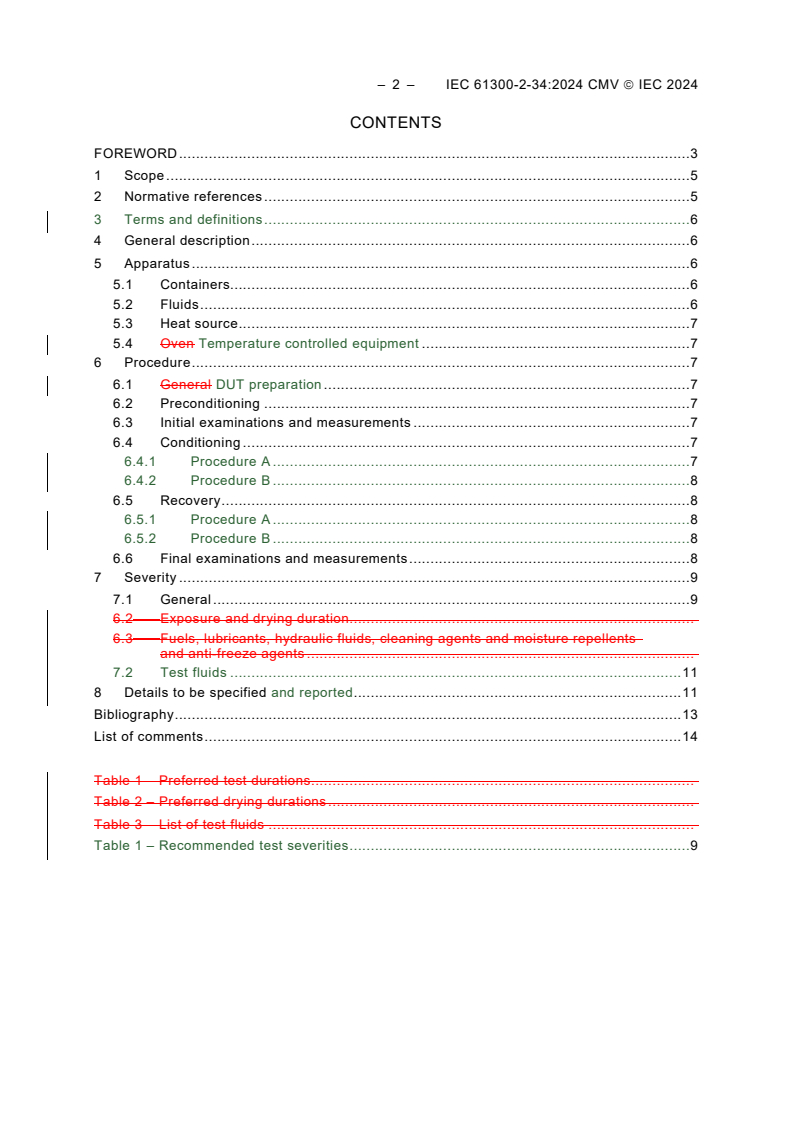
CONTENTS
FOREWORD .3
1 Scope .5
2 Normative references .5
3 Terms and definitions .6
4 General description .6
5 Apparatus .6
5.1 Containers.6
5.2 Fluids .6
5.3 Heat source .7
5.4 Oven Temperature controlled equipment .7
6 Procedure .7
6.1 General DUT preparation .7
6.2 Preconditioning .7
6.3 Initial examinations and measurements .7
6.4 Conditioning .7
6.4.1 Procedure A .7
6.4.2 Procedure B .8
6.5 Recovery .8
6.5.1 Procedure A .8
6.5.2 Procedure B .8
6.6 Final examinations and measurements .8
7 Severity .9
7.1 General .9
6.2 Exposure and drying duration .
6.3 Fuels, lubricants, hydraulic fluids, cleaning agents and moisture repellents
and anti-freeze agents .
7.2 Test fluids . 11
8 Details to be specified and reported . 11
Bibliography . 13
List of comments . 14
Table 1 – Preferred test durations .
Table 2 – Preferred drying durations .
Table 3 – List of test fluids .
Table 1 – Recommended test severities .9
INTERNATIONAL ELECTROTECHNICAL COMMISSION
____________
FIBRE OPTIC INTERCONNECTING DEVICES AND PASSIVE
COMPONENTS – BASIC TEST AND MEASUREMENT PROCEDURES –
Part 2-34: Tests – Resistance to solvents and contaminating fluids of
interconnecting components and closures
FOREWORD
1) The International Electrotechnical Commission (IEC) is a worldwide organization for standardization comprising
all national electrotechnical committees (IEC National Committees). The object of IEC is to promote international
co-operation on all questions concerning standardization in the electrical and electronic fields. To this end and
in addition to other activities, IEC publishes International Standards, Technical Specifications, Technical Reports,
Publicly Available Specifications (PAS) and Guides (hereafter referred to as “IEC Publication(s)”). Their
preparation is entrusted to technical committees; any IEC National Committee interested in the subject dealt with
may participate in this preparatory work. International, governmental and non-governmental organizations liaising
with the IEC also participate in this preparation. IEC collaborates closely with the International Organization for
Standardization (ISO) in accordance with conditions determined by agreement between the two organizations.
2) The formal decisions or agreements of IEC on technical matters express, as nearly as possible, an international
consensus of opinion on the relevant subjects since each technical committee has representation from all
interested IEC National Committees.
3) IEC Publications have the form of recommendations for international use and are accepted by IEC National
Committees in that sense. While all reasonable efforts are made to ensure that the technical content of IEC
Publications is accurate, IEC cannot be held responsible for the way in which they are used or for any
misinterpretation by any end user.
4) In order to promote international uniformity, IEC National Committees undertake to apply IEC Publications
transparently to the maximum extent possible in their national and regional publications. Any divergence between
any IEC Publication and the corresponding national or regional publication shall be clearly indicated in the latter.
5) IEC itself does not provide any attestation of conformity. Independent certification bodies provide conformity
assessment services and, in some areas, access to IEC marks of conformity. IEC is not responsible for any
services carried out by independent certification bodies.
6) All users should ensure that they have the latest edition of this publication.
7) No liability shall attach to IEC or its directors, employees, servants or agents including individual experts and
members of its technical committees and IEC National Committees for any personal injury, property damage or
other damage of any nature whatsoever, whether direct or indirect, or for costs (including legal fees) and
expenses arising out of the publication, use of, or reliance upon, this IEC Publication or any other IEC
Publications.
8) Attention is drawn to the Normative references cited in this publication. Use of the referenced publications is
indispensable for the correct application of this publication.
9) IEC draws attention to the possibility that the implementation of this document may involve the use of (a)
patent(s). IEC takes no position concerning the evidence, validity or applicability of any claimed patent rights in
respect thereof. As of the date of publication of this document, IEC had not received notice of (a) patent(s), which
may be required to implement this document. However, implementers are cautioned that this may not represent
the latest information, which may be obtained from the patent database available at https://patents.iec.ch. IEC
shall not be held responsible for identifying any or all such patent rights.
This commented version (CMV) of the official standard IEC 61300-2-34:2024 edition 3.0
allows the user to identify the changes made to the previous IEC 61300-2-34:2009 edition
2.0. Furthermore, comments from IEC TC SC 86B experts are provided to explain the
reasons of the most relevant changes, or to clarify any part of the content.
A vertical bar appears in the margin wherever a change has been made. Additions are in
green text, deletions are in strikethrough red text. Experts' comments are identified by a
blue-background number. Mouse over a number to display a pop-up note with the
comment.
This publication contains the CMV and the official standard. The full list of comments is
available at the end of the CMV.
– 4 – IEC 61300-2-34:2024 CMV IEC 2024
IEC 61300-2-34 has been prepared by subcommittee 86B: Fibre optic interconnecting devices
and passive components, of IEC technical committee 86: Fibre optics. It is an International
Standard.
This third edition cancels and replaces the second edition published in 2009. This edition
constitutes a technical revision.
This edition includes the following significant technical changes with respect to the previous
edition:
a) revision of the title;
b) classification of test procedure and applicable fluids, bringing the document in line with
IEC 61753-1;
c) severities of test.
The text of this International Standard is based on the following documents:
Draft Report on voting
86B/4879/FDIS 86B/4924/RVD
Full information on the voting for its approval can be found in the report on voting indicated in
the above table.
The language used for the development of this International Standard is English.
This document was drafted in accordance with ISO/IEC Directives, Part 2, and developed in
accordance with ISO/IEC Directives, Part 1 and ISO/IEC Directives, IEC Supplement, available
at www.iec.ch/members_experts/refdocs. The main document types developed by IEC are
described in greater detail at www.iec.ch/publications.
A list of all the parts in the IEC 61300 series, under the general title Fibre optic interconnecting
devices and passive components – Basic test and measurement procedures, can be found on
the IEC website.
The committee has decided that the contents of this document will remain unchanged until the
stability date indicated on the IEC website under webstore.iec.ch in the data related to the
specific document. At this date, the document will be
• reconfirmed,
• withdrawn, or
• revised.
IMPORTANT – The "colour inside" logo on the cover page of this document indicates
that it contains colours which are considered to be useful for the correct understanding
of its contents. Users should therefore print this document using a colour printer.
FIBRE OPTIC INTERCONNECTING DEVICES AND PASSIVE
COMPONENTS – BASIC TEST AND MEASUREMENT PROCEDURES –
Part 2-34: Tests – Resistance to solvents and contaminating fluids of
interconnecting components and closures
1 Scope
The purpose of this part of IEC 61300 is for testing the resistance to solvents and contaminating
fluids on fibre optic interconnecting devices, passive components and closures protective
housings, and their functionality. The object of this test is to define a standard test method to
assess the effects of short term exposure to fluids and lubricants on fibre optic interconnecting
components and closure. 1
2 Normative references
The following documents are referred to in the text in such a way that some or all of their content
constitutes requirements of this document. For dated references, only the edition cited applies.
For undated references, the latest edition of the referenced document (including any
amendments) applies.
IEC 61300-1, Fibre optic interconnecting devices and passive components – Basic test and
measurement procedures – Part 1: General and guidance
IEC 61300-2-38, Fibre optic interconnecting devices and passive components – Basic test and
measurement procedures – Part 2-38: Tests – Sealing for fibre optic sealed closures and
hardened connectors using air pressure
IEC 61300-3-1, Fibre optic interconnecting devices and passive components – Basic test and
measurement procedures – Part 3-1: Examinations and measurements – Visual examination
IEC 61300-3-4, Fibre optic interconnecting devices and passive components – Basic test and
measurement procedures – Part 3-4: Examinations and measurements – Attenuation
IEC 61300-3-6, Fibre optic interconnecting devices and passive components – Basic test and
measurement procedures – Part 3-6: Examinations and measurements – Return loss
IEC 61753 (all parts), Fibre optic interconnecting devices and passive components –
Performance standards
IEC 62005 (all parts), Fibre optic interconnecting devices and passive components – Reliability
ISO 1998-1:1998, Petroleum industry – Terminology – Part 1: Raw materials and products
EN 590, Automotive fuels – Diesel – Requirements and test methods
– 6 – IEC 61300-2-34:2024 CMV IEC 2024
3 Terms and definitions
No terms and definitions are listed in this document.
ISO and IEC maintain terminology databases for use in standardization at the following
addresses:
• IEC Electropedia: available at https://www.electropedia.org/
• ISO Online browsing platform: available at https://www.iso.org/obp
4 General description
WARNING − Intended users of this procedure are cautioned that tests of this nature may can
involve the use of certain hazardous material, operations and equipment. In particular, Some
of the fluids that may can be used are flammable or may can constitute health hazards, or both.
Test temperatures should shall be at least 10 °C below the flashpoint of any fluid being used.
Open flame heat sources should not be used with any organic solvents. Test personnel should
shall consult the relevant material’s safety data sheet of each used fluid and wear the
recommended personal protection clothing and equipment for handling highly toxic or
flammable products when necessary.
This test method covers the effects of contaminating fluids on the properties of fibre optic
interconnecting devices, passive components and closures protective housings when coming
in contact with fluids in an intentional or unintentional way. Testing is performed to ensure
resistance of a device under test (DUT) to liquids to which it could be exposed during storage,
installation or operation, and is carried out by immersing specimens in exposing the DUT to a
specified fluid or group of fluids for a specified period at a specified temperature. A separate
specimen DUT shall be used with each test fluid. Properties are measured prior to and after
exposure to the fluid.
This test method contains two procedures, procedure A and procedure B: 2
• Procedure A
DUT is immersed in a test fluid for 30 s, removed and then exposed to the test temperature
for the test duration specified in Table 1.
• Procedure B
DUT is immersed in a test fluid while being exposed for the test duration and to the test
temperature specified in Table 1.
The selected procedure shall be based on the relevant IEC 61753 performance standard.
5 Apparatus
5.1 Containers
A container made of a material that will not interact with the testing fluid shall be used for each
test fluid. Example materials for the test vessel are boro-silicate glass or stainless steel vessel
of suitable volume for each test fluid shall be used. Vessels shall be of sufficient size and
capacity to permit the specimen DUT to be immersed until it is fully covered in the selected fluid
without violating other physical constraints (e.g. minimum cable bend radius).
5.2 Fluids
Fluids used shall be in accordance with the relevant specification for the fluid IEC 61753
performance standard or IEC 62005 reliability document 3. Table 1 give examples of fluids
that may be used for this evaluation; other liquids can be used by specific request. 4
5.3 Heat source
A suitable heat source capable of achieving and maintaining the specified temperatures within
±2 °C of the required setting shall be used.
5.4 Oven Temperature controlled equipment
A suitable oven to dry the specimen shall be used.
If the specified period for liquid exposure is longer than 1 h, or to dry the DUT after exposure,
a temperature-controlled oven or an environmental test chamber shall be used in order to keep
the test temperature stable. See 6.4 and 6.5.
6 Procedure
6.1 General DUT preparation
The preparation of the specimen DUT shall be in accordance with the relevant specification
IEC 61753 performance standard or IEC 62005 reliability document 5. If cables are fitted, they
shall be long enough to exit the test medium. Where no cables are fitted, blanking plugs shall
be inserted.
6.2 Preconditioning
Clean the mechanical and optical alignment parts of the specimen DUT according to the
manufacturer’s instructions.
Unless otherwise stated, maintain the specimen DUT under standard atmospheric condition
according to IEC 61300-1 for a minimum of 2 h.
6.3 Initial examinations and measurements
If specified, Perform initial examinations according to IEC 61300-3-1 and measurements as
required by the relevant specification IEC 61753 performance standard or IEC 62005 reliability
document.
For optical properties measurement, the equipment and measurement methods shall be
according to IEC 61300-3-4 for attenuation and IEC 61300-3-6 for return loss measurement.
The optical performance measurement shall be performed at the wavelength(s) specified in the
relevant IEC 61753 performance standard or IEC 62005 reliability document. When sealing
performance is requested to be evaluated, for devices such as sealed closures and hardened
connectors, the equipment and measurement method shall be according to IEC 61300-2-38 6.
For free breathing protective housings (that are not able to hold a permanent overpressure or
underpressure), the test shall be carried out on material slabs.
6.4 Conditioning
For each specified fluid, prepare a vessel with sufficient fluid such that the specimen can be
adequately immersed.
Immerse the specimen for the specified period while maintaining the fluid temperature.
NOTE In the case of volatile fluids, it may be necessary to add additional amounts of fluid (heated to the test
temperature) during the test in order to keep the specimen immersed.
6.4.1 Procedure A 7
For each specified fluid, prepare a vessel with sufficient fluid such that the DUT can be fully
immersed. Immerse the DUT for 30 s in the fluid, then remove the DUT from the fluid. For large
– 8 – IEC 61300-2-34:2024 CMV IEC 2024
DUTs or high viscosity fluids such as jellies, that are not practical to be immersed, brush the
test fluid homogeneously over the DUT external area. Drain-off the excess test fluid for 2 mins
and immediately after this step, set the DUT inside the temperature-controlled equipment to be
exposed to the test temperature and the period specified in Table 1.
DUTs of the same type and material, although exposed to different test fluids, can be placed
inside the same temperature-controlled equipment.
6.4.2 Procedure B 8
For each specified fluid, prepare a vessel with sufficient fluid such that the DUT can be fully
immersed.
Immerse the DUT while maintaining the fluid temperature during the period specified in Table 1.
This may require putting the vessel with the DUT immersed in temperature-controlled equipment.
In the case of volatile fluids, it is sometimes necessary to add fluid (heated to the test
temperature) during the test in order to keep the DUT immersed.
6.5 Recovery
At the end of the immersion period, remove the specimen and wipe off surplus fluid.
Where applicable as defined in the relevant specification, dry components in an oven at an
appropriate temperature for a defined period.
6.5.1 Procedure A
After the exposure period at the designated test temperature, remove the DUT from the
temperature-controlled equipment and maintain it under standard atmospheric conditions
according to IEC 61300-1 for a minimum of 1 h.
6.5.2 Procedure B
At the end of the immersion period, remove the DUT and wipe off surplus fluid.
Dry the DUT in a temperature-controlled equipment at the temperature and period as defined
in Table 1. Remove the DUT from the temperature-controlled equipment and maintain it under
standard atmospheric conditions according to IEC 61300-1.
6.6 Final examinations and measurements
Upon completion of the test, the specimen DUT(s) shall be visually examined in accordance
with IEC 61300-3-1 and all necessary observations recorded as specified in the relevant
specification IEC 61753 performance standard or IEC 62005 reliability document. Careful
attention shall be given to Ensure no swelling and shrinkage of materials, loss of adhesive
bonding between bonded surfaces, corrosion of materials metallic parts, softening of materials,
cracks in material, degradation of optical characteristics, etc, have occurred.
The functional measurements shall should be accomplished taken at the standard test
atmospheric conditions as defined in IEC 61300-1, unless otherwise specified in the relevant
specification. When optical measurements are required, the equipment and measurement
methods shall be according to IEC 61300-3-4 for attenuation and 61300-3-6 for return loss
measurement. When sealing performance is evaluated, the equipment and measurement
method shall be according to IEC 61300-2-38.
In the case of contamination, the disposal of contaminated water can be subject to local
regulations. Follow the recommendations and warnings indicated in IEC 61300-2-38.
7 Severity
7.1 General
The severity consists of the combination a selection of the test fluid, exposure duration and the
fluid exposure temperature. The severity shall be specified in the relevant specification.
Table 1 shows the specified test severities in relation to the performance categories. It is
recommended to verify the test severities with the relevant IEC 61753 performance standards
or IEC 62005 reliability documents for the normative values. 9
Table 1 – Recommended test severities
a,b
Fluid Test duration Test Drying
Category
c d
temperature duration
HD
C, C , OP
OPHD, OP+, Not required
OP+HD, E
-6
NaCl 0,3 × 10 24 h 30 °C None
I
-6
Mineral Oil 0,5 × 10 24 h 70 °C None
HD
I
-6
Soap 50 000 × 10 24 h 30 °C None
HCl at pH 2
NaOH at pH 12
5 days
A +23 °C ± 5 °C None
petroleum jelly, ISO 1998-1:1998,
(1.60.132)
90 % Isopropyl alcohol (IPA) 24 h
HCl at pH 2
NaOH at pH 12
5 days
None
Cable compound (petroleum jelly),
ISO 1998-1:1998, 1.60.132 +23 °C ± 5 °C
G
90 % Isopropyl alcohol (IPA) 24 h
S
Automotive diesel oil ISO 1998-1:1998,
1.20.131, and EN 590 1 h 24 h
10 % Nonyl Phenol Ethoxylate solution
5 days 50 °C ± 2 °C None
e
(Igepal)
a
Categories are defined in IEC 61753-1.
b HD
When the tests are performed for category I , the product will be automatically qualified for category I.
c
For specified test temperature of 23 °C, the standard atmospheric conditions according IEC 61300-1 can be
applied
d
When drying duration is none, sample should be checked immediately at the end of the test.
e
Nonylphenol ethoxylate (Igepal®) is an example of a suitable product available commercially. This information
is given for the convenience of users of this document and does not constitute an endorsement by IEC of this
product. An alternative to this fluid is 10 % sorbitan monostearate solution.
– 10 – IEC 61300-2-34:2024 CMV IEC 2024
The following preferred severities are non-mandatory severities which may be specified for this
procedure.
6.2 Exposure and drying duration
Specimen shall be exposed to the test for the following preferred duration:
Table 1 – Preferred test durations
1 h
24 h
5 days
7 days
1 month
After exposure specimen shall be recovered by drying applied according to the temperatures
given in the relevant specification and durations mentioned below.
Table 2 – Preferred drying durations
1 h
2 h
24 h
The dry out temperature should be at maximum temperature of the service environment.
6.3 Fuels, lubricants, hydraulic fluids, cleaning agents and moisture repellents and
anti-freeze agents
Table 3 provides a non-exhaustive list of recommended fluids.
Table 3 – List of test fluids
a
Chemical description Test fluid code
Test temperature
°C
A mixture of toluene (aromatic) 30 % and iso-octane (aliphatic) 70 % (V/V) - 40 ± 2
b
Wide cut aviation turbine fuel F-34 70 ± 2
Di-octyl sebacate (aircraft turbine engine lubrication oil) - 150 ± 2
b
Mineral oil, viscosity approximately 15 cSt at 38 °C 70 ± 2
O-135
Castor oil 20 %, ethoxyethanol 80 % (V/V) (this represents a normal hydraulic fluid) 20 ± 2
-
b
Phosphate ester hydraulic fluid (synthetic hydraulic fluid) 70 ± 2
H-544
b
Dimethyl silicone fluid (high temperature hydraulic fluid) 150 ± 2
S-1720
b
Monopropylene glycol (de-icing fluid) 20 ± 2
S-745
b
Lithium soap/synthetic oil grease (low temperature grease) 20 ± 2
G-395
Acetone 15 to 35
-
White spirit, 0,79 – 0,81 g/ml 15 to 35
-
Isopropyl alcohol 15 to 35
-
Petroleum jelly, Vaseline 15 to 35
-
HCl(pH2) 15-35
-
NaOH(pH12) 15-35
-
Kerosene 15-35
-
Diesel fuel 15-35
EN 590
10 % Nonyl Phenol Ethoxylate solution 50± 2
-
a
Wherever possible the fluid given is specified in an International Standard or is described by its constituent chemicals.
In some cases a NATO identification has been used in preference to a commercial identification. Reference to relevant
commercial literature can correlate the NATO number with commercially available fluid(s).
b
NATO code.
7.2 Test fluids 10
Table 1 provides a non-exhaustive list of recommended test fluids. The fluids listed are
representative of those that can be encountered in storage, installation and specific operational
applications. It is not intended that any DUT should be exposed to all of them.
NOTE See WARNING in Clause 4 about personal safety and compliance with regional regulations.
8 Details to be specified and reported
The following details, as applicable, shall be specified in the relevant specification and reported
in the test report:
• Test fluid
• Specimen optically functioning or non-functioning
• Specimen DUT characteristics: mated or unmated (capped or uncapped), functional or non-
functional and all spare, sealed ports sealed or capped.
• Preconditioning procedure (see Clause 6.2).
• Immersion period
• Fluid temperature
– 12 – IEC 61300-2-34:2024 CMV IEC 2024
• Test conditions applied (see Clause 6.4):
– procedure A or procedure B;
– immersed or brushed.
• Severity (see Table 1):
– test fluids;
– test duration;
– test temperature;
– number of samples to be evaluated per test fluid.
• Recovery procedure (see clause 6.5):
– duration;
– temperature.
• Initial examinations, measurements and performance requirements (see Clause 6.3).
• Final examinations, measurements, calculations and performance requirements
(see Clause 6.5).
• Additional pass/fail criteria.
• Deviations from test procedure.
Bibliography
IEC 60068-2-74, Environmental testing – Part 2-74: Tests – Test Xc: Fluid contamination
ISO 1817, Rubber, vulcanized – Determination of the effect of liquids
EN 590, Automotive fuels – Diesel – Requirements and test methods
IEC 61753-1, Fibre optic interconnecting devices and passive components – Performance
standard – Part 1: General and guidance
– 14 – IEC 61300-2-34:2024 CMV IEC 2024
List of comments
1 The object of this test method is to verify the effect of contaminating fluids on the device
under test as a whole and its functionality as part of a communications network.
2 Due to diversity of DUTs, sizes, handling and test conditions during the evaluation,
IEC 61300-2-34 edition 2 defines two test procedures that can be applied, depending on
the degree of simulated contamination on the DUT.
3 Fluids to be used have been reviewed and aligned with the general guidance for
performance of fibre optic interconnecting devices and passive components.
4 The fluids list includes those considered reflect actual risk of contamination during storage,
handling, installation or operation of interconnecting devices. Fluids that correspond to
other applications, e.g. avionics, have been removed from this document.
5 The IEC 62005 reference is an adequate guidance when extended period evaluation is
requested because of special applications or for new materials or products reliability
studies.
6 References to allow for quantitative base measurements and criteria for effects during and
after the evaluations are included.
7 Procedure A is convenient to evaluate interconnecting devices with permanent or long-term
exposure to contaminating fluid(s).
8 Procedure B is suitable to evaluate the effect of short-term exposure of interconnecting
devices to contaminating fluids.
9 In this new edition the severity for the evaluations are concentrated in a general table and
evaluation severities aligned to the operation category of the interconnecting device to be
evaluated. This minimizes the risk of applying a severity that does not correspond to a
specific element application.
10 Although the list of fluids covers the most used fluids in field and in the different stages of
handling and operation optical interconnecting devices may go through, there is the
possibility that a specific fluid or operation category can be requested for special
applications.
___________
IEC 61300-2-34 ®
Edition 3.0 2024-05
INTERNATIONAL
STANDARD
NORME
INTERNATIONALE
Fibre optic interconnecting devices and passive components – Basic test and
measurement procedures –
Part 2-34: Tests – Resistance to solvents and contaminating fluids
Dispositifs d'interconnexion et composants passifs fibroniques – Procédures
fondamentales d'essais et de mesures –
Partie 2-34 : Essais – Résistance aux solvants et aux fluides contaminants
– 2 – IEC 61300-2-34:2024 IEC 2024
CONTENTS
FOREWORD . 3
1 Scope . 5
2 Normative references . 5
3 Terms and definitions . 6
4 General description . 6
5 Apparatus . 6
5.1 Containers . 6
5.2 Fluids . 6
5.3 Heat source . 7
5.4 Temperature controlled equipment . 7
6 Procedure . 7
6.1 DUT preparation . 7
6.2 Preconditioning . 7
6.3 Initial examinations and measurements . 7
6.4 Conditioning . 7
6.4.1 Procedure A . 7
6.4.2 Procedure B . 8
6.5 Recovery . 8
6.5.1 Procedure A . 8
6.5.2 Procedure B . 8
6.6 Final examinations and measurements . 8
7 Severity . 8
7.1 General . 8
7.2 Test fluids . 9
8 Details to be specified and reported. 10
Bibliography . 11
Table 1 – Recommended test severities . 9
INTERNATIONAL ELECTROTECHNICAL COMMISSION
____________
FIBRE OPTIC INTERCONNECTING DEVICES AND PASSIVE
COMPONENTS – BASIC TEST AND MEASUREMENT PROCEDURES –
Part 2-34: Tests – Resistance to solvents and contaminating fluids
FOREWORD
1) The International Electrotechnical Commission (IEC) is a worldwide organization for standardization comprising
all national electrotechnical committees (IEC National Committees). The object of IEC is to promote international
co-operation on all questions concerning standardization in the electrical and electronic fields. To this end and
in addition to other activities, IEC publishes International Standards, Technical Specifications, Technical Reports,
Publicly Available Specifications (PAS) and Guides (hereafter referred to as “IEC Publication(s)”). Their
preparation is entrusted to technical committees; any IEC National Committee interested in the subject dealt with
may participate in this preparatory work. International, governmental and non-governmental organizations liaising
with the IEC also participate in this preparation. IEC collaborates closely with the International Organization for
Standardization (ISO) in accordance with conditions determined by agreement between the two organizations.
2) The formal decisions or agreements of IEC on technical matters express, as nearly as possible, an international
consensus of opinion on the relevant subjects since each technical committee has representation from all
interested IEC National Committees.
3) IEC Publications have the form of recommendations for international use and are accepted by IEC National
Committees in that sense. While all reasonable efforts are made to ensure that the technical content of IEC
Publications is accurate, IEC cannot be held responsible for the way in which they are used or for any
misinterpretation by any end user.
4) In order to promote international uniformity, IEC National Committees undertake to apply IEC Publications
transparently to the maximum extent possible in their national and regional publications. Any divergence between
any IEC Publication and the corresponding national or regional publication shall be clearly indicated in the latter.
5) IEC itself does not provide any attestation of conformity. Independent certification bodies provide conformity
assessment services and, in some areas, access to IEC marks of conformity. IEC is not responsible for any
services carried out by independent certification bodies.
6) All users should ensure that they have the latest edition of this publication.
7) No liability shall attach to IEC or its directors, employees, servants or agents including individual experts and
members of its technical committees and IEC National Committees for any personal injury, property damage or
other damage of any nature whatsoever, whether direct or indirect, or for costs (including legal fees) and
expenses arising out of the publication, use of, or reliance upon, this IEC Publication or any other IEC
Publications.
8) Attention is drawn to the Normative references cited in this publication. Use of the referenced publications is
indispensable for the correct application of this publication.
9) IEC draws attention to the possibility that the implementation of this document may involve the use of (a)
patent(s). IEC takes no position concerning the evidence, validity or applicability of any claimed patent rights in
respect thereof. As of the date of publication of this document, IEC had not received notice of (a) patent(s), which
may be required to implement this document. However, implementers are cautioned that this may not represent
the latest information, which may be obtained from the patent database available at https://patents.iec.ch. IEC
shall not be held responsible for identifying any or all such patent rights.
IEC 61300-2-34 has been prepared by subcommittee 86B: Fibre optic interconnecting devices
and passive components, of IEC technical committee 86: Fibre optics. It is an International
Standard.
This third edition cancels and replaces the second edition published in 2009. This edition
constitutes a technical revision.
– 4 – IEC 61300-2-34:2024 IEC 2024
This edition includes the following significant technical changes with respect to the previous
edition:
a) revision of the title;
b) classification of test procedure and applicable fluids, bringing the document in line with
IEC 61753-1;
c) severities of test.
The text of this International Standard is based on the following documents:
Draft Report on voting
86B/4879/FDIS 86B/4924/RVD
Full information on the voting for its approval can be found in the report on voting indicated in
the above table.
The language used for the development of this International Standard is English.
This document was drafted in accordance with ISO/IEC Directives, Part 2, and developed in
accordance with ISO/IEC Directives, Part 1 and ISO/IEC Directives, IEC Supplement, available
at www.iec.ch/members_experts/refdocs. The main document types developed by IEC are
described in greater detail at www.iec.ch/publications.
A list of all the parts in the IEC 61300 series, under the general title Fibre optic interconnecting
devices and passive components – Basic test and measurement procedures, can be found on
the IEC website.
The committee has decided that the contents of this document will remain unchanged until the
stability date indicated on the IEC website under webstore.iec.ch in the data related to the
specific document. At this date, the document will be
• reconfirmed,
• withdrawn, or
• revised.
FIBRE OPTIC INTERCONNECTING DEVICES AND PASSIVE
COMPONENTS – BASIC TEST AND MEASUREMENT PROCEDURES –
Part 2-34: Tests – Resistance to solvents and contaminating fluids
1 Scope
The purpose of this part of IEC 61300 is for testing the resistance to solvents and contaminating
fluids on fibre optic interconnecting devices, passive components and protective housings, and
their functionality.
2 Normative references
The following documents are referred to in the text in such a way that some or all of their content
constitutes requirements of this document. For dated references, only the edition cited applies.
For undated references, the latest edition of the referenced document (including an
...
IEC 61300-2-34 ®
Edition 3.0 2024-05
INTERNATIONAL
STANDARD
NORME
INTERNATIONALE
Fibre optic interconnecting devices and passive components – Basic test and
measurement procedures –
Part 2-34: Tests – Resistance to solvents and contaminating fluids
Dispositifs d'interconnexion et composants passifs fibroniques – Procédures
fondamentales d'essais et de mesures –
Partie 2-34 : Essais – Résistance aux solvants et aux fluides contaminants
All rights reserved. Unless otherwise specified, no part of this publication may be reproduced or utilized in any form
or by any means, electronic or mechanical, including photocopying and microfilm, without permission in writing from
either IEC or IEC's member National Committee in the country of the requester. If you have any questions about IEC
copyright or have an enquiry about obtaining additional rights to this publication, please contact the address below or
your local IEC member National Committee for further information.
Droits de reproduction réservés. Sauf indication contraire, aucune partie de cette publication ne peut être reproduite ni
utilisée sous quelque forme que ce soit et par aucun procédé, électronique ou mécanique, y compris la photocopie et
les microfilms, sans l'accord écrit de l'IEC ou du Comité national de l'IEC du pays du demandeur. Si vous avez des
questions sur le copyright de l'IEC ou si vous désirez obtenir des droits supplémentaires sur cette publication, utilisez
les coordonnées ci-après ou contactez le Comité national de l'IEC de votre pays de résidence.
IEC Secretariat Tel.: +41 22 919 02 11
3, rue de Varembé info@iec.ch
CH-1211 Geneva 20 www.iec.ch
Switzerland
About the IEC
The International Electrotechnical Commission (IEC) is the leading global organization that prepares and publishes
International Standards for all electrical, electronic and related technologies.
About IEC publications
The technical content of IEC publications is kept under constant review by the IEC. Please make sure that you have the
latest edition, a corrigendum or an amendment might have been published.
IEC publications search - webstore.iec.ch/advsearchform IEC Products & Services Portal - products.iec.ch
The advanced search enables to find IEC publications by a Discover our powerful search engine and read freely all the
variety of criteria (reference number, text, technical publications previews, graphical symbols and the glossary.
committee, …). It also gives information on projects, replaced With a subscription you will always have access to up to date
and withdrawn publications. content tailored to your needs.
IEC Just Published - webstore.iec.ch/justpublished
Electropedia - www.electropedia.org
Stay up to date on all new IEC publications. Just Published
The world's leading online dictionary on electrotechnology,
details all new publications released. Available online and once
containing more than 22 500 terminological entries in English
a month by email.
and French, with equivalent terms in 25 additional languages.
Also known as the International Electrotechnical Vocabulary
IEC Customer Service Centre - webstore.iec.ch/csc
(IEV) online.
If you wish to give us your feedback on this publication or need
further assistance, please contact the Customer Service
Centre: sales@iec.ch.
A propos de l'IEC
La Commission Electrotechnique Internationale (IEC) est la première organisation mondiale qui élabore et publie des
Normes internationales pour tout ce qui a trait à l'électricité, à l'électronique et aux technologies apparentées.
A propos des publications IEC
Le contenu technique des publications IEC est constamment revu. Veuillez vous assurer que vous possédez l’édition la
plus récente, un corrigendum ou amendement peut avoir été publié.
Recherche de publications IEC - IEC Products & Services Portal - products.iec.ch
webstore.iec.ch/advsearchform Découvrez notre puissant moteur de recherche et consultez
La recherche avancée permet de trouver des publications IEC gratuitement tous les aperçus des publications, symboles
en utilisant différents critères (numéro de référence, texte, graphiques et le glossaire. Avec un abonnement, vous aurez
comité d’études, …). Elle donne aussi des informations sur les toujours accès à un contenu à jour adapté à vos besoins.
projets et les publications remplacées ou retirées.
Electropedia - www.electropedia.org
IEC Just Published - webstore.iec.ch/justpublished
Le premier dictionnaire d'électrotechnologie en ligne au monde,
Restez informé sur les nouvelles publications IEC. Just
avec plus de 22 500 articles terminologiques en anglais et en
Published détaille les nouvelles publications parues.
français, ainsi que les termes équivalents dans 25 langues
Disponible en ligne et une fois par mois par email.
additionnelles. Egalement appelé Vocabulaire
Electrotechnique International (IEV) en ligne.
Service Clients - webstore.iec.ch/csc
Si vous désirez nous donner des commentaires sur cette
publication ou si vous avez des questions contactez-nous:
sales@iec.ch.
IEC 61300-2-34 ®
Edition 3.0 2024-05
INTERNATIONAL
STANDARD
NORME
INTERNATIONALE
Fibre optic interconnecting devices and passive components – Basic test and
measurement procedures –
Part 2-34: Tests – Resistance to solvents and contaminating fluids
Dispositifs d'interconnexion et composants passifs fibroniques – Procédures
fondamentales d'essais et de mesures –
Partie 2-34 : Essais – Résistance aux solvants et aux fluides contaminants
INTERNATIONAL
ELECTROTECHNICAL
COMMISSION
COMMISSION
ELECTROTECHNIQUE
INTERNATIONALE
ICS 33.180.20 ISBN 978-2-8322-8977-8
– 2 – IEC 61300-2-34:2024 IEC 2024
CONTENTS
FOREWORD . 3
1 Scope . 5
2 Normative references . 5
3 Terms and definitions . 6
4 General description . 6
5 Apparatus . 6
5.1 Containers . 6
5.2 Fluids . 6
5.3 Heat source . 7
5.4 Temperature controlled equipment . 7
6 Procedure . 7
6.1 DUT preparation . 7
6.2 Preconditioning . 7
6.3 Initial examinations and measurements . 7
6.4 Conditioning . 7
6.4.1 Procedure A . 7
6.4.2 Procedure B . 8
6.5 Recovery . 8
6.5.1 Procedure A . 8
6.5.2 Procedure B . 8
6.6 Final examinations and measurements . 8
7 Severity . 8
7.1 General . 8
7.2 Test fluids . 9
8 Details to be specified and reported. 10
Bibliography . 11
Table 1 – Recommended test severities . 9
INTERNATIONAL ELECTROTECHNICAL COMMISSION
____________
FIBRE OPTIC INTERCONNECTING DEVICES AND PASSIVE
COMPONENTS – BASIC TEST AND MEASUREMENT PROCEDURES –
Part 2-34: Tests – Resistance to solvents and contaminating fluids
FOREWORD
1) The International Electrotechnical Commission (IEC) is a worldwide organization for standardization comprising
all national electrotechnical committees (IEC National Committees). The object of IEC is to promote international
co-operation on all questions concerning standardization in the electrical and electronic fields. To this end and
in addition to other activities, IEC publishes International Standards, Technical Specifications, Technical Reports,
Publicly Available Specifications (PAS) and Guides (hereafter referred to as “IEC Publication(s)”). Their
preparation is entrusted to technical committees; any IEC National Committee interested in the subject dealt with
may participate in this preparatory work. International, governmental and non-governmental organizations liaising
with the IEC also participate in this preparation. IEC collaborates closely with the International Organization for
Standardization (ISO) in accordance with conditions determined by agreement between the two organizations.
2) The formal decisions or agreements of IEC on technical matters express, as nearly as possible, an international
consensus of opinion on the relevant subjects since each technical committee has representation from all
interested IEC National Committees.
3) IEC Publications have the form of recommendations for international use and are accepted by IEC National
Committees in that sense. While all reasonable efforts are made to ensure that the technical content of IEC
Publications is accurate, IEC cannot be held responsible for the way in which they are used or for any
misinterpretation by any end user.
4) In order to promote international uniformity, IEC National Committees undertake to apply IEC Publications
transparently to the maximum extent possible in their national and regional publications. Any divergence between
any IEC Publication and the corresponding national or regional publication shall be clearly indicated in the latter.
5) IEC itself does not provide any attestation of conformity. Independent certification bodies provide conformity
assessment services and, in some areas, access to IEC marks of conformity. IEC is not responsible for any
services carried out by independent certification bodies.
6) All users should ensure that they have the latest edition of this publication.
7) No liability shall attach to IEC or its directors, employees, servants or agents including individual experts and
members of its technical committees and IEC National Committees for any personal injury, property damage or
other damage of any nature whatsoever, whether direct or indirect, or for costs (including legal fees) and
expenses arising out of the publication, use of, or reliance upon, this IEC Publication or any other IEC
Publications.
8) Attention is drawn to the Normative references cited in this publication. Use of the referenced publications is
indispensable for the correct application of this publication.
9) IEC draws attention to the possibility that the implementation of this document may involve the use of (a)
patent(s). IEC takes no position concerning the evidence, validity or applicability of any claimed patent rights in
respect thereof. As of the date of publication of this document, IEC had not received notice of (a) patent(s), which
may be required to implement this document. However, implementers are cautioned that this may not represent
the latest information, which may be obtained from the patent database available at https://patents.iec.ch. IEC
shall not be held responsible for identifying any or all such patent rights.
IEC 61300-2-34 has been prepared by subcommittee 86B: Fibre optic interconnecting devices
and passive components, of IEC technical committee 86: Fibre optics. It is an International
Standard.
This third edition cancels and replaces the second edition published in 2009. This edition
constitutes a technical revision.
– 4 – IEC 61300-2-34:2024 IEC 2024
This edition includes the following significant technical changes with respect to the previous
edition:
a) revision of the title;
b) classification of test procedure and applicable fluids, bringing the document in line with
IEC 61753-1;
c) severities of test.
The text of this International Standard is based on the following documents:
Draft Report on voting
86B/4879/FDIS 86B/4924/RVD
Full information on the voting for its approval can be found in the report on voting indicated in
the above table.
The language used for the development of this International Standard is English.
This document was drafted in accordance with ISO/IEC Directives, Part 2, and developed in
accordance with ISO/IEC Directives, Part 1 and ISO/IEC Directives, IEC Supplement, available
at www.iec.ch/members_experts/refdocs. The main document types developed by IEC are
described in greater detail at www.iec.ch/publications.
A list of all the parts in the IEC 61300 series, under the general title Fibre optic interconnecting
devices and passive components – Basic test and measurement procedures, can be found on
the IEC website.
The committee has decided that the contents of this document will remain unchanged until the
stability date indicated on the IEC website under webstore.iec.ch in the data related to the
specific document. At this date, the document will be
• reconfirmed,
• withdrawn, or
• revised.
FIBRE OPTIC INTERCONNECTING DEVICES AND PASSIVE
COMPONENTS – BASIC TEST AND MEASUREMENT PROCEDURES –
Part 2-34: Tests – Resistance to solvents and contaminating fluids
1 Scope
The purpose of this part of IEC 61300 is for testing the resistance to solvents and contaminating
fluids on fibre optic interconnecting devices, passive components and protective housings, and
their functionality.
2 Normative references
The following documents are referred to in the text in such a way that some or all of their content
constitutes requirements of this document. For dated references, only the edition cited applies.
For undated references, the latest edition of the referenced document (including any
amendments) applies.
IEC 61300-1, Fibre optic interconnecting devices and passive components – Basic test and
measurement procedures – Part 1: General and guidance
IEC 61300-2-38, Fibre optic interconnecting devices and passive components – Basic test and
measurement procedures – Part 2-38: Tests – Sealing for fibre optic sealed closures and
hardened connectors using air pressure
IEC 61300-3-1, Fibre optic interconnecting devices and passive components – Basic test and
measurement procedures – Part 3-1: Examinations and measurements – Visual examination
IEC 61300-3-4, Fibre optic interconnecting devices and passive components – Basic test and
measurement procedures – Part 3-4: Examinations and measurements – Attenuation
IEC 61300-3-6, Fibre optic interconnecting devices and passive components – Basic test and
measurement procedures – Part 3-6: Examinations and measurements – Return loss
IEC 61753 (all parts), Fibre optic interconnecting devices and passive components –
Performance standards
IEC 62005 (all parts), Fibre optic interconnecting devices and passive components – Reliability
ISO 1998-1:1998, Petroleum industry – Terminology – Part 1: Raw materials and products
EN 590, Automotive fuels – Diesel – Requirements and test methods
– 6 – IEC 61300-2-34:2024 IEC 2024
3 Terms and definitions
No terms and definitions are listed in this document.
ISO and IEC maintain terminology databases for use in standardization at the following
addresses:
• IEC Electropedia: available at https://www.electropedia.org/
• ISO Online browsing platform: available at https://www.iso.org/obp
4 General description
WARNING − Intended users of this procedure are cautioned that tests of this nature can involve
the use of certain hazardous material, operations and equipment. Some of the fluids that can
be used are flammable or can constitute health hazards, or both. Test temperatures shall be at
least 10 °C below the flashpoint of any fluid being used. Open flame heat sources should not
be used with any organic solvents. Test personnel shall consult the relevant material’s safety
data sheet of each used fluid and wear the recommended personal protection clothing and
equipment for handling highly toxic or flammable products when necessary.
This test method covers the effects on the properties of fibre optic interconnecting devices,
passive components and protective housings when coming in contact with fluids in an
intentional or unintentional way. Testing is performed to ensure resistance of a device under
test (DUT) to liquids to which it could be exposed during storage, installation or operation, and
is carried out by exposing the DUT to a specified fluid or group of fluids for a specified period
at a specified temperature. A separate DUT shall be used with each test fluid. Properties are
measured prior to and after exposure to the fluid.
This test method contains two procedures, procedure A and procedure B:
• Procedure A
DUT is immersed in a test fluid for 30 s, removed and then exposed to the test temperature
for the test duration specified in Table 1.
• Procedure B
DUT is immersed in a test fluid while being exposed for the test duration and to the test
temperature specified in Table 1.
The selected procedure shall be based on the relevant IEC 61753 performance standard.
5 Apparatus
5.1 Containers
A container made of a material that will not interact with the testing fluid shall be used for each
test fluid. Example materials for the test vessel are boro-silicate glass or stainless steel. Vessels
shall be of sufficient size and capacity to permit the DUT to be immersed until it is fully covered
in the selected fluid without violating other physical constraints (e.g. minimum cable bend
radius).
5.2 Fluids
Fluids used shall be in accordance with the relevant IEC 61753 performance standard or
IEC 62005 reliability document. Table 1 give examples of fluids that may be used for this
evaluation; other liquids can be used by specific request.
5.3 Heat source
A suitable heat source capable of achieving and maintaining the specified temperatures within
±2 °C of the required setting shall be used.
5.4 Temperature controlled equipment
If the specified period for liquid exposure is longer than 1 h, or to dry the DUT after exposure,
a temperature-controlled oven or an environmental test chamber shall be used in order to keep
the test temperature stable. See 6.4 and 6.5.
6 Procedure
6.1 DUT preparation
The preparation of the DUT shall be in accordance with the relevant IEC 61753 performance
standard or IEC 62005 reliability document. If cables are fitted, they shall be long enough to
exit the test medium. Where no cables are fitted, blanking plugs shall be inserted.
6.2 Preconditioning
Clean the mechanical and optical alignment parts of the DUT according to the manufacturer’s
instructions.
Unless otherwise stated, maintain the DUT under standard atmospheric condition according to
IEC 61300-1 for a minimum of 2 h.
6.3 Initial examinations and measurements
Perform initial examinations according to IEC 61300-3-1 and measurements as required by the
relevant IEC 61753 performance standard or IEC 62005 reliability document.
For optical properties measurement, the equipment and measurement methods shall be
according to IEC 61300-3-4 for attenuation and IEC 61300-3-6 for return loss measurement.
The optical performance measurement shall be performed at the wavelength(s) specified in the
relevant IEC 61753 performance standard or IEC 62005 reliability document. When sealing
performance is requested to be evaluated, for devices such as sealed closures and hardened
connectors, the equipment and measurement method shall be according to IEC 61300-2-38.
For free breathing protective housings (that are not able to hold a permanent overpressure or
underpressure), the test shall be carried out on material slabs.
6.4 Conditioning
6.4.1 Procedure A
For each specified fluid, prepare a vessel with sufficient fluid such that the DUT can be fully
immersed. Immerse the DUT for 30 s in the fluid, then remove the DUT from the fluid. For large
DUTs or high viscosity fluids such as jellies, that are not practical to be immersed, brush the
test fluid homogeneously over the DUT external area. Drain-off the excess test fluid for 2 mins
and immediately after this step, set the DUT inside the temperature-controlled equipment to be
exposed to the test temperature and the period specified in Table 1.
DUTs of the same type and material, although exposed to different test fluids, can be placed
inside the same temperature-controlled equipment.
– 8 – IEC 61300-2-34:2024 IEC 2024
6.4.2 Procedure B
For each specified fluid, prepare a vessel with sufficient fluid such that the DUT can be fully
immersed.
Immerse the DUT while maintaining the fluid temperature during the period specified in Table 1.
This may require putting the vessel with the DUT immersed in temperature-controlled equipment.
In the case of volatile fluids, it is sometimes necessary to add fluid (heated to the test
temperature) during the test in order to keep the DUT immersed.
6.5 Recovery
6.5.1 Procedure A
After the exposure period at the designated test temperature, remove the DUT from the
temperature-controlled equipment and maintain it under standard atmospheric conditions
according to IEC 61300-1 for a minimum of 1 h.
6.5.2 Procedure B
At the end of the immersion period, remove the DUT and wipe off surplus fluid.
Dry the DUT in a temperature-controlled equipment at the temperature and period as defined
in Table 1. Remove the DUT from the temperature-controlled equipment and maintain it under
standard atmospheric conditions according to IEC 61300-1.
6.6 Final examinations and measurements
Upon completion of the test, the DUT(s) shall be visually examined in accordance with
IEC 61300-3-1 and all necessary observations recorded as specified in the relevant IEC 61753
performance standard or IEC 62005 reliability document. Ensure no swelling and shrinkage of
materials, loss of adhesive bonding between bonded surfaces, corrosion of metallic parts,
softening of materials, cracks in material, degradation of optical characteristics, etc, have
occurred.
The functional measurements should be taken at the standard atmospheric conditions as
defined in IEC 61300-1. When optical measurements are required, the equipment and
measurement methods shall be according to IEC 61300-3-4 for attenuation and 61300-3-6 for
return loss measurement. When sealing performance is evaluated, the equipment and
measurement method shall be according to IEC 61300-2-38.
In the case of contamination, the disposal of contaminated water can be subject to local
regulations. Follow the recommendations and warnings indicated in IEC 61300-2-38.
7 Severity
7.1 General
The severity consists of a selection of the test fluid, exposure duration and the fluid exposure
temperature.
Table 1 shows the specified test severities in relation to the performance categories. It is
recommended to verify the test severities with the relevant IEC 61753 performance standards
or IEC 62005 reliability documents for the normative values.
Table 1 – Recommended test severities
a,b
Fluid Test duration Test Drying
Category
c d
temperature duration
HD
C, C , OP
OPHD, OP+, Not required
OP+HD, E
-6
NaCl 0,3 × 10 24 h 30 °C None
I
-6
Mineral Oil 0,5 × 10 24 h 70 °C None
HD
I
-6
Soap 50 000 × 10 24 h 30 °C None
HCl at pH 2
NaOH at pH 12
5 days
A +23 °C ± 5 °C None
petroleum jelly, ISO 1998-1:1998,
(1.60.132)
90 % Isopropyl alcohol (IPA) 24 h
HCl at pH 2
NaOH at pH 12
5 days
None
Cable compound (petroleum jelly),
ISO 1998-1:1998, 1.60.132 +23 °C ± 5 °C
G
90 % Isopropyl alcohol (IPA) 24 h
S
Automotive diesel oil ISO 1998-1:1998,
1.20.131, and EN 590 1 h 24 h
10 % Nonyl Phenol Ethoxylate solution
5 days 50 °C ± 2 °C None
e
(Igepal)
a
Categories are defined in IEC 61753-1.
b HD
When the tests are performed for category I , the product will be automatically qualified for category I.
c
For specified test temperature of 23 °C, the standard atmospheric conditions according IEC 61300-1 can be
applied
d
When drying duration is none, sample should be checked immediately at the end of the test.
e
Nonylphenol ethoxylate (Igepal®) is an example of a suitable product available commercially. This information
is given for the convenience of users of this document and does not constitute an endorsement by IEC of this
product. An alternative to this fluid is 10 % sorbitan monostearate solution.
...