

IEC 62963:2020
(Main)Radiation protection instrumentation - X-ray computed tomography (CT) inspection systems of bottled/canned liquids
General Information
- Abstract
IEC 62963:2020 describes the technical requirements, test methods, inspection requirements, markings and labelling, and requirements on the accompanying documents, packaging, shipping and storage for X-ray security inspection systems that inspect bottled or canned liquids (hereinafter referred to as "the system") based on X-ray computed tomography (CT). Here, the system is limited to those that feature tomographic scanning, not standard X-ray projection. This document is applicable to liquids, aerosols and gelatinous objects in transparent or visually opaque containers.
This technical performance document includes minimum or baseline performance requirements; regulators may require additional performance testing.
- Status
- Published
- Publication Date
- 10-Jun-2020
- Technical Committee
- SC 45B - Radiation protection instrumentation
- Drafting Committee
- WG 17 - TC 45/SC 45B/WG 17
- Current Stage
- PPUB - Publication issued
- Start Date
- 11-Jun-2020
- Completion Date
- 29-May-2020
Overview
IEC 62963:2020 is an international standard published by the International Electrotechnical Commission (IEC) that specifies the technical requirements and performance criteria for X-ray computed tomography (CT) inspection systems used in the security inspection of bottled or canned liquids. This standard is specifically tailored to systems employing tomographic scanning techniques rather than conventional X-ray projection methods. The scope of IEC 62963:2020 encompasses the inspection of liquids, aerosols, and gelatinous substances contained within transparent or visually opaque bottles and cans.
This standard addresses multiple facets of these CT inspection systems, including their structure, functionality, radiation safety, electrical and mechanical safety, environmental resilience, electromagnetic compatibility, and documentation requirements. Additionally, IEC 62963:2020 provides guidance on testing methods, inspection criteria, labelling, packaging, shipping, and storage of such systems. It establishes baseline technical and performance benchmarks essential for manufacturers and regulators involved in radiation protection instrumentation for bottled/canned liquids inspection.
Key Topics
Technical and Performance Requirements
Defining minimum standards for CT inspection systems to ensure reliable detection and image quality, including contrast sensitivity and spatial resolution tests.Radiation Protection and Safety
Specifications to safeguard operators and the environment from harmful radiation exposure, with compliance to ambient dose equivalent limits.Electrical and Mechanical Safety
Guidelines on electrical safety compatible with measurement and control equipment standards, plus mechanical robustness to withstand operational stresses.Environmental and Electromagnetic Compatibility
Requirements for systems to function correctly under various environmental conditions (temperature, humidity, vibration) and to maintain immunity against electromagnetic interference.Markings, Labelling, and Documentation
Standardized labeling and comprehensive documentation obligations covering user manuals, safety warnings, and calibration certificates.Packaging, Shipping, and Storage
Instructions for secure packaging and handling to prevent damage during transportation and storage.Test Methods and Inspection
Detailed reference procedures for conducting technical performance tests such as contrast-sensitivity evaluations and spatial resolution assessments using standardized test articles.
Applications
IEC 62963:2020 is primarily applicable to the design, manufacture, installation, and regulatory approval of X-ray CT inspection systems at security checkpoints, manufacturing quality controls, and inspection facilities focusing on bottled and canned liquids. Practical applications include:
Airport and Border Security
Inspecting liquids for hidden threats or contraband using advanced CT scanning for higher resolution imaging beyond conventional X-ray projections.Food and Beverage Industry Quality Control
Non-destructive testing of beverages and liquid products in opaque or transparent containers to detect foreign objects, contamination, or packaging defects.Hazardous Materials Screening
Checking aerosols and gelatinous substances in sealed containers for security threats in public transportation and sensitive environments.
Compliance with IEC 62963:2020 facilitates uniform assessment criteria for these CT systems, ensuring safety, reliability, accuracy, and interoperability across international borders.
Related Standards
IEC 62963:2020 references and complements several international standards that govern environmental testing, electrical and machinery safety, and electromagnetic compatibility, including:
- IEC 60068 Series – Environmental Testing (Cold, Dry Heat, Vibration, Damp Heat)
- IEC 60529 – Degrees of Protection Provided by Enclosures (IP Code)
- IEC 61010-1 – Safety Requirements for Electrical Equipment for Measurement and Control
- IEC 61000-6-1 and IEC 61000-6-3 – Electromagnetic Compatibility Standards
- ISO 780:2015 – Packaging – Graphical Symbols for Handling and Storage
- ISO 13849 – Safety of Machinery – Safety-Related Control Systems
These standards provide essential foundations and complementary requirements that ensure the CT inspection systems are tested for environmental resilience, operational safety, and electromagnetic compatibility according to global best practices.
Enhancing radiation protection instrumentation, IEC 62963:2020 empowers manufacturers and regulatory bodies to deploy advanced X-ray CT inspection systems that are safe, effective, and consistent worldwide for the critical task of bottled and canned liquid security inspection.
Get Certified
Connect with accredited certification bodies for this standard

CIS Institut d.o.o.
Personal Protective Equipment (PPE) certification body. Notified Body NB-2890 for EU Regulation 2016/425 PPE.

Kiwa BDA Testing
Building and construction product certification.
Kmetijski inštitut Slovenije
Agricultural Institute of Slovenia. Soil testing, plant health, agricultural product analysis.
Sponsored listings
Frequently Asked Questions
IEC 62963:2020 is a standard published by the International Electrotechnical Commission (IEC). Its full title is "Radiation protection instrumentation - X-ray computed tomography (CT) inspection systems of bottled/canned liquids". This standard covers: IEC 62963:2020 describes the technical requirements, test methods, inspection requirements, markings and labelling, and requirements on the accompanying documents, packaging, shipping and storage for X-ray security inspection systems that inspect bottled or canned liquids (hereinafter referred to as "the system") based on X-ray computed tomography (CT). Here, the system is limited to those that feature tomographic scanning, not standard X-ray projection. This document is applicable to liquids, aerosols and gelatinous objects in transparent or visually opaque containers. This technical performance document includes minimum or baseline performance requirements; regulators may require additional performance testing.
IEC 62963:2020 describes the technical requirements, test methods, inspection requirements, markings and labelling, and requirements on the accompanying documents, packaging, shipping and storage for X-ray security inspection systems that inspect bottled or canned liquids (hereinafter referred to as "the system") based on X-ray computed tomography (CT). Here, the system is limited to those that feature tomographic scanning, not standard X-ray projection. This document is applicable to liquids, aerosols and gelatinous objects in transparent or visually opaque containers. This technical performance document includes minimum or baseline performance requirements; regulators may require additional performance testing.
IEC 62963:2020 is classified under the following ICS (International Classification for Standards) categories: 13.280 - Radiation protection. The ICS classification helps identify the subject area and facilitates finding related standards.
IEC 62963:2020 is available in PDF format for immediate download after purchase. The document can be added to your cart and obtained through the secure checkout process. Digital delivery ensures instant access to the complete standard document.
Standards Content (Sample)
IEC 62963 ®
Edition 1.0 2020-06
INTERNATIONAL
STANDARD
NORME
INTERNATIONALE
Radiation protection instrumentation – X-ray computed tomography (CT)
inspection systems of bottled/canned liquids
Instrumentation pour la radioprotection – Systèmes d'inspection par
tomographie aux rayons x par ordinateur (CT) des liquides en bouteille ou en
canette
All rights reserved. Unless otherwise specified, no part of this publication may be reproduced or utilized in any form
or by any means, electronic or mechanical, including photocopying and microfilm, without permission in writing from
either IEC or IEC's member National Committee in the country of the requester. If you have any questions about IEC
copyright or have an enquiry about obtaining additional rights to this publication, please contact the address below or
your local IEC member National Committee for further information.
Droits de reproduction réservés. Sauf indication contraire, aucune partie de cette publication ne peut être reproduite
ni utilisée sous quelque forme que ce soit et par aucun procédé, électronique ou mécanique, y compris la photocopie
et les microfilms, sans l'accord écrit de l'IEC ou du Comité national de l'IEC du pays du demandeur. Si vous avez des
questions sur le copyright de l'IEC ou si vous désirez obtenir des droits supplémentaires sur cette publication, utilisez
les coordonnées ci-après ou contactez le Comité national de l'IEC de votre pays de résidence.
IEC Central Office Tel.: +41 22 919 02 11
3, rue de Varembé info@iec.ch
CH-1211 Geneva 20 www.iec.ch
Switzerland
About the IEC
The International Electrotechnical Commission (IEC) is the leading global organization that prepares and publishes
International Standards for all electrical, electronic and related technologies.
About IEC publications
The technical content of IEC publications is kept under constant review by the IEC. Please make sure that you have the
latest edition, a corrigendum or an amendment might have been published.
IEC publications search - webstore.iec.ch/advsearchform Electropedia - www.electropedia.org
The advanced search enables to find IEC publications by a The world's leading online dictionary on electrotechnology,
variety of criteria (reference number, text, technical containing more than 22 000 terminological entries in English
committee,…). It also gives information on projects, replaced and French, with equivalent terms in 16 additional languages.
and withdrawn publications. Also known as the International Electrotechnical Vocabulary
(IEV) online.
IEC Just Published - webstore.iec.ch/justpublished
Stay up to date on all new IEC publications. Just Published IEC Glossary - std.iec.ch/glossary
details all new publications released. Available online and 67 000 electrotechnical terminology entries in English and
once a month by email. French extracted from the Terms and Definitions clause of
IEC publications issued since 2002. Some entries have been
IEC Customer Service Centre - webstore.iec.ch/csc collected from earlier publications of IEC TC 37, 77, 86 and
If you wish to give us your feedback on this publication or CISPR.
need further assistance, please contact the Customer Service
Centre: sales@iec.ch.
A propos de l'IEC
La Commission Electrotechnique Internationale (IEC) est la première organisation mondiale qui élabore et publie des
Normes internationales pour tout ce qui a trait à l'électricité, à l'électronique et aux technologies apparentées.
A propos des publications IEC
Le contenu technique des publications IEC est constamment revu. Veuillez vous assurer que vous possédez l’édition la
plus récente, un corrigendum ou amendement peut avoir été publié.
Recherche de publications IEC - Electropedia - www.electropedia.org
webstore.iec.ch/advsearchform Le premier dictionnaire d'électrotechnologie en ligne au
La recherche avancée permet de trouver des publications IEC monde, avec plus de 22 000 articles terminologiques en
en utilisant différents critères (numéro de référence, texte, anglais et en français, ainsi que les termes équivalents dans
comité d’études,…). Elle donne aussi des informations sur les 16 langues additionnelles. Egalement appelé Vocabulaire
projets et les publications remplacées ou retirées. Electrotechnique International (IEV) en ligne.
IEC Just Published - webstore.iec.ch/justpublished Glossaire IEC - std.iec.ch/glossary
Restez informé sur les nouvelles publications IEC. Just 67 000 entrées terminologiques électrotechniques, en anglais
Published détaille les nouvelles publications parues. et en français, extraites des articles Termes et Définitions des
Disponible en ligne et une fois par mois par email. publications IEC parues depuis 2002. Plus certaines entrées
antérieures extraites des publications des CE 37, 77, 86 et
Service Clients - webstore.iec.ch/csc CISPR de l'IEC.
Si vous désirez nous donner des commentaires sur cette
publication ou si vous avez des questions contactez-nous:
sales@iec.ch.
IEC 62963 ®
Edition 1.0 2020-06
INTERNATIONAL
STANDARD
NORME
INTERNATIONALE
Radiation protection instrumentation – X-ray computed tomography (CT)
inspection systems of bottled/canned liquids
Instrumentation pour la radioprotection – Systèmes d'inspection par
tomographie aux rayons x par ordinateur (CT) des liquides en bouteille ou en
canette
INTERNATIONAL
ELECTROTECHNICAL
COMMISSION
COMMISSION
ELECTROTECHNIQUE
INTERNATIONALE
ICS 13.280 ISBN 978-2-8322-8254-0
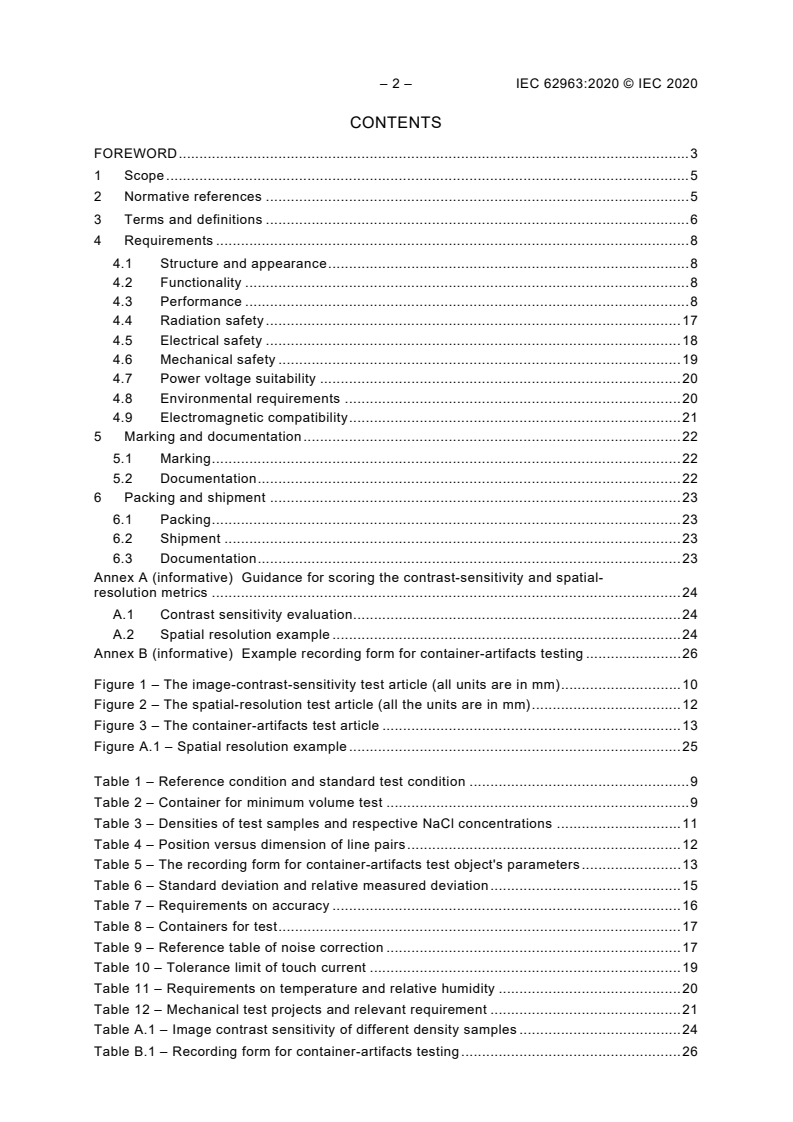
– 2 – IEC 62963:2020 © IEC 2020
CONTENTS
FOREWORD . 3
1 Scope . 5
2 Normative references . 5
3 Terms and definitions . 6
4 Requirements . 8
4.1 Structure and appearance . 8
4.2 Functionality . 8
4.3 Performance . 8
4.4 Radiation safety . 17
4.5 Electrical safety . 18
4.6 Mechanical safety . 19
4.7 Power voltage suitability . 20
4.8 Environmental requirements . 20
4.9 Electromagnetic compatibility . 21
5 Marking and documentation . 22
5.1 Marking . 22
5.2 Documentation . 22
6 Packing and shipment . 23
6.1 Packing . 23
6.2 Shipment . 23
6.3 Documentation . 23
Annex A (informative) Guidance for scoring the contrast-sensitivity and spatial-
resolution metrics . 24
A.1 Contrast sensitivity evaluation . 24
A.2 Spatial resolution example . 24
Annex B (informative) Example recording form for container-artifacts testing . 26
Figure 1 – The image-contrast-sensitivity test article (all units are in mm) . 10
Figure 2 – The spatial-resolution test article (all the units are in mm) . 12
Figure 3 – The container-artifacts test article . 13
Figure A.1 – Spatial resolution example . 25
Table 1 – Reference condition and standard test condition . 9
Table 2 – Container for minimum volume test . 9
Table 3 – Densities of test samples and respective NaCl concentrations . 11
Table 4 – Position versus dimension of line pairs . 12
Table 5 – The recording form for container-artifacts test object's parameters . 13
Table 6 – Standard deviation and relative measured deviation . 15
Table 7 – Requirements on accuracy . 16
Table 8 – Containers for test . 17
Table 9 – Reference table of noise correction . 17
Table 10 – Tolerance limit of touch current . 19
Table 11 – Requirements on temperature and relative humidity . 20
Table 12 – Mechanical test projects and relevant requirement . 21
Table A.1 – Image contrast sensitivity of different density samples . 24
Table B.1 – Recording form for container-artifacts testing . 26
INTERNATIONAL ELECTROTECHNICAL COMMISSION
____________
RADIATION PROTECTION INSTRUMENTATION –
X-RAY COMPUTED TOMOGRAPHY (CT) INSPECTION
SYSTEMS OF BOTTLED/CANNED LIQUIDS
FOREWORD
1) The International Electrotechnical Commission (IEC) is a worldwide organization for standardization comprising
all national electrotechnical committees (IEC National Committees). The object of IEC is to promote
international co-operation on all questions concerning standardization in the electrical and electronic fields. To
this end and in addition to other activities, IEC publishes International Standards, Technical Specifications,
Technical Reports, Publicly Available Specifications (PAS) and Guides (hereafter referred to as "IEC
Publication(s)"). Their preparation is entrusted to technical committees; any IEC National Committee interested
in the subject dealt with may participate in this preparatory work. International, governmental and non-
governmental organizations liaising with the IEC also participate in this preparation. IEC collaborates closely
with the International Organization for Standardization (ISO) in accordance with conditions determined by
agreement between the two organizations.
2) The formal decisions or agreements of IEC on technical matters express, as nearly as possible, an international
consensus of opinion on the relevant subjects since each technical committee has representation from all
interested IEC National Committees.
3) IEC Publications have the form of recommendations for international use and are accepted by IEC National
Committees in that sense. While all reasonable efforts are made to ensure that the technical content of IEC
Publications is accurate, IEC cannot be held responsible for the way in which they are used or for any
misinterpretation by any end user.
4) In order to promote international uniformity, IEC National Committees undertake to apply IEC Publications
transparently to the maximum extent possible in their national and regional publications. Any divergence
between any IEC Publication and the corresponding national or regional publication shall be clearly indicated in
the latter.
5) IEC itself does not provide any attestation of conformity. Independent certification bodies provide conformity
assessment services and, in some areas, access to IEC marks of conformity. IEC is not responsible for any
services carried out by independent certification bodies.
6) All users should ensure that they have the latest edition of this publication.
7) No liability shall attach to IEC or its directors, employees, servants or agents including individual experts and
members of its technical committees and IEC National Committees for any personal injury, property damage or
other damage of any nature whatsoever, whether direct or indirect, or for costs (including legal fees) and
expenses arising out of the publication, use of, or reliance upon, this IEC Publication or any other IEC
Publications.
8) Attention is drawn to the Normative references cited in this publication. Use of the referenced publications is
indispensable for the correct application of this publication.
9) Attention is drawn to the possibility that some of the elements of this IEC Publication may be the subject of
patent rights. IEC shall not be held responsible for identifying any or all such patent rights.
International Standard IEC 62963 has been prepared by subcommittee 45B: Radiation
protection instrumentation, of IEC technical committee 45: Nuclear instrumentation.
The text of this International Standard is based on the following documents:
FDIS Report on voting
45B/958/FDIS 45B/962/RVD
Full information on the voting for the approval of this International Standard can be found in
the report on voting indicated in the above table.
This document has been drafted in accordance with the ISO/IEC Directives, Part 2.
– 4 – IEC 62963:2020 © IEC 2020
The committee has decided that the contents of this document will remain unchanged until the
stability date indicated on the IEC website under "http://webstore.iec.ch" in the data related to
the specific document. At this date, the document will be
• reconfirmed,
• withdrawn,
• replaced by a revised edition, or
• amended.
RADIATION PROTECTION INSTRUMENTATION –
X-RAY COMPUTED TOMOGRAPHY (CT) INSPECTION
SYSTEMS OF BOTTLED/CANNED LIQUIDS
1 Scope
This document describes the technical requirements, test methods, inspection requirements,
markings and labelling, and requirements on the accompanying documents, packaging,
shipping and storage for X-ray security inspection systems that inspect bottled or canned
liquids (hereinafter referred to as "the system") based on X-ray computed tomography (CT).
Here, the system is limited to those that feature tomographic scanning, not standard X-ray
projection. This document is applicable to liquids, aerosols and gelatinous objects in
transparent or visually opaque containers.
This technical performance document includes minimum or baseline performance
requirements; regulators may require additional performance testing.
2 Normative references
The following documents are referred to in the text in such a way that some or all of their
content constitutes requirements of this document. For dated references, only the edition
cited applies. For undated references, the latest edition of the referenced document (including
any amendments) applies.
IEC 60068-2-1, Environmental testing – Part 2-1:Tests – Test A:Cold
IEC 60068-2-2, Environmental testing – Part 2-2:Tests – Test B:Dry heat
IEC 60068-2-6, Environmental testing – Part 2-6: Tests – Test Fc: Vibration (sinusoidal)
IEC 60068-2-78, Environmental testing – Part 2-78: Tests – Test Cab: Damp heat, steady
state
IEC 60529, Degrees of protection provided by enclosures (IP Code)
IEC 61000-6-1:2016, Electromagnetic compatibility (EMC) – Part 6-1: Generic standards –
Immunity standard for residential, commercial and light-industrial environments
IEC 61000-6-3:2006, Electromagnetic compatibility (EMC) – Part 6-3: Generic standards –
Emission standard for residential, commercial and light-industrial environments
IEC 61010-1:2010, Safety requirements for electrical equipment for measurement, control,
and laboratory use – Part 1: General requirements
ISO 780:2015, Packaging – Distribution packaging – Graphical symbols for handling and
storage of packages
ISO 13849 (all parts), Safety of machinery – Safety-related parts of control systems
ASTM A624/624M:2013, Standard Specification for Tin Mill Products, Electrolytic Tin Plate,
Single Reduced
– 6 – IEC 62963:2020 © IEC 2020
ASTM B221:2014, Standard Specification for Aluminium and Aluminium-Alloy Extruded Bars,
Rods, Wire, Profiles, and Tubes
EN 546-1:2006, Aluminium and aluminium alloys – Foil – Part 1: Technical conditions for
inspection and delivery
3 Terms and definitions
For the purposes of this document, the following terms and definitions apply.
ISO and IEC maintain terminological databases for use in standardization at the following
addresses:
• IEC Electropedia: available at http://www.electropedia.org/
• ISO Online browsing platform: available at http://www.iso.org/obp
3.1
ambient dose equivalent
H*(10)
dose equivalent at a point in a radiation field that would be produced by the corresponding
expanded and aligned field in the ICRU sphere at a depth of 10 mm on the radius opposing
the direction of the aligned field
Note 1 to entry: The SI unit of ambient dose equivalent is the sievert (Sv) or its decimal multiples or submultiples
(e.g. mSv).
Note 2 to entry: The ambient dose equivalent (rate), used for the monitoring of strongly penetrating radiation, is
not an appropriate quantity for any beta radiation even that which is nominally penetrating (ICRU Report 47, 1992).
Note 3 to entry: When the term dose equivalent alone is used in this document, the quantities ambient dose
equivalent and directional dose equivalent are implied.
3.2
ambient dose equivalent rate
ratio of dH*(10) by dt, where dH*(10) is the increment of ambient dose equivalent in the time
interval dt:
dH * (10)
H * (10)=
dt
-1
Note 1 to entry: The SI unit of ambient dose equivalent rate is the sievert per second (Sv·s ). Units of ambient
dose equivalent rate are any quotient of the sievert or its decimal multiples or submultiples by a suitable unit of
-1
time (e.g., mSv·h ).
3.3
CT value
value reported by CT systems on a per voxel basis that is a function of the material’s density
and atomic number
Note 1 to entry: It is expressed in Hounsfield units (HU) in which the value of air at standard pressure and
temperature (STP) is defined as zero HU, while the value of distilled water at STP is defined as 1 000 HU.
3.4
density resolution
measure of the extent to which a tomograph or radiograph can be used to detect physical
differences in the test object
3.5
effective atomic number
Z
eff
material property that represents the atomic number of a theoretical element that, if the
material were replaced by the element, would produce the same x-ray attenuation
characteristics
Note 1 to entry: Z measurements can be scanner-dependent and its value shall not be considered as absolute.
eff
3.6
electron density
material property defined as:
𝜌𝜌 =𝜌𝜌×2𝑍𝑍/𝐴𝐴
𝑒𝑒
Where
𝜌𝜌 is electron density,
𝑒𝑒
𝜌𝜌 is physical density,
𝑍𝑍 is atomic number, and
𝐴𝐴 is atomic weight.
3.7
object inspection time
time interval from when the object to be inspected is inserted into the system to the time when
the system shows the result for the whole object. This does not include initial system warm up
time
Note 1 to entry: Object inspection may contain one or more single slices.
3.8
single slice inspection time
time interval from when the object to be inspected is inserted into the system, to the time that
the system shows the result for only one two-dimensional imaged slice of the object, a single
voxel in height
Note 1 to entry: This definition applies only to systems that have a single-slice mode available. This does not
include initial system warm up time.
3.9
spatial resolution
smallest separation distance at which two points (or line pairs) can be distinguished as
separate entities
3.10
test sample
combination of designated container and its content to be scanned
3.11
X-ray computed tomography (CT)
technique that uses computer-processed combinations of many X-ray images taken from
different angles to produce cross-sectional (tomographic) images (virtual 'slices') of specific
areas of a scanned object
3.12
X-ray inspection system of bottled/canned liquids
system that applies X-ray CT to bottles or cans with the intent of identifying liquids, aerosols,
or gels for security purposes
– 8 – IEC 62963:2020 © IEC 2020
4 Requirements
4.1 Structure and appearance
Protection grade for the system’s shell shall be subject to rules of IEC 60529, which shall not
be rated lower than the international protection marking code IP20.
4.2 Functionality
4.2.1 Threat alarm
The system shall automatically provide warning by audible or visual signals when threats are
detected. The signals may be disabled by configuration, if desired.
4.2.2 Image display
a) The system shall designate the position(s) that a container should be placed for inspection.
b) The system shall display images of inspected position(s).
4.2.3 Data storage
a) Data stored in the system shall include the resulting image, device identification number
(ID), operator ID and image generation time.
b) Image retrieval: functionality shall be provided to retrieve result images by operator ID,
image generation time and alarm result.
c) Image storage capacity: The system shall save images and results of a minimum of 10
000 scanned objects.
d) Image storage security: Images saved in the system shall be secured. Only authorized
personnel should be able to access to operate on the images.
e) Image export: The system shall export images into an open image format that can be
easily transferred or exported.
4.3 Performance
4.3.1 Reference environmental conditions and standard test requirements
Except where otherwise specified, tests shall be carried out within the standard test
conditions shown in the third column of Table 1. For tests performed outside the standard test
conditions, the values of temperature, pressure and relative humidity shall be stated and the
appropriate corrections, if any, made to give the response under reference conditions. All
tests in 4.3 shall be performed with the same values of these reference environmental
conditions. Reference conditions are given in the second column of Table 1.
The values in Table 1 are intended for tests performed in temperate climates. In other
climates, the actual values for the test shall be stated. Similarly atmospheric pressure lower
than 70 kPa may be permitted at higher altitudes. If the system is to be operate outside the
environmental standard test conditions, testing shall be performed at these non-standard
conditions.
Table 1 – Reference condition and standard test condition
Environment condition Reference condition Standard test conditions
Environment temperature 20 °C 15 °C to 35 °C
Relative humidity 65 % 45 % to 75 %
Atmospheric pressure 101,3 kPa 70 kPa to 106,6 kPa
Ambient dose equivalent rate no Ambient dose equivalent rate less than
Background radiation dose rate
-1
greater than 0,1 μSv·h 0,25 μSv·h-1
Less than the lowest value that causes
Ambient electromagnetic field Negligible
interference
Less than twice the value of the
Ambient magnetic induction Negligible
induction due to earth’s magnetic field
For the system under test, the image quality test report shall include manufacturer,
manufacture date, model No., serial No., software version, environmental conditions, serial
No. of the test articles, type and serial No. of X-ray emitter. For all performance requirements
in 4.3, image evaluation shall be based on images acquired under normal security-screening
operation mode including exposure time, high voltage, and any other adjustable parameters.
4.3.2 Requirement on inspection time
4.3.2.1 Requirements
The object inspection time shall not be more than 30 s. In single slice mode, if available, the
inspection time shall be no more than 10 s.
4.3.2.2 Test method
The system shall conduct an inspection for a test sample and the measurement/scanning time
and mode shall be recorded, and comply with the requirement of 4.3.2.1.
4.3.3 Requirement on minimum volume of liquid to be inspected
4.3.3.1 Requirements
The system shall be able to inspect volumes of liquid that are ≥ 100 ml. The shape of the
container used to test for minimum scannable volume shall be a cylinder with a diameter of 50
mm.
4.3.3.2 Test method
Fill the container TC01, defined in Table 2, with water, and use the sample to perform
inspection. Such test shall be normally achieved and finally give an inspection result.
Table 2 – Container for minimum volume test
Code Name Specification
Container for minimum
Cross-section is circular; external diameter: 50±1 mm; wall thickness:
TC01 volume of liquid-to-be-
1±0,5 mm; polyethylene plastic bottle
inspected test sample
– 10 – IEC 62963:2020 © IEC 2020
4.3.4 Image contrast sensitivity
4.3.4.1 Requirements
The system's image contrast sensitivity shall be sufficient to achieve discrimination between
samples with physical density that differs by less than or equal to 3 % from that of water. The
evaluation report format for this metric is given in Annex A, Table A.1.
4.3.4.2 Description of the image-contrast-sensitivity test article
Using image contrast, this metric gauges effective liquid density resolution or sensitivity. The
test article consists of 6 cylindrical cavities in a large cylindrical base, each filled with a
different density liquid, as shown in Figure 1. The large cylinder is made of polyethylene.
Each cavity is filled with distilled water or NaCl water solutions of different concentrations
which is contained with a lid. Ensure the liquids are chemically stable over the period of
testing. Relative densities of the liquids are given in Table 3.
Key
1 to 6 Test samples at different densities
7 Base of the cylinder
Figure 1 – The image-contrast-sensitivity test article (all units are in mm)
Table 3 – Densities of test samples and respective NaCl concentrations
Sample NaCl concentration
Physical density of test liquid
No. (20 °C)
1 Water 0
2 Base density of water +1 % 1,66 ± 0,05 %
3 Base density of water +2 % 3,06 ± 0,05 %
4 Base density of water +3 % 4,44 ± 0,05 %
5 Base density of water +4 % 5,83 ± 0,05 %
6 Base density of water +5 % 7,20 ± 0,05 %
4.3.4.3 Test method
Place the image-contrast-sensitivity test article at the center of the inspection volume with the
axis of the cylinder vertically upwards. Scan the test object such that the central position of
the article that contains the test samples is imaged. Visually determine which of the NaCl test
samples can be discriminated from the water test sample by comparing the imaged samples
within one of the following reconstructed images: CT value, electron density or Z . If the
eff
reconstructed image includes more than one vertical voxel, before performing the evaluation,
produce a two-dimensional image using a projection method in the vertical direction that
produces the best signal to noise. Otherwise, evaluate directly the acquired single slice, two-
dimensional image of the samples. The system shall achieve discrimination between samples
with physical densities that differ by less than or equal to 3 % from that of water; i.e., at least
4 samples (namely, #1, #4, #5, #6) shall be discriminable. The image inspection shall be
taken by at least 5 different persons with normal vision and at least 3 persons shall produce
the same result as defined in Table A.1.
4.3.5 Spatial resolution
4.3.5.1 Requirements
The system shall be able to entirely resolve line pairs with spatial frequencies of less than or
equal to 2,0 mm. Evaluation of the sample is described in Clause A.2.
4.3.5.2 The spatial-resolution test article
The spatial-resolution test article is a plastic cylinder with a diameter of 150 mm and a height
of 50 mm into which iron plates are inserted. Three iron plates form each line-pair gauge. The
article is composed of eight line-pair gauges of different thicknesses as shown in Figure 2.
– 12 – IEC 62963:2020 © IEC 2020
Figure 2 – The spatial-resolution test article (all the units are in mm)
The line-pair gauge dimensions and positions are given in Table 4.
Table 4 – Position versus dimension of line pairs
Inserted iron plate dimensions length × width × Thickness of the gap between
Code No.
thickness the plates
mm mm
1 50×10×(4,00 ± 0,05) 4,00 ± 0,05
2 50×10×(3,50 ± 0,05) 3,50 ± 0,05
3 50×10×(3,00 ± 0,05) 3,00 ± 0,05
4 50×10×(2,50 ± 0,05) 2,50 ± 0,05
5 50×10×(2,00 ± 0,05) 2,00 ± 0,05
6 50×10×(1,50 ± 0,05) 1,50 ± 0,05
7 50×10×(1,00 ± 0,05) 1,00 ± 0,05
8 50×10×(0,50 ± 0,05) 0,50 ± 0,05
4.3.5.3 Test method
Place the spatial-resolution test article at the center of the scanning volume with the axis of
the cylinder vertically upwards. Scan the central position of the article. Visually inspect the
imaged test object within one of the following slice images: CT value, electron density or Z .
eff
A line-pair gauge with all three lines visually complete and separable from others is judged as
resolvable. Record each of the resolvable line-pair gauge with code number designated in
Table 4. At least codes 1 to 5 (4,0 mm to 2,0 mm) shall be entirely resolved. Such inspection
shall be taken by at least 5 different persons with normal vision and at least 3 persons shall
produce the same conclusion.
4.3.6 Container artifacts
4.3.6.1 Container-artifacts test article
This test article is used to measure the influence of the container size and material on the CT
determined for the liquid within the container. The container-
value, electron density and Z
eff
artifacts test article is an object constructed by binding to a polyformaldehyde cuboid and
cylinder thick/thin strips of aluminum and thick/thin strips of iron including 14 steps, with a
100 mm diameter 210 mm height polyethylene barrel as protective sleeve on the outside.
Here, the polyformaldehyde cuboid has 7 steps in total at the height of 105 ± 3 mm and the
polyformaldehyde cylinder has 7 steps too, at the height of 105 ± 3 mm as shown in Figure 3.
For detailed parameters, see Table 5.
Figure 3 – The container-artifacts test article
Table 5 – The recording form for container-artifacts test object's parameters
Step Specification of inner Covering material Cross- Covering
Height Representative
No. materials grade section thickness
mm mm mm
small-sized
polyformaldehyde
round
1 -- 20 ± 1 15 ± 1 --
Φ20 mm
plastic container
medium-sized
polyformaldehyde
round
2 -- 40±1 15±1 --
Φ40 mm
plastic container
large-sized
polyformaldehyde
round
3 -- 60±1 15±1 --
Φ60 mm
plastic container
ASTM
A624/A624M:2013
Single reduced,
4 polyformaldehyde 60±1 15±1 0,2 ± 0,01 round iron can
electrolytic tin plate,
L,T-2, or equivalent,
thickness 0,2 mm
EN 546-1:2006
Aluminium Foil Al
polyformaldehyde round Al
5 60±1 15±1 0,2 ± 0,01
6061, or equivalent,
Φ60 mm container
thickness 0,2 mm
– 14 – IEC 62963:2020 © IEC 2020
Step Specification of inner Covering material Cross- Covering
Height Representative
No. materials grade section thickness
mm mm mm
ASTM
A624/A624M:2013
Single reduced,
polyformaldehyde dual-layer round
6 60±1 15±1 1,0 ± 0,01
electrolytic tin plate,
Φ60 mm vacuum cup
L,T-2, or equivalent,
thickness 0,5 mm
ASTM B221:2014
polyformaldehyde Aluminum Extruded round glass
7 60±1 15±1 5,0 ± 0,01
Φ60 mm Bar Al 6061, or container
equivalent
ASTM B221:2014
polyformaldehyde with
60±1
Aluminum Extruded square glass
8 cross section 60 mm × 15±1 5,0 ± 0,01
Bar Al 6061, or container
×60±1
60 mm
equivalent
ASTM
A624/A624M:2013
polyformaldehyde with dual-layer
Single reduced, 60±1
9 cross section 60 mm × 15±1 1,0 ± 0,01 square vacuum
electrolytic tin plate,
×60±1
60 mm cup
L,T-2, or equivalent,
thickness 0,5 mm
EN 546-1:2006
Aluminium Foil
polyformaldehyde with
60±1
square Al
10 cross section 60 mm × 15±1 0,2 ± 0,01
Al 6061, or equivalent, container
×60±1
60 mm
thickness 0,2 mm
ASTM
A624/A624M:2013
polyformaldehyde with
Single reduced, 60±1
11 cross section 60 mm × 15±1 0,2 ± 0,01 square iron can
electrolytic tin plate,
×60±1
60 mm
L,T-2, or equivalent,
thickness 0,2 mm
large-sized
polyformaldehyde with
60±1
square
12 cross section 60 mm × -- 15±1 --
×60±1
60 mm
plastic container
medium-sized
polyformaldehyde with
40±1
square
13 cross section 40 mm × -- 15±1 --
×40±1
40 mm
plastic container
small-sized
polyformaldehyde with
20±1
square
14 cross section 20 mm × -- 15±1 --
×20±1
20 mm
plastic container
4.3.6.2 Requirements
The requirements on the standard deviation and relative measured deviation (benchmarked
against the CT mean value of step 3) are presented in Table 6.
Table 6 – Standard deviation and relative measured deviation
Step Standard Relative measured deviation of
Characteristic of liquid
No. deviation mean
%
1 < 20 < 10
2 < 20 < 10
3 < 20 0,00
4 < 40 < 20
5 < 40 < 10
6 < 50 < 50
7 < 50 < 20
CT value
8 < 50 < 20
9 < 50 < 50
10 < 40 < 10
11 < 40 < 20
12 < 20 < 10
13 < 20 < 10
14 < 20 < 10
1 < 0,1 < 5
2 < 0,1 < 5
3 < 0,1 0,00
< 0,1 < 5
5 < 0,1 < 5
6 < 0,1 < 10
7 < 0,1 < 5
Electron density
8 < 0,1 < 5
9 < 0,1 < 10
10 < 0,1 < 5
11 < 0,1 < 5
12 < 0,1 < 5
13 < 0,1 < 5
14 < 0,1 < 5
1 < 0,4 < 5
2 < 0,4 < 5
3 < 0,4 0,00
4 < 2,0 < 20
5 < 0,5 < 5
6 < 3,0 < 100
7 < 2,0 < 20
Effective atomic number (Z )
eff
8 < 2,0 < 20
9 < 3,0 < 100
10 < 0,5 < 5
11 < 2,0 < 20
12 < 0,4 < 5
13 < 0,4 < 5
14 < 0,4 < 5
– 16 – IEC 62963:2020 © IEC 2020
4.3.6.3 Test method
Place the container-artifacts test article at the center of the inspection volume. Scan the
article, and for each of the 14 steps of the test article (see Figure 3 and Table 5), scan the
middle of the step to get a CT image.
From the generated 14 CT images, draw a box to get a rectangular area within the container-
artifacts test article and the side length of the rectangular is between 30 mm and 40 mm at
the layer with large cross-section and between 8 mm and 15 mm at the layer with small cross-
section. From the voxel values in the image, calculate the values below (when the system is
able to automatically select any area within the container-artifacts test article, these values
may be reported directly by the system from each of the 14 CT images):
a) Mean CT value;
b) Standard deviation of CT value;
c) Relative measured deviation of mean CT value, taking the CT mean value of the step 3 as
reference;
d) Mean electron density (if available);
e) Standard deviation of electron density (if available);
f) Relative measured deviation of mean electron density, taking the CT mean value of the
step 3 as reference (if available);
g) Mean Z (if available);
eff
(if available);
h) Standard deviation of Z
eff
i) Relative measured deviation of mean Z , taking the CT mean value of the step 3 as
eff
reference (if available);
Record the calculated results. A sample of recording form for the testing is given in Annex B,
Table B.1.
Of these, the measured value's standard deviation and the mean's relative measured
deviation shall meet the requirements in Table 6.
4.3.7 Accuracy
4.3.7.1 Requirements
The requirements on the absolute accuracy of various characteristics are given in Table 7.
Table 7 – Requirements on accuracy
Characteristic value of liquid Distilled water 100 % ethanol (analytically pure)
CT value 970 to 1030 680 to 750
Electron density 1,097 to 1,119 0,873 to 0,909
Atomic number 7,28 to 7,74 6,28 to 6,67
4.3.7.2 Test method
Use the system to test container TC02 and TC03 (see Table 8) filled with distilled water and
100 % ethanol (analytically pure) respectively. Record the values of CT value, and if provided
by the system, the values of electron density and effective atomic number. These shall be
within the ranges specified in Table 7.
Table 8 – Containers for test
Code Name Specification
Container for minimum Cross-section is circular; external diameter: 53±3 mm; cylinder’s
TC02 volume of object to be height is 110±5 mm; wall thickness: 1±0,1 mm; polyethylene plastic
inspected test sample 1 bottle
Cross-section is circular; external diameter: 100±5 mm; cylinder’s
Container for volume
TC03 height is 110±5 mm; wall thickness: 1±0,1 mm; polyethylene plastic
suitability test sample 2
bottle
4.3.8 System noise
4.3.8.1 Requirements
The sound level at a distance of 1 m to the system surface shall be less than 65 dB(A).
4.3.8.2 Test method
Use a sound level meter (accuracy is 0,1 dB) to perform a survey test in positions 1 m from
surface of the system (both around and above) while the system is normally operating. The
system noise shall satisfy the requirement of 4.3.8.1. The sound level of background noise
shall be under that of the noise to be tested by 10 dB(A) or more. If the difference between
the measurement value and the background value is less than 10 dB(A), the operator shall
amend it following the instruction of Table 9.
Table 9 – Reference table of noise correction
Difference value Correction value
dB dB
3 -3
4 to 6 -2
7 to 9 -1
4.4 Radiation safety
4.4.1 Ambient dose equivalent rate
4.4.1.1 Standard scatter body
The standard scatter article is a plastic cylinder made of white polyethylene. The cylinder’s
cross-section is circular; the cylinder’s diameter is 160 ± 1 mm; the cylinder’s height is 100 ±
1 mm.
4.4.1.2 Requirements
The ambient dose equivalent rate shall not be higher than 1 μSv/h in any place beyond 5 cm
from surface of the system, including above.
4.4.1.3 Test method
Place the standard scatter article in the central inspection area. While the radiation source is
operating, perform a radiation survey test at 5 cm from all surfaces of the system. The results
shall conform to the requirements of 4.4.2.2. The environmental dose meter itself shall
register emissions greater than 0,1 µSv/h with at least an accuracy of ±10 %.
– 18 – IEC 62963:2020 © IEC 2020
4.4.2 Safety interlocking device
4.4.2.1 Requirements
The system shall be provided with reliable safety interlocking subsystems (including safety
interlocking switch) so that the X-rays can be interlocked to cover and doors. The safety
interlocking subsystem shall comply with the requirements of ISO 13849 or equivalent safety
standard.
4.4.2.2 Test method
Activate each safety interlock separately while x-rays are being emitted. X-rays shall stop
emitting immediately.
4.4.3 Emergency stop switch
4.4.3.1 Requirements
An emergency stop switch shall be provided in an easily accessible location such that the
operator can immediately terminate x-ray emissions in case of an emergency. The emergency
stop switch shall comply the requirements of ISO 13849 or equivalent safety standard.
4.4.3.2 Test method
While the system is operating with X-rays, verify using an appropriate radiation survey meter
that X-ray emissions terminate with activation of each safety interlock (separately) as well as
the emergency stop switch. The system shall be subject to the requirements of 4.4.4.1 in such
case.
4.4.4 Status indicators for power and X-ray emission
4.4.4.1 Requirements
There shall be either audible or visible indication for the status of system power and x-ray
emission.
4.4.4.2 Test method
Operate the system and verify using an appropriate radiation survey meter that x-ray emission
and power indicators are consistent with the determined status of the system.
4.5 Electrical safety
4.5.1 Protective grounding
4.5.1.1 Requirements
a) The system shall be provided with protective grounding terminals that can be connected to
grounding wires and are clearly marked.
b) Resistance between grounding terminals and metal article connecting with exterior surface
shall not be above 0,1 Ω.
4.5.1.2 Test method
Visually inspect insulation colour of grounding wire and use earth resistance tester (milliohm
range; measurement error is no more than ± 3 %) to measure resistance value between
protective grounding terminal and grounding wire. Measurement result shall be subject to the
requirements of 4.5.1.1.
4.5.2 Insulation resistance
4.5.2.1 Requirements
Under the test condition shown in Table 1, the insulation resistance between power supply
terminal and exposed metal article shall not be less than 100 MΩ.
4.5.2.2 Test method
Use an insulation resistance meter (500 V; measurement error is no more than ± 10 %) to
measure insulation resistance value between phase/zero conductors of power supply and
exposed metal parts. Power switch shall be turned to connection mode and power plug shall
not be connected to the grid. Then apply 1 000 V test voltage and maintain such stable status
for 5 s and then read value of insulation resistance. Such value shall be subject to the
requirements of 4.5.2.1.
4.5.3 Dielectric strength
4.5.3.1 Requirements
The insulation between the power circuit conductors and protective circuit shall be able to
withstand voltage of 1,5 kV and 50 Hz to 60 Hz for 1 min under normal conditions and there
shall be no breakdown or arc over during the test.
4.5.3.2 Test method
After pre-wetting treatment is performed in normal working condition and following
requirements of 6.8.2 of IEC 61010-1:2010, ope
...