

IEC 60276:2018
(Main)Carbon brushes, brush holders, commutators and slip-rings - Definitions and nomenclature
General Information
- Abstract
IEC 60276:2018 applies to carbon brushes for electrical machinery. This edition applies only to carbon brushes for commutators and slip-rings in rotating machines. Terms and definitions are relative to the brush construction (references 100’s to 500’s and parts of 900’s) and to the markings when operating on a rotating machine (references 600’s to 800’s).
This new edition includes the following significant technical changes with respect to the previous edition:
Some nomenclature has been deleted or added, whereas remaining definitions have been detailed and clarified, to reflect the technical evolution since 1987.
Additional definitions have been included to address the request for reviewing this standard, in particular nomenclature of commutator/slip-rings markings, brush markings and commutation sparks codes.
- Status
- Published
- Publication Date
- 07-May-2018
- Technical Committee
- TC 2 - Rotating machinery
- Drafting Committee
- MT 14 - TC 2/MT 14
- Current Stage
- PPUB - Publication issued
- Start Date
- 08-May-2018
- Completion Date
- 25-May-2018
Overview
IEC 60276:2018 is an international standard published by the International Electrotechnical Commission (IEC) that defines terminology and nomenclature related to carbon brushes, brush holders, commutators, and slip-rings used in rotating electrical machinery. This current edition applies specifically to carbon brushes for commutators and slip-rings operating in rotating machines.
The standard serves as a comprehensive reference for the constructional elements and operational markings of brushes and related components, reflecting the technical evolutions since the previous edition issued in 1987. It provides clear, detailed definitions and nomenclature classifications that are critical for manufacturers, engineers, and maintenance specialists involved in electrical machinery design, testing, and application.
Key Topics
Brush Construction Definitions
Definitions encompassing the various parts of carbon brushes such as the body, edges, faces, tops, and different brush configurations (monobloc, divided, double brushes). These terms are categorized by reference numbers (100's to 500's).Markings for Operational Use
Standards for commutator and slip-ring markings, as well as brush markings on sliding surfaces, edges, sides, and connections when the brushes are operating in rotating machines (reference 600's to 800's).Brush Material Classifications
Detailed terminology for various brush grades including:- Carbon: Hard carbon materials made from amorphous carbon powders agglomerated with binders.
- Carbon-Graphite: Mixtures of graphite and amorphous carbon baked with binders.
- Electrographite: Synthetic graphite forms formed through manufacturing processes.
- Natural Graphite: Primarily natural graphite used in soft graphite brushes.
- Resin-Bonded: Materials bonded with synthetic or natural resins.
- Metal-Graphite: Composites with powdered metals and graphite sintered to achieve specific properties.
Spark Evaluation Codes
Annex A includes spark codes, which help in assessing sparking phenomena during brush operation, correlating spark intensity, color, and sound with standardized measurement scales.Symbols and Abbreviated Terms
Standardized symbols and subscripts are established to maintain consistency in documentation and communication across the industry.
Applications
IEC 60276:2018 provides essential guidance for anyone involved in the manufacturing, design, installation, and maintenance of electrical rotating machines such as motors and generators. Key practical applications include:
Manufacturing Compliance
Brush, holder, commutator, and slip-ring manufacturers use this standard to ensure their products meet internationally accepted definitions and naming conventions, facilitating interoperability and quality assurance.Maintenance and Troubleshooting
Maintenance engineers rely on standardized terminology and spark evaluation codes to diagnose and monitor brush performance, helping to optimize operational reliability and reduce unexpected failures.Design and Testing
Electrical machine designers and testers apply the standard to specify brush materials, define component geometries, and interpret marking codes for accurate assembly and testing protocols.Technical Communication
The standard enables clear, unambiguous communication between international stakeholders including engineers, manufacturers, and certification bodies, reducing misunderstandings and enhancing collaboration.
Related Standards
For comprehensive understanding and implementation of this standard in practice, consider the following related IEC references:
IEC 60136 – Dimensions of brushes and brush-holders for electrical machinery. This standard complements IEC 60276 by specifying physical size requirements for compatibility and performance.
IEC 60773 – Test methods and apparatus for measurement of operational characteristics of brushes. It details testing protocols supporting the evaluation criteria introduced in IEC 60276.
IEC Electropedia – The online electrotechnical vocabulary resource provides authoritative definitions and explanations related to terms used in IEC standards.
By integrating IEC 60276:2018 with these associated standards, professionals ensure an all-encompassing approach to the design, evaluation, and utilization of carbon brushes and related components in rotating electrical machines.
Keywords: IEC 60276, carbon brushes, brush holders, commutators, slip-rings, rotating machines, brush nomenclature, brush definitions, brush markings, spark evaluation, electrical machinery standards, carbon-graphite brushes, metal-graphite brushes, brush material classification, international electrotechnical commission.
Get Certified
Connect with accredited certification bodies for this standard

IMQ S.p.A. (Certification)
Italian electrical product certification.

SLG Prüf- und Zertifizierungs GmbH
German testing and certification body.

UL Solutions
Global safety science company with testing, inspection and certification.
Sponsored listings
Frequently Asked Questions
IEC 60276:2018 is a standard published by the International Electrotechnical Commission (IEC). Its full title is "Carbon brushes, brush holders, commutators and slip-rings - Definitions and nomenclature". This standard covers: IEC 60276:2018 applies to carbon brushes for electrical machinery. This edition applies only to carbon brushes for commutators and slip-rings in rotating machines. Terms and definitions are relative to the brush construction (references 100’s to 500’s and parts of 900’s) and to the markings when operating on a rotating machine (references 600’s to 800’s). This new edition includes the following significant technical changes with respect to the previous edition: Some nomenclature has been deleted or added, whereas remaining definitions have been detailed and clarified, to reflect the technical evolution since 1987. Additional definitions have been included to address the request for reviewing this standard, in particular nomenclature of commutator/slip-rings markings, brush markings and commutation sparks codes.
IEC 60276:2018 applies to carbon brushes for electrical machinery. This edition applies only to carbon brushes for commutators and slip-rings in rotating machines. Terms and definitions are relative to the brush construction (references 100’s to 500’s and parts of 900’s) and to the markings when operating on a rotating machine (references 600’s to 800’s). This new edition includes the following significant technical changes with respect to the previous edition: Some nomenclature has been deleted or added, whereas remaining definitions have been detailed and clarified, to reflect the technical evolution since 1987. Additional definitions have been included to address the request for reviewing this standard, in particular nomenclature of commutator/slip-rings markings, brush markings and commutation sparks codes.
IEC 60276:2018 is classified under the following ICS (International Classification for Standards) categories: 29.160.01 - Rotating machinery in general. The ICS classification helps identify the subject area and facilitates finding related standards.
IEC 60276:2018 is available in PDF format for immediate download after purchase. The document can be added to your cart and obtained through the secure checkout process. Digital delivery ensures instant access to the complete standard document.
Standards Content (Sample)
IEC 60276 ®
Edition 2.0 2018-05
INTERNATIONAL
STANDARD
NORME
INTERNATIONALE
colour
inside
Carbon brushes, brush holders, commutators and slip-rings – Definitions and
nomenclature
Balais de charbon, porte-balais, collecteurs et bagues – Définitions et
nomenclature
All rights reserved. Unless otherwise specified, no part of this publication may be reproduced or utilized in any form
or by any means, electronic or mechanical, including photocopying and microfilm, without permission in writing from
either IEC or IEC's member National Committee in the country of the requester. If you have any questions about IEC
copyright or have an enquiry about obtaining additional rights to this publication, please contact the address below or
your local IEC member National Committee for further information.
Droits de reproduction réservés. Sauf indication contraire, aucune partie de cette publication ne peut être reproduite
ni utilisée sous quelque forme que ce soit et par aucun procédé, électronique ou mécanique, y compris la photocopie
et les microfilms, sans l'accord écrit de l'IEC ou du Comité national de l'IEC du pays du demandeur. Si vous avez des
questions sur le copyright de l'IEC ou si vous désirez obtenir des droits supplémentaires sur cette publication, utilisez
les coordonnées ci-après ou contactez le Comité national de l'IEC de votre pays de résidence.
IEC Central Office Tel.: +41 22 919 02 11
3, rue de Varembé info@iec.ch
CH-1211 Geneva 20 www.iec.ch
Switzerland
About the IEC
The International Electrotechnical Commission (IEC) is the leading global organization that prepares and publishes
International Standards for all electrical, electronic and related technologies.
About IEC publications
The technical content of IEC publications is kept under constant review by the IEC. Please make sure that you have the
latest edition, a corrigenda or an amendment might have been published.
IEC Catalogue - webstore.iec.ch/catalogue Electropedia - www.electropedia.org
The stand-alone application for consulting the entire The world's leading online dictionary of electronic and
bibliographical information on IEC International Standards, electrical terms containing 21 000 terms and definitions in
Technical Specifications, Technical Reports and other English and French, with equivalent terms in 16 additional
documents. Available for PC, Mac OS, Android Tablets and languages. Also known as the International Electrotechnical
iPad. Vocabulary (IEV) online.
IEC publications search - webstore.iec.ch/advsearchform IEC Glossary - std.iec.ch/glossary
The advanced search enables to find IEC publications by a 67 000 electrotechnical terminology entries in English and
variety of criteria (reference number, text, technical French extracted from the Terms and Definitions clause of
committee,…). It also gives information on projects, replaced IEC publications issued since 2002. Some entries have been
and withdrawn publications. collected from earlier publications of IEC TC 37, 77, 86 and
CISPR.
IEC Just Published - webstore.iec.ch/justpublished
Stay up to date on all new IEC publications. Just Published IEC Customer Service Centre - webstore.iec.ch/csc
details all new publications released. Available online and If you wish to give us your feedback on this publication or
also once a month by email. need further assistance, please contact the Customer Service
Centre: sales@iec.ch.
A propos de l'IEC
La Commission Electrotechnique Internationale (IEC) est la première organisation mondiale qui élabore et publie des
Normes internationales pour tout ce qui a trait à l'électricité, à l'électronique et aux technologies apparentées.
A propos des publications IEC
Le contenu technique des publications IEC est constamment revu. Veuillez vous assurer que vous possédez l’édition la
plus récente, un corrigendum ou amendement peut avoir été publié.
Catalogue IEC - webstore.iec.ch/catalogue Electropedia - www.electropedia.org
Application autonome pour consulter tous les renseignements
Le premier dictionnaire en ligne de termes électroniques et
bibliographiques sur les Normes internationales,
électriques. Il contient 21 000 termes et définitions en anglais
Spécifications techniques, Rapports techniques et autres
et en français, ainsi que les termes équivalents dans 16
documents de l'IEC. Disponible pour PC, Mac OS, tablettes
langues additionnelles. Egalement appelé Vocabulaire
Android et iPad.
Electrotechnique International (IEV) en ligne.
Recherche de publications IEC -
Glossaire IEC - std.iec.ch/glossary
webstore.iec.ch/advsearchform
67 000 entrées terminologiques électrotechniques, en anglais
La recherche avancée permet de trouver des publications IEC et en français, extraites des articles Termes et Définitions des
en utilisant différents critères (numéro de référence, texte, publications IEC parues depuis 2002. Plus certaines entrées
comité d’études,…). Elle donne aussi des informations sur les antérieures extraites des publications des CE 37, 77, 86 et
projets et les publications remplacées ou retirées. CISPR de l'IEC.
IEC Just Published - webstore.iec.ch/justpublished Service Clients - webstore.iec.ch/csc
Restez informé sur les nouvelles publications IEC. Just Si vous désirez nous donner des commentaires sur cette
Published détaille les nouvelles publications parues. publication ou si vous avez des questions contactez-nous:
Disponible en ligne et aussi une fois par mois par email. sales@iec.ch.
IEC 60276 ®
Edition 2.0 2018-05
INTERNATIONAL
STANDARD
NORME
INTERNATIONALE
colour
inside
Carbon brushes, brush holders, commutators and slip-rings – Definitions and
nomenclature
Balais de charbon, porte-balais, collecteurs et bagues – Définitions et
nomenclature
INTERNATIONAL
ELECTROTECHNICAL
COMMISSION
COMMISSION
ELECTROTECHNIQUE
INTERNATIONALE
ICS 29.160.01 ISBN 978-2-8322-5680-0
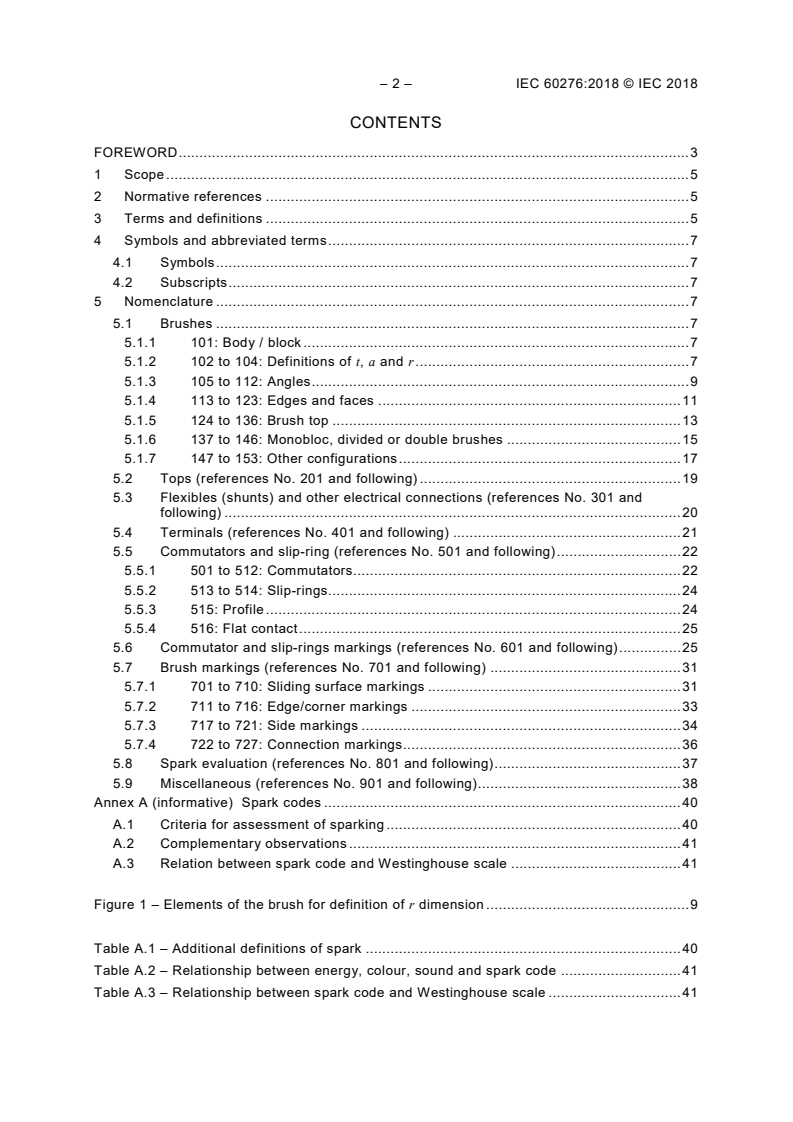
– 2 – IEC 60276:2018 © IEC 2018
CONTENTS
FOREWORD . 3
1 Scope . 5
2 Normative references . 5
3 Terms and definitions . 5
4 Symbols and abbreviated terms . 7
4.1 Symbols . 7
4.2 Subscripts . 7
5 Nomenclature . 7
5.1 Brushes . 7
5.1.1 101: Body / block . 7
5.1.2 102 to 104: Definitions of t, a and r . 7
5.1.3 105 to 112: Angles . 9
5.1.4 113 to 123: Edges and faces . 11
5.1.5 124 to 136: Brush top . 13
5.1.6 137 to 146: Monobloc, divided or double brushes . 15
5.1.7 147 to 153: Other configurations . 17
5.2 Tops (references No. 201 and following) . 19
5.3 Flexibles (shunts) and other electrical connections (references No. 301 and
following) . 20
5.4 Terminals (references No. 401 and following) . 21
5.5 Commutators and slip-ring (references No. 501 and following) . 22
5.5.1 501 to 512: Commutators. 22
5.5.2 513 to 514: Slip-rings. 24
5.5.3 515: Profile . 24
5.5.4 516: Flat contact . 25
5.6 Commutator and slip-rings markings (references No. 601 and following) . 25
5.7 Brush markings (references No. 701 and following) . 31
5.7.1 701 to 710: Sliding surface markings . 31
5.7.2 711 to 716: Edge/corner markings . 33
5.7.3 717 to 721: Side markings . 34
5.7.4 722 to 727: Connection markings . 36
5.8 Spark evaluation (references No. 801 and following) . 37
5.9 Miscellaneous (references No. 901 and following) . 38
Annex A (informative) Spark codes . 40
A.1 Criteria for assessment of sparking . 40
A.2 Complementary observations . 41
A.3 Relation between spark code and Westinghouse scale . 41
Figure 1 – Elements of the brush for definition of r dimension . 9
Table A.1 – Additional definitions of spark . 40
Table A.2 – Relationship between energy, colour, sound and spark code . 41
Table A.3 – Relationship between spark code and Westinghouse scale . 41
INTERNATIONAL ELECTROTECHNICAL COMMISSION
_____________
CARBON BRUSHES, BRUSH HOLDERS, COMMUTATORS
AND SLIP-RINGS – DEFINITIONS AND NOMENCLATURE
FOREWORD
1) The International Electrotechnical Commission (IEC) is a worldwide organization for standardization comprising
all national electrotechnical committees (IEC National Committees). The object of IEC is to promote
international co-operation on all questions concerning standardization in the electrical and electronic fields. To
this end and in addition to other activities, IEC publishes International Standards, Technical Specifications,
Technical Reports, Publicly Available Specifications (PAS) and Guides (hereafter referred to as “IEC
Publication(s)”). Their preparation is entrusted to technical committees; any IEC National Committee interested
in the subject dealt with may participate in this preparatory work. International, governmental and non-
governmental organizations liaising with the IEC also participate in this preparation. IEC collaborates closely
with the International Organization for Standardization (ISO) in accordance with conditions determined by
agreement between the two organizations.
2) The formal decisions or agreements of IEC on technical matters express, as nearly as possible, an international
consensus of opinion on the relevant subjects since each technical committee has representation from all
interested IEC National Committees.
3) IEC Publications have the form of recommendations for international use and are accepted by IEC National
Committees in that sense. While all reasonable efforts are made to ensure that the technical content of IEC
Publications is accurate, IEC cannot be held responsible for the way in which they are used or for any
misinterpretation by any end user.
4) In order to promote international uniformity, IEC National Committees undertake to apply IEC Publications
transparently to the maximum extent possible in their national and regional publications. Any divergence
between any IEC Publication and the corresponding national or regional publication shall be clearly indicated in
the latter.
5) IEC itself does not provide any attestation of conformity. Independent certification bodies provide conformity
assessment services and, in some areas, access to IEC marks of conformity. IEC is not responsible for any
services carried out by independent certification bodies.
6) All users should ensure that they have the latest edition of this publication.
7) No liability shall attach to IEC or its directors, employees, servants or agents including individual experts and
members of its technical committees and IEC National Committees for any personal injury, property damage or
other damage of any nature whatsoever, whether direct or indirect, or for costs (including legal fees) and
expenses arising out of the publication, use of, or reliance upon, this IEC Publication or any other IEC
Publications.
8) Attention is drawn to the Normative references cited in this publication. Use of the referenced publications is
indispensable for the correct application of this publication.
9) Attention is drawn to the possibility that some of the elements of this IEC Publication may be the subject of
patent rights. IEC shall not be held responsible for identifying any or all such patent rights.
International Standard IEC 60276 has been prepared by IEC technical committee 2: Rotating
machinery.
This second edition cancels and replaces the first edition, issued in 1968 and its
Amendment 1, issued in 1987. It constitutes a technical revision.
This edition includes the following significant technical changes with respect to the previous
edition:
– Some nomenclature has been deleted or added, whereas remaining definitions have been
detailed and clarified, to reflect the technical evolution since 1987.
– Additional definitions have been included to address the request for reviewing this
standard, in particular nomenclature of commutator/slip-rings markings, brush markings
and commutation sparks codes.
– 4 – IEC 60276:2018 © IEC 2018
The text of this standard is based on the following documents:
FDIS Report on voting
2/1898/FDIS 2/1901/RVD
Full information on the voting for the approval of this standard can be found in the report on
voting indicated in the above table.
This publication has been drafted in accordance with the ISO/IEC Directives, Part 2.
The committee has decided that the contents of this publication will remain unchanged until
the stability date indicated on the IEC website under "http://webstore.iec.ch" in the data
related to the specific publication. At this date, the publication will be
• reconfirmed,
• withdrawn,
• replaced by a revised edition, or
• amended.
IMPORTANT – The 'colour inside' logo on the cover page of this publication indicates
that it contains colours which are considered to be useful for the correct
understanding of its contents. Users should therefore print this document using a
colour printer.
CARBON BRUSHES, BRUSH HOLDERS, COMMUTATORS
AND SLIP-RINGS – DEFINITIONS AND NOMENCLATURE
1 Scope
This document applies to carbon brushes for electrical machinery. For the present, it applies
only to carbon brushes for commutators and slip-rings in rotating machines.
Terms and definitions are relative to the brush construction (references 100’s to 500’s and
parts of 900’s) and to the markings when operating on a rotating machine (references 600’s to
800’s).
By extension, terms and definitions may be relevant for any kind of sliding electrical contacts
for electrical machinery.
2 Normative references
The following documents are referred to in the text in such a way that some or all of their
content constitutes requirements of this document. For dated references, only the edition
cited applies. For undated references, the latest edition of the referenced document (including
any amendments) applies.
IEC 60136, Dimensions of brushes and brush-holders for electrical machinery
IEC 60773, Test methods and apparatus for measurement of the operational characteristics of
brushes
3 Terms and definitions
For the purposes of this document, the following terms and definitions apply.
ISO and IEC maintain terminological databases for use in standardization at the following
addresses:
• IEC Electropedia: available at http://www.electropedia.org/
• ISO Online browsing platform: available at http://www.iso.org/obp
NOTE Brushes are classified according to the class of grade used, as follows.
3.1
grade
brush material used for the brush body, defined by its composition and its physical properties
3.2
carbon
consists of various forms of amorphous carbon, generally made of a mixture of
carbonaceous powders agglomerated with a binder, moulded and baked at suitable
temperature to carbonize the binder
Note 1 to entry: Also named hard carbon (or plain carbon).
Note 2 to entry: The material can contain additives and can be impregnated with oils, wax or resin. This material
contains principally carbon, because it is not graphitized during baking operation.
– 6 – IEC 60276:2018 © IEC 2018
3.3
carbon-graphite
carbographitic
CG
consists of a mixture of po wd er e d amorphous carbon and graphite, agglomerated with a
binder (pitch or resin), moulded and baked at suitable temperature to carbonize the binder
3.4
electrographite
electrographitic
EG
consists of various forms of amorphous carbon (hard carbon or carbon-graphite) converted
during manufacture into artificial / synthetic graphite
3.5
natural-graphite
NG
carbon-graphite grade consisting principally of natural graphite
Note 1 to entry: Sometimes also called soft graphite.
3.6
resin-bonded
bakelite-graphite
BG
consists of powdered carbon and/or graphite bonded with a resin (artificial, synthetic or
natural) and polymerized at suitable temperature
3.7
metal-graphite
metallographitic
MG
consists of a mixture of powdered metals and graphite pressed and baked at suitable
temperature
Note 1 to entry: Baking is named sintering when a reducing atmosphere is used during baking.
3.8
metal-impregnated
M
consists of carbon, carbon-graphite or electrographite which contains a metal which has been
added by an impregnation process.
Metal can be added by:
– melting the metal and impregnating under pressure, or
– impregnating with a metal precursor and decomposition of this precursor during a further
baking operation, or
– deposition in vapour phase.
Note 1 to entry: The second and third processes are also called metallization.
4 Symbols and abbreviated terms
4.1 Symbols
a axial dimension of brush (mm)
c chamfer dimension (mm)
I current per brush (A)
r radial dimension of brush (mm)
R radius (mm)
t tangential dimension of brush (mm)
U voltage (V)
α contact bevel angle (°)
β top bevel angle (°)
4.2 Subscripts
A anodic
C cathodic
B brush
T top of the brush
c contact
5 Nomenclature
NOTE The definition corresponds to the part highlighted in blue / grey colour or pointed out by an arrow on the
corresponding figure (when applicable).
5.1 Brushes
5.1.1 101: Body / block
101 Brush body / block
5.1.2 102 to 104: Definitions of t, a and r
References a) and b) below correspond respectively to commutator (DC Motor) and slip-ring
(synchronous or asynchronous machine).
– 8 – IEC 60276:2018 © IEC 2018
a)
b)
t
t
Tangential dimension
t is the brush dimension in the tangential direction
defined by the distance between two planes parallel to
the centre line (see 105), the planes comprising the
faces of the brush (see 121).
a)
b)
a
a
Axial dimension
a is the brush dimension in the axial direction defined
by the distance between two planes parallel to the
centre line (see 105), the planes comprising the sides
of the brush (see 118).
a)
b)
Radial dimension
r is the brush dimension in the radial direction defined
r
r by the distance between two planes normal to the brush
centre line (see 105), passing over the extremities of
the brush elements, or parts of elements, which take
part in the pressure application (see Figure 1). r is the
longest dimension parallel to the centre line.
Recommended dimensions for t, a and r, as well as tolerances, are given in IEC 60136.
The pressure systems fitted on brushes are excluded from r. With reference to Figure 1 only
the elements marked 1, 2 and 3 take part in the pressure application. The possible litigious
cases which could not be justified by the definition of r shall be dealt with by agreement.
Key
1 brush material (body)
2 soft top pad
3 hard top pad
4 metal retainer
5 brush flexible
6 brush terminal
Figure 1 – Elements of the brush for definition of r dimension
5.1.3 105 to 112: Angles
NOTE 1 Figures 106 to 112 are cross-section view of the carbon brush.
105 Centre line
α
Contact bevel angle α
Angle between the center line of the brush and the
radial axis of the commutator/ring.
– 10 – IEC 60276:2018 © IEC 2018
Radial brush
when α is equal to zero
α
Reaction brush
when α is positive (in the same direction as the
rotation)
α
Trailing brush
when α is negative (in the opposite direction of the
rotation)
β
110 β
Top bevel angle
β
111 Positive top bevel angle
β
112 Negative top bevel angle
NOTE 2 IEC 60136 gives some recommendations for values of α and β angles.
5.1.4 113 to 123: Edges and faces
113 Entering edge (leading edge)
114 Leaving edge (trailing edge)
115 Contact surface (contact face)
α
116 Bevelled contact surface (bevelled contact face)
– 12 – IEC 60276:2018 © IEC 2018
Radiused contact surface (concave contact face)
Figure a) Brush with a radius R
c
Figures b) and c) are relative to fitted/bedded brushes
Figure b) When the radius is equal to the radius of the
R
c
a)
commutator/slip-ring
– after fitting (machining operation), the brush 117 is
named fitted brush,
– after bedding (machine operating at the specified
conditions of speed and current density during a
certain time), the brush 117 is named bedded
brush.
b)
Figure a) when the radius R is machined with a
c
dimension slightly superior to the radius of the
commutator/slip-ring the brush 117 is named pre-fitted
brush.
c)
118 Sides
Inner side, i.e. winding side (for commutator)
NOTE Winding side is at the rear part of the
commutator on the figure.
Outer side, i.e. non-winding side (for commutator)
NOTE Winding side is at the rear part of the
commutator on the figure).
121 Faces
122 Front face (front)
123 Back face (back)
5.1.5 124 to 136: Brush top
124 Top
125 Top surface
R
T
126 Rounded top (convex top) – radius R
T
– 14 – IEC 60276:2018 © IEC 2018
R
T
127 Grooved top – radius R
T
128 Slotted top
a) Bevelled edge
b) Partly bevelled edge
a) b)
a) Bevelled top
b) Partly bevelled top
a) b)
131 Shoulder
132 Bevelled corner
133 134 to 136 Headed brush
134 Dovetailed top (double angle shoulder)
135 Cylindrical head
136 Conical head
5.1.6 137 to 146: Monobloc, divided or double brushes
137 Solid/monobloc brush
– 16 – IEC 60276:2018 © IEC 2018
Split/divided brush (2 wafers)
NOTE Both wafers have the same grade. Triple split
brush (3 wafers) may also be possible.
139 Split brush with plate separated top
Split brush with clip
NOTE See 5.2 for tops.
Split brush with wedge top
NOTE Generally wafers are joined by a bonded
insulated top.
Sandwich brush (sandwich brush laminated), where
wafers are made of the same grade
NOTE Generally wafers are joined by an adhesive.
Dual grade sandwich (laminated)
NOTE Generally wafers are joined by an adhesive.
Brush with insert
a) insulator sheet
NOTE Generally wafers are joined by an adhesive.
b) second grade insertion
a) b)
145 Tandem/double brush
V-tandem brush
5.1.7 147 to 153: Other configurations
Chamfer
NOTE referred values of c are given in IEC 60136.
– 18 – IEC 60276:2018 © IEC 2018
Non-reversing chamfer
NOTE Typically used for a square brush.
149 Dust grooves
150 Dust slot
151 Cored brush
152 Wear indicator
153 Contact face with saw cut
5.2 Tops (references No. 201 and following)
201 Top insert
Insulated top
a) shock absorber (rubber)
a) b)
b) hard (plastic/composite)
c) mixed: shock absorber S + hard top H
NOTE Insulated top can be independent or glued.
c)
203 Riveted metal top (metal clip)
204 Soldered metal top
– 20 – IEC 60276:2018 © IEC 2018
205 Cantilever top
206 Top with a guiding hole
5.3 Flexibles (shunts) and other electrical connections (references No. 301 and
following)
Flexible (shunt)
NOTE Flexible is made of conductive material, such
as copper, tinned copper.
IEC 60136 gives definitions of cables: material,
composition, dimensions (length and section).
302 Insulated flexible
303 Riveted connection
304 Tamped connection
305 Soldered connection (on a metal top)
Spring connexion: Electrical connection with pressure
system
5.4 Terminals (references No. 401 and following)
401 Flag terminal
(example)
Axial terminal
example: Spade terminal
(example)
403 Hook terminal
– 22 – IEC 60276:2018 © IEC 2018
404 Double shoe terminal
405 Pin terminal
406 Flat pin terminal
407 Pin terminal (soldered on shunt)
NOTE 1 IEC 60136 gives some recommendations for dimensions of terminals.
NOTE 2 Items number 403, 405 and 406 are rarely used.
NOTE 3 Open slots are usually preferred compared to closed holes, because they are easier to mount.
Nevertheless, closed holes are favoured when high vibrations can occur.
5.5 Commutators and slip-ring (references No. 501 and following)
NOTE 502 to 512 and 515 are crossed-section definitions.
5.5.1 501 to 512: Commutators
501 Cylindrical commutator (DC machine)
502 Insulator (mica or moulded resin)
503 Recessed or under cut insulator
504 Flush insulator
505 Worn down to the micas / insulator
506 High mica ( sticking out insulator)
507 Flat (flat spot)
508 High bar
509 Low bar
510 Chamfered bars
511 Burs at bars edge
512 Copper drag
– 24 – IEC 60276:2018 © IEC 2018
5.5.2 513 to 514: Slip-rings
513 Slip-ring (collector ring)
514 Helically grooved slip-ring
5.5.3 515: Profile
Example of profile:
515 Rough commutator or slip-ring
NOTE The run-out (or runout) is a measurement of radial displacement of the commutator/slip-ring surface while
it is turned.
5.5.4 516: Flat contact
Flat disk or commutator
Example: shaft earthing for traction (railways)
5.6 Commutator and slip-rings markings (references No. 601 and following)
Definitions below apply to surface of commutators or slip-rings.
601 Skin / patina: uniform film – light brown to dark brown
a)
Lining (streaking)
b)
602 a) on commutator
b) on flat disk
– 26 – IEC 60276:2018 © IEC 2018
603 Banding
604 Ribbing
605 Threading
606 Grooving (non-uniform wear of commutator)
607 Ridging
608 Waved track – Hourglass shape film
Non-conductive or patchy film (thick patina over all
surface or over limited area)
– 28 – IEC 60276:2018 © IEC 2018
a)
Patina surface discoloration
Examples:
b)
a) uniform discoloration of bars in tangential direction
b) local discoloration (due to local overheat)
611 Screw / helical thread
a)
Marking
612 a) regular bar marking
b)
b) irregular bar marking
613 Copper dragging
614 Burning
a)
b)
Bar burn: Roughen surface by arc
a) at exit edge of bar
b) whole surface of one bar
c) pole pitch bar burning
c)
– 30 – IEC 60276:2018 © IEC 2018
a)
Arc spot
a) at bar edge
b)
NOTE This step may evolve to a fracture at bar edge.
b) on bar surface
617 Bar to bar arc spot
618 Pitting: strong spark marks
a)
Ghost mark
619 a) on commutator
b) on slip-ring
b)
Glazing: brilliant surface, without roughness (mirror-
like)
5.7 Brush markings (references No. 701 and following)
5.7.1 701 to 710: Sliding surface markings
701 Shining (normal running conditions)
– 32 – IEC 60276:2018 © IEC 2018
a)
Circumferential lining (streaking) / streaks
702 a) Light
b) Heavy
b)
703 Matt zone
704 Glossy surface (like a mirror)
705 Dual contact surface
Limited contact area: one shining zone (contact area)
and two mat zone (no contact areas)
NOTE Frequently observed when brush is not fully
bedded.
Burnt zone (erosion)
Copper picking: transfer of copper from the sliding
surface of commutator / slip-ring
709 Holes (removal of grains from the surface)
710 Pollution
5.7.2 711 to 716: Edge/corner markings
711 Traces of sparking on the edge
712 Traces of glowing close to the edge
713 Chipping (mechanical origin)
– 34 – IEC 60276:2018 © IEC 2018
714 Tipping at contact surface corner
715 Tipping at side edge
716 Elephant foot at surface edge
5.7.3 717 to 721: Side markings
717 Side wear zone
Erosion of brush face (current passing through brush
holder)
Cross-section side wear:
a)
719 a) Elephant nose cross-section wear (external side)
b) V-shape cross-section wear (between wafers)
b)
720 Mechanical crack
721 Thermal crack and discoloration
– 36 – IEC 60276:2018 © IEC 2018
5.7.4 722 to 727: Connection markings
722 Fringed cable/ shunt
723 Cable/ shunt broken
724 Pulled up / torned out cable / shunt
725 Colored cable/shunt
Colored rivet and discoloration of brush grade around
rivet area
727 Cut cable sleeve
5.8 Spark evaluation (references No. 801 and following)
Spark codes definitions herein do not only concern commutators machines, but also slip-ring
application, as it is a criterion of injury for the machine. In figures below, sparks are seen from
a tangential brush view. Annex A gives a guidance on spark evaluation.
NOTE Subclause 5.9 is inspired from the withdrawn standard IEC 60638: Criteria for assessing and coding of the
commutation of rotating electrical machines for traction.
Spark
N° Spark figures Description
code
801 1 No spark
802 2 Intermittent beads
803 3 Several beads
804 4 Numerous beads
805 5 Intermittent shootings
– 38 – IEC 60276:2018 © IEC 2018
Spark
N° Spark figures Description
code
806 6 Several shootings
807 7 Numerous streamers
808 8 Heavy and continuous streamers
5.9 Miscellaneous (references No. 901 and following)
Anodic brush
The current I flows from the fixed part to the rotating
A
part through the brush.
I
A
Cathodic brush
The current I flows from the rotating part to the fixed
C
part through the brush.
I
C
Circumferential (tangential) stagger
where N.L. is the neutral line of the DC machine
NOTE When deemed necessary by the OEM, it is
imperative that it is done correctly. Type b) is generally
preferred.
Examples: a) no stagger
a b c d
b) to d) different stagger positions
Axial stagger
where N.L. is the neutral line of the DC machine
NOTE Equal number of positive and negative brushes
per track shall be maintained.
Total single brush voltage drop
«U »
B
NOTE IEC 60773 gives methods for measuring brush
voltage drop.
Numbering of slip-rings: track 1 is the closest to the
power part of the rotor.
Numbering of brush tracks: track 1 is the closest to the
armature winding.
– 40 – IEC 60276:2018 © IEC 2018
Annex A
(informative)
Spark codes
A.1 Criteria for assessment of sparking
Sparks records shall be done during runs in steady-state conditions. Observations shall be
made in the normal condition of lighting in the room.
Sparking is checked on all brush arms which can be directly observed. Only the arm exhibiting
the worst commutation shall be recorded.
The basic criteria for observation of sparks are, see Table A.1:
– size of ordinary sparks ( and proportion of the edge on which they appear);
– shooting sparks;
– streamers.
Table A.1 – Additional definitions of spark
Sparks of all sizes localized at the edge
810 Ordinary sparks
of brushes.
Incandescent particles flying out from the
811 Shooting sparks leaving edge (almost straight luminous
lines)
Small arcs occurring between
consecutive segments and blowing out at
a certain distance from the leaving edge.
813 Streamers
NOTE The eyes perceives them in the
form of continuous luminous lines lying
on the commutator.
NOTE Figures from IEC 60638:1979 (withdrawn).
Experts consider spark code as a criterion of injury for the machine.
For commutators, spark code are injurious when:
– spark code over 5 when continuous, and
spark code over 6 when transient.
For slip-rings (in particular steel and stainless steel):
– spark code strictly over 2, even when transient.
A.2 Complementary observations
Spark level N can be correlated to a relative light energy E . A polynomial function can be
r
assessed:
( )
𝐸 =𝑘× 𝑁−1
𝑟
where k is a constant.
Sparks may also be described by their colour and sound (when possible). Observations below
are indicative, see Table A.2.
Table A.2 – Relationship between energy, colour, sound and spark code
Energy
N° Spark code Colour Sound
coefficient (N-1)²
801 1 0 No No
802 2 1 Red No sound
803 3 4 Orange No sound
804 4 9 Orange-Yellow Almost no sound
805 5 16 Yellow-White Slight cracking sound
806 6 25 White Cracking sound
807 7 36 White-Blue Loud cracking sound
808 8 49 Blue – sometimes green Loud cracking sound
A.3 Relation between spark code and Westinghouse scale
Users usually quote sparks with the Westinghouse scale. Table A.3 shows the
correspondence with Westinghouse code:
Table A.3 – Relationship between spark code and Westinghouse scale
Spark code
1 2 3 4 5 6 7 8
Westinghouse code 1 1 ¼ 1 ½ 1 ¾ 2 2 ¼ 2 ½ 3
___________
– 42 – IEC 60276:2018 © IEC 2018
SOMMAIRE
AVANT-PROPOS . 43
1 Domaine d'application . 45
2 Références normatives . 45
3 Termes et définitions . 45
4 Symboles et termes abrégés . 47
4.1 Symboles . 47
4.2 Indices . 47
5 Nomenclature . 47
5.1 Balais . 47
5.1.1 101: Corps / bloc . 47
5.1.2 102 à 104: Définitions de t, a et r . 47
5.1.3 105 à 112: Angles . 49
5.1.4 113 à 123: Arêtes et faces . 51
5.1.5 124 à 136: Tête de balai . 53
5.1.6 137 à 146: Balai monobloc, jumelé ou double . 55
5.1.7 147 à 153: Autres configurations . 57
5.2 Têtes (n° de référence 201 et suivants) . 59
5.3 Connexions flexibles (shunts) et autres connexions électriques
(n° de référence 301 et suivants) . 60
5.4 Cosses et fiches (n° de référence 401 et suivants) . 61
5.5 Collecteurs et bagues (n° de référence 501 et suivants) . 62
5.5.1 501 à 512: Collecteurs . 62
5.5.2 513 à 514: Bagues . 64
5.5.3 515: Profil . 64
5.5.4 516: Contact plat . 65
5.6 État de surface des collecteurs et des bagues (n° de référence 601 et
suivants) . 65
5.7 État de surface des balais (n° de référence 701 et suivants) . 71
5.7.1 701 à 710: Surface de glissement marquée . 71
5.7.2 711 à 716: Défauts au niveau des arêtes/angles . 73
5.7.3 717 à 721: Marques au niveau des faces latérales . 74
5.7.4 722 à 727: Défauts au niveau des connexions . 76
5.8 Appréciation des étincelles (n° de référence 801 et suivants). 77
5.9 Divers (n° de référence 901 et suivants) . 78
Annexe A (informative) Cotation des étincelles . 80
A.1 Critères d'appréciation des étincelles . 80
A.2 Observations complémentaires . 81
A.3 Relation entre la cotation des étincelles et l'échelle de Westinghouse . 81
Figure 1 – Éléments du balai pour la définition de la dimension r . 49
Tableau A.1 – Définitions supplémentaires d'une étincelle . 80
Tableau A.2 – Relation entre énergie, couleur, effet sonore et cotation des étincelles . 81
Tableau A.3 – Relation entre la cotation des étincelles et l'échelle de Westinghouse . 81
COMMISSION ÉLECTROTECHNIQUE INTERNATIONALE
_____________
BALAIS DE CHARBON, PORTE-BALAIS, COLLECTEURS ET BAGUES –
DÉFINITIONS ET NOMENCLATURE
AVANT-PROPOS
1) La Commission Électrotechnique Internationale (IEC) est une organisation mondiale de normalisation
composée de l'ensemble des comités électrotechniques nationaux (Comités nationaux de l'IEC). L'IEC a pour
objet de favoriser la coopération internationale pour toutes les questions de normalisation dans les domaines
de l'électricité et de l'électronique. À cet effet, l'IEC – entre autres activités – publie des Normes
internationales, des Spécifications techniques, des Rapports techniques, des Spécifications accessibles au
public (PAS) et des Guides (ci-après dénommés "Publication(s) de l'IEC"). Leur élaboration est confiée à des
comités d'études, aux travaux desquels tout Comité national de l’IEC intéressé par le sujet traité peut
participer. Les organisations internationales, gouvernementales et non gouvernementales, en liaison avec
l'IEC, participent également aux travaux. L'IEC collabore étroitement avec l'Organisation Internationale de
Normalisation (ISO), selon des conditions fixées par accord entre les deux organisations.
2) Les décisions ou accords officiels de l'IEC concernant les questions techniques représentent, dans la mesure
du possible, un accord international sur l
...