

IEC 60079-17:2013
(Main)Explosive atmospheres - Part 17: Electrical installations inspection and maintenance
General Information
- Abstract
IEC 60079-17:2013 applies to users and covers factors directly related to the inspection and maintenance of electrical installations within hazardous areas only, where the hazard may be caused by flammable gases, vapours, mists, dusts, fibres or flyings. It does not include:
- other fundamental installation and inspection requirements for electrical installations;
- the verification of electrical equipment;
- the repair and reclamation of explosion protected equipment (see IEC 60079-19). This standard supplements the requirements of IEC 60364-6. In the case of dusts, fibres or flyings the level of housekeeping may influence the inspection and maintenance requirements. This standard is intended to be applied where there can be a risk due to the presence of explosive gas or dust mixtures with air or combustible dust layers under normal atmospheric conditions. It does not apply to:
- underground mining areas,
- dusts of explosives that do not require atmospheric oxygen for combustion,
- pyrophoric substances. This fifth edition cancels and replaces the fourth edition published in 2007 and constitutes a technical revision. The significant technical changes with respect to the previous edition are as follows:
- Equipment specific inspection tables for luminaires, heating systems and motors have been added into Annex A to supplement the general protection concept tables;
- Document has been updated to complement the changes made to IEC 60079-14 for initial inspection. Keywords: inspection and maintenance of electrical installations within hazardous area, flammable gases, vapours, mists, dusts, fibres or flyings
This publication is to be read in conjunction with IEC 60364-6:2006.
- Status
- Published
- Publication Date
- 18-Nov-2013
- Technical Committee
- SC 31J - Classification of hazardous areas and installation requirements
- Drafting Committee
- MT 60079-17 - TC 31/SC 31J/MT 60079-17
- Current Stage
- DELPUB - Deleted Publication
- Start Date
- 01-Dec-2023
- Completion Date
- 22-Mar-2019
Overview
IEC 60079-17:2013 is an international standard published by the International Electrotechnical Commission (IEC) focused on the inspection and maintenance of electrical installations in explosive atmospheres. This 5th edition replaces the 2007 version and introduces key technical revisions to enhance safety and compliance within hazardous areas where flammable gases, vapours, mists, dusts, fibres, or flyings may be present.
The standard applies specifically to inspection and maintenance activities, ensuring electrical installations in hazardous locations operate reliably without becoming ignition sources. It supplements IEC 60364-6, targeting environments at risk of explosive gas or dust mixtures under normal atmospheric conditions. Notably, it excludes underground mining, pyrophoric substances, and explosive dusts that do not require atmospheric oxygen.
Key Topics
Scope and Application: IEC 60079-17 addresses inspection and maintenance procedures for electrical installations in hazardous areas classified by explosive atmospheres created by flammable gases, vapours, mists, dusts, fibres, or flyings. It excludes equipment verification, repair, and reclamation covered by IEC 60079-19.
Inspection Procedures: The standard defines different types and grades of inspections, highlighting the importance of periodic and continuous supervision by skilled personnel. This ensures hazards are managed effectively and installations remain safe throughout their operational lifecycle.
Documentation and Qualifications: Thorough documentation is required for inspection and maintenance activities. Personnel involved must hold appropriate knowledge, skills, and competencies as outlined in annexes, helping organizations maintain compliance and operational integrity.
Specific Protection Types: IEC 60079-17 includes tailored inspection schedules for various explosion protection methods:
- Flameproof enclosures (type “d”)
- Increased safety (type “e”)
- Intrinsic safety (type “i”)
- Pressurized enclosures (type “p” and “pD”)
- Protection by enclosure (type “t” and “tD”)
- Other methods such as encapsulation, oil immersion, optical radiation, and powder filling.
Maintenance Requirements: Guidance covers remedial actions, isolation of equipment, maintenance of flexible cables, earthing and bonding, environmental considerations, and proper tools and fastenings.
Fitness-for-Purpose: Annexes provide frameworks for assessing the fitness-for-purpose of equipment, supporting decisions on the suitability and safety of electrical installations within explosive atmospheres.
Applications
IEC 60079-17:2013 is essential for industries where hazardous areas exist due to the presence of explosive gases or dusts. Common applications include:
- Oil and gas processing facilities
- Chemical and petrochemical plants
- Pharmaceutical manufacturing environments
- Grain handling and storage facilities
- Paint and solvent manufacturing
- Mining operations (excluding underground coal mining areas)
- Any facilities managing flammable atmospheres requiring robust electrical installation inspection protocols
Organizations implementing IEC 60079-17 benefit from reduced ignition risks, compliance with international safety regulations, and improved reliability of electrical systems within hazardous locations.
Related Standards
To ensure comprehensive safety management and compliance, IEC 60079-17 should be used in conjunction with related standards such as:
- IEC 60364-6: Electrical installations – Inspection and testing, which governs general inspection principles.
- IEC 60079-14: Electrical installations design, selection, and erection for explosive atmospheres, providing initial installation inspection guidance.
- IEC 60079-19: Repair and reclamation of electrical equipment for hazardous areas.
- IEC 60079 series: Covering various protection types and design requirements for electrical equipment in explosive atmospheres.
- IEC 61241 series: Pertaining to equipment for use in combustible dust atmospheres.
Adhering to these standards ensures a holistic approach to electrical safety, covering installation design, inspection, maintenance, repair, and operational integrity.
Keywords: IEC 60079-17:2013, inspection and maintenance of electrical installations, explosive atmospheres, hazardous area electrical safety, flammable gases, combustible dust, electrical installation inspection, explosion protection, intrinsic safety, flameproof enclosure, hazardous locations compliance.
Relations
- Effective Date
- 10-Feb-2026
- Effective Date
- 09-Feb-2026
- Effective Date
- 09-Feb-2026
- Effective Date
- 09-Feb-2026
- Effective Date
- 09-Feb-2026
- Effective Date
- 05-Sep-2023
- Effective Date
- 05-Sep-2023
Get Certified
Connect with accredited certification bodies for this standard

IMQ S.p.A. (Certification)
Italian electrical product certification.

SLG Prüf- und Zertifizierungs GmbH
German testing and certification body.

UL Solutions
Global safety science company with testing, inspection and certification.
Sponsored listings
Frequently Asked Questions
IEC 60079-17:2013 is a standard published by the International Electrotechnical Commission (IEC). Its full title is "Explosive atmospheres - Part 17: Electrical installations inspection and maintenance". This standard covers: IEC 60079-17:2013 applies to users and covers factors directly related to the inspection and maintenance of electrical installations within hazardous areas only, where the hazard may be caused by flammable gases, vapours, mists, dusts, fibres or flyings. It does not include: - other fundamental installation and inspection requirements for electrical installations; - the verification of electrical equipment; - the repair and reclamation of explosion protected equipment (see IEC 60079-19). This standard supplements the requirements of IEC 60364-6. In the case of dusts, fibres or flyings the level of housekeeping may influence the inspection and maintenance requirements. This standard is intended to be applied where there can be a risk due to the presence of explosive gas or dust mixtures with air or combustible dust layers under normal atmospheric conditions. It does not apply to: - underground mining areas, - dusts of explosives that do not require atmospheric oxygen for combustion, - pyrophoric substances. This fifth edition cancels and replaces the fourth edition published in 2007 and constitutes a technical revision. The significant technical changes with respect to the previous edition are as follows: - Equipment specific inspection tables for luminaires, heating systems and motors have been added into Annex A to supplement the general protection concept tables; - Document has been updated to complement the changes made to IEC 60079-14 for initial inspection. Keywords: inspection and maintenance of electrical installations within hazardous area, flammable gases, vapours, mists, dusts, fibres or flyings This publication is to be read in conjunction with IEC 60364-6:2006.
IEC 60079-17:2013 applies to users and covers factors directly related to the inspection and maintenance of electrical installations within hazardous areas only, where the hazard may be caused by flammable gases, vapours, mists, dusts, fibres or flyings. It does not include: - other fundamental installation and inspection requirements for electrical installations; - the verification of electrical equipment; - the repair and reclamation of explosion protected equipment (see IEC 60079-19). This standard supplements the requirements of IEC 60364-6. In the case of dusts, fibres or flyings the level of housekeeping may influence the inspection and maintenance requirements. This standard is intended to be applied where there can be a risk due to the presence of explosive gas or dust mixtures with air or combustible dust layers under normal atmospheric conditions. It does not apply to: - underground mining areas, - dusts of explosives that do not require atmospheric oxygen for combustion, - pyrophoric substances. This fifth edition cancels and replaces the fourth edition published in 2007 and constitutes a technical revision. The significant technical changes with respect to the previous edition are as follows: - Equipment specific inspection tables for luminaires, heating systems and motors have been added into Annex A to supplement the general protection concept tables; - Document has been updated to complement the changes made to IEC 60079-14 for initial inspection. Keywords: inspection and maintenance of electrical installations within hazardous area, flammable gases, vapours, mists, dusts, fibres or flyings This publication is to be read in conjunction with IEC 60364-6:2006.
IEC 60079-17:2013 is classified under the following ICS (International Classification for Standards) categories: 29.260.20 - Electrical apparatus for explosive atmospheres. The ICS classification helps identify the subject area and facilitates finding related standards.
IEC 60079-17:2013 has the following relationships with other standards: It is inter standard links to EN 61800-2:2015, EN ISO 16315:2016, EN ISO 20257-1:2020, EN ISO 21789:2022, EN ISO 16924:2018, IEC 60079-17:2023, IEC 60079-17:2007. Understanding these relationships helps ensure you are using the most current and applicable version of the standard.
IEC 60079-17:2013 is available in PDF format for immediate download after purchase. The document can be added to your cart and obtained through the secure checkout process. Digital delivery ensures instant access to the complete standard document.
Standards Content (Sample)
IEC 60079-17 ®
Edition 5.0 2013-11
INTERNATIONAL
STANDARD
NORME
INTERNATIONALE
Explosive atmospheres –
Part 17: Electrical installations inspection and maintenance
Atmosphères explosives –
Partie 17: Inspection et entretien des installations électriques
All rights reserved. Unless otherwise specified, no part of this publication may be reproduced or utilized in any form
or by any means, electronic or mechanical, including photocopying and microfilm, without permission in writing from
either IEC or IEC's member National Committee in the country of the requester.
If you have any questions about IEC copyright or have an enquiry about obtaining additional rights to this publication,
please contact the address below or your local IEC member National Committee for further information.
Droits de reproduction réservés. Sauf indication contraire, aucune partie de cette publication ne peut être reproduite ni
utilisée sous quelque forme que ce soit et par aucun procédé, électronique ou mécanique, y compris la photocopie et les
microfilms, sans l'accord écrit de la CEI ou du Comité national de la CEI du pays du demandeur.
Si vous avez des questions sur le copyright de la CEI ou si vous désirez obtenir des droits supplémentaires sur cette
publication, utilisez les coordonnées ci-après ou contactez le Comité national de la CEI de votre pays de résidence.
IEC Central Office Tel.: +41 22 919 02 11
3, rue de Varembé Fax: +41 22 919 03 00
CH-1211 Geneva 20 info@iec.ch
Switzerland www.iec.ch
About the IEC
The International Electrotechnical Commission (IEC) is the leading global organization that prepares and publishes
International Standards for all electrical, electronic and related technologies.
About IEC publications
The technical content of IEC publications is kept under constant review by the IEC. Please make sure that you have the
latest edition, a corrigenda or an amendment might have been published.
Useful links:
IEC publications search - www.iec.ch/searchpub Electropedia - www.electropedia.org
The advanced search enables you to find IEC publications The world's leading online dictionary of electronic and
by a variety of criteria (reference number, text, technical electrical terms containing more than 30 000 terms and
committee,…). definitions in English and French, with equivalent terms in
It also gives information on projects, replaced and additional languages. Also known as the International
withdrawn publications. Electrotechnical Vocabulary (IEV) on-line.
IEC Just Published - webstore.iec.ch/justpublished Customer Service Centre - webstore.iec.ch/csc
Stay up to date on all new IEC publications. Just Published If you wish to give us your feedback on this publication
details all new publications released. Available on-line and or need further assistance, please contact the
also once a month by email. Customer Service Centre: csc@iec.ch.
A propos de la CEI
La Commission Electrotechnique Internationale (CEI) est la première organisation mondiale qui élabore et publie des
Normes internationales pour tout ce qui a trait à l'électricité, à l'électronique et aux technologies apparentées.
A propos des publications CEI
Le contenu technique des publications de la CEI est constamment revu. Veuillez vous assurer que vous possédez
l’édition la plus récente, un corrigendum ou amendement peut avoir été publié.
Liens utiles:
Recherche de publications CEI - www.iec.ch/searchpub Electropedia - www.electropedia.org
La recherche avancée vous permet de trouver des Le premier dictionnaire en ligne au monde de termes
publications CEI en utilisant différents critères (numéro de électroniques et électriques. Il contient plus de 30 000
référence, texte, comité d’études,…). termes et définitions en anglais et en français, ainsi que
Elle donne aussi des informations sur les projets et les les termes équivalents dans les langues additionnelles.
publications remplacées ou retirées. Egalement appelé Vocabulaire Electrotechnique
International (VEI) en ligne.
Just Published CEI - webstore.iec.ch/justpublished
Service Clients - webstore.iec.ch/csc
Restez informé sur les nouvelles publications de la CEI.
Just Published détaille les nouvelles publications parues. Si vous désirez nous donner des commentaires sur
Disponible en ligne et aussi une fois par mois par email. cette publication ou si vous avez des questions
contactez-nous: csc@iec.ch.
IEC 60079-17 ®
Edition 5.0 2013-11
INTERNATIONAL
STANDARD
NORME
INTERNATIONALE
Explosive atmospheres –
Part 17: Electrical installations inspection and maintenance
Atmosphères explosives –
Partie 17: Inspection et entretien des installations électriques
INTERNATIONAL
ELECTROTECHNICAL
COMMISSION
COMMISSION
ELECTROTECHNIQUE
PRICE CODE
INTERNATIONALE
CODE PRIX W
ICS 29.260.20 ISBN 978-2-8322-1193-9
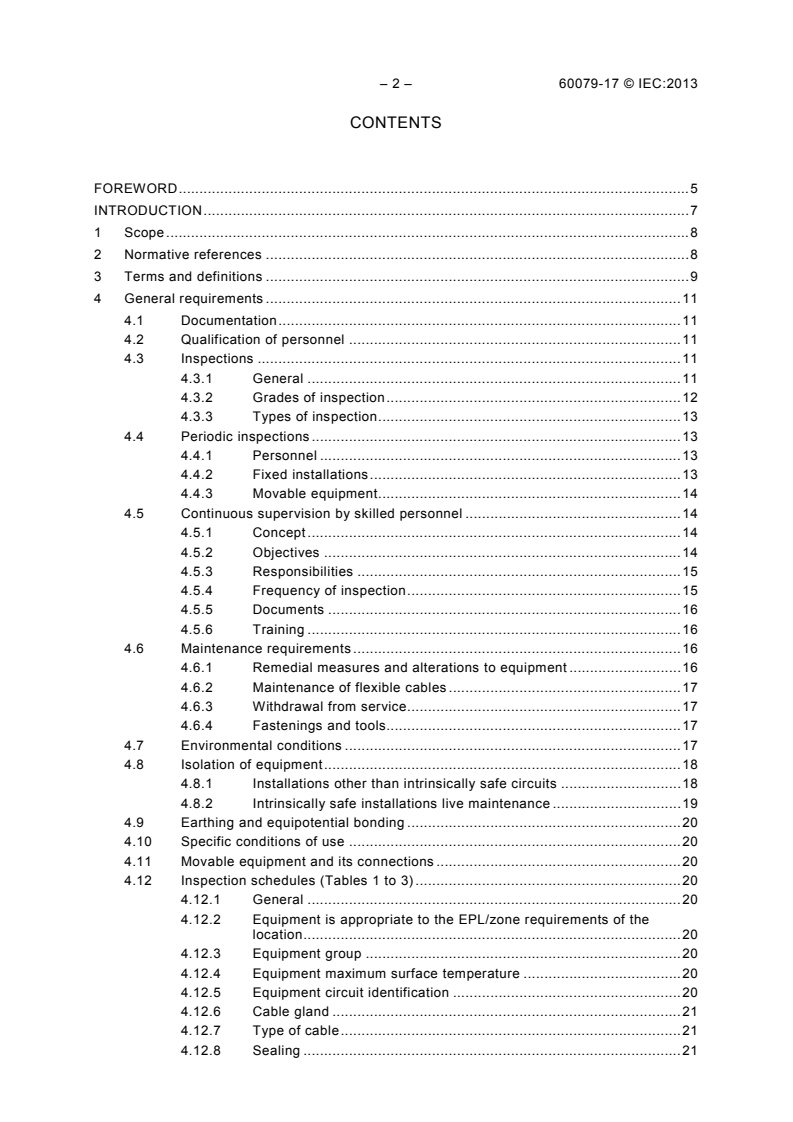
– 2 – 60079-17 © IEC:2013
CONTENTS
FOREWORD . 5
INTRODUCTION . 7
1 Scope . 8
2 Normative references . 8
3 Terms and definitions . 9
4 General requirements . 11
4.1 Documentation . 11
4.2 Qualification of personnel . 11
4.3 Inspections . 11
4.3.1 General . 11
4.3.2 Grades of inspection . 12
4.3.3 Types of inspection . 13
4.4 Periodic inspections . 13
4.4.1 Personnel . 13
4.4.2 Fixed installations . 13
4.4.3 Movable equipment. 14
4.5 Continuous supervision by skilled personnel . 14
4.5.1 Concept . 14
4.5.2 Objectives . 14
4.5.3 Responsibilities . 15
4.5.4 Frequency of inspection . 15
4.5.5 Documents . 16
4.5.6 Training . 16
4.6 Maintenance requirements . 16
4.6.1 Remedial measures and alterations to equipment . 16
4.6.2 Maintenance of flexible cables . 17
4.6.3 Withdrawal from service. 17
4.6.4 Fastenings and tools. 17
4.7 Environmental conditions . 17
4.8 Isolation of equipment . 18
4.8.1 Installations other than intrinsically safe circuits . 18
4.8.2 Intrinsically safe installations live maintenance . 19
4.9 Earthing and equipotential bonding . 20
4.10 Specific conditions of use . 20
4.11 Movable equipment and its connections . 20
4.12 Inspection schedules (Tables 1 to 3) . 20
4.12.1 General . 20
4.12.2 Equipment is appropriate to the EPL/zone requirements of the
location . 20
4.12.3 Equipment group . 20
4.12.4 Equipment maximum surface temperature . 20
4.12.5 Equipment circuit identification . 20
4.12.6 Cable gland . 21
4.12.7 Type of cable . 21
4.12.8 Sealing . 21
60079-17 © IEC:2013 – 3 –
4.12.9 Fault loop impedance or earthing resistance . 21
4.12.10 Insulation resistance . 21
4.12.11 Overload protection . 21
4.12.12 Lamps and luminaires . 21
5 Additional inspection schedule requirements . 22
5.1 Type of protection “d” – Flameproof enclosure (see Table 1 and
IEC 60079-1) . 22
5.2 Type of protection “e” – Increased safety (see Table 1 and IEC 60079-7) . 22
5.3 Type of protection “i” – Intrinsic safety (see Table 2 and IEC 60079-11) . 22
5.3.1 General . 22
5.3.2 Documentation . 22
5.3.3 Labelling . 23
5.3.4 Unauthorized modifications . 23
5.3.5 Associated apparatus (safety interface) between intrinsically
safe and non-intrinsically safe circuits . 23
5.3.6 Cables . 23
5.3.7 Cable screens. 23
5.3.8 Point-to-point connections . 23
5.3.9 Earth continuity of non-galvanically isolated circuits . 23
5.3.10 Earth connections to maintain the integrity of the intrinsic
safety . 24
5.3.11 Intrinsically safe circuit earthing and/or insulation . 24
5.3.12 Separation between intrinsically safe and non-intrinsically
safe circuits . 24
5.4 Type of protection “p” and “pD” – Pressurized enclosure (see Table 3,
IEC 60079-2 and IEC 61241-4) . 24
5.5 Type of protection “n” (see Table 1 or 2 and IEC 60079-15) . 24
5.5.1 General . 24
5.5.2 Restricted breathing enclosures . 25
5.6 Type of protection “t” and “tD” – Protection by enclosure (see Table 1 and
IEC 60079-31 and IEC 61241-1) . 25
5.7 Types of protection “m” and “mD” (encapsulation), “o”, (oil-immersion)
“op” (optical radiation) and “q” (powder-filling). 25
6 Inspection tables . 25
Annex A (informative) Typical inspection procedure for periodic inspections . 30
Annex B (normative) Knowledge, skills and competencies of responsible persons,
technical persons with executive function and operatives . 31
B.1 Scope . 31
B.2 Knowledge and skills . 31
B.2.1 Responsible persons and technical persons with executive
function . 31
B.2.2 Operative/technician (inspection and maintenance) . 31
B.3 Competencies . 32
B.3.1 General . 32
B.3.2 Responsible persons and technical persons with executive
function . 32
B.3.3 Operative/technician . 32
B.4 Assessment . 32
Annex C (informative) Fitness-for-purpose assessment . 33
C.1 Background . 33
– 4 – 60079-17 © IEC:2013
C.2 Need for a fitness-for-purpose assessment . 33
C.3 Approach . 33
C.4 Ignition sources . 33
C.5 Contents of the fitness-for-purpose assessment . 33
C.5.1 General . 33
C.5.2 Scope . 33
C.5.3 Equipment and its application . 34
C.5.4 Description . 34
C.5.5 Function of the product including the location . 34
C.5.6 Specification . 34
C.5.7 Standards compliance . 34
C.5.8 Documents . 35
C.5.9 Product sample . 35
C.5.10 Equipment label . 35
C.5.11 Training of personnel . 35
Annex D (informative) Example of motor checks . 36
Bibliography . 37
Figure A.1 – Typical inspection procedure for periodic inspections . 30
Table 1 – Inspection schedule for Ex “d”, Ex “e”, Ex “n” and Ex “t/tD” . 25
Table 2 – Inspection schedule for Ex “i” installations . 28
Table 3 – Inspection schedule for Ex “p” and “pD” installations . 29
60079-17 © IEC:2013 – 5 –
INTERNATIONAL ELECTROTECHNICAL COMMISSION
____________
EXPLOSIVE ATMOSPHERES –
Part 17: Electrical installations inspection and maintenance
FOREWORD
1) The International Electrotechnical Commission (IEC) is a worldwide organization for standardization comprising
all national electrotechnical committees (IEC National Committees). The object of IEC is to promote
international co-operation on all questions concerning standardization in the electrical and electronic fields. To
this end and in addition to other activities, IEC publishes International Standards, Technical Specifications,
Technical Reports, Publicly Available Specifications (PAS) and Guides (hereafter referred to as “IEC
Publication(s)”). Their preparation is entrusted to technical committees; any IEC National Committee interested
in the subject dealt with may participate in this preparatory work. International, governmental and non-
governmental organizations liaising with the IEC also participate in this preparation. IEC collaborates closely
with the International Organization for Standardization (ISO) in accordance with conditions determined by
agreement between the two organizations.
2) The formal decisions or agreements of IEC on technical matters express, as nearly as possible, an international
consensus of opinion on the relevant subjects since each technical committee has representation from all
interested IEC National Committees.
3) IEC Publications have the form of recommendations for international use and are accepted by IEC National
Committees in that sense. While all reasonable efforts are made to ensure that the technical content of IEC
Publications is accurate, IEC cannot be held responsible for the way in which they are used or for any
misinterpretation by any end user.
4) In order to promote international uniformity, IEC National Committees undertake to apply IEC Publications
transparently to the maximum extent possible in their national and regional publications. Any divergence
between any IEC Publication and the corresponding national or regional publication shall be clearly indicated in
the latter.
5) IEC itself does not provide any attestation of conformity. Independent certification bodies provide conformity
assessment services and, in some areas, access to IEC marks of conformity. IEC is not responsible for any
services carried out by independent certification bodies.
6) All users should ensure that they have the latest edition of this publication.
7) No liability shall attach to IEC or its directors, employees, servants or agents including individual experts and
members of its technical committees and IEC National Committees for any personal injury, property damage or
other damage of any nature whatsoever, whether direct or indirect, or for costs (including legal fees) and
expenses arising out of the publication, use of, or reliance upon, this IEC Publication or any other IEC
Publications.
8) Attention is drawn to the Normative references cited in this publication. Use of the referenced publications is
indispensable for the correct application of this publication.
9) Attention is drawn to the possibility that some of the elements of this IEC Publication may be the subject of
patent rights. IEC shall not be held responsible for identifying any or all such patent rights.
International Standard IEC 60079-17 has been prepared by subcommittee 31J: Classification
of hazardous areas and installation requirements, of IEC technical committee 31: Equipment
for explosive atmospheres.
This fifth edition cancels and replaces the fourth edition published in 2007 and constitutes a
technical revision.
The significant technical changes with respect to the previous edition are as follows:
• Equipment specific inspection tables for luminaires, heating systems and motors have
been added into Annex A to supplement the general protection concept tables.
• Document has been updated to complement the changes made to IEC 60079-14 for initial
inspection.
– 6 – 60079-17 © IEC:2013
The text of this standard is based on the following documents:
FDIS Report on voting
31J/224/FDIS 31J/229/RVD
Full information on the voting for the approval of this standard can be found in the report on
voting indicated in the above table.
This publication has been drafted in accordance with the ISO/IEC Directives, Part 2.
This International Standard is to be used in conjunction with IEC 60364-6.
A list of all parts of the IEC 60079 series, under the general title Explosive atmospheres, can
be found on the IEC website.
The committee has decided that the contents of this publication will remain unchanged until
the stability date indicated on the IEC web site under "http://webstore.iec.ch" in the data
related to the specific publication. At this date, the publication will be
• reconfirmed,
• withdrawn,
• replaced by a revised edition, or
• amended.
60079-17 © IEC:2013 – 7 –
INTRODUCTION
Electrical installations in hazardous areas possess features specially designed to render them
suitable for operations in such atmospheres. It is essential for reasons of safety in those
areas that, throughout the life of such installations, the integrity of those special features is
preserved. This standard provides the details for initial inspection and on-going inspections as
either;
a) regular periodic inspections thereafter, or,
b) continuous supervision by skilled personnel.
When necessary, maintenance may also be needed.
Correct functional operation of hazardous area installations does not mean, and should not be
interpreted as meaning, that the integrity of the special features referred to above is
preserved.
Inspections are carried out in accordance with this standard, however for older installations
the details for the equipment and installations requirements should be referenced to the
standards applied at the date of the installation.
NOTE Standards applied at the date of installation may not have been IEC standards.
– 8 – 60079-17 © IEC:2013
EXPLOSIVE ATMOSPHERES –
Part 17: Electrical installations inspection and maintenance
1 Scope
This part of the IEC 60079 series applies to users and covers factors directly related to the
inspection and maintenance of electrical installations within hazardous areas only, where the
hazard may be caused by flammable gases, vapours, mists, dusts, fibres or flyings.
It does not include:
• other fundamental installation and inspection requirements for electrical installations;
• the verification of electrical equipment;
• the repair and reclamation of explosion protected equipment (see IEC 60079-19).
This standard supplements the requirements of IEC 60364-6.
In the case of dusts, fibres or flyings the level of housekeeping may influence the inspection
and maintenance requirements.
This standard is intended to be applied where there can be a risk due to the presence of
explosive gas or dust mixtures with air or combustible dust layers under normal atmospheric
conditions. It does not apply to:
• underground mining areas,
• dusts of explosives that do not require atmospheric oxygen for combustion,
• pyrophoric substances.
2 Normative references
The following documents, in whole or in part, are normatively referenced in this document and
are indispensable for its application. For dated references, only the edition cited applies. For
undated references, the latest edition of the referenced document (including any
amendments) applies.
IEC 60079-0, Explosive atmospheres - Part 0: Equipment - General requirements
IEC 60079-1, Explosive atmospheres – Part 1: Equipment protection by flameproof enclosures
"d"
IEC 60079-2, Explosive atmospheres – Part 2: Equipment protection by pressurized
enclosures "p"
IEC 60079-7, Explosive atmospheres – Part 7: Equipment protection by increased safety “e”
IEC 60079-10-1, Explosive atmospheres – Part 10-1: Classification of areas – Explosive gas
atmospheres
IEC 60079-10-2, Explosive atmospheres – Part 10-2: Classification of areas – Combustible
dust atmospheres
60079-17 © IEC:2013 – 9 –
IEC 60079-11, Explosive atmospheres – Part 11: Equipment protection by intrinsic safety "i"
IEC 60079-14, Explosive atmospheres – Part 14: Electrical installations design, selection and
erection
IEC 60079-15, Explosive atmospheres – Part 15: Equipment protection by type of protection
"n"
IEC 60079-19, Explosive atmospheres – Part 19: Equipment repair, overhaul and reclamation
IEC 60079-31, Explosive atmospheres – Part 31: Equipment dust ignition protection by
enclosure "t"
IEC 60364-6, Low-voltage electrical installations – Part 6: Verification
IEC 61241-4, Electrical apparatus for combustible dust atmospheres – Part 4: Type of
protection "pD"
3 Terms and definitions
For the purposes of this document, the terms and definitions given in IEC 60079-0 and the
following apply.
NOTE Additional definitions applicable to explosive atmospheres can be found in IEC 60050-426.
3.1
close inspection
inspection which encompasses those aspects covered by a visual inspection and, in addition,
identifies those defects, such as loose bolts, which will be apparent only by the use of access
equipment
EXAMPLE Steps, (where necessary), and tools.
Note 1 to entry: Close inspections do not normally require the enclosure to be opened, or the equipment to be de-
energized.
3.2
continuous supervision
frequent attendance, inspection, service, care and maintenance of the electrical installation by
skilled personnel who have experience in the specific installation and its environment in order
to maintain the explosion protection features of the installation in satisfactory condition
3.3
detailed inspection
inspection which encompasses those aspects covered by a close inspection and, in addition,
identifies those defects, such as loose terminations, which will only be apparent by opening
the enclosure, and/or using, where necessary, tools and test equipment
3.4
hazardous area
area in which an explosive atmosphere is present, or may be expected to be present, in
quantities such as to require special precautions for the construction, installation and use of
equipment
Note 1 to entry: For the purposes of this standard, an area is a three-dimensional region or space.
– 10 – 60079-17 © IEC:2013
3.5
initial inspection
inspection of all electrical equipment, systems and installations before they are brought into
service
3.6
inspection
action comprising careful scrutiny of an item carried out either without dismantling, or with the
addition of partial dismantling as required, supplemented by means such as measurement, in
order to arrive at a reliable conclusion as to the condition of an item
3.7
maintenance
combination of any actions carried out to retain an item in, or restore it to, conditions in which
it is able to meet the requirements of the relevant specification and perform its required
functions
3.8
live maintenance
maintenance activities carried out while circuits are energized
3.9
non-hazardous area
area in which an explosive atmosphere is not expected to be present in quantities such as to
require special precautions for the construction, installation and use of equipment
3.10
periodic inspection
inspection of all electrical equipment, systems and installations carried out on a routine basis
3.11
sample inspection
inspection of a representative proportion of the electrical equipment, systems and installations
3.12
skilled personnel
persons whose training has included instruction on the various types of protection and
installation practices, the requirements of this standard, the relevant national
regulations/company rules applicable to the installation and on the general principles of area
classification
3.13
technical person with executive function
person providing technical management of the skilled personnel, having adequate knowledge
in the field of explosion protection, having familiarity with the local conditions, having
familiarity with the installation and who has overall responsibility and control of the inspection
systems for the electrical equipment within hazardous areas
3.14
visual inspection
inspection which identifies, without the use of access equipment or tools, those defects, such
as missing bolts, which will be apparent to the eye
60079-17 © IEC:2013 – 11 –
4 General requirements
4.1 Documentation
For the purposes of inspection and maintenance, up-to-date documentation (verification
dossier) including any modification records, of the following items shall be available:
a) zone classification of areas and, if included, the equipment protection level (EPL) required
for each location (see IEC 60079-10-1 and IEC 60079-10-2),
b) for gases: equipment group (IIA, IIB or IIC) and temperature class requirements,
c) for dusts: equipment group (IIIA, IIIB or IIIC) and maximum surface temperature
requirements,
d) equipment characteristics e.g. temperature ratings, type of protection, IP rating, corrosion
resistance,
e) records sufficient to enable the explosion protected equipment to be maintained in
accordance with its type of protection (see IEC 60079-14), (for example list and location of
equipment, spares, certificates, technical information),
f) copies of previous inspection records,
g) copy of the additional initial inspection records as detailed in IEC 60079-14.
Requirements for other documentation that may be necessary are provided in IEC 60079-14
and IEC 60079-19.
4.2 Qualification of personnel
The inspection and maintenance of installations covered by this standard shall be carried out
only by experienced personnel, whose training has included instruction on the various types
of protection and installation practices, the requirements of this standard, the relevant
national regulations/company rules applicable to the installation and on the general principles
of area classification (see Annex B). Appropriate continuing education or training shall be
undertaken by personnel on a regular basis. Evidence of the relevant experience and training
claimed shall be documented and available.
4.3 Inspections
4.3.1 General
4.3.1.1 Basic Principles
Before plant or equipment is brought into service, it shall be given an initial inspection. As
part of the plant commissioning and start up procedures, initial inspection and other additional
requirements are provided in IEC 60079-14.
To ensure that the installations are maintained in a satisfactory condition for continued use
within a hazardous area, either
a) regular periodic inspections, or
b) continuous supervision by skilled personnel,
and, where necessary, maintenance shall be carried out.
NOTE 1 In the case of dusts, fibres or flyings, housekeeping can influence the inspection and maintenance
requirements.
Following any adjustment, maintenance, repair, reclamation, modification or replacement, the
equipment or relevant parts of equipment concerned shall be inspected in accordance with
the relevant items of the detailed column of Tables 1, 2 and 3.
– 12 – 60079-17 © IEC:2013
The inspection activity shall be sufficiently independent of any immediate demands of
maintenance and/or other activities so as not to prejudice the reliability of any report findings
from the inspection.
NOTE 2 Inspection personnel do not need to be members of an external independent organisation.
If at any time there is a change in the area classification or the Equipment Protection Level
requirements or if any equipment is moved from one location to another, a check shall be
made to ensure that the type of protection, group and surface temperature, where appropriate,
are suitable for the revised conditions.
If plant or equipment is dismantled during the course of an inspection, precautions shall be
taken during reassembly to ensure that the integrity of the type of protection is not impaired.
NOTE 3 This includes removing any residual dust and replacing gaskets correctly.
NOTE 4 The major factors effecting the deterioration of equipment include: susceptibility to corrosion, exposure to
chemicals or solvents, likelihood of accumulation of dust or dirt, likelihood of water ingress, exposure to excessive
ambient temperature, risk of mechanical damage, exposure to undue vibration. Other service factors include:
training and experience of personnel, likelihood of unauthorized modifications or adjustments and likelihood of
inappropriate maintenance, for example that which is not in accordance with the manufacturer's recommendation.
4.3.1.2 Verification of unmarked equipment
Where the certification plate or markings on explosion protected equipment is missing or
illegible, alternative methods may be used to determine traceability to the certification details
of the specific equipment. The method used could include: additional identification labels
which incorporate unique tag numbers, serial numbers or reference to the installation
databases. The method of attaching or fixing the labelling shall not reduce the integrity of the
equipment.
The inventory and identification tagging method used for managing explosion protected
equipment shall be capable of tracking the replacement of equipment with replacement or
repaired equipment, which may have different certification markings and details to the original
equipment.
4.3.1.3 Acceptance of equipment in old installations
For existing equipment not able to be identified as being certified for use in a hazardous area
it is necessary to establish that the equipment is suitable for on-going use. In order to
correctly operate and maintain the equipment, an assessment will be necessary to verify the
specification of the equipment, to determine it is fit-for-purpose in the specific location in order
to determine the appropriate inspection and maintenance requirements. In these
circumstances the procedure given in Annex C may be followed.
NOTE This assessment is intended to apply to items in an installation that predate any requirement for the use of
certified electrical equipment in hazardous areas.
4.3.2 Grades of inspection
The grade of inspection may be visual, close or detailed. Tables 1, 2, and 3 detail the checks
required for these three grades of inspection on general and specific items of electrical
equipment.
Visual and close inspections can be performed with the equipment energized. Detailed
inspections will generally require the equipment to be isolated.
The grade of inspection selected for equipment using more than one type of protection (e.g.
Ex “ed” equipment) shall be a combination of the relevant columns from the tables 1, 2 and 3.
60079-17 © IEC:2013 – 13 –
4.3.3 Types of inspection
Types of inspections include:
a) Initial inspections used to check that the selected type of protection and its installation are
appropriate based on detailed inspections. The requirements are covered in IEC 60079-14.
b) Periodic inspections which may be visual, close or detailed in accordance with Tables 1,
2, and 3, or modified tables in accordance with 5.7, as appropriate.
c) Sample inspections which may be visual, close or detailed in accordance with Tables 1, 2,
and 3, or modified tables in accordance with 5.7, as appropriate. The size and
composition of all samples shall be determined with regard to the purpose of the
inspection.
Sample inspections should not be expected to reveal faults of a random nature, such as
loose connections, but should be used to monitor the effects of environmental conditions,
vibration, inherent design weakness, etc.
d) Continuous supervision utilizing the visual or close inspections in accordance with Tables
1, 2, and 3, or modified tables in accordance with 5.7, as appropriate and in accordance
with 4.5. Where the installation falls outside the capability for continuous supervision it
shall be subject to periodic inspection.
The results of all inspections shall be recorded and retained, and may lead to a need for
further actions. The requirements for continuous supervision are detailed in 4.5.5.
4.4 Periodic inspections
4.4.1 Personnel
Regular periodic inspection requires personnel who are competent for the inspection required,
including that they:
a) have a knowledge of area classification/EPL and sufficient technical knowledge to
understand its implications for the location under consideration;
b) have technical knowledge and understanding of the theoretical and practical requirements
for electrical equipment and installations used in those hazardous areas;
c) understand the requirements of visual, close and detailed inspections as they relate to the
installed equipment and installations.
NOTE Competencies and training may be identified in relevant national training and assessment frameworks.
4.4.2 Fixed installations
The grade of inspection and the interval between periodic inspections shall be determined
taking account of the type of equipment, the manufacturer's guidance, if any, the factors
governing its deterioration (see 4.3.1.1, Note 3), the area classification and/or the EPL
requirements and the results of previous inspections. Where inspection grades and intervals
have been established for similar equipment, installations and environments, this experience
shall be used in determining the inspection strategy.
The interval between periodic inspections shall not exceed three years without seeking expert
advice. The basis for changing the inspection period shall be documented.
Intervals between periodic inspections exceeding three years should be based on an
assessment including relevant information.
Once an interval has been fixed, the installation should be subjected to additional interim
sample inspections to support or modify the proposed interval and grade of inspection.
Ongoing review of the results of inspections will be required to justify the interval between,
and grade of inspections.
– 14 – 60079-17 © IEC:2013
A typical inspection procedure is shown diagrammatically in Annex A.
When large numbers of similar items such as luminaires, junction boxes, etc. are installed in a
similar environment, it may be feasible to carry out periodical inspections on a sample basis
provided that the number of samples in addition to the inspection frequency is subjected to
review. It is, however recommended that all items be subjected at least to a visual inspection.
4.4.3 Movable equipment
Movable electrical equipment (hand-held, portable, and transportable) is particularly prone to
damage or misuse and therefore the interval between periodic inspections may need to be
reduced.
The interval between periodic inspections shall not exceed the following without seeking
expert advice:
a) hand-held and portable equipment shall be visually checked by the user, before each use,
to ensure that the equipment is not obviously damaged;
b) all equipment shall be submitted to a close inspection at least every 12 months;
c) enclosures which are frequently opened (such as battery housings) shall be given a
detailed inspection at least every 6 months.
The basis for changing the inspection period shall be documented.
4.5 Continuous supervision by skilled personnel
4.5.1 Concept
Where an installation is visited on a regular basis, in the normal course of work, by skilled
personnel who, in addition to satisfying the requirements of 4.4.1 a), b) and c), are:
a) aware of the process and environmental implications on the deterioration of the specific
equipment in the installation, and
b) required to carry out visual and/or close inspections as part of their normal work schedule
as well as detailed inspections as part of any replacement, or adjustment in accordance
with 4.3.1.1,
then it may be possible to dispense with regular periodic inspection and utilize the frequent
presence of the skilled personnel to ensure the on-going integrity of the equipment.
The use of continuous supervision by skilled personnel does not remove the requirement for
initial and sample inspections.
Continuous supervision is not practicable for electrical equipment for which this kind of
attendance cannot be provided (e.g. in the case of movable equipment). See also 4.5.4.
4.5.2 Objectives
The objective of continuous supervision is to enable the early detection of arising faults and
their subsequent repair. It makes use of existing skilled personnel who are in attendance at
the installation in the course of their normal work (e.g. erection work, alterations, inspections,
maintenance work, checking for faults, cleaning work, control operations, switching operations,
making terminal connections and disconnections, setting and adjustment work, functional
tests, measurements) and who use their skill to detect faults and changes at an early stage.
60079-17 © IEC:2013 – 15 –
4.5.3 Responsibilities
4.5.3.1 Technical persons with executive function
A technical person with executive function shall be identified for each installation and shall
carry out the following tasks:
a) assess the viability of the continuous supervision concept in light of the competence, skills
and availability of personnel and their experience in relation to the particular installation;
b) define the scope of equipment to be considered under continuous supervision taking
account of environmental conditions, frequency of attendance, special knowledge, work
flow and location of equipment;
c) determine the frequency of inspection, the grade of inspection and the content of reporting
such as to enable meaningful analysis of equipment performance;
d) ensure that the documentation referred to in 4.1 and 4.5.5 is made available;
e) ensure that skilled personnel are familiar with:
1) the concept of continuous supervision together with the needs for any reporting or
analysis function;
2) the installation they attend;
3) the inventory of explosion protected equipment within their area of responsibility;
f) arrange for verification that:
1) process of continuous supervision is being adhered to;
2) skilled personnel a
...