

IEC TR 62839-1:2025
(Main)Environmental declaration - Part 1: Communication wires and cables - Product specific rules
General Information
- Abstract
IEC TR 62839-1:2025 describes the product specific rules (PSR) for wires and cables used for communication, data, control and command.
These PSR are applicable in case the life cycle assessment (LCA) results are intended to be used in external communication in the form of an environmental product declaration (EPD), as laid out in ISO 14021, ISO 14025, ISO 14026 and ISO 14067. These PSR are complementary to the product category rules (PCR) for (LCA) of electrical and electronic products and systems (EEPS) provided in IEC 63366.
The following categories of wires and cables are covered in this document:
– communication and data wires and cables which can comprise metallic conductors or optical fibre;
– control and command wires and cables which can comprise metallic conductors or optical fibre.
This document is applicable to communication cables in general, it is related in particular to the wire and cable products covered by generic cabling described in the ISO/IEC 11801 series which is based on component standards described in the IEC 60794 series (fibre optic cables), IEC 61156 series (metallic balanced communication cables) and the IEC 61196 series (coaxial metallic communication cables). According to this relationship, this document is related to ISO/IEC 14763-5 which describes sustainability aspect of generic cabling.
This document is primarily intended for:
– environment and/or product managers;
– LCA experts in companies or contractors and other 3rd party operators, in charge of EPD;
– verifiers in charge of conformity assessment in accordance with the defined rules.
This second edition cancels and replaces the first edition published in 2014. This edition constitutes a technical revision.
This edition includes the following significant technical changes with respect to the previous edition:
a) The term "accessory products" has been removed from the title and the text as accessories are covered by IEC TR 62839-2.
b) The consideration of remote powering was added for the evaluation of the use stage.
c) Guidance was added with respect to evaluate the use stage of certain coaxial cables.
d) Update of the entire document to reflect a complete life cycle assessment.
- Status
- Published
- Publication Date
- 07-Aug-2025
- Technical Committee
- TC 46 - Cables, wires, waveguides, RF connectors, RF and microwave passive components and accessories
- Drafting Committee
- JWG 1 - TC 46/JWG 1
- Current Stage
- PPUB - Publication issued
- Start Date
- 08-Aug-2025
- Completion Date
- 15-Aug-2025
Overview
IEC TR 62839-1:2025 - Environmental declaration - Part 1: Communication wires and cables - Product specific rules - provides product specific rules (PSR) for preparing life cycle assessments (LCA) and environmental product declarations (EPD) for communication, data, control and command wires and cables. The report covers metallic (copper/coaxial) and optical-fibre cables and is intended to support external environmental communication in line with ISO 14021, ISO 14025, ISO 14026 and ISO 14067. This second edition (2025) updates the first edition (2014) to reflect a complete LCA approach and adds guidance on remote powering and certain coaxial cable use-stage evaluations.
Key topics and technical requirements
- Scope and product categories: communication/data wires and cables and control/command cables, comprising metallic conductors or optical fibre. Related to generic cabling covered in ISO/IEC 11801 and component standards IEC 60794, IEC 61156, IEC 61196.
- Functional unit and declared unit: PSR defines standard functional units (for example, “to transmit one communication signal over 1 m during X years at Y% use rate”) and declared unit conventions for presenting impacts per fiber, per pair, or per cable.
- System boundaries and LCI: rules for defining cradle-to-end-of-life system boundaries, life cycle inventory (LCI) data collection, allocation methods and data quality requirements.
- Use stage considerations: specific guidance on evaluating the use phase including remote powering losses and transmission losses (balanced copper, coaxial and optical fibre), and protocols for extrapolating to cable capacity.
- Life cycle impact assessment (LCIA): mandatory and common indicators to be reported in EPDs, plus rules for scenarios, extrapolation to homogeneous product families, and treatment of carbon offset/biogenic carbon.
- Reporting and verification: requirements for LCA reporting and the intended format for EPD use in external communication.
Applications and practical value
- Helps manufacturers and LCA practitioners create comparable, standardized EPDs for communication and control cables.
- Facilitates environmental product reporting used in procurement, green building, telecom infrastructure planning, and sustainability assessments.
- Supports product design decisions (material selection, durability, remote powering trade-offs) by clarifying use-stage impacts and end-of-life treatments.
Who should use this standard
- Environment and product managers preparing EPDs
- LCA experts and consultants conducting cable LCAs
- Third‑party verifiers and conformity assessors validating EPDs
- Procurement specialists and sustainability officers evaluating cable environmental performance
Related standards
- ISO 14021, ISO 14025, ISO 14026, ISO 14067 (EPD and LCA communication)
- IEC 63366 (PCR for electrical and electronic products and systems)
- ISO/IEC 11801, ISO/IEC 14763-5, IEC 60794, IEC 61156, IEC 61196 (cabling and component standards)
Keywords: IEC TR 62839-1:2025, environmental declaration, EPD, LCA, communication wires and cables, product specific rules, remote powering, fibre optic, copper, coaxial.
Relations
- Effective Date
- 05-Sep-2023
Get Certified
Connect with accredited certification bodies for this standard

BSI Group
BSI (British Standards Institution) is the business standards company that helps organizations make excellence a habit.

Bureau Veritas
Bureau Veritas is a world leader in laboratory testing, inspection and certification services.

DNV
DNV is an independent assurance and risk management provider.
Sponsored listings
Frequently Asked Questions
IEC TR 62839-1:2025 is a technical report published by the International Electrotechnical Commission (IEC). Its full title is "Environmental declaration - Part 1: Communication wires and cables - Product specific rules". This standard covers: IEC TR 62839-1:2025 describes the product specific rules (PSR) for wires and cables used for communication, data, control and command. These PSR are applicable in case the life cycle assessment (LCA) results are intended to be used in external communication in the form of an environmental product declaration (EPD), as laid out in ISO 14021, ISO 14025, ISO 14026 and ISO 14067. These PSR are complementary to the product category rules (PCR) for (LCA) of electrical and electronic products and systems (EEPS) provided in IEC 63366. The following categories of wires and cables are covered in this document: – communication and data wires and cables which can comprise metallic conductors or optical fibre; – control and command wires and cables which can comprise metallic conductors or optical fibre. This document is applicable to communication cables in general, it is related in particular to the wire and cable products covered by generic cabling described in the ISO/IEC 11801 series which is based on component standards described in the IEC 60794 series (fibre optic cables), IEC 61156 series (metallic balanced communication cables) and the IEC 61196 series (coaxial metallic communication cables). According to this relationship, this document is related to ISO/IEC 14763-5 which describes sustainability aspect of generic cabling. This document is primarily intended for: – environment and/or product managers; – LCA experts in companies or contractors and other 3rd party operators, in charge of EPD; – verifiers in charge of conformity assessment in accordance with the defined rules. This second edition cancels and replaces the first edition published in 2014. This edition constitutes a technical revision. This edition includes the following significant technical changes with respect to the previous edition: a) The term "accessory products" has been removed from the title and the text as accessories are covered by IEC TR 62839-2. b) The consideration of remote powering was added for the evaluation of the use stage. c) Guidance was added with respect to evaluate the use stage of certain coaxial cables. d) Update of the entire document to reflect a complete life cycle assessment.
IEC TR 62839-1:2025 describes the product specific rules (PSR) for wires and cables used for communication, data, control and command. These PSR are applicable in case the life cycle assessment (LCA) results are intended to be used in external communication in the form of an environmental product declaration (EPD), as laid out in ISO 14021, ISO 14025, ISO 14026 and ISO 14067. These PSR are complementary to the product category rules (PCR) for (LCA) of electrical and electronic products and systems (EEPS) provided in IEC 63366. The following categories of wires and cables are covered in this document: – communication and data wires and cables which can comprise metallic conductors or optical fibre; – control and command wires and cables which can comprise metallic conductors or optical fibre. This document is applicable to communication cables in general, it is related in particular to the wire and cable products covered by generic cabling described in the ISO/IEC 11801 series which is based on component standards described in the IEC 60794 series (fibre optic cables), IEC 61156 series (metallic balanced communication cables) and the IEC 61196 series (coaxial metallic communication cables). According to this relationship, this document is related to ISO/IEC 14763-5 which describes sustainability aspect of generic cabling. This document is primarily intended for: – environment and/or product managers; – LCA experts in companies or contractors and other 3rd party operators, in charge of EPD; – verifiers in charge of conformity assessment in accordance with the defined rules. This second edition cancels and replaces the first edition published in 2014. This edition constitutes a technical revision. This edition includes the following significant technical changes with respect to the previous edition: a) The term "accessory products" has been removed from the title and the text as accessories are covered by IEC TR 62839-2. b) The consideration of remote powering was added for the evaluation of the use stage. c) Guidance was added with respect to evaluate the use stage of certain coaxial cables. d) Update of the entire document to reflect a complete life cycle assessment.
IEC TR 62839-1:2025 is classified under the following ICS (International Classification for Standards) categories: 13.020.01 - Environment and environmental protection in general; 33.120.10 - Coaxial cables. Waveguides; 33.120.20 - Wires and symmetrical cables. The ICS classification helps identify the subject area and facilitates finding related standards.
IEC TR 62839-1:2025 has the following relationships with other standards: It is inter standard links to IEC TR 62839-1:2014. Understanding these relationships helps ensure you are using the most current and applicable version of the standard.
IEC TR 62839-1:2025 is available in PDF format for immediate download after purchase. The document can be added to your cart and obtained through the secure checkout process. Digital delivery ensures instant access to the complete standard document.
Standards Content (Sample)
IEC TR 62839-1 ®
Edition 2.0 2025-08
TECHNICAL
REPORT
Environmental declaration -
Part 1: Communication wires and cables - Product specific rules
ICS 13.020.01; 33.120.10; 33.120.20 ISBN 978-2-8327-0597-1
All rights reserved. Unless otherwise specified, no part of this publication may be reproduced or utilized in any form or
by any means, electronic or mechanical, including photocopying and microfilm, without permission in writing from either
IEC or IEC's member National Committee in the country of the requester. If you have any questions about IEC copyright
or have an enquiry about obtaining additional rights to this publication, please contact the address below or your local
IEC member National Committee for further information.
IEC Secretariat Tel.: +41 22 919 02 11
3, rue de Varembé info@iec.ch
CH-1211 Geneva 20 www.iec.ch
Switzerland
About the IEC
The International Electrotechnical Commission (IEC) is the leading global organization that prepares and publishes
International Standards for all electrical, electronic and related technologies.
About IEC publications
The technical content of IEC publications is kept under constant review by the IEC. Please make sure that you have the
latest edition, a corrigendum or an amendment might have been published.
IEC publications search - IEC Products & Services Portal - products.iec.ch
webstore.iec.ch/advsearchform Discover our powerful search engine and read freely all the
publications previews, graphical symbols and the glossary.
The advanced search enables to find IEC publications by a
variety of criteria (reference number, text, technical With a subscription you will always have access to up to date
committee, …). It also gives information on projects, content tailored to your needs.
replaced and withdrawn publications.
Electropedia - www.electropedia.org
The world's leading online dictionary on electrotechnology,
IEC Just Published - webstore.iec.ch/justpublished
Stay up to date on all new IEC publications. Just Published containing more than 22 500 terminological entries in English
details all new publications released. Available online and and French, with equivalent terms in 25 additional languages.
once a month by email. Also known as the International Electrotechnical Vocabulary
(IEV) online.
IEC Customer Service Centre - webstore.iec.ch/csc
If you wish to give us your feedback on this publication or
need further assistance, please contact the Customer
Service Centre: sales@iec.ch.
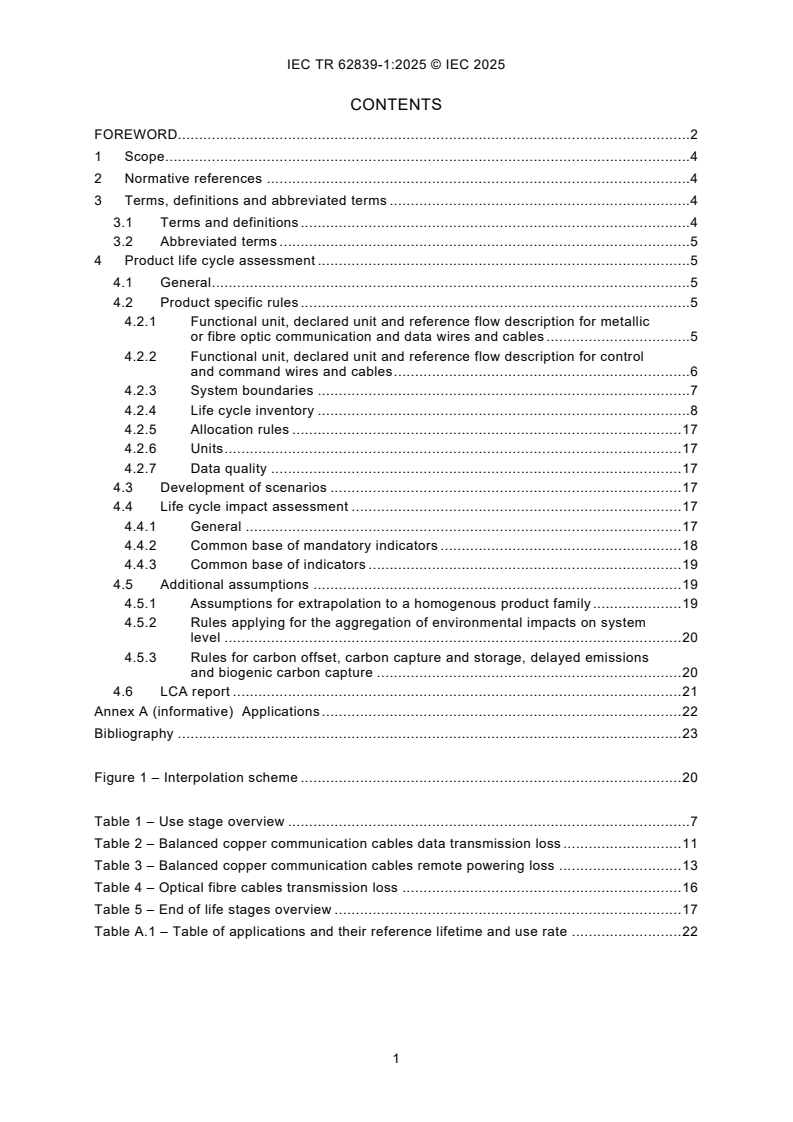
CONTENTS
FOREWORD. 2
1 Scope . 4
2 Normative references . 4
3 Terms, definitions and abbreviated terms . 4
3.1 Terms and definitions . 4
3.2 Abbreviated terms . 5
4 Product life cycle assessment . 5
4.1 General . 5
4.2 Product specific rules . 5
4.2.1 Functional unit, declared unit and reference flow description for metallic
or fibre optic communication and data wires and cables . 5
4.2.2 Functional unit, declared unit and reference flow description for control
and command wires and cables . 6
4.2.3 System boundaries . 7
4.2.4 Life cycle inventory . 8
4.2.5 Allocation rules . 17
4.2.6 Units . 17
4.2.7 Data quality . 17
4.3 Development of scenarios . 17
4.4 Life cycle impact assessment . 17
4.4.1 General . 17
4.4.2 Common base of mandatory indicators . 18
4.4.3 Common base of indicators . 19
4.5 Additional assumptions . 19
4.5.1 Assumptions for extrapolation to a homogenous product family . 19
4.5.2 Rules applying for the aggregation of environmental impacts on system
level . 20
4.5.3 Rules for carbon offset, carbon capture and storage, delayed emissions
and biogenic carbon capture . 20
4.6 LCA report . 21
Annex A (informative) Applications . 22
Bibliography . 23
Figure 1 – Interpolation scheme . 20
Table 1 – Use stage overview . 7
Table 2 – Balanced copper communication cables data transmission loss . 11
Table 3 – Balanced copper communication cables remote powering loss . 13
Table 4 – Optical fibre cables transmission loss . 16
Table 5 – End of life stages overview . 17
Table A.1 – Table of applications and their reference lifetime and use rate . 22
INTERNATIONAL ELECTROTECHNICAL COMMISSION
____________
Environmental declaration -
Part 1: Communication wires and cables - Product specific rules
FOREWORD
1) The International Electrotechnical Commission (IEC) is a worldwide organization for standardization comprising
all national electrotechnical committees (IEC National Committees). The object of IEC is to promote international
co-operation on all questions concerning standardization in the electrical and electronic fields. To this end and
in addition to other activities, IEC publishes International Standards, Technical Specifications, Technical Reports,
Publicly Available Specifications (PAS) and Guides (hereafter referred to as "IEC Publication(s)"). Their
preparation is entrusted to technical committees; any IEC National Committee interested in the subject dealt with
may participate in this preparatory work. International, governmental and non-governmental organizations liaising
with the IEC also participate in this preparation. IEC collaborates closely with the International Organization for
Standardization (ISO) in accordance with conditions determined by agreement between the two organizations.
2) The formal decisions or agreements of IEC on technical matters express, as nearly as possible, an international
consensus of opinion on the relevant subjects since each technical committee has representation from all
interested IEC National Committees.
3) IEC Publications have the form of recommendations for international use and are accepted by IEC National
Committees in that sense. While all reasonable efforts are made to ensure that the technical content of IEC
Publications is accurate, IEC cannot be held responsible for the way in which they are used or for any
misinterpretation by any end user.
4) In order to promote international uniformity, IEC National Committees undertake to apply IEC Publications
transparently to the maximum extent possible in their national and regional publications. Any divergence between
any IEC Publication and the corresponding national or regional publication shall be clearly indicated in the latter.
5) IEC itself does not provide any attestation of conformity. Independent certification bodies provide conformity
assessment services and, in some areas, access to IEC marks of conformity. IEC is not responsible for any
services carried out by independent certification bodies.
6) All users should ensure that they have the latest edition of this publication.
7) No liability shall attach to IEC or its directors, employees, servants or agents including individual experts and
members of its technical committees and IEC National Committees for any personal injury, property damage or
other damage of any nature whatsoever, whether direct or indirect, or for costs (including legal fees) and
expenses arising out of the publication, use of, or reliance upon, this IEC Publication or any other IEC
Publications.
8) Attention is drawn to the Normative references cited in this publication. Use of the referenced publications is
indispensable for the correct application of this publication.
9) IEC draws attention to the possibility that the implementation of this document may involve the use of (a)
patent(s). IEC takes no position concerning the evidence, validity or applicability of any claimed patent rights in
respect thereof. As of the date of publication of this document, IEC had not received notice of (a) patent(s), which
may be required to implement this document. However, implementers are cautioned that this may not represent
the latest information, which may be obtained from the patent database available at https://patents.iec.ch. IEC
shall not be held responsible for identifying any or all such patent rights.
IEC TR 62839-1 has been prepared by IEC technical committee 46: Cables, wires, waveguides,
RF connectors, RF and microwave passive components and accessories. It is a Technical
Report.
This second edition cancels and replaces the first edition published in 2014. This edition
constitutes a technical revision.
This edition includes the following significant technical changes with respect to the previous
edition:
a) The term "accessory products" has been removed from the title and the text as accessories
are covered by IEC TR 62839-2.
b) The consideration of remote powering was added for the evaluation of the use stage.
c) Guidance was added with respect to evaluate the use stage of certain coaxial cables.
d) Update of the entire document to reflect a complete life cycle assessment.
The text of this Technical Report is based on the following documents:
Draft Report on voting
46/1051/DTR 46/1058/RVDTR
Full information on the voting for its approval can be found in the report on voting indicated in
the above table.
The language used for the development of this Technical Report is English.
This document was drafted in accordance with ISO/IEC Directives, Part 2, and developed in
accordance with ISO/IEC Directives, Part 1 and ISO/IEC Directives, IEC Supplement, available
at www.iec.ch/members_experts/refdocs. The main document types developed by IEC are
described in greater detail at www.iec.ch/publications.
A list of all parts in the IEC 62839 series, published under the general title Environmental
declaration, can be found on the IEC website.
The committee has decided that the contents of this document will remain unchanged until the
stability date indicated on the IEC website under webstore.iec.ch in the data related to the
specific document. At this date, the document will be
• reconfirmed,
• withdrawn, or
• revised.
1 Scope
This part of IEC 62839 describes the product specific rules (PSR) for wires and cables used for
communication, data, control and command.
These PSR are applicable in case the life cycle assessment (LCA) results are intended to be
used in external communication in the form of an environmental product declaration (EPD), as
laid out in ISO 14021, ISO 14025, ISO 14026 and ISO 14067. These PSR are complementary
to the product category rules (PCR) for (LCA) of electrical and electronic products and systems
(EEPS) provided in IEC 63366.
The following categories of wires and cables are covered in this document:
– communication and data wires and cables which can comprise metallic conductors or optical
fibre;
– control and command wires and cables which can comprise metallic conductors or optical
fibre.
This document is applicable to communication cables in general, it is related in particular to the
wire and cable products covered by generic cabling described in the ISO/IEC 11801 series
which is based on component standards described in the IEC 60794 series (fibre optic cables),
IEC 61156 series (metallic balanced communication cables) and the IEC 61196 series (coaxial
metallic communication cables). According to this relationship, this document is related to
ISO/IEC 14763-5 which describes sustainability aspect of generic cabling.
This document is primarily intended for:
– environment and/or product managers;
rd
– LCA experts in companies or contractors and other 3 party operators, in charge of EPD;
– verifiers in charge of conformity assessment in accordance with the defined rules.
2 Normative references
There are no normative references in this document.
3 Terms, definitions and abbreviated terms
3.1 Terms and definitions
No terms and definitions are listed in this document.
ISO and IEC maintain terminology databases for use in standardization at the following
addresses:
• IEC Electropedia: available at https://www.electropedia.org/
• ISO Online browsing platform: available at https://www.iso.org/obp
3.2 Abbreviated terms
ADPe abiotic resource depletion
CCS carbon capture and storage
EC-JRC European Union Joined Research Center
EEPS electrical and electronic products and systems
EPD environmental product declaration
Epf eutrophication-freshwater
GWP global warming potential (climate change-total)
LCA life cycle assessment
LCI life cycle inventory
LCIA life cycle impact assessment
PSR product specific rules
4 Product life cycle assessment
4.1 General
There are two options for declaring the environmental impact indicators of a system declared
in an EPD, each of them meeting different needs:
– the functional unit used systematically when the comparison between systems (products,
solutions.) is required;
– the declared unit, which allows the direct integration of environmental impact indicators of
products at the product or system level.
4.2 Product specific rules
4.2.1 Functional unit, declared unit and reference flow description for metallic or
fibre optic communication and data wires and cables
To define the functional unit for the communication and data wires and cables, the following
sentence can be used:
"To transmit one communication signal over a distance of 1 m, at a frequency of α Hz (or
respectively a wavelength of β nm for a mono- or multi-mode optical fibre), during X years
and a Y % use rate in accordance with the standards in force.
Reference lifetime and use rate correspond to the application Z as defined in the table given
in Annex A of this document."
If the protocol used and the cable (or respectively optical fibre) category are known, the
following sentence can be used:
"To transmit one communication signal on 1 m according to XX protocol, YY category, during
X years and a Y % use rate in accordance with the standards in force (mention the relevant
standards or refer the product technical data sheet).
Reference lifetime and use rate correspond to the application Z as defined in the table given
in Annex A of this document."
The determination of the numbers X of years depends on the application and is explained in
4.2.4.5.
Moreover, on account of the wide variability in the number of communication units that a cable
can contain for a given application, and to ensure the comparability of the EPD, the impacts
can be calculated for one communication signal.
Consequently, the life cycle analysis can be carried out for the maximum capacity of the
reference product and the results presented corresponding to the functional unit, i.e. one
communication signal.
For fibre optic cables, the impacts will be presented for one optical fibre. For copper cables, the
impacts will be presented according to the protocol used for example, one pair for single pair
Ethernet, two pairs for the 100 Mbit/s Ethernet protocol and four pairs for the other protocols
with higher bandwidth. The impact results will be calculated by the EPD user by multiplying the
capability of the cable by the number of communications signals and by the number of meters
of cables laid to obtain the impacts at the scale of the equipment:
Environmental impact total = impact for 1 protocol
x number of communications signals x length (metres)
For communication and data wires and cables, to describe the declared unit the following
sentence can be used:
"A cable consisting of "N" (optical fibres or copper pairs) used to transmit communication
signals on 1 m at the frequency of α Hz (or respectively at a wavelength of β nm for an
optical fibre mono or multimode), for X years and at a rate of use of Y %, in accordance with
the standards in force (mention the standards in force or refer to the technical sheet of the
product).
Reference lifetime and use rate correspond to the application Z as defined in the table given
in Annex A of this document."
N is the total number of communication signals transmitted over the product. If the protocol
used and the cable (or respectively optical fibre) category are known, the following sentence
can be used:
"A cable composed of X (optical fibres or copper pairs) used to transmit one communication
signal on 1 m according to XX protocol, YY category, during X years and a Y % use rate in
accordance with the standards in force (mention the relevant standards or refer the product
technical data sheet).
Reference lifetime and use rate correspond to the application Z as defined in the table given
in Annex A of this document."
Conversion of environmental impacts from functional unit to declared unit:
– Multiplication of production, distribution, installation, use and end of life stages impacts by
N.
– If calculated, multiplication of module D data (see 4.2.3.1 of this document and of
IEC 63366:- , Figure D.1) by N.
4.2.2 Functional unit, declared unit and reference flow description for control and
command wires and cables
To define the functional unit for the control and command wires and cables, the following
sentence can be used:
"To transmit data and signals on a distance of 1 m during X years and a Y % use rate to
control, measure and regulate equipment, in accordance with the standards in force
(mention the relevant standards or refer the product technical data sheet).
Reference lifetime and use rate correspond to the application Z as defined in the table given
in Annex A of this document."
___________
Under preparation. Stage at the time of publication: IEC FDIS 63366:2025.
The determination of the numbers X of years depends on the application and is explained in
4.2.4.5.
To define the declared unit for the control and command wires and cables, the following
sentence can be used:
"To transmit data and signals on a distance of 1 meter during X years and a Y % use rate to
control, measure and regulate equipment, in accordance with the standards in force
(mention the relevant standards or refer the product technical data sheet).
Reference lifetime and use rate correspond to the application Z as defined in the table given
in Annex A of this document."
Conversion of environmental impacts from functional unit to declared unit:
– The declared unit is the same as the functional unit mentioned above. Thus, the conversion
factor to recalculate environmental impacts from functional unit to declared unit is "1".
4.2.3 System boundaries
4.2.3.1 General
These specific rules are additional to IEC 63366:-, 4.2.3, in order to provide a more precise
definition of the functional unit for this product category (see also IEC 63366:-, Figure D.1).
The following life cycle stages can be included:
– the manufacturing stage as described in in the product category rules of IEC 63366:-,
4.2.4.2;
– the distribution stage as described in in the product category rules of IEC 63366:-, 4.2.4.3;
– the installation stage as described in the product category rules of IEC 63366:-, 4.2.4.4;
– the use stage as described in the product category rules of IEC 63366:-, 4.2.4.5.
If breakdown of modules B (B1 to B7) is done according to the scheme described in IEC 63366:-
Annex D, the environmental impacts of the use stage can be broken down done as given in
Table 1:
Table 1 – Use stage overview
B1: Use or application of the product installed Not applicable. Module equal to 0
B2: Maintenance Not applicable. Module equal to 0
B3: Repair Not applicable. Module equal to 0
B4: Replacement Not applicable. Module equal to 0
B5: Restoration Not applicable. Module equal to 0
B6: Energy requirements during the use stage Energy losses are considered as given in 4.2.4.5
B7: Water requirements during the use stage Not applicable. Module equal to 0
– The end-of-life stage.
– Net benefits and impacts outside system boundaries (optional).
The net benefits and loads beyond the system boundaries can also be included in the EPD. It
is referred to as module D across this document (see 4.2.3.1 of this document and IEC 63366:-,
Figure D.1). It is useful to declare module D for EPDs whose systems are installed in a building.
This stage corresponds to the potential for reuse, recovery or recycling, expressed as net
benefits and impacts. The inclusion of this stage is optional.
The inputs and outputs associated with the following aspects can be included in the net benefits
and loads beyond the system boundaries stage:
a) impacts prevented by recycling the material;
b) impacts prevented by waste-to-energy recovery;
c) environmental impact of the production of the recycled material of the product, not taken
into account during the manufacturing stage.
The net benefits and loads beyond the system boundaries are calculated using the formulas
described in IEC 63366:-, Annex A.
4.2.3.2 Exclusions from system boundary
As given in IEC 63366:-, 4.2.3.2.
4.2.3.3 Cut-off criteria
As given in IEC 63366:-, 4.2.3.3.
4.2.4 Life cycle inventory
4.2.4.1 General
These specific rules are additional to IEC 63366:-, 4.2.4, in order to provide a more precise
definition of the functional unit for this product category.
4.2.4.2 Manufacturing stage
The default scenarios to be considered in this stage are:
– recycled content: 0 % recycled content or 100 % virgin materials in raw materials;
– production loss rate: 20 % of total weight of raw materials used for manufacturing the final
product.
The default end of life treatment scenario for manufacturing losses to be considered:
– transportation, assuming a local transport as described in IEC 63366;
– Refer IEC 63366:-, Annex A, for recycling of metals end-of-life treatment of different
materials;
– landfilling of other materials that are not provided in IEC 63366:-, Annex A.
Accepted document of proof to modify default scenarios is as follows: If the declarant wants to
use specific data instead of default data given in this PSR, this data is justified in the LCA
report. This data of traceable proof provided by industries can be certified. The basic
requirements are described in IEC 63366. These supporting documents are documents
engaging the responsibility of the registrant or supplier or a third party (example of third party:
independent certification body). These supporting documents can be made available to an
accredited verifier and upon request of competent authorities.
The recycled content of raw materials can, for example, be justified by supplier data (data sheet
or supplier's declaration) but cannot be justified by generic data (e.g. sector, trade unions,
national agencies).
The raw material production losses rates can, for example, be justified by an internal document
from the production plant (example: annual report detailing the quantity of raw material used to
make product compared to the total amount entering the manufacturing process).
The end-of-life treatment of waste can, for example, be justified by a certificate from the
company in charge of the plant's waste treatment.
If recycled content is considered in the LCA and if the information is available, the percentage
of pre- and post-consumer recycled content can be provided separately in the EPD for
transparency.
Base data for calculation of environmental impact can be provided by raw material suppliers.
Alternatively, reliable publicly available databases can be used in order to achieve consistent
and comparable calculation results.
4.2.4.3 Distribution stage
The default transport scenarios to be considered are:
– international transport: 19 000 km by boat plus 1 000 km by lorry,
– intracontinental transport: 3 500 km by lorry,
– local or domestic transport: 1 000 km by lorry.
By default, an articulated lorry > 27 t is used with a loading rate is 85 %. If the loading rate is
not specified in the life cycle inventory (LCI) dataset, it can be indicated in the LCA report and
the EPD. Where special means of transport (e.g. rail freight) or unladen return journeys are
required, they can be taken into consideration.
4.2.4.4 Installation stage
Considering that there are many diverse locations for these products, installation processes are
excluded from the system boundaries.
This extended cut-off rule does not exclude the respect of the following:
– the default value of 5 % of product can be considered as product waste in installation stage;
– the end of life of packaging treatment and waste from the installation stage (manufacturing,
transportation, and end of life of waste).
The default end of life treatment scenario for end of life of packaging or waste from installation
stage can be considered:
– transportation, assuming a local transport as described in 4.2.4.3;
– refer to ISO/IEC 14763-5;
– refer to IEC 63366:-, Annex A, for end-of-life treatment of different materials;
– landfilling of other materials that are not provided in IEC 63366:-, Annex A.
In the final EPD it can be mentioned that the impact concerning the product installation
processes can be completed by the EPD user.
4.2.4.5 Use stage overview
4.2.4.5.1 General
There are four types of communication and data transmission cables:
– balanced copper communication cables,
– coaxial cables,
– control and command wires and cables,
– optical fibre cables.
In the case of communication wires and cables, the impact of the product use stage on the
product total life cycle is typically low, except when remote powering is used (see 4.2.4.5.3).
The energy consumed in the use stage by transmitted communication signals is related to the
cable attenuation. This attenuation is due to the signal energy loss along the conductors caused
by resistive and dielectric losses and electromagnetic emission occurring at high frequency.
Attenuation increases with conductors' length, temperature, and frequency of the transmitted
signal. Remote powering loss is due to the DC resistance and depending on length and
temperature, consideration will be given where some installations are designed to run at much
higher temperatures.
On optical fibre cables, attenuation depends on the type of fibres, on the used wavelength and
on the optical fibre length. The attenuation measurement (in dB) expresses the ratio between
the emitted energy and the received energy: the smaller the measured value, the better the link.
The energy consumption during use stage will correspond, in order of preference, to growing
energy consumption either to be measured or will reference the losses maximum values as
specified in the respective standards. Subclauses 4.2.4.5.2 to 4.2.4.5.7 describe how to
calculate the losses.
In all cases, the determination of loss method used can be specified in the EPD and justified in
the LCA report.
4.2.4.5.2 Balanced copper communication cables data transmission loss
Balanced copper communication cables are mainly used for computer networking, telephony
including remote powering. Networks are defined in the standards, such as being links of length
up to 100 m maximum, consisting of 90 m of horizontal cables and two times 5 m of patch-
cords. In actual installations, the length of installed horizontal cables can vary from 10 m to
90 m. The average permanent link length usually found in installed premisses is 40 m. This
average length of 40 m is used to calculate the energy loss at the frequency of considered
protocol because attenuation is not proportional to the length but has an exponential behaviour.
Actually, 50 % of the energy is consumed in the first 20 m of cable. The energy loss is calculated
using a 40 m cable, and the consumed power is then reduced to the functional unit (1 m of
cable).
a) Use stage losses determined by measurement
For the use stage losses
...