

IEC 60364-4-44:2024
(Amendment)Low-voltage electrical installations - Part 4-44: Protection for safety - Protection against voltage disturbances and electromagnetic disturbances
General Information
- Abstract
IEC 60364-4-44:2024 provides requirements for the safety of electrical installations in the event of voltage disturbances and electromagnetic disturbances generated for different specified reasons. The requirements of this document are not intended to apply to systems for distribution of energy to the public, or power generation and transmission for such systems (see the scope of IEC 60364-1) although such disturbances can be conducted into or between electrical installations via these supply systems. This third edition cancels and replaces the second edition published in 2007, Amendment 1:2015 and Amendment 2:2018. This edition constitutes a technical revision.
This edition includes the following significant technical changes with respect to the previous edition:
a) the structure of the document has been updated in accordance with the ISO/IEC Directives, Part 2:2021: the terms, definitions and symbols have been regrouped under a new Subclause 440.3, the tables and figures have been renumbered;
b) Clause 443 has been amended to better introduce the DC SPD and to improve some of the wording.
- Status
- Published
- Publication Date
- 18-Dec-2024
- Technical Committee
- TC 64 - Electrical installations and protection against electric shock
- Drafting Committee
- MT 3 - TC 64/MT 3
- Current Stage
- PPUB - Publication issued
- Start Date
- 19-Dec-2024
- Completion Date
- 10-Jan-2025
Buy Documents
IEC 60364-4-44:2024 - Low-voltage electrical installations - Part 4-44: Protection for safety - Protection against voltage disturbances and electromagnetic disturbances/19/2024
IEC 60364-4-44:2024 RLV - Low-voltage electrical installations - Part 4-44: Protection for safety - Protection against voltage disturbances and electromagnetic disturbances Released:12/19/2024
Overview
IEC 60364-4-44:2024 - Part 4-44 of the IEC 60364 series - sets requirements for the safety of low-voltage electrical installations against voltage disturbances and electromagnetic disturbances. This third edition (2024) is a technical revision that cancels and replaces the 2007 second edition and subsequent amendments. The document addresses protection measures inside electrical installations (not the public energy distribution or generation systems), including risk assessment, overvoltage control and electromagnetic interference (EMI) mitigation.
Key Topics
- Scope & structure: Updated in line with ISO/IEC Directives, Part 2:2021; terms, definitions and symbols regrouped (Subclause 440.3).
- Power-frequency overvoltages (Clause 442): Guidance on temporary overvoltages originating from earth faults and conductor faults, and calculation limits for tolerable stress voltages.
- Transient overvoltages and SPDs (Clause 443): Risk assessment methods, classification of rated impulse voltages (overvoltage categories) and provisions for Surge Protective Devices (SPDs). Clause 443 has been amended to better introduce DC SPDs and clarify wording.
- Electromagnetic influences (Clause 444): Practical measures to mitigate EMI, including sources of interference, earthing and equipotential bonding, segregation of circuits, cable management systems, protective devices and handling of services entering buildings.
- Undervoltage protection (Clause 445): Requirements and considerations for preventing operational issues due to undervoltage.
- Informative annexes: Examples of risk level calculations for SPD application and guidance for overhead line overvoltage control.
Practical Applications
IEC 60364-4-44:2024 is used to:
- Define installation rules to limit damage from lightning, switching transients and conducted disturbances.
- Specify when and how to apply Surge Protective Devices (SPDs) including considerations for DC systems.
- Design earthing and equipotential bonding networks to reduce EMI and ensure safety.
- Plan cable segregation and cable management to limit interference between power and signal circuits.
- Conduct risk assessments to justify protective measures and select appropriate overvoltage categories and protective devices.
Who Uses This Standard
- Electrical designers and consulting engineers
- Installation contractors and site electricians
- Facility managers and building services engineers
- Surge protection and earthing product manufacturers
- Regulatory bodies and inspectors concerned with low-voltage safety and EMI mitigation
Related Standards
- IEC 60364-1 (general principles and scope of the 60364 series)
- ISO/IEC Directives, Part 2:2021 (document structure and editorial rules)
Keywords: IEC 60364-4-44:2024, low-voltage electrical installations, protection against voltage disturbances, electromagnetic disturbances, SPDs, earthing, equipotential bonding, EMI mitigation, transient overvoltages.
Relations
- Effective Date
- 05-Jul-2024
- Effective Date
- 05-Jul-2024
- Effective Date
- 05-Jul-2024
- Effective Date
- 05-Jul-2024
- Effective Date
- 05-Jul-2024
- Effective Date
- 05-Sep-2023
Buy Documents
IEC 60364-4-44:2024 - Low-voltage electrical installations - Part 4-44: Protection for safety - Protection against voltage disturbances and electromagnetic disturbances/19/2024
IEC 60364-4-44:2024 RLV - Low-voltage electrical installations - Part 4-44: Protection for safety - Protection against voltage disturbances and electromagnetic disturbances Released:12/19/2024
Get Certified
Connect with accredited certification bodies for this standard

DIBt (Deutsches Institut für Bautechnik)
German Institute for Building Technology.
DIN CERTCO
DIN Group product certification.

Aboma Certification B.V.
Specialized in construction, metal, and transport sectors.
Sponsored listings
Frequently Asked Questions
IEC 60364-4-44:2024 is a standard published by the International Electrotechnical Commission (IEC). Its full title is "Low-voltage electrical installations - Part 4-44: Protection for safety - Protection against voltage disturbances and electromagnetic disturbances". This standard covers: IEC 60364-4-44:2024 provides requirements for the safety of electrical installations in the event of voltage disturbances and electromagnetic disturbances generated for different specified reasons. The requirements of this document are not intended to apply to systems for distribution of energy to the public, or power generation and transmission for such systems (see the scope of IEC 60364-1) although such disturbances can be conducted into or between electrical installations via these supply systems. This third edition cancels and replaces the second edition published in 2007, Amendment 1:2015 and Amendment 2:2018. This edition constitutes a technical revision. This edition includes the following significant technical changes with respect to the previous edition: a) the structure of the document has been updated in accordance with the ISO/IEC Directives, Part 2:2021: the terms, definitions and symbols have been regrouped under a new Subclause 440.3, the tables and figures have been renumbered; b) Clause 443 has been amended to better introduce the DC SPD and to improve some of the wording.
IEC 60364-4-44:2024 provides requirements for the safety of electrical installations in the event of voltage disturbances and electromagnetic disturbances generated for different specified reasons. The requirements of this document are not intended to apply to systems for distribution of energy to the public, or power generation and transmission for such systems (see the scope of IEC 60364-1) although such disturbances can be conducted into or between electrical installations via these supply systems. This third edition cancels and replaces the second edition published in 2007, Amendment 1:2015 and Amendment 2:2018. This edition constitutes a technical revision. This edition includes the following significant technical changes with respect to the previous edition: a) the structure of the document has been updated in accordance with the ISO/IEC Directives, Part 2:2021: the terms, definitions and symbols have been regrouped under a new Subclause 440.3, the tables and figures have been renumbered; b) Clause 443 has been amended to better introduce the DC SPD and to improve some of the wording.
IEC 60364-4-44:2024 is classified under the following ICS (International Classification for Standards) categories: 33.100.10 - Emission; 33.100.20 - Immunity; 91.140.50 - Electricity supply systems. The ICS classification helps identify the subject area and facilitates finding related standards.
IEC 60364-4-44:2024 has the following relationships with other standards: It is inter standard links to IEC 60364-4-44:2007/AMD1:2015/COR1:2016, IEC 60364-4-44:2007/COR2:2011, IEC 60364-4-44:2007/AMD2:2018, IEC 60364-4-44:2007/COR1:2010, IEC 60364-4-44:2007/AMD1:2015, IEC 60364-4-44:2007. Understanding these relationships helps ensure you are using the most current and applicable version of the standard.
IEC 60364-4-44:2024 is available in PDF format for immediate download after purchase. The document can be added to your cart and obtained through the secure checkout process. Digital delivery ensures instant access to the complete standard document.
Standards Content (Sample)
IEC 60364-4-44 ®
Edition 3.0 2024-12
INTERNATIONAL
STANDARD
colour
inside
Low-voltage electrical installations –
Part 4-44: Protection for safety – Protection against voltage disturbances and
electromagnetic disturbances
All rights reserved. Unless otherwise specified, no part of this publication may be reproduced or utilized in any form
or by any means, electronic or mechanical, including photocopying and microfilm, without permission in writing from
either IEC or IEC's member National Committee in the country of the requester. If you have any questions about IEC
copyright or have an enquiry about obtaining additional rights to this publication, please contact the address below or
your local IEC member National Committee for further information.
IEC Secretariat Tel.: +41 22 919 02 11
3, rue de Varembé info@iec.ch
CH-1211 Geneva 20 www.iec.ch
Switzerland
About the IEC
The International Electrotechnical Commission (IEC) is the leading global organization that prepares and publishes
International Standards for all electrical, electronic and related technologies.
About IEC publications
The technical content of IEC publications is kept under constant review by the IEC. Please make sure that you have the
latest edition, a corrigendum or an amendment might have been published.
IEC publications search - webstore.iec.ch/advsearchform IEC Products & Services Portal - products.iec.ch
The advanced search enables to find IEC publications by a Discover our powerful search engine and read freely all the
variety of criteria (reference number, text, technical publications previews, graphical symbols and the glossary.
committee, …). It also gives information on projects, replaced With a subscription you will always have access to up to date
and withdrawn publications. content tailored to your needs.
IEC Just Published - webstore.iec.ch/justpublished
Electropedia - www.electropedia.org
Stay up to date on all new IEC publications. Just Published
The world's leading online dictionary on electrotechnology,
details all new publications released. Available online and once
containing more than 22 500 terminological entries in English
a month by email.
and French, with equivalent terms in 25 additional languages.
Also known as the International Electrotechnical Vocabulary
IEC Customer Service Centre - webstore.iec.ch/csc
(IEV) online.
If you wish to give us your feedback on this publication or need
further assistance, please contact the Customer Service
Centre: sales@iec.ch.
IEC 60364-4-44 ®
Edition 3.0 2024-12
INTERNATIONAL
STANDARD
colour
inside
Low-voltage electrical installations –
Part 4-44: Protection for safety – Protection against voltage disturbances and
electromagnetic disturbances
INTERNATIONAL
ELECTROTECHNICAL
COMMISSION
ICS 91.140.50; 33.100.10; 33.100.20 ISBN 978-2-8327-0087-7
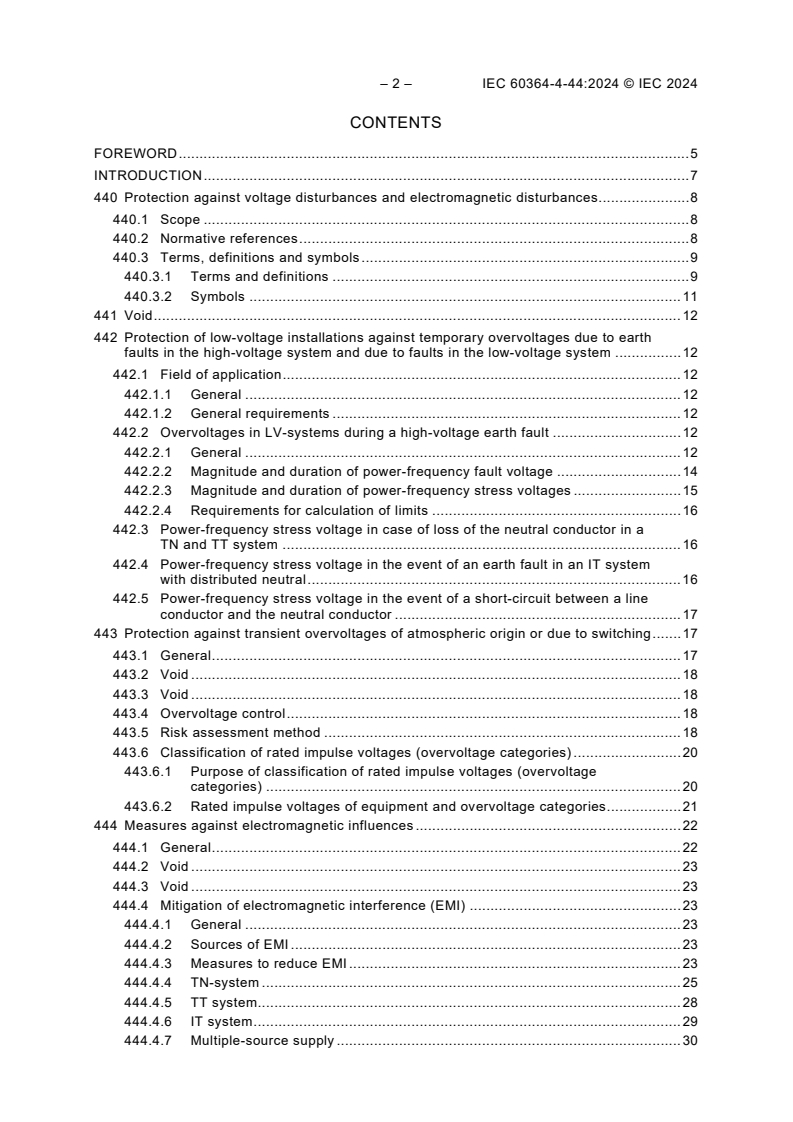
– 2 – IEC 60364-4-44:2024 © IEC 2024
CONTENTS
FOREWORD . 5
INTRODUCTION . 7
440 Protection against voltage disturbances and electromagnetic disturbances. 8
440.1 Scope . 8
440.2 Normative references . 8
440.3 Terms, definitions and symbols . 9
440.3.1 Terms and definitions . 9
440.3.2 Symbols . 11
441 Void . 12
442 Protection of low-voltage installations against temporary overvoltages due to earth
faults in the high-voltage system and due to faults in the low-voltage system . 12
442.1 Field of application . 12
442.1.1 General . 12
442.1.2 General requirements . 12
442.2 Overvoltages in LV-systems during a high-voltage earth fault . 12
442.2.1 General . 12
442.2.2 Magnitude and duration of power-frequency fault voltage . 14
442.2.3 Magnitude and duration of power-frequency stress voltages . 15
442.2.4 Requirements for calculation of limits . 16
442.3 Power-frequency stress voltage in case of loss of the neutral conductor in a
TN and TT system . 16
442.4 Power-frequency stress voltage in the event of an earth fault in an IT system
with distributed neutral . 16
442.5 Power-frequency stress voltage in the event of a short-circuit between a line
conductor and the neutral conductor . 17
443 Protection against transient overvoltages of atmospheric origin or due to switching . 17
443.1 General . 17
443.2 Void . 18
443.3 Void . 18
443.4 Overvoltage control . 18
443.5 Risk assessment method . 18
443.6 Classification of rated impulse voltages (overvoltage categories) . 20
443.6.1 Purpose of classification of rated impulse voltages (overvoltage
categories) . 20
443.6.2 Rated impulse voltages of equipment and overvoltage categories . 21
444 Measures against electromagnetic influences . 22
444.1 General . 22
444.2 Void . 23
444.3 Void . 23
444.4 Mitigation of electromagnetic interference (EMI) . 23
444.4.1 General . 23
444.4.2 Sources of EMI . 23
444.4.3 Measures to reduce EMI . 23
444.4.4 TN-system . 25
444.4.5 TT system. 28
444.4.6 IT system . 29
444.4.7 Multiple-source supply . 30
444.4.8 Transfer of supply . 33
444.4.9 Services entering a building . 36
444.4.10 Separate buildings . 37
444.4.11 Inside buildings . 37
444.4.12 Protective devices . 39
444.4.13 Signal cables . 39
444.5 Earthing and equipotential bonding . 39
444.5.1 Interconnection of earth electrodes . 39
444.5.2 Interconnection of incoming networks and earthing arrangements . 39
444.5.3 Different structures for the network of equipotential conductors and
earthing conductors . 40
444.5.4 Equipotential bonding networks in buildings with several floors . 42
444.5.5 Functional earthing conductor . 43
444.5.6 Commercial or industrial buildings containing significant amounts of
information technology equipment . 44
444.5.7 Earthing arrangements and equipotential bonding of information
technology installations for functional purposes . 44
444.6 Segregation of circuits . 45
444.6.1 General . 45
444.6.2 Design requirements . 45
444.6.3 Conditions for zero segregation . 46
444.7 Cable management systems . 47
444.7.1 General . 47
444.7.2 Design guidelines . 47
444.7.3 Installation guidelines . 48
445 Protection against undervoltage. 50
Annex A (informative) Examples of calculated risk level CRL for the use of SPDs . 51
A.1 Example 1 – Building in rural environment . 51
A.2 Example 2 – Building in rural environment powered in HV . 51
A.3 Example 3 – Building in urban environment powered by overhead lines . 52
A.4 Example 4 – Building in urban environment powered by underground cables . 52
Annex B (informative) Guidance on overvoltage control by SPDs applied to overhead
lines . 53
Annex C (informative) List of notes concerning certain countries . 54
Bibliography . 56
Figure 1 – Representative schematic diagram for possible connections to earth in
substation and LV-installation and occurring overvoltages in case of faults . 13
Figure 2 – Tolerable fault voltage due to an earth-fault in the HV system . 15
Figure 3 – Illustration of an installation showing the lengths to consider . 20
Figure 4 – By-pass conductor for screen reinforcement to provide a common
equipotential bonding system . 24
Figure 5 – Example of a substitute or by-pass equipotential bonding conductor in a TT-
system . 25
Figure 6 – Avoidance of neutral conductor currents in a bonded structure by using the
TN-S system from the origin of the public supply up to and including the final circuit
within a building . 26
Figure 7 – Avoidance of neutral conductor currents in a bonded structure by using a
TN-S system downstream of a consumer’s private supply transformer . 27
– 4 – IEC 60364-4-44:2024 © IEC 2024
Figure 8 – TN-C-S system within an existing building installation . 28
Figure 9 – TT system within a building installation . 29
Figure 10 – IT system within a building installation . 30
Figure 11 – TN multiple-source power supply with a non-suitable multiple connection
between PEN and earth . 31
Figure 12 – TN multiple-source power supplies to an installation with connection to
earth of the star points at one and the same point . 32
Figure 13 – TT multiple-source power supplies to an installation with connection to
earth of the star points at one and the same point . 33
Figure 14 – Three-phase alternative power supply with a 4-pole switch . 34
Figure 15 – Neutral current flow in a three-phase alternative power supply with an
unsuitable 3-pole switch . 35
Figure 16 – Single-phase alternative power supply with 2-pole switch . 36
Figure 17 – Armoured cables and metal pipes entering the buildings (examples) . 37
Figure 18 – Illustration of measures in an existing building . 38
Figure 19 – Interconnected earth electrodes . 39
Figure 20 – Examples of protective conductors in star network . 40
Figure 21 – Example of multiple meshed bonding star network . 41
Figure 22 – Example of a common meshed bonding star network . 42
Figure 23 – Example of equipotential bonding networks in structures without lightning
protection systems . 43
Figure 24 – Example of cable separation distance . 46
Figure 25 – Cable arrangements in metal cable trays . 48
Figure 26 – Continuity of metallic system components . 48
Figure 27 – Location of cables inside metallic construction elements . 49
Figure 28 – Connection of metallic sections . 49
Table 1 – Power-frequency stress voltages and power-frequency fault voltage in low-
voltage system . 14
Table 2 – Permissible power-frequency stress voltage . 16
Table 3 – Calculation of f . 19
env
Table 4 – Required rated impulse voltage of equipment U . 22
W
Table 5 – Summary of minimum separation distances where the specification or
intended application of the information and communication technology cable is not
available . 46
INTERNATIONAL ELECTROTECHNICAL COMMISSION
_____________
LOW-VOLTAGE ELECTRICAL INSTALLATIONS –
Part 4-44: Protection for safety –
Protection against voltage disturbances
and electromagnetic disturbances
FOREWORD
1) The International Electrotechnical Commission (IEC) is a worldwide organization for standardization comprising
all national electrotechnical committees (IEC National Committees). The object of IEC is to promote international
co-operation on all questions concerning standardization in the electrical and electronic fields. To this end and
in addition to other activities, IEC publishes International Standards, Technical Specifications, Technical Reports,
Publicly Available Specifications (PAS) and Guides (hereafter referred to as “IEC Publication(s)”). Their
preparation is entrusted to technical committees; any IEC National Committee interested in the subject dealt with
may participate in this preparatory work. International, governmental and non-governmental organizations liaising
with the IEC also participate in this preparation. IEC collaborates closely with the International Organization for
Standardization (ISO) in accordance with conditions determined by agreement between the two organizations.
2) The formal decisions or agreements of IEC on technical matters express, as nearly as possible, an international
consensus of opinion on the relevant subjects since each technical committee has representation from all
interested IEC National Committees.
3) IEC Publications have the form of recommendations for international use and are accepted by IEC National
Committees in that sense. While all reasonable efforts are made to ensure that the technical content of IEC
Publications is accurate, IEC cannot be held responsible for the way in which they are used or for any
misinterpretation by any end user.
4) In order to promote international uniformity, IEC National Committees undertake to apply IEC Publications
transparently to the maximum extent possible in their national and regional publications. Any divergence between
any IEC Publication and the corresponding national or regional publication shall be clearly indicated in the latter.
5) IEC itself does not provide any attestation of conformity. Independent certification bodies provide conformity
assessment services and, in some areas, access to IEC marks of conformity. IEC is not responsible for any
services carried out by independent certification bodies.
6) All users should ensure that they have the latest edition of this publication.
7) No liability shall attach to IEC or its directors, employees, servants or agents including individual experts and
members of its technical committees and IEC National Committees for any personal injury, property damage or
other damage of any nature whatsoever, whether direct or indirect, or for costs (including legal fees) and
expenses arising out of the publication, use of, or reliance upon, this IEC Publication or any other IEC
Publications.
8) Attention is drawn to the Normative references cited in this publication. Use of the referenced publications is
indispensable for the correct application of this publication.
9) IEC draws attention to the possibility that the implementation of this document may involve the use of (a)
patent(s). IEC takes no position concerning the evidence, validity or applicability of any claimed patent rights in
respect thereof. As of the date of publication of this document, IEC had not received notice of (a) patent(s), which
may be required to implement this document. However, implementers are cautioned that this may not represent
the latest information, which may be obtained from the patent database available at https://patents.iec.ch. IEC
shall not be held responsible for identifying any or all such patent rights.
IEC 60364-4-44 has been prepared by IEC technical committee 64: Electrical installations and
protection against electric shock. It is an International Standard.
This third edition cancels and replaces the second edition published in 2007,
Amendment 1:2015 and Amendment 2:2018. This edition constitutes a technical revision.
This edition includes the following significant technical changes with respect to the previous
edition:
a) the structure of the document has been updated in accordance with the ISO/IEC Directives,
Part 2:2021: the terms, definitions and symbols have been regrouped under a new
Subclause 440.3, the tables and figures have been renumbered;
– 6 – IEC 60364-4-44:2024 © IEC 2024
b) Clause 443 has been amended to better introduce the DC SPD and to improve some of the
wording.
The text of this International Standard is based on the following documents:
Draft Report on voting
64/2696/FDIS 64/2737/RVD
Full information on the voting for its approval can be found in the report on voting indicated in
the above table.
The language used for the development of this International Standard is English.
This document was drafted in accordance with ISO/IEC Directives, Part 2, and developed in
accordance with ISO/IEC Directives, Part 1 and ISO/IEC Directives, IEC Supplement, available
at www.iec.ch/members_experts/refdocs. The main document types developed by IEC are
described in greater detail at www.iec.ch/publications.
A list of all parts in the IEC 60364 series, published under the general title Low-voltage electrical
installations, can be found on the IEC website.
The reader's attention is drawn to the fact that Annex C lists all of the "in-some-country" clauses
on differing practices of a less permanent nature relating to the subject of this document.
The committee has decided that the contents of this document will remain unchanged until the
stability date indicated on the IEC website under webstore.iec.ch in the data related to the
specific document. At this date, the document will be
• reconfirmed,
• withdrawn, or
• revised.
IMPORTANT – The "colour inside" logo on the cover page of this document indicates
that it contains colours which are considered to be useful for the correct understanding
of its contents. Users should therefore print this document using a colour printer.
INTRODUCTION
This part of IEC 60364 covers the protection of electrical installations and measures against
voltage disturbances and electromagnetic disturbances.
The requirements are arranged into four clauses as follows:
Clause 442 Protection of low-voltage installations against temporary overvoltages due to
earth faults in the high-voltage system and due to faults in the low-voltage
system
Clause 443 Protection against transient overvoltages of atmospheric origin or due to
switching
Clause 444 Measures against electromagnetic influences
Clause 445 Protection against undervoltage
– 8 – IEC 60364-4-44:2024 © IEC 2024
LOW-VOLTAGE ELECTRICAL INSTALLATIONS –
Part 4-44: Protection for safety –
Protection against voltage disturbances
and electromagnetic disturbances
440 Protection against voltage disturbances and electromagnetic disturbances
440.1 Scope
This part of IEC 60364 provides requirements for the safety of electrical installations in the
event of voltage disturbances and electromagnetic disturbances generated for different
specified reasons.
The requirements of this document are not intended to apply to systems for distribution of
energy to the public, or power generation and transmission for such systems (see the scope of
IEC 60364-1) although such disturbances can be conducted into or between electrical
installations via these supply systems.
440.2 Normative references
The following documents are referred to in the text in such a way that some or all of their content
constitutes requirements of this document. For dated references, only the edition cited applies.
For undated references, the latest edition of the referenced document (including any
amendments) applies.
IEC 60364-1, Low-voltage electrical installations – Part 1: Fundamental principles, assessment
of general characteristics, definitions
IEC 60364-5-52, Low-voltage electrical installations – Part 5-52: Selection and erection of
electrical equipment – Wiring systems
IEC 60364-5-53:2019, Low-voltage electrical installations – Part 5-53: Selection and erection
of electrical equipment – Devices for protection for safety, isolation, switching, control and
monitoring
IEC 60364-5-53:2019/AMD1:2020
IEC 60364-5-53:2019/AMD2:2024
IEC 60364-5-54:2011, Low-voltage electrical installations – Part 5-54: Selection and erection
of electrical equipment – Earthing arrangements and protective conductors
IEC 60364-5-54:2011/AMD1:2021
IEC 60664-1:2020, Insulation coordination for equipment within low-voltage supply systems –
Part 1: Principles, requirements and tests
IEC 61156 (all parts), Multicore and symmetrical pair/quad cables for digital communications
IEC 61196-7, Coaxial communication cables – Part 7: Sectional specification for cables for BCT
cabling in accordance with ISO/IEC 11801-4 – Indoor drop cables for systems operating at
5 MHz – 6 000 MHz
IEC 61936-1, Power installations exceeding 1 kV AC and 1,5 kV DC – Part 1: AC
IEC 62305-3, Protection against lightning – Part 3: Physical damage to structures and life
hazard
ISO/IEC 11801-1, Information technology – Generic cabling for customer premises – Part 1:
General requirements
ISO/IEC 14763-2:2019, Information technology – Implementation and operation of customer
premises cabling – Part 2: Planning and installation
ISO/IEC TR 29106, Information technology – Generic cabling – Introduction to the MICE
environmental classification
440.3 Terms, definitions and symbols
440.3.1 Terms and definitions
For the purposes of this document, the terms and definitions given in IEC 60364-1 and the
following apply.
ISO and IEC maintain terminology databases for use in standardization at the following
addresses:
• IEC Electropedia: available at https://www.electropedia.org/
• ISO Online browsing platform: available at https://www.iso.org/obp
440.3.1.1
urban environment
area with a high density of buildings or densely populated communities with tall buildings
EXAMPLE Town centre.
440.3.1.2
suburban environment
area with a medium density of buildings
EXAMPLE Town outskirts.
440.3.1.3
rural environment
area with a low density of buildings
EXAMPLE The countryside.
440.3.1.4
surge protective device
SPD
device that contains at least one non-linear component that is intended to limit surge voltages
and divert surge currents
Note 1 to entry: An SPD is a complete assembly, having appropriate connecting means.
[SOURCE: IEC 61643-11:2011, 3.1.1]
440.3.1.5
calculated risk level
CRL
calculated value of risk used to evaluate the need for transient overvoltage protection
– 10 – IEC 60364-4-44:2024 © IEC 2024
440.3.1.6
rated impulse voltage
U
W
value of the impulse withstand voltage assigned by the manufacturer to the equipment or to a
part of it, characterizing the specified withstand capability of its insulation against transient
overvoltages
[SOURCE: IEC 60664-1:2020, 3.1.19, modified – In the term, "withstand" has been deleted and
the symbol U has been replaced with U .]
imp W
440.3.1.7
bonding network
BN
set of interconnected conductive structures that provides an "electromagnetic shield" for
electronic systems at frequencies from direct current (DC) to low radio frequency (RF)
Note 1 to entry: The term "electromagnetic shield" denotes any structure used to divert, block or impede the
passage of electromagnetic energy. In general, a BN does not need to be connected to earth but BN considered in
this standard are connected to earth.
440.3.1.8
bonding ring conductor
BRC
earthing bus conductor in the form of a closed ring
Note 1 to entry: Normally the bonding ring conductor, as part of the bonding network, has multiple connections to
the CBN that improves its performance.
440.3.1.9
common equipotential bonding system
common bonding network
CBN
equipotential bonding system providing both protective-equipotential-bonding and functional-
equipotential-bonding
[SOURCE: IEC 60050-195:2021, 195-02-25]
440.3.1.10
equipotential bonding
set of electric connections intended to achieve equipotentiality between conductive parts
[SOURCE: IEC 60050-195:2021, 195-01-10]
440.3.1.11
earth-electrode network
ground-electrode network (US)
part of an earthing arrangement comprising only the earth electrodes and their interconnections
[SOURCE: IEC 60050-195:2021, 195-02-21]
440.3.1.12
meshed bonding network
MESH-BN
bonding network in which all associated equipment frames, racks and cabinets and usually the
DC power return conductor, are bonded together as well as at multiple points to the CBN and
may have the form of a mesh
Note 1 to entry: The MESH-BN augments the CBN.
440.3.1.13
by-pass equipotential bonding conductor
parallel earthing conductor
PEC
earthing conductor connected in parallel with the screens of signal or data cables in order to
limit the current flowing through the screens
440.3.2 Symbols
In this document, the following symbols are used (see Figure 1).
I part of the earth fault current in the high-voltage system that flows through the earthing
E
arrangement of the transformer substation
R resistance of the earthing arrangement of the transformer substation
E
R resistance of the earthing arrangement of the exposed-conductive-parts of the equipment
A
of the low-voltage installation
R resistance of the earthing arrangement of the low-voltage system neutral, for low-voltage
B
systems in which the earthing arrangements of the transformer substation and of the low-
voltage system neutral are electrically independent
U in TN- and TT-systems: nominal AC RMS line voltage to earth
o
in IT-systems: nominal AC voltage between line conductor and neutral conductor or mid-
point conductor, as appropriate
U power-frequency fault voltage that appears in the low-voltage system between exposed-
f
conductive-parts and earth for the duration of the fault
U power-frequency stress voltage between the line conductor and the exposed-conductive-
parts of the low-voltage equipment of the transformer substation during the fault
U power-frequency stress voltage between the line conductor and the exposed-conductive-
parts of the low-voltage equipment of the low-voltage installation during the fault
NOTE 1 The power-frequency stress voltage (U and U ) is the voltage that appears across the insulation of low-
1 2
voltage equipment and across surge protective devices connected to the low-voltage system.
The following additional symbols are used in respect of IT-systems in which the exposed-
conductive-parts of the equipment of the low-voltage installation are connected to an earthing
arrangement that is electrically independent of the earthing arrangement of the transformer
substation.
I fault current that flows through the earthing arrangement of the exposed-conductive-parts
h
of the equipment of the low-voltage installation during a period when there is a high-
voltage fault and a first fault in the low-voltage installation (see Table 1).
I fault current that flows through the earthing arrangement of the exposed-conductive-parts
d
of the low-voltage installation during the first fault in a low-voltage system (see Table 1).
Z impedance (e.g. IMD internal impedance, artificial neutral impedance) between the low-
voltage system and an earthing arrangement.
NOTE 2 An earthing arrangement can be considered electrically independent of another earthing arrangement if a
rise of potential with respect to earth in one earthing arrangement does not cause an unacceptable rise of potential
with respect to earth in the other earthing arrangement. See IEC 61936-1.
– 12 – IEC 60364-4-44:2024 © IEC 2024
441 Void
442 Protection of low-voltage installations against temporary overvoltages due
to earth faults in the high-voltage system and due to faults in the low-
voltage system
442.1 Field of application
442.1.1 General
This Clause 442 provides requirements for the safety of low-voltage installation in the event of
– a fault between the high-voltage system and earth in the transformer substation that supplies
the low-voltage installation,
– a loss of the supply neutral in the low-voltage system,
– a short-circuit between a line conductor and neutral,
– an accidental earthing of a line conductor of a low-voltage IT-system.
The requirements for the earthing arrangement at the transformer substation are given in
IEC 61936-1.
442.1.2 General requirements
As Clause 442 covers faults between a high-voltage line and the earth in the HV/LV substation,
it gives rules for the designer and installer of the substation. It is necessary to have the following
information concerning the high-voltage system:
– quality of the system earthing;
– maximum level of earth fault current;
– resistance of the earthing arrangement.
The following Subclauses 442.2, 442.3, 442.4 and 442.5 consider four situations as proposed
in 442.1, which generally cause the most severe temporary overvoltages such as defined in
IEC 60050-614:
– fault between the high-voltage system(s) and earth (see 442.2);
– loss of the neutral in a low-voltage system (see 442.3);
– accidental earthing of a low-voltage IT system (see 442.4);
– short-circuit in the low-voltage installation (see 442.5).
442.2 Overvoltages in LV-systems during a high-voltage earth fault
442.2.1 General
In case of a fault to earth on the HV-side of the substation, the following types of overvoltage
may affect the LV-installation:
• power-frequency fault voltage (U );
f
• power-frequency stress voltages (U and U ).
1 2
Table 1 provides the relevant methods of calculation for the different types of overvoltages.
Table 1 deals with IT systems with a neutral point only. For IT systems with no neutral point,
the formulae should be adjusted accordingly.
Figure 1 – Representative schematic diagram for possible connections to earth in
substation and LV-installation and occurring overvoltages in case of faults
Where high- and low-voltage earthing systems exist in proximity to each other, two practices
are presently used:
– interconnection of all high-voltage (R ) and low-voltage (R ) earthing systems;
E B
– separation of high-voltage (R ) from low-voltage (R ) earthing systems.
E B
The general method used is interconnection. The high- and low-voltage earthing systems shall
be interconnected if the low-voltage system is totally confined within the area covered by the
high-voltage earthing system (see IEC 61936-1).
NOTE 1 Details of the different types of system earthing (TN, TT, IT) are shown in IEC 60364-1.
– 14 – IEC 60364-4-44:2024 © IEC 2024
Table 1 – Power-frequency stress voltages and power-frequency fault
voltage in low-voltage system
Types of
Types of earth
U U U
system
1 2 f
connections
earthing
a
a
R × I + U
R and R connected U
E B E E o
o
TT
a
a
R and R separated R × I + U U
E B 0
E E o o
a a b
R and R connected U U R × I
E B o o E E
TN
a
a
R and R separated R × I + U
U
E B E E o
o
a
a
U R × I + U
o E E o
R and Z connected
E
R and R separated
E A
R × I
U × 3 R × I + U × 3
A h
o E E o
a a
U U R × I
o o E E
R and Z connected
E
IT R and R interconnected
E A
R × I
U × 3 U × 3
E E
o o
a
a
R × I + U U
E E o o
R and Z separated
E
R and R separated
E A
R × I
R × I + U × 3 U × 3
A d
E E o o
Key
With existing earth fault in the installation.
a
No consideration shall be given.
b
See 442.2.2 second paragraph.
NOTE 2 The requirements for U and U are derived from design criteria for insulation of low-voltage equipment
1 2
with regard to temporary power-frequency overvoltage (see also Table 2).
NOTE 3 In a system whose neutral is connected to the earthing arrangement of the transformer substation, such
temporary power-frequency overvoltage is also expected across insulation which is not in an earthed enclosure when
the equipment is outside a building.
NOTE 4 In TT- and TN-systems the statement "connected" and "separated" refers to the electrical connection
between R and R . For IT-systems it refers to the electrical connection between R and Z and the connection
E B E
between R and R .
E A
442.2.2 Magnitude and duration of power-frequency fault voltage
The magnitude and the duration of the fault voltage U (as calculated in Table 1) which appears
f
in the LV installation between exposed-conductive-parts and earth, shall not exceed the values
given for U by the curve of Figure 2 for the duration of the fault.
f
Normally, the PEN conductor of the low-voltage system is connected to earth at more than one
point. In this case, the total resistance is reduced. For these multiple grounded PEN conductors,
U can be calculated as:
f
U 0,5 R× I
f EE
=
NOTE On the basis of probabilistic and statistical evidence this curve represents a low level of risk for the simple
worst case where the low-voltage system neutral conductor is earthed only at the transformer substation earthing
arrangements. Guidance is provided in IEC 61936-1 concerning other situations.
SOURCE: IEC 61936-1:2021, Figure 12
Figure 2 – Tolerable fault voltage due to an earth-fault in the HV system
442.2.3 Magnitude and duration of power-frequency stress voltages
The magnitude and the duration of the power-frequency stress voltage (U and U ) as calculated
1 2
in Table 1 of the low-voltage equipment in the low-voltage installation due to an earth fault in the
high-voltage system shall not exceed the requirements given in Table 2.
– 16 – IEC 60364-4-44:2024 © IEC 2024
Table 2 – Permissible power-frequency stress voltage
Duration of the earth fault in the Permissible power-frequency stress voltage on equipment
high-voltage system in low-voltage installations
t U
> 5 s U + 250 V
o
≤ 5 s
U + 1 200 V
o
In systems without a neutral conductor, U shall be the line-to-line voltage.
o
NOTE 1 The first line of the table relates to high-voltage systems having long disconnection times, for example,
isolated neutral and resonant earthed high-voltage systems. The second line relates to high-voltage systems
having short disconnection times, for example low-impedance earthed high-voltage systems. Both lines together
are relevant design criteria for insulation of low-voltage equipment with regard to temporary power frequency
overvoltage, see IEC 60664-1.
NOTE 2 In a system whose neutral is connected to the earthing arrangement of the transformer substation, such
temporary power-frequency overvoltage is also expected across insulation which is not in an earthed enclosure
when the equipment is outside a building.
442.2.4 Requirements for calculation of limits
Where required by Table 1, the permissible power-frequency stress voltage shall not exceed
the value given in Table 2.
Where required by Table 1, the permissible power-frequency fault voltage shall not exceed the
value given in Figure 2.
The requirements of 442.2.2 and 442.2.3 are deemed to be fulfilled for installations receiving a
supply at low-voltage from a public electricity distribution system.
To fulfil the above requirements, coordination between the HV-system operator and the
LV-system installer is necessary. Compliance with the above requirements mainly falls into the
responsibility of the substation installer, owner, operator for whom it is also necessary to fulfil
requirements provided by IEC 61936-1. Therefore the calculation for U , U and U is normally
1 2 f
not necessary for the LV system installer.
Possible measures to fulfil the above requirements are for example:
• separation of earthing arrangement between HV and LV;
• change of LV system earthing;
• reduction of earth resistance R .
E
442.3 Power-frequency stress voltage in case of loss of the neutral conductor in a TN
and TT system
Consideration shall be given to the fact that, if the neutral conductor in a multi-phase system is
interrupted, basic, double and reinforced insulation as well as components rated for the voltage
between line and neutral conductors can be temporarily stressed with the line-to-Iine voltage.
The stress voltage can reach up to U = √3 U .
o
442.4 Power-frequency stress voltage in the event of an earth fault in an IT system
with distributed neutral
Consideration shall be given to the fact that, if a line conductor of an IT system is earthed
accidentally, insulation or components rated for the voltage between line and neutral conductors
can be temporarily stressed with the line-to-Iine voltage. The stress voltage can reach up to
U = √3 U .
o
442.5 Power-frequency stress voltage in the event of a short-circuit between a line
conductor and the neutral conductor
Consideration shall be given to the fact that if a short-circuit occurs in the low-voltage
installation between a phase conductor and the neutral conductor, the voltage between the
other line conductors and the neutral conductor can reach the value of 1,45 × U for a time up
o
to 5 s.
443 Protection against transient overvoltages of atmospheric origin or due to
switching
443.1 General
Clause 443 specifies requirements for protection of electrical installations against transient
overvoltages of atmospheric origin transmitted by the supply distribution system including direct
strikes to the supply system and against switching overvoltages. Clause 443 does not specify
requirements for protection against transient overvoltage due to direct or nearby lightning
strokes on the structure.
NOTE 1 For risk management for protect
...
IEC 60364-4-44 ®
Edition 3.0 2024-12
REDLINE VERSION
INTERNATIONAL
STANDARD
colour
inside
Low-voltage electrical installations –
Part 4-44: Protection for safety – Protection against voltage disturbances and
electromagnetic disturbances
All rights reserved. Unless otherwise specified, no part of this publication may be reproduced or utilized in any form
or by any means, electronic or mechanical, including photocopying and microfilm, without permission in writing from
either IEC or IEC's member National Committee in the country of the requester. If you have any questions about IEC
copyright or have an enquiry about obtaining additional rights to this publication, please contact the address below or
your local IEC member National Committee for further information.
IEC Secretariat Tel.: +41 22 919 02 11
3, rue de Varembé info@iec.ch
CH-1211 Geneva 20 www.iec.ch
Switzerland
About the IEC
The International Electrotechnical Commission (IEC) is the leading global organization that prepares and publishes
International Standards for all electrical, electronic and related technologies.
About IEC publications
The technical content of IEC publications is kept under constant review by the IEC. Please make sure that you have the
latest edition, a corrigendum or an amendment might have been published.
IEC publications search - webstore.iec.ch/advsearchform IEC Products & Services Portal - products.iec.ch
The advanced search enables to find IEC publications by a Discover our powerful search engine and read freely all the
variety of criteria (reference number, text, technical publications previews, graphical symbols and the glossary.
committee, …). It also gives information on projects, replaced With a subscription you will always have access to up to date
and withdrawn publications. content tailored to your needs.
IEC Just Published - webstore.iec.ch/justpublished
Electropedia - www.electropedia.org
Stay up to date on all new IEC publications. Just Published
The world's leading online dictionary on electrotechnology,
details all new publications released. Available online and once
containing more than 22 500 terminological entries in English
a month by email.
and French, with equivalent terms in 25 additional languages.
Also known as the International Electrotechnical Vocabulary
IEC Customer Service Centre - webstore.iec.ch/csc
(IEV) online.
If you wish to give us your feedback on this publication or need
further assistance, please contact the Customer Service
Centre: sales@iec.ch.
IEC 60364-4-44 ®
Edition 3.0 2024-12
REDLINE VERSION
INTERNATIONAL
STANDARD
colour
inside
Low-voltage electrical installations –
Part 4-44: Protection for safety – Protection against voltage disturbances and
electromagnetic disturbances
INTERNATIONAL
ELECTROTECHNICAL
COMMISSION
ICS 91.140.50; 33.100.10; 33.100.20 ISBN 978-2-8327-0121-8
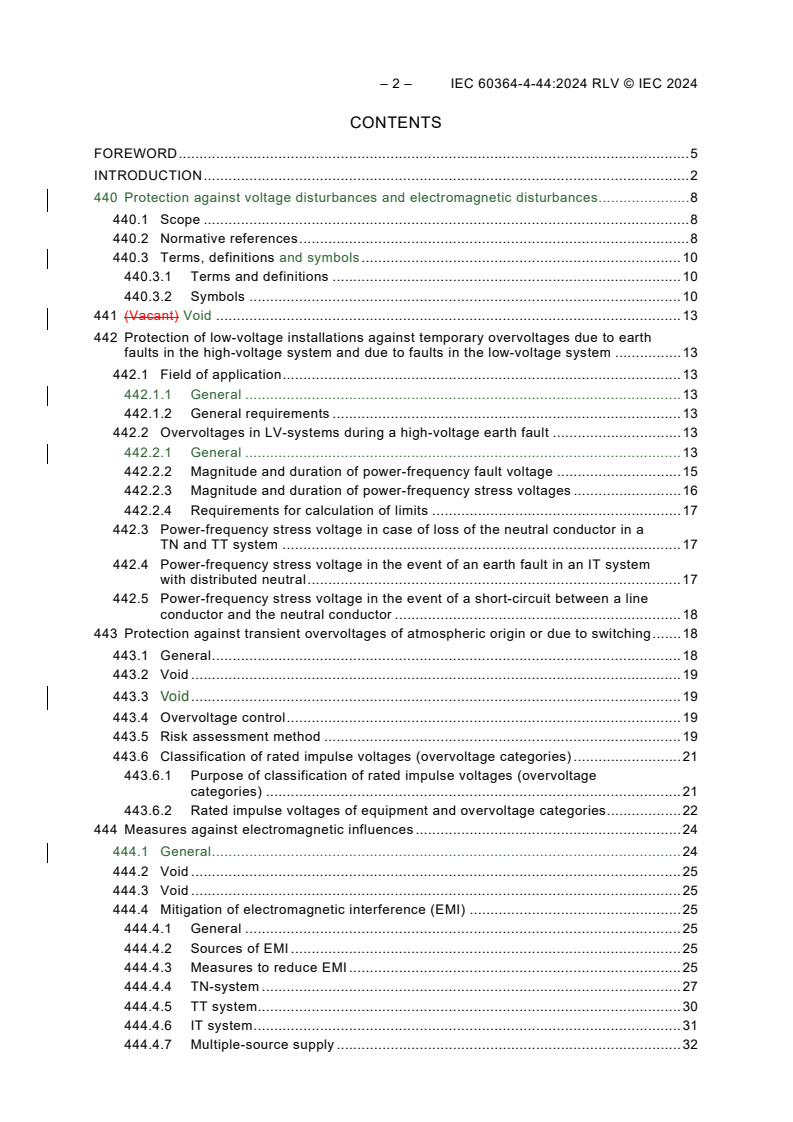
– 2 – IEC 60364-4-44:2024 RLV © IEC 2024
CONTENTS
FOREWORD . 5
INTRODUCTION . 2
440 Protection against voltage disturbances and electromagnetic disturbances. 8
440.1 Scope . 8
440.2 Normative references . 8
440.3 Terms, definitions and symbols . 10
440.3.1 Terms and definitions . 10
440.3.2 Symbols . 10
441 (Vacant) Void . 13
442 Protection of low-voltage installations against temporary overvoltages due to earth
faults in the high-voltage system and due to faults in the low-voltage system . 13
442.1 Field of application . 13
442.1.1 General . 13
442.1.2 General requirements . 13
442.2 Overvoltages in LV-systems during a high-voltage earth fault . 13
442.2.1 General . 13
442.2.2 Magnitude and duration of power-frequency fault voltage . 15
442.2.3 Magnitude and duration of power-frequency stress voltages . 16
442.2.4 Requirements for calculation of limits . 17
442.3 Power-frequency stress voltage in case of loss of the neutral conductor in a
TN and TT system . 17
442.4 Power-frequency stress voltage in the event of an earth fault in an IT system
with distributed neutral . 17
442.5 Power-frequency stress voltage in the event of a short-circuit between a line
conductor and the neutral conductor . 18
443 Protection against transient overvoltages of atmospheric origin or due to switching . 18
443.1 General . 18
443.2 Void . 19
443.3 Void . 19
443.4 Overvoltage control . 19
443.5 Risk assessment method . 19
443.6 Classification of rated impulse voltages (overvoltage categories) . 21
443.6.1 Purpose of classification of rated impulse voltages (overvoltage
categories) . 21
443.6.2 Rated impulse voltages of equipment and overvoltage categories . 22
444 Measures against electromagnetic influences . 24
444.1 General . 24
444.2 Void . 25
444.3 Void . 25
444.4 Mitigation of electromagnetic interference (EMI) . 25
444.4.1 General . 25
444.4.2 Sources of EMI . 25
444.4.3 Measures to reduce EMI . 25
444.4.4 TN-system . 27
444.4.5 TT system. 30
444.4.6 IT system . 31
444.4.7 Multiple-source supply . 32
444.4.8 Transfer of supply . 35
444.4.9 Services entering a building . 38
444.4.10 Separate buildings . 39
444.4.11 Inside buildings . 39
444.4.12 Protective devices . 41
444.4.13 Signal cables . 41
444.5 Earthing and equipotential bonding . 41
444.5.1 Interconnection of earth electrodes . 41
444.5.2 Interconnection of incoming networks and earthing arrangements . 41
444.5.3 Different structures for the network of equipotential conductors and
earthing conductors . 42
444.5.4 Equipotential bonding networks in buildings with several floors . 44
444.5.5 Functional earthing conductor . 45
444.5.6 Commercial or industrial buildings containing significant amounts of
information technology equipment . 46
444.5.7 Earthing arrangements and equipotential bonding of information
technology installations for functional purposes . 46
444.6 Segregation of circuits . 47
444.6.1 General . 47
444.6.2 Design requirements . 47
444.6.3 Conditions for zero segregation . 48
444.7 Cable management systems . 49
444.7.1 General . 49
444.7.2 Design guidelines . 49
444.7.3 Installation guidelines . 50
445 Protection against undervoltage. 52
Annex A (informative) Examples of calculated risk level CRL for the use of SPDs . 53
A.1 Example 1 – Building in rural environment . 53
A.2 Example 2 – Building in rural environment powered in HV . 53
A.3 Example 3 – Building in urban environment powered by overhead lines . 54
A.4 Example 4 – Building in urban environment powered by underground cables . 54
Annex B (informative) Guidance on overvoltage control by SPDs applied to overhead
lines . 55
Annex C (informative) List of notes concerning certain countries . 56
Bibliography . 58
Figure 1 – Representative schematic sketch diagram for possible connections to earth in
substation and LV-installation and occurring overvoltages in case of faults . 14
Figure 2 – Tolerable fault voltage due to an earth-fault in the HV system . 16
Figure 3 – Illustration of an installation showing the lengths to consider . 21
Figure 4 – By-pass conductor for screen reinforcement to provide a common
equipotential bonding system . 26
Figure 5 – Example of a substitute or by-pass equipotential bonding conductor in a TT-
system . 26
Figure 6 – Avoidance of neutral conductor currents in a bonded structure by using the
TN-S system from the origin of the public supply up to and including the final circuit
within a building . 28
Figure 7 – Avoidance of neutral conductor currents in a bonded structure by using a
TN-S system downstream of a consumer’s private supply transformer . 29
– 4 – IEC 60364-4-44:2024 RLV © IEC 2024
Figure 8 – TN-C-S system within an existing building installation . 30
Figure 9 – TT system within a building installation . 31
Figure 10 – IT system within a building installation . 32
Figure 11 – TN multiple-source power supply with a non-suitable multiple connection
between PEN and earth . 33
Figure 12 – TN multiple-source power supplies to an installation with connection to
earth of the star points at one and the same point . 34
Figure 13 – TT multiple-source power supplies to an installation with connection to
earth of the star points at one and the same point . 35
Figure 14 – Three-phase alternative power supply with a 4-pole switch . 36
Figure 15 – Neutral current flow in a three-phase alternative power supply with an
unsuitable 3-pole switch . 37
Figure 16 – Single-phase alternative power supply with 2-pole switch . 38
Figure 17 – Armoured cables and metal pipes entering the buildings (examples) . 39
Figure 18 – Illustration of measures in an existing building . 40
Figure 19 – Interconnected earth electrodes . 41
Figure 20 – Examples of protective conductors in star network . 42
Figure 21 – Example of multiple meshed bonding star network . 43
Figure 22 – Example of a common meshed bonding star network . 44
Figure 23 – Example of equipotential bonding networks in structures without lightning
protection systems . 45
Figure 24 – Example of cable separation distance . 48
Figure 25 – Cable arrangements in metal cable trays . 50
Figure 26 – Continuity of metallic system components . 50
Figure 27 – Location of cables inside metallic construction elements . 51
Figure 28 – Connection of metallic sections . 51
Table 1 – Power-frequency stress voltages and power-frequency fault voltage in low-
voltage system . 15
Table 2 – Permissible power-frequency stress voltage . 17
Table 3 – Calculation of f . 20
env
Table 4 – Required rated impulse voltage of equipment U . 23
W
Table 5 – Summary of minimum separation distances where the specification and/or
intended application of the information and communication technology cable is not
available . 48
INTERNATIONAL ELECTROTECHNICAL COMMISSION
_____________
LOW-VOLTAGE ELECTRICAL INSTALLATIONS –
Part 4-44: Protection for safety –
Protection against voltage disturbances
and electromagnetic disturbances
FOREWORD
1) The International Electrotechnical Commission (IEC) is a worldwide organization for standardization comprising
all national electrotechnical committees (IEC National Committees). The object of IEC is to promote international
co-operation on all questions concerning standardization in the electrical and electronic fields. To this end and
in addition to other activities, IEC publishes International Standards, Technical Specifications, Technical Reports,
Publicly Available Specifications (PAS) and Guides (hereafter referred to as “IEC Publication(s)”). Their
preparation is entrusted to technical committees; any IEC National Committee interested in the subject dealt with
may participate in this preparatory work. International, governmental and non-governmental organizations liaising
with the IEC also participate in this preparation. IEC collaborates closely with the International Organization for
Standardization (ISO) in accordance with conditions determined by agreement between the two organizations.
2) The formal decisions or agreements of IEC on technical matters express, as nearly as possible, an international
consensus of opinion on the relevant subjects since each technical committee has representation from all
interested IEC National Committees.
3) IEC Publications have the form of recommendations for international use and are accepted by IEC National
Committees in that sense. While all reasonable efforts are made to ensure that the technical content of IEC
Publications is accurate, IEC cannot be held responsible for the way in which they are used or for any
misinterpretation by any end user.
4) In order to promote international uniformity, IEC National Committees undertake to apply IEC Publications
transparently to the maximum extent possible in their national and regional publications. Any divergence between
any IEC Publication and the corresponding national or regional publication shall be clearly indicated in the latter.
5) IEC itself does not provide any attestation of conformity. Independent certification bodies provide conformity
assessment services and, in some areas, access to IEC marks of conformity. IEC is not responsible for any
services carried out by independent certification bodies.
6) All users should ensure that they have the latest edition of this publication.
7) No liability shall attach to IEC or its directors, employees, servants or agents including individual experts and
members of its technical committees and IEC National Committees for any personal injury, property damage or
other damage of any nature whatsoever, whether direct or indirect, or for costs (including legal fees) and
expenses arising out of the publication, use of, or reliance upon, this IEC Publication or any other IEC
Publications.
8) Attention is drawn to the Normative references cited in this publication. Use of the referenced publications is
indispensable for the correct application of this publication.
9) IEC draws attention to the possibility that the implementation of this document may involve the use of (a)
patent(s). IEC takes no position concerning the evidence, validity or applicability of any claimed patent rights in
respect thereof. As of the date of publication of this document, IEC had not received notice of (a) patent(s), which
may be required to implement this document. However, implementers are cautioned that this may not represent
the latest information, which may be obtained from the patent database available at https://patents.iec.ch. IEC
shall not be held responsible for identifying any or all such patent rights.
This redline version of the official IEC Standard allows the user to identify the changes
made to the previous edition IEC 60364-4-44:2007+AMD1:2015+AMD2:2018 CSV. A
vertical bar appears in the margin wherever a change has been made. Additions are in
green text, deletions are in strikethrough red text.
– 6 – IEC 60364-4-44:2024 RLV © IEC 2024
IEC 60364-4-44 has been prepared by IEC technical committee 64: Electrical installations and
protection against electric shock. It is an International Standard.
This third edition cancels and replaces the second edition published in 2007,
Amendment 1:2015 and Amendment 2:2018. This edition constitutes a technical revision.
This edition includes the following significant technical changes with respect to the previous
edition:
a) the structure of the document has been updated in accordance with the ISO/IEC Directives,
Part 2:2021: the terms, definitions and symbols have been regrouped under a new
Subclause 440.3, the tables and figures have been renumbered;
b) Clause 443 has been amended to better introduce the DC SPD and to improve some of the
wording.
The text of this International Standard is based on the following documents:
Draft Report on voting
64/2696/FDIS 64/2737/RVD
Full information on the voting for its approval can be found in the report on voting indicated in
the above table.
The language used for the development of this International Standard is English.
This document was drafted in accordance with ISO/IEC Directives, Part 2, and developed in
accordance with ISO/IEC Directives, Part 1 and ISO/IEC Directives, IEC Supplement, available
at www.iec.ch/members_experts/refdocs. The main document types developed by IEC are
described in greater detail at www.iec.ch/publications.
A list of all parts in the IEC 60364 series, published under the general title Low-voltage electrical
installations, can be found on the IEC website.
The reader's attention is drawn to the fact that Annex C lists all of the "in-some-country" clauses
on differing practices of a less permanent nature relating to the subject of this document.
The committee has decided that the contents of this document will remain unchanged until the
stability date indicated on the IEC website under webstore.iec.ch in the data related to the
specific document. At this date, the document will be
• reconfirmed,
• withdrawn, or
• revised.
IMPORTANT – The "colour inside" logo on the cover page of this document indicates
that it contains colours which are considered to be useful for the correct understanding
of its contents. Users should therefore print this document using a colour printer.
INTRODUCTION
This part of IEC 60364 covers the protection of electrical installations and measures against
voltage disturbances and electromagnetic disturbances.
The requirements are arranged into four clauses as follows:
Clause 442 Protection of low-voltage installations against temporary overvoltages due to
earth faults in the high-voltage system and due to faults in the low-voltage
system
Clause 443 Protection against transient overvoltages of atmospheric origin or due to
switching
Clause 444 Measures against electromagnetic influences
Clause 445 Protection against undervoltage
– 8 – IEC 60364-4-44:2024 RLV © IEC 2024
LOW-VOLTAGE ELECTRICAL INSTALLATIONS –
Part 4-44: Protection for safety –
Protection against voltage disturbances
and electromagnetic disturbances
440 Protection against voltage disturbances and electromagnetic disturbances
440.1 Scope
The rules of This part of IEC 60364 are intended to provide provides requirements for the safety
of electrical installations in the event of voltage disturbances and electromagnetic disturbances
generated for different specified reasons.
The rules requirements of this document are not intended to apply to systems for distribution of
energy to the public, or power generation and transmission for such systems (see the scope of
IEC 60364-1) although such disturbances may can be conducted into or between electrical
installations via these supply systems.
440.2 Normative references
The following documents are referred to in the text in such a way that some or all of their content
constitutes requirements of this document. For dated references, only the edition cited applies.
For undated references, the latest edition of the referenced document (including any
amendments) applies.
IEC 60038:2009, IEC standard voltages
IEC 60050-604:1987, International Electrotechnical Vocabulary – Chapter 604: Generation,
transmission and distribution of electricity – Operation
IEC 60364-1, Low-voltage electrical installations – Part 1: Fundamental principles, assessment
of general characteristics, definitions
IEC 60364-4-41:2005, Electrical installations of buildings – Part 4-41: Protection for safety –
Protection against electric shock
IEC 60364-5-52, Low-voltage electrical installations – Part 5-52: Selection and erection of
electrical equipment – Wiring systems
IEC 60364-5-53:20012019, Low-voltage electrical installations of buildings – Part 5-53:
Selection and erection of electrical equipment – Devices for protection for safety, isolation,
switching and, control and monitoring
IEC 60364-5-53:20012019/AMD1:20022020
IEC 60364-5-53:20012019/AMD2:20152024
IEC 60364-5-54:2002,2011, Low-voltage electrical installations of buildings – Part 5-54:
Selection and erection of electrical equipment – Earthing arrangements and
protective bonding conductors
IEC 60364-5-54:2011/AMD1:2021
___________
A third edition is currently in preparation.
IEC 60479-1:2005, Effects of current on human beings and livestock – Part 1: General aspects
IEC 60664-1:20072020, Insulation coordination for equipment within low-voltage supply
systems – Part 1: Principles, requirements and tests
IEC 60950-1, Information technology equipment – Safety – Part 1: General requirements
IEC 61000-2-5:1995, Electromagnetic compatibility (EMC) − Part 2: Environment − Section 5:
Classification of electromagnetic environments – Basic EMC publication
IEC 61000-6-1, Electromagnetic compatibility (EMC) – Part 6-1: Generic standards – Immunity
for residential, commercial and light-industrial environments
IEC 61000-6-2, Electromagnetic compatibility (EMC) – Part 6-2: Generic standards – Immunity
for industrial environments
IEC 61000-6-3, Electromagnetic compatibility (EMC) – Part 6-3: Generic standards – Emission
standard for residential, commercial and light-industrial environments
IEC 61000-6-4, Electromagnetic compatibility (EMC) – Part 6-4: Generic standards – Emission
standard for industrial environments
IEC 61156 (all parts), Multicore and symmetrical pair/quad cables for digital communications
IEC 61196-7, Coaxial communication cables – Part 7: Sectional specification for cables for BCT
cabling in accordance with ISO/IEC 15018 11801-4 – Indoor drop cables for systems operating
at 5 MHz – 3 000 6 000 MHz
IEC 61558-2-1, Safety of power transformers, power supplies, reactors and similar products –
Part 2-1: Particular requirements for tests for separating transformers and power supplies
incorporating separating transformers for general applications
IEC 61558-2-4, Safety of power transformers, power supply units and similar – Part 2-4:
Particular requirements for isolating transformers for general use
IEC 61558-2-6, Safety of power transformers, power supply units and similar – Part 2-6:
Particular requirements for safety isolating transformers for general use
IEC 61558-2-15, Safety of power transformers, power supply units and similar – Part 2-15:
Particular requirements for isolating transformers for the supply of medical locations
IEC 61643 (all parts), Low-voltage surge protective devices
IEC 61643-11:2011, Low-voltage surge protective devices – Part 11: Surge protective devices
connected to low-voltage power systems – Requirements and test methods
IEC 61643-22, Low-voltage surge protective devices – Part 22: Surge protective devices
connected to telecommunications and signalling networks – Selection and application principles
IEC 61936-1, Power installations exceeding 1 kV AC and 1,5 kV DC – Part 1: Common rules
AC
IEC 62305 (all parts), Protection against lightning
IEC 62305-1, Protection against lightning – Part 1: General principles
IEC 62305-3, Protection against lightning – Part 3: Physical damage to structures and life
hazard
– 10 – IEC 60364-4-44:2024 RLV © IEC 2024
IEC 62305-4, Protection against lightning – Part 4: Electrical and electronic systems within
structures
ISO/IEC 11801-1, Information technology – Generic cabling for customer premises – Part 1:
General requirements
ISO/IEC 14763-2:20122019, Information technology – Implementation and operation of
customer premises cabling – Part 2: Planning and installation
ISO/IEC 14763-2:2012/AMD1:2015
ISO/IEC TR 29106, Information technology – Generic cabling – Introduction to the MICE
environmental classification
440.3 Terms, definitions and symbols
440.3.1 Terms and definitions
For the purposes of this document, the terms and definitions given in IEC 60364-1 and the
following apply.
ISO and IEC maintain terminology databases for use in standardization at the following
addresses:
• IEC Electropedia: available at https://www.electropedia.org/
• ISO Online browsing platform: available at https://www.iso.org/obp
440.3.1.1
urban environment
area with a high density of buildings or densely populated communities with tall buildings
EXAMPLE Town centre.
440.3.1.2
suburban environment
area with a medium density of buildings
EXAMPLE Town outskirts.
440.3.1.3
rural environment
area with a low density of buildings
EXAMPLE The countryside.
440.3.1.4
surge protective device
SPD
device that contains at least one non-linear component that is intended to limit surge voltages
and divert surge currents
Note 1 to entry: An SPD is a complete assembly, having appropriate connecting means.
Note 2 to entry: This note applies to the French language only.
[SOURCE: IEC 61643-11:2011, 3.1.1]
440.3.1.5
calculated risk level
CRL
calculated value of risk used to evaluate the need for transient overvoltage protection
Note 1 to entry: This note applies to the French language only.
440.3.1.6
rated impulse voltage
U
W
value of the impulse withstand voltage assigned by the manufacturer to the equipment or to a
part of it, characterizing the specified withstand capability of its insulation against transient
overvoltages
[SOURCE: IEC 60664-1:20072020, 3.9.2, Modified — symbol added 3.1.19, modified – In the
term, "withstand" has been deleted and the symbol U has been replaced with U .]
imp W
440.3.1.7
bonding network
BN
set of interconnected conductive structures that provides an "electromagnetic shield" for
electronic systems at frequencies from direct current (DC) to low radio frequency (RF)
[3.2.2 of ETS 300 253:1995]
Note 1 to entry: The term "electromagnetic shield" denotes any structure used to divert, block or impede the
passage of electromagnetic energy. In general, a BN does not need to be connected to earth but BN considered in
this standard are connected to earth.
440.3.1.8
bonding ring conductor
BRC
earthing bus conductor in the form of a closed ring
[3.1.3 of EN 50310:2000]
Note 1 to entry: Normally the bonding ring conductor, as part of the bonding network, has multiple connections to
the CBN that improves its performance.
440.3.1.9
common equipotential bonding system
common bonding network
CBN
equipotential bonding system providing both protective-equipotential-bonding and functional-
equipotential-bonding
[SOURCE: IEC 60050-195:2021, 195-02-25]
440.3.1.10
equipotential bonding
provision set of electric connections intended to achieve equipotentiality between conductive
parts
[SOURCE: IEC 60050-195:2021, 195-01-10]
440.3.1.11
earth-electrode network
ground-electrode network (US)
part of an earthing arrangement comprising only the earth electrodes and their interconnections
[SOURCE: IEC 60050-195:2021, 195-02-21]
– 12 – IEC 60364-4-44:2024 RLV © IEC 2024
440.3.1.12
meshed bonding network
MESH-BN
bonding network in which all associated equipment frames, racks and cabinets and usually the
DC power return conductor, are bonded together as well as at multiple points to the CBN and
may have the form of a mesh
[3.2.2 of ETS 300 253:1995]
Note 1 to entry: The MESH-BN augments the CBN.
440.3.1.13
by-pass equipotential bonding conductor
parallel earthing conductor
PEC
earthing conductor connected in parallel with the screens of signal and/or data cables in order
to limit the current flowing through the screens
440.3.2 Symbols
In this document, the following symbols are used (see Figure 1).
I part of the earth fault current in the high-voltage system that flows through the earthing
E
arrangement of the transformer substation
R resistance of the earthing arrangement of the transformer substation
E
resistance of the earthing arrangement of the exposed-conductive-parts of the equipment
R
A
of the low-voltage installation
R resistance of the earthing arrangement of the low-voltage system neutral, for low-voltage
B
systems in which the earthing arrangements of the transformer substation and of the low-
voltage system neutral are electrically independent
U in TN- and TT-systems: nominal AC RMS line voltage to earth
o
in IT-systems: nominal AC voltage between line conductor and neutral conductor or mid-
point conductor, as appropriate
U power-frequency fault voltage that appears in the low-voltage system between exposed-
f
conductive-parts and earth for the duration of the fault
U power-frequency stress voltage between the line conductor and the exposed-conductive-
parts of the low-voltage equipment of the transformer substation during the fault
U power-frequency stress voltage between the line conductor and the exposed-conductive-
parts of the low-voltage equipment of the low-voltage installation during the fault
NOTE 1 The power-frequency stress voltage (U and U ) is the voltage that appears across the insulation of low-
1 2
voltage equipment and across surge protective devices connected to the low-voltage system.
The following additional symbols are used in respect of IT-systems in which the exposed-
conductive-parts of the equipment of the low-voltage installation are connected to an earthing
arrangement that is electrically independent of the earthing arrangement of the transformer
substation.
I fault current that flows through the earthing arrangement of the exposed-conductive-parts
h
of the equipment of the low-voltage installation during a period when there is a high-
voltage fault and a first fault in the low-voltage installation (see Table 1).
I fault current, in accordance with 411.6.2, that flows through the earthing arrangement of
d
the exposed-conductive-parts of the low-voltage installation during the first fault in a low-
voltage system (see Table 1).
Z impedance (e.g. IMD internal impedance, artificial neutral impedance) between the low-
voltage system and an earthing arrangement.
NOTE 2 An earthing arrangement may can be considered electrically independent of another earthing arrangement
if a rise of potential with respect to earth in one earthing arrangement does not cause an unacceptable rise of
potential with respect to earth in the other earthing arrangement. See IEC 61936-1.
441 (Vacant) Void
442 Protection of low-voltage installations against temporary overvoltages due
to earth faults in the high-voltage system and due to faults in the low-
voltage system
442.1 Field of application
442.1.1 General
The rules of this clause provide This Clause 442 provides requirements for the safety of low-
voltage installation in the event of
– a fault between the high-voltage system and earth in the transformer substation that supplies
the low-voltage installation,
– a loss of the supply neutral in the low-voltage system,
– a short-circuit between a line conductor and neutral,
– an accidental earthing of a line conductor of a low-voltage IT-system.
The requirements for the earthing arrangement at the transformer substation are given in
IEC 61936-1.
442.1.2 General requirements
As Clause 442 covers faults between a high-voltage line and the earth in the HV/LV substation,
it gives rules for the designer and installer of the substation. It is necessary to have the following
information concerning the high-voltage system:
– quality of the system earthing;
– maximum level of earth fault current;
– resistance of the earthing arrangement.
The following Subclauses 442.2, 442.3, 442.4 and 442.5 consider four situations as proposed
in 442.1, which generally cause the most severe temporary overvoltages such as defined in
IEC 60050-604614:
– fault between the high-voltage system(s) and earth (see 442.2);
– loss of the neutral in a low-voltage system (see 442.3);
– accidental earthing of a low-voltage IT system (see 442.4);
– short-circuit in the low-voltage installation (see 442.5).
442.2 Overvoltages in LV-systems during a high-voltage earth fault
442.2.1 General
In case of a fault to earth on the HV-side of the substation, the following types of overvoltage
may affect the LV-installation:
);
• power-frequency fault voltage (U
f
• power-frequency stress voltages (U and U ).
1 2
Table 1 provides the relevant methods of calculation for the different types of overvoltages.
– 14 – IEC 60364-4-44:2024 RLV © IEC 2024
NOTE 1 Table 1 deals with IT systems with a neutral point only. For IT systems with no neutral
point, the formulae should be adjusted accordingly.
Figure 1 – Representative schematic sketch diagram for possible connections to earth in
substation and LV-installation and occurring overvoltages in case of faults
Where high- and low-voltage earthing systems exist in proximity to each other, two practices
are presently used:
– interconnection of all high-voltage (R ) and low-voltage (R ) earthing systems;
E B
– separation of high-voltage (R ) from low-voltage (R ) earthing systems.
E B
The general method used is interconnection. The high- and low-voltage earthing systems shall
be interconnected if the low-voltage system is totally confined within the area covered by the
high-voltage earthing system (see IEC 61936-1).
NOTE 21 Details of the different types of system earthing (TN, TT, IT) are shown in IEC 60364-1.
Table 1 – Power-frequency stress voltages and power-frequency fault
voltage in low-voltage system
Types of
Types of earth
U U U
system
1 2 f
connections
earthing
a
a
R × I + U
R and R connected U
E B E E o
o
TT
a
a
R and R separated R × I + U U
E B 0
E E o o
a a b
R and R connected U U R × I
E B o o E E
TN
a
a
R and R separated R × I + U
U
E B E E o
o
a
a
U R × I + U
o E E o
R and Z connected
E
R and R separated
E A
R × I
U × 3 R × I + U × 3
A h
o E E o
a a
U U R × I
o o E E
R and Z connected
E
R and R interconnected
IT
E A
R × I
U × 3 U × 3
E E
o o
a
a
R × I + U U
E E o o
R and Z separated
E
R and R separated
E A
R × I
R × I + U × 3 U × 3
A d
E E o o
Key
With existing earth fault in the installation.
a
No consideration needs to shall be given.
b
See 442.2.2 second paragraph.
NOTE 32 The requirements for U and U are derived from design criteria for insulation of low-voltage equipment
1 2
with regard to temporary power-frequency overvoltage (see also Table 2).
NOTE 43 In a system whose neutral is connected to the earthing arrangement of the transformer substation, such
temporary power-frequency overvoltage is also expected across insulation which is not in an earthed enclosure when
the equipment is outside a building.
NOTE 54 In TT- and TN-systems the statement "connected" and "separated" refers to the electrical connection
between R and R . For IT-systems it refers to the electrical connection between R and Z and the connection
E B E
between R and R .
E A
442.2.2 Magnitude and duration of power-frequency fault voltage
The magnitude and the duration of the fault voltage U (as calculated in Table 1) which appears
f
in the LV installation between exposed-conductive-parts and earth, shall not exceed the values
given for U by the curve of Figure 2 for the duration of the fault.
f
Normally, the PEN conductor of the low-voltage system is connected to earth at more than one
point. In this case, the total resistance is reduced. For these multiple grounded PEN conductors,
U can be calculated as:
f
U 0,5 R× I
f EE
=
– 16 – IEC 60364-4-44:2024 RLV © IEC 2024
NOTE The curve shown in Figure 44.A2 is taken from IEC 61936-1. On the basis of probabilistic and statistical
evidence this curve represents a low level of risk for the simple worst case where the low-voltage system neutral
conductor is earthed only at the transformer substation earthing arrangements. Guidance is provided in IEC 61936-
1 concerning other situations.
SOURCE: IEC 61936-1:2021, Figure 12
Figure 2 – Tolerable fault voltage due to an earth-fault in the HV system
442.2.3 Magnitude and duration of power-frequency stress voltages
The magnitude and the duration of the power-frequency stress voltage (U and U ) as calculated
1 2
in Table 1 of the low-voltage equipment in the low-voltage installation due to an earth fault in the
high-voltage system shall not exceed the requirements given in Table 2.
Table 2 – Permissible power-frequency stress voltage
Duration of the earth fault in the Permissible power-frequency stress voltage on equipment
high-voltage system in low-voltage installations
t U
> 5 s U + 250 V
o
≤ 5 s
U + 1 200 V
o
In systems without a neutral conductor, U shall be the line-to-line voltage.
o
NOTE 1 The first line of the table relates to high-vo
...