

IEC TR 62357-2:2019
(Main)Power systems management and associated information exchange - Part 2: Use Cases and role model
General Information
- Abstract
IEC 62357-2:2019 (E), which is a technical report, establishes the list of Use Cases developed by TC 57, Power systems management and associated information exchanges, in order to prepare International Standards, Technical Reports and Technical Specifications. Use Cases are fundamental to TC 57 publications This Technical Report:
• Identifies in existing standards, technical specification, reports and in ongoing TC 57 work (CD, DTS, DTR etc.) the Use Cases used as well as their links to standards, their status as Use Cases (level of description, standardization of the description referring to IEC 62559) and as IEC deliverables (are they in a TR/TS/IS, what is the status of the document CD, CDV etc.)
• Helps System Committees consolidate Use Cases through terminology and term definition work (link with existing relevant standards on the TC Terminology) and building links between roles and modelling frameworks (Role models). For example in TC 57 building links between the Use Case methodology and the roles used in IEC 62913-2 with CIM Interface Reference Model (IRM – IEC 61968).
• Shares and promotes those Use Cases within TC 57 and outside it. TC 57 mainly describes System Use Cases in the standards it publishes. Business roles and business Use Cases are mainly described within SyC SE (System Committee Smart Energy) deliverables (IEC 62559 series and IEC 62913 series).
• This document provides good input in reusing System Use Cases and System Roles inside and outside TC 57.
• Explains the content of its Use Cases to potential users and providing support on using those Use Cases for standardization (Normative context, maturity of the Use Case, location in standardization work, roles implied)
Those Use Cases aimed to be used as tools to identify requirements as input to further development of technical standards (whether TC 57 or not) and improve the consistency in this work and in that way contribute to interoperability. Use Cases facilitate cooperation at a system level with TCs, other standards-developing organizations, non-traditional players of electrotechnology, and regional organizations. Inside the IEC they provide a convergence platform with overall system level value for support of the Technical Committees and other standard development groups.
This document allows TC 57 to self-assess its work on Use Cases through KPIs (Key Performance Indicator) such as:
• % of Use Cases compliant with IEC 62559-2
• % of Business Use Cases (BUC) and System Use Cases (SUC)
• % of Business Roles and System Roles
- Status
- Published
- Publication Date
- 16-Apr-2019
- Technical Committee
- TC 57 - Power systems management and associated information exchange
- Drafting Committee
- WG 19 - TC 57/WG 19
- Current Stage
- PPUB - Publication issued
- Start Date
- 17-Apr-2019
- Completion Date
- 23-Apr-2019
Overview
IEC TR 62357-2:2019 - "Power systems management and associated information exchange – Part 2: Use Cases and role model" is a Technical Report published by IEC TC 57. Its primary purpose is to collect, consolidate and explain the Use Cases used across TC 57 standardization work, map them to existing deliverables, and describe the role models that connect business and system actors. The report makes Use Cases discoverable for reuse, helps harmonize terminology and modelling practices, and supports interoperability-driven standards development.
Key topics and requirements
- Use Case inventory and mapping: Identification of Use Cases referenced in existing standards, Technical Specifications and ongoing TC 57 projects, with links to the normative documents and status of each deliverable.
- Use Case description maturity: Assessment of the level of Use Case description and conformance to the IEC Use Case methodology (IEC 62559 series).
- Role models and terminology: Consolidation of business and system roles and alignment with modelling frameworks (for example linking IEC 62913 role definitions with CIM Interface Reference Model concepts such as IEC 61968).
- Support for standardization: Guidance on normative context, maturity, document location, and roles implied by each Use Case-intended to feed requirements into further technical standards development.
- Use Case analytics and KPIs: Metrics to self-assess TC 57’s Use Case work, e.g. percentage compliant with IEC 62559-2, ratio of Business Use Cases (BUC) to System Use Cases (SUC), and distribution of Business vs System Roles.
Practical applications
- Reuse of validated System Use Cases across Standards Development Organizations (SDOs), utilities, vendors and integrators to accelerate standard creation and implementation.
- A reference for mapping high-level business processes to technical requirements, improving consistency when producing interface specifications (EMS, DMS, IEDs).
- A convergence platform for cross‑committee cooperation (e.g., joint work with smart energy groups, EV charging JWG) and for aligning system-level solutions to promote interoperability.
- Input for architects and standards writers to create consistent, role‑driven interfaces and to ensure traceability from Use Case to standard deliverable.
Who should use this standard
- IEC TC 57 experts and WG members
- Other IEC technical committees and System Committees (SyC SE)
- Utilities, system integrators, equipment vendors and SDOs involved in power systems management
- Architects and requirements engineers designing EMS/DMS/IED interfaces seeking standardized Use Cases and role models
Related standards
- IEC 62559 (Use Case methodology)
- IEC 62913 series (roles and role models)
- IEC 61968 (CIM Interface Reference Model)
- Core TC 57 families referenced for system approaches: IEC 61850, IEC 62746, IEC 62351
Keywords: IEC TR 62357-2:2019, TC 57, Use Cases, role model, IEC 62559, interoperability, power systems management, CIM, EMS, DMS, IED.
Get Certified
Connect with accredited certification bodies for this standard

ANCE
Mexican certification and testing association.

Intertek Slovenia
Intertek testing, inspection, and certification services in Slovenia.

LNE (Laboratoire National de Métrologie et d'Essais)
French national laboratory for metrology and testing.
Sponsored listings
Frequently Asked Questions
IEC TR 62357-2:2019 is a technical report published by the International Electrotechnical Commission (IEC). Its full title is "Power systems management and associated information exchange - Part 2: Use Cases and role model". This standard covers: IEC 62357-2:2019 (E), which is a technical report, establishes the list of Use Cases developed by TC 57, Power systems management and associated information exchanges, in order to prepare International Standards, Technical Reports and Technical Specifications. Use Cases are fundamental to TC 57 publications This Technical Report: • Identifies in existing standards, technical specification, reports and in ongoing TC 57 work (CD, DTS, DTR etc.) the Use Cases used as well as their links to standards, their status as Use Cases (level of description, standardization of the description referring to IEC 62559) and as IEC deliverables (are they in a TR/TS/IS, what is the status of the document CD, CDV etc.) • Helps System Committees consolidate Use Cases through terminology and term definition work (link with existing relevant standards on the TC Terminology) and building links between roles and modelling frameworks (Role models). For example in TC 57 building links between the Use Case methodology and the roles used in IEC 62913-2 with CIM Interface Reference Model (IRM – IEC 61968). • Shares and promotes those Use Cases within TC 57 and outside it. TC 57 mainly describes System Use Cases in the standards it publishes. Business roles and business Use Cases are mainly described within SyC SE (System Committee Smart Energy) deliverables (IEC 62559 series and IEC 62913 series). • This document provides good input in reusing System Use Cases and System Roles inside and outside TC 57. • Explains the content of its Use Cases to potential users and providing support on using those Use Cases for standardization (Normative context, maturity of the Use Case, location in standardization work, roles implied) Those Use Cases aimed to be used as tools to identify requirements as input to further development of technical standards (whether TC 57 or not) and improve the consistency in this work and in that way contribute to interoperability. Use Cases facilitate cooperation at a system level with TCs, other standards-developing organizations, non-traditional players of electrotechnology, and regional organizations. Inside the IEC they provide a convergence platform with overall system level value for support of the Technical Committees and other standard development groups. This document allows TC 57 to self-assess its work on Use Cases through KPIs (Key Performance Indicator) such as: • % of Use Cases compliant with IEC 62559-2 • % of Business Use Cases (BUC) and System Use Cases (SUC) • % of Business Roles and System Roles
IEC 62357-2:2019 (E), which is a technical report, establishes the list of Use Cases developed by TC 57, Power systems management and associated information exchanges, in order to prepare International Standards, Technical Reports and Technical Specifications. Use Cases are fundamental to TC 57 publications This Technical Report: • Identifies in existing standards, technical specification, reports and in ongoing TC 57 work (CD, DTS, DTR etc.) the Use Cases used as well as their links to standards, their status as Use Cases (level of description, standardization of the description referring to IEC 62559) and as IEC deliverables (are they in a TR/TS/IS, what is the status of the document CD, CDV etc.) • Helps System Committees consolidate Use Cases through terminology and term definition work (link with existing relevant standards on the TC Terminology) and building links between roles and modelling frameworks (Role models). For example in TC 57 building links between the Use Case methodology and the roles used in IEC 62913-2 with CIM Interface Reference Model (IRM – IEC 61968). • Shares and promotes those Use Cases within TC 57 and outside it. TC 57 mainly describes System Use Cases in the standards it publishes. Business roles and business Use Cases are mainly described within SyC SE (System Committee Smart Energy) deliverables (IEC 62559 series and IEC 62913 series). • This document provides good input in reusing System Use Cases and System Roles inside and outside TC 57. • Explains the content of its Use Cases to potential users and providing support on using those Use Cases for standardization (Normative context, maturity of the Use Case, location in standardization work, roles implied) Those Use Cases aimed to be used as tools to identify requirements as input to further development of technical standards (whether TC 57 or not) and improve the consistency in this work and in that way contribute to interoperability. Use Cases facilitate cooperation at a system level with TCs, other standards-developing organizations, non-traditional players of electrotechnology, and regional organizations. Inside the IEC they provide a convergence platform with overall system level value for support of the Technical Committees and other standard development groups. This document allows TC 57 to self-assess its work on Use Cases through KPIs (Key Performance Indicator) such as: • % of Use Cases compliant with IEC 62559-2 • % of Business Use Cases (BUC) and System Use Cases (SUC) • % of Business Roles and System Roles
IEC TR 62357-2:2019 is classified under the following ICS (International Classification for Standards) categories: 01 - GENERALITIES. TERMINOLOGY. STANDARDIZATION. DOCUMENTATION; 33.200 - Telecontrol. Telemetering. The ICS classification helps identify the subject area and facilitates finding related standards.
IEC TR 62357-2:2019 is available in PDF format for immediate download after purchase. The document can be added to your cart and obtained through the secure checkout process. Digital delivery ensures instant access to the complete standard document.
Standards Content (Sample)
IEC TR 62357-2 ®
Edition 1.0 2019-04
TECHNICAL
REPORT
colour
inside
Power systems management and associated information exchange –
Part 2: Use cases and role models
All rights reserved. Unless otherwise specified, no part of this publication may be reproduced or utilized in any form
or by any means, electronic or mechanical, including photocopying and microfilm, without permission in writing from
either IEC or IEC's member National Committee in the country of the requester. If you have any questions about IEC
copyright or have an enquiry about obtaining additional rights to this publication, please contact the address below or
your local IEC member National Committee for further information.
IEC Central Office Tel.: +41 22 919 02 11
3, rue de Varembé info@iec.ch
CH-1211 Geneva 20 www.iec.ch
Switzerland
About the IEC
The International Electrotechnical Commission (IEC) is the leading global organization that prepares and publishes
International Standards for all electrical, electronic and related technologies.
About IEC publications
The technical content of IEC publications is kept under constant review by the IEC. Please make sure that you have the
latest edition, a corrigendum or an amendment might have been published.
IEC publications search - webstore.iec.ch/advsearchform Electropedia - www.electropedia.org
The advanced search enables to find IEC publications by a The world's leading online dictionary on electrotechnology,
variety of criteria (reference number, text, technical containing more than 22 000 terminological entries in English
committee,…). It also gives information on projects, replaced and French, with equivalent terms in 16 additional languages.
and withdrawn publications. Also known as the International Electrotechnical Vocabulary
(IEV) online.
IEC Just Published - webstore.iec.ch/justpublished
Stay up to date on all new IEC publications. Just Published IEC Glossary - std.iec.ch/glossary
details all new publications released. Available online and 67 000 electrotechnical terminology entries in English and
once a month by email. French extracted from the Terms and Definitions clause of
IEC publications issued since 2002. Some entries have been
IEC Customer Service Centre - webstore.iec.ch/csc collected from earlier publications of IEC TC 37, 77, 86 and
If you wish to give us your feedback on this publication or CISPR.
need further assistance, please contact the Customer Service
Centre: sales@iec.ch.
IEC TR 62357-2 ®
Edition 1.0 2019-04
TECHNICAL
REPORT
colour
inside
Power systems management and associated information exchange –
Part 2: Use cases and role models
INTERNATIONAL
ELECTROTECHNICAL
COMMISSION
ICS 33.200 ISBN 978-2-8322-6798-1
– 2 – IEC TR 62357-2:2019 IEC 2019
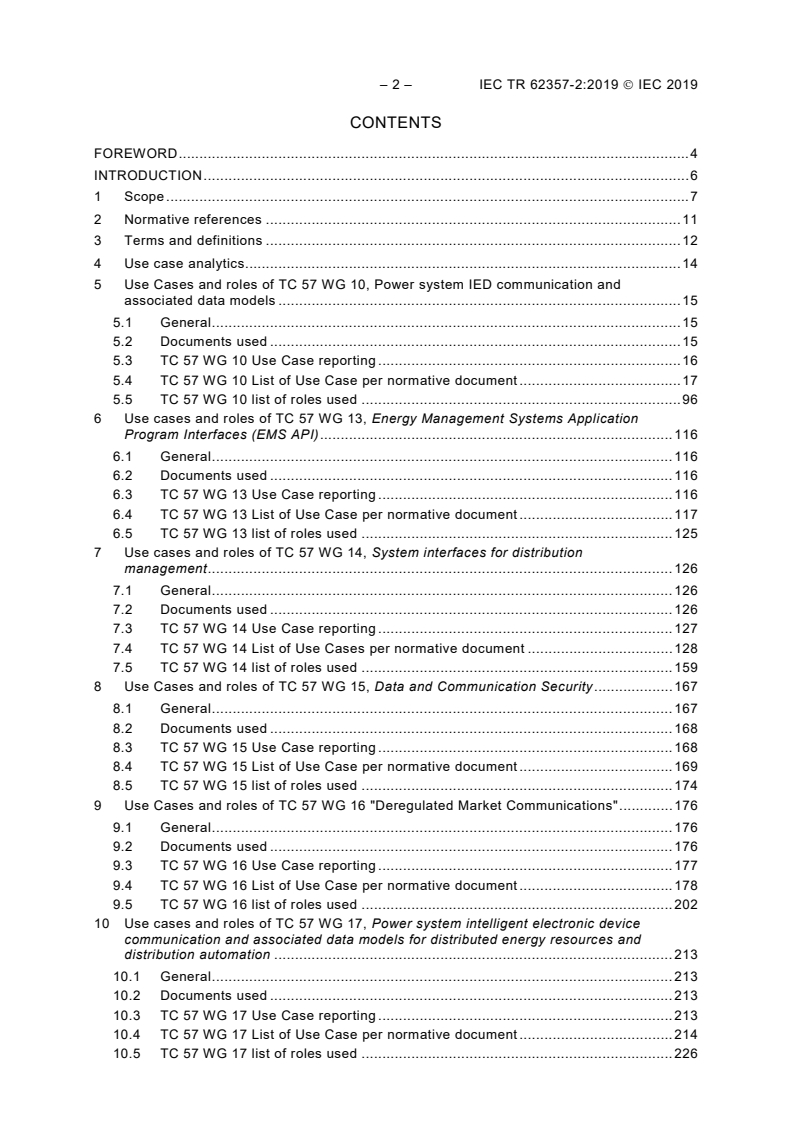
CONTENTS
FOREWORD . 4
INTRODUCTION . 6
1 Scope . 7
2 Normative references . 11
3 Terms and definitions . 12
4 Use case analytics. 14
5 Use Cases and roles of TC 57 WG 10, Power system IED communication and
associated data models . 15
5.1 General . 15
5.2 Documents used . 15
5.3 TC 57 WG 10 Use Case reporting . 16
5.4 TC 57 WG 10 List of Use Case per normative document . 17
5.5 TC 57 WG 10 list of roles used . 96
6 Use cases and roles of TC 57 WG 13, Energy Management Systems Application
Program Interfaces (EMS API) . 116
6.1 General . 116
6.2 Documents used . 116
6.3 TC 57 WG 13 Use Case reporting . 116
6.4 TC 57 WG 13 List of Use Case per normative document . 117
6.5 TC 57 WG 13 list of roles used . 125
7 Use cases and roles of TC 57 WG 14, System interfaces for distribution
management . 126
7.1 General . 126
7.2 Documents used . 126
7.3 TC 57 WG 14 Use Case reporting . 127
7.4 TC 57 WG 14 List of Use Cases per normative document . 128
7.5 TC 57 WG 14 list of roles used . 159
8 Use Cases and roles of TC 57 WG 15, Data and Communication Security . 167
8.1 General . 167
8.2 Documents used . 168
8.3 TC 57 WG 15 Use Case reporting . 168
8.4 TC 57 WG 15 List of Use Case per normative document . 169
8.5 TC 57 WG 15 list of roles used . 174
9 Use Cases and roles of TC 57 WG 16 "Deregulated Market Communications" . 176
9.1 General . 176
9.2 Documents used . 176
9.3 TC 57 WG 16 Use Case reporting . 177
9.4 TC 57 WG 16 List of Use Case per normative document . 178
9.5 TC 57 WG 16 list of roles used . 202
10 Use cases and roles of TC 57 WG 17, Power system intelligent electronic device
communication and associated data models for distributed energy resources and
distribution automation . 213
10.1 General . 213
10.2 Documents used . 213
10.3 TC 57 WG 17 Use Case reporting . 213
10.4 TC 57 WG 17 List of Use Case per normative document . 214
10.5 TC 57 WG 17 list of roles used . 226
11 Use cases and roles of TC 57 WG 18, Hydroelectric power plants –
Communication for monitoring and control . 228
11.1 General . 228
11.2 Documents used . 228
11.3 TC 57 WG 18 Use Case reporting . 228
11.4 TC 57 WG 18 List of Use Case per normative document . 229
11.5 TC 57 WG 18 list of roles used . 232
12 Use cases and roles of TC 57 WG 19, Interoperability within TC 57 in the long
term . 232
12.1 General . 232
12.2 Documents used . 232
12.3 TC 57 WG 19 Use Case reporting . 232
12.4 TC 57 WG 19 List of Use Case per normative document . 233
12.5 TC 57 WG 19 list of roles used . 236
13 Use cases and roles of TC 57 WG 21, Interfaces and protocol profiles relevant to
systems connected to the electrical grid . 237
13.1 General . 237
13.2 Documents used . 237
13.3 TC 57 WG21 Use Case reporting . 237
13.4 TC 57 WG 21 List of Use Case per normative document . 238
13.5 TC 57 WG 21 list of roles used . 280
14 Recommendations . 289
Annex A (informative) Joint Working Groups Use Cases . 290
A.1 Use Cases and roles of JWG 11, Management of Electric Vehicles charging
and discharging infrastructures . 290
A.1.1 General . 290
A.1.2 Documents used . 290
A.1.3 Use case reporting . 290
A.1.4 JWG 11 List of Use Case per normative document . 291
A.1.5 JWG 11 List of roles used . 293
Bibliography . 295
Figure 1 – TC 57 core standards . 7
Figure 2 – UML-driven top/down approach supporting IEC 62559 and IEC 62913 . 8
Figure 3 – Use Case design process . 9
Figure 4 – Enterprise architecture and IEC core standards relationships . 9
Figure 5 – Use Case Repository . 11
Table 1 – Differences between Business and System Use Cases. 13
Table 2 – Use Case analytics per Working Group . 14
– 4 – IEC TR 62357-2:2019 IEC 2019
INTERNATIONAL ELECTROTECHNICAL COMMISSION
____________
POWER SYSTEMS MANAGEMENT
AND ASSOCIATED INFORMATION EXCHANGE –
Part 2: Use cases and role models
FOREWORD
1) The International Electrotechnical Commission (IEC) is a worldwide organization for standardization comprising
all national electrotechnical committees (IEC National Committees). The object of IEC is to promote
international co-operation on all questions concerning standardization in the electrical and electronic fields. To
this end and in addition to other activities, IEC publishes International Standards, Technical Specifications,
Technical Reports, Publicly Available Specifications (PAS) and Guides (hereafter referred to as "IEC
Publication(s)"). Their preparation is entrusted to technical committees; any IEC National Committee interested
in the subject dealt with may participate in this preparatory work. International, governmental and non-
governmental organizations liaising with the IEC also participate in this preparation. IEC collaborates closely
with the International Organization for Standardization (ISO) in accordance with conditions determined by
agreement between the two organizations.
2) The formal decisions or agreements of IEC on technical matters express, as nearly as possible, an international
consensus of opinion on the relevant subjects since each technical committee has representation from all
interested IEC National Committees.
3) IEC Publications have the form of recommendations for international use and are accepted by IEC National
Committees in that sense. While all reasonable efforts are made to ensure that the technical content of IEC
Publications is accurate, IEC cannot be held responsible for the way in which they are used or for any
misinterpretation by any end user.
4) In order to promote international uniformity, IEC National Committees undertake to apply IEC Publications
transparently to the maximum extent possible in their national and regional publications. Any divergence
between any IEC Publication and the corresponding national or regional publication shall be clearly indicated in
the latter.
5) IEC itself does not provide any attestation of conformity. Independent certification bodies provide conformity
assessment services and, in some areas, access to IEC marks of conformity. IEC is not responsible for any
services carried out by independent certification bodies.
6) All users should ensure that they have the latest edition of this publication.
7) No liability shall attach to IEC or its directors, employees, servants or agents including individual experts and
members of its technical committees and IEC National Committees for any personal injury, property damage or
other damage of any nature whatsoever, whether direct or indirect, or for costs (including legal fees) and
expenses arising out of the publication, use of, or reliance upon, this IEC Publication or any other IEC
Publications.
8) Attention is drawn to the Normative references cited in this publication. Use of the referenced publications is
indispensable for the correct application of this publication.
9) Attention is drawn to the possibility that some of the elements of this IEC Publication may be the subject of
patent rights. IEC shall not be held responsible for identifying any or all such patent rights.
The main task of IEC technical committees is to prepare International Standards. However, a
technical committee may propose the publication of a Technical Report when it has collected
data of a different kind from that which is normally published as an International Standard, for
example "state of the art".
IEC 62357-2, which is a technical report, has been prepared by IEC technical committee 57:
Power systems management and associated information exchange.
The text of this Technical Report is based on the following documents:
DTR Report on voting
57/2042/DTR 57/2066/RVDTR
Full information on the voting for the approval of this Technical Report can be found in the
report on voting indicated in the above table.
This document has been drafted in accordance with the ISO/IEC Directives, Part 2.
A list of all parts in the IEC 62357 series, published under the general title Power systems
management and associated information exchange, can be found on the IEC website.
The committee has decided that the contents of this document will remain unchanged until the
stability date indicated on the IEC website under "http://webstore.iec.ch" in the data related to
the specific document. At this date, the document will be
• reconfirmed,
• withdrawn,
• replaced by a revised edition, or
• amended.
A bilingual version of this publication may be issued at a later date.
IMPORTANT – The 'colour inside' logo on the cover page of this publication indicates
that it contains colours which are considered to be useful for the correct
understanding of its contents. Users should therefore print this document using a
colour printer.
– 6 – IEC TR 62357-2:2019 IEC 2019
INTRODUCTION
The IEC is in an operational implementation phase of the System approach of
standardization. Technical Committee 57 (TC 57) has a crucial role in helping other
Application Domain TCs extending their core standards (i.e. CIM
standards/IEC 61850/IEC 62746/IEC 62351) to their specific domains. This should ensure
efficient and secured power network management.
In the system approach working process, it is important for TC 57 to be able to consolidate,
share and explain the numerous Use Cases serving as basis for its standardization work.
These Use Cases are an excellent tool for design and implementation of new processes, also
for external organisations (SDOs, User Groups, Alliances etc.)
The mission of this Technical Report is to list the Use Cases featured in the TC 57
standardization work, thus making them available for re-use in on-going and future work.
Hopefully this will also promote Use Cases as a good tool for further work.
The intended audience for the document is the experts of TC 57 for their standardization work
or experts of other Application Domain TCs for on-going standardization work, independently
from TC 57 or through Joint Working Groups (JWG) or Task Forces (TF), as well as roadmaps
and strategic vision through Ad-hoc Groups, Strategic Groups, System Evaluation Groups or
System Committees.
This document structures and consolidates the TC 57 Use Cases (Status, WG and documents
linked, roles used, roadmap) to facilitate their use and re-use. It will list the following
elements:
• Existing Use Cases used to develop standards and their links with source documents, the
IEC Status of this source document, a short Use Case description, its compliance to
IEC 62559-2
• A roadmap: planned or drafted Use Cases (in on-going standardization work and PWI)
• Roles used in those Use Cases
• Terminology used in standardization work and not present in existing standards
This Technical report is split by active Working Group (WG) of TC 57
• WG 10 Power system IED communication and associated data models
• WG 13 Energy Management Systems Application Program Interfaces (EMS API)"
• WG 14 System interfaces for distribution management
• WG 15 Data and Communication Security
• WG 16 Deregulated Market Communications
• WG 17 Power system intelligent electronic device communication and associated data
models for distributed energy resources and distribution automation
• WG 18 Hydroelectric power plants – Communication for monitoring and control
• WG 19 Interoperability within TC 57 in the long term
• WG21 Interfaces and protocol profiles relevant to systems connected to the electrical grid
POWER SYSTEMS MANAGEMENT
AND ASSOCIATED INFORMATION EXCHANGE –
Part 2: Use cases and role models
1 Scope
This part of IEC 62357, which is a technical report, establishes the list of Use Cases
developed by TC 57, Power systems management and associated information exchanges, in
order to prepare International Standards, Technical Reports and Technical Specifications.
Use Cases are fundamental to TC 57 publications, as shown in Figure 1.
Figure 1 – TC 57 core standards
The Use Case creation process is shown in Figures 2, 3 and 4.
– 8 – IEC TR 62357-2:2019 IEC 2019
Figure 2 – UML-driven top/down approach supporting IEC 62559 and IEC 62913
Figure 3 – Use Case design process
Figure 4 – Enterprise architecture and IEC core standards relationships
– 10 – IEC TR 62357-2:2019 IEC 2019
This Technical Report:
• Identifies in existing standards, technical specification, reports and in ongoing TC 57 work
(CD, DTS, DTR etc.) the Use Cases used as well as their links to standards, their status
as Use Cases (level of description, standardization of the description referring to
IEC 62559) and as IEC deliverables (are they in a TR/TS/IS, what is the status of the
document CD, CDV etc.)
• Helps System Committees consolidate Use Cases through terminology and term definition
work (link with existing relevant standards on the TC Terminology) and building links
between roles and modelling frameworks (Role models). For example in TC 57 building
links between the Use Case methodology and the roles used in IEC 62913-2 with CIM
Interface Reference Model (IRM – IEC 61968).
• Shares and promotes those Use Cases within TC 57 and outside it. TC 57 mainly
describes System Use Cases in the standards it publishes. Business roles and business
Use Cases are mainly described within SyC SE (System Committee Smart Energy)
deliverables (IEC 62559 series and IEC 62913 series).
• This document provides good input in reusing System Use Cases and System Roles inside
and outside TC 57.
• Explains the content of its Use Cases to potential users and providing support on using
those Use Cases for standardization (Normative context, maturity of the Use Case,
location in standardization work, roles implied)
Those Use Cases aimed to be used as tools to identify requirements as input to further
development of technical standards (whether TC 57 or not) and improve the consistency in
this work and in that way contribute to interoperability. Use Cases facilitate cooperation at a
system level with TCs, other standards-developing organizations, non-traditional players of
electrotechnology, and regional organizations. Inside the IEC they provide a convergence
platform with overall system level value for support of the Technical Committees and other
standard development groups.
This document allows TC 57 to self-assess its work on Use Cases through KPIs (Key
Performance Indicator) such as:
• % of Use Cases compliant with IEC 62559-2
• % of Business Use Cases (BUC) and System Use Cases (SUC)
• % of Business Roles and System Roles
• % of non-defined roles
Another objective of this document is to fill up the TC 57 Use Case Repository, as shown in
Figure 5.
Figure 5 – Use Case Repository
2 Normative references
The following documents are referred to in the text in such a way that some or all of their
content constitutes requirements of this document. For dated references, only the edition
cited applies. For undated references, the latest edition of the referenced document (including
any amendments) applies.
IEC 60870-5, Telecontrol equipment and systems – Part 5: Transmission protocols
IEC 60870-6, Telecontrol equipment and systems – Part 6: Telecontrol protocols compatible
with ISO standards and ITU-T recommendations
IEC 61850 (all parts), Communication networks and systems for power utility automation
IEC 61968 (all parts), Application integration at electric utilities – System interfaces for
distribution management
IEC 61970 (all parts), Energy management system application program interface (EMS-API)
IEC 62351 (all parts), Power systems management and associated information exchange –
Data and communications security
IEC 62325 (all parts), Framework for energy market communications
IEC 62361 (all parts), Power systems management and associated information exchange –
Interoperability in the long term
IEC 62559-2:2015, Use case methodology - Part 2: Definition of the templates for use cases,
actor list and requirements list
IEC 62746 (all parts), Systems interface between customer energy management system and
the power management system
– 12 – IEC TR 62357-2:2019 IEC 2019
IEC TS 62913-1, Generic Smart Grid Requirements – Specific application of the Use Case
methodology for defining Generic Smart Grid Requirements according to the IEC System
approach
3 Terms and definitions
For the purposes of this document, the following terms and definitions apply.
ISO and IEC maintain terminological databases for use in standardization at the following
addresses:
• IEC Electropedia: available at http://www.electropedia.org/
• ISO Online browsing platform: available at http://www.iso.org/obp
3.1
actor
entity that communicates and interacts
Note 1 to entry: These actors can include people, software applications, systems, databases, and even the power
system itself.
Note 2 to entry: In IEC TS 62913-1 this term includes the concepts of Business Role and System Role involved in
Use Cases.
[SOURCE: IEC 62559-2:2015]
3.2
business role
role describing a finite set of responsibilities that is assumed by a party (organizations,
organizational entities or physical persons)
3.3
levels of maturity
set of structured levels that describe how well a process, or Use Case, is implemented
through an organization and relates to its degree of formality, optimization and reliability
Note 1 to entry: Proposed levels of maturity:
– Level "Already implemented": the process is implemented in and between several organizations, it is well
defined, reliable, sustainable and few uncertainties remain in its framework (regulatory, business or
technological).
– Level "Adjustments in progress": the process is implemented in few organizations, it is well defined but subject
to remaining major uncertainties in its framework (regulatory, business or technological).
– Level "Explorative": the process is tested in very few organizations, it is not completely defined and subject to
numerous major uncertainties in its framework (regulatory, business or technological).
3.4
role
type of actor which has responsibilities and represents the external intended behavior of a
party
EXAMPLE 1 A legally defined market participant (e.g. grid operator, customer), a generic role which represents a
bundle of possible roles (e.g. flexibility operator) or an artificially defined body needed for generic process and Use
Case descriptions.
Note 1 to entry: IEC TS 62913 uses two kinds of roles: Business Roles and System Roles.
__________
Under preparation. Stage at the time of publication: IEC/RPUB 62913-1:2019.
Note 2 to entry: Legally or generically defined external actors may be named and identified by their roles.
Note 3 to entry: Between Systems, Devices and Operators can be described or modelled as System Use Cases.
[SOURCE: SG-CG/M490/C:2012-12]
3.5
system role
role describing a finite set of functionalities that is assumed by an entity (devices, information
system, equipment)
3.6
Use Case
specification of a set of actions performed by a system, which yields an observable result that
is, typically, of value for one or more actors or other stakeholders of the system
Note 1 to entry: There are two types of Use Cases:
– Business Use Cases describe how Business Roles interact to execute a business process. These processes
are derived from services, i.e. business transactions, which have previously been identified.
– System Use Cases describe how System and/or Business Roles of a given system interact to perform a Smart
Grid Function required to enable / facilitate the business processes described in Business Use Cases. Their
purpose is to detail the execution of those processes from an Information System perspective.
Note 2 to entry: Since a Smart Grid Function can be used to enable / facilitate more than one business process, a
System Use Case can be linked to more than one Business Use Case.
Table 1 highlights the differences between these 2 types of Use Case.
Table 1 – Differences between Business and System Use Cases
Type of Use Case Description Actors involved
Business Roles (organizations,
Business Use Cases Depicts a business process– Expected
organizational entities or physical
(BUC) to be system agnostic
persons)
Depicts a function or sub-function
System Use Cases Business Roles and System Roles
supporting one or several business
(SUC) ( Devices, Information System)
processes
– 14 – IEC TR 62357-2:2019 IEC 2019
4 Use case analytics
Table 2 gathers information that characterizes each WG’s set of Use Cases.
Table 2 – Use Case analytics per Working Group
a a a a
WG 10 232 98 9,27 % 228 16,23 %
5,6 % 80,1 % 9,65 % 89,91 %
WG 13 20 24 0 % 75 % 25 % 21 9,52 % 90,48 % 80,95 %
WG 14 72 98 12,5 % 1,39 % 98,61 % 63 25,40 % 74,60 % 20,7 %
WG 15 12 0 0 % 25 % 75 % 21 42,86 % 57,14 % 60,4 %
b b
WG 16 59 10 1,7 % 100 % 0 %
23 / 37 100 % 0 % 0% / 64,9 %
WG 17 38 3 0 % 0 % 100 % 21 14,29 % 85,71 % 14,3 %
WG 18 6 6 0 % 0 % 100 % 0 N/A N/A N/A
WG 19 7 3 28,6 % 0 % 100 % 17 23,53 % 76,47 % 5,9 %
WG21 55 47 100 % 1,8 % 98,2 % 23 21,74 % 78,26 % 0 %
JWG 11 8 0 100 % 75 % 25 % 9 44,44 % 55,56 % 0 %
Global 509 289 19 % 19,25 % 74,2 % 464 26,94 % 73,06 % 23,49 %
a
The sum does not match 100 % because some Use Cases and roles of WG 10 can be classified as neither business nor system.
b
The roles of WG 16 are divided between those from the ebIX, EFET and ENTSO-E role model and the others, hence the two numbers that respectively characterize these two
parts.
5 Use Cases and roles of TC 57 WG 10, Power system IED communication and
associated data models
5.1 General
The scope of WG 10, Power system IED communication and associated data models, is to
develop standards and technical reports related to the communication and data models of
Power System IEDs, to take responsibility for the generic aspects of IEC 61850 and to
coordinate with other WGs that are developing domain specific data models.
5.2 Documents used
IEC Publication
Name Edition
reference status
61850-4 System and project management Published 2
Configuration description language for
61850-6 communication in electrical substations Published 2
related to IEDs
Configuration description language for
61850-7-4 communication in power utility automation Published 2
systems related to IEDs
Use of logical nodes for modeling
61850-7-500 application functions and related concepts Published 1
and guidelines for substations
Use of logical nodes for modeling
61850-7-5 application functions and related concepts PWI 1
and guidelines for substations
Use of IEC 61850 for the communication
61850-90-1 Published 1
between substations
Using IEC 61850 for communication
61850-90-2 Published 1
between substations and control centres
Using IEC 61850 for condition monitoring
61850-90-3 Published 1
diagnosis and analysis
61850-90-4 Network engineering guidelines Published 1
Use of IEC 61850 to transmit synchrophasor
61850-90-5 Published 1
information according to IEEE C37.118
Use of IEC 61850 for Distribution
61850-90-6 BPUB 1
Automation Systems
Methodologies for modeling of logics for
61850-90-11
PWI 1
IEC 61850 based applications
Using IEC 61850 for FACTS (Flexible AC
61850-90-14 PWI 1
Transmission Systems) data modelling
– 16 – IEC TR 62357-2:2019 IEC 2019
IEC Publication
Name Edition
reference status
61850-90-16 System management for IEC 61850 ACD 1
Using IEC 61850 to transmit power quality
61850-90-17 Published 1
data
61850-90-18 Alarm Handling PWI 1
61850-90-20 Guideline to redundancy systems PWI 1
61850-90-21 Travelling Wave Fault Location PWI 1
5.3 TC 57 WG 10 Use Case reporting
WG % of Use % of % of Number % of % of % of
number of Cases Business System of roles Business System non-
identified described Use Use identified Roles Roles defined
Use with Cases Cases roles
Cases 62559-2
a a a a
232 9,27 % 228 16,23 %
5,6 % 80,1 % 9,65 % 89,91 %
a
The sum does not match 100 % because some Use Cases and roles of WG 10 can neither be classified
business or system.
5.4 TC 57 WG 10 List of Use Case per normative document
IEC Pub. IEC 62559-2
Use Case Title Description Actors / Roles
document status compliance
System and project
61850-4 Published
management
Project Requirement
Engineer, Project
Design Engineer,
System engineering process Manufacturer, System
61850-4 for designing and configuring Published Describes actors and tools Integrator, IED
an automation system parameterizing
Engineer, Testing and
Commissioning
Engineer
Replacement of one IED with
61850-4 one coming from the same Published Replacement of an IED due to device failure IED, Vendor A
vendor
Replacement of one IED with IED, Vendor A,
61850-4 Published Replacement of an IED due to device failure
one coming a different vendor Vendor B
Extension with addition of one
61850-4 Published Addition of a device IED, Vendor A or B
IED into an existing system
Extension of the system with
61850-4 Published UAS extension IED, Vendor A or B
new functionalities
– 18 – IEC TR 62357-2:2019 IEC 2019
IEC Pub. IEC 62559-2
Use Case Title Description Actors / Roles
document status compliance
Configuration description
language for
communication in power Published
61850-6
utility automation systems
related to IEDs
Engineering process with
IED Configurator,
61850-6 System Configuration Published Defines tool roles
System Configurator
description Language
Engineering process with A system specification in terms of the single
System Configuration line diagram, and allocation of logical nodes IED Configurator,
61850-6 Published
description Language – (LN) to parts and equipment of the single System Configurator
system specification line to indicate the needed functionality
Complete process configuration with all
Engineering process with IEDs bound to individual process functions
System Configuration and primary equipment, enhanced by the IED Configurator,
61850-6 Published
description Language – access point connections and possible System Configurator
process configuration access paths in subnetworks for all possible
clients
Engineering process with
System Configuration The IED Configurator loads IED IED Configurator,
61850-6 Published
description Language – IED configuration into the IED System Configurator
configuration
IEC Pub. IEC 62559-2
Use Case Title Description Actors / Roles
document status compliance
As far as the engineering responsibility is
concerned, a complete secondary system
can be split into different parts. Examples
include separate engineering of high-voltage
level and medium-voltage level, of a
transformer-related part, or even of different
Engineering process with substations exchanging data e.g. for line
System Configuration protection or interlocking. For the purposes IED Configurator,
61850-6 Published
description Language – data of this standard, such a system part with System Configurator
exchange between projects responsibility for all its contained IEDs is
called a project. To allow the engineering of
online communication data flow between
such projects, some interfacing data has to
be exchanged between the projects, and the
engineered interfaces have to be reimported
to the concerned projects.
During the engineering process it may
happen that the IED-related data has to be
Engineering process with changed. This can in principle be done by
System Configuration removing the IED from the system, and IED Configurator,
61850-6 Published
description Language – IED reinstantiating a modified IED description System Configurator
modifications file in the system. However, in this case also
all existing references from or to the IED are
lost and have to be re-established.
Basic communication
structure – Compatible Functions are described in more detail in
61850-7-4 Published
logical node classes and IEC 61850-7-500
data object classes
Substation control and
61850-7-4 Published Implied
supervision
– 20 – IEC TR 62357-2:2019 IEC 2019
IEC Pub. IEC 62559-2
Use Case Title Description Actors / Roles
document status compliance
Substation bay process
61850-7-4 Published Implied
control
Substation switch gear
61850-7-4 Published Implied
process control
Protection relay and
61850-7-4 Published Implied
protection functions
61850-7-4 Metering and measurement Published Implied
61850-7-4 Power Quality Monitoring Published Implied
Use of logical nodes for
modelling application
61850-7- Functions are described in detail, but not
functions and related Published
500 modelled as Use Cases
concepts and guidelines for
substations
The switchgear is basically represented by
logical nodes XCBR or XSWI. The
application of the time critical GOOSE
service according to IEC 61850-8-1 is
61850-7-
Control of switchgear Published needed between the control (CSWI) and
protection (Pxxx-PTRC) at bay level and the
switchgear to operate or trip the switchgear.
It refers for time-critical functions, also to
the position indication from the switchgear.
IEC Pub. IEC 62559-2
Use Case Title Description Actors / Roles
document status compliance
The synchrocheck allows closing of an open
circuit breaker only if both the amplitudes,
61850-7-
Synchrocheck Published phase angles and frequencies of the voltage
on both sides are within predefined
intervals.
The interlocking should forbid dangerous
switching operations which may harm
people or destroy equipment. The
requirements are easily derived from the
61850-7- task and properties of the switches. Simple
Interlocking Published
500 and common requirement examples are to
avoid switching power to ground, creating a
short circuit or breaking or connecting power
by disconnectors which would destroy this
kind of equipment.
By definition, blocking switching operations
refers not to the condition of the rest of the
switchgear but only to the behavior of the
switch which is intended to be operated.
61850-7- There could be a mechanical problem with
Blocking Published
500 the operating mechanism, too low gas
density or not enough drive energy. The
blocking of switchgear could be also issued
by an operator command to the X-nodes by
the DO BlkOpn and BlkCls.
– 22 – IEC TR 62357-2:2019 IEC 2019
IEC Pub. IEC 62559-2
Use Case Title Description Actors / Roles
document status compliance
If more than one switch is operated at once,
then overlapping of contact movement with
dangerous power transfer may happen.
61850-7- Unpredictable transient events may occur.
Operation 1 out of n Published
500 Therefore, as a general rule in most
substations, only one of the switches should
be operated at same time, at least in
interconnected parts of the substation.
Control actions in a substation may be
accomplished at different control levels. For
61850-7- safety reasons, an operator or service
Control authority management Published
500 person if applicable shall be able to isolate
a level from the others by claiming the
control authority for that level.
The bay protection (Protection IED) is
connected to the station level and other
bays (if applicable) by the station bus
providing communication over Ethernet. The
bay protection is hardwired (parallel copper
61850-7- wires) to the switchgear (process). External
Protection Published
500 process states and measured values are
converted to data according to the IEC6
1850 data model in the Protection IED.
Therefore, the boundary LNs are all in this
IED. The switchgear is shown as single
phase switches.
IEC Pub. IEC 62559-2
Use Case Title Description Actors / Roles
document status compliance
Point-on-wave switching (also known as
controlled switching or synchronous
61850-7- switching) means to open or close the circuit
Point on wave switching Published
500 breaker at a predefined instant of time i.e. at
a certain value of the sinusoidal current or
voltage.
Since also in three-phase breakers
differences in the pole positions per phase
may happen, the modeling of supervision
requests three instances of XCBR. The
common XCBR reports the phase
61850-7-
Breaker failure protection Published discrepancy if any. The trip may be
performed for all three phases (three-phase
trip) or per phase (single phase tripping),
which is very common at higher voltage
levels e.g. to keep the power system
synchronization.
The current differential protection (LN PDIF,
one instance per phase) checks that the
currents on both or more sides of the
61850-7- Line differential protection
Published protected object are the same disregarding
500 (see as well 61850-90-1)
the sign, i.e. under no fault conditions the
sum of the currents is zero according to the
Kirchhoff law.
The distance protection PDIS (one instance
Line distance protection with per zone) measures current and voltage
61850-7-
teleprotection schemes (see Published (TCTR, TVTR) at one side of the line and
as well IEC 61850-90-1) permanently calculates the impedance. The
impedance is calculated in different zones.
– 24 – IEC TR 62357-2:2019 IEC 2019
IEC Pub. IEC 62559-2
Use Case Title Description Actors / Roles
document status compliance
In case of transient faults, after the trip by
protection (LN Pxxx) the auto recloser (LN
RREC) shall try to close the tripped circuit
breaker as fast as possible with some
boundary conditions to minimize the
61850-7-
Autorecloser Published interruption on power delivery. RREC will
make a predefined number of reclosing
cycles (e.g. 3) but declare the fault
permanent if this number of trials
...