

ISO/IEC TS 30180:2025
(Main)Internet of Things (IoT) - Functional requirements to determine the status of self-quarantine through IoT data interfaces
General Information
- Abstract
ISO/IEC TS 30180:2025 specifies the functional requirements of the following items to determine the status of self-quarantine through IoT data interfaces working over a set of hand-held devices, monitoring tag, and a management system:
- functional requirements for monitoring entity and monitoring tag at a self-quarantine place;
- functional requirements for managing entity and proxy managing entity at the management side; and
- functional requirements for the protection of the self-quarantine status and the privacy information.
- Status
- Published
- Publication Date
- 20-Aug-2025
- Technical Committee
- ISO/IEC JTC 1/SC 41 - Internet of Things and Digital Twin
- Drafting Committee
- WG 5 - ISO/IEC JTC 1/SC 41/WG 5
- Current Stage
- PPUB - Publication issued
- Start Date
- 21-Aug-2025
- Completion Date
- 05-Sep-2025
Overview
ISO/IEC TS 30180:2025 - “Internet of Things (IoT) – Functional requirements to determine the status of self-quarantine through IoT data interfaces” - defines functional requirements for IoT-based self-quarantine monitoring systems. Published as a Technical Specification in August 2025, it focuses on how a set of hand-held devices, a monitoring tag, and a management system exchange data via IoT data interfaces to determine and report a person’s self-quarantine status. The document is intended for self-quarantine measures imposed by public health authorities and includes provisions for data protection and privacy.
Key topics
- Functional entities and roles
- Monitoring entity (client-side) and monitoring tag attached to the individual.
- Managing entity (server-side) and proxy managing entity for delegated responsibilities.
- Functional requirements
- Requirements for monitoring at the self-quarantine place, tag-device interactions, and management-side processing.
- Provisions that specify mandatory and optional functional elements and interface behaviours.
- Data interfaces and communications
- Definitions and reference interface relations for exchanging self-quarantine status information across IoT components.
- Self-quarantine management model
- Management levels (Level 0–4) ranging from no management to tag-based active management for graduated control and oversight.
- Security, privacy and ethical guidance
- Functional requirements for protection of self-quarantine status and personal data.
- Informative annexes covering ethical considerations, transparency, and applicability under local laws.
- Reference configurations and use cases
- Illustrative topologies: peer-to-peer, three-tier and four-tier schemes; application guidelines and development cases.
Applications
ISO/IEC TS 30180 is practical for:
- Public health authorities designing policy-compliant self-quarantine monitoring programs.
- IoT system architects and product manufacturers implementing monitoring tags, wearable devices, and management platforms.
- Software developers and integrators building secure IoT data interfaces and management dashboards.
- Researchers and implementers evaluating ethical, legal, and operational impacts of quarantine monitoring. The specification supports interoperability, privacy-aware design, and clear delegation (managing vs. proxy managing entity) for large-scale public health deployments.
Related standards
- Complements IoT-related standards on terminology and IoT interfaces (see ISO/IEC joint technical committee SC 41 materials).
- Aligns with general privacy, security and device interoperability best practices; consult national regulations and ISO/IEC guidance when implementing.
Keywords: ISO/IEC TS 30180, IoT self-quarantine monitoring, monitoring tag, managing entity, proxy managing entity, IoT data interfaces, functional requirements, data privacy, public health authorities.
Get Certified
Connect with accredited certification bodies for this standard

BSI Group
BSI (British Standards Institution) is the business standards company that helps organizations make excellence a habit.

NYCE
Mexican standards and certification body.
Sponsored listings
Frequently Asked Questions
ISO/IEC TS 30180:2025 is a technical specification published by the International Electrotechnical Commission (IEC). Its full title is "Internet of Things (IoT) - Functional requirements to determine the status of self-quarantine through IoT data interfaces". This standard covers: ISO/IEC TS 30180:2025 specifies the functional requirements of the following items to determine the status of self-quarantine through IoT data interfaces working over a set of hand-held devices, monitoring tag, and a management system: - functional requirements for monitoring entity and monitoring tag at a self-quarantine place; - functional requirements for managing entity and proxy managing entity at the management side; and - functional requirements for the protection of the self-quarantine status and the privacy information.
ISO/IEC TS 30180:2025 specifies the functional requirements of the following items to determine the status of self-quarantine through IoT data interfaces working over a set of hand-held devices, monitoring tag, and a management system: - functional requirements for monitoring entity and monitoring tag at a self-quarantine place; - functional requirements for managing entity and proxy managing entity at the management side; and - functional requirements for the protection of the self-quarantine status and the privacy information.
ISO/IEC TS 30180:2025 is classified under the following ICS (International Classification for Standards) categories: 35.020 - Information technology (IT) in general. The ICS classification helps identify the subject area and facilitates finding related standards.
ISO/IEC TS 30180:2025 is available in PDF format for immediate download after purchase. The document can be added to your cart and obtained through the secure checkout process. Digital delivery ensures instant access to the complete standard document.
Standards Content (Sample)
ISO/IEC TS 30180
Edition 1.0 2025-08
TECHNICAL
SPECIFICATION
Internet of Things (IoT) –
Functional requirements to determine the status of self-quarantine through IoT
data interfaces
ICS 35.020 ISBN 978-2-8327-0632-9
ISO/IEC TS 30180: 2025-08(en)
All rights reserved. Unless otherwise specified, no part of this publication may be reproduced or utilized in any form or
by any means, electronic or mechanical, including photocopying and microfilm, without permission in writing from either
IEC or IEC's member National Committee in the country of the requester. If you have any questions about IEC copyright
or have an enquiry about obtaining additional rights to this publication, please contact the address below or your local
IEC member National Committee for further information.
IEC Secretariat Tel.: +41 22 919 02 11
3, rue de Varembé info@iec.ch
CH-1211 Geneva 20 www.iec.ch
Switzerland
About the IEC
The International Electrotechnical Commission (IEC) is the leading global organization that prepares and publishes
International Standards for all electrical, electronic and related technologies.
About IEC publications
The technical content of IEC publications is kept under constant review by the IEC. Please make sure that you have the
latest edition, a corrigendum or an amendment might have been published.
IEC publications search - IEC Products & Services Portal - products.iec.ch
webstore.iec.ch/advsearchform Discover our powerful search engine and read freely all the
publications previews, graphical symbols and the glossary.
The advanced search enables to find IEC publications by a
variety of criteria (reference number, text, technical With a subscription you will always have access to up to date
committee, …). It also gives information on projects, content tailored to your needs.
replaced and withdrawn publications.
Electropedia - www.electropedia.org
The world's leading online dictionary on electrotechnology,
IEC Just Published - webstore.iec.ch/justpublished
Stay up to date on all new IEC publications. Just Published containing more than 22 500 terminological entries in English
details all new publications released. Available online and and French, with equivalent terms in 25 additional languages.
once a month by email. Also known as the International Electrotechnical Vocabulary
(IEV) online.
IEC Customer Service Centre - webstore.iec.ch/csc
If you wish to give us your feedback on this publication or
need further assistance, please contact the Customer
Service Centre: sales@iec.ch.
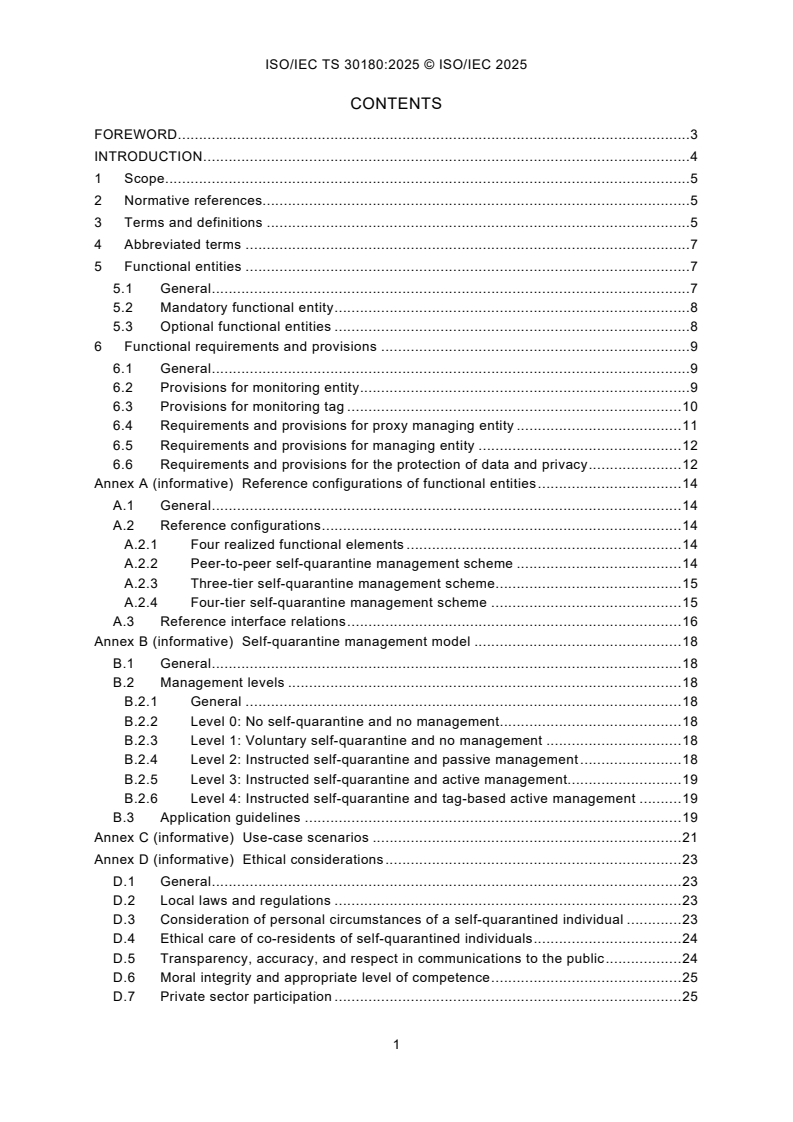
CONTENTS
FOREWORD . 3
INTRODUCTION . 4
1 Scope . 5
2 Normative references. 5
3 Terms and definitions . 5
4 Abbreviated terms . 7
5 Functional entities . 7
5.1 General . 7
5.2 Mandatory functional entity . 8
5.3 Optional functional entities . 8
6 Functional requirements and provisions . 9
6.1 General . 9
6.2 Provisions for monitoring entity . 9
6.3 Provisions for monitoring tag . 10
6.4 Requirements and provisions for proxy managing entity . 11
6.5 Requirements and provisions for managing entity . 12
6.6 Requirements and provisions for the protection of data and privacy . 12
Annex A (informative) Reference configurations of functional entities . 14
A.1 General . 14
A.2 Reference configurations . 14
A.2.1 Four realized functional elements . 14
A.2.2 Peer-to-peer self-quarantine management scheme . 14
A.2.3 Three-tier self-quarantine management scheme . 15
A.2.4 Four-tier self-quarantine management scheme . 15
A.3 Reference interface relations . 16
Annex B (informative) Self-quarantine management model . 18
B.1 General . 18
B.2 Management levels . 18
B.2.1 General . 18
B.2.2 Level 0: No self-quarantine and no management . 18
B.2.3 Level 1: Voluntary self-quarantine and no management . 18
B.2.4 Level 2: Instructed self-quarantine and passive management . 18
B.2.5 Level 3: Instructed self-quarantine and active management. 19
B.2.6 Level 4: Instructed self-quarantine and tag-based active management . 19
B.3 Application guidelines . 19
Annex C (informative) Use-case scenarios . 21
Annex D (informative) Ethical considerations . 23
D.1 General . 23
D.2 Local laws and regulations . 23
D.3 Consideration of personal circumstances of a self-quarantined individual . 23
D.4 Ethical care of co-residents of self-quarantined individuals . 24
D.5 Transparency, accuracy, and respect in communications to the public . 24
D.6 Moral integrity and appropriate level of competence . 25
D.7 Private sector participation . 25
D.8 Research for the effectiveness and impact of the self-quarantine
management process . 26
Annex E (informative) Development cases of self-quarantine management . 27
Bibliography . 30
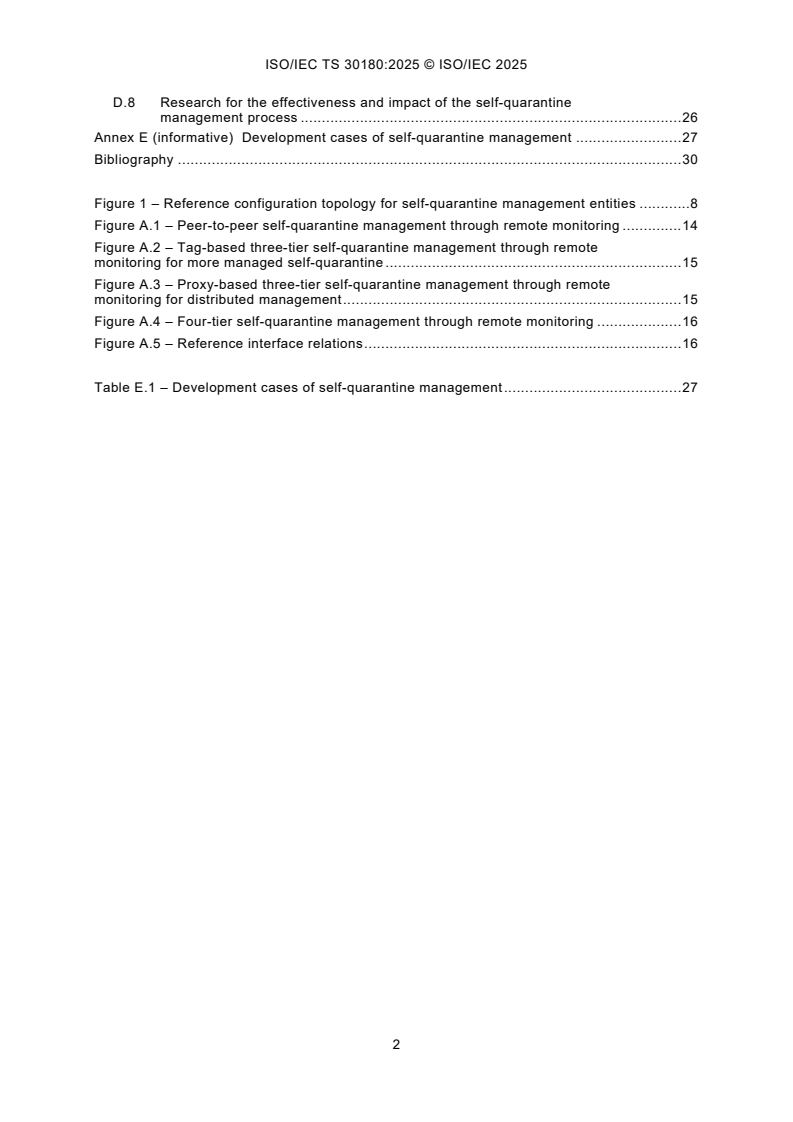
Figure 1 – Reference configuration topology for self-quarantine management entities . 8
Figure A.1 – Peer-to-peer self-quarantine management through remote monitoring . 14
Figure A.2 – Tag-based three-tier self-quarantine management through remote
monitoring for more managed self-quarantine . 15
Figure A.3 – Proxy-based three-tier self-quarantine management through remote
monitoring for distributed management . 15
Figure A.4 – Four-tier self-quarantine management through remote monitoring . 16
Figure A.5 – Reference interface relations . 16
Table E.1 – Development cases of self-quarantine management . 27
Internet of Things (IoT) -
Functional requirements to determine the status of self-quarantine
through IoT data interfaces
FOREWORD
1) ISO (the International Organization for Standardization) and IEC (the International Electrotechnical Commission)
form the specialized system for worldwide standardization. National bodies that are members of ISO or IEC
participate in the development of International Standards through technical committees established by the
respective organization to deal with particular fields of technical activity. ISO and IEC technical committees
collaborate in fields of mutual interest. Other international organizations, governmental and non-governmental,
in liaison with ISO and IEC, also take part in the work.
2) The formal decisions or agreements of IEC and ISO on technical matters express, as nearly as possible, an
international consensus of opinion on the relevant subjects since each technical committee has representation
from all interested IEC and ISO National bodies.
3) IEC and ISO documents have the form of recommendations for international use and are accepted by IEC and
ISO National bodies in that sense. While all reasonable efforts are made to ensure that the technical content of
IEC and ISO documents is accurate, IEC and ISO cannot be held responsible for the way in which they are used
or for any misinterpretation by any end user.
4) In order to promote international uniformity, IEC and ISO National bodies undertake to apply IEC and ISO
documents transparently to the maximum extent possible in their national and regional publications. Any
divergence between any IEC and ISO document and the corresponding national or regional publication shall be
clearly indicated in the latter.
5) IEC and ISO do not provide any attestation of conformity. Independent certification bodies provide conformity
assessment services and, in some areas, access to IEC and ISO marks of conformity. IEC and ISO are not
responsible for any services carried out by independent certification bodies.
6) All users should ensure that they have the latest edition of this document.
7) No liability shall attach to IEC and ISO or their directors, employees, servants or agents including individual
experts and members of its technical committees and IEC and ISO National bodies for any personal injury,
property damage or other damage of any nature whatsoever, whether direct or indirect, or for costs (including
legal fees) and expenses arising out of the publication, use of, or reliance upon, this ISO/IEC document or any
other IEC and ISO documents.
8) Attention is drawn to the Normative references cited in this document. Use of the referenced publications is
indispensable for the correct application of this document.
9) IEC and ISO draw attention to the possibility that the implementation of this document may involve the use of (a)
patent(s). IEC and ISO take no position concerning the evidence, validity or applicability of any claimed patent
rights in respect thereof. As of the date of publication of this document, IEC and ISO had not received notice of
(a) patent(s), which may be required to implement this document. However, implementers are cautioned that this
may not represent the latest information, which may be obtained from the patent database available at
https://patents.iec.ch and www.iso.org/patents. IEC and ISO shall not be held responsible for identifying any or
all such patent rights.
ISO/IEC 30180 has been prepared by subcommittee SC 41: Internet of Things and Digital Twin,
of ISO/IEC joint technical committee 1: Information technology. It is a Technical Specification.
The text of this Technical Specification is based on the following documents:
Draft Report on voting
JTC1-SC41/508/DTS JTC1-SC41/533/RVDTS
Full information on the voting for its approval can be found in the report on voting indicated in
the above table.
The language used for the development of this Technical Specification is English.
This document was drafted in accordance with ISO/IEC Directives, Part 2, and developed in
accordance with ISO/IEC Directives, Part 1, and the ISO/IEC Directives, JTC 1 Supplement
available at www.iec.ch/members_experts/refdocs and www.iso.org/directives.
INTRODUCTION
This document applies IoT functionality to self-quarantine status monitoring to mitigate the
spread of highly contagious diseases, as determined by appropriate public health authorities
as representing a serious threat to public health unless self-quarantine measures are enacted.
This document only applies to self-quarantine requirements imposed for the purposes of public
health as deemed clinically and scientifically necessary by an appropriate public health
authority. This document does not apply to self-quarantine for any other purpose, including but
not limited to legal, political, or social objectives. This document can help demonstrate how to
implement an IoT-based technical solution by utilizing the following IoT components: monitoring
entity, managing entity, proxy managing entity, and monitoring tag.
"Self-quarantine" for the purposes of this document can be defined as a need for individuals to
quarantine by themselves (i.e. self-quarantine) due to a diagnosis, or a desire to quarantine by
themselves due to public health authorities' recommendations based on the best publicly
available scientific evidence pertaining to the specific public health threat identified to minimize
the spread of documented infectious disease. It is a very effective way to mitigate contagious
disease spread as it minimizes the connections of potential confirmed cases with the public.
Self-quarantined individuals must remain at a self-quarantine place, separate themselves from
others for a particular observation period during which it is important that they monitor their
health conditions for themselves, and follow self-quarantine directions from public health
authorities. Public health authorities can determine and establish scientifically-based self-
quarantine options and rules for their jurisdictions.
1 Scope
This document specifies the functional requirements of the following items to determine the
status of self-quarantine through IoT data interfaces working over a set of hand-held devices,
monitoring tag, and a management system:
– functional requirements for monitoring entity and monitoring tag at a self-quarantine place;
– functional requirements for managing entity and proxy managing entity at the management
side; and
– functional requirements for the protection of the self-quarantine status and the privacy
information.
2 Normative references
There are no normative references in this document.
3 Terms and definitions
For the purposes of this document, the following terms and definitions apply.
ISO and IEC maintain terminology databases for use in standardization at the following
addresses:
– IEC Electropedia: available at https://www.electropedia.org/
– ISO Online browsing platform: available at https://www.iso.org/obp
3.1
authorized person
person designated by a public health authority according to the applicable regulations
Note 1 to entry: Government or municipal officers can be designated as authorized persons to monitor self-
quarantine status.
Note 2 to entry: An authorized person can be under the employment of a managing entity or a proxy managing
entity.
[SOURCE: ISO 20421-2:2017, 3.7, modified – In the definition, "authorized by" has been
replaced with "designated by a public health authority according to". The notes to entry have
been added.]
3.2
data
symbol or symbols represented in a digital and formalized manner suitable for communication,
storage, interpretation, or processing
[SOURCE: ISO/IEC 20924:2024, 3.1.11]
3.3
data interface
interface (3.5) to exchange and share data among functional communication components
Note 1 to entry: IoT data interface can be interpreted as data interface through IoT technologies.
3.4
monitoring tag
transponder plus the information storage mechanism attached to an individual who is kept in
self-quarantine (3.10)
Note 1 to entry: The monitoring tag is a neutral term, but it can be called other names such as safety band for self-
quarantine purposes and from a user acceptance perspective.
[SOURCE: ISO/IEC 19762:2025, 3.5.4.5, modified – The term "RF tag" has been replaced with
"monitoring tag" and the other terms have been deleted. In the definition, "an object" has been
replaced with "an individual who is kept in self-quarantine". Note 1 to entry has been replaced.]
3.5
interface
shared boundary between two functional components, defined by various characteristics
pertaining to the functions, physical interconnections, signal exchanges, and other
characteristics
[SOURCE: ISO/IEC 20924:2024, 3.1.22]
3.6
managing entity
functional element to receive self-quarantine status information from monitoring entities,
maintain the status information and help determine self-quarantine status
Note 1 to entry: While the monitoring entity (3.7) is a client-side entity for self-quarantined individuals, the managing
entity is a server-side entity for the public health emergency (PHE) response and management staff.
Note 2 to entry: Public health authorities can specify constituents of the self-quarantine status information. Example
constituents are given in the NOTE of 5.2.
3.7
monitoring entity
functional element to monitor if the self-quarantined individual is in the designated self-
quarantine location and transmit the information to a designated managing entity
Note 1 to entry: It can identify the self-quarantine status through the connection state, while keeping a physical
connection with the monitoring tag (3.4).
3.8
proximity
nearness in space
3.9
proxy managing entity
functional element to represent all or part of the roles of a managing entity
Note 1 to entry: Public health authorities' policy can specify the details of delegating the roles from the managing
entity (3.6) to the proxy managing entity.
3.10
self-quarantine
separation and restriction of the movement of people, under their own responsibility, who were
exposed to a contagious disease to see if they become sick
Note 1 to entry: The self-quarantine can be interpreted for infectious disease responses as keeping someone, who
was in close contact with a confirmed case of an infectious disease, who can have been exposed to an infectious
disease, or who was exposed to suspicious situations such as long-range air travel, away from others.
Note 2 to entry: The public health authorities can specify the definition of close contact.
Note 3 to entry: The self-quarantine can be compelled by a regulatory order of the government or municipal public
health authorities. It can apply to a particular quarantine place that controls access of entry and exit. But also, it can
apply to an uncontrolled self-quarantine place.
Note 4 to entry: Different from self-quarantine, isolation refers to keeping someone who is infected with an infectious
disease, away from others, even in their home.
4 Abbreviated terms
CIA confidentiality, integrity, and availability
COVID-19 coronavirus disease 2019
GDPR General Data Protection Regulation
IoT Internet of Things
IPX International Protection X
IRB institutional review board
MERS Middle East respiratory syndrome
PHE public health emergency
SARS-CoV-2 severe acute respiratory syndrome coronavirus 2
US CDC United States Centers for Disease Control and Prevention
UWB ultra-wide band
5 Functional entities
5.1 General
Under public health emergency (PHE) situations caused by infectious diseases, self-quarantine
measures can help mitigate disease spread.
NOTE ISO/IEC 5153-1:2024 includes the functional activity of self-quarantine monitoring as part of the response to
certain PHE situations.
Public health authorities determine and establish self-quarantine options and rules for their
jurisdictions. As described in Annex D, self-quarantine policies are obligated to safeguard public
health, subsequently raising ethical concerns such as balancing the needs and rights of
individuals against the overall welfare of a community of self-quarantined individuals. When
public health authorities determine self-quarantine policies, key related authorities shall be
consulted and ethical concerns shall be transparently listed and addressed.
Self-quarantine can be a useful tool to contain spread of disease in exceptional circumstances
when based on clear scientific evidence and implemented consistent with relevant laws and
regulations, but it is not foolproof. Since adherence with self-quarantine directions can be
imperfect, it can at times be necessary to have a means of detecting individuals who are in
violation of self-quarantine directions. Therefore, the ability to track possible disease spread
can be improved by data on when and where a self-quarantine has been broken. However,
given the invasiveness of self-quarantine as a public health intervention, a self-quarantine is
issued by public health authorities to the individuals who are in violation of self-quarantine
directions only in exceptional circumstances according to related laws and regulations.
This document describes an IoT-based functionality to determine the status of self-quarantine
and specifies relevant functional requirements to monitor, manage, and protect the information
collected on the state of self-quarantine.
The self-quarantine management can engage four functional entities, and Figure 1 provides its
reference configuration topology. Annex A includes specific example configurations, Annex C
provides example use-case scenarios, and Annex E introduces development cases for
information.
Key
M mandatory
O optional
Figure 1 – Reference configuration topology for self-quarantine management entities
5.2 Mandatory functional entity
The following functional entity is mandatory to support remote monitoring of self-quarantine
status between self-quarantine and management sides:
a) Managing entity: Receives the status information of self-quarantine from monitoring entities,
receives abnormal event alerts, and reacts accordingly to the abnormal events by a
designated management process. In the case of delegating particular reaction
functionalities to a proxy managing entity, it transmits some of the status information or any
abnormal event information to the proxy managing entity to request an appropriate reaction.
NOTE The abnormal event refers to something that causes the self-quarantine management system to function
improperly for self-quarantine operations, demonstrates that the self-quarantine limits have been exceeded, or
otherwise reflects a situation that was not foreseen by the implementation. For example, abnormal events can be
that monitoring entities have been turned off or disabled, a self-quarantined individual's proximity is outside of
its self-quarantine place, and the connection with a monitoring tag has been broken.
5.3 Optional functional entities
The following functional entities are optionally involved in supporting remote monitoring of self-
quarantine status between self-quarantine and management sides:
a) Monitoring entity: Monitors the proximity of self-quarantined individuals. It can also connect
to a monitoring tag to monitor the proximity between the tag and the monitoring entity. It
also interacts with a managing entity to support user registration, monitor self-quarantine
status, and transmit the status information to the managing entity.
NOTE 1 Status information can consist of user identifier, proximity information, timestamp, connection state
between tag and monitoring entity, and non-movement for a defined time, for example. Constituents of status
information depend on implementations and can be specified by policies of public health authorities.
NOTE 2 The monitoring entity, which is a self-quarantine application as described in Annex A, operates on a
monitoring entity device of the self-quarantined individual.
NOTE 3 The monitoring entity can be developed together with a self-symptom check based on ISO 6028:2024.
b) Monitoring tag: Its primary goal is to establish and keep a data connection with a monitoring
entity in order to check physical proximity.
NOTE 4 The data connection tracks the proximity between monitoring tag and monitoring entity, and a short-
range communication technology is used to support the purpose.
NOTE 5 Public health authorities' self-quarantine management policies for short-range communication must
accommodate diverse self-quarantine contexts (e.g. size of the self-quarantine place) so as not to unduly restrict
self-quarantined individuals.
NOTE 6 Public health authorities can request a self-quarantined individual to wear a monitoring tag somewhere
on the body. The proximity monitoring is used to detect if the self-quarantined individual has left their monitoring
entity device at their self-quarantine place.
c) Proxy managing entity: Although its roles depend on delegation of the managing entity, it
may interact with the managing entity to check the self-quarantine status. When the
managing entity receives an abnormal event alert, it can share the abnormal event
information with the proxy managing entity.
NOTE 7 Proxy managing entity users can be designated as authorized persons to perform the self-quarantine
status check.
Users of this voluntary self-quarantine system do have the option to opt out or stop using the
system at their discretion and a notification is sent to the managing entity via digital means.
After opting out or stopping, no further technical procedures will take place, and administrative
follow-ups are beyond the scope of this document.
6 Functional requirements and provisions
6.1 General
Clause 6 specifies various functional requirements to help establish a self-quarantine
management process. According to development policies, it is not required that every functional
requirement be implemented but may be implemented selectively with appropriate technologies.
The functional requirements may be selectively applied according to the level of the self-
quarantine intensity as described in Annex B.
The appropriate technology for a particular purpose and requirement depends on various
aspects of implementing countries such as regulations, social customs, technology conditions
and operation environment, and social sensitivity for specific issues. Public health authorities
choose what technology is used to support a particular functional requirement.
6.2 Provisions for monitoring entity
Self-quarantined individuals should have their monitoring entity device to track their self-
quarantine status.
The monitoring entity has the following roles.
a) If applicable, check the proximity of the monitoring tag to the self-quarantine boundaries in
order to determine the status of the self-quarantined individual. The monitoring entity
monitors the connection between the monitoring entity device and its paired monitoring tag.
NOTE 1 The paired connection can be broken for various reasons, for example, failure of monitoring tag, battery
shortage, intentional damage to monitoring tag, radio disturbance, and intentional disconnection.
b) It tracks its own location to determine the proximity of the monitoring tag.
c) It transmits the self-quarantine status and the connection status to the managing entity.
The monitoring entity has the following functional provisions that may be developed accordingly
by appropriate technologies.
d) It should provide the self-quarantined individual with the ability to register the geographical
location information of the self-quarantine place. Registering the location of the self-
quarantine place is a prerequisite action before the self-quarantine process starts.
e) Non-movement of the monitoring entity for a defined time should be detected.
NOTE 2 The absence of movement of the monitoring entity can be interpreted as the self-quarantined individual
leaving the monitoring entity inside and being outside the self-quarantine place.
NOTE 3 The time duration is a policy issue. It is out of the scope of this document.
f) It should detect if its monitoring entity is further than the expected proximity from the
registered self-quarantine place.
g) It should detect if the connection between its monitoring entity and its paired monitoring tag
is broken.
h) It can send abnormal event alerts to its designated managing entity.
NOTE 4 For example, non-movement during a defined time period, connection failure to the monitoring tag,
and proximity beyond the self-quarantine boundary can be considered abnormal.
i) It can allow the self-quarantined individual to register their contact information and the
authorized person's contact information.
j) It should have one or more locating methods, such as satellite, radio base station, short-
range wireless communication, and magnetic field-based technologies.
NOTE 5 Any method that can remotely determine the self-quarantined individual's proximity to the monitoring
entity can be used.
k) It should handle the quality of proximity information such as reliability and stability and
transmit the quality information to its designated managing entity.
NOTE 6 It has been observed in various implementation cases that location devices have occasionally
produced abnormal location information. Deleting such erroneous information once identified and promptly
notifying impacted individuals and the relevant public health authority is important from an accountability and
quality improvement perspective.
l) It should be appropriately designed and developed to minimize power consumption caused
by power consuming functions, for example, location tracking.
m) It should provide the self-quarantined individual with all their associated information
recorded on the system.
n) It should provide the self-quarantined individual with the ability to request access, correct,
and delete their data.
6.3 Provisions for monitoring tag
Self-quarantined individuals can wear a monitoring tag somewhere on their body according to
a self-quarantine management policy, if a monitoring tag is used as part of the monitoring
protocol. The public health authority can determine the position of wearing the tag.
NOTE 1 Wearing a monitoring tag can proceed with an appropriate consent process.
NOTE 2 Wearing the monitoring tag can result in ethical and privacy concerns. Subclause 6.6 and Annex D include
relevant requirements and issues for consideration.
The monitoring tag is an optional device for the self-quarantine management process.
The monitoring tag has the following roles.
a) It connects to the monitoring entity.
b) It informs the monitoring entity if it has a paired connection and is working.
The monitoring tag has the following functional and form-factor provisions that may be
developed accordingly by appropriate technologies.
c) The monitoring tag should remain connected to the monitoring entity.
d) Wireless connection between the monitoring tag and its corresponding monitoring entity
should be established.
e) The size and shape of the monitoring tag should not be uncomfortable to wear.
f) The monitoring tag should be water-resistant at an appropriate level.
NOTE 3 Since the usage of the monitoring tag is very similar to that of wristwatches, industry-popular water
resistance ratings for wristwatches can be given for an informative purpose. 20 bar or 20 atm or 200 m or 660 ft
or International Protection X8 (IPX8) can be suitable for hot water shower and steam sauna, following ISO 22810
and IEC 60529. Popular pressure units are bar, atm (atmosphere), and water depth in metres or feet. IPX8
means that the level of solid particle protection is "X" for no data available to specify a protection rating with
regard to this criterion and "8" for continuous immersion in water under conditions which are specified by the
manufacturer.
6.4 Requirements and provisions for proxy managing entity
The proxy managing entity users are authorized persons who are designated to take the proxy
management roles according to a self-quarantine management policy.
The proxy managing entity has the following roles.
a) It supports authorized persons to monitor self-quarantined individuals' self-quarantine status
through the managing entity.
b) It helps authorized persons to change certain information of self-quarantined individuals,
such as their self-quarantine place.
c) It warns authorized persons of any abnormal event of self-quarantined individuals, such as
moving out of their self-quarantine place and turning off their monitoring entity.
NOTE 1 The managing entity can determine whether the monitoring tag or monitoring entity has ceased
transmitting data over a defined period of time, which can be caused by battery failure, network connectivity, or
device shut-down.
The proxy managing entity has the following functional requirements and provisions that may
be developed accordingly by appropriate technologies.
d) Only when an abnormal event is reported from the managing entity, an authorized person
should be able to see the location of the monitoring entity and, if applicable, the proximity
of any associated monitoring tag. Relevant information of the self-quarantined individual
may also be revealed to an authorized person responding to an abnormal event.
e) It may support an authorized person to be changed to another authorized person.
f) Authorized persons of the proxy managing entity may change the self-quarantine place
where and when appropriate. For these cases, authorized persons can look up the
designated self-quarantine place.
g) Any change shall be maintained as a logging record.
h) It shall not support authorized persons to be able to see the entire list of self-quarantined
individuals.
i) It should support authorized persons to change the self-quarantine instruction to release
self-quarantined individuals from self-quarantine or allow the transfer of the self-quarantined
individual to a hospital for medical treatment.
NOTE 2 This does not include sending data to the hospital about the self-quarantine state. This only includes
the change of instructions to the individual on the state of their self-quarantine.
6.5 Requirements and provisions for managing entity
The managing entity users are authorized persons who are designated to take the self-
quarantine management roles according to a management policy and regulation.
The managing entity has the following roles.
a) It records relevant information of self-quarantined individuals and authorized persons.
NOTE What information is recorded follows relevant policies and regulations, e.g. the principle of data
minimization, as stated, for example, in GDPR 5(1)(c).
b) It tracks any abnormal event alerts.
c) It informs managing entities or proxy managing entities of any abnormal event detected.
d) It may delegate particular self-quarantine management roles to proxy managing entities.
The managing entity has the following functional requirements and provisions that may be
developed accordingly by appropriate technologies.
e) Lost connection between the monitoring entity and the monitoring tag if applicable, shall be
detected.
f) Disabling the monitoring entity or the monitoring tag if applicable, shall be detected.
g) It shall send appropriate information to proxy managing entities to help play their roles
accordingly.
h) It shall support appropriate data exchanges to meet the requirements of monitoring entities
and proxy managing entities.
i) It shall maintain self-quarantine status information to determine self-quarantine status.
j) It shall notify managing entities of abnormal event information and send abnormal event
notifications to proxy managing entities.
k) It should handle the quality of proximity information, including location, received from
monitoring entities or the monitoring tag if applicable.
l) It should support an authorized person to be changed to another authorized person.
6.6 Requirements and provisions for the protection of data and privacy
Data collected during the use of remote monitoring of self-quarantine are subject to specific
self-quarantine management policies, regulations, and laws regarding storage, use, and sharing
of the data. Self-quarantined individuals should be made aware of how their data will be
collected and used, and have access to their data. The whole self-quarantine management
system must accept the regulatory supervision and audit in accordance with the local
regulations.
NOTE 1 For example, the access and use of private data in Europe must conform with the General Data Protection
Regulation (GDPR).
NOTE 2 Existing standards such as ISO/IEC 27701:2019 for privacy and ISO/IEC 27000:2018, ISO/IEC 27001:2022,
and ISO/IEC 27002:2022 for security have specified data and privacy protection-related requirements. They can help
develop the following requirements.
The managing entity has the following functional requirements and provisions for the protection
of data and privacy that shall be developed accordingly by appropriate technologies:
a) A privileged access control scheme for data and management functions shall apply to
managing entity users such as system administrators and authorized persons.
NOTE 3 The authority and authentication management can support configuring the different rights to allow the
access of data and management functions based on the identified type of user.
b) Any access or changes to personally identifiable information of self-quarantined individuals
shall be recorded to track inappropriate access while being managed by authorized persons.
NOTE 4 Examples of personally identifiable information for the self-quarantine management include name, age,
gender, contact information, geographic location, and symptom data.
c) The data exchanges for the following pair relations should be secured with cryptographic
controls to prevent and control the hidden dangers of malicious theft and illegal tampering
of the data at rest and in transit between them, i.e.:
1) managing entity and monitoring entity;
2) managing entity and proxy managing entity if applicable;
3) monitoring entity and monitoring tag if applicable. If in use, the monitoring tag should
transmit data via a secure data channel to the monitoring entity;
4) monitoring entity and proxy managing entity if their data exchanges occur;
5) managing entity or proxy managing entity and any information access from information
terminals such as hand-held devices and personal computers.
NOTE 5 The managing entity appears as a data processing system and its users can access at the management
data processing system anywhere through their hand-held device, personal computer, or work system.
NOTE 6 ISO/IEC 27001:2022, A.10 can be referred to for cryptographic controls.
d) All relevant information, consisting of the private data and the self-quarantine status of the
self-quarantined individual, shall be stored following confidentiality, integrity, and availability
(CIA) security tenets and shall use existing security, confidentiality and encrypted data
standards.
NOTE 7 For example, the ISO/IEC 18033 series can be referred to for encryption data standards.
e) All relevant information of the individual released from self-quarantine along with
co-residents, family members and guardians shall be deleted.
NOTE 8 For example, ISO/IEC 27002:2022, 8.10 can be referred to for information deletion requirements.
f) Self-quarantine data may be sent to a designated entity.
NOTE 9 Receiving entities are defined by the policies of public health authorities.
The monitoring entity has the following functional requirement that may be developed
accordingly by appropriate technologies.
g) When uninstalling the monitoring entity for any reason, all relevant information stored for
self-quarantine shall be deleted.
The proxy managing entity has the following functional requirement that may be developed
accordingly by appropriate technologies.
h) When uninstalling the proxy managing entity for any reason, all relevant information stored
for the proxy self-quarantine management shall be deleted.
The monitoring tag has the following functional provisions that may be developed accordingly
by appropriate technologies.
i) The monitoring tag should encrypt all stored data using existing related standards, as
described in NOTE 2 of 6.6, to protect the privacy of the self-quarantined individual.
j) The monitoring tag should not store any private information internally. Any necessary data
for its functioning should be minimal and non-identifiable, ensuring privacy in case of loss
or theft.
Annex A
(informative)
Reference configurations of functional entities
A.1 General
The reference configurations and interface relationships are provided for informative purposes
to help understand the functional requirements and develop them into a working system. Other
implementation cases are also possible by following the requirements of Clause 6.
A.2 Reference configurations
A.2.1 Four realized functional elements
Four functional elements, realizing the four functional entities (5.2 and 5.3), can establish
various self-quarantine management schemes, as shown in Figure A.1, Figure A.2, Figure A.3,
and Figure A.4:
– self-quarantine application: a front-end application of the monitoring entity which is used by
the self-quarantined individual, as shown in Figure A.1;
– monitoring tag: usually a radio frequency (RF) tag of short-range wireless communication;
– self-quarantine management application: a front-end application of the proxy managing
entity, as shown in Figure A.3;
– self-quarantine management system: an event monitoring and reaction system of the
managing entity.
A.2.2 Peer-to-peer self-quarantine management scheme
Conventional remote monitoring can establish the peer-to-peer self-quarantine management
scheme. A self-quarantined individual holds its monitoring entity device that hosts and runs its
self-quarant
...