

IEC 62590:2010
(Main)Railway applications - Fixed installations - Electronic power converters for substations
General Information
- Abstract
IEC 62590:2010 specifies the requirements for the performance of all fixed installations electronic power converters, using controllable and/or non-controllable electronic valves, intended for traction power supply. The devices can be controlled by means of current, voltage or light. Non-bistable devices are assumed to be operated in the switched mode.
- Status
- Published
- Publication Date
- 20-Jun-2010
- Technical Committee
- TC 9 - Electrical equipment and systems for railways
- Current Stage
- DELPUB - Deleted Publication
- Start Date
- 23-Aug-2019
- Completion Date
- 29-Jun-2018
Overview
IEC 62590:2010 is an international standard published by the International Electrotechnical Commission (IEC) that specifies performance requirements for electronic power converters installed in fixed railway substations. These electronic power converters utilize controllable and/or non-controllable electronic valves designed primarily for traction power supply systems. The standard addresses converters controlled through current, voltage, or light signals and assumes non-bistable devices operate in switched mode. IEC 62590:2010 ensures consistent performance, safety, and interoperability across railway traction power installations globally.
Key Topics
Scope and Application
Defines required performance parameters for fixed installation power converters in railway substations, focusing on power conversion for traction systems.Semiconductor Valve Technology
Details classifications of controllable and non-controllable electronic valves, including operational principles, cooling methods, and commutation characteristics.Rated Values and Load Capabilities
Specifies calculation and determination of rated voltages, currents, and operational factors, addressing both symmetrical and unsymmetrical loads.Service Conditions
Addresses environmental and electrical operating conditions such as temperature, ambient air circulation, and electrical supply variations critical for reliable converter performance.Operational Performance and Testing
Outlines comprehensive test procedures including insulation, load, temperature-rise, and short-time withstand current tests to ensure compliance with performance criteria.Electromagnetic Compatibility (EMC) and Harmonic Distortion
Identifies requirements to mitigate electromagnetic interference, ensuring converters operate harmoniously within railway power networks.Marking and Identification
Sets standards for labeling, rating plates, and terminal markings for clear identification and maintenance.
Applications
IEC 62590:2010 applies to fixed electronic power converters used in substations for railway traction power supply systems. These converters facilitate the transformation and control of electric power to drive trains efficiently and safely. Their uses include:
Traction Power Supply
Converting and regulating electrical energy to supply traction motors in locomotives and multiple units on electrified rail networks.Substation Equipment Standardization
Ensuring consistent performance, interoperability, and safety across railway substations equipped with fixed electronic power converters.Maintenance and Safety
Providing guidelines for reliable operation under varied environmental conditions, helping operators maintain system integrity and passenger safety.Energy Efficiency and Performance Optimization
Defining losses, efficiency metrics, and power factor to support energy-saving initiatives in railway power networks.
Related Standards
IEC 62590:2010 aligns and interfaces with multiple international standards relevant to railway electrification and power electronics, such as:
IEC 61373 – Railway Applications – Rolling Stock Equipment – Shock and Vibration Tests
Relevant for mechanical durability of power converters installed in railway environments.IEC 61850 – Communication Networks and Systems in Substations
Addresses communication protocols potentially used alongside electronic power converters in smart substations.IEC 61000 series – Electromagnetic Compatibility (EMC) Standards
Provide detailed EMC requirements complementary to those in IEC 62590 regarding electromagnetic noise and interference.ISO/IEC 17025 – Testing and Calibration Laboratories
Pertinent for laboratories performing conformity and performance tests as outlined in IEC 62590.
Conclusion
IEC 62590:2010 is a vital international standard ensuring the safe, reliable, and efficient operation of fixed electronic power converters in railway substations. It supports global harmonization of railway traction power supply systems by defining clear guidelines on device performance, service conditions, testing, electromagnetic compatibility, and marking requirements. Implementation of IEC 62590 facilitates improved energy management, operational safety, and maintenance procedures within railway infrastructure worldwide.
Keywords: IEC 62590, railway power converters, traction power supply, electronic valves, substation equipment, railway electrification standards, power converter testing, electromagnetic compatibility, railway fixed installations, IEC standards.
Relations
- Effective Date
- 10-Feb-2026
- Effective Date
- 05-Sep-2023
Get Certified
Connect with accredited certification bodies for this standard

IRIS Certification (UNIFE)
International Railway Industry Standard certification.

TÜV SÜD Rail GmbH
TÜV SÜD railway certification services.

Bureau Veritas Railway Certification
Railway and transportation certification.
Sponsored listings
Frequently Asked Questions
IEC 62590:2010 is a standard published by the International Electrotechnical Commission (IEC). Its full title is "Railway applications - Fixed installations - Electronic power converters for substations". This standard covers: IEC 62590:2010 specifies the requirements for the performance of all fixed installations electronic power converters, using controllable and/or non-controllable electronic valves, intended for traction power supply. The devices can be controlled by means of current, voltage or light. Non-bistable devices are assumed to be operated in the switched mode.
IEC 62590:2010 specifies the requirements for the performance of all fixed installations electronic power converters, using controllable and/or non-controllable electronic valves, intended for traction power supply. The devices can be controlled by means of current, voltage or light. Non-bistable devices are assumed to be operated in the switched mode.
IEC 62590:2010 is classified under the following ICS (International Classification for Standards) categories: 45.060.01 - Railway rolling stock in general. The ICS classification helps identify the subject area and facilitates finding related standards.
IEC 62590:2010 has the following relationships with other standards: It is inter standard links to EN 62924:2017, IEC 62590:2019. Understanding these relationships helps ensure you are using the most current and applicable version of the standard.
IEC 62590:2010 is available in PDF format for immediate download after purchase. The document can be added to your cart and obtained through the secure checkout process. Digital delivery ensures instant access to the complete standard document.
Standards Content (Sample)
IEC 62590 ®
Edition 1.0 2010-06
INTERNATIONAL
STANDARD
NORME
INTERNATIONALE
Railway applications – Fixed installations – Electronic power converters for
substations
Applications ferroviaires – Installations fixes – Convertisseurs électroniques de
puissance pour sous-stations
All rights reserved. Unless otherwise specified, no part of this publication may be reproduced or utilized in any form or by
any means, electronic or mechanical, including photocopying and microfilm, without permission in writing from either IEC or
IEC's member National Committee in the country of the requester.
If you have any questions about IEC copyright or have an enquiry about obtaining additional rights to this publication,
please contact the address below or your local IEC member National Committee for further information.
Droits de reproduction réservés. Sauf indication contraire, aucune partie de cette publication ne peut être reproduite
ni utilisée sous quelque forme que ce soit et par aucun procédé, électronique ou mécanique, y compris la photocopie
et les microfilms, sans l'accord écrit de la CEI ou du Comité national de la CEI du pays du demandeur.
Si vous avez des questions sur le copyright de la CEI ou si vous désirez obtenir des droits supplémentaires sur cette
publication, utilisez les coordonnées ci-après ou contactez le Comité national de la CEI de votre pays de résidence.
IEC Central Office
3, rue de Varembé
CH-1211 Geneva 20
Switzerland
Email: inmail@iec.ch
Web: www.iec.ch
About the IEC
The International Electrotechnical Commission (IEC) is the leading global organization that prepares and publishes
International Standards for all electrical, electronic and related technologies.
About IEC publications
The technical content of IEC publications is kept under constant review by the IEC. Please make sure that you have the
latest edition, a corrigenda or an amendment might have been published.
ƒ Catalogue of IEC publications: www.iec.ch/searchpub
The IEC on-line Catalogue enables you to search by a variety of criteria (reference number, text, technical committee,…).
It also gives information on projects, withdrawn and replaced publications.
ƒ IEC Just Published: www.iec.ch/online_news/justpub
Stay up to date on all new IEC publications. Just Published details twice a month all new publications released. Available
on-line and also by email.
ƒ Electropedia: www.electropedia.org
The world's leading online dictionary of electronic and electrical terms containing more than 20 000 terms and definitions
in English and French, with equivalent terms in additional languages. Also known as the International Electrotechnical
Vocabulary online.
ƒ Customer Service Centre: www.iec.ch/webstore/custserv
If you wish to give us your feedback on this publication or need further assistance, please visit the Customer Service
Centre FAQ or contact us:
Email: csc@iec.ch
Tel.: +41 22 919 02 11
Fax: +41 22 919 03 00
A propos de la CEI
La Commission Electrotechnique Internationale (CEI) est la première organisation mondiale qui élabore et publie des
normes internationales pour tout ce qui a trait à l'électricité, à l'électronique et aux technologies apparentées.
A propos des publications CEI
Le contenu technique des publications de la CEI est constamment revu. Veuillez vous assurer que vous possédez
l’édition la plus récente, un corrigendum ou amendement peut avoir été publié.
ƒ Catalogue des publications de la CEI: www.iec.ch/searchpub/cur_fut-f.htm
Le Catalogue en-ligne de la CEI vous permet d’effectuer des recherches en utilisant différents critères (numéro de référence,
texte, comité d’études,…). Il donne aussi des informations sur les projets et les publications retirées ou remplacées.
ƒ Just Published CEI: www.iec.ch/online_news/justpub
Restez informé sur les nouvelles publications de la CEI. Just Published détaille deux fois par mois les nouvelles
publications parues. Disponible en-ligne et aussi par email.
ƒ Electropedia: www.electropedia.org
Le premier dictionnaire en ligne au monde de termes électroniques et électriques. Il contient plus de 20 000 termes et
définitions en anglais et en français, ainsi que les termes équivalents dans les langues additionnelles. Egalement appelé
Vocabulaire Electrotechnique International en ligne.
ƒ Service Clients: www.iec.ch/webstore/custserv/custserv_entry-f.htm
Si vous désirez nous donner des commentaires sur cette publication ou si vous avez des questions, visitez le FAQ du
Service clients ou contactez-nous:
Email: csc@iec.ch
Tél.: +41 22 919 02 11
Fax: +41 22 919 03 00
IEC 62590 ®
Edition 1.0 2010-06
INTERNATIONAL
STANDARD
NORME
INTERNATIONALE
Railway applications – Fixed installations – Electronic power converters for
substations
Applications ferroviaires – Installations fixes – Convertisseurs électroniques de
puissance pour sous-stations
INTERNATIONAL
ELECTROTECHNICAL
COMMISSION
COMMISSION
ELECTROTECHNIQUE
PRICE CODE
INTERNATIONALE
XA
CODE PRIX
ICS 45.060 ISBN 978-2-88912-000-0
– 2 – 62590 © IEC:2010
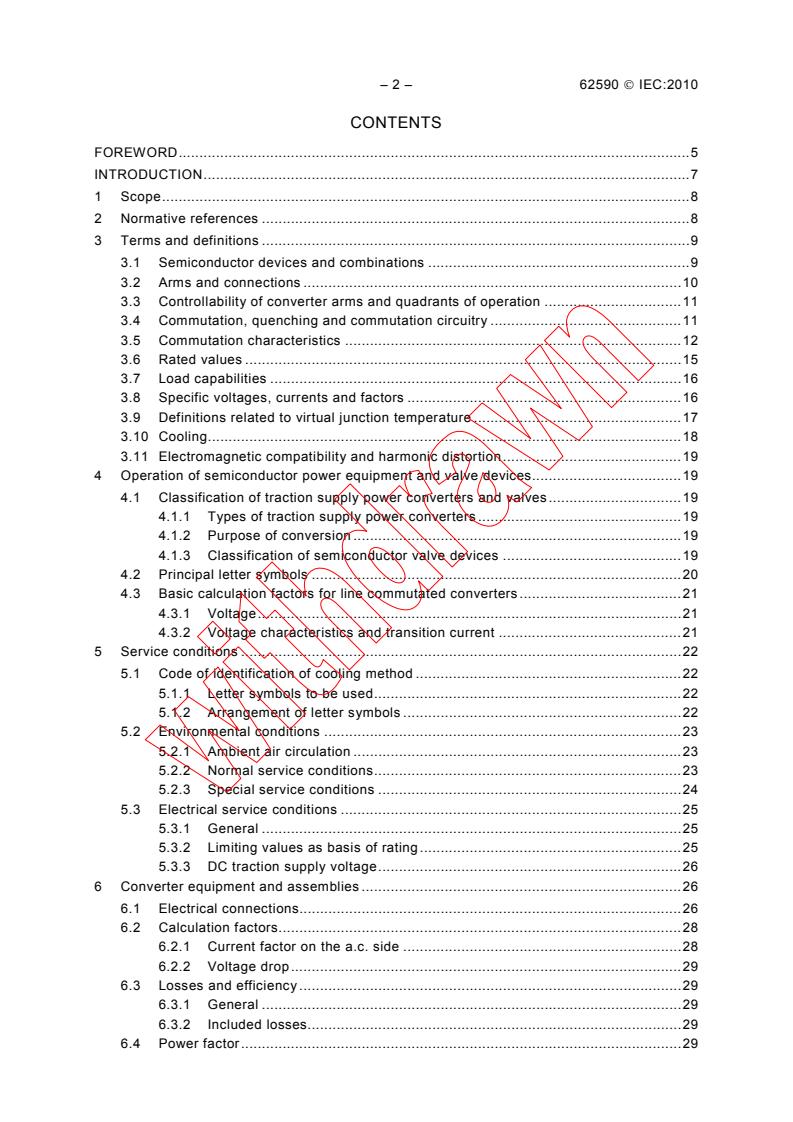
CONTENTS
FOREWORD.5
INTRODUCTION.7
1 Scope.8
2 Normative references .8
3 Terms and definitions .9
3.1 Semiconductor devices and combinations .9
3.2 Arms and connections .10
3.3 Controllability of converter arms and quadrants of operation .11
3.4 Commutation, quenching and commutation circuitry .11
3.5 Commutation characteristics .12
3.6 Rated values .15
3.7 Load capabilities .16
3.8 Specific voltages, currents and factors .16
3.9 Definitions related to virtual junction temperature .17
3.10 Cooling.18
3.11 Electromagnetic compatibility and harmonic distortion.19
4 Operation of semiconductor power equipment and valve devices.19
4.1 Classification of traction supply power converters and valves.19
4.1.1 Types of traction supply power converters .19
4.1.2 Purpose of conversion .19
4.1.3 Classification of semiconductor valve devices .19
4.2 Principal letter symbols .20
4.3 Basic calculation factors for line commutated converters .21
4.3.1 Voltage.21
4.3.2 Voltage characteristics and transition current .21
5 Service conditions .22
5.1 Code of identification of cooling method .22
5.1.1 Letter symbols to be used.22
5.1.2 Arrangement of letter symbols .22
5.2 Environmental conditions .23
5.2.1 Ambient air circulation .23
5.2.2 Normal service conditions.23
5.2.3 Special service conditions .24
5.3 Electrical service conditions .25
5.3.1 General .25
5.3.2 Limiting values as basis of rating.25
5.3.3 DC traction supply voltage.26
6 Converter equipment and assemblies .26
6.1 Electrical connections.26
6.2 Calculation factors.28
6.2.1 Current factor on the a.c. side .28
6.2.2 Voltage drop.29
6.3 Losses and efficiency .29
6.3.1 General .29
6.3.2 Included losses.29
6.4 Power factor.29
62590 © IEC:2010 – 3 –
6.5 Direct voltage harmonic content .30
6.6 Electromagnetic compatibility (EMC) .30
6.7 Rated values for converters.30
6.7.1 General .30
6.7.2 Current values.31
6.7.3 Capability for unsymmetrical load of a 12-pulse converter in parallel
connection.33
6.7.4 Semiconductor device failure conditions .33
6.8 Mechanical characteristics .33
6.8.1 General .33
6.8.2 Earthing.34
6.8.3 Degree of protection .34
6.9 Marking .34
6.9.1 Rating plate.34
6.9.2 Main circuit terminals.35
7 Tests .35
7.1 General .35
7.1.1 Performance of tests .35
7.1.2 Test schedule .35
7.2 Test specifications.36
7.2.1 Insulation tests .36
7.2.2 Light load functional test.38
7.2.3 Load test .38
7.2.4 Power loss determination .39
7.2.5 Temperature-rise test .39
7.2.6 Checking of auxiliary devices .40
7.2.7 Checking of the properties of the control equipment .40
7.2.8 Checking of the protective devices .40
7.2.9 Short-time withstand current test .41
7.2.10 Additional tests.41
Annex A (informative) Information required .42
Annex B (informative) Determination of the current capability through calculation of
the virtual junction temperature.48
Annex C (informative) Index of definitions.53
Bibliography.55
Figure 1 – Illustration of angles.14
Figure 2 – Voltage drop .21
Figure 3 – AC voltage waveform .26
Figure B.1 – Approximation of the shape of power pulses .49
Figure B.2 – Calculation of the virtual junction temperature for continuous load .50
Figure B.3 – Calculation of the virtual junction temperature for cyclic load .51
Table 1 – Letter symbols for cooling mediums and heat transfer agents.22
Table 2 – Letter symbols for methods of circulation .22
Table 3 – Connections and calculation factors for line commutated converters .28
Table 4 – Standardized duty classes.31
– 4 – 62590 © IEC:2010
Table 5 – Semiconductor device failure conditions.33
Table 6 – Summary of tests .36
Table 7 – Insulation levels for a.c./d.c. converters .38
Table B.1 – Examples for typical applications .52
62590 © IEC:2010 – 5 –
INTERNATIONAL ELECTROTECHNICAL COMMISSION
____________
RAILWAY APPLICATIONS –
FIXED INSTALLATIONS –
ELECTRONIC POWER CONVERTERS FOR SUBSTATIONS
FOREWORD
1) The International Electrotechnical Commission (IEC) is a worldwide organization for standardization comprising
all national electrotechnical committees (IEC National Committees). The object of IEC is to promote
international co-operation on all questions concerning standardization in the electrical and electronic fields. To
this end and in addition to other activities, IEC publishes International Standards, Technical Specifications,
Technical Reports, Publicly Available Specifications (PAS) and Guides (hereafter referred to as “IEC
Publication(s)”). Their preparation is entrusted to technical committees; any IEC National Committee interested
in the subject dealt with may participate in this preparatory work. International, governmental and non-
governmental organizations liaising with the IEC also participate in this preparation. IEC collaborates closely
with the International Organization for Standardization (ISO) in accordance with conditions determined by
agreement between the two organizations.
2) The formal decisions or agreements of IEC on technical matters express, as nearly as possible, an international
consensus of opinion on the relevant subjects since each technical committee has representation from all
interested IEC National Committees.
3) IEC Publications have the form of recommendations for international use and are accepted by IEC National
Committees in that sense. While all reasonable efforts are made to ensure that the technical content of IEC
Publications is accurate, IEC cannot be held responsible for the way in which they are used or for any
misinterpretation by any end user.
4) In order to promote international uniformity, IEC National Committees undertake to apply IEC Publications
transparently to the maximum extent possible in their national and regional publications. Any divergence
between any IEC Publication and the corresponding national or regional publication shall be clearly indicated in
the latter.
5) IEC itself does not provide any attestation of conformity. Independent certification bodies provide conformity
assessment services and, in some areas, access to IEC marks of conformity. IEC is not responsible for any
services carried out by independent certification bodies.
6) All users should ensure that they have the latest edition of this publication.
7) No liability shall attach to IEC or its directors, employees, servants or agents including individual experts and
members of its technical committees and IEC National Committees for any personal injury, property damage or
other damage of any nature whatsoever, whether direct or indirect, or for costs (including legal fees) and
expenses arising out of the publication, use of, or reliance upon, this IEC Publication or any other IEC
Publications.
8) Attention is drawn to the Normative references cited in this publication. Use of the referenced publications is
indispensable for the correct application of this publication.
9) Attention is drawn to the possibility that some of the elements of this IEC Publication may be the subject of
patent rights. IEC shall not be held responsible for identifying any or all such patent rights.
International Standard IEC 62590 has been prepared by IEC technical committee 9: Electrical
equipment and systems for railways.
This standard is based on EN 50328.
The text of this standard is based on the following documents:
FDIS Report on voting
9/1387/FDIS 9/1411/RVD
Full information on the voting for the approval of this standard can be found in the report on
voting indicated in the above table.
This publication has been drafted in accordance with the ISO/IEC Directives, Part 2.
– 6 – 62590 © IEC:2010
The committee has decided that the contents of this publication will remain unchanged until
the stability date indicated on the IEC web site under "http://webstore.iec.ch" in the data
related to the specific publication. At this date, the publication will be
• reconfirmed,
• withdrawn,
• replaced by a revised edition, or
• amended.
62590 © IEC:2010 – 7 –
INTRODUCTION
Semiconductor converters for traction power supply differ from other converters for industrial
use due to special electrical service conditions and due to the large range of load variation
and the peculiar characteristics of the load.
For these reasons IEC 60146-1-1 does not fully cover the requirements of railway applications
and the decision was taken to have a specific standard for this use.
Converter transformers for fixed installations of railway applications are covered by
EN 50329.
Harmonization of the rated values and tests of the whole converter group are covered by
IEC 62589.
– 8 – 62590 © IEC:2010
RAILWAY APPLICATIONS –
FIXED INSTALLATIONS –
ELECTRONIC POWER CONVERTERS FOR SUBSTATIONS
1 Scope
This International Standard specifies the requirements for the performance of all fixed
installations electronic power converters, using controllable and/or non-controllable electronic
valves, intended for traction power supply.
The devices can be controlled by means of current, voltage or light. Non-bistable devices are
assumed to be operated in the switched mode.
This Standard applies to fixed installations of following electric traction systems:
– railways,
– guided mass transport systems such as: tramways, light rail systems, elevated and
underground railways, mountain railways, trolleybusses.
This Standard does not apply to
– cranes, transportable platforms and similar transportation equipment on rails,
– suspended cable cars,
– funicular railways.
This Standard applies to diode rectifiers, controlled rectifiers, inverters and frequency
converters.
The equipment covered in this Standard is the converter itself.
2 Normative references
The following referenced documents are indispensable for the application of this document.
For dated references, only the edition cited applies. For undated references, the latest edition
of the referenced document (including any amendments) applies.
IEC 60050-551:1998, International Electrotechnical Vocabulary (IEV) – Part 551: Power
Electronics
IEC 60050-811:1991, International Electrotechnical Vocabulary (IEV) – Chapter 811: Electric
traction
IEC 60146 (all parts), Semiconductor convertors
IEC 60146-1-2:1991, Semiconductor convertors – General requirements and line commutated
convertors – Part 1-2: Application guide
IEC 60529:1989, Degrees of protection provided by enclosures (IP Code)
IEC 60721 (all parts), Classification of environmental conditions
IEC 60850:2007, Railway applications – Supply voltages of traction systems
62590 © IEC:2010 – 9 –
IEC 61000-2-4:2002, Electromagnetic compatibility (EMC) – Part 2-4: Environment –
Compatibility levels in industrial plants for low-frequency conducted disturbances
IEC 61000-2-12:2003, Electromagnetic compatibility (EMC) – Part 2-12: Environment –
Compatibility levels for low-frequency conducted disturbances and signalling in public
medium-voltage power supply systems
IEC 61992-7-1:2006, Railway applications – Fixed installations – DC switchgear – Part 7-1:
Measurement, control and protection devices for specific use in d.c. traction systems –
Application guide
IEC 62236 (all parts), Railway applications – Electromagnetic compatibility
IEC 62236-5:2008, Railway applications – Electromagnetic compatibility – Part 5: Emission
and immunity of fixed power supply installations and apparatus
IEC 62497-1:2010, Railway applications – Insulation coordination – Part 1: Basic
requirements - Clearances and creepage distances for all electrical and electronic equipment
EN 50329:2003, Railway applications – Fixed installations – Traction transformers
3 Terms and definitions
For the purposes of this document, the following terms and definitions apply. In this standard,
IEV definitions are used wherever possible, particularly those in IEC 60050-551.
The policy adopted is as follows:
a) when a suitable IEV definition exists, the term and the reference are given without
repeating the text;
b) when an existing IEV definition needs amplification or additional information, the term, the
reference and the additional text are given;
c) when no IEV definition exists, the term and the text are given.
An alphabetical index is given in Annex C.
3.1 Semiconductor devices and combinations
3.1.1
semiconductor device
device whose essential characteristics are due to the flow of charge carriers within a
semiconductor
3.1.2
(valve device) stack
[IEV 551-14-12]
3.1.3
(valve device) assembly
[IEV 551-14-13]
3.1.4
electronic power converter
operative unit for power conversion comprising one or more assemblies of semiconductor
devices
[IEV 551-12-01, modified]
– 10 – 62590 © IEC:2010
3.1.5
trigger equipment (gating equipment)
equipment which provides suitable trigger pulses from a control signal for controllable valve
devices in a converter or power switch including timing or phase shifting circuits, pulse
generating circuits and usually power supply circuits
3.1.6
system control equipment
equipment associated with a converter equipment or system which performs automatic
adjustment of the output characteristics as a function of a controlled quantity
3.2 Arms and connections
3.2.1
(valve) arm
[IEV 551-15-01]
3.2.2
principal arm
[IEV 551-15-02]
3.2.3
converter connection
[IEV 551-15-10]
3.2.4
basic converter connection
[IEV 551-15-11]
3.2.5
single-way connection (of a converter)
[IEV 551-15-12]
3.2.6
double-way connection (of a converter)
[IEV 551-15-13]
3.2.7
uniform connection
[IEV 551-15-15]
3.2.8
non-uniform connection
[IEV 551-15-18]
3.2.9
series connection
connection in which two or more converters are connected in such a way that their voltages
add
3.2.10
boost and buck connection
series connection in which the converters are controlled independently
[IEV 551-15-21, modified]
62590 © IEC:2010 – 11 –
3.2.11
parallel connection
connection in which two or more converters are connected in such a way that their currents
add
3.3 Controllability of converter arms and quadrants of operation
3.3.1
controllable arm
converter arm including controllable semiconductor element(s) as valve device(s)
3.3.2
non-controllable arm
converter arm including non-controllable semiconductor element(s) as valve device(s)
3.3.3
quadrant of operation (on the d.c. side)
quadrant of the voltage current plane defined by the d.c. voltage polarity and the current
direction
3.3.4
one quadrant converter
[IEV 551-12-34]
3.3.5
two quadrant (single) converter
[IEV 551-12-35]
3.3.6
four quadrant (double) converter
[IEV 551-12-36]
3.3.7
reversible converter
[IEV 551-12-37]
3.3.8
single converter
[IEV 551-12-38]
3.3.9
double converter
[IEV 551-12-39]
3.3.10
converter section of a double converter
[IEV 551-12-40]
3.4 Commutation, quenching and commutation circuitry
3.4.1
commutation
transfer of current from one conducting arm to the next to conduct in sequence, without
interruption of the d.c. current. During a finite interval of time both arms are conducting
simultaneously
[IEV 551-16-01, modified]
– 12 – 62590 © IEC:2010
3.4.2
quenching
[IEV 551-16-19]
3.4.3
direct commutation
[IEV 551-16-09]
3.4.4
indirect commutation
[IEV 551-16-10]
3.4.5
external commutation
[IEV 551-16-11]
3.4.6
line commutation
[IEV 551-16-12]
3.4.7
load commutation
[IEV 551-16-13]
3.4.8
self commutation
[IEV 551-16-15]
3.5 Commutation characteristics
3.5.1
commutation circuit
[IEV 551-16-03]
3.5.2
commutating voltage
[IEV 551-16-02]
3.5.3
commutation inductance
total inductance included in the commutation circuit, in series with the commutating voltage
[IEV 551-16-07, modified]
NOTE For line or machine commutated converters the commutation reactance is the impedance of the
commutation inductance at the fundamental frequency.
3.5.4
angle of overlap u
duration of the commutation interval between a pair of principal arms, expressed in angular
measure, where the two arms carry current
[IEV 551-16-05, modified]
3.5.5
commutation notch
periodic voltage transient that can appear in the a.c. voltage of a line or machine-commutated
converter due to commutation
62590 © IEC:2010 – 13 –
[IEV 551-16-06, modified]
3.5.6
commutation repetitive transient
voltage oscillation associated with the commutation notch
3.5.7
commutating group
[IEV 551-16-08]
3.5.8
commutation number q
number of commutations from one principal arm to another, occurring during one period of the
alternating voltage in each commutating group
[IEV 551-17-03, modified]
3.5.9
pulse number p
number of non-simultaneous symmetrical direct or indirect commutations from one principal
arm to another, during one period of the alternating voltage
[IEV 551-17-01, modified]
3.5.10
trigger delay angle α
time expressed in angular measure by which the trigger pulse is delayed with respect to the
reference instant (see Figure 1)
For line, machine or load commutated converters the reference instant is the zero crossing
instant of the commutating voltage.
For a.c. controllers it is the zero crossing instant of the supply voltage.
For a.c. controllers with inductive load, the trigger delay angle is the sum of the phase shift
and the current delay angle
[IEV 551-16-33, modified]
– 14 – 62590 © IEC:2010
+
U U U
R S T
–
L
U
VT
U U U
R S T
I I I
S T R
γ
U
α
β
U
VT
IEC 1371/10
Figure 1 – Illustration of angles
3.5.11
trigger advance angle β
(see Figure 1)
[IEV 551-16-34]
3.5.12
inherent delay angle α
p
delay angle which occurs in some converter connections under certain operating conditions
even if no phase control is applied
[IEV 551-16-35, modified]
3.5.13
extinction angle γ
time, expressed in angular measure, between the moment when the current of the arm falls to
zero and the moment when the arm is required to withstand steeply rising off-state voltage
62590 © IEC:2010 – 15 –
3.6 Rated values
3.6.1
rated value
numerical value for the electrical, thermal, mechanical and environmental rating assigned to
the quantities which define the operation of a converter group in the conditions specified in
accordance with this Standard and on which the supplier’s guarantees and tests are based
3.6.2
rated frequency f
N
frequency on either side of the converter for the conversion of which the converter group is
designed to operate
3.6.3
nominal voltage U
n
voltage by which a converter is designated
NOTE The standardized values of nominal voltages are given in IEC 60850.
3.6.4
rated insulation voltage U
Nm
r.m.s. withstand voltage value assigned by the manufacturer to the equipment or a part of it,
characterizing the specified permanent withstand capability of its insulation
NOTE Standardized values of rated insulation voltages are given in IEC 62497.
3.6.5
rated a.c. voltage on the supply side of a converter U
Nv
r.m.s. value of the no-load voltage between vectorially consecutive commutating phase
terminals of a commutating group
3.6.6
rated a.c. voltage on the traction side of a converter U
Nt
r.m.s. value of the no-load voltage on the traction side of a frequency converter
3.6.7
rated direct voltage U
Nd
specified value of the direct voltage between the d.c. terminals of the converter assembly at
basic direct current. This value is the mean value of the direct voltage
NOTE 1 A converter may have more than one rated voltage or a rated direct voltage range.
NOTE 2 The rated direct voltage of a converter depends on the characteristics of the transformer and a
guaranteed value of rated direct voltage is valid only together with the transformer (see IEC 62589).
3.6.8
basic service current on the supply side of a converter I
Bv
r.m.s. value of the a.c. current, containing all harmonics, on the supply side of a converter at
basic current on the d.c. side
NOTE For polyphase equipment, this value is computed from the basic direct current on the basis of rectangular
shaped currents, 120° conducting, of the converter elements. For single phase equipment, the basis of calculation
must be specified.
3.6.9
rated current on the traction side of a frequency converter I
Nt
r.m.s. value of the a.c. current on the traction side of a frequency converter under rated
conditions
– 16 – 62590 © IEC:2010
3.6.10
basic direct current I
Bd
mean value of the direct current for specified load and service conditions
NOTE Together with a duty class I is considered as the 1,0 p.u. value, to which other values of I are
Bd d
compared.
3.7 Load capabilities
3.7.1
duty class
tabled representation of current capability and test values for standard design converters in
terms of current values and duration selected to represent a characteristic group of practical
applications. The current values are expressed in per unit of the basic direct current I
Bd
3.7.2
load cycle
representation of the conventional current demand to a special design converter showing the
repetitive variation of the load within a specified time period. The current values are
expressed in A or in per unit of I
Bd
3.7.3
d.c. power
product of the nominal d.c. voltage U and the basic direct current I
n Bd
3.7.4
power efficiency
ratio of the output power to the input power of the converter
3.8 Specific voltages, currents and factors
3.8.1
ideal no-load direct voltage U
di
theoretical no-load mean direct voltage of a converter, assuming no reduction by phase
control, no voltage drop in the assemblies and no voltage rise at small loads
[IEV 551-17-15, modified]
3.8.2
controlled ideal no-load direct voltage U
diα
theoretical no-load mean direct voltage of a converter, when the direct voltage is reduced by
phase control, assuming no voltage drop in the assemblies and no voltage rise at small loads
[IEV 551-17-16, modified]
3.8.3
conventional no-load direct voltage U
d0
mean value of the direct voltage which would be obtained by extrapolating the direct
voltage/current characteristic for continuous direct current back to zero current
[IEV 551-17-17, modified]
NOTE U is equal to the sum of U and the no-load voltage drop in the assembly.
di d0
3.8.4
controlled conventional no-load direct voltage U
d0α
conventional no-load mean direct voltage obtained when extrapolating the direct voltage/
current characteristic, corresponding to a delay angle a, back to zero current
[IEV 551-17-18, modifed]
62590 © IEC:2010 – 17 –
3.8.5
real no-load direct voltage U
d00
actual mean direct voltage at zero direct current
[IEV 551-17-19]
3.8.6
ideal crest no-load voltage U
iM
no-load voltage between the end terminals of an arm neglecting internal and external voltage
surge and voltage drop in valves
3.8.7
transition current
mean direct current of a converter connection when the direct current of the commutating
groups becomes intermittent when decreasing the current
[IEV 551-17-20, modified]
3.8.8
direct voltage drop
difference between the conventional no-load direct voltage and the direct voltage at basic
direct current, at the same current delay angle, excluding the correction effect of stabilizing
means if any
[IEV 551-17-21, modified]
NOTE The nature of the d.c. circuit (for example capacitors, back e.m.f. load) can affect the voltage drop
significantly. Where this is the case, special consideration is required.
3.8.9
total power factor λ
active power
λ =
apparent power
3.8.10
power factor of the fundamental wave or displacement factor cos ϕ
active power of the fundamental wave
cos ϕ =
apparent power of the fundamental wave
3.8.11
deformation factor ν
λ
ν =
cos ϕ
3.9 Definitions related to virtual junction temperature
3.9.1
thermal resistance R
th
quotient of the temperature difference between two specified points or regions and the heat
flow between these two points or regions under conditions of thermal equilibrium
NOTE For most cases, the heat flow can be assumed to be equal to the power dissipation.
3.9.2
transient thermal impedance Z
th
quotient of the variation of the temperature difference, reached at the end of a time interval
between the virtual junction temperature and the temperature at a specified external reference
– 18 – 62590 © IEC:2010
point and the step function change of power dissipation at the beginning of the same time
interval causing the change of temperature
NOTE The transient thermal impedance is given in a characteristic curve as a function of the time interval.
3.9.3
virtual junction temperature Θ
j
calculated temperature within the semiconductor material which is based on a simplified
representation of the thermal and electrical behaviour of a semiconductor device
3.10 Cooling
3.10.1
cooling medium
liquid (for example water) or gas (for example air) which removes the heat from the equipment
3.10.2
heat transfer agent
liquid (for example water) or gas (for example air) within the equipment to transfer the heat
from its source to a heat exchanger from where the heat is removed by the cooling medium
3.10.3
direct cooling
method of cooling by which the cooling medium is in direct contact with the parts of the
equipment to be cooled, i.e. no heat transfer agent is used
3.10.4
indirect cooling
method of cooling in which a heat transfer agent is used to transfer heat from the part to be
cooled to the cooling medium
3.10.5
natural circulation
convection
method of circulating the cooling medium or heat transfer agent which uses the change of
volumetric mass (density) with temperature
3.10.6
forced circulation
forced cooling
method of circulating the cooling medium or heat transfer agent by means of blower(s), fan(s)
or pump(s)
3.10.7
mixed circulation
method of circulating the cooling medium or heat transfer agent, which uses alternately
natural and forced circulation
3.10.8
equilibrium temperature
steady-state temperature reached by a component of a converter under specified conditions
of load and cooling
NOTE The steady-state temperatures are in general different for different components. The times necessary to
establish steady-state are also different and proportional to the thermal time constants.
62590 © IEC:2010 – 19 –
3.11 Electromagnetic compatibility and harmonic distortion
3.11.1
electrical disturbance
any variation of an electrical quantity, beyond specified limits, which can be the cause of a
loss of performance or an interruption of service or damage
3.11.2
immunity level of a converter
specified value of an electrical disturbance below which a converter is designed to meet the
required performances or continue operation or avoid damage
3.11.3
(total) harmonic distortion
[IEV 551-17-06]
4 Operation of semiconductor power equipment and valve devices
4.1 Classification of traction supply power converters and valves
4.1.1 Types of traction supply power converters
a) a.c. to d.c. conversion:
1) diode rectifier;
2) controlled rectifier.
b) d.c. to a.c. conversion:
1) inverter.
c) a.c. to a.c. conversion:
1) direct frequency converter;
2) d.c. link frequency converter:
i) supply side;
ii) traction side.
4.1.2 Purpose of conversion
A converter changes or controls one or more characteristics such as
a) frequency (including zero frequency),
b) voltage,
c) number of phases,
d) flow of reactive power,
e) quality of load power.
4.1.3 Classification of semiconductor valve devices
Semiconductor valves can be turned off either by commutation implying that the current of the
valve is transferred to another valve or by quenching if the current of the valve falls to zero.
Valves used in traction supply power converters can be divided into the following categories:
a) non-controllable valve with a conductive forward and a blocking reverse characteristic
(diode);
b) valve with a controllable forward and a blocking reverse characteristic (e.g. reverse
blocking thyristor);
– 20 – 62590 © IEC:2010
c) valve with a controllable forward and a conductive reverse characteristic (e.g. reverse
conducting thyristor);
d) valve with a controllable forward and / or reverse characteristic which can be turned on
and/or off via a signal applied to the gate (e.g. gate turn-off thyristor, insulated gate
bipolar transistor);
e) valve with controllable forward and reverse characteristic (e.g. bi-directional thyristors).
4.2 Principal letter symbols
d inductive direct voltage drop due to converter transformer referred to U
xtB di
e inductive component of the relative short-circuit voltage of the converter transformer
xB
corresponding to the basic current on the supply side of the transformer
f rated frequency
N
g number of sets of commutating groups between which I is divided
Bd
h order of harmonic
I basic direct current
Bd
I basic service current on the supply side of a converter
Bv
I direct current (any defined value)
d
I rated current on the traction side of a frequency converter
Nt
I current on the supply side of a converter
v
K coupling factor
p pulse number
P active power
q commutation number
s number of series connected commutating groups
u angle of overlap (commutation angle)
U power frequency withstand voltage
a
U total inductive direct voltage drop at basic direct current
Bdx
U direct voltage (any defined value)
d
U conventional no-load direct voltage
d0
U value of U with trigger delay angle α
d0α d0
U real no-load direct voltage
d00
U ideal no-load direct voltage
di
U controlled ideal no-load direct voltage
diα
U ideal crest no-load voltage
iM
U nominal voltage
n
U rated direct voltage
Nd
U impulse voltage
Ni
U rated insulation voltage
Nm
U rated a.c.voltage on the traction side of a frequency converter
Nt
U rated a.c. voltage on the supply side of a converter
Nv
U no-load phase to phase voltage
v0
α trigger delay angle
α inherent delay angle
p
β trigger advance angle
γ extinction angle
δ number of commutating groups commutating simultaneously per primary
λ total power factor
ν deformation factor
ϕ1 displacement angle for the fundamental component of I
Bv
62590 © IEC:2010 – 21 –
4.3 Basic calculation factors for line commutated converters
4.3.1 Voltage
The ideal no-load direct voltage U is obtained from the voltage betwe
...