

IEC 60754-2:2011
(Main)Test on gases evolved during combustion of materials from cables - Part 2: Determination of acidity (by pH measurement) and conductivity
General Information
- Abstract
IEC 60754-2:2011 specifies the apparatus and procedure for the determination of the potential corrosivity of gases evolved during the combustion of materials taken from electric or optical fibre cable constructions by measuring the acidity (pH) and conductivity of an aqueous solution resulting from the gases evolved during the combustion. The general method specified in this standard is intended for the testing of individual components used in a cable construction. Formulae are given for the calculation of a weighted value for a combination of materials found in a specified cable. The use of this method will enable the verification of relevant requirements for either individual components or combined components of a cable construction stated in the appropriate cable specification. A simplified method is included for the testing of individual components where it is required only to demonstrate compliance with a stated performance requirement for quality control purposes. The significant technical changes with respect to the previous edition are as follows:
- improved definition of safety requirements relating to capture of gases;
- introduction of guidance on the preparation of test specimens for more even combustion;
- better expression of tolerances and precision;
- clarification of the conductivity and acidity functions;
- improved definition of the heating procedure;
- greater precision in the definition of the test temperature for the determination of pH value and conductivity;
- correction of the formulae for the calculation of the test results.
- Status
- Published
- Publication Date
- 24-Nov-2019
- Technical Committee
- TC 20 - Electric cables
- Drafting Committee
- WG 18 - TC 20/WG 18
- Current Stage
- PPUB - Publication issued
- Start Date
- 17-Nov-2011
- Completion Date
- 31-Oct-2011
Buy Documents
IEC 60754-2:2011 - Test on gases evolved during combustion of materials from cables - Part 2: Determination of acidity (by pH measurement) and conductivity Released:11/17/2011

IEC 60754-2:2011+AMD1:2019 CSV - Test on gases evolved during combustion of materials from cables - Part 2: Determination of acidity (by pH measurement) and conductivity Released:11/25/2019
Overview
IEC 60754-2:2011 is an international standard published by the International Electrotechnical Commission (IEC) that specifies the test method to assess the corrosivity of gases evolved during the combustion of materials used in electric and optical fiber cables. Specifically, this part of the standard focuses on determining acidity via pH measurement and conductivity of the aqueous solution exposed to these combustion gases. The standard applies primarily to individual cable components but also provides guidance for evaluating combined materials within cable constructions.
This test method helps cable manufacturers, specifiers, and safety engineers evaluate and limit the potential damage caused by acidic and conductive gases produced in cable fires. These gases can severely corrode electrical and electronic systems, leading to failures unrelated to the fire itself. IEC 60754-2 enables quality control, specifications compliance, and enhances fire safety assessment for cable materials.
Key Topics
Scope and Purpose
Defines the apparatus, test procedures, and calculations for measuring the corrosive potential of gases released during cable material combustion, through acidity and conductivity.Test Apparatus
- Tube furnace for controlled combustion
- Quartz glass tubes
- Combustion boats for specimen holding
- Bubbling devices for gas capture
- Analytical instruments including pH meters and conductivity measuring devices
Specimen Preparation and Conditioning
Guidelines for preparing test specimens to ensure even combustion for reliable gas evolution.Test Procedure
Standardized heating and air supply methods, washing procedures, and measurement protocols to determine pH and conductivity values accurately.Evaluation
- Calculation of weighted values when testing combined materials
- Simplified method for compliance checking
- Formula corrections and tolerances for precise results
Safety and Quality Improvements
Updated safety requirements for gas capture and test repeatability, ensuring accuracy and operator protection.
Applications
The IEC 60754-2:2011 standard serves various practical purposes, including:
Cable Manufacturing and Quality Control
Ensuring raw materials and cable components meet corrosivity limits helps manufacturers maintain product reliability and compliance with safety regulations.Fire Safety Engineering
Assessment of cable materials’ behavior under fire conditions contributes to safer building, industrial, and transportation infrastructure by minimizing post-fire electronic damage.Product Specification and Compliance
Cable designers and purchasers use this test to verify components meet contractual and regulatory requirements for corrosive gas emission during fire.Research and Development
Enables material scientists and product developers to innovate low-corrosivity cable compounds and enhance fire performance.
Related Standards
IEC 60754-2 forms part of a broader suite of standards addressing fire-related cable testing:
- IEC 60754-1: Test on gases evolved during combustion of materials from cables – Part 1: Determination of halogen acid gas content
- IEC 60754-3: Measurement of low levels of halogen content by ion chromatography
- IEC 60695-5-1: Fire hazard testing-Guidance on corrosivity of fire effluent
These interconnected standards provide holistic methodologies to evaluate the chemical hazards stemming from cable fires, helping to protect electrical systems and enhance overall fire safety management.
Keywords: IEC 60754-2, cable combustion testing, acidity measurement, pH determination, conductivity test, corrosive gas evaluation, cable fire safety, electric cable materials, optical fiber cable testing, cable component corrosion, IEC standards for cables, fire effluent corrosivity, cable quality control.
Relations
- Effective Date
- 10-Feb-2026
- Effective Date
- 05-Sep-2023
- Effective Date
- 05-Sep-2023
Buy Documents
IEC 60754-2:2011 - Test on gases evolved during combustion of materials from cables - Part 2: Determination of acidity (by pH measurement) and conductivity Released:11/17/2011
IEC 60754-2:2011+AMD1:2019 CSV - Test on gases evolved during combustion of materials from cables - Part 2: Determination of acidity (by pH measurement) and conductivity Released:11/25/2019
Get Certified
Connect with accredited certification bodies for this standard

IMQ S.p.A. (Certification)
Italian electrical product certification.

SLG Prüf- und Zertifizierungs GmbH
German testing and certification body.

UL Solutions
Global safety science company with testing, inspection and certification.
Sponsored listings
Frequently Asked Questions
IEC 60754-2:2011 is a standard published by the International Electrotechnical Commission (IEC). Its full title is "Test on gases evolved during combustion of materials from cables - Part 2: Determination of acidity (by pH measurement) and conductivity". This standard covers: IEC 60754-2:2011 specifies the apparatus and procedure for the determination of the potential corrosivity of gases evolved during the combustion of materials taken from electric or optical fibre cable constructions by measuring the acidity (pH) and conductivity of an aqueous solution resulting from the gases evolved during the combustion. The general method specified in this standard is intended for the testing of individual components used in a cable construction. Formulae are given for the calculation of a weighted value for a combination of materials found in a specified cable. The use of this method will enable the verification of relevant requirements for either individual components or combined components of a cable construction stated in the appropriate cable specification. A simplified method is included for the testing of individual components where it is required only to demonstrate compliance with a stated performance requirement for quality control purposes. The significant technical changes with respect to the previous edition are as follows: - improved definition of safety requirements relating to capture of gases; - introduction of guidance on the preparation of test specimens for more even combustion; - better expression of tolerances and precision; - clarification of the conductivity and acidity functions; - improved definition of the heating procedure; - greater precision in the definition of the test temperature for the determination of pH value and conductivity; - correction of the formulae for the calculation of the test results.
IEC 60754-2:2011 specifies the apparatus and procedure for the determination of the potential corrosivity of gases evolved during the combustion of materials taken from electric or optical fibre cable constructions by measuring the acidity (pH) and conductivity of an aqueous solution resulting from the gases evolved during the combustion. The general method specified in this standard is intended for the testing of individual components used in a cable construction. Formulae are given for the calculation of a weighted value for a combination of materials found in a specified cable. The use of this method will enable the verification of relevant requirements for either individual components or combined components of a cable construction stated in the appropriate cable specification. A simplified method is included for the testing of individual components where it is required only to demonstrate compliance with a stated performance requirement for quality control purposes. The significant technical changes with respect to the previous edition are as follows: - improved definition of safety requirements relating to capture of gases; - introduction of guidance on the preparation of test specimens for more even combustion; - better expression of tolerances and precision; - clarification of the conductivity and acidity functions; - improved definition of the heating procedure; - greater precision in the definition of the test temperature for the determination of pH value and conductivity; - correction of the formulae for the calculation of the test results.
IEC 60754-2:2011 is classified under the following ICS (International Classification for Standards) categories: 13.220.40 - Ignitability and burning behaviour of materials and products; 29.020 - Electrical engineering in general; 29.060.20 - Cables. The ICS classification helps identify the subject area and facilitates finding related standards.
IEC 60754-2:2011 has the following relationships with other standards: It is inter standard links to EN 50090-5-2:2020, IEC 60754-2:2011/AMD1:2019, IEC 60754-2:1991/AMD1:1997. Understanding these relationships helps ensure you are using the most current and applicable version of the standard.
IEC 60754-2:2011 is available in PDF format for immediate download after purchase. The document can be added to your cart and obtained through the secure checkout process. Digital delivery ensures instant access to the complete standard document.
Standards Content (Sample)
IEC 60754-2 ®
Edition 2.0 2011-11
INTERNATIONAL
STANDARD
NORME
INTERNATIONALE
GROUP SAFETY PUBLICATION
PUBLICATION GROUPÉE DE SÉCURITÉ
Test on gases evolved during combustion of materials from cables –
Part 2: Determination of acidity (by pH measurement) and conductivity
Essai sur les gaz émis lors de la combustion des matériaux prélevés sur
câbles –
Partie 2: Détermination de la conductivité et de l‘acidité (par mesure du pH)
All rights reserved. Unless otherwise specified, no part of this publication may be reproduced or utilized in any form or by
any means, electronic or mechanical, including photocopying and microfilm, without permission in writing from either IEC or
IEC's member National Committee in the country of the requester.
If you have any questions about IEC copyright or have an enquiry about obtaining additional rights to this publication,
please contact the address below or your local IEC member National Committee for further information.
Droits de reproduction réservés. Sauf indication contraire, aucune partie de cette publication ne peut être reproduite
ni utilisée sous quelque forme que ce soit et par aucun procédé, électronique ou mécanique, y compris la photocopie
et les microfilms, sans l'accord écrit de la CEI ou du Comité national de la CEI du pays du demandeur.
Si vous avez des questions sur le copyright de la CEI ou si vous désirez obtenir des droits supplémentaires sur cette
publication, utilisez les coordonnées ci-après ou contactez le Comité national de la CEI de votre pays de résidence.
IEC Central Office
3, rue de Varembé
CH-1211 Geneva 20
Switzerland
Email: inmail@iec.ch
Web: www.iec.ch
About the IEC
The International Electrotechnical Commission (IEC) is the leading global organization that prepares and publishes
International Standards for all electrical, electronic and related technologies.
About IEC publications
The technical content of IEC publications is kept under constant review by the IEC. Please make sure that you have the
latest edition, a corrigenda or an amendment might have been published.
Catalogue of IEC publications: www.iec.ch/searchpub
The IEC on-line Catalogue enables you to search by a variety of criteria (reference number, text, technical committee,…).
It also gives information on projects, withdrawn and replaced publications.
IEC Just Published: www.iec.ch/online_news/justpub
Stay up to date on all new IEC publications. Just Published details twice a month all new publications released. Available
on-line and also by email.
Electropedia: www.electropedia.org
The world's leading online dictionary of electronic and electrical terms containing more than 20 000 terms and definitions
in English and French, with equivalent terms in additional languages. Also known as the International Electrotechnical
Vocabulary online.
Customer Service Centre: www.iec.ch/webstore/custserv
If you wish to give us your feedback on this publication or need further assistance, please visit the Customer Service
Centre FAQ or contact us:
Email: csc@iec.ch
Tel.: +41 22 919 02 11
Fax: +41 22 919 03 00
A propos de la CEI
La Commission Electrotechnique Internationale (CEI) est la première organisation mondiale qui élabore et publie des
normes internationales pour tout ce qui a trait à l'électricité, à l'électronique et aux technologies apparentées.
A propos des publications CEI
Le contenu technique des publications de la CEI est constamment revu. Veuillez vous assurer que vous possédez
l’édition la plus récente, un corrigendum ou amendement peut avoir été publié.
Catalogue des publications de la CEI: www.iec.ch/searchpub/cur_fut-f.htm
Le Catalogue en-ligne de la CEI vous permet d’effectuer des recherches en utilisant différents critères (numéro de référence,
texte, comité d’études,…). Il donne aussi des informations sur les projets et les publications retirées ou remplacées.
Just Published CEI: www.iec.ch/online_news/justpub
Restez informé sur les nouvelles publications de la CEI. Just Published détaille deux fois par mois les nouvelles
publications parues. Disponible en-ligne et aussi par email.
Electropedia: www.electropedia.org
Le premier dictionnaire en ligne au monde de termes électroniques et électriques. Il contient plus de 20 000 termes et
définitions en anglais et en français, ainsi que les termes équivalents dans les langues additionnelles. Egalement appelé
Vocabulaire Electrotechnique International en ligne.
Service Clients: www.iec.ch/webstore/custserv/custserv_entry-f.htm
Si vous désirez nous donner des commentaires sur cette publication ou si vous avez des questions, visitez le FAQ du
Service clients ou contactez-nous:
Email: csc@iec.ch
Tél.: +41 22 919 02 11
Fax: +41 22 919 03 00
IEC 60754-2 ®
Edition 2.0 2011-11
INTERNATIONAL
STANDARD
NORME
INTERNATIONALE
GROUP SAFETY PUBLICATION
PUBLICATION GROUPÉE DE SÉCURITÉ
Test on gases evolved during combustion of materials from cables –
Part 2: Determination of acidity (by pH measurement) and conductivity
Essai sur les gaz émis lors de la combustion des matériaux prélevés sur
câbles –
Partie 2: Détermination de la conductivité et de l‘acidité (par mesure du pH)
INTERNATIONAL
ELECTROTECHNICAL
COMMISSION
COMMISSION
ELECTROTECHNIQUE
PRICE CODE
INTERNATIONALE
CODE PRIX R
ICS 13.220.40; 29.020; 29.060.20 ISBN 978-2-88912-716-0
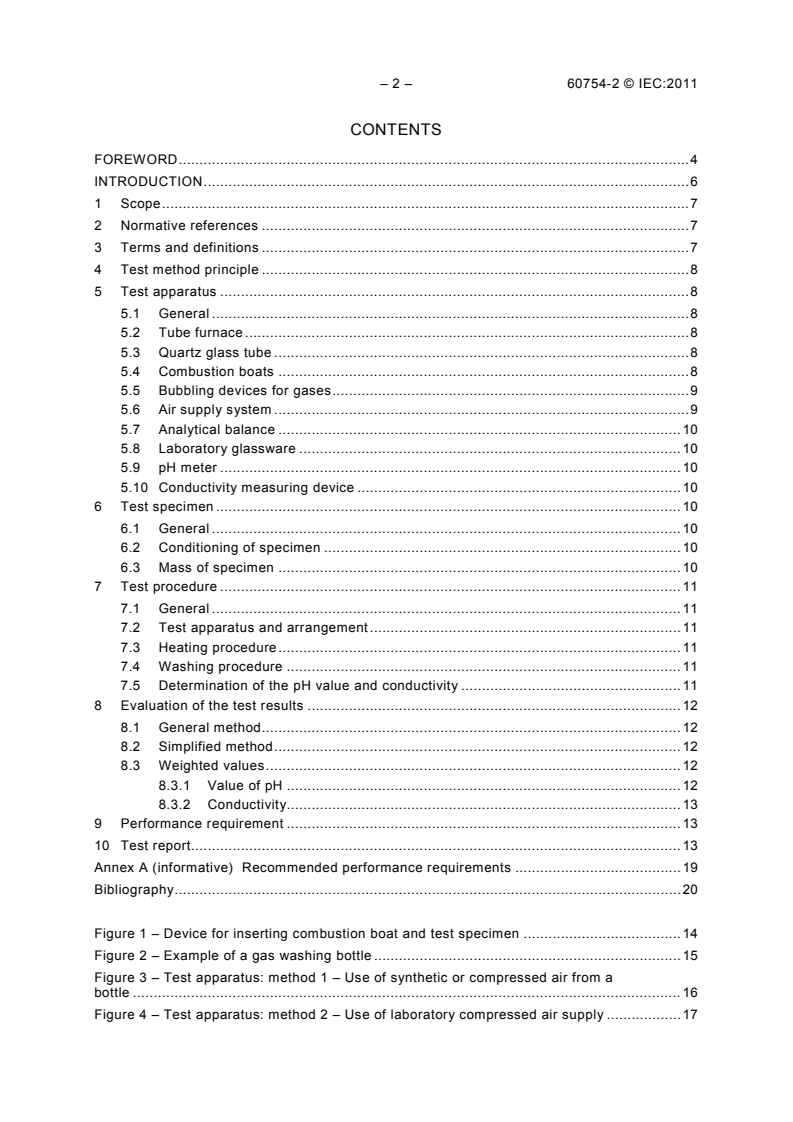
– 2 – 60754-2 © IEC:2011
CONTENTS
FOREWORD . 4
INTRODUCTION . 6
1 Scope . 7
2 Normative references . 7
3 Terms and definitions . 7
4 Test method principle . 8
5 Test apparatus . 8
5.1 General . 8
5.2 Tube furnace . 8
5.3 Quartz glass tube . 8
5.4 Combustion boats . 8
5.5 Bubbling devices for gases . 9
5.6 Air supply system . 9
5.7 Analytical balance . 10
5.8 Laboratory glassware . 10
5.9 pH meter . 10
5.10 Conductivity measuring device . 10
6 Test specimen . 10
6.1 General . 10
6.2 Conditioning of specimen . 10
6.3 Mass of specimen . 10
7 Test procedure . 11
7.1 General . 11
7.2 Test apparatus and arrangement . 11
7.3 Heating procedure . 11
7.4 Washing procedure . 11
7.5 Determination of the pH value and conductivity . 11
8 Evaluation of the test results . 12
8.1 General method . 12
8.2 Simplified method . 12
8.3 Weighted values . 12
8.3.1 Value of pH . 12
8.3.2 Conductivity. 13
9 Performance requirement . 13
10 Test report. 13
Annex A (informative) Recommended performance requirements . 19
Bibliography . 20
Figure 1 – Device for inserting combustion boat and test specimen . 14
Figure 2 – Example of a gas washing bottle . 15
Figure 3 – Test apparatus: method 1 – Use of synthetic or compressed air from a
bottle . 16
Figure 4 – Test apparatus: method 2 – Use of laboratory compressed air supply . 17
60754-2 © IEC:2011 – 3 –
Figure 5 – Test apparatus: method 3 – Use of ambient air sucked by means of a
suction pump . 18
– 4 – 60754-2 © IEC:2011
INTERNATIONAL ELECTROTECHNICAL COMMISSION
____________
TEST ON GASES EVOLVED DURING
COMBUSTION OF MATERIALS FROM CABLES –
Part 2: Determination of acidity
(by pH measurement) and conductivity
FOREWORD
1) The International Electrotechnical Commission (IEC) is a worldwide organization for standardization comprising
all national electrotechnical committees (IEC National Committees). The object of IEC is to promote
international co-operation on all questions concerning standardization in the electrical and electronic fields. To
this end and in addition to other activities, IEC publishes International Standards, Technical Specifications,
Technical Reports, Publicly Available Specifications (PAS) and Guides (hereafter referred to as “IEC
Publication(s)”). Their preparation is entrusted to technical committees; any IEC National Committee interested
in the subject dealt with may participate in this preparatory work. International, governmental and non-
governmental organizations liaising with the IEC also participate in this preparation. IEC collaborates closely
with the International Organization for Standardization (ISO) in accordance with conditions determined by
agreement between the two organizations.
2) The formal decisions or agreements of IEC on technical matters express, as nearly as possible, an international
consensus of opinion on the relevant subjects since each technical committee has representation from all
interested IEC National Committees.
3) IEC Publications have the form of recommendations for international use and are accepted by IEC National
Committees in that sense. While all reasonable efforts are made to ensure that the technical content of IEC
Publications is accurate, IEC cannot be held responsible for the way in which they are used or for any
misinterpretation by any end user.
4) In order to promote international uniformity, IEC National Committees undertake to apply IEC Publications
transparently to the maximum extent possible in their national and regional publications. Any divergence
between any IEC Publication and the corresponding national or regional publication shall be clearly indicated in
the latter.
5) IEC itself does not provide any attestation of conformity. Independent certification bodies provide conformity
assessment services and, in some areas, access to IEC marks of conformity. IEC is not responsible for any
services carried out by independent certification bodies.
6) All users should ensure that they have the latest edition of this publication.
7) No liability shall attach to IEC or its directors, employees, servants or agents including individual experts and
members of its technical committees and IEC National Committees for any personal injury, property damage or
other damage of any nature whatsoever, whether direct or indirect, or for costs (including legal fees) and
expenses arising out of the publication, use of, or reliance upon, this IEC Publication or any other IEC
Publications.
8) Attention is drawn to the Normative references cited in this publication. Use of the referenced publications is
indispensable for the correct application of this publication.
9) Attention is drawn to the possibility that some of the elements of this IEC Publication may be the subject of
patent rights. IEC shall not be held responsible for identifying any or all such patent rights.
International Standard IEC 60754-2 has been prepared by IEC technical committee 20:
Electric cables.
It has the status of a group safety publication in accordance with IEC Guide 104.
This second edition of IEC 60754-2 cancels and replaces the first edition, published in 1991,
Amendment 1 (1997), and constitutes a technical revision.
The significant technical changes with respect to the previous edition are as follows:
– improved definition of safety requirements relating to capture of gases;
– introduction of guidance on the preparation of test specimens for more even combustion;
– better expression of tolerances and precision;
– clarification of the conductivity and acidity functions;
60754-2 © IEC:2011 – 5 –
– improved definition of the heating procedure;
– greater precision in the definition of the test temperature for the determination of pH value
and conductivity;
– correction of the formulae for the calculation of the test results.
The text of this standard is based on the following documents:
FDIS Report on voting
20/1265/FDIS 20/1275/RVD
Full information on the voting for the approval of this standard can be found in the report on
voting indicated in the above table.
This publication has been drafted in accordance with the ISO/IEC Directives, Part 2.
A list of all the parts in the IEC 60754 series, published under the general title Test on gases
evolved during combustion of materials from cables, can be found on the IEC website.
The committee has decided that the contents of this publication will remain unchanged until
the stability date indicated on the IEC web site under "http://webstore.iec.ch" in the data
related to the specific publication. At this date, the publication will be
• reconfirmed,
• withdrawn,
• replaced by a revised edition, or
• amended.
– 6 – 60754-2 © IEC:2011
INTRODUCTION
IEC 60754 consists of the following parts, under the general title Test on gases evolved
during combustion of materials from cables:
– Part 1: Determination of the halogen acid gas content
– Part 2: Determination of acidity (by pH measurement) and conductivity.
IEC 60754-2 was originally developed due to concerns expressed by cable users over the
amount of acid gas evolved when some cable insulating, sheathing and other materials are
burned, as such corrosive effluent can cause extensive damage to electrical and electronic
equipment not involved in the fire itself.
NOTE Guidance on the corrosivity of fire effluent is given in IEC 60695-5-1.
This standard provides a method for determining the acidity (by pH measurement) and
conductivity of an aqueous solution of gases evolved during the combustion of materials so
that limits can be agreed for cable specifications. As the test is not carried out on a complete
cable test piece, for a hazard assessment the actual material volumes of the cable
components should be taken into consideration.
The method provides an indirect assessment of corrosivity. However, the recommended limits
of pH and conductivity can only be regarded as an indication, as the relationship between
corrosion and these two parameters does not necessarily embrace all materials.
This part of IEC 60754 is linked with IEC 60754-1, but the test procedure differs considerably.
60754-2 © IEC:2011 – 7 –
TEST ON GASES EVOLVED DURING
COMBUSTION OF MATERIALS FROM CABLES –
Part 2: Determination of acidity
(by pH measurement) and conductivity
1 Scope
This part of IEC 60754 specifies the apparatus and procedure for the determination of the
potential corrosivity of gases evolved during the combustion of materials taken from electric
or optical fibre cable constructions by measuring the acidity (pH) and conductivity of an
aqueous solution resulting from the gases evolved during the combustion.
The general method specified in this standard is intended for the testing of individual
components used in a cable construction. Formulae are given for the calculation of a weighted
value for a combination of materials found in a specified cable. The use of this method will
enable the verification of relevant requirements for either individual components or combined
components of a cable construction stated in the appropriate cable specification.
A simplified method is included for the testing of individual components where it is required
only to demonstrate compliance with a stated performance requirement for quality control
purposes.
NOTE 1 The relevant cable standard should indicate which components of the cable should be tested, and which
method of calculation (see Clause 8) should be used in the case of dispute.
NOTE 2 This test method may be used to test materials to be used in cable manufacture, but a declaration of
cable performance should not be made based on such a test.
NOTE 3 For the purposes of this standard, the term “electric cable” covers all insulated metallic conductor cables
used for the conveyance of energy or signals.
2 Normative references
The following referenced documents are indispensable for the application of this document.
For dated references, only the edition cited applies. For undated references, the latest edition
of the referenced document (including any amendments) applies.
ISO 1042, Laboratory glassware – One-mark volumetric flasks
(available only in French)
ISO 3696, Water for analytical laboratory use – Specification and test methods
3 Terms and definitions
For the purposes of this document, the following terms and definitions apply.
3.1
pH value
pH of an aqueous solution resulting from the gases evolved during the combustion of the
material under the conditions given in this standard
– 8 – 60754-2 © IEC:2011
3.2
conductivity value
conductivity of an aqueous solution resulting from the gases evolved during the combustion of
the material under the conditions given in this standard
4 Test method principle
The material under test shall be heated in a stream of dry air. The evolved gases shall be
trapped by bubbling through wash bottles filled with distilled or demineralized water.
The acidity of the resulting solution shall be assessed by determination of its pH value. The
conductivity of the solution shall also be determined.
5 Test apparatus
5.1 General
The apparatus is shown in Figures 1 to 5.
The assembly of the components which constitute the test apparatus shall be leak-tight. The
connecting distances between the quartz glass tube and the first bottle and between
subsequent bottles shall be as short as possible. Glass or silicone rubber tubing shall be used
for these connections.
NOTE 1 At the exit side of the quartz glass tube, as close to the end as possible, it is permitted to place a plug of
silica wool to aid collection of condensates.
NOTE 2 A third empty bottle, of the same size as the gas washing bottles, placed before the gas washing bottles
may be used to improve safety, i.e. to prevent suck back of water into the quartz glass tube.
5.2 Tube furnace
The length of the heating zone of the furnace shall be within the range 480 mm to 620 mm
and its inside diameter shall be within the range 38 mm to 62 mm. It shall be equipped with
an adjustable electrical heating system.
5.3 Quartz glass tube
For the test, a quartz glass tube shall be introduced into the tube furnace. The tube shall be
approximately concentric to the furnace. It shall be resistant to the action of corrosive gases.
The inside diameter of the tube shall be within the range 30 mm to 46 mm. The tube shall
protrude on the entrance side of the furnace by a length of between 60 mm to 200 mm, and
on the exit side by between 60 mm to 100 mm. The initial clearance shall allow for thermal
expansion. For the purposes of measurement of the protrusion distances, the tube shall be
regarded as that part of essentially constant diameter.
NOTE The outer diameter of the tube should be chosen with due regard to the inside diameter of the tube
furnace.
Prior to each test the tube shall be cleaned throughout its length by being calcined at
approximately 950 °C.
5.4 Combustion boats
The combustion boat shall be made of porcelain, fused quartz or soapstone and shall have
the following dimensions:
– external length: within the range 45 mm to 100 mm;
60754-2 © IEC:2011 – 9 –
– external width: within the range 12 mm to 30 mm;
– internal depth: within the range 5 mm to 10 mm.
NOTE The dimensions of the boat should be chosen with due regard to the inside diameter of the quartz tube.
The preferred method for insertion of the combustion boat into the quartz glass tube is shown
in Figure 1.
Prior to each test, the combustion boat shall be washed and calcined in a muffle furnace at
approximately 950 °C for 4 h after which it shall be introduced into a desiccator and cooled to
ambient temperature. The combustion boat shall then be weighed to an accuracy of 0,1 mg
until two identical consecutive weights are obtained. This weight m shall be recorded.
5.5 Bubbling devices for gases
At the exit of the quartz glass tube, the evolved gases shall be trapped by bubbling through
two wash bottles (see Figure 2), each containing approximately 450 ml of distilled or
demineralized water of a purity at least Grade 3 in accordance with ISO 3696.
The pH value of the water shall be between 5,5 and 7,5, and the conductivity less than
0,5 µS/mm.
A magnetic stirrer shall be introduced in the first gas washing bottle to get a good swirling
motion and an effective absorbtion of the combustion gases. The tubes into the wash bottles
shall have a maximum internal diameter at their tip of 5 mm in order to aid absorption.
The height of the liquid above the end of the tube shall be (110 ± 10) mm in each bottle.
NOTE Use of a standard laboratory glass bottle of internal diameter approximately 75 mm will enable this
requirement to be met.
5.6 Air supply system
The gas used for combustion shall be air.
The flow rate of air introduced into the quartz tube shall be adjusted according to the actual
internal cross-sectional area of the tube, such that the speed of air flowing across the sample
is approximately 20 ml/mm /h.
The speed of air shall be regulated by reference to the flow rate of air. The flow rate of air
shall be (0,0157 × D ) l/h with a tolerance of ±10 %.
NOTE The derivation of the flow rate of air from the speed of air is:
π D
ρ = V ×
where
D is the internal diameter of the tube (mm);
ρ is the flow rate of air (ml/h);
V is the speed of air (ml/mm /h).
The air supply shall be adjusted and controlled by a needle valve, and the flow rate
monitored by a flowmeter of the appropriate range.
The air supplied shall be selected from one of the following methods:
– 10 – 60754-2 © IEC:2011
Method 1
This method uses synthetic air or compressed air from a bottle. The air shall be introduced on
the inlet side of the quartz glass tube (see Figure 3).
Method 2
This method uses a laboratory compressed air supply. Air shall be introduced on the inlet
side of the quartz glass tube and shall be filtered and dried (see Figure 4).
Method 3
This method uses the ambient air of the laboratory. The air shall be filtered and dried. In this
case, the mixture of air and combustion gas shall be sucked by a pump (see Figure 5).
5.7 Analytical balance
The balance shall have a precision of ± 0,1 mg.
5.8 Laboratory glassware
For pH and conductivity determination, the following laboratory glassware shall be available:
– one mark volumetric flask in accordance of ISO 1042 with 1 000 ml capacity.
5.9 pH meter
The pH meter shall have a precision of ±0,02 and shall be equipped with a pH electrode.
5.10 Conductivity measuring device
–1 +2
The conductivity measuring device shall have a range of 10 µS/mm to 10 µS/mm and shall
be equipped with an electrode.
6 Test specimen
6.1 General
Three test specimens for the general method, or two for the simplified method, each
consisting of (1 000 ±5) mg of the material to be tested, shall be prepared. Each test
specimen shall be taken from a sample representative of the material. Each test specimen
shall be cut into a number of smaller pieces.
NOTE Pieces with a maximum dimension of 3 mm have been found to be suitable.
6.2 Conditioning of specimen
The prepared test specimens shall be stored for at least 16 h at a temperature of (23 ±2) °C
and a relative humidity of (50 ±5) %.
6.3 Mass of specimen
Weigh the combustion boat ( m ) with a precision of 0,1 mg (see 5.4). After conditioning,
the test specimen shall be put into the combustion boat and evenly distributed on the bottom
of the boat, which shall be weighed to an accuracy of 0,1 mg. The weight ( m ) shall be
recorded.
The mass m of the test specimen shall be calculated as follows:
60754-2 © IEC:2011 – 11 –
m = m − m
2 1
where
m is the mass of the test specimen in grams;
is the mass of the combustion boat in grams;
m
m is the mass of the combustion boat with the test specimen, in grams.
7 Test procedure
7.1 General
The test procedure and determination of pH value and conductivity value shall be carried
out on each test specimen.
7.2 Test apparatus and arrangement
The test procedure defined in this clause shall be carried out using the apparatus detailed
in Clause 5.
7.3 Heating procedure
The air flow shall be adjusted by means of a needle valve to the value specified in 5.6 and
shall be kept constant during the test.
The temperature shall be measured by a thermocouple suitably protected against corrosion
and placed inside the quartz glass tube. The heating system shall be adjusted such that the
temperature at the designated position for the boat shall be not less than 935 °C and not
more than 965 °C. The temperature at a position 300 mm from the designated position in
the direction of the air flow shall be not less than 900 °C.
The boat containing the test specimen shall be quickly inserted into the heating zone of the
tube to the designated position determined by the thermocouple measurement and the timer
shall be started. The combustion boat shall be placed in such a way that the distance
between the boat and the exit end of the effective heating zone is at least 300 mm. The
effective heating zone is that zone where a temperature of not less than 900 °C has been
determined by the thermocouple measurement.
The combustion procedure, under the air flow condition, shall be continued for (30 ±1) min in
the furnace.
WARNING The operator should take precautions, e.g. the wearing of eye protection and suitable protective
clothing, because certain materials ignite quickly, and can cause "blow back" of hot gases. Care should also be
taken to avoid over-pressurization of the system, and to allow for venting of exhaust gases. Guidance on the
avoidance of “blow back” is given in NOTE 2 of 5.1.
7.4 Washing procedure
Following the heating procedure, all the bottles used shall be disconnected, and the contents
washed into a 1 000 ml volumetric flask. Using water with the properties given in 5.5, the
bottles, the connecting links and, after cooling, the end of the quartz glass tube including the
silica wool (if used) shall also be washed into the flask, and the contents made up to
1 000 ml.
7.5 Determination of the pH value and conductivity
The pH shall be measured using a pH meter calibrated as proposed by the instrument
supplier.
– 12 – 60754-2 © IEC:2011
The pH value of the solution shall be determined at (25 ±1) °C in accordance with the test
procedures as prescribed by the supplier of the measuring instrument.
Conductivity value measurements shall also be performed at (25 ±1) °C in accordance with
the test procedures as prescribed by the supplier of the conductivity measuring instrument.
The pH value and conductivity value shall preferably be read by using automatic temperature
compensation. If such a facility is not available, the values shall be read when the
temperature of the solution is at (25 ±1) °C.
NOTE Automatic temperature compensation is usually an integral feature of the pH and conductivity measuring
instruments.
8 Evaluation of the test results
8.1 General method
From the three test determinations undertaken, the mean value, standard deviation and
coefficient of variation shall be calculated for both pH and conductivity.
If the coefficient of variation is higher than 5 %, a further three tests shall be carried out and
the mean value, standard deviation and coefficient of variation shall be recalculated using the
six values.
8.2 Simplified method
From the two test determinations undertaken, the sample shall be considered to have met the
performance requirement if both pH values are greater than or equal to the specified value
and both conductivity values are less than or equal to the specified value.
If one test specimen fails to meet this requirement, the test procedure and determination shall
be repeated on two further test specimens taken from the same sample of material. Both
repeat test specimens shall comply with specified values for pH and conductivity.
8.3 Weighted values
8.3.1 General
Using the mean values determined in 8.1, the assessment of the pH and conductivity of the
aqueous solution of the combustion gases expected to be evolved by a combination of
materials found in a specified cable under similar test conditions shall be be estimated as
follows:
8.3.2 Value of pH
Measure the weight w , of each non-metallic material, i, per unit length of cable.
i
The weighted value of pH, pH′, is calculated as follows:
Σ w
i
pH′ = log
w
i
Σ
x
10
where x is the pH of each non-metallic material, i.
60754-2 © IEC:2011 – 13 –
8.3.3 Conductivity
Measure the weight, w , of each non-metallic material, i, per unit length of cable.
i
The weighted value of conductivity, c′, is calculated as follows:
Σ (c × w )
i i
′
c =
Σ w
i
9 Performance requirement
The performance requirements for a particular compound or component taken from a wire or
weighted value for a cable should preferably be given in the individual cable standard. In the
absence of any given requirement it is recommended that those given in Annex A should be
taken as acceptable levels.
10 Test report
The test report shall include the following information:
a) a full description of the material tested and the cable from which it was taken;
b) the number of this standard;
c) the mean pH value and the mean conductivity value of the material expressed at 25 °C;
d) the method used for the determination (general or simplified);
e) the calculated weighted values of the pH and conductivity for the cable tested (if required).
– 14 – 60754-2 © IEC:2011
7 9 8
IEC 2235/11
Key
1 Synthetic air or compressed air, filtered and dried 6 Bar magnets
2 Glass tube 7 Platinum wire
3 Thermocouple 8 Combustion boat
4 Quartz glass tube 9 Standard ground joint, size in correlation to the diameter of the quartz glass tube
5 Test specimen 10 Furnace
Figure 1 – Device for inserting combustion boat and test specimen
60754-2 © IEC:2011 – 15 –
IEC 2236/11
Key
1 Magnetic stirring bar h 100 mm to 120 mm
Figure 2 – Example of a gas washing bottle
h
– 16 – 60754-2 © IEC:2011
10 12
IEC 2237/11
Key
1 Pressure reducing valve 7 Gas washing bottles
2 Flow meter 8 Synthetic air
3 Quartz glass tube 9 Device for inserting combustion boat containing test specimen
4 Furnace 10 Combustion boat containing test specimen
5 Needle valve 11 Magnetic stirrer
6 Thermocouple 12 Magnetic stirring bar
Figure 3 – Test apparatus: method 1 – Use of synthetic or compressed air from a bottle
60754-2 © IEC:2011 – 17 –
3 4
7 8
11 12
14 15
IEC 2238/11
Key
1 Pressure reducing valve 7 Activated charcoal 13 Device for inserting combustion boat containing test specimen
2 Flow meter 8 Silica gel 14 Combustion boat containing test specimen
3 Quartz glass tube 9 Thermocouple 15 Magnetic stirring bar
4 Furnace 10 Gas washing bottles 16 Magnetic stirrer
5 Compressed air 11 Air filtering
6 Needle valve 12 Air drying
Figure 4 – Test apparatus: method 2 – Use of laboratory compressed air supply
– 18 – 60754-2 © IEC:2011
6 7
11 12
IEC 2239/11
Key
1 Flow meter 7 Silica gel 13 Device for inserting combustion boat containing test specimen
2 Furnace 8 Thermocouple 14 Combustion boat containing test specimen
3 Ambient air 9 Gas washing bottles 15 Magnetic stirring bar
4 Quartz glass tube 10 Suction pump 16 Magnetic stirrer
5 Needle valve 11 Air filtering
6 Activated charcoal 12 Air drying
Figure 5 – Test apparatus: method 3 – Use of ambient air sucked by means of a suction pump
60754-2 © IEC:2011 – 19 –
Annex A
(informative)
Recommended performance requirements
A.1 Cable weighted value
The weighted pH value, as determined in 8.3.2, should not be less than 4,3.
The weighted value of conductivity, as determined in 8.3.3, should not exceed 10 µS/mm.
A.2 Material value
The pH value as determined in 8.1 or 8.2, should not be less than 4,3.
The conductivity value, as determined in 8.1 or 8.2, should not exceed 10 µS/mm.
– 20 – 60754-2 © IEC:2011
Bibliography
IEC 60695-5-1, Fire hazard testing – Part 5-1: Corrosion damage effects of fire effluent –
General guidance
IEC Guide 104, The preparation of safety publications and the use of basic safety publications
and group safety publications
____________
– 22 – 60754-2 © CEI:2011
SOMMAIRE
AVANT-PROPOS . 24
INTRODUCTION . 26
1 Domaine d'application . 27
2 Références normatives . 27
3 Termes et définitions . 27
4 Principe de la méthode d’essai . 28
5 Appareillage d’essai . 28
5.1 Généralités. 28
5.2 Four tubulaire . 28
5.3 Tube en quartz . 28
5.4 Nacelles de combustion . 28
5.5 Dispositif de barbotage des gaz . 29
5.6 Dispositif d'entraînement . 29
5.7 Balance analytique . 30
5.8 Verrerie de laboratoire . 30
5.9 pH mètre . 30
5.10 Conductimètre . 30
6 Éprouvette d'essai . 30
6.1 Généralité . 30
6.2 Conditionnement des éprouvettes d'essai . 30
6.3 Masse de l’éprouvette . 31
7 Mode opératoire . 31
7.1 Généralité . 31
7.2 Appareillage d’essai et matériel . 31
7.3 Procédure de chauffage . 31
7.4 Procédure de lavage . 32
7.5 Détermination de la valeur du pH et de la conductivité . 32
8 Évaluation des résultats . 32
8.1 Méthode générale . 32
8.2 Méthode simplifiée . 32
8.3 Valeurs pondérées . 32
8.3.1 Valeur du pH . 33
8.3.2 Conductivité . 33
9 Exigence (d’exécution) . 33
10 Rapport d’essai . 33
Annexe A (informative) Exigences de performance recommandées . 39
Bibliographie . 40
Figure 1 – Système pour introduire la nacelle de combustion et l’éprouvette d’essai . 34
Figure 2 – Exemple de flacon barboteur . 35
Figure 3 – Appareillage d’essai: méthode 1 – Utilisation de l’air synthétique ou
comprimé provenant d’une bouteille . 36
Figure 4 – Appareillage d’essai: méthode 2 – Utilisation de l’air comprimé provenant du
laboratoire . 37
60754-2 © CEI:2011 – 23 –
Figure 5 – Appareillage d’essai: méthode 3 – Utilisation de l’air aspiré au moyen d’une
pompe . 38
– 24 – 60754-2 © CEI:2011
COMMISSION ÉLECTROTECHNIQUE INTERNATIONALE
____________
ESSAI SUR LES GAZ ÉMIS LORS DE LA
COMBUSTION DES MATÉRIAUX PRÉLEVÉS SUR CÂBLES –
Partie 2: Détermination de la conductivité
et de l‘acidité (par mesure du pH)
AVANT-PROPOS
1) La Commission Electrotechnique Internationale (CEI) est une organisation mondiale de normalisation
composée de l'ensemble des comités électrotechniques nationaux (Comités nationaux de la CEI). La CEI a
pour objet de favoriser la coopération internationale pour toutes les questions de normalisation dans les
domaines de l'électricité et de l'électronique. A cet effet, la CEI – entre autres activités – publie des Normes
internationales, des Spécifications techniques, des Rapports techniques, des Spécifications accessibles au
public (PAS) et des Guides (ci-après dénommés "Publication(s) de la CEI"). Leur élaboration est confiée à des
comités d'études, aux travaux desquels tout Comité national intéressé par le sujet traité peut participer. Les
organisations internationales, gouvernementales et non gouvernementales, en liaison avec la CEI, participent
également aux travaux. La CEI collabore étroitement avec l'Organisation Internationale de Normalisation (ISO),
selon des conditions fixées par accord entre les deux organisations.
2) Les décisions ou accords officiels de la CEI concernant les questions techniques représentent, dans la mesure
du possible, un accord international sur les sujets étudiés, étant donné que les Comités nationaux de la CEI
intéressés sont représentés dans chaque comité d’études.
3) Les Publications de la CEI
...
IEC 60754-2 ®
Edition 2.1 2019-11
CONSOLIDATED VERSION
INTERNATIONAL
STANDARD
NORME
INTERNATIONALE
colour
inside
GROUP SAFETY PUBLICATION
PUBLICATION GROUPÉE DE SÉCURITÉ
Test on gases evolved during combustion of materials from cables –
Part 2: Determination of acidity (by pH measurement) and conductivity
Essai sur les gaz émis lors de la combustion des matériaux prélevés
sur câbles –
Partie 2: Détermination de la conductivité et de l‘acidité (par mesure du pH)
All rights reserved. Unless otherwise specified, no part of this publication may be reproduced or utilized in any form
or by any means, electronic or mechanical, including photocopying and microfilm, without permission in writing from
either IEC or IEC's member National Committee in the country of the requester. If you have any questions about IEC
copyright or have an enquiry about obtaining additional rights to this publication, please contact the address below or
your local IEC member National Committee for further information.
Droits de reproduction réservés. Sauf indication contraire, aucune partie de cette publication ne peut être reproduite
ni utilisée sous quelque forme que ce soit et par aucun procédé, électronique ou mécanique, y compris la photocopie
et les microfilms, sans l'accord écrit de l'IEC ou du Comité national de l'IEC du pays du demandeur. Si vous avez des
questions sur le copyright de l'IEC ou si vous désirez obtenir des droits supplémentaires sur cette publication, utilisez
les coordonnées ci-après ou contactez le Comité national de l'IEC de votre pays de résidence.
IEC Central Office Tel.: +41 22 919 02 11
3, rue de Varembé info@iec.ch
CH-1211 Geneva 20 www.iec.ch
Switzerland
About the IEC
The International Electrotechnical Commission (IEC) is the leading global organization that prepares and publishes
International Standards for all electrical, electronic and related technologies.
About IEC publications
The technical content of IEC publications is kept under constant review by the IEC. Please make sure that you have the
latest edition, a corrigendum or an amendment might have been published.
IEC publications search - webstore.iec.ch/advsearchform Electropedia - www.electropedia.org
The advanced search enables to find IEC publications by a The world's leading online dictionary on electrotechnology,
variety of criteria (reference number, text, technical containing more than 22 000 terminological entries in English
committee,…). It also gives information on projects, replaced and French, with equivalent terms in 16 additional languages.
and withdrawn publications. Also known as the International Electrotechnical Vocabulary
(IEV) online.
IEC Just Published - webstore.iec.ch/justpublished
Stay up to date on all new IEC publications. Just Published IEC Glossary - std.iec.ch/glossary
details all new publications released. Available online and 67 000 electrotechnical terminology entries in English and
once a month by email. French extracted from the Terms and Definitions clause of
IEC publications issued since 2002. Some entries have been
IEC Customer Service Centre - webstore.iec.ch/csc collected from earlier publications of IEC TC 37, 77, 86 and
If you wish to give us your feedback on this publication or CISPR.
need further assistance, please contact the Customer Service
Centre: sales@iec.ch.
A propos de l'IEC
La Commission Electrotechnique Internationale (IEC) est la première organisation mondiale qui élabore et publie des
Normes internationales pour tout ce qui a trait à l'électricité, à l'électronique et aux technologies apparentées.
A propos des publications IEC
Le contenu technique des publications IEC est constamment revu. Veuillez vous assurer que vous possédez l’édition la
plus récente, un corrigendum ou amendement peut avoir été publié.
Recherche de publications IEC - Electropedia - www.electropedia.org
webstore.iec.ch/advsearchform Le premier dictionnaire d'électrotechnologie en ligne au
La recherche avancée permet de trouver des publications IEC monde, avec plus de 22 000 articles terminologiques en
en utilisant différents critères (numéro de référence, texte, anglais et en français, ainsi que les termes équivalents dans
comité d’études,…). Elle donne aussi des informations sur les 16 langues additionnelles. Egalement appelé Vocabulaire
projets et les publications remplacées ou retirées. Electrotechnique International (IEV) en ligne.
IEC Just Published - webstore.iec.ch/justpublished Glossaire IEC - std.iec.ch/glossary
Restez informé sur les nouvelles publications IEC. Just 67 000 entrées terminologiques électrotechniques, en anglais
Published détaille les nouvelles publications parues. et en français, extraites des articles Termes et Définitions des
Disponible en ligne et une fois par mois par email. publications IEC parues depuis 2002. Plus certaines entrées
antérieures extraites des publications des CE 37, 77, 86 et
Service Clients - webstore.iec.ch/csc CISPR de l'IEC.
Si vous désirez nous donner des commentaires sur cette
publication ou si vous avez des questions contactez-nous:
sales@iec.ch.
IEC 60754-2 ®
Edition 2.1 2019-11
CONSOLIDATED VERSION
INTERNATIONAL
STANDARD
NORME
INTERNATIONALE
colour
inside
GROUP SAFETY PUBLICATION
PUBLICATION GROUPÉE DE SÉCURITÉ
Test on gases evolved during combustion of materials from cables –
Part 2: Determination of acidity (by pH measurement) and conductivity
Essai sur les gaz émis lors de la combustion des matériaux prélevés
sur câbles –
Partie 2: Détermination de la conductivité et de l‘acidité (par mesure du pH)
INTERNATIONAL
ELECTROTECHNICAL
COMMISSION
COMMISSION
ELECTROTECHNIQUE
INTERNATIONALE
ICS 13.220.40; 29.020; 29.060.20 ISBN 978-2-8322-7659-4
IEC 60754-2 ®
Edition 2.1 2019-11
CONSOLIDATED VERSION
REDLINE VERSION
VERSION REDLINE
colour
inside
GROUP SAFETY PUBLICATION
PUBLICATION GROUPÉE DE SÉCURITÉ
Test on gases evolved during combustion of materials from cables –
Part 2: Determination of acidity (by pH measurement) and conductivity
Essai sur les gaz émis lors de la combustion des matériaux prélevés
sur câbles –
Partie 2: Détermination de la conductivité et de l‘acidité (par mesure du pH)
– 2 – IEC 60754-2:2011+AMD1:2019 CSV
© IEC 2019
CONTENTS
FOREWORD . 4
INTRODUCTION . 6
1 Scope . 7
2 Normative references . 7
3 Terms and definitions . 7
4 Test method principle . 8
5 Test apparatus . 8
5.1 General . 8
5.2 Tube furnace . 8
5.3 Quartz glass tube . 8
5.4 Combustion boats . 8
5.5 Bubbling devices for gases . 9
5.6 Air supply system . 9
5.7 Analytical balance . 10
5.8 Laboratory glassware . 10
5.9 pH meter . 10
5.10 Conductivity measuring device . 10
6 Test specimen . 11
6.1 General . 11
6.2 Conditioning of specimen . 11
6.3 Mass of specimen . 11
7 Test procedure . 11
7.1 General . 11
7.2 Test apparatus and arrangement . 11
7.3 Heating procedure . 11
7.4 Washing procedure . 12
7.5 Determination of the pH value and conductivity . 12
8 Evaluation of the test results . 12
8.1 General method . 12
8.2 Simplified method . 13
8.3 Weighted values . 13
8.3.1 General . 13
8.3.2 Value of pH . 13
8.3.3 Conductivity. 13
9 Performance requirement . 13
10 Test report. 13
Annex A (informative) Recommended performance requirements . 23
Bibliography . 24
Figure 1 – Device for inserting combustion boat and test specimen . 15
Figure 2 – Example of a gas washing bottle . 16
Figure 3 – Test apparatus: method 1 – Use of synthetic or compressed air
from a bottle . 18
Figure 4 – Test apparatus: method 2 – Use of laboratory compressed air supply . 20
© IEC 2019
Figure 5 – Test apparatus: method 3 – Use of ambient air sucked by means
of a suction pump . 22
– 4 – IEC 60754-2:2011+AMD1:2019 CSV
© IEC 2019
INTERNATIONAL ELECTROTECHNICAL COMMISSION
____________
TEST ON GASES EVOLVED DURING
COMBUSTION OF MATERIALS FROM CABLES –
Part 2: Determination of acidity
(by pH measurement) and conductivity
FOREWORD
1) The International Electrotechnical Commission (IEC) is a worldwide organization for standardization comprising
all national electrotechnical committees (IEC National Committees). The object of IEC is to promote
international co-operation on all questions concerning standardization in the electrical and electronic fields. To
this end and in addition to other activities, IEC publishes International Standards, Technical Specifications,
Technical Reports, Publicly Available Specifications (PAS) and Guides (hereafter referred to as “IEC
Publication(s)”). Their preparation is entrusted to technical committees; any IEC National Committee interested
in the subject dealt with may participate in this preparatory work. International, governmental and non-
governmental organizations liaising with the IEC also participate in this preparation. IEC collaborates closely
with the International Organization for Standardization (ISO) in accordance with conditions determined by
agreement between the two organizations.
2) The formal decisions or agreements of IEC on technical matters express, as nearly as possible, an international
consensus of opinion on the relevant subjects since each technical committee has representation from all
interested IEC National Committees.
3) IEC Publications have the form of recommendations for international use and are accepted by IEC National
Committees in that sense. While all reasonable efforts are made to ensure that the technical content of IEC
Publications is accurate, IEC cannot be held responsible for the way in which they are used or for any
misinterpretation by any end user.
4) In order to promote international uniformity, IEC National Committees undertake to apply IEC Publications
transparently to the maximum extent possible in their national and regional publications. Any divergence
between any IEC Publication and the corresponding national or regional publication shall be clearly indicated in
the latter.
5) IEC itself does not provide any attestation of conformity. Independent certification bodies provide conformity
assessment services and, in some areas, access to IEC marks of conformity. IEC is not responsible for any
services carried out by independent certification bodies.
6) All users should ensure that they have the latest edition of this publication.
7) No liability shall attach to IEC or its directors, employees, servants or agents including individual experts and
members of its technical committees and IEC National Committees for any personal injury, property damage or
other damage of any nature whatsoever, whether direct or indirect, or for costs (including legal fees) and
expenses arising out of the publication, use of, or reliance upon, this IEC Publication or any other IEC
Publications.
8) Attention is drawn to the Normative references cited in this publication. Use of the referenced publications is
indispensable for the correct application of this publication.
9) Attention is drawn to the possibility that some of the elements of this IEC Publication may be the subject of
patent rights. IEC shall not be held responsible for identifying any or all such patent rights.
This consolidated version of the official IEC Standard and its amendment has been
prepared for user convenience.
IEC 60754-2 edition 2.1 contains the second edition (2011-11) [documents 20/1265/FDIS
and 20/1275/RVD] and its amendment 1 (2019-11) [documents 20/1883/FDIS and 20/1890/
RVD].
In this Redline version, a vertical line in the margin shows where the technical content
is modified by amendment 1. Additions are in green text, deletions are in strikethrough
red text. A separate Final version with all changes accepted is available in this
publication.
© IEC 2019
International Standard IEC 60754-2 has been prepared by IEC technical committee 20:
Electric cables.
It has the status of a group safety publication in accordance with IEC Guide 104.
This second edition constitutes a technical revision.
The significant technical changes with respect to the previous edition are as follows:
– improved definition of safety requirements relating to capture of gases;
– introduction of guidance on the preparation of test specimens for more even combustion;
– better expression of tolerances and precision;
– clarification of the conductivity and acidity functions;
– improved definition of the heating procedure;
– greater precision in the definition of the test temperature for the determination of pH value
and conductivity;
– correction of the formulae for the calculation of the test results.
This publication has been drafted in accordance with the ISO/IEC Directives, Part 2.
A list of all the parts in the IEC 60754 series, published under the general title Test on gases
evolved during combustion of materials from cables, can be found on the IEC website.
Le comité a décidé que le contenu de la publication de base et de son amendement ne sera
pas modifié avant la date de stabilité indiquée sur le site web de l’IEC sous
"http://webstore.iec.ch" dans les données relatives à la publication recherchée. A cette date,
la publication sera
• reconduite,
• supprimée,
• remplacée par une édition révisée, ou
• amendée.
IMPORTANT – Le logo "colour inside" qui se trouve sur la page de couverture de cette
publication indique qu'elle contient des couleurs qui sont considérées comme utiles à
une bonne compréhension de son contenu. Les utilisateurs devraient, par conséquent,
imprimer cette publication en utilisant une imprimante couleur.
– 6 – IEC 60754-2:2011+AMD1:2019 CSV
© IEC 2019
INTRODUCTION
IEC 60754 consists of the following parts, under the general title Test on gases evolved
during combustion of materials from cables:
– Part 1: Determination of the halogen acid gas content
– Part 2: Determination of acidity (by pH measurement) and conductivity.
– Part 3: Measurement of low level of halogen content by ion chromatography
IEC 60754-2 was originally developed due to concerns expressed by cable users over the
amount of acid gas evolved when some cable insulating, sheathing and other materials are
burned, as such corrosive effluent can cause extensive damage to electrical and electronic
equipment not involved in the fire itself.
NOTE Guidance on the corrosivity of fire effluent is given in IEC 60695-5-1.
This standard provides a method for determining the acidity (by pH measurement) and
conductivity of an aqueous solution of gases evolved during the combustion of materials so
that limits can be agreed for cable specifications. As the test is not carried out on a complete
cable test piece, for a hazard assessment the actual material volumes of the cable
components should be taken into consideration.
The method provides an indirect assessment of corrosivity. However, the recommended limits
of pH and conductivity can only be regarded as an indication, as the relationship between
corrosion and these two parameters does not necessarily embrace all materials.
This part of IEC 60754 is linked with both IEC 60754-1, but the test procedure differs
considerably and IEC 60754-3. The test procedure for obtaining the absorption solution in this
part of IEC 60754 is the same as for IEC 60754-3 but the test procedure differs considerably
from IEC 60754-1.
© IEC 2019
TEST ON GASES EVOLVED DURING
COMBUSTION OF MATERIALS FROM CABLES –
Part 2: Determination of acidity
(by pH measurement) and conductivity
1 Scope
This part of IEC 60754 specifies the apparatus and procedure for the determination of the
potential corrosivity of gases evolved during the combustion of materials taken from electric
or optical fibre cable constructions by measuring the acidity (pH) and conductivity of an
aqueous solution resulting from the gases evolved during the combustion. The heating
(combustion) procedure of this part of IEC 60754 is the same as in IEC 60754-3.
The general method specified in this standard is intended for the testing of individual
components used in a cable construction. Formulae are given for the calculation of a weighted
value for a combination of materials found in a specified cable. The use of this method will
enable the verification of relevant requirements for either individual components or combined
components of a cable construction stated in the appropriate cable specification.
A simplified method is included for the testing of individual components where it is required
only to demonstrate compliance with a stated performance requirement for quality control
purposes.
NOTE 1 The relevant cable standard should indicate which components of the cable should be tested, and which
method of calculation (see Clause 8) should be used in the case of dispute.
NOTE 2 This test method may be used to test materials to be used in cable manufacture, but a declaration of
cable performance should not be made based on such a test.
NOTE 3 For the purposes of this standard, the term “electric cable” covers all insulated metallic conductor cables
used for the conveyance of energy or signals.
2 Normative references
The following referenced documents are indispensable for the application of this document.
For dated references, only the edition cited applies. For undated references, the latest edition
of the referenced document (including any amendments) applies.
ISO 1042, Laboratory glassware – One-mark volumetric flasks
(available only in French)
ISO 3696, Water for analytical laboratory use – Specification and test methods
3 Terms and definitions
For the purposes of this document, the following terms and definitions apply.
3.1
pH value
pH of an aqueous solution resulting from the gases evolved during the combustion of the
material under the conditions given in this standard
– 8 – IEC 60754-2:2011+AMD1:2019 CSV
© IEC 2019
3.2
conductivity value
conductivity of an aqueous solution resulting from the gases evolved during the combustion of
the material under the conditions given in this standard
4 Test method principle
The material under test shall be heated in a stream of dry air. The evolved gases shall be
trapped by bubbling through wash bottles filled with distilled or demineralized water.
The acidity of the resulting solution shall be assessed by determination of its pH value. The
conductivity of the solution shall also be determined.
5 Test apparatus
5.1 General
The apparatus is shown in Figures 1 to 5.
The assembly of the components which constitute the test apparatus shall be leak-tight. The
connecting distances between the quartz glass tube and the first bottle and between
subsequent bottles shall be as short as possible. Glass or silicone rubber tubing shall be used
for these connections.
NOTE 1 At the exit side of the quartz glass tube, as close to the end as possible, it is permitted to place a plug of
silica wool to aid collection of condensates.
NOTE 2 A third empty bottle, of the same size as the gas washing bottles, placed before the gas washing bottles
may be used to improve safety, i.e. to prevent suck back of water into the quartz glass tube.
5.2 Tube furnace
The length of the heating zone of the furnace shall be within the range 480 mm to 620 mm
and its inside diameter shall be within the range 38 mm to 62 mm. It shall be equipped with
an adjustable electrical heating system.
5.3 Quartz glass tube
For the test, a quartz glass tube shall be introduced into the tube furnace. The tube shall be
approximately concentric to the furnace. It shall be resistant to the action of corrosive gases.
The inside diameter of the tube shall be within the range 30 mm to 46 mm. The tube shall
protrude on the entrance side of the furnace by a length of between 60 mm to 200 mm, and
on the exit side by between 60 mm to 100 mm. The initial clearance shall allow for thermal
expansion. For the purposes of measurement of the protrusion distances, the tube shall be
regarded as that part of essentially constant diameter.
NOTE The outer diameter of the tube should be chosen with due regard to the inside diameter of the tube
furnace.
Prior to each test the tube shall be cleaned throughout its length by being calcined at
approximately 950 °C.
5.4 Combustion boats
The combustion boat shall be made of porcelain, fused quartz or soapstone and shall have
the following dimensions:
– external length: within the range 45 mm to 100 mm;
© IEC 2019
– external width: within the range 12 mm to 30 mm;
– internal depth: within the range 5 mm to 10 mm.
NOTE The dimensions of the boat should be chosen with due regard to the inside diameter of the quartz tube.
The preferred method for insertion of the combustion boat into the quartz glass tube is shown
in Figure 1.
Prior to each test, the combustion boat shall be washed and calcined in a muffle furnace at
approximately 950 °C for 4 h after which it shall be introduced into a desiccator and cooled to
ambient temperature. The combustion boat shall then be weighed to an accuracy of 0,1 mg
until two identical consecutive weights with an analytical balance until two identical
consecutive measurements in mg, rounded to one decimal figure, are obtained. The accuracy
is described in 5.7. This weight m shall be recorded.
5.5 Bubbling devices for gases
At the exit of the quartz glass tube, the evolved gases shall be trapped by bubbling through
two wash bottles (see Figure 2), each containing approximately 450 ml of distilled or
demineralized water of a purity at least Grade 3 in accordance with ISO 3696.
The pH value of the water shall be between 5,5 and 7,5, and the conductivity less than
0,5 µS/mm.
A magnetic stirrer shall be introduced in the first gas washing bottle to get a good swirling
motion and an effective absorbtion of the combustion gases. The tubes into the wash bottles
shall have a maximum internal diameter at their tip of 5 mm in order to aid absorption.
The height of the liquid above the end of the tube shall be (110 ± 10) mm in each bottle.
NOTE Use of a standard laboratory glass bottle of internal diameter approximately 75 mm will enable this
requirement to be met.
5.6 Air supply system
The gas used for combustion shall be air.
The flow rate of air introduced into the quartz tube shall be adjusted according to the actual
internal cross-sectional area of the tube, such that the speed of air flowing across the sample
is approximately 20 ml/mm /h.
The speed of air shall be regulated by reference to the flow rate of air. The flow rate of air
shall be (0,0157 × D ) l/h with a tolerance of ±10 %.
NOTE The derivation of the flow rate of air from the speed of air is:
π D
ρ =V ×
where
D is the internal diameter of the tube (mm);
ρ is the flow rate of air (ml/h);
V is the speed of air (ml/mm /h).
2 -3
The flow rate of air, ρ, shall be 20 m/h × (π/4) x D x 10 with a tolerance of ±10 %, where D
is the internal diameter of the quartz tube.
EXAMPLE
– 10 – IEC 60754-2:2011+AMD1:2019 CSV
© IEC 2019
2 -3
If D = 30 mm, 20 m/h × (π/4) × D x 10 = 14,1 l/h, and the flow rate can be in the range 12,7 l/h to 15,5 l/h.
2 -3
If D = 46 mm, 20 m/h × (π/4) × D x 10 = 33,2 l/h, and the flow rate can be in the range 29,9 l/h to 36,5 l/h.
NOTE The flow rate of air, ρ, is related to the velocity, v , according to the formula
π D²
−3
ρ=v ××10
where
D is the internal diameter of the tube (mm);
ρ is the flow rate of air (l/h);
v is the speed of air (m/h).
2 -3
If v = 20 m/h, this becomes, ρ = 15,7 m/h × D x 10 .
The air supply shall be adjusted and controlled by a needle valve, and the flow rate
monitored by a flowmeter of the appropriate range.
The air supplied shall be selected from one of the following methods:
Method 1
This method uses synthetic air or compressed air from a bottle. The air shall be introduced on
the inlet side of the quartz glass tube (see Figure 3).
Method 2
This method uses a laboratory compressed air supply. The air shall be filtered and dried and
shall be introduced on the inlet side of the quartz glass tube and shall be filtered and dried
(see Figure 4).
Method 3
This method uses the ambient air of the laboratory. The air shall be filtered and dried. In this
case, the mixture of air and combustion gas shall be sucked by a pump (see Figure 5).
5.7 Analytical balance
The balance shall have a precision resolution and an accuracy of ± 0,1 mg or better.
5.8 Laboratory glassware
For pH and conductivity determination, the following laboratory glassware shall be available:
– one mark volumetric flask in accordance of ISO 1042 Class B with 1 000 ml capacity.
5.9 pH meter
The pH meter shall have a precision of ±0,02 and shall be equipped with a pH electrode.
5.10 Conductivity measuring device
–1 +2
The conductivity measuring device shall have a range of 10 µS/mm to 10 µS/mm and shall
be equipped with an electrode.
© IEC 2019
6 Test specimen
6.1 General
Three test specimens for the general method, or two for the simplified method, each
consisting of (1 000 ±5) mg of the material to be tested, shall be prepared. Each test
specimen shall be taken from a sample representative of the material. Each test specimen
shall be cut into a number of smaller pieces.
NOTE Pieces with a maximum dimension of 3 mm have been found to be suitable.
6.2 Conditioning of specimen
The prepared test specimens shall be stored for at least 16 h at a temperature of (23 ±2) °C
and a relative humidity of (50 ±5) %.
6.3 Mass of specimen
Weigh the combustion boat (m ) with a precision of 0,1 mg (see as defined in 5.4). After
conditioning, the test specimen shall be put into the combustion boat and evenly distributed
on the bottom of the boat, which shall be weighed to an accuracy of 0,1 mg with an
analytical balance so a measurement in mg, rounded to one decimal figure (m ), is obtained.
The weight (m ) shall be recorded.
The mass m of the test specimen shall be calculated as follows:
m =m −m
2 1
where
m is the mass of the test specimen in grams;
m is the mass of the combustion boat in grams;
m is the mass of the combustion boat with the test specimen, in grams.
7 Test procedure
7.1 General
The test procedure and determination of pH value and conductivity value shall be carried
out on each test specimen.
7.2 Test apparatus and arrangement
The test procedure defined in this clause shall be carried out using the apparatus detailed
in Clause 5.
7.3 Heating procedure
The air flow shall be adjusted by means of a needle valve to the value specified in 5.6 and
shall be kept constant during the test.
The temperature shall be measured by a thermocouple suitably protected against corrosion
and placed inside the quartz glass tube. The heating system shall be adjusted such that the
temperature at the designated position for the boat shall be not less than 935 °C and not
more than 965 °C. The temperature at a position 300 mm from the designated position in
the direction of the air flow shall be not less than 900 °C.
– 12 – IEC 60754-2:2011+AMD1:2019 CSV
© IEC 2019
The boat containing the test specimen shall be quickly inserted into the heating zone of the
tube to the designated position determined by the thermocouple measurement and the timer
shall be started. The combustion boat shall be placed in such a way that the distance
between the boat and the exit end of the effective heating zone is at least 300 mm. The
effective heating zone is that zone where a temperature of not less than 900 °C has been
determined by the thermocouple measurement.
The combustion procedure, under the air flow condition, shall be continued for (30 ±1) min in
the furnace.
WARNING The operator should take precautions, e.g. the wearing of eye protection and suitable protective
clothing, because certain materials ignite quickly, and can cause "blow back" of hot gases. Care should also be
taken to avoid over-pressurization of the system, and to allow for venting of exhaust gases. Guidance on the
avoidance of “blow back” is given in NOTE 2 of 5.1.
7.4 Washing procedure
Following the heating procedure, all the bottles used shall be disconnected, and the contents
washed into a 1 000 ml volumetric flask. Using water with the properties given in 5.5, the
bottles, the connecting links and, after cooling, the end of the quartz glass tube including the
silica wool (if used) shall also be washed into the flask, and the contents made up to the
1 000 ml mark.
7.5 Determination of the pH value and conductivity
The pH shall be measured using a pH meter calibrated as proposed by the instrument
supplier.
The pH value of the solution shall be determined at (25 ±1) °C in accordance with the test
procedures as prescribed by the supplier of the measuring instrument.
Conductivity value measurements shall also be performed at (25 ±1) °C in accordance with
the test procedures as prescribed by the supplier of the conductivity measuring instrument.
The pH value and conductivity value shall preferably be read by using automatic temperature
compensation. If such a facility is not available, the values shall be read when the
temperature of the solution is at (25 ±1) °C.
NOTE Automatic temperature compensation is usually an integral feature of the pH and conductivity measuring
instruments.
8 Evaluation of the test results
8.1 General method
From the three test determinations undertaken, the mean value, standard deviation and
coefficient of variation shall be calculated for both pH and conductivity.
If the coefficient of variation is higher than 5 %, a further three tests shall be carried out and
the mean value, standard deviation and coefficient of variation shall be recalculated using the
six values.
If, in the case of reporting against a performance requirement, the coefficient of variation is
higher than 5 % and the difference between the requirement and the mean value is less than
or equal to 2,5 times the standard deviation, a further three tests shall be carried out and the
mean value, standard deviation and coefficient of variation shall be recalculated using the six
values. If the difference between the requirement and the mean value is more than 2,5 times
the standard deviation, no additional tests are necessary.
© IEC 2019
If, in the case of not reporting against a performance requirement, the coefficient of variation
is higher than 5 %, a further three tests shall be carried out and the mean value, standard
deviation and coefficient of variation shall be recalculated using the six values.
8.2 Simplified method
From the two test determinations undertaken, the sample shall be considered to have met the
performance requirement if both pH values are greater than or equal to the specified value
and both conductivity values are less than or equal to the specified value.
If one test specimen fails to meet this requirement, the test procedure and determination shall
be repeated on two further test specimens taken from the same sample of material. Both
repeat test specimens shall comply with specified values for pH and conductivity.
8.3 Weighted values
8.3.1 General
Using the mean values determined in 8.1, the assessment of the pH and conductivity of the
aqueous solution of the combustion gases expected to be evolved by a combination of
materials found in a specified cable under similar test conditions shall be be estimated as
follows:
8.3.2 Value of pH
Measure the weight w , of each non-metallic material, i, per unit length of cable.
i
The weighted value of pH, pH′, is calculated as follows:
Σw
i
′
pH = log
10
w
i
Σ
x
where x is the pH of each non-metallic material, i.
8.3.3 Conductivity
Measure the weight, w , of each non-metallic material, i, per unit length of cable.
i
The weighted value of conductivity, c′, is calculated as follows:
Σ (c × w )
i i
′
c =
Σw
i
9 Performance requirement
The performance requirements for a particular compound or component taken from a wire or
weighted value for a cable should preferably be given in the individual cable standard. In the
absence of any given requirement it is recommended that those given in Annex A should be
taken as acceptable levels.
10 Test report
The test report shall include the following information:
– 14 – IEC 60754-2:2011+AMD1:2019 CSV
© IEC 2019
a) a full description of the material tested and the cable from which it was taken;
b) the number of this standard;
c) the mean pH value and the mean conductivity value of the material expressed at 25 °C;
d) the method used for the determination (general or simplified);
e) the calculated weighted values of the pH and conductivity for the cable tested (if required).
© IEC 2019
7 9 8
IEC 2235/11
Key
1 Synthetic air or compressed air, filtered and dried 6 Bar magnets
2 Glass tube 7 Platinum wire
3 Thermocouple 8 Combustion boat
4 Quartz glass tube 9 Standard ground joint, size in correlation to the diameter of the quartz glass tube
5 Test specimen 10 Furnace
Figure 1 – Device for inserting combustion boat and test specimen
– 16 – IEC 60754-2:2011+AMD1:2019 CSV
© IEC 2019
IEC 2236/11
Key
1 Magnetic stirring bar h 100 mm to 120 mm
Figure 2 – Example of a gas washing bottle
h
IEC 2019
10 12
IEC 2237/11
Key
1 Pressure reducing valve 7 Gas washing bottles
2 Flow meter 8 Synthetic air
3 Quartz glass tube 9 Device for inserting combustion boat containing test specimen
4 Furnace 10 Combustion boat containing test specimen
5 Needle valve 11 Magnetic stirrer
6 Thermocouple 12 Magnetic stirring bar
– 18 – IEC 60754-2:2011+AMD1:2019 CSV
© IEC 2019
Key
1 Pressure reducing valve 8 Synthetic air
2 Flow meter 9 Device for inserting combustion boat containing test specimen
3 Quartz glass tube 10 Combustion boat containing test specimen
4 Furnace 11 Magnetic stirrer
5 Needle valve 12 Magnetic stirring bar
6 Thermocouple 13 Optional empty bottle to prevent suck-back of water into the
quartz glass tube
7 Gas washing bottles
Figure 3 – Test apparatus: method 1 – Use of synthetic or compressed air from a bottle
IEC 2019
3 4
7 8
11 12
14 15
IEC 2238/11
Key
1 Pressure reducing valve 7 Activated charcoal 13 Device for inserting combustion boat containing test specimen
2 Flow meter 8 Silica gel 14 Combustion boat containing test specimen
3 Quartz glass tube 9 Thermocouple 15 Magnetic stirring bar
4 Furnace 10 Gas washing bottles 16 Magnetic stirrer
5 Compressed air 11 Air filtering
6 Needle valve 12 Air drying
– 20 – IEC 60754-2:2011+AMD1:2019 CSV
© IEC 2019
Key
1 Pressure reducing valve 10 Gas washing bottles
2 Flow meter 11 Air filtering
3 Quartz glass tube 12 Air drying
4 Furnace 13 Device for inserting combustion boat containing test specimen
5 Compressed air 14 Combustion boat containing test specimen
6 Needle valve 15 Magnetic stirring bar
7 Activated charcoal 16 Magnetic stirrer
8 Silica gel 17 Optional empty bottle to prevent suck-back of water into the
quartz glass tube
9 Thermocouple
Figure 4 – Test apparatus: method 2 – Use of laboratory compressed air supply
IEC 2019
6 7
11 12
IEC 2239/11
Key
1 Flow meter 7 Silica gel 13 Device for inserting combustion boat containing test specimen
2 Furnace 8 Thermocouple 14 Combustion boat containing test specimen
3 Ambient air 9 Gas washing bottles 15 Magnetic stirring bar
4 Quartz glass tube 10 Suction pump 16 Magnetic stirrer
5 Needle valve 11 Air filtering
6 Activated charcoal 12 Air drying
– 22 – IEC 60754-2:2011+AMD1:2019 CSV
© IEC 2019
Key
1 Flow meter 10 Suction pump
2 Furnace 11 Air filtering
3 Ambient air 12 Air drying
4 Quartz glass tube 13 Device for inserting combustion boat containing test specimen
5 Needle valve 14 Combustion boat containing test specimen
6 Activated charcoal 15 Magnetic stirring bar
7 Silica gel 16 Magnetic stirrer
8 Thermocouple 17 Optional empty bottle to prevent suck-back of water into the quartz
glass tube
9 Gas washing bottles
Figure 5 – Test apparatus: method 3 – Use of ambient air sucked by means of a suction pump
© IEC 2019
Annex A
(informative)
Recommended performance requirements
A.1 Cable weighted value
The weighted pH value, as determined in 8.3.2, should not be less than 4,3.
The weighted value of conductivity, as determined in 8.3.3, should not exceed 10 µS/mm.
A.2 Material value
The pH value as determined in 8.1 or 8.2, should not be less than 4,3.
The conductivity value, as determined in 8.1 or 8.2, should not exceed 10 µS/mm.
– 24 – IEC 60754-2:2011+AMD1:2019 CSV
© IEC 2019
Bibliography
IEC 60695-5-1, Fire hazard testing – Part 5-1: Corrosion damage effects of fire effluent –
General guidance
IEC 60754-1, Test on gases evolved during combustion of materials from cables – Part 1:
Determination of the halogen acid gas content
IEC 60754-3, Test on gases evolved during combustion of materials from cables – Part 3:
Measurement of low level of halogen content by ion chromatography
IEC Guide 104, The preparation of safety publications and the use of basic safety publications
and group safety publications
____________
– 26 – IEC 60754-2:2011+AMD1:2019 CSV
© IEC 2019
SOMMAIRE
AVANT-PROPOS . 28
INTRODUCTION . 30
1 Domaine d'application . 31
2 Références normatives . 31
3 Termes et définitions .
...