

IEC TS 62786-41:2023
(Main)Distributed energy resources connection with the grid - Part 41: Requirements for frequency measurement used to control distributed energy resources (DER) and loads
General Information
- Abstract
IEC TS 62786-41:2023 (E), which is a Technical Specification, defines minimum requirements for frequency and rate of change of frequency measurements used to control distributed energy resources (DER) and loads connected to electrical power networks.
This document specifies the characteristics of frequency and rate of change of frequency measurements to evaluate their performances. It describes the main use cases of frequency and rate of change of frequency measurements, with associated level of performances. It describes the principle of functional tests to evaluate the specified characteristics and defines the influencing factors that affect these performances, under steady state or dynamic conditions.
This document defines the functional requirements applicable to frequency and rate of change of frequency measurements which can be inside or outside the DER or loads. In the case of DER, this document provides requirements additional to those which are defined in the other parts of IEC 62786 or standards produced by the relevant IEC technical committees (e.g. TC 82 for photovoltaic systems, TC 88 for wind systems, TC 120 for electrical energy storage systems (EES)).
This document is applicable to DER and loads regardless of the voltage level of the point of connection to the grid.
This document does not specify hardware, software or a method for frequency or rate of change of frequency measurement. It does not specify tests linked to environmental conditions associated with hardware devices (climatic, electromagnetic disturbances above 3 kHz, mechanical stress, etc.).
Frequency and rate of change of frequency measurements associated with time stamping are not in the scope of this document. These measurements are already covered by IEC 60255 118 1.
Frequency and rate of change of frequency measurements associated with protection functions or protection relays are not in the scope of this document. These requirements are already covered by IEC 60255-181.
- Status
- Published
- Publication Date
- 16-Jul-2023
- Technical Committee
- TC 8 - System aspects of electrical energy supply
- Drafting Committee
- JWG 12 - TC 8/JWG 12
- Current Stage
- PPUB - Publication issued
- Start Date
- 17-Jul-2023
- Completion Date
- 17-Jul-2023
Buy Documents
IEC TS 62786-41:2023 - Distributed energy resources connection with the grid - Part 41: Requirements for frequency measurement used to control distributed energy resources (DER) and loads Released:7/17/2023
Overview
IEC TS 62786-41:2023 - "Distributed energy resources connection with the grid - Part 41: Requirements for frequency measurement used to control distributed energy resources (DER) and loads" defines minimum requirements for frequency and rate of change of frequency (ROCOF) measurements used to control DER and grid-connected loads. This Technical Specification describes the measurement characteristics, performance levels for common use cases, and the functional test principles needed to evaluate performance under steady-state and dynamic conditions. It applies regardless of the point-of-connection voltage and to measurements located inside or outside a DER or load.
Key Topics
- Measurement objectives: frequency and ROCOF characteristics required to support DER control functions (e.g., frequency‑watt, synthetic inertia, fast frequency response, UFLS, anti‑islanding).
- Performance parameters:
- Delay time (measurement latency) and reporting of declared delay
- Effective resolution and accuracy for frequency and ROCOF
- Measuring range and operating range, including rejection of harmonics and interharmonics
- Timing characteristics such as reporting rate and settling time
- Functional test principles: test reference conditions, verification methods for delay, resolution, ranges, settling time, and influence of voltage magnitude/phase changes and noise.
- Influencing factors: environmental and signal conditions that affect measurement performance (steady-state vs dynamic scenarios).
- Use-case guidance and classes: informative annexes summarize typical performance classes and detailed use cases (PLL in PV systems, primary/secondary reserve, load control, UFLS, etc.).
Applications
This TS is practical for stakeholders who need to design, evaluate, or specify reliable frequency/ROCOF measurement for DER control and load management:
- DER manufacturers (photovoltaic, wind, energy storage) implementing frequency‑based controls
- Grid operators and utilities defining grid‑connection requirements and control schemes
- Test laboratories and certification bodies performing functional verification of measurement performance
- System integrators and consultants designing DER controllers and microgrids
- Standards authors and regulators aligning grid codes with measurable device performance
Practical uses include tuning PLLs, setting ROCOF thresholds for synthetic inertia, defining reporting rates for centralized control, and ensuring reliable under‑frequency load shedding (UFLS) actions.
Related Standards
- IEC 60255-118-1 (time-stamping of frequency/ROCOF measurements) - out of scope for this TS
- IEC 60255-181 (protection relays) - protection-specific ROCOF requirements are covered there
- Other parts of IEC 62786 and IEC technical committees: TC 82 (PV), TC 88 (wind), TC 120 (EES) - this TS provides supplementary measurement requirements for DER-specific standards
Keywords: IEC TS 62786-41:2023, frequency measurement, ROCOF, distributed energy resources, DER grid connection, frequency measurement requirements, frequency measurement performance, functional tests.
Buy Documents
IEC TS 62786-41:2023 - Distributed energy resources connection with the grid - Part 41: Requirements for frequency measurement used to control distributed energy resources (DER) and loads Released:7/17/2023
Get Certified
Connect with accredited certification bodies for this standard

DIBt (Deutsches Institut für Bautechnik)
German Institute for Building Technology.
DIN CERTCO
DIN Group product certification.

Aboma Certification B.V.
Specialized in construction, metal, and transport sectors.
Sponsored listings
Frequently Asked Questions
IEC TS 62786-41:2023 is a technical specification published by the International Electrotechnical Commission (IEC). Its full title is "Distributed energy resources connection with the grid - Part 41: Requirements for frequency measurement used to control distributed energy resources (DER) and loads". This standard covers: IEC TS 62786-41:2023 (E), which is a Technical Specification, defines minimum requirements for frequency and rate of change of frequency measurements used to control distributed energy resources (DER) and loads connected to electrical power networks. This document specifies the characteristics of frequency and rate of change of frequency measurements to evaluate their performances. It describes the main use cases of frequency and rate of change of frequency measurements, with associated level of performances. It describes the principle of functional tests to evaluate the specified characteristics and defines the influencing factors that affect these performances, under steady state or dynamic conditions. This document defines the functional requirements applicable to frequency and rate of change of frequency measurements which can be inside or outside the DER or loads. In the case of DER, this document provides requirements additional to those which are defined in the other parts of IEC 62786 or standards produced by the relevant IEC technical committees (e.g. TC 82 for photovoltaic systems, TC 88 for wind systems, TC 120 for electrical energy storage systems (EES)). This document is applicable to DER and loads regardless of the voltage level of the point of connection to the grid. This document does not specify hardware, software or a method for frequency or rate of change of frequency measurement. It does not specify tests linked to environmental conditions associated with hardware devices (climatic, electromagnetic disturbances above 3 kHz, mechanical stress, etc.). Frequency and rate of change of frequency measurements associated with time stamping are not in the scope of this document. These measurements are already covered by IEC 60255 118 1. Frequency and rate of change of frequency measurements associated with protection functions or protection relays are not in the scope of this document. These requirements are already covered by IEC 60255-181.
IEC TS 62786-41:2023 (E), which is a Technical Specification, defines minimum requirements for frequency and rate of change of frequency measurements used to control distributed energy resources (DER) and loads connected to electrical power networks. This document specifies the characteristics of frequency and rate of change of frequency measurements to evaluate their performances. It describes the main use cases of frequency and rate of change of frequency measurements, with associated level of performances. It describes the principle of functional tests to evaluate the specified characteristics and defines the influencing factors that affect these performances, under steady state or dynamic conditions. This document defines the functional requirements applicable to frequency and rate of change of frequency measurements which can be inside or outside the DER or loads. In the case of DER, this document provides requirements additional to those which are defined in the other parts of IEC 62786 or standards produced by the relevant IEC technical committees (e.g. TC 82 for photovoltaic systems, TC 88 for wind systems, TC 120 for electrical energy storage systems (EES)). This document is applicable to DER and loads regardless of the voltage level of the point of connection to the grid. This document does not specify hardware, software or a method for frequency or rate of change of frequency measurement. It does not specify tests linked to environmental conditions associated with hardware devices (climatic, electromagnetic disturbances above 3 kHz, mechanical stress, etc.). Frequency and rate of change of frequency measurements associated with time stamping are not in the scope of this document. These measurements are already covered by IEC 60255 118 1. Frequency and rate of change of frequency measurements associated with protection functions or protection relays are not in the scope of this document. These requirements are already covered by IEC 60255-181.
IEC TS 62786-41:2023 is classified under the following ICS (International Classification for Standards) categories: 91.140.50 - Electricity supply systems. The ICS classification helps identify the subject area and facilitates finding related standards.
IEC TS 62786-41:2023 is available in PDF format for immediate download after purchase. The document can be added to your cart and obtained through the secure checkout process. Digital delivery ensures instant access to the complete standard document.
Standards Content (Sample)
IEC TS 62786-41 ®
Edition 1.0 2023-07
TECHNICAL
SPECIFICATION
colour
inside
Distributed energy resources connection with the grid –
Part 41: Requirements for frequency measurement used to control distributed
energy resources (DER) and loads
All rights reserved. Unless otherwise specified, no part of this publication may be reproduced or utilized in any form
or by any means, electronic or mechanical, including photocopying and microfilm, without permission in writing from
either IEC or IEC's member National Committee in the country of the requester. If you have any questions about IEC
copyright or have an enquiry about obtaining additional rights to this publication, please contact the address below or
your local IEC member National Committee for further information.
IEC Secretariat Tel.: +41 22 919 02 11
3, rue de Varembé info@iec.ch
CH-1211 Geneva 20 www.iec.ch
Switzerland
About the IEC
The International Electrotechnical Commission (IEC) is the leading global organization that prepares and publishes
International Standards for all electrical, electronic and related technologies.
About IEC publications
The technical content of IEC publications is kept under constant review by the IEC. Please make sure that you have the
latest edition, a corrigendum or an amendment might have been published.
IEC publications search - webstore.iec.ch/advsearchform IEC Products & Services Portal - products.iec.ch
The advanced search enables to find IEC publications by a Discover our powerful search engine and read freely all the
variety of criteria (reference number, text, technical publications previews. With a subscription you will always have
committee, …). It also gives information on projects, replaced access to up to date content tailored to your needs.
and withdrawn publications.
Electropedia - www.electropedia.org
IEC Just Published - webstore.iec.ch/justpublished
The world's leading online dictionary on electrotechnology,
Stay up to date on all new IEC publications. Just Published
containing more than 22 300 terminological entries in English
details all new publications released. Available online and once
and French, with equivalent terms in 19 additional languages.
a month by email.
Also known as the International Electrotechnical Vocabulary
(IEV) online.
IEC Customer Service Centre - webstore.iec.ch/csc
If you wish to give us your feedback on this publication or need
further assistance, please contact the Customer Service
Centre: sales@iec.ch.
IEC TS 62786-41 ®
Edition 1.0 2023-07
TECHNICAL
SPECIFICATION
colour
inside
Distributed energy resources connection with the grid –
Part 41: Requirements for frequency measurement used to control distributed
energy resources (DER) and loads
INTERNATIONAL
ELECTROTECHNICAL
COMMISSION
ICS 91.140.50 ISBN 978-2-8322-7225-1
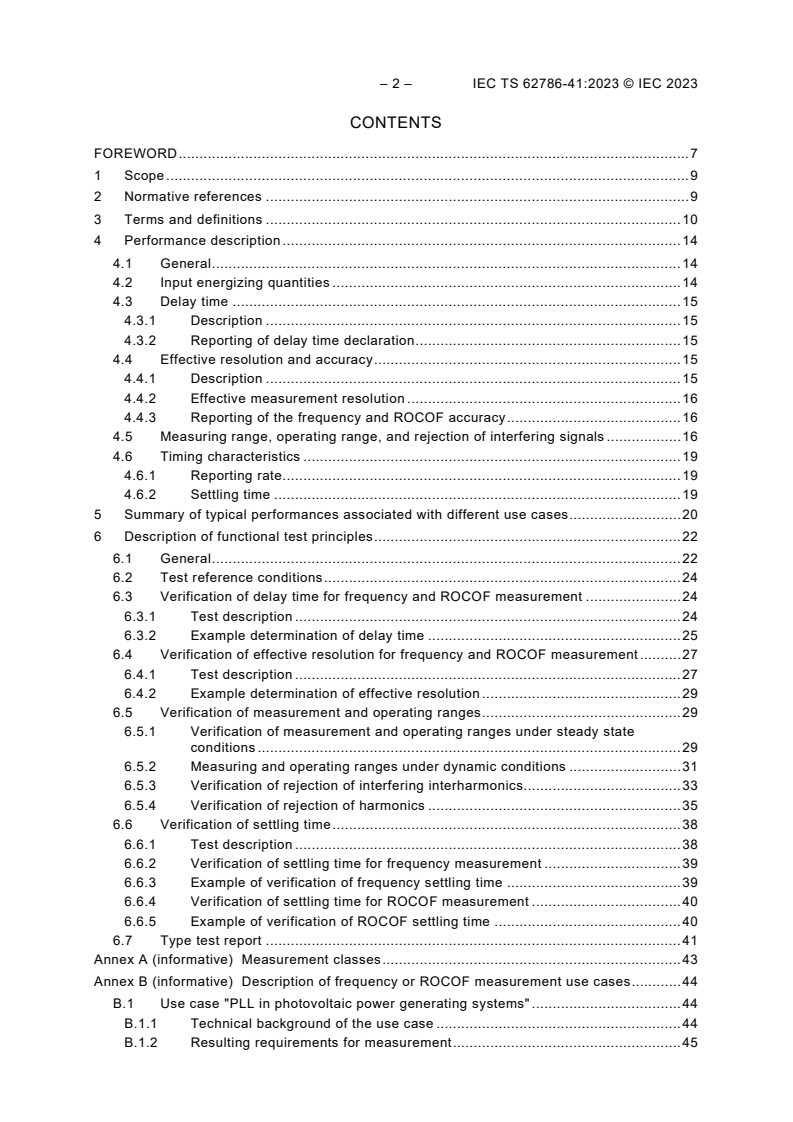
– 2 – IEC TS 62786-41:2023 © IEC 2023
CONTENTS
FOREWORD . 7
1 Scope . 9
2 Normative references . 9
3 Terms and definitions . 10
4 Performance description . 14
4.1 General . 14
4.2 Input energizing quantities . 14
4.3 Delay time . 15
4.3.1 Description . 15
4.3.2 Reporting of delay time declaration . 15
4.4 Effective resolution and accuracy . 15
4.4.1 Description . 15
4.4.2 Effective measurement resolution . 16
4.4.3 Reporting of the frequency and ROCOF accuracy . 16
4.5 Measuring range, operating range, and rejection of interfering signals . 16
4.6 Timing characteristics . 19
4.6.1 Reporting rate. 19
4.6.2 Settling time . 19
5 Summary of typical performances associated with different use cases . 20
6 Description of functional test principles . 22
6.1 General . 22
6.2 Test reference conditions . 24
6.3 Verification of delay time for frequency and ROCOF measurement . 24
6.3.1 Test description . 24
6.3.2 Example determination of delay time . 25
6.4 Verification of effective resolution for frequency and ROCOF measurement . 27
6.4.1 Test description . 27
6.4.2 Example determination of effective resolution . 29
6.5 Verification of measurement and operating ranges . 29
6.5.1 Verification of measurement and operating ranges under steady state
conditions . 29
6.5.2 Measuring and operating ranges under dynamic conditions . 31
6.5.3 Verification of rejection of interfering interharmonics. 33
6.5.4 Verification of rejection of harmonics . 35
6.6 Verification of settling time . 38
6.6.1 Test description . 38
6.6.2 Verification of settling time for frequency measurement . 39
6.6.3 Example of verification of frequency settling time . 39
6.6.4 Verification of settling time for ROCOF measurement . 40
6.6.5 Example of verification of ROCOF settling time . 40
6.7 Type test report . 41
Annex A (informative) Measurement classes . 43
Annex B (informative) Description of frequency or ROCOF measurement use cases . 44
B.1 Use case "PLL in photovoltaic power generating systems" . 44
B.1.1 Technical background of the use case . 44
B.1.2 Resulting requirements for measurement . 45
B.2 Use case "Primary reserve" . 46
B.2.1 Technical background of the use case . 46
B.2.2 Resulting requirements for measurement . 46
B.2.3 Example of "frequency-watt" function in photovoltaic power generating
systems . 47
B.3 Use case "Secondary reserve – frequency measurement used for centralized
control" . 48
B.3.1 Technical background of the use case . 48
B.3.2 Resulting requirements for measurement . 48
B.4 Use case "Fast frequency-active power proportional controller with dead
band" . 49
B.4.1 Technical background of the use case . 49
B.4.2 Resulting requirements for measurement . 50
B.5 Use case "Fast frequency response" . 51
B.5.1 Technical background of the use case . 51
B.5.2 Resulting requirements for measurement . 51
B.6 Use case "Synthetic inertia" . 51
B.6.1 Technical background of the use case . 51
B.6.2 Resulting requirements for measurement . 52
B.7 Use case "Passive anti-islanding detection" . 52
B.7.1 Technical background of the use case . 52
B.7.2 Resulting requirements for measurement . 53
B.8 Use case "Active anti-islanding detection" . 54
B.8.1 Technical background of the use case . 54
B.8.2 Resulting requirements for measurement . 54
B.9 Use case "ROCOF measurement used for centralized control" . 55
B.9.1 Technical background of the use case . 55
B.9.2 Resulting requirements for measurement . 55
B.10 Use case "Load control with active power management" . 55
B.10.1 Technical background of the use case . 55
B.10.2 Resulting requirements for measurement . 55
B.11 Use case "Self-dispatchable loads" (microgrid applications) . 56
B.11.1 Technical background of the use case . 56
B.11.2 Resulting requirements for measurement . 56
B.12 Use case "Under-frequency load shedding" (UFLS) . 57
B.12.1 Technical background of the use case . 57
B.12.2 Resulting requirements for measurement . 57
Annex C (informative) Summary of requirements expressed in standards and grid
codes related to frequency and ROCOF measurements . 58
Annex D (informative) Maximum ROCOF to be considered on power systems in case
of incidents . 65
D.1 General . 65
D.2 UK . 65
D.3 European continent . 65
D.4 Islands . 65
Annex E (informative) Frequency and rotating vectors . 66
Annex F (informative) Synthetizing input signals with sudden frequency change
without discontinuity in voltage waveform. 68
Annex G (informative) Step test equivalent time sampling technique . 71
G.1 Overview. 71
– 4 – IEC TS 62786-41:2023 © IEC 2023
G.2 Equivalent time sampling . 72
G.3 Determination of settling time using instrument errors . 73
Annex H (informative) Voltage and phase angle changes during transmission line
faults related to the type of transformer connection . 75
H.1 Overview. 75
H.2 Power line short circuit fault and protection . 75
H.3 Voltage magnitude and phase angle change at line fault . 77
H.3.1 General . 77
H.3.2 Balanced-three-phase short circuit fault . 77
H.3.3 Line-to-line short circuit fault . 77
H.4 Conclusion . 79
Annex I (informative) Influencing factors and functional tests . 80
I.1 Influencing factors . 80
I.2 Functional tests . 80
I.2.1 General . 80
I.2.2 Phase step change . 80
I.2.3 Magnitude step change . 82
I.2.4 Combined magnitude and phase step change . 85
I.2.5 Voltage magnitude drop and restoration . 89
I.2.6 Noise . 95
I.2.7 Unbalanced input signal magnitude . 97
I.2.8 Linear ramp of frequency . 99
Bibliography . 104
Figure 1 – Measuring range and operating range without interfering signals . 17
Figure 2 – Measuring range and operating range in the presence of interfering signals . 17
Figure 3 – Settling time description with input signal added . 20
Figure 4 – Example of frequency delay time validation: measurement of delay time for
a power frequency of 50 Hz . 26
Figure 5 – Example of cross-correlations of the normalized frequencies and ROCOF . 26
Figure 6 – Example of frequency modulation used to determine frequency effective
resolution . 29
Figure 7 – Example of frequency modulation used to determine ROCOF effective
resolution . 29
Figure 8 – Example of verification of measurement bandwidth under steady state
conditions . 31
Figure 9 – Example of verification of measuring and operating ranges under dynamic
conditions . 33
Figure 10 – Example of verification of rejection of interfering interharmonics . 34
Figure 11 – Waveforms with superimposed harmonics . 36
Figure 12 – Three-phase harmonic test signals, 0° and 180° harmonic phases . 37
Figure 13 – Example of verification of rejection of harmonics . 38
Figure 14 – Example of verification of frequency settling time using positive 1 Hz step
in frequency . 39
Figure 15 – Example of verification of frequency settling time using negative 1 Hz step
in input frequency . 40
Figure 16 – Example of verification of ROCOF settling time using positive 1 Hz/s step
in ROCOF . 41
Figure 17 – Example of verification of ROCOF settling time using negative 1 Hz/s step
in ROCOF . 41
Figure B.1 – Example of a system diagram of a PV system with a three-phase DC to
AC converter . 44
Figure B.2 – Example of system diagram of a three-phase PV system for voltage
control . 45
Figure B.3 – Example of system diagram of PV system with frequency-watt function . 47
Figure B.4 – Application example of frequency-watt function for PV systems . 48
Figure B.5 – Example of fast frequency-active power proportional controller with dead
band (LFSM-O and LFSM-U characteristics from European Grid Code) . 50
Figure E.1 – Phasor representation of a power system signal, which has amplitude (a),
angle (Φ) and angular velocity (ω) . 66
Figure F.1 – Example of voltage waveform without discontinuity at t = 0,02 s . 69
o
Figure F.2 – Example of voltage waveform with discontinuity at t = 0,02 s. 70
o
Figure G.1 – Example of reports during step response . 71
Figure G.2 – Example of reports during step response with higher resolution . 72
Figure G.3 – Example of reports during step response with higher resolution . 73
Figure H.1 – Voltage phase change by transmission line short circuit fault . 76
Figure H.2 – Transmission line protection sequence and line voltage, frequency
change . 76
Figure H.3 – Voltage and phase angle change at three-phase short circuit . 77
Figure H.4 – Relationship of voltage phase angle between Y-connection side and
Δ-connection side . 78
Figure H.5 – Voltage magnitude and phase angle change at two-phase short circuit
fault 78
Figure I.1 – Frequency error response to +0,3 radian phase step followed by −0,3
radian step . 82
Figure I.2 – ROCOF error response to +0,3 radian phase step followed by −0,3 radian
step 82
Figure I.3 – Frequency error response to magnitude step changes . 84
Figure I.4 – ROCOF error response to steps in magnitude . 85
Figure I.5 – Voltage vectors for test case a) . 86
Figure I.6 – Voltage vectors for test case b) . 87
Figure I.7 – Frequency error responses to combined phase and magnitude steps . 88
Figure I.8 – ROCOF error responses to combined phase and magnitude steps . 89
Figure I.9 – Representation of the input energizing quantity (voltage, RMS) injection . 91
Figure I.10 – Frequency response to voltage drop and restoration . 92
Figure I.11 – ROCOF response to voltage drop and restoration . 94
Figure I.12 – Frequency error absolute values from noise test scenarios a) and b) . 96
Figure I.13 – ROCOF error absolute values from noise test scenarios a) and b) . 97
Figure I.14 – Frequency absolute error due to unbalanced input signal magnitude . 98
Figure I.15 – ROCOF absolute error due to unbalanced input signal magnitude . 99
Figure I.16 – Frequency ramp test scenarios . 100
Figure I.17 – Absolute frequency error during linear ramp of frequency test scenarios . 102
Figure I.18 – Absolute ROCOF error during linear ramp of frequency test scenarios . 103
– 6 – IEC TS 62786-41:2023 © IEC 2023
Table 1 – Performance characteristics presented in Clause 4 . 14
Table 2 – Example of delay time . 15
Table 3 – Example of measurement resolution and maximum absolute error for
frequency and ROCOF measurements . 16
Table 4 – Example of measuring range and operating range for frequency and ROCOF
measurements (taken from an actual instrument) . 18
Table 5 – Example of reporting of settling time and reporting rate . 19
Table 6 – List of use cases and associated requirements . 21
Table 7 – Input signal harmonic magnitudes . 35
Table A.1 – Measurement classes for frequency measurements . 43
Table A.2 – Measurement classes for ROCOF measurements . 43
Table B.1 – Typical requirements for frequency measurement of PLL in PV systems . 46
Table B.2 – Typical requirements for frequency measurement – use case "Primary
reserve" . 46
Table B.3 – Example of requirements of frequency-Watt function of PV systems. 48
Table B.4 – Typical requirements for use case "Secondary reserve – frequency
measurement used for centralized control" . 49
Table B.5 – Typical requirements for frequency measurement – use case "Fast
frequency-active power proportional controller with dead band" . 51
Table B.6 – Typical requirements for frequency measurement – use case "Fast
frequency response" . 51
Table B.7 – Typcial requirements for ROCOF measurement – use case "Synthetic
inertia" . 52
Table B.8 – Set of typical requirements for frequency measurement – use case
"Passive anti-islanding detection" . 53
Table B.9 – Typical requirements for ROCOF measurement – use case "Passive anti-
islanding detection" . 53
Table B.10 – Typical requirements for frequency measurement – use case "Active anti-
islanding detection" . 54
Table B.11 – Typical requirements for ROCOF measurement – use case "ROCOF
measurement used for centralized control" . 55
Table B.12 – Typical requirements for frequency measurement – use case "Load
control with active power management" . 55
Table B.13 – Typical requirements for frequency measurement – use case "Self-
dispatchable loads" . 56
Table B.14 – Typical requirements for frequency measurement – use case "Under-
frequency load shedding" . 57
Table B.15 – Typical requirements for ROCOF measurement – use case "Under-
frequency load shedding" . 57
Table C.1 – Requirements expressed in standards and grid codes related to frequency
and ROCOF measurements . 59
Table I.1 – Influencing factors of frequency and ROCOF measurements . 80
Table I.2 – Test case a) for combined magnitude and phase step change . 86
Table I.3 – Test case b) for combined magnitude and phase step change . 86
Table I.4 – Magnitudes and phase angles for three phase voltages . 97
INTERNATIONAL ELECTROTECHNICAL COMMISSION
____________
DISTRIBUTED ENERGY RESOURCES CONNECTION WITH THE GRID –
Part 41: Requirements for frequency measurement used to control
distributed energy resources (DER) and loads
FOREWORD
1) The International Electrotechnical Commission (IEC) is a worldwide organization for standardization comprising
all national electrotechnical committees (IEC National Committees). The object of IEC is to promote international
co-operation on all questions concerning standardization in the electrical and electronic fields. To this end and
in addition to other activities, IEC publishes International Standards, Technical Specifications, Technical Reports,
Publicly Available Specifications (PAS) and Guides (hereafter referred to as "IEC Publication(s)"). Their
preparation is entrusted to technical committees; any IEC National Committee interested in the subject dealt with
may participate in this preparatory work. International, governmental and non-governmental organizations liaising
with the IEC also participate in this preparation. IEC collaborates closely with the International Organization for
Standardization (ISO) in accordance with conditions determined by agreement between the two organizations.
2) The formal decisions or agreements of IEC on technical matters express, as nearly as possible, an international
consensus of opinion on the relevant subjects since each technical committee has representation from all
interested IEC National Committees.
3) IEC Publications have the form of recommendations for international use and are accepted by IEC National
Committees in that sense. While all reasonable efforts are made to ensure that the technical content of IEC
Publications is accurate, IEC cannot be held responsible for the way in which they are used or for any
misinterpretation by any end user.
4) In order to promote international uniformity, IEC National Committees undertake to apply IEC Publications
transparently to the maximum extent possible in their national and regional publications. Any divergence between
any IEC Publication and the corresponding national or regional publication shall be clearly indicated in the latter.
5) IEC itself does not provide any attestation of conformity. Independent certification bodies provide conformity
assessment services and, in some areas, access to IEC marks of conformity. IEC is not responsible for any
services carried out by independent certification bodies.
6) All users should ensure that they have the latest edition of this publication.
7) No liability shall attach to IEC or its directors, employees, servants or agents including individual experts and
members of its technical committees and IEC National Committees for any personal injury, property damage or
other damage of any nature whatsoever, whether direct or indirect, or for costs (including legal fees) and
expenses arising out of the publication, use of, or reliance upon, this IEC Publication or any other IEC
Publications.
8) Attention is drawn to the Normative references cited in this publication. Use of the referenced publications is
indispensable for the correct application of this publication.
9) IEC draws attention to the possibility that the implementation of this document may involve the use of (a)
patent(s). IEC takes no position concerning the evidence, validity or applicability of any claimed patent rights in
respect thereof. As of the date of publication of this document, IEC had not received notice of (a) patent(s), which
may be required to implement this document. However, implementers are cautioned that this may not represent
the latest information, which may be obtained from the patent database available at https://patents.iec.ch. IEC
shall not be held responsible for identifying any or all such patent rights.
IEC TS 62786-41 has been prepared by IEC technical committee 8: System aspects of electrical
energy supply. It is a Technical Specification.
The text of this Technical Specification is based on the following documents:
Draft Report on voting
8/1649/DTS 8/1661/RVDTS
Full information on the voting for its approval can be found in the report on voting indicated in
the above table.
The language used for the development of this Technical Specification is English.
– 8 – IEC TS 62786-41:2023 © IEC 2023
This document was drafted in accordance with ISO/IEC Directives, Part 2, and developed in
accordance with ISO/IEC Directives, Part 1 and ISO/IEC Directives, IEC Supplement, available
at www.iec.ch/members_experts/refdocs. The main document types developed by IEC are
described in greater detail at www.iec.ch/publications.
It has been developed as part of measurement series together with IEC TS 62786-42 on voltage
measurement.
A list of all parts in the IEC 62786 series, published under the general title Distributed energy
resources connection with the grid, can be found on the IEC website.
The committee has decided that the contents of this document will remain unchanged until the
stability date indicated on the IEC website under webstore.iec.ch in the data related to the
specific document. At this date, the document will be
• reconfirmed,
• withdrawn,
• replaced by a revised edition, or
• amended.
IMPORTANT – The "colour inside" logo on the cover page of this document indicates
that it contains colours which are considered to be useful for the correct understanding
of its contents. Users should therefore print this document using a colour printer.
DISTRIBUTED ENERGY RESOURCES CONNECTION WITH THE GRID –
Part 41: Requirements for frequency measurement used to control
distributed energy resources (DER) and loads
1 Scope
This part of IEC 62786, which is a Technical Specification, defines minimum requirements for
frequency and rate of change of frequency measurements used to control distributed energy
resources (DER) and loads connected to electrical power networks.
This document specifies the characteristics of frequency and rate of change of frequency
measurements to evaluate their performances. It describes the main use cases of frequency
and rate of change of frequency measurements, with associated level of performances.
It describes the principle of functional tests to evaluate the specified characteristics and defines
the influencing factors that affect these performances, under steady state or dynamic conditions.
This document defines the functional requirements applicable to frequency and rate of change
of frequency measurements which can be inside or outside the DER or loads. In the case of
DER, this document provides requirements additional to those which are defined in the other
parts of IEC 62786 or standards produced by the relevant IEC technical committees (e.g. TC 82
for photovoltaic systems, TC 88 for wind systems, TC 120 for electrical energy storage systems
(EES)).
This document is applicable to DER and loads regardless of the voltage level of the point of
connection to the grid.
This document does not specify hardware, software or a method for frequency or rate of change
of frequency measurement. It does not specify tests linked to environmental conditions
associated with hardware devices (climatic, electromagnetic disturbances above 3 kHz,
mechanical stress, etc.).
Frequency and rate of change of frequency measurements associated with time stamping are
not in the scope of this document. These measurements are already covered by
IEC 60255-118-1 [1] .
Frequency and rate of change of frequency measurements associated with protection functions
or protection relays are not in the scope of this document. These requirements are already
covered by IEC 60255-181 [2].
NOTE As defined in the first paragraph, this document is focused on frequency and rate of change of frequency
measurements used to control DER and loads. But the technical requirements defined in this document, with the list
of declared characteristics and their associated functional tests, can also be applicable for other uses where "fast"
frequency and ROCOF measurement is required (small or large generators of power substations connected to
transmission or distribution grids, power meter devices, power quality instruments, etc.).
2 Normative references
There are no normative references in this document.
___________
Numbers in square brackets refer to the Bibliography.
– 10 – IEC TS 62786-41:2023 © IEC 2023
3 Terms and definitions
For the purposes of this document, the following terms and definitions apply.
ISO and IEC maintain terminological databases for use in standardization at the following
addresses:
• IEC Electropedia: available at http://www.electropedia.org/
• ISO Online browsing platform: available at http://www.iso.org/obp
3.1
instrument
device or measurement function which performs frequency or
ROCOF measurement
Note 1 to entry: As the frequency or ROCOF measuring functions can be performed inside different types of devices
or systems (control system of distributed energy resources, power system loads, protection relays, metering devices,
etc.), the generic term "instrument" is used in this document to designate frequency or ROCOF measuring function
which must be characterized and tested.
3.2
rotating vector
representation of a sinusoidal function where a polar vector rotates at an angular velocity which
can be a non-constant function of time and is expressed in radians per second
Note 1 to entry: The radius of the rotating vector can also be a non-constant function of time.
Note 2 to entry: Rotating vectors can represent periodic or non-periodic sinusoids.
Note 3 to entry: Power system signals can be represented by a combination of signals, each represented by one
rotating vector, each with various angular velocities and various radii. Each of these rotating vectors represents one
component of the power system signal (see Annex E).
Note 4 to entry: The noise component of a power system signal is not represented by a rotating vector. Noise is
represented as a time series.
3.3
phase
angle of a rotating vector
Note 1 to entry: When the rotating vector is described in polar notation, the phase is the angle; when described in
complex notation, the phase is the argument.
3.4
instantaneous phase
phase of a rotating vector at a specific moment of time
Note 1 to entry: Any point along a sinusoidal periodic function can be represented by a complex number. The
instantaneous phase is the argument of that complex number.
3.5
frequency
rate of change of phase of a rotating vector
Note 1 to entry: If the period is a span of time, the unit of frequency is hertz (Hz) in cycles per second.
Note 2 to entry: Frequency can be a non-constant function of time.
3.6
power frequency
values of frequency used in the electricity supply systems
[SOURCE: IEC 60050-601:1985, 601-01-05, modified – In the definition, "conventionally" has
been deleted.]
3.7
instantaneous frequency
rate of change of instantaneous phase
Note 1 to entry: Typical frequency reporting instruments report instantaneous frequency and can report the
changing frequency within one period of the input energizing quantity.
3.8
measured frequency
estimated frequency provided by an instrument
3.9
fundamental component
rotating vector of interest for a waveform that is a sum of rotating vectors
Note 1 to entry: Generally, the fundamental component is the rotating vector with the greatest magnitude;
sometimes it is the component with the lowest frequency (often called the first harmonic). However, neither is always
the case, for example in AC current waveforms or in oscillating signals with sub-harmonics.
3.10
fundamental frequency
frequency of the fundamental component
Note 1 to entry: In AC electrical power systems, the fundamental frequency is to be maintained within relevant
statutory deviation from the nominal frequency.
Note 2 to entry: In three-phase systems, measuring fundamental frequency for all three phases can yield slightly
different measurements due to interference. Frequency can be obtained by a transformation of the individual phases
such as by averaging the three frequency measurements or by calculating the rate change of instantaneous phase
of the positive sequence since positive sequence cancels common-mode interference.
[SOURCE: IEC 60050-103:2009, 103-07-21, modified – In the definition, "of a periodic quantity"
has been deleted. Notes 1 and 2 to entry have been added.]
3.11
nominal frequency
nominal value of power frequency
Note 1 to entry: In conventional power systems, nominal frequency is normally 50 Hz or 60 Hz.
3.12
rate of change of frequency
ROCOF
first time derivative of instantaneous frequency or second time derivative of instantaneous
phase
3.13
harmonic component
rotating vector whose frequency is an integer multiple of the fundamental frequency for a signal
that is the sum of rotating vectors
Note 1 to entry: The fundamental component is the first harmonic component.
3.14
interharmonic component
rotating vector whose frequency is not an integer multiple of the fundamental frequency for a
signal that is a sum of rotating vectors
– 12 – IEC TS 62786-41:2023 © IEC 2023
3.15
sub-harmonic component
interharmonic component having harmonic order lower than one
[SOURCE: IEC 60050-103:2009, 103-07-29]
3.16
settling time
for a step response the duration of the time interval between the instant of the step change of
an input variable and the instant, when the difference between the step response and their
steady-state value remains smaller than the transient value tolerance
SEE: Figure 3
[SOURCE: IEC 60050-351:2013, 351-45-37, modified – Figure 5 inside the terminology entry
has been replaced by Figure 3.]
3.17
fast frequency response
FFR
fast active power response to frequency variations that uses a droop control
3.18
droop control
control loop to control dispatchable generators or loads to ensure
that the active power generation or consumption is a proportional function of the measured
power frequency deviation
Note 1 to entry: The proportionality factor is an inverse of the frequency droop.
3.19
frequency droop
ratio of the per-unit changes in frequency (∆f)/f to the per-unit change in power (∆P)/P
n n
σ = (∆f/f ) / (∆P/P ),
n n
where f is the nominal frequency and P is the DER or load rated power
n n
Note 1 to entry: The frequency droop is a f(P) function, whereas often used characteristic curve is P(f).
Note 2 to entry: The same principle can be applied for a voltage droop.
Note 3 to entry: The frequency gradient of a characteristic curve, which describes the power response to frequency,
is the active power change per frequency change. In a 50 Hz system, a droop of σ % can be transformed into a
gradient g % (in P /Hz) by the formula g = 200/σ; in a 60 Hz system g = 166,7/σ.
n
3.20
synthetic inertia
capability of a grid connected converter to emulate the effect of
inertia of a synchronous generator to a prescribed level of performance
Note 1 to entry: A static converter can provide
...