

IEC 62135-1:2008
(Main)Resistance welding equipment - Part 1: Safety requirements for design, manufacture and installation
General Information
- Abstract
IEC 62135:2008 applies to equipment for resistance welding and allied processes and includes single and multiple welding stations which may be manually or automatically loaded and/or started. This standard covers stationary and portable equipment and specifies safety requirements for design, manufacture and installation.
- Status
- Published
- Publication Date
- 07-Jul-2008
- Technical Committee
- TC 26 - Electric welding
- Drafting Committee
- WG 6 - TC 26/WG 6
- Current Stage
- DELPUB - Deleted Publication
- Start Date
- 07-May-2015
- Completion Date
- 28-Aug-2026
Overview
IEC 62135-1:2008 is an international standard published by the International Electrotechnical Commission (IEC) that outlines safety requirements for the design, manufacture, and installation of resistance welding equipment. This standard covers a wide range of equipment types, including stationary and portable machines used for resistance welding and allied processes. It is applicable to single or multiple welding stations and supports manual or automatic operation.
The primary goal of IEC 62135-1 is to ensure high safety standards in the use of resistance welding equipment by addressing electrical, mechanical, thermal, and operational hazards. By adhering to this standard, manufacturers and users can reduce the risk of accidents and improve equipment reliability during welding processes.
Key Topics
Scope and Applicability
IEC 62135-1 applies to all resistance welding machines, including single and multi-station setups which may be manually or automatically loaded and controlled.Electrical Safety Requirements
The standard provides detailed requirements for protection against electric shock, covering insulation, clearances, creepage distances, dielectric strength, and protection against direct and indirect contact. It specifies testing methods to ensure compliance, including leakage current measurements and the use of protective devices.Thermal Safety
It includes guidelines for thermal testing such as heating tests, temperature measurement, and limits for temperature rise on windings, external surfaces, and components ensuring safe operation under normal and abnormal conditions.Mechanical Hazards
IEC 62135-1 mandates risk analysis and mechanical protection measures to minimize risks associated with moving parts and other mechanical hazards during equipment operation.Abnormal Operation and Fault Conditions
The standard addresses safety provisions under conditions like stalled fans, overloads, and cooling system failures to prevent unsafe situations.Instructions and Markings
Clear requirements for user instructions and necessary markings are included to inform users about safety precautions and correct handling.
Applications
IEC 62135-1:2008 is essential for manufacturers, installers, safety inspectors, and operators of resistance welding equipment. It ensures compliance with internationally recognized safety principles applicable to:
- Industrial manufacturing plants using resistance welding in automotive, aerospace, electronics, and metalworking industries.
- Suppliers of resistance welding machinery seeking certification for global markets.
- Safety engineers performing risk assessments and safety audits of welding equipment.
- Maintenance teams tasked with the safe installation and servicing of welding machines.
By following the guidelines of IEC 62135-1, stakeholders can enhance workplace safety, reduce downtime caused by equipment failures, and meet regulatory requirements for industrial welding operations.
Related Standards
To complement IEC 62135-1, several related international standards should be considered:
- IEC 60974 Series – Covers arc welding equipment safety and performance requirements.
- ISO 12100 – Provides principles for risk assessment and risk reduction for machinery safety.
- IEC 60204-1 – Safety of machinery – Electrical equipment of machines.
- ANSI/AWS Standards – American Welding Society standards related to welding safety and processes.
Together, these standards form a comprehensive framework for ensuring the safety and reliability of welding equipment used worldwide.
Keywords: IEC 62135-1, resistance welding equipment, welding safety standard, electrical safety, mechanical hazards, welding machine installation, thermal requirements, safety requirements welding, welding equipment design, international welding standard.
Relations
- Effective Date
- 05-Sep-2023
Get Certified
Connect with accredited certification bodies for this standard

DVS-ZERT GmbH
German welding certification society.
CARES (UK Certification Authority for Reinforcing Steels)
UK certification for reinforcing steels and construction.
EWF/IIW (European/International Welding Federation)
International welding personnel certification.
Sponsored listings
Frequently Asked Questions
IEC 62135-1:2008 is a standard published by the International Electrotechnical Commission (IEC). Its full title is "Resistance welding equipment - Part 1: Safety requirements for design, manufacture and installation". This standard covers: IEC 62135:2008 applies to equipment for resistance welding and allied processes and includes single and multiple welding stations which may be manually or automatically loaded and/or started. This standard covers stationary and portable equipment and specifies safety requirements for design, manufacture and installation.
IEC 62135:2008 applies to equipment for resistance welding and allied processes and includes single and multiple welding stations which may be manually or automatically loaded and/or started. This standard covers stationary and portable equipment and specifies safety requirements for design, manufacture and installation.
IEC 62135-1:2008 is classified under the following ICS (International Classification for Standards) categories: 25.160.30 - Welding equipment. The ICS classification helps identify the subject area and facilitates finding related standards.
IEC 62135-1:2008 has the following relationships with other standards: It is inter standard links to IEC 62135-1:2015. Understanding these relationships helps ensure you are using the most current and applicable version of the standard.
IEC 62135-1:2008 is available in PDF format for immediate download after purchase. The document can be added to your cart and obtained through the secure checkout process. Digital delivery ensures instant access to the complete standard document.
Standards Content (Sample)
IEC 62135-1
Edition 1.0 2008-07
INTERNATIONAL
STANDARD
NORME
INTERNATIONALE
Resistance welding equipment –
Part 1: Safety requirements for design, manufacture and installation
Matériels de soudage par résistance –
Partie 1: Exigences de sécurité pour la conception, la fabrication et l’installation
All rights reserved. Unless otherwise specified, no part of this publication may be reproduced or utilized in any form or by
any means, electronic or mechanical, including photocopying and microfilm, without permission in writing from either IEC or
IEC's member National Committee in the country of the requester.
If you have any questions about IEC copyright or have an enquiry about obtaining additional rights to this publication,
please contact the address below or your local IEC member National Committee for further information.
Droits de reproduction réservés. Sauf indication contraire, aucune partie de cette publication ne peut être reproduite
ni utilisée sous quelque forme que ce soit et par aucun procédé, électronique ou mécanique, y compris la photocopie
et les microfilms, sans l'accord écrit de la CEI ou du Comité national de la CEI du pays du demandeur.
Si vous avez des questions sur le copyright de la CEI ou si vous désirez obtenir des droits supplémentaires sur cette
publication, utilisez les coordonnées ci-après ou contactez le Comité national de la CEI de votre pays de résidence.
IEC Central Office
3, rue de Varembé
CH-1211 Geneva 20
Switzerland
Email: inmail@iec.ch
Web: www.iec.ch
About the IEC
The International Electrotechnical Commission (IEC) is the leading global organization that prepares and publishes
International Standards for all electrical, electronic and related technologies.
About IEC publications
The technical content of IEC publications is kept under constant review by the IEC. Please make sure that you have the
latest edition, a corrigenda or an amendment might have been published.
ƒ Catalogue of IEC publications: www.iec.ch/searchpub
The IEC on-line Catalogue enables you to search by a variety of criteria (reference number, text, technical committee,…).
It also gives information on projects, withdrawn and replaced publications.
ƒ IEC Just Published: www.iec.ch/online_news/justpub
Stay up to date on all new IEC publications. Just Published details twice a month all new publications released. Available
on-line and also by email.
ƒ Electropedia: www.electropedia.org
The world's leading online dictionary of electronic and electrical terms containing more than 20 000 terms and definitions
in English and French, with equivalent terms in additional languages. Also known as the International Electrotechnical
Vocabulary online.
ƒ Customer Service Centre: www.iec.ch/webstore/custserv
If you wish to give us your feedback on this publication or need further assistance, please visit the Customer Service
Centre FAQ or contact us:
Email: csc@iec.ch
Tel.: +41 22 919 02 11
Fax: +41 22 919 03 00
A propos de la CEI
La Commission Electrotechnique Internationale (CEI) est la première organisation mondiale qui élabore et publie des
normes internationales pour tout ce qui a trait à l'électricité, à l'électronique et aux technologies apparentées.
A propos des publications CEI
Le contenu technique des publications de la CEI est constamment revu. Veuillez vous assurer que vous possédez
l’édition la plus récente, un corrigendum ou amendement peut avoir été publié.
ƒ Catalogue des publications de la CEI: www.iec.ch/searchpub/cur_fut-f.htm
Le Catalogue en-ligne de la CEI vous permet d’effectuer des recherches en utilisant différents critères (numéro de référence,
texte, comité d’études,…). Il donne aussi des informations sur les projets et les publications retirées ou remplacées.
ƒ Just Published CEI: www.iec.ch/online_news/justpub
Restez informé sur les nouvelles publications de la CEI. Just Published détaille deux fois par mois les nouvelles
publications parues. Disponible en-ligne et aussi par email.
ƒ Electropedia: www.electropedia.org
Le premier dictionnaire en ligne au monde de termes électroniques et électriques. Il contient plus de 20 000 termes et
définitions en anglais et en français, ainsi que les termes équivalents dans les langues additionnelles. Egalement appelé
Vocabulaire Electrotechnique International en ligne.
ƒ Service Clients: www.iec.ch/webstore/custserv/custserv_entry-f.htm
Si vous désirez nous donner des commentaires sur cette publication ou si vous avez des questions, visitez le FAQ du
Service clients ou contactez-nous:
Email: csc@iec.ch
Tél.: +41 22 919 02 11
Fax: +41 22 919 03 00
IEC 62135-1
Edition 1.0 2008-07
INTERNATIONAL
STANDARD
NORME
INTERNATIONALE
Resistance welding equipment –
Part 1: Safety requirements for design, manufacture and installation
Matériels de soudage par résistance –
Partie 1: Exigences de sécurité pour la conception, la fabrication et l’installation
INTERNATIONAL
ELECTROTECHNICAL
COMMISSION
COMMISSION
ELECTROTECHNIQUE
PRICE CODE
INTERNATIONALE
XB
CODE PRIX
ICS 25.160 ISBN 2-8318-9823-4
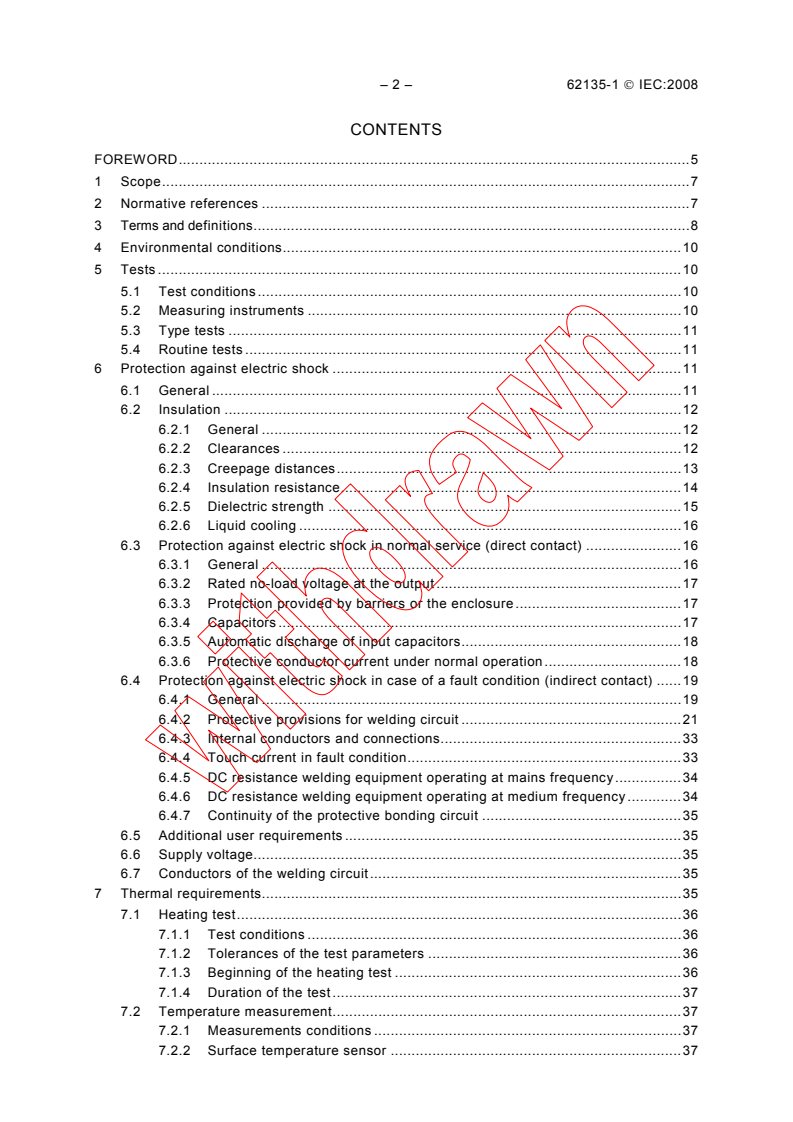
– 2 – 62135-1 © IEC:2008
CONTENTS
FOREWORD.5
1 Scope.7
2 Normative references .7
3 Terms and definitions.8
4 Environmental conditions.10
5 Tests .10
5.1 Test conditions.10
5.2 Measuring instruments .10
5.3 Type tests .11
5.4 Routine tests .11
6 Protection against electric shock .11
6.1 General .11
6.2 Insulation .12
6.2.1 General .12
6.2.2 Clearances .12
6.2.3 Creepage distances.13
6.2.4 Insulation resistance.14
6.2.5 Dielectric strength .15
6.2.6 Liquid cooling .16
6.3 Protection against electric shock in normal service (direct contact) .16
6.3.1 General .16
6.3.2 Rated no-load voltage at the output .17
6.3.3 Protection provided by barriers or the enclosure.17
6.3.4 Capacitors .17
6.3.5 Automatic discharge of input capacitors.18
6.3.6 Protective conductor current under normal operation.18
6.4 Protection against electric shock in case of a fault condition (indirect contact) .19
6.4.1 General .19
6.4.2 Protective provisions for welding circuit .21
6.4.3 Internal conductors and connections.33
6.4.4 Touch current in fault condition.33
6.4.5 DC resistance welding equipment operating at mains frequency.34
6.4.6 DC resistance welding equipment operating at medium frequency.34
6.4.7 Continuity of the protective bonding circuit .35
6.5 Additional user requirements .35
6.6 Supply voltage.35
6.7 Conductors of the welding circuit.35
7 Thermal requirements.35
7.1 Heating test.36
7.1.1 Test conditions .36
7.1.2 Tolerances of the test parameters .36
7.1.3 Beginning of the heating test .36
7.1.4 Duration of the test.37
7.2 Temperature measurement.37
7.2.1 Measurements conditions .37
7.2.2 Surface temperature sensor .37
62135-1 © IEC:2008 – 3 –
7.2.3 Resistance .37
7.2.4 Embedded temperature sensor.38
7.2.5 Determination of the ambient temperature (t ).38
a
7.2.6 Determination of cooling liquid temperature (t ).38
a
7.2.7 Recording of temperatures .38
7.3 Limits of temperature rise.38
7.3.1 Windings .38
7.3.2 External surfaces.39
7.3.3 Other components .40
8 Abnormal operation .40
8.1 General requirements.40
8.2 Stalled fan test .40
8.3 Cooling system failure .40
8.4 Overload test.41
9 Provisions against mechanical hazards .41
9.1 General .41
9.2 Risk analysis .41
9.2.1 General .41
9.2.2 Ready to use equipment as in delivery state.41
9.2.3 Equipment not ready to use as in delivery state.41
9.2.4 Equipment not ready to use and designed to be incorporated in a
more complex equipment.42
9.3 Measures .42
9.3.1 Minimum measures.42
9.3.2 Additional measures .42
9.4 Conformity of components.43
9.5 Starting for manual operated equipment .43
10 Instructions and markings.44
10.1 Instructions .44
10.2 Markings .44
Annex A (informative) Nominal voltages of supply networks.45
Annex B (normative) Construction of supply circuit terminals .46
Annex C (informative) Extrapolation of temperature to time of shutdown.48
Annex D (informative) Example of risk analysis and safety level requirement.49
Annex E (informative) Indirect contact protection in resistance welding equipment.53
Bibliography.60
Figure 1 – Measurement of leakage current .22
Figure 2 – Example of metal screen between windings of the supply circuit and the
welding circuit.23
Figure 3 – Example of protective conductor connected directly to the welding circuit
(single-spot, a.c. current equipment).24
Figure 4 – Example of protective conductor connected directly to welding circuits
(multi-spot, a.c. current equipment) .24
Figure 5 – Example of protective conductor connected direct to welding circuits
(medium-frequency equipment).25
Figure 6 – Example of protective conductor connected to welding circuits through
impedances .26
– 4 – 62135-1 © IEC:2008
Figure 7 – Example of protective conductor connected to welding circuits through
auto-inductances .27
Figure 8 – Example of protective conductor connected to welding circuits through
auto-inductances .27
Figure 9 – Example of current operated residual current device (a.c. current
equipment) .28
Figure 10 – Example of current operated residual current device (medium-frequency
equipment) .29
Figure 11 – Example of current operated residual current device and voltage relay .30
Figure 12 – Example of current operated residual current device and safety voltage
operated relay.31
Figure 13 – Example of safety voltage operated relay .32
Figure 14 – Measuring network for leakage current.34
Figure E.1 – Typical fault current .57
Figure E.2 – Time-to-voltage reference curve .59
Table 1 – Minimum clearances for overvoltage category III .12
Table 2 – Minimum creepage distances .14
Table 3 – Insulation resistance .15
Table 4 – Dielectric test voltages .15
Table 5 – Minimum distance through insulation.21
Table 6 – Continuity of the protective bonding circuit .35
Table 7 – Limits of temperature rise for windings .39
Table 8 – Limits of temperature rise for external surfaces .39
Table B.1 – Range of conductor dimensions to be accepted by the supply circuit
terminals.46
Table B.2 – Spacing between supply circuit terminals .47
62135-1 © IEC:2008 – 5 –
INTERNATIONAL ELECTROTECHNICAL COMMISSION
____________
RESISTANCE WELDING EQUIPMENT –
Part 1: Safety requirements for design,
manufacture and installation
FOREWORD
1) The International Electrotechnical Commission (IEC) is a worldwide organization for standardization comprising
all national electrotechnical committees (IEC National Committees). The object of IEC is to promote
international co-operation on all questions concerning standardization in the electrical and electronic fields. To
this end and in addition to other activities, IEC publishes International Standards, Technical Specifications,
Technical Reports, Publicly Available Specifications (PAS) and Guides (hereafter referred to as “IEC
Publication(s)”). Their preparation is entrusted to technical committees; any IEC National Committee interested
in the subject dealt with may participate in this preparatory work. International, governmental and non-
governmental organizations liaising with the IEC also participate in this preparation. IEC collaborates closely
with the International Organization for Standardization (ISO) in accordance with conditions determined by
agreement between the two organizations.
2) The formal decisions or agreements of IEC on technical matters express, as nearly as possible, an international
consensus of opinion on the relevant subjects since each technical committee has representation from all
interested IEC National Committees.
3) IEC Publications have the form of recommendations for international use and are accepted by IEC National
Committees in that sense. While all reasonable efforts are made to ensure that the technical content of IEC
Publications is accurate, IEC cannot be held responsible for the way in which they are used or for any
misinterpretation by any end user.
4) In order to promote international uniformity, IEC National Committees undertake to apply IEC Publications
transparently to the maximum extent possible in their national and regional publications. Any divergence
between any IEC Publication and the corresponding national or regional publication shall be clearly indicated in
the latter.
5) IEC provides no marking procedure to indicate its approval and cannot be rendered responsible for any
equipment declared to be in conformity with an IEC Publication.
6) All users should ensure that they have the latest edition of this publication.
7) No liability shall attach to IEC or its directors, employees, servants or agents including individual experts and
members of its technical committees and IEC National Committees for any personal injury, property damage or
other damage of any nature whatsoever, whether direct or indirect, or for costs (including legal fees) and
expenses arising out of the publication, use of, or reliance upon, this IEC Publication or any other IEC
Publications.
8) Attention is drawn to the Normative references cited in this publication. Use of the referenced publications is
indispensable for the correct application of this publication.
9) Attention is drawn to the possibility that some of the elements of this IEC Publication may be the subject of
patent rights. IEC shall not be held responsible for identifying any or all such patent rights.
International Standard IEC 62135-1 has been prepared by IEC technical committee 26:
Electric welding.
The text of this standard is based on the following documents:
FDIS Report on voting
26/377/FDIS 26/383/RVD
Full information on the voting for the approval of this standard can be found in the report on
voting indicated in the above table.
This publication has been drafted in accordance with the ISO/IEC Directives, Part 2.
– 6 – 62135-1 © IEC:2008
The list of all the parts of the IEC 62135 series, under the general title Resistance welding
equipment, can be found on the IEC website.
The committee has decided that the contents of this publication will remain unchanged until
the maintenance result date indicated on the IEC web site under "http://webstore.iec.ch" in
the data related to the specific publication. At this date, the publication will be
• reconfirmed,
• withdrawn,
• replaced by a revised edition, or
• amended.
62135-1 © IEC:2008 – 7 –
RESISTANCE WELDING EQUIPMENT –
Part 1: Safety requirements for design,
manufacture and installation
1 Scope
This part of IEC 62135 applies to equipment for resistance welding and allied processes and
includes single and multiple welding stations which may be manually or automatically loaded
and/or started.
This standard covers stationary and portable equipment.
It specifies safety requirements for design, manufacture and installation.
To comply with this standard, all safety risks involved in loading, feeding, operating and
unloading the equipment, where applicable, should be assessed and the requirements of
related standards should be observed.
2 Normative references
The following normative documents contain provisions which, through reference in this text,
constitute provisions of this part of IEC 62135. For dated references, only the edition cited
applies. For undated references, the latest edition of the referenced document (including any
amendments) applies.
IEC 60204-1, Safety of machinery – Electrical equipment of machines – Part 1: General
requirements
IEC 60364-4-41:2005, Low-voltage electrical installations – Part 4-41: Protection for safety –
Protection against electric shock
IEC 60364-6, Low-voltage electrical installations – Part 6: Verification
IEC 60439-1, Low-voltage switchgear and controlgear assemblies – Part 1: Type-tested and
partially type-tested assemblies
IEC 60529, Degrees of protection provided by enclosures (IP code)
IEC 60664-1:2007, Insulation coordination for equipment within low-voltage systems – Part 1:
Principles, requirements and tests
IEC 60664-3, Insulation coordination for equipment within low-voltage systems – Part 3: Use
of coating, potting or moulding for protection against pollution
IEC 61140, Protection against electric shock – Common aspects for installation and
equipment
ISO 669, Resistance welding – Resistance welding equipment – Mechanical and electrical
requirements
– 8 – 62135-1 © IEC:2008
ISO 5828, Resistance welding equipment – Secondary connecting cables with terminals
connected to water-cooled lugs – Dimensions and characteristics
ISO 8205-1, Water-cooled secondary connection cables for resistance welding – Part 1:
Dimensions and requirements for double-conductor connection cables
ISO 8205-2, Water-cooled secondary connection cables for resistance welding – Part 2:
Dimensions and requirements for single-conductor connection cables
ISO 12100-1, Safety of machinery – Basic concepts, general principles for design – Part 1:
Basic terminology, methodology
ISO 12100-2, Safety of machinery – Basic concepts, general principles for design – Part 2:
Technical principles
ISO 13849-1, Safety of machinery – Safety-related parts of control systems – Part 1: General
principles for design
ISO 14121-1, Safety of machinery – Risk assessment – Part 1: Principles
3 Terms and definitions
For the purposes of this document, the following terms and definitions, together with those
given in ISO 669, IEC 60664-1 and IEC 60204-1, apply.
3.1
equipment for resistance welding and allied processes
equipment associated with carrying out the processes of resistance welding or allied
processes consisting of, for example, power source, electrodes, tooling and associated
control equipment
NOTE 1 It may be a separate unit or part of a complex machine.
NOTE 2 The term "resistance welding equipment" is used in the following text.
3.2
processes allied to resistance welding
processes carried out on machines comparable to resistance welding equipment considered
as allied to resistance welding, for example, resistance brazing, soldering or heating
3.3
type test
test of one or more devices made to a given design, to check if these devices comply with the
requirements of the standard concerned
[IEV 851-02-09]
3.4
routine test
test made on each individual device during or after manufacture to check if it complies with
the requirements of the standard concerned or the criteria specified
[IEV 851-02-10]
3.5
welding circuit
conductive material through which the welding current is intended to flow
62135-1 © IEC:2008 – 9 –
3.6
control circuit
circuit for the operational control of welding equipment, and/or for protection of the power
circuits
3.7
conventional value
standardized value that is used as a measure of a parameter for the purposes of comparison,
calibration, testing, etc.
NOTE Conventional values do not necessarily apply during the actual welding process.
3.8
rated value
value assigned, generally by the manufacturer, for a specified operating condition of a
component, device or equipment
3.9
rating
set of rated values and operating conditions
3.10
hand-held equipment
resistance welding equipment with built-in or external transformer, which is intended to be
held in the hand during use, suspended or not
3.11
portable equipment
resistance welding equipment that is connected to the mains supply by means of a plug.
3.12
stationary equipment
resistance welding equipment permanently connected to the mains supply
3.13
material group
materials are separated into four groups by their comparative tracking index (CTI) values, as
follows:
Material group I 600 ≤ CTI
Material group II 400 ≤ CTI < 600
Material group IIIa 175 ≤ CTI < 400
Material group IIIb 100 ≤ CTI < 175
The CTI values above refer to values in accordance with IEC 60112.
NOTE For inorganic insulating materials, for example, glass or ceramics, which do not track, creepage distances
need not be greater than their associated clearance for the purpose of insulation coordination.
3.14
thermal equilibrium
state reached when the observed temperature rise of any part of the welding equipment does
not exceed 2 K/h
3.15
thermal protection
system intended to ensure the protection of all or part of the welding equipment against
excessive temperatures resulting from certain conditions of thermal overload
– 10 – 62135-1 © IEC:2008
NOTE It is capable of being reset (either manually or automatically) when the temperature falls to the reset value.
3.16
supply circuit
conductive material of the power source through which the supply current is intended to flow
3.17
general visual inspection
inspection by eye to verify that there are no apparent discrepancies with respect to provisions
of the standard concerned
3.18
working voltage
highest r.m.s. value of the a.c. or d.c. voltage across any particular insulation which can occur
when the equipment is supplied at rated voltage
NOTE 1 Transients are disregarded.
NOTE 2 Both open-circuit conditions and normal operating conditions are taken into account.
4 Environmental conditions
Resistance welding equipment complying with this standard shall be safe to operate under the
following service conditions.
a) At an ambient air temperature from 5 °C to 40 °C at a relative humidity of
– up to 50 % at 40 °C;
– up to 90 % at 20 °C.
The ambient air shall be free from excessive amounts of dust, acids, corrosive gases or
substances etc. other than those generated by the welding process. These environmental
conditions apply to equipment intended for indoor use only.
b) The temperature of the cooling medium does not exceed
1) in the case of a liquid: 30 °C at the inlet;
2) in the case of the ambient air: 40 °C.
c) The altitude above sea-level does not exceed 1 000 m.
NOTE Different environmental conditions may be agreed upon between the manufacturer and the purchaser and
the resulting welding equipment so marked. Examples of these conditions are: outdoor use, different altitude,
different temperature of cooling medium, high humidity, unusually corrosive fumes, steam, excessive oil vapour,
abnormal vibration or shock, excessive dust, unusual sea coast or shipboard conditions.
5 Tests
5.1 Test condition
The tests shall be carried out on new, dry and completely assembled resistance welding
equipment at an ambient air temperature between 10 °C and 40 °C. It is recommended that
the thermal tests be carried out at 40 °C. Liquid-cooled resistance welding equipment shall be
tested with liquid conditions as specified by the manufacturer.
5.2 Measuring instruments
The accuracy of measuring instruments shall be as follows.
a) Electrical measuring instruments: class 0,5 (±0,5 % of full-scale reading), except for the
measurement of insulation resistance and dielectric strength where the accuracy of the
instruments is not specified, but shall be taken into account for the measurement.
b) Instruments for measuring welding current: class 5.
62135-1 © IEC:2008 – 11 –
c) Temperature measuring instruments: ±2 K.
5.3 Type tests
Unless otherwise specified, the tests in this standard are type tests.
The resistance welding equipment shall be tested with all ancillary equipment fitted that could
affect the test results.
All type tests shall be carried out on the same resistance welding equipment except where it
is specified that a test may be carried out on another resistance welding equipment.
As a condition of conformity, the type tests given below shall be carried out in the following
sequence:
a) general visual inspection, see 3.17;
b) insulation resistance, see 6.2.4 (preliminary check);
c) protection provided by the enclosure, see 6.3.3;
d) insulation resistance, see 6.2.4;
e) dielectric strength, see 6.2.5;
f) general visual inspection, see 3.17.
The other tests included in this standard and not listed here may be carried out in any
convenient sequence.
5.4 Routine tests
All routine tests shall be carried out on each resistance welding equipment. The following
sequence is recommended:
a) general visual inspection, see 3.17;
b) continuity of the protective circuit, see 6.4.7;
c) dielectric strength, see 6.2.5;
d) no-load voltage, see 6.3.2;
e) test to ensure rated minimum and maximum output values in accordance with ISO 669;
f) general visual inspection, see 3.17.
6 Protection against electric shock
6.1 General
Hazardous-live-parts shall not be accessible and accessible conductive parts shall not be
hazardous live
– either under normal conditions (operation in intended use, and absence of a fault); or
– under single-fault conditions.
The requirements for provisions for normal conditions protection are given in 6.3.
The requirements for provisions for fault condition protection are given in 6.4.
– 12 – 62135-1 © IEC:2008
6.2 Insulation
6.2.1 General
The majority of resistance welding equipment falls within overvoltage category III in
accordance with IEC 60664-1. All resistance welding equipments shall be designed for use in
environmental conditions of pollution degree 3 as a minimum.
Design of liquid cooled equipment shall consider possible condensation which may require
different conditions.
Components or subassemblies with clearances or creepage distances corresponding to
pollution degree 2 are permitted, if they are completely coated, potted or moulded in
accordance with IEC 60664-3.
Equipment designed with insulation based on line-to-eutral voltage values shall be provided
with a caution that such equipment shall only be used on a supply system that is either a
three-phase, four-wire system with an earthed neutral or a single-phase, three-wire, system
with an earthed neutral.
6.2.2 Clearances
For basic insulation or supplementary and reinforced insulation, minimum clearances shall be
in accordance with IEC 60664-1, as partially summarized in Table 1 for overvoltage category
III.
Table 1 – Minimum clearances for overvoltage category III
Basic or supplementary insulation Reinforced insulation
Rated AC test Pollution degree Rated AC test Pollution degree
Voltage impulse voltage impulse voltage
test 2 3 4 test 2 3 4
voltage voltage
Clearance Clearance
V r.m.s. Peak V V r.m.s. mm Peak V V r.m.s. mm
50 800 566 0,2 1 500 1 061 0,5 0,8
0,8 1,6
100 1 500 1 061 0,5 1,6 2 500 1 768 1,5
150 2 500 1 768 1,5 4 000 2 828 3
300 4 000 2 828 3 6 000 4 243 5,5
600 6 000 4 243 5,5 8 000 5 657 8
1 000 8 000 5 657 8 12 000 8 485 14
NOTE 1 Values taken from Tables F.1 and F.2 of IEC 60664-1.
NOTE 2 For other pollution degrees and overvoltage categories, see IEC 60664-1.
See Annex A for voltage value.
For dimensioning clearances to accessible non-conductive surfaces, such surfaces shall be
considered to be covered by metal foil wherever they can be touched by the standard test
finger in accordance with IEC 60529.
Clearances shall not be interpolated.
For supply circuit terminals, see Annex B.
Clearances between parts of resistance welding equipment (for example, circuits or
components) which are protected by an overvoltage limiting device (for example, oxide
varistor) may be rated in accordance with overvoltage category I (see IEC 60664-1).
62135-1 © IEC:2008 – 13 –
The values of Table 1 shall also apply to control circuits when separated from the supply
circuit, for example, by a transformer.
If the control circuit is connected direct to the supply circuit, the values for the supply voltage
shall apply.
Conformity shall be checked by measurement in accordance with 6.2 of IEC 60664-1 or where
this is not possible, by submitting the welding equipment to an impulse test using the voltages
given in Table 1.
For the impulse test, a minimum of three impulses of each polarity at the voltage given in
Table 1 are applied with an interval of at least 1 s between impulses using a generator with an
output waveform of 1,2/50 μs and an output impedance of less than 500 Ω.
Alternatively, either an a.c. test voltage as given in Table 1 may be applied for three cycles or
a ripple free d.c. voltage, the value of which is equal to the impulse voltage, may be applied
three times for 10 ms, for each polarity.
The equipment shall withstand the test voltages without any flashover or breakdown.
6.2.3 Creepage distances
For basic insulation or supplementary insulation, minimum creepage distances shall be in
accordance with IEC 60664-1, as summarized in Table 2.
Creepage distances for reinforced or double insulation shall be twice those determined for
basic insulation.
For the purpose of dimensioning creepage distances to accessible surfaces of insulation
material, such surfaces shall be considered to be covered by metal foil wherever they can be
touched by the standard test finger in accordance with IEC 60529.
Creepage distances are given for the highest rated voltage of each line of Table 2. In the case
of a lower rated voltage, interpolation is allowed.
For supply circuit terminals, see Annex B.
The values of Table 2 shall also be applicable to control circuits when separated from the
supply circuit by, for example, a transformer.
A creepage distance cannot be less than the associated clearance, so the shortest possible
creepage distance is equal to the required clearance.
If the control circuit is connected directly to the supply circuit, the values for the supply
voltage shall apply.
Conformity shall be checked by linear measurement in accordance with 6.2 of IEC 60664-1.
– 14 – 62135-1 © IEC:2008
Table 2 – Minimum creepage distances
Creepage distances in millimetres
Basic or supplementary insulation
Printed wiring
material
Pollution degree
Working Pollution degree
voltage 1 2 1 2 3 4
Material Group Material Group Material Group
a b a
I II III I II III I II III
V r.m.s mm mm mm mm mm mm mm mm mm mm mm mm
10 0,025 0,04 0,08 0,4 0,4 0,4 1 1 1 1,6 1,6 1,6
12,5 0,025 0,04 0,09 0,42 0,42 0,42 1,0 1,05 1,05 1,6 1,6 1,6
16 0,025 0,04 0,1 0,45 0,45 0,45 1,1 1,1 1,1 1,6 1,6 1,6
20 0,025 0,04 0,11 0,48 0,48 0,48 1,2 1,2 1,2 1,6 1,6 1,6
25 0,025 0,04 0,12 0,5 0,5 0,5 1,2 1,25 1,25 1,7 1,7 1,7
32 0,025 0,04 0,14 0,53 0,53 0,53 1,3 1,3 1,3 1,8 1,8 1,8
40 0,025 0,04 0,16 0,56 0,8 1,1 1,4 1,6 1,8 1,9 2,4 3
50 0,025 0,04 0,18 0,6 0,85 1,2 1,5 1,7 1,9 2 2,5 3,2
63 0,04 0,063 0,2 0,63 0,9 1,25 1,6 1,8 2 2,1 2,6 3,4
80 0,063 0,1 0,22 0,67 0,95 1,3 1,7 1,9 2,1 2,2 2,8 3,6
100 0,1 0,16 0,25 0,71 1 1,4 1,8 2 2,2 2,4 3 3,8
125 0,16 0,25 0,28 0,75 1,05 1,5 1,9 2,1 2,4 2,5 3,2 4
160 0,25 0,4 0,32 0,8 1,1 1,6 2 2,2 2,5 3,2 4 5
200 0,4 0,63 0,42 1 1,4 2 2,5 2,8 3,2 4 5 6,3
250 0,56 1 0,56 1,25 1,8 2,5 3,2 3,6 4 5 6,3 8
320 0,75 1,6 0,75 1,6 2,2 3,2 4 4,5 5 6,3 8 10
400 1 2 1 2 2,8 4 5 5,6 6,3 8 10 12,5
500 1,3 2,5 1,3 2,5 3,6 5 6,3 7,1 8 10 12,5 16
630 1,8 3,2 1,8 3,2 4,5 6,3 8 9 10 12,5 16 20
800 2,4 4 2,4 4 5,6 8 10 11 12,5 16 20 25
1 000 3,2 5 3,2 5 7,1 10 12,5 14 16 20 25 32
1 250 4,2 6,3 9 12,5 16 18 20 25 32 40
1 600 5,6 8 11 16 20 22 25 32 40 50
2 000 7,5 10 14 20 25 28 32 40 50 63
2 500 10 12,5 18 25 32 36 40 50 63 80
3 200 12,5 16 22 32 40 45 50 63 80 100
4 000 16 20 28 40 50 56 63 80 100 125
5 000 20 25 36 50 63 71 80 100 125 160
6 300 25 32 45 63 80 90 100 125 160 200
8 000 32 40 56 80 100 110 125 160 200 250
10 000 40 50 71 100 125 140 160 200 250 320
a
Material group I, II, IIIa and IIIb.
b
Material group I, II and IIIa.
6.2.4 Insulation resistance
The insulation resistance shall be not less than the values given in Table 3.
62135-1 © IEC:2008 – 15 –
Table 3 – Insulation resistance
Supply circuit (including control circuits welding circuit (including control
to
5 MΩ
connected to it) with protection provision circuits connected to it)
specified in 6.4.2.2
Supply circuit (including control circuits welding circuit (including control
to
2,5 MΩ
connected to it) with protection provision circuits connected to it)
different from those specified in 6.4.2.2
Control circuits and exposed
to all circuits 2,5 MΩ
conductive parts
Any control or auxiliary circuit connected to the protective conductor terminal shall be
considered as an exposed conductive part for the purpose of this test.
Conformity shall be checked by the stabilized measurement of the insulation resistance
without interference suppression or protection capacitors (see 6.4.2.2) by application of a d.c.
voltage of 500 V at room temperature.
Solid-state electronic components and their protective devices may be short-circuited during
the measurement.
6.2.5 Dielectric strength
The insulation shall withstand the following test voltages without any flashover or breakdown:
a) first test of a welding power source: test voltages given in Table 4;
b) repetition of the test of the same resistance welding equipment: test voltage 80 % of the
values given in Table 4.
Table 4 – Dielectric test voltages
Maximum rated AC dielectric test voltage
a
voltage
V r.m.s. V r.m.s.
All circuits All circuits to exposed conductive All circuits Supply circuit to Supply circuit to
parts, except supply welding circuit welding circuit
supply circuit to all circuits except circuit to with protection with protection
the welding circuit welding circuit provision provision
different from specified
those specified in 6.4.2.2
in 6.4.2.2
Class I Class II equipment
equipment
Up to 50 250 500 500 - –
200 1 000 2 000 1 000 1 000 2 000
450 1 875 3 750 1 875 1 875 3 750
700 2 500 5 000 2 500 2 500 5 000
1 000 2 750 5 500 – 2 750 5 500
NOTE 1 The maximum rated voltage is valid for earthed and unearthed systems.
NOTE 2 In this standard the dielectric strength test of control circuits is limited to any circuit that enters or exits the
enclosure apart from the supply circuit and the welding circuit.
a
For intermediate values, except between 200 V and 450 V, interpolation of the test voltages is allowed. Interpolation
of the test voltage between 200 V and 450 V is allowed for equipment designed to be installed on delta corner
grounded supply networks only
The a.c. test voltage shall be of an approximate sine wave-form with a peak value not
exceeding 1,45 times the r.m.s. value, having a frequency of approximately 50 Hz or 60 Hz.
The high-voltage transformer shall deliver the prescribed voltage up to the tripping current.
. The tripping current setting can be
Tripping is regarded as a flashover or a breakdown
– 16 – 62135-1 © IEC:2008
selected according transformer capacitive dispersion current. The maximum permissible
setting of the tripping current shall be 100 mA.
NOTE For operator’s safety, the lowest setting of the tripping current (less than 10 mA) is recommended.
Alternative test: A d.c. test voltage of 1,4 times the r.m.s. test voltage may be used.
Components or subassemblies shall not be disconnected or short-circuited unless the
conditions of a), b) or c) below are met.
...