

IEC 60404-8-6:1999
(Main)Magnetic materials - Part 8-6: Specifications for individual materials - Soft magnetic metallic materials
General Information
- Abstract
Specifies the general requirements, magnetic properties, geometric characteristics and tolerances as well as inspection procedures for pure iron, silicon-iron, nickel-iron and cobalt-iron. The materials are in the form of bar, billet, sheet, strip or wire. The alloys covered correspond to those defined by classes A, C1, C2, E1 to E4 and F1 to F3 in IEC 60404-1.
- Status
- Published
- Publication Date
- 13-Jun-2007
- Technical Committee
- TC 68 - Magnetic alloys and steels
- Drafting Committee
- WG 4 - TC 68/WG 4
- Current Stage
- DELPUB - Deleted Publication
- Start Date
- 08-Dec-2016
- Completion Date
- 13-Dec-2016
Buy Documents
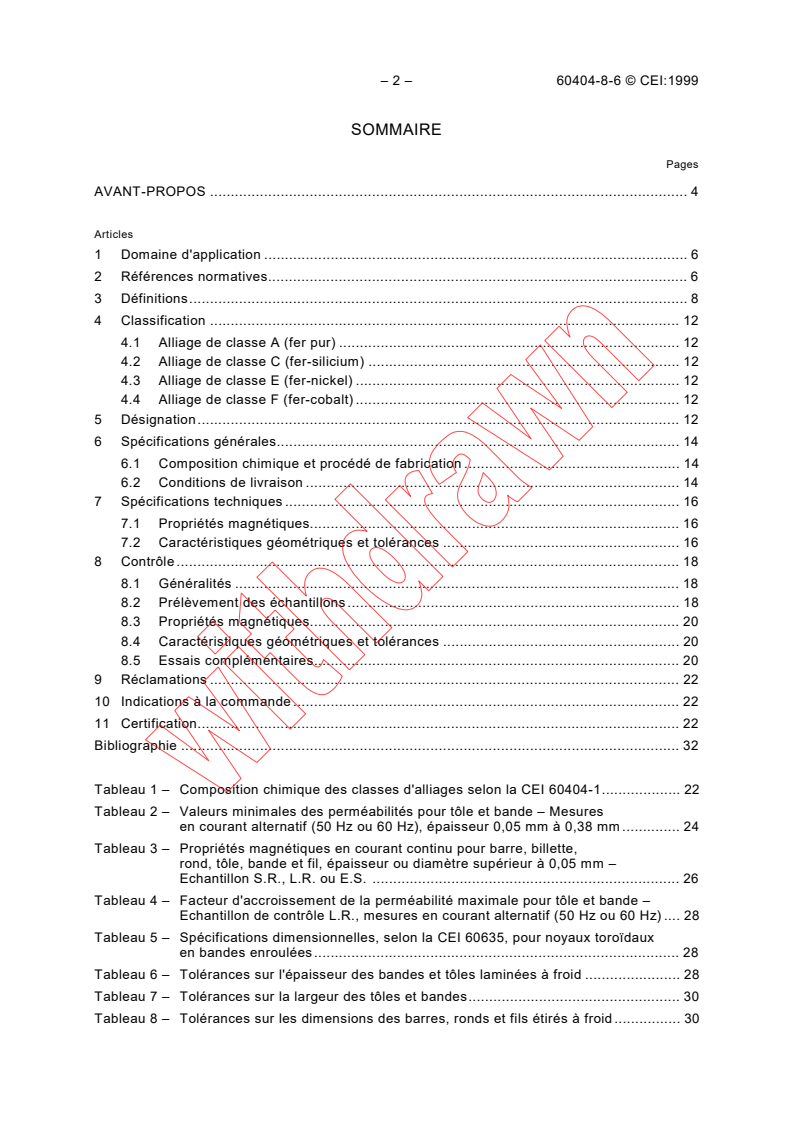
IEC 60404-8-6:1999 - Magnetic materials - Part 8-6: Specifications for individual materials - Soft magnetic metallic materials Released:4/28/1999
IEC 60404-8-6:1999+AMD1:2007 CSV - Magnetic materials - Part 8-6: Specifications for individual materials - Soft magnetic metallic materials Released:6/14/2007
Overview
IEC 60404-8-6:1999 is an international standard developed by the International Electrotechnical Commission (IEC), providing detailed specifications for soft magnetic metallic materials. This standard covers the essential requirements regarding magnetic properties, geometric characteristics, tolerances, and inspection procedures for several types of magnetic alloys, including pure iron, silicon-iron, nickel-iron, and cobalt-iron. The materials specified are supplied in various forms such as bar, billet, sheet, strip, and wire, and are classified according to alloy content and intended application, referring to material classes A, C1, C2, E1 to E4, and F1 to F3 as defined in IEC 60404-1.
IEC 60404-8-6 ensures consistency and quality for manufacturers and users dealing with soft magnetic metallic materials in electrical and electronic engineering.
Key Topics
Scope of Application
The standard specifies general requirements, test methods, and geometric tolerances for soft magnetic metallic materials, focusing on main alloying elements and their classification.Material Types
- Pure Iron (Class A)
- Silicon-Iron (Classes C1, C2)
- Nickel-Iron (Classes E1-E4)
- Cobalt-Iron (Classes F1-F3)
Forms of Supply
The covered materials may be delivered as bars, billets, sheets, strips, or wires, and may be hot-finished, cold-worked, or annealed, depending on requirements.Magnetic Properties
Properties such as permeability and coercivity are measured and classified according to both AC and DC methods, depending on the alloy class and form.Geometric Characteristics and Tolerances
Detailed tolerances on thickness, width, flatness (wave factor), and straightness are specified, ensuring the dimensional quality required for end applications.Inspection, Testing, and Certification
Procedures for sample selection, inspection documentation, and retesting ensure product quality. Certification is available upon request, confirming compliance with all specified criteria.Ordering Information
Purchasers need to specify product nature, material designation, quantity, inspection procedures, tolerances, and any additional specific requirements to ensure correct supply.
Applications
IEC 60404-8-6 supports a broad array of electrical and electromechanical industries by standardizing soft magnetic materials crucial in:
- Electromagnetic Components
Used in manufacturing transformers, inductors, and magnetic cores for a wide frequency range. - Electrical Machines
Employed in motors, generators, and other rotating machines where specific magnetic properties are critical for performance. - Signal Processing Devices
Essential for sensors, relays, actuators, and precision instruments due to controlled magnetic performance. - Power Electronics
Vital in designing efficient power conversion systems, thanks to specified permeability and low coercivity. - Research & Development
Facilitates material comparison, selection, and quality assurance for designers and material scientists.
By adhering to these specifications, manufacturers and end-users achieve higher reliability, interchangeability, and performance consistency in their magnetic devices and systems.
Related Standards
To fully implement or complement IEC 60404-8-6, organizations often refer to related standards, including:
- IEC 60404-1: Classification of magnetic materials
- IEC 60404-2: Measurement methods for magnetic properties
- IEC 60404-4/6/7: DC and AC magnetic property measurement methods for specific alloy families
- IEC 60404-8 Series: Additional parts for specific alloy specifications (e.g., cold-rolled and oriented steel sheets, materials for relays, medium frequency strips)
- IEC 60404-9: Determination of geometrical characteristics
- IEC 60635: Toroidal strip-wound cores
- ISO 404, ISO 10474: General delivery and inspection documentation for steel products
Staying up-to-date with the latest editions of these IEC standards ensures optimal implementation of quality management practices for magnetic material procurement and utilization.
Keywords: IEC 60404-8-6, soft magnetic metallic materials, magnetic properties, geometric tolerances, pure iron, silicon-iron, nickel-iron, cobalt-iron, standards for magnetic materials, IEC standards, magnetic core materials, electrical steel, inspection procedures, material classification
Relations
- Effective Date
- 10-Feb-2026
- Effective Date
- 10-Feb-2026
- Effective Date
- 05-Sep-2023
- Effective Date
- 05-Sep-2023
- Effective Date
- 05-Sep-2023
Buy Documents
IEC 60404-8-6:1999 - Magnetic materials - Part 8-6: Specifications for individual materials - Soft magnetic metallic materials Released:4/28/1999
IEC 60404-8-6:1999+AMD1:2007 CSV - Magnetic materials - Part 8-6: Specifications for individual materials - Soft magnetic metallic materials Released:6/14/2007
Get Certified
Connect with accredited certification bodies for this standard

IMQ S.p.A. (Certification)
Italian electrical product certification.

SLG Prüf- und Zertifizierungs GmbH
German testing and certification body.

UL Solutions
Global safety science company with testing, inspection and certification.
Sponsored listings
Frequently Asked Questions
IEC 60404-8-6:1999 is a standard published by the International Electrotechnical Commission (IEC). Its full title is "Magnetic materials - Part 8-6: Specifications for individual materials - Soft magnetic metallic materials". This standard covers: Specifies the general requirements, magnetic properties, geometric characteristics and tolerances as well as inspection procedures for pure iron, silicon-iron, nickel-iron and cobalt-iron. The materials are in the form of bar, billet, sheet, strip or wire. The alloys covered correspond to those defined by classes A, C1, C2, E1 to E4 and F1 to F3 in IEC 60404-1.
Specifies the general requirements, magnetic properties, geometric characteristics and tolerances as well as inspection procedures for pure iron, silicon-iron, nickel-iron and cobalt-iron. The materials are in the form of bar, billet, sheet, strip or wire. The alloys covered correspond to those defined by classes A, C1, C2, E1 to E4 and F1 to F3 in IEC 60404-1.
IEC 60404-8-6:1999 is classified under the following ICS (International Classification for Standards) categories: 29.030 - Magnetic materials. The ICS classification helps identify the subject area and facilitates finding related standards.
IEC 60404-8-6:1999 has the following relationships with other standards: It is inter standard links to EN 62044-3:2001, EN 60404-6:2003, IEC 60404-8-6:1999/AMD1:2007, IEC 60404-8-6:2016, IEC 60404-8-6:1986. Understanding these relationships helps ensure you are using the most current and applicable version of the standard.
IEC 60404-8-6:1999 is available in PDF format for immediate download after purchase. The document can be added to your cart and obtained through the secure checkout process. Digital delivery ensures instant access to the complete standard document.
Standards Content (Sample)
NORME CEI
INTERNATIONALE IEC
60404-8-6
INTERNATIONAL
Deuxième édition
STANDARD
Second edition
1999-04
Matériaux magnétiques –
Partie 8-6:
Spécifications pour matériaux particuliers –
Matériaux métalliques magnétiquement doux
Magnetic materials –
Part 8-6:
Specifications for individual materials –
Soft magnetic metallic materials
Numéro de référence
Reference number
CEI/IEC 60404-8-6:1999
Numéros des publications Numbering
Depuis le 1er janvier 1997, les publications de la CEI As from 1 January 1997 all IEC publications are
sont numérotées à partir de 60000. issued with a designation in the 60000 series.
Publications consolidées Consolidated publications
Les versions consolidées de certaines publications de Consolidated versions of some IEC publications
la CEI incorporant les amendements sont disponibles. including amendments are available. For example,
Par exemple, les numéros d’édition 1.0, 1.1 et 1.2 edition numbers 1.0, 1.1 and 1.2 refer, respectively, to
indiquent respectivement la publication de base, la the base publication, the base publication incor-
publication de base incorporant l’amendement 1, et la porating amendment 1 and the base publication
publication de base incorporant les amendements 1 incorporating amendments 1 and 2.
et 2.
Validité de la présente publication Validity of this publication
Le contenu technique des publications de la CEI est The technical content of IEC publications is kept
constamment revu par la CEI afin qu'il reflète l'état under constant review by the IEC, thus ensuring that
actuel de la technique. the content reflects current technology.
Des renseignements relatifs à la date de reconfir- Information relating to the date of the reconfirmation
mation de la publication sont disponibles dans le of the publication is available in the IEC catalogue.
Catalogue de la CEI.
Les renseignements relatifs à des questions à l’étude et Information on the subjects under consideration and
des travaux en cours entrepris par le comité technique work in progress undertaken by the technical
qui a établi cette publication, ainsi que la liste des committee which has prepared this publication, as well
publications établies, se trouvent dans les documents ci- as the list of publications issued, is to be found at the
dessous: following IEC sources:
• «Site web» de la CEI* • IEC web site*
• Catalogue des publications de la CEI • Catalogue of IEC publications
Publié annuellement et mis à jour Published yearly with regular updates
régulièrement (On-line catalogue)*
(Catalogue en ligne)*
• IEC Bulletin
• Bulletin de la CEI Available both at the IEC web site* and
Disponible à la fois au «site web» de la CEI* as a printed periodical
et comme périodique imprimé
Terminology, graphical and letter
Terminologie, symboles graphiques
symbols
et littéraux
For general terminology, readers are referred to
En ce qui concerne la terminologie générale, le lecteur IEC 60050: International Electrotechnical Vocabulary
se reportera à la CEI 60050: Vocabulaire Electro- (IEV).
technique International (VEI).
For graphical symbols, and letter symbols and signs
Pour les symboles graphiques, les symboles littéraux approved by the IEC for general use, readers are
et les signes d'usage général approuvés par la CEI, le referred to publications IEC 60027: Letter symbols to
lecteur consultera la CEI 60027: Symboles littéraux à be used in electrical technology, IEC 60417: Graphical
utiliser en électrotechnique, la CEI 60417: Symboles symbols for use on equipment. Index, survey and
graphiques utilisables sur le matériel. Index, relevé et compilation of the single sheets and IEC 60617:
compilation des feuilles individuelles, et la CEI 60617: Graphical symbols for diagrams.
Symboles graphiques pour schémas.
* See web site address on title page.
* Voir adresse «site web» sur la page de titre.
NORME CEI
INTERNATIONALE IEC
60404-8-6
INTERNATIONAL
Deuxième édition
STANDARD
Second edition
1999-04
Matériaux magnétiques –
Partie 8-6:
Spécifications pour matériaux particuliers –
Matériaux métalliques magnétiquement doux
Magnetic materials –
Part 8-6:
Specifications for individual materials –
Soft magnetic metallic materials
IEC 1999 Droits de reproduction réservés Copyright - all rights reserved
Aucune partie de cette publication ne peut être reproduite ni No part of this publication may be reproduced or utilized in
utilisée sous quelque forme que ce soit et par aucun procédé, any form or by any means, electronic or mechanical,
électronique ou mécanique, y compris la photocopie et les including photocopying and microfilm, without permission in
microfilms, sans l'accord écrit de l'éditeur. writing from the publisher.
International Electrotechnical Commission 3, rue de Varembé Geneva, Switzerland
Telefax: +41 22 919 0300 e-mail: inmail@iec.ch IEC web site http://www.iec.ch
CODE PRIX
Commission Electrotechnique Internationale
Q
PRICE CODE
International Electrotechnical Commission
Pour prix, voir catalogue en vigueur
For price, see current catalogue
– 2 – 60404-8-6 © CEI:1999
SOMMAIRE
Pages
AVANT-PROPOS . 4
Articles
1 Domaine d'application.6
2 Références normatives.6
3 Définitions.8
4 Classification.12
4.1 Alliage de classe A (fer pur) . 12
4.2 Alliage de classe C (fer-silicium) . 12
4.3 Alliage de classe E (fer-nickel) . 12
4.4 Alliage de classe F (fer-cobalt) . 12
5 Désignation.12
6 Spécifications générales.14
6.1 Composition chimique et procédé de fabrication . 14
6.2 Conditions de livraison . 14
7 Spécifications techniques.16
7.1 Propriétés magnétiques.16
7.2 Caractéristiques géométriques et tolérances . 16
8 Contrôle.18
8.1 Généralités.18
8.2 Prélèvement des échantillons . 18
8.3 Propriétés magnétiques.20
8.4 Caractéristiques géométriques et tolérances . 20
8.5 Essais complémentaires.20
9 Réclamations.22
10 Indications à la commande . 22
11 Certification.22
Bibliographie.32
Tableau 1 – Composition chimique des classes d'alliages selon la CEI 60404-1. 22
Tableau 2 – Valeurs minimales des perméabilités pour tôle et bande – Mesures
en courant alternatif (50 Hz ou 60 Hz), épaisseur 0,05 mm à 0,38 mm . 24
Tableau 3 – Propriétés magnétiques en courant continu pour barre, billette,
rond, tôle, bande et fil, épaisseur ou diamètre supérieur à 0,05 mm –
Echantillon S.R., L.R. ou E.S. . 26
Tableau 4 – Facteur d'accroissement de la perméabilité maximale pour tôle et bande –
Echantillon de contrôle L.R., mesures en courant alternatif (50 Hz ou 60 Hz) . 28
Tableau 5 – Spécifications dimensionnelles, selon la CEI 60635, pour noyaux toroïdaux
en bandes enroulées. 28
Tableau 6 – Tolérances sur l'épaisseur des bandes et tôles laminées à froid . 28
Tableau 7 – Tolérances sur la largeur des tôles et bandes. 30
Tableau 8 – Tolérances sur les dimensions des barres, ronds et fils étirés à froid . 30
60404-8-6 © IEC:1999 – 3 –
CONTENTS
Page
FOREWORD . 5
Clause
1 Scope.7
2 Normative references.7
3 Definitions.9
4 Classification.13
4.1 Alloy class A (pure iron) . 13
4.2 Alloy class C (silicon-iron) . 13
4.3 Alloy class E (nickel-iron) . 13
4.4 Alloy class F (cobalt-iron) . 13
5 Designation.13
6 General requirements.15
6.1 Chemical composition and production process . 15
6.2 Delivery condition.15
7 Technical requirements.17
7.1 Magnetic properties.17
7.2 Geometric characteristics and tolerances . 17
8 Inspection and testing . 19
8.1 General.19
8.2 Selection of samples . 19
8.3 Magnetic properties.21
8.4 Geometric characteristics and tolerances . 21
8.5 Retests.21
9 Complaints.23
10 Ordering information.23
11 Certification.23
Bibliography.33
Table 1 – Chemical composition of the alloy classes in accordance with IEC 60404-1. 23
Table 2 – Minimum permeability requirements for sheet and strip – AC measurement
(50 Hz or 60 Hz), thickness 0,05 mm to 0,38 mm . 25
Table 3 – DC magnetic property requirements for bar, billet, rod, sheet, strip and wire,
thickness or diameter greater than 0,05 mm – S.R., L.R. or E.S. specimen . 27
Table 4 – Maximum permeability rise factor for sheet and strip – L.R. test specimen,
a.c. measurement (50 Hz or 60 Hz) . 29
Table 5 – Dimensional requirements for toroidal strip-wound cores
according to IEC 60635 . 29
Table 6 – Tolerances on thickness of cold-rolled sheet and strip . 29
Table 7 – Tolerances on width of sheet and strip. 31
Table 8 – Tolerances on dimensions of cold-worked bar, rod and wire. 31
– 4 – 60404-8-6 © CEI:1999
COMMISSION ÉLECTROTECHNIQUE INTERNATIONALE
____________
MATÉRIAUX MAGNÉTIQUES –
Partie 8-6: Spécifications pour matériaux particuliers –
Matériaux métalliques magnétiquement doux
AVANT-PROPOS
1) La CEI (Commission Electrotechnique Internationale) est une organisation mondiale de normalisation composée
de l'ensemble des comités électrotechniques nationaux (Comités nationaux de la CEI). La CEI a pour objet de
favoriser la coopération internationale pour toutes les questions de normalisation dans les domaines de
l'électricité et de l'électronique. A cet effet, la CEI, entre autres activités, publie des Normes internationales.
Leur élaboration est confiée à des comités d'études, aux travaux desquels tout Comité national intéressé par le
sujet traité peut participer. Les organisations internationales, gouvernementales et non gouvernementales, en
liaison avec la CEI, participent également aux travaux. La CEI collabore étroitement avec l'Organisation
Internationale de Normalisation (ISO), selon des conditions fixées par accord entre les deux organisations.
2) Les décisions ou accords officiels de la CEI concernant les questions techniques représentent, dans la mesure
du possible un accord international sur les sujets étudiés, étant donné que les Comités nationaux intéressés
sont représentés dans chaque comité d’études.
3) Les documents produits se présentent sous la forme de recommandations internationales. Ils sont publiés
comme normes, rapports techniques ou guides et agréés comme tels par les Comités nationaux.
4) Dans le but d'encourager l'unification internationale, les Comités nationaux de la CEI s'engagent à appliquer de
façon transparente, dans toute la mesure possible, les Normes internationales de la CEI dans leurs normes
nationales et régionales. Toute divergence entre la norme de la CEI et la norme nationale ou régionale
correspondante doit être indiquée en termes clairs dans cette dernière.
5) La CEI n’a fixé aucune procédure concernant le marquage comme indication d’approbation et sa responsabilité
n’est pas engagée quand un matériel est déclaré conforme à l’une de ses normes.
6) L’attention est attirée sur le fait que certains des éléments de la présente Norme internationale peuvent faire
l’objet de droits de propriété intellectuelle ou de droits analogues. La CEI ne saurait être tenue pour
responsable de ne pas avoir identifié de tels droits de propriété et de ne pas avoir signalé leur existence.
La Norme internationale CEI 60404-8-6 a été établie par le comité d'études 68 de la CEI:
Matériaux magnétiques tels qu'alliages et aciers.
Cette deuxième édition annule et remplace la première édition parue en 1986 et
l'amendement 1 (1992). Cette deuxième édition constitue une révision technique.
Le texte de cette norme est issu des documents suivants:
FDIS Rapport de vote
68/197/FDIS 68/200/RVD
Le rapport de vote indiqué dans le tableau ci-dessus donne toute information sur le vote ayant
abouti à l'approbation de cette norme.
60404-8-6 © IEC:1999 – 5 –
INTERNATIONAL ELECTROTECHNICAL COMMISSION
___________
MAGNETIC MATERIALS –
Part 8-6: Specifications for individual materials –
Soft magnetic metallic materials
FOREWORD
1) The IEC (International Electrotechnical Commission) is a worldwide organization for standardization comprising
all national electrotechnical committees (IEC National Committees). The object of the IEC is to promote
international co-operation on all questions concerning standardization in the electrical and electronic fields. To
this end and in addition to other activities, the IEC publishes International Standards. Their preparation is
entrusted to technical committees; any IEC National Committee interested in the subject dealt with may
participate in this preparatory work. International, governmental and non-governmental organizations liaising
with the IEC also participate in this preparation. The IEC collaborates closely with the International Organization
for Standardization (ISO) in accordance with conditions determined by agreement between the two
organizations.
2) The formal decisions or agreements of the IEC on technical matters express, as nearly as possible, an
international consensus of opinion on the relevant subjects since each technical committee has representation
from all interested National Committees.
3) The documents produced have the form of recommendations for international use and are published in the form
of standards, technical reports or guides and they are accepted by the National Committees in that sense.
4) In order to promote international unification, IEC National Committees undertake to apply IEC International
Standards transparently to the maximum extent possible in their national and regional standards. Any
divergence between the IEC Standard and the corresponding national or regional standard shall be clearly
indicated in the latter.
5) The IEC provides no marking procedure to indicate its approval and cannot be rendered responsible for any
equipment declared to be in conformity with one of its standards.
6) Attention is drawn to the possibility that some of the elements of this International Standard may be the subject
of patent rights. The IEC shall not be held responsible for identifying any or all such patent rights.
International Standard IEC 60404-8-6 has been prepared by IEC technical committee 68:
Magnetic alloys and steels.
This second edition cancels and replaces the first edition, published in 1986 and amendment 1
(1992). This second edition constitutes a technical revision.
The text of this standard is based on the following documents:
FDIS Report on voting
68/197/FDIS 68/200/RVD
Full information on the voting for the approval of this standard can be found in the report on
voting indicated in the above table.
– 6 – 60404-8-6 © CEI:1999
MATÉRIAUX MAGNÉTIQUES –
Partie 8-6: Spécifications pour matériaux particuliers –
Matériaux métalliques magnétiquement doux
1 Domaine d'application
La présente partie de la CEI 60404 spécifie les exigences générales, les propriétés
magnétiques, les caractéristiques géométriques et leurs tolérances, ainsi que les modes de
contrôle pour le fer pur, le fer-silicium, le fer-nickel et le fer-cobalt. Les produits sont sous
forme de barres, billettes, tôles, bandes ou fils. Les alliages concernés correspondent à ceux
définis par les classes A, C1, C2, E1 à E4 et F1 à F3 de la CEI 60404-1.
Les matériaux magnétiques employés principalement pour relais, fer pur et aciers, classés
seulement d'après leur coercivité, sont couverts par la CEI 60404-8-10. La CEI 60404-8-10 est
moins restrictive en termes de propriétés magnétiques que cela est spécifié dans la présente
norme pour le matériau en fer pur (classe A) et les alliages fer-silicium (classes C21 et C22),
mais elle donne une meilleure interprétation des tolérances dimensionnelles.
Les aciers au silicium non orientés ou à grains orientés (C21 et C22), pour applications à
fréquence industrielle, classés d'après leurs pertes spécifiques totales, sont traités dans la
CEI 60404-8-2, la CEI 60404-8-4 et la CEI 60404-8-7.
Les matériaux magnétiques en bandes minces, non orientés ou orientés, pour emploi aux
fréquences moyennes, classés d'après leurs pertes spécifiques totales, sont couverts par la
CEI 60404-8-8.
2 Références normatives
Les documents normatifs suivants contiennent des dispositions qui, par suite de la référence
qui y est faite, constituent des dispositions valables pour la présente partie de la CEI 60404.
Pour les références datées, les amendements ultérieurs ou les révisions de ces publications ne
s’appliquent pas. Toutefois, les parties prenantes aux accords fondés sur la présente partie de
la CEI 60404 sont invitées à rechercher la possibilité d'appliquer les éditions les plus récentes
des documents normatifs indiqués ci-après. Pour les références non datées, la dernière édition
du document normatif en référence s’applique. Les membres de la CEI et de l'ISO possèdent
le registre des Normes internationales en vigueur.
CEI 60050(121):1978, Vocabulaire Electrotechnique International (VEI) – Chapitre 121:
Electromagnétisme
CEI 60050(131):1978, Vocabulaire Electrotechnique International (VEI) – Chapitre 131: Circuits
électriques et magnétiques
CEI 60050(221):1990, Vocabulaire Electrotechnique International (VEI) – Chapitre 221:
Matériaux et composants magnétiques
CEI 60404-1:1979, Matériaux magnétiques – Partie 1: Classification
CEI 60404-2:1996, Matériaux magnétiques – Partie 2: Méthodes de mesure des propriétés
magnétiques des tôles et bandes magnétiques au moyen d'un cadre Epstein
60404-8-6 © IEC:1999 – 7 –
MAGNETIC MATERIALS –
Part 8-6: Specifications for individual materials –
Soft magnetic metallic materials
1 Scope
This part of IEC 60404 specifies the general requirements, magnetic properties, geometric
characteristics and tolerances as well as inspection procedures for pure iron, silicon-iron,
nickel-iron and cobalt-iron. The materials are in the form of bar, billet, sheet, strip or wire. The
alloys covered correspond to those defined by classes A, C1, C2, E1 to E4 and F1 to F3 in
IEC 60404-1.
Magnetic materials used primarily for relays, pure iron and steel products, classified only by
coercivity, are covered in IEC 60404-8-10. IEC 60404-8-10 is less restrictive in terms of
magnetic properties than the pure iron material (class A) and the silicon-iron alloys (classes
C21 and C22) specified in this standard, but it gives more comprehensive dimensional
tolerances.
Non-oriented and oriented silicon steels (C21 and C22) for industrial power frequency
applications, classified by specific total loss, are covered in IEC 60404-8-2, IEC 60404-8-4 and
IEC 60404-8-7.
Non-oriented and oriented thin magnetic materials for use at medium frequencies, classified by
specific total loss, are covered in IEC 60404-8-8.
2 Normative references
The following normative documents contain provisions which, through reference in this text,
constitute provisions of this part of IEC 60404. For dated references, subsequent amendments
to, or revisions of, any of these publications do not apply. However, parties to agreements
based on this part of IEC 60404 are encouraged to investigate the possibility of applying the
most recent editions of the normative documents indicated below. For undated references, the
latest edition of the normative document referred to applies. Members of IEC and ISO maintain
registers of currently valid International Standards.
IEC 60050(121):1978, International Electrotechnical Vocabulary (IEV) – Chapter 121: Electro-
magnetism
IEC 60050(131):1978, International Electrotechnical Vocabulary (IEV) – Chapter 131: Electric
and magnetic circuits
IEC 60050(221):1990, International Electrotechnical Vocabulary (IEV) – Chapter 221: Magnetic
materials and components
IEC 60404-1:1979, Magnetic materials – Part 1: Classification
IEC 60404-2:1996, Magnetic materials – Part 2: Methods of measurement of the magnetic
properties of electrical steel sheet and strip by means of an Epstein frame
– 8 – 60404-8-6 © CEI:1999
CEI 60404-4:1995, Matériaux magnétiques – Partie 4: Méthodes de mesure en courant continu
des propriétés magnétiques du fer et de l'acier
CEI 60404-6:1986, Matériaux magnétiques – Partie 6: Méthodes de mesure des propriétés
magnétiques des alliages magnétiques doux fer-nickel isotropes, types E1, E3 et E4
CEI 60404-7:1982, Matériaux magnétiques – Partie 7: Méthode de mesure du champ coercitif
des matériaux magnétiques en circuit magnétique ouvert
CEI 60404-8-2:1998, Matériaux magnétiques – Partie 8-2: Spécifications pour matériaux
particuliers – Tôles magnétiques en acier allié, laminées à froid et livrées à l'état semi-fini
CEI 60404-8-4:1998, Matériaux magnétiques – Partie 8-4: Spécifications pour matériaux
particuliers – Tôles magnétiques en acier à grains non orientés, laminées à froid et livrées à
l'état fini
CEI 60404-8-7:1998, Matériaux magnétiques – Partie 8-7: Spécifications pour matériaux
particuliers – Tôles magnétiques en acier à grains orientés, laminées à froid et livrées à l'état
fini
CEI 60404-8-8:1991, Matériaux magnétiques – Partie 8: Spécifications pour matériaux
particuliers – Section 8: Spécification des tôles magnétiques extra-minces en acier pour
utilisation à moyennes fréquences
CEI 60404-8-10:1994, Matériaux magnétiques – Partie 8: Spécifications pour matériaux
particuliers – Section 10: Spécification des matériaux magnétiques (fer et acier) pour relais
CEI 60404-9:1987, Matériaux magnétiques – Partie 9: Méthodes de détermination des
caractéristiques géométriques des tôles magnétiques en acier
CEI 60635:1978, Noyaux toroïdaux en feuillard bobiné en matériau magnétique doux
ISO 404:1992, Aciers et produits sidérurgiques – Conditions techniques générales de livraison
ISO 10474:1991, Aciers et produits sidérurgiques – Documents de réception
3 Définitions
Pour les besoins de la présente partie de la CEI 60404, les définitions des termes principaux
relatifs aux propriétés magnétiques et aux circuits électriques et magnétiques donnés dans la
CEI 60050(121), la CEI 60050(131) et la CEI 60050(221), ainsi que les définitions suivantes,
s'appliquent.
3.1
vieillissement
variation du champ coercitif, exprimée en pourcentage, résultant d'un traitement thermique
3.2
barre
produit massif, de section uniforme, livré en longueurs droites. La section peut être ronde,
carrée, rectangulaire ou celle d'un polygone régulier.
plat: barre de section rectangulaire, laminée sur ses quatre faces, dont l'épaisseur est
généralement égale ou supérieure à 5 mm, et dont la largeur ne dépasse par 150 mm.
rond: barre de section circulaire dont le diamètre est généralement égal ou supérieur à 8 mm
60404-8-6 © IEC:1999 – 9 –
IEC 60404-4:1995, Magnetic materials – Part 4: Methods of measurement of d.c. magnetic
properties of iron and steel
IEC 60404-6:1986, Magnetic materials – Part 6: Methods of measurement of the magnetic
properties of isotropic nickel-iron soft magnetic alloys, types E1, E3 and E4
IEC 60404-7:1982, Magnetic materials – Part 7: Method of measurement of the coercivity of
magnetic materials in an open magnetic circuit
IEC 60404-8-2:1998, Magnetic materials – Part 8-2: Specifications for individual materials –
Cold-rolled electrical alloyed steel sheet and strip delivered in the semi-processed state
IEC 60404-8-4:1998, Magnetic materials – Part 8-4: Specifications for individual materials –
Cold-rolled non-oriented electrical steel sheet and strip delivered in the fully-processed state
IEC 60404-8-7:1998, Magnetic materials – Part 8-7: Specifications for individual materials –
Cold-rolled grain-oriented electrical steel sheet and strip delivered in the fully-processed state
IEC 60404-8-8:1991, Magnetic materials – Part 8: Specifications for individual materials –
Section 8: Specification for thin magnetic steel strip for use at medium frequencies
IEC 60404-8-10:1994, Magnetic materials – Part 8: Specifications for individual materials –
Section 10: Specification for magnetic materials (iron and steel) for use in relays
IEC 60404-9:1987, Magnetic materials – Part 9: Methods of determination of the geometrical
characteristics of magnetic steel sheet and strip
IEC 60635:1978, Toroidal strip-wound cores made of magnetically soft material
ISO 404:1992, Steel and steel products – General technical delivery requirements
ISO 10474:1991, Steel and steel products – Inspection documents
3 Definitions
For the purpose of this part of IEC 60404, the definitions of the principal terms relative
to magnetic properties and to electric and magnetic circuits given in IEC 60050(121),
IEC 60050(131) and IEC 60050(221) apply, as well as the following definitions.
3.1
ageing
change of coercivity, expressed as a percentage, resulting from heat treatment
3.2
bar
solid product of uniform cross-section supplied in straight lengths. The cross-section may be
round, square, rectangular or regular polygonal.
flat: A bar of rectangular cross-section, rolled on the four faces, whose thickness is generally
5 mm or greater and whose width is not greater than 150 mm
round: A bar of circular cross-section whose diameter is generally 8 mm or greater
– 10 – 60404-8-6 © CEI:1999
3.3
billette
produit massif de section uniforme, carrée, ronde ou rectangulaire, dont la largeur est
inférieure au double de l'épaisseur
3.4
rectitude
la rectitude est caractérisée par la plus grande distance entre une rive d'une tôle et la ligne
joignant les deux extrémités de la longueur mesurée de cette rive (voir CEI 60404-9)
3.5
planéité (facteur d'ondulation)
la planéité d'une tôle est caractérisée par le facteur d'ondulation, qui est le rapport de la
hauteur de l'ondulation à sa longueur (voir CEI 60404-9)
3.6
coulée
produit de fusion, dans un ou plusieurs fours, mélangé avant d'être coulé
3.7
lot
matériaux de la même coulée, de la même forme, produits en même temps et éventuellement
recuits, simultanément ou séquentiellement, dans un four continu
3.8
rond
produit étiré à froid, de section uniforme, rectangulaire ou ronde, livré en longueurs droites
3.9
tôle et plaque
produit plat laminé, de section uniforme, livré en bobines ou coupé à longueur. La largeur est
supérieure à 600 mm; les tôles ont une épaisseur inférieure à 5 mm et les plaques une
épaisseur supérieure à 5 mm
3.10
rectitude des produits longs
plus grande distance entre la barre et la ligne joignant les deux extrémités de la barre
3.11
bande
produit plat laminé, de section uniforme, livré en bobines ou coupé à longueur. La largeur est
inférieure à 600 mm et l'épaisseur inférieure à 5 mm
3.12
fil
produit laminé ou tréfilé, de section uniforme, ronde ou rectangulaire, livré en bobines
3.13 Abréviations pour les échantillons de contrôle
type E.S.: échantillon allongé pour contrôle de pièces, de section circulaire, rectangulaire ou
polygonale, avec un rapport longueur sur diamètre d'au moins 5/1, suivant la CEI 60404-7.
type L.R.: noyaux feuilletés de rondelles découpées mécaniquement ou chimiquement (pour un
anneau de tête magnétique, on peut utiliser un noyau de diamètre extérieur de 10 mm et de
diamètre intérieur de 6 mm).
60404-8-6 © IEC:1999 – 11 –
3.3
billet
solid product of uniform cross-section, which may be square, round or rectangular, with a width
less than twice the thickness
3.4
edge camber
the edge camber is characterized by the greatest distance between an edge of the sheet and
the line joining the two extremities of the measured length of this edge (see IEC 60404-9)
3.5
flatness (wave factor)
the flatness of a sheet is characterized by the wave factor, which is the relation of the height of
the wave to its length (see IEC 60404-9)
3.6
heat
product of a furnace melt or of a number of melts that are mixed prior to casting
3.7
lot
material from the same heat, of the same form, produced at the same time and, if annealed,
heat-treated together or sequentially in a continuous furnace
3.8
rod
cold-drawn product of uniform rectangular or round cross-section, supplied in straight lengths
3.9
sheet and plate
flat-rolled product of uniform cross-section, supplied in coils or cut lengths. The width is over
600 mm; sheets have a thickness under 5 mm and plates have a thickness over 5 mm
3.10
straightness of long products
straightness is characterized by the greatest distance between the bar and the line joining the
two ends of the bar
3.11
strip
flat-rolled product of uniform cross-section, supplied in coils or cut lengths. The width is under
600 mm and the thickness under 5 mm
3.12
wire
rolled or drawn product of uniform round or rectangular cross-section, supplied in coils
3.13 Abbreviations for test specimens
Type E.S.: Elongated specimen for test samples, of circular, rectangular or polygonal cross-
section, with a length to diameter ratio of at least 5/1, according to IEC 60404-7.
Type L.R.: Laminated cores of stamped or etched rings (for magnetic head ring, a core with
10 mm outside diameter and 6 mm inside diameter can be used).
– 12 – 60404-8-6 © CEI:1999
type S.R.: anneaux massifs ou cadres, mis en forme ou usinés à partir d'un matériau massif.
Le diamètre extérieur de l'anneau doit mesurer entre 30 mm et 50 mm, et le rapport diamètre
extérieur sur diamètre intérieur devra valoir de 1,2 à 1,4.
NOTE – Les types L.R. et S.R. sont applicables seulement aux matériaux approximativement isotropes.
type S.W.: noyaux enroulés tels que définis dans la CEI 60635. Pour les restrictions
dimensionnelles voir le tableau 5. Les diamètres extérieurs des tores de contrôle doivent
mesurer entre 30 mm et 80 mm.
4 Classification
Les matériaux couverts par la présente norme sont classés suivant l'élément d'alliage principal
et la teneur de cet élément. La sous-classification tient compte des différents emplois des
alliages.
4.1 Alliage de classe A (fer pur)
Ce matériau est classé d'après la valeur maximale de son champ coercitif.
4.2 Alliage de classe C (fer-silicium)
L'alliage C1, avec 0 % à 5 % en poids de silicium, est classé d'après la valeur maximale de son
champ coercitif.
Les alliages C2, avec 0,4 % à 5 % en poids de silicium, sont classés d'après la forme du cycle
d'hystérésis et la perméabilité minimale dans une mesure en alternatif sur un échantillon
de type L.R. tiré d'un matériau de 0,35 mm d'épaisseur, le point de mesure étant pour
�
H = 1,6 A/m.
4.3 Alliage de classe E (fer-nickel)
Ces alliages sont classés d'après la forme du cycle d'hystérésis et la perméabilité minimale
dans une mesure en alternatif sur un échantillon de type S.W. tiré d'un matériau de 0,10 mm
�
d'épaisseur, le point de mesure étant pour H = 0,4 A/m, excepté pour l'alliage de classe E41
�
où le point de mesure est pour H = 1,6 A/m.
4.4 Alliage de classe F (fer-cobalt)
Ces alliages sont classés d'après la forme du cycle d'hystérésis et la valeur maximale du
champ coercitif.
5 Désignation
La désignation conventionnelle des matériaux comprend ce qui suit dans l'ordre donné:
a) la lettre désignant la classe d'alliage: A, C, E ou F (voir tableau 1);
b) le nombre correspondant à la teneur en élément d'alliage principal (voir tableau 1);
c) pour les classes d'alliage C, E et F, le nombre 1 ou 2 indiquant la forme du cycle
d'hystérésis:
1 = arrondi (non orienté),
2 = rectangulaire (orienté par texture ou par traitement thermomagnétique);
d) un tiret;
60404-8-6 © IEC:1999 – 13 –
Type S.R.: Solid rings or square frames, formed or machined from solid material. The outside
diameter of the ring shall be between 30 mm and 50 mm, with an outside/inside diameter ratio
from 1,2 to 1,4.
NOTE – Types L.R. and S.R. are only applicable to essentially isotropic materials.
Type S.W.: Strip-wound cores as defined by IEC 60635. For dimensional restrictions, see
table 5. The outside diameters of test cores are between 30 mm and 80 mm.
4 Classification
The materials covered by this standard are classified according to the main alloying element
and the content of this element. The subclassification takes into account the different uses of
the alloys.
4.1 Alloy class A (pure iron)
This material is classified according to the maximum value of coercivity.
4.2 Alloy class C (silicon-iron)
Alloy C1, with 0 % to 5 % weight of silicon, is classified according to the maximum value of
coercivity.
Alloys C2, with 0,4 % to 5 % weight of silicon, are classified according to the shape of the
hysteresis loop and the minimum permeability in an a.c. measurement with a L.R. specimen
�
made of material with a thickness of 0,35 mm; the measuring point is H = 1,6 A/m.
4.3 Alloy class E (nickel-iron)
These alloys are classified according to the shape of the hysteresis loop and the minimum
permeability in an a.c. measurement with a S.W. specimen made of material with a thickness
�
of 0,10 mm; the measuring point is H = 0,4 A/m, except for the alloy class E41, where the
�
measuring point is H = 1,6 A/m.
4.4 Alloy class F (cobalt-iron)
These alloys are classified according to the shape of the hysteresis loop and to the maximum
value of coercivity.
5 Designation
The conventional designation of the materials comprises the following in the order given:
a) the letter for the alloy class: A, C, E or F (see table 1);
b) the number according to the content of the main alloying element (see table 1);
c) for alloy classes C, E and F, the number 1 or 2 according to the shape of the hysteresis
loop:
1 = round (non-oriented)
2 = rectangular (oriented by texture or by thermomagnetic treatment);
d) a dash;
– 14 – 60404-8-6 © CEI:1999
e) suivant la classe d'alliage, soit la valeur maximale du champ coercitif en ampères par
mètre, soit la valeur minimale de la perméabilité divisée par 1 000 pour une valeur de crête
�
donnée du champ magnétique ( H = 0,4 A/m ou 1,6 A/m) et une épaisseur donnée,
mesurée sur un certain échantillon de contrôle (voir ci-dessus à la rubrique classification).
Exemple:
E 31-10: alliage fer-nickel avec 45 % à 50 % en poids de nickel, cycle d'hystérésis rond et
perméabilité minimale de 10 000 pour un noyau enroulé fait avec une tôle de 0,10 mm
d'épaisseur.
6 Spécifications générales
6.1 Composition chimique et procédé de fabrication
La composition type de chaque classe de matériaux couverts par la présente norme est
donnée au tableau 1.
La composition réelle et le procédé de fabrication sont laissés à la discrétion du producteur, à
moins qu'il n'y ait eu accord entre l'acheteur et le producteur, et spécification dans la
commande.
6.2 Conditions de livraison
Les produits couverts par la présente norme peuvent être livrés transformés à chaud, écrouis
ou recuits. Les conditions de livraison souhaitées doivent être spécifiées dans la commande.
6.2.1 Forme de livraison
Les bobines doivent être de largeur constante et enroulées de telle sorte que les rives se
superposent d'une façon régulière et que les faces latérales des bobines soient
approximativement plates. Les bobines doivent être enroulées suffisamment serrées pour
qu'elles ne se déforment pas sous leur propre poids.
Les bobines peuvent occasionnellement comporter des soudures ou des raboutages résultant
de l'élimination de zones défectueuses, sous réserve d'un accord préalable entre les parties.
La surépaisseur due à la soudure est soumise à un accord particulier. Si nécessaire, le
marquage des soudures ou des raboutages pourra faire l'objet d'un accord particulier. Pour les
bobines comportant des soudures ou des raboutages, chaque partie de la bande doit être d'un
matériau de même qualité.
Les rives des parties soudées ensemble doivent être suffisamment bien alignées pour ne pas
gêner la transformation ultérieure du matériau.
La masse des bobines doit faire l'objet d'un accord au moment de la commande.
6.2.2 Etat de surface
La surface des tôles et des bandes doit être uniforme, propre, exempte de graisse et de rouille.
Des imperfections isolées telles que rayures, cloques, etc. peuvent être tolérées si l'épaisseur
reste à l'intérieur des tolérances et si la fabrication ou les performances du produit final n'en
sont pas affectées.
La nature de l'état de surface dépendra du traitement final. Pour les produits laminés à chaud,
le matériau est recouvert de calamine.
60404-8-6 © IEC:1999 – 15 –
e) depending on the alloy class, either the maximum value for the coercivity in amperes per
metre or the peak value of the minimum permeability divided by 1 000 for a given magnetic
�
field strength ( H = 0,4 A/m or 1,6 A/m) and a given thickness measured with a certain test
specimen (see above under classification).
Example:
E31-10: nickel-iron with 45 % to 50 % weight of nickel, a round hysteresis loop, and a minimum
permeability of 10 000 for a strip-wound core made of a sheet with a thickness of 0,10 mm.
6 General requirements
6.1 Chemical composition and production process
The typical composition of each of the material classes covered by this standard is given in
table 1.
The actual composition and production process are left to the discretion of the manufacturer,
unless otherwise agreed between the manufacturer and purchaser, and specified in the order.
6.2 Delivery condition
The materials covered by this standard may be delivered in the hot-finished, cold-worked or
annealed condition. The condition required shall be specified in the order.
6.2.1 Form of supply
Coils shall be of constant width and wound in such a manner that the edges are superimposed
in a regular manner and the side faces of the coil are substantially flat. Coils shall be
sufficiently tightly wound that they do not collapse under their own weight.
Coils can occasionally present welds or interleaves resulting from the removal of defective
zones, subject to prior agreement between the parties. The value of the additional thickness
due to the weld is subject to special agreement. If necessary, the marking of welds or
interleaves may form the subject of a special agreement. For coils containing repair welds or
interleaves, each part of the strip shall be of the same quality material.
The edges of parts welded together shall not be so much out of alignment as to affect the
further processing of the material.
The mass of coils shall be agreed upon at the time of ordering.
6.2.2 Surface condition
The surface condition of sheets or strips shall be uniform, clean, and free from grease and
rust.
Isolated imperfections such as scratches, blisters, etc. may be tolerated if the thickness
remains within the tolerance limits and the manufacture or performance of the final product is
not affected.
The nature of the surface condition will depend on the final treatment. For material in the hot-
rolled condition, the material exhibits a hot mill scale.
– 16 – 60404-8-6 © CEI:1999
7 Spécifications techniques
7.1 Propriétés magnétiques
Sauf spécification contraire dans la commande, les propriétés magnétiques doivent être
déterminées pour chaque lot de produit sur un échantillon représentatif pris dans le lot et recuit
suivant les recommandations du fabricant ou selon les spécifications du client.
Les mesures d'acceptation des tôles ou bandes doivent être pratiquées, en cou
...
IEC 60404-8-6
Edition 2.1 2007-06
INTERNATIONAL
STANDARD
NORME
INTERNATIONALE
Magnetic materials –
Part 8-6: Specifications for individual materials – Soft magnetic metallic
materials
Matériaux magnétiques –
Partie 8-6: Spécifications pour matériaux particuliers – Matériaux métalliques
magnétiquement doux
All rights reserved. Unless otherwise specified, no part of this publication may be reproduced or utilized in any form or by
any means, electronic or mechanical, including photocopying and microfilm, without permission in writing from either IEC or
IEC's member National Committee in the country of the requester.
If you have any questions about IEC copyright or have an enquiry about obtaining additional rights to this publication,
please contact the address below or your local IEC member National Committee for further information.
Droits de reproduction réservés. Sauf indication contraire, aucune partie de cette publication ne peut être reproduite
ni utilisée sous quelque forme que ce soit et par aucun procédé, électronique ou mécanique, y compris la photocopie
et les microfilms, sans l'accord écrit de la CEI ou du Comité national de la CEI du pays du demandeur.
Si vous avez des questions sur le copyright de la CEI ou si vous désirez obtenir des droits supplémentaires sur cette
publication, utilisez les coordonnées ci-après ou contactez le Comité national de la CEI de votre pays de résidence.
IEC Central Office
3, rue de Varembé
CH-1211 Geneva 20
Switzerland
Email: inmail@iec.ch
Web: www.iec.ch
About the IEC
The International Electrotechnical Commission (IEC) is the leading global organization that prepares and publishes
International Standards for all electrical, electronic and related technologies.
About IEC publications
The technical content of IEC publications is kept under constant review by the IEC. Please make sure that you have the
latest edition, a corrigenda or an amendment might have been published.
ƒ Catalogue of IEC publications: www.iec.ch/searchpub
The IEC on-line Catalogue enables you to search by a variety of criteria (reference number, text, technical committee,…).
It also gives information on projects, withdrawn and replaced publications.
ƒ IEC Just Published: www.iec.ch/online_news/justpub
Stay up to date on all new IEC publications. Just Published details twice a month all new publications released. Available
on-line and also by email.
ƒ Electropedia: www.electropedia.org
The world's leading online dictionary of electronic and electrical terms containing more than 20 000 terms and definitions
in English and French, with equivalent terms in additional languages. Also known as the International Electrotechnical
Vocabulary online.
ƒ Customer Service Centre: www.iec.ch/webstore/custserv
If you wish to give us your feedback on this publication or need further assistance, please visit the Customer Service
Centre FAQ or contact us:
Email: csc@iec.ch
Tel.: +41 22 919 02 11
Fax: +41 22 919 03 00
A propos de la CEI
La Commission Electrotechnique Internationale (CEI) est la première organisation mondiale qui élabore et publie des
normes internationales pour tout ce qui a trait à l'électricité, à l'électronique et aux technologies apparentées.
A propos des publications CEI
Le contenu technique des publications de la CEI est constamment revu. Veuillez vous assurer que vous possédez
l’édition la plus récente, un corrigendum ou amendement peut avoir été publié.
ƒ Catalogue des publications de la CEI: www.iec.ch/searchpub/cur_fut-f.htm
Le Catalogue en-ligne de la CEI vous permet d’effectuer des recherches en utilisant différents critères (numéro de référence,
texte, comité d’études,…). Il donne aussi des informations sur les projets et les publications retirées ou remplacées.
ƒ Just Published CEI: www.iec.ch/online_news/justpub
Restez informé sur les nouvelles publications de la CEI. Just Published détaille deux fois par mois les nouvelles
publications parues. Disponible en-ligne et aussi par email.
ƒ Electropedia: www.electropedia.org
Le premier dictionnaire en ligne au monde de termes électroniques et électriques. Il contient plus de 20 000 termes et
définitions en anglais et en français, ainsi que les termes équivalents dans les langues additionnelles. Egalement appelé
Vocabulaire Electrotechnique International en ligne.
ƒ Service Clients: www.iec.ch/webstore/custserv/custserv_entry-f.htm
Si vous désirez nous donner des commentaires sur cette publication ou si vous avez des questions, visitez le FAQ du
Service clients ou contactez-nous:
Email: csc@iec.ch
Tél.: +41 22 919 02 11
Fax: +41 22 919 03 00
IEC 60404-8-6
Edition 2.1 2007-06
INTERNATIONAL
STANDARD
NORME
INTERNATIONALE
Magnetic materials –
Part 8-6: Specifications for individual materials – Soft magnetic metallic
materials
Matériaux magnétiques –
Partie 8-6: Spécifications pour matériaux particuliers – Matériaux métalliques
magnétiquement doux
INTERNATIONAL
ELECTROTECHNICAL
COMMISSION
COMMISSION
ELECTROTECHNIQUE
PRICE CODE
INTERNATIONALE
CG
CODE PRIX
ICS 29.030 ISBN 2-8318-9167-1
– 2 – 60404-8-6 © IEC:1999+A1:2007
CONTENTS
FOREWORD.3
1 Scope.4
2 Normative references.4
3 Definitions .5
4 Classification .7
4.1 Alloy class A (pure iron).7
4.2 Alloy class C (silicon-iron).7
4.3 Alloy class E (nickel-iron).7
4.4 Alloy class F (cobalt-iron) .7
5 Designation .7
6 General requirements .8
6.1 Chemical composition and production process .8
6.2 Delivery condition .8
7 Technical requirements.8
7.1 Magnetic properties .8
7.2 Geometric characteristics and tolerances.9
8 Inspection and testing.9
8.1 General .9
8.2 Selection of samples.10
8.3 Magnetic properties .10
8.4 Geometric characteristics and tolerances.11
8.5 Retests.11
9 Complaints .11
10 Ordering information .12
11 Certification .12
Bibliography .18
Table 1 – Chemical composition of the alloy classes in accordance with IEC 60404-1 .12
Table 2 – Minimum permeability requirements .13
Table 2a – Minimum amplitude permeability requirements for sheet and strip –
AC measurement (50 Hz or 60 Hz), sine flux conditions, thickness 0,05 mm to 0,38 mm.13
Table 2b – Minimum serial inductance permeability requirements for sheet and strip –
AC measurement (0,3 kHz, 1 kHz, 3 kHz, 10 kHz and 30 kHz),
thickness 0,025 mm to 0,35 mm .14
Table 3 – DC magnetic property requirements for bar, billet, rod, sheet, strip and wire,
a
thickness or diameter greater than 0,05 mm – S.R., L.R. or E.S. specimen.15
Table 4 – Maximum permeability rise factor for sheet and strip –
L.R. test specimen, a.c. measurement (50 Hz or 60 Hz).16
Table 5 – Dimensional requirements for toroidal strip-wound cores .16
Table 6 – Tolerances on thickness of cold-rolled sheet and strip.16
Table 7 – Tolerances on width of sheet and strip .17
Table 8 – Tolerances on dimensions of cold-worked bar, rod and wire .17
60404-8-6 © IEC:1999+A1:2007 – 3 –
INTERNATIONAL ELECTROTECHNICAL COMMISSION
___________
MAGNETIC MATERIALS –
Part 8-6: Specifications for individual materials –
Soft magnetic metallic materials
FOREWORD
1) The International Electrotechnical Commission (IEC) is a worldwide organization for standardization comprising
all national electrotechnical committees (IEC National Committees). The object of IEC is to promote
international co-operation on all questions concerning standardization in the electrical and electronic fields. To
this end and in addition to other activities, IEC publishes International Standards, Technical Specifications,
Technical Reports, Publicly Available Specifications (PAS) and Guides (hereafter referred to as “IEC
Publication(s)”). Their preparation is entrusted to technical committees; any IEC National Committee interested
in the subject dealt with may participate in this preparatory work. International, governmental and non-
governmental organizations liaising with the IEC also participate in this preparation. IEC collaborates closely
with the International Organization for Standardization (ISO) in accordance with conditions determined by
agreement between the two organizations.
2) The formal decisions or agreements of IEC on technical matters express, as nearly as possible, an international
consensus of opinion on the relevant subjects since each technical committee has representation from all
interested IEC National Committees.
3) IEC Publications have the form of recommendations for international use and are accepted by IEC National
Committees in that sense. While all reasonable efforts are made to ensure that the technical content of IEC
Publications is accurate, IEC cannot be held responsible for the way in which they are used or for any
misinterpretation by any end user.
4) In order to promote international uniformity, IEC National Committees undertake to apply IEC Publications
transparently to the maximum extent possible in their national and regional publications. Any divergence
between any IEC Publication and the corresponding national or regional publication shall be clearly indicated in
the latter.
5) IEC provides no marking procedure to indicate its approval and cannot be rendered responsible for any
equipment declared to be in conformity with an IEC Publication.
6) All users should ensure that they have the latest edition of this publication.
7) No liability shall attach to IEC or its directors, employees, servants or agents including individual experts and
members of its technical committees and IEC National Committees for any personal injury, property damage or
other damage of any nature whatsoever, whether direct or indirect, or for costs (including legal fees) and
expenses arising out of the publication, use of, or reliance upon, this IEC Publication or any other IEC
Publications.
8) Attention is drawn to the Normative references cited in this publication. Use of the referenced publications is
indispensable for the correct application of this publication.
9) Attention is drawn to the possibility that some of the elements of this IEC Publication may be the subject of
patent rights. IEC shall not be held responsible for identifying any or all such patent rights.
International Standard IEC 60404-8-6 has been prepared by IEC technical committee 68:
Magnetic alloys and steels.
This consolidated version of IEC 60404-8-6 consists of the second edition (1999) [documents
68/197/FDIS and 68/200/RVD] and its amendment 1 (2007) [documents 68/325A/CDV and
68/328/RVC].
The technical content is therefore identical to the base edition and its amendment(s) and has
been prepared for user convenience.
It bears the edition number 2.1.
A vertical line in the margin shows where the base publication has been modified by
amendment 1.
– 4 – 60404-8-6 © IEC:1999+A1:2007
MAGNETIC MATERIALS –
Part 8-6: Specifications for individual materials –
Soft magnetic metallic materials
1 Scope
This part of IEC 60404 specifies the general requirements, magnetic properties, geometric
characteristics and tolerances as well as inspection procedures for pure iron, silicon-iron,
nickel-iron and cobalt-iron. The materials are in the form of bar, billet, sheet, strip or wire. The
alloys covered correspond to those defined by classes A, C1, C2, E1 to E4 and F1 to F3 in
IEC 60404-1.
Magnetic materials used primarily for relays, pure iron and steel products, classified only by
coercivity, are covered in IEC 60404-8-10. IEC 60404-8-10 is less restrictive in terms of
magnetic properties than the pure iron material (class A) and the silicon-iron alloys (classes
C21 and C22) specified in this standard, but it gives more comprehensive dimensional
tolerances.
Non-oriented and oriented silicon steels (C21 and C22) for industrial power frequency
applications, classified by specific total loss, are covered in IEC 60404-8-2, IEC 60404-8-4 and
IEC 60404-8-7.
Non-oriented and oriented thin magnetic materials for use at medium frequencies, classified by
specific total loss, are covered in IEC 60404-8-8.
2 Normative references
The following referenced documents are indispensable for the application of this document. For
dated references, only the edition cited applies. For undated references, the latest edition of
the referenced document (including any amendments) applies.
IEC 60050(121):1978, International Electrotechnical Vocabulary (IEV) – Chapter 121: Electro-
magnetism
IEC 60050(131):1978, International Electrotechnical Vocabulary (IEV) – Chapter 131: Electric
and magnetic circuits
IEC 60050(221):1990, International Electrotechnical Vocabulary (IEV) – Chapter 221: Magnetic
materials and components
IEC 60404-1:1979, Magnetic materials – Part 1: Classification
IEC 60404-2:1996, Magnetic materials – Part 2: Methods of measurement of the magnetic
properties of electrical steel sheet and strip by means of an Epstein frame
IEC 60404-4:1995, Magnetic materials – Part 4: Methods of measurement of d.c. magnetic
properties of iron and steel
IEC 60404-6:1986, Magnetic materials – Part 6: Methods of measurement of the magnetic
properties of isotropic nickel-iron soft magnetic alloys, types E1, E3 and E4
60404-8-6 © IEC:1999+A1:2007 – 5 –
IEC 60404-7:1982, Magnetic materials – Part 7: Method of measurement of the coercivity of
magnetic materials in an open magnetic circuit
IEC 60404-8-2:1998, Magnetic materials – Part 8-2: Specifications for individual materials –
Cold-rolled electrical alloyed steel sheet and strip delivered in the semi-processed state
IEC 60404-8-4:1998, Magnetic materials – Part 8-4: Specifications for individual materials –
Cold-rolled non-oriented electrical steel sheet and strip delivered in the fully-processed state
IEC 60404-8-7:1998, Magnetic materials – Part 8-7: Specifications for individual materials –
Cold-rolled grain-oriented electrical steel sheet and strip delivered in the fully-processed state
IEC 60404-8-8:1991, Magnetic materials – Part 8: Specifications for individual materials –
Section 8: Specification for thin magnetic steel strip for use at medium frequencies
IEC 60404-8-10:1994, Magnetic materials – Part 8: Specifications for individual materials –
Section 10: Specification for magnetic materials (iron and steel) for use in relays
IEC 60404-9:1987, Magnetic materials – Part 9: Methods of determination of the geometrical
characteristics of magnetic steel sheet and strip
IEC 60635:1978, Toroidal strip-wound cores made of magnetically soft material
ISO 404:1992, Steel and steel products – General technical delivery requirements
ISO 10474:1991, Steel and steel products – Inspection documents
3 Definitions
For the purpose of this part of IEC 60404, the definitions of the principal terms relative
to magnetic properties and to electric and magnetic circuits given in IEC 60050(121),
IEC 60050(131) and IEC 60050(221) apply, as well as the following definitions.
3.1
ageing
change of coercivity, expressed as a percentage, resulting from heat treatment
3.2
bar
solid product of uniform cross-section supplied in straight lengths. The cross-section may be
round, square, rectangular or regular polygonal.
flat: A bar of rectangular cross-section, rolled on the four faces, whose thickness is generally
5 mm or greater and whose width is not greater than 150 mm
round: A bar of circular cross-section whose diameter is generally 8 mm or greater
3.3
billet
solid product of uniform cross-section, which may be square, round or rectangular, with a width
less than twice the thickness
3.4
edge camber
the edge camber is characterized by the greatest distance between an edge of the sheet and
the line joining the two extremities of the measured length of this edge (see IEC 60404-9)
– 6 – 60404-8-6 © IEC:1999+A1:2007
3.5
flatness (wave factor)
the flatness of a sheet is characterized by the wave factor, which is the relation of the height of
the wave to its length (see IEC 60404-9)
3.6
heat
product of a furnace melt or of a number of melts that are mixed prior to casting
3.7
lot
material from the same heat, of the same form, produced at the same time and, if annealed,
heat-treated together or sequentially in a continuous furnace
3.8
rod
cold-drawn product of uniform rectangular or round cross-section, supplied in straight lengths
3.9
sheet and plate
flat-rolled product of uniform cross-section, supplied in coils or cut lengths. The width is over
600 mm; sheets have a thickness under 5 mm and plates have a thickness over 5 mm
3.10
straightness of long products
straightness is characterized by the greatest distance between the bar and the line joining the
two ends of the bar
3.11
strip
flat-rolled product of uniform cross-section, supplied in coils or cut lengths. The width is under
600 mm and the thickness under 5 mm
3.12
wire
rolled or drawn product of uniform round or rectangular cross-section, supplied in coils
3.13 Abbreviations for test specimens
Type E.S.: Elongated specimen for test samples, of circular, rectangular or polygonal cross-
section, with a length to diameter ratio of at least 5/1, according to IEC 60404-7.
Type L.R.: Laminated cores of stamped or etched rings (for magnetic head ring, a core with
10 mm outside diameter and 6 mm inside diameter can be used).
Type S.R.: Solid rings or square frames, formed or machined from solid material. The outside
diameter of the ring shall be between 30 mm and 50 mm, with an outside/inside diameter ratio
from 1,2 to 1,4.
NOTE Types L.R. and S.R. are only applicable to essentially isotropic materials.
Type S.W.: Strip-wound cores as defined by IEC 60635. For dimensional restrictions, see
table 5. The outside diameters of test cores are between 30 mm and 80 mm.
60404-8-6 © IEC:1999+A1:2007 – 7 –
4 Classification
The materials covered by this standard are classified according to the main alloying element
and the content of this element. The subclassification takes into account the different uses of
the alloys.
4.1 Alloy class A (pure iron)
This material is classified according to the maximum value of coercivity.
4.2 Alloy class C (silicon-iron)
Alloy C1, with 0 % to 5 % weight of silicon, is classified according to the maximum value of
coercivity.
Alloys C2, with 0,4 % to 5 % weight of silicon, are classified according to the shape of the
hysteresis loop and the minimum permeability in an a.c. measurement with a L.R. specimen
$
made of material with a thickness of 0,35 mm; the measuring point is H = 1,6 A/m.
4.3 Alloy class E (nickel-iron)
These alloys are classified according to the shape of the hysteresis loop and the minimum
amplitude permeability in an a.c. measurement (50 Hz or 60 Hz), under sine flux conditions,
with a S.W. specimen made of material with a thickness of 0,10 mm.
4.4 Alloy class F (cobalt-iron)
These alloys are classified according to the shape of the hysteresis loop and to the maximum
value of coercivity.
5 Designation
The conventional designation of the materials comprises the following in the order given:
a) the letter for the alloy class: A, C, E or F (see table 1);
b) the number according to the content of the main alloying element (see table 1);
c) for alloy classes C, E and F, the number 1 or 2 according to the shape of the hysteresis
loop:
1 = round (non-oriented)
2 = rectangular (oriented by texture or by thermomagnetic treatment);
d) a dash;
e) depending on the alloy class, either the maximum value for the coercivity in amperes per
metre or the peak value of the minimum permeability divided by 1 000 for a given magnetic
$
field strength ( H = 0,4 A/m or 1,6 A/m) and a given thickness measured with a certain test
specimen (see above under classification).
Example:
E31-10: nickel-iron with 45 % to 50 % weight of nickel, a round hysteresis loop, and a minimum
permeability of 10 000 for a strip-wound core made of a sheet with a thickness of 0,10 mm.
– 8 – 60404-8-6 © IEC:1999+A1:2007
6 General requirements
6.1 Chemical composition and production process
The typical composition of each of the material classes covered by this standard is given in
table 1.
The actual composition and production process are left to the discretion of the manufacturer,
unless otherwise agreed between the manufacturer and purchaser, and specified in the order.
6.2 Delivery condition
The materials covered by this standard may be delivered in the hot-finished, cold-worked or
annealed condition. The condition required shall be specified in the order.
6.2.1 Form of supply
Coils shall be of constant width and wound in such a manner that the edges are superimposed
in a regular manner and the side faces of the coil are substantially flat. Coils shall be
sufficiently tightly wound that they do not collapse under their own weight.
Coils can occasionally present welds or interleaves resulting from the removal of defective
zones, subject to prior agreement between the parties. The value of the additional thickness
due to the weld is subject to special agreement. If necessary, the marking of welds or
interleaves may form the subject of a special agreement. For coils containing repair welds or
interleaves, each part of the strip shall be of the same quality material.
The edges of parts welded together shall not be so much out of alignment as to affect the
further processing of the material.
The mass of coils shall be agreed upon at the time of ordering.
6.2.2 Surface condition
The surface condition of sheets or strips shall be uniform, clean, and free from grease and
rust.
Isolated imperfections such as scratches, blisters, etc. may be tolerated if the thickness
remains within the tolerance limits and the manufacture or performance of the final product is
not affected.
The nature of the surface condition will depend on the final treatment. For material in the hot-
rolled condition, the material exhibits a hot mill scale.
7 Technical requirements
7.1 Magnetic properties
Unless otherwise required by the order, the magnetic properties shall be determined for each
lot of material on a representative sample taken from the lot and heat-treated in accordance
with the recommendations of the manufacturer or as specified by the purchaser. Acceptance
testing of sheets and strips shall be carried out by a.c. testing of laminated rings (type L.R.) or
strip-wound cores (type S.W.), or by d.c. testing of either solid rings (type S.R.), laminated
rings (type L.R.) or elongated specimens (type E.S.).
60404-8-6 © IEC:1999+A1:2007 – 9 –
The properties shall meet the magnetic requirements specified in Tables 2 to 4 for the alloy,
the magnetic grade and the thickness specified in the order. For intermediate thicknesses not
given in the table, the values for the next thicker group shall apply. When a.c. magnetic testing
is used to demonstrate conformance of the alloy to this standard, either amplitude permeability
measurements (Table 2a) or serial inductance permeability measurements (Table 2b) can be
used. It is not a requirement of this standard that both methods must be used. The method
used shall be subject to agreement between the manufacturer and the purchaser.
7.2 Geometric characteristics and tolerances
7.2.1 Flat products: sheet, plate and strip
7.2.1.1 Thickness
The thickness of sheet and strip shall not vary by more than the tolerances indicated in table 6.
7.2.1.2 Width
The width of strip shall not vary by more than the tolerances indicated in table 7.
7.2.1.3 Flatness
The wave factor, expressed as a percentage, shall not exceed 2 % and flatness shall be as
agreed between manufacturer and purchaser.
7.2.1.4 Edge camber
The edge camber shall be as agreed between the manufacturer and the purchaser.
7.2.2 Cold-drawn bar, rod and wire
The diameter, width and thickness tolerances shall be as specified in table 8.
7.2.3 Hot-finished bar
Tolerances shall be as agreed between the manufacturer and the purchaser.
8 Inspection and testing
8.1 General
The materials defined by this standard are generally ordered with inspection in accordance with
ISO 404. The purchaser shall specify, when ordering, the properties for which the verification
shall be made, the type of inspection and the related document (see ISO 10474).
In the case of an order without inspection, as a dispensation from ISO 404, the manufacturer
and the purchaser shall agree which property shall be certified, for example the maximum
coercivity of the delivered material.
– 10 – 60404-8-6 © IEC:1999+A1:2007
Each acceptance unit shall comprise not more than 23 t of the same grade and the same
nominal dimensions. Different acceptance units can be adopted by special agreement.
For products supplied in coil form, each coil shall constitute an acceptance unit.
When the products are delivered in the form of slit coils, the test results applying to the parent
unit of acceptance shall apply.
Except by special agreement, the same rules apply to the characteristics which are specifically
specified.
8.2 Selection of samples
As far as possible only one sample for acceptance inspection shall be taken from each
acceptance unit. The same sample shall serve to check the various properties by choosing a
suitable order for the execution of the tests.
8.2.1 Flat products
In the case of coils, the first internal turn and the last external turn shall be regarded as
wrapping and not as representative of the quality of the rest of the coil. The selection shall be
made from the first internal or external turns, excluding the wrapping turn. The selection shall
be made away from weld zones or interleaves. In the case of sheets or plates, the sample shall
be taken from the upper part of the bundle.
8.2.2 Long products
The sample shall be taken from the bundle.
8.2.3 Wire
The sampling shall be carried out at the end of the coil.
8.3 Magnetic properties
8.3.1 Magnetic testing, d.c. methods
Measurement of d.c. flux density, permeability and coercivity shall be in accordance with
IEC 60404-4 and IEC 60404-6.
8.3.2 Magnetic testing, a.c. methods
Measurement of a.c. flux density and permeability shall be in accordance with IEC 60404-2 and
IEC 60404-6. Unless otherwise specified, a test frequency of 50 Hz or 60 Hz shall be used.
When amplitude permeability measurements are made, the test conditions shall conform to
sine flux (sine B). When inductance permeability measurements are made, the serial
inductance permeability shall be measured.
8.3.3 Test specimens
The type of test specimens to be used for testing is indicated in tables 2 to 4 by the
abbreviations for test specimens given in 3.13.
60404-8-6 © IEC:1999+A1:2007 – 11 –
8.4 Geometric characteristics and tolerances
8.4.1 Thickness of flat products
The measurement of thickness shall be made at any point 10 mm or more from the edges,
except for widths less than 25 mm, which shall be measured at any point.
The measurement shall be made using a micrometer accurate to 1/100 mm.
8.4.2 Width of flat products
The width shall be measured perpendicularly to the longitudinal axis of the strip.
8.4.3 Flatness
The flatness (wave factor) of flat products shall be measured in accordance with IEC 60404-9.
8.4.4 Edge camber
The edge camber shall be determined in accordance with IEC 60404-9.
8.4.5 Dimensions of long products
The dimensions of long products shall be determined as the mean of readings taken at any two
points, with an accuracy of 0,1 mm.
8.4.6 Straightness of long products
The straightness shall be measured with an accuracy of 0,1 mm.
8.5 Retests
If a test specimen fails to meet the specified requirements, two further test specimens from the
same lot shall be selected for testing. If both of the additional samples pass, the lot is regarded
as complying with the requirements of this standard. If either of the further test specimens fails,
the lot shall be rejected.
The producer has the right, after retreatment, to present again for test acceptance those units
which had been found not to comply with the order.
9 Complaints
Internal or external defects shall justify a complaint only if they are clearly prejudicial to the
method of working or the judicious use of the material.
The user shall give the supplier the opportunity of convincing himself of the fairness of the
claim by presenting the material in dispute and evidence for the complaint.
In all cases, the terms and conditions of complaint shall be in accordance with ISO 404.
– 12 – 60404-8-6 © IEC:1999+A1:2007
10 Ordering information
For material to comply adequately with the requirements of this standard, the purchaser shall
include the following information in his enquiry or order:
a) nature of the product and the designation of the material in accordance with clause 5;
b) quantity required, including any limitations on the mass of coils (see 6.2.1);
c) inspection procedure required, including the nature of the related documents (see 8.1 and
clause 11);
d) type of tolerances when necessary (see 7.2);
e) the following additional requirements, which shall be specified by the purchaser at the time
of order; in the case where nothing is specified, the producer shall consider that there are
no particular requirements on this point:
– presence of welds or interleaves, and their possible marking (see 6.2),
– delivery of materials in the fully processed condition (see 6.3),
– magnetic characteristics in the aged condition (see 7.1).
11 Certification
When required by the purchaser and stated in the order (see clause 10), the manufacturer
shall certify that the material has been manufactured and tested in accordance with the
requirements of this standard. The certificate shall detail the results of all tests required by
the order.
Table 1 – Chemical composition of the alloy classes in accordance with IEC 60404-1
a
Typical compositions
Constituents
in Mass fraction in %
Alloy
accordance
class
with
Co Cr Cu Mo Ni Si V
IEC 60404-1
A 100 Fe – – – – – – –
C1 0 – 5 Si – – – – – 2 – 4,5 –
C21 0,4 – 5 Si – – – – – 1 – 4,5 –
C22 3 Si – – – – – 2,5 – 3,5 –
– 2 – 3 1 – 6 – 75 – 80 – –
E1 70 – 85 Ni – – 1 – 6 3 – 5 75 – 80 – –
– – – 3,5 – 6 79 – 82 – –
E2 54 – 68 Ni – – – – 53 – 65 – –
E3 41 – 51 Ni – – – – 42 – 49 – –
E4 35 – 40 Ni – – – – 36 – 40 – –
F1 47 – 50 Co 47,5 – 50 – – – – – 1,7 – 2,5
F2 35 Co 34,5 – 36 – – – – – –
F3 23 –27 Co 23 – 28 – – – – – –
Typical compositions of each alloy class are shown as the examples and other compositions are acceptable if
the magnetic property requirements in this standard are satisfied.
a
Remainder: iron.
60404-8-6 © IEC:1999+A1:2007 – 13 –
Table 2 – Minimum permeability requirements
Table 2a – Minimum amplitude permeability requirements for sheet and strip –
AC measurement (50 Hz or 60 Hz), sine flux conditions, thickness 0,05 mm to 0,38 mm
Alloy Magnetic Measuring Specimen Minimum amplitude permeability
a
class grade point for a thickness, in millimetres, of
ˆ
H(A / m)
0,35 0,20
A As agreed between manufacturer and purchaser
C1 As agreed between manufacturer and purchaser
C21 –9 900 750
1,6 L.R.
C22 –13 1 300 -–
Alloy Magnetic Measuring Specimen Minimum amplitude permeability
a
class grade point for a thickness, in millimetres, of
ˆ
H(A / m)
0,30 – 0,38 0,15 – 0,20 0,10 0,05
–30 20 000 20 000 18 000 16 000
–60 40 000 40 000 35 000 30 000
E11 0,4
–100 50 000 60 000 60 000 50 000
–200 100 000 120 000 120 000 100 000
–4 L.R. 4 000 4 000 4 000 4 000
E31 0,4
–6 6 000 6 000 6 000 6 000
–10 10 000 10 000 8 000 8 000
–2 2 200 2 200 2 200 2 200
E41 0,8
–3 2 900 2 900 2 900 2 500
b
–30 30 000 30 000 30 000
b
–60 60 000 60 000 60 000
E11 0,4
b
–100 80 000 100 000 100 000
b
–200 160 000 200 000 200 000
b
–4 S.W. 4 000 4 000 4 000
E31 0,4 b
–6 6 000 6 000 6 000
b
–10 10 000 10 000 10 000
–2 b 2 200 2 200 2 200
E41 0,8
–3 b 2 900 2 900 2 500
E21
As agreed between the manufacturer and the purchaser
E32
F1
F2 As agreed between the manufacturer and the purchaser
F3
a
The second digit of the alloy class stands for the shape of the hysteresis loop:
1 = round (non-oriented);
2 = rectangular (oriented).
b
Type S.W. should not be used in this thickness range.
– 14 – 60404-8-6 © IEC:1999+A1:2007
Table 2b – Minimum serial inductance permeability requirements for sheet and strip –
AC measurement (0,3 kHz, 1 kHz, 3 kHz, 10 kHz and 30 kHz),
thickness 0,025 mm to 0,35 mm
Alloy Measuring Minimum a.c. inductance permeability
a
class point for a thickness, in millimetres, of
Measuring
Magnetic
Specimen frequency
grade
ˆ
kHz
H ( A/m)
0,35 0,20 0,15 0,10 0,05 0,025
0,3 12 000 24 000 27 000 30 000 – –
L.R. 1 4 800 10 000 12 000 20 000 25 000 30 000
–100 0,4 or 3 – – – 9 000 – –
S.W.
10 – – – – 9 000 18 000
30 – – – – – 9 000
E11
0,3 – – – 40 000 – –
L.R. 1 – – – 25 000 40 000 40 000
–200 0,4 or
3 – – – 10 000 – –
S.W.
10 – – – – 9 000 20 000
30 – – – – – 12 000
0,3 3 000 3 600 – – – –
L.R.
–6 0,4 or 1 2 200 2 400 – 3 000 – –
E31
S.W.
3 – – – 2 500 – –
–10 0,4 L.R. or S.W. 0,3 3 600 4 000 – 5 000 – –
L.R. 0,3 1 900 2 000 – – – –
–2 0,4 or
1 1 800 1 900 – 1 900 – –
S.W. 3 – – – 1 800 – –
E41
L.R. 0,3 3 500 3 800 – – – –
–3 0,4 or
1 3 000 3 300 – 3 600 – –
S.W. 3 – – – 3 000 – –
a
The second digit of the alloy class stands for the shape of the hysteresis loop:
1 = round (non-oriented);
2 = rectangular (oriented).
NOTE There is no corresponding measurement procedure in the IEC 60404-6 up to now. However, 60404-6 is
under revision, and will be amended correspondingly.
60404-8-6 © IEC:1999+A1:2007 – 15 –
Table 3 – DC magnetic property requirements for bar, billet, rod, sheet, strip and wire,
a
thickness or diameter greater than 0,05 mm – S.R., L.R. or E.S. specimen
Alloy Minimum magnetic polarization in teslas
b
class Magnetic Maximum coercivity
ˆ
for in amperes per metre
H
grade A/m
100 200 300 500 1 000 4 000
A –240 240 – – 1,15 1,30 – 1,60
–120 120 – – 1,15 1,30 1,45 1,60
–80 80 – 1,10 1,20 1,30 1,45 1,60
–60 60 – 1,15 1,25 1,35 1,45 1,60
–20 20 1,15 1,25 1,30 1,40 1,45 1,60
–12 12 1,15 1,25 1,30 1,40 1,45 1,60
C1 –48 48 0,60 – 1,10 1,20 – 1,50
–24 24 1,20 – 1,30 1,35 – 1,50
–12 12 1,20 – 1,30 1,35 – 1,50
Measuring
Maximum coercivity in
Minimum permeability
Minimum magnetic polarization in teslas
Alloy Magnetic amperes per metre for a
ˆ
point
H for a thickness, in
b
ˆ
class grade thickness, in
for in amperes per metre
H
millimetres, of
millimetres, of
A/m
0,05-1,5 0,05-1,5 20 50 100 500 800
>1,5 >1,5
–30 30 000 15 000 4 4
0,40 0,55 0,60 0,63 0,65
E11 –60 0,4 60 000 30 000 2 4
–100 100 000 50 000 1 2 0,50 0,65 0,70 0,73 0,73
–4 4 000 3 000 12 12
0,50 0,90 1,00 1,30 1,40
E31 –6 0,4 6 000 5 000 10 10
–10 10 000 7 000 6 6 0,50 0,90 1,10 1,35 1,40
E41 –3 0,8 2 500 2 500 24 24 0,20 0,45 0,70 1,00 1,10
E21
As agreed between the manufacturer and the purchaser
E32
Minimum magnetic polarization in teslas
Maximum
Alloy Magnetic Supplied Dimensions
ˆ
for H in amperes per metre
coercivity
b
class grade form mm
A/m
300 800 1 600 2 800 4 000 8 000
Bulk material, 240 1,40 1,70 1,90 2,00 2,06 2,15
–240 > 6
hot–rolled
Rod, wire 120 1,70 2,00 2,10 2,15 2,20 2,25
F11 d ≤ 6
–120
Sheet, strip 120 – – – – – –
0,05 ≤ t ≤2,0
–60 Sheet, strip 60 1,80 2,10 2,20 2,23 2,25 2,25
0,05 ≤ t ≤2,0
F12 –30 S.W. 30 As agreed between the manufacturer and the purchaser
0,05 ≤ t ≤1,5
Bulk material 300 – 1,20 1,30 1,35 – –
> 6
F21 –300
Sheet, strip 300 – 1,50 1,60 1,80 2,00 2,20
0,05 ≤ t ≤2,0
Bulk material 300 – – – – 1,10 1,75
> 6
F31 –300
Sheet, strip 300 – – – – 1,85 2,00
0,05 ≤ t ≤2,0
a
The properties for 0,05 mm to 2 mm thicknesses refer to sheet and strip only. For bar, billet, rod and wire with small cross-sections, magnetic
polarization shall be determined on S.R. specimens taken at an earlier stage of manufacture.
b
The second digit of the alloy class stands for the shape of the hysteresis loop:
1 = round (non-oriented);
2 = rectangular (oriented by texture or thermomagnetic treatment).
– 16 – 60404-8-6 © IEC:1999+A1:2007
Table 4 – Maximum permeability rise factor for sheet and strip – L.R. test specimen,
a.c. measurement (50 Hz or 60 Hz)
a b
Alloy class δ δ
0,4 8
Magnetic grade
–2 –2
10 m/A 10 m/A
E41 –2 4,7 3,1
C21 –9 – 15,7
C22 –13 – 15,7
a
δ = (μ − μ ) /(μ ⋅ ΔH ) = 0,833(μ − μ ) / μ (m/A)
0,4 1,6 0,4 0,4 1,6 0,4 0,4
b
δ = (μ − μ ) /(μ ⋅ ΔH) = 0,156(μ − μ ) / μ (m/A)
8 8 1,6 1,6 8 1,6 1,6
The indices denote the field strength, in amperes per metre (A/m).
Table 5 – Dimensional requirements for toroidal strip-wound cores
Alloy class
Ratio of dimensions
E11 – E41 E32
Outside/inside diameter (d /d ) 1,2 – 1,6 1,2 – 1,6
1 2
Height/inside diameter (h/d ) 0,2 – 1,1 0,2 – 1,1
Inside diameter/strip thickness (d /t) > 100 > 100
Table 6 – Tolerances on thickness of cold-rolled sheet and strip
Thickness (t) Tolerance in millimetres* for nominal width w in millimetres
mm 50 < w < 150 w > 600
150 < w ≤ 300 300 < w ≤ 600
0,05 ≤ t < 0,15 ±5 % ±5 % ±7,5 % ±10 %
0,15 ≤ t < 0,25 ±0,020 ±0,020 ±0,025 ±0,030
0,25 ≤ t < 0,50 ±0,025 ±0,030 ±0,030 ±0,040
0,50 ≤ t < 0,75 ±0,030 ±0,045 ±0,045 ±0,050
0,75 ≤ t < 1,00 ±0,030 ±0,045 ±0,045 ±0,065
1,00 ≤ t < 1,25 ±0,040 ±0,045 ±0,045 ±0,065
1,25 ≤ t < 1,50 ±0,040 ±0,045 ±0,045 ±0,075
1,50 ≤ t < 1,75 ±0,040 ±0,050 ±0,065 ±0,075
1,75 ≤ t < 2,00 ±0,040 ±0,050 ±0,065 ±0,090
2,00 ≤ t < 2,25 ±0,050 ±0,055 ±0,065 ±0,100
2,25 ≤ t < 2,50 ±0,050 ±0,055 ±0,065 ±0,120
* For thicknesses equal to or greater than 0,05 mm and smaller than 0,15 mm the tolerance is given in percent.
60404-8-6 © IEC:1999+A1:2007 – 17 –
Table 7 – Tolerances on width of sheet and strip
Nominal thickness (t) Tolerance in millimetres for nominal width w in millimetres
mm
w < 125 125 ≤ w < 250 250 ≤ w < 400 400 ≤ w < 1 200
As rolled
3,0 3,5 4,0 4,5
0,30 ≤ t < 6,00
With cut edges
0,10 ≤ t < 0,40 +03, +04, +06, +06,
−00, −00, −00, −00,
0,40 ≤ t < 1,50 +04, +06, +08, +08,
−00, −00, −00, −00,
1,50 ≤ t < 2,50
+06, +08, +10, +10,
−00, −00, −00, −00,
2,50 ≤ t < 6,00 +08, +10, +12, +12,
−00, −00, −00, −00,
Table 8 – Tolerances on dimensions of cold-worked bar, rod and wire
Wire and rod Bar
1)
Diameter (d) Tolerance Tolerance
Dimension (d)
mm mm mm mm
0,20 ≤ d < 0,35 ±0,015 0,5 ≤ d < 1,5
+00, 0
−00, 6
0,35 ≤ d < 0,55 ±0,020 1,5 ≤ d < 4,5
+00, 0
−00, 5
0,55 ≤ d < 0,90 ±0,030 4,5 ≤ d < 10 +00, 0
−00, 8
0,90 ≤ d < 1,40 ±0,040 10 ≤ d < 25 +00, 3
−00, 5
1,40 ≤ d < 2,20 ±0,060
2,20 ≤ d < 3,50 ±0,080
3,50 ≤ d < 6,00 ±0,100
1) Round: diameter.
Hexagonal, square: distance between parallel surfaces
Rectangular: width and thickness
– 18 – 60404-8-6 © IEC:1999+A1:2007
Bibliography
ISO 286-1:1988, ISO system of limits and fits – Part 1: Bases of tolerances, deviations and fits
___________
– 20 – 60404-8-6 © CEI:1999+A1:2007
SOMMAIRE
AVANT-PROPOS .21
1 Domaine d'application.22
2 Références normatives .22
3 Définitions .23
4 Classification .25
4.1 Alliage de classe A (fer pur).25
4.2 Alliage de classe C (fer-silicium) .25
4.3 Alliage de classe E (fer-nickel).25
4.4 Alliage de classe F (fer-cobalt).25
5 Désignation .25
6 Spécifications générales .
...