

IEC 60216-8:2013
(Main)Electrical insulating materials - Thermal endurance properties - Part 8: Instructions for calculating thermal endurance characteristics using simplified procedures
General Information
- Abstract
IEC 60216-8:2013 specifies the general ageing conditions and simplified procedures to be used for deriving thermal endurance characteristics, which are shown by temperature index (TI) and/or relative temperature index (RTI) and the halving interval (HIC). The procedures specify the principles for evaluating the thermal endurance properties of materials exposed to elevated temperature for long periods. In the application of this standard, it is assumed that a practically linear relationship exists between the logarithm of the time required to cause the predetermined property change and the reciprocal of the corresponding absolute temperature (Arrhenius relationship). For the valid application of the standard, no transition, in particular no first-order transition should occur in the temperature range under study.
- Status
- Published
- Publication Date
- 14-Mar-2013
- Technical Committee
- TC 112 - Evaluation and qualification of electrical insulating materials and systems
- Drafting Committee
- WG 1 - TC 112/WG 1
- Current Stage
- PPUB - Publication issued
- Start Date
- 15-Mar-2013
- Completion Date
- 31-Mar-2013
Buy Documents
IEC 60216-8:2013 - Electrical insulating materials - Thermal endurance properties - Part 8: Instructions for calculating thermal endurance characteristics using simplified procedures Released:3/15/2013
Overview
IEC 60216-8:2013 is an international standard developed by the International Electrotechnical Commission (IEC) that provides instructions for calculating thermal endurance characteristics of electrical insulating materials using simplified procedures. This part of the IEC 60216 series focuses on the evaluation of materials exposed to elevated temperatures over extended periods, aiming to determine critical thermal endurance parameters such as the Temperature Index (TI), Relative Temperature Index (RTI), and the Halving Interval (HIC).
The standard assumes a linear relationship between the logarithm of time to a predetermined material property change and the reciprocal of the absolute temperature, based on the Arrhenius equation. This relationship is essential for predicting the long-term performance and reliability of insulating materials under thermal stress.
Key Topics
- Thermal Endurance Properties: Evaluation of electrical insulating materials subjected solely to thermal stress in air, focusing on changes in properties measured after exposure to high temperatures.
- Simplified Calculation Procedures: Guidance on assessing the thermal endurance characteristics using streamlined numerical and graphical methods.
- Temperature Index (TI): A numerical value (in °C) representing the temperature at which a material maintains its essential properties for a specified time (typically 20,000 hours).
- Relative Temperature Index (RTI): A comparative index used to evaluate the thermal endurance of a material relative to a reference material.
- Halving Interval (HIC): The temperature interval (in Kelvin) that corresponds to halving the material's lifetime.
- Thermal Endurance Graphs: Graphical representation where the logarithm of time to reach an end-point is plotted against the reciprocal of absolute temperature, enabling visual evaluation of thermal aging behavior.
- End-Point Definition: The limit for a diagnostic property value which marks the failure time or time to predetermined property change.
- Arrhenius Relationship: Underpinning assumption allowing prediction of long-term thermal aging based on accelerated aging tests under elevated temperatures.
- Validity Conditions: The standard requires no phase transitions (especially first-order transitions) within the tested temperature range for accurate application.
- Data Analysis and Regression: Calculation of regression lines, correlation coefficients, and deviation analysis to ensure reliable thermal endurance data evaluation.
- Test Specimen Preparation and Aging Process: Standardized guidelines for preparing test specimens and conducting controlled aging to ensure reproducible and comparable results.
Applications
- Electrical Insulation Material Qualification: IEC 60216-8 helps manufacturers and testing laboratories determine the expected lifetime and safe operating temperature range of insulating materials used in electrical equipment.
- Design and Safety Assurance: Enables engineers to select appropriate materials based on verified thermal endurance characteristics, ensuring operational safety and longevity of electrical systems.
- Quality Control and Certification: Provides a basis for standardized testing and documentation required for regulatory compliance and product certifications.
- Material Development: Assists R&D teams in evaluating new insulating materials and improving formulations for enhanced thermal stability.
- Predictive Maintenance and Reliability Analysis: Facilitates lifetime predictions of insulation systems in transformers, motors, cables, and other electrical components operating under thermal stress.
- Industry Standards Harmonization: Supports alignment with global market requirements through consistent thermal endurance evaluation techniques.
Related Standards
- IEC 60216-1: Ageing procedures and evaluation of test results for electrical insulating materials.
- IEC 60216-2: Selection of test criteria for determining thermal endurance properties.
- IEC 60216-3: Detailed instructions for calculating thermal endurance characteristics.
- IEC 60216-4-1: Specifications for aging ovens used in thermal endurance testing.
- IEC 60216-5: Determination of Relative Thermal Endurance Index (RTE) of insulating materials.
- IEC 60085: Electrical insulation - Thermal evaluation and designation provides foundational concepts utilized in thermal endurance assessment.
- ISO 291: Standard atmospheres for conditioning and testing plastics, ensuring consistent environmental conditions during testing.
By adhering to IEC 60216-8:2013's simplified procedures, laboratories and manufacturers can efficiently evaluate and quantify the thermal endurance properties of electrical insulating materials with reliability and international consistency. This ensures materials deployed in electrical and electronic equipment can withstand thermal stresses, maintaining safety and performance throughout their service life.
Buy Documents
IEC 60216-8:2013 - Electrical insulating materials - Thermal endurance properties - Part 8: Instructions for calculating thermal endurance characteristics using simplified procedures Released:3/15/2013
Get Certified
Connect with accredited certification bodies for this standard

IMQ S.p.A. (Certification)
Italian electrical product certification.

SLG Prüf- und Zertifizierungs GmbH
German testing and certification body.

UL Solutions
Global safety science company with testing, inspection and certification.
Sponsored listings
Frequently Asked Questions
IEC 60216-8:2013 is a standard published by the International Electrotechnical Commission (IEC). Its full title is "Electrical insulating materials - Thermal endurance properties - Part 8: Instructions for calculating thermal endurance characteristics using simplified procedures". This standard covers: IEC 60216-8:2013 specifies the general ageing conditions and simplified procedures to be used for deriving thermal endurance characteristics, which are shown by temperature index (TI) and/or relative temperature index (RTI) and the halving interval (HIC). The procedures specify the principles for evaluating the thermal endurance properties of materials exposed to elevated temperature for long periods. In the application of this standard, it is assumed that a practically linear relationship exists between the logarithm of the time required to cause the predetermined property change and the reciprocal of the corresponding absolute temperature (Arrhenius relationship). For the valid application of the standard, no transition, in particular no first-order transition should occur in the temperature range under study.
IEC 60216-8:2013 specifies the general ageing conditions and simplified procedures to be used for deriving thermal endurance characteristics, which are shown by temperature index (TI) and/or relative temperature index (RTI) and the halving interval (HIC). The procedures specify the principles for evaluating the thermal endurance properties of materials exposed to elevated temperature for long periods. In the application of this standard, it is assumed that a practically linear relationship exists between the logarithm of the time required to cause the predetermined property change and the reciprocal of the corresponding absolute temperature (Arrhenius relationship). For the valid application of the standard, no transition, in particular no first-order transition should occur in the temperature range under study.
IEC 60216-8:2013 is classified under the following ICS (International Classification for Standards) categories: 17.220.99 - Other standards related to electricity and magnetism; 29.035.01 - Insulating materials in general. The ICS classification helps identify the subject area and facilitates finding related standards.
IEC 60216-8:2013 is available in PDF format for immediate download after purchase. The document can be added to your cart and obtained through the secure checkout process. Digital delivery ensures instant access to the complete standard document.
Standards Content (Sample)
IEC 60216-8 ®
Edition 1.0 2013-03
INTERNATIONAL
STANDARD
NORME
INTERNATIONALE
Electrical insulating materials – Thermal endurance properties –
Part 8: Instructions for calculating thermal endurance characteristics using
simplified procedures
Matériaux isolants électriques – Propriétés d'endurance thermique –
Partie 8: Instructions pour le calcul des caractéristiques d'endurance thermique
en utilisant des procédures simplifiées
All rights reserved. Unless otherwise specified, no part of this publication may be reproduced or utilized in any form
or by any means, electronic or mechanical, including photocopying and microfilm, without permission in writing from
either IEC or IEC's member National Committee in the country of the requester.
If you have any questions about IEC copyright or have an enquiry about obtaining additional rights to this publication,
please contact the address below or your local IEC member National Committee for further information.
Droits de reproduction réservés. Sauf indication contraire, aucune partie de cette publication ne peut être reproduite ni
utilisée sous quelque forme que ce soit et par aucun procédé, électronique ou mécanique, y compris la photocopie et les
microfilms, sans l'accord écrit de la CEI ou du Comité national de la CEI du pays du demandeur.
Si vous avez des questions sur le copyright de la CEI ou si vous désirez obtenir des droits supplémentaires sur cette
publication, utilisez les coordonnées ci-après ou contactez le Comité national de la CEI de votre pays de résidence.
IEC Central Office Tel.: +41 22 919 02 11
3, rue de Varembé Fax: +41 22 919 03 00
CH-1211 Geneva 20 info@iec.ch
Switzerland www.iec.ch
About the IEC
The International Electrotechnical Commission (IEC) is the leading global organization that prepares and publishes
International Standards for all electrical, electronic and related technologies.
About IEC publications
The technical content of IEC publications is kept under constant review by the IEC. Please make sure that you have the
latest edition, a corrigenda or an amendment might have been published.
Useful links:
IEC publications search - www.iec.ch/searchpub Electropedia - www.electropedia.org
The advanced search enables you to find IEC publications The world's leading online dictionary of electronic and
by a variety of criteria (reference number, text, technical electrical terms containing more than 30 000 terms and
committee,…). definitions in English and French, with equivalent terms in
It also gives information on projects, replaced and additional languages. Also known as the International
withdrawn publications. Electrotechnical Vocabulary (IEV) on-line.
IEC Just Published - webstore.iec.ch/justpublished Customer Service Centre - webstore.iec.ch/csc
Stay up to date on all new IEC publications. Just Published If you wish to give us your feedback on this publication
details all new publications released. Available on-line and or need further assistance, please contact the
also once a month by email. Customer Service Centre: csc@iec.ch.
A propos de la CEI
La Commission Electrotechnique Internationale (CEI) est la première organisation mondiale qui élabore et publie des
Normes internationales pour tout ce qui a trait à l'électricité, à l'électronique et aux technologies apparentées.
A propos des publications CEI
Le contenu technique des publications de la CEI est constamment revu. Veuillez vous assurer que vous possédez
l’édition la plus récente, un corrigendum ou amendement peut avoir été publié.
Liens utiles:
Recherche de publications CEI - www.iec.ch/searchpub Electropedia - www.electropedia.org
La recherche avancée vous permet de trouver des Le premier dictionnaire en ligne au monde de termes
publications CEI en utilisant différents critères (numéro de électroniques et électriques. Il contient plus de 30 000
référence, texte, comité d’études,…). termes et définitions en anglais et en français, ainsi que
Elle donne aussi des informations sur les projets et les les termes équivalents dans les langues additionnelles.
publications remplacées ou retirées. Egalement appelé Vocabulaire Electrotechnique
International (VEI) en ligne.
Just Published CEI - webstore.iec.ch/justpublished
Service Clients - webstore.iec.ch/csc
Restez informé sur les nouvelles publications de la CEI.
Just Published détaille les nouvelles publications parues. Si vous désirez nous donner des commentaires sur
Disponible en ligne et aussi une fois par mois par email. cette publication ou si vous avez des questions
contactez-nous: csc@iec.ch.
IEC 60216-8 ®
Edition 1.0 2013-03
INTERNATIONAL
STANDARD
NORME
INTERNATIONALE
Electrical insulating materials – Thermal endurance properties –
Part 8: Instructions for calculating thermal endurance characteristics using
simplified procedures
Matériaux isolants électriques – Propriétés d'endurance thermique –
Partie 8: Instructions pour le calcul des caractéristiques d'endurance thermique
en utilisant des procédures simplifiées
INTERNATIONAL
ELECTROTECHNICAL
COMMISSION
COMMISSION
ELECTROTECHNIQUE
PRICE CODE
INTERNATIONALE
CODE PRIX R
ICS 17.220.99; 29.035.01 ISBN 978-2-83220-679-9
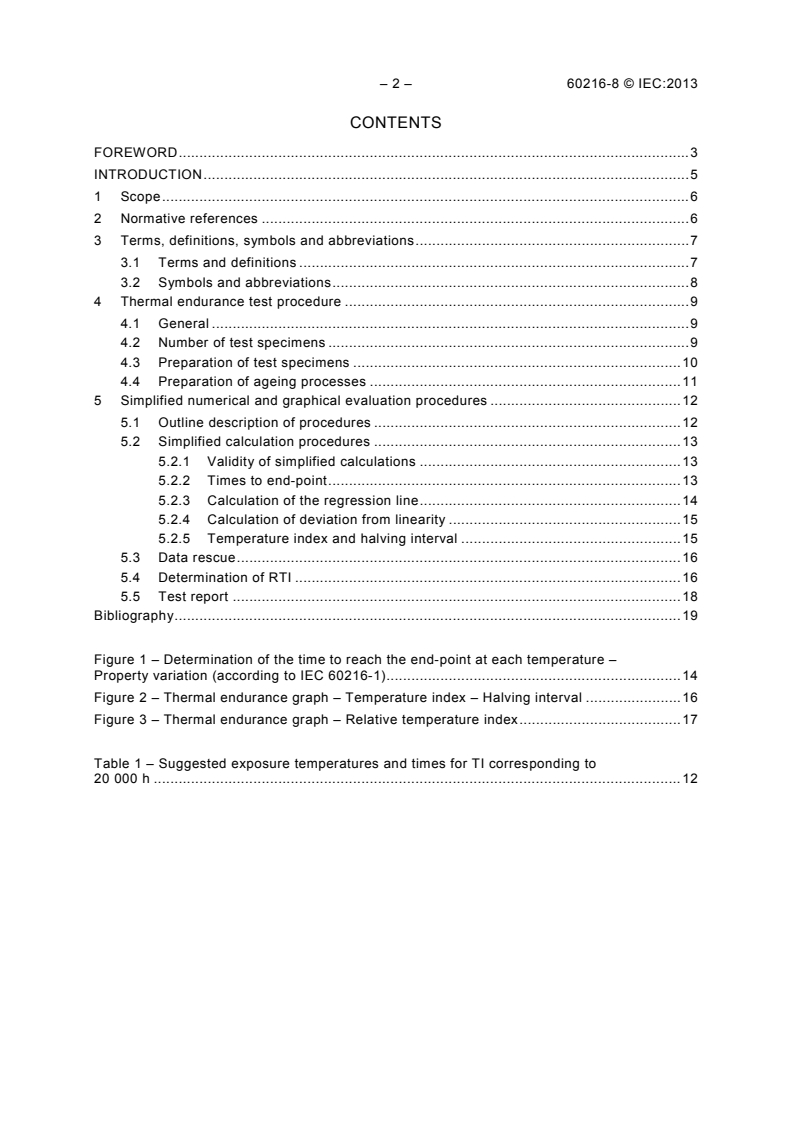
– 2 – 60216-8 © IEC:2013
CONTENTS
FOREWORD . 3
INTRODUCTION . 5
1 Scope . 6
2 Normative references . 6
3 Terms, definitions, symbols and abbreviations . 7
3.1 Terms and definitions . 7
3.2 Symbols and abbreviations . 8
4 Thermal endurance test procedure . 9
4.1 General . 9
4.2 Number of test specimens . 9
4.3 Preparation of test specimens . 10
4.4 Preparation of ageing processes . 11
5 Simplified numerical and graphical evaluation procedures . 12
5.1 Outline description of procedures . 12
5.2 Simplified calculation procedures . 13
5.2.1 Validity of simplified calculations . 13
5.2.2 Times to end-point . 13
5.2.3 Calculation of the regression line . 14
5.2.4 Calculation of deviation from linearity . 15
5.2.5 Temperature index and halving interval . 15
5.3 Data rescue . 16
5.4 Determination of RTI . 16
5.5 Test report . 18
Bibliography . 19
Figure 1 – Determination of the time to reach the end-point at each temperature –
Property variation (according to IEC 60216-1) . 14
Figure 2 – Thermal endurance graph – Temperature index – Halving interval . 16
Figure 3 – Thermal endurance graph – Relative temperature index . 17
Table 1 – Suggested exposure temperatures and times for TI corresponding to
20 000 h . 12
60216-8 © IEC:2013 – 3 –
INTERNATIONAL ELECTROTECHNICAL COMMISSION
____________
ELECTRICAL INSULATING MATERIALS –
THERMAL ENDURANCE PROPERTIES –
Part 8: Instructions for calculating thermal endurance
characteristics using simplified procedures
FOREWORD
1) The International Electrotechnical Commission (IEC) is a worldwide organization for standardization comprising
all national electrotechnical committees (IEC National Committees). The object of IEC is to promote
international co-operation on all questions concerning standardization in the electrical and electronic fields. To
this end and in addition to other activities, IEC publishes International Standards, Technical Specifications,
Technical Reports, Publicly Available Specifications (PAS) and Guides (hereafter referred to as “IEC
Publication(s)”). Their preparation is entrusted to technical committees; any IEC National Committee interested
in the subject dealt with may participate in this preparatory work. International, governmental and non-
governmental organizations liaising with the IEC also participate in this preparation. IEC collaborates closely
with the International Organization for Standardization (ISO) in accordance with conditions determined by
agreement between the two organizations.
2) The formal decisions or agreements of IEC on technical matters express, as nearly as possible, an international
consensus of opinion on the relevant subjects since each technical committee has representation from all
interested IEC National Committees.
3) IEC Publications have the form of recommendations for international use and are accepted by IEC National
Committees in that sense. While all reasonable efforts are made to ensure that the technical content of IEC
Publications is accurate, IEC cannot be held responsible for the way in which they are used or for any
misinterpretation by any end user.
4) In order to promote international uniformity, IEC National Committees undertake to apply IEC Publications
transparently to the maximum extent possible in their national and regional publications. Any divergence
between any IEC Publication and the corresponding national or regional publication shall be clearly indicated in
the latter.
5) IEC itself does not provide any attestation of conformity. Independent certification bodies provide conformity
assessment services and, in some areas, access to IEC marks of conformity. IEC is not responsible for any
services carried out by independent certification bodies.
6) All users should ensure that they have the latest edition of this publication.
7) No liability shall attach to IEC or its directors, employees, servants or agents including individual experts and
members of its technical committees and IEC National Committees for any personal injury, property damage or
other damage of any nature whatsoever, whether direct or indirect, or for costs (including legal fees) and
expenses arising out of the publication, use of, or reliance upon, this IEC Publication or any other IEC
Publications.
8) Attention is drawn to the Normative references cited in this publication. Use of the referenced publications is
indispensable for the correct application of this publication.
9) Attention is drawn to the possibility that some of the elements of this IEC Publication may be the subject of
patent rights. IEC shall not be held responsible for identifying any or all such patent rights.
International Standard IEC 60216-8 has been prepared by IEC technical committee 112:
Evaluation and qualification of electrical insulating materials and systems.
The text of this standard is based on the following documents:
FDIS Report on voting
112/236/FDIS 112/244/RVD
Full information on the voting for the approval of this standard can be found in the report on
voting indicated in the above table.
This publication has been drafted in accordance with the ISO/IEC Directives, Part 2.
– 4 – 60216-8 © IEC:2013
A list of all parts in the IEC 60216 series, published under the general title Electrical insulating
materials – Thermal endurance properties, can be found on the IEC website.
The committee has decided that the contents of this publication will remain unchanged until
the stability date indicated on the IEC web site under "http://webstore.iec.ch" in the data
related to the specific publication. At this date, the publication will be
• reconfirmed,
• withdrawn,
• replaced by a revised edition, or
• amended.
60216-8 © IEC:2013 – 5 –
INTRODUCTION
The designation 'thermal endurance' is used here to refer to the test of thermal stress in air,
excluding any other influence or stress applied to the test specimens. Thermal endurance
properties evaluated in different environments and/or with different stresses applied to the
test specimens require different test procedures.
In this part of IEC 60216, the study of the thermal ageing of materials is based solely on the
change in certain properties resulting from a period of exposure to elevated temperature. The
properties studied are always measured after the temperature has returned to ambient.
Properties of materials change at various rates on thermal ageing. To enable comparisons to
be made of the thermal ageing of different materials, the criteria for judgment depend on the
type of property to be studied and its acceptable limiting value.
– 6 – 60216-8 © IEC:2013
ELECTRICAL INSULATING MATERIALS –
THERMAL ENDURANCE PROPERTIES –
Part 8: Instructions for calculating thermal endurance
characteristics using simplified procedures
1 Scope
This part of IEC 60216 specifies the general ageing conditions and simplified procedures to
be used for deriving thermal endurance characteristics, which are shown by temperature
index (TI) and/or relative temperature index (RTI) and the halving interval (HIC).
The procedures specify the principles for evaluating the thermal endurance properties of
materials exposed to elevated temperature for long periods.
In the application of this standard, it is assumed that a practically linear relationship exists
between the logarithm of the time required to cause the predetermined property change and
the reciprocal of the corresponding absolute temperature (Arrhenius relationship).
For the valid application of the standard, no transition, in particular no first-order transition
should occur in the temperature range under study.
Throughout the rest of this standard the designation "insulating materials" is always taken to
mean "insulating materials and simple combinations of such materials".
2 Normative references
The following documents, in whole or in part, are normatively referenced in this document and
are indispensable for its application. For dated references, only the edition cited applies. For
undated references, the latest edition of the referenced document (including any
amendments) applies.
IEC 60085, Electrical insulation – Thermal evaluation and designation
IEC 60216-1:2013, Electrical insulating materials –Thermal endurance properties – Part 1:
Ageing procedures and evaluation of test results
IEC 60216-2, Electrical insulating materials - Thermal endurance properties - Part 2:
Determination of thermal endurance properties of electrical insulating materials - Choice of
test criteria
IEC 60216-3, Electrical insulating materials – Thermal endurance properties – Part 3:
Instructions for calculating thermal endurance characteristics
IEC 60216-4-1, Electrical insulating materials – Thermal endurance properties – Part 4-1:
Ageing ovens – Single-chamber ovens
—————————
A sixth edition is due to be published shortly.
60216-8 © IEC:2013 – 7 –
IEC 60216-5, Electrical insulating materials – Thermal endurance properties – Part 5:
Determination of relative thermal endurance index (RTE) of an insulating material
ISO 291, Plastics – Standard atmospheres for conditioning and testing
3 Terms, definitions, symbols and abbreviations
For the purposes of this document, the following terms, definitions, symbols and abbreviations
apply.
3.1 Terms and definitions
3.1.1
temperature index
TI
numerical value of the temperature in degrees Celsius derived from the thermal endurance
relationship at a time of 20 000 h (or other specified time)
3.1.2
halving interval
HIC
numerical value of the temperature interval in Kelvin which expresses the halving of the time
to end-point taken at the temperature equal to TI
[SOURCE: IEC 60050-212:2010 [1] , definition 212-12-13, modified – omission of reference to
"relative temperature index”]
3.1.3
thermal endurance graph
graph in which the logarithm of the time to reach a specified end-point in a thermal endurance
test is plotted against the reciprocal thermodynamic test temperature
[SOURCE: IEC 60050-212:2010, definition 212-12-10]
3.1.4
thermal endurance graph paper
graph paper having a logarithmic time scale as the ordinate, graduated in powers of ten
(from 10 h to 100 000 h is often a convenient range) and values of the abscissa are
proportional to the reciprocal of the thermodynamic (absolute) temperature
Note 1 to entry: The abscissa is usually graduated in a non-linear (Celsius) temperature scale oriented with
temperature increasing from left to right.
3.1.5
degrees of freedom
number of data values minus the number of parameter values
3.1.6
end-point
limit for a diagnostic property value based on which the thermal endurance is evaluated.
—————————
Figures in square brackets refer to the Bibliography.
– 8 – 60216-8 © IEC:2013
3.1.7
time to end-point
failure time
time to reach the end point or conventional failure
3.1.8
square of the correlation coefficient
r
fraction of the variation in one variable that may be explained by the other variable
Note 1 to entry: r is a square of correlation coefficient which explains the ratio of all data deviation on the
regression line.
3.1.9
destructive test
diagnostic property test, where the test specimen is irreversibly changed by the property
measurement, in a way which precludes a repeated measurement on the same specimen
3.1.10
non-destructive test
diagnostic property test, where the properties of the test specimen are not permanently
changed by the measurement, so that a further measurement on the same specimen may be
made after appropriate treatment
3.1.11
proof test
diagnostic property test, where each test specimen is, at the end of each ageing cycle,
subjected to a specified stress, further ageing cycles being conducted until the specimen fails
on testing
3.1.12
temperature group
temperature group of specimens
number of specimens being exposed together to the same temperature ageing in the same
oven
Note 1 to entry: Where there is no risk of ambiguity, either temperature groups or test groups may be referred to
simply as groups.
3.1.13
test group
test group of specimens
number of specimens removed together from a temperature group (as above) for destructive
testing
3.1.14
relative temperature index
RTI
numerical value of the temperature in degrees Celsius at which the estimated time to endpoint
of the candidate material is the same as the estimated time to endpoint of the reference
material at a temperature equal to its assessed temperature index
3.2 Symbols and abbreviations
a,b
Regression coefficients
n
Numbers of specimens for destructive tests
a,b,c,d
n Number of y-values
60216-8 © IEC:2013 – 9 –
N
Total number of test specimens
r
Correlation coefficient
F
Fisher distributed stochastic variable
x
Reciprocal thermodynamic temperature (1/Θ)
y
Logarithm of time to end-point
Temperature, °C
ϑ
Temperature, thermodynamic (Kelvin)
Θ
Value in Kelvin of 0 °C (273,15 K)
Θ
Time (to end-point)
τ
TI Temperature index
HIC Halving interval at temperature equal to TI
RTI Relative temperature index
4 Thermal endurance test procedure
4.1 General
Simplified procedures, which do not test the data dispersion but only deviations from linear
behaviour, are described.
It is possible, with some limitations, to evaluate the thermal endurance data graphically. In
this case, statistical assessment of data dispersion is not possible, but it is considered
important to evaluate any deviation of the data from the linear relationship.
Since the temperature is very often the dominant ageing factor affecting an electrical
insulating material (EIM) certain basic thermal classes are useful and have been recognized
as such internationally (see IEC 60085).
4.2 Number of test specimens
The accuracy of endurance test results depends largely on the number of specimens aged at
each temperature. Generally, the following instructions, which influence the testing procedure,
apply.
a) For a criterion requiring non-destructive testing, in most cases a group of five test
specimens for each exposure temperature is adequate.
Where the test criterion for non-destructive or proof tests is based upon the initial value of
the property, this should be determined from a group of specimens of at least twice the
number of specimens in each temperature group
b) For proof-test criteria, a group of at least 11 and possibly 21 specimens will be required
for each exposure temperature.
The dimensions and method of preparation of the test specimens shall be in accordance
with the specifications given for the relevant test method.
c) For a criterion requiring a destructive test, the minimum total number (N) of test specimens
needed is derived as follows:
N = n × n × n + n (1)
a b c d
where
– 10 – 60216-8 © IEC:2013
n is the number of specimens in a test group undergoing identical treatment at one
a
temperature and one treatment time and discarded after determination of the property
(usually five);
n is the number of treatments, i.e. exposure lengths, at one temperature;
b
n is the number of exposure temperature levels;
c
n is the number of specimens in the group used to establish the initial value of the
d
property. Normal practice is to select n = 2n when the diagnostic criterion is a
d a
percentage change of the property from its initial level. When the criterion is an absolute
property level, n is usually given the value of zero, unless reporting of the initial value
d
is required.
NOTE When there is a large number of specimens to be tested, it may be possible in certain cases to deviate
from the relevant test specifications and to reduce this number. However, it should be recognized that the precision
of the test result depends to a large extent on the number of specimens tested. In contrast, when the individual
results are too scattered, an increase in the number of specimens may be necessary in order to obtain satisfactory
precision. It is advisable to make an approximate assessment, by means of preliminary tests, of the number and
duration of the ageing tests required.
4.3 Preparation of test specimens
The specimens used for the ageing test should constitute a random sample from the
population investigated and are to be treated uniformly.
The material specifications or the test standards will contain all necessary instructions for the
preparation of specimens.
The thickness of specimens is in some cases specified in the list of property measurements
for the determination of thermal endurance (see IEC 60216-2); otherwise the thickness shall
be reported. Some physical properties are sensitive even to minor variations of specimen
thickness. In such cases, the thickness after each ageing period may need to be determined
and reported if required in the relevant specification.
The thickness is also important because the rate of ageing may vary with thickness. Ageing
data of materials with different thicknesses are not always comparable. Consequently, a
material may be assigned more than one thermal endurance characteristic derived from the
measurement of properties at different thicknesses.
The tolerances of specimen dimensions should be the same as those normally used for
general testing; where specimen dimensions need smaller tolerances than those normally
used, these special tolerances should be given. Screening measurements ensure that
specimens are of uniform quality and typical of the material to be tested.
Since processing conditions may significantly affect the ageing characteristics of some
materials, it shall be ensured that, for example, sampling, cutting sheet from the supply roll,
cutting of anisotropic material in a given direction, moulding, curing, pre-conditioning, are
performed in the same manner for all specimens.
It is good practice to keep an adequate number of test specimens separately as a reserve of the
original material batch from which such specimens may subsequently be prepared. In this
way, any required ageing of additional specimens in case of unforeseen complications will
introduce a minimum risk of producing systematic differences between groups of specimens.
Such complications may arise, for example, if the thermal endurance relationship turns out to
be non-linear, or if specimens are lost due to thermal runaway of an oven. Moreover they can
be used:
– for cases in which the accuracy requires heat ageing at an additional temperature;
– as reference specimens.
They shall be stored in an appropriately controlled atmosphere (see ISO 291).
60216-8 © IEC:2013 – 11 –
Thermosetting materials shall be conditioned for 48 h at the lowest exposure temperature of
the range selected.
If necessary, thermoplastic materials should be annealed for 48 h at the lowest exposure
temperature of the range selected.
4.4 Preparation of ageing processes – exposure temperature and cycle time
For TI determinations, test specimens should be exposed to not less than three, preferably at
least four, temperatures covering a sufficient range to demonstrate a linear relationship
between logarithms of time to end-point and reciprocal thermodynamic (absolute) temperature.
To reduce the uncertainties in calculating the appropriate thermal endurance characteristic,
the overall temperature range of thermal exposure needs to be carefully selected, observing
the following requirements:
a) the lowest exposure temperature shall be one which will result in a mean or median time
to end-point more than 1/4 of the extrapolation time (which is generally 20 000 h) when
determining TI;
NOTE 1 The mean time corresponding to TI is generally 20 000 h, thus the lowest exposure temperature
corresponds to a mean time > = 5 000 h.
b) the extrapolation necessary to establish TI shall not be more than 25 K;
c) the highest exposure temperature shall be one which will result in a mean or median time
to end-point of more than 100 h.
NOTE 2 For some materials, it may not be possible to achieve a time to end-point of less than 500 h while
retaining satisfactory linearity. However, it is important that a smaller range of mean times to end-point will lead to
a larger confidence interval of the result for the same data dispersion.
Table 1 gives guidance in making initial selections.
A number of recommendations and suggestions useful in establishing times and temperatures
can be found in IEC 60216-1:2013, Annex B.
Before the heat-ageing procedure is started, an initial test shall be made at room temperature
with the required number of specimens conditioned and tested in accordance with the chosen
test method.
Selection of adequate exposure temperatures requires previously determined information on
the material under test. If such information is not available, exploratory tests may help in
selecting exposure temperatures which are suitable for evaluating the thermal endurance
characteristics.
For heat ageing, ovens shall be used that meet the requirements specified in IEC 60216-4-1,
in particular with respect to the temperature tolerances and ventilation rates of air exchange.
Place the required number of specimens in each of the ovens maintained at the selected
temperatures.
If there is a risk of cross-contamination between test specimens originating from different
materials, use separate ovens for each material.
At the end of each heat-ageing period, the required number of test specimens is removed
from the oven and conditioned, if necessary, under the appropriately controlled atmosphere
(see ISO 291). The test, in accordance with the selected test criterion, shall be carried out at
room temperature.
– 12 – 60216-8 © IEC:2013
Continue this procedure until the numerical value of the characteristic under investigation
reaches the relevant threshold value.
Table 1 – Suggested exposure temperatures and times for TI
corresponding to 20 000 h
Estimated Exposure temperature
value of TI
°C
in range
Boxes: duration of exposure cycle in days
°C
120 13 14 15 16 17 18 19 20 21 22 23 24 25 26 27 28 29 30 31 32 33 34 36
0 0 0 0 0 0 0 0 0 0 0 0 0 0 0 0 0 0 0 0 0 0 0
95-104 28 14 7 3 1
105-114 28 14 7 3 1
115-124 28 14 7 3 1
125-134 28 14 7 3 1
135-144 28 14 7 3 1
145-154 28 14 7 3 1
155-164 28 14 7 3 1
165-174 28 14 7 3 1
175-184 28 14 7 3 1
185-194 28 14 7 3 1
195-204 28 14 7 3 1
205-214 28 14 7 3 1
215-224 28 14 7 3 1
225-234 28 14 7 3 1
235-244 28 14 7 3 1
245-254 28 14 7 3 1
NOTE 1 This table is intended primarily for cyclic proof testing and non-destructive tests, but may also be used
as a guide for selection of suitable time intervals for destructive tests. In this case, cycle times of 56 days, or even
more, may be required.
NOTE 2 When extending the test program by submitting additional specimens to ageing at temperatures below
the lower of the originally planned ageing temperatures, a temperature interval of 10 K and cycle duration of 42
days for TI determination should be considered.
5 Simplified numerical and graphical evaluation procedures
5.1 Outline description of procedures
At a chosen temperature, the variations in the numerical value of a chosen characteristic (for
example, a mechanical, optical or diagnostic property: see IEC 60216-2) are determined as a
function of time.
The procedure is continued until the specified end-point value of that characteristic has been
reached, resulting in the time to end-point at that particular temperature.
Further specimens are exposed at a minimum of two other temperatures and the variations in
the relevant characteristic determined. It is recommended that test specimens be heated-aged
at three or four temperatures, and the time to end-point for each of the temperatures
determined.
60216-8 © IEC:2013 – 13 –
When the data at all temperatures are complete, a thermal endurance graph is drawn, and a
relatively simple statistical calculation made, to assess whether the linearity of the graph
enables the calculation of thermal endurance characteristics.
The test chosen shall relate to a characteristic which is likely to be of significance in practice
and, wherever possible, use shall be made of test methods specified in international
standards (see, for example, IEC 60216-2). If the dimensions and/or form of the test
specimens are altered by the heat treatment, then only test methods which are independent of
these effects may be used.
For the selection of the end-point, an acceptable change in value of the chosen characteristic
shall be considered. This value depends on the conditions of use foreseen.
NOTE Other times (shorter or longer than 20 000 h) may be chosen if necessary.
5.2 Simplified calculation procedures
5.2.1 Validity of simplified calculations
The calculation procedure is only valid when the numbers of data contributing to the mean
time to end-point for all temperature groups are approximately equal. In addition, the
procedure does not test the scatter of the test data for acceptability. For these reasons, the
result cannot be given the status of full statistical acceptance, and the procedure should only
be used when there is already satisfactory experience of the behavior of the material in
thermal endurance testing.
In all cases of doubt, the full analysis described in IEC 60216-3 should be carried out,
especially if there is doubt about the acceptability of scatter of test data can be questioned.
5.2.2 Times to end-point
For destructive tests for each exposure temperature and for the group removed from the oven
after each heat-ageing period, the per cent of the mean value of the chosen property relative
to the initial property value is plotted as a function of the logarithm of the time of ageing (see
Figure 1). The point at which this graph intersects the horizontal line representing the end-
point criterion is taken as the time to end-point of the temperature group.
For non-destructive tests, the per cent of the value of property measured on each specimen
after each ageing period relative to initial property value is plotted as a function of the
logarithm of the time and the point at which this graph intersects the horizontal line
representing the end-point criterion is taken as the time to end-point of the specimen. The
time to end-point of the temperature group is the mean of the specimen times.
When applying a proof test, each ageing time shall be calculated as the mean of the times at
the beginning and end of the ageing period. The ageing time of the temperature group shall
be taken as the time of the ageing period in which the median failure on proof test takes
place.
The logarithms of the mean times to end point are plotted versus the reciprocal values of the
exposure temperatures. The intersection of this curve with the chosen time limit (in general
20 000 h) gives the temperature index sought.
– 14 – 60216-8 © IEC:2013
End-point criterion
Exposure temperatures 190 °C 171 °C 149 °C 130 °C
20 50 100 200 500 1 000 2 000 5 000 10 000
Ageing time (h)
IEC 546/13
Figure 1 – Determination of the time to reach the end-point at each temperature –
Property variation (according to IEC 60216-1)
NOTE When the temperature scale is chosen in such a way that equal intervals correspond to equal intervals of
reciprocal Kelvin, then the various points obtained will be found to lie on a straight line if a linear dependence
exists. When the temperature range used is comparatively small, a curve can be prepared using an abscissa scale
proportional to the temperature; in this case the curve can be fit to a straight line only with great circumspection.
5.2.3 Calculation of the regression line
The ageing function assumed for the purposes of this standard is the equation relating
Θ to the mean time needed for a fixed change in the value
the absolute (Kelvin) temperature
of property, τ:
B/Θ
(2)
τ = Ae
where
A and B are constants dependent on material and diagnostic test.
This may be expressed as a linear equation:
(3)
y = a + bx
where
y = ln τ
x = 1/Θ
a = ln A
Property value in relative units (%)
60216-8 © IEC:2013 – 15 –
b = B.
Given a group of paired x, y values, the values of a and b giving the best fit linear relationship
are determined from the x, y values:
( )
xy − x y / k
∑ ∑ ∑
b = (4)
2 2
x − ( x) / k
∑ ∑
( y − b x)
∑ ∑
a = (5)
k
where k is the number of x, y values.
NOTE 1 Since most "scientific" calculators with "statistics" functions have regression analysis facilities, the
calculations implied by Equations (2) to (4) above are executed by the calculator. It is important in this case that x
is entered as the independent variable and y as the dependent.
NOTE 2 It is usually possible with such calculators to enter the time and temperature values and convert them to
x and y before the summation is executed.
NOTE 3 Logarithms to another base (for example, 10) may be used but will affect the value to be used.
5.2.4 Calculation of deviation from linearity
Calculate the coefficient of determination (square of correlation coefficient). Again, this can be
done in the regression facility of the calculator.
( xy − x y / k)
∑ ∑ ∑
r = (6)
2 2
2 2
x − ( x) / k y − ( y) / k
∑ ∑ ∑ ∑
If the value of r > 0,985 then the values of TI and HIC may be determined. If this condition is
not satisfied, then the deviations from the fundamental assumption are too great to allow the
calculation.
NOTE This is not a Fisher linearity test, but an expression of the mean deviation of data from the regression line,
as a fraction of the range of data values
5.2.5 Temperature index and halving interval
b
ϑ = − Θ (7)
(lnτ − a)
Using Equation (7), calculate the temperatures corresponding to values of τ (time in hours) of
20 000, 10 000 and 2 000, designated ϑ , ϑ , and ϑ respectively.
20 000 10 000 2 000
Using the data pairs (ϑ , 20 000) and (ϑ , 2 000) draw the regression line on thermal
20 000 2 000
endurance graph paper to obtain the thermal endurance graph.
Calculate the values of TI and HIC:
TI = ϑ , HIC = ϑ – ϑ
20 000 10 000 20 000
An example is given in Figure 2.
– 16 – 60216-8 © IEC:2013
NOTE 1 If a value τ, different from 20 000 is used for the calculation of TI, replace 10 000 and 2 000 in the above
by τ/2 and τ/10.
NOTE 2 The value of r is related to the Fisher test described in IEC 60216-1 and IEC 60216-3.
20 000
10 000
Regression line
2 000
HIC
TI
ϑ ϑ ϑ
20 000 10 000 2 000
IEC 547/13
Figure 2 – Thermal endurance graph – Temperature index – Halving interval
5.3 Data rescue
The reliability of the extrapolation of the graph depends on obtaining an acceptable Arrhenius
plot, which may not be possible with materials showing behaviour related to a transition
phenomenon in the chosen temperature range.
For this purpose the correlation coefficient r is calculated in accordance with 5.2.4. If this
calculation results in a value smaller than 0,985 (for three test temperatures) an additional
test at a different test temperature may improve the linearity of data.
5.4 Determination of RTI
For determination of RTI, the chosen reference material, its thermal endurance and the
method of determination are of central importance.
The reference material shall be of the same type as the tested material, and have a history of
satisfactory service. It shall have a known temperature index for the property and a end point
value which are the same, or at least reasonably similar to, those to be employed in the RTI
test. The TI and HIC of the reference material should also be approximately the same as the
values expected for the tested material.
Time (h)
60216-8 © IEC:2013 – 17 –
A
B
t
r
Reference
Candidate
RTI
TI
Temperature (°C)
r
IEC 548/13
Key
TI original TI of the reference material
r
t time to the end point of the reference material
r
A the cross point of the thermal index of the reference material (= TI ) and the regression line of the
r
reference material
B the cross point of the end point time of reference material and the regression line of the candidate
material (= RTI)
Figure 3 – Thermal endurance graph – Relative temperature index
Define ϑ and ϑ (from Equation (7)).
A B
Points A and B may be determined either graphically or numerically, and the RTI then
determined using Equation (8):
RTI =TI +ϑ -ϑ (8)
r A B
When reporting the RTI, the usual information regarding the property, end-point and test
specimen data should be supplemented with corresponding information regarding the
reference material.
When required, the test material may be assigned to an insulation thermal class according
IEC 60085 (see IEC 60216-5).
The relative temperature index (RTI) is a thermal endurance characteristic which is derived
from the two thermal endurance relationships or curves resulting from the comparative testing
of the test material and the reference material. The RTI is specifically related to the time
corresponding to the TI originally determined for the reference material.
Time (h)
– 18 – 60216-8 © IEC:2013
5.5 Test report
Make the test report, reporting in the format
TI = xxx, HIC = yyy, RTI = zzz
s s s
The test report shall include:
– all information necessary for complete identification of the material tested, description of
the tested material including dimensions and any conditioning of the specimens;
– the property investigated, the chosen end-point, and, if this is a percentage value, the
initial value of the property;
– the test method used for determination of the property (for example, by reference to a
relevant IEC publication);
– any relevant information on the test procedure, for example, ageing environment; details
of the ageing conditions, if these are other than the exposure of unstressed specimens to
hot air;
– shape, dimensions and method of preparation of the test specimens, with reference to the
relevant standard;
– conditioning;
– type of oven, with details of rate of air change and direction an velocity of airflow;
– times and temperatures of exposure in ovens;
– the individual test temperatures, with the appropriate data:
• for non-destructive tests, the individual times to end-point, with the graphs of variation
of property with ageing time;
• for proof tests, the numbers and durations of the ageing cycles, with the numbers of
specimens reaching end-point during the cycles;
• for destructive tests, the ageing times and individual property values, with the graphs
of variation of property with ageing time;
– the thermal endurance graph;
– reference to this standard.
60216-8 © IEC:2013 – 19 –
Bibliography
IEC 60050-212, International Electrotechnical Vocabulary – Part 212: Insulating solids, liquids
and gases
IEC 60216-6, Electrical insulating materials – Thermal endurance properties – Part 6:
Determination of thermal endurance indices (TI and RTE) of an insulating material using the
fixed time frame method.
IEC 60212, Standard conditions for use prior to and during the testing of soli
...