

IEC 61577-1:2000
(Main)Radiation protection instrumentation - Radon and radon decay product measuring instruments - Part 1: General requirements
General Information
- Abstract
Covers the general features concerning tests and calibrations of radon and radon decay product measuring instruments. Emphasizes the definition and use of reference atmospheres. Is intended to help the user or the manufacturer to choose the most appropriate instrument for a given application. Is also intended to help to define type tests which have to be conducted in order to qualify these instruments. See also IEC 61577-2, IEC 61577-3 and IEC 61263.
- Status
- Published
- Publication Date
- 09-Aug-2000
- Technical Committee
- SC 45B - Radiation protection instrumentation
- Current Stage
- DELPUB - Deleted Publication
- Start Date
- 19-Jul-2006
- Completion Date
- 28-Aug-2026
Overview
IEC 61577-1:2000 is an international standard developed by the International Electrotechnical Commission (IEC) covering general requirements for radon and radon decay product measuring instruments used in radiation protection. This standard defines fundamental concepts, testing, and calibration methods for instrumentation that measures radon gas (particularly isotopes 220 and 222) and their short-lived decay products, with special emphasis on the use and definition of reference atmospheres.
Radon isotopes and their decay products represent a significant portion of natural radioactivity exposure for both the general public and workers in specific environments such as underground mines. Accurate measurement of these radioactive elements is essential for health physics and environmental monitoring. IEC 61577-1 provides a framework to help users and manufacturers select appropriate instruments and establish standardized type tests for qualifying device performance.
Key Topics
- Scope and Applicability:
- Focuses on the isotopes radon-220 and radon-222 and their short-lived decay products.
- Outlines which instruments and scenarios are covered, notably excluding systems involving enriched uranium.
- Reference Atmospheres:
- Defines how reference atmospheres are to be created and used for the calibration and testing of radon measuring devices.
- Ensures the comparability and traceability of results across laboratories and applications.
- Type Tests and Calibration:
- Identifies general procedures for type tests to qualify radon and radon decay product measuring instruments.
- References specific calibration methodologies to ensure instruments provide reliable and repeatable results.
- Instrument Classification:
- Discusses the criteria by which radon measurement devices are classified, based on application such as workplace monitoring, environmental surveillance, or laboratory research.
- Terminology and Units:
- Standardizes vocabulary and units to avoid ambiguity and facilitate communication between manufacturers, users, and regulatory bodies.
Applications
Radon measuring instruments are critical tools in a variety of settings. The practical impact of IEC 61577-1 includes:
- Workplace Safety:
- Ensuring health and safety in underground mines, water treatment facilities, and spas where workers are at risk of high radon exposures.
- Environmental Monitoring:
- Supporting long-term surveillance of radon levels in residential areas, public buildings, and outdoor environments as part of public health protection programs.
- Laboratory Research:
- Providing standard test and calibration environments for studies of radon behavior, instrument development, and epidemiological research.
- Regulatory Compliance:
- Assisting regulators and manufacturers in verifying that measurement instruments meet minimum requirements for accuracy and reliability.
- Uranium Mining and Prospecting:
- Enabling precise measurement of radon and decay products to assess occupational exposure risks and assist in geological assessments.
Related Standards
IEC 61577-1 is intended to be used alongside other specialized standards in the IEC 61577 series and related documents:
- IEC 61577-2: Specific requirements for radon measuring instruments.
- IEC 61577-3: Specific requirements for radon decay product (RnDP) measuring instruments.
- IEC 61263: Standard for portable alpha energy meters for rapid measurement in mines.
- IEC 60050 and IEC 60027: Reference standards for terminology, graphical, and letter symbols used in electrotechnical instrumentation.
Adherence to these internationally recognized standards ensures the reliability, safety, and comparability of radon measurements across different regions and applications, supporting effective radiation protection and regulatory compliance.
Keywords: IEC 61577-1, radon measuring instruments, radiation protection, reference atmosphere, calibration, radon decay products, environmental monitoring, occupational safety, instrument classification, international standard.
Relations
- Effective Date
- 05-Sep-2023
Get Certified
Connect with accredited certification bodies for this standard

DNV
DNV is an independent assurance and risk management provider.

Lloyd's Register
Lloyd's Register is a global professional services organisation specialising in engineering and technology.
DNV Energy Systems
Energy and renewable energy certification.
Sponsored listings
Frequently Asked Questions
IEC 61577-1:2000 is a standard published by the International Electrotechnical Commission (IEC). Its full title is "Radiation protection instrumentation - Radon and radon decay product measuring instruments - Part 1: General requirements". This standard covers: Covers the general features concerning tests and calibrations of radon and radon decay product measuring instruments. Emphasizes the definition and use of reference atmospheres. Is intended to help the user or the manufacturer to choose the most appropriate instrument for a given application. Is also intended to help to define type tests which have to be conducted in order to qualify these instruments. See also IEC 61577-2, IEC 61577-3 and IEC 61263.
Covers the general features concerning tests and calibrations of radon and radon decay product measuring instruments. Emphasizes the definition and use of reference atmospheres. Is intended to help the user or the manufacturer to choose the most appropriate instrument for a given application. Is also intended to help to define type tests which have to be conducted in order to qualify these instruments. See also IEC 61577-2, IEC 61577-3 and IEC 61263.
IEC 61577-1:2000 is classified under the following ICS (International Classification for Standards) categories: 27.120.20 - Nuclear power plants. Safety. The ICS classification helps identify the subject area and facilitates finding related standards.
IEC 61577-1:2000 has the following relationships with other standards: It is inter standard links to IEC 61577-1:2006. Understanding these relationships helps ensure you are using the most current and applicable version of the standard.
IEC 61577-1:2000 is available in PDF format for immediate download after purchase. The document can be added to your cart and obtained through the secure checkout process. Digital delivery ensures instant access to the complete standard document.
Standards Content (Sample)
NORME CEI
INTERNATIONALE IEC
61577-1
INTERNATIONAL
Première édition
STANDARD
First edition
2000-08
Instrumentation pour la radioprotection –
Instruments de mesure du radon
et des descendants du radon –
Partie 1:
Règles générales
Radiation protection instrumentation –
Radon and radon decay product
measuring instruments –
Part 1:
General requirements
Numéro de référence
Reference number
CEI/IEC 61577-1:2000
Numéros des publications Numbering
Depuis le 1er janvier 1997, les publications de la CEI As from 1 January 1997 all IEC publications are
sont numérotées à partir de 60000. issued with a designation in the 60000 series.
Publications consolidées Consolidated publications
Les versions consolidées de certaines publications de Consolidated versions of some IEC publications
la CEI incorporant les amendements sont disponibles. including amendments are available. For example,
Par exemple, les numéros d’édition 1.0, 1.1 et 1.2 edition numbers 1.0, 1.1 and 1.2 refer, respectively, to
indiquent respectivement la publication de base, la the base publication, the base publication incor-
publication de base incorporant l’amendement 1, et la porating amendment 1 and the base publication
publication de base incorporant les amendements 1 incorporating amendments 1 and 2.
et 2.
Validité de la présente publication Validity of this publication
Le contenu technique des publications de la CEI est The technical content of IEC publications is kept
constamment revu par la CEI afin qu'il reflète l'état under constant review by the IEC, thus ensuring that
actuel de la technique. the content reflects current technology.
Des renseignements relatifs à la date de reconfir- Information relating to the date of the reconfirmation
mation de la publication sont disponibles dans le of the publication is available in the IEC catalogue.
Catalogue de la CEI.
Les renseignements relatifs à des questions à l’étude et Information on the subjects under consideration and
des travaux en cours entrepris par le comité technique work in progress undertaken by the technical
qui a établi cette publication, ainsi que la liste des committee which has prepared this publication, as well
publications établies, se trouvent dans les documents ci- as the list of publications issued, is to be found at the
dessous: following IEC sources:
• «Site web» de la CEI* • IEC web site*
• Catalogue des publications de la CEI • Catalogue of IEC publications
Publié annuellement et mis à jour Published yearly with regular updates
régulièrement (On-line catalogue)*
(Catalogue en ligne)*
• Bulletin de la CEI
• IEC Bulletin
Disponible à la fois au «site web» de la CEI*
Available both at the IEC web site* and
et comme périodique imprimé
as a printed periodical
Terminologie, symboles graphiques
Terminology, graphical and letter
et littéraux
symbols
En ce qui concerne la terminologie générale, le lecteur
For general terminology, readers are referred to
se reportera à la CEI 60050: Vocabulaire Electro-
IEC 60050: International Electrotechnical Vocabulary
technique International (VEI).
(IEV).
Pour les symboles graphiques, les symboles littéraux
For graphical symbols, and letter symbols and signs
et les signes d'usage général approuvés par la CEI, le
approved by the IEC for general use, readers are
lecteur consultera la CEI 60027: Symboles littéraux à
referred to publications IEC 60027: Letter symbols to
utiliser en électrotechnique, la CEI 60417: Symboles
be used in electrical technology, IEC 60417: Graphical
graphiques utilisables sur le matériel. Index, relevé et
symbols for use on equipment. Index, survey and
compilation des feuilles individuelles, et la CEI 60617:
compilation of the single sheets and IEC 60617:
Symboles graphiques pour schémas.
Graphical symbols for diagrams.
* Voir adresse «site web» sur la page de titre.
* See web site address on title page.
NORME CEI
INTERNATIONALE IEC
61577-1
INTERNATIONAL
Première édition
STANDARD
First edition
2000-08
Instrumentation pour la radioprotection –
Instruments de mesure du radon
et des descendants du radon –
Partie 1:
Règles générales
Radiation protection instrumentation –
Radon and radon decay product
measuring instruments –
Part 1:
General requirements
IEC 2000 Droits de reproduction réservés Copyright - all rights reserved
Aucune partie de cette publication ne peut être reproduite ni No part of this publication may be reproduced or utilized in
utilisée sous quelque forme que ce soit et par aucun procédé, any form or by any means, electronic or mechanical,
électronique ou mécanique, y compris la photocopie et les including photocopying and microfilm, without permission in
microfilms, sans l'accord écrit de l'éditeur. writing from the publisher.
International Electrotechnical Commission 3, rue de Varembé Geneva, Switzerland
Telefax: +41 22 919 0300 e-mail: inmail@iec.ch IEC web site http://www.iec.ch
CODE PRIX
Commission Electrotechnique Internationale
XB
PRICE CODE
International Electrotechnical Commission
Pour prix, voir catalogue en vigueur
For price, see current catalogue
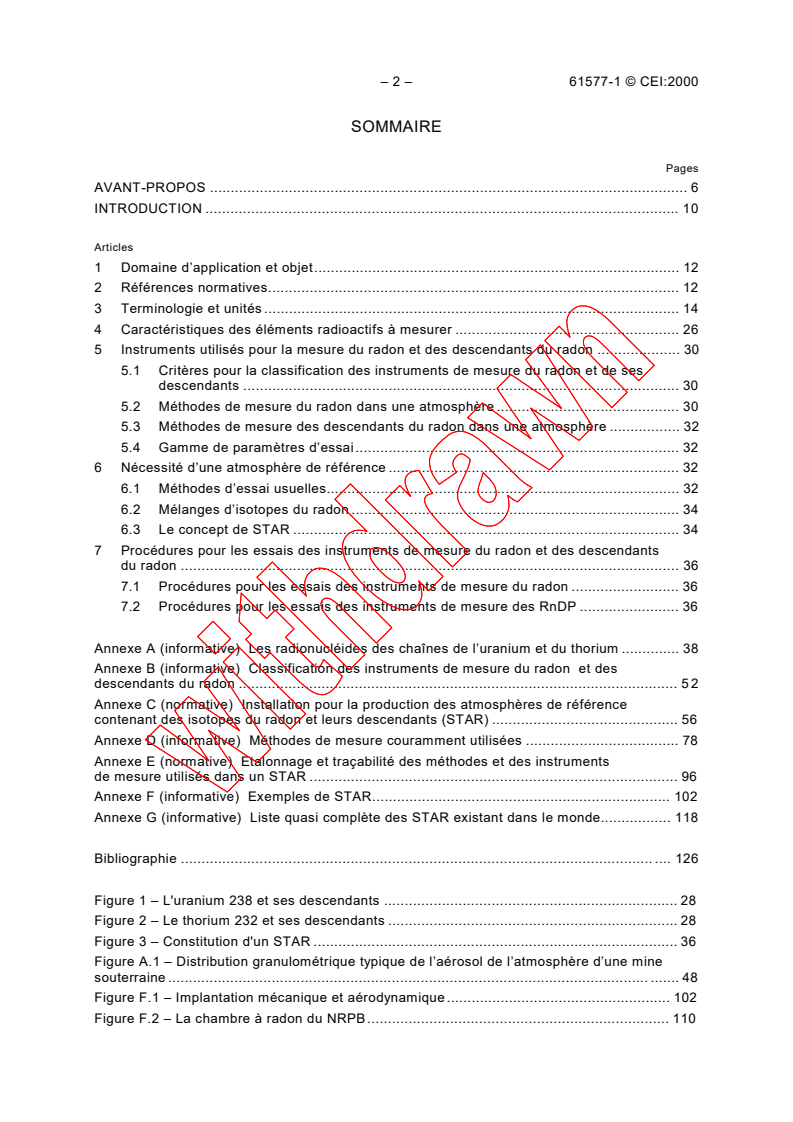
– 2 – 61577-1 © CEI:2000
SOMMAIRE
Pages
AVANT-PROPOS . 6
INTRODUCTION . 10
Articles
1 Domaine d’application et objet. 12
2 Références normatives. 12
3 Terminologie et unités . 14
4 Caractéristiques des éléments radioactifs à mesurer . 26
5 Instruments utilisés pour la mesure du radon et des descendants du radon . 30
5.1 Critères pour la classification des instruments de mesure du radon et de ses
descendants . 30
5.2 Méthodes de mesure du radon dans une atmosphère . 30
5.3 Méthodes de mesure des descendants du radon dans une atmosphère . 32
5.4 Gamme de paramètres d’essai. 32
6 Nécessité d’une atmosphère de référence . 32
6.1 Méthodes d’essai usuelles. 32
6.2 Mélanges d’isotopes du radon . 34
6.3 Le concept de STAR . 34
7 Procédures pour les essais des instruments de mesure du radon et des descendants
du radon .36
7.1 Procédures pour les essais des instruments de mesure du radon . 36
7.2 Procédures pour les essais des instruments de mesure des RnDP . 36
Annexe A (informative) Les radionucléides des chaînes de l’uranium et du thorium . 38
Annexe B (informative) Classification des instruments de mesure du radon et des
descendants du radon . 5 2
Annexe C (normative) Installation pour la production des atmosphères de référence
contenant des isotopes du radon et leurs descendants (STAR) . 56
Annexe D (informative) Méthodes de mesure couramment utilisées . 78
Annexe E (normative) Etalonnage et traçabilité des méthodes et des instruments
de mesure utilisés dans un STAR . 96
Annexe F (informative) Exemples de STAR. 102
Annexe G (informative) Liste quasi complète des STAR existant dans le monde. 118
Bibliographie . . 126
Figure 1 – L'uranium 238 et ses descendants . 28
Figure 2 – Le thorium 232 et ses descendants . 28
Figure 3 – Constitution d'un STAR . 36
Figure A.1 – Distribution granulométrique typique de l’aérosol de l’atmosphère d’une mine
souterraine . . 48
Figure F.1 – Implantation mécanique et aérodynamique . 102
Figure F.2 – La chambre à radon du NRPB. 110
61577-1 © IEC:2000 – 3 –
CONTENTS
Page
FOREWORD . 7
INTRODUCTION . 11
Clause
1 Scope and object . 13
2 Normative references . 13
3 Terminology and units . 15
4 Characteristics of the radioactive elements to be measured. 27
5 Instruments used for measuring radon and radon decay products . 31
5.1 Criteria for the classification of radon and RnDP measuring instruments. 31
5.2 Methods of measuring radon in an atmosphere . 31
5.3 Methods of measuring radon decay products in an atmosphere . 33
5.4 Range of test parameters. 33
6 Need for a reference atmosphere . 33
6.1 Usual test methods . 33
6.2 Mixtures of radon isotopes . 35
6.3 The concept of STAR. 35
7 Protocols for testing radon and RnDP measuring instruments . 37
7.1 Protocols for testing radon measuring instruments . 37
7.2 Protocols for testing RnDP measuring instruments . 37
Annex A (informative) Radionuclides in the uranium and thorium series . 39
Annex B (informative) Classification of radon and radon decay product measuring
instruments . 53
Annex C (normative) Equipment for the production of reference atmospheres containing
radon isotopes and their decay products (STAR). 57
Annex D (informative) Currently used methods. 79
Annex E (normative) Calibration and traceability of measurement methods
and instruments used in a STAR. 97
Annex F (informative) Examples of STARs. 103
Annex G (informative) Nearly complete list of existing radon facilities in the world . 119
Bibliography . 127
Figure 1 – Uranium 238 and its decay products . 29
Figure 2 – Thorium 232 and its decay products . 29
Figure 3 – Construction of a STAR. 37
Figure A.1 – Particle size distribution typical of the atmosphere in an underground mine . 49
Figure F.1 – Mechanical and aerodynamic set-up. 103
Figure F.2 – NRPB radon calibration chamber. 111
– 4 – 61577-1 © CEI:2000
Tableau 1 – Liste des unités . 24
Tableau 2 – Liste de radionucléides . 26
Tableau A.1 – Caractéristiques des radionucléides de la chaîne de l’uranium 238 . 40
Tableau A.2 – Caractéristiques des radionucléides de la chaîne du thorium 232. 42
Tableau A.3 – Caractéristiques physico-chimiques des principaux composants radioactifs
d’un environnement atmosphérique. 44
Tableau B.1 –Types d’instruments utilisés pour la mesure du radon . 52
Tableau B.2 – Types d’instruments utilisés pour la mesure des descendants du radon . 54
Tableau C.1 – Domaine de fonctionnement d’un STAR (radioactivité). 68
Tableau C.2 – Conditions de référence et d’essai normalisées . 76
Tableau C.3 – Essais avec variation des grandeurs d’influence . 76
Tableau D.1 – Diagramme de temps, méthode de Thomas. 82
Tableau D.2 – Temps de comptage optimaux de la méthode de Thomas optimisés
par Hartley . . 82
Tableau D.3 – Diagramme des temps, méthode de Thomas optimisée par Hartley . 84
Tableau D.4 – Coefficients de la méthode de Thomas optimisés par Hartley . 84
Tableau D.5 – Diagramme des temps, méthode de Markov . 86
Tableau D.6 – Diagramme des temps, méthode de Nazaroff . 88
Tableau D.7 – Diagramme des temps, méthode de Hill . 90
Tableau D.8 – Diagramme des temps, méthode de Kusnetz. 90
Tableau D.9 – Exemple d’un diagramme de temps, méthode de Rolle . 94
Tableau F.1 – Instrumentation de la chambre du NRPB . 114
61577-1 © IEC:2000 – 5 –
Table 1 – List of units . . 25
Table 2 – List of radionuclides . 27
Table A.1 – Uranium 238 nuclide radioactive characteristics . 41
Table A.2 – Thorium 232 nuclide radioactive characteristics. 43
Table A.3 – Physical and chemical properties of the main radioactive components
that may be present in an atmospheric environment . 45
Table B.1 – Types of instruments used for measuring radon . 53
Table B.2 – Types of instruments used for measuring radon decay product . 55
Table C.1 – Working range of a STAR (radioactivity). 69
Table C.2 – Reference and standard test conditions. 77
Table C.3 – Tests with variation of the influence quantities. 77
Table D.1 – Time diagram, Thomas's method . 83
Table D.2 – Optimal counting times of Thomas’s method optimised by Hartley . 83
Table D.3 – Time diagram, Thomas’s method optimized by Hartley . 85
Table D.4 – Coefficient of Thomas’s method optimized by Hartley. 85
Table D.5 – Time diagram, Markov’s method . 87
Table D.6 – Time diagram, Nazaroff’s method. 89
Table D.7 – Time diagram, Hill’s method. 91
Table D.8 – Time diagram, Kusnetz’s method . 91
Table D.9 – Example of time diagram, Rolle’s method. 95
Table F.1 – Instrumentation of the NRPB chamber. 115
– 6 – 61577-1 © CEI:2000
COMMISSION ÉLECTROTECHNIQUE INTERNATIONALE
____________
INSTRUMENTATION POUR LA RADIOPROTECTION –
INSTRUMENTS DE MESURE DU RADON
ET DES DESCENDANTS DU RADON –
Partie 1: Règles générales
AVANT-PROPOS
1) La CEI (Commission Électrotechnique Internationale) est une organisation mondiale de normalisation composée
de l'ensemble des comités électrotechniques nationaux (Comités nationaux de la CEI). La CEI a pour objet de
favoriser la coopération internationale pour toutes les questions de normalisation dans les domaines de
l'électricité et de l'électronique. A cet effet, la CEI, entre autres activités, publie des Normes internationales.
Leur élaboration est confiée à des comités d'études, aux travaux desquels tout Comité national intéressé par le
sujet traité peut participer. Les organisations internationales, gouvernementales et non gouvernementales, en
liaison avec la CEI, participent également aux travaux. La CEI collabore étroitement avec l'Organisation
Internationale de Normalisation (ISO), selon des conditions fixées par accord entre les deux organisations.
2) Les décisions ou accords officiels de la CEI concernant les questions techniques représentent, dans la mesure
du possible, un accord international sur les sujets étudiés, étant donné que les Comités nationaux intéressés
sont représentés dans chaque comité d’études.
3) Les documents produits se présentent sous la forme de recommandations internationales. Ils sont publiés
comme normes, spécifications techniques, rapports techniques ou guides et agréés comme tels par les Comités
nationaux.
4) Dans le but d'encourager l'unification internationale, les Comités nationaux de la CEI s'engagent à appliquer de
façon transparente, dans toute la mesure possible, les Normes internationales de la CEI dans leurs normes
nationales et régionales. Toute divergence entre la norme de la CEI et la norme nationale ou régionale
correspondante doit être indiquée en termes clairs dans cette dernière.
5) La CEI n’a fixé aucune procédure concernant le marquage comme indication d’approbation et sa responsabilité
n’est pas engagée quand un matériel est déclaré conforme à l’une de ses normes.
6) L’attention est attirée sur le fait que certains des éléments de la présente Norme internationale peuvent faire
l’objet de droits de propriété intellectuelle ou de droits analogues. La CEI ne saurait être tenue pour
responsable de ne pas avoir identifié de tels droits de propriété et de ne pas avoir signalé leur existence.
La Norme internationale CEI 61577-1 a été établie par le sous-comité 45B: Instrumentation
pour la radioprotection, du comité d'études 45 de la CEI: Instrumentation nucléaire.
Le texte de cette norme est issu des documents suivants:
FDIS Rapport de vote
45B/267/FDIS 45B/276/RVD
Le rapport de vote indiqué dans le tableau ci-dessus donne toute information sur le vote ayant
abouti à l'approbation de cette norme.
La CEI 61577 est composée des parties suivantes, sous le titre général: Instrumentation pour
la radioprotection – Instruments de mesure du radon et des descendants du radon:
Partie 1: Règles générales
1)
Partie 2: Exigences spécifiques concernant les instruments de mesure du radon ;
Partie 3: Exigences spécifiques concernant les instruments de mesure des descendants du
1)
radon ;
___________
1)
A publier.
61577-1 © IEC:2000 – 7 –
INTERNATIONAL ELECTROTECHNICAL COMMISSION
___________
RADIATION PROTECTION INSTRUMENTATION –
RADON AND RADON DECAY PRODUCT MEASURING INSTRUMENTS –
Part 1: General requirements
FOREWORD
1) The IEC (International Electrotechnical Commission) is a worldwide organization for standardization comprising
all national electrotechnical committees (IEC National Committees). The object of the IEC is to promote
international co-operation on all questions concerning standardization in the electrical and electronic fields. To
this end and in addition to other activities, the IEC publishes International Standards. Their preparation is
entrusted to technical committees; any IEC National Committee interested in the subject dealt with may
participate in this preparatory work. International, governmental and non-governmental organizations liaising
with the IEC also participate in this preparation. The IEC collaborates closely with the International Organization
for Standardization (ISO) in accordance with conditions determined by agreement between the two
organizations.
2) The formal decisions or agreements of the IEC on technical matters express, as nearly as possible, an
international consensus of opinion on the relevant subjects since each technical committee has representation
from all interested National Committees.
3) The documents produced have the form of recommendations for international use and are published in the form
of standards, technical specifications, technical reports or guides and they are accepted by the National
Committees in that sense.
4) In order to promote international unification, IEC National Committees undertake to apply IEC International
Standards transparently to the maximum extent possible in their national and regional standards. Any
divergence between the IEC Standard and the corresponding national or regional standard shall be clearly
indicated in the latter.
5) The IEC provides no marking procedure to indicate its approval and cannot be rendered responsible for any
equipment declared to be in conformity with one of its standards.
6) Attention is drawn to the possibility that some of the elements of this International Standard may be the subject
of patent rights. The IEC shall not be held responsible for identifying any or all such patent rights.
International standard IEC 61577-1 has been prepared by subcommittee 45B: Radiation
protection instrumentation, of IEC technical committee 45: Nuclear instrumentation.
The text of this standard is based on the following documents:
FDIS Report on voting
45B/267/FDIS 45B/276/RVD
Full information on the voting for the approval of this standard can be found in the report on
voting indicated the above table.
IEC 61577 consists of the following parts, under the general title: Radiation protection
instrumentation – Radon and radon decay product measuring instruments:
Part 1: General requirements;
1)
Part 2: Specific requirements for radon measuring instruments ;
1)
Part 3: Specific requirements for radon decay product measuring instruments ;
___________
1)
To be published.
– 8 – 61577-1 © CEI:2000
1)
Partie 4: Instruments de mesure rapide de l’énergie alpha potentielle dans les mines .
Les parties 2, 3 et 4 doivent être utilisées conjointement avec la présente partie.
Cette publication a été rédigée selon les Directives ISO/CEI, Partie 3.
Les annexes C et E font partie intégrante de cette norme.
Les annexes A, B, D, F et G sont données uniquement à titre d’information.
Le comité a décidé que le contenu de cette publication ne sera pas modifié avant 2004. A cette
date, la publication sera
• reconduite;
• supprimée;
• remplacée par une édition révisée, ou
• amendée.
___________
1)
A l'étude. Disponible actuellement sous la référence CEI 61263.
61577-1 © IEC:2000 – 9 –
1)
Part 4: Instruments for rapid measurement of potential alpha energy in mines .
Parts 2, 3 and 4 are to be read in conjunction with this part.
This publication has been drafted in accordance with the ISO/IEC Directives, Part 3.
Annexes C and E form an integral part of this standard.
Annexes A, B, D, F and G are for information only.
The committee has decided that the contents of this publication will remain unchanged
until 2004. At this date, the publication will be
• reconfirmed;
• withdrawn;
• replaced by a revised edition, or
• amended.
___________
1)
Under consideration. Presently available under reference IEC 61263.
– 10 – 61577-1 © CEI:2000
INTRODUCTION
226 224
Le radon est un gaz radioactif produit par la désintégration du Ra et du Ra, respective-
238 232
ment les descendants de l' U et du Th qui sont présents dans les roches de la croûte
terrestre. En se désintégrant, les isotopes du radon génèrent deux chaînes de désintégration
finissant chacune par un isotope stable du plomb.
Les isotopes du radon et leurs descendants correspondants (RnDP) sont d’une importance
considérable puisqu’ils constituent la majeure partie (≈54 %) de l’exposition des populations à
la radioactivité naturelle. Sur certains lieux de travail, comme, par exemple, les mines
souterraines, les stations thermales et les installations d’adduction d’eau, les travailleurs sont
soumis à des expositions très importantes aux descendants du radon. Ces radionucléides sont
présents dans l’air en quantités variables, sous forme de gaz dans le cas des isotopes du
radon, et sous forme de particules très fines dans le cas de leurs descendants. Compte tenu
du danger connu, lié à l’inhalation de ces radionucléides, qu’ils représentent pour la santé, il
importe aux physiciens de la santé de disposer de moyens pour mesurer avec une grande
précision le niveau de ce type de radioactivité naturelle dans l’atmosphère. En raison du
comportement très particulier de ces éléments radioactifs dans l’atmosphère et dans les
instruments de mesure correspondants, il est nécessaire de formaliser la façon de contrôler de
tels instruments.
Ces instruments peuvent être de types variés et être classés selon l’utilisation pour laquelle ils
sont prévus, (étude des risques pour la santé dans les lieux d'habitation, sur les lieux de travail
ou dans les mines, mesures en laboratoire pour la recherche, prospection du minerai
d’uranium, surveillance de l’environnement, etc.). L’annexe B en présente une classification
détaillée.
La CEI 61577-2, la CEI 61577-3 et la CEI 61263 sont dédiées aux essais respectifs des
instruments pour la mesure du radon, des descendants du radon, et des descendants du radon
dans les environnements miniers; elles doivent être utilisées conjointement avec la présente
partie 1.
61577-1 © IEC:2000 – 11 –
INTRODUCTION
226 224
Radon is a radioactive gas produced by the decay of Ra and Ra, respectively decay
238 232
products of U and Th which are present in the crustal rocks. By decay, radon isotopes
produces two decay chains ended by a stable lead isotope.
Radon isotopes and their corresponding Radon Decay Products (RnDP) are of considerable
importance as they constitute the major part (≈54 %) of the exposure to natural radioactivity for
the general public. In some workplaces, also, for instance in underground mines, spas and
waterworks, the workers are submitted to a very significant exposure to RnDP. These
radionuclides are present in variable quantities in the air, in a gaseous form for the radon
isotopes, and as very fine particles for the decay products. Due to the known health hazard
linked to the inhalation of these radionuclides, it is worthwhile for health physicists to be able to
measure with a great accuracy the level of this kind of natural radioactivity in the atmosphere.
Because the very particular behaviour of these radioactive elements in the atmosphere and in
the corresponding measuring instruments, it is necessary to formalize the way such
instruments could be tested.
These instruments may be of various types and may be classified by their intended use, (i.e.
health risk assessment in dwelling, workplaces or in mines, laboratory measurement for
research purposes, prospecting for uranium ore, environment monitoring, etc.). A detailed
classification is given in annex B.
IEC 61577-2, IEC 61577-3 and IEC 61263 are specialized standards, respectively dedicated to
the tests of radon, RnDP and RnDP in mines measuring instruments and are to be used in
conjunction with this publication.
– 12 – 61577-1 © CEI:2000
INSTRUMENTATION POUR LA RADIOPROTECTION –
INSTRUMENTS DE MESURE DU RADON
ET DES DESCENDANTS DU RADON –
Partie 1: Règles générales
1 Domaine d’application et objet
La présente partie de la CEI 61577 traite des caractéristiques générales concernant les essais
et étalonnages des instruments de mesure du radon et de ses descendants; une importance
particulière y est accordée à la définition et à l’utilisation des atmosphères de référence.
Cette norme ne concerne que les isotopes 220 et 222 du radon et leurs descendants à vie courte.
Compte tenu de la très courte période radioactive du radon 219, son activité et celle de ses
descendants est considérée comme négligeable en comparaison de l’activité des deux autres
séries. Ses effets sur la santé sont donc insignifiants. Sauf mention particulière, le radon 219
ne sera pas concerné par cette norme.
Cette norme ne s’applique donc pas aux installations utilisant de l’uranium enrichi.
Cette norme a pour but d’aider l’utilisateur ou le fabricant à choisir l’instrument le mieux adapté
à une application donnée.
Elle a aussi pour vocation d’aider à la définition des essais de type à effectuer pour qualifier
ces instruments. Ces essais de type sont décrits dans la CEI 61577-2, la CEI 61577-3 et la
CEI 61263.
2 Références normatives
Les documents normatifs suivants contiennent des dispositions qui, par suite de la référence
qui y est faite, constituent des dispositions valables pour la CEI 61577. Pour les références
datées, les amendements ultérieurs ou les révisions de ces publications ne s’appliquent pas.
Toutefois, les parties prenantes aux accords fondés sur la CEI 61577 sont invitées à
rechercher la possibilité d'appliquer les éditions les plus récentes des documents normatifs
indiqués ci-après. Pour les références non datées, la dernière édition du document normatif en
référence s’applique. Les membres de la CEI et de l'ISO possèdent le registre des Normes
internationales en vigueur.
CEI 60050(151):1978, Vocabulaire Electrotechnique International (VEI) – Chapitre 151:
Dispositifs électriques et magnétiques
Amendement 1 (1987)
CEI 61263:1994, Instrumentation pour la radioprotection – Appareil portatif pour la mesure de
l'énergie alpha potentielle pour mesures rapides dans les mines
CEI 61577-2, Exigences spécifiques concernant l'instrumentation pour la radioprotection –
Instruments de mesure du radon et des descendants du radon – Partie 2: Instruments de
1)
mesure du radon
CEI 61577-3, Exigences spécifiques concernant l'instrumentation pour la radioprotection –
Instruments de mesure du radon et des descendants du radon – Partie 3: Instruments de
1)
mesure des descendants du radon
___________
1)
A publier.
61577-1 © IEC:2000 – 13 –
RADIATION PROTECTION INSTRUMENTATION –
RADON AND RADON DECAY PRODUCT MEASURING INSTRUMENTS –
Part 1: General requirements
1 Scope and object
This part of IEC 61577 covers the general features concerning tests and calibrations of radon
and radon decay product measuring instruments. It emphasizes the definition and use of
reference atmospheres.
This standard addresses only the isotopes 220 and 222 of radon and their subsequent short-
lived decay products.
Due to the very short half-life of radon 219, its activity and the activity of its RnDP are considered
as negligible compared to the activity of the two other series. Its health effects are therefore not
important. Unless particularly mentioned, it will not be addressed by this standard.
Thus this standard does not apply to installations where enriched uranium is used.
This standard is intended to help the user or the manufacturer to choose the most appropriate
instrument for a given application.
It is also intended to help to define type tests which have to be conducted in order to qualify these
instruments. These type tests are described in IEC 61577-2, IEC 61577-3 and IEC 61263.
2 Normative references
The following normative documents contain provisions which, through reference in this text,
constitute provisions of this part of IEC 61577. For dated references, subsequent amendments
to, or revisions of, any of these publications do not apply. However, parties to agreements
based on this part of IEC 61577 are encouraged to investigate the possibility of applying the
most recent editions of the normative documents indicated below. For undated references, the
latest edition of the normative document referred to applies. Members of IEC and ISO maintain
registers of currently valid International Standards.
IEC 60050(151):1978, International Electrotechnical Vocabulary (IEV) – Chapter 151: Electrical
and magnetic devices
Amendment 1 (1987)
IEC 61263:1994, Radiation protection instrumentation – Portable potential alpha energy meter
for rapid measurement in mines
IEC 61577-2, Specific requirements for radiation protection instrumentation – Radon and
1)
radon decay product measuring instruments – Part 2: Radon measuring instruments
IEC 61577-3, Specific requirements for radiation protection instrumentation – Radon and
1)
radon decay product measuring instruments – Part 3: RnDP measuring instruments
___________
1)
To be published.
– 14 – 61577-1 © CEI:2000
3 Terminologie et unités
Pour les besoins de la présente norme, les définitions suivantes s'appliquent.
NOTE 1 Dans l’ensemble de la présente norme, le mot radon est utilisé pour désigner tous les isotopes du radon
concernés. Un isotope particulier sera indiqué par son symbole chimique précédé de son nombre de masse (par
220 222
exemple Rn, Rn).
NOTE 2 Le terme descendant du radon ou son abréviation (RnDP) représente l’ensemble des descendants à vie
courte. Un isotope particulier est indiqué par son symbole chimique précédé de son nombre de masse. Les indices
220, 222 ajoutés à l’abréviation RnDP désignent tous les descendants de l’isotope du radon correspondant ( Po,
214 214 214 216 212 212 212 208
Pb, Bi, Po), ( Po, Pb, Bi, Po, Tl).
3.1
activité volumique
activité d’un radionucléide contenu dans un volume unité
3.2
énergie alpha potentielle (EAP)
énergie alpha totale émise pendant la désintégration d’un atome de RnDP le long de la chaîne
210 208 238 232
jusqu'au Pb ou Pb respectivement pour les chaînes de l' U et du Th.
xxx
Si N est le nombre d’atomes de Xx,
xxxXx
–13
EAP =[(6,003 + 7,687)×N +7,687×(N +N )]×1,602×10 (J)
222 218Po 214Pb 214Bi
–13
EAP =[((6,779 + 7,804)×N )+(7,804×(N +N ))+(8,785 × N )]×1,602×10 (J)
220 216Po 212Pb 212Bi 212Po
NOTE EAP et EAP sont toujours calculées ou mesurées séparément puisqu’une EAP, étant un indicateur de
222 220
risque sanitaire, est liée directement aux limites annuelles d’inhalation (LAI) qui sont différentes pour RnDP et
RnDP .
3.3
énergie alpha potentielle volumique (EAPv)
énergie alpha potentielle des RnDP présente dans un volume unité de l’atmosphère étudiée
3.4
exposition à l’énergie alpha potentielle volumique (Ex )
EAPv
intégrale de l’EAPv sur le temps d’exposition
Ex = EAPv ⋅ dt
EAPv
∫
exposition
3.5
activité volumique équivalente du radon en équilibre (EEC )
Rn
activité volumique du radon en équilibre radioactif avec ses RnDP qui a la même énergie alpha
potentielle que le mélange non à l’équilibre auquel l’EEC fait référence
Rn
3.6
facteur d’équilibre
rapport F entre l’EEC et l’activité volumique réelle du radon dans l’atmosphère étudiée
Rn
3.7
rapport d’équilibre (ou fraction d’équilibre)
rapport entre l’activité d’un descendant du radon donné et l’activité de l’isotope du radon parent
dans l’atmosphère étudiée
61577-1 © IEC:2000 – 15 –
3 Terminology and units
For the purpose of this standard, the following definitions apply.
NOTE 1 Throughout the whole document, the term radon is used to denote all the radon isotopes which are
concerned by this standard. When a particular isotope is to be referred to, it will be indicated by its chemical symbol
220 222
preceded by its mass number (e.g. Rn, Rn).
NOTE 2 The term radon decay product or its abbreviation (RnDP) denotes the whole set of short-lived decay
products which are concerned by this standard. A particular isotope is indicated by its chemical symbol preceded by
its mass number. The subscripts 220, 222 added to the symbol RnDP refer to the whole set of decay products of
218 214 214 214 216 212 212 212 208
the corresponding radon isotope ( Po, Pb, Bi, Po), ( Po, Pb, Bi, Po, Tl).
3.1
volume activity
the activity of a radionuclide contained in a unit volume
3.2
potential alpha energy (PAE)
the total alpha energy emitted during the decay of an RnDP atom along the decay chain up to
210 208 238 232
Pb or Pb respectively for the decay chains of the U and Th.
xxx
If N is the number of Xx atoms,
xxxXx
–13
PAE =[(6,003+7,687)×N +7,687×(N +N )]×1,602×10 (J)
222 218Po 214Pb 214Bi
–13
PAE =[((6,779+7,804)×N )+(7,804×(N +N ))+(8,785×N )]×1,602×10 (J)
220 216Po 212Pb 212Bi 212Po
NOTE PAE and PAE are always calculated or measured separately since a PAE as an indicator of health risk
222 220
is directly linked to the Annual Limits of Intake (ALI) which are different for RnDP and RnDP .
222 220
3.3
volume potential alpha energy (or Potential Alpha Energy Concentration (PAEC))
the potential alpha energy of the RnDP present in a unit volume of the atmosphere being
studied
3.4
exposure to volume potential alpha energy (Ex )
PAEC
the integral of PAEC over time of exposure
Ex = PAEC ⋅ dt
PAEC
∫
exposure
3.5
equilibrium equivalent radon volume activity (EEC )
Rn
the volume activity of radon in radioactive equilibrium with its RnDP that has the same potential
alpha energy as the non-equilibrium mixture to which the EEC refers
Rn
3.6
equilibrium factor
the ratio F between the EEC and the actual radon volume activity in the atmosphere under
Rn
examination
3.7
equilibrium ratio (or equilibrium fraction)
the ratio between the activity of a given radon decay product and the activity of the parent
radon isotope in the atmosphere under investigation
– 16 – 61577-1 © CEI:2000
3.8
exposition au radon (Ex )
AvRn
intégrale sur le temps d’exposition d’un individu à l’activité volumique du radon
Ex = Av ⋅ dt
AvRn Rn
∫
exposition
3.9
coefficient d’émanation (τ)
rapport entre le nombre d’atomes de radon (n) transférés dans l’espace occupé par les pores
d’un matériau et le nombre (N) d’atomes de radon présents dans la totalité du matériau, y
compris l’espace des pores,
τ = n/N
3.10
taux d’émanation
valeur de l’activité des atomes de radon quittant un corps par unité de temps et de masse
3.11
taux d’exhalaison
valeur de l’activité des atomes de radon quittant un corps par unité de temps et de surface
3.12
déconvolution
traitement mathématique d’un ensemble de données constituant un résultat de mesure (par
exemple un nombre d’impulsions totalisées), permettant, par l’usage d’un ensemble particulier
d’équations, d’obtenir la valeur de la grandeur à mesurer
3.13
aérosols
suspension dans l’air de particules fines solides ou liquides. Les dimensions de l’aérosol
porteur auquel la plupart des RnDP sont attachés, varient généralement entre 0,1 μm et
0,3 μm. Les dimensions qui sont généralement prises en compte pour la radioprotection varient
entre 0,01 μm et 10 μm
3.14
diamètre aérodynamique médian en activité (AMAD)
–3
médiane de la distribution en activité des diamètres de sphères de densité unité (1 kg⋅m ) qui
ont la même vitesse limite de chute que les particules de l’aérosol considéré
3.15
fraction libre
il se peut qu’une fraction des RnDP ne soit pas attachée à l’aérosol; cette grandeur est
souvent appelée fraction libre ou non attachée. La fraction libre est définie, pour un
radionucléide donné, comme le rapport entre l’activité des atomes non attachés et l’activité de
l’isotope du radon considéré. La taille des particules concernées est de l’ordre de 1 nm
3.16
fraction attachée
rapport, pour un radionucléide donné, entre l’activité des atomes radioactifs attachés à des
particules d’aérosol et l’activité de l’isotope du radon concerné
61577-1 © IEC:2000 – 17 –
3.8
exposure to radon (Ex )
AvRn
the integral over time of the radon volume activity to which an individual is exposed
Ex = Av ⋅ dt
AvRn Rn
∫
exposure
3.9
emanating power (or emanation coefficient) (τ)
the ratio between the number of radon atoms (n) transferred in the space occupied by the
pores of the material and the number (N) of radon atoms present in the material itself,
including the pores space
τ = n/N
3.10
emanation rate
the value of the activity of radon atoms leaving a body per unit time and per unit mass
3.11
exhalation rate
the value of the activity of radon atoms leaving a body per unit time and per unit surface
3.12
deconvolution
mathematical treatment of a set of data resulting from a measurement (i.e. counted events)
allowing, through the use of a particular set of equations, to get the value of the original
quantity to be measured
3.13
aerosols
suspension of fine solid or liquid particles in air. The sizes of the carrier aerosol, to which most
of RnDP are attached, are generally in the 0,1 μm to 0,3 μm range. The dimensions generally
taken into account for radiation protection purposes are in the range of 0,01 μm to 10 μm
3.14
activity median aerodynamic diameter (AMAD)
–3
the median of the activity distribution of diameters of the unit density (1 kg⋅m ) spheres that
have the same settling velocity as the a
...