

IEC 61660-1:1997
(Main)Short-circuit currents in d.c. auxiliary installations in power plants and substations - Part 1: Calculation of short-circuit currents
General Information
- Abstract
Describes method for calculating short-circuit currents in d.c. auxilliary systems in power plants and substations, which can be equipped with the following equipment, acting as short-circuit current sources: - rectifiers in three-phase a.c. bridge connection for 50 Hz; - stationary lead-acid batteries; - smoothing capacitors; - d.c. motors with independent excitation Provides a generally applicable method of calculation which produces results of sufficient accuracy on the conservative side. The contents of the corrigenda of February 1999 and March 2000 have been included in this copy.
- Status
- Published
- Publication Date
- 16-Jun-1997
- Technical Committee
- TC 73 - Short-circuit currents
- Current Stage
- PPUB - Publication issued
- Start Date
- 17-Jun-1997
- Completion Date
- 31-May-1997
Overview
IEC 61660-1:1997 is an International Electrotechnical Commission (IEC) standard that outlines a method for calculating short-circuit currents in d.c. (direct current) auxiliary installations within power plants and substations. This standard is particularly relevant to d.c. auxiliary systems that may contain key equipment acting as short-circuit current sources, including:
- Three-phase a.c. bridge-connected rectifiers (for 50 Hz operations)
- Stationary lead-acid batteries
- Smoothing capacitors
- D.C. motors with independent excitation
IEC 61660-1 provides a universal, conservative calculation approach designed to yield sufficiently accurate results for engineering applications-particularly for protection, fuse selection, and system design. The document incorporates corrections from February 1999 and March 2000, ensuring its ongoing applicability and accuracy for users.
Key Topics
- Scope and Applicability: The standard is applicable to d.c. auxiliary networks in power plants and substations using specific sources and equipment listed above. It addresses only three-phase a.c. bridge-connected rectifiers for 50 Hz; other types may require additional considerations.
- Calculation Methodology: IEC 61660-1 offers a standardized approach for determining short-circuit currents, focusing on:
- Maximum short-circuit current: for defining equipment ratings
- Minimum short-circuit current: as a basis for protection and fuse settings Calculations account for both time-dependent and quasi steady-state short-circuit currents.
- Definitions and Symbols: The standard provides precise definitions for concepts such as short-circuit current, partial short-circuit current, and peak short-circuit current, along with standardized symbols and subscripts used in equations.
- Practical Considerations: Guidance is provided on data acquisition (e.g., testing or measurement in existing systems), required system parameters, and assumptions such as negligible load currents and zero-impedance faults for conservative calculations.
Applications
IEC 61660-1 is widely used in the following areas:
- Design and Engineering of D.C. Systems: Power plant and substation engineers use this standard to size and select electrical devices capable of withstanding prospective short-circuit events, ensuring reliable and safe system operation.
- Protection Coordination: The calculation of minimum and maximum short-circuit currents supports the correct specification of fuses and protection relays, optimizing system selectivity and safety.
- Compliance and Standardization: Utilities, contractors, and manufacturers refer to IEC 61660-1 to align with international best practices, facilitate regulatory compliance, and guarantee interoperability of subsystems.
- System Upgrades and Maintenance: When integrating new equipment or modifying system topology, professionals can quickly reassess short-circuit risks using the methodologies detailed in this standard.
Related Standards
Several IEC standards complement IEC 61660-1 or are referenced within it:
- IEC 61660-2: Calculation of the effects of short-circuit currents in d.c. auxiliary installations (follow-up to Part 1).
- IEC 60038: Standard voltages used in electrical installations.
- IEC 60896-1: General requirements and test methods for stationary lead-acid batteries.
- IEC 60050 (IEV): International Electrotechnical Vocabulary, providing definitions for terminology used.
- IEC 60909: Calculations of short-circuit currents in three-phase a.c. systems (for relevant comparisons).
By following IEC 61660-1, practitioners in power system design and operations can confidently perform d.c. short-circuit calculations, ensuring robust auxiliary power systems in critical energy infrastructure. For more specialized scenarios or equipment, additional guidance from complementary IEC standards may be required.
Relations
- Effective Date
- 05-Sep-2023
- Effective Date
- 05-Sep-2023
Get Certified
Connect with accredited certification bodies for this standard

BSMI (Bureau of Standards, Metrology and Inspection)
Taiwan's standards and inspection authority.
Sponsored listings
Frequently Asked Questions
IEC 61660-1:1997 is a standard published by the International Electrotechnical Commission (IEC). Its full title is "Short-circuit currents in d.c. auxiliary installations in power plants and substations - Part 1: Calculation of short-circuit currents". This standard covers: Describes method for calculating short-circuit currents in d.c. auxilliary systems in power plants and substations, which can be equipped with the following equipment, acting as short-circuit current sources: - rectifiers in three-phase a.c. bridge connection for 50 Hz; - stationary lead-acid batteries; - smoothing capacitors; - d.c. motors with independent excitation Provides a generally applicable method of calculation which produces results of sufficient accuracy on the conservative side. The contents of the corrigenda of February 1999 and March 2000 have been included in this copy.
Describes method for calculating short-circuit currents in d.c. auxilliary systems in power plants and substations, which can be equipped with the following equipment, acting as short-circuit current sources: - rectifiers in three-phase a.c. bridge connection for 50 Hz; - stationary lead-acid batteries; - smoothing capacitors; - d.c. motors with independent excitation Provides a generally applicable method of calculation which produces results of sufficient accuracy on the conservative side. The contents of the corrigenda of February 1999 and March 2000 have been included in this copy.
IEC 61660-1:1997 is classified under the following ICS (International Classification for Standards) categories: 17.220.01 - Electricity. Magnetism. General aspects. The ICS classification helps identify the subject area and facilitates finding related standards.
IEC 61660-1:1997 has the following relationships with other standards: It is inter standard links to IEC 61660-1:1997/COR2:2000, IEC 61660-1:1997/COR1:1999. Understanding these relationships helps ensure you are using the most current and applicable version of the standard.
IEC 61660-1:1997 is available in PDF format for immediate download after purchase. The document can be added to your cart and obtained through the secure checkout process. Digital delivery ensures instant access to the complete standard document.
Standards Content (Sample)
NORME
CEI
INTERNATIONALE
IEC
61660-1
INTERNATIONAL
Première édition
STANDARD
First edition
1997-06
Courants de court-circuit dans les installations
auxiliaires alimentées en courant continu
dans les centrales et les postes –
Partie 1:
Calcul des courants de court-circuit
Short-circuit currents in d.c. auxiliary installations
in power plants and substations –
Part 1:
Calculation of short-circuit currents
Numéro de référence
Reference number
CEI/IEC 61660-1: 1997
Validité de la présente publication Validity of this publication
Le contenu technique des publications de la CEI est The technical content of IEC publications is kept under
constamment revu par la CEI afin qu'il reflète l'état constant review by the IEC, thus ensuring that the
actuel de la technique. content reflects current technology.
Des renseignements relatifs à la date de Information relating to the date of the reconfirmation
reconfirmation de la publication sont disponibles of the publication is available from the IEC Central
auprès du Bureau Central de la CEI. Office.
Les renseignements relatifs à ces révisions, à Information on the revision work, the issue of revised
l'établissement des éditions révisées et aux editions and amendments may be obtained from IEC
amendements peuvent être obtenus auprès des National Committees and from the following IEC
Comités nationaux de la CEI et dans les documents sources:
ci-dessous:
• Bulletin de la CEI • IEC Bulletin
• Annuaire de la CEI • IEC Yearbook
Publié annuellement Published yearly
• Catalogue des publications de la CEI • Catalogue of IEC publications
Publié annuellement et mis à jour régulièrement Published yearly with regular updates
Terminologie Terminology
En ce qui concerne la terminologie générale, le lecteur For general terminology, readers are referred to
se reportera à la CEI 60050: Vocabulaire IEC 60050: International Electrotechnical Vocabulary
Electrotechnique International (VEI), qui se présente (IEV), which is issued in the form of separate chapters
sous forme de chapitres séparés traitant chacun d'un each dealing with a specific field. Full details of the
sujet défini. Des détails complets sur le VEI peuvent IEV will be supplied on request. See also the IEC
être obtenus sur demande. Voir également le Multilingual Dictionary.
dictionnaire multilingue de la CEI.
Les termes et définitions figurant dans la présente The terms and definitions contained in the present
publication ont été soit tirés du VEI, soit publi-cation have either been taken from the IEV or
spécifiquement approuvés aux fins de cette have been specifically approved for the purpose of this
publication. publication.
Symboles graphiques et littéraux Graphical and letter symbols
Pour les symboles graphiques, les symboles littéraux For graphical symbols, and letter symbols and signs
et les signes d'usage général approuvés par la CEI, le approved by the IEC for general use, readers are
lecteur consultera: referred to publications:
– IEC 60027: Letter symbols to be used in electrical
– la CEI 60027: Symboles littéraux à utiliser en
technology;
électrotechnique;
– IEC 60417: Graphical symbols for use on
– la CEI 60417: Symboles graphiques utilisables sur
equipment. Index, survey and compilation of the
le matériel. Index, relevé et compilation des feuilles
individuelles; single sheets;
Symboles graphiques pour schémas; – IEC 60617: Graphical symbols for diagrams;
– la CEI 60617:
and for medical electrical equipment,
et pour les appareils électromédicaux,
– IEC 60878: Graphical symbols for electromedical
– la CEI 60878: Symboles graphiques pour
equipment in medical practice.
équipements électriques en pratique médicale.
Les symboles et signes contenus dans la présente The symbols and signs contained in the present
publication ont été soit tirés de la CEI 60027, de la publication have either been taken from IEC 60027,
IEC 60417, IEC 60617 and/or IEC 60878, or have
CEI 60417, de la CEI 60617 et/ou de la CEI 60878,
been specifically approved for the purpose of this
soit spécifiquement approuvés aux fins de cette
publication.
publication.
Publications de la CEI établies par le IEC publications prepared by the same
même comité d'études technical committee
The attention of readers is drawn to the end pages of
L'attention du lecteur est attirée sur les listes figurant
this publication which list the IEC publications issued
à la fin de cette publication, qui énumèrent les
by the technical committee which has prepared the
publications de la CEI préparées par le comité
present publication.
d'études qui a établi la présente publication.
NORME
CEI
INTERNATIONALE
IEC
61660-1
INTERNATIONAL
Première édition
STANDARD
First edition
1997-06
Courants de court-circuit dans les installations
auxiliaires alimentées en courant continu
dans les centrales et les postes –
Partie 1:
Calcul des courants de court-circuit
Short-circuit currents in d.c. auxiliary installations
in power plants and substations –
Part 1:
Calculation of short-circuit currents
IEC 1997 Droits de reproduction réservés Copyright - all rights reserved
Aucune partie de cette publication ne peut être reproduite ni No part of this publication may be reproduced or utilized in
utilisée sous quelque forme que ce soit et par aucun any form or by any means, electronic or mechanical,
procédé, électronique ou mécanique, y compris la photo- including photocopying and microfilm, without permission in
copie et les microfilms, sans l'accord écrit de l'éditeur. writing from the publisher.
International Electrotechnical Commission 3, rue de Varembé Geneva, Switzerland
Telefax: +41 22 919 0300 e-mail: inmail@iec.ch IEC web site http: //www.iec.ch
CODE PRIX
Commission Electrotechnique Internationale
V
PRICE CODE
International Electrotechnical Commission
Pour prix, voir catalogue en vigueur
For price, see current catalogue
– 2 – 61660-1 © CEI:1997
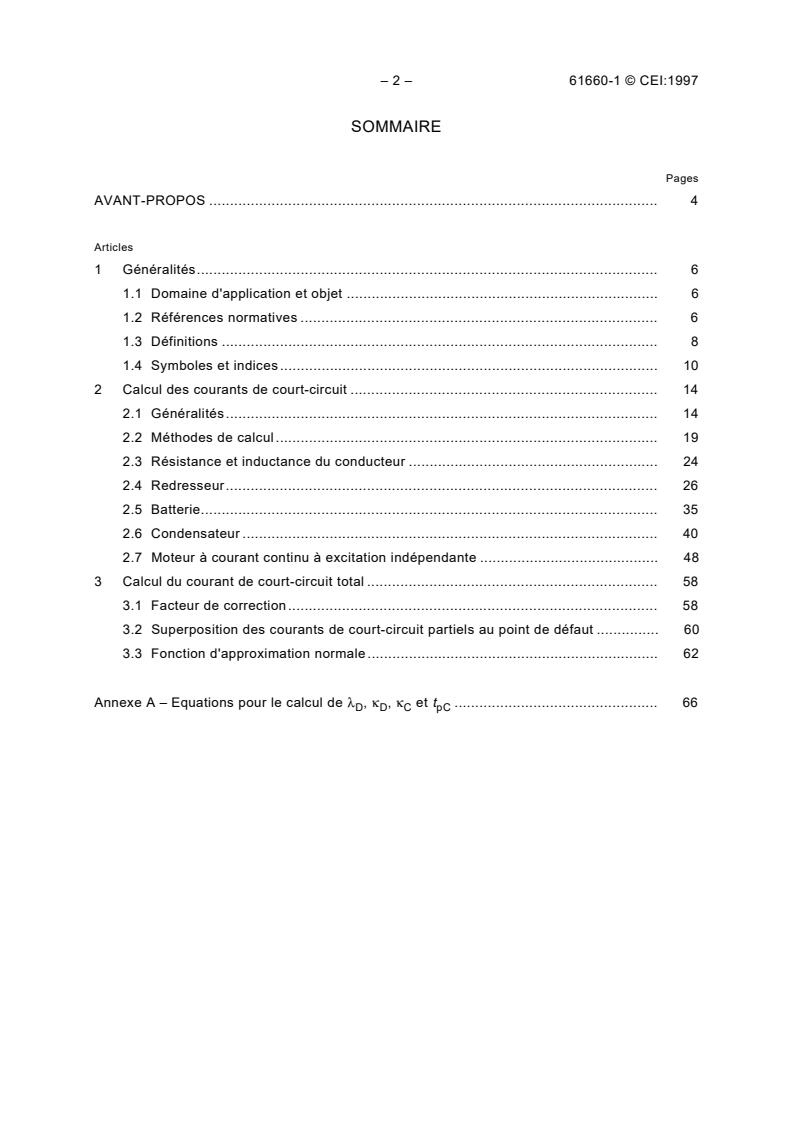
SOMMAIRE
Pages
AVANT-PROPOS . 4
Articles
1 Généralités. 6
1.1 Domaine d'application et objet . 6
1.2 Références normatives. 6
1.3 Définitions. 8
1.4 Symboles et indices . 10
2 Calcul des courants de court-circuit . 14
2.1 Généralités. 14
2.2 Méthodes de calcul. 19
2.3 Résistance et inductance du conducteur . 24
2.4 Redresseur. 26
2.5 Batterie. 35
2.6 Condensateur. 40
2.7 Moteur à courant continu à excitation indépendante . 48
3 Calcul du courant de court-circuit total . 58
3.1 Facteur de correction. 58
3.2 Superposition des courants de court-circuit partiels au point de défaut . 60
3.3 Fonction d'approximation normale. 62
Annexe A – Equations pour le calcul de λ , κ , κ et t . 66
D D C pC
61660-1 © IEC:1997 – 3 –
CONTENTS
Page
FOREWORD . 5
Clause
1 General. 7
1.1 Scope and object . 7
1.2 Normative references. 7
1.3 Definitions. 9
1.4 Symbols and subscripts . 11
2 Calculation of short-circuit currents. 15
2.1 General. 15
2.2 Calculating methods. 21
2.3 Resistance and inductance of conductor . 25
2.4 Rectifier. 27
2.5 Battery. 37
2.6 Capacitor. 41
2.7 DC motor with independent excitation . 49
3 Calculation of the total short-circuit current . 59
3.1 Correction factor. 59
3.2 Superimposing the partial short-circuit currents at the short-circuit location . 61
3.3 Standard approximation function. 63
Annex A – Equations for the calculation of λ , κ , κ and t
D D C pC . 67
– 4 – 61660-1 © CEI:1997
COMMISSION ÉLECTROTECHNIQUE INTERNATIONALE
____________
COURANTS DE COURT-CIRCUIT DANS LES INSTALLATIONS
AUXILIAIRES ALIMENTÉES EN COURANT CONTINU
DANS LES CENTRALES ET LES POSTES –
Partie 1: Calcul des courants de court-circuit
AVANT-PROPOS
1) La CEI (Commission Electrotechnique Internationale) est une organisation mondiale de normalisation
composée de l'ensemble des comités électrotechniques nationaux (Comités nationaux de la CEI). La CEI a
pour objet de favoriser la coopération internationale pour toutes les questions de normalisation dans les
domaines de l'électricité et de l'électronique. A cet effet, la CEI, entre autres activités, publie des Normes
Internationales. Leur élaboration est confiée à des comités d'études, aux travaux desquels tout Comité
national intéressé par le sujet traité peut participer. Les organisations internationales, gouvernementales et
non gouvernementales, en liaison avec la CEI, participent également aux travaux. La CEI collabore
étroitement avec l'Organisation Internationale de Normalisation (ISO), selon des conditions fixées par accord
entre les deux organisations.
2) Les décisions ou accords officiels de la CEI concernant les questions techniques, représentent, dans la
mesure du possible un accord international sur les sujets étudiés, étant donné que les Comités nationaux
intéressés sont représentés dans chaque comité d’études.
3) Les documents produits se présentent sous la forme de recommandations internationales. Ils sont publiés
comme normes, rapports techniques ou guides et agréés comme tels par les Comités nationaux.
4) Dans le but d'encourager l'unification internationale, les Comités nationaux de la CEI s'engagent à appliquer
de façon transparente, dans toute la mesure possible, les Normes internationales de la CEI dans leurs normes
nationales et régionales. Toute divergence entre la norme de la CEI et la norme nationale ou régionale
correspondante doit être indiquée en termes clairs dans cette dernière.
5) La CEI n’a fixé aucune procédure concernant le marquage comme indication d’approbation et sa
responsabilité n’est pas engagée quand un matériel est déclaré conforme à l’une de ses normes.
6) L’attention est attirée sur le fait que certains des éléments de la présente Norme internationale peuvent faire
l’objet de droits de propriété intellectuelle ou de droits analogues. La CEI ne saurait être tenue pour
responsable de ne pas avoir identifié de tels droits de propriété et de ne pas avoir signalé leur existence.
La Norme internationale CEI 61660-1 a été établie par le comité d’études 73 de la CEI:
Courants de court-circuit.
Le texte de cette norme est issu des documents suivants:
FDIS Rapport de vote
73/84/FDIS 73/97/RVD
Le rapport de vote indiqué dans le tableau ci-dessus donne toute information sur le vote ayant
abouti à l'approbation de cette norme.
L’annexe A est donnée uniquement à titre d’information.
La CEI 61660 comprend les parties suivantes, présentées sous le titre général: Courants de
court-circuit dans les installations auxiliaires alimentées en courant continu dans les centrales
et les postes:
– Partie 1: 1997, Calcul des courants de court-circuit
Calcul des effets
– Partie 2: 1997,
– Partie 3: 199X, Exemples de calcul (en préparation).
Le contenu des corrigenda de février 1999 et mars 2000 a été pris en considération dans cet
exemplaire.
61660-1 © IEC:1997 – 5 –
INTERNATIONAL ELECTROTECHNICAL COMMISSION
____________
SHORT-CIRCUIT CURRENTS IN DC AUXILIARY INSTALLATIONS
IN POWER PLANTS AND SUBSTATIONS –
Part 1: Calculation of short-circuit currents
FOREWORD
1) The IEC (International Electrotechnical Commission) is a worldwide organization for standardization
comprising all national electrotechnical committees (IEC National Committees). The object of the IEC is to
promote international co-operation on all questions concerning standardization in the electrical and electronic
fields. To this end and in addition to other activities, the IEC publishes International Standards. Their
preparation is entrusted to technical committees; any IEC National Committee interested in the subject dealt
with may participate in this preparatory work. International, governmental and non-governmental organizations
liaising with the IEC also participate in this preparation. The IEC collaborates closely with the International
Organization for Standardization (ISO) in accordance with conditions determined by agreement between the
two organizations.
2) The formal decisions or agreements of the IEC on technical matters express, as nearly as possible, an
international consensus of opinion on the relevant subjects since each technical committee has representation
from all interested National Committees.
3) The documents produced have the form of recommendations for international use and are published in the
form of standards, technical reports or guides and they are accepted by the National Committees in that
sense.
4) In order to promote international unification, IEC National Committees undertake to apply IEC International
Standards transparently to the maximum extent possible in their national and regional standards. Any
divergence between the IEC Standard and the corresponding national or regional standard shall be clearly
indicated in the latter.
5) The IEC provides no marking procedure to indicate its approval and cannot be rendered responsible for any
equipment declared to be in conformity with one of its standards.
6) Attention is drawn to the possibility that some of the elements of this International Standard may be the
subject of patent rights. The IEC shall not be held responsible for identifying any or all such patent rights.
International Standard 61660-1 has been prepared by IEC technical committee 73: Short-circuit
currents.
The text of this standard is based on the following documents:
FDIS Report on voting
73/84/FDIS 73/97/RVD
Full information on the voting for the approval of this standard can be found in the report on
voting indicated in the above table.
Annex A is for information only.
IEC 61660 consists of the following parts, under the general title: Short-circuit currents in d.c.
auxiliary installations in power plants and substations:
– Part 1: 1997, Calculation of short-circuit currents
– Part 2: 1997, Calculation of effects
– Part 3: 199X, Examples of calculations (in preparation).
The contents of the corrigenda of February 1999 and March 2000 have been included in this
copy.
– 6 – 61660-1 © CEI:1997
COURANTS DE COURT-CIRCUIT DANS LES INSTALLATIONS
AUXILIAIRES ALIMENTÉES EN COURANT CONTINU
DANS LES CENTRALES ET LES POSTES –
Partie 1: Calcul des courants de court-circuit
1 Généralités
1.1 Domaine d'application et objet
La présente partie de la CEI 61660 décrit une méthode de calcul des courants de court-circuit
des réseaux auxiliaires en courant continu dans des centrales et des postes. Ces réseaux
peuvent être équipés des éléments suivants, agissant comme sources de courants de court-
circuit:
– redresseurs dans des ponts triphasés en courant alternatif pour 50 Hz;
– batteries stationnaires au plomb;
– condensateurs de lissage;
– moteurs à courant continu avec excitation indépendante.
NOTE – Les redresseurs dans des ponts triphasés en courant alternatif pour 60 Hz sont à l'étude. Les
informations concernant d'autres matériels peuvent être données par le constructeur.
La présente norme prend en compte seulement les redresseurs dans des ponts triphasés en
courant alternatif. Elle ne concerne pas les autres types de redresseurs.
L'objet de cette norme est de fournir une méthode générale de calcul donnant des résultats
suffisamment précis et par excès. Des méthodes spéciales adaptées à des circonstances
particulières peuvent être utilisées si elles donnent au moins la même précision. Les courants
de court-circuit, les résistances et les inductances peuvent être vérifiés à partir de réseaux
d'essai ou des mesures sur des réseaux modèles. Dans les réseaux existants en courant
continu, les valeurs indispensables peuvent être vérifiées d'après des mesures prises au point
de court-circuit présumé. Le courant de charge n'est pas pris en considération pour le calcul du
courant de court-circuit. Il est nécessaire de faire la distinction entre deux différentes valeurs
de courant de court-circuit:
– le courant de court-circuit maximal, qui détermine les caractéristiques assignées du
matériel électrique;
– le courant de court-circuit minimal, qui peut être pris comme base pour l'installation et les
caractéristiques des fusibles et des protections.
1.2 Références normatives
Les documents normatifs suivants contiennent des dispositions qui, par suite de la référence
qui y est faite, constituent des dispositions valables pour la présente partie de la CEI 61660.
Au moment de la publication, les éditions indiquées étaient en vigueur. Tout document normatif
est sujet à révision et les parties prenantes aux accords fondés sur la présente partie de la
CEI 61660 sont invitées à rechercher la possibilité d’appliquer les éditions les plus récentes
des documents normatifs indiqués ci-après. Les membres de la CEI et de l’ISO possèdent le
registre des Normes internationales en vigueur.
CEI 60038: 1983, Tensions normales de la CEI
61660-1 © IEC:1997 – 7 –
SHORT-CIRCUIT CURRENTS IN DC AUXILIARY INSTALLATIONS
IN POWER PLANTS AND SUBSTATIONS –
Part 1: Calculation of short-circuit currents
1 General
1.1 Scope and object
This part of IEC 61660 describes a method for calculating short-circuit currents in d.c. auxiliary
systems in power plants and substations. Such systems can be equipped with the following
equipment, acting as short-circuit current sources:
– rectifiers in three-phase a.c. bridge connection for 50 Hz;
– stationary lead-acid batteries;
– smoothing capacitors;
– d.c. motors with independent excitation.
NOTE – Rectifiers in three-phase a.c. bridge connection for 60 Hz are under consideration. The data of other
equipment may be given by the manufacturer.
This standard is only concerned with rectifiers in three-phase a.c. bridge connection. It is not
concerned with other types of rectifiers.
The purpose of the standard is to provide a generally applicable method of calculation which
produces results of sufficient accuracy on the conservative side. Special methods, adjusted to
particular circumstances, may be used if they give at least the same precision. Short-circuit
currents, resistances and inductances may also be ascertained from system tests or
measurements on model systems. In existing d.c. systems the necessary values can be
ascertained from measurements taken at the assumed short-circuit location. The load current
is not taken into consideration when calculating the short-circuit current. It is necessary to
distinguish between two different values of short-circuit current:
– the maximum short-circuit current which determines the rating of the electrical
equipment;
– the minimum short-circuit current which can be taken as the basis for fuse and protection
ratings and settings.
1.2 Normative references
The following normative documents contain provisions which, through reference in this text,
constitute provisions of this part of IEC 61660. At the time of publication, the edition indicated
was valid. All normative documents are subject to revision, and parties to agreements based
on this part of IEC 61660 are encouraged to investigate the possibility of applying the most
recent editions of the normative documents indicated below. Members of IEC and ISO maintain
registers of currently valid International Standards.
IEC 60038: 1983, IEC standard voltages
– 8 – 61660-1 © CEI:1997
CEI 60050(151): 1978, Vocabulaire Electrotechnique International (VEI) – Chapitre 151:
Dispositifs électriques et magnétiques
CEI 60050 (441): 1984, Vocabulaire Electrotechnique International (VEI) – Chapitre 441:
Appareillage et fusibles
CEI 60896-1: 1987, Batteries stationnaires au plomb – Prescriptions générales et méthodes
d'essai – Partie 1:Batteries au plomb du type ouvert.
Modification 1 (1988).
Amendement 2 (1990)
CEI 60909: 1988, Calcul des courants de court-circuit dans les réseaux triphasés à courant
alternatif
CEI 61660-2: 1997, Calculs des courants de court-circuit dans les installations auxiliaires
alimentées en courant continu dans les centrales et les postes – Partie 2: Calcul des effets
1.3 Définitions
Pour les besoins de la présente partie de la CEI 61160, les définitions suivantes sont
applicables.
1.3.1 court-circuit: Connexion accidentelle ou intentionnelle, par une résistance ou une
impédance relativement faible de deux ou plusieurs points d'un circuit se trouvant normalement
à des tensions différentes. [VEI 151-03-41]
NOTE – Dans cette norme le branchement est supposé avoir une impédance égale à zéro.
1.3.2 courant de court-circuit: Surintensité résultant d'un court-circuit dû à un défaut ou un
branchement incorrect dans un circuit électrique. [VEI 441-11-07]
NOTE – Il y a lieu de distinguer entre le courant de court-circuit au point de défaut et le courant de court-circuit
circulant dans les branches du réseau.
1.3.3 courant de court-circuit partiel: Courant de court-circuit au point de défaut alimenté
par une source, les autres sources étant débranchées.
1.3.4 branche commune: Branche de réseau avec plusieurs courants de court-circuit
partiels provenant de différentes sources.
′′
1.3.5 courant de court-circuit symétrique initial I : Valeur efficace de la composante
k
symétrique alternative d'un courant de court-circuit présumé à l'instant d'apparition du court-
circuit, si l'impédance conserve sa valeur initiale.
1.3.6 courant de crête de court-circuit i : Valeur maximale instantanée du courant de
p
court-circuit présumé, côté courant continu (figures 1 et 2).
1.3.7 courant de court-circuit quasi permanent I : Valeur du courant de court-circuit côté
k
courant continu 1 s après le début du court-circuit.
1.3.8 temps pour atteindre la crête t : Temps entre le début du court-circuit et la valeur
p
crête du courant de court-circuit (figures 1 et 2).
1.3.9 durée du court-circuit T : Temps entre le début du court-circuit et la coupure du
k
courant continu de court-circuit.
1.3.10 tension nominale du réseau U : Tension (entre phases) désignant un réseau
n
alternatif triphasé et à laquelle certaines caractéristiques de fonctionnement font référence.
Les valeurs sont données dans la CEI 60038.
61660-1 © IEC:1997 – 9 –
IEC 60050(151): 1978, International Electrotechnical Vocabulary (IEV) – Chapter 151:
Electrical and magnetic devices
IEC 60050(441): 1984, International Electrotechnical Vocabulary (IEV) – Chapter 441:
Switchgear, controlgear and fuses
IEC 60896-1: 1987, Stationary lead-acid batteries – General requirements and methods of test
– Part 1: Vented types
Amendment 1 (1988)
Amendment 2 (1990)
IEC 60909: 1988, Short-circuit current calculation in three-phase a.c. systems
IEC 61660-2: 1997, Short-circuit currents in d.c. auxiliary installations in power plants and
substations – Part 2: Calculation of effects
1.3 Définitions
For the purpose of this part of IEC 61660, the following definitions apply.
1.3.1 short circuit: The accidental or intentional connection, by a relatively low resistance
or impedance, of two or more points in a circuit which are normally at different voltages.
[IEV 151-03-41]
NOTE – In this standard the connection is assumed to have zero impedance.
1.3.2 short-circuit current: An over-current resulting from a short circuit due to a fault or an
incorrect connection in an electric circuit. [IEV 441-11-07]
NOTE – It is necessary to distinguish between the short-circuit current at the short-circuit location and in the
network branches.
1.3.3 partial short-circuit current: The short-circuit current at the short-circuit location
being fed from one source with all other sources disconnected.
1.3.4 common branch: A network branch with several partial short-circuit currents from
different sources.
1.3.5 initial symmetrical short-circuit current I ′′ : The r.m.s. value of the a.c. symmetrical
k
component of a prospective short-circuit current applicable at the instant of short circuit if the
impedance remains at zero time value.
1.3.6 peak short-circuit current i : The maximum possible instantaneous value of the
p
prospective short-circuit current at the d.c. side (figures 1 and 2).
1.3.7 quasi steady-state short-circuit current I : The value of the short-circuit current at
k
the d.c. side 1 s after the beginning of the short circuit.
1.3.8 time to peak t : The interval between the initiation of the short circuit and the peak
p
value of the short-circuit current (figures 1 and 2).
1.3.9 short-circuit duration T : The time interval between the initiation of the short circuit
k
and the breaking of the d.c. short-circuit current.
1.3.10 nominal system voltage U : Voltage (line-to-line) by which a three-phase a.c.
n
system is designated and to which certain operating characteristics are referred. Values are
given in IEC 60038.
– 10 – 61660-1 © CEI:1997
1.3.11 tension nominale U d'une batterie au plomb: La tension nominale d'une batterie
nB
au plomb est donnée par le constructeur. Si la valeur est inconnue, la tension nominale d'un
élément de 2,0 V multipliée par le nombre d'éléments en série, peut être utilisée.
1.3.12 batterie stationnaire: Batterie conçue pour une utilisation à poste fixe et qui est en
permanence raccordée à la charge et au circuit de charge associée à la batterie (voir CEI 60896-1).
1.3.13 tension finale d'une batterie (tension à la fin de la décharge): Tension minimale
admise après un temps spécifié de décharge.
1.4 Symboles et indices
Toutes les équations sont écrites sans spécifier les unités. Les symboles représentent des
quantités ayant à la fois des valeurs numériques et des dimensions qui sont indépendantes
des unités pourvu qu'un système cohérent d'unités soit choisi, par exemple le système
international des unités (SI).
1.4.1 Symboles
A Section de conducteur
a Entraxe entre conducteurs
d Epaisseur de conducteur rectangulaire
C Capacité
c Facteur de tension selon la CEI 60909
cU / 3 Source de tension équivalente selon la CEI 60909
n
E Tension en circuit ouvert d'une batterie
B
f Fréquence de réseau
b Hauteur de conducteur rectangulaire
′′
I Courant de court-circuit symétrique initial triphasé
k
I Courant de court-circuit quasi permanent
k
I Courant assigné
r
i Valeur instantanée du courant
i ,i Sections de la fonction d'approximation normale
1 2
i Courant de court-circuit dans une branche
Br
i Courant de court-circuit de crête
p
i Courant corrigé
cor
J Moment d'inertie de l'ensemble de la partie rotative
k ,k Facteurs pour le calcul des constantes du temps de croissance et du temps de
1C 2C
décroissance du courant capacitif
k Facteur pour le calcul du temps pour atteindre la crête du courant du moteur
1M
k ,k Facteurs pour le calcul des constantes de temps de croissance du courant du
2M 3M
moteur
k Facteur pour le calcul des constantes de temps de décroissance du courant du
4M
moteur
L,L' Inductance/Inductance par unité
L Inductance saturée équivalente du circuit de charge en cas de court-circuit
F
61660-1 © IEC:1997 – 11 –
1.3.11 nominal voltage U of a lead-acid battery: The nominal voltage of a lead-acid
nB
battery is given by the manufacturer. If the value is unknown, then the nominal voltage of one
cell 2,0 V multiplied by the number of cells in series may be used.
1.3.12 stationary battery: A battery designed for service in a fixed location and which is
permanently connected to the load and to the associated battery charging circuit (see
IEC 60896-1).
1.3.13 final voltage of a battery (end-of-discharge voltage): The minimum permissible
voltage after a specified discharge time.
1.4 Symbols and subscripts
All equations are written without specifying units. The symbols represent quantities possessing
both numerical values and dimensions that are independent of units, provided a coherent unit
system is chosen, for example the International System of Units (SI).
1.4.1 Symbols
A Conductor cross-section
a Centre-line distance between conductors
d Thickness of rectangular conductor
C Capacitance
c Voltage factor according to IEC 60909
cU / 3 Equivalent voltage source according to IEC 60909
n
E Open-circuit voltage of a battery
B
f System frequency
b Height of rectangular conductor
′′
I Three-phase initial symmetrical short-circuit current
k
I Quasi steady-state short-circuit current
k
I Rated current
r
i Instantaneous value of current
i ,i Sections of the standard approximation function
1 2
i Short-circuit current in a branch
Br
i Peak short-circuit current
p
i Corrected current
cor
J Moment of inertia of the whole rotating part
k ,k Factors for calculating the rise-time and decay-time constant of the capacitor
1C 2C
current
k Factor for calculating the time to peak of the motor current
1M
k ,k Factors for calculating the rise-time constant of the motor current
2M 3M
k Factor for calculating the decay-time constant of the motor current
4M
L,L′ Inductance, inductance per unit length
L Equivalent saturated inductance of the field circuit at short circuit
F
– 12 – 61660-1 © CEI:1997
L Inductance non saturée équivalente du circuit de charge à charge nulle
OF
l Longueur
M Couple assigné d'un moteur
r
n, n ,n Vitesse de moteur/vitesse de moteur à charge nulle/vitesse nominale de moteur
o n
p Rapport I /i
k p
R,R′ Résistance/résistance par unité
R Résistance de jonction
joint
r Rayon du conducteur
T Durée du court-circuit
k
t
Temps
t Temps jusqu'à la crête
p
U Tension au point de court-circuit avant le court-circuit
U Tension normale de réseau triphasé à courant alternatif, entre-phase (valeur
n
efficace)
U Tension nominale d'une batterie
nB
X Réactance
Z Impédance du réseau triphasé à courant alternatif
N
δ Coefficient de décroissance
κ Facteur pour le calcul du courant de court-circuit de crête
λ Facteur pour le calcul du courant de court-circuit quasi permanent du redresseur
d
–7
μ Perméabilité absolue du vide, μ = 4 π ⋅ 10 H/m
o o
ρ Résistivité
σ Facteur de correction pour le courant de court-circuit partiel
τ Constante de temps de l'armature du moteur
M
τ Constante de temps du circuit de champ du moteur
F
τ Constante de temps mécanique du moteur
mec
τ ,τ Constante de temps de croissance/de décroissance de la fonction d'approximation
1 2
normale
ω , ω
Fréquence angulaire propre sans/avec amortissement
o d
1.4.2 Indices
a.c. Courant alternatif
B Batterie
Br Branche côté courant continu
C Condensateur
cor Corrigé
D Redresseur
d.c. Courant continu
F Point du court-circuit
F Circuit de champ du moteur
61660-1 © IEC:1997 – 13 –
L Equivalent unsaturated inductance of the field circuit at no-load
OF
l Length
M Rated torque of the motor
r
n,n ,n Motor speed, no-load motor speed, nominal motor speed
o n
p Ratio I /i
k p
R,R ′ Resistance, resistance per unit length
R Joint resistance
joint
r Radius of the conductor
T Short-circuit duration
k
t Time
t Time to peak
p
U Voltage at the short-circuit location before short circuit
U Nominal system voltage of the three-phase a.c. system, line-to-line (r.m.s.)
n
U Nominal voltage of a battery
nB
X Reactance
Z Impedance of the three-phase a.c. network
N
δ Decay coefficient
κ Factor for calculating the peak short-circuit current
λ Factor for calculating the quasi steady-state short-circuit current of the rectifier
D
–7
μ Absolute permeability of vacuum, μ = 4 π ⋅ 10 H/m
o o
ρ Resistivity
σ Correction factor for the partial short-circuit current
τ Armature time constant of the motor
M
τ Field circuit time constant of the motor
F
τ Mechanical time constant of the motor
mec
τ , τ Rise-time, decay-time constants of the standard approximation function
1 2
ω ,ω Undamped, damped natural angular frequency
o d
1.4.2 Subscripts
a.c. Alternating current
B Battery
Br Branch on the d.c. side
C Capacitor
cor Corrected
D Rectifier
d.c. Direct current
F Short-circuit location
F Field circuit of the motor
– 14 – 61660-1 © CEI:1997
HV, LV Haute tension, basse tension
i Interne
j,m Numéro de la source de tension
k Court-circuit
L Ligne
M Moteur
max, min Maximal/minimal
mec mécanique
N Réseau triphasé à courant alternatif
n Nominal
pCrête
P Câble de puissance
Q Entrée du réseau selon CEI 60909
R Réactance de commutation
r Assigné
res Résiduel
S Réactance de lissage
T Transformateur
Y Branche commune
O Charge nulle/sans amortissement
2 Calcul des courants de court-circuit
2.1
Généralités
Un calcul complet des courants de court-circuit fournit les variations en fonction du temps des
courants au point de défaut, depuis le début du court-circuit jusqu'à sa fin; étant donné les
variations nombreuses du courant et la non-linéarité du matériel, ces calculs ne peuvent être
effectués que par des moyens numériques. Le coût en est très élevé, en particulier du fait qu’il
n'y a pas de méthodes universelles de calcul. Pour cette raison, seul le calcul des grandeurs
caractéristiques est traité.
La figure 1 montre les courants de court-circuit typiques de plusieurs sources. Le courant de
court-circuit total au point de défaut peut être produit par plusieurs sources différentes.
La figure 2 montre la fonction d'approximation normale couvrant les différentes variations de
courant. La fonction est décrite par les équations (1) à (3).
−tτ
1e−
it()=i 0 ≤ t ≤ t (1)
1p p
−t τ
p1
1e−
−−tt τ
()
p2
it()=−i()1ep +p t ≤ t (2)
2p p
61660-1 © IEC:1997 – 15 –
HV, LV High voltage, low voltage
i Internal
j,m Numeral/number of the voltage source
k Short circuit
LLine
M Motor
max, min Maximum, minimum
mec Mechanical
N Three-phase a.c. network
n Nominal
p Peak
P Power cable
Q Feeder connection point according to IEC 60909
R Commutation reactor
r Rated
res Residual
S Smoothing reactor
T Transformer
Y Common branch
O No load/undamped
2 Calculation of short-circuit currents
2.1 General
A complete calculation of the short-circuit currents provides details of the time variation of the
currents at the short-circuit location, from the initiation of the short circuit to its end. Due to
many variations of current and the non-linearity of equipment, such calculations can only be
performed by numerical means. The expense is very high, especially since there are no
universal methods of calculation. For this reason only calculation of characteristic quantities is
dealt with.
Figure 1 shows the typical short-circuit currents of various sources. The total short-circuit
current at the short-circuit location may be produced by the action of several different sources.
Figure 2 shows the standard approximation function which covers the different current
variations. The function is described by equations (1) to (3).
−tτ
1e−
()
it =i 0 ≤ t ≤ t (1)
1p p
−t τ
p1
1e−
−−tt τ
()
p2
()
it=−i()1ep +p t ≤ t (2)
2p p
– 16 – 61660-1 © CEI:1997
I
k
p = (3)
i
p
où
i est le courant de crête;
p
I est le courant de court-circuit quasi permanent;
k
t est le temps jusqu'à la crête;
p
τ est la constante de temps de croissance;
τ est la constante de temps de décroissance.
S'il n'y a pas de courant maximal défini, alors i = I et t = T l'équation (1) décrit alors toute
p k p k;
la variation dans le temps du courant de court-circuit.
Par calcul des grandeurs caractéristiques pour la variation dans le temps du courant de court-
circuit selon la figure 2, les contraintes mécaniques et thermiques dues au court-circuit
peuvent être vérifiées. Il convient d'utiliser les équations (13), (22), (36) et (37) lorsque les
courants de court-circuit quasi permanents seulement sont requis.
Les hypothèses de l'impédance zéro entre les points de potentiel différent au point du défaut et
la non prise en compte des résistances de charge (résistances shunts) sont valables pour le
calcul des courants maximaux et minimaux de court-circuit.
Lors du calcul des courants de court-circuit maximaux, les conditions de commutation et de
fonctionnement suivantes doivent être prises en compte, de telle façon que le plus grand
courant de court-circuit circule:
– les résistances des conducteurs sont référencées à la température de 20 °C;
– les résistances de jonction des jeux de barre sont négligées;
– le contrôle pour limiter le courant du redresseur n'est pas efficace;
– les diodes pour découpler les parties du réseau sont négligées;
– la batterie est chargée à pleine capacité;
– l'effet de limitation du courant par les fusibles ou d'autres dispositifs de protection doit
être pris en compte.
Lors du calcul des courants de court-circuit minimaux, les conditions de commutation et de
fonctionnement suivantes doivent être prises en compte, de telle façon que le courant de court-
circuit minimal circule:
– les résistances de conducteur sont référencées à la température maximale de
fonctionnement;
– les résistances de jonction doivent être prises en compte (voir 2.3.1);
– la contribution du redresseur est le courant de court-circuit assigné;
– la batterie est à la tension finale comme spécifié par le constructeur;
– les diodes de découplage des parties du réseau sont prises en compte;
– les effets de limitation du courant dus aux fusibles ou à d’autres dispositifs de protection
doivent être pris en compte.
61660-1 © IEC:1997 – 17 –
I
k
p = (3)
i
p
where
i is the peak short-circuit current;
p
I is the quasi steady-state short-circuit current;
k
t is the time to peak;
p
τ is the rise-time constant;
τ is the decay-time constant.
If there is no defined maximum current present, then i = I and t = T ; equation (1) then
p k p k
describes the whole time variation of the short-circuit current.
By calculation of the characteristic quantities for the time variation of the short-circuit current
according to figure 2, the mechanical and thermal short-circuit stresses can be ascertained. If
only the quasi steady-state short-circuit currents are required, the equations (13), (22), (36)
and (37) should be used.
The assumptions that the impedance is zero between points of different potential at the
short-circuit location and that the load resistances (shunt resistors) can be ignored, are valid
for calculation of both the maximum and minimum short-circuit currents.
When calculating the maximum short-circuit currents the following switching and operating
conditions shall be taken into account so that the maximum short-circuit current is flowing:
– the conductor resistances are referred to a temperature of 20 °C;
– the joint resistances of the busbars are neglected;
– the control for limiting the rectifier current is not effective;
– any diodes for decoupling parts of the system are neglected;
– the battery is charged to full capacity;
– the current-limiting effect of fuses or other protective devices shall be taken into account.
When calculating the minimum short-circuit currents the following switching and operating
conditions shall be taken into account so that the minimum short-circuit current is flowing:
– the conductor resistances are referred to the maximum operating temperature;
– the joint resistances shall be taken into account (see 2.3.1);
– the contribution of the rectifier is the rated short-circuit current;
– the battery is at the final voltage as specified by the manufacturer;
– any diodes for decoupling parts of the system are taken into account;
– the current-limiting effect of fuses or other protective devices shall be taken into account.
– 18 – 61660-1 © CEI:1997
i
D i
B
i i
pD pB
I I
kD kB
I
kD
t t
t t
pB
pD
IEC 679/97
IEC 680/97
Figure 1a – Redresseur sans et avec
Figure 1b – Batterie
réactance de lissage
i i
C M
i
pC
i
pM
I
kM
I
kM
t
t t
t
pC
pM
IEC 681/97 IEC 682/97
Figure 1c – Condensateur Figure 1d
___
Moteur sans masse supplémentaire d’inertie
..... Moteur avec masse supplémentaire d’inertie
Figure 1 – Courbe de courants de court-circuit typiques
i
τ
i
p
(t)
i
(t)
i
I
k
τ
I Courant de court-circuit quasi
k
permanent
i Courant de crête du court-circuit
p
T Durée de court-circuit
k
t Temps jusqu'à la crête
p
0 τ Constante de temps de croissance
t T t 1
p k
IEC 683/97
τ Constante de temps de décroissance
Figure 2 – Fonction d'approximation normale
61660-1 © IEC:1997 – 19 –
i
D i
B
i i
pD pB
I I
kD kB
I
kD
t t
t t
pB
pD
IEC 679/97
IEC 680/97
Figure 1a – Rectifier without and with
Figure 1b – Battery
smoothing reactor
i i
C M
i
pC
i
pM
I
kM
I
kM
t
t t
t
pC
pM
IEC 681/97 IEC 682/97
Figure 1c – Capacitor Figure 1d
___
Motor without additional inertia mass
..... Motor with additional inertia mass
Figure 1 – Diagrams of typical short-circuit currents
i
τ
i
p
(t)
i
(t)
i
I
k
I Quasi steady-state short-circuit
k
current
τ
i Peak short-circuit current
p
T Short-circuit duration
k
t Time to peak
p
τ Rise-time constant
τ Decay-time constant
t T t
p k
IEC 683/97
Figure 2 – Standard approximation function
– 20 – 61660-1 © CEI:1997
2.2 Méthodes de calcul
La figure 3 montre le diagramme de circuit équivalent d'un réseau contenant quatre sources:
un redresseur dans un pont triphasé, une batterie, un condensateur et un moteur. Pour les
grandeurs caractéristiques des diagrammes de circuit équivalents de ces sources, voir ci-après
en 2.4, 2.5, 2.6 et 2.7.
Lorsque le diagramme de circuit équivalent contient seulement une source, le courant de court-
circuit au point de défaut est calculé en tenant compte seulement des séries de résistances et
d'inductances.
L
...