

IEC TS 62153-4-1:2014
(Main)Metallic communication cable test methods - Part 4-1: Electromagnetic compatibility (EMC) - Introduction to electromagnetic screening measurements
General Information
- Abstract
IEC TS 62153-4-1:2014(E) deals with screening measurements. Screening (or shielding) is one basic way of achieving electromagnetic compatibility (EMC). However, a confusingly large number of methods and concepts is available to test for the screening quality of cables and related components, and for defining their quality. This technical specification gives a brief introduction to basic concepts and terms trying to reveal the common features of apparently different test methods. It is intended to assist in correct interpretation of test data, and in the better understanding of screening (or shielding) and related specifications and standards. This technical specification cancels and replaces the second edition of the technical report IEC/TR 62153-4-1 published in 2010.
- Status
- Published
- Publication Date
- 06-May-2020
- Current Stage
- PPUB - Publication issued
- Start Date
- 22-Jan-2014
- Completion Date
- 31-Mar-2014
Buy Documents
IEC TS 62153-4-1:2014 - Metallic communication cable test methods - Part 4-1: Electromagnetic compatibility (EMC) - Introduction to electromagnetic screening measurements Released:1/22/2014

IEC TS 62153-4-1:2014+AMD1:2020 CSV - Metallic communication cable test methods - Part 4-1: Electromagnetic compatibility (EMC) - Introduction to electromagnetic (EMC) screening measurements Released:5/7/2020
Overview
IEC TS 62153-4-1:2014 is a technical specification from the IEC that provides an introductory framework for electromagnetic screening (shielding) measurements of metallic communication cables and related components. It explains the basic concepts, measurement set-ups and parameters used to assess cable screening quality, clarifies similarities between multiple test methods, and supports correct interpretation of screening test data. This TS replaces IEC/TR 62153-4-1 (2010) and is consolidated with later amendments.
Key Topics
- Fundamental EMC concepts: total electromagnetic field, near‑ and far‑end coupling, and how screening contributes to electromagnetic compatibility (EMC).
- Intrinsic screening parameters: definition and interpretation of surface transfer impedance (Z) and capacitive coupling admittance (Y = jωC) as primary metrics for screen quality.
- Measurement methods and set-ups: triaxial (triax) set-ups, tube‑in‑tube layouts, double‑short circuited methods, and comparisons between test configurations for transfer impedance and screening attenuation.
- Screening attenuation and coupling functions: theoretical background for screening attenuation, normalized attenuation, and length‑dependent coupling behavior of long cables (coupled transmission-line effects).
- Screens and assemblies: behavior of braided wire screens, overbraided vs underbraided constructions, connectors, feed‑throughs, gaskets and coaxial assemblies.
- Practical test considerations: influence of mismatches, contact resistance, and measurement fixtures; guidance for interpreting frequency responses and S‑parameter (mixed‑mode) data (Annex A/B).
- Comparative analysis: links to standard methods (e.g., EN 50289‑1‑6, IEC 61196‑1, IEC 62153‑4‑3/4‑4/4‑7/4‑10) and simulation vs measurement insights.
Applications
Who uses IEC TS 62153-4-1 and why:
- EMC engineers and test labs - to choose appropriate screening tests and correctly interpret transfer impedance and screening attenuation results.
- Cable and connector designers - to understand how construction (braid, foil, gaskets) affects shielding effectiveness across frequency and length.
- System integrators and procurement specialists - to specify measurable screening requirements in contracts and product specifications.
- Standards writers and compliance officers - to harmonize test approaches and compare data from different measurement methods.
Practical uses include evaluating cable shielding for telecom, data center cabling, RF systems, and ensuring EMC compliance where cable-borne emissions or immunity matter.
Related Standards
- EN 50289-1-6, IEC 61196-1 (method references)
- IEC 62153 family (parts 4‑3, 4‑4, 4‑7, 4‑10) - specific measurement techniques for transfer impedance, screening attenuation, connectors and feed‑throughs
- IEC/TR 62153‑4‑1 (2010) - superseded by this TS
Keywords: IEC TS 62153-4-1, cable screening, shielding measurements, transfer impedance Z, screening attenuation, EMC testing, triaxial set-up, mixed-mode S-parameters.
Relations
- Effective Date
- 05-Sep-2023
- Effective Date
- 10-Feb-2026
- Effective Date
- 10-Feb-2026
- Effective Date
- 10-Feb-2026
- Effective Date
- 10-Feb-2026
- Effective Date
- 05-Sep-2023
Buy Documents
IEC TS 62153-4-1:2014 - Metallic communication cable test methods - Part 4-1: Electromagnetic compatibility (EMC) - Introduction to electromagnetic screening measurements Released:1/22/2014
IEC TS 62153-4-1:2014+AMD1:2020 CSV - Metallic communication cable test methods - Part 4-1: Electromagnetic compatibility (EMC) - Introduction to electromagnetic (EMC) screening measurements Released:5/7/2020
Get Certified
Connect with accredited certification bodies for this standard

ANCE
Mexican certification and testing association.

Intertek Slovenia
Intertek testing, inspection, and certification services in Slovenia.

LNE (Laboratoire National de Métrologie et d'Essais)
French national laboratory for metrology and testing.
Sponsored listings
Frequently Asked Questions
IEC TS 62153-4-1:2014 is a technical specification published by the International Electrotechnical Commission (IEC). Its full title is "Metallic communication cable test methods - Part 4-1: Electromagnetic compatibility (EMC) - Introduction to electromagnetic screening measurements". This standard covers: IEC TS 62153-4-1:2014(E) deals with screening measurements. Screening (or shielding) is one basic way of achieving electromagnetic compatibility (EMC). However, a confusingly large number of methods and concepts is available to test for the screening quality of cables and related components, and for defining their quality. This technical specification gives a brief introduction to basic concepts and terms trying to reveal the common features of apparently different test methods. It is intended to assist in correct interpretation of test data, and in the better understanding of screening (or shielding) and related specifications and standards. This technical specification cancels and replaces the second edition of the technical report IEC/TR 62153-4-1 published in 2010.
IEC TS 62153-4-1:2014(E) deals with screening measurements. Screening (or shielding) is one basic way of achieving electromagnetic compatibility (EMC). However, a confusingly large number of methods and concepts is available to test for the screening quality of cables and related components, and for defining their quality. This technical specification gives a brief introduction to basic concepts and terms trying to reveal the common features of apparently different test methods. It is intended to assist in correct interpretation of test data, and in the better understanding of screening (or shielding) and related specifications and standards. This technical specification cancels and replaces the second edition of the technical report IEC/TR 62153-4-1 published in 2010.
IEC TS 62153-4-1:2014 is classified under the following ICS (International Classification for Standards) categories: 33.100.10 - Emission. The ICS classification helps identify the subject area and facilitates finding related standards.
IEC TS 62153-4-1:2014 has the following relationships with other standards: It is inter standard links to IEC TR 62153-4-1:2010, EN IEC 62153-4-15:2021, EN 62153-4-7:2016, EN IEC 62153-4-5:2021, EN IEC 62153-4-7:2021, IEC TS 62153-4-1:2014/AMD1:2020. Understanding these relationships helps ensure you are using the most current and applicable version of the standard.
IEC TS 62153-4-1:2014 is available in PDF format for immediate download after purchase. The document can be added to your cart and obtained through the secure checkout process. Digital delivery ensures instant access to the complete standard document.
Standards Content (Sample)
IEC TS 62153-4-1 ®
Edition 1.0 2014-01
TECHNICAL
SPECIFICATION
colour
inside
Metallic communication cable test methods –
Part 4-1: Electromagnetic compatibility (EMC) – Introduction to electromagnetic
screening measurements
All rights reserved. Unless otherwise specified, no part of this publication may be reproduced or utilized in any form
or by any means, electronic or mechanical, including photocopying and microfilm, without permission in writing from
either IEC or IEC's member National Committee in the country of the requester. If you have any questions about IEC
copyright or have an enquiry about obtaining additional rights to this publication, please contact the address below or
your local IEC member National Committee for further information.
IEC Central Office Tel.: +41 22 919 02 11
3, rue de Varembé Fax: +41 22 919 03 00
CH-1211 Geneva 20 info@iec.ch
Switzerland www.iec.ch
About the IEC
The International Electrotechnical Commission (IEC) is the leading global organization that prepares and publishes
International Standards for all electrical, electronic and related technologies.
About IEC publications
The technical content of IEC publications is kept under constant review by the IEC. Please make sure that you have the
latest edition, a corrigenda or an amendment might have been published.
IEC Catalogue - webstore.iec.ch/catalogue Electropedia - www.electropedia.org
The stand-alone application for consulting the entire The world's leading online dictionary of electronic and
bibliographical information on IEC International Standards, electrical terms containing more than 30 000 terms and
Technical Specifications, Technical Reports and other definitions in English and French, with equivalent terms in 14
documents. Available for PC, Mac OS, Android Tablets and additional languages. Also known as the International
iPad. Electrotechnical Vocabulary (IEV) online.
IEC publications search - www.iec.ch/searchpub IEC Glossary - std.iec.ch/glossary
The advanced search enables to find IEC publications by a More than 55 000 electrotechnical terminology entries in
variety of criteria (reference number, text, technical English and French extracted from the Terms and Definitions
committee,…). It also gives information on projects, replaced clause of IEC publications issued since 2002. Some entries
and withdrawn publications. have been collected from earlier publications of IEC TC 37,
77, 86 and CISPR.
IEC Just Published - webstore.iec.ch/justpublished
Stay up to date on all new IEC publications. Just Published IEC Customer Service Centre - webstore.iec.ch/csc
details all new publications released. Available online and If you wish to give us your feedback on this publication or
also once a month by email. need further assistance, please contact the Customer Service
Centre: csc@iec.ch.
IEC TS 62153-4-1 ®
Edition 1.0 2014-01
TECHNICAL
SPECIFICATION
colour
inside
Metallic communication cable test methods –
Part 4-1: Electromagnetic compatibility (EMC) – Introduction to electromagnetic
screening measurements
INTERNATIONAL
ELECTROTECHNICAL
COMMISSION
PRICE CODE
XD
ICS 33.100 ISBN 978-2-8322-1311-7
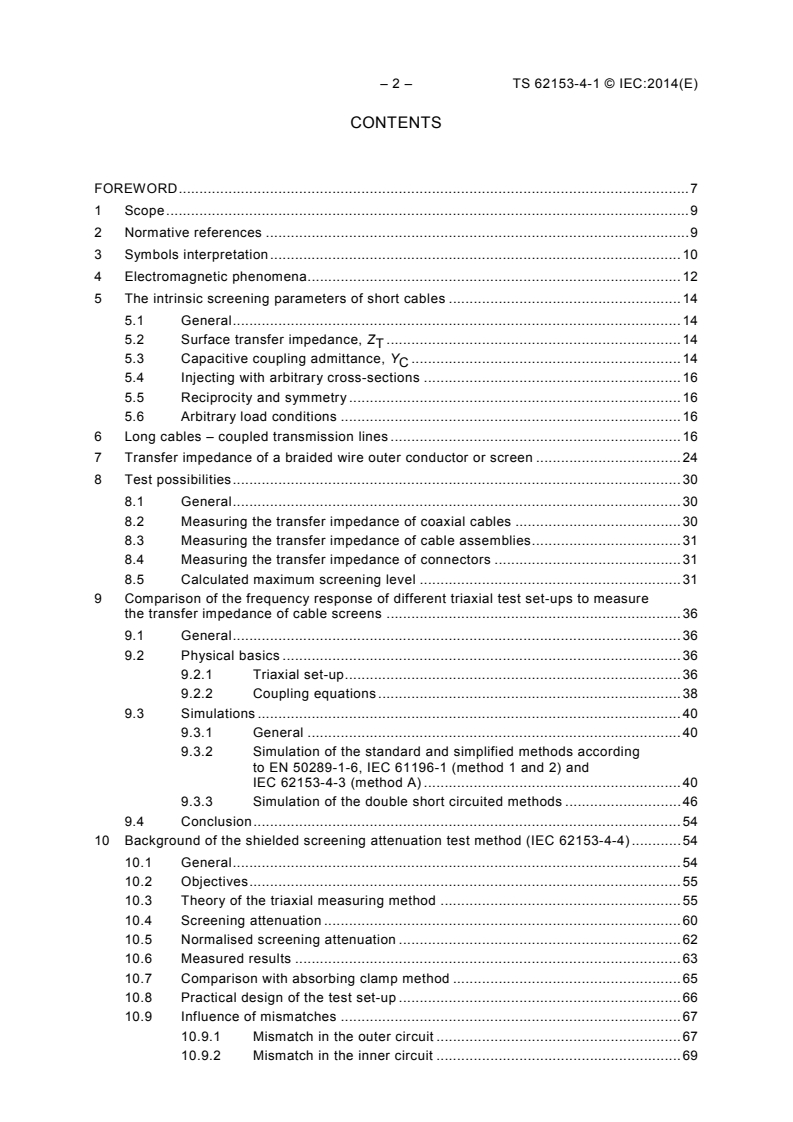
– 2 – TS 62153-4-1 © IEC:2014(E)
CONTENTS
FOREWORD . 7
1 Scope . 9
2 Normative references . 9
3 Symbols interpretation . 10
4 Electromagnetic phenomena. 12
5 The intrinsic screening parameters of short cables . 14
5.1 General . 14
5.2 Surface transfer impedance, Z . 14
T
5.3 Capacitive coupling admittance, Y . 14
C
5.4 Injecting with arbitrary cross-sections . 16
5.5 Reciprocity and symmetry . 16
5.6 Arbitrary load conditions . 16
6 Long cables – coupled transmission lines . 16
7 Transfer impedance of a braided wire outer conductor or screen . 24
8 Test possibilities . 30
8.1 General . 30
8.2 Measuring the transfer impedance of coaxial cables . 30
8.3 Measuring the transfer impedance of cable assemblies . 31
8.4 Measuring the transfer impedance of connectors . 31
8.5 Calculated maximum screening level . 31
9 Comparison of the frequency response of different triaxial test set-ups to measure
the transfer impedance of cable screens . 36
9.1 General . 36
9.2 Physical basics . 36
9.2.1 Triaxial set-up . 36
9.2.2 Coupling equations . 38
9.3 Simulations . 40
9.3.1 General . 40
9.3.2 Simulation of the standard and simplified methods according
to EN 50289-1-6, IEC 61196-1 (method 1 and 2) and
IEC 62153-4-3 (method A) . 40
9.3.3 Simulation of the double short circuited methods . 46
9.4 Conclusion . 54
10 Background of the shielded screening attenuation test method (IEC 62153-4-4) . 54
10.1 General . 54
10.2 Objectives . 55
10.3 Theory of the triaxial measuring method . 55
10.4 Screening attenuation . 60
10.5 Normalised screening attenuation . 62
10.6 Measured results . 63
10.7 Comparison with absorbing clamp method . 65
10.8 Practical design of the test set-up . 66
10.9 Influence of mismatches . 67
10.9.1 Mismatch in the outer circuit . 67
10.9.2 Mismatch in the inner circuit . 69
TS 62153-4-1 © IEC:2014(E) – 3 –
11 Background of the shielded screening attenuation test method for measuring the
screening effectiveness of feed-throughs and electromagnetic gaskets
(IEC 62153-4-10) . 72
11.1 General . 72
11.2 Theoretical background of the test Fixtures and their equivalent circuit . 73
11.3 Pictures and measurement results . 76
11.3.1 Characteristic impedance uniformity . 76
11.3.2 Measurements of shielding effectiveness . 78
11.3.3 Calculation of transfer impedance . 80
11.4 Calculation of screening attenuation for feed-through when the transfer
impedance Z is known . 82
T
12 Background of the shielded screening attenuation test method for measuring the
screening effectiveness of RF connectors and assemblies (IEC 62153-4-7) . 83
12.1 Physical basics . 83
12.1.1 Surface transfer impedance Z . 83
T
12.1.2 Screening attenuation a . 84
S
12.1.3 Coupling attenuation a . 84
C
12.1.4 Coupling transfer function . 84
12.1.5 Relationship between length and screening measurements . 85
12.2 Tube in tube set-up (IEC 62153-4-7) . 86
12.2.1 General . 86
12.2.2 Procedure . 86
12.2.3 Measurements and simulations . 88
12.2.4 Influence of contact resistances . 89
Bibliography . 91
Figure 1 – Total electromagnetic field . 12
(E ,H )
t t
Figure 2 – Defining and measuring screening parameters – A triaxial set-up . 13
Figure 3 – Equivalent circuit for the testing of Z . 15
T
Figure 4 – Equivalent circuit for the testing of Y = j ωC . 15
c T
Figure 5 – Electrical quantities in a set-up that is matched at both ends . 16
Figure 6 – The summing function S{L·f} for near and far end coupling . 20
Figure 7 – Transfer impedance of a typical single braid screen . 20
Figure 8 – The effect of the summing function on the coupling transfer function of a
typical single braid screen cable . 21
Figure 9 – Calculated coupling transfer functions T and T for a single braid – Z = 0 . 21
n f F
Figure 10 – Calculated coupling transfer functions T and T for a single braid – Im(Z )
n f T
is positive and Z = +0,5 × Im(Z ) at high frequencies . 22
F T
Figure 11 – Calculated coupling transfer functions T and T for a single braid – Im(Z )
n f T
is negative and Z = –0,5 × Im(Z ) at high frequencies. 23
F T
Figure 12 – : the complete length dependent factor in the coupling function T . 24
L·S
Figure 13 – Transfer impedance of typical cables . 25
Figure 14 – Magnetic coupling in the braid – Complete flux. 26
Figure 15 – Magnetic coupling in the braid – Left-hand lay contribution . 26
Figure 16 – Magnetic coupling in the braid – Right-hand lay contribution . 26
Figure 17 – Complex plane, Z = Re Z + j Im Z , frequency f as parameter . 27
T T T
Figure 18 – Magnitude (amplitude), | Z (f) | . 27
T
– 4 – TS 62153-4-1 © IEC:2014(E)
Figure 19 – Typical Z (time) step response of an overbraided and underbraided single
T
braided outer conductor of a coaxial cable . 28
Figure 20 – Z equivalent circuits of a braided wire screen . 29
T
Figure 21 – Comparison of signal levels in a generic test setup . 32
Figure 22 – Triaxial set-up for the measurement of the transfer impedance Z . 36
T
Figure 23 – Equivalent circuit of the triaxial set-up . 37
Figure 24 – Simulation of the frequency response for g . 41
Figure 25 – Simulation of the frequency response for g . 41
Figure 26 – Simulation of the frequency response for g . 42
Figure 27 – Simulation of the frequency response for g . 42
Figure 28 – Simulation of the 3 dB cut off wavelength (L/λ ) . 43
Figure 29 – Interpolation of the simulated 3 dB cut off wavelength (L/λ ) . 43
Figure 30 – 3 dB cut-off frequency length product as a function of the dielectric
permittivity of the inner circuit (cable) . 44
Figure 31 – Measurement result of the normalised voltage drop of a single braid
screen on a solid PE dielectric in the triaxial set-up . 45
Figure 32 – Measurement result of the normalised voltage drop of a single braid
screen on a foam PE dielectric in the triaxial set-up . 46
Figure 33 – Triaxial set-up (measuring tube), double short circuited method . 47
Figure 34 – Simulation of the frequency response for g of a cable having solid PE
dielectric (ε =2,3) . 48
r1
Figure 35 – Simulation of the frequency response for g of a cable having foamed PE
dielectric (ε =1,6) . 48
r1
Figure 36 – Simulation of the frequency response for g of a cable having foamed PE
dielectric (ε =1,3) . 49
r1
Figure 37 – Simulation of the frequency response for g of a cable having PVC
dielectric (ε =5) . 49
r1
Figure 38 – Interpolation of the simulated 3 dB cut off wavelength (L/λ ) . 50
Figure 39 – 3 dB cut-off frequency length product as a function of the dielectric
permittivity of the inner circuit (cable) . 51
Figure 40 – Simulation of the frequency response for g . 52
Figure 41 – Interpolation of the simulated 3 dB cut off wavelength (L/λ ) . 53
Figure 42 – 3 dB cut-off frequency length product as a function of the dielectric
permittivity of the inner circuit (cable) . 53
Figure 43 – Definition of transfer impedance . 55
Figure 44 – Definition of coupling admittance . 55
Figure 45 – Triaxial measuring set-up for screening attenuation . 56
Figure 46 – Equivalent circuit of the triaxial measuring set-up . 56
Figure 47 – Calculated voltage ratio for a typical braided cable screen . 58
Figure 48 – Calculated periodic functions for ε = 2,3 and ε = 1,1 . 59
r1 r2
Figure 49 – Calculated voltage ratio-typical braided cable screen . 59
Figure 50 – Equivalent circuit for an electrical short part of the length ∆l and negligible
capacitive coupling . 61
Figure 51 – a of single braid screen, cable type RG 58, L = 2 m . 63
s
Figure 52 – a of single braid screen, cable type RG 58, L = 0,5 m . 64
s
Figure 53 – a of cable type HF 75 0,7/4,8 2YCY (solid PE dielectric). 64
s
TS 62153-4-1 © IEC:2014(E) – 5 –
Figure 54 – a of cable type HF 75 1,0/4,8 02YCY (foam PE dielectric) . 65
s
Figure 55 – a of double braid screen, cable type RG 223 . 65
s
Figure 56 – Schematic for the measurement of the screening attenuation a . 67
s
Figure 57 – Short circuit between tube and cable screen of the CUT . 67
Figure 58 – Triaxial set-up, impedance mismatches . 68
Figure 59 – Calculated voltage ratio including multiple reflections caused by the
screening case . 69
Figure 60 – Calculated voltage ratio including multiple reflections caused by the
screening case . 69
Figure 61 – Attenuation and return loss of a self-made 50 Ω to 5 Ω impedance
matching adapter . 70
Figure 62 – equivalent circuit of a load resistance connected to a source . 71
Figure 63 – Cross-sectional sketch of a typical feed-through configuration . 72
Figure 64 – Cross-sectional sketch of the test fixture with a feed-through connector (a)
and EMI gasket (b) under test . 73
Figure 65 – Equivalent circuit of the test fixture . 74
Figure 66 –Two-port network . 74
Figure 67 – TDR measurement of the text-fixture with inserted “Teflon-through” sample . 76
Figure 68 – TDR step response from A (Input)-port of test fixture with inserted “Teflon-
through” sample . 77
Figure 69 – TDR step response from B (Output)-port of test fixture with inserted
“Teflon-through” sample . 77
Figure 70 – S-parameter measurement (linear sweep): “Teflon-through” sample . 78
Figure 71 – S-parameter measurement (logarithmic sweep): “Teflon-through” sample . 78
Figure 72 – S parameter test setup . 79
Figure 73 – TDR test setup . 79
Figure 74 – Test fixture assembled . 79
Figure 75 – Detailed views of the contact area the test fixture and the secondary side
of side opened . 80
Figure 76 – S measurements . 80
Figure 77 – S measurements of “Teflon-through” and “Sonnenscheibe” feed-through . 81
Figure 78 – Transfer impedance ZT of a “Sonnenscheibe” feed-through based on the
S measurement in Figure 77 . 81
Figure 79 – measurements of a conducting plastic gasket. 82
Figure 80 – Z of the conducting plastic gasket based on the S measurement in
T 21
Figure 79 . 82
Figure 81 – equivalent circuit of the set-up without DUT . 82
Figure 82 – equivalent circuit of the set-up with inserted DUT . 83
Figure 83 – Definition of Z . 84
T
Figure 84 – Calculated coupling transfer function . 85
Figure 85 – Principle test set-up for measuring the screening attenuation of a
connector with the tube in tube procedure . 86
Figure 86 – Principle test set-up for measuring the coupling attenuation of screened
balanced or multipin connectors . 87
Figure 87 – Principle preparation of balanced or multiconductor connectors for
coupling attenuation. 87
– 6 – TS 62153-4-1 © IEC:2014(E)
Figure 88 – Comparison of simulation and measurement, linear frequency scale . 88
Figure 89 – Comparison of simulation and measurement, logarithmic frequency scale . 89
Figure 90 – Measurement of the coupling attenuation of a CAT6 connector . 89
Figure 91 – Contact resistances of the test set-up . 90
Figure 92 – Equivalent circuit of the test set-up with contact resistances . 90
a
Table 1 – The coupling transfer function T (coupling function) . 18
Table 2 – Screening effectiveness of cable test methods for surface transfer
impedance Z . 34
T
Table 3 – Load conditions of the different set-ups . 38
Table 4 – Parameters of the different set-ups . 40
Table 5 – Cut-off frequency length product . 44
Table 6 – Typical values for the factor v, for an inner tube diameter of 40 mm and a
generator output impedance of 50 Ω . 47
Table 7 – Cut-off frequency length product . 50
Table 8 – Material combinations and the factor n . 52
Table 9 – Cut-off frequency length product . 53
Table 10 – Cut-off frequency length product for some typical cables in the different set-
ups . 54
Table 11 – ∆a in dB for typical cable dielectrics . 63
Table 12 – Comparison of results of some coaxial cables . 66
Table 13 – Cable parameters used for simulation . 88
TS 62153-4-1 © IEC:2014(E) – 7 –
INTERNATIONAL ELECTROTECHNICAL COMMISSION
____________
METALLIC COMMUNICATION CABLE TEST METHODS –
Part 4-1: Electromagnetic compatibility (EMC) –
Introduction to electromagnetic screening measurements
FOREWORD
1) The International Electrotechnical Commission (IEC) is a worldwide organization for standardization comprising
all national electrotechnical committees (IEC National Committees). The object of IEC is to promote
international co-operation on all questions concerning standardization in the electrical and electronic fields. To
this end and in addition to other activities, IEC publishes International Standards, Technical Specifications,
Technical Reports, Publicly Available Specifications (PAS) and Guides (hereafter referred to as “IEC
Publication(s)”). Their preparation is entrusted to technical committees; any IEC National Committee interested
in the subject dealt with may participate in this preparatory work. International, governmental and non-
governmental organizations liaising with the IEC also participate in this preparation. IEC collaborates closely
with the International Organization for Standardization (ISO) in accordance with conditions determined by
agreement between the two organizations.
2) The formal decisions or agreements of IEC on technical matters express, as nearly as possible, an international
consensus of opinion on the relevant subjects since each technical committee has representation from all
interested IEC National Committees.
3) IEC Publications have the form of recommendations for international use and are accepted by IEC National
Committees in that sense. While all reasonable efforts are made to ensure that the technical content of IEC
Publications is accurate, IEC cannot be held responsible for the way in which they are used or for any
misinterpretation by any end user.
4) In order to promote international uniformity, IEC National Committees undertake to apply IEC Publications
transparently to the maximum extent possible in their national and regional publications. Any divergence
between any IEC Publication and the corresponding national or regional publication shall be clearly indicated in
the latter.
5) IEC itself does not provide any attestation of conformity. Independent certification bodies provide conformity
assessment services and, in some areas, access to IEC marks of conformity. IEC is not responsible for any
services carried out by independent certification bodies.
6) All users should ensure that they have the latest edition of this publication.
7) No liability shall attach to IEC or its directors, employees, servants or agents including individual experts and
members of its technical committees and IEC National Committees for any personal injury, property damage or
other damage of any nature whatsoever, whether direct or indirect, or for costs (including legal fees) and
expenses arising out of the publication, use of, or reliance upon, this IEC Publication or any other IEC
Publications.
8) Attention is drawn to the Normative references cited in this publication. Use of the referenced publications is
indispensable for the correct application of this publication.
9) Attention is drawn to the possibility that some of the elements of this IEC Publication may be the subject of
patent rights. IEC shall not be held responsible for identifying any or all such patent rights.
The main task of IEC technical committees is to prepare International Standards. In
exceptional circumstances, a technical committee may propose the publication of a technical
specification when
• the required support cannot be obtained for the publication of an International Standard,
despite repeated efforts, or
• the subject is still under technical development or where, for any other reason, there is the
future but no immediate possibility of an agreement on an International Standard.
Technical specifications are subject to review within three years of publication to decide
whether they can be transformed into International Standards.
IEC/TS 62153-4-1, which is a technical specification, has been prepared by IEC technical
committee 46: Cables, wires, waveguides, R.F. connectors, R.F. and microwave passive
components and accessories.
– 8 – TS 62153-4-1 © IEC:2014(E)
This first edition of technical specification IEC/TS 62153-4-1 cancels and replaces the second
edition of the technical report IEC/TR 62153-4-1 published in 2010. This edition constitutes a
technical revision. This edition includes the following significant technical changes with
respect to IEC/TR 62153-4-1:
a) comparison of the frequency response of different triaxial test set-ups to measure the
transfer impedance of cable screens;
b) background of the shielded screening attenuation test method (IEC 62153-4-4);
c) background of the shielded screening attenuation test method for measuring the screening
effectiveness of feed-throughs and electromagnetic gaskets (IEC 62153-4-10);
d) background of the shielded screening attenuation test method for measuring the screening
effectiveness of RF connectors and assemblies (IEC 62153-4-7).
The text of this technical specification is based on the following documents:
Enquiry draft Report on voting
46/465/DTS 46/492/RVC
Full information on the voting for the approval of this technical specification can be found in
the report on voting indicated in the above table.
This publication has been drafted in accordance with the ISO/IEC Directives, Part 2.
A list of all parts of the IEC 62153 series, under the general title: Metallic communication
cable test methods, can be found on the IEC website.
The committee has decided that the contents of this publication will remain unchanged until
the stability date indicated on the IEC web site under "http://webstore.iec.ch" in the data
related to the specific publication. At this date, the publication will be
• transformed into an International standard,
• reconfirmed,
• withdrawn,
• replaced by a revised edition, or
• amended.
A bilingual version of this publication may be issued at a later date.
IMPORTANT – The 'colour inside' logo on the cover page of this publication indicates
that it contains colours which are considered to be useful for the correct
understanding of its contents. Users should therefore print this document using a
colour printer.
TS 62153-4-1 © IEC:2014(E) – 9 –
METALLIC COMMUNICATION CABLE TEST METHODS –
Part 4-1: Electromagnetic compatibility (EMC) –
Introduction to electromagnetic (EMC) screening measurements
1 Scope
This part of IEC 62153 deals with screening measurements. Screening (or shielding) is one
basic way of achieving electromagnetic compatibility (EMC). However, a confusingly large
number of methods and concepts is available to test for the screening quality of cables and
related components, and for defining their quality. This technical specification gives a brief
introduction to basic concepts and terms trying to reveal the common features of apparently
different test methods. It is intended to assist in correct interpretation of test data, and in the
better understanding of screening (or shielding) and related specifications and standards.
2 Normative references
The following documents, in whole or in part, are normatively referenced in this document and
are indispensable for its application. For dated references, only the edition cited applies. For
undated references, the latest edition of the referenced document (including any
amendments) applies.
IEC 60096-1:1986, Radio-frequency cables – Part 1: General requirements and measuring
methods
IEC 60096-4-1, Radio-frequency cables – Part 4: Specification for superscreened cables –
Section 1: General requirements and test methods
IEC 60169-1-3, Radio-frequency connectors - Part 1: General requirements and measuring
methods - Section Three: Electrical tests and measuring procedures: Screening effectiveness
IEC 61196-1:2005, Coaxial communication cables - Part 1: Generic specification - General,
definitions and requirements
IEC 61726, Cable assemblies, cables, connectors and passive microwave components -
Screening attenuation measurement by the reverberation chamber method
IEC 62153-4-2, Metallic communication cable test methods - Part 4-2: Electromagnetic
compatibility (EMC) - Screening and coupling attenuation - Injection clamp method
IEC 62153-4-3, Metallic communication cable test methods - Part 4-3: Electromagnetic
compatibility (EMC) - Surface transfer impedance - Triaxial method
IEC 62153-4-4, Metallic communication cable test methods - Part 4-4: Electromagnetic
compatibility (EMC) - Shielded screening attenuation, test method for measuring of the
screening attenuation as up to and above 3 GHz
IEC 62153-4-5, Metallic communication cables test methods - Part 4-5: Electromagnetic
compatibility (EMC) - Coupling or screening attenuation - Absorbing clamp method
___________
This publication has been withdrawn.
– 10 – TS 62153-4-1 © IEC:2014(E)
IEC 62153-4-6, Metallic communication cable test methods - Part 4-6: Electromagnetic
compatibility (EMC) - Surface transfer impedance - Line injection method
IEC 62153-4-7, Metallic communication cable test methods - Part 4-7: Electromagnetic
compatibility (EMC) - Test method for measuring the transfer impedance and the screening -
or the coupling attenuation - Tube in tube method
IEC 62153-4-10, Metallic communication cable test methods - Part 4-10: Electromagnetic
compatibility (EMC) - Shielded screening attenuation test method for measuring the screening
effectiveness of feed-throughs and electromagnetic gaskets double coaxial method
IEC/TR 62152:2009, Transmission properties of cascaded two-ports or quadripols –
Background of terms and definitions
EN 50289-1-6: 2002, Communication cables – Specifications for test methods Part 1-6:
Electrical test methods – Electromagnetic performance
CISPR 25, Vehicles, boats and internal combustion engines – Radio disturbance
characteristics – Limits and methods of measurement for the protection of on-board receivers
3 Symbols interpretation
This clause gives the interpretation of the symbols used throughout this specification.
α , α attenuation constants of primary and secondary circuit
1 2
a screening attenuation
s
a normalized screening attenuation with phase velocity difference not greater than
sn
10 % and 150 Ω characteristic impedance of the injection line
(Z =150 Ω and |∆v/v |=10 % or ε /ε =1,21)
s 1 r1 r2n
c velocity of light in free space
o
c = 3 × 10 m/s
o
C through capacitance of the braided cable
T
CUT cable or component under test
E e.m.f.
f frequency
f far end
f cut-off frequency
c
f far end cut-off frequency
cf
f near end cut-off frequency
cn
Φ the total flux of the magnetic field induced by the disturbing current I
1 1
Φ′ the direct leaking magnetic flux
Φ″ complete magnetic flux in the braid
I , U current and voltage in the primary circuit (feeding system)
1 1
I current coupled by the feed through capacitance to the secondary system (measuring
F
system)
ε relative permittivity of the injection line (feeding system)
r1
ε relative permittivity of the cable (measuring system)
r2
TS 62153-4-1 © IEC:2014(E) – 11 –
cable length, coupling length
L
L (external) inductance of the outer circuit
L (external) inductance of the inner circuit
M ′ mutual inductance related to direct leakage of the magnetic flux Φ′
12 12
M ″ mutual inductance related to the magnetic flux Φ ″ (or ½ Φ ″ ) in the braid
12 12 12
'
Φ ′′
' Φ 12 1 12
and
M = M′′ = ⋅
jω I 2 jω I
1 1
M effective mutual inductance per unit length for braided screens
T
M = M’ M’’
T 12 – 12
’ ’’
where M relates to the direct leakage of the magnetic flux and M relates to the
12 12
magnetic flux in the braid [24]
n near end
P sending power
P far end measured power
2f
P near end measured power
2n
P radiated power in the environment of the cable, which is comparable to P +P of
r 2n 2f
the absorbing clamp method of 12.4 of IEC 61196-1:1995
P radiated power in the normalised environment of the cable under test
s
(Z =150 Ω and |∆v/v |=10 % or ε /ε =1,21)
s 1 r1 r2n
R load resistance of secondary circuit (input resistance of receiver)
R screen resistance per unit length
T
T coupling transfer function
T far end transfer function
f
T near end transfer function
n
U ′ the disturbing voltage induced by Φ ′
2 12
U ″ the disturbing voltage induced by ½ Φ ″ of the right hand lay contribution
rh 12
U ″ the disturbing voltage induced by ½ Φ ″ of the left hand lay contribution
lh 12
U ″ is equal to U ″ and U ″ (= the disturbing voltage induced by ½ Φ″ )
2 rh lh 12
v phase velocity
v phase velocity of the "primary" system (feeding system)
v phase velocity of the "secondary" system (measuring system)
v relative phase velocity of the "primary" system (feeding system)
r1
v relative phase velocity of the "secondary" system (measuring system)
r2
Z characteristic impedance of the "primary" system (feeding system or line (1))
Z characteristic impedance of the cable under test (CUT) (measuring system or line
(2))
Z terminating impedance of the line (1) in the far end
1f
Z terminating impedance of the line (2) in the near end
2n
Z terminating impedance of the line (2) in the far end (in a matched set-up
2f
Z = Z and Z = Z = Z )
1f 1 2n 2f 2
Z = Z Z
12 1 2
– 12 – TS 62153-4-1 © IEC:2014(E)
Z surface impedance of the braided cable
a
Z capacitive coupling impedance per unit length
F
Z capacitive coupling impedance
f
Z surface transfer impedance per unit length
T
Z transfer impedance of a tubular homogeneous screen per unit length
Th
Z surface transfer impedance
t
Z effective transfer impedance (= | Z + Z |) per unit length in the near end
TEn F T
Z effective transfer impedance (= | Z – Z |) per unit length in the far end
TEf F T
effective transfer impedance (= | Z ± Z |) per unit length in the near end or in the
Z
TEn,f F T
far end
Z effective transfer impedance (= max | Z Z |) per unit length
,
TE TEn TEf
Z effective transfer impedance (= max | Z ± Z |)
te f t
Z normalized effective transfer impedance of a cable
ten
(Z = 150 Ω and | v – v | / v ≤ 10 % velocity difference in relation to velocity of CUT
1 1 2 2
4 Electromagnetic phenomena
It is assumed that if an electromagnetic field is incident on a screened cable, there is only
weak coupling between the external field and that inside, and that the cable diameter is very
small compared with both the cable length and the wavelength of the incident field. The
superposition of the external incident field and the field scattered by the cable yields the total
electromagnetic field in Figure 1. The total field at the screen's surface may be
(E ,H )
t t
considered as the source of the coupling: electric field penetrates through apertures by
electric or capacitive coupling; also magnetic fields penetrate through apertures by inductive
or magnetic coupling. In addition, the induced current in the screen results in conductive or
resistive coupling.
(E ,H )
s s
E
)
(E ,H t
i i
H
t
n
Key
σ
E ,H incident electromagnetic
( )
i i
J
field
scattered electromagnetic
(E ,H )
s s
field
(E ,H ) total electromagnetic field
t t
x positive axial cable direction
X
induced surface charge
σ
density- (C/m )
n unit vector normal to the
surface
IEC 3105/13
ε , ε permittivity, free space and
o r
relative
Figure 1 – Total electromagnetic field (E ,H )
t t
TS 62153-4-1 © IEC:2014(E) – 13 –
(E ,H ) = (E ,H )+ (E ,H ) (1)
t t i i s s
J = n ⋅ H (2)
t
(3)
σ = n ⋅ E ε ε
t o r
where the symbols are described in the key of Figure 1.
As the field at the surface of the screen is directly related to density of surface current and
surface charge, the coupling may be assigned either to the total field or to the surface
(E ,H )
t t
current- and charge- densities (J and σ). Consequently, the coupling into the cable may be
simulated by reproducing, through any suitable means, the surface currents and charges on
the screen. Because the cable diameter is assumed to be small, the higher modes may be
neglected and it is possible to use an additional coaxial conductor as the injection structure,
as shown in Figure 2.
L
+
E
U
1n
Z
1n U
1f
Z
1f
Z U
I
Z
2n 2n (1) U
1 ε
2f
1 2f
ε
(2) D
Z
Z
IEC 3106/13
Key (for Figures 2,3,4,5)
(1), (2) outer circuit (1), tube, respectively inner circuit (2), cable
Z characteristic impedance of the outer circuit (1), tube, respectively inner circuit (2), cable
1,2
dielectric permittivity of the outer circuit (1), tube, respectively inner circuit (2), cable
ε
1,2
phase constant of the outer circuit (1), tube, respectively inner circuit (2), cable
β
1,2
λ wave length of the outer circuit (1), tube, respectively inner circuit (2), cable
1,2
L coupling length
D diameter of injection cylinder-tube
V voltmeter
A ammeter
Z , Z load resistance at the near end, respectively far end of the outer circuit (1), tube
1n 1f
Z , Z load resistance at the near end, respectively far end of the inner circuit (2), cable
2n 2f
E EMF of the generator
I , I current in the outer circuit (1), tube, respectively inner circuit (2), cable
1 2
U , U voltage at the near end, respectively far end of the outer circuit (1), tube
1n 1f
U , U voltage at the near end, respectively far end of the inner circuit (2), cable
2n 2f
Figure 2 – Defining and meas
...
IEC TS 62153-4-1 ®
Edition 1.1 2020-05
CONSOLIDATED VERSION
TECHNICAL
SPECIFICATION
colour
inside
Metallic communication cable test methods –
Part 4-1: Electromagnetic compatibility (EMC) – Introduction to electromagnetic
screening measurements
All rights reserved. Unless otherwise specified, no part of this publication may be reproduced or utilized in any form
or by any means, electronic or mechanical, including photocopying and microfilm, without permission in writing from
either IEC or IEC's member National Committee in the country of the requester. If you have any questions about IEC
copyright or have an enquiry about obtaining additional rights to this publication, please contact the address below or
your local IEC member National Committee for further information.
IEC Central Office Tel.: +41 22 919 02 11
3, rue de Varembé info@iec.ch
CH-1211 Geneva 20 www.iec.ch
Switzerland
About the IEC
The International Electrotechnical Commission (IEC) is the leading global organization that prepares and publishes
International Standards for all electrical, electronic and related technologies.
About IEC publications
The technical content of IEC publications is kept under constant review by the IEC. Please make sure that you have the
latest edition, a corrigendum or an amendment might have been published.
IEC publications search - webstore.iec.ch/advsearchform Electropedia - www.electropedia.org
The advanced search enables to find IEC publications by a The world's leading online dictionary on electrotechnology,
variety of criteria (reference number, text, technical containing more than 22 000 terminological entries in English
committee,…). It also gives information on projects, replaced and French, with equivalent terms in 16 additional languages.
and withdrawn publications. Also known as the International Electrotechnical Vocabulary
(IEV) online.
IEC Just Published - webstore.iec.ch/justpublished
Stay up to date on all new IEC publications. Just Published IEC Glossary - std.iec.ch/glossary
details all new publications released. Available online and 67 000 electrotechnical terminology entries in English and
once a month by email. French extracted from the Terms and definitions clause of
IEC publications issued between 2002 and 2015. Some
IEC Customer Service Centre - webstore.iec.ch/csc entries have been collected from earlier publications of IEC
If you wish to give us your feedback on this publication or TC 37, 77, 86 and CISPR.
need further assistance, please contact the Customer Service
Centre: sales@iec.ch.
IEC TS 62153-4-1 ®
Edition 1.1 2020-05
CONSOLIDATED VERSION
TECHNICAL
SPECIFICATION
colour
inside
Metallic communication cable test methods –
Part 4-1: Electromagnetic compatibility (EMC) – Introduction to electromagnetic
screening measurements
INTERNATIONAL
ELECTROTECHNICAL
COMMISSION
ICS 33.100.10 ISBN 978-2-8322-8341-7
IEC TS 62153-4-1 ®
Edition 1.1 2020-05
REDLINE VERSION
colour
inside
Metallic communication cable test methods –
Part 4-1: Electromagnetic compatibility (EMC) – Introduction to electromagnetic
screening measurements
– 2 – IEC TS 62153-4-1:2014+AMD1:2020 CSV
IEC 2020
CONTENTS
FOREWORD . 7
1 Scope . 9
2 Normative references . 9
3 Symbols interpretation . 10
4 Electromagnetic phenomena. 12
5 The intrinsic screening parameters of short cables . 14
5.1 General . 14
5.2 Surface transfer impedance, Z . 14
T
5.3 Capacitive coupling admittance, Y . 15
C
5.4 Injecting with arbitrary cross-sections . 17
5.5 Reciprocity and symmetry . 17
5.6 Arbitrary load conditions . 17
6 Long cables – coupled transmission lines . 17
7 Transfer impedance of a braided wire outer conductor or screen . 25
8 Test possibilities . 31
8.1 General . 31
8.2 Measuring the transfer impedance of coaxial cables . 31
8.3 Measuring the transfer impedance of cable assemblies . 32
8.4 Measuring the transfer impedance of connectors . 32
8.5 Calculated maximum screening level . 32
9 Comparison of the frequency response of different triaxial test set-ups to measure
the transfer impedance of cable screens . 37
9.1 General . 37
9.2 Physical basics . 37
9.2.1 Triaxial set-up . 37
9.2.2 Coupling equations . 39
9.3 Simulations . 41
9.3.1 General . 41
9.3.2 Simulation of the standard and simplified methods according
to EN 50289-1-6, IEC 61196-1 (method 1 and 2)
and IEC 62153-4-3 (method A) . 41
9.3.3 Simulation of the double short circuited methods . 47
9.4 Conclusion . 55
10 Background of the shielded screening attenuation test method (IEC 62153-4-4) . 55
10.1 General . 55
10.2 Objectives . 56
10.3 Theory of the triaxial measuring method . 56
10.4 Screening attenuation . 61
10.5 Normalised screening attenuation . 63
10.6 Measured results . 64
10.7 Comparison with absorbing clamp method . 66
10.8 Practical design of the test set-up . 67
10.9 Influence of mismatches . 68
10.9.1 Mismatch in the outer circuit . 68
10.9.2 Mismatch in the inner circuit . 70
IEC 2020
11 Background of the shielded screening attenuation test method for measuring
the screening effectiveness of feed-throughs and electromagnetic gaskets
(IEC 62153-4-10) . 73
11.1 General . 73
11.2 Theoretical background of the test Fixtures and their equivalent circuit . 74
11.3 Pictures and measurement results . 77
11.3.1 Characteristic impedance uniformity . 77
11.3.2 Measurements of shielding effectiveness . 79
11.3.3 Calculation of transfer impedance . 81
11.4 Calculation of screening attenuation for feed-through when the transfer
impedance Z is known . 83
T
12 Background of the shielded screening attenuation test method for measuring the
screening effectiveness of RF connectors and assemblies (IEC 62153-4-7) . 84
12.1 Physical basics . 84
12.1.1 Surface transfer impedance Z . 84
T
12.1.2 Screening attenuation a . 85
S
12.1.3 Coupling attenuation a . 85
C
12.1.4 Coupling transfer function . 85
12.1.5 Relationship between length and screening measurements . 86
12.2 Tube in tube set-up (IEC 62153-4-7) . 87
12.2.1 General . 87
12.2.2 Procedure . 87
12.2.3 Measurements and simulations . 89
12.2.4 Influence of contact resistances . 90
Annex A (normative) Mixed mode S-parameter . 92
A.1 General . 92
A.2 Definition of mixed mode S-parameters . 92
A.3 Mixed mode S-parameter nomenclature . 93
A.4 Termination . 95
A.5 Reference impedance of a VNA . 96
A.6 TP-connecting unit . 96
Annex B (informative) Example derivation of mixed mode parameters using the modal
decomposition technique . 98
Bibliography . 102
Figure 1 – Total electromagnetic field (E ,H ) . 13
t t
Figure 2 – Defining and measuring screening parameters – A triaxial set-up . 14
Figure 3 – Equivalent circuit for the testing of Z . 16
T
Figure 4 – Equivalent circuit for the testing of Y = j ωC . 16
c T
Figure 5 – Electrical quantities in a set-up that is matched at both ends . 16
Figure 6 – The summing function S{L·f} for near and far end coupling . 21
Figure 7 – Transfer impedance of a typical single braid screen . 21
Figure 8 – The effect of the summing function on the coupling transfer function of a
typical single braid screen cable . 22
Figure 9 – Calculated coupling transfer functions T and T for a single braid – Z = 0 . 22
n f F
Figure 10 – Calculated coupling transfer functions T and T for a single braid – Im(Z )
n f T
is positive and Z = +0,5 × Im(Z ) at high frequencies . 23
F T
– 4 – IEC TS 62153-4-1:2014+AMD1:2020 CSV
IEC 2020
Figure 11 – Calculated coupling transfer functions T and T for a single braid – Im(Z )
n f T
is negative and Z = –0,5 × Im(Z ) at high frequencies. 24
F T
Figure 12 – : the complete length dependent factor in the coupling function T . 25
L·S
Figure 13 – Transfer impedance of typical cables . 26
Figure 14 – Magnetic coupling in the braid – Complete flux. 27
Figure 15 – Magnetic coupling in the braid – Left-hand lay contribution . 27
Figure 16 – Magnetic coupling in the braid – Right-hand lay contribution . 27
Figure 17 – Complex plane, Z = Re Z + j Im Z , frequency f as parameter . 28
T T T
Figure 18 – Magnitude (amplitude), | Z (f) | . 28
T
Figure 19 – Typical Z (time) step response of an overbraided and underbraided single
T
braided outer conductor of a coaxial cable . 29
Figure 20 – Z equivalent circuits of a braided wire screen . 30
T
Figure 21 – Comparison of signal levels in a generic test setup . 33
Figure 22 – Triaxial set-up for the measurement of the transfer impedance Z . 37
T
Figure 23 – Equivalent circuit of the triaxial set-up . 38
Figure 24 – Simulation of the frequency response for g . 42
Figure 25 – Simulation of the frequency response for g . 42
Figure 26 – Simulation of the frequency response for g . 43
Figure 27 – Simulation of the frequency response for g . 43
Figure 28 – Simulation of the 3 dB cut off wavelength (L/λ ) . 44
Figure 29 – Interpolation of the simulated 3 dB cut off wavelength (L/λ ) . 44
Figure 30 – 3 dB cut-off frequency length product as a function of the dielectric
permittivity of the inner circuit (cable) . 45
Figure 31 – Measurement result of the normalised voltage drop of a single braid
screen on a solid PE dielectric in the triaxial set-up . 46
Figure 32 – Measurement result of the normalised voltage drop of a single braid
screen on a foam PE dielectric in the triaxial set-up . 47
Figure 33 – Triaxial set-up (measuring tube), double short circuited method . 48
Figure 34 – Simulation of the frequency response for g of a cable having solid PE
dielectric (ε =2,3) . 49
r1
Figure 35 – Simulation of the frequency response for g of a cable having foamed PE
dielectric (ε =1,6) . 49
r1
Figure 36 – Simulation of the frequency response for g of a cable having foamed PE
dielectric (ε =1,3) . 50
r1
Figure 37 – Simulation of the frequency response for g of a cable having PVC
dielectric (ε =5) . 50
r1
Figure 38 – Interpolation of the simulated 3 dB cut off wavelength (L/λ ) . 51
Figure 39 – 3 dB cut-off frequency length product as a function of the dielectric
permittivity of the inner circuit (cable) . 52
Figure 40 – Simulation of the frequency response for g . 53
Figure 41 – Interpolation of the simulated 3 dB cut off wavelength (L/λ ) . 54
Figure 42 – 3 dB cut-off frequency length product as a function of the dielectric
permittivity of the inner circuit (cable) . 54
Figure 43 – Definition of transfer impedance . 56
Figure 44 – Definition of coupling admittance . 56
Figure 45 – Triaxial measuring set-up for screening attenuation . 57
IEC 2020
Figure 46 – Equivalent circuit of the triaxial measuring set-up . 57
Figure 47 – Calculated voltage ratio for a typical braided cable screen . 59
Figure 48 – Calculated periodic functions for ε = 2,3 and ε = 1,1 . 60
r1 r2
Figure 49 – Calculated voltage ratio-typical braided cable screen . 60
Figure 50 – Equivalent circuit for an electrical short part of the length ∆l and negligible
capacitive coupling . 62
Figure 51 – a of single braid screen, cable type RG 58, L = 2 m . 64
s
Figure 52 – a of single braid screen, cable type RG 58, L = 0,5 m . 65
s
Figure 53 – a of cable type HF 75 0,7/4,8 2YCY (solid PE dielectric). 65
s
Figure 54 – a of cable type HF 75 1,0/4,8 02YCY (foam PE dielectric) . 66
s
Figure 55 – a of double braid screen, cable type RG 223 . 66
s
Figure 56 – Schematic for the measurement of the screening attenuation a . 68
s
Figure 57 – Short circuit between tube and cable screen of the CUT . 68
Figure 58 – Triaxial set-up, impedance mismatches . 69
Figure 59 – Calculated voltage ratio including multiple reflections caused by the
screening case . 70
Figure 60 – Calculated voltage ratio including multiple reflections caused by the
screening case . 70
Figure 61 – Attenuation and return loss of a self-made 50 Ω to 5 Ω impedance
matching adapter . 71
Figure 62 – equivalent circuit of a load resistance connected to a source . 72
Figure 63 – Cross-sectional sketch of a typical feed-through configuration . 73
Figure 64 – Cross-sectional sketch of the test fixture with a feed-through connector (a)
and EMI gasket (b) under test . 74
Figure 65 – Equivalent circuit of the test fixture . 75
Figure 66 –Two-port network . 75
Figure 67 – TDR measurement of the text-fixture with inserted “Teflon-through” sample . 77
Figure 68 – TDR step response from A (Input)-port of test fixture with inserted “Teflon-
through” sample . 78
Figure 69 – TDR step response from B (Output)-port of test fixture with inserted
“Teflon-through” sample . 78
Figure 70 – S-parameter measurement (linear sweep): “Teflon-through” sample . 79
Figure 71 – S-parameter measurement (logarithmic sweep): “Teflon-through” sample . 79
Figure 72 – S parameter test setup . 80
Figure 73 – TDR test setup . 80
Figure 74 – Test fixture assembled . 80
Figure 75 – Detailed views of the contact area the test fixture and the secondary side
of side opened . 81
Figure 76 – S measurements . 81
Figure 77 – S measurements of “Teflon-through” and “Sonnenscheibe” feed-through . 82
Figure 78 – Transfer impedance ZT of a “Sonnenscheibe” feed-through based on the
S measurement in Figure 77 . 82
Figure 79 – measurements of a conducting plastic gasket. 83
Figure 80 – Z of the conducting plastic gasket based on the S measurement in
T 21
Figure 79 . 83
Figure 81 – equivalent circuit of the set-up without DUT . 83
– 6 – IEC TS 62153-4-1:2014+AMD1:2020 CSV
IEC 2020
Figure 82 – equivalent circuit of the set-up with inserted DUT . 84
Figure 83 – Definition of Z . 85
T
Figure 84 – Calculated coupling transfer function . 86
Figure 85 – Principle test set-up for measuring the screening attenuation of a
connector with the tube in tube procedure . 87
Figure 86 – Principle test set-up for measuring the coupling attenuation of screened
balanced or multipin connectors . 88
Figure 87 – Principle preparation of balanced or multiconductor connectors for
coupling attenuation. 88
Figure 88 – Comparison of simulation and measurement, linear frequency scale . 89
Figure 89 – Comparison of simulation and measurement, logarithmic frequency scale . 90
Figure 90 – Measurement of the coupling attenuation of a CAT6 connector . 90
Figure 91 – Contact resistances of the test set-up . 91
Figure 92 – Equivalent circuit of the test set-up with contact resistances . 91
Figure A.1 – Common two-port network . 92
Figure A.2 – Common four port network . 92
Figure A.3 – Physical and logical ports of a VNA . 93
Figure A.4 – Nomenclature of mixed mode S-parameters . 93
Figure A.5 – Balunless measuring of coupling attenuation, principle set-up with
multiport VNA and standard head . 94
Figure A.6 – Termination network . 95
Figure A.7 – Termination of a screened symmetrical cable, principle . 96
Figure B.1 – Voltage and current on balanced cable or cabling under test (CUT) . 98
Figure B.2 – Voltage and current on unbalanced DUT . 100
a
Table 1 – The coupling transfer function T (coupling function) . 19
Table 2 – Screening effectiveness of cable test methods for surface transfer
impedance Z . 35
T
Table 3 – Load conditions of the different set-ups . 39
Table 4 – Parameters of the different set-ups . 41
Table 5 – Cut-off frequency length product . 45
Table 6 – Typical values for the factor v, for an inner tube diameter of 40 mm and a
generator output impedance of 50 Ω . 48
Table 7 – Cut-off frequency length product . 51
Table 8 – Material combinations and the factor n . 53
Table 9 – Cut-off frequency length product . 54
Table 10 – Cut-off frequency length product for some typical cables in the different
set-ups . 55
Table 11 – ∆a in dB for typical cable dielectrics . 64
Table 12 – Comparison of results of some coaxial cables . 67
Table 13 – Cable parameters used for simulation . 89
Table A.1 – Measurement configurations unbalanced – balanced . 94
Table A.2 – Measurement configurations balanced – balanced . 95
Table A.3 – TP-connecting unit performance requirements (100 kHz to 2 GHz). 97
IEC 2020
INTERNATIONAL ELECTROTECHNICAL COMMISSION
____________
METALLIC COMMUNICATION CABLE TEST METHODS –
Part 4-1: Electromagnetic compatibility (EMC) –
Introduction to electromagnetic screening measurements
FOREWORD
1) The International Electrotechnical Commission (IEC) is a worldwide organization for standardization comprising
all national electrotechnical committees (IEC National Committees). The object of IEC is to promote
international co-operation on all questions concerning standardization in the electrical and electronic fields. To
this end and in addition to other activities, IEC publishes International Standards, Technical Specifications,
Technical Reports, Publicly Available Specifications (PAS) and Guides (hereafter referred to as “IEC
Publication(s)”). Their preparation is entrusted to technical committees; any IEC National Committee interested
in the subject dealt with may participate in this preparatory work. International, governmental and non-
governmental organizations liaising with the IEC also participate in this preparation. IEC collaborates closely
with the International Organization for Standardization (ISO) in accordance with conditions determined by
agreement between the two organizations.
2) The formal decisions or agreements of IEC on technical matters express, as nearly as possible, an international
consensus of opinion on the relevant subjects since each technical committee has representation from all
interested IEC National Committees.
3) IEC Publications have the form of recommendations for international use and are accepted by IEC National
Committees in that sense. While all reasonable efforts are made to ensure that the technical content of IEC
Publications is accurate, IEC cannot be held responsible for the way in which they are used or for any
misinterpretation by any end user.
4) In order to promote international uniformity, IEC National Committees undertake to apply IEC Publications
transparently to the maximum extent possible in their national and regional publications. Any divergence
between any IEC Publication and the corresponding national or regional publication shall be clearly indicated in
the latter.
5) IEC itself does not provide any attestation of conformity. Independent certification bodies provide conformity
assessment services and, in some areas, access to IEC marks of conformity. IEC is not responsible for any
services carried out by independent certification bodies.
6) All users should ensure that they have the latest edition of this publication.
7) No liability shall attach to IEC or its directors, employees, servants or agents including individual experts and
members of its technical committees and IEC National Committees for any personal injury, property damage or
other damage of any nature whatsoever, whether direct or indirect, or for costs (including legal fees) and
expenses arising out of the publication, use of, or reliance upon, this IEC Publication or any other IEC
Publications.
8) Attention is drawn to the Normative references cited in this publication. Use of the referenced publications is
indispensable for the correct application of this publication.
9) Attention is drawn to the possibility that some of the elements of this IEC Publication may be the subject of
patent rights. IEC shall not be held responsible for identifying any or all such patent rights.
This consolidated version of the official IEC Standard and its amendment(s) has been
prepared for user convenience.
IEC TS 62153-4-1 edition 1.1 contains the first edition (2014-01) [documents 46/465/DTS
and 46/492/RVC] and its amendment 1 (2020-05) [documents 46/726/DTS and
46/748/RVDTS].
In this Redline version, a vertical line in the margin shows where the technical content
is modified by amendment 1. Additions are in green text, deletions are in strikethrough
red text. A separate Final version with all changes accepted is available in this
publication.
– 8 – IEC TS 62153-4-1:2014+AMD1:2020 CSV
IEC 2020
The main task of IEC technical committees is to prepare International Standards. In
exceptional circumstances, a technical committee may propose the publication of a technical
specification when
• the required support cannot be obtained for the publication of an International Standard,
despite repeated efforts, or
• the subject is still under technical development or where, for any other reason, there is the
future but no immediate possibility of an agreement on an International Standard.
Technical specifications are subject to review within three years of publication to decide
whether they can be transformed into International Standards.
IEC TS 62153-4-1, which is a technical specification, has been prepared by IEC technical
committee 46: Cables, wires, waveguides, R.F. connectors, R.F. and microwave passive
components and accessories.
This first edition of technical specification IEC TS 62153-4-1 constitutes a technical revision.
This edition includes the following significant technical changes with respect to IEC TR
62153-4-1:
a) comparison of the frequency response of different triaxial test set-ups to measure the
transfer impedance of cable screens;
b) background of the shielded screening attenuation test method (IEC 62153-4-4);
c) background of the shielded screening attenuation test method for measuring the screening
effectiveness of feed-throughs and electromagnetic gaskets (IEC 62153-4-10);
d) background of the shielded screening attenuation test method for measuring the screening
effectiveness of RF connectors and assemblies (IEC 62153-4-7).
This publication has been drafted in accordance with the ISO/IEC Directives, Part 2.
A list of all parts of the IEC 62153 series, under the general title: Metallic communication
cable test methods, can be found on the IEC website.
The committee has decided that the contents of the base publication and its amendment will
remain unchanged until the stability date indicated on the IEC web site under
"http://webstore.iec.ch" in the data related to the specific publication. At this date, the
publication will be
• reconfirmed,
• withdrawn,
• replaced by a revised edition, or
• amended.
IMPORTANT – The 'colour inside' logo on the cover page of this publication indicates
that it contains colours which are considered to be useful for the correct
understanding of its contents. Users should therefore print this document using a
colour printer.
IEC 2020
METALLIC COMMUNICATION CABLE TEST METHODS –
Part 4-1: Electromagnetic compatibility (EMC) –
Introduction to electromagnetic (EMC) screening measurements
1 Scope
This part of IEC 62153 deals with screening measurements. Screening (or shielding) is one
basic way of achieving electromagnetic compatibility (EMC). However, a confusingly large
number of methods and concepts is available to test for the screening quality of cables and
related components, and for defining their quality. This technical specification gives a brief
introduction to basic concepts and terms trying to reveal the common features of apparently
different test methods. It is intended to assist in correct interpretation of test data, and in the
better understanding of screening (or shielding) and related specifications and standards.
2 Normative references
The following documents, in whole or in part, are normatively referenced in this document and
are indispensable for its application. For dated references, only the edition cited applies. For
undated references, the latest edition of the referenced document (including any
amendments) applies.
IEC 60096-1:1986, Radio-frequency cables – Part 1: General requirements and measuring
methods
IEC 60096-4-1, Radio-frequency cables – Part 4: Specification for superscreened cables –
Section 1: General requirements and test methods
IEC 60169-1-3, Radio-frequency connectors - Part 1: General requirements and measuring
methods - Section Three: Electrical tests and measuring procedures: Screening effectiveness
IEC 61196-1:2005, Coaxial communication cables - Part 1: Generic specification - General,
definitions and requirements
IEC 61726, Cable assemblies, cables, connectors and passive microwave components -
Screening attenuation measurement by the reverberation chamber method
IEC 62153-4-2, Metallic communication cable test methods - Part 4-2: Electromagnetic
compatibility (EMC) - Screening and coupling attenuation - Injection clamp method
IEC 62153-4-3, Metallic communication cable test methods - Part 4-3: Electromagnetic
compatibility (EMC) - Surface transfer impedance - Triaxial method
IEC 62153-4-4, Metallic communication cable test methods - Part 4-4: Electromagnetic
compatibility (EMC) - Shielded screening attenuation, test method for measuring of the
screening attenuation as up to and above 3 GHz
IEC 62153-4-5, Metallic communication cables test methods - Part 4-5: Electromagnetic
compatibility (EMC) - Coupling or screening attenuation - Absorbing clamp method
___________
This publication has been withdrawn.
– 10 – IEC TS 62153-4-1:2014+AMD1:2020 CSV
IEC 2020
IEC 62153-4-6, Metallic communication cable test methods - Part 4-6: Electromagnetic
compatibility (EMC) - Surface transfer impedance - Line injection method
IEC 62153-4-7, Metallic communication cable test methods - Part 4-7: Electromagnetic
compatibility (EMC) - Test method for measuring the transfer impedance and the screening -
or the coupling attenuation - Tube in tube method
IEC 62153-4-9, Metallic communication cable test methods – Part 4-9: Electromagnetic
compatibility (EMC) – Coupling attenuation of screened balanced cables, triaxial method
IEC 62153-4-10, Metallic communication cable test methods - Part 4-10: Electromagnetic
compatibility (EMC) - Shielded screening attenuation test method for measuring the screening
effectiveness of feed-throughs and electromagnetic gaskets double coaxial method
IEC/TR 62152:2009, Transmission properties of cascaded two-ports or quadripols –
Background of terms and definitions
EN 50289-1-6: 2002, Communication cables – Specifications for test methods Part 1-6:
Electrical test methods – Electromagnetic performance
CISPR 25, Vehicles, boats and internal combustion engines – Radio disturbance
characteristics – Limits and methods of measurement for the protection of on-board receivers
3 Symbols interpretation
This clause gives the interpretation of the symbols used throughout this specification.
α , α attenuation constants of primary and secondary circuit
1 2
a screening attenuation
s
a normalized screening attenuation with phase velocity difference not greater than
sn
10 % and 150 Ω characteristic impedance of the injection line
(Z =150 Ω and |∆v/v |=10 % or ε /ε =1,21)
s 1 r1 r2n
c velocity of light in free space
o
c = 3 × 10 m/s
o
C through capacitance of the braided cable
T
CUT cable or component under test
E e.m.f.
f frequency
f far end
f cut-off frequency
c
f far end cut-off frequency
cf
f near end cut-off frequency
cn
Φ the total flux of the magnetic field induced by the disturbing current I
1 1
Φ′ the direct leaking magnetic flux
Φ″ complete magnetic flux in the braid
I , U current and voltage in the primary circuit (feeding system)
1 1
I current coupled by the feed through capacitance to the secondary system (measuring
F
system)
IEC 2020
ε relative permittivity of the injection line (feeding system)
r1
ε relative permittivity of the cable (measuring system)
r2
cable length, coupling length
L
L (external) inductance of the outer circuit
L (external) inductance of the inner circuit
M ′ mutual inductance related to direct leakage of the magnetic flux Φ′
12 12
M ″ mutual inductance related to the magnetic flux Φ ″ (or ½ Φ ″ ) in the braid
12 12 12
'
Φ ′′
Φ 1 12
' 12
and
M = M′′ = ⋅
jω I 2 jω I
1 1
M effective mutual inductance per unit length for braided screens
T
M = M’ M’’
T 12 – 12
’ ’’
where M relates to the direct leakage of the magnetic flux and M relates to the
12 12
magnetic flux in the braid [24]
n near end
P sending power
P far end measured power
2f
P near end measured power
2n
P radiated power in the environment of the cable, which is comparable to P +P of
r 2n 2f
the absorbing clamp method of 12.4 of IEC 61196-1:1995
P radiated power in the normalised environment of the cable under test
s
(Z =150 Ω and |∆v/v |=10 % or ε /ε =1,21)
s 1 r1 r2n
R load resistance of secondary circuit (input resistance of receiver)
R screen resistance per unit length
T
T coupling transfer function
T far end transfer function
f
T near end transfer function
n
U ′ the disturbing voltage induced by Φ ′
2 12
U ″ the disturbing voltage induced by ½ Φ ″ of the right hand lay contribution
rh 12
U ″ the disturbing voltage induced by ½ Φ ″ of the left hand lay contribution
lh 12
U ″ is equal to U ″ and U ″ (= the disturbing voltage induced by ½ Φ″ )
2 rh lh 12
v phase velocity
v phase velocity of the "primary" system (feeding system)
v phase velocity of the "secondary" system (measuring system)
v relative phase velocity of the "primary" system (feeding system)
r1
v relative phase velocity of the "secondary" system (measuring system)
r2
Z characteristic impedance of the "primary" system (feeding system or line (1))
Z characteristic impedance of the cable under test (CUT) (measuring system or line
(2))
Z terminating impedance of the line (1) in the far end
1f
Z terminating impedance of the line (2) in the near end
2n
– 12 – IEC TS 62153-4-1:2014+AMD1:2020 CSV
IEC 2020
Z terminating impedance of the line (2) in the far end (in a matched set-up
2f
Z = Z and Z = Z = Z )
1f 1 2n 2f 2
Z = Z Z
12 1 2
Z surface impedance of the braided cable
a
Z capacitive coupling impedance per unit length
F
Z capacitive coupling impedance
f
Z surface transfer impedance per unit length
T
Z transfer impedance of a tubular homogeneous screen per unit length
Th
Z surface transfer impedance
t
Z effective transfer impedance (= | Z + Z |) per unit length in the near end
TEn F T
Z effective transfer impedance (= | Z – Z |) per unit length in the far end
TEf F T
Z effective transfer impedance (= | Z ± Z |) per unit length in the near end or in the
,f
TEn F T
far end
Z effective transfer impedance (= max | Z Z |) per unit length
,
TE TEn TEf
Z effective transfer impedance (= max | Z ± Z |)
te f t
Z normalized effective transfer impedance of a cable
ten
(Z = 150 Ω and | v – v | / v ≤ 10 % velocity difference in relation to velocity of CUT
1 1 2 2
4 Electromagnetic phenomena
It is assumed that if an electromagnetic field is incident on a screened cable, there is only
weak coupling between the external field and that inside, and that the cable diameter is very
small compared with both the cable length and the wavelength of the incident field. The
superposition of the external inci
...