

IEC 60255-27:2005
(Main)Measuring relays and protection equipment - Part 27: Product safety requirements
General Information
- Abstract
Describes the product safety requirements for measuring relays and protection equipment having a rated a.c. voltage up to 1 000 V with a rated frequency up to 65 Hz, or a rated d.c. voltage up to 1 500 V. Details essential safety requirements to minimize the risk of fire and hazards caused by electric shock or injury to the user. The contents of the corrigendum of March 2007 have been included in this copy.
- Status
- Published
- Publication Date
- 08-Nov-2005
- Technical Committee
- TC 95 - Measuring relays and protection equipment
- Drafting Committee
- MT 3 - TC 95/MT 3
- Current Stage
- DELPUB - Deleted Publication
- Start Date
- 15-Oct-2013
- Completion Date
- 28-Aug-2026
Overview
IEC 60255-27:2005 is an international standard published by the International Electrotechnical Commission (IEC) that specifies the product safety requirements for measuring relays and protection equipment. This standard applies to devices with rated AC voltages up to 1,000 V (at frequencies up to 65 Hz) and rated DC voltages up to 1,500 V. The primary objective is to ensure the safety of these devices to minimize risks such as electric shock, fire hazards, and physical injury to users during normal operation and fault conditions.
Updated with the March 2007 corrigendum, IEC 60255-27:2005 provides detailed safety criteria covering electrical, mechanical, and fire safety, along with marking, documentation, packaging, and testing protocols.
Key Topics
Scope and Safety Objectives
Covers measuring relays and protection equipment for medium voltage applications, focusing on user protection and product fire safety.Protection Against Electric Shock
Specifies mandatory requirements and protective measures to prevent electrical hazards, including conditions under single-fault scenarios to ensure continuous safety.Mechanical Safety
Defines the mechanical design requirements to protect against hazards arising from mechanical failure, including the robustness of terminals and device enclosures.Fire Prevention and Flammability
Provides guidance and requirements to minimize fire risks, including restrictions on material flammability, heat resistance, cabling, and fuse specifications.Design Requirements for Safety
Addresses environmental conditions such as climatic impact on safety, suitable components, and considerations for connections to communication networks and other equipment.Marking, Documentation, and Packaging
Specifies clear marking for safe use, comprehensive documentation to support proper installation and maintenance, and packaging standards to protect devices during transport and storage.Testing Protocols
Includes type testing and routine inspections focused on ensuring compliance with safety standards through electrical, mechanical, and fire-resistance tests.
Applications
IEC 60255-27:2005 is essential for manufacturers, designers, and quality assurance professionals involved in the production and certification of:
- Measuring Relays used for current and voltage monitoring in electrical power systems.
- Protection Equipment that safeguards electrical installations from faults and overloads.
- Equipment used in electrical substations, power generation facilities, and industrial plants where voltages can range up to 1,000 V AC and 1,500 V DC.
Adherence to this standard enhances the reliability and safety of electrical protection devices, reducing the likelihood of equipment failure, personnel injury, and fire damage in critical energy infrastructure.
Related Standards
For comprehensive safety and operational compliance in power system protection devices, IEC 60255-27:2005 interfaces with and complements several other IEC standards, including:
- IEC 60255 Series (Measuring Relays and Protection Equipment) – Covering performance, functional, and testing requirements of protection relays.
- IEC 60068 (Environmental Testing) – Addressing environmental robustness and climatic tests for electrical devices.
- IEC 60950 / IEC 62368 (Safety of Information Technology Equipment) – Related for aspects overlapping with communication interfaces.
- IEC 61010 (Safety Requirements for Electrical Equipment for Measurement, Control, and Laboratory Use) – For general electrical safety principles that can apply to specialized measuring equipment.
- National and regional standards that incorporate or align with IEC product safety requirements.
Keywords: IEC 60255-27, measuring relays, protection equipment, product safety requirements, electric shock protection, fire safety, mechanical safety, electrical standards, relay safety testing, relay marking and documentation, electrical equipment safety, medium voltage safety standards.
Relations
- Effective Date
- 05-Sep-2023
- Revised
IEC 60255-27:2013 - Measuring relays and protection equipment - Part 27: Product safety requirements - Effective Date
- 05-Sep-2023
Get Certified
Connect with accredited certification bodies for this standard

IMQ S.p.A. (Certification)
Italian electrical product certification.

SLG Prüf- und Zertifizierungs GmbH
German testing and certification body.

UL Solutions
Global safety science company with testing, inspection and certification.
Sponsored listings
Frequently Asked Questions
IEC 60255-27:2005 is a standard published by the International Electrotechnical Commission (IEC). Its full title is "Measuring relays and protection equipment - Part 27: Product safety requirements". This standard covers: Describes the product safety requirements for measuring relays and protection equipment having a rated a.c. voltage up to 1 000 V with a rated frequency up to 65 Hz, or a rated d.c. voltage up to 1 500 V. Details essential safety requirements to minimize the risk of fire and hazards caused by electric shock or injury to the user. The contents of the corrigendum of March 2007 have been included in this copy.
Describes the product safety requirements for measuring relays and protection equipment having a rated a.c. voltage up to 1 000 V with a rated frequency up to 65 Hz, or a rated d.c. voltage up to 1 500 V. Details essential safety requirements to minimize the risk of fire and hazards caused by electric shock or injury to the user. The contents of the corrigendum of March 2007 have been included in this copy.
IEC 60255-27:2005 is classified under the following ICS (International Classification for Standards) categories: 29.120.70 - Relays. The ICS classification helps identify the subject area and facilitates finding related standards.
IEC 60255-27:2005 has the following relationships with other standards: It is inter standard links to IEC 60255-27:2005/COR1:2007, IEC 60255-27:2013. Understanding these relationships helps ensure you are using the most current and applicable version of the standard.
IEC 60255-27:2005 is available in PDF format for immediate download after purchase. The document can be added to your cart and obtained through the secure checkout process. Digital delivery ensures instant access to the complete standard document.
Standards Content (Sample)
NORME CEI
INTERNATIONALE
IEC
60255-27
INTERNATIONAL
Première édition
STANDARD
First edition
2005-11
Relais de mesure et dispositifs de protection –
Partie 27:
Exigences de sécurité
Measuring relays and protection equipment –
Part 27:
Product safety requirements
Numéro de référence
Reference number
CEI/IEC 60255-27:2005
Numérotation des publications Publication numbering
Depuis le 1er janvier 1997, les publications de la CEI As from 1 January 1997 all IEC publications are
sont numérotées à partir de 60000. Ainsi, la CEI 34-1 issued with a designation in the 60000 series. For
devient la CEI 60034-1. example, IEC 34-1 is now referred to as IEC 60034-1.
Editions consolidées Consolidated editions
Les versions consolidées de certaines publications de la The IEC is now publishing consolidated versions of its
CEI incorporant les amendements sont disponibles. Par publications. For example, edition numbers 1.0, 1.1
exemple, les numéros d’édition 1.0, 1.1 et 1.2 indiquent and 1.2 refer, respectively, to the base publication,
respectivement la publication de base, la publication de the base publication incorporating amendment 1 and
base incorporant l’amendement 1, et la publication de the base publication incorporating amendments 1
base incorporant les amendements 1 et 2. and 2.
Informations supplémentaires Further information on IEC publications
sur les publications de la CEI
Le contenu technique des publications de la CEI est The technical content of IEC publications is kept
constamment revu par la CEI afin qu'il reflète l'état under constant review by the IEC, thus ensuring that
actuel de la technique. Des renseignements relatifs à the content reflects current technology. Information
cette publication, y compris sa validité, sont dispo- relating to this publication, including its validity, is
nibles dans le Catalogue des publications de la CEI available in the IEC Catalogue of publications
(voir ci-dessous) en plus des nouvelles éditions, (see below) in addition to new editions, amendments
amendements et corrigenda. Des informations sur les and corrigenda. Information on the subjects under
sujets à l’étude et l’avancement des travaux entrepris consideration and work in progress undertaken by the
par le comité d’études qui a élaboré cette publication, technical committee which has prepared this
ainsi que la liste des publications parues, sont publication, as well as the list of publications issued,
également disponibles par l’intermédiaire de: is also available from the following:
• Site web de la CEI (www.iec.ch) • IEC Web Site (www.iec.ch)
• Catalogue des publications de la CEI • Catalogue of IEC publications
Le catalogue en ligne sur le site web de la CEI The on-line catalogue on the IEC web site
(www.iec.ch/searchpub) vous permet de faire des (www.iec.ch/searchpub) enables you to search by a
recherches en utilisant de nombreux critères, variety of criteria including text searches,
comprenant des recherches textuelles, par comité technical committees and date of publication. On-
d’études ou date de publication. Des informations en line information is also available on recently
ligne sont également disponibles sur les nouvelles issued publications, withdrawn and replaced
publications, les publications remplacées ou retirées, publications, as well as corrigenda.
ainsi que sur les corrigenda.
• IEC Just Published • IEC Just Published
Ce résumé des dernières publications parues This summary of recently issued publications
(www.iec.ch/online_news/justpub) est aussi dispo- (www.iec.ch/online_news/justpub) is also available
nible par courrier électronique. Veuillez prendre by email. Please contact the Customer Service
contact avec le Service client (voir ci-dessous) Centre (see below) for further information.
pour plus d’informations.
• Service clients • Customer Service Centre
Si vous avez des questions au sujet de cette If you have any questions regarding this
publication ou avez besoin de renseignements publication or need further assistance, please
supplémentaires, prenez contact avec le Service contact the Customer Service Centre:
clients:
Email: custserv@iec.ch Email: custserv@iec.ch
Tél: +41 22 919 02 11 Tel: +41 22 919 02 11
Fax: +41 22 919 03 00 Fax: +41 22 919 03 00
.
NORME CEI
INTERNATIONALE
IEC
60255-27
INTERNATIONAL
Première édition
STANDARD
First edition
2005-11
Relais de mesure et dispositifs de protection –
Partie 27:
Exigences de sécurité
Measuring relays and protection equipment –
Part 27:
Product safety requirements
IEC 2005 Droits de reproduction réservés Copyright - all rights reserved
Aucune partie de cette publication ne peut être reproduite ni No part of this publication may be reproduced or utilized in any
utilisée sous quelque forme que ce soit et par aucun procédé, form or by any means, electronic or mechanical, including
électronique ou mécanique, y compris la photocopie et les photocopying and microfilm, without permission in writing from
microfilms, sans l'accord écrit de l'éditeur. the publisher.
International Electrotechnical Commission, 3, rue de Varembé, PO Box 131, CH-1211 Geneva 20, Switzerland
Telephone: +41 22 919 02 11 Telefax: +41 22 919 03 00 E-mail: inmail@iec.ch Web: www.iec.ch
CODE PRIX
XE
PRICE CODE
Commission Electrotechnique Internationale
International Electrotechnical Commission
МеждународнаяЭлектротехническаяКомиссия
Pour prix, voir catalogue en vigueur
For price, see current catalogue
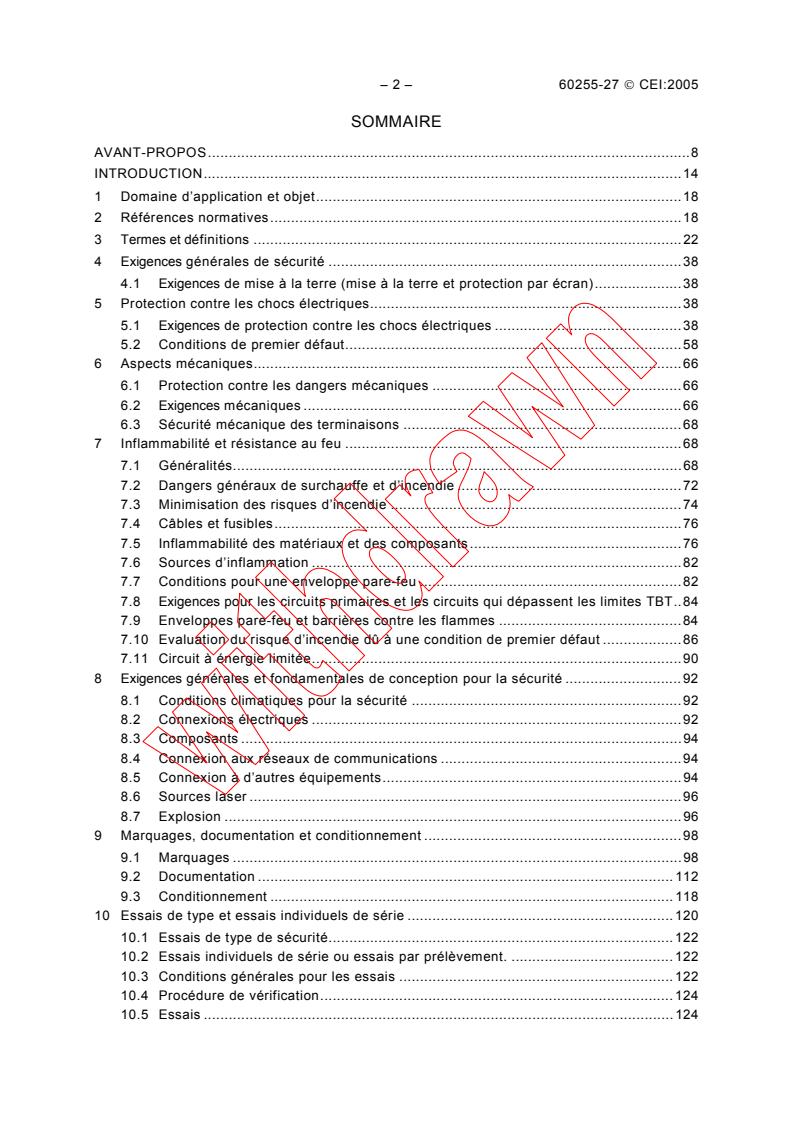
– 2 – 60255-27 CEI:2005
SOMMAIRE
AVANT-PROPOS.8
INTRODUCTION.14
1 Domaine d’application et objet.18
2 Références normatives.18
3 Termes et définitions .22
4 Exigences générales de sécurité .38
4.1 Exigences de mise à la terre (mise à la terre et protection par écran).38
5 Protection contre les chocs électriques.38
5.1 Exigences de protection contre les chocs électriques .38
5.2 Conditions de premier défaut.58
6 Aspects mécaniques.66
6.1 Protection contre les dangers mécaniques .66
6.2 Exigences mécaniques .66
6.3 Sécurité mécanique des terminaisons .68
7 Inflammabilité et résistance au feu .68
7.1 Généralités.68
7.2 Dangers généraux de surchauffe et d’incendie .72
7.3 Minimisation des risques d’incendie .74
7.4 Câbles et fusibles.76
7.5 Inflammabilité des matériaux et des composants.76
7.6 Sources d’inflammation .82
7.7 Conditions pour une enveloppe pare-feu .82
7.8 Exigences pour les circuits primaires et les circuits qui dépassent les limites TBT.84
7.9 Enveloppes pare-feu et barrières contre les flammes .84
7.10 Evaluation du risque d’incendie dû à une condition de premier défaut .86
7.11 Circuit à énergie limitée.90
8 Exigences générales et fondamentales de conception pour la sécurité .92
8.1 Conditions climatiques pour la sécurité .92
8.2 Connexions électriques .92
8.3 Composants .94
8.4 Connexion aux réseaux de communications .94
8.5 Connexion à d’autres équipements.94
8.6 Sources laser .96
8.7 Explosion .96
9 Marquages, documentation et conditionnement .98
9.1 Marquages .98
9.2 Documentation .112
9.3 Conditionnement .118
10 Essais de type et essais individuels de série .120
10.1 Essais de type de sécurité.122
10.2 Essais individuels de série ou essais par prélèvement. .122
10.3 Conditions générales pour les essais .122
10.4 Procédure de vérification.124
10.5 Essais .124
60255-27 IEC:2005 – 3 –
CONTENTS
FOREWORD.9
INTRODUCTION.15
1 Scope and object.19
2 Normative references .19
3 Terms and definitions .23
4 General safety requirements.39
4.1 Earthing requirements (grounding, earthing and screening).39
5 Protection against electric shock .39
5.1 Requirements for protection against electric shock.39
5.2 Single-fault conditions .59
6 Mechanical aspects .67
6.1 Protection against mechanical hazards.67
6.2 Mechanical requirements.67
6.3 Mechanical security of terminations.69
7 Flammability and resistance to fire .69
7.1 General .69
7.2 General hazards from overheating and fire.73
7.3 Minimization of fire risk.75
7.4 Cabling and fusing .77
7.5 Flammability of materials and components .77
7.6 Fire ignition sources .83
7.7 Conditions for a fire enclosure.83
7.8 Requirements for primary circuits and circuits exceeding ELV limits .85
7.9 Fire enclosures and flame barriers .85
7.10 Assessment of the fire risk due to a single-fault condition.87
7.11 Limited-energy circuit .91
8 General and fundamental design requirements for safety .93
8.1 Climatic conditions for safety.93
8.2 Electrical connections.93
8.3 Components .95
8.4 Connection to communication networks.95
8.5 Connection to other equipment.95
8.6 Laser sources.97
8.7 Explosion .97
9 Marking, documentation and packaging .99
9.1 Marking .99
9.2 Documentation .113
9.3 Packaging .119
10 Type tests and routine tests .121
10.1 Safety type tests .123
10.2 Routine testing or sample testing .123
10.3 Conditions for testing .123
10.4 Verification procedure .125
10.5 Tests.125
– 4 – 60255-27 CEI:2005
Annexe A (normative) Exigences des classes d’isolation et diagrammes d’exemple.150
Annexe B (informative) Tensions nominales des systèmes d’alimentation.162
Annexe C (normative) Tensions de choc assignées .164
Annexe D (normative) Guide pour la détermination de la distance dans l’air, de la
ligne de fuite et des tensions de tenue.166
Annexe E (informative) Mesure des lignes de fuite et des distances dans l’air .188
Annexe F (normative) Doigts d’épreuve standard.200
Annexe G (informative) Guide pour les essais de tension de choc .204
Annexe H (informative) Composants.208
Annexe I (informative) Durée maximale de sécurité de tensions de courte durée et
taille du condensateur en condition de premier défaut .216
Annexe J (informative) Connexions externes de sortie de câbles .220
Annexe K (informative) Exemples de protection de batterie .224
Annexe L (informative) Raisons pour lesquelles la sécurité fonctionnelle est exclue de
la portée de la CEI 60255-27 .226
Figure 1 – Diagramme de flux présentant les exigences nécessaires pour la protection
contre la propagation du feu .70
Figure 2 – Déflecteur .86
Figure 3 – Emplacement et extension d’une barrière non combustible contre les
flammes.86
Figure A.1 – Equipement avec des entrées/sorties TBTS.156
Figure D.1 – Guide pour la détermination des distances dans l’air, des lignes de fuite
et des tensions de tenue.174
Figure F.1 – Doigt d’épreuve rigide .200
Figure F.2 – Doigt d’épreuve articulé .202
Figure G.1 – Diagramme schématique de l’assemblage d’un générateur d’essai de
tension de choc .206
Figure I.1 – Durée maximale de tensions accessibles temporaires de courte durée en
condition de premier défaut .216
Figure I.2 – Niveau de capacité chargée en condition d’utilisation normale et en
condition de premier défaut .218
Figure K.1 – Protection de batterie non rechargeable .224
Figure K.2 – Protection de batterie rechargeable .224
Figure L.1 – Diagramme de bloc simplifié montrant un relais de protection qui peut
commander un disjoncteur et l’ouvrir, la ligne sous tension déconnectée étant ensuite
sécurisée par une mise à la terre.230
Figure. L.2 – Lignes sous tension isolées par des sectionneurs reliés mécaniquement
ou électromécaniquement au disjoncteur, la ligne sous tension déconnectée étant
ensuite sécurisée par une mise à la terre.230
Tableau 1 – Niveaux de courant en conditions normales.44
Tableau 2 – Charge ou énergie des capacités en conditions normales.44
Tableau 3 – Niveaux de courant en condition de premier défaut .64
Tableau 4 – Température maximale en conditions d’utilisation normale et à une
température ambiante de 40°C .72
Tableau 5 – Perforations acceptables du fond de l’enveloppe d’équipement .86
60255-27 IEC:2005 – 5 –
Annex A (normative) Isolation class requirements and example diagrams.151
Annex B (informative) Nominal voltages of supply systems .163
Annex C (normative) Rated impulse voltages.165
Annex D (normative) Guidance for the determination of clearance, creepage distance
and withstand voltages .167
Annex E (informative) Measurement of creepage distances and clearances.189
Annex F (normative) Standard test fingers .201
Annex G (informative) Guidance for impulse voltage test .205
Annex H (informative) Components.209
Annex I (informative) Safe maximum short-term voltage duration and capacitor size
under a single-fault condition .217
Annex J (informative) External wiring terminations.221
Annex K (informative) Examples of battery protection .225
Annex L (informative) Reasons why functional safety is excluded from the scope of
IEC 60255-27 .227
Figure 1 – Flow chart showing requirements for protection against the spread of fire .71
Figure 2 – Baffle .87
Figure 3 – Location and extent of a non-combustible flame barrier.87
Figure A.1 – Equipment with SELV input/output (I/O) .157
Figure D.1 – Guidance for determination of clearances, creepage distances and
withstand voltages .175
Figure F.1 – Rigid test finger.201
Figure F.2 – Jointed test finger .203
Figure G.1 – Impulse voltage test generator assembly schematic diagram.207
Figure I.1 – Maximum duration of short-term temporary accessible voltages under a
single-fault condition.217
Figure I.2 – Charged capacitance level under normal operational use and single-fault
condition.219
Figure K.1 – Non-rechargeable battery protection .225
Figure K.2 – Rechargeable battery protection .225
Figure L.1 – Simplified block diagram showing a protective relay which can actuate a
circuit-breaker to open it, the disconnected live line being subsequently rendered safe
by earthing.231
Figure L.2 – Live lines isolated by isolators mechanically or electro-mechanically
linked to the circuit-breaker, the disconnected live line being subsequently rendered
safe by earthing .231
Table 1 – Current levels in normal operational condition .45
Table 2 – Charge or energy of capacitance levels in normal operational condition .45
Table 3 – Current levels in single-fault condition.65
Table 4 – Maximum temperature in normal operational use and at an ambient
temperature of 40°C .73
Table 5 – Acceptable perforation in the bottom of an equipment case .87
– 6 – 60255-27 CEI:2005
Tableau 6 – Matériau d’isolation des enroulements.88
Tableau 7 – Limites du courant maximum disponible .90
Tableau 8 – Dispositif de protection contre la surintensité .92
Tableau 9 – Symboles .108
Tableau 10 – Symboles pour le marquage des tensions d’essai.110
Tableau 11 – Vue d’ensemble des essais .120
Tableau 12 – Essai de chaleur sèche – Fonctionnement.124
Tableau 13 – Fonctionnement au froid – en fonctionnement.126
Tableau 14 – Essai de chaleur sèche, température de stockage .128
Tableau 15 – Essai à froid, température de stockage.128
Tableau 16 – Essai de chaleur humide .130
Tableau 17 – Essai de température cyclique avec humidité .130
Tableau 18 – Guide pour les essais de tension diélectrique pour la sécurité (essais
individuels de série et par prélèvement).140
Tableau 19 – Tensions d’essai c.a. .142
Tableau A.1 – Classes d’isolement par circuits/groupes de produits .150
Tableau A.2 – Exigences d’isolation entre deux circuits .154
Tableau B.1 – Tensions nominales des systèmes d’alimentation c.a. ou c.c.162
Tableau C.1 – Tensions de choc assignées (forme d’onde: 1,2/50 µs) .164
Tableau D.1 – Isolation fonctionnelle, degré de pollution 1, catégorie de surtension I .176
Tableau D.2 – Isolation fonctionnelle, degré de pollution 2, catégorie de surtension I .178
Tableau D.3 – Isolation fonctionnelle, principale ou supplémentaire, degré de pollution
1, catégorie de surtension II.178
Tableau D.4 – Isolation fonctionnelle, principale ou supplémentaire, degré de pollution
2, catégorie de surtension II.180
Tableau D.5 – Isolation fonctionnelle, principale ou supplémentaire, degré de pollution
1, catégorie de surtension III .180
Tableau D.6 – Isolation fonctionnelle, principale ou supplémentaire, degré de pollution
2, catégorie de surtension III .182
Tableau D.7 – Isolation double ou renforcée, degré de pollution 1, catégorie de
surtension II.182
Tableau D.8 – Isolation double ou renforcée, degré de pollution 2, catégorie de
surtension II.184
Tableau D.9 – Isolation double ou renforcée, degré de pollution 1, catégorie de
surtension III.184
Tableau D.10 – Isolation double ou renforcée, degré de pollution 2, catégorie de
surtension III.186
Tableau D.11 – Facteur de multiplication de la tension d’essai pour prouver la distance
dans l’air.186
Tableau D.12 – Réduction du degré de pollution de l’environnement interne par
l’utilisation d’une protection additionnelle à l’intérieur de l’équipement.186
Tableau E.1 – Largeur X des sillons en fonction du degré de pollution.188
Tableau G.1 – Composants du générateur d’essai .204
Tableau J.1 – Gamme des sections de conducteurs devant être acceptés par les bornes .222
Tableau J.2 – Tailles des tiges de bornes ou des vis qui serrent directement des
conducteurs d’alimentation .222
60255-27 IEC:2005 – 7 –
Table 6 – Insulation material of windings .89
Table 7 – Limits of maximum available current.91
Table 8 – Overcurrent protective device.93
Table 9 – Symbols .109
Table 10 – Symbols for marking of test voltage(s).111
Table 11 – Overview of tests.121
Table 12 – Dry-heat test – Operational .125
Table 13 – Cold test – operational .127
Table 14 – Dry heat test, storage temperature .129
Table 15 – Cold test, storage temperature .129
Table 16 – Damp-heat test.131
Table 17 – Cyclic temperature with humidity test .131
Table 18 – Guidance for routine and sample dielectric voltage testing for safety –
informative.141
Table 19 – AC test voltages .143
Table A.1 – Circuit isolation class for product circuits/groups.151
Table A.2 – Insulation requirement between any two circuits .155
Table B.1 – Nominal voltages of a.c. or d.c. supply systems .163
Table C.1 – Rated impulse voltages (waveform: 1,2/50µs) .165
Table D.1 – Functional insulation, pollution degree 1, overvoltage category I.177
Table D.2 – Functional insulation, pollution degree 2, overvoltage category I.179
Table D.3 – Functional, basic or supplementary insulation, pollution degree 1,
overvoltage category II .179
Table D.4 – Functional, basic or supplementary insulation, pollution degree 2,
overvoltage category II .181
Table D.5 – Functional, basic or supplementary insulation, pollution degree 1,
overvoltage category III .181
Table D.6 – Functional, basic or supplementary insulation, pollution degree 2,
overvoltage category III .183
Table D.7 – Double or reinforced insulation, pollution degree 1, overvoltage category II .183
Table D.8 – Double or reinforced insulation, pollution degree 2, overvoltage category II .185
Table D.9 – Double or reinforced insulation, pollution degree 1, overvoltage category III .185
Table D.10 – Double or reinforced insulation, pollution degree 2, overvoltage category III .187
Table D.11 – Test voltage multiplication factor for proving the clearance in air .187
Table D.12 – Reduction of the pollution degree of internal environment through the use
of additional protection within the equipment .187
Table E.1 – Width X of groove as a function of pollution degree.189
Table G.1 – Components of the test generator.205
Table J.1 – Range of conductor sizes to be accepted by terminals.223
Table J.2 – Sizes of terminal studs or screws directly securing supply conductors .223
– 8 – 60255-27 CEI:2005
COMMISSION ÉLECTROTECHNIQUE INTERNATIONALE
____________
RELAIS DE MESURE ET DISPOSITIFS DE PROTECTION –
Partie 27: Exigences de sécurité
AVANT-PROPOS
1) La Commission Electrotechnique Internationale (CEI) est une organisation mondiale de normalisation
composée de l'ensemble des comités électrotechniques nationaux (Comités nationaux de la CEI). La CEI a
pour objet de favoriser la coopération internationale pour toutes les questions de normalisation dans les
domaines de l'électricité et de l'électronique. A cet effet, la CEI – entre autres activités – publie des Normes
internationales, des Spécifications techniques, des Rapports techniques, des Spécifications accessibles au
public (PAS) et des Guides (ci-après dénommés "Publication(s) de la CEI"). Leur élaboration est confiée à des
comités d'études, aux travaux desquels tout Comité national intéressé par le sujet traité peut participer. Les
organisations internationales, gouvernementales et non gouvernementales, en liaison avec la CEI, participent
également aux travaux. La CEI collabore étroitement avec l'Organisation Internationale de Normalisation (ISO),
selon des conditions fixées par accord entre les deux organisations.
2) Les décisions ou accords officiels de la CEI concernant les questions techniques représentent, dans la mesure
du possible, un accord international sur les sujets étudiés, étant donné que les Comités nationaux de la CEI
intéressés sont représentés dans chaque comité d’études.
3) Les Publications de la CEI se présentent sous la forme de recommandations internationales et sont agréées
comme telles par les Comités nationaux de la CEI. Tous les efforts raisonnables sont entrepris afin que la CEI
s'assure de l'exactitude du contenu technique de ses publications; la CEI ne peut pas être tenue responsable
de l'éventuelle mauvaise utilisation ou interprétation qui en est faite par un quelconque utilisateur final.
4) Dans le but d'encourager l'uniformité internationale, les Comités nationaux de la CEI s'engagent, dans toute la
mesure possible, à appliquer de façon transparente les Publications de la CEI dans leurs publications
nationales et régionales. Toutes divergences entre toutes Publications de la CEI et toutes publications
nationales ou régionales correspondantes doivent être indiquées en termes clairs dans ces dernières.
5) La CEI n’a prévu aucune procédure de marquage valant indication d’approbation et n'engage pas sa
responsabilité pour les équipements déclarés conformes à une de ses Publications.
6) Tous les utilisateurs doivent s'assurer qu'ils sont en possession de la dernière édition de cette publication.
7) Aucune responsabilité ne doit être imputée à la CEI, à ses administrateurs, employés, auxiliaires ou
mandataires, y compris ses experts particuliers et les membres de ses comités d'études et des Comités
nationaux de la CEI, pour tout préjudice causé en cas de dommages corporels et matériels, ou de tout autre
dommage de quelque nature que ce soit, directe ou indirecte, ou pour supporter les coûts (y compris les frais
de justice) et les dépenses découlant de la publication ou de l'utilisation de cette Publication de la CEI ou de
toute autre Publication de la CEI, ou au crédit qui lui est accordé.
8) L'attention est attirée sur les références normatives citées dans cette publication. L'utilisation de publications
référencées est obligatoire pour une application correcte de la présente publication.
9) L’attention est attirée sur le fait que certains des éléments de la présente Publication de la CEI peuvent faire
l’objet de droits de propriété intellectuelle ou de droits analogues. La CEI ne saurait être tenue pour
responsable de ne pas avoir identifié de tels droits de propriété et de ne pas avoir signalé leur existence.
La Norme internationale CEI 60255-27 a été établie par le comité d'études 95 de la CEI:
Relais de mesure et dispositifs de protection.
Le texte de cette norme est issu des documents suivants:
FDIS Rapport de vote
95/180/FDIS 95/182/RVD
Le rapport de vote indiqué dans le tableau ci-dessus donne toute information sur le vote ayant
abouti à l'approbation de cette norme.
Cette publication a été rédigée selon les Directives ISO/CEI, Partie 2.
60255-27 IEC:2005 – 9 –
INTERNATIONAL ELECTROTECHNICAL COMMISSION
____________
MEASURING RELAYS AND PROTECTION EQUIPMENT –
Part 27: Product safety requirements
FOREWORD
1) The International Electrotechnical Commission (IEC) is a worldwide organization for standardization comprising
all national electrotechnical committees (IEC National Committees). The object of IEC is to promote
international co-operation on all questions concerning standardization in the electrical and electronic fields. To
this end and in addition to other activities, IEC publishes International Standards, Technical Specifications,
Technical Reports, Publicly Available Specifications (PAS) and Guides (hereafter referred to as “IEC
Publication(s)”). Their preparation is entrusted to technical committees; any IEC National Committee interested
in the subject dealt with may participate in this preparatory work. International, governmental and non-
governmental organizations liaising with the IEC also participate in this preparation. IEC collaborates closely
with the International Organization for Standardization (ISO) in accordance with conditions determined by
agreement between the two organizations.
2) The formal decisions or agreements of IEC on technical matters express, as nearly as possible, an international
consensus of opinion on the relevant subjects since each technical committee has representation from all
interested IEC National Committees.
3) IEC Publications have the form of recommendations for international use and are accepted by IEC National
Committees in that sense. While all reasonable efforts are made to ensure that the technical content of IEC
Publications is accurate, IEC cannot be held responsible for the way in which they are used or for any
misinterpretation by any end user.
4) In order to promote international uniformity, IEC National Committees undertake to apply IEC Publications
transparently to the maximum extent possible in their national and regional publications. Any divergence
between any IEC Publication and the corresponding national or regional publication shall be clearly indicated in
the latter.
5) IEC provides no marking procedure to indicate its approval and cannot be rendered responsible for any
equipment declared to be in conformity with an IEC Publication.
6) All users should ensure that they have the latest edition of this publication.
7) No liability shall attach to IEC or its directors, employees, servants or agents including individual experts and
members of its technical committees and IEC National Committees for any personal injury, property damage or
other damage of any nature whatsoever, whether direct or indirect, or for costs (including legal fees) and
expenses arising out of the publication, use of, or reliance upon, this IEC Publication or any other IEC
Publications.
8) Attention is drawn to the Normative references cited in this publication. Use of the referenced publications is
indispensable for the correct application of this publication.
9) Attention is drawn to the possibility that some of the elements of this IEC Publication may be the subject of
patent rights. IEC shall not be held responsible for identifying any or all such patent rights.
International Standard IEC 60255-27 has been prepared by IEC technical committee 95:
Measuring relays and protection equipment.
The text of this standard is based on the following documents:
FDIS Report on voting
95/180/FDIS 95/182/RVD
Full information on the voting for the approval of this standard can be found in the report on
voting indicated in the above table.
This publication has been drafted in accordance with the ISO/IEC Directives, Part 2.
– 10 – 60255-27 CEI:2005
La CEI 60255 comprend les parties suivantes, sous le titre général Relais de mesure et
dispositifs de protection:
Partie 3: Relais de mesure et dispositifs de protection à une seule grandeur
d’alimentation d’entrée à temps dépendant ou indépendant
Partie 5: Coordination de l’isolement des relais de mesure et des dispositifs de
protection – Prescriptions et essais
Partie 6: Relais de mesure et dispositifs de protection
Partie 8: Relais électriques thermiques
Partie 11: Interruptions et composante alternative des grandeurs d’alimentation
auxiliaires à courant continu pour relais de mesure
Partie 12: Relais directionnels et relais de puissance à deux grandeurs d’alimentation
d’entrée
Partie 13: Relais différentiels à pourcentage
Partie 16: Relais de mesure d’impédance
Partie 21-1: Essais de vibrations, de chocs, de secousses et de tenue aux séismes
applicables aux relais de mesure et aux dispositifs de protection – Section un:
Essais de vibrations (sinusoïdales)
Partie 21-2: Essais de vibrations, de chocs, de secousses et de tenue aux séismes
applicables aux relais
...