

IEC 61069-3:2016
(Main)Industrial-process measurement, control and automation - Evaluation of system properties for the purpose of system assessment - Part 3: Assessment of system functionality
General Information
- Abstract
IEC 61069-3:2016 specifies the detailed method of the assessment of functionality of a basic control system (BCS) based on the basic concepts of IEC 61069-1 and methodology of IEC 61069-2, defines basic categorization of functionality properties, describes the factors that influence functionality and which need to be taken into account when evaluating functionality, and provides guidance in selecting techniques from a set of options (with references) for evaluating the functionality. This second edition cancels and replaces the first edition published in 1996. This edition constitutes a technical revision. This edition includes the following significant technical changes with respect to the previous edition:
- Reorganization of the material of IEC 61069-3:1996 to make the overall set of standards more organized and consistent;
- IEC TS 62603-1:2014 has been incorporated into this edition.
- Status
- Published
- Publication Date
- 14-Jun-2016
- Technical Committee
- SC 65A - System aspects
- Drafting Committee
- WG 16 - TC 65/SC 65A/WG 16
- Current Stage
- PPUB - Publication issued
- Start Date
- 15-Jun-2016
- Completion Date
- 15-Jul-2016
Buy Documents
IEC 61069-3:2016 - Industrial-process measurement, control and automation - Evaluation of system properties for the purpose of system assessment - Part 3: Assessment of system functionality Released:6/15/2016
Overview
IEC 61069-3:2016 is an international standard published by the International Electrotechnical Commission (IEC) that focuses on the evaluation of functionality in basic control systems (BCS) used for industrial-process measurement, control, and automation. This standard forms Part 3 of the IEC 61069 series, which provides comprehensive guidelines for assessing system properties to ensure effective system assessment.
The 2016 edition represents a technical revision, reorganizing material from the 1996 edition and incorporating IEC TS 62603-1:2014. It establishes a detailed methodology for the functional assessment of control systems, building upon foundational concepts and methodologies outlined in IEC 61069-1 and IEC 61069-2. The standard emphasizes categorizing functionality properties, identifying influencing factors, and selecting appropriate evaluation techniques.
Key Topics
Functionality Properties
IEC 61069-3 defines core functionality attributes of basic control systems, including:- Coverage - the extent to which the system meets functional requirements.
- Configurability - capabilities for system configuration both online and offline.
- Flexibility - ability to adapt to varying conditions through scalability, expandability, and spare capacity.
Assessment Methodology
The standard guides users through a structured assessment process:- Defining objectives tailored to the system and application.
- Designing and planning assessment programs.
- Executing evaluations with detailed reporting requirements.
Evaluation Techniques
It categorizes evaluation methods into:- Analytical techniques - assessing system documentation, design, and specifications.
- Empirical techniques - based on observed and experimental data. Guidance on selecting techniques ensures reliable assessment of system functionality.
Factors Influencing Functionality
The assessment considers elements such as integration of subsystems, communication interfaces, alarm management, software requirements, and interaction with external systems like ERP or MES.Supplementary Information
Annexes provide checklists for system requirements and specifications, examples of assessment items, and detailed considerations for configuration, communication networks, and software simulations.
Applications
IEC 61069-3:2016 is essential for engineers, system integrators, and quality assurance professionals involved in designing, implementing, or maintaining industrial control systems. It supports such applications as:
Industrial Automation System Assessment
Ensures control systems meet required functional criteria for robust and reliable process automation.System Integration Projects
Provides a framework to evaluate combined subsystems and verify functional compatibility.Quality and Compliance Audits
Offers standardized procedures for verifying system functionality during audits or before commissioning.Upgrade and Expansion Planning
Assists in assessing flexibility and configurability to plan future scalability or feature enhancements.Risk Management and Safety Evaluations
Identifies functionality limitations that could impact operational safety or system performance.
Related Standards
IEC 61069-3 is part of a broader set of standards dedicated to system assessment in industrial automation, including:
- IEC 61069-1 - Basic concepts related to evaluating system properties and overall assessment framework.
- IEC 61069-2 - Detailed methodologies for assessment beyond functionality, such as performance and reliability.
- IEC TS 62603-1:2014 - Technical specification integrated into IEC 61069-3 addressing additional assessment aspects and guidelines.
- IEC 61508 - Functional safety of electrical/electronic systems relevant for safety-critical control functionalities.
- IEC 61131 Series - Standards covering programming languages and software aspects of control systems relevant to configurability and flexibility.
By adhering to IEC 61069-3:2016, organizations gain a robust standard-based approach to thoroughly evaluate and validate the functionality of industrial process control systems, enhancing operational efficiency, safety, and compliance with international best practices.
Buy Documents
IEC 61069-3:2016 - Industrial-process measurement, control and automation - Evaluation of system properties for the purpose of system assessment - Part 3: Assessment of system functionality Released:6/15/2016
Get Certified
Connect with accredited certification bodies for this standard

DVS-ZERT GmbH
German welding certification society.
CARES (UK Certification Authority for Reinforcing Steels)
UK certification for reinforcing steels and construction.
EWF/IIW (European/International Welding Federation)
International welding personnel certification.
Sponsored listings
Frequently Asked Questions
IEC 61069-3:2016 is a standard published by the International Electrotechnical Commission (IEC). Its full title is "Industrial-process measurement, control and automation - Evaluation of system properties for the purpose of system assessment - Part 3: Assessment of system functionality". This standard covers: IEC 61069-3:2016 specifies the detailed method of the assessment of functionality of a basic control system (BCS) based on the basic concepts of IEC 61069-1 and methodology of IEC 61069-2, defines basic categorization of functionality properties, describes the factors that influence functionality and which need to be taken into account when evaluating functionality, and provides guidance in selecting techniques from a set of options (with references) for evaluating the functionality. This second edition cancels and replaces the first edition published in 1996. This edition constitutes a technical revision. This edition includes the following significant technical changes with respect to the previous edition: - Reorganization of the material of IEC 61069-3:1996 to make the overall set of standards more organized and consistent; - IEC TS 62603-1:2014 has been incorporated into this edition.
IEC 61069-3:2016 specifies the detailed method of the assessment of functionality of a basic control system (BCS) based on the basic concepts of IEC 61069-1 and methodology of IEC 61069-2, defines basic categorization of functionality properties, describes the factors that influence functionality and which need to be taken into account when evaluating functionality, and provides guidance in selecting techniques from a set of options (with references) for evaluating the functionality. This second edition cancels and replaces the first edition published in 1996. This edition constitutes a technical revision. This edition includes the following significant technical changes with respect to the previous edition: - Reorganization of the material of IEC 61069-3:1996 to make the overall set of standards more organized and consistent; - IEC TS 62603-1:2014 has been incorporated into this edition.
IEC 61069-3:2016 is classified under the following ICS (International Classification for Standards) categories: 01 - GENERALITIES. TERMINOLOGY. STANDARDIZATION. DOCUMENTATION; 25.040.40 - Industrial process measurement and control. The ICS classification helps identify the subject area and facilitates finding related standards.
IEC 61069-3:2016 is available in PDF format for immediate download after purchase. The document can be added to your cart and obtained through the secure checkout process. Digital delivery ensures instant access to the complete standard document.
Standards Content (Sample)
IEC 61069-3 ®
Edition 2.0 2016-06
INTERNATIONAL
STANDARD
NORME
INTERNATIONALE
colour
inside
Industrial-process measurement, control and automation – Evaluation of system
properties for the purpose of system assessment –
Part 3: Assessment of system functionality
Mesure, commande et automation dans les processus industriels – Appréciation
des propriétés d'un système en vue de son évaluation –
Partie 3: Évaluation de la fonctionnalité d’un système
All rights reserved. Unless otherwise specified, no part of this publication may be reproduced or utilized in any form
or by any means, electronic or mechanical, including photocopying and microfilm, without permission in writing from
either IEC or IEC's member National Committee in the country of the requester. If you have any questions about IEC
copyright or have an enquiry about obtaining additional rights to this publication, please contact the address below or
your local IEC member National Committee for further information.
Droits de reproduction réservés. Sauf indication contraire, aucune partie de cette publication ne peut être reproduite
ni utilisée sous quelque forme que ce soit et par aucun procédé, électronique ou mécanique, y compris la photocopie
et les microfilms, sans l'accord écrit de l'IEC ou du Comité national de l'IEC du pays du demandeur. Si vous avez des
questions sur le copyright de l'IEC ou si vous désirez obtenir des droits supplémentaires sur cette publication, utilisez
les coordonnées ci-après ou contactez le Comité national de l'IEC de votre pays de résidence.
IEC Central Office Tel.: +41 22 919 02 11
3, rue de Varembé Fax: +41 22 919 03 00
CH-1211 Geneva 20 info@iec.ch
Switzerland www.iec.ch
About the IEC
The International Electrotechnical Commission (IEC) is the leading global organization that prepares and publishes
International Standards for all electrical, electronic and related technologies.
About IEC publications
The technical content of IEC publications is kept under constant review by the IEC. Please make sure that you have the
latest edition, a corrigenda or an amendment might have been published.
IEC Catalogue - webstore.iec.ch/catalogue Electropedia - www.electropedia.org
The stand-alone application for consulting the entire The world's leading online dictionary of electronic and
bibliographical information on IEC International Standards, electrical terms containing 20 000 terms and definitions in
Technical Specifications, Technical Reports and other English and French, with equivalent terms in 15 additional
documents. Available for PC, Mac OS, Android Tablets and languages. Also known as the International Electrotechnical
iPad. Vocabulary (IEV) online.
IEC publications search - www.iec.ch/searchpub IEC Glossary - std.iec.ch/glossary
The advanced search enables to find IEC publications by a 65 000 electrotechnical terminology entries in English and
variety of criteria (reference number, text, technical French extracted from the Terms and Definitions clause of
committee,…). It also gives information on projects, replaced IEC publications issued since 2002. Some entries have been
and withdrawn publications. collected from earlier publications of IEC TC 37, 77, 86 and
CISPR.
IEC Just Published - webstore.iec.ch/justpublished
Stay up to date on all new IEC publications. Just Published IEC Customer Service Centre - webstore.iec.ch/csc
details all new publications released. Available online and If you wish to give us your feedback on this publication or
also once a month by email. need further assistance, please contact the Customer Service
Centre: csc@iec.ch.
A propos de l'IEC
La Commission Electrotechnique Internationale (IEC) est la première organisation mondiale qui élabore et publie des
Normes internationales pour tout ce qui a trait à l'électricité, à l'électronique et aux technologies apparentées.
A propos des publications IEC
Le contenu technique des publications IEC est constamment revu. Veuillez vous assurer que vous possédez l’édition la
plus récente, un corrigendum ou amendement peut avoir été publié.
Catalogue IEC - webstore.iec.ch/catalogue Electropedia - www.electropedia.org
Application autonome pour consulter tous les renseignements
Le premier dictionnaire en ligne de termes électroniques et
bibliographiques sur les Normes internationales,
électriques. Il contient 20 000 termes et définitions en anglais
Spécifications techniques, Rapports techniques et autres
et en français, ainsi que les termes équivalents dans 15
documents de l'IEC. Disponible pour PC, Mac OS, tablettes
langues additionnelles. Egalement appelé Vocabulaire
Android et iPad.
Electrotechnique International (IEV) en ligne.
Recherche de publications IEC - www.iec.ch/searchpub
Glossaire IEC - std.iec.ch/glossary
La recherche avancée permet de trouver des publications IEC 65 000 entrées terminologiques électrotechniques, en anglais
en utilisant différents critères (numéro de référence, texte, et en français, extraites des articles Termes et Définitions des
comité d’études,…). Elle donne aussi des informations sur les publications IEC parues depuis 2002. Plus certaines entrées
projets et les publications remplacées ou retirées. antérieures extraites des publications des CE 37, 77, 86 et
CISPR de l'IEC.
IEC Just Published - webstore.iec.ch/justpublished
Service Clients - webstore.iec.ch/csc
Restez informé sur les nouvelles publications IEC. Just
Published détaille les nouvelles publications parues. Si vous désirez nous donner des commentaires sur cette
Disponible en ligne et aussi une fois par mois par email. publication ou si vous avez des questions contactez-nous:
csc@iec.ch.
IEC 61069-3 ®
Edition 2.0 2016-06
INTERNATIONAL
STANDARD
NORME
INTERNATIONALE
colour
inside
Industrial-process measurement, control and automation – Evaluation of system
properties for the purpose of system assessment –
Part 3: Assessment of system functionality
Mesure, commande et automation dans les processus industriels – Appréciation
des propriétés d'un système en vue de son évaluation –
Partie 3: Évaluation de la fonctionnalité d’un système
INTERNATIONAL
ELECTROTECHNICAL
COMMISSION
COMMISSION
ELECTROTECHNIQUE
INTERNATIONALE
ICS 25.040.40 ISBN 978-2-8322-3409-9
− 2 − IEC 61069-3:2016 IEC 2016
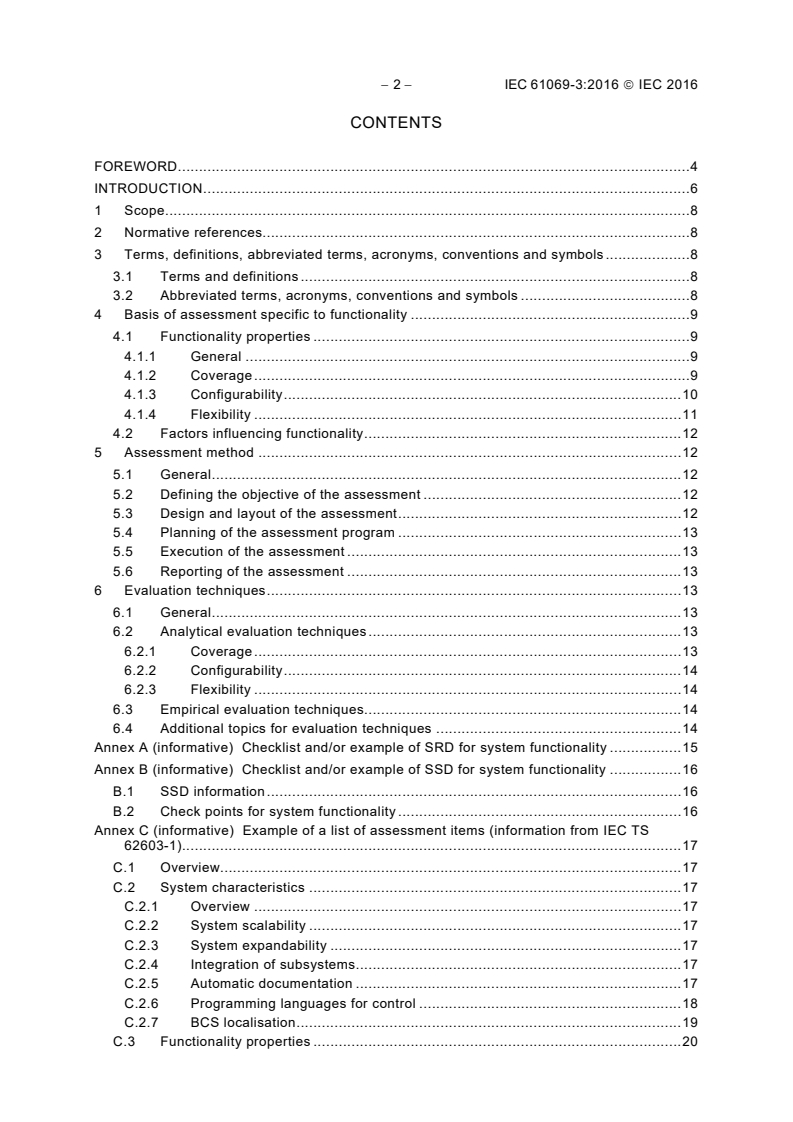
CONTENTS
FOREWORD . 4
INTRODUCTION . 6
1 Scope . 8
2 Normative references. 8
3 Terms, definitions, abbreviated terms, acronyms, conventions and symbols . 8
3.1 Terms and definitions . 8
3.2 Abbreviated terms, acronyms, conventions and symbols . 8
4 Basis of assessment specific to functionality . 9
4.1 Functionality properties . 9
4.1.1 General . 9
4.1.2 Coverage . 9
4.1.3 Configurability . 10
4.1.4 Flexibility . 11
4.2 Factors influencing functionality . 12
5 Assessment method . 12
5.1 General . 12
5.2 Defining the objective of the assessment . 12
5.3 Design and layout of the assessment . 12
5.4 Planning of the assessment program . 13
5.5 Execution of the assessment . 13
5.6 Reporting of the assessment . 13
6 Evaluation techniques . 13
6.1 General . 13
6.2 Analytical evaluation techniques . 13
6.2.1 Coverage . 13
6.2.2 Configurability . 14
6.2.3 Flexibility . 14
6.3 Empirical evaluation techniques. 14
6.4 Additional topics for evaluation techniques . 14
Annex A (informative) Checklist and/or example of SRD for system functionality . 15
Annex B (informative) Checklist and/or example of SSD for system functionality . 16
B.1 SSD information . 16
B.2 Check points for system functionality . 16
Annex C (informative) Example of a list of assessment items (information from IEC TS
62603-1). 17
C.1 Overview. 17
C.2 System characteristics . 17
C.2.1 Overview . 17
C.2.2 System scalability . 17
C.2.3 System expandability . 17
C.2.4 Integration of subsystems . 17
C.2.5 Automatic documentation . 17
C.2.6 Programming languages for control . 18
C.2.7 BCS localisation . 19
C.3 Functionality properties . 20
C.3.1 Input/output specifications . 20
C.3.2 Conventional input/output . 20
C.3.3 Input/output from/to smart devices . 21
C.3.4 Fieldbus connection to the remote I/O . 21
C.3.5 Input validation . 21
C.3.6 Special inputs . 21
C.3.7 Software requirements . 21
C.3.8 Alarm management . 22
C.3.9 Events management. 24
C.3.10 Historical archiving . 25
C.3.11 Trend and statistics management . 26
C.3.12 Communication requirements . 26
C.3.13 Fieldbus . 27
C.3.14 Controller network . 27
C.3.15 Control room network . 27
C.3.16 External link . 28
C.3.17 Communication interfaces . 28
C.3.18 Communication with ERP system . 28
C.3.19 Communication with a manufacturing execution system (MES) . 29
C.3.20 Software simulator . 29
C.3.21 Simulator of the control logic . 29
C.3.22 On-line debugging . 29
C.3.23 Simulator of the I/O . 30
C.3.24 Remote supervisory functions . 30
C.3.25 Technology and scope of the BCS . 30
C.3.26 Basic architecture . 30
C.4 Configurability . 31
C.4.1 System configuration . 31
C.4.2 On-line configuration . 32
C.4.3 Off-line configuration . 32
C.4.4 Configuration in simulation mode . 32
C.4.5 Graphical resources . 32
C.5 Flexibility . 32
C.5.1 Spare capacity of the system . 32
C.5.2 Total number of I/O . 33
C.5.3 Number of tags . 33
C.5.4 Number of control loops . 34
C.5.5 System scalability . 34
C.5.6 System expandability . 34
Bibliography . 35
Figure 1 – General layout of IEC 61069 . 7
Figure 2 – Functionality . 9
Figure 3 – Configuration methods . 10
Figure C.1 – Communication networks in a BCS . 27
Figure C.2 – Example of a layout drawing . 31
Table A.1 – SRD checklist . 15
− 4 − IEC 61069-3:2016 IEC 2016
INTERNATIONAL ELECTROTECHNICAL COMMISSION
____________
INDUSTRIAL-PROCESS MEASUREMENT, CONTROL AND AUTOMATION –
EVALUATION OF SYSTEM PROPERTIES FOR
THE PURPOSE OF SYSTEM ASSESSMENT –
Part 3: Assessment of system functionality
FOREWORD
1) The International Electrotechnical Commission (IEC) is a worldwide organization for standardization comprising
all national electrotechnical committees (IEC National Committees). The object of IEC is to promote
international co-operation on all questions concerning standardization in the electrical and electronic fields. To
this end and in addition to other activities, IEC publishes International Standards, Technical Specifications,
Technical Reports, Publicly Available Specifications (PAS) and Guides (hereafter referred to as “IEC
Publication(s)”). Their preparation is entrusted to technical committees; any IEC National Committee interested
in the subject dealt with may participate in this preparatory work. International, governmental and non-
governmental organizations liaising with the IEC also participate in this preparation. IEC collaborates closely
with the International Organization for Standardization (ISO) in accordance with conditions determined by
agreement between the two organizations.
2) The formal decisions or agreements of IEC on technical matters express, as nearly as possible, an international
consensus of opinion on the relevant subjects since each technical committee has representation from all
interested IEC National Committees.
3) IEC Publications have the form of recommendations for international use and are accepted by IEC National
Committees in that sense. While all reasonable efforts are made to ensure that the technical content of IEC
Publications is accurate, IEC cannot be held responsible for the way in which they are used or for any
misinterpretation by any end user.
4) In order to promote international uniformity, IEC National Committees undertake to apply IEC Publications
transparently to the maximum extent possible in their national and regional publications. Any divergence
between any IEC Publication and the corresponding national or regional publication shall be clearly indicated in
the latter.
5) IEC itself does not provide any attestation of conformity. Independent certification bodies provide conformity
assessment services and, in some areas, access to IEC marks of conformity. IEC is not responsible for any
services carried out by independent certification bodies.
6) All users should ensure that they have the latest edition of this publication.
7) No liability shall attach to IEC or its directors, employees, servants or agents including individual experts and
members of its technical committees and IEC National Committees for any personal injury, property damage or
other damage of any nature whatsoever, whether direct or indirect, or for costs (including legal fees) and
expenses arising out of the publication, use of, or reliance upon, this IEC Publication or any other IEC
Publications.
8) Attention is drawn to the Normative references cited in this publication. Use of the referenced publications is
indispensable for the correct application of this publication.
9) Attention is drawn to the possibility that some of the elements of this IEC Publication may be the subject of
patent rights. IEC shall not be held responsible for identifying any or all such patent rights.
International Standard IEC 61069-3 has been prepared by subcommittee 65A: System
aspects, of IEC technical committee 65: Industrial-process measurement, control and
automation.
This second edition cancels and replaces the first edition published in 1996. This edition
constitutes a technical revision.
This edition includes the following significant technical changes with respect to the previous
edition:
a) Reorganization of the material of IEC 61069-3:1996 to make the overall set of standards
more organized and consistent;
b) IEC TS 62603-1:2014 has been incorporated into this edition.
The text of this standard is based on the following documents:
FDIS Report on voting
65A/791/FDIS 65A/800/RVD
Full information on the voting for the approval of this standard can be found in the report on
voting indicated in the above table.
This publication has been drafted in accordance with the ISO/IEC Directives, Part 2.
A list of all parts in the IEC 61069 series, published under the general title Industrial-process
measurement, control and automation – Evaluation of system properties for the purpose of
system assessment, can be found on the IEC website.
The committee has decided that the contents of this publication will remain unchanged until
the stability date indicated on the IEC website under "http://webstore.iec.ch" in the data
related to the specific publication. At this date, the publication will be
• reconfirmed,
• withdrawn,
• replaced by a revised edition, or
• amended.
IMPORTANT – The 'colour inside' logo on the cover page of this publication indicates
that it contains colours which are considered to be useful for the correct
understanding of its contents. Users should therefore print this document using a
colour printer.
− 6 − IEC 61069-3:2016 IEC 2016
INTRODUCTION
IEC 61069 deals with the method which should be used to assess system properties of a
basic control system (BCS). IEC 61069 consists of the following parts:
Part 1: Terminology and basic concepts
Part 2: Assessment methodology
Part 3: Assessment of system functionality
Part 4: Assessment of system performance
Part 5: Assessment of system dependability
Part 6: Assessment of system operability
Part 7: Assessment of system safety
Part 8: Assessment of other system properties
Assessment of a system is the judgement, based on evidence, of the suitability of the system
for a specific mission or class of missions.
To obtain total evidence would require complete evaluation (for example under all influencing
factors) of all system properties relevant to the specific mission or class of missions.
Since this is rarely practical, the rationale on which an assessment of a system should be
based is:
– the identification of the importance of each of the relevant system properties,
– the planning for evaluation of the relevant system properties with a cost-effective
dedication of effort to the various system properties.
In conducting an assessment of a system, it is crucial to bear in mind the need to gain a
maximum increase in confidence in the suitability of a system within practical cost and time
constraints.
An assessment can only be carried out if a mission has been stated (or given), or if any
mission can be hypothesized. In the absence of a mission, no assessment can be made;
however, evaluations can still be specified and carried out for use in assessments performed
by others. In such cases, IEC 61069 can be used as a guide for planning an evaluation and it
provides methods for performing evaluations, since evaluations are an integral part of
assessment.
In preparing the assessment, it can be discovered that the definition of the system is too
narrow. For example, a facility with two or more revisions of the control systems sharing
resources, for example a network, should consider issues of co-existence and inter-operability.
In this case, the system to be investigated should not be limited to the “new” BCS; it should
include both. That is, it should change the boundaries of the system to include enough of the
other system to address these concerns.
The part structure and the relationship among the parts of IEC 61069 are shown in Figure 1.
IEC 61069: Industrial-process measurement, control and automation –
Evaluation of system properties for the purpose of system assessment
Part 1: Terminology and basic concepts
• Basic concept
• Terminology ‐ Objective
‐ Description of system
‐ Common terms
‐ Terms for particular part
‐ System properties
‐ Influencing factors
Part 2: Assessment methodology
• Generic requirements of procedure of assessment
‐ Overview, approach and phases
‐ Requirements for each phase
‐ General description of evaluation techniques
Parts 3 to 8: Assessment of each system property
• Basics of assessment specific to each property
‐ Properties and influencing factors
• Assessment method for each property
• Evaluation techniques for each property
IEC
Figure 1 – General layout of IEC 61069
Some example assessment items are integrated in Annex C.
− 8 − IEC 61069-3:2016 IEC 2016
INDUSTRIAL-PROCESS MEASUREMENT, CONTROL AND AUTOMATION –
EVALUATION OF SYSTEM PROPERTIES FOR
THE PURPOSE OF SYSTEM ASSESSMENT –
Part 3: Assessment of system functionality
1 Scope
This part of IEC 61069:
– specifies the detailed method of the assessment of functionality of a basic control system
(BCS) based on the basic concepts of IEC 61069-1 and methodology of IEC 61069-2,
– defines basic categorization of functionality properties,
– describes the factors that influence functionality and which need to be taken into account
when evaluating functionality, and
– provides guidance in selecting techniques from a set of options (with references) for
evaluating the functionality.
2 Normative references
The following documents, in whole or in part, are normatively referenced in this document and
are indispensable for its application. For dated references, only the edition cited applies. For
undated references, the latest edition of the referenced document (including any
amendments) applies.
IEC 61069-1:— , Industrial-process measurement, control and automation – Evaluation of
system properties for the purpose of system assessment – Part 1: Terminology and basic
concepts
IEC 61069-2:— , Industrial process measurement, control and automation – Evaluation of
system properties for the purpose of system assessment – Part 2: Assessment methodology
3 Terms, definitions, abbreviated terms, acronyms, conventions and symbols
3.1 Terms and definitions
For the purposes of this document, the terms and definitions given in IEC 61069- apply.
3.2 Abbreviated terms, acronyms, conventions and symbols
For the purposes of this document, the abbreviated terms, acronyms, conventions and
symbols given in IEC 61069-1 apply.
____________
Second edition to be published simultaneously with this part of IEC 61069.
Second edition to be published simultaneously with this part of IEC 61069.
4 Basis of assessment specific to functionality
4.1 Functionality properties
4.1.1 General
A system is able to perform the required mission if the functions provided by the system cover
the mission. The extent to which this is the case can be expressed as the system property
coverage.
For a system designed for a set of rigid and fixed tasks, coverage can describe fully the
functionality of a system.
Tasks required, however, can differ for different applications of the system or the mission can
change or be extended over time due to changes in the industrial process or arrangements in
the control strategy. To cope with this, the system should provide means for configuring the
selection and arrangement of modules, and should have a system configuration which
provides flexibility for additions and modifications.
To fully assess the functionality of a system, the system properties are categorised in a
hierarchical way.
Functionality properties are categorized as shown in Figure 2.
Functionality
Coverage Configurability Flexibility
IEC
Figure 2 – Functionality
Functionality cannot be assessed directly and cannot be described by a single property.
Functionality can only be determined by analysis and testing of each of the functionality
properties individually.
Some of the functionality properties can be expressed in quantitative terms as an absolute or
relative value; others can only be described in a qualitative way with some quantitative
elements.
When assessing the functionality of a system, the availability of facilities necessary for the
system to operate should be taken into account.
4.1.2 Coverage
Coverage is determined by:
– the range of distinct functions provided, each differentiated by type, execution frequency,
data volume, etc.;
– the variety of ways in which the functions cooperate, as determined by the system
configuration, to perform the task(s) required;
– the number of replications available of each function, as determined by the way in which
the system modules provide these functions and how these functions are allocated within
the modules.
− 10 − IEC 61069-3:2016 IEC 2016
The way in which the individual functions are set up and combined to perform tasks can
impose interdependent limits on each function. It can also impose limits on the simultaneous
use of separate functions when there is sharing of system resources.
The coverage of the system should be quantified as a coverage factor, which is the ratio of
tasks which the system covers against the totality of tasks required by the system mission. If
appropriate, partial coverage factors should be expressed for each individual task.
System mission = n Tasks
Coverage factor (CF) = tasks covered / n tasks
4.1.3 Configurability
Configurability is dependent upon the architecture of the system and the ease with which
modules can be selected, set up, arranged and combined to assemble function(s) to perform
tasks required by the mission of system.
There can be configuration elements at any level of the system. Methods to configure systems
are shown in Figure 3. The method can be implemented by hardware or software.
Configuration methods
Hardware Software
– Connecting by soldering – Setting parameters
– Connecting by wiring – Selecting parameters
– Connecting via wireless/optical network – Selecting options
– Connecting via LAN/WAN – Programming
– Setting jumpers – Inserting software modules
– Setting switches – Downloading programs
– Inserting printed circuit cards
– Inserting modules
IEC
Figure 3 – Configuration methods
It is also important to bear in mind that configuration changes can modify system properties
unexpectedly.
The configuration facilities are parts of the system and considered as "supporting functions" if
they are fully described in the system specification document.
In practice the activity of configuring a system sometimes requires deep knowledge of system
architecture, module behaviour and module interfaces. The need for this knowledge can be
reduced by the configuration facilities.
Depending on the mode of operation of the system ("on-line”, “off-line", etc.) some of the
configuration actions are permissible or not permissible. Some actions (such as module set-
up, changes to module connections, module insertion or removal, etc.) are possible only while
the system is disabled from process operation. Configurability cannot be quantified as a
number. It can be described in a qualitative manner by detailing configuration actions and
tools, and stating for each of these the know-how, skills and time required.
4.1.4 Flexibility
4.1.4.1 General
The flexibility of a system depends on the ways the system can be adapted.
The system has higher flexibility when it has more capability to add, remove, change and/or
rearrange modules of the system.
Flexibility cannot be expressed by a single system property.
4.1.4.2 Scalability
A system can be designed in such a way that it is possible to scale the system. For example,
a system might be able to increase in size (more I/O points) or in communication capabilities
(more network interfaces) or supported operator workstations, or in some other
countable/measurable way.
The extent to which the system can be scaled can be assessed by analysis of the system
configuration, communication functions and shared resources.
Scalability can be expressed by a qualitative description containing some quantified elements.
4.1.4.3 Variability
A system can be designed in such a way that it is possible to vary the range of executable
tasks.
Variability can be assessed by analysis of the system configuration, the degree of modularity,
the specification of interfaces between the modules, and the number and scope of functions
provided by the individual modules.
Variability can be expressed by a qualitative description containing some quantified elements.
4.1.4.4 Enhanceability
A system can be designed in such a way that it is possible to enhance certain system
properties.
Enhanceability can be assessed by analysing the system configuration and the range of
available modules with alternative property values.
Some examples of implementation which achieve higher enhanceability are:
– modules with a larger main memory to allow a decrease in response time via reduced data
transfers;
– modules which allow an increased number of iterations of mathematical procedures to
increase the accuracy of a calculated value;
– use of better protected input or output cards against electrical noise to increase the
system's security, or to increase the system's usability in areas where there is explosive
atmosphere.
The potential for improvement of these properties can extend beyond the requirements stated
in the system requirements document.
Enhanceability can be expressed by a qualitative description containing some quantified
elements.
− 12 − IEC 61069-3:2016 IEC 2016
4.2 Factors influencing functionality
The functionality of a system can be affected by the influencing factors listed in IEC 61069-1:–,
5.3.
For each of the system functionality properties listed in 4.1, the primary influencing factors are
as follows:
a) Coverage can be affected by:
No influencing factors.
b) Configurability can be affected by:
1) licensing of specific functionality;
2) installation, for example all modules and elements are in place.
c) Operational rules, dictated by the mission, training of personnel, and deficiencies in
documentation, manuals and technical support can hamper the full use of the system
functionality.
5 Assessment method
5.1 General
The assessment shall follow the method as laid down in IEC 61069-2:—, Clause 5.
5.2 Defining the objective of the assessment
Defining the objective of the assessment shall follow the method as laid down in
IEC 61069-2:—, 5.2.
5.3 Design and layout of the assessment
Design and layout of the assessment shall follow the method as laid down in IEC 61069-2:—,
5.3.
Defining the scope of assessment shall follow the method laid down in IEC 61069-2:—, 5.3.1.
Collation of documented information shall be conducted in accordance with IEC 61069-2:—,
5.3.3.
The statements compiled in accordance with IEC 61069-2:—, 5.3.3, should include the
following in addition to the items listed in IEC 61069-2:–, 5.3.3:
– No additional items are noted.
Documenting collated information shall follow the method in IEC 62069-2:—, 5.3.4.
Selecting assessment items shall follow IEC 61069-2:—, 5.3.5.
Assessment specification should be developed in accordance with IEC 61069-2: —, 5.3.6.
Comparison of the SRD and the SSD shall follow IEC 61069-2:—, 5.3.
NOTE 1 A check list of SRD for system functionality is provided in Annex A.
NOTE 2 A check list of SSD for system functionality is provided in Annex B.
5.4 Planning of the assessment program
Planning the assessment program shall follow the method as laid down in IEC 62069-2:—, 5.4.
Assessment activities shall be developed in accordance with IEC 61069-2:—, 5.4.2.
The final assessment program should specify points specified in IEC 61069-2:—, 5.4.3.
5.5 Execution of the assessment
The execution of the assessment shall be in accordance with IEC 61069-2:—, 5.5.
5.6 Reporting of the assessment
The reporting of the assessment shall be in accordance with IEC 61069-2:—, 5.6.
The report shall include information specified in IEC 61069-2:—, 5.6. Additionally, the
assessment report should address the following points:
– information specified in Clause 6.
6 Evaluation techniques
6.1 General
Within IEC 61069-3 several evaluation techniques are suggested. Other methods may be
applied, but in all cases the assessment report should provide references to documents
describing the techniques used.
Those evaluation techniques are categorized as described in IEC 61069-2:—, Clause 6.
Factors influencing the functionality properties of the system as per 4.2 shall be taken into
account.
The techniques given in 6.2, 6.3 and 6.4 are used to assess the functionality properties.
It is not possible to evaluate the functionality property as one entity. Instead each functionality
property should be addressed separately.
Functionality which is built in the system but is not specified in the SRD may be omitted from
the evaluation, but such omissions shall be recorded in the report.
NOTE An example of a list of assessment items is provided in Annex C.
6.2 Analytical evaluation techniques
6.2.1 Coverage
Coverage can be evaluated by analytically checking whether the number of modules or
elements of the system and their scopes specified in the SSD are able to perform the system
functions required for the tasks specified in the SRD.
The following information shall be included in the report:
– the tasks and the supporting functions analysed,
– the functions not provided,
– the deficiencies of function found.
− 14 − IEC 61069-3:2016 IEC 2016
6.2.2 Configurability
Configurability can be evaluated by listing the actions to be taken and the time necessary to
set up, change or add a system function to perform a task under defined circumstances, for
example:
– know-how and skill of personnel involved;
– the tools used, which are provided by the system or specified in the SSD;
– the system modes of operation ("on-line, "off-line", etc.) for which each configuration
action is permissible.
6.2.3 Flexibility
Flexibility can be evaluated by analytically:
– listing the maximum number of functional replicas to which the system can be expanded
without hampering the correct performance of the functions necessary to perform tasks for
the mission;
– listing the number of different functions to which the system can be extended without
hampering the correct performance of the functions necessary to perform tasks for the
mission;
– listing alternative modules and elements available to the system to enhance the system
with different performance, dependability, operability and system safety characteristics,
which can be used without hampering the correct performance of the functions necessary
to perform tasks for the mission.
6.3 Empirical evaluation techniques
Empirical evaluation shall also be conducted for coverage, compatibility and flexibility.
Empirical evaluation is conducted to verify the result of the analytical evaluation described in
6.2.
6.4 Additional topics for evaluation techniques
No additional items are noted.
Annex A
(informative)
Checklist and/or example of SRD for system functionality
The matrix in Table A.1 provides guidance on the type of information (task by task and/or
information translation) which should be given in the SRD for the purpose of performance
assessment.
Particular attention should be given to checking that the required configuration facilities and
the future requirements for the system have been stated and appropriately quantified, both in
relation to individual tasks as well as in relation to the total system mission.
Table A.1 – SRD checklist
Property Data, drawings, etc.
Coverage Present and future required tasks supported by:
– process control and measurement diagram;
– description of the control and measurement requirements in support of each task;
– operational and monitoring requirements of each task;
– importance of task for mission.
Environment including:
– a plot plan showing suggested location of measurement and control points, operator’s
control desk/panel, etc.;
– hazardous area classification drawing;
– space, location, physical access, expansion constraints.
Configurability Level of provision required, for example:
– fixed;
– configurable within constraints (under lock, etc.);
– freely programmable.
Operational circumstances under which configuration is allowed and/or required.
Flexibility Expected future expansion of the mission in terms of:
– replication of tasks;
– new set of tasks, measurements, outputs, etc.;
– additional or extended displays or reports.
Gradual or "all at once" project realisation.
Expected future change in property requirements:
– higher dependability;
– higher performance (faster, higher accuracy);
– better operability (use of touch screen, etc.);
– maximum I/O per controller;
– task rate;
– scan rate.
− 16 − IEC 61069-3:2016 IEC 2016
Annex B
(informative)
Checklist and/or example of SSD for system functionality
B.1 SSD information
The system specification document should be reviewed to check that the properties given in
the SRD are listed as described in IEC 61069-2:–, Annex B.
B.2 Check points for system functionality
Particular attention should be paid to check that information is given on:
a) the modules and elements, both hardware and software, supporting each function;
b) quantitative and/or qualitative data on the properties of these modules and elements, and
the availability of modules and elements with alternative properties;
c) details of configuration tools, their use and constraints on the system operation;
d) facilities provided by the system which, in the assembled operational system, support
analysis of functionality properties. Examples of these facilities are utilities for:
1) listing all loaded programs, the supporting modules and elements;
2) calculation of the spare capacity on memories devices, etc.;
3) statistical analysis of system resource utilisation, etc.;
4) listing any side-effects on any
...