

IEC 62933-4-4:2023
(Main)Electrical energy storage (EES) systems - Part 4-4: Environmental requirements for battery-based energy storage systems (BESS) with reused batteries
General Information
- Abstract
IEC 62933-4-4:2023 describes environmental issues when reused batteries are considered for a BESS.
It provides details and requirements for identifying and preventing environmental issues in each life cycle stage, i.e., from the design to the disassembly of such reused batteries in a BESS.
- Status
- Published
- Publication Date
- 07-Nov-2023
- Technical Committee
- TC 120 - Electrical Energy Storage (EES) systems
- Drafting Committee
- WG 4 - TC 120/WG 4
- Current Stage
- PPUB - Publication issued
- Start Date
- 08-Nov-2023
- Completion Date
- 08-Dec-2023
Buy Documents
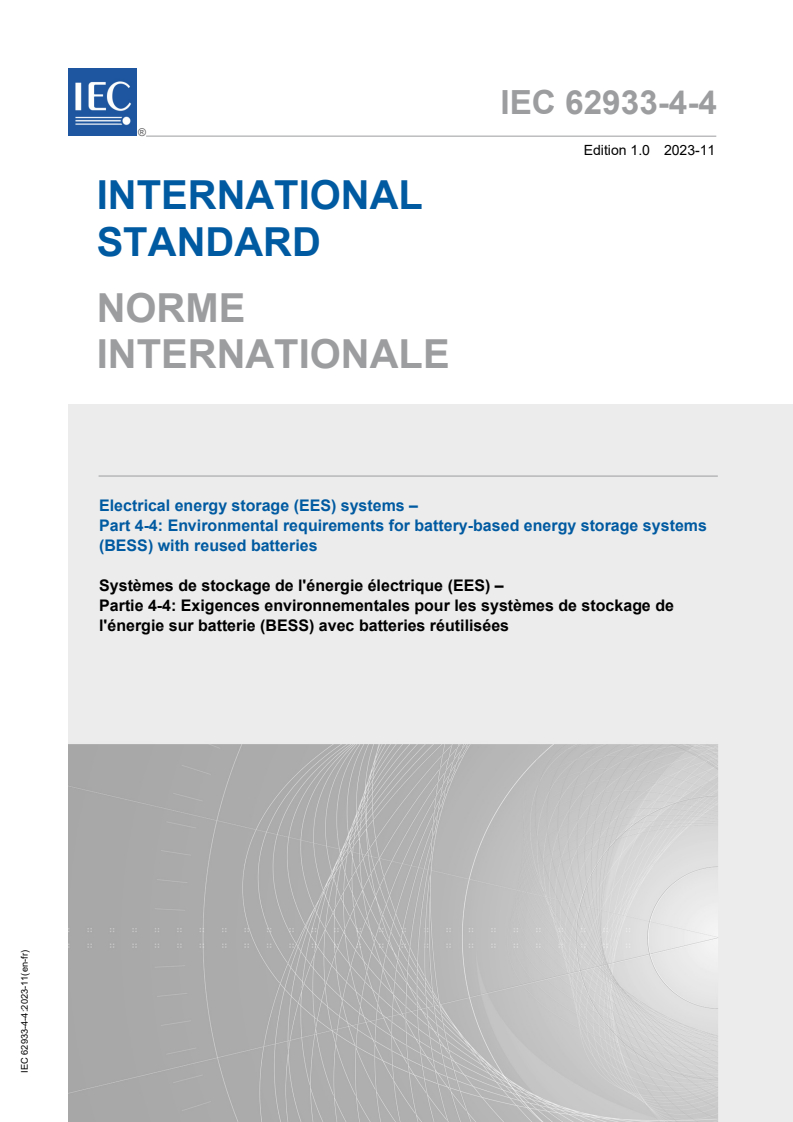
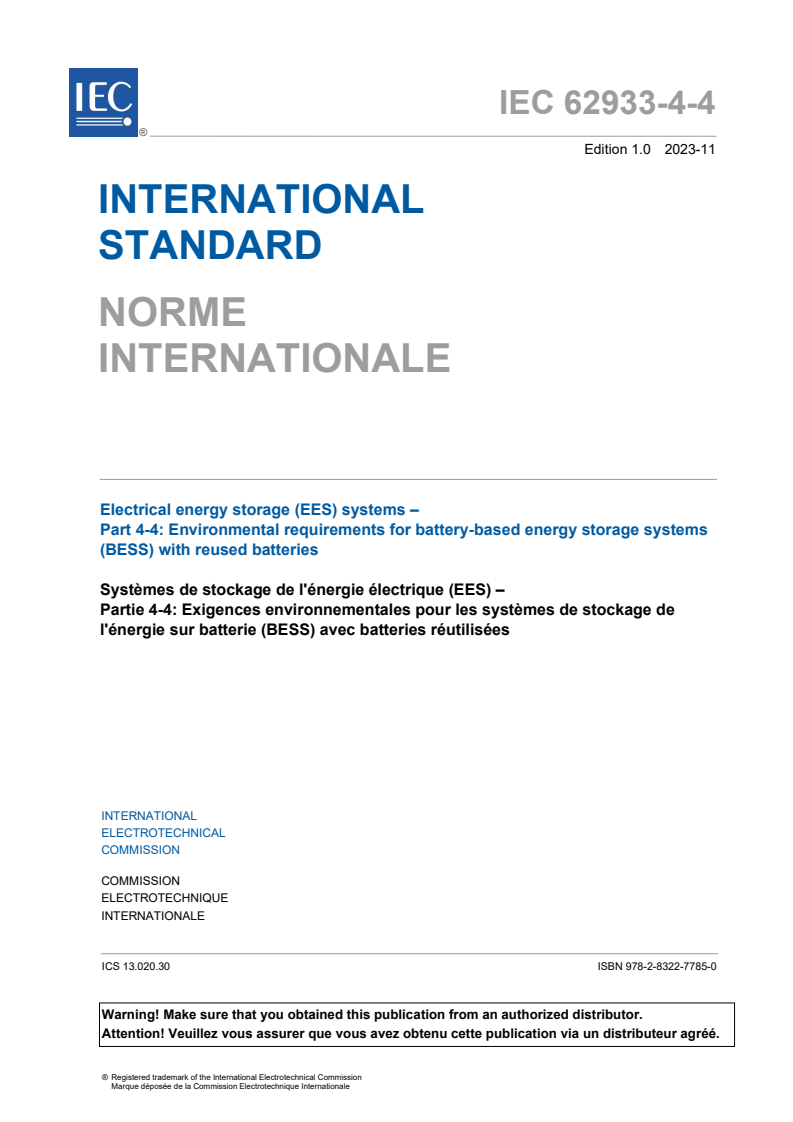
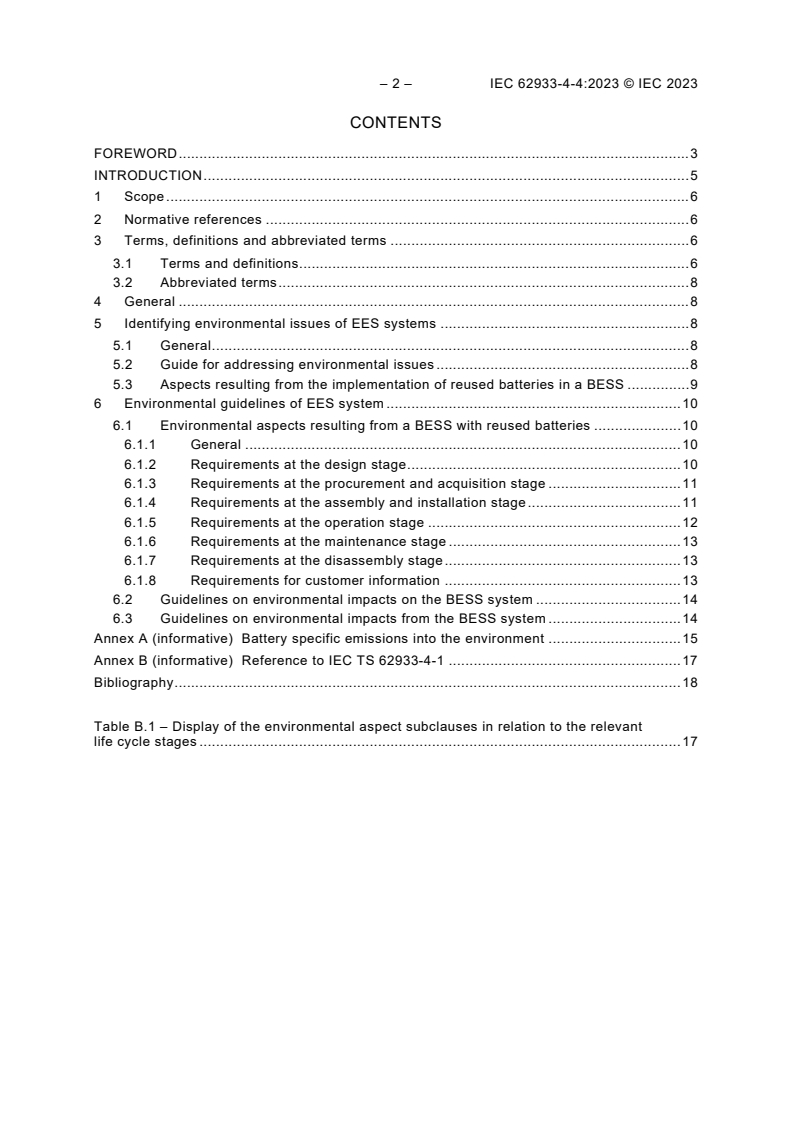
IEC 62933-4-4:2023 - Electrical energy storage (EES) systems - Part 4-4: Environmental requirements for battery-based energy storage systems (BESS) with reused batteries Released:11/8/2023
Overview
IEC 62933-4-4:2023 is an international standard that focuses on the environmental requirements for battery-based energy storage systems (BESS) utilizing reused batteries. Developed by the International Electrotechnical Commission (IEC), this standard provides comprehensive guidance and requirements for addressing environmental concerns at every stage of the reused battery lifecycle-from design and procurement to operation and disassembly. It aims to support sustainable energy storage solutions by promoting life cycle thinking (LCT) and minimizing environmental impacts associated with reused batteries in BESS.
This standard is essential for manufacturers, system integrators, operators, and regulators involved in the development and management of BESS with reused batteries, ensuring environmentally responsible practices throughout the product lifecycle.
Key Topics
Environmental Issues Identification
IEC 62933-4-4 outlines methods to identify potential environmental concerns linked to the reuse of batteries within energy storage systems. It addresses risks related to the pre-aged nature of reused batteries and their lifecycle impacts.Life Cycle Stages and Environmental Requirements
The standard breaks down environmental requirements across all stages of battery lifecycle management, including:- Design Stage: Incorporation of environmental impact considerations in system design to reduce adverse effects.
- Procurement and Acquisition: Guidelines for sourcing reused batteries responsibly, ensuring compliance with environmental standards.
- Assembly and Installation: Procedures to mitigate environmental risks during system integration.
- Operation and Maintenance: Practices to monitor and minimize environmental impacts during system use.
- Disassembly: Safe and environmentally sound methods for battery removal and recycling.
Environmental Guidelines
Detailed guidance emphasizes the significance of addressing environmental factors specific to BESS with reused batteries, considering emissions, resource preservation, and pollution prevention.Integration with Related Standards
IEC 62933-4-4 complements IEC TS 62933-4-1, which provides general environmental guidance for energy storage systems, by focusing specifically on reused battery applications.
Applications
IEC 62933-4-4:2023 is particularly valuable for:
- Battery Reuse Programs: Facilitating sustainable reuse of secondary batteries from electric vehicles or previous energy storage installations.
- Renewable Energy Integration: Enabling reliable and environmentally responsible battery energy storage to stabilize fluctuating solar and wind power generation.
- Sustainable Energy Storage Design: Assisting manufacturers in meeting environmental obligations through life cycle assessment and environmental impact reduction.
- Regulatory Compliance: Guiding stakeholders to comply with environmental regulations related to battery reuse and disposal.
- Environmental Risk Management: Providing frameworks to anticipate and minimize negative environmental effects related to battery aging, emissions, and end-of-life handling.
Related Standards
- IEC TS 62933-4-1:2017 – Guidance on general environmental issues for electrical energy storage (EES) systems.
- IEC 60529 – Degrees of protection provided by enclosures (IP Code), relevant to design requirements ensuring environmental safety.
- IEC Guide 109:2012 – Environmental aspects inclusion in electrotechnical product standards, forming the foundational terminology and methodology for environmental considerations.
By adhering to IEC 62933-4-4:2023, organizations can enhance sustainability in energy storage technologies, reduce environmental risks associated with reused batteries, and contribute to the global push for decarbonized, reliable renewable energy systems.
Buy Documents
IEC 62933-4-4:2023 - Electrical energy storage (EES) systems - Part 4-4: Environmental requirements for battery-based energy storage systems (BESS) with reused batteries Released:11/8/2023
Get Certified
Connect with accredited certification bodies for this standard

BSI Group
BSI (British Standards Institution) is the business standards company that helps organizations make excellence a habit.

Bureau Veritas
Bureau Veritas is a world leader in laboratory testing, inspection and certification services.

DNV
DNV is an independent assurance and risk management provider.
Sponsored listings
Frequently Asked Questions
IEC 62933-4-4:2023 is a standard published by the International Electrotechnical Commission (IEC). Its full title is "Electrical energy storage (EES) systems - Part 4-4: Environmental requirements for battery-based energy storage systems (BESS) with reused batteries". This standard covers: IEC 62933-4-4:2023 describes environmental issues when reused batteries are considered for a BESS. It provides details and requirements for identifying and preventing environmental issues in each life cycle stage, i.e., from the design to the disassembly of such reused batteries in a BESS.
IEC 62933-4-4:2023 describes environmental issues when reused batteries are considered for a BESS. It provides details and requirements for identifying and preventing environmental issues in each life cycle stage, i.e., from the design to the disassembly of such reused batteries in a BESS.
IEC 62933-4-4:2023 is classified under the following ICS (International Classification for Standards) categories: 13.020.30 - Environmental impact assessment. The ICS classification helps identify the subject area and facilitates finding related standards.
IEC 62933-4-4:2023 is available in PDF format for immediate download after purchase. The document can be added to your cart and obtained through the secure checkout process. Digital delivery ensures instant access to the complete standard document.
Standards Content (Sample)
IEC 62933-4-4 ®
Edition 1.0 2023-11
INTERNATIONAL
STANDARD
NORME
INTERNATIONALE
Electrical energy storage (EES) systems –
Part 4-4: Environmental requirements for battery-based energy storage systems
(BESS) with reused batteries
Systèmes de stockage de l'énergie électrique (EES) –
Partie 4-4: Exigences environnementales pour les systèmes de stockage de
l'énergie sur batterie (BESS) avec batteries réutilisées
All rights reserved. Unless otherwise specified, no part of this publication may be reproduced or utilized in any form
or by any means, electronic or mechanical, including photocopying and microfilm, without permission in writing from
either IEC or IEC's member National Committee in the country of the requester. If you have any questions about IEC
copyright or have an enquiry about obtaining additional rights to this publication, please contact the address below or
your local IEC member National Committee for further information.
Droits de reproduction réservés. Sauf indication contraire, aucune partie de cette publication ne peut être reproduite ni
utilisée sous quelque forme que ce soit et par aucun procédé, électronique ou mécanique, y compris la photocopie et
les microfilms, sans l'accord écrit de l'IEC ou du Comité national de l'IEC du pays du demandeur. Si vous avez des
questions sur le copyright de l'IEC ou si vous désirez obtenir des droits supplémentaires sur cette publication, utilisez
les coordonnées ci-après ou contactez le Comité national de l'IEC de votre pays de résidence.
IEC Secretariat Tel.: +41 22 919 02 11
3, rue de Varembé info@iec.ch
CH-1211 Geneva 20 www.iec.ch
Switzerland
About the IEC
The International Electrotechnical Commission (IEC) is the leading global organization that prepares and publishes
International Standards for all electrical, electronic and related technologies.
About IEC publications
The technical content of IEC publications is kept under constant review by the IEC. Please make sure that you have the
latest edition, a corrigendum or an amendment might have been published.
IEC publications search - webstore.iec.ch/advsearchform IEC Products & Services Portal - products.iec.ch
The advanced search enables to find IEC publications by a Discover our powerful search engine and read freely all the
variety of criteria (reference number, text, technical publications previews. With a subscription you will always have
committee, …). It also gives information on projects, replaced access to up to date content tailored to your needs.
and withdrawn publications.
Electropedia - www.electropedia.org
IEC Just Published - webstore.iec.ch/justpublished
The world's leading online dictionary on electrotechnology,
Stay up to date on all new IEC publications. Just Published
containing more than 22 300 terminological entries in English
details all new publications released. Available online and once
and French, with equivalent terms in 19 additional languages.
a month by email.
Also known as the International Electrotechnical Vocabulary
(IEV) online.
IEC Customer Service Centre - webstore.iec.ch/csc
If you wish to give us your feedback on this publication or need
further assistance, please contact the Customer Service
Centre: sales@iec.ch.
A propos de l'IEC
La Commission Electrotechnique Internationale (IEC) est la première organisation mondiale qui élabore et publie des
Normes internationales pour tout ce qui a trait à l'électricité, à l'électronique et aux technologies apparentées.
A propos des publications IEC
Le contenu technique des publications IEC est constamment revu. Veuillez vous assurer que vous possédez l’édition la
plus récente, un corrigendum ou amendement peut avoir été publié.
Recherche de publications IEC - IEC Products & Services Portal - products.iec.ch
webstore.iec.ch/advsearchform Découvrez notre puissant moteur de recherche et consultez
La recherche avancée permet de trouver des publications IEC gratuitement tous les aperçus des publications. Avec un
en utilisant différents critères (numéro de référence, texte, abonnement, vous aurez toujours accès à un contenu à jour
comité d’études, …). Elle donne aussi des informations sur les adapté à vos besoins.
projets et les publications remplacées ou retirées.
Electropedia - www.electropedia.org
IEC Just Published - webstore.iec.ch/justpublished
Le premier dictionnaire d'électrotechnologie en ligne au monde,
Restez informé sur les nouvelles publications IEC. Just
avec plus de 22 300 articles terminologiques en anglais et en
Published détaille les nouvelles publications parues.
français, ainsi que les termes équivalents dans 19 langues
Disponible en ligne et une fois par mois par email.
additionnelles. Egalement appelé Vocabulaire
Electrotechnique International (IEV) en ligne.
Service Clients - webstore.iec.ch/csc
Si vous désirez nous donner des commentaires sur cette
publication ou si vous avez des questions contactez-nous:
sales@iec.ch.
IEC 62933-4-4 ®
Edition 1.0 2023-11
INTERNATIONAL
STANDARD
NORME
INTERNATIONALE
Electrical energy storage (EES) systems –
Part 4-4: Environmental requirements for battery-based energy storage systems
(BESS) with reused batteries
Systèmes de stockage de l'énergie électrique (EES) –
Partie 4-4: Exigences environnementales pour les systèmes de stockage de
l'énergie sur batterie (BESS) avec batteries réutilisées
INTERNATIONAL
ELECTROTECHNICAL
COMMISSION
COMMISSION
ELECTROTECHNIQUE
INTERNATIONALE
ICS 13.020.30 ISBN 978-2-8322-7785-0
– 2 – IEC 62933-4-4:2023 © IEC 2023
CONTENTS
FOREWORD . 3
INTRODUCTION . 5
1 Scope . 6
2 Normative references . 6
3 Terms, definitions and abbreviated terms . 6
3.1 Terms and definitions . 6
3.2 Abbreviated terms . 8
4 General . 8
5 Identifying environmental issues of EES systems . 8
5.1 General . 8
5.2 Guide for addressing environmental issues . 8
5.3 Aspects resulting from the implementation of reused batteries in a BESS . 9
6 Environmental guidelines of EES system . 10
6.1 Environmental aspects resulting from a BESS with reused batteries . 10
6.1.1 General . 10
6.1.2 Requirements at the design stage . 10
6.1.3 Requirements at the procurement and acquisition stage . 11
6.1.4 Requirements at the assembly and installation stage . 11
6.1.5 Requirements at the operation stage . 12
6.1.6 Requirements at the maintenance stage . 13
6.1.7 Requirements at the disassembly stage . 13
6.1.8 Requirements for customer information . 13
6.2 Guidelines on environmental impacts on the BESS system . 14
6.3 Guidelines on environmental impacts from the BESS system . 14
Annex A (informative) Battery specific emissions into the environment . 15
Annex B (informative) Reference to IEC TS 62933-4-1 . 17
Bibliography . 18
Table B.1 – Display of the environmental aspect subclauses in relation to the relevant
life cycle stages . 17
INTERNATIONAL ELECTROTECHNICAL COMMISSION
____________
ELECTRICAL ENERGY STORAGE (EES) SYSTEMS –
Part 4-4: Environmental requirements for battery-based energy storage
systems (BESS) with reused batteries
FOREWORD
1) The International Electrotechnical Commission (IEC) is a worldwide organization for standardization comprising
all national electrotechnical committees (IEC National Committees). The object of IEC is to promote international
co-operation on all questions concerning standardization in the electrical and electronic fields. To this end and
in addition to other activities, IEC publishes International Standards, Technical Specifications, Technical Reports,
Publicly Available Specifications (PAS) and Guides (hereafter referred to as "IEC Publication(s)"). Their
preparation is entrusted to technical committees; any IEC National Committee interested in the subject dealt with
may participate in this preparatory work. International, governmental and non-governmental organizations liaising
with the IEC also participate in this preparation. IEC collaborates closely with the International Organization for
Standardization (ISO) in accordance with conditions determined by agreement between the two organizations.
2) The formal decisions or agreements of IEC on technical matters express, as nearly as possible, an international
consensus of opinion on the relevant subjects since each technical committee has representation from all
interested IEC National Committees.
3) IEC Publications have the form of recommendations for international use and are accepted by IEC National
Committees in that sense. While all reasonable efforts are made to ensure that the technical content of IEC
Publications is accurate, IEC cannot be held responsible for the way in which they are used or for any
misinterpretation by any end user.
4) In order to promote international uniformity, IEC National Committees undertake to apply IEC Publications
transparently to the maximum extent possible in their national and regional publications. Any divergence between
any IEC Publication and the corresponding national or regional publication shall be clearly indicated in the latter.
5) IEC itself does not provide any attestation of conformity. Independent certification bodies provide conformity
assessment services and, in some areas, access to IEC marks of conformity. IEC is not responsible for any
services carried out by independent certification bodies.
6) All users should ensure that they have the latest edition of this publication.
7) No liability shall attach to IEC or its directors, employees, servants or agents including individual experts and
members of its technical committees and IEC National Committees for any personal injury, property damage or
other damage of any nature whatsoever, whether direct or indirect, or for costs (including legal fees) and
expenses arising out of the publication, use of, or reliance upon, this IEC Publication or any other IEC
Publications.
8) Attention is drawn to the Normative references cited in this publication. Use of the referenced publications is
indispensable for the correct application of this publication.
9) IEC draws attention to the possibility that the implementation of this document may involve the use of (a)
patent(s). IEC takes no position concerning the evidence, validity or applicability of any claimed patent rights in
respect thereof. As of the date of publication of this document, IEC had not received notice of (a) patent(s), which
may be required to implement this document. However, implementers are cautioned that this may not represent
the latest information, which may be obtained from the patent database available at https://patents.iec.ch. IEC
shall not be held responsible for identifying any or all such patent rights.
IEC 62933-4-4 has been prepared by IEC technical committee 120: Electrical Energy Storage
(EES) Systems. It is an International Standard.
The text of this International Standard is based on the following documents:
Draft Report on voting
120/333/FDIS 120/338/RVD
Full information on the voting for its approval can be found in the report on voting indicated in
the above table.
The language used for the development of this International Standard is English.
– 4 – IEC 62933-4-4:2023 © IEC 2023
This document was drafted in accordance with ISO/IEC Directives, Part 2, and developed in
accordance with ISO/IEC Directives, Part 1 and ISO/IEC Directives, IEC Supplement, available
at www.iec.ch/members_experts/refdocs. The main document types developed by IEC are
described in greater detail at www.iec.ch/publications.
A list of all parts in the IEC 62933 series, published under the general title Electrical energy
storage (EES) systems, can be found on the IEC website.
The committee has decided that the contents of this document will remain unchanged until the
stability date indicated on the IEC website under webstore.iec.ch in the data related to the
specific document. At this date, the document will be
• reconfirmed,
• withdrawn, or
• revised.
INTRODUCTION
The increased use of renewable energy is enhancing the decarbonization of energy production
by reducing CO emissions caused by the use of fossil fuels. The production of renewable
energy with solar and wind power is however associated with large temporal output fluctuations.
This causes increased voltage and frequency instabilities in the power grid. These irregularities
can be advantageously counteracted with battery-based energy storage systems (BESS).
Such battery-based energy storage systems can be assembled with reused batteries coming
from other electric energy storage installations or electric vehicles.
The reuse of batteries enhances all facets of the life cycle thinking (LCT) by reducing premature
product obsolescence.
Reused cells, modules or battery assemblies entail particular attention toward the possible
impact on the environment they will have due to their being a pre-aged component.
The impacts to the environment resulting from reused batteries are reviewed and appropriate
requirements are defined.
This document complements, when reused batteries are involved, the information and guidance
provided by IEC TS 62933-4-1.
– 6 – IEC 62933-4-4:2023 © IEC 2023
ELECTRICAL ENERGY STORAGE (EES) SYSTEMS –
Part 4-4: Environmental requirements for battery-based energy storage
systems (BESS) with reused batteries
1 Scope
This part of the IEC 62933 series describes environmental issues when reused batteries are
considered for a BESS.
It provides details and requirements for identifying and preventing environmental issues in each
life cycle stage, i.e., from the design to the disassembly of such reused batteries in a BESS.
2 Normative references
The following documents are referred to in the text in such a way that some or all of their content
constitutes requirements of this document. For dated references, only the edition cited applies.
For undated references, the latest edition of the referenced document (including any
amendments) applies.
IEC 60529, Degrees of protection provided by enclosures (IP Code)
IEC TS 62933-4-1:2017, Electric energy storage (EES) systems – Part 4-1: Guidance on
environmental issues – General specification
IEC Guide 109:2012, Environmental aspects – Inclusion in electrotechnical product standards
3 Terms, definitions and abbreviated terms
3.1 Terms and definitions
For the purposes of this document, the following terms and definitions apply.
ISO and IEC maintain terminology databases for use in standardization at the following
addresses:
• IEC Electropedia: available at https://www.electropedia.org/
• ISO Online browsing platform: available at https://www.iso.org/obp
3.1.1
battery-based energy storage system
BESS
electrical energy storage system with an accumulation subsystem based on batteries with
secondary cells
Note 1 to entry: Battery energy storage systems include flow battery energy systems.
3.1.2
reuse, noun
operation by which secondary batteries that are not waste are used again in an application
3.1.3
life cycle thinking
LCT
consideration of all relevant environmental aspects during the entire (product) life cycle
[SOURCE: IEC Guide 109:2012, 3.10, modified – in the definition "of products" has been
replaced with "(product)".]
3.1.4
life cycle assessment
LCA
compilation and evaluation of the inputs, outputs and the potential environmental impacts
product system throughout its life cycle
[SOURCE: ISO 14040:2006, 3.2]
3.1.5
environment
surroundings in which a product or system exists, including air, water, land, natural resources,
flora, fauna, humans and their interrelation
[SOURCE: IEC Guide 109:2012, 3.3]
3.1.6
environmental aspect
element of an organization's activities or products that can interact with the environment
Note 1 to entry: A significant environmental aspect has or can have a significant environmental impact.
[SOURCE: IEC Guide 109:2012, 3.4]
3.1.7
environmental impact
change to the environment, whether adverse or beneficial, wholly or partly resulting from
environmental aspects
[SOURCE: IEC Guide 109: 2012, 3.5, modified – in the definition "an organization's" has been
omitted.]
3.1.8
life cycle
consecutive and interlinked stages of a product system, from raw material acquisition or
generation from natural resources to the final disposal
[SOURCE: IEC Guide 109:2012, 3.8]
3.1.9
installation
one apparatus or set of devices and/or apparatuses associated in a given location to fulfil
specified purposes, including all means for their satisfactory operation
[SOURCE: IEC 60050-151:2001, 151-11-26]
– 8 – IEC 62933-4-4:2023 © IEC 2023
3.1.10
service life
total period of useful life of a cell or battery in operation
[SOURCE: IEC 60050-482:2004, 482-03-46, modified – the notes have been deleted.]
3.1.11
customer
person or organization that receives a product or service
Note 1 to entry: The customer will be the user or a distributor.
[SOURCE: ISO 9000:2014, 3.2.4, modified – in the definition, "could or does" and "that is
intended for or required by this person or organization" have been deleted, the example has
been omitted and the note has been modified.]
3.2 Abbreviated terms
BESS battery-based energy storage system
BMS battery management system
EV electric vehicle
LCA life cycle assessment
LCT life cycle thinking
PPE personal protective equipment
SoC state of charge
SoH state of health
4 General
Batteries of the BESS accumulation subsystem can be derived from installations and systems
where they have been operated with specific user profiles and environmental conditions for
sizable periods of time. Details of these use conditions can be fragmentary or unknown,
complicating the reuse of the batteries.
Clause 5 and Clause 6 provide guidance and requirements to properly select and use reused
batteries for a BESS and thus prevent premature failures and unwanted negative impacts on
the environment.
5 Identifying environmental issues of EES systems
5.1 General
The guidance on general environmental aspects and their impacts caused by EES systems is
given in IEC TS 62933-4-1.
Environmental aspects and requirements specific to the use of reused batteries in the
accumulation subsystem of a BESS are addressed in the present document.
5.2 Guide for addressing environmental issues
ISO Guide 64 addresses environmental issues in product standards and outlines the
relationship between provisions in product standards and the environmental aspects and
impacts of the product.
ISO Guide 64 recommends the use of life cycle thinking when defining environmental provisions
for a product for which a standard is drafted.
The following clauses in ISO Guide 64:2008 are referred to in this document.
– Clause 3 – Basic principles and approaches
– Clause 4 – Environmental aspects to be considered for systematically addressing
environmental issues in product standards
– Clause 5 – Identifying product environmental aspects using a systematic approach
– Clause 6 – Guidance for integrating environmental provisions in the product standards
The major stages in the life cycle thinking process referred to in ISO Guide 64 are as follows:
• Design, procurement and acquisition, such as design, procurement of products/components
and location of assembly where some EES systems, depending on storage technologies,
can be integrated as a system in a factory while others can be integrated as a system on-
site.
• Assembly and installation, such as on-site deployment of an already integrated EES system,
on-site integration of products/components, on-site test and checking of operations and
commissioning test.
• Operation and maintenance, such as on-site repair, partial replacement of a
product/component.
• Disassembly, such as disassembly into products/components and shift in location,
depending on storage technologies, of an already integrated EES system.
The service life of a product, such as an ESS, starts from the commissioning test at the end of
the "installation stage" and ends when it is removed from its intended use during the
"disassembly stage".
This document focuses on environmental issues on a BESS. For battery specific emissions into
the environment, see Annex A.
Table B.1 in Annex B shows the relationship between the stages of the life cycle and the
respective subclauses of the present document.
5.3 Aspects resulting from the implementation of reused batteries in a BESS
A reused battery of a BESS can have its origin in single cells and modules reclaimed from a
disassembled electric vehicle (EV) or a BESS or consist in complete battery assemblies, with
or without attached battery management and environmental control systems, coming from
similar sources.
One of the key tasks when planning to reuse batteries is the assessment that all of their
components satisfy the requirements of homogeneity in terms of design, manufacturing, age
and operating history, and that their present status allows their economically viable, safe and
environmentally sound operation in the future BESS.
The following relevant product life stages can be identified:
• specification of the required performance of the battery in the BESS;
• selection and procurement of the reused battery;
• fit-for-service verification of the reused battery;
• installation of the reused battery and ancillary equipment;
• operation in the BESS with the reused battery;
• disposal and recycling of the reused battery at its end of service life.
– 10 – IEC 62933-4-4:2023 © IEC 2023
The reuse of batteries is desirable for environmental reasons, but they should not induce
heightened environmental risk levels in a BESS, and adequate steps for their selection and
characterization should be implemented.
The crucial information necessary for risk mitigation is knowledge of the first-life service history,
usage data and the actual state of health (SoH). It is possible that the access to such data is
not forthcoming due to invoked intellectual property rights or business and trade secrets.
Possible sources of risks which can be carried by a reused battery into a BESS are:
– Damaged or over-aged separators in the cells which can induce internal shorts and thermal
runaway.
– Decomposed electrolyte and accumulated gaseous decomposition products which can
cause the release of toxic, corrosive, and flammable compounds.
– Degraded cell container integrity which can cause electrolyte creep and conductive paths
to ground, i.e., ground shorts.
– Imbalanced cell capacities which can be induced by excessive periods of high current
demand in the first-life application, and which are not properly recoverable by the BMS of
the BESS.
– Lost first-life service and SoH data due to a defective or missing BMS which does not allow
a proper assessment of the health of incoming batteries destined for a reuse in the BESS.
– Lost traceability of the cells of the battery pack to its manufacturer and implemented design
version which does not allow to properly pair them for use in a BESS and cause performance
imbalances.
– Early deterioration of other components (e.g., insulation, controls, wiring) that are part of
the reused battery assembly, and which can cause premature system outages and failures.
6 Environmental guidelines of EES system
6.1 Environmental aspects resulting from a BESS with reused batteries
6.1.1 General
The results generated throughout the assessments of the environmental aspects detailed below
shall be accessible and safeguarded. Local regulations on environmental aspects can apply.
The economical attractiveness of reused batteries depends on the operational benefits
achieved minus cost of other life cycle stages, for example, the cost of the ultimate and
environmentally sound recycling or disposal of the battery materials.
Reused batteries can be supplied in various layouts, forms or assembly structures and can
require that particular measures are to be taken in case of a fault developing within the battery.
6.1.2 Requirements at the design stage
The use of reused batteries in the BESS shall be considered in accordance with IEC Guide
109:2012, 4.3, to maximize resource and energy conservation and minimize pollution and waste.
The following requirements shall be fulfilled:
– The operating conditions of the reused battery in terms of power demands, ambient
temperatures and energy turnovers per defined time period shall be defined.
– A contingency plan for their ultimate disposal and recycling shall be established to provide
data for decision making in this matter.
– A contingency plan for battery failure mitigation shall be established and implemented to
prevent a possible negative impact on the environment.
6.1.3 Requirements at the procurement and acquisition stage
The following requirements shall be fulfilled and appropriate acceptance criteria available:
– The batteries to be reused shall come only from sources assuring traceability of their design
details, materials and compositions and past, i.e. first life operating conditions.
– The selection process shall verify that a reuse of the battery is considered admissible by
the battery manufacturer as applicable.
– The "first-life data" of the battery shall be assembled in accordance with the guidance of
relevant IEC standards as applicable, and the access to and archiving of the documents
shall be assured for a duration of the BESS service duration.
– Batteries in transit from their prior application to their future use in a BESS shall be stored
appropriately.
– The storage of the reused batteries shall not impair their status by exposing them to
condensing humidity, excessive low or high temperatures and mechanical damages.
– All accessories such as BMS, cabling, monitoring devices and associated environmental
controls shall be stored and safeguarded in such a way that the link to the concerned cells,
modules and batteries can be restored if necessary.
– The incoming reused cells, modules and batteries shall be inspected in accordance with an
established quality assurance protocol.
– Cells with an unknown condition or visible signs of leakage, stains or case deformations
shall not be considered fit for reuse in the BESS and shall be disposed in an environmentally
friendly mode.
– Due to uncertainties in the performance level of the cells, modules and batteries proposed
for reuse, each unit shall be tested in accordance with IEC battery performance and safety
standards in such a way that the performance values are those necessary in the BESS.
– The performance and safety standards applied in the selection process of the reused cells
and batteries shall be equal to that when new cells and batteries are qualified for use.
– The tested cells, modules and batteries to be reused shall all carry or be provided with
unique and robust identification code allowing for full traceability of their origin, qualification
test results and future location in the BESS.
– The cells, modules and batteries to be reused can already arrive equipped with diagnostic
equipment such as temperature and voltage probes, capacity or SoC equalization circuits
and similar. The satisfactory functioning of these components and their integration and
compatibility with the original BESS equipment of similar function shall be verified.
– The reused cells, modules and batteries can have been designed to operate with specified
and customized environmental control equipment and conditions. The planned
environmental controls and ancillary equipment of the BESS shall meet the requirements
the manufacturer of these reused cells, modules and batteries has also specified for a new
operating environment in a BESS.
6.1.4 Requirements at the assembly and installation stage
6.1.4.1 General
The reuse of batteries will entail their physical integration into the design of an existing or a
new BESS system.
This assembly activity will require specialized means and conditions of transport, local storage
and additional access, by installation personnel, to critical features and components carrying
dangerous voltages or containing toxic or corrosive chemicals.
Risks can be potentiated by a possibly necessary reconfiguration and rewiring of the reused
batteries and a lack of appropriate operating and installation instructions.
– 12 – IEC 62933-4-4:2023 © IEC 2023
Adequate precautions to avoid environmental aspects are therefore necessary as indicated in
6.1.4.2.
6.1.4.2 Requirements
The following requirements shall be fulfilled:
– Risks to the environment, i.e., to personnel in a chronic way shall be minimized and all
activities shall be carried out to ensure safety during work on live power sources and
dangerous chemicals.
– Only qualified personnel, with an established chain of command and open communication
channels to the BESS plant operator, shall carry out the work.
– The enclosure of the BESS, where the installation work is carried out, shall be free from any
toxic liquid, vapour and gas and well ventilated during any presence of installation
personnel.
– Adequate environmental and personal protective equipment (PPE) shall be made available.
– The storage of the battery and ancillary components, prior to installation, shall be such that
no damage occurs, especially due to water, temperature, airborne salt, human intervention
and similar.
– The BESS shall be kept powered down and all components, potentially carrying dangerous
voltages, shall be fully compliant with the appropriate protection levels against access to
hazardous parts (IP according to IEC 60529) and the required insulation class level.
– For added safety, the battery components to be installed shall stay disconnected
galvanically from any live circuit until completion of the installation.
– For added safety, all components shall be placed in such a state that the subunits also do
not carry dangerous voltages.
– Prior to the reactivation of the BESS, a thorough inspection of the correct connection and
placement of sensing and monitoring devices and also cooling and ventilation air channels
shall be carried out following a checklist.
– The BESS control software shall be updated and take in consideration the presence of
reused batteries.
6.1.5 Requirements at the operation stage
6.1.5.1 General
The start of the operation of a BESS with reused batteries requires attention in its execution.
Any negative environmental impact is to be prevented that can otherwise nullify the benefits
derived from operating the system with reused batteries.
6.1.5.2 Requirements
The following requirements shall be fulfilled:
– Prior to the start of operation and to minimize risks, the status of the BESS and its batteries
shall be again verified and documented.
– The current state of charge of the cells, modules and batteries shall be checked to avoid
under- or overcharge conditions and associated failures.
– All installed hardware and software and also their sources and specifications shall be
documented.
– This documentation shall be reviewed by the responsible parties of the BESS with reused
batteries and formally approved.
– The revised operation and maintenance instruction document, with a clear identification of
its version and validity, shall be distributed to all responsible parties and any divergent
version recalled.
– The environmental and personal protective equipment (PPE) present in the BESS shall be
updated to reflect the presence of reused batteries as necessary.
– Certain models of the reused cells, modules and batteries can require that particular
measures be taken in case of a fault developing in or with the battery.
– Contingency plans for such mitigations of failures, specifically for their negative impact on
the environment, shall be prepared and implemented.
6.1.6 Requirements at the maintenance stage
The following requirements shall be fulfilled:
– The inspection and maintenance interval of the BESS with reused batteries shall be adapted
to take in account that reused batteries can show an accelerated ageing compared to new
batteries in the same installation.
– A maintenance instruction document adapted to the presence of reused batteries shall be
established, carrying a clear identification of the type and location of the reused cells in the
BESS.
– The environmental and personal protective equipment (PPE) present in the BESS shall be
updated to reflect the presence of reused batteries as necessary.
– The maintenance, repair tools and equipment shall take into consideration the particular
features and needs of the reused batteries.
– Third-party personnel such as for mechanical and electrical maintenance, chemical
decontamination and firefighting shall be fully briefed for the presence of reused batteries.
They shall be clearly marked especially if they are collocated physically in the same BESS
accumulation system.
6.1.7 Requirements at the disassembly stage
The following requirements shall be fulfilled:
– A decommissioning plan for such activities shall be established already in the design phase
of the BESS project to provide data for decision taking.
– The disposal procedures of the reused cells can change over the lifetime of the battery and
the resulting financial burden can evolve. The disposal procedures shall be periodically
reviewed for continued relevancy.
– If new information on the environmental risks of battery chemicals present becomes
available, then their impact on the continued viability of the BESS operation shall be
reviewed and corrective action, including a possible cessation of operation, shall be taken.
– A disposal procedure shall be established, by which substances that can impact the
environment are safely managed and disposed of.
6.1.8 Requirements for customer information
The BESS is a complex system requiring a robust and stable interaction between chemical,
physical, electrical and mechanical features and devices.
In view of this complexity an appropriate and exhaustive information of the concerned entities
is essential .
The following requirements shall be fulfilled:
– The functioning of the BESS with reused batteries shall be properly documented.
– This documentation shall be transmitted to the involved responsible parties of the BESS.
– The documentation shall be updated when changes in layout, components or the operation
mode of the BESS with reused batteries occurs.
– 14 – IEC 62933-4-4:2023 © IEC 2023
6.2 Guidelines on environmental impacts on the BESS system
Under development.
6.3 Guidelines on environmental impacts from the BESS system
Under development.
Annex A
(informative)
Battery specific emissions into the environment
The environment is defined as the surroundings in which an organization or equipment operates
including air, water, land, natural resources, flora, fauna, humans, and their interrelation.
The installation of new or reused batteries in a BESS results in the presence of specific chemical
compounds and the decomposition or transformation products that could be released into the
environment and possibly associated with harmful effects thereupon.
The batteries used as energy accumulation systems in a BESS are typically of a sealed
construction with or without overpressure relief valves.
Batteries with aqueous electrolyte in the lead-acid (Pb/PbO ) or nickel-cadmium design (NiCd)
release hydrogen via these valves during their charge.
Exceptions are cells and batteries in the nickel-metal hydrid (NiMH) design where hydrogen is
efficiently captured in the hydrogen absorption alloy.
The released hydrogen has to be removed via ventilation from the environment in the vicinity
of the battery so that its local concentration does not exceed its lower explosive limit of 4 % in
volume in air.
The ventilation requirements are specified in relevant IEC standards such as for example
IEC 62485-2.
Batteries with aqueous electrolyte should be ventilated as batteries undergoing charge under
boost conditions.
Flow batteries also produce hydrogen that accumulates in the headroom of the electrolyte
storage tanks from where it is released via one-way resealable valves. The ventilation
requirements for flow batteries are chemistry and design specific and provided by their
manufacturers.
Flow batteries require also adequate electrolyte catchment volumes to prevent soil and water
contamination in the case of a rupture in the flow cell stack, electrolyte storage tanks and piping.
Batteries with organic electrolyte such as lithium-ion types release, upon malfunctioning,
vapours and gases of organic compounds. These compounds have varying toxicity and
flammability levels and are released via valves and burst discs into the environment.
Batteries of the high temperature type of the sodium-sulphur (NaS) or sodium-nickel chloride
(NaNiCl) have active masses with molten sodium, sulphur and nickel chloride compounds at
temperatures above 250 °C which can escape in the case of the rupture of the metallic cell
containers. Batteries operating at elevated temperature (> 250 °C) with molten salts as active
masses and solid electrolyte do not emit gasses.
Aged batteries with organic electrolyte will be showing an increased tendency of venting due to
an accumulation of electrolyte decomposition by-products and drifting SoC control values.
Due to the combined effects of toxicity and flammability, the level of these compounds has to
be properly monitored and their content in air managed via emergency ventilation.
– 16 – IEC 62933-4-4:2023 © IEC 2023
Adequate firefighting capabilities and personal protective equipment is essential when an ESS
with batteries is operated.
It is recommended that all BESS installations have adequate catchments for fire-extinguishing
water and monitors for released gasses.
Heat is released by the cells in relation to the amount of current flow and the instantaneous cell
polarization and internal ohmic resistance. This value can be affected by the presence of reused
cells where a deteriorated internal resistance and voltage levels will increase heat generation.
It is recommended that all such BESS installations have adequate fire-extinguishing water
barriers and catchments.
Annex B
(informative)
Reference to IEC TS 62933-4-1
Table B.1 is an adaptation IEC TS 62933-4-1:2017, Table 1.
It shows the subclauses of IEC 62933-4-4 which detail the life cycle stages of a BESS and the
associated environmental aspects.
The subclauses describing the environmental aspects at the different stages of the life cycle
are identified by the grey fields.
Table B.1 – Display of the environmental aspect subclauses in relation
to the relevant life cycle stages
Stage of the life cycle
Procurement Assembly Operation
ISO Guide 64 issues
Design and and and Disassembly Transport
category
acquisition installation maintenance
Inputs
Materials
Water
6.1.2 6.1.3
Energy
Land
Outputs
Emissions to air
Discharges to water
6.1.5
Discharge to soil
6.1.4 6.1.7
Waste
6.1.6
Noise, vibration, radiation,
heat
Other relevant aspects
Risk to the environment
from accidents or
unintended use
Customer information 6.1.8
– 18 – IEC 62933-4-4:2023 © IEC 2023
Bibliography
IEC 60050-151:2001, International Electrotechnical Vocabulary (IEV) – Part 151: Electrical and
magnetic devices
IEC 60050-482:2004, International Electrotechnical Vocabulary (IEV) – Part 482: Primary and
secondary cells and batteries
IEC 62485-2, Safety requirements for secondary batteries and battery installations – Part 2:
Stationary batteries
IEC 63330 , Requirements for reuse of secondary batteries
IEC 63338 , General guidance on reuse of secondary cells and batteries
ISO Guide 64, Guide for addressing environmental issues in product standards
ISO 9000:2015, Quality management systems – Fundamentals and vocabulary
ISO 14040:2006, Environmental management – Life cycle assessment – Principles and
framework
___________
___________
Under preparation. Stage at the time of publication: IEC FDIS 63330:2023.
Under preparation. Stage at the time of publication: IEC CDV 63338:2023.
– 20 – IEC 62933-4-4:2023 © IEC 2023
SOMMAIRE
AVANT-PROPOS . 21
INTRODUCTION . 23
1 Domaine d'application .
...