

CISPR 11:2003
(Main)Industrial, scientific and medical (ISM) radio-frequency equipment - Electromagnetic disturbance characteristics - Limits and methods of measurement
General Information
- Abstract
The limits and methods of measurement laid down in this International Standard apply to industrial, scientific and medical (ISM) equipment, and to electro-discharge machining (EDM) and arc welding equipment. Procedures are given for the measurement of radio-frequency disturbances and limits are laid down within the frequency range 9 kHz to 400 GHz. Requirements for ISM lighting apparatus operating in the ISM frequency bands of 915 MHz (only allowed in region 2 as defined by the ITU Radio Regulations), 2,45 GHz and 5,8 GHz are contained in this standard. Requirements for other types of lighting apparatus are covered in CISPR 15.
- Status
- Published
- Publication Date
- 24-Jun-2004
- Current Stage
- DELPUB - Deleted Publication
- Start Date
- 28-May-2009
- Completion Date
- 28-Aug-2026
Buy Documents
CISPR 11:2003 - Industrial, scientific and medical (ISM) radio-frequency equipment - Electromagnetic disturbance characteristics - Limits and methods of measurement Released:3/31/2003
CISPR 11:2003+AMD1:2004 CSV - Industrial, scientific and medical (ISM) radio-frequency equipment - Electromagnetic disturbance characteristics - Limits and methods of measurement Released:6/25/2004
CISPR 11:2003 - Appareils industriels, scientifiques et médicaux (ISM) a fréquence radioélectrique - Caractéristiques de perturbations électromagnétiques - Limites et méthodes de mesure Released:3/31/2003
CISPR 11:2003+AMD1:2004 CSV - Appareils industriels, scientifiques et médicaux (ISM) a fréquence radioélectrique - Caractéristiques de perturbations électromagnétiques - Limites et méthodes de mesure Released:6/25/2004
CISPR 11:2003 - Industrial, scientific and medical (ISM) radio-frequency equipment - Electromagnetic disturbance characteristics - Limits and methods of measurement Released:3/31/2003
CISPR 11:2003+AMD1:2004 CSV - Industrial, scientific and medical (ISM) radio-frequency equipment - Electromagnetic disturbance characteristics - Limits and methods of measurement Released:6/25/2004
Overview
CISPR 11:2003 (IEC consolidated edition 4.1, 2003 + A1:2004) is the international EMC standard for industrial, scientific and medical (ISM) radio‑frequency equipment. It specifies the limits and methods of measurement for radio‑frequency electromagnetic disturbances produced by ISM equipment - including electro‑discharge machining (EDM) and arc welding - over the frequency range 9 kHz to 400 GHz. The standard also contains requirements for ISM lighting apparatus and UV irradiators operating in ITU‑designated ISM bands (notably 915 MHz (region 2 only), 2.45 GHz and 5.8 GHz).
Keywords: CISPR 11, ISM equipment, electromagnetic disturbance, EMC testing, limits and methods, 9 kHz–400 GHz, EDM, arc welding, ISM lighting.
Key Topics
- Scope and definitions: Clarifies what constitutes ISM equipment and related terminology used in EMC testing.
- Frequency coverage: Measurement and limits defined from 9 kHz to 400 GHz, with specific provisions for ITU ISM bands.
- Classification: Equipment divided into groups and classes (e.g., Group 1/2, Class A/B) to determine applicable limits and measurement procedures.
- Limits: Sets limits for
- Mains terminal disturbance voltage (conducted emissions);
- Electromagnetic radiation disturbance (radiated emissions);
- Protection provisions for safety and specific sensitive radio services.
- Measurement methods: Specifies general and special measurement requirements, including
- ambient noise handling,
- measuring equipment calibration (references to CISPR 16),
- frequency measurement,
- test site configurations (9 kHz–1 GHz and 1 GHz–18 GHz),
- load and operational conditions of the equipment under test,
- in‑situ (field) measurement procedures.
- Assessment and conformity: Statistical procedures for series production, small‑scale or one‑off equipment evaluations.
- Annexes: Informative and normative annexes cover examples of classification, use of spectrum analyzers, propagation effects, and protection bands.
Applications
CISPR 11 is used by:
- Manufacturers of ISM devices (microwave heaters, RF generators, sterilization, industrial heaters, EDM, welding equipment, ISM‑band lighting) to design for EMC compliance.
- EMC test laboratories to perform standardized conducted and radiated emission testing.
- Regulatory bodies and certification bodies for product conformity assessment and market access.
- Design and compliance engineers to set mitigation measures (filtering, shielding, grounding) and pre‑compliance testing. Practical outcomes: consistent EMC testing, reduced risk of radio interference, safer deployment near sensitive services, and smoother product certification.
Related standards
- CISPR 16 (parts 1 & 2) - measurement apparatus and methods (referenced for measuring equipment).
- CISPR 15 - limits and methods for lighting equipment not covered by CISPR 11.
- CISPR 19 - guidance for substitution method for microwave ovens.
- IEC 60050(161) - EMC vocabulary.
For product development or certification involving ISM radio‑frequency equipment, CISPR 11 is the primary reference for defined limits and standardized measurement procedures.
Relations
- Referred By
EN 60947-2:2006/A1:2009 - Low-voltage switchgear and controlgear - Part 2: Circuit-breakers - Effective Date
- 10-Feb-2026
- Effective Date
- 05-Sep-2023
- Effective Date
- 05-Sep-2023
- Effective Date
- 05-Sep-2023
- Effective Date
- 05-Sep-2023
- Effective Date
- 05-Sep-2023
- Effective Date
- 05-Sep-2023
- Effective Date
- 05-Sep-2023
- Effective Date
- 05-Sep-2023
Buy Documents
CISPR 11:2003 - Industrial, scientific and medical (ISM) radio-frequency equipment - Electromagnetic disturbance characteristics - Limits and methods of measurement Released:3/31/2003
CISPR 11:2003+AMD1:2004 CSV - Industrial, scientific and medical (ISM) radio-frequency equipment - Electromagnetic disturbance characteristics - Limits and methods of measurement Released:6/25/2004
CISPR 11:2003 - Appareils industriels, scientifiques et médicaux (ISM) a fréquence radioélectrique - Caractéristiques de perturbations électromagnétiques - Limites et méthodes de mesure Released:3/31/2003
CISPR 11:2003+AMD1:2004 CSV - Appareils industriels, scientifiques et médicaux (ISM) a fréquence radioélectrique - Caractéristiques de perturbations électromagnétiques - Limites et méthodes de mesure Released:6/25/2004
CISPR 11:2003 - Industrial, scientific and medical (ISM) radio-frequency equipment - Electromagnetic disturbance characteristics - Limits and methods of measurement Released:3/31/2003
CISPR 11:2003+AMD1:2004 CSV - Industrial, scientific and medical (ISM) radio-frequency equipment - Electromagnetic disturbance characteristics - Limits and methods of measurement Released:6/25/2004
Get Certified
Connect with accredited certification bodies for this standard

ANCE
Mexican certification and testing association.

Intertek Slovenia
Intertek testing, inspection, and certification services in Slovenia.

LNE (Laboratoire National de Métrologie et d'Essais)
French national laboratory for metrology and testing.
Sponsored listings
Frequently Asked Questions
CISPR 11:2003 is a standard published by the International Electrotechnical Commission (IEC). Its full title is "Industrial, scientific and medical (ISM) radio-frequency equipment - Electromagnetic disturbance characteristics - Limits and methods of measurement". This standard covers: The limits and methods of measurement laid down in this International Standard apply to industrial, scientific and medical (ISM) equipment, and to electro-discharge machining (EDM) and arc welding equipment. Procedures are given for the measurement of radio-frequency disturbances and limits are laid down within the frequency range 9 kHz to 400 GHz. Requirements for ISM lighting apparatus operating in the ISM frequency bands of 915 MHz (only allowed in region 2 as defined by the ITU Radio Regulations), 2,45 GHz and 5,8 GHz are contained in this standard. Requirements for other types of lighting apparatus are covered in CISPR 15.
The limits and methods of measurement laid down in this International Standard apply to industrial, scientific and medical (ISM) equipment, and to electro-discharge machining (EDM) and arc welding equipment. Procedures are given for the measurement of radio-frequency disturbances and limits are laid down within the frequency range 9 kHz to 400 GHz. Requirements for ISM lighting apparatus operating in the ISM frequency bands of 915 MHz (only allowed in region 2 as defined by the ITU Radio Regulations), 2,45 GHz and 5,8 GHz are contained in this standard. Requirements for other types of lighting apparatus are covered in CISPR 15.
CISPR 11:2003 is classified under the following ICS (International Classification for Standards) categories: 33.100.10 - Emission. The ICS classification helps identify the subject area and facilitates finding related standards.
CISPR 11:2003 has the following relationships with other standards: It is inter standard links to EN 60947-2:2006/A1:2009, CISPR 11:2003/AMD1:2004, CISPR 11:2003/AMD2:2006, CISPR 11:1997, CISPR 11:1997/AMD1:1999, CISPR 11:1997/AMD2:2002, CISPR 11/AMD2/FRAG4, CISPR 11/AMD3/FRAG6, CISPR 11:2009. Understanding these relationships helps ensure you are using the most current and applicable version of the standard.
CISPR 11:2003 is available in PDF format for immediate download after purchase. The document can be added to your cart and obtained through the secure checkout process. Digital delivery ensures instant access to the complete standard document.
Standards Content (Sample)
INTERNATIONAL
CISPR
ELECTROTECHNICAL
COMMISSION
Fourth edition
2003-03
INTERNATIONAL SPECIAL COMMITTEE ON RADIO INTERFERENCE
Industrial, scientific and medical (ISM)
radio-frequency equipment –
Electromagnetic disturbance characteristics –
Limits and methods of measurement
This English-language version is derived from the original
bilingual publication by leaving out all French-language
pages. Missing page numbers correspond to the French-
language pages.
Reference number
Publication numbering
As from 1 January 1997 all IEC publications are issued with a designation in the
60000 series. For example, IEC 34-1 is now referred to as IEC 60034-1.
Consolidated editions
The IEC is now publishing consolidated versions of its publications. For example,
edition numbers 1.0, 1.1 and 1.2 refer, respectively, to the base publication, the
base publication incorporating amendment 1 and the base publication incorporating
amendments 1 and 2.
Further information on IEC publications
The technical content of IEC publications is kept under constant review by the IEC,
thus ensuring that the content reflects current technology. Information relating to
this publication, including its validity, is available in the IEC Catalogue of
publications (see below) in addition to new editions, amendments and corrigenda.
Information on the subjects under consideration and work in progress undertaken
by the technical committee which has prepared this publication, as well as the list
of publications issued, is also available from the following:
IEC Web Site (www.iec.ch)
Catalogue of IEC publications
The on-line catalogue on the IEC web site (http://www.iec.ch/searchpub/cur_fut.htm)
enables you to search by a variety of criteria including text searches, technical
committees and date of publication. On-line information is also available on
recently issued publications, withdrawn and replaced publications, as well as
corrigenda.
IEC Just Published
This summary of recently issued publications (http://www.iec.ch/online_news/
justpub/jp_entry.htm) is also available by email. Please contact the Customer
Service Centre (see below) for further information.
Customer Service Centre
If you have any questions regarding this publication or need further assistance,
please contact the Customer Service Centre:
Email: custserv@iec.ch
Tel: +41 22 919 02 11
Fax: +41 22 919 03 00
INTERNATIONAL
CISPR
ELECTROTECHNICAL
COMMISSION
Fourth edition
2003-03
INTERNATIONAL SPECIAL COMMITTEE ON RADIO INTERFERENCE
Industrial, scientific and medical (ISM)
radio-frequency equipment –
Electromagnetic disturbance characteristics –
Limits and methods of measurement
IEC 2003 Copyright - all rights reserved
No part of this publication may be reproduced or utilized in any form or by any means, electronic or mechanical,
including photocopying and microfilm, without permission in writing from the publisher.
International Electrotechnical Commission, 3, rue de Varembé, PO Box 131, CH-1211 Geneva 20, Switzerland
Telephone: +41 22 919 02 11 Telefax: +41 22 919 03 00 E-mail: inmail@iec.ch Web: www.iec.ch
PRICE CODE
Commission Electrotechnique Internationale X
International Electrotechnical Commission
For price, see current catalogue
CISPR 11 © IEC:2003 – 3 –
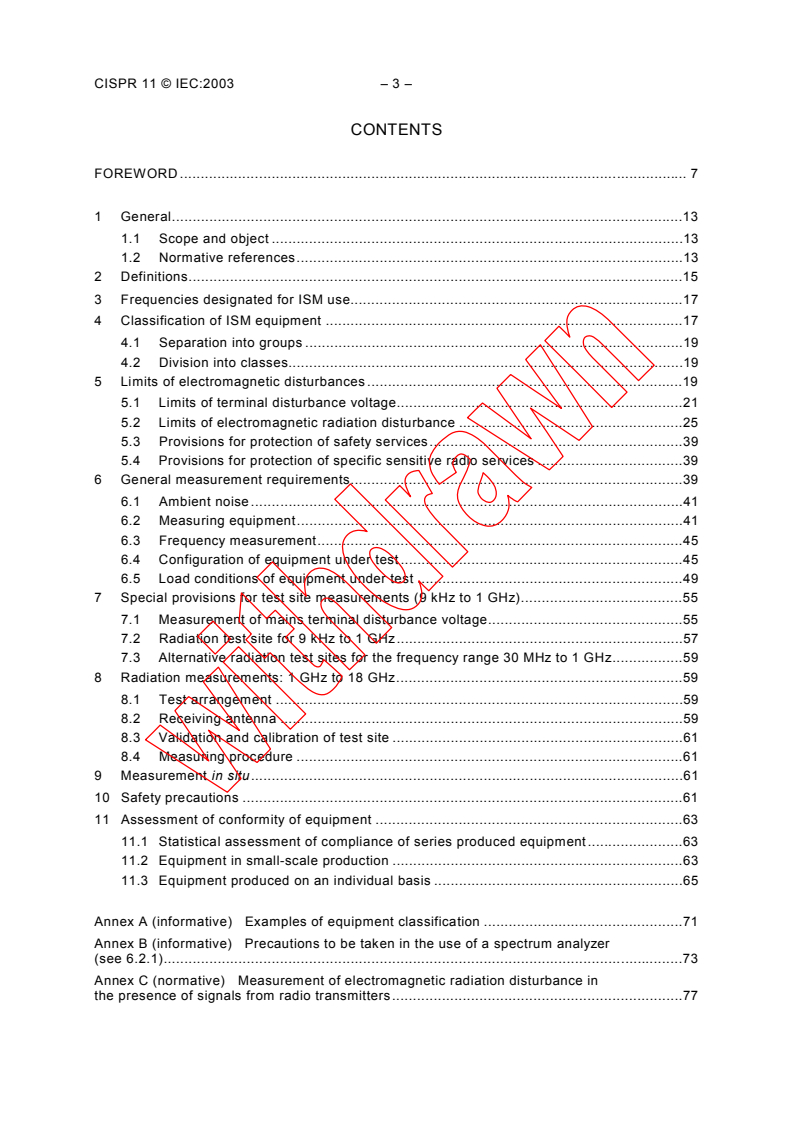
CONTENTS
FOREWORD . 7
1 General.13
1.1 Scope and object .13
1.2 Normative references.13
2 Definitions.15
3 Frequencies designated for ISM use.17
4 Classification of ISM equipment .17
4.1 Separation into groups .19
4.2 Division into classes.19
5 Limits of electromagnetic disturbances .19
5.1 Limits of terminal disturbance voltage.21
5.2 Limits of electromagnetic radiation disturbance .25
5.3 Provisions for protection of safety services.39
5.4 Provisions for protection of specific sensitive radio services .39
6 General measurement requirements.39
6.1 Ambient noise .41
6.2 Measuring equipment.41
6.3 Frequency measurement.45
6.4 Configuration of equipment under test .45
6.5 Load conditions of equipment under test .49
7 Special provisions for test site measurements (9 kHz to 1 GHz).55
7.1 Measurement of mains terminal disturbance voltage.55
7.2 Radiation test site for 9 kHz to 1 GHz.57
7.3 Alternative radiation test sites for the frequency range 30 MHz to 1 GHz.59
8 Radiation measurements: 1 GHz to 18 GHz.59
8.1 Test arrangement .59
8.2 Receiving antenna .59
8.3 Validation and calibration of test site .61
8.4 Measuring procedure .61
9 Measurement in situ.61
10 Safety precautions .61
11 Assessment of conformity of equipment .63
11.1 Statistical assessment of compliance of series produced equipment.63
11.2 Equipment in small-scale production .63
11.3 Equipment produced on an individual basis .65
Annex A (informative) Examples of equipment classification .71
Annex B (informative) Precautions to be taken in the use of a spectrum analyzer
(see 6.2.1).73
Annex C (normative) Measurement of electromagnetic radiation disturbance in
the presence of signals from radio transmitters.77
CISPR 11 © IEC:2003 – 5 –
Annex D (informative) Propagation of interference from industrial r.f. equipment at
frequencies between 30 MHz and 300 MHz.79
Annex E (informative) Safety related service bands.81
Annex F (informative) Sensitive service bands .83
Bibliography .85
Figure 1 – Test site .65
Figure 2 – Minimum size of metal ground plane .65
Figure 3 – Disposition of medical (capacitive type) and dummy load (see 6.5.1.1) .67
Figure 4 – Circuit for d sturbance voltage measurements on mains supply (see 6.2.2).67
Figure 5 – Decision tree for the measurement of emissions from 1 GHz to 18 GHz
of class B, group 2 ISM equipment operating at frequencies above 400 MHz.69
Figure 6 – Artificial hand, RC element (see 6.2.5) .69
Table 1 – Frequencies designated by ITU for use as fundamental ISM frequencies .17
Table 2a Mains terminal disturbance voltage limits for class A equipment
measured on a test site .23
Table 2b – Mains terminal disturbance voltage limits for class B equipment
measured on a test site .23
Table 2c – Mains terminal disturbance voltage for induction cooking appliances.25
Table 3 – Electromagnetic radiation disturbance limits for group 1 equipment .27
Table 4 – Electromagnetic radiation disturbance limits for group 2,
class B equipment measured on a test site .31
Table 5a – Electromagnetic radiation disturbance limits for group 2,
Class A equipment .33
Table 5b – Electromagnetic radiation disturbance limits for class A EDM
and arc welding equipment measured on a test site .35
Table 6 – Electromagnetic radiation disturbance peak limits for group 2,
class B ISM equipment producing CW type disturbances and operating
at frequencies above 400 MHz.37
Table 7 – Electromagnetic radiation disturbance peak limits for group 2,
class B ISM equipment producing fluctuating disturbances other than CW
and operating at frequencies above 400 MHz.37
Table 8 – Electromagnetic radiation disturbance weighted limits for group 2,
class B ISM equipment operating at frequencies above 400 MHz .37
Table 9 – Limits for electromagnetic radiation disturbances to protect specific safety
services in particular areas.39
Table 10 – The non-central t-distribution factor k as a function of the sample size n .63
CISPR 11 © IEC:2003 – 7 –
INTERNATIONAL ELECTROTECHNICAL COMMISSION
INTERNATIONAL SPECIAL COMMITTEE ON RADIO INTERFERENCE
_____________
INDUSTRIAL, SCIENTIFIC AND MEDICAL (ISM)
RADIO-FREQUENCY EQUIPMENT –
ELECTROMAGNETIC DISTURBANCE CHARACTERISTICS –
LIMITS AND METHODS OF MEASUREMENT
FOREWORD
1) The IEC (International Electrotechnical Commission) is a worldwide organization for standardization comprising
all national electrotechnical committees (IEC National Committees). The object of the IEC is to promote
international co-operation on all questions concerning standardization in the electrical and electronic fields. To
this end and in addition to other activities, the IEC publishes International Standards. Their preparation is
entrusted to technical committees; any IEC National Committee interested in the subject dealt with may
participate in this preparatory work. International, governmental and non-governmental organizations liaising
with the IEC also participate in this preparation. The IEC collaborates closely with the International Organization
for Standardization (ISO) in accordance with conditions determined by agreement between the two
organizations.
2) The formal decisions or agreements of the IEC on technical matters express, as nearly as possible, an
international consensus of opinion on the relevant subjects since each technical committee has representation
from all interested National Committees.
3) The documents produced have the form of recommendations for international use and are published in the form
of standards, technical specifications, technical reports or guides and they are accepted by the National
Committees in that sense.
4) In order to promote international unification, IEC National Committees undertake to apply IEC International
Standards transparently to the maximum extent possible in their national and regional standards. Any
divergence between the IEC Standard and the corresponding national or regional standard shall be clearly
indicated in the latter.
5) The IEC provides no marking procedure to indicate its approval and cannot be rendered responsible for any
equipment declared to be in conformity with one of its standards.
6) Attention is drawn to the possibility that some of the elements of this International Standard may be the subject
of patent rights. The IEC shall not be held responsible for identifying any or all such patent rights.
International Standard CISPR 11 has been prepared by CISPR Subcommittee B: Interference
relating to industrial, scientific and medical radio-frequency apparatus, to other (heavy) industrial
equipment, to overhead power lines, to high voltage equipment and to electric traction.
This fourth edition of CISPR 11 cancels and replaces the third edition published in 1997,
amendment 1 (1999) and amendment 2 (2002). It has the status of a Product Family EMC
standard in accordance with IEC Guide 107.
The document CISPR/B/295/FDIS, circulated to the National Committees as amendment 3, led
to the publication of the new edition.
The text of this standard is based on the third edition, amendment 1, amendment 2 and the
following documents:
FDIS Report on voting
CISPR/B/295/FDIS CISPR/B/301/RVD
Full information on the voting for the approval of this standard can be found in the report on
voting indicated in the above table.
This publication has been drafted in accordance with the ISO/IEC Directives, Part 2.
CISPR 11 © IEC:2003 – 9 –
The committee has decided that the contents of this publication will remain unchanged until
2004. At this date, the publication will be
• reconfirmed;
• withdrawn;
• replaced by a revised edition, or
• amended.
CISPR 11 © IEC:2003 – 11 –
The main content of this standard is based on CISPR Recommendation No. 39/2 given below:
RECOMMENDATION No. 39/2
Limits and methods of measurement of electromagnetic disturbance characteristics
of industrial, scientific and medical (ISM) radio-frequency equipment
The CISPR
CONSIDERING
a) that ISM r.f. equipment is an important source of disturbance;
b) that methods of measuring such disturbances have been prescribed by the CISPR;
c) that certain frequencies are designated by the International Telecommunication Union
(ITU) for unrestricted radiation from ISM equipment,
RECOMMENDS
that the latest edition of CISPR 11 be used for the application of limits and methods of
measurement of ISM equipment.
CISPR 11 © IEC:2003 – 13 –
INDUSTRIAL, SCIENTIFIC AND MEDICAL (ISM)
RADIO-FREQUENCY EQUIPMENT –
ELECTROMAGNETIC DISTURBANCE CHARACTERISTICS –
LIMITS AND METHODS OF MEASUREMENT
1 General
1.1 Scope and object
The limits and methods of measurement laid down in this International Standard apply to
industrial, scientific and medical (ISM) equipment as defined in Clause 2, and to electro-
discharge machining (EDM) and arc welding equipment.
NOTE The limits have been determined on a probabilistic basis taking into account the likelihood of interference.
In cases of interference, additional provisions may be required.
Procedures are given for the measurement of radio-frequency disturbances and limits are laid
down within the frequency range 9 kHz to 400 GHz.
Requirements for ISM lighting apparatus operating in the ISM frequency bands of 915 MHz
(only allowed in region 2 as defined by the ITU Radio Regulations), 2,45 GHz and 5,8 GHz are
contained in this standard.
Requirements for other types of lighting apparatus are covered in CISPR 15.
1.2 Normative references
The following referenced documents are indispensable for the application of this document. For
dated references, only the edition cited applies. For undated references, the latest edition of
the referenced document (including any amendments) applies.
CISPR 15, Limits and methods of measurement of radio disturbance characteristics of
electrical lighting and similar equipment
CISPR 16-1:1999, Specification for radio disturbance and immunity measuring apparatus and
methods – Part 1: Radio disturbance and immunity measuring apparatus
CISPR 16-2:1996, Specification for radio disturbance and immunity measuring apparatus and
methods – Part 2: Methods of measurement of disturbances and immunity
CISPR 19, Guidance on the use of the substitution method for measurements of radiation from
microwave ovens for frequencies above 1 GHz
IEC 60050(161), International Electrotechnical Vocabulary (IEV) – Chapter 161: Electro-
magnetic compatibility
IEC 60083, Plugs and sockets outlets for domestic and similar general use standardized
in member countries of IEC
CISPR 11 © IEC:2003 – 15 –
IEC 60705:1999, Household microwave ovens – Methods for measuring performance
IEC 60974-10, Arc welding equipment – Part 10: Electromagnetic compatibility (EMC)
requirements
IEC 61689, Ultrasonics – Physiotherapy systems – Performance requirements and methods
of measurement in the frequency range 0,5 MHz to 5 MHz
2 Definitions
For the purpose of this document, the definitions of IEC 60050(161) and the following
definitions apply.
2.1
ISM equipment
ISM appliance
equipment or appliances designed to generate and/or use locally radio-frequency energy for
industrial, scientific, medical, domestic or similar purposes, excluding applications in the field
of telecommunications and information technology and other applications covered by other
CISPR publications
2.2
electromagnetic radiation
1. The phenomenon by which energy in the form of electromagnetic waves emanates from
a source into space.
2. Energy transferred through space in the form of electromagnetic waves.
NOTE By extension, the term "electromagnetic radiation" sometimes also covers induction phenomena.
[IEV 161-01-10: 1990]
2.3
boundary of the equipment under test
imaginary straight line periphery describing a simple geometric configuration encompassing the
equipment under test. All interconnecting cables shall be included within this boundary
2.4
click
disturbance which exceeds the limit of continuous disturbance no longer than 200 ms and
which is separated from a subsequent disturbance by at least 200 ms. Both intervals are
related to the level of the limit of continuous disturbance.
A click may contain a number of impulses, in which case the relevant time is that from the
beginning of the first to the end of the last impulse.
2.5
electro-discharge machining (EDM) equipment
all the necessary units for the spark erosion process including the machine tool, the generator,
control circuits, the working fluid container and integral devices
2.6
spark erosion
removal of material in a dielectric working fluid by electro-discharges, which are separated in
time and randomly distributed in space, between two electrically conductive electrodes (the tool
electrode and the work piece electrode), and where the energy in the discharge is controlled
CISPR 11 © IEC:2003 – 17 –
2.7
arc welding equipment
equipment for applying current and voltage and having the required characteristics suitable for
arc welding and allied processes
2.8
arc welding
fusion welding in which the heat for welding is obtained from an electric arc or arcs
3 Frequencies designated for ISM use
Certain frequencies are designated by the International Telecommunication Union (ITU) for use
as fundamental frequencies for ISM equipment. These frequencies are listed in Table 1.
NOTE In individual countries different or additional frequencies may be designated for use by ISM equipment.
Table 1 – Frequencies designated by ITU for use as fundamental ISM frequencies
Number of appropriate
Centre frequency Frequency range
Maximum footnote to the table of
b
radiation limit frequency allocation of the
MHz MHz
a
ITU Radio Regulations
6,780 6,765 – 6,795 Under consideration S5.138
13,560 13,553 – 13,567 Unrestricted S5.150
27,120 26,957 – 27,283 Unrestricted S5.150
40,680 40,66 – 40,70 Unrestricted S5.150
433,920 433,05 – 434,79 Under consideration S5.138 in Region 1, except
countries mentioned in S5.280
915,000 902 – 928 Unrestricted S5.150 in Region 2 only
2 450 2 400 – 2 500 Unrestricted S5.150
5 800 5 725 – 5 875 Unrestricted S5.150
24 125 24 000 – 24 250 Unrestricted S5.150
61 250 61 000 – 61 500 Under consideration S5.138
122 500 122 000 – 123 000 Under consideration S5.138
245 000 244 000 – 246 000 Under consideration S5.138
a
Resolution No. 63 of the ITU Radio Regulations applies.
b
The term “unrestricted” applies to the fundamental and all other frequency components falling within the
designated band.
4 Classification of ISM equipment
The manufacturer and/or supplier of ISM equipment shall ensure that the user is informed
about the class and group of the equipment, either by labelling or by the accompanying
documentation. In both cases the manufacturer/supplier shall explain the meaning of both the
class and the group in the documentation accompanying the equipment.
NOTE See Annex A for examples of the classification of ISM equipment.
CISPR 11 © IEC:2003 – 19 –
4.1 Separation into groups
Group 1 ISM equipment: group 1 contains all ISM equipment in which there is intentionally
generated and/or used conductively coupled radio-frequency energy which is necessary for the
internal functioning of the equipment itself.
Group 2 ISM equipment: group 2 contains all ISM equipment in which radio-frequency energy is
intentionally generated and/or used in the form of electromagnetic radiation for the treatment of
material, and EDM and arc welding equipment.
Excluded from the testing requirements and limits of this standard are components and
subassemblies not intended to perform any stand-alone ISM function.
4.2 Division into classes
Class A equipment is equipment suitable for use in all establishments other than domestic and
those directly connected to a low voltage power supply network which supplies buildings used
for domestic purposes.
Class A equipment shall meet class A limits.
NOTE 1 Operation of equipment which does not meet the class A limits but does not result in unacceptable
degradation of radio services may be sanctioned on a case-by-case basis by the competent national authority.
NOTE 2 Although class A limits have been derived for industrial and commercial establishments, administrations
may allow, with whatever additional measures are necessary, the installation and use of class A ISM equipment in a
domestic establishment or in an establishment connected directly to domestic electricity power supplies.
Class B equipment is equipment suitable for use in domestic establishments and in
establishments directly connected to a low voltage power supply network which supplies
buildings used for domestic purposes.
Class B equipment shall meet class B limits.
5 Limits of electromagnetic disturbances
Class A ISM equipment may be measured either on a test site or in situ as preferred by the
manufacturer.
NOTE Due to size, complexity or operating conditions some ISM equipment may have to be measured in situ in
order to show compliance with the radiation disturbance limits specified herein.
Class B ISM equipment shall be measured on a test site.
Limits are under consideration for:
– arc stud welding equipment and arc striking and stabilizing devices for arc welding;
– radiology equipment;
– radio-frequency surgical diathermy equipment.
The limits given in Tables 2 to 9 are applicable to all electromagnetic disturbances at all
frequencies not exempted according to Table 1.
CISPR 11 © IEC:2003 – 21 –
The lower limit shall apply at all transition frequencies.
For ISM lighting devices operating in the ISM frequency bands 2,45 GHz and 5,8 GHz (and
915 MHz for Region 2 as defined by the ITU Radio Regulations), the limits to be applied are
those for class B, group 2 ISM equipment.
5.1 Limits of terminal disturbance voltage
The equipment under test shall meet either:
a) both the average limit specified for measurements with an average detector receiver and
the quasi-peak limit specified for measurements with a quasi-peak detector (see 6.2); or
b) the average limit when using a quasi-peak detector receiver (see 6.2).
Limits for signal line disturbance voltage are under consideration.
5.1.1 Frequency band 9 kHz to 150 kHz
Limits for mains terminal disturbance voltages in the frequency band 9 kHz to 150 kHz are
under consideration, except for induction cooking appliances.
For class A, group 2 ISM equipment in situ, no limits apply unless otherwise specified in this
standard.
5.1.2 Frequency band 150 kHz to 30 MHz
5.1.2.1 Continuous disturbance
Limits for mains terminal disturbance voltages in the frequency band 150 kHz to 30 MHz for
equipment measured on a test site using the 50 /50 H CISPR network or the CISPR voltage
probe (see 6.2.3 and Figure 4) are given in Tables 2a and 2b, except for the ITU designated
frequency bands listed in Table 1 for which the mains terminal disturbance voltage limits are
under consideration.
For class A, group 2 ISM equipment in situ, no limits apply unless otherwise specified in this
standard.
CISPR 11 © IEC:2003 – 23 –
Table 2a Mains terminal disturbance voltage limits
for class A equipment measured on a test site
Class A equipment limits
Frequency
dB( V)
band
a
Group 1 Group 2 Group 2
MHz Quasi-peak Average Quasi-peak Average Quasi-peak Average
0,15 – 0,50 79 66 100 90 130 120
0,50 5 73 60 86 76 125 115
90 80
Decreasing linearly with
5 30 73 60 115 105
logarithm of frequency to
70 60
NOTE Care should be taken to comply with leakage current requirements.
a Mains supply currents in excess of 100 A per phase when using the CISPR voltage probe or a suitable
V-network (LISN or AMN).
For class A EDM and arc welding equipment measured on a test site, the mains terminal
disturbance voltage limits of Table 2a apply.
Warning: Class A equipment is intended for use in an industrial environment. In the
documentation for the user, a statement shall be included drawing attention to the fact that
there may be potential difficulties in ensuring electromagnetic compatibility in other
environments, due to conducted as well as radiated disturbances.
Table 2b – Mains terminal disturbance voltage limits
for class B equipment measured on a test site
Class B equipment limits
dB( V)
Frequency band Groups 1 and 2
MHz
Quasi-peak Average
66 56
Decreasing linearly with logarithm Decreasing linearly with logarithm
0,15 – 0,50
of frequency to of frequency to
56 46
0,50 – 5 56 46
5 – 30 60 50
NOTE Care should be taken to comply with leakage current requirements.
For class B arc welding equipment measured on a test site, the mains terminal disturbance
voltage limits of Table 2b apply.
CISPR 11 © IEC:2003 – 25 –
5.1.2.2 Induction cooking appliances for domestic or commercial use
For induction cooking appliances for domestic or for commercial use (group 2 class B
equipment), the limits of Table 2c apply.
Table 2c – Mains terminal disturbance voltage for induction cooking appliances
Induction cooking appliance limits
Frequency range
dB( V)
MHz
Quasi-peak Average
0,009 to 0,050 110
Decreasing linearly with logarithm
0,050 to 0,1485
of frequency to
66 56
Decreasing linearly with logarithm Decreasing linearly with logarithm
0,1485 to 0,50
of frequency to of frequency to
56 46
0,50 to 5 56 46
5 to 30 60 50
NOTE The mains terminal disturbance voltage limits for a 100/110 V rated system are under consideration.
5.1.2.3 Discontinuous disturbance
For diagnostic X-ray generators, operating in intermittent mode, the limit for clicks shall be
the quasi-peak limit, as formulated in Table 2a or Table 2b for continuous disturbance,
increased by 20 dB.
5.1.3 Frequency band above 30 MHz
No limits are specified for terminal disturbance voltage above 30 MHz.
5.2 Limits of electromagnetic radiation disturbance
Measuring apparatus and methods of measurement are specified in Clauses 6, 7 and 8. The
equipment under test shall meet the limits when using a measuring instrument with a quasi-
peak detector.
Below 30 MHz the limits refer to the magnetic component of the electromagnetic radiation
disturbance. Between 30 MHz and 1 GHz the limits refer to the electric field strength
component of the electromagnetic radiation disturbance. Above 1 GHz the limits refer to the
power of the electromagnetic radiation disturbance.
5.2.1 Frequency band 9 kHz to 150 kHz
Limits for electromagnetic radiation disturbance in the frequency band 9 kHz to 150 kHz are
under consideration, except for induction cooking appliances.
CISPR 11 © IEC:2003 – 27 –
5.2.2 Frequency band 150 kHz to 1 GHz
Except for the designated frequency range listed in Table 1, the electromagnetic radiation
disturbance limits for the frequency band 150 kHz to 1 GHz for group 1, classes A and B
equipment are specified in Table 3; for group 2 class B equipment in Table 4; for group 2 class
A equipment in Table 5a and for class A EDM and arc welding equipment in Table 5b.
For induction cooking appliances falling within group 2 class, the limits are specified in
Tables 3a and 3b. Special provisions for the protection of specific safety services are given
in 5.3 and Table 9.
In certain circumstances (see 7.2.3), class A, group 2 equipment may be measured on a test
site at distances between 10 m and 30 m, and class B, group 1 or 2 equipment at distances
between 3 m and 10 m. In case of dispute class A, group 2 equipment shall be measured at a
distance of 30 m; class B, group 1 or group 2 equipment (as well as class A, group 1
equipment) shall be measured at a distance of 10 m.
Table 3 – Electromagnetic radiation disturbance limits for group 1 equipment
Measured on a test site Measured in situ
Group 1, class A
Limits with measuring
Frequency
Group 1, class A Group 1, class B distance 30 m from exterior
band
10 m measurement distance 10 m measurement distance wall outside the building
in which the equipment
is situated
MHz
dB( V/m) dB( V/m) dB( V/m)
0,15 – 30 Under consideration Under consideration Under consideration
30 – 230 40 30 30
230 – 1 000 47 37 37
NOTE For group 1, classes A and B equipment, intended to be permanently installed in X-ray shielded locations,
an increase in the electromagnetic radiation disturbance limits of 12 dB for tests conducted on a test site is
allowed.
Such equipment which does not meet the Table 3 limits is labelled as “Class A + 12” or “Class B + 12”. The
installation instructions should contain the following warning:
“Warning: This equipment is allowed to be installed only in X-ray protected rooms, which provide an attenuation of
at least 12 dB for radio disturbances from 30 MHz to 1 GHz.”
CISPR 11 © IEC:2003 – 29 –
Table 3a Limits of the magnetic field induced current in a 2 m loop antenna
around the device under test
Limits in dB( A)
Frequency range
Quasi-peak
MHz Horizontal component Vertical component
0,009 to 0,070 88 106
88 106
Decreasing linearly with logarithm Decreasing linearly with logarithm
0,070 to 0,1485
of frequency to of frequency to
58 76
58 76
Decreasing linearly with logarithm Decreasing linearly with logarithm
0,1485 to 30
of frequency to of frequency to
22 40
NOTE The limits of Table 3a apply to induction cooking appliances for domestic use which have a diagonal
dimension of less than 1,6 m.
Measurement is performed using the “Van Veen loop method” as described in 2.6.5 of CISPR 16-2.
Table 3b – Limits of the magnetic field strength
Frequency range Limits in dB( A/m) at 3 m distance
Quasi-peak
MHz
0,009 to 0,070 69
0,070 to 0,1485 Decreasing linearly with logarithm of frequency to
0,1485 to 4,0 Decreasing linearly with logarithm of frequency to
4,0 to 30 3
NOTE The limits of Table 3b apply to induction cooking appliances for commercial use and those for domestic
use with a diagonal diameter of more than 1,6 m.
Measurements are performed at 3 m distance with a 0,6 m loop antenna as described in 5.5.2.1 of CISPR 16-1.
The antenna shall be vertically installed, with the lower edge of the loop at 1 m height above the floor.
CISPR 11 © IEC:2003 – 31 –
Table 4 – Electromagnetic radiation disturbance limits for group 2,
class B equipment measured on a test site
Electric field
Magnetic field
Measurement distance 10 m
Frequency band Measurement distance 10 m
Quasi-peak limits
a
Quasi–peak limits Average limits
MHz dB( V/m) dB( V/m) dB( A/m)
Decreasing linearly with logarithm
0,15 to 30 – –
of frequency to
30 to 80,872 30 25 –
80,872 to 81,848 50 45 –
81,848 to 134,786 30 25 –
134,786 to 136,414 50 45 –
136,414 to 230 30 25 –
230 to 1 000 37 32 –
a
The average limits apply to magnetron driven equipment only. If magnetron driven equipment exceeds
the quasi–peak limit at certain frequencies, then the measurement shall be repeated at these
frequencies with the average detector and the average limits specified in this table apply.
CISPR 11 © IEC:2003 – 33 –
Table 5a – Electromagnetic radiation disturbance limits
for group 2, Class A equipment
Limits with measuring distance D
m
Frequency band
Distance D from exterior wall On a test site
of the building D = 10 m from the equipment
MHz
dB( V/m) dB( V/m)
0,15 – 0,49 75 95
0,49 – 1,705 65 85
1,705 – 2,194 70 90
2,194 – 3,95 65 85
3,95 – 20 50 70
20 – 30 40 60
30 – 47 48 68
47 – 53,91 30 50
a a
53,91 – 54,56 30(40) 50(60)
54,56 – 68 30 50
68 – 80,872 43 63
80,872 – 81,848 58 78
81,848 – 87 43 63
87 – 134,786 40 60
134,786 – 136,414 50 70
136,414 – 156 40 60
156 – 174 54 74
174 – 188,7 30 50
188,7 – 190,979 40 60
190,979 – 230 30 50
230 – 400 40 60
400 – 470 43 63
470 – 1 000 40 60
a
The limits in the frequency band of 53,91 MHz to 54,56 MHz can be relaxed by 10 dB on a national basis.
For equipment measured in situ, the measuring distance D from the exterior wall of the building
in which the equipment is situated equals (30 + x/a) m or 100 m whichever is smaller, provided
that the measuring distance D is within the boundary of the premises. In the case where the
calculated distance D is beyond the boundary of the premises, the measuring distance D
equals x or 30 m, whichever is longer.
For the calculation of the above values:
x is the nearest distance between the outside wall of the building in which the equipment is
situated and the boundary of the user’s premises in each measuring direction;
a = 2,5 for frequencies lower than 1 MHz;
a = 4,5 for frequencies equal to or higher than 1 MHz.
For the protection of specific aeronautical services in particular areas, national authorities may
require that specific limits be met at 30 m distance.
CISPR 11 © IEC:2003 – 35 –
Table 5b – Electromagnetic radiation disturbance limits
for class A EDM and arc welding equipment measured on a test site
Quasi-peak limits
Frequency band
(at 10 m measurement distance)
MHz dB(µV/m)
30 to 230 80
Decreasing linearly with logarithm of
frequency to
230 to 1 000 60
Warning: Class A equipment is intended for use in an industrial environment. In the
documentation for the user, a statement shall be included drawing attention to the fact that
there may be potential difficulties in ensuring electromagnetic compatibility in other
environments, due to conducted as well as radiated disturbances.
5.2.3 Frequency band 1 GHz to 18 GHz
Group 1 ISM equipment
Limits are under consideration.
NOTE Radiated disturbance limits for group 1 ISM equipment are intended to be identical to the limits currently
under consideration for information technology equipment (ITE) above 1 GHz.
Group 2 ISM equipment
Class A equipment
Limits are under consideration.
Class B equipment
a) ISM equipment operating at frequencies below 400 MHz
Limits are under consideration.
NOTE When finalized, these limits will be introduced together with the following conditional testing Clause.
If, in the band from 400 MHz to 1 GHz, all emissions are below the class B limits and the fifth harmonic of the
highest internally generated source is lower than 1 GHz (i.e. highest source <200 MHz), no testing above
1 GHz is required.
b) ISM equipment operating at frequencies above 400 MHz
The electromagnetic radiation disturbance limits for the frequency range 1 GHz to 18 GHz
are specified in Tables 6 to 8; the ISM equipment shall meet either the limits of Table 6 or
the limits of both Table 7 and Table 8 (see decision tree, Figure 5).
Special provision for the protection of specific safety services are given in 5.3 and Table 9.
CISPR 11 © IEC:2003 – 37 –
Table 6 – Electromagnetic radiation disturbance peak limits for group 2,
class B ISM equipment producing CW type disturbances
and operating at frequencies above 400 MHz
Frequency band Field strength at a measurement distance of 3 m
GHz
dB( V/m)
1 – 2,4 70
2,5 – 5,725 70
5,875 – 18 70
NOTE 1 For the protection of radio services, competent national authorities may require lower limits.
NOTE 2 Peak measurements with a resolution bandwidth of 1 MHz and a video signal bandwidth higher or equal
to 1 MHz.
Table 7 – Electromagnetic radiation disturbance peak limits for group 2,
class B ISM equipment producing fluctuating disturbances other than CW
and operating at frequencies above 400 MHz
Frequency band Field strength at a measurement distance of 3 m
GHz
dB( V/m)
1 – 2,3 92
2,3 – 2,4 110
2,5 – 5,725 92
5,875 – 11,7 92
11,7 – 12,7 73
12,7 – 18 92
NOTE 1 For the protection of radio services, competent national authorities may require lower limits.
NOTE 2 Peak measurements with a resolution bandwidth of 1 MHz and a video signal bandwidth higher or equal
to 1 MHz.
NOTE 3 Limits in this table were derived considering fluctuating sources such as magnetron-driven microwave
ovens.
Table 8 – Electromagnetic radiation disturbance weighted limits
for group 2, class B ISM equipment operating at frequencies above 400 MHz
Frequency band Field strength at a measurement distance of 3 m
GHz
dB( V/m)
1 – 2,4 60
2,5 – 5,725 60
5,875 – 18 60
NOTE 1 For the protection of radio services, competent national authorities may require lower limits.
NOTE 2 Weighted measurements with a resolution bandwidth of 1 MHz and a video bandwidth of 10 Hz.
NOTE 3 To check the limits of this table, measurements need only be performed around two centre frequencies:
the highest emission in the 1 005 MHz – 2 395 MHz band and the highest peak emission in the 2 505 MHz to
17 995 MHz band (outside the band 5 720 MHz – 5 880 MHz). At these two centre frequencies, measurements are
performed with a span of 10 MHz on the spectrum analyser.
CISPR 11 © IEC:2003 – 39 –
5.2.4 Frequency band 18 GHz to 400 GHz
Limits for the frequency band 18 GHz to 400 GHz are under consideration.
5.3 Provisions for protection of safety services
ISM systems should be designed to avoid fundamental operations or radiation of high-level
spurious and harmonic signals in bands used for safety-related radio services. A list of these
bands is provided in Annex E.
For the protection of specific services, in particular areas, national authorities may require
measurements to be made in situ and require the limits specified in Table 9 to be met in the
frequency band listed.
Table 9 – Limits for electromagnetic radiation disturbances
to protect specific safety services in particular areas
Measuring distance from
exterior wall outside the building
Frequency band Limits
in which the equipment
is situated
MHz dB( V/m) m
0,2835 – 0,5265 65 30
74,6 – 75,4 30 10
108 – 137 30 10
242,95 – 243,05 37 10
328,6 – 335,4 37 10
960 – 1 215 37 10
NOTE Many aeronautical communications require the limitation of vertically radiated electromagnetic disturbances.
Work is continuing to determine what provisions may be necessary to provide protection for such systems.
5.4 Provisions for protection of specific sensitive radio services
For the protection of specific sensitive services, in particular areas, national authorities may
request additional suppression measures or designated separation zones for cases where
harmful interference may occur. It is, therefore recommended to avoid fundamental operations
or the radiation of high level harmonic signals in the bands. Some examples of these bands are
listed for information in Annex F.
6 General measurement requirements
Class A equipment may be measured either on a test site or in situ as determined by the
manufacturer. Class B ISM equipment shall be measured on a test site.
Specific requirements for making measurements on a test site are given in Clauses 7 and 8,
for making measurements in situ in Clause 9.
The requirements of the present clause are to be met for both test site and/or in situ
measurements.
CISPR 11 © IEC:2003 – 41 –
6.1 Ambient noise
A test site for type testing shall allow emissions from the equipment under test to be
distinguished from ambient noise. The suitability in this respect can be determined by
measuring the ambient noise levels with the equipment under test inoperative and ensuring
that the ambient noise levels are at least 6 dB below the limits specified in 5.1, 5.2 or 5.3, as
appropriate for the measurement being carried out.
It is not necessary to reduce the ambient noise level to 6 dB below the specified limit where the
combination of the ambient noise plus the emission from the equipment under test does not
exceed the specified limit. Under these conditions the equipment under test is considered to
satisfy the specified limit.
When carrying out measurements on mains terminal disturbance voltage, local radio
transmissions may increase the ambient noise level at some frequencies. A suitable r.f. filter
may be inserted between the artificial mains network and the mains supply, or measurements
may be performed in a shielded enclosure. The components forming the r.f. filter should be
enclosed in a metallic screen directly connected to the reference earth of the measuring
system. The requirements for the impedance of the artificial mains network shall be satisfied at
the frequency of measurement when the r.f. filter is connected.
If, when measuring the electromagnetic radiation disturbance, the 6 dB ambient noise
conditions cannot be met, then the antenna may be located at a distance closer to the
equipment under test than specified in Clause 5 (see 7.2.3).
6.2 Measuring equipment
6.2.1 Measuring instruments
Receivers with quasi-peak detectors shall be in accordance with CISPR 16-1. Receivers with
average detec
...
INTERNATIONAL
CISPR
ELECTROTECHNICAL
COMMISSION
Edition 4.1
2004-06
Edition 4:2003 consolidated with amendment 1:2004
INTERNATIONAL SPECIAL COMMITTEE ON RADIO INTERFERENCE
Industrial, scientific and medical (ISM)
radio-frequency equipment –
Electromagnetic disturbance characteristics –
Limits and methods of measurement
This English-language version is derived from the original
bilingual publication by leaving out all French-language
pages. Missing page numbers correspond to the French-
language pages.
Reference number
Consolidated editions
The IEC is now publishing consolidated versions of its publications. For example,
edition numbers 1.0, 1.1 and 1.2 refer, respectively, to the base publication, the base
publication incorporating amendment 1 and the base publication incorporating
amendments 1 and 2.
Further information on IEC publications
The technical content of IEC publications is kept under constant review by the IEC,
thus ensuring that the content reflects current technology. Information relating to this
publication, including its validity, is available in the IEC Catalogue of publications
(see below) in addition to new editions, amendments and corrigenda. Information on
the subjects under consideration and work in progress undertaken by the technical
committee which has prepared this publication, as well as the list of publications
issued, is also available from the following:
• IEC Web Site (www.iec.ch)
• Catalogue of IEC publications
The on-line catalogue on the IEC web site (www.iec.ch/searchpub) enables you to
search by a variety of criteria including text searches, technical committees and
date of publication. On-line information is also available on recently issued
publications, withdrawn and replaced publications, as well as corrigenda.
• IEC Just Published
This summary of recently issued publications (www.iec.ch/online_news/justpub) is
also available by email. Please contact the Customer Service Centre (see below)
for further information.
• Customer Service Centre
If you have any questions regarding this publication or need further assistance,
please contact the Customer Service Centre:
Email: custserv@iec.ch
Tel: +41 22 919 02 11
Fax: +41 22 919 03 00
INTERNATIONAL
CISPR
ELECTROTECHNICAL
COMMISSION
Edition 4.1
2004-06
Edition 4:2003 consolidated with amendment 1:2004
INTERNATIONAL SPECIAL COMMITTEE ON RADIO INTERFERENCE
Industrial, scientific and medical (ISM)
radio-frequency equipment –
Electromagnetic disturbance characteristics –
Limits and methods of measurement
IEC 2004 Copyright - all rights reserved
No part of this publication may be reproduced or utilized in any form or by any means, electronic or mechanical,
including photocopying and microfilm, without permission in writing from the publisher.
International Electrotechnical Commission, 3, rue de Varembé, PO Box 131, CH-1211 Geneva 20, Switzerland
Telephone: +41 22 919 02 11 Telefax: +41 22 919 03 00 E-mail: inmail@iec.ch Web: www.iec.ch
PRICE CODE
CN
Commission Electrotechnique Internationale
International Electrotechnical Commission
Международная Электротехническая Комиссия
For price, see current catalogue
CISPR 11 © IEC:2003+A1:2004 – 3 –
CONTENTS
FOREWORD.7
1 General.13
1.1 Scope and object.13
1.2 Normative references.13
2 Definitions.15
3 Frequencies designated for ISM use .17
4 Classification of ISM equipment .17
4.1 Separation into groups.19
4.2 Division into classes .19
5 Limits of electromagnetic disturbances.19
5.1 Limits of terminal disturbance voltage .21
5.2 Limits of electromagnetic radiation disturbance .25
5.3 Provisions for protection of safety services .39
5.4 Provisions for protection of specific sensitive radio services .39
6 General measurement requirements .39
6.1 Ambient noise.41
6.2 Measuring equipment.41
6.3 Frequency measurement.45
6.4 Configuration of equipment under test.45
6.5 Load conditions of equipment under test .49
7 Special provisions for test site measurements (9 kHz to 1 GHz) .55
7.1 Measurement of mains terminal disturbance voltage .55
7.2 Radiation test site for 9 kHz to 1 GHz.57
7.3 Alternative radiation test sites for the frequency range 30 MHz to 1 GHz .59
8 Radiation measurements: 1 GHz to 18 GHz .59
8.1 Test arrangement.59
8.2 Receiving antenna.59
8.3 Validation and calibration of test site.61
8.4 Measuring procedure.61
9 Measurement in situ .61
10 Safety precautions.61
11 Assessment of conformity of equipment .63
11.1 Statistical assessment of compliance of series produced equipment.63
11.2 Equipment in small-scale production .63
11.3 Equipment produced on an individual basis.65
Annex A (informative) Examples of equipment classification .71
Annex B (informative) Precautions to be taken in the use of a spectrum analyzer
(see 6.2.1) .73
Annex C (normative) Measurement of electromagnetic radiation disturbance in
the presence of signals from radio transmitters.77
CISPR 11 © IEC:2003+A1:2004 – 5 –
Annex D (informative) Propagation of interference from industrial r.f. equipment at
frequencies between 30 MHz and 300 MHz .79
Annex E (informative) Safety related service bands .81
Annex F (informative) Sensitive service bands.83
Bibliography .85
Figure 1 – Test site .65
Figure 2 – Minimum size of metal ground plane .65
Figure 3 – Disposition of medical (capacitive type) and dummy load (see 6.5.1.1) .67
Figure 4 – Circuit for d sturbance voltage measurements on mains supply (see 6.2.2) .67
Figure 5 – Decision tree for the measurement of emissions from 1 GHz to 18 GHz
of class B, group 2 ISM equipment operating at frequencies above 400 MHz .69
Figure 6 – Artificial hand, RC element (see 6.2.5).69
Table 1 – Frequencies designated by ITU for use as fundamental ISM frequencies .17
Table 2a − Mains terminal disturbance voltage limits for class A equipment
measured on a test site.23
Table 2b – Mains terminal disturbance voltage limits for class B equipment
measured on a test site.23
Table 2c – Mains terminal disturbance voltage for induction cooking appliances .25
Table 3 – Electromagnetic radiation disturbance limits for group 1 equipment .27
Table 4 – Electromagnetic radiation disturbance limits for group 2,
class B equipment measured on a test site.31
Table 5a – Electromagnetic radiation disturbance limits for group 2,
Class A equipment .33
Table 5b – Electromagnetic radiation disturbance limits for class A EDM
and arc welding equipment measured on a test site .35
Table 6 – Electromagnetic radiation disturbance peak limits for group 2, class A and
class B ISM equipment producing CW type disturbances and operating at frequencies
above 400 MHz .37
Table 7 – Electromagnetic radiation disturbance peak limits for group 2,
class B ISM equipment producing fluctuating disturbances other than CW
and operating at frequencies above 400 MHz .37
Table 8 – Electromagnetic radiation disturbance weighted limits for group 2,
class B ISM equipment operating at frequencies above 400 MHz .37
Table 9 – Limits for electromagnetic radiation disturbances to protect specific safety
services in particular areas.39
Table 10 – The non-central t-distribution factor k as a function of the sample size n.63
CISPR 11 © IEC:2003+A1:2004 – 7 –
INTERNATIONAL ELECTROTECHNICAL COMMISSION
INTERNATIONAL SPECIAL COMMITTEE ON RADIO INTERFERENCE
_____________
INDUSTRIAL, SCIENTIFIC AND MEDICAL (ISM)
RADIO-FREQUENCY EQUIPMENT –
ELECTROMAGNETIC DISTURBANCE CHARACTERISTICS –
LIMITS AND METHODS OF MEASUREMENT
FOREWORD
1) The International Electrotechnical Commission (IEC) is a worldwide organization for standardization comprising
all national electrotechnical committees (IEC National Committees). The object of IEC is to promote
international co-operation on all questions concerning standardization in the electrical and electronic fields. To
this end and in addition to other activities, IEC publishes International Standards, Technical Specifications,
Technical Reports, Publicly Available Specifications (PAS) and Guides (hereafter referred to as “IEC
Publication(s)”). Their preparation is entrusted to technical committees; any IEC National Committee interested
in the subject dealt with may participate in this preparatory work. International, governmental and non-
governmental organizations liaising with the IEC also participate in this preparation. IEC collaborates closely
with the International Organization for Standardization (ISO) in accordance with conditions determined by
agreement between the two organizations.
2) The formal decisions or agreements of IEC on technical matters express, as nearly as possible, an international
consensus of opinion on the relevant subjects since each technical committee has representation from all
interested IEC National Committees.
3) IEC Publications have the form of recommendations for international use and are accepted by IEC National
Committees in that sense. While all reasonable efforts are made to ensure that the technical content of IEC
Publications is accurate, IEC cannot be held responsible for the way in which they are used or for any
misinterpretation by any end user.
4) In order to promote international uniformity, IEC National Committees undertake to apply IEC Publications
transparently to the maximum extent possible in their national and regional publications. Any divergence
between any IEC Publication and the corresponding national or regional publication shall be clearly indicated in
the latter.
5) IEC provides no marking procedure to indicate its approval and cannot be rendered responsible for any
equipment declared to be in conformity with an IEC Publication.
6) All users should ensure that they have the latest edition of this publication.
7) No liability shall attach to IEC or its directors, employees, servants or agents including individual experts and
members of its technical committees and IEC National Committees for any personal injury, property damage or
other damage of any nature whatsoever, whether direct or indirect, or for costs (including legal fees) and
expenses arising out of the publication, use of, or reliance upon, this IEC Publication or any other IEC
Publications.
8) Attention is drawn to the Normative references cited in this publication. Use of the referenced publications is
indispensable for the correct application of this publication.
9) Attention is drawn to the possibility that some of the elements of this IEC Publication may be the subject of
patent rights. IEC shall not be held responsible for identifying any or all such patent rights.
International Standard CISPR 11 has been prepared by CISPR Subcommittee B: Interference
relating to industrial, scientific and medical radio-frequency apparatus, to other (heavy)
industrial equipment, to overhead power lines, to high voltage equipment and to electric
traction.
It has the status of a Product Family EMC standard in accordance with IEC Guide 107.
This consolidated version of CISPR 11 consists of the fourth edition (2003) [documents
CISPR/B/295/FDIS and CISPR/B/301/RVD] and its amendment 1 (2004) [documents
CISPR/B/324/FDIS and CISPR/B/327/RVD].
The technical content is therefore identical to the base edition and its amendment and has
been prepared for user convenience.
CISPR 11 © IEC:2003+A1:2004 – 9 –
It bears the edition number 4.1.
A vertical line in the margin shows where the base publication has been modified by
amendment 1.
This publication has been drafted in accordance with the ISO/IEC Directives, Part 2.
The committee has decided that the contents of the base publication and its amendments will
remain unchanged until the maintenance result date indicated on the IEC web site under
"http://webstore.iec.ch" in the data related to the specific publication. At this date, the
publication will be
• reconfirmed,
• withdrawn,
• replaced by a revised edition, or
• amended.
CISPR 11 © IEC:2003+A1:2004 – 11 –
The main content of this standard is based on CISPR Recommendation No. 39/2 given below:
RECOMMENDATION No. 39/2
Limits and methods of measurement of electromagnetic disturbance characteristics
of industrial, scientific and medical (ISM) radio-frequency equipment
The CISPR
CONSIDERING
a) that ISM r.f. equipment is an important source of disturbance;
b) that methods of measuring such disturbances have been prescribed by the CISPR;
c) that certain frequencies are designated by the International Telecommunication Union
(ITU) for unrestricted radiation from ISM equipment,
RECOMMENDS
that the latest edition of CISPR 11 be used for the application of limits and methods of
measurement of ISM equipment.
CISPR 11 © IEC:2003+A1:2004 – 13 –
INDUSTRIAL, SCIENTIFIC AND MEDICAL (ISM)
RADIO-FREQUENCY EQUIPMENT –
ELECTROMAGNETIC DISTURBANCE CHARACTERISTICS –
LIMITS AND METHODS OF MEASUREMENT
1 General
1.1 Scope and object
The limits and methods of measurement laid down in this International Standard apply to
industrial, scientific and medical (ISM) equipment as defined in Clause 2, and to electro-
discharge machining (EDM) and arc welding equipment.
NOTE The limits have been determined on a probabilistic basis taking into account the likelihood of interference.
In cases of interference, additional provisions may be required.
Procedures are given for the measurement of radio-frequency disturbances and limits are laid
down within the frequency range 9 kHz to 400 GHz.
Requirements for ISM lighting apparatus and UV irradiators operating at frequencies within the
ISM frequency bands defined by the ITU Radio Regulations are contained in this standard.
Requirements for other types of lighting apparatus are covered in CISPR 15.
1.2 Normative references
The following referenced documents are indispensable for the application of this document. For
dated references, only the edition cited applies. For undated references, the latest edition of
the referenced document (including any amendments) applies.
CISPR 15, Limits and methods of measurement of radio disturbance characteristics of
electrical lighting and similar equipment
CISPR 16-1:1999, Specification for radio disturbance and immunity measuring apparatus and
methods – Part 1: Radio disturbance and immunity measuring apparatus
CISPR 16-2:1996, Specification for radio disturbance and immunity measuring apparatus and
methods – Part 2: Methods of measurement of disturbances and immunity
CISPR 19, Guidance on the use of the substitution method for measurements of radiation from
microwave ovens for frequencies above 1 GHz
IEC 60050(161), International Electrotechnical Vocabulary (IEV) – Chapter 161: Electro-
magnetic compatibility
IEC 60083, Plugs and sockets outlets for domestic and similar general use standardized
in member countries of IEC
CISPR 11 © IEC:2003+A1:2004 – 15 –
IEC 60705:1999, Household microwave ovens – Methods for measuring performance
IEC 60974-10, Arc welding equipment – Part 10: Electromagnetic compatibility (EMC)
requirements
IEC 61689, Ultrasonics – Physiotherapy systems – Performance requirements and methods
of measurement in the frequency range 0,5 MHz to 5 MHz
2 Definitions
For the purpose of this document, the definitions of IEC 60050(161) and the following
definitions apply.
2.1
ISM equipment
ISM appliance
equipment or appliances designed to generate and/or use locally radio-frequency energy for
industrial, scientific, medical, domestic or similar purposes, excluding applications in the field
of telecommunications and information technology and other applications covered by other
CISPR publications
2.2
electromagnetic radiation
1. The phenomenon by which energy in the form of electromagnetic waves emanates from
a source into space.
2. Energy transferred through space in the form of electromagnetic waves.
NOTE By extension, the term "electromagnetic radiation" sometimes also covers induction phenomena.
[IEV 161-01-10: 1990]
2.3
boundary of the equipment under test
imaginary straight line periphery describing a simple geometric configuration encompassing the
equipment under test. All interconnecting cables shall be included within this boundary
2.4
click
disturbance which exceeds the limit of continuous disturbance no longer than 200 ms and
which is separated from a subsequent disturbance by at least 200 ms. Both intervals are
related to the level of the limit of continuous disturbance.
A click may contain a number of impulses, in which case the relevant time is that from the
beginning of the first to the end of the last impulse.
2.5
electro-discharge machining (EDM) equipment
all the necessary units for the spark erosion process including the machine tool, the generator,
control circuits, the working fluid container and integral devices
2.6
spark erosion
removal of material in a dielectric working fluid by electro-discharges, which are separated in
time and randomly distributed in space, between two electrically conductive electrodes (the tool
electrode and the work piece electrode), and where the energy in the discharge is controlled
CISPR 11 © IEC:2003+A1:2004 – 17 –
2.7
arc welding equipment
equipment for applying current and voltage and having the required characteristics suitable for
arc welding and allied processes
2.8
arc welding
fusion welding in which the heat for welding is obtained from an electric arc or arcs
3 Frequencies designated for ISM use
Certain frequencies are designated by the International Telecommunication Union (ITU) for use
as fundamental frequencies for ISM equipment. These frequencies are listed in Table 1.
NOTE In individual countries different or additional frequencies may be designated for use by ISM equipment.
Table 1 – Frequencies designated by ITU for use as fundamental ISM frequencies
Number of appropriate
Centre frequency Frequency range
Maximum footnote to the table of
b
radiation limit frequency allocation of the
MHz MHz
a
ITU Radio Regulations
6,780 6,765 – 6,795 Under consideration S5.138
13,560 13,553 – 13,567 Unrestricted S5.150
27,120 26,957 – 27,283 Unrestricted S5.150
40,680 40,66 – 40,70 Unrestricted S5.150
433,920 433,05 – 434,79 Under consideration S5.138 in Region 1, except
countries mentioned in S5.280
915,000 902 – 928 Unrestricted S5.150 in Region 2 only
2 450 2 400 – 2 500 Unrestricted S5.150
5 800 5 725 – 5 875 Unrestricted S5.150
24 125 24 000 – 24 250 Unrestricted S5.150
61 250 61 000 – 61 500 Under consideration S5.138
122 500 122 000 – 123 000 Under consideration S5.138
245 000 244 000 – 246 000 Under consideration S5.138
a
Resolution No. 63 of the ITU Radio Regulations applies.
b
The term “unrestricted” applies to the fundamental and all other frequency components falling within the
designated band.
4 Classification of ISM equipment
The manufacturer and/or supplier of ISM equipment shall ensure that the user is informed
about the class and group of the equipment, either by labelling or by the accompanying
documentation. In both cases the manufacturer/supplier shall explain the meaning of both the
class and the group in the documentation accompanying the equipment.
NOTE See Annex A for examples of the classification of ISM equipment.
CISPR 11 © IEC:2003+A1:2004 – 19 –
4.1 Separation into groups
Group 1 ISM equipment: group 1 contains all ISM equipment in which there is intentionally
generated and/or used conductively coupled radio-frequency energy which is necessary for the
internal functioning of the equipment itself.
Group 2 ISM equipment: group 2 contains all ISM equipment in which radio-frequency energy is
intentionally generated and/or used in the form of electromagnetic radiation for the treatment of
material, and EDM and arc welding equipment.
Excluded from the testing requirements and limits of this standard are components and
subassemblies not intended to perform any stand-alone ISM function.
4.2 Division into classes
Class A equipment is equipment suitable for use in all establishments other than domestic and
those directly connected to a low voltage power supply network which supplies buildings used
for domestic purposes.
Class A equipment shall meet class A limits.
NOTE 1 Operation of equipment which does not meet the class A limits but does not result in unacceptable
degradation of radio services may be sanctioned on a case-by-case basis by the competent national authority.
NOTE 2 Although class A limits have been derived for industrial and commercial establishments, administrations
may allow, with whatever additional measures are necessary, the installation and use of class A ISM equipment in a
domestic establishment or in an establishment connected directly to domestic electricity power supplies.
Class B equipment is equipment suitable for use in domestic establishments and in
establishments directly connected to a low voltage power supply network which supplies
buildings used for domestic purposes.
Class B equipment shall meet class B limits.
5 Limits of electromagnetic disturbances
Class A ISM equipment may be measured either on a test site or in situ as preferred by the
manufacturer.
NOTE Due to size, complexity or operating conditions some ISM equipment may have to be measured in situ in
order to show compliance with the radiation disturbance limits specified herein.
Class B ISM equipment shall be measured on a test site.
Limits are under consideration for:
– arc stud welding equipment and arc striking and stabilizing devices for arc welding;
– radiology equipment;
– radio-frequency surgical diathermy equipment.
The limits given in Tables 2 to 9 are applicable to all electromagnetic disturbances at all
frequencies not exempted according to Table 1.
CISPR 11 © IEC:2003+A1:2004 – 21 –
The lower limit shall apply at all transition frequencies.
For ISM lighting devices operating in the ISM frequency bands 2,45 GHz and 5,8 GHz (and
915 MHz for Region 2 as defined by the ITU Radio Regulations), the limits to be applied are
those for class B, group 2 ISM equipment.
5.1 Limits of terminal disturbance voltage
The equipment under test shall meet either:
a) both the average limit specified for measurements with an average detector receiver and
the quasi-peak limit specified for measurements with a quasi-peak detector (see 6.2); or
b) the average limit when using a quasi-peak detector receiver (see 6.2).
Limits for signal line disturbance voltage are under consideration.
5.1.1 Frequency band 9 kHz to 150 kHz
Limits for mains terminal disturbance voltages in the frequency band 9 kHz to 150 kHz are
under consideration, except for induction cooking appliances.
For class A, group 2 ISM equipment in situ, no limits apply unless otherwise specified in this
standard.
5.1.2 Frequency band 150 kHz to 30 MHz
5.1.2.1 Continuous disturbance
Limits for mains terminal disturbance voltages in the frequency band 150 kHz to 30 MHz for
equipment measured on a test site using the 50 Ω/50 μH CISPR network or the CISPR voltage
probe (see 6.2.3 and Figure 4) are given in Tables 2a and 2b, except for the ITU designated
frequency bands listed in Table 1 for which the mains terminal disturbance voltage limits are
under consideration.
For class A, group 2 ISM equipment in situ, no limits apply unless otherwise specified in this
standard.
CISPR 11 © IEC:2003+A1:2004 – 23 –
Table 2a −−−− Mains terminal disturbance voltage limits
for class A equipment measured on a test site
Class A equipment limits
Frequency
dB(μV)
band
a
Group 1 Group 2 Group 2
MHz
Quasi-peak Average Quasi-peak Average Quasi-peak Average
0,15 – 0,50 79 66 100 90 130 120
0,50 − 5 73 60 86 76 125 115
90 80
Decreasing linearly with
5 − 30 73 60 115 105
logarithm of frequency to
70 60
NOTE Care should be taken to comply with leakage current requirements.
a Mains supply currents in excess of 100 A per phase when using the CISPR voltage probe or a suitable
V-network (LISN or AMN).
For class A EDM and arc welding equipment measured on a test site, the mains terminal
disturbance voltage limits of Table 2a apply.
Warning: Class A equipment is intended for use in an industrial environment. In the
documentation for the user, a statement shall be included drawing attention to the fact that
there may be potential difficulties in ensuring electromagnetic compatibility in other
environments, due to conducted as well as radiated disturbances.
Table 2b – Mains terminal disturbance voltage limits
for class B equipment measured on a test site
Class B equipment limits
dB(μV)
Frequency band Groups 1 and 2
MHz
Quasi-peak Average
66 56
Decreasing linearly with logarithm Decreasing linearly with logarithm
0,15 – 0,50
of frequency to of frequency to
56 46
0,50 – 5 56 46
5 – 30 60 50
NOTE Care should be taken to comply with leakage current requirements.
For class B arc welding equipment measured on a test site, the mains terminal disturbance
voltage limits of Table 2b apply.
CISPR 11 © IEC:2003+A1:2004 – 25 –
5.1.2.2 Induction cooking appliances for domestic or commercial use
For induction cooking appliances for domestic or for commercial use (group 2 class B
equipment), the limits of Table 2c apply.
Table 2c – Mains terminal disturbance voltage for induction cooking appliances
Induction cooking appliance limits
Frequency range
dB(μV)
MHz
Quasi-peak Average
0,009 to 0,050 110 −
Decreasing linearly with logarithm
0,050 to 0,1485
of frequency to
66 56
Decreasing linearly with logarithm Decreasing linearly with logarithm
0,1485 to 0,50
of frequency to of frequency to
56 46
0,50 to 5 56 46
5 to 30 60 50
NOTE The mains terminal disturbance voltage limits for a 100/110 V rated system are under consideration.
5.1.2.3 Discontinuous disturbance
For diagnostic X-ray generators, operating in intermittent mode, the limit for clicks shall be
the quasi-peak limit, as formulated in Table 2a or Table 2b for continuous disturbance,
increased by 20 dB.
5.1.3 Frequency band above 30 MHz
No limits are specified for terminal disturbance voltage above 30 MHz.
5.2 Limits of electromagnetic radiation disturbance
Measuring apparatus and methods of measurement are specified in Clauses 6, 7 and 8. The
equipment under test shall meet the limits when using a measuring instrument with a quasi-
peak detector.
Below 30 MHz the limits refer to the magnetic component of the electromagnetic radiation
disturbance. Between 30 MHz and 1 GHz the limits refer to the electric field strength
component of the electromagnetic radiation disturbance. Above 1 GHz the limits refer to the
power of the electromagnetic radiation disturbance.
5.2.1 Frequency band 9 kHz to 150 kHz
Limits for electromagnetic radiation disturbance in the frequency band 9 kHz to 150 kHz are
under consideration, except for induction cooking appliances.
CISPR 11 © IEC:2003+A1:2004 – 27 –
5.2.2 Frequency band 150 kHz to 1 GHz
Except for the designated frequency range listed in Table 1, the electromagnetic radiation
disturbance limits for the frequency band 150 kHz to 1 GHz for group 1, classes A and B
equipment are specified in Table 3; for group 2 class B equipment in Table 4; for group 2 class
A equipment in Table 5a and for class A EDM and arc welding equipment in Table 5b.
For induction cooking appliances falling within group 2 class, the limits are specified in
Tables 3a and 3b. Special provisions for the protection of specific safety services are given
in 5.3 and Table 9.
In certain circumstances (see 7.2.3), class A, group 2 equipment may be measured on a test
site at distances between 10 m and 30 m, and class B, group 1 or 2 equipment at distances
between 3 m and 10 m. In case of dispute class A, group 2 equipment shall be measured at a
distance of 30 m; class B, group 1 or group 2 equipment (as well as class A, group 1
equipment) shall be measured at a distance of 10 m.
Table 3 – Electromagnetic radiation disturbance limits for group 1 equipment
Measured on a test site Measured in situ
Group 1, class A
Limits with measuring
Frequency
Group 1, class A Group 1, class B distance 30 m from exterior
band
10 m measurement distance 10 m measurement distance wall outside the building
in which the equipment
is situated
MHz
dB(μV/m) dB(μV/m) dB(μV/m)
0,15 – 30 Under consideration Under consideration Under consideration
30 – 230 40 30 30
230 – 1 000 47 37 37
NOTE For group 1, classes A and B equipment, intended to be permanently installed in X-ray shielded locations,
an increase in the electromagnetic radiation disturbance limits of 12 dB for tests conducted on a test site is
allowed.
Such equipment which does not meet the Table 3 limits is labelled as “Class A + 12” or “Class B + 12”. The
installation instructions should contain the following warning:
“Warning: This equipment is allowed to be installed only in X-ray protected rooms, which provide an attenuation of
at least 12 dB for radio disturbances from 30 MHz to 1 GHz.”
CISPR 11 © IEC:2003+A1:2004 – 29 –
Table 3a −−−− Limits of the magnetic field induced current in a 2 m loop antenna
around the device under test
Limits in dB(μμA)
μμ
Frequency range
Quasi-peak
MHz Horizontal component Vertical component
0,009 to 0,070 88 106
88 106
Decreasing linearly with logarithm Decreasing linearly with logarithm
0,070 to 0,1485
of frequency to of frequency to
58 76
58 76
Decreasing linearly with logarithm Decreasing linearly with logarithm
0,1485 to 30
of frequency to of frequency to
22 40
NOTE The limits of Table 3a apply to induction cooking appliances for domestic use which have a diagonal
dimension of less than 1,6 m.
Measurement is performed using the “Van Veen loop method” as described in 2.6.5 of CISPR 16-2.
Table 3b – Limits of the magnetic field strength
Frequency range
Limits in dB(μμμμA/m) at 3 m distance
Quasi-peak
MHz
0,009 to 0,070 69
0,070 to 0,1485 Decreasing linearly with logarithm of frequency to
0,1485 to 4,0 Decreasing linearly with logarithm of frequency to
4,0 to 30 3
NOTE The limits of Table 3b apply to induction cooking appliances for commercial use and those for domestic
use with a diagonal diameter of more than 1,6 m.
Measurements are performed at 3 m distance with a 0,6 m loop antenna as described in 5.5.2.1 of CISPR 16-1.
The antenna shall be vertically installed, with the lower edge of the loop at 1 m height above the floor.
CISPR 11 © IEC:2003+A1:2004 – 31 –
Table 4 – Electromagnetic radiation disturbance limits for group 2,
class B equipment measured on a test site
Electric field
Magnetic field
Measurement distance 10 m
Frequency band Measurement distance 10 m
Quasi-peak limits
a
Quasi–peak limits Average limits
MHz
dB(μV/m) dB(μV/m) dB(μA/m)
Decreasing linearly with logarithm
0,15 to 30 – –
of frequency to
30 to 80,872 30 25 –
80,872 to 81,848 50 45 –
81,848 to 134,786 30 25 –
134,786 to 136,414 50 45 –
136,414 to 230 30 25 –
230 to 1 000 37 32 –
a
The average limits apply to magnetron driven equipment only. If magnetron driven equipment exceeds
the quasi–peak limit at certain frequencies, then the measurement shall be repeated at these
frequencies with the average detector and the average limits specified in this table apply.
CISPR 11 © IEC:2003+A1:2004 – 33 –
Table 5a – Electromagnetic radiation disturbance limits
for group 2, Class A equipment
Limits with measuring distance D
m
Frequency band
Distance D from exterior wall On a test site
of the building D = 10 m from the equipment
MHz
dB(μV/m) dB(μV/m)
0,15 – 0,49 75 95
0,49 – 1,705 65 85
1,705 – 2,194 70 90
2,194 – 3,95 65 85
3,95 – 20 50 70
20 – 30 40 60
30 – 47 48 68
47 – 53,91 30 50
a a
53,91 – 54,56 30(40) 50(60)
54,56 – 68 30 50
68 – 80,872 43 63
80,872 – 81,848 58 78
81,848 – 87 43 63
87 – 134,786 40 60
134,786 – 136,414 50 70
136,414 – 156 40 60
156 – 174 54 74
174 – 188,7 30 50
188,7 – 190,979 40 60
190,979 – 230 30 50
230 – 400 40 60
400 – 470 43 63
470 – 1 000 40 60
a
The limits in the frequency band of 53,91 MHz to 54,56 MHz can be relaxed by 10 dB on a national basis.
For equipment measured in situ, the measuring distance D from the exterior wall of the building
in which the equipment is situated equals (30 + x/a) m or 100 m whichever is smaller, provided
that the measuring distance D is within the boundary of the premises. In the case where the
calculated distance D is beyond the boundary of the premises, the measuring distance D
equals x or 30 m, whichever is longer.
For the calculation of the above values:
x is the nearest distance between the outside wall of the building in which the equipment is
situated and the boundary of the user’s premises in each measuring direction;
a = 2,5 for frequencies lower than 1 MHz;
a = 4,5 for frequencies equal to or higher than 1 MHz.
For the protection of specific aeronautical services in particular areas, national authorities may
require that specific limits be met at 30 m distance.
CISPR 11 © IEC:2003+A1:2004 – 35 –
Table 5b – Electromagnetic radiation disturbance limits
for class A EDM and arc welding equipment measured on a test site
Quasi-peak limits
Frequency band
(at 10 m measurement distance)
MHz dB(µV/m)
30 to 230 80
Decreasing linearly with logarithm of
frequency to
230 to 1 000 60
Warning: Class A equipment is intended for use in an industrial environment. In the
documentation for the user, a statement shall be included drawing attention to the fact that
there may be potential difficulties in ensuring electromagnetic compatibility in other
environments, due to conducted as well as radiated disturbances.
5.2.3 Frequency band 1 GHz to 18 GHz
Group 1 ISM equipment
Limits are under consideration.
NOTE Radiated disturbance limits for group 1 ISM equipment are intended to be identical to the limits currently
under consideration for information technology equipment (ITE) above 1 GHz.
Group 2 ISM equipment
a) ISM equipment operating at frequencies below 400 MHz
Limits are under consideration.
NOTE When finalized, these limits will be introduced together with the following conditional testing Clause.
If, in the band from 400 MHz to 1 GHz, all emissions are below the class B limits and the fifth harmonic of the
highest internally generated source is lower than 1 GHz (i.e. highest source <200 MHz), no testing above
1 GHz is required.
b) ISM equipment operating at frequencies above 400 MHz
The electromagnetic radiation disturbance limits for the frequency range 1 GHz to 18 GHz
are specified in Tables 6 to 8; the ISM equipment shall meet either the limits of Table 6 or
the limits of both Table 7 and Table 8 (see decision tree, Figure 5).
Special provision for the protection of specific safety services are given in 5.3 and Table 9.
For microwave-powered UV irradiators, the limits specified in Table 6 apply.
CISPR 11 © IEC:2003+A1:2004 – 37 –
Table 6 – Electromagnetic radiation disturbance peak limits for group 2,
class A and class B ISM equipment producing CW type disturbances
and operating at frequencies above 400 MHz
Frequency band Field strength at a measurement distance of 3 m
dB(µV/m)
1 GHz to 18 GHz class A class B
a
Within harmonic frequency bands 70
Outside harmonic frequency bands 70 70
NOTE 1 For the protection of radio services, competent national authorities may require lower limits.
NOTE 2 Peak measurements with a resolution bandwidth of 1 MHz and a video signal bandwidth higher than or
equal to 1 MHz.
NOTE 3 In this table, “harmonic frequency bands” means the frequency bands which are multiples of the ISM
bands allocated above 1 GHz.
a
At the upper and lower edge frequency of harmonic frequency bands, the lower limit of 70 dB(µV/m) applies.
Table 7 – Electromagnetic radiation disturbance peak limits for group 2,
class B ISM equipment producing fluctuating disturbances other than CW
and operating at frequencies above 400 MHz
Frequency band Field strength at a measurement distance of 3 m
GHz
dB(μV/m)
1 – 2,3 92
2,3 – 2,4 110
2,5 – 5,725 92
5,875 – 11,7 92
11,7 – 12,7 73
12,7 – 18 92
NOTE 1 For the protection of radio services, competent national authorities may require lower limits.
NOTE 2 Peak measurements with a resolution bandwidth of 1 MHz and a video signal bandwidth higher or equal
to 1 MHz.
NOTE 3 Limits in this table were derived considering fluctuating sources such as magnetron-driven microwave
ovens.
Table 8 – Electromagnetic radiation disturbance weighted limits
for group 2, class B ISM equipment operating at frequencies above 400 MHz
Frequency band Field strength at a measurement distance of 3 m
GHz dB(μV/m)
1 – 2,4 60
2,5 – 5,725 60
5,875 – 18 60
NOTE 1 For the protection of radio services, competent national authorities may require lower limits.
NOTE 2 Weighted measurements with a resolution bandwidth of 1 MHz and a video bandwidth of 10 Hz.
NOTE 3 To check the limits of this table, measurements need only be performed around two centre frequencies:
the highest emission in the 1 005 MHz – 2 395 MHz band and the highest peak emission in the 2 505 MHz to
17 995 MHz band (outside the band 5 720 MHz – 5 880 MHz). At these two centre frequencies, measurements are
performed with a span of 10 MHz on the spectrum analyser.
CISPR 11 © IEC:2003+A1:2004 – 39 –
5.2.4 Frequency band 18 GHz to 400 GHz
Limits for the frequency band 18 GHz to 400 GHz are under consideration.
5.3 Provisions for protection of safety services
ISM systems should be designed to avoid fundamental operations or radiation of high-level
spurious and harmonic signals in bands used for safety-related radio services. A list of these
bands is provided in Annex E.
For the protection of specific services, in particular areas, national authorities may require
measurements to be made in situ and require the limits specified in Table 9 to be met in the
frequency band listed.
Table 9 – Limits for electromagnetic radiation disturbances
to protect specific safety services in particular areas
Measuring distance from
exterior wall outside the building
Frequency band Limits
in which the equipment
is situated
MHz dB(μV/m) m
0,2835 – 0,5265 65 30
74,6 – 75,4 30 10
108 – 137 30 10
242,95 – 243,05 37 10
328,6 – 335,4 37 10
960 – 1 215 37 10
NOTE Many aeronautical communications require the limitation of vertically radiated ele
...
COMMISSION
CISPR
ÉLECTROTECHNIQUE
INTERNATIONALE
Quatrième édition
2003-03
COMITÉ INTERNATIONAL SPÉCIAL DES PERTURBATIONS RADIOÉLECTRIQUES
Appareils industriels, scientifiques et
médicaux (ISM) à fréquence radioélectrique –
Caractéristiques de perturbations
électromagnétiques-
Limites et méthodes de mesure
Cette version française découle de la publication d’origine
bilingue dont les pages anglaises ont été supprimées.
Les numéros de page manquants sont ceux des pages
supprimées.
Numéro de référence
Publication numbering
As from 1 January 1997 all IEC publications are issued with a designation in the
60000 series. For example, IEC 34-1 is now referred to as IEC 60034-1.
Consolidated editions
The IEC is now publishing consolidated versions of its publications. For example,
edition numbers 1.0, 1.1 and 1.2 refer, respectively, to the base publication, the
base publication incorporating amendment 1 and the base publication incorporating
amendments 1 and 2.
Further information on IEC publications
The technical content of IEC publications is kept under constant review by the IEC,
thus ensuring that the content reflects current technology. Information relating to
this publication, including its validity, is available in the IEC Catalogue of
publications (see below) in addition to new editions, amendments and corrigenda.
Information on the subjects under consideration and work in progress undertaken
by the technical committee which has prepared this publication, as well as the list
of publications issued, is also available from the following:
IEC Web Site (www.iec.ch)
Catalogue of IEC publications
The on-line catalogue on the IEC web site (http://www.iec.ch/searchpub/cur_fut.htm)
enables you to search by a variety of criteria including text searches, technical
committees and date of publication. On-line information is also available on
recently issued publications, withdrawn and replaced publications, as well as
corrigenda.
IEC Just Published
This summary of recently issued publications (http://www.iec.ch/online_news/
justpub/jp_entry.htm) is also available by email. Please contact the Customer
Service Centre (see below) for further information.
Customer Service Centre
If you have any questions regarding this publication or need further assistance,
please contact the Customer Service Centre:
Email: custserv@iec.ch
Tel: +41 22 919 02 11
Fax: +41 22 919 03 00
COMMISSION
CISPR
ÉLECTROTECHNIQUE
INTERNATIONALE
Quatrième édition
2003-03
COMITÉ INTERNATIONAL SPÉCIAL DES PERTURBATIONS RADIOÉLECTRIQUES
Appareils industriels, scientifiques et
médicaux (ISM) à fréquence radioélectrique –
Caractéristiques de perturbations
électromagnétiques-
Limites et méthodes de mesure
IEC 2003 Droits de reproduction réservés
Aucune partie de cette publication ne peut être reproduite ni utilisée sous quelque forme que ce soit et par aucun
procédé, électronique ou mécanique, y compris la photocopie et les microfilms, sans l'accord écrit de l'éditeur.
International Electrotechnical Commission, 3, rue de Varembé, PO Box 131, CH-1211 Geneva 20, Switzerland
Telephone: +41 22 919 02 11 Telefax: +41 22 919 03 00 E-mail: inmail@iec.ch Web: www.iec.ch
CODE PRIX
Commission Electrotechnique Internationale X
International Electrotechnical Commission
Pour prix, voir catalogue en vigueur
– 2 – CISPR 11 © CEI:2003
SOMMAIRE
AVANT-PROPOS . 6
1 Généralités .12
1.1 Domaine d'application et objet.12
1.2 Références normatives .12
2 Définitions.14
3 Fréquences désignées pour être utilisées par les ISM .16
4 Classification des appareils ISM.16
4.1 Séparation en groupes .18
4.2 Division en classes .18
5 Valeurs limites des perturbations électromagnétiques.18
5.1 Valeurs limites de la tension perturbatrice aux bornes .20
5.2 Valeurs limites du rayonnement électromagnétique perturbateur.24
5.3 Dispositions de protection des services de sécurité .38
5.4 Dispositions pour la protection de certains services radio spécifiques
et sensibles .38
6 Exigences générales pour les mesures.38
6.1 Bruit ambiant .40
6.2 Equipement de mesure .40
6.3 Mesure de fréquence .44
6.4 Configuration des appareils en essai.44
6.5 Conditions de charge des appareils en essai.48
7 Dispositions spéciales pour les mesures sur un emplacement d'essai
(9 kHz à 1 GHz) .54
7.1 Mesure de la tension perturbatrice aux bornes .54
7.2 Emplacement d'essai de rayonnement dans la bande de 9 kHz à 1 GHz .56
7.3 Autres emplacements d’essai de rayonnement dans la bande de fréquences
de 30 MHz à 1 GHz.58
8 Mesures de rayonnement entre 1 GHz et 18 GHz .58
8.1 Disposition de l'appareil en essai .58
8.2 Antenne de réception .58
8.3 Validation et étalonnage de l'emplacement d'essai .60
8.4 Procédé de mesure.60
9 Mesures in situ.60
10 Précautions de sécurité.60
11 Evaluation de la conformité des appareils.62
11.1 Evaluation statistique de la conformité des appareils produits en série .62
11.2 Appareils produits en petite série .62
11.3 Appareils produits individuellement .64
Annexe A (informative) Exemples de classification des appareils .70
Annexe B (informative) Précautions à prendre lors de l'utilisation d'un analyseur de
spectre (voir 6.2.1) .72
Annexe C (normative) Mesure du rayonnement électromagnétique perturbateur en
présence de signaux provenant d'émetteurs radio.76
– 4 – CISPR 11 © CEI:2003
Annexe D (informative) Propagation des perturbations émanant d'appareils industriels
r.f. aux fréquences comprises entre 30 MHz et 300 MHz.78
Annexe E (informative) Bandes de services de sécurité .80
Annexe F (informative) Bandes de services sensibles .82
Bibliographie .84
Figure 1 – Emplacement d'essai .64
Figure 2 – Dimensions minimales du plan de masse métallique .64
Figure 3 – Appareils médicaux (type capacitif): disposition de l'appareil
et de la charge fictive (voir 6.5.1.1).66
Figure 4 – Dispositif pour la mesure des tensions perturbatrices
sur le réseau d'alimentation (voir 6.2.2) .66
Figure 5 – Arbre de décision pour la mesure des émissions entre 1 GHz et 18 GHz
des appareils ISM du groupe 2 de classe B fonctionnant à des fréquences supérieures
à 400 MHz.68
Figure 6 – Main artificielle, réseau RC (voir 6.2.5).68
Tableau 1 – Fréquences désignées par l'UIT comme fréquences fondamentales
pour les appareils ISM.16
Tableau 2a Limites de tensions perturbatrices aux bornes du réseau d’alimentation
pour les appareils de classe A mesurés sur un emplacement d’essai .22
Tableau 2b – Limites des tensions perturbatrices aux bornes du réseau
pour les appareils de classe B mesurés sur un emplacement d'essai .22
Tableau 2c – Limites de la tension perturbatrice aux bornes du réseau
pour les appareils de cuisson à induction.24
Tableau 3 – Limites du rayonnement électromagnétique perturbateur
pour les appareils du groupe 1.26
Tableau 4 Limites du rayonnement électromagnétique perturbateur pour les appareils
du groupe 2, classe B, mesurées sur un emplacement d’essai.30
Tableau 5a – Limites du rayonnement électromagnétique perturbateur
pour les appareils du groupe 2, classe A.32
Tableau 5b – Limites du rayonnement électromagnétique perturbateur
pour les matériels UDE et les matériels de soudage à l’arc de classe A mesurés
sur un emplacement d’essai .34
Tableau 6 – Limites en valeur crête du rayonnement électromagnétique perturbateur
des appareils ISM du groupe 2 de classe B produisant des perturbations de type continu
et fonctionnant à des fréquences supérieures à 400 MHz.36
Tableau 7 – Limites en valeur crête du rayonnement électromagnétique perturbateur
des appareils ISM du groupe 2 de classe B produisant des perturbations fluctuantes
de type non continu et fonctionnant à des fréquences supérieures à 400 MHz.36
Tableau 8 – Limites en valeur pondérée du rayonnement électromagnétique
perturbateur des appareils ISM du groupe 2 de classe B fonctionnant à des fréquences
supérieures à 400 MHz.36
Tableau 9 – Limites du rayonnement électromagnétique perturbateur pour protéger
des services spécifiquement liés à la sécurité, dans des zones particulières .38
Tableau 10 – Facteur k de distribution t non centrale en fonction de la taille n
de l'échantillon .62
– 6 – CISPR 11 © CEI:2003
COMMISSION ÉLECTROTECHNIQUE INTERNATIONALE
COMITÉ INTERNATIONAL SPÉCIAL DES PERTURBATIONS RADIOÉLECTRIQUES
___________
APPAREILS INDUSTRIELS, SCIENTIFIQUES ET MÉDICAUX (ISM)
À FRÉQUENCE RADIOÉLECTRIQUE –
CARACTÉRISTIQUES DE PERTURBATIONS ÉLECTROMAGNÉTIQUES –
LIMITES ET MÉTHODES DE MESURE
AVANT-PROPOS
1) La CEI (Commission Electrotechnique Internationale) est une organisation mondiale de normalisation composée
de l'ensemble des comités électrotechniques nationaux (Comités nationaux de la CEI). La CEI a pour objet de
favoriser la coopération internationale pour toutes les questions de normalisation dans les domaines de
l'électricité et de l'électronique. A cet effet, la CEI, entre autres activités, publie des Normes internationales.
Leur élaboration est confiée à des comités d'études, aux travaux desquels tout Comité national intéressé par le
sujet traité peut participer. Les organisations internationales, gouvernementales et non gouvernementales, en
liaison avec la CEI, participent également aux travaux. La CEI collabore étroitement avec l'Organisation
Internationale de Normalisation (ISO), selon des conditions fixées par accord entre les deux organisations.
2) Les décisions ou accords officiels de la CEI concernant les questions techniques représentent, dans la mesure
du possible, un accord international sur les sujets étudiés, étant donné que les Comités nationaux intéressés
sont représentés dans chaque comité d’études.
3) Les documents produits se présentent sous la forme de recommandations internationales. Ils sont publiés
comme normes, spécifications techniques, rapports techniques ou guides et agréés comme tels par les Comités
nationaux.
4) Dans le but d'encourager l'unification internationale, les Comités nationaux de la CEI s'engagent à appliquer de
façon transparente, dans toute la mesure possible, les Normes internationales de la CEI dans leurs normes
nationales et régionales. Toute divergence entre la norme de la CEI et la norme nationale ou régionale
correspondante doit être indiquée en termes clairs dans cette dernière.
5) La CEI n’a fixé aucune procédure concernant le marquage comme indication d’approbation et sa responsabilité
n’est pas engagée quand un matériel est déclaré conforme à l’une de ses normes.
6) L’attention est attirée sur le fait que certains des éléments de la présente Norme internationale peuvent faire
l’objet de droits de propriété intellectuelle ou de droits analogues. La CEI ne saurait être tenue pour
responsable de ne pas avoir identifié de tels droits de propriété et de ne pas avoir signalé leur existence.
La Norme internationale CISPR 11 a été établie par le sous-comité B du CISPR: Perturbations
relatives aux appareils industriels, scientifiques et médicaux à fréquences radioélectriques, aux
autres appareils de l’industrie lourde, aux lignes à haute tension, aux appareils à haute tension
et aux appareils de traction électrique.
Cette quatrième édition de la CISPR 11 annule et remplace la troisième édition parue en 1997,
l’amendement 1 (1999) et l’amendement 2 (2002). Elle a le statut de norme de famille de
produits en CEM en accord avec le Guide 107 de la CEI.
Le document CISPR/B/295/FDIS, circulé comme amendement 3 auprès des Comités nationaux
de la CEI, a conduit à la publication de la nouvelle édition.
Le texte de cette norme est issu de la troisième édition, de l’amendement 1, de l’amendement 2
et des documents suivants :
FDIS Rapport de vote
CISPR/B/295/FDIS CISPR/B/301/RVD
Le rapport de vote indiqué dans le tableau ci-dessus donne toute information sur le vote ayant
abouti à l'approbation de cette norme.
Cette publication a été rédigée selon les Directives ISO/CEI, Partie 2.
– 8 – CISPR 11 © CEI:2003
Le comité a décidé que le contenu de cette publication ne sera pas modifié avant 2004. A cette
date, la publication sera
• reconduite;
• supprimée;
• remplacée par une édition révisée, ou
• amendée.
– 10 – CISPR 11 © CEI:2003
Le contenu principal de la présente norme est fondé sur la Recommandation n° 39/2 du CISPR
rappelée ci-dessous:
RECOMMANDATION n° 39/2 du CISPR:
Limites et méthodes de mesure des caractéristiques
de perturbations électromagnétiques des appareils industriels,
scientifiques et médicaux (ISM) à fréquence radioélectrique
Le CISPR,
CONSIDÉRANT
a) que les appareils ISM à fréquence radioélectrique constituent une source importante de
perturbations;
b) que les méthodes de mesure de ces perturbations ont été prescrites par le CISPR;
c) que certaines fréquences sont désignées par l'Union Internationale des Télécom-
munications (UIT) pour un rayonnement non limité provenant des appareils ISM,
RECOMMANDE
que la dernière édition du CISPR 11 soit utilisée pour appliquer des limites et méthodes de
mesure des caractéristiques des appareils ISM.
– 12 – CISPR 11 © CEI:2003
APPAREILS INDUSTRIELS, SCIENTIFIQUES ET MÉDICAUX (ISM)
À FRÉQUENCE RADIOÉLECTRIQUE –
CARACTÉRISTIQUES DE PERTURBATIONS ÉLECTROMAGNÉTIQUES –
LIMITES ET MÉTHODES DE MESURE
1 Généralités
1.1 Domaine d'application et objet
Les limites et méthodes de mesure qui figurent dans la présente Norme internationale
s'appliquent aux appareils industriels, scientifiques et médicaux (ISM) tels qu'ils sont définis
dans l'Article 2, et aux matériels d’usinage par décharges électriques (UDE) et aux matériels
de soudage à l’arc.
NOTE Les limites ont été déterminées sur une base probabiliste en tenant compte des risques de brouillage.
En cas de brouillage, il peut être nécessaire de prendre des dispositions complémentaires.
Les procédures sont indiquées pour la mesure des perturbations radioélectriques et leurs
valeurs limites sont données dans la bande de fréquences de 9 kHz à 400 GHz.
Les exigences concernant les appareils d’éclairage ISM fonctionnant dans les bandes de
fréquences ISM de 915 MHz (autorisées uniquement en Région 2 comme défini par le
Règlement des radiocommunications de l’UIT), 2,45 GHz et 5,8 GHz, sont spécifiées dans
cette norme.
Les exigences concernant les autres types d'appareils d’éclairage sont spécifiées dans le
CISPR 15.
1.2 Références normatives
Les documents de référence suivants sont indispensables pour l'application du présent
document. Pour les références datées, seule l'édition citée s'applique. Pour les références non
datées, la dernière édition du document de référence s'applique (y compris les éventuels
amendements).
CISPR 15, Limites et méthodes de mesure des perturbations radioélectriques produites par les
appareils électriques d'éclairage et les appareils analogues
CISPR 16-1:1999, Spécifications des méthodes et des appareils de mesure des perturbations
radioélectriques et de l'immunité aux perturbations radioélectriques – Partie 1: Appareils de
mesure des perturbations radioélectriques et de l'immunité aux perturbations radioélectriques
CISPR 16-2:1996, Spécifications pour les appareils et méthodes de mesure des perturbations
radioélectriques et de l’immunité– Partie 2: Méthodes de mesure des perturbations et de
l'immunité
CISPR 19, Lignes directrices relatives à l'utilisation de la méthode de substitution pour
la mesure du rayonnement émis par les fours micro-ondes pour des fréquences au-dessus
de 1 GHz
CEI 60050(161), Vocabulaire Electrotechnique International (VEI) – Chapitre 161: Compatibilité
électromagnétique
CEI 60083, Prises de courant pour usages domestiques et analogues normalisées par les pays
membres de la CEI
– 14 – CISPR 11 © CEI:2003
CEI 60705:1999, Fours micro-ondes à usage domestique – Méthodes de mesure de l'aptitude
à la fonction
CEI 60974–10, Matériel de soudage à l’arc – Partie 10: Exigences relatives à la compatibilité
électromagnétique (CEM)
CEI 61689, Ultrasons – Systèmes de physiothérapie – Prescriptions de performance et
méthodes de mesure dans la gamme de fréquences de 0,5 MHz à 5 MHz
2 Définitions
Pour les besoins du présent document, les définitions de la CEI 60050(161) et les définitions
suivantes s'appliquent.
2.1
installation ISM
appareil ISM
installation ou appareil conçu pour produire et utiliser, dans un espace réduit, de l'énergie
radioélectrique pour des applications industrielles, scientifiques, médicales, domestiques ou
similaires, à l'exclusion des applications relevant du domaine des télécommunications et des
techniques de l'information et des autres applications couvertes par d'autres publications du CISPR
2.2
rayonnement électromagnétique
1. Processus par lequel une source fournit de l'énergie vers l'espace extérieur sous forme
d'ondes électromagnétiques.
2. Energie transportée dans l'espace sous forme d'ondes électromagnétiques.
NOTE Le sens du terme «rayonnement électromagnétique» est quelquefois étendu aux phénomènes d'induction.
[VEI 161-01-10: 1990]
2.3
périmètre de l'appareil en essai
périmètre imaginaire de lignes droites décrivant une configuration géométrique simple qui
englobe l'appareil en essai. Tous les câbles d'interconnexion doivent être inclus à l'intérieur de
ce périmètre
2.4
claquement
perturbation qui dépasse la limite d'une perturbation continue d'une durée maximale de 200 ms
et qui est séparée de la perturbation suivante par un intervalle de temps minimal de 200 ms.
Ces deux intervalles de temps se rapportent au niveau de la limite d'une perturbation continue.
Un claquement peut comporter un certain nombre d'impulsions; dans ce cas, la durée corres-
pondante s'étend du début de la première impulsion à la fin de la dernière impulsion.
2.5
matériel d’usinage par décharges électriques (UDE)
tous les composants nécessaires au procédé d’électro-érosion incluant la machine outil, le
générateur, les circuits de commande, le réceptacle de fluide de travail et les dispositifs
intégrés
2.6
électro-érosion
enlèvement de matière dans un fluide diélectrique de travail par des décharges électriques,
réparties dans le temps et distribuées aléatoirement dans l’espace, entre deux électrodes
électriquement conductrices (une électrode servant d’outil et l’autre de pièce de travail), avec
une maîtrise de l’énergie des décharges
– 16 – CISPR 11 © CEI:2003
2.7
matériel de soudage à l’arc
matériel destiné à appliquer un courant et une tension et ayant les caractéristiques nécessaires
pour le soudage à l’arc et les processus associés
2.8
soudage à l’arc
soudage par fusion dans lequel la chaleur pour le soudage est obtenue par un ou des arcs
électriques
3 Fréquences désignées pour être utilisées par les ISM
L'Union Internationale des Télécommunications (UIT) a désigné certaines fréquences comme
fréquences fondamentales pour les appareils ISM. Ces fréquences sont énumérées au
Tableau 1.
NOTE Dans certains pays, des fréquences différentes ou supplémentaires peuvent être désignées pour une
utilisation par les appareils ISM.
Tableau 1 – Fréquences désignées par l'UIT comme fréquences fondamentales
pour les appareils ISM
Numéro de la note de bas
de page du tableau
Fréquence centrale Gamme de fréquences
Limite maximale
des allocations de fréquences
b
de rayonnement
MHz MHz
du Règlement des Radio-
a
communications de l'UIT
6,780 6,765–6,795 A l'étude S5.138
13,560 13,553–13,567 Sans restriction S5.150
27,120 26,957–27,283 Sans restriction S5.150
40,680 40,66–40,70 Sans restriction S5.150
433,920 433,05–434,79 A l'étude S5.138 en Région 1, sauf pour
les pays mentionnés en S5.280
915,000 902–928 Sans restriction S5.150 en Région 2 seulement
2 450 2 400–2 500 Sans restriction S5.150
5 800 5 725–5 875 Sans restriction S5.150
24 125 24 000–24 250 Sans restriction S5.150
61 250 61 000–61 500 A l'étude S5.138
122 500 122 000–123 000 A l'étude S5.138
245 000 244 000–246 000 A l'étude S5.138
a
La résolution n° 63 du Règlement des Radiocommunications de l'UIT est applicable.
b
L'expression «sans restriction» s'applique aux fréquences fondamentales et à toutes les autres compo-
santes de fréquence comprises dans la bande désignée.
4 Classification des appareils ISM
Le fabricant et/ou le fournisseur de l’appareil ISM doit s’assurer que l’utilisateur est informé de
la classe et du groupe de l’appareil, soit par un marquage soit par la documentation
accompagnant l’appareil. Dans les deux cas, le fabricant et/ou le fournisseur doit expliquer
dans la documentation accompagnant l’appareil la signification de la classe et du groupe.
NOTE Voir l'Annexe A pour des exemples de classification des appareils ISM.
– 18 – CISPR 11 © CEI:2003
4.1 Séparation en groupes
Appareils ISM du groupe 1: le groupe 1 réunit tous les appareils ISM dans lesquels de l'énergie
à fréquence radioélectrique couplée par conduction est produite ou utilisée intentionnellement
parce qu'elle est nécessaire au fonctionnement interne de l'appareil proprement dit.
Appareils ISM du groupe 2: le groupe 2 réunit tous les appareils ISM dans lesquels de l'énergie
à fréquence radioélectrique est produite ou utilisée intentionnellement sous forme de rayon-
nement électromagnétique pour le traitement de la matière ainsi que les matériels d’usinage
par décharges électriques et les matériels de soudage à l’arc.
Les limites et les exigences de mesure de cette norme ne s'appliquent pas aux composants et
aux sous-ensembles qui ne sont pas prévus pour réaliser une fonction ISM par eux-mêmes.
4.2 Division en classes
Les appareils de classe A sont les appareils prévus pour être utilisés dans tous les établis-
sements autres que les locaux domestiques et autres que ceux qui sont connectés directement à un
réseau de distribution d'électricité à basse tension alimentant des bâtiments à usage domestique.
Les appareils de classe A doivent respecter les limites de la classe A.
NOTE 1 L'utilisation d'appareils qui ne sont pas conformes aux limites de la classe A mais qui ne provoquent pas
de dégradation inacceptable des services de radiocommunication peut être autorisée à titre individuel par l'adminis-
tration nationale compétente.
NOTE 2 Bien que les limites de la classe A aient été établies pour les établissements industriels et commerciaux,
les administrations peuvent autoriser, avec les mesures complémentaires nécessaires, I'installation et l'emploi
d'appareils ISM de classe A dans un local domestique ou dans un établissement connecté directement aux réseaux
de distribution d'électricité à usage domestique.
Les appareils de classe B sont les appareils prévus pour être utilisés dans les locaux
domestiques et dans les établissements raccordés directement à un réseau de distribution
d'électricité à basse tension alimentant des bâtiments à usage domestique.
Les appareils de classe B doivent respecter les limites de la classe B.
5 Valeurs limites des perturbations électromagnétiques
Les appareils ISM de classe A peuvent être mesurés soit sur un emplacement d'essai, soit
in situ, selon la préférence du constructeur.
NOTE En fonction de la taille de l'appareil, de sa complexité ou de ses conditions de fonctionnement, il peut
arriver qu'il soit nécessaire de mesurer certains appareils ISM in situ pour démontrer la conformité aux limites de
perturbations rayonnées spécifiées dans la présente norme.
Les appareils ISM de classe B doivent être mesurés sur l'emplacement d'essai.
Des limites sont à l'étude pour:
– le matériel de soudage à l’arc des goujons et les systèmes d’amorçage et de stabilisation
d’arc pour le soudage à l’arc;
– les appareils de radiologie;
– les appareils à fréquence radioélectrique de diathermie chirurgicale.
Les valeurs limites indiquées dans les Tableaux 2 à 9 sont applicables à toutes les perturbations
électromagnétiques de toutes fréquences non exemptées conformément aux dispositions du
Tableau 1.
– 20 – CISPR 11 © CEI:2003
La limite inférieure doit être appliquée à toutes les fréquences de transition.
Pour les appareils d’éclairage ISM fonctionnant dans les bandes de fréquences ISM de
2,45 GHz et 5,8 GHz (et 915 MHz en Région 2 comme cela est défini dans le Règlement des
radiocommunications de l’UIT) les limites applicables sont celles des appareils ISM de
classe B, groupe 2.
5.1 Valeurs limites de la tension perturbatrice aux bornes
L'appareil en essai doit satisfaire:
a) soit à la fois à la limite en valeur moyenne spécifiée pour les mesures faites avec un
récepteur à détecteur de valeur moyenne et à la limite de quasi-crête spécifiée pour les
mesures faites avec un détecteur de quasi-crête (voir 6.2);
b) soit à la limite en valeur moyenne quand on utilise un récepteur à détecteur de quasi-crête
(voir 6.2).
Les limites de tension perturbatrice pour les lignes transportant des signaux sont à l'étude.
5.1.1 Bande de fréquences comprise entre 9 kHz et 150 kHz
Les limites pour les tensions perturbatrices aux bornes du réseau d'alimentation dans la bande
de fréquences comprise entre 9 kHz et 150 kHz sont à l'étude, sauf pour les appareils de
cuisson à induction.
Pour les appareils ISM du groupe 2, classe A mesuré in situ, aucune limite ne s'applique, sauf
spécification contraire dans la présente norme.
5.1.2 Bande de fréquences comprise entre 150 kHz et 30 MHz
5.1.2.1 Perturbation continue
Les limites pour les tensions perturbatrices aux bornes du réseau d’alimentation, dans la
bande de fréquences comprise entre 150 kHz et 30 MHz, pour les appareils mesurés sur un
emplacement d’essai utilisant le réseau 50 /50 H du CISPR ou la sonde de tension du
CISPR (voir 6.2.3 et Figure 4) sont indiquées dans les Tableaux 2a et 2b, à l’exception des
bandes de fréquences désignées par l’UIT et spécifiées dans le Tableau 1 pour lesquelles les
limites de tensions perturbatrices sont à l’étude.
Pour les appareils ISM du groupe 2, classe A mesuré in situ, aucune limite ne s'applique, sauf
spécification contraire dans la présente norme.
– 22 – CISPR 11 © CEI:2003
Tableau 2a Limites de tensions perturbatrices aux bornes du réseau d’alimentation
pour les appareils de classe A mesurés sur un emplacement d’essai
Limites pour les appareils de classe A
Bande de
dB( V)
fréquences
a
Groupe 1 Groupe 2 Groupe 2
En quasi- En valeur En quasi- En valeur En quasi- En valeur
MHz
crête moyenne crête moyenne crête moyenne
0,15 – 0,50 79 66 100 90 130 120
0,50 – 5 73 60 86 76 125 115
90 80
Décroissant linéairement
5 – 30 73 60 avec le logarithme de 115 105
la fréquence jusqu’à
70 60
NOTE Il y a lieu de prendre les précautions nécessaires pour se conformer aux prescriptions concernant les
courants de fuite.
a
Appareil dont les courants d’alimentation sont supérieurs à 100 A par phase quand on utilise la sonde de
tension CISPR ou un réseau en V approprié (RISL ou AMN).
Pour les matériels UDE et les matériels de soudage à l’arc de classe A mesurés sur un
emplacement d’essai, les limites de tensions perturbatrices du Tableau 2a s’appliquent.
Avertissement: Les appareils de classe A sont destinés à être utilisés en environnement
industriel. Dans la documentation pour l’utilisateur, on doit inclure une indication attirant
l’attention sur le fait qu’il peut y avoir des difficultés potentielles pour assurer la compatibilité
électromagnétique dans d’autres environnements, du fait des perturbations conduites et
rayonnées.
Tableau 2b – Limites des tensions perturbatrices aux bornes du réseau
pour les appareils de classe B mesurés sur un emplacement d'essai
Limites pour les appareils de classe B
dB( V)
Bande de fréquences Groupes 1 et 2
MHz En quasi-crête En valeur moyenne
66 56
Décroissant linéairement avec le Décroissant linéairement avec le
0,15 – 0,50
logarithme de la fréquence jusqu'à logarithme de la fréquence jusqu'à
56 46
0,50 – 5 56 46
5 – 30 60 50
NOTE Il y a lieu de prendre les précautions nécessaires pour se conformer aux prescriptions concernant les
courants de fuite.
Pour les matériels de soudage à l’arc de classe B mesurés sur un emplacement d’essai, les
limites des tensions perturbatrices aux bornes du réseau du Tableau 2b s’appliquent.
– 24 – CISPR 11 © CEI:2003
5.1.2.2 Appareils de cuisson à induction pour usage domestique ou commercial
Pour les appareils de cuisson à induction pour usage domestique ou commercial (appareils du
groupe 2 de classe B), les limites du Tableau 2c s’appliquent.
Tableau 2c – Limites de la tension perturbatrice aux bornes du réseau
pour les appareils de cuisson à induction
Limites pour les appareils de cuisson à induction
Bande de fréquences
dB( V)
MHz
Quasi-crête Valeur moyenne
0,009 à 0,050 110
Décroissant linéairement avec le
0,050 à 0,1485
logarithme de la fréquence jusqu’à
66 56
Décroissant linéairement avec le Décroissant linéairement avec le
0,1485 à 0,50
logarithme de la fréquence jusqu’à logarithme de la fréquence jusqu’à
56 46
0,50 à 5 56 46
5 à 30 60 50
NOTE Les limites de la tension perturbatrice aux bornes du réseau pour les systèmes de tension assignée
égale à 100/110 V sont à l’étude.
5.1.2.3 Perturbation discontinue
Pour les générateurs de rayons X utilisés pour le diagnostic et fonctionnant de façon inter-
mittente, la limite pour les claquements doit être la limite en quasi-crête, donnée dans les
Tableaux 2a et 2b pour la limite des perturbations continues, augmentée de 20 dB.
5.1.3 Bande de fréquences supérieure à 30 MHz
Il n'est pas spécifié de limites pour la tension perturbatrice aux bornes au-dessus de 30 MHz.
5.2 Valeurs limites du rayonnement électromagnétique perturbateur
Les appareils et les méthodes de mesure sont spécifiés aux Articles 6, 7 et 8. Les appareils en
essai doivent respecter les limites quand on utilise un appareil de mesure à détecteur de
quasi-crête.
Au-dessous de 30 MHz, les limites s'appliquent à la composante magnétique du rayonnement
électromagnétique perturbateur. Entre 30 MHz et 1 GHz, les limites s'appliquent à la compo-
sante électrique du rayonnement électromagnétique perturbateur. Au-dessus de 1 GHz, les
limites s'appliquent à la puissance du rayonnement électromagnétique perturbateur.
5.2.1 Bande de fréquences comprise entre 9 kHz et 150 kHz
Les limites pour le rayonnement électromagnétique perturbateur dans la bande de fréquences
comprise entre 9 kHz et 150 kHz sont à l'étude, sauf pour les appareils de cuisson à induction.
– 26 – CISPR 11 © CEI:2003
5.2.2 Bande de fréquences comprise entre 150 kHz et 1 GHz
Sauf pour les bandes de fréquences désignées qui sont indiquées au Tableau 1, les valeurs
limites du rayonnement électromagnétique perturbateur dans la bande de fréquences comprise
entre 150 kHz et 1 GHz pour les appareils de groupe 1, classes A et B sont spécifiées dans le
Tableau 3, pour les appareils du groupe 2, classe B, dans le Tableau 4, pour les appareils du
groupe 2, classe A dans le Tableau 5a et pour les matériels UDE et les matériels de soudage à
l’arc de classe A dans le Tableau 5b. Pour les appareils de cuisson à induction du groupe 2,
classe B, les limites sont spécifiées dans les Tableaux 3a et 3b. Des dispositions spéciales
pour la protection de services spécifiquement liés à la sécurité sont données en 5.3 et dans le
Tableau 9.
Dans certaines circonstances (voir 7.2.3), les appareils du groupe 2, classe A, peuvent être
mesurés sur un emplacement d’essai à des distances comprises entre 10 m et 30 m et les
appareils du groupe 1 ou du groupe 2, classe B, à des distances comprises entre 3 m et 10 m.
En cas de contestation, les appareils du groupe 2, classe A, doivent être mesurés à une
distance de 30 m; les appareils du groupe 1 ou du groupe 2, classe B (ainsi que les appareils
du groupe 1, classe A) doivent être mesurés à une distance de 10 m.
Tableau 3 – Limites du rayonnement électromagnétique perturbateur
pour les appareils du groupe 1
Mesuré sur un emplacement d'essai Mesuré in situ
Groupe 1, classe A
Bande de
Groupe 1, classe A Groupe 1, classe B mesuré à une distance
fréquences
Distance de mesure Distance de mesure de 30 m à partir du mur
10 m 10 m extérieur du bâtiment dans
lequel se trouve l'appareil
MHz dB( V/m) dB( V/m) dB( V/m)
0,15 – 30 A l'étude A l'étude A l'étude
30 – 230 40 30 30
230 – 1 000 47 37 37
NOTE Pour les appareils de groupe 1, classes A et B, destinés à être installés de façon permanente dans des
emplacements blindés pour les rayons X, une augmentation de 12 dB des limites des perturbations électro-
magnétiques rayonnées, pour les essais effectués sur un emplacement d’essai, est autorisée.
Il convient que de tels appareils qui ne respectent pas les limites du Tableau 3 portent une étiquette indiquant
«classe A + 12» ou «classe B + 12». Il convient que les instructions d’installation comportent l’avertissement
suivant:
«Avertissement: Il est autorisé d’installer cet appareil dans des locaux protégés contre les rayons X qui apportent
une atténuation d’au moins 12 dB pour les perturbations radioélectriques dans la bande de 30 MHz à 1 GHz.»
– 28 – CISPR 11 © CEI:2003
Tableau 3a Limites du courant induit par le champ magnétique
dans une antenne cadre de 2 m placée autour de l’appareil en essai
Limites en dB( A)
Bande de fréquences
Valeur quasi-crête
MHz Composante horizontale Composante verticale
0,009 à 0,070 88 106
88 106
Décroissant linéairement avec le Décroissant linéairement avec le
0,070 à 0,1485
logarithme de la fréquence jusqu’à logarithme de la fréquence jusqu’à
58 76
58 76
Décroissant linéairement avec le Décroissant linéairement avec le
0,1485 à 30
logarithme de la fréquence jusqu’à logarithme de la fréquence jusqu’à
22 40
NOTE Les limites du Tableau 3a s’appliquent aux appareils de cuisson à induction pour usage domestique, dont
la dimension de la diagonale est inférieure à 1,6 m.
La mesure est effectuée en utilisant la méthode de la «boucle de Van Veen» décrite en 2.6.5 du CISPR 16-2.
Tableau 3b – Limites du champ magnétique
Bande de fréquences
Limites en dB( A/m) à une distance de 3 m
Valeur quasi-crête
MHz
0,009 à 0,070 69
0,070 à 0,1485 Décroissant linéairement avec le logarithme de la fréquence jusqu’à
0,1485 à 4,0 Décroissant linéairement avec le logarithme de la fréquence jusqu’à
4,0 à 30 3
NOTE Les limites du Tableau 3b s’appliquent aux appareils de cuisson à induction pour usage commercial ou
pour usage domestique dont la dimension de la diagonale est supérieure à 1,6 m.
Les mesures sont effectuées à une distance de 3 m avec une antenne cadre de 0,6 m telle que celle décrite
en 5.5.2.1 du CISPR 16-1.
L’antenne doit être placée verticalement, son bord le plus bas étant à 1 m au-dessus du sol.
– 30 – CISPR 11 © CEI:2003
Tableau 4 Limites du rayonnement électromagnétique perturbateur pour
les appareils du groupe 2, classe B, mesurées sur un emplacement d’essai
Champ électrique
Champ magnétique
Distance de mesure 10 m
Bande de fréquences Distance de mesure 10 m
Limites en valeur
Limites quasi-crête
Limites quasi-crête
a
moyenne
MHz dB(µV/m) dB(µV/m)
dB( A/m)
Décroissant linéairement avec le
0,15 à 30
logarithme de la fréquence jusqu’à
30 à 80,872 30 25
80,872 à 81,848 50 45
81,848 à 134,786 30 25
134,786 à 136,414 50 45
136,414 à 230 30 25
230 à 1 000 37 32
a
Les limites en valeur moyenne s'appliquent uniquement aux appareils utilisant des magnétrons. Si l'appareil
utilisant un magnétron dépasse la limite quasi-crête à certaines fréquences, on répète alors la mesure à ces
fréquences avec un détecteur de valeur moyenne et la limite en valeur moyenne spécifiée dans ce tableau
s'applique.
– 32 – CISPR 11 © CEI:2003
Tableau 5a – Limites du rayonnement électromagnétique perturbateur
pour les appareils du groupe 2, classe A
Limites à une distance de mesure D
m
Bande de fréquences
Distance D à partir du mur Sur un emplacement d'essai
extérieur du bâtiment D = 10 m à partir de l'appareil
MHz
dB( V/m) dB( V/m)
0,15 – 0,49 75 95
0,49 – 1,705 65 85
1,705 – 2,194 70 90
2,194 – 3,95 65 85
3,95 – 20 50 70
20 – 30 40 60
30 – 47 48 68
47 – 53,91 30 50
a a
53,91 – 54,56 30(40) 50(60)
54,56 – 68 30 50
68 – 80,872 43 63
80,872 – 81,848 58 78
81,848 – 87 43 63
87 – 134,786 40 60
134,786 – 136,414 50 70
136,414 – 156 40 60
156 – 174 54 74
174 – 188,7 30 50
188,7 – 190,979 40 60
190,979 – 230 30 50
230 – 400 40 60
400 – 470 43 63
470 – 1 000 40 60
a
Les limites dans la bande de fréquences de 53,91 MHz à 54,56 MHz peuvent être relâchées de 10 dB sur un
plan national.
Pour les appareils mesurés in situ, la distance de mesure D, à partir du mur extérieur du
bâtiment dans lequel se trouve l’appareil, est égale à la plus petite des deux valeurs suivantes:
(30 + x/a) m ou 100 m, à condition que la distance D soit située à l’intérieur de l’emprise de
l’utilisateur. Si la distance D calculée est située à l’extérieur de l’emprise de l’utilisateur, la
distance de mesure D est égale à la plus grande des deux valeurs suivantes: x ou 30 m.
Pour le calcul des valeurs ci-dessus,
x est la distance la plus courte entre le mur extérieur du bâtiment dans lequel se trouve
l’appareil et la limite de l’emprise de l’utilisateur pour chaque direction de mesure;
a = 2,5 pour les fréquences inférieures à 1 MHz;
a = 4,5 pour les fréquences égales ou supérieures à 1 MHz.
Pour la protection de services aéronautiques spécifiques, dans des zones particulières, les
autorités nationales peuvent demander de respecter des limites spécifiques à 30 m.
– 34 – CISPR 11 © CEI:2003
Tableau 5b – Limites du rayonnement électromagnétique perturbateur
pour les matériels UDE et les matériels de soudage à l’arc de classe A
mesurés sur un emplacement d’essai
Limites quasi-crête (à une distance
Bande de fréquences
de mesure de 10 m)
MHz dB(µV/m)
30 à 230 80
Décroissant linéairement avec le logarithme
de la fréquence jusqu’à
230 à 1 000 60
Avertissement: Les appareils de classe A sont destinés à être utilisés en environnement
industriel. Dans la documentation pour l’utilisateur, on doit inclure une indication attirant
l’attention sur le fait qu’il peut y avoir des difficultés potentielles pour assurer la compatibilité
électromagnétique dans d’autres environnements, du fait des perturbations conduites et
rayonnées.
5.2.3 Bande de fréquences comprise entre 1 GHz et 18 GHz
Appareils ISM du groupe 1
Les limites sont à l’étude.
NOTE Il est prévu que les limites de perturbations rayonnées pour les appareils ISM du groupe 1 soient identiques
aux limites actuellement à l’étude pour les appareils de traitement de l’information (ATI) au-dessus de 1 GHz.
Appareils ISM du groupe 2
Appareils de classe A
Les limites sont à l’étude.
Appareils de classe B
a) Appareils ISM fonctionnant à des fréquences inférieures à 400 MHz
Les limites sont à l’étude.
NOTE Lorsqu‘elles auront été finalisées, ces limites seront introduites accompagnées de la clause d’essai
conditionnel qui suit. Si, dans la bande de 400 MHz à 1 GHz, toutes les émissions sont inférieures aux limites
de la classe B et si la cinquième harmonique de la plus haute source interne n’excède pas 1 GHz (c’est-à-dire,
la plus haute source <200 MHz), aucun essai au-dessus de 1 GHz n’est requis.
b) Appareils ISM fonctionnant à des fréquences supérieures à 400 MHz
Les limites du rayonnement électromagnétique perturbateur dans la gamme de fréquences
comprise entre 1 GHz et 18 GHz sont spécifiées aux Tableaux 6 à 8; l’appareil ISM doit
respecter soit les limites du Tableau 6, soit à la fois les limites des Tableaux 7 et 8 (voir
l’arbre de décision, Figure 5).
Des dispositions particulières concernant la protection des services spécifiquement liés à la
sécurité sont données en 5.3 et au Tableau 9.
...
COMMISSION
CISPR
ÉLECTROTECHNIQUE
INTERNATIONALE
Edition 4.1
2004-06
Edition 4:2003 consolidée par l’amendement 1:2004
COMITÉ INTERNATIONAL SPÉCIAL DES PERTURBATIONS RADIOÉLECTRIQUES
Appareils industriels, scientifiques et
médicaux (ISM) à fréquence radioélectrique –
Caractéristiques de perturbations
électromagnétiques-
Limites et méthodes de mesure
Cette version française découle de la publication d’origine
bilingue dont les pages anglaises ont été supprimées.
Les numéros de page manquants sont ceux des pages
supprimées.
Numéro de référence
Editions consolidées
Les versions consolidées de certaines publications de la CEI incorporant les
amendements sont disponibles. Par exemple, les numéros d’édition 1.0, 1.1 et 1.2
indiquent respectivement la publication de base, la publication de base incorporant
l’amendement 1, et la publication de base incorporant les amendements 1 et 2
Informations supplémentaires sur les publications de la CEI
Le contenu technique des publications de la CEI est constamment revu par la CEI
afin qu'il reflète l'état actuel de la technique. Des renseignements relatifs à cette
publication, y compris sa validité, sont disponibles dans le Catalogue des
publications de la CEI (voir ci-dessous) en plus des nouvelles éditions, amende-
ments et corrigenda. Des informations sur les sujets à l’étude et l’avancement des
travaux entrepris par le comité d’études qui a élaboré cette publication, ainsi que la
liste des publications parues, sont également disponibles par l’intermédiaire de:
• Site web de la CEI (www.iec.ch)
• Catalogue des publications de la CEI
Le catalogue en ligne sur le site web de la CEI (www.iec.ch/searchpub) vous permet
de faire des recherches en utilisant de nombreux critères, comprenant des
recherches textuelles, par comité d’études ou date de publication. Des informations
en ligne sont également disponibles sur les nouvelles publications, les publications
remplacées ou retirées, ainsi que sur les corrigenda.
• IEC Just Published
Ce résumé des dernières publications parues (www.iec.ch/online_news/justpub)
est aussi disponible par courrier électronique. Veuillez prendre contact avec le
Service client (voir ci-dessous) pour plus d’informations.
• Service clients
Si vous avez des questions au sujet de cette publication ou avez besoin de
renseignements supplémentaires, prenez contact avec le Service clients:
Email: custserv@iec.ch
Tél: +41 22 919 02 11
Fax: +41 22 919 03 00
COMMISSION
CISPR
ÉLECTROTECHNIQUE
INTERNATIONALE
Edition 4.1
2004-06
Edition 4:2003 consolidée par l’amendement 1:2004
COMITÉ INTERNATIONAL SPÉCIAL DES PERTURBATIONS RADIOÉLECTRIQUES
Appareils industriels, scientifiques et
médicaux (ISM) à fréquence radioélectrique –
Caractéristiques de perturbations
électromagnétiques-
Limites et méthodes de mesure
IEC 2004 Droits de reproduction réservés
Aucune partie de cette publication ne peut être reproduite ni utilisée sous quelque forme que ce soit et par aucun
procédé, électronique ou mécanique, y compris la photocopie et les microfilms, sans l'accord écrit de l'éditeur.
International Electrotechnical Commission, 3, rue de Varembé, PO Box 131, CH-1211 Geneva 20, Switzerland
Telephone: +41 22 919 02 11 Telefax: +41 22 919 03 00 E-mail: inmail@iec.ch Web: www.iec.ch
CODE PRIX
CN
Commission Electrotechnique Internationale
International Electrotechnical Commission
Международная Электротехническая Комиссия
Pour prix, voir catalogue en vigueur
– 2 – CISPR 11 © CEI:2003+A1:2004
SOMMAIRE
AVANT-PROPOS .6
1 Généralités.12
1.1 Domaine d'application et objet .12
1.2 Références normatives.12
2 Définitions.14
3 Fréquences désignées pour être utilisées par les ISM .16
4 Classification des appareils ISM.16
4.1 Séparation en groupes.18
4.2 Division en classes .18
5 Valeurs limites des perturbations électromagnétiques .18
5.1 Valeurs limites de la tension perturbatrice aux bornes .20
5.2 Valeurs limites du rayonnement électromagnétique perturbateur .24
5.3 Dispositions de protection des services de sécurité.38
5.4 Dispositions pour la protection de certains services radio spécifiques
et sensibles .38
6 Exigences générales pour les mesures .38
6.1 Bruit ambiant.40
6.2 Equipement de mesure .40
6.3 Mesure de fréquence .44
6.4 Configuration des appareils en essai.44
6.5 Conditions de charge des appareils en essai.48
7 Dispositions spéciales pour les mesures sur un emplacement d'essai
(9 kHz à 1 GHz).54
7.1 Mesure de la tension perturbatrice aux bornes .54
7.2 Emplacement d'essai de rayonnement dans la bande de 9 kHz à 1 GHz.56
7.3 Autres emplacements d’essai de rayonnement dans la bande de fréquences
de 30 MHz à 1 GHz .58
8 Mesures de rayonnement entre 1 GHz et 18 GHz .58
8.1 Disposition de l'appareil en essai .58
8.2 Antenne de réception.58
8.3 Validation et étalonnage de l'emplacement d'essai .60
8.4 Procédé de mesure .60
9 Mesures in situ .60
10 Précautions de sécurité .60
11 Evaluation de la conformité des appareils .62
11.1 Evaluation statistique de la conformité des appareils produits en série .62
11.2 Appareils produits en petite série .62
11.3 Appareils produits individuellement .64
Annexe A (informative) Exemples de classification des appareils.70
Annexe B (informative) Précautions à prendre lors de l'utilisation d'un analyseur de
spectre (voir 6.2.1).72
Annexe C (normative) Mesure du rayonnement électromagnétique perturbateur en
présence de signaux provenant d'émetteurs radio .76
– 4 – CISPR 11 © CEI:2003+A1:2004
Annexe D (informative) Propagation des perturbations émanant d'appareils industriels
r.f. aux fréquences comprises entre 30 MHz et 300 MHz.78
Annexe E (informative) Bandes de services de sécurité .80
Annexe F (informative) Bandes de services sensibles.82
Bibliographie .83
Figure 1 – Emplacement d'essai.64
Figure 2 – Dimensions minimales du plan de masse métallique .64
Figure 3 – Appareils médicaux (type capacitif): disposition de l'appareil
et de la charge fictive (voir 6.5.1.1).66
Figure 4 – Dispositif pour la mesure des tensions perturbatrices
sur le réseau d'alimentation (voir 6.2.2) .66
Figure 5 – Arbre de décision pour la mesure des émissions entre 1 GHz et 18 GHz
des appareils ISM du groupe 2 de classe B fonctionnant à des fréquences supérieures
à 400 MHz .68
Figure 6 – Main artificielle, réseau RC (voir 6.2.5) .68
Tableau 1 – Fréquences désignées par l'UIT comme fréquences fondamentales
pour les appareils ISM.16
Tableau 2a − Limites de tensions perturbatrices aux bornes du réseau d’alimentation
pour les appareils de classe A mesurés sur un emplacement d’essai.22
Tableau 2b – Limites des tensions perturbatrices aux bornes du réseau
pour les appareils de classe B mesurés sur un emplacement d'essai.22
Tableau 2c – Limites de la tension perturbatrice aux bornes du réseau
pour les appareils de cuisson à induction .24
Tableau 3 – Limites du rayonnement électromagnétique perturbateur
pour les appareils du groupe 1 .26
Tableau 4 − Limites du rayonnement électromagnétique perturbateur pour les appareils
du groupe 2, classe B, mesurées sur un emplacement d’essai.30
Tableau 5a – Limites du rayonnement électromagnétique perturbateur
pour les appareils du groupe 2, classe A .32
Tableau 5b – Limites du rayonnement électromagnétique perturbateur
pour les matériels UDE et les matériels de soudage à l’arc de classe A mesurés
sur un emplacement d’essai .34
Tableau 6 – Limites en valeur crête du rayonnement électromagnétique perturbateur
des appareils ISM du groupe 2 de classe A et de classe B produisant des perturbations
de type continu et fonctionnant à des fréquences supérieures à 400 MHz .36
Tableau 7 – Limites en valeur crête du rayonnement électromagnétique perturbateur
des appareils ISM du groupe 2 de classe B produisant des perturbations fluctuantes
de type non continu et fonctionnant à des fréquences supérieures à 400 MHz.36
Tableau 8 – Limites en valeur pondérée du rayonnement électromagnétique
perturbateur des appareils ISM du groupe 2 de classe B fonctionnant à des fréquences
supérieures à 400 MHz .36
Tableau 9 – Limites du rayonnement électromagnétique perturbateur pour protéger
des services spécifiquement liés à la sécurité, dans des zones particulières .38
Tableau 10 – Facteur k de distribution t non centrale en fonction de la taille n
de l'échantillon .62
– 6 – CISPR 11 © CEI:2003+A1:2004
COMMISSION ÉLECTROTECHNIQUE INTERNATIONALE
COMITÉ INTERNATIONAL SPÉCIAL DES PERTURBATIONS RADIOÉLECTRIQUES
___________
APPAREILS INDUSTRIELS, SCIENTIFIQUES ET MÉDICAUX (ISM)
À FRÉQUENCE RADIOÉLECTRIQUE –
CARACTÉRISTIQUES DE PERTURBATIONS ÉLECTROMAGNÉTIQUES –
LIMITES ET MÉTHODES DE MESURE
AVANT-PROPOS
1) La Commission Electrotechnique Internationale (CEI) est une organisation mondiale de normalisation composée
de l'ensemble des comités électrotechniques nationaux (Comités nationaux de la CEI). La CEI a pour objet de
favoriser la coopération internationale pour toutes les questions de normalisation dans les domaines de
l'électricité et de l'électronique. A cet effet, la CEI – entre autres activités – publie des Normes internationales,
des Spécifications techniques, des Rapports techniques, des Spécifications accessibles au public (PAS) et des
Guides (ci-après dénommés "Publication(s) de la CEI"). Leur élaboration est confiée à des comités d'études,
aux travaux desquels tout Comité national intéressé par le sujet traité peut participer. Les organisations
internationales, gouvernementales et non gouvernementales, en liaison avec la CEI, participent également aux
travaux. La CEI collabore étroitement avec l'Organisation Internationale de Normalisation (ISO), selon des
conditions fixées par accord entre les deux organisations.
2) Les décisions ou accords officiels de la CEI concernant les questions techniques représentent, dans la mesure
du possible, un accord international sur les sujets étudiés, étant donné que les Comités nationaux de la CEI
intéressés sont représentés dans chaque comité d’études.
3) Les Publications de la CEI se présentent sous la forme de recommandations internationales et sont agréées
comme telles par les Comités nationaux de la CEI. Tous les efforts raisonnables sont entrepris afin que la CEI
s'assure de l'exactitude du contenu technique de ses publications; la CEI ne peut pas être tenue responsable de
l'éventuelle mauvaise utilisation ou interprétation qui en est faite par un quelconque utilisateur final.
4) Dans le but d'encourager l'uniformité internationale, les Comités nationaux de la CEI s'engagent, dans toute la
mesure possible, à appliquer de façon transparente les Publications de la CEI dans leurs publications
nationales et régionales. Toutes divergences entre toutes Publications de la CEI et toutes publications
nationales ou régionales correspondantes doivent être indiquées en termes clairs dans ces dernières.
5) La CEI n’a prévu aucune procédure de marquage valant indication d’approbation et n'engage pas sa
responsabilité pour les équipements déclarés conformes à une de ses Publications.
6) Tous les utilisateurs doivent s'assurer qu'ils sont en possession de la dernière édition de cette publication.
7) Aucune responsabilité ne doit être imputée à la CEI, à ses administrateurs, employés, auxiliaires ou
mandataires, y compris ses experts particuliers et les membres de ses comités d'études et des Comités
nationaux de la CEI, pour tout préjudice causé en cas de dommages corporels et matériels, ou de tout autre
dommage de quelque nature que ce soit, directe ou indirecte, ou pour supporter les coûts (y compris les frais
de justice) et les dépenses découlant de la publication ou de l'utilisation de cette Publication de la CEI ou de
toute autre Publication de la CEI, ou au crédit qui lui est accordé.
8) L'attention est attirée sur les références normatives citées dans cette publication. L'utilisation de publications
référencées est obligatoire pour une application correcte de la présente publication.
9) L’attention est attirée sur le fait que certains des éléments de la présente Publication de la CEI peuvent faire
l’objet de droits de propriété intellectuelle ou de droits analogues. La CEI ne saurait être tenue pour
responsable de ne pas avoir identifié de tels droits de propriété et de ne pas avoir signalé leur existence.
La Norme internationale CISPR 11 a été établie par le sous-comité B du CISPR: Perturbations
relatives aux appareils industriels, scientifiques et médicaux à fréquences radioélectriques, aux
autres appareils de l’industrie lourde, aux lignes à haute tension, aux appareils à haute tension
et aux appareils de traction électrique.
Elle a le statut de norme de famille de produits en CEM en accord avec le Guide 107 de la CEI.
La présente version consolidée du CISPR 11 comprend la quatrième édition (2003) [documents
CISPR/B/295/FDIS et CISPR/B/301/RVD] et son amendement 1 (2004) [documents
CISPR/B/324/FDIS et CISPR/B/327/RVD].
Le contenu technique de cette version consolidée est donc identique à celui de l'édition de
base et à son amendement; cette version a été préparée par commodité pour l'utilisateur.
– 8 – CISPR 11 © CEI:2003+A1:2004
Elle porte le numéro d'édition 4.1.
Une ligne verticale dans la marge indique où la publication de base a été modifiée par
l'amendement 1.
Cette publication a été rédigée selon les Directives ISO/CEI, Partie 2.
Le comité a décidé que le contenu de la publication de base et de ses amendements ne sera
pas modifié avant la date de maintenance indiquée sur le site web de la CEI sous
"http://webstore.iec.ch" dans les données relatives à la publication recherchée. A cette date, la
publication sera
• reconduite,
• supprimée,
• remplacée par une édition révisée, ou
• amendée.
– 10 – CISPR 11 © CEI:2003+A1:2004
Le contenu principal de la présente norme est fondé sur la Recommandation n° 39/2 du CISPR
rappelée ci-dessous:
RECOMMANDATION n° 39/2 du CISPR:
Limites et méthodes de mesure des caractéristiques
de perturbations électromagnétiques des appareils industriels,
scientifiques et médicaux (ISM) à fréquence radioélectrique
Le CISPR,
CONSIDERANT
a) que les appareils ISM à fréquence radioélectrique constituent une source importante de
perturbations;
b) que les méthodes de mesure de ces perturbations ont été prescrites par le CISPR;
c) que certaines fréquences sont désignées par l'Union Internationale des Télécom-
munications (UIT) pour un rayonnement non limité provenant des appareils ISM,
RECOMMANDE
que la dernière édition du CISPR 11 soit utilisée pour appliquer des limites et méthodes de
mesure des caractéristiques des appareils ISM.
– 12 – CISPR 11 © CEI:2003+A1:2004
APPAREILS INDUSTRIELS, SCIENTIFIQUES ET MÉDICAUX (ISM)
À FRÉQUENCE RADIOÉLECTRIQUE –
CARACTÉRISTIQUES DE PERTURBATIONS ÉLECTROMAGNÉTIQUES –
LIMITES ET MÉTHODES DE MESURE
1 Généralités
1.1 Domaine d'application et objet
Les limites et méthodes de mesure qui figurent dans la présente Norme internationale
s'appliquent aux appareils industriels, scientifiques et médicaux (ISM) tels qu'ils sont définis
dans l'Article 2, et aux matériels d’usinage par décharges électriques (UDE) et aux matériels
de soudage à l’arc.
NOTE Les limites ont été déterminées sur une base probabiliste en tenant compte des risques de brouillage.
En cas de brouillage, il peut être nécessaire de prendre des dispositions complémentaires.
Les procédures sont indiquées pour la mesure des perturbations radioélectriques et leurs
valeurs limites sont données dans la bande de fréquences de 9 kHz à 400 GHz.
Les exigences concernant les appareils d'éclairage ISM et les générateurs de rayonnement UV
fonctionnant dans les bandes de fréquences ISM, comme définies par le Règlement des
radiocommunications de l'UIT, sont spécifiées dans cette norme.
Les exigences concernant les autres types d'appareils d’éclairage sont spécifiées dans le
CISPR 15.
1.2 Références normatives
Les documents de référence suivants sont indispensables pour l'application du présent
document. Pour les références datées, seule l'édition citée s'applique. Pour les références non
datées, la dernière édition du document de référence s'applique (y compris les éventuels
amendements).
CISPR 15, Limites et méthodes de mesure des perturbations radioélectriques produites par les
appareils électriques d'éclairage et les appareils analogues
CISPR 16-1:1999, Spécifications des méthodes et des appareils de mesure des perturbations
radioélectriques et de l'immunité aux perturbations radioélectriques – Partie 1: Appareils de
mesure des perturbations radioélectriques et de l'immunité aux perturbations radioélectriques
CISPR 16-2:1996, Spécifications pour les appareils et méthodes de mesure des perturbations
radioélectriques et de l’immunité– Partie 2: Méthodes de mesure des perturbations et de
l'immunité
CISPR 19, Lignes directrices relatives à l'utilisation de la méthode de substitution pour
la mesure du rayonnement émis par les fours micro-ondes pour des fréquences au-dessus
de 1 GHz
CEI 60050(161), Vocabulaire Electrotechnique International (VEI) – Chapitre 161: Compatibilité
électromagnétique
CEI 60083, Prises de courant pour usages domestiques et analogues normalisées par les pays
membres de la CEI
– 14 – CISPR 11 © CEI:2003+A1:2004
CEI 60705:1999, Fours micro-ondes à usage domestique – Méthodes de mesure de l'aptitude
à la fonction
CEI 60974–10, Matériel de soudage à l’arc – Partie 10: Exigences relatives à la compatibilité
électromagnétique (CEM)
CEI 61689, Ultrasons – Systèmes de physiothérapie – Prescriptions de performance et
méthodes de mesure dans la gamme de fréquences de 0,5 MHz à 5 MHz
2 Définitions
Pour les besoins du présent document, les définitions de la CEI 60050(161) et les définitions
suivantes s'appliquent.
2.1
installation ISM
appareil ISM
installation ou appareil conçu pour produire et utiliser, dans un espace réduit, de l'énergie
radioélectrique pour des applications industrielles, scientifiques, médicales, domestiques ou
similaires, à l'exclusion des applications relevant du domaine des télécommunications et des
techniques de l'information et des autres applications couvertes par d'autres publications du CISPR
2.2
rayonnement électromagnétique
1. Processus par lequel une source fournit de l'énergie vers l'espace extérieur sous forme
d'ondes électromagnétiques.
2. Energie transportée dans l'espace sous forme d'ondes électromagnétiques.
NOTE Le sens du terme «rayonnement électromagnétique» est quelquefois étendu aux phénomènes d'induction.
[VEI 161-01-10: 1990]
2.3
périmètre de l'appareil en essai
périmètre imaginaire de lignes droites décrivant une configuration géométrique simple qui
englobe l'appareil en essai. Tous les câbles d'interconnexion doivent être inclus à l'intérieur de
ce périmètre
2.4
claquement
perturbation qui dépasse la limite d'une perturbation continue d'une durée maximale de 200 ms
et qui est séparée de la perturbation suivante par un intervalle de temps minimal de 200 ms.
Ces deux intervalles de temps se rapportent au niveau de la limite d'une perturbation continue.
Un claquement peut comporter un certain nombre d'impulsions; dans ce cas, la durée corres-
pondante s'étend du début de la première impulsion à la fin de la dernière impulsion.
2.5
matériel d’usinage par décharges électriques (UDE)
tous les composants nécessaires au procédé d’électro-érosion incluant la machine outil, le
générateur, les circuits de commande, le réceptacle de fluide de travail et les dispositifs
intégrés
2.6
électro-érosion
enlèvement de matière dans un fluide diélectrique de travail par des décharges électriques,
réparties dans le temps et distribuées aléatoirement dans l’espace, entre deux électrodes
électriquement conductrices (une électrode servant d’outil et l’autre de pièce de travail), avec
une maîtrise de l’énergie des décharges
– 16 – CISPR 11 © CEI:2003+A1:2004
2.7
matériel de soudage à l’arc
matériel destiné à appliquer un courant et une tension et ayant les caractéristiques nécessaires
pour le soudage à l’arc et les processus associés
2.8
soudage à l’arc
soudage par fusion dans lequel la chaleur pour le soudage est obtenue par un ou des arcs
électriques
3 Fréquences désignées pour être utilisées par les ISM
L'Union Internationale des Télécommunications (UIT) a désigné certaines fréquences comme
fréquences fondamentales pour les appareils ISM. Ces fréquences sont énumérées au
Tableau 1.
NOTE Dans certains pays, des fréquences différentes ou supplémentaires peuvent être désignées pour une
utilisation par les appareils ISM.
Tableau 1 – Fréquences désignées par l'UIT comme fréquences fondamentales
pour les appareils ISM
Numéro de la note de bas
de page du tableau
Fréquence centrale Gamme de fréquences
Limite maximale
des allocations de fréquences
b
de rayonnement
MHz MHz
du Règlement des Radio-
a
communications de l'UIT
6,780 6,765–6,795 A l'étude S5.138
13,560 13,553–13,567 Sans restriction S5.150
S5.150
27,120 26,957–27,283 Sans restriction
40,680 40,66–40,70 Sans restriction S5.150
433,920 433,05–434,79 A l'étude S5.138 en Région 1, sauf pour
les pays mentionnés en S5.280
S5.150 en Région 2 seulement
915,000 902–928 Sans restriction
2 450 2 400–2 500 Sans restriction S5.150
5 725–5 875 Sans restriction S5.150
5 800
S5.150
24 125 24 000–24 250 Sans restriction
61 250 61 000–61 500 A l'étude S5.138
122 500 122 000–123 000 A l'étude S5.138
245 000 244 000–246 000 A l'étude S5.138
a
La résolution n° 63 du Règlement des Radiocommunications de l'UIT est applicable.
b
L'expression «sans restriction» s'applique aux fréquences fondamentales et à toutes les autres compo-
santes de fréquence comprises dans la bande désignée.
4 Classification des appareils ISM
Le fabricant et/ou le fournisseur de l’appareil ISM doit s’assurer que l’utilisateur est informé de
la classe et du groupe de l’appareil, soit par un marquage soit par la documentation
accompagnant l’appareil. Dans les deux cas, le fabricant et/ou le fournisseur doit expliquer
dans la documentation accompagnant l’appareil la signification de la classe et du groupe.
NOTE Voir l'Annexe A pour des exemples de classification des appareils ISM.
– 18 – CISPR 11 © CEI:2003+A1:2004
4.1 Séparation en groupes
Appareils ISM du groupe 1: le groupe 1 réunit tous les appareils ISM dans lesquels de l'énergie
à fréquence radioélectrique couplée par conduction est produite ou utilisée intentionnellement
parce qu'elle est nécessaire au fonctionnement interne de l'appareil proprement dit.
Appareils ISM du groupe 2: le groupe 2 réunit tous les appareils ISM dans lesquels de l'énergie
à fréquence radioélectrique est produite ou utilisée intentionnellement sous forme de rayon-
nement électromagnétique pour le traitement de la matière ainsi que les matériels d’usinage
par décharges électriques et les matériels de soudage à l’arc.
Les limites et les exigences de mesure de cette norme ne s'appliquent pas aux composants et
aux sous-ensembles qui ne sont pas prévus pour réaliser une fonction ISM par eux-mêmes.
4.2 Division en classes
Les appareils de classe A sont les appareils prévus pour être utilisés dans tous les établis-
sements autres que les locaux domestiques et autres que ceux qui sont connectés directement à un
réseau de distribution d'électricité à basse tension alimentant des bâtiments à usage domestique.
Les appareils de classe A doivent respecter les limites de la classe A.
NOTE 1 L'utilisation d'appareils qui ne sont pas conformes aux limites de la classe A mais qui ne provoquent pas
de dégradation inacceptable des services de radiocommunication peut être autorisée à titre individuel par l'adminis-
tration nationale compétente.
NOTE 2 Bien que les limites de la classe A aient été établies pour les établissements industriels et commerciaux,
les administrations peuvent autoriser, avec les mesures complémentaires nécessaires, I'installation et l'emploi
d'appareils ISM de classe A dans un local domestique ou dans un établissement connecté directement aux réseaux
de distribution d'électricité à usage domestique.
Les appareils de classe B sont les appareils prévus pour être utilisés dans les locaux
domestiques et dans les établissements raccordés directement à un réseau de distribution
d'électricité à basse tension alimentant des bâtiments à usage domestique.
Les appareils de classe B doivent respecter les limites de la classe B.
5 Valeurs limites des perturbations électromagnétiques
Les appareils ISM de classe A peuvent être mesurés soit sur un emplacement d'essai, soit
in situ, selon la préférence du constructeur.
NOTE En fonction de la taille de l'appareil, de sa complexité ou de ses conditions de fonctionnement, il peut
arriver qu'il soit nécessaire de mesurer certains appareils ISM in situ pour démontrer la conformité aux limites de
perturbations rayonnées spécifiées dans la présente norme.
Les appareils ISM de classe B doivent être mesurés sur l'emplacement d'essai.
Des limites sont à l'étude pour:
– le matériel de soudage à l’arc des goujons et les systèmes d’amorçage et de stabilisation
d’arc pour le soudage à l’arc;
– les appareils de radiologie;
– les appareils à fréquence radioélectrique de diathermie chirurgicale.
Les valeurs limites indiquées dans les Tableaux 2 à 9 sont applicables à toutes les perturbations
électromagnétiques de toutes fréquences non exemptées conformément aux dispositions du
Tableau 1.
– 20 – CISPR 11 © CEI:2003+A1:2004
La limite inférieure doit être appliquée à toutes les fréquences de transition.
Pour les appareils d’éclairage ISM fonctionnant dans les bandes de fréquences ISM de
2,45 GHz et 5,8 GHz (et 915 MHz en Région 2 comme cela est défini dans le Règlement des
radiocommunications de l’UIT) les limites applicables sont celles des appareils ISM de
classe B, groupe 2.
5.1 Valeurs limites de la tension perturbatrice aux bornes
L'appareil en essai doit satisfaire:
a) soit à la fois à la limite en valeur moyenne spécifiée pour les mesures faites avec un
récepteur à détecteur de valeur moyenne et à la limite de quasi-crête spécifiée pour les
mesures faites avec un détecteur de quasi-crête (voir 6.2);
b) soit à la limite en valeur moyenne quand on utilise un récepteur à détecteur de quasi-crête
(voir 6.2).
Les limites de tension perturbatrice pour les lignes transportant des signaux sont à l'étude.
5.1.1 Bande de fréquences comprise entre 9 kHz et 150 kHz
Les limites pour les tensions perturbatrices aux bornes du réseau d'alimentation dans la bande
de fréquences comprise entre 9 kHz et 150 kHz sont à l'étude, sauf pour les appareils de
cuisson à induction.
Pour les appareils ISM du groupe 2, classe A mesuré in situ, aucune limite ne s'applique, sauf
spécification contraire dans la présente norme.
5.1.2 Bande de fréquences comprise entre 150 kHz et 30 MHz
5.1.2.1 Perturbation continue
Les limites pour les tensions perturbatrices aux bornes du réseau d’alimentation, dans la
bande de fréquences comprise entre 150 kHz et 30 MHz, pour les appareils mesurés sur un
emplacement d’essai utilisant le réseau 50 Ω/50 μH du CISPR ou la sonde de tension du
CISPR (voir 6.2.3 et Figure 4) sont indiquées dans les Tableaux 2a et 2b, à l’exception des
bandes de fréquences désignées par l’UIT et spécifiées dans le Tableau 1 pour lesquelles les
limites de tensions perturbatrices sont à l’étude.
Pour les appareils ISM du groupe 2, classe A mesuré in situ, aucune limite ne s'applique, sauf
spécification contraire dans la présente norme.
– 22 – CISPR 11 © CEI:2003+A1:2004
Tableau 2a −−−− Limites de tensions perturbatrices aux bornes du réseau d’alimentation
pour les appareils de classe A mesurés sur un emplacement d’essai
Limites pour les appareils de classe A
Bande de
dB(μV)
fréquences
a
Groupe 1 Groupe 2 Groupe 2
En quasi- En valeur En quasi- En valeur En quasi- En valeur
MHz
crête moyenne crête moyenne crête moyenne
0,15 – 0,50 79 66 100 90 130 120
0,50 – 5 73 60 86 76 125 115
90 80
Décroissant linéairement
5 – 30 73 60 avec le logarithme de 115 105
la fréquence jusqu’à
70 60
NOTE Il y a lieu de prendre les précautions nécessaires pour se conformer aux prescriptions concernant les
courants de fuite.
a
Appareil dont les courants d’alimentation sont supérieurs à 100 A par phase quand on utilise la sonde de
tension CISPR ou un réseau en V approprié (RISL ou AMN).
Pour les matériels UDE et les matériels de soudage à l’arc de classe A mesurés sur un
emplacement d’essai, les limites de tensions perturbatrices du Tableau 2a s’appliquent.
Avertissement: Les appareils de classe A sont destinés à être utilisés en environnement
industriel. Dans la documentation pour l’utilisateur, on doit inclure une indication attirant
l’attention sur le fait qu’il peut y avoir des difficultés potentielles pour assurer la compatibilité
électromagnétique dans d’autres environnements, du fait des perturbations conduites et
rayonnées.
Tableau 2b – Limites des tensions perturbatrices aux bornes du réseau
pour les appareils de classe B mesurés sur un emplacement d'essai
Limites pour les appareils de classe B
dB(μV)
Bande de fréquences Groupes 1 et 2
MHz En quasi-crête En valeur moyenne
66 56
Décroissant linéairement avec le Décroissant linéairement avec le
0,15 – 0,50
logarithme de la fréquence jusqu'à logarithme de la fréquence jusqu'à
56 46
0,50 – 5 56 46
5 – 30 60 50
NOTE Il y a lieu de prendre les précautions nécessaires pour se conformer aux prescriptions concernant les
courants de fuite.
Pour les matériels de soudage à l’arc de classe B mesurés sur un emplacement d’essai, les
limites des tensions perturbatrices aux bornes du réseau du Tableau 2b s’appliquent.
– 24 – CISPR 11 © CEI:2003+A1:2004
5.1.2.2 Appareils de cuisson à induction pour usage domestique ou commercial
Pour les appareils de cuisson à induction pour usage domestique ou commercial (appareils du
groupe 2 de classe B), les limites du Tableau 2c s’appliquent.
Tableau 2c – Limites de la tension perturbatrice aux bornes du réseau
pour les appareils de cuisson à induction
Limites pour les appareils de cuisson à induction
Bande de fréquences
dB(μV)
MHz
Quasi-crête Valeur moyenne
0,009 à 0,050 110 −
Décroissant linéairement avec le
0,050 à 0,1485
logarithme de la fréquence jusqu’à
66 56
Décroissant linéairement avec le Décroissant linéairement avec le
0,1485 à 0,50
logarithme de la fréquence jusqu’à logarithme de la fréquence jusqu’à
56 46
0,50 à 5 56 46
5 à 30 60 50
NOTE Les limites de la tension perturbatrice aux bornes du réseau pour les systèmes de tension assignée
égale à 100/110 V sont à l’étude.
5.1.2.3 Perturbation discontinue
Pour les générateurs de rayons X utilisés pour le diagnostic et fonctionnant de façon inter-
mittente, la limite pour les claquements doit être la limite en quasi-crête, donnée dans les
Tableaux 2a et 2b pour la limite des perturbations continues, augmentée de 20 dB.
5.1.3 Bande de fréquences supérieure à 30 MHz
Il n'est pas spécifié de limites pour la tension perturbatrice aux bornes au-dessus de 30 MHz.
5.2 Valeurs limites du rayonnement électromagnétique perturbateur
Les appareils et les méthodes de mesure sont spécifiés aux Articles 6, 7 et 8. Les appareils en
essai doivent respecter les limites quand on utilise un appareil de mesure à détecteur de
quasi-crête.
Au-dessous de 30 MHz, les limites s'appliquent à la composante magnétique du rayonnement
électromagnétique perturbateur. Entre 30 MHz et 1 GHz, les limites s'appliquent à la compo-
sante électrique du rayonnement électromagnétique perturbateur. Au-dessus de 1 GHz, les
limites s'appliquent à la puissance du rayonnement électromagnétique perturbateur.
5.2.1 Bande de fréquences comprise entre 9 kHz et 150 kHz
Les limites pour le rayonnement électromagnétique perturbateur dans la bande de fréquences
comprise entre 9 kHz et 150 kHz sont à l'étude, sauf pour les appareils de cuisson à induction.
– 26 – CISPR 11 © CEI:2003+A1:2004
5.2.2 Bande de fréquences comprise entre 150 kHz et 1 GHz
Sauf pour les bandes de fréquences désignées qui sont indiquées au Tableau 1, les valeurs
limites du rayonnement électromagnétique perturbateur dans la bande de fréquences comprise
entre 150 kHz et 1 GHz pour les appareils de groupe 1, classes A et B sont spécifiées dans le
Tableau 3, pour les appareils du groupe 2, classe B, dans le Tableau 4, pour les appareils du
groupe 2, classe A dans le Tableau 5a et pour les matériels UDE et les matériels de soudage à
l’arc de classe A dans le Tableau 5b. Pour les appareils de cuisson à induction du groupe 2,
classe B, les limites sont spécifiées dans les Tableaux 3a et 3b. Des dispositions spéciales
pour la protection de services spécifiquement liés à la sécurité sont données en 5.3 et dans le
Tableau 9.
Dans certaines circonstances (voir 7.2.3), les appareils du groupe 2, classe A, peuvent être
mesurés sur un emplacement d’essai à des distances comprises entre 10 m et 30 m et les
appareils du groupe 1 ou du groupe 2, classe B, à des distances comprises entre 3 m et 10 m.
En cas de contestation, les appareils du groupe 2, classe A, doivent être mesurés à une
distance de 30 m; les appareils du groupe 1 ou du groupe 2, classe B (ainsi que les appareils
du groupe 1, classe A) doivent être mesurés à une distance de 10 m.
Tableau 3 – Limites du rayonnement électromagnétique perturbateur
pour les appareils du groupe 1
Mesuré sur un emplacement d'essai Mesuré in situ
Groupe 1, classe A
Bande de
Groupe 1, classe A Groupe 1, classe B mesuré à une distance
fréquences
Distance de mesure Distance de mesure de 30 m à partir du mur
10 m 10 m extérieur du bâtiment dans
lequel se trouve l'appareil
MHz dB(μV/m) dB(μV/m) dB(μV/m)
0,15 – 30 A l'étude A l'étude A l'étude
30 – 230 40 30 30
230 – 1 000 47 37 37
NOTE Pour les appareils de groupe 1, classes A et B, destinés à être installés de façon permanente dans des
emplacements blindés pour les rayons X, une augmentation de 12 dB des limites des perturbations électro-
magnétiques rayonnées, pour les essais effectués sur un emplacement d’essai, est autorisée.
Il convient que de tels appareils qui ne respectent pas les limites du Tableau 3 portent une étiquette indiquant
«classe A + 12» ou «classe B + 12». Il convient que les instructions d’installation comportent l’avertissement
suivant:
«Avertissement: Il est autorisé d’installer cet appareil dans des locaux protégés contre les rayons X qui apportent
une atténuation d’au moins 12 dB pour les perturbations radioélectriques dans la bande de 30 MHz à 1 GHz.»
– 28 – CISPR 11 © CEI:2003+A1:2004
Tableau 3a −−−− Limites du courant induit par le champ magnétique
dans une antenne cadre de 2 m placée autour de l’appareil en essai
Limites en dB(μμA)
μμ
Bande de fréquences
Valeur quasi-crête
MHz Composante horizontale Composante verticale
0,009 à 0,070 88 106
88 106
Décroissant linéairement avec le Décroissant linéairement avec le
0,070 à 0,1485
logarithme de la fréquence jusqu’à logarithme de la fréquence jusqu’à
58 76
58 76
Décroissant linéairement avec le Décroissant linéairement avec le
0,1485 à 30
logarithme de la fréquence jusqu’à logarithme de la fréquence jusqu’à
22 40
NOTE Les limites du Tableau 3a s’appliquent aux appareils de cuisson à induction pour usage domestique, dont
la dimension de la diagonale est inférieure à 1,6 m.
La mesure est effectuée en utilisant la méthode de la «boucle de Van Veen» décrite en 2.6.5 du CISPR 16-2.
Tableau 3b – Limites du champ magnétique
Bande de fréquences
Limites en dB(μμμμA/m) à une distance de 3 m
Valeur quasi-crête
MHz
0,009 à 0,070 69
0,070 à 0,1485 Décroissant linéairement avec le logarithme de la fréquence jusqu’à
0,1485 à 4,0 Décroissant linéairement avec le logarithme de la fréquence jusqu’à
4,0 à 30 3
NOTE Les limites du Tableau 3b s’appliquent aux appareils de cuisson à induction pour usage commercial ou
pour usage domestique dont la dimension de la diagonale est supérieure à 1,6 m.
Les mesures sont effectuées à une distance de 3 m avec une antenne cadre de 0,6 m telle que celle décrite
en 5.5.2.1 du CISPR 16-1.
L’antenne doit être placée verticalement, son bord le plus bas étant à 1 m au-dessus du sol.
– 30 – CISPR 11 © CEI:2003+A1:2004
Tableau 4 −−−− Limites du rayonnement électromagnétique perturbateur pour
les appareils du groupe 2, classe B, mesurées sur un emplacement d’essai
Champ électrique
Champ magnétique
Distance de mesure 10 m
Bande de fréquences Distance de mesure 10 m
Limites en valeur
Limites quasi-crête
Limites quasi-crête
a
moyenne
MHz dB(µV/m) dB(µV/m)
dB(μA/m)
Décroissant linéairement avec le
0,15 à 30 − −
logarithme de la fréquence jusqu’à
30 à 80,872 30 25
−
80,872 à 81,848 50 45 −
81,848 à 134,786 30 25
−
134,786 à 136,414 50 45 −
136,414 à 230 30 25
−
230 à 1 000 37 32
−
a
Les limites en valeur moyenne s'appliquent uniquement aux appareils utilisant des magnétrons. Si l'appareil
utilisant un magnétron dépasse la limite quasi-crête à certaines fréquences, on répète alors la mesure à ces
fréquences avec un détecteur de valeur moyenne et la limite en valeur moyenne spécifiée dans ce tableau
s'applique.
– 32 – CISPR 11 © CEI:2003+A1:2004
Tableau 5a – Limites du rayonnement électromagnétique perturbateur
pour les appareils du groupe 2, classe A
Limites à une distance de mesure D
m
Bande de fréquences
Distance D à partir du mur Sur un emplacement d'essai
extérieur du bâtiment D = 10 m à partir de l'appareil
MHz
dB(μV/m) dB(μV/m)
0,15 –0,49 75 95
0,49 –1,705 65 85
1,705 –2,194 70 90
2,194 –3,95 65 85
3,95 –20 50 70
20 –30 40 60
30 –47 48 68
47 –53,91 30 50
a a
53,91 –54,56 30(40) 50(60)
54,56 –68 30 50
68 –80,872 43 63
80,872 –81,848 58 78
81,848 –87 43 63
87 –134,786 40 60
134,786 –136,414 50 70
136,414 –156 40 60
156 –174 54 74
174 –188,7 30 50
188,7 –190,979 40 60
190,979 –230 30 50
230 –400 40 60
400 –470 43 63
470 – 1 000 40 60
a
Les limites dans la bande de fréquences de 53,91 MHz à 54,56 MHz peuvent être relâchées de 10 dB sur un
plan national.
Pour les appareils mesurés in situ, la distance de mesure D, à partir du mur extérieur du
bâtiment dans lequel se trouve l’appareil, est égale à la plus petite des deux valeurs suivantes:
(30 + x/a) m ou 100 m, à condition que la distance D soit située à l’intérieur de l’emprise de
l’utilisateur. Si la distance D calculée est située à l’extéri
...
COMMISSION
CISPR
ÉLECTROTECHNIQUE
INTERNATIONALE
INTERNATIONAL
ELECTROTECHNICAL Quatrième édition
Fourth edition
2003-03
COMMISSION
COMITÉ INTERNATIONAL SPÉCIAL DES PERTURBATIONS RADIOÉLECTRIQUES
INTERNATIONAL SPECIAL COMMITTEE ON RADIO INTERFERENCE
Appareils industriels, scientifiques et
médicaux (ISM) à fréquence radioélectrique –
Caractéristiques de perturbations
électromagnétiques –
Limites et méthodes de mesure
Industrial, scientific and medical (ISM)
radio-frequency equipment –
Electromagnetic disturbance characteristics –
Limits and methods of measurement
Numéro de référence
Reference number
Révision de la présente publication Revision of this publication
Le contenu technique des publications de la CEI et du The technical content of IEC and CISPR publications
CISPR est constamment revu par la Commission et is kept under constant review by the IEC and CISPR,
par le CISPR afin qu'il reflète bien l'état actuel de la thus ensuring that the content reflects current
technique. technology.
Les renseignements relatifs à des questions à l’étude Information on the subjects under consideration and
et des travaux en cours entrepris par le comité work in progress undertaken by the technical
technique qui a établi cette publication, ainsi que la committee which has prepared this publication, as
liste des publications établies, se trouvent dans les well as the list of publications issued, is to be found at
documents ci-dessous: the following IEC sources:
• Site web de la CEI* • IEC web site*
• Catalogue des publications de la CEI • Catalogue of IEC publications
Publié annuellement et mis à jour Published yearly with monthly updates
mensuellement (On-line catalogue)*
(Catalogue en ligne)*
• iec e-tech • iec e-tech
Disponible à la fois sur le site web de la CEI* Available both at the IEC web site* and
et comme périodique imprimé as a printed periodical
Terminologie utilisée dans la présente Terminology used in this publication
publication
Seuls sont définis ici les termes spéciaux se Only special terms required for the purpose of this
rapportant à la présente publication. publication are defined herein.
En ce qui concerne la terminologie générale, le For general terminology, readers are referred to
lecteur se reportera à la CEI 60050: Vocabulaire IEC 60050: International Electrotechnical Vocabulary
Electrotechnique International (VEI), qui est établie (IEV), which is issued in the form of separate chapters
sous forme de chapitres séparés traitant chacun d'un each dealing with a specific field, the General Index
sujet défini, l’Index général étant publié séparément. being published as a separate booklet. Full details of
Des détails complets sur le VEI peuvent être obtenus the IEV will be supplied on request.
sur demande.
Pour les termes concernant les perturbations For terms on radio interference, see Chapter 902.
radioélectriques, voir le chapitre 902.
Symboles graphiques et littéraux Graphical and letter symbols
Pour les symboles graphiques, les symboles littéraux For graphical symbols, and letter symbols and signs
et les signes d'usage général approuvés par la CEI, le approved by the IEC for general use, readers are
lecteur consultera la CEI 60027: Symboles littéraux à referred to IEC 60027: Letter symbols to be used
utiliser en électrotechnique et la CEI 60617: Symboles in electrical technology and IEC 60617: Graphical
graphiques pour schémas; symbols for diagrams;
Les symboles et signes contenus dans la présente The symbols and signs contained in the present
publication ont été soit tirés de la CEI 60027 ou publication have either been taken from IEC 60027 or
CEI 60617, soit spécifiquement approuvés aux fins de IEC 60617, or have been specifically approved for the
cette publication. purpose of this publication.
* Voir adresse du site web sur la page de titre. * See web site address on title page.
COMMISSION
CISPR
ÉLECTROTECHNIQUE
INTERNATIONALE
INTERNATIONAL
ELECTROTECHNICAL Quatrième édition
Fourth edition
2003-03
COMMISSION
COMITÉ INTERNATIONAL SPÉCIAL DES PERTURBATIONS RADIOÉLECTRIQUES
INTERNATIONAL SPECIAL COMMITTEE ON RADIO INTERFERENCE
Appareils industriels, scientifiques et
médicaux (ISM) à fréquence radioélectrique –
Caractéristiques de perturbations
électromagnétiques –
Limites et méthodes de mesure
Industrial, scientific and medical (ISM)
radio-frequency equipment –
Electromagnetic disturbance characteristics –
Limits and methods of measurement
IEC 2003 Droits de reproduction réservés Copyright - all rights reserved
Aucune partie de cette publication ne peut être reproduite ni No part of this publication may be reproduced or utilized in any
utilisée sous quelque forme que ce soit et par aucun procédé, form or by any means, electronic or mechanical, including
électronique ou mécanique, y compris la photocopie et les photocopying and microfilm, without permission in writing from
microfilms, sans l'accord écrit de l'éditeur. the publisher.
International Electrotechnical Commission, 3, rue de Varembé, PO Box 131, CH-1211 Geneva 20, Switzerland
Telephone: +41 22 919 02 11 Telefax: +41 22 919 03 00 E-mail: inmail@iec.ch Web: www.iec.ch
CODE PRIX
X
Commission Electrotechnique Internationale
PRICE CODE
International Electrotechnical Commission
Международная Электротехническая Комиссия
Pour prix, voir catalogue en vigueur
For price, see current catalogue
– 2 – CISPR 11 © CEI:2003
SOMMAIRE
AVANT-PROPOS . 6
1 Généralités .12
1.1 Domaine d'application et objet.12
1.2 Références normatives .12
2 Définitions.14
3 Fréquences désignées pour être utilisées par les ISM .16
4 Classification des appareils ISM.16
4.1 Séparation en groupes .18
4.2 Division en classes .18
5 Valeurs limites des perturbations électromagnétiques.18
5.1 Valeurs limites de la tension perturbatrice aux bornes .20
5.2 Valeurs limites du rayonnement électromagnétique perturbateur.24
5.3 Dispositions de protection des services de sécurité .38
5.4 Dispositions pour la protection de certains services radio spécifiques
et sensibles .38
6 Exigences générales pour les mesures.38
6.1 Bruit ambiant .40
6.2 Equipement de mesure .40
6.3 Mesure de fréquence .44
6.4 Configuration des appareils en essai.44
6.5 Conditions de charge des appareils en essai .48
7 Dispositions spéciales pour les mesures sur un emplacement d'essai
(9 kHz à 1 GHz) .54
7.1 Mesure de la tension perturbatrice aux bornes .54
7.2 Emplacement d'essai de rayonnement dans la bande de 9 kHz à 1 GHz .56
7.3 Autres emplacements d’essai de rayonnement dans la bande de fréquences
de 30 MHz à 1 GHz.58
8 Mesures de rayonnement entre 1 GHz et 18 GHz .58
8.1 Disposition de l'appareil en essai .58
8.2 Antenne de réception .58
8.3 Validation et étalonnage de l'emplacement d'essai .60
8.4 Procédé de mesure.60
9 Mesures in situ.60
10 Précautions de sécurité.60
11 Evaluation de la conformité des appareils.62
11.1 Evaluation statistique de la conformité des appareils produits en série .62
11.2 Appareils produits en petite série .62
11.3 Appareils produits individuellement .64
Annexe A (informative) Exemples de classification des appareils .70
Annexe B (informative) Précautions à prendre lors de l'utilisation d'un analyseur de
spectre (voir 6.2.1) .72
Annexe C (normative) Mesure du rayonnement électromagnétique perturbateur en
présence de signaux provenant d'émetteurs radio.76
CISPR 11 © IEC:2003 – 3 –
CONTENTS
FOREWORD . 7
1 General.13
1.1 Scope and object .13
1.2 Normative references.13
2 Definitions.15
3 Frequencies designated for ISM use.17
4 Classification of ISM equipment .17
4.1 Separation into groups .19
4.2 Division into classes.19
5 Limits of electromagnetic disturbances .19
5.1 Limits of terminal disturbance voltage.21
5.2 Limits of electromagnetic radiation disturbance .25
5.3 Provisions for protection of safety services.39
5.4 Provisions for protection of specific sensitive radio services .39
6 General measurement requirements.39
6.1 Ambient noise.41
6.2 Measuring equipment.41
6.3 Frequency measurement.45
6.4 Configuration of equipment under test .45
6.5 Load conditions of equipment under test .49
7 Special provisions for test site measurements (9 kHz to 1 GHz).55
7.1 Measurement of mains terminal disturbance voltage.55
7.2 Radiation test site for 9 kHz to 1 GHz.57
7.3 Alternative radiation test sites for the frequency range 30 MHz to 1 GHz.59
8 Radiation measurements: 1 GHz to 18 GHz.59
8.1 Test arrangement .59
8.2 Receiving antenna .59
8.3 Validation and calibration of test site .61
8.4 Measuring procedure .61
9 Measurement in situ.61
10 Safety precautions .61
11 Assessment of conformity of equipment .63
11.1 Statistical assessment of compliance of series produced equipment.63
11.2 Equipment in small-scale production .63
11.3 Equipment produced on an individual basis .65
Annex A (informative) Examples of equipment classification .71
Annex B (informative) Precautions to be taken in the use of a spectrum analyzer
(see 6.2.1).73
Annex C (normative) Measurement of electromagnetic radiation disturbance in
the presence of signals from radio transmitters.77
– 4 – CISPR 11 © CEI:2003
Annexe D (informative) Propagation des perturbations émanant d'appareils industriels
r.f. aux fréquences comprises entre 30 MHz et 300 MHz.78
Annexe E (informative) Bandes de services de sécurité .80
Annexe F (informative) Bandes de services sensibles .82
Bibliographie .84
Figure 1 – Emplacement d'essai .64
Figure 2 – Dimensions minimales du plan de masse métallique .64
Figure 3 – Appareils médicaux (type capacitif): disposition de l'appareil
et de la charge fictive (voir 6.5.1.1).66
Figure 4 – Dispositif pour la mesure des tensions perturbatrices
sur le réseau d'alimentation (voir 6.2.2) .66
Figure 5 – Arbre de décision pour la mesure des émissions entre 1 GHz et 18 GHz
des appareils ISM du groupe 2 de classe B fonctionnant à des fréquences supérieures
à 400 MHz.68
Figure 6 – Main artificielle, réseau RC (voir 6.2.5).68
Tableau 1 – Fréquences désignées par l'UIT comme fréquences fondamentales
pour les appareils ISM.16
Tableau 2a − Limites de tensions perturbatrices aux bornes du réseau d’alimentation
pour les appareils de classe A mesurés sur un emplacement d’essai .22
Tableau 2b – Limites des tensions perturbatrices aux bornes du réseau
pour les appareils de classe B mesurés sur un emplacement d'essai .22
Tableau 2c – Limites de la tension perturbatrice aux bornes du réseau
pour les appareils de cuisson à induction.24
Tableau 3 – Limites du rayonnement électromagnétique perturbateur
pour les appareils du groupe 1.26
Tableau 4 − Limites du rayonnement électromagnétique perturbateur pour les appareils
du groupe 2, classe B, mesurées sur un emplacement d’essai .30
Tableau 5a – Limites du rayonnement électromagnétique perturbateur
pour les appareils du groupe 2, classe A.32
Tableau 5b – Limites du rayonnement électromagnétique perturbateur
pour les matériels UDE et les matériels de soudage à l’arc de classe A mesurés
sur un emplacement d’essai .34
Tableau 6 – Limites en valeur crête du rayonnement électromagnétique perturbateur
des appareils ISM du groupe 2 de classe B produisant des perturbations de type continu
et fonctionnant à des fréquences supérieures à 400 MHz.36
Tableau 7 – Limites en valeur crête du rayonnement électromagnétique perturbateur
des appareils ISM du groupe 2 de classe B produisant des perturbations fluctuantes
de type non continu et fonctionnant à des fréquences supérieures à 400 MHz.36
Tableau 8 – Limites en valeur pondérée du rayonnement électromagnétique
perturbateur des appareils ISM du groupe 2 de classe B fonctionnant à des fréquences
supérieures à 400 MHz.36
Tableau 9 – Limites du rayonnement électromagnétique perturbateur pour protéger
des services spécifiquement liés à la sécurité, dans des zones particulières .38
Tableau 10 – Facteur k de distribution t non centrale en fonction de la taille n
de l'échantillon .62
CISPR 11 © IEC:2003 – 5 –
Annex D (informative) Propagation of interference from industrial r.f. equipment at
frequencies between 30 MHz and 300 MHz.79
Annex E (informative) Safety related service bands.81
Annex F (informative) Sensitive service bands .83
Bibliography .85
Figure 1 – Test site .65
Figure 2 – Minimum size of metal ground plane .65
Figure 3 – Disposition of medical (capacitive type) and dummy load (see 6.5.1.1) .67
Figure 4 – Circuit for d sturbance voltage measurements on mains supply (see 6.2.2).67
Figure 5 – Decision tree for the measurement of emissions from 1 GHz to 18 GHz
of class B, group 2 ISM equipment operating at frequencies above 400 MHz.69
Figure 6 – Artificial hand, RC element (see 6.2.5) .69
Table 1 – Frequencies designated by ITU for use as fundamental ISM frequencies .17
Table 2a − Mains terminal disturbance voltage limits for class A equipment
measured on a test site .23
Table 2b – Mains terminal disturbance voltage limits for class B equipment
measured on a test site .23
Table 2c – Mains terminal disturbance voltage for induction cooking appliances.25
Table 3 – Electromagnetic radiation disturbance limits for group 1 equipment .27
Table 4 – Electromagnetic radiation disturbance limits for group 2,
class B equipment measured on a test site .31
Table 5a – Electromagnetic radiation disturbance limits for group 2,
Class A equipment .33
Table 5b – Electromagnetic radiation disturbance limits for class A EDM
and arc welding equipment measured on a test site .35
Table 6 – Electromagnetic radiation disturbance peak limits for group 2,
class B ISM equipment producing CW type disturbances and operating
at frequencies above 400 MHz.37
Table 7 – Electromagnetic radiation disturbance peak limits for group 2,
class B ISM equipment producing fluctuating disturbances other than CW
and operating at frequencies above 400 MHz.37
Table 8 – Electromagnetic radiation disturbance weighted limits for group 2,
class B ISM equipment operating at frequencies above 400 MHz .37
Table 9 – Limits for electromagnetic radiation disturbances to protect specific safety
services in particular areas .39
Table 10 – The non-central t-distribution factor k as a function of the sample size n .63
– 6 – CISPR 11 © CEI:2003
COMMISSION ÉLECTROTECHNIQUE INTERNATIONALE
COMITÉ INTERNATIONAL SPÉCIAL DES PERTURBATIONS RADIOÉLECTRIQUES
___________
APPAREILS INDUSTRIELS, SCIENTIFIQUES ET MÉDICAUX (ISM)
À FRÉQUENCE RADIOÉLECTRIQUE –
CARACTÉRISTIQUES DE PERTURBATIONS ÉLECTROMAGNÉTIQUES –
LIMITES ET MÉTHODES DE MESURE
AVANT-PROPOS
1) La CEI (Commission Electrotechnique Internationale) est une organisation mondiale de normalisation composée
de l'ensemble des comités électrotechniques nationaux (Comités nationaux de la CEI). La CEI a pour objet de
favoriser la coopération internationale pour toutes les questions de normalisation dans les domaines de
l'électricité et de l'électronique. A cet effet, la CEI, entre autres activités, publie des Normes internationales.
Leur élaboration est confiée à des comités d'études, aux travaux desquels tout Comité national intéressé par le
sujet traité peut participer. Les organisations internationales, gouvernementales et non gouvernementales, en
liaison avec la CEI, participent également aux travaux. La CEI collabore étroitement avec l'Organisation
Internationale de Normalisation (ISO), selon des conditions fixées par accord entre les deux organisations.
2) Les décisions ou accords officiels de la CEI concernant les questions techniques représentent, dans la mesure
du possible, un accord international sur les sujets étudiés, étant donné que les Comités nationaux intéressés
sont représentés dans chaque comité d’études.
3) Les documents produits se présentent sous la forme de recommandations internationales. Ils sont publiés
comme normes, spécifications techniques, rapports techniques ou guides et agréés comme tels par les Comités
nationaux.
4) Dans le but d'encourager l'unification internationale, les Comités nationaux de la CEI s'engagent à appliquer de
façon transparente, dans toute la mesure possible, les Normes internationales de la CEI dans leurs normes
nationales et régionales. Toute divergence entre la norme de la CEI et la norme nationale ou régionale
correspondante doit être indiquée en termes clairs dans cette dernière.
5) La CEI n’a fixé aucune procédure concernant le marquage comme indication d’approbation et sa responsabilité
n’est pas engagée quand un matériel est déclaré conforme à l’une de ses normes.
6) L’attention est attirée sur le fait que certains des éléments de la présente Norme internationale peuvent faire
l’objet de droits de propriété intellectuelle ou de droits analogues. La CEI ne saurait être tenue pour
responsable de ne pas avoir identifié de tels droits de propriété et de ne pas avoir signalé leur existence.
La Norme internationale CISPR 11 a été établie par le sous-comité B du CISPR: Perturbations
relatives aux appareils industriels, scientifiques et médicaux à fréquences radioélectriques, aux
autres appareils de l’industrie lourde, aux lignes à haute tension, aux appareils à haute tension
et aux appareils de traction électrique.
Cette quatrième édition de la CISPR 11 annule et remplace la troisième édition parue en 1997,
l’amendement 1 (1999) et l’amendement 2 (2002). Elle a le statut de norme de famille de
produits en CEM en accord avec le Guide 107 de la CEI.
Le document CISPR/B/295/FDIS, circulé comme amendement 3 auprès des Comités nationaux
de la CEI, a conduit à la publication de la nouvelle édition.
Le texte de cette norme est issu de la troisième édition, de l’amendement 1, de l’amendement 2
et des documents suivants :
FDIS Rapport de vote
CISPR/B/295/FDIS CISPR/B/301/RVD
Le rapport de vote indiqué dans le tableau ci-dessus donne toute information sur le vote ayant
abouti à l'approbation de cette norme.
Cette publication a été rédigée selon les Directives ISO/CEI, Partie 2.
CISPR 11 © IEC:2003 – 7 –
INTERNATIONAL ELECTROTECHNICAL COMMISSION
INTERNATIONAL SPECIAL COMMITTEE ON RADIO INTERFERENCE
_____________
INDUSTRIAL, SCIENTIFIC AND MEDICAL (ISM)
RADIO-FREQUENCY EQUIPMENT –
ELECTROMAGNETIC DISTURBANCE CHARACTERISTICS –
LIMITS AND METHODS OF MEASUREMENT
FOREWORD
1) The IEC (International Electrotechnical Commission) is a worldwide organization for standardization comprising
all national electrotechnical committees (IEC National Committees). The object of the IEC is to promote
international co-operation on all questions concerning standardization in the electrical and electronic fields. To
this end and in addition to other activities, the IEC publishes International Standards. Their preparation is
entrusted to technical committees; any IEC National Committee interested in the subject dealt with may
participate in this preparatory work. International, governmental and non-governmental organizations liaising
with the IEC also participate in this preparation. The IEC collaborates closely with the International Organization
for Standardization (ISO) in accordance with conditions determined by agreement between the two
organizations.
2) The formal decisions or agreements of the IEC on technical matters express, as nearly as possible, an
international consensus of opinion on the relevant subjects since each technical committee has representation
from all interested National Committees.
3) The documents produced have the form of recommendations for international use and are published in the form
of standards, technical specifications, technical reports or guides and they are accepted by the National
Committees in that sense.
4) In order to promote international unification, IEC National Committees undertake to apply IEC International
Standards transparently to the maximum extent possible in their national and regional standards. Any
divergence between the IEC Standard and the corresponding national or regional standard shall be clearly
indicated in the latter.
5) The IEC provides no marking procedure to indicate its approval and cannot be rendered responsible for any
equipment declared to be in conformity with one of its standards.
6) Attention is drawn to the possibility that some of the elements of this International Standard may be the subject
of patent rights. The IEC shall not be held responsible for identifying any or all such patent rights.
International Standard CISPR 11 has been prepared by CISPR Subcommittee B: Interference
relating to industrial, scientific and medical radio-frequency apparatus, to other (heavy) industrial
equipment, to overhead power lines, to high voltage equipment and to electric traction.
This fourth edition of CISPR 11 cancels and replaces the third edition published in 1997,
amendment 1 (1999) and amendment 2 (2002). It has the status of a Product Family EMC
standard in accordance with IEC Guide 107.
The document CISPR/B/295/FDIS, circulated to the National Committees as amendment 3, led
to the publication of the new edition.
The text of this standard is based on the third edition, amendment 1, amendment 2 and the
following documents:
FDIS Report on voting
CISPR/B/295/FDIS CISPR/B/301/RVD
Full information on the voting for the approval of this standard can be found in the report on
voting indicated in the above table.
This publication has been drafted in accordance with the ISO/IEC Directives, Part 2.
– 8 – CISPR 11 © CEI:2003
Le comité a décidé que le contenu de cette publication ne sera pas modifié avant 2004. A cette
date, la publication sera
• reconduite;
• supprimée;
• remplacée par une édition révisée, ou
• amendée.
CISPR 11 © IEC:2003 – 9 –
The committee has decided that the contents of this publication will remain unchanged until
2004. At this date, the publication will be
• reconfirmed;
• withdrawn;
• replaced by a revised edition, or
• amended.
– 10 – CISPR 11 © CEI:2003
Le contenu principal de la présente norme est fondé sur la Recommandation n° 39/2 du CISPR
rappelée ci-dessous:
RECOMMANDATION n° 39/2 du CISPR:
Limites et méthodes de mesure des caractéristiques
de perturbations électromagnétiques des appareils industriels,
scientifiques et médicaux (ISM) à fréquence radioélectrique
Le CISPR,
CONSIDÉRANT
a) que les appareils ISM à fréquence radioélectrique constituent une source importante de
perturbations;
b) que les méthodes de mesure de ces perturbations ont été prescrites par le CISPR;
c) que certaines fréquences sont désignées par l'Union Internationale des Télécom-
munications (UIT) pour un rayonnement non limité provenant des appareils ISM,
RECOMMANDE
que la dernière édition du CISPR 11 soit utilisée pour appliquer des limites et méthodes de
mesure des caractéristiques des appareils ISM.
CISPR 11 © IEC:2003 – 11 –
The main content of this standard is based on CISPR Recommendation No. 39/2 given below:
RECOMMENDATION No. 39/2
Limits and methods of measurement of electromagnetic disturbance characteristics
of industrial, scientific and medical (ISM) radio-frequency equipment
The CISPR
CONSIDERING
a) that ISM r.f. equipment is an important source of disturbance;
b) that methods of measuring such disturbances have been prescribed by the CISPR;
c) that certain frequencies are designated by the International Telecommunication Union
(ITU) for unrestricted radiation from ISM equipment,
RECOMMENDS
that the latest edition of CISPR 11 be used for the application of limits and methods of
measurement of ISM equipment.
– 12 – CISPR 11 © CEI:2003
APPAREILS INDUSTRIELS, SCIENTIFIQUES ET MÉDICAUX (ISM)
À FRÉQUENCE RADIOÉLECTRIQUE –
CARACTÉRISTIQUES DE PERTURBATIONS ÉLECTROMAGNÉTIQUES –
LIMITES ET MÉTHODES DE MESURE
1 Généralités
1.1 Domaine d'application et objet
Les limites et méthodes de mesure qui figurent dans la présente Norme internationale
s'appliquent aux appareils industriels, scientifiques et médicaux (ISM) tels qu'ils sont définis
dans l'Article 2, et aux matériels d’usinage par décharges électriques (UDE) et aux matériels
de soudage à l’arc.
NOTE Les limites ont été déterminées sur une base probabiliste en tenant compte des risques de brouillage.
En cas de brouillage, il peut être nécessaire de prendre des dispositions complémentaires.
Les procédures sont indiquées pour la mesure des perturbations radioélectriques et leurs
valeurs limites sont données dans la bande de fréquences de 9 kHz à 400 GHz.
Les exigences concernant les appareils d’éclairage ISM fonctionnant dans les bandes de
fréquences ISM de 915 MHz (autorisées uniquement en Région 2 comme défini par le
Règlement des radiocommunications de l’UIT), 2,45 GHz et 5,8 GHz, sont spécifiées dans
cette norme.
Les exigences concernant les autres types d'appareils d’éclairage sont spécifiées dans le
CISPR 15.
1.2 Références normatives
Les documents de référence suivants sont indispensables pour l'application du présent
document. Pour les références datées, seule l'édition citée s'applique. Pour les références non
datées, la dernière édition du document de référence s'applique (y compris les éventuels
amendements).
CISPR 15, Limites et méthodes de mesure des perturbations radioélectriques produites par les
appareils électriques d'éclairage et les appareils analogues
CISPR 16-1:1999, Spécifications des méthodes et des appareils de mesure des perturbations
radioélectriques et de l'immunité aux perturbations radioélectriques – Partie 1: Appareils de
mesure des perturbations radioélectriques et de l'immunité aux perturbations radioélectriques
CISPR 16-2:1996, Spécifications pour les appareils et méthodes de mesure des perturbations
radioélectriques et de l’immunité– Partie 2: Méthodes de mesure des perturbations et de
l'immunité
CISPR 19, Lignes directrices relatives à l'utilisation de la méthode de substitution pour
la mesure du rayonnement émis par les fours micro-ondes pour des fréquences au-dessus
de 1 GHz
CEI 60050(161), Vocabulaire Electrotechnique International (VEI) – Chapitre 161: Compatibilité
électromagnétique
CEI 60083, Prises de courant pour usages domestiques et analogues normalisées par les pays
membres de la CEI
CISPR 11 © IEC:2003 – 13 –
INDUSTRIAL, SCIENTIFIC AND MEDICAL (ISM)
RADIO-FREQUENCY EQUIPMENT –
ELECTROMAGNETIC DISTURBANCE CHARACTERISTICS –
LIMITS AND METHODS OF MEASUREMENT
1 General
1.1 Scope and object
The limits and methods of measurement laid down in this International Standard apply to
industrial, scientific and medical (ISM) equipment as defined in Clause 2, and to electro-
discharge machining (EDM) and arc welding equipment.
NOTE The limits have been determined on a probabilistic basis taking into account the likelihood of interference.
In cases of interference, additional provisions may be required.
Procedures are given for the measurement of radio-frequency disturbances and limits are laid
down within the frequency range 9 kHz to 400 GHz.
Requirements for ISM lighting apparatus operating in the ISM frequency bands of 915 MHz
(only allowed in region 2 as defined by the ITU Radio Regulations), 2,45 GHz and 5,8 GHz are
contained in this standard.
Requirements for other types of lighting apparatus are covered in CISPR 15.
1.2 Normative references
The following referenced documents are indispensable for the application of this document. For
dated references, only the edition cited applies. For undated references, the latest edition of
the referenced document (including any amendments) applies.
CISPR 15, Limits and methods of measurement of radio disturbance characteristics of
electrical lighting and similar equipment
CISPR 16-1:1999, Specification for radio disturbance and immunity measuring apparatus and
methods – Part 1: Radio disturbance and immunity measuring apparatus
CISPR 16-2:1996, Specification for radio disturbance and immunity measuring apparatus and
methods – Part 2: Methods of measurement of disturbances and immunity
CISPR 19, Guidance on the use of the substitution method for measurements of radiation from
microwave ovens for frequencies above 1 GHz
IEC 60050(161), International Electrotechnical Vocabulary (IEV) – Chapter 161: Electro-
magnetic compatibility
IEC 60083, Plugs and sockets outlets for domestic and similar general use standardized
in member countries of IEC
– 14 – CISPR 11 © CEI:2003
CEI 60705:1999, Fours micro-ondes à usage domestique – Méthodes de mesure de l'aptitude
à la fonction
CEI 60974–10, Matériel de soudage à l’arc – Partie 10: Exigences relatives à la compatibilité
électromagnétique (CEM)
CEI 61689, Ultrasons – Systèmes de physiothérapie – Prescriptions de performance et
méthodes de mesure dans la gamme de fréquences de 0,5 MHz à 5 MHz
2 Définitions
Pour les besoins du présent document, les définitions de la CEI 60050(161) et les définitions
suivantes s'appliquent.
2.1
installation ISM
appareil ISM
installation ou appareil conçu pour produire et utiliser, dans un espace réduit, de l'énergie
radioélectrique pour des applications industrielles, scientifiques, médicales, domestiques ou
similaires, à l'exclusion des applications relevant du domaine des télécommunications et des
techniques de l'information et des autres applications couvertes par d'autres publications du CISPR
2.2
rayonnement électromagnétique
1. Processus par lequel une source fournit de l'énergie vers l'espace extérieur sous forme
d'ondes électromagnétiques.
2. Energie transportée dans l'espace sous forme d'ondes électromagnétiques.
NOTE Le sens du terme «rayonnement électromagnétique» est quelquefois étendu aux phénomènes d'induction.
[VEI 161-01-10: 1990]
2.3
périmètre de l'appareil en essai
périmètre imaginaire de lignes droites décrivant une configuration géométrique simple qui
englobe l'appareil en essai. Tous les câbles d'interconnexion doivent être inclus à l'intérieur de
ce périmètre
2.4
claquement
perturbation qui dépasse la limite d'une perturbation continue d'une durée maximale de 200 ms
et qui est séparée de la perturbation suivante par un intervalle de temps minimal de 200 ms.
Ces deux intervalles de temps se rapportent au niveau de la limite d'une perturbation continue.
Un claquement peut comporter un certain nombre d'impulsions; dans ce cas, la durée corres-
pondante s'étend du début de la première impulsion à la fin de la dernière impulsion.
2.5
matériel d’usinage par décharges électriques (UDE)
tous les composants nécessaires au procédé d’électro-érosion incluant la machine outil, le
générateur, les circuits de commande, le réceptacle de fluide de travail et les dispositifs
intégrés
2.6
électro-érosion
enlèvement de matière dans un fluide diélectrique de travail par des décharges électriques,
réparties dans le temps et distribuées aléatoirement dans l’espace, entre deux électrodes
électriquement conductrices (une électrode servant d’outil et l’autre de pièce de travail), avec
une maîtrise de l’énergie des décharges
CISPR 11 © IEC:2003 – 15 –
IEC 60705:1999, Household microwave ovens – Methods for measuring performance
IEC 60974-10, Arc welding equipment – Part 10: Electromagnetic compatibility (EMC)
requirements
IEC 61689, Ultrasonics – Physiotherapy systems – Performance requirements and methods
of measurement in the frequency range 0,5 MHz to 5 MHz
2 Definitions
For the purpose of this document, the definitions of IEC 60050(161) and the following
definitions apply.
2.1
ISM equipment
ISM appliance
equipment or appliances designed to generate and/or use locally radio-frequency energy for
industrial, scientific, medical, domestic or similar purposes, excluding applications in the field
of telecommunications and information technology and other applications covered by other
CISPR publications
2.2
electromagnetic radiation
1. The phenomenon by which energy in the form of electromagnetic waves emanates from
a source into space.
2. Energy transferred through space in the form of electromagnetic waves.
NOTE By extension, the term "electromagnetic radiation" sometimes also covers induction phenomena.
[IEV 161-01-10: 1990]
2.3
boundary of the equipment under test
imaginary straight line periphery describing a simple geometric configuration encompassing the
equipment under test. All interconnecting cables shall be included within this boundary
2.4
click
disturbance which exceeds the limit of continuous disturbance no longer than 200 ms and
which is separated from a subsequent disturbance by at least 200 ms. Both intervals are
related to the level of the limit of continuous disturbance.
A click may contain a number of impulses, in which case the relevant time is that from the
beginning of the first to the end of the last impulse.
2.5
electro-discharge machining (EDM) equipment
all the necessary units for the spark erosion process including the machine tool, the generator,
control circuits, the working fluid container and integral devices
2.6
spark erosion
removal of material in a dielectric working fluid by electro-discharges, which are separated in
time and randomly distributed in space, between two electrically conductive electrodes (the tool
electrode and the work piece electrode), and where the energy in the discharge is controlled
– 16 – CISPR 11 © CEI:2003
2.7
matériel de soudage à l’arc
matériel destiné à appliquer un courant et une tension et ayant les caractéristiques nécessaires
pour le soudage à l’arc et les processus associés
2.8
soudage à l’arc
soudage par fusion dans lequel la chaleur pour le soudage est obtenue par un ou des arcs
électriques
3 Fréquences désignées pour être utilisées par les ISM
L'Union Internationale des Télécommunications (UIT) a désigné certaines fréquences comme
fréquences fondamentales pour les appareils ISM. Ces fréquences sont énumérées au
Tableau 1.
NOTE Dans certains pays, des fréquences différentes ou supplémentaires peuvent être désignées pour une
utilisation par les appareils ISM.
Tableau 1 – Fréquences désignées par l'UIT comme fréquences fondamentales
pour les appareils ISM
Numéro de la note de bas
de page du tableau
Fréquence centrale Gamme de fréquences
Limite maximale
des allocations de fréquences
b
de rayonnement
MHz MHz
du Règlement des Radio-
a
communications de l'UIT
6,780 6,765–6,795 A l'étude S5.138
13,560 13,553–13,567 Sans restriction S5.150
S5.150
27,120 26,957–27,283 Sans restriction
40,680 40,66–40,70 Sans restriction S5.150
433,920 433,05–434,79 A l'étude S5.138 en Région 1, sauf pour
les pays mentionnés en S5.280
S5.150 en Région 2 seulement
915,000 902–928 Sans restriction
2 450 2 400–2 500 Sans restriction S5.150
5 800 5 725–5 875 Sans restriction S5.150
S5.150
24 125 24 000–24 250 Sans restriction
61 250 61 000–61 500 A l'étude S5.138
122 500 122 000–123 000 A l'étude S5.138
245 000 244 000–246 000 A l'étude S5.138
a
La résolution n° 63 du Règlement des Radiocommunicatio
...
CISPR 11
Edition 4.1 2004-06
INTERNATIONAL
STANDARD
NORME
INTERNATIONALE
INTERNATIONAL SPECIAL COMMITTEE ON RADIO INTERFERENCE
COMITÉ INTERNATIONAL SPÉCIAL DES PERTURBATIONS RADIOÉLECTRIQUES
Industrial, scientific and medical (ISM) radio-frequency equipment –
Electromagnetic disturbance characteristics – Limits and methods
of measurement
Appareils industriels, scientifiques et médicaux (ISM) à fréquence
radioélectrique – Caractéristiques de perturbations électromagnétiques –
Limites et méthodes de mesure
All rights reserved. Unless otherwise specified, no part of this publication may be reproduced or utilized in any form or by
any means, electronic or mechanical, including photocopying and microfilm, without permission in writing from either IEC or
IEC's member National Committee in the country of the requester.
If you have any questions about IEC copyright or have an enquiry about obtaining additional rights to this publication,
please contact the address below or your local IEC member National Committee for further information.
Droits de reproduction réservés. Sauf indication contraire, aucune partie de cette publication ne peut être reproduite
ni utilisée sous quelque forme que ce soit et par aucun procédé, électronique ou mécanique, y compris la photocopie
et les microfilms, sans l'accord écrit de la CEI ou du Comité national de la CEI du pays du demandeur.
Si vous avez des questions sur le copyright de la CEI ou si vous désirez obtenir des droits supplémentaires sur cette
publication, utilisez les coordonnées ci-après ou contactez le Comité national de la CEI de votre pays de résidence.
IEC Central Office
3, rue de Varembé
CH-1211 Geneva 20
Switzerland
Email: inmail@iec.ch
Web: www.iec.ch
About the IEC
The International Electrotechnical Commission (IEC) is the leading global organization that prepares and publishes
International Standards for all electrical, electronic and related technologies.
About IEC publications
The technical content of IEC publications is kept under constant review by the IEC. Please make sure that you have the
latest edition, a corrigenda or an amendment might have been published.
ƒ Catalogue of IEC publications: www.iec.ch/searchpub
The IEC on-line Catalogue enables you to search by a variety of criteria (reference number, text, technical committee,…).
It also gives information on projects, withdrawn and replaced publications.
ƒ IEC Just Published: www.iec.ch/online_news/justpub
Stay up to date on all new IEC publications. Just Published details twice a month all new publications released. Available
on-line and also by email.
ƒ Electropedia: www.electropedia.org
The world's leading online dictionary of electronic and electrical terms containing more than 20 000 terms and definitions
in English and French, with equivalent terms in additional languages. Also known as the International Electrotechnical
Vocabulary online.
ƒ Customer Service Centre: www.iec.ch/webstore/custserv
If you wish to give us your feedback on this publication or need further assistance, please visit the Customer Service
Centre FAQ or contact us:
Email: csc@iec.ch
Tel.: +41 22 919 02 11
Fax: +41 22 919 03 00
A propos de la CEI
La Commission Electrotechnique Internationale (CEI) est la première organisation mondiale qui élabore et publie des
normes internationales pour tout ce qui a trait à l'électricité, à l'électronique et aux technologies apparentées.
A propos des publications CEI
Le contenu technique des publications de la CEI est constamment revu. Veuillez vous assurer que vous possédez
l’édition la plus récente, un corrigendum ou amendement peut avoir été publié.
ƒ Catalogue des publications de la CEI: www.iec.ch/searchpub/cur_fut-f.htm
Le Catalogue en-ligne de la CEI vous permet d’effectuer des recherches en utilisant différents critères (numéro de référence,
texte, comité d’études,…). Il donne aussi des informations sur les projets et les publications retirées ou remplacées.
ƒ Just Published CEI: www.iec.ch/online_news/justpub
Restez informé sur les nouvelles publications de la CEI. Just Published détaille deux fois par mois les nouvelles
publications parues. Disponible en-ligne et aussi par email.
ƒ Electropedia: www.electropedia.org
Le premier dictionnaire en ligne au monde de termes électroniques et électriques. Il contient plus de 20 000 termes et
définitions en anglais et en français, ainsi que les termes équivalents dans les langues additionnelles. Egalement appelé
Vocabulaire Electrotechnique International en ligne.
ƒ Service Clients: www.iec.ch/webstore/custserv/custserv_entry-f.htm
Si vous désirez nous donner des commentaires sur cette publication ou si vous avez des questions, visitez le FAQ du
Service clients ou contactez-nous:
Email: csc@iec.ch
Tél.: +41 22 919 02 11
Fax: +41 22 919 03 00
CISPR 11
Edition 4.1 2004-06
INTERNATIONAL
STANDARD
NORME
INTERNATIONALE
INTERNATIONAL SPECIAL COMMITTEE ON RADIO INTERFERENCE
COMITÉ INTERNATIONAL SPÉCIAL DES PERTURBATIONS RADIOÉLECTRIQUES
Industrial, scientific and medical (ISM) radio-frequency equipment –
Electromagnetic disturbance characteristics – Limits and methods
of measurement
Appareils industriels, scientifiques et médicaux (ISM) à fréquence
radioélectrique – Caractéristiques de perturbations électromagnétiques –
Limites et méthodes de mesure
INTERNATIONAL
ELECTROTECHNICAL
COMMISSION
COMMISSION
ELECTROTECHNIQUE
PRICE CODE
INTERNATIONALE
CN
CODE PRIX
ICS 33.100.01; 33.100.10 ISBN 2-8318-7546-3
– 2 – CISPR 11 © IEC:2003+A1:2004
CISPR 11 © IEC:2003+A1:2004 – 3 –
CONTENTS
FOREWORD.4
1 General.7
1.1 Scope and object.7
1.2 Normative references.7
2 Definitions.8
3 Frequencies designated for ISM use .9
4 Classification of ISM equipment .9
4.1 Separation into groups.10
4.2 Division into classes .10
5 Limits of electromagnetic disturbances.10
5.1 Limits of terminal disturbance voltage .11
5.2 Limits of electromagnetic radiation disturbance .13
5.3 Provisions for protection of safety services .20
5.4 Provisions for protection of specific sensitive radio services .20
6 General measurement requirements .20
6.1 Ambient noise.21
6.2 Measuring equipment.21
6.3 Frequency measurement.23
6.4 Configuration of equipment under test.23
6.5 Load conditions of equipment under test .25
7 Special provisions for test site measurements (9 kHz to 1 GHz) .28
7.1 Measurement of mains terminal disturbance voltage .28
7.2 Radiation test site for 9 kHz to 1 GHz.29
7.3 Alternative radiation test sites for the frequency range 30 MHz to 1 GHz .30
8 Radiation measurements: 1 GHz to 18 GHz .30
8.1 Test arrangement.30
8.2 Receiving antenna.30
8.3 Validation and calibration of test site.31
8.4 Measuring procedure.31
9 Measurement in situ .31
10 Safety precautions.31
11 Assessment of conformity of equipment .32
11.1 Statistical assessment of compliance of series produced equipment.32
11.2 Equipment in small-scale production .32
11.3 Equipment produced on an individual basis.33
Annex A (informative) Examples of equipment classification .36
Annex B (informative) Precautions to be taken in the use of a spectrum analyzer
(see 6.2.1) .37
Annex C (normative) Measurement of electromagnetic radiation disturbance in
the presence of signals from radio transmitters.39
CISPR 11 © IEC:2003+A1:2004 – 3 –
CISPR 11 © IEC:2003+A1:2004 – 5 –
Annex D (informative) Propagation of interference from industrial r.f. equipment at
frequencies between 30 MHz and 300 MHz .40
Annex E (informative) Safety related service bands .41
Annex F (informative) Sensitive service bands.42
Bibliography .43
Figure 1 – Test site .33
Figure 2 – Minimum size of metal ground plane .33
Figure 3 – Disposition of medical (capacitive type) and dummy load (see 6.5.1.1) .34
Figure 4 – Circuit for d sturbance voltage measurements on mains supply (see 6.2.2) .34
Figure 5 – Decision tree for the measurement of emissions from 1 GHz to 18 GHz
of class B, group 2 ISM equipment operating at frequencies above 400 MHz .35
Figure 6 – Artificial hand, RC element (see 6.2.5).35
Table 1 – Frequencies designated by ITU for use as fundamental ISM frequencies .9
Table 2a − Mains terminal disturbance voltage limits for class A equipment
measured on a test site.12
Table 2b – Mains terminal disturbance voltage limits for class B equipment
measured on a test site.12
Table 2c – Mains terminal disturbance voltage for induction cooking appliances .13
Table 3 – Electromagnetic radiation disturbance limits for group 1 equipment .14
Table 4 – Electromagnetic radiation disturbance limits for group 2,
class B equipment measured on a test site.16
Table 5a – Electromagnetic radiation disturbance limits for group 2,
Class A equipment .17
Table 5b – Electromagnetic radiation disturbance limits for class A EDM
and arc welding equipment measured on a test site .18
Table 6 – Electromagnetic radiation disturbance peak limits for group 2, class A and
class B ISM equipment producing CW type disturbances and operating at frequencies
above 400 MHz .19
Table 7 – Electromagnetic radiation disturbance peak limits for group 2,
class B ISM equipment producing fluctuating disturbances other than CW
and operating at frequencies above 400 MHz .19
Table 8 – Electromagnetic radiation disturbance weighted limits for group 2,
class B ISM equipment operating at frequencies above 400 MHz .19
Table 9 – Limits for electromagnetic radiation disturbances to protect specific safety
services in particular areas.20
Table 10 – The non-central t-distribution factor k as a function of the sample size n.32
CISPR 11 © IEC:2003+A1:2004 – 7 –
– 4 – CISPR 11 © IEC:2003+A1:2004
INTERNATIONAL ELECTROTECHNICAL COMMISSION
INTERNATIONAL SPECIAL COMMITTEE ON RADIO INTERFERENCE
_____________
INDUSTRIAL, SCIENTIFIC AND MEDICAL (ISM)
RADIO-FREQUENCY EQUIPMENT –
ELECTROMAGNETIC DISTURBANCE CHARACTERISTICS –
LIMITS AND METHODS OF MEASUREMENT
FOREWORD
1) The International Electrotechnical Commission (IEC) is a worldwide organization for standardization comprising
all national electrotechnical committees (IEC National Committees). The object of IEC is to promote
international co-operation on all questions concerning standardization in the electrical and electronic fields. To
this end and in addition to other activities, IEC publishes International Standards, Technical Specifications,
Technical Reports, Publicly Available Specifications (PAS) and Guides (hereafter referred to as “IEC
Publication(s)”). Their preparation is entrusted to technical committees; any IEC National Committee interested
in the subject dealt with may participate in this preparatory work. International, governmental and non-
governmental organizations liaising with the IEC also participate in this preparation. IEC collaborates closely
with the International Organization for Standardization (ISO) in accordance with conditions determined by
agreement between the two organizations.
2) The formal decisions or agreements of IEC on technical matters express, as nearly as possible, an international
consensus of opinion on the relevant subjects since each technical committee has representation from all
interested IEC National Committees.
3) IEC Publications have the form of recommendations for international use and are accepted by IEC National
Committees in that sense. While all reasonable efforts are made to ensure that the technical content of IEC
Publications is accurate, IEC cannot be held responsible for the way in which they are used or for any
misinterpretation by any end user.
4) In order to promote international uniformity, IEC National Committees undertake to apply IEC Publications
transparently to the maximum extent possible in their national and regional publications. Any divergence
between any IEC Publication and the corresponding national or regional publication shall be clearly indicated in
the latter.
5) IEC provides no marking procedure to indicate its approval and cannot be rendered responsible for any
equipment declared to be in conformity with an IEC Publication.
6) All users should ensure that they have the latest edition of this publication.
7) No liability shall attach to IEC or its directors, employees, servants or agents including individual experts and
members of its technical committees and IEC National Committees for any personal injury, property damage or
other damage of any nature whatsoever, whether direct or indirect, or for costs (including legal fees) and
expenses arising out of the publication, use of, or reliance upon, this IEC Publication or any other IEC
Publications.
8) Attention is drawn to the Normative references cited in this publication. Use of the referenced publications is
indispensable for the correct application of this publication.
9) Attention is drawn to the possibility that some of the elements of this IEC Publication may be the subject of
patent rights. IEC shall not be held responsible for identifying any or all such patent rights.
International Standard CISPR 11 has been prepared by CISPR Subcommittee B: Interference
relating to industrial, scientific and medical radio-frequency apparatus, to other (heavy)
industrial equipment, to overhead power lines, to high voltage equipment and to electric
traction.
It has the status of a Product Family EMC standard in accordance with IEC Guide 107.
This consolidated version of CISPR 11 consists of the fourth edition (2003) [documents
CISPR/B/295/FDIS and CISPR/B/301/RVD] and its amendment 1 (2004) [documents
CISPR/B/324/FDIS and CISPR/B/327/RVD].
The technical content is therefore identical to the base edition and its amendment and has
been prepared for user convenience.
CISPR 11 © IEC:2003+A1:2004 – 9 –
CISPR 11 © IEC:2003+A1:2004 – 5 –
It bears the edition number 4.1.
A vertical line in the margin shows where the base publication has been modified by
amendment 1.
This publication has been drafted in accordance with the ISO/IEC Directives, Part 2.
The committee has decided that the contents of the base publication and its amendments will
remain unchanged until the maintenance result date indicated on the IEC web site under
"http://webstore.iec.ch" in the data related to the specific publication. At this date, the
publication will be
• reconfirmed,
• withdrawn,
• replaced by a revised edition, or
• amended.
– 6 – CISPR 11 © IEC:2003+A1:2004
CISPR 11 © IEC:2003+A1:2004 – 11 –
The main content of this standard is based on CISPR Recommendation No. 39/2 given below:
RECOMMENDATION No. 39/2
Limits and methods of measurement of electromagnetic disturbance characteristics
of industrial, scientific and medical (ISM) radio-frequency equipment
The CISPR
CONSIDERING
a) that ISM r.f. equipment is an important source of disturbance;
b) that methods of measuring such disturbances have been prescribed by the CISPR;
c) that certain frequencies are designated by the International Telecommunication Union
(ITU) for unrestricted radiation from ISM equipment,
RECOMMENDS
that the latest edition of CISPR 11 be used for the application of limits and methods of
measurement of ISM equipment.
CISPR 11 © IEC:2003+A1:2004 – 7 –
CISPR 11 © IEC:2003+A1:2004 – 13 –
INDUSTRIAL, SCIENTIFIC AND MEDICAL (ISM)
RADIO-FREQUENCY EQUIPMENT –
ELECTROMAGNETIC DISTURBANCE CHARACTERISTICS –
LIMITS AND METHODS OF MEASUREMENT
1 General
1.1 Scope and object
The limits and methods of measurement laid down in this International Standard apply to
industrial, scientific and medical (ISM) equipment as defined in Clause 2, and to electro-
discharge machining (EDM) and arc welding equipment.
NOTE The limits have been determined on a probabilistic basis taking into account the likelihood of interference.
In cases of interference, additional provisions may be required.
Procedures are given for the measurement of radio-frequency disturbances and limits are laid
down within the frequency range 9 kHz to 400 GHz.
Requirements for ISM lighting apparatus and UV irradiators operating at frequencies within the
ISM frequency bands defined by the ITU Radio Regulations are contained in this standard.
Requirements for other types of lighting apparatus are covered in CISPR 15.
1.2 Normative references
The following referenced documents are indispensable for the application of this document. For
dated references, only the edition cited applies. For undated references, the latest edition of
the referenced document (including any amendments) applies.
CISPR 15, Limits and methods of measurement of radio disturbance characteristics of
electrical lighting and similar equipment
CISPR 16-1:1999, Specification for radio disturbance and immunity measuring apparatus and
methods – Part 1: Radio disturbance and immunity measuring apparatus
CISPR 16-2:1996, Specification for radio disturbance and immunity measuring apparatus and
methods – Part 2: Methods of measurement of disturbances and immunity
CISPR 19, Guidance on the use of the substitution method for measurements of radiation from
microwave ovens for frequencies above 1 GHz
IEC 60050(161), International Electrotechnical Vocabulary (IEV) – Chapter 161: Electro-
magnetic compatibility
IEC 60083, Plugs and sockets outlets for domestic and similar general use standardized
in member countries of IEC
– 8 – CISPR 11 © IEC:2003+A1:2004
CISPR 11 © IEC:2003+A1:2004 – 15 –
IEC 60705:1999, Household microwave ovens – Methods for measuring performance
IEC 60974-10, Arc welding equipment – Part 10: Electromagnetic compatibility (EMC)
requirements
IEC 61689, Ultrasonics – Physiotherapy systems – Performance requirements and methods
of measurement in the frequency range 0,5 MHz to 5 MHz
2 Definitions
For the purpose of this document, the definitions of IEC 60050(161) and the following
definitions apply.
2.1
ISM equipment
ISM appliance
equipment or appliances designed to generate and/or use locally radio-frequency energy for
industrial, scientific, medical, domestic or similar purposes, excluding applications in the field
of telecommunications and information technology and other applications covered by other
CISPR publications
2.2
electromagnetic radiation
1. The phenomenon by which energy in the form of electromagnetic waves emanates from
a source into space.
2. Energy transferred through space in the form of electromagnetic waves.
NOTE By extension, the term "electromagnetic radiation" sometimes also covers induction phenomena.
[IEV 161-01-10: 1990]
2.3
boundary of the equipment under test
imaginary straight line periphery describing a simple geometric configuration encompassing the
equipment under test. All interconnecting cables shall be included within this boundary
2.4
click
disturbance which exceeds the limit of continuous disturbance no longer than 200 ms and
which is separated from a subsequent disturbance by at least 200 ms. Both intervals are
related to the level of the limit of continuous disturbance.
A click may contain a number of impulses, in which case the relevant time is that from the
beginning of the first to the end of the last impulse.
2.5
electro-discharge machining (EDM) equipment
all the necessary units for the spark erosion process including the machine tool, the generator,
control circuits, the working fluid container and integral devices
2.6
spark erosion
removal of material in a dielectric working fluid by electro-discharges, which are separated in
time and randomly distributed in space, between two electrically conductive electrodes (the tool
electrode and the work piece electrode), and where the energy in the discharge is controlled
CISPR 11 © IEC:2003+A1:2004 – 9 –
CISPR 11 © IEC:2003+A1:2004 – 17 –
2.7
arc welding equipment
equipment for applying current and voltage and having the required characteristics suitable for
arc welding and allied processes
2.8
arc welding
fusion welding in which the heat for welding is obtained from an electric arc or arcs
3 Frequencies designated for ISM use
Certain frequencies are designated by the International Telecommunication Union (ITU) for use
as fundamental frequencies for ISM equipment. These frequencies are listed in Table 1.
NOTE In individual countries different or additional frequencies may be designated for use by ISM equipment.
Table 1 – Frequencies designated by ITU for use as fundamental ISM frequencies
Number of appropriate
Centre frequency Frequency range
Maximum footnote to the table of
b
radiation limit frequency allocation of the
MHz MHz
a
ITU Radio Regulations
6,780 6,765 – 6,795 Under consideration S5.138
13,560 13,553 – 13,567 Unrestricted S5.150
27,120 26,957 – 27,283 Unrestricted S5.150
40,680 40,66 – 40,70 Unrestricted S5.150
433,920 433,05 – 434,79 Under consideration S5.138 in Region 1, except
countries mentioned in S5.280
915,000 902 – 928 Unrestricted S5.150 in Region 2 only
2 450 2 400 – 2 500 Unrestricted S5.150
5 800 5 725 – 5 875 Unrestricted S5.150
24 125 24 000 – 24 250 Unrestricted S5.150
61 250 61 000 – 61 500 Under consideration S5.138
122 500 122 000 – 123 000 Under consideration S5.138
245 000 244 000 – 246 000 Under consideration S5.138
a
Resolution No. 63 of the ITU Radio Regulations applies.
b
The term “unrestricted” applies to the fundamental and all other frequency components falling within the
designated band.
4 Classification of ISM equipment
The manufacturer and/or supplier of ISM equipment shall ensure that the user is informed
about the class and group of the equipment, either by labelling or by the accompanying
documentation. In both cases the manufacturer/supplier shall explain the meaning of both the
class and the group in the documentation accompanying the equipment.
NOTE See Annex A for examples of the classification of ISM equipment.
– 10 – CISPR 11 © IEC:2003+A1:2004
CISPR 11 © IEC:2003+A1:2004 – 19 –
4.1 Separation into groups
Group 1 ISM equipment: group 1 contains all ISM equipment in which there is intentionally
generated and/or used conductively coupled radio-frequency energy which is necessary for the
internal functioning of the equipment itself.
Group 2 ISM equipment: group 2 contains all ISM equipment in which radio-frequency energy is
intentionally generated and/or used in the form of electromagnetic radiation for the treatment of
material, and EDM and arc welding equipment.
Excluded from the testing requirements and limits of this standard are components and
subassemblies not intended to perform any stand-alone ISM function.
4.2 Division into classes
Class A equipment is equipment suitable for use in all establishments other than domestic and
those directly connected to a low voltage power supply network which supplies buildings used
for domestic purposes.
Class A equipment shall meet class A limits.
NOTE 1 Operation of equipment which does not meet the class A limits but does not result in unacceptable
degradation of radio services may be sanctioned on a case-by-case basis by the competent national authority.
NOTE 2 Although class A limits have been derived for industrial and commercial establishments, administrations
may allow, with whatever additional measures are necessary, the installation and use of class A ISM equipment in a
domestic establishment or in an establishment connected directly to domestic electricity power supplies.
Class B equipment is equipment suitable for use in domestic establishments and in
establishments directly connected to a low voltage power supply network which supplies
buildings used for domestic purposes.
Class B equipment shall meet class B limits.
5 Limits of electromagnetic disturbances
Class A ISM equipment may be measured either on a test site or in situ as preferred by the
manufacturer.
NOTE Due to size, complexity or operating conditions some ISM equipment may have to be measured in situ in
order to show compliance with the radiation disturbance limits specified herein.
Class B ISM equipment shall be measured on a test site.
Limits are under consideration for:
– arc stud welding equipment and arc striking and stabilizing devices for arc welding;
– radiology equipment;
– radio-frequency surgical diathermy equipment.
The limits given in Tables 2 to 9 are applicable to all electromagnetic disturbances at all
frequencies not exempted according to Table 1.
CISPR 11 © IEC:2003+A1:2004 – 11 –
CISPR 11 © IEC:2003+A1:2004 – 21 –
The lower limit shall apply at all transition frequencies.
For ISM lighting devices operating in the ISM frequency bands 2,45 GHz and 5,8 GHz (and
915 MHz for Region 2 as defined by the ITU Radio Regulations), the limits to be applied are
those for class B, group 2 ISM equipment.
5.1 Limits of terminal disturbance voltage
The equipment under test shall meet either:
a) both the average limit specified for measurements with an average detector receiver and
the quasi-peak limit specified for measurements with a quasi-peak detector (see 6.2); or
b) the average limit when using a quasi-peak detector receiver (see 6.2).
Limits for signal line disturbance voltage are under consideration.
5.1.1 Frequency band 9 kHz to 150 kHz
Limits for mains terminal disturbance voltages in the frequency band 9 kHz to 150 kHz are
under consideration, except for induction cooking appliances.
For class A, group 2 ISM equipment in situ, no limits apply unless otherwise specified in this
standard.
5.1.2 Frequency band 150 kHz to 30 MHz
5.1.2.1 Continuous disturbance
Limits for mains terminal disturbance voltages in the frequency band 150 kHz to 30 MHz for
equipment measured on a test site using the 50 Ω/50 µH CISPR network or the CISPR voltage
probe (see 6.2.3 and Figure 4) are given in Tables 2a and 2b, except for the ITU designated
frequency bands listed in Table 1 for which the mains terminal disturbance voltage limits are
under consideration.
For class A, group 2 ISM equipment in situ, no limits apply unless otherwise specified in this
standard.
– 12 – CISPR 11 © IEC:2003+A1:2004
CISPR 11 © IEC:2003+A1:2004 – 23 –
Table 2a −− Mains terminal disturbance voltage limits
−−
for class A equipment measured on a test site
Class A equipment limits
Frequency
dB(µV)
band
a
Group 1 Group 2 Group 2
MHz Quasi-peak Average Quasi-peak Average Quasi-peak Average
0,15 – 0,50 79 66 100 90 130 120
73 60 86 76 125 115
0,50 − 5
90 80
Decreasing linearly with
73 60 115 105
5 − 30
logarithm of frequency to
70 60
NOTE Care should be taken to comply with leakage current requirements.
a Mains supply currents in excess of 100 A per phase when using the CISPR voltage probe or a suitable
V-network (LISN or AMN).
For class A EDM and arc welding equipment measured on a test site, the mains terminal
disturbance voltage limits of Table 2a apply.
Warning: Class A equipment is intended for use in an industrial environment. In the
documentation for the user, a statement shall be included drawing attention to the fact that
there may be potential difficulties in ensuring electromagnetic compatibility in other
environments, due to conducted as well as radiated disturbances.
Table 2b – Mains terminal disturbance voltage limits
for class B equipment measured on a test site
Class B equipment limits
dB(µV)
Frequency band Groups 1 and 2
MHz Quasi-peak Average
66 56
Decreasing linearly with logarithm Decreasing linearly with logarithm
0,15 – 0,50
of frequency to of frequency to
56 46
0,50 – 5 56 46
5 – 30 60 50
NOTE Care should be taken to comply with leakage current requirements.
For class B arc welding equipment measured on a test site, the mains terminal disturbance
voltage limits of Table 2b apply.
CISPR 11 © IEC:2003+A1:2004 – 13 –
CISPR 11 © IEC:2003+A1:2004 – 25 –
5.1.2.2 Induction cooking appliances for domestic or commercial use
For induction cooking appliances for domestic or for commercial use (group 2 class B
equipment), the limits of Table 2c apply.
Table 2c – Mains terminal disturbance voltage for induction cooking appliances
Induction cooking appliance limits
Frequency range
dB(µV)
MHz Quasi-peak Average
0,009 to 0,050 110
−
Decreasing linearly with logarithm
0,050 to 0,1485
of frequency to
66 56
Decreasing linearly with logarithm Decreasing linearly with logarithm
0,1485 to 0,50
of frequency to of frequency to
56 46
0,50 to 5 56 46
5 to 30 60 50
NOTE The mains terminal disturbance voltage limits for a 100/110 V rated system are under consideration.
5.1.2.3 Discontinuous disturbance
For diagnostic X-ray generators, operating in intermittent mode, the limit for clicks shall be
the quasi-peak limit, as formulated in Table 2a or Table 2b for continuous disturbance,
increased by 20 dB.
5.1.3 Frequency band above 30 MHz
No limits are specified for terminal disturbance voltage above 30 MHz.
5.2 Limits of electromagnetic radiation disturbance
Measuring apparatus and methods of measurement are specified in Clauses 6, 7 and 8. The
equipment under test shall meet the limits when using a measuring instrument with a quasi-
peak detector.
Below 30 MHz the limits refer to the magnetic component of the electromagnetic radiation
disturbance. Between 30 MHz and 1 GHz the limits refer to the electric field strength
component of the electromagnetic radiation disturbance. Above 1 GHz the limits refer to the
power of the electromagnetic radiation disturbance.
5.2.1 Frequency band 9 kHz to 150 kHz
Limits for electromagnetic radiation disturbance in the frequency band 9 kHz to 150 kHz are
under consideration, except for induction cooking appliances.
– 14 – CISPR 11 © IEC:2003+A1:2004
CISPR 11 © IEC:2003+A1:2004 – 27 –
5.2.2 Frequency band 150 kHz to 1 GHz
Except for the designated frequency range listed in Table 1, the electromagnetic radiation
disturbance limits for the frequency band 150 kHz to 1 GHz for group 1, classes A and B
equipment are specified in Table 3; for group 2 class B equipment in Table 4; for group 2 class
A equipment in Table 5a and for class A EDM and arc welding equipment in Table 5b.
For induction cooking appliances falling within group 2 class, the limits are specified in
Tables 3a and 3b. Special provisions for the protection of specific safety services are given
in 5.3 and Table 9.
In certain circumstances (see 7.2.3), class A, group 2 equipment may be measured on a test
site at distances between 10 m and 30 m, and class B, group 1 or 2 equipment at distances
between 3 m and 10 m. In case of dispute class A, group 2 equipment shall be measured at a
distance of 30 m; class B, group 1 or group 2 equipment (as well as class A, group 1
equipment) shall be measured at a distance of 10 m.
Table 3 – Electromagnetic radiation disturbance limits for group 1 equipment
Measured on a test site Measured in situ
Group 1, class A
Limits with measuring
Frequency
Group 1, class A Group 1, class B distance 30 m from exterior
band
10 m measurement distance 10 m measurement distance wall outside the building
in which the equipment
is situated
MHz
dB(µV/m) dB(µV/m) dB(µV/m)
0,15 – 30 Under consideration Under consideration Under consideration
30 – 230 40 30 30
230 – 1 000 47 37 37
NOTE For group 1, classes A and B equipment, intended to be permanently installed in X-ray shielded locations,
an increase in the electromagnetic radiation disturbance limits of 12 dB for tests conducted on a test site is
allowed.
Such equipment which does not meet the Table 3 limits is labelled as “Class A + 12” or “Class B + 12”. The
installation instructions should contain the following warning:
“Warning: This equipment is allowed to be installed only in X-ray protected rooms, which provide an attenuation of
at least 12 dB for radio disturbances from 30 MHz to 1 GHz.”
CISPR 11 © IEC:2003+A1:2004 – 15 –
CISPR 11 © IEC:2003+A1:2004 – 29 –
Table 3a −− Limits of the magnetic field induced current in a 2 m loop antenna
−−
around the device under test
Limits in dB(µµµµA)
Frequency range
Quasi-peak
MHz Horizontal component Vertical component
0,009 to 0,070 88 106
88 106
Decreasing linearly with logarithm Decreasing linearly with logarithm
0,070 to 0,1485
of frequency to of frequency to
58 76
58 76
Decreasing linearly with logarithm Decreasing linearly with logarithm
0,1485 to 30
of frequency to of frequency to
22 40
NOTE The limits of Table 3a apply to induction cooking appliances for domestic use which have a diagonal
dimension of less than 1,6 m.
Measurement is performed using the “Van Veen loop method” as described in 2.6.5 of CISPR 16-2.
Table 3b – Limits of the magnetic field strength
Frequency range Limits in dB(µµµµA/m) at 3 m distance
Quasi-peak
MHz
0,009 to 0,070 69
0,070 to 0,1485 Decreasing linearly with logarithm of frequency to
0,1485 to 4,0 Decreasing linearly with logarithm of frequency to
4,0 to 30 3
NOTE The limits of Table 3b apply to induction cooking appliances for commercial use and those for domestic
use with a diagonal diameter of more than 1,6 m.
Measurements are performed at 3 m distance with a 0,6 m loop antenna as described in 5.5.2.1 of CISPR 16-1.
The antenna shall be vertically installed, with the lower edge of the loop at 1 m height above the floor.
– 16 – CISPR 11 © IEC:2003+A1:2004
CISPR 11 © IEC:2003+A1:2004 – 31 –
Table 4 – Electromagnetic radiation disturbance limits for group 2,
class B equipment measured on a test site
Electric field
Magnetic field
Measurement distance 10 m
Frequency band Measurement distance 10 m
Quasi-peak limits
a
Quasi–peak limits Average limits
MHz
dB(µV/m) dB(µV/m) dB(µA/m)
Decreasing linearly with logarithm
0,15 to 30 – –
of frequency to
30 to 80,872 30 25 –
80,872 to 81,848 50 45 –
81,848 to 134,786 30 25 –
134,786 to 136,414 50 45 –
136,414 to 230 30 25 –
230 to 1 000 37 32 –
a
The average limits apply to magnetron driven equipment only. If magnetron driven equipment exceeds
the quasi–peak limit at certain frequencies, then the measurement shall be repeated at these
frequencies with the average detector and the average limits specified in this table apply.
CISPR 11 © IEC:2003+A1:2004 – 17 –
CISPR 11 © IEC:2003+A1:2004 – 33 –
Table 5a – Electromagnetic radiation disturbance limits
for group 2, Class A equipment
Limits with measuring distance D
m
Frequency band
Distance D from exterior wall On a test site
of the building D = 10 m from the equipment
MHz dB(µV/m) dB(µV/m)
0,15 – 0,49 75 95
0,49 – 1,705 65 85
1,705 – 2,194 70 90
2,194 – 3,95 65 85
3,95 – 20 50 70
20 – 30 40 60
30 – 47 48 68
47 – 53,91 30 50
a a
53,91 – 54,56 30(40) 50(60)
54,56 – 68 30 50
68 – 80,872 43 63
80,872 – 81,848 58 78
81,848 – 87 43 63
87 – 134,786 40 60
134,786 – 136,414 50 70
136,414 – 156 40 60
156 – 174 54 74
174 – 188,7 30 50
188,7 – 190,979 40 60
190,979 – 230 30 50
230 – 400 40 60
400 – 470 43 63
470 – 1 000 40 60
a
The limits in the frequency band of 53,91 MHz to 54,56 MHz can be relaxed by 10 dB on a national basis.
For equipment measured in situ, the measuring distance D from the exterior wall of the building
in which the equipment is situated equals (30 + x/a) m or 100 m whichever is smaller, provided
that the measuring distance D is within the boundary of the premises. In the case where the
calculated distance D is beyond the boundary of the premises, the measuring distance D
equals x or 30 m, whichever is longer.
For the calculation of the above values:
x is the nearest distance between the outside wall of the building in which the equipment is
situated and the boundary of the user’s premises in each measuring direction;
a = 2,5 for frequencies lower than 1 MHz;
a = 4,5 for frequencies equal to or higher than 1 MHz.
For the protection of specific aeronautical services in particular areas, national authorities may
require that specific limits be met at 30 m distance.
– 18 – CISPR 11 © IEC:2003+A1:2004
CISPR 11 © IEC:2003+A1:2004 – 35 –
Table 5b – Electromagnetic radiation disturbance limits
for class A EDM and arc welding equipment measured on a test site
Quasi-peak limits
Frequency band
(at 10 m measurement distance)
MHz dB(µV/m)
30 to 230 80
Decreasing linearly with logarithm of
frequency to
230 to 1 000 60
Warning: Class A equipment is intended for use in an industrial environment. In the
documentation for the user, a statement shall be included drawing attention to the fact that
there may be potential difficulties in ensuring electromagnetic compatibility in other
environments, due to conducted as well as radiated disturbances.
5.2.3 Frequency band 1 GHz to 18 GHz
Group 1 ISM equipment
Limits are under consideration.
NOTE Radiated disturbance limits for group 1 ISM equipment are intended to be identical to the limits currently
under consideration for information technology equipment (ITE) above 1 GHz.
Group 2 ISM equipment
a) ISM equipment operating at frequencies below 400 MHz
Limits are under consideration.
NOTE When finalized, these limits will be introduced together with the following conditional testing Clause.
If, in the band from 400 MHz to 1 GHz, all emissions are below the class B limits and the fifth harmonic of the
highest internally generated source is lower than 1 GHz (i.e. highest source <200 MHz), no testing above
1 GHz is required.
b) ISM equipment operating at frequencies above 400 MHz
The electromagnetic radiation disturbance limits for the frequency range 1 GHz to 18 GHz
are specified in Tables 6 to 8; the ISM equipment shall meet either the limits of Table 6 or
the limits of both Table 7 and Table 8 (see decision tree, Figure 5).
Special provision for the protection of specific safety services are given in 5.3 and Table 9.
For microwave-powered UV irradiators, the limits specified in Table 6 apply.
CISPR 11 © IEC:2003+A1:2004 – 19 –
CISPR 11 © IEC:2003+A1:2004 – 37 –
Table 6 – Electromagnetic radiation disturbance peak limits for group 2,
class A and class B ISM equipment producing CW type disturbances
and operating at frequencies above 400 MHz
Frequency band Field strength at a measurement distance of 3 m
dB(µV/m)
1 GHz to 18 GHz class A class B
a
Within harmonic frequency bands 70
Outside harmonic frequency bands 70 70
NOTE 1 For the protection of radio services, competent national authorities may require lower limits.
NOTE 2 Peak measurements with a resolution bandwidth of 1 MHz and a video signal bandwidth higher than or
equal to 1 MHz.
NOTE 3 In this table, “harmonic frequency bands”
...