

IEC 61000-6-5:2015
(Main)Electromagnetic compatibility (EMC) - Part 6-5: Generic standards - Immunity for equipment used in power station and substation environment
General Information
- Abstract
IEC 61000-6-5:2015 specifies EMC immunity requirements which apply to electrical and electronic equipment intended for use in power stations and substations. Immunity requirements for electromagnetic phenomena with spectral contributions in the frequency range 0 Hz to 400 GHz are covered. This first edition cancels and replaces the first edition of IEC TS 61000-6-5 published in 2001. This edition constitutes a technical revision.
The contents of the corrigendum of December 2017 have been included in this copy.
- Status
- Published
- Publication Date
- 20-Aug-2015
- Technical Committee
- TC 77 - Electromagnetic compatibility
- Drafting Committee
- WG 13 - TC 77/WG 13
- Current Stage
- PPUB - Publication issued
- Start Date
- 21-Aug-2015
- Completion Date
- 15-Sep-2015
Overview
IEC 61000-6-5:2015 is an International Electrotechnical Commission (IEC) standard that defines electromagnetic compatibility (EMC) immunity requirements for electrical and electronic equipment used in power stations and substations. This generic standard covers immunity against electromagnetic phenomena within the frequency range of 0 Hz to 400 GHz, ensuring equipment reliability and safety in high-risk power environments. It supersedes the earlier Technical Specification IEC TS 61000-6-5 from 2001, offering revised performance criteria, expanded scope, and improved guidelines.
This standard is essential for manufacturers, system designers, and operators of power generation and distribution equipment to meet rigorous EMC immunity demands tailored to the challenging electromagnetic environment of power stations and substations.
Key Topics
Scope and Application
IEC 61000-6-5:2015 specifies EMC immunity requirements specifically for power station and substation equipment, including power generating systems in industrial facilities. It addresses equipment located in various substation designs such as air-insulated substations (AIS) and gas-insulated substations (GIS).Electromagnetic Environment Description
Detailed characterization of electromagnetic phenomena affecting power infrastructure is provided, including typical sources and causes such as switching operations, lightning surges, and continuous power frequency disturbances.Performance Criteria
The standard defines performance criteria linked to equipment functions, guiding acceptable operational performance levels under electromagnetic stress to ensure stable and safe operation during electromagnetic disturbances.Immunity Test Requirements
Specific immunity test levels are aligned with equipment ports such as enclosure, signal/control, low voltage AC and DC power ports, covering power stations and substations separately to address their unique environmental conditions.Guidance on Protected Zones
Annexes provide practical advice on shielding and earthing design to mitigate radiated and conducted disturbances within power stations and substations, including definitions of protection zones (building shield, room shield, equipment shield) and shielding effectiveness.Documentation and Uncertainty
The standard includes requirements for product documentation related to EMC immunity and discusses measurement uncertainty to support reliable test results.
Applications
Power Stations and Substations Equipment
Ensuring immunity against electromagnetic interference (EMI) in protective relays, control systems, instrumentation, communication devices, and power converter units within power generation and distribution facilities.Industrial Power Generating Systems
IEC 61000-6-5:2015 extends protection to equipment used in large-scale industrial power generation, where electromagnetic disturbances are comparable to those in utility power stations and substations.Equipment Design and Testing
Provides manufacturers and test laboratories with standardized electromagnetic immunity criteria and testing methodologies, facilitating product certification and market access.Mitigation Strategies in Power Infrastructure
Offers guidelines on physical layout, shielding, and grounding techniques to enhance electromagnetic immunity in critical power equipment installations.
Related Standards
IEC 61000 Series - Electromagnetic Compatibility (EMC)
A broad suite of standards addressing various aspects of EMC including testing techniques, emission limits, and immunity requirements across different environments.IEC 61000-6-1 & 6-2
Generic EMC standards for immunity and emission, focusing on residential, commercial, and light-industrial environments, complementing the specific immunity focus of Part 6-5.IEC 61000-4 Series
Specific testing methods for electromagnetic phenomena such as electrostatic discharge, radiated susceptibility, conducted disturbances, and surges, forming the technical basis for immunity tests referenced in IEC 61000-6-5.ISO/IEC Directives, Part 2
Provides the framework for preparing and drafting IEC standards, ensuring consistency and international consensus.
IEC 61000-6-5:2015 is a critical standard that supports reliable power system operation by mandating robust EMC immunity for equipment in demanding power station and substation environments. Adhering to this standard helps protect vital infrastructure from electromagnetic disturbances, enhancing safety, continuity, and performance in power generation and distribution worldwide.
Relations
- Effective Date
- 05-Sep-2023
- Effective Date
- 05-Sep-2023
Get Certified
Connect with accredited certification bodies for this standard

ANCE
Mexican certification and testing association.

Intertek Slovenia
Intertek testing, inspection, and certification services in Slovenia.

LNE (Laboratoire National de Métrologie et d'Essais)
French national laboratory for metrology and testing.
Sponsored listings
Frequently Asked Questions
IEC 61000-6-5:2015 is a standard published by the International Electrotechnical Commission (IEC). Its full title is "Electromagnetic compatibility (EMC) - Part 6-5: Generic standards - Immunity for equipment used in power station and substation environment". This standard covers: IEC 61000-6-5:2015 specifies EMC immunity requirements which apply to electrical and electronic equipment intended for use in power stations and substations. Immunity requirements for electromagnetic phenomena with spectral contributions in the frequency range 0 Hz to 400 GHz are covered. This first edition cancels and replaces the first edition of IEC TS 61000-6-5 published in 2001. This edition constitutes a technical revision. The contents of the corrigendum of December 2017 have been included in this copy.
IEC 61000-6-5:2015 specifies EMC immunity requirements which apply to electrical and electronic equipment intended for use in power stations and substations. Immunity requirements for electromagnetic phenomena with spectral contributions in the frequency range 0 Hz to 400 GHz are covered. This first edition cancels and replaces the first edition of IEC TS 61000-6-5 published in 2001. This edition constitutes a technical revision. The contents of the corrigendum of December 2017 have been included in this copy.
IEC 61000-6-5:2015 is classified under the following ICS (International Classification for Standards) categories: 33.100.20 - Immunity. The ICS classification helps identify the subject area and facilitates finding related standards.
IEC 61000-6-5:2015 has the following relationships with other standards: It is inter standard links to IEC TS 61000-6-5:2001, IEC 61000-6-5:2015/COR1:2017. Understanding these relationships helps ensure you are using the most current and applicable version of the standard.
IEC 61000-6-5:2015 is available in PDF format for immediate download after purchase. The document can be added to your cart and obtained through the secure checkout process. Digital delivery ensures instant access to the complete standard document.
Standards Content (Sample)
IEC 61000-6-5 ®
Edition 1.0 2015-08
INTERNATIONAL
STANDARD
NORME
INTERNATIONALE
colour
inside
Electromagnetic compatibility (EMC) –
Part 6-5: Generic standards – Immunity for equipment used in power station and
substation environment
Compatibilité électromagnétique (CEM) –
Partie 6-5: Normes génériques – Immunité pour les équipements utilisés dans
les environnements de centrales électriques et de postes
All rights reserved. Unless otherwise specified, no part of this publication may be reproduced or utilized in any form
or by any means, electronic or mechanical, including photocopying and microfilm, without permission in writing from
either IEC or IEC's member National Committee in the country of the requester. If you have any questions about IEC
copyright or have an enquiry about obtaining additional rights to this publication, please contact the address below or
your local IEC member National Committee for further information.
Droits de reproduction réservés. Sauf indication contraire, aucune partie de cette publication ne peut être reproduite
ni utilisée sous quelque forme que ce soit et par aucun procédé, électronique ou mécanique, y compris la photocopie
et les microfilms, sans l'accord écrit de l'IEC ou du Comité national de l'IEC du pays du demandeur. Si vous avez des
questions sur le copyright de l'IEC ou si vous désirez obtenir des droits supplémentaires sur cette publication, utilisez
les coordonnées ci-après ou contactez le Comité national de l'IEC de votre pays de résidence.
IEC Central Office Tel.: +41 22 919 02 11
3, rue de Varembé Fax: +41 22 919 03 00
CH-1211 Geneva 20 info@iec.ch
Switzerland www.iec.ch
About the IEC
The International Electrotechnical Commission (IEC) is the leading global organization that prepares and publishes
International Standards for all electrical, electronic and related technologies.
About IEC publications
The technical content of IEC publications is kept under constant review by the IEC. Please make sure that you have the
latest edition, a corrigenda or an amendment might have been published.
IEC Catalogue - webstore.iec.ch/catalogue Electropedia - www.electropedia.org
The stand-alone application for consulting the entire The world's leading online dictionary of electronic and
bibliographical information on IEC International Standards, electrical terms containing more than 30 000 terms and
Technical Specifications, Technical Reports and other definitions in English and French, with equivalent terms in 15
documents. Available for PC, Mac OS, Android Tablets and additional languages. Also known as the International
iPad. Electrotechnical Vocabulary (IEV) online.
IEC publications search - www.iec.ch/searchpub IEC Glossary - std.iec.ch/glossary
The advanced search enables to find IEC publications by a More than 60 000 electrotechnical terminology entries in
variety of criteria (reference number, text, technical English and French extracted from the Terms and Definitions
committee,…). It also gives information on projects, replaced clause of IEC publications issued since 2002. Some entries
and withdrawn publications. have been collected from earlier publications of IEC TC 37,
77, 86 and CISPR.
IEC Just Published - webstore.iec.ch/justpublished
Stay up to date on all new IEC publications. Just Published IEC Customer Service Centre - webstore.iec.ch/csc
details all new publications released. Available online and If you wish to give us your feedback on this publication or
also once a month by email. need further assistance, please contact the Customer Service
Centre: csc@iec.ch.
A propos de l'IEC
La Commission Electrotechnique Internationale (IEC) est la première organisation mondiale qui élabore et publie des
Normes internationales pour tout ce qui a trait à l'électricité, à l'électronique et aux technologies apparentées.
A propos des publications IEC
Le contenu technique des publications IEC est constamment revu. Veuillez vous assurer que vous possédez l’édition la
plus récente, un corrigendum ou amendement peut avoir été publié.
Catalogue IEC - webstore.iec.ch/catalogue Electropedia - www.electropedia.org
Application autonome pour consulter tous les renseignements
Le premier dictionnaire en ligne de termes électroniques et
bibliographiques sur les Normes internationales,
électriques. Il contient plus de 30 000 termes et définitions en
Spécifications techniques, Rapports techniques et autres
anglais et en français, ainsi que les termes équivalents dans
documents de l'IEC. Disponible pour PC, Mac OS, tablettes
15 langues additionnelles. Egalement appelé Vocabulaire
Android et iPad.
Electrotechnique International (IEV) en ligne.
Recherche de publications IEC - www.iec.ch/searchpub
Glossaire IEC - std.iec.ch/glossary
Plus de 60 000 entrées terminologiques électrotechniques, en
La recherche avancée permet de trouver des publications IEC
en utilisant différents critères (numéro de référence, texte, anglais et en français, extraites des articles Termes et
comité d’études,…). Elle donne aussi des informations sur les Définitions des publications IEC parues depuis 2002. Plus
projets et les publications remplacées ou retirées. certaines entrées antérieures extraites des publications des
CE 37, 77, 86 et CISPR de l'IEC.
IEC Just Published - webstore.iec.ch/justpublished
Service Clients - webstore.iec.ch/csc
Restez informé sur les nouvelles publications IEC. Just
Published détaille les nouvelles publications parues. Si vous désirez nous donner des commentaires sur cette
Disponible en ligne et aussi une fois par mois par email. publication ou si vous avez des questions contactez-nous:
csc@iec.ch.
IEC 61000-6-5 ®
Edition 1.0 2015-08
INTERNATIONAL
STANDARD
NORME
INTERNATIONALE
colour
inside
Electromagnetic compatibility (EMC) –
Part 6-5: Generic standards – Immunity for equipment used in power station and
substation environment
Compatibilité électromagnétique (CEM) –
Partie 6-5: Normes génériques – Immunité pour les équipements utilisés dans
les environnements de centrales électriques et de postes
INTERNATIONAL
ELECTROTECHNICAL
COMMISSION
COMMISSION
ELECTROTECHNIQUE
INTERNATIONALE
ICS 33.100.20 ISBN 978-2-8322-2859-3
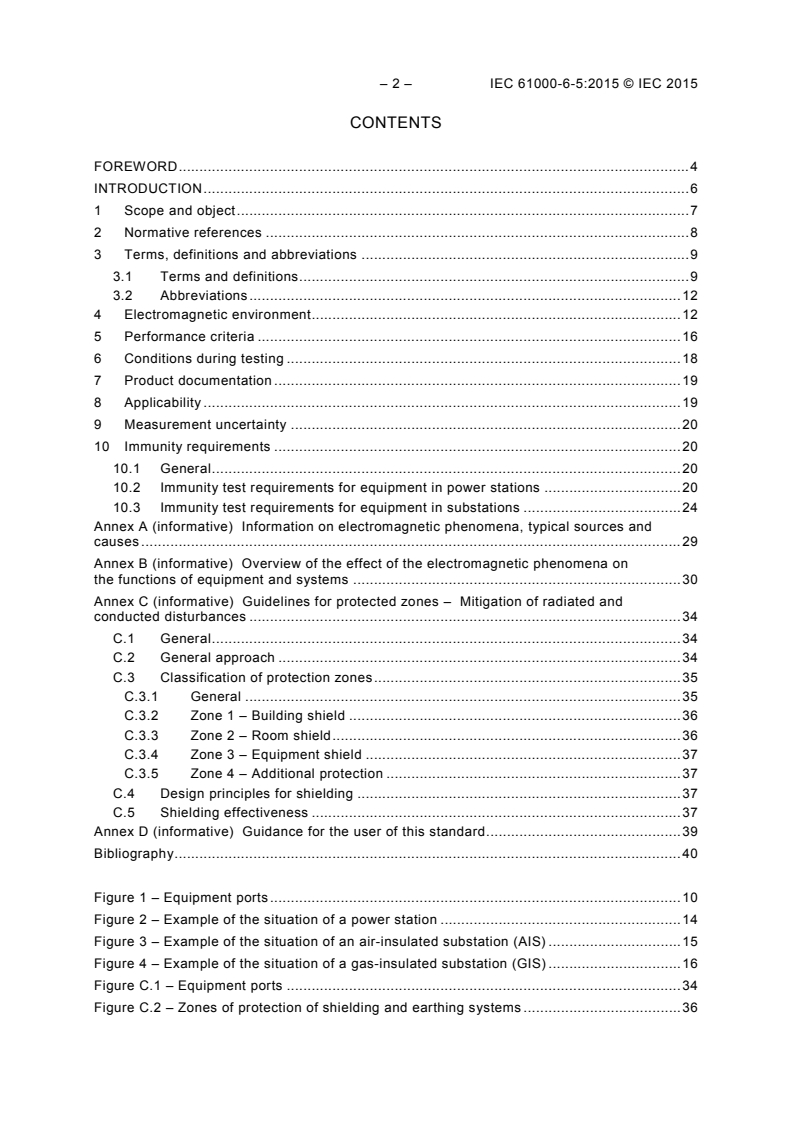
– 2 – IEC 61000-6-5:2015 © IEC 2015
CONTENTS
FOREWORD . 4
INTRODUCTION . 6
1 Scope and object . 7
2 Normative references . 8
3 Terms, definitions and abbreviations . 9
3.1 Terms and definitions . 9
3.2 Abbreviations . 12
4 Electromagnetic environment . 12
5 Performance criteria . 16
6 Conditions during testing . 18
7 Product documentation . 19
8 Applicability . 19
9 Measurement uncertainty . 20
10 Immunity requirements . 20
10.1 General . 20
10.2 Immunity test requirements for equipment in power stations . 20
10.3 Immunity test requirements for equipment in substations . 24
Annex A (informative) Information on electromagnetic phenomena, typical sources and
causes . 29
Annex B (informative) Overview of the effect of the electromagnetic phenomena on
the functions of equipment and systems . 30
Annex C (informative) Guidelines for protected zones – Mitigation of radiated and
conducted disturbances . 34
C.1 General . 34
C.2 General approach . 34
C.3 Classification of protection zones . 35
C.3.1 General . 35
C.3.2 Zone 1 – Building shield . 36
C.3.3 Zone 2 – Room shield . 36
C.3.4 Zone 3 – Equipment shield . 37
C.3.5 Zone 4 – Additional protection . 37
C.4 Design principles for shielding . 37
C.5 Shielding effectiveness . 37
Annex D (informative) Guidance for the user of this standard . 39
Bibliography . 40
Figure 1 – Equipment ports . 10
Figure 2 – Example of the situation of a power station . 14
Figure 3 – Example of the situation of an air-insulated substation (AIS) . 15
Figure 4 – Example of the situation of a gas-insulated substation (GIS) . 16
Figure C.1 – Equipment ports . 34
Figure C.2 – Zones of protection of shielding and earthing systems . 36
Table 1 – Characterization of the electromagnetic phenomena . 13
Table 2 – Suggested performance criteria for some representative functions . 18
Table 3 – Immunity requirements – Power station – Enclosure port . 21
Table 4 – Immunity specifications – Power station – Signal/control ports . 22
Table 5 – Immunity specifications – Power station – Low voltage a.c. input and output
power ports . 23
Table 6 – Immunity specifications – Power station – Low voltage d.c. input and output
power ports . 24
Table 7 – Immunity specifications – Substation – Enclosure port . 25
Table 8 – Immunity specifications – Substation – Signal/control ports . 26
Table 9 – Immunity specifications – Substation – Low voltage a.c. input and output
power ports . 27
Table 10 – Immunity specifications – Substation – Low voltage d.c. input and output
power ports . 28
Table A.1 – Electromagnetic phenomena – Sources and causes . 29
Table D.1 – Immunity tests and test levels to be considered in the future or for
particular product families . 39
– 4 – IEC 61000-6-5:2015 © IEC 2015
INTERNATIONAL ELECTROTECHNICAL COMMISSION
____________
ELECTROMAGNETIC COMPATIBILITY (EMC) –
Part 6-5: Generic standards – Immunity for equipment used
in power station and substation environment
FOREWORD
1) The International Electrotechnical Commission (IEC) is a worldwide organization for standardization comprising
all national electrotechnical committees (IEC National Committees). The object of IEC is to promote
international co-operation on all questions concerning standardization in the electrical and electronic fields. To
this end and in addition to other activities, IEC publishes International Standards, Technical Specifications,
Technical Reports, Publicly Available Specifications (PAS) and Guides (hereafter referred to as “IEC
Publication(s)”). Their preparation is entrusted to technical committees; any IEC National Committee interested
in the subject dealt with may participate in this preparatory work. International, governmental and non-
governmental organizations liaising with the IEC also participate in this preparation. IEC collaborates closely
with the International Organization for Standardization (ISO) in accordance with conditions determined by
agreement between the two organizations.
2) The formal decisions or agreements of IEC on technical matters express, as nearly as possible, an international
consensus of opinion on the relevant subjects since each technical committee has representation from all
interested IEC National Committees.
3) IEC Publications have the form of recommendations for international use and are accepted by IEC National
Committees in that sense. While all reasonable efforts are made to ensure that the technical content of IEC
Publications is accurate, IEC cannot be held responsible for the way in which they are used or for any
misinterpretation by any end user.
4) In order to promote international uniformity, IEC National Committees undertake to apply IEC Publications
transparently to the maximum extent possible in their national and regional publications. Any divergence
between any IEC Publication and the corresponding national or regional publication shall be clearly indicated in
the latter.
5) IEC itself does not provide any attestation of conformity. Independent certification bodies provide conformity
assessment services and, in some areas, access to IEC marks of conformity. IEC is not responsible for any
services carried out by independent certification bodies.
6) All users should ensure that they have the latest edition of this publication.
7) No liability shall attach to IEC or its directors, employees, servants or agents including individual experts and
members of its technical committees and IEC National Committees for any personal injury, property damage or
other damage of any nature whatsoever, whether direct or indirect, or for costs (including legal fees) and
expenses arising out of the publication, use of, or reliance upon, this IEC Publication or any other IEC
Publications.
8) Attention is drawn to the Normative references cited in this publication. Use of the referenced publications is
indispensable for the correct application of this publication.
9) Attention is drawn to the possibility that some of the elements of this IEC Publication may be the subject of
patent rights. IEC shall not be held responsible for identifying any or all such patent rights.
International Standard IEC 61000-6-5 has been prepared by committee 77: Electromagnetic
compatibility (EMC).
This first edition cancels and replaces the first edition of IEC TS 61000-6-5 published in 2001.
This edition constitutes a technical revision.
This edition includes the following significant technical changes with respect to the previous
edition:
a) the scope is extended in order to cover also power generating systems in industrial
facilities;
b) the locations under consideration, i.e. power stations and substations are described in
more detail;
c) performance criteria and the EUT functions they apply to are reviewed;
d) immunity requirements are reviewed and more specifically related to the relevant
locations;
e) informative annexes for guidance and on protected zones are added.
The text of this standard is based on the following documents:
FDIS Report on voting
77/484/FDIS 77/500/RVD
Full information on the voting for the approval of this standard can be found in the report on
voting indicated in the above table.
This publication has been drafted in accordance with the ISO/IEC Directives, Part 2.
A list of all parts in the IEC 61000 series, published under the general title Electromagnetic
compatibility (EMC), can be found on the IEC website.
The committee has decided that the contents of this publication will remain unchanged until
the stability date indicated on the IEC web site under "http://webstore.iec.ch" in the data
related to the specific publication. At this date, the publication will be
• reconfirmed,
• withdrawn,
• replaced by a revised edition, or
• amended.
The contents of the corrigendum of December 2017 have been included in this copy.
IMPORTANT – The 'colour inside' logo on the cover page of this publication indicates
that it contains colours which are considered to be useful for the correct
understanding of its contents. Users should therefore print this document using a
colour printer.
– 6 – IEC 61000-6-5:2015 © IEC 2015
INTRODUCTION
IEC 61000 series is published in separate parts, according to the following structure:
Part 1: General
General considerations (introduction, fundamental principles)
Definitions, terminology
Part 2: Environment
Description of the environment
Classification of the environment
Compatibility levels
Part 3: Limits
Emission limits
Immunity limits (in so far as they do not fall under the responsibility of the product
committees)
Part 4: Testing and measurement techniques
Measurement techniques
Testing techniques
Part 5: Installation and mitigation guidelines
Installation guidelines
Mitigation methods and devices
Part 6: Generic standards
Part 9: Miscellaneous
Each part is further subdivided into sections which are to be published either as International
Standards or as technical specifications or technical reports, some of which have already
been published as sections. Others will be published with the part number followed by a dash
and a second number identifying the subdivision (example: IEC 61000-6-1).
This International Standard deals with the electromagnetic compatibility (EMC) of equipment
used in the generation, transmission and distribution of electricity and related
telecommunication systems.
Several EMC product standards have been published by technical committees dealing with
different application areas in the generation, transmission and distribution of electricity and
related telecommunication systems, for example:
• fixed power supply installations and apparatus for railway applications (TC 9),
• switchgear and controlgear (TC 17),
• instrument transformers (TC 38),
• nuclear instrumentation (TC 45),
• power systems management and associated information exchange (TC 57),
• industrial-process measurement and control – system aspects (SC 65A),
• measuring relays and protection equipment (TC 95), etc.
The requirements specified in these product standards consider product-specific aspects only.
It is the task of this generic standard IEC 61000-6-5 to specify a set of essential requirements,
test procedures and generalized performance criteria applicable to such products or systems
operating in this electromagnetic environment.
ELECTROMAGNETIC COMPATIBILITY (EMC) –
Part 6-5: Generic standards – Immunity for equipment used
in power station and substation environment
1 Scope and object
This part of IEC 61000 specifies EMC immunity requirements which apply to electrical and
electronic equipment intended for use in power stations and substations, as described below.
Immunity requirements for electromagnetic phenomena with spectral contributions in the
frequency range 0 Hz to 400 GHz are covered. No tests need to be performed at frequencies
or for phenomena where no requirements are specified.
This international standard sets immunity test requirements for equipment intended for use in
the generation, transmission and distribution of electricity and related telecommunication
systems. The electromagnetic environments encompassed by this standard are those which
exist at locations
• in power stations, and
• in high and medium voltage substations.
Installations to generate or convert into electrical power inside industrial facilities are also
covered by this standard as long as they, at their primary electrical connection, cannot be
directly connected to the LV power network, e.g. where the generator output voltage is
medium voltage or higher. Power installations that directly provide power into the low voltage
network (such as photovoltaic cells or combined heat power systems in private houses) are
not covered by this standard.
NOTE 1 In general, power stations comprise installations which are mainly built to convert some kind of primary
energy into electrical energy. Moreover, these power stations are connected to the medium or high voltage power
system directly or via a step-up transformer.
The object of this standard is to define immunity test requirements for equipment defined in
the scope in relation to continuous and transient, conducted and radiated disturbances,
including electrostatic discharges.
The immunity test requirements are given on a port-by-port basis, and selected according to
the location, with differentiated levels for equipment to be installed in power stations or
substations. In special cases, situations will arise where the level of electromagnetic
disturbances may exceed the levels specified in this standard; in these instances, special
mitigation measures should be adopted.
The immunity requirements are suitable for satisfying the particular needs related to the
functions and tasks of equipment and systems, for which reliable operation is required under
realistic electromagnetic conditions; in this respect, this standard establishes performance
criteria for different functional requirements.
This generic EMC immunity standard is applicable if no relevant dedicated product or product-
family EMC immunity standard exists. According to IEC Guide 107, this generic standard
should be considered for the preparation or revision of any EMC standard referring to specific
products used in power stations and substations.
NOTE 2 Product standards covering EMC aspects for equipment to be used in power stations or substations are
for example IEC 62271-1 (switchgear and controlgear), IEC 60255-26 (measuring relays and protection equipment)
or IEC 62236-5 (fixed power supply installations and apparatus for railway applications).
– 8 – IEC 61000-6-5:2015 © IEC 2015
Non-electronic high voltage and power equipment (primary system) are excluded from the
scope of this standard.
Emission requirements are not within the scope of this standard and are covered by relevant
product or product-family standards.
NOTE 3 Where no dedicated product or product family standard covering emission requirements exists, the
generic standard IEC 61000-6-4 applies.
2 Normative references
The following documents, in whole or in part, are normatively referenced in this document and
are indispensable for its application. For dated references, only the edition cited applies. For
undated references, the latest edition of the referenced document (including any
amendments) applies.
IEC 61000-4-2, Electromagnetic compatibility (EMC) – Part 4-2: Testing and measurement
techniques – Electrostatic discharge immunity test
IEC 61000-4-3, Electromagnetic compatibility (EMC) – Part 4-3: Testing and measurement
techniques – Radiated, radio-frequency, electromagnetic field immunity test
IEC 61000-4-4, Electromagnetic compatibility (EMC) – Part 4-4: Testing and measurement
techniques – Electrical fast transient/burst immunity test
IEC 61000-4-5, Electromagnetic compatibility (EMC) – Part 4-5: Testing and measurement
techniques – Surge immunity test
IEC 61000-4-6, Electromagnetic compatibility (EMC) – Part 4-6: Testing and measurement
techniques – Immunity to conducted disturbances, induced by radio-frequency fields
IEC 61000-4-8, Electromagnetic compatibility (EMC) – Part 4-8: Testing and measurement
techniques – Power frequency magnetic field immunity test
IEC 61000-4-11, Electromagnetic compatibility (EMC) – Part 4-11: Testing and measurement
techniques – Voltage dips, short interruptions and voltage variations immunity tests
IEC 61000-4-16, Electromagnetic compatibility (EMC) – Part 4-16: Testing and measurement
techniques – Test for immunity to conducted, common mode disturbances in the frequency
range 0 Hz to 150 kHz
IEC 61000-4-17, Electromagnetic compatibility (EMC) – Part 4-17: Testing and measurement
techniques – Ripple on d.c. input power port immunity test
IEC 61000-4-18, Electromagnetic compatibility (EMC) – Part 4-18: Testing and measurement
techniques – Damped oscillatory wave immunity test
IEC 61000-4-29, Electromagnetic compatibility (EMC) – Part 4-29: Testing and measurement
techniques – Voltage dips, short interruptions and voltage variations on d.c. input power port
immunity tests
IEC 61000-4-34, Electromagnetic compatibility (EMC) – Part 4-34: Testing and measurement
techniques – Voltage dips, short interruptions and voltage variations immunity tests for
equipment with input current more than 16 A per phase
IEC 61000-6-1, Electromagnetic compatibility (EMC) – Part 6-1: Generic standards –
Immunity for residential, commercial and light-industrial environments
3 Terms, definitions and abbreviations
3.1 Terms and definitions
For the purposes of this document, the following terms and definitions apply.
NOTE The definitions related to EMC and to relevant electromagnetic phenomena can be found in IEC 60050-161
and in other IEC publications.
3.1.1
connections to HV equipment
connections from control equipment to HV equipment such as circuit breakers, current
transformers, voltage transformers, power line carrier systems
3.1.2
DC distribution network
local DC electricity supply network in the infrastructure of a certain site or building intended
for flexible use by one or more different types of equipment and guaranteeing continuous
power supply independently from the conditions of the public mains network
Note 1 to entry: Connection to a remote local battery is not regarded as a DC distribution network, if such a link
comprises only power supply for a single piece of equipment.
3.1.3
enclosure port
physical boundary of the equipment through which electromagnetic fields may radiate or
impinge on
3.1.4
equipment
single apparatus or set of devices or apparatuses, or the set of main devices of an
installation, or all devices necessary to perform a specific task
Note 1 to entry: Examples of equipment are a power transformer, the equipment of a substation, measuring
equipment.
[SOURCE: IEC 60050-151:2001, 151-11-25]
3.1.5
field connections
cables which are intended to be connected to process equipment of the plant, within the same
earth network
EXAMPLE
Examples of this category are:
– connections from control room or equipment room to the field of power stations and HV substations;
– connections to low voltage power equipment;
– connections within the relay house or telecommunication house of HV substations, where no special mitigation
measures are adopted (e.g. shielding);
– field bus.
Note 1 to entry: Those cable ports of process instrumentation which are self-powered through the signal
conductors (e.g. 4 mA to 20 mA) are considered as signal ports.
– 10 – IEC 61000-6-5:2015 © IEC 2015
3.1.6
high voltage
HV
set of voltage levels in excess of medium voltage
Note 1 to entry: In the context of this standard the following terms for system voltage are used (see also 3.1.9):
– low voltage (LV) refers to U ≤ 1 kV;
n
– medium voltage (MV) refers to 1 kV < U ≤ 36 kV;
n
– high voltage (HV) refers to voltage above 36 kV and includes EHV and UHV.
3.1.7
installation
several combined items of equipment (including cables) put together at a given place to fulfil a
specific task
3.1.8
low voltage
set of voltage levels used for the distribution of electricity and whose upper limit is generally
accepted to be 1 000 V a.c.
[SOURCE: IEC 60050-601:1985, 601-01-26]
3.1.9
medium voltage
MV
any set of voltage levels lying between low and high voltage
Note 1 to entry: The boundaries between medium and high voltage levels overlap and depend on local
circumstances and history or common usage. Nevertheless the band 30 kV to 100 kV frequently contains the
accepted boundary.
Note 2 to entry: In the context of this standard, medium voltage is defined as the voltage range of
1 Kv < U ≤ 36 kV.
n
[SOURCE: IEC 60050-601:1985, 601-01-28, modified – a note to entry 2 has been added.]
3.1.10
port
particular interface of the equipment which couples this equipment with, or is influenced by,
the external electromagnetic environment
Note 1 to entry: Examples of ports of interest are shown in Figure 1. The enclosure port is the physical boundary
of the equipment (e.g. enclosure). The enclosure port provides for radiated and electrostatic discharge (ESD)
energy transfer, whereas the other ports provide for conducted energy transfer.
Enclosure port
Signal/control port
AC power port
EQUIPMENT
DC power port
IEC
Figure 1 – Equipment ports
3.1.11
power port
port at which a conductor or cable carries the primary electrical power needed for the
operation (functioning) of equipment
3.1.12
power station
installation whose purpose is to generate electricity and which includes civil engineering
works, energy conversion equipment and all the necessary ancillary equipment
[SOURCE: IEC 60050-601:1985, 601-03-01]
3.1.13
protected area
area inside an installation in which electromagnetic phenomena appear in a mitigated extent
compared to other areas of the same installation
Note 1 to entry: Mitigation can be provided for example by means of shielding or filtering.
3.1.14
signal/control port
port at which a conductor or cable intended to carry signals is connected to equipment
Note 1 to entry: Examples are analog inputs, outputs and control lines; data busses; communication lines, fibre-
optic lines containing metallic conductors, etc.
3.1.15
substation (of a power system)
part of an electrical system, confined to a given area, mainly including ends of transmission or
distribution lines, electrical switchgear and controlgear, buildings and transformers. A
substation generally includes safety or control devices (for example protection)
Note 1 to entry: The substation can be qualified according to the designation of the system of which it forms a
part. Examples: transmission, substation (transmission system), distribution substation, 400 kV or 20 kV
substation.
[SOURCE: IEC 60050-601:1985, 601-03-02]
3.1.16
switchgear
general term covering switching devices and their combination with associated control,
measuring, protective and regulating equipment, also assemblies of such devices and
equipment with associated interconnections, accessories, enclosures and supporting
structures, intended in principle for use in connection with generation, transmission,
distribution and conversion of electric energy
[SOURCE: IEC 60050-441:2000, 441-11-02]
3.1.17
system
several items of equipment combined to fulfil a specific task as a single functional unit
3.1.18
telecommunication connections
communication cables which reach the border of the earth network of the plant for interfacing
with a telecommunication network or with a remote equipment without any particular insulation
barrier
– 12 – IEC 61000-6-5:2015 © IEC 2015
3.2 Abbreviations
AIS Air insulated switchgear
CRT Cathode ray tube
CT Current transformer
EHV Extra high voltage
ESD Electrostatic discharge
EUT Equipment under test
GIS Gas insulated switchgear
HV High voltage
MTU Master terminal unit
MV Medium voltage
PLC Power line communication
PT Power transformer
RTU Remote terminal unit
UHV Ultra high voltage
UPS Uninterruptable power systems
4 Electromagnetic environment
The typical locations covered by this international standard are power stations (see Figure 2),
medium voltage (MV) and high-voltage (HV) substations, comprising air insulated switchgear
(AIS) (see Figure 3), and/or gas insulated switchgear (GIS) (see Figure 4). In Figure 2, the
solid lines do not represent physical boundaries between the areas where the equipment is
installed. They rather indicate boundaries between electromagnetic environments. It should
be kept in mind that the electromagnetic environments can be different for items of equipment
installed close to each other.
For the purpose of the specifications given in this international standard, the term "HV" is
taken to mean extra high voltage and high voltage of 36 kV and above.
NOTE A different limit between MV and HV can be agreed upon between the parties involved and the
manufacturer.
An overview of electromagnetic phenomena to be taken into account at the locations covered
by this standard is given in Table 1. For the purpose of determining the need of the
corresponding phenomenon as well as of the applicable performance criterion, the
phenomena are grouped with respect to their nature and probability of occurrence. A survey
of these electromagnetic phenomena is given in IEC TR 61000-2-5 and IEC 61000-4-1.
Additional information on the typical sources and causes of electromagnetic disturbances is
given in Annex A. Typical values of electromagnetic phenomena observed in high voltage
substations and power stations can be found in the publications listed in the bibliography.
Table 1 – Characterization of the electromagnetic phenomena
Continuous Transient phenomena with Transient phenomena with
phenomena high occurrence low occurrence
Voltage variations:
Voltage dips (duration ≤ 0,02 s): Voltage dips (duration > 0,02 s):
– a.c. power supply
– a.c. power supply – a.c power supply
a
– d.c. power supply
– d.c. power supply – d.c. power supply
a
Harmonics, interharmonics Voltage fluctuations Voltage interruptions:
a
Signalling voltages Fast transient/burst – a.c. power supply
Ripple on d.c. power supply
Damped oscillatory/ring wave – d.c. power supply
a
Power frequency variation
Damped oscillatory magnetic field Short duration power frequency
a, b
variation
Conducted disturbances in the
Electrostatic discharge
a
range 2 kHz to 150 kHz Surge
Conducted disturbances in the Short duration power frequency
a
range 1,6 MHz to 30 MHz
voltage
Power frequency magnetic field
Short duration power frequency
(according to IEC 61000-4-8)
magnetic fields (according to
IEC 61000-4-8)
Radiated, radio frequency
electromagnetic field Radiated pulsed disturbances
Conducted disturbances, induced
by radio-frequency fields
Mains frequency voltage (according
to IEC 61000-4-16)
a
Not covered in this standard by dedicated immunity requirements.
b
In case of islanded systems (e.g. not connected to a public network), the characterization of the phenomenon
changes from "low occurrence" to "high occurrence".
Items of equipment are installed and implemented within power stations and substations
according to the rules/guidelines given by the manufacturers. It is essential that these items of
equipment operate according to the specified performances when exposed to the variety of
electromagnetic phenomena, conducted and radiated, typical of these installations.
In addition to the mentioned electrical plants, equipment can be installed in control centres,
radio repeaters, or low voltage distribution points in industrial, commercial or residential
areas. These locations are covered by other generic standards or product standards.
In some cases, special mitigation measures (e.g. use of special cabling, shielding of some
areas, and/or avoidance of interference sources, etc.) are taken in order to create a
“protected area” and to reduce the immunity requirements accordingly. This allows the use of
equipment that does not meet the requirements of this standard.
A protected area can be created by means of mitigation measures and/or avoidance of
disturbance sources in order to reduce immunity requirements to the immunity levels of
product standards or generic standards.
In this document a protected area (see 3.1.13) is considered as a location where at least the
requirements of IEC 61000-6-1 are sufficient to demonstrate immunity (see Annex C for
further information).
– 14 – IEC 61000-6-5:2015 © IEC 2015
Process area,
Control room
not involved in
area
the electrical
Protected
process
area
2 2
Process area,
involved in
the electrical
2 3
process
Substation/
Interface area 3
2 HV area
Outside
area
IEC
Key
Interface types
1 Inside protected area
2 Inside interface and/or control room and/or process area not involved in the electrical process
3 Inside or from process area involved in the electrical process
4 Connections from outside (HV area and external telecommunication)
NOTE
The process area involved in the electrical process can contain for example MV/HV or high power equipment such
as generators, large drives, converters, MV switchgear.
The process area not involved in the electrical process can contain for example turbines, boiler, pollution
monitoring, fuel handling, LV switchgear.
The control room area can contain for example control systems, industrial computers, fire fighting systems, UPS,
etc.
The protected area can contain for example special sensitive equipment like routers, computers, etc.
The interface area can contain for example equipment and systems connected to the outside with measures like
surge protection and bonding of cable shields. This is the area where signals from the outside are collected,
converted and distributed.
The outside area can contain additional process equipment, signalling, etc.
The high voltage area can contain for example circuit breakers, bus bars, disconnectors, metering etc.
Figure 2 – Example of the situation of a power station
IEC
Key
Interface types
1 Inside protected area
2 Inside interface and/or control room area
3 Inside or from process area
4 Connections from outside (HV and external telecommunication)
NOTE
The control room area can be a dedicated house or only a relay house that contains control systems, computers,
fire fighting systems, UPS, etc.
The relay house / kiosk contains protection relays, marshalling kiosks for PTs/CTs.
The protected area contains for example special sensitive equipment like routers, special computers, etc.
The process area contains mainly MV systems (if available) with circuit breakers and MV-bus bars.
The interface area contains equipment and systems connected to the outside with measures like surge protection
and bonding of cable shields.
The high voltage area contains circuit breakers, bus bars, disconnectors, metering, UPS, etc.
The outside area contains for example control centres.
Figure 3 – Example of the situation of an air-insulated substation (AIS)
– 16 – IEC 61000-6-5:2015 © IEC 2015
Control room area
HV area
Protected area
Interface area
Outside
Process area
area
3 3
4 4
IEC
Key
Interface types
1 Inside protected area
2 Inside interface and/or control room area
3 Inside or from process area
4 Connections from outside (HV and external telecommunication)
NOTE
The control room area contains control systems, computers, fire fighting systems, UPS, etc.
The process area contains mainly MV systems (if available) with circuit breakers and MV-bus bars.
The protected area contains for example special sensitive equipment like routers, special computers, etc.
The interface area contains equipment and systems connected to the outside with measures like surge protection
and bonding of cable shields.
The outside area contains for example control centres.
The HV area contains GIS, earthing bus bars, transformers, etc.
Figure 4 – Example of the situation of a gas-insulated substation (GIS)
5 Performance criteria
The performance criteria are closely related to the nature of the electromagnetic phenomena
(types and occurrence), as given in Table 1 and to the applicable representative functions of
the equipment concerned.
Table 2 lists the suggested performance criteria to be applied for the corresponding function
of equipment. A functional description and a definition of performance criteria, during or as a
consequence of the EMC testing, shall be provided by the manufacturer and noted in the test
report, based on one of the following criteria, for each test as specified in Table 3 to Table 10.
a) Performance criterion A: The EUT shall continue to operate as intended during and after
the test. No degradation of performance or loss of function is allowed below a
performance level specified by the manufacturer, when the EUT is used as intended. If the
performance level is not specified by the manufacturer, this may be derived from the
product description and documentation and what the user may reasonably expect from the
equipment if used as intended.
b) Performance criterion B: The EUT shall continue to operate as intended after the test.
No degradation of performance or l
...