IEC 62061:2005/COR1:2005
(Corrigendum)Corrigendum 1 - Safety of machinery - Functional safety of safety-related electrical, electronic and programmable electronic control systems
Corrigendum 1 - Safety of machinery - Functional safety of safety-related electrical, electronic and programmable electronic control systems
Corrigendum 1 - Sécurité des machines - Sécurité fonctionnelle des systèmes de commande électriques, électroniques et électroniques programmables relatifs à la sécurité
General Information
Relations
Standards Content (Sample)
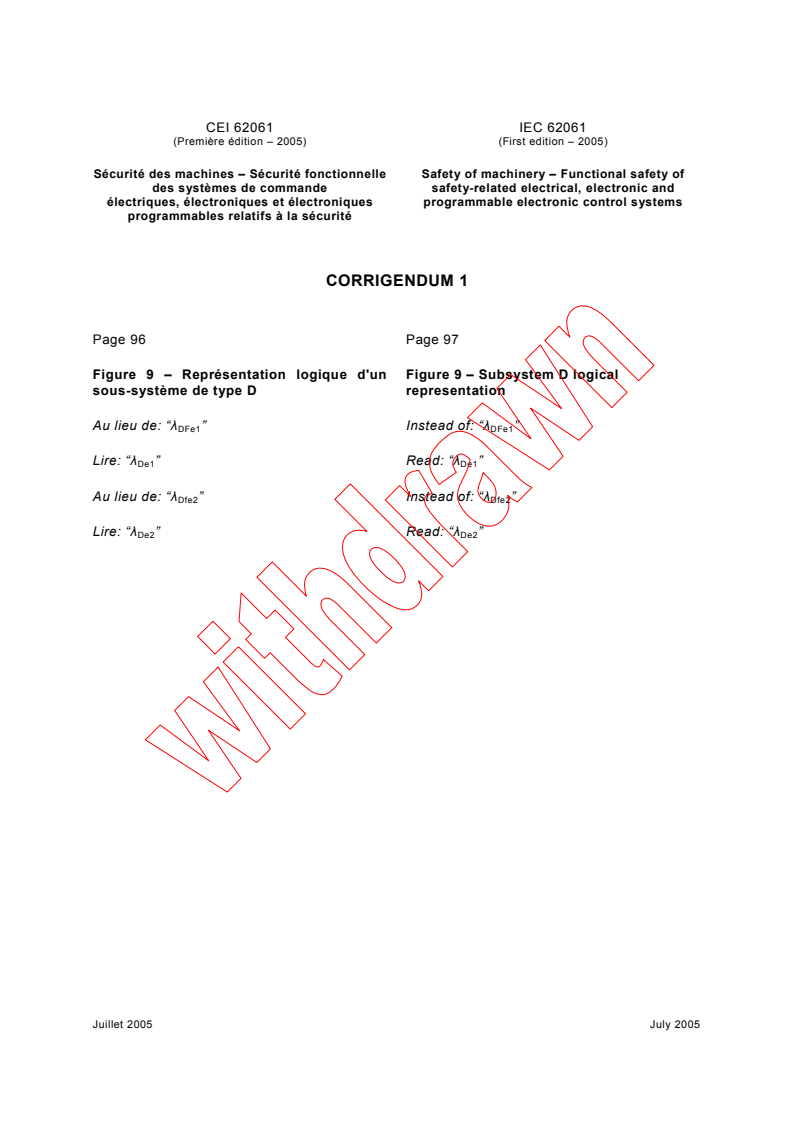
CEI 62061 IEC 62061
(Première édition – 2005) (First edition – 2005)
Sécurité des machines – Sécurité fonctionnelle Safety of machinery – Functional safety of
des systèmes de commande safety-related electrical, electronic and
électriques, électroniques et électroniques programmable electronic control systems
programmables relatifs à la sécurité
CORRIGENDUM 1
Pa
...
This May Also Interest You
IEC 62061:2021 specifies requirements and makes recommendations for the design, integration and validation of safety-related control systems (SCS) for machines. It is applicable to control systems used, either singly or in combination, to carry out safety functions on machines that are not portable by hand while working, including a group of machines working together in a coordinated manner.
This document is a machinery sector specific standard within the framework of IEC 61508 (all parts).
The design of complex programmable electronic subsystems or subsystem elements is not within the scope of this document.
The main body of this sector standard specifies general requirements for the design, and verification of a safety-related control system intended to be used in high/continuous demand mode.
This document:
– is concerned only with functional safety requirements intended to reduce the risk of hazardous situations;
– is restricted to risks arising directly from the hazards of the machine itself or from a group of machines working together in a coordinated manner;
This document does not cover
– electrical hazards arising from the electrical control equipment itself (e.g. electric shock - see IEC 60204-1);
– other safety requirements necessary at the machine level such as safeguarding;
– specific measures for security aspects – see IEC TR 63074.
This document is not intended to limit or inhibit technological advancement.
IEC 62061:2021 cancels and replaces the first edition, published in 2005, Amendment 1:2012 and Amendment 2:2015. This edition constitutes a technical revision.
This edition includes the following significant technical changes with respect to the previous edition:
– structure has been changed and contents have been updated to reflect the design process of the safety function,
– standard extended to non-electrical technologies,
– definitions updated to be aligned with IEC 61508-4,
– functional safety plan introduced and configuration management updated (Clause 4),
– requirements on parametrization expanded (Clause 6),
– reference to requirements on security added (Subclause 6.8),
– requirements on periodic testing added (Subclause 6.9),
– various improvements and clarification on architectures and reliability calculations (Clause 6 and Clause 7),
– shift from "SILCL" to "maximum SIL" of a subsystem (Clause 7),
– use cases for software described including requirements (Clause 8),
– requirements on independence for software verification (Clause 8) and validation activities (Clause 9) added,
– new informative annex with examples (Annex G),
– new informative annexes on typical MTTFD values, diagnostics and calculation methods for the architectures (Annex C, Annex D and Annex H).
- Standard289 pagesEnglish languagesale 15% off
- Standard304 pagesEnglish and French languagesale 15% off
- Standard21 pagesEnglish and French languagesale 15% off
IEC TS 63394:2023 In the context of the safety of machinery, the sector standard IEC 62061, along with ISO 13849 1, provides requirements to manufacturers of machines for the design, development and integration of safety-related control systems (SCS) or safety-related parts of control systems (SRP/CS), depending on technology used (mechanical, pneumatic, hydraulic or electrical technologies) to perform safety function(s). This document does not replace ISO 13849-1 and IEC 62061. This document gives additional guidance to the application of IEC 62061 or ISO 13849-1.
This document:
– gives guidelines and specifies additional requirements for specific safety functions based on the methodology of ISO 12100, which are relevant in machinery and respecting typical boundary conditions of machinery;
– considers safety functions which are designed for high demand mode of operation yet are rarely operated, called rarely activated safety functions;
– gives additional information for the calculation of failure rates using other (non-electronic) technologies based e.g. on Weibull distribution, because all the formula defined in IEC 62061 and ISO 13849-1 are based on exponential distribution.
Therefore, the basis for these guidelines and additional requirements is
– a typical classification of safety functions;
– a consideration of typical architectures used for designing safety functions;
– a consideration of modes of operation of safety functions;
– the derivation and evaluation of PFH formulas for subsystems considering the used technology.
This document does not address low demand mode of operation according to IEC 61508.
This document does not take into account either layer of protection analysis (LOPA) or basic process control system (BPCS), according to IEC 61511 as a risk reduction measure.
This document considers all lifecycle phases of the machine regarding functional safety, and SCS or SRP/CS.
- Technical specification142 pagesEnglish languagesale 15% off
- Standard16 pagesEnglish and French languagesale 15% off
- Standard18 pagesEnglish and French languagesale 15% off
specifies requirements and makes recommendations for the design, integration and validation of safety-related electrical, electronic and programmable electronic control systems (SRECS) for machines (see Notes 1 and 2). It is applicable to control systems used, either singly or in combination, to carry out safety-related control functions on machines that are not portable by hand while working, including a group of machines working together in a co-ordinated manner. The contents of the corrigenda of July 2005 and April 2008 have been included in this copy.
- Standard10 pagesEnglish and French languagesale 15% off
- Standard205 pagesEnglish and French languagesale 15% off
- Standard204 pagesEnglish and French languagesale 15% off
- Standard387 pagesEnglish and French languagesale 15% off
IEC TR 61169-1-8:2025 provides a test method for voltage standing wave ratio (VSWR, hereinafter) of single RF connector by double-connector method. This document is applicable to single RF cable connectors and single microstrip RF connectors as well as single adapters if an estimation of the VSWR of a single completely installed RF-connector is used and a time domain feature is not available on the vector network analyzer.
- Technical report18 pagesEnglish languagesale 15% off
IEC 62541-100:2025 defines the information model associated with Devices. This document describes three models which build upon each other as follows:
• The (base) Device Model is intended to provide a unified view of devices and their hardware and software parts irrespective of the underlying device protocols.
• The Device Communication Model adds Network and Connection information elements so that communication topologies can be created.
• The Device Integration Host Model finally adds additional elements and rules required for host systems to manage integration for a complete system. It enables reflecting the topology of the automation system with the devices as well as the connecting communication networks.
This document also defines AddIns that can be used for the models in this document but also for models in other information models. They are:
• Locking model – a generic AddIn to control concurrent access,
• Software update model – an AddIn to manage software in a Device.
This second edition cancels and replaces the first edition published in 2015. This edition constitutes a technical revision.
This edition includes the following significant technical changes with respect to the previous edition:
a a ComponentType that can be used to model any HW or SW element of a device has been defined and a SoftwareType has been added as subtype of ComponentType;
b the new OPC UA interface concept and defined interfaces for Nameplate, DeviceHealth, and SupportInfo has been added.
c) a new model for Software Update (Firmware Update) has been added;
d) a new entry point for documents where each document is represented by a FileType instance has been specified;
e) a model that provides information about the lifetime, related limits and semantic of the lifetime of things like tools, material or machines has been added.
- Standard152 pagesEnglish languagesale 15% off
- Standard158 pagesFrench languagesale 15% off
- Standard310 pagesEnglish and French languagesale 15% off
IEC TS 63414:2025 is applicable for the determination of the AC and DC pollution flashover and withstand voltage characteristics of insulators with polymeric housing, to be used outdoors in HV applications and exposed to polluted environments. This is also applicable for insulators with hydrophobic coatings. This document refers to AC systems with a rated voltage greater than 1 000 V and DC systems with a rated voltage greater than 1 500 V.
The object of this technical specification is to prescribe standardized test methods, requirements and procedures for artificial pollution tests applicable to polymeric insulators for overhead lines including traction lines, station post and hollow insulators of equipment. Available test experience with polymeric station post and hollow insulators, especially for DC applications, is limited.
The proposed tests are not applicable to ceramic and glass insulators without polymeric housing, to greased insulators or to special types of insulators (e.g., insulators with semiconducting glaze).
Differently to ceramic and glass insulators without polymeric housing:
- The pollution performance of insulators with polymeric housing varies with the hydrophobicity condition of the surface. The specific conditions simulated by standardized tests might not represent the actual dynamic field conditions.
- The determination of the flashover and/or withstand voltage under pollution conditions is not enough for dimensioning. Additional constraints related to possible ageing are also to be considered.
- If the Hydrophobicity Transfer Material (HTM) test according to IEC TR 62039 confirms that an insulator is non-HTM, it can be tested according to IEC 60507 or IEC TS 61245.
- Technical specification39 pagesEnglish languagesale 15% off
IEC 61757-1-4:2025 defines the terminology, structure, and measurement methods of distributed fibre optic sensors for absolute strain measurements based on spectral correlation analysis of Rayleigh backscattering signatures in single-mode fibres, where the fibre is the distributed strain measurement element in a measurement range from about 10 m to tens of km. This document also applies to hybrid sensor systems that combine the advantages of Brillouin and Rayleigh backscattering effects to obtain optimal measurement quality. This document also specifies the most important features and performance parameters of these distributed fibre optic strain sensors defines procedures for measuring these features and parameters. This part of IEC 61757 does not apply to point measurements or to dynamic strain measurements. Distributed strain measurements using Brillouin scattering in single-mode fibres are covered in IEC 61757-1-2. The most relevant applications of this strain measurement technique are listed in Annex A, while Annex B provides a short description of the underlying measurement principle.
- Standard27 pagesEnglish languagesale 15% off
- Standard29 pagesFrench languagesale 15% off
- Standard56 pagesEnglish and French languagesale 15% off


Questions, Comments and Discussion
Ask us and Technical Secretary will try to provide an answer. You can facilitate discussion about the standard in here.
Loading comments...