

IEC 60549:2013
(Main)High-voltage fuses for the external protection of shunt capacitors
General Information
- Abstract
IEC 60549:2013 applies to external fuses used with high-voltage capacitors according to IEC 60871-1, Shunt capacitors for a.c. power systems having a rated voltage above 1 000 V - Part 1: General. IEC 60871-1 is applicable to both capacitor units and capacitor banks intended to be used, particularly, for power-factor correction of a.c. power systems, and also to capacitors intended for use in power filter circuits. Fuses according to IEC 60549:2013 are intended to clear either faults inside a capacitor unit to permit continued operation of the remaining parts of the bank in which the unit is connected (unit fuses) or faults on the whole capacitor bank to isolate the bank from the system (line fuses). This second edition cancels and replaces the first edition published in 1976. This edition constitutes a technical revision. This edition includes the following significant technical changes with respect to the previous edition:
- alignment of the document with current IEC document structure requirements;
- clarification of certain test requirements. Keywords: external fuses used with high-voltage capacitors, shunt capacitors for a.c.power system
- Status
- Published
- Publication Date
- 22-Apr-2013
- Technical Committee
- SC 32A - High-voltage fuses
- Drafting Committee
- MT 7 - TC 32/SC 32A/MT 7
- Current Stage
- PPUB - Publication issued
- Start Date
- 23-Apr-2013
- Completion Date
- 31-Jul-2013
Overview
IEC 60549:2013 is an international standard developed by the International Electrotechnical Commission (IEC) addressing high-voltage fuses for the external protection of shunt capacitors in AC power systems. This standard applies to external fuses used with high-voltage capacitor units or banks rated above 1,000 V, particularly those used for power-factor correction and power filter circuits as defined in IEC 60871-1.
The standard's main objective is to ensure the reliable and safe clearing of faults, either within individual capacitor units (using unit fuses) or the entire capacitor bank (using line fuses), thereby protecting power systems from damage and maintaining operational continuity. IEC 60549:2013 is a technical revision of the original 1976 edition, aligned with updated IEC document structures and clarifying test requirements.
Key Topics
Scope and Application
- Applicable to high-voltage shunt capacitors above 1,000 V AC.
- Covers fuses used externally to protect both capacitor units and capacitor banks.
- Fuses are designed to interrupt capacitive breaking currents arising from faults in capacitor elements or banks.
Fuse Types
- Unit fuses: Protect individual capacitor units within banks, allowing other units to continue operation.
- Line fuses: Protect the entire capacitor bank by isolating it from the system during faults.
Performance and Testing
- Compliance with IEC 60282-1 (current-limiting fuses) or IEC 60282-2 (expulsion fuses) standards is required, except where excluded in IEC 60549.
- Key test requirements include:
- Rated maximum capacitive breaking current.
- Rated capacitor discharge energy the fuse can safely withstand.
- Power frequency inductive current tests.
- Capacitive breaking current tests using specified test circuits and procedures.
- Tests verify fuse capability to withstand fault conditions without compromising system stability.
Terms and Definitions
- Capacitor unit: Assembly of capacitor elements in a single container.
- Capacitor bank: Multiple capacitor units connected to act together.
- Capacitive current: Current that leads voltage caused by capacitive components.
- Inductive current: Current that lags voltage due to inductive components.
Applications
IEC 60549:2013 is essential for manufacturers, engineers, and operators dealing with:
- Power-factor correction in AC power systems, where shunt capacitors are widely used to improve system efficiency.
- Power filter circuits, benefiting from reliable capacitor protection to maintain power quality and reduce harmonic distortion.
- High-voltage capacitor banks in industrial, utility, and commercial electrical installations requiring dependable fault clearing and isolation.
- Integration of fuses in fused switches and fused disconnectors providing both mechanical switching and electrical protection.
Using fuses compliant with IEC 60549 helps to mitigate risks of capacitor damage, minimize downtime, and ensure safer maintenance by isolating only the faulted parts without unnecessarily tripping the entire system.
Related Standards
- IEC 60871-1: Defines general requirements for shunt capacitors above 1,000 V AC, setting the context for fuse application.
- IEC 60282-1: Specifies the requirements for current-limiting high-voltage fuses, which IEC 60549 references for fuse performance criteria.
- IEC 60282-2: Covers expulsion fuses for high voltage applications, also referenced by IEC 60549.
- IEC 60050-436: Electrotechnical vocabulary terms for capacitors, providing standard definitions used in IEC 60549.
Summary
IEC 60549:2013 is a critical standard for ensuring the safe and effective external protection of shunt capacitors operating at high voltages in AC power systems. By defining performance requirements, testing procedures, and application guidelines for external fuses, it promotes enhanced reliability and safety in power-factor correction and filtering equipment. Compliance with IEC 60549 contributes to longevity of capacitor banks, improved system stability, and effective fault management in modern electrical networks.
Get Certified
Connect with accredited certification bodies for this standard

IMQ S.p.A. (Certification)
Italian electrical product certification.

SLG Prüf- und Zertifizierungs GmbH
German testing and certification body.

UL Solutions
Global safety science company with testing, inspection and certification.
Sponsored listings
Frequently Asked Questions
IEC 60549:2013 is a standard published by the International Electrotechnical Commission (IEC). Its full title is "High-voltage fuses for the external protection of shunt capacitors". This standard covers: IEC 60549:2013 applies to external fuses used with high-voltage capacitors according to IEC 60871-1, Shunt capacitors for a.c. power systems having a rated voltage above 1 000 V - Part 1: General. IEC 60871-1 is applicable to both capacitor units and capacitor banks intended to be used, particularly, for power-factor correction of a.c. power systems, and also to capacitors intended for use in power filter circuits. Fuses according to IEC 60549:2013 are intended to clear either faults inside a capacitor unit to permit continued operation of the remaining parts of the bank in which the unit is connected (unit fuses) or faults on the whole capacitor bank to isolate the bank from the system (line fuses). This second edition cancels and replaces the first edition published in 1976. This edition constitutes a technical revision. This edition includes the following significant technical changes with respect to the previous edition: - alignment of the document with current IEC document structure requirements; - clarification of certain test requirements. Keywords: external fuses used with high-voltage capacitors, shunt capacitors for a.c.power system
IEC 60549:2013 applies to external fuses used with high-voltage capacitors according to IEC 60871-1, Shunt capacitors for a.c. power systems having a rated voltage above 1 000 V - Part 1: General. IEC 60871-1 is applicable to both capacitor units and capacitor banks intended to be used, particularly, for power-factor correction of a.c. power systems, and also to capacitors intended for use in power filter circuits. Fuses according to IEC 60549:2013 are intended to clear either faults inside a capacitor unit to permit continued operation of the remaining parts of the bank in which the unit is connected (unit fuses) or faults on the whole capacitor bank to isolate the bank from the system (line fuses). This second edition cancels and replaces the first edition published in 1976. This edition constitutes a technical revision. This edition includes the following significant technical changes with respect to the previous edition: - alignment of the document with current IEC document structure requirements; - clarification of certain test requirements. Keywords: external fuses used with high-voltage capacitors, shunt capacitors for a.c.power system
IEC 60549:2013 is classified under the following ICS (International Classification for Standards) categories: 29.120.50 - Fuses and other overcurrent protection devices. The ICS classification helps identify the subject area and facilitates finding related standards.
IEC 60549:2013 is available in PDF format for immediate download after purchase. The document can be added to your cart and obtained through the secure checkout process. Digital delivery ensures instant access to the complete standard document.
Standards Content (Sample)
IEC 60549 ®
Edition 2.0 2013-04
INTERNATIONAL
STANDARD
NORME
INTERNATIONALE
High-voltage fuses for the external protection of shunt capacitors
Coupe-circuit à fusibles haute tension destinés à la protection externe des
condensateurs shunt
All rights reserved. Unless otherwise specified, no part of this publication may be reproduced or utilized in any form
or by any means, electronic or mechanical, including photocopying and microfilm, without permission in writing from
either IEC or IEC's member National Committee in the country of the requester.
If you have any questions about IEC copyright or have an enquiry about obtaining additional rights to this publication,
please contact the address below or your local IEC member National Committee for further information.
Droits de reproduction réservés. Sauf indication contraire, aucune partie de cette publication ne peut être reproduite ni
utilisée sous quelque forme que ce soit et par aucun procédé, électronique ou mécanique, y compris la photocopie et les
microfilms, sans l'accord écrit de la CEI ou du Comité national de la CEI du pays du demandeur.
Si vous avez des questions sur le copyright de la CEI ou si vous désirez obtenir des droits supplémentaires sur cette
publication, utilisez les coordonnées ci-après ou contactez le Comité national de la CEI de votre pays de résidence.
IEC Central Office Tel.: +41 22 919 02 11
3, rue de Varembé Fax: +41 22 919 03 00
CH-1211 Geneva 20 info@iec.ch
Switzerland www.iec.ch
About the IEC
The International Electrotechnical Commission (IEC) is the leading global organization that prepares and publishes
International Standards for all electrical, electronic and related technologies.
About IEC publications
The technical content of IEC publications is kept under constant review by the IEC. Please make sure that you have the
latest edition, a corrigenda or an amendment might have been published.
Useful links:
IEC publications search - www.iec.ch/searchpub Electropedia - www.electropedia.org
The advanced search enables you to find IEC publications The world's leading online dictionary of electronic and
by a variety of criteria (reference number, text, technical electrical terms containing more than 30 000 terms and
committee,…). definitions in English and French, with equivalent terms in
It also gives information on projects, replaced and additional languages. Also known as the International
withdrawn publications. Electrotechnical Vocabulary (IEV) on-line.
IEC Just Published - webstore.iec.ch/justpublished Customer Service Centre - webstore.iec.ch/csc
Stay up to date on all new IEC publications. Just Published If you wish to give us your feedback on this publication
details all new publications released. Available on-line and or need further assistance, please contact the
also once a month by email. Customer Service Centre: csc@iec.ch.
A propos de la CEI
La Commission Electrotechnique Internationale (CEI) est la première organisation mondiale qui élabore et publie des
Normes internationales pour tout ce qui a trait à l'électricité, à l'électronique et aux technologies apparentées.
A propos des publications CEI
Le contenu technique des publications de la CEI est constamment revu. Veuillez vous assurer que vous possédez
l’édition la plus récente, un corrigendum ou amendement peut avoir été publié.
Liens utiles:
Recherche de publications CEI - www.iec.ch/searchpub Electropedia - www.electropedia.org
La recherche avancée vous permet de trouver des Le premier dictionnaire en ligne au monde de termes
publications CEI en utilisant différents critères (numéro de électroniques et électriques. Il contient plus de 30 000
référence, texte, comité d’études,…). termes et définitions en anglais et en français, ainsi que
Elle donne aussi des informations sur les projets et les les termes équivalents dans les langues additionnelles.
publications remplacées ou retirées. Egalement appelé Vocabulaire Electrotechnique
International (VEI) en ligne.
Just Published CEI - webstore.iec.ch/justpublished
Service Clients - webstore.iec.ch/csc
Restez informé sur les nouvelles publications de la CEI.
Just Published détaille les nouvelles publications parues. Si vous désirez nous donner des commentaires sur
Disponible en ligne et aussi une fois par mois par email. cette publication ou si vous avez des questions
contactez-nous: csc@iec.ch.
IEC 60549 ®
Edition 2.0 2013-04
INTERNATIONAL
STANDARD
NORME
INTERNATIONALE
High-voltage fuses for the external protection of shunt capacitors
Coupe-circuit à fusibles haute tension destinés à la protection externe des
condensateurs shunt
INTERNATIONAL
ELECTROTECHNICAL
COMMISSION
COMMISSION
ELECTROTECHNIQUE
PRICE CODE
INTERNATIONALE
CODE PRIX P
ICS 29.120.50 ISBN 978-2-83220-743-7
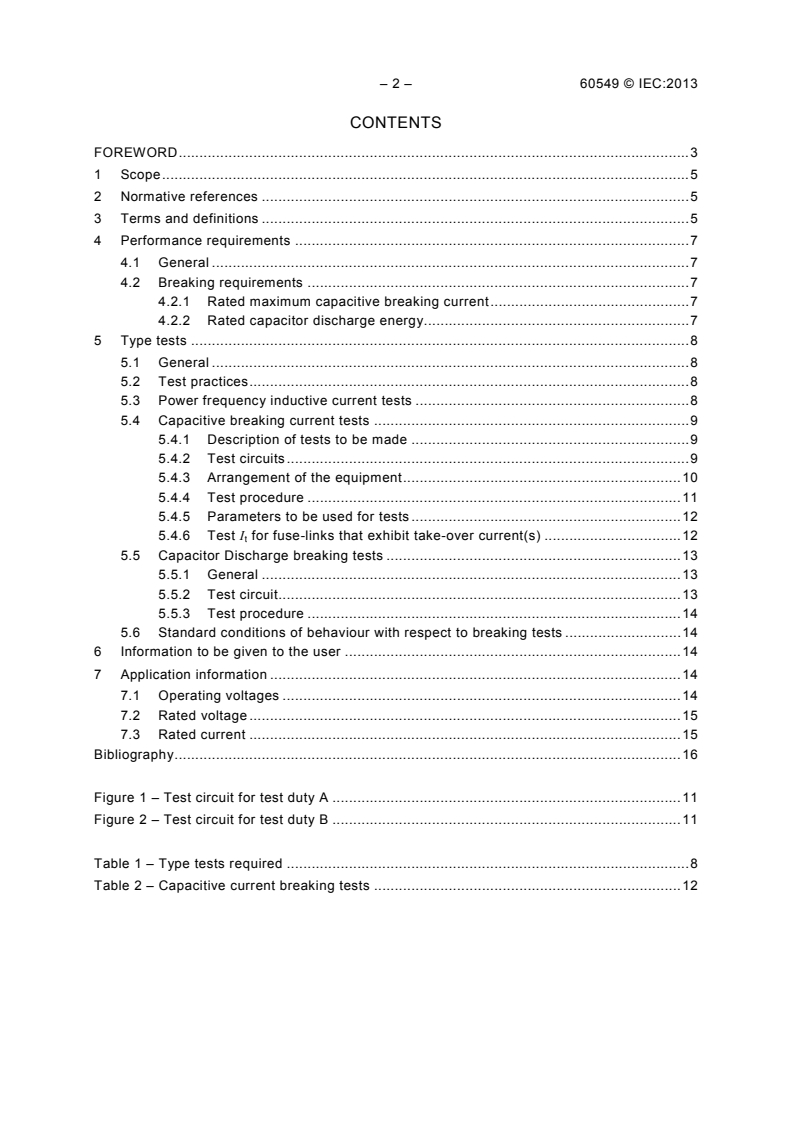
– 2 – 60549 © IEC:2013
CONTENTS
FOREWORD . 3
1 Scope . 5
2 Normative references . 5
3 Terms and definitions . 5
4 Performance requirements . 7
4.1 General . 7
4.2 Breaking requirements . 7
4.2.1 Rated maximum capacitive breaking current . 7
4.2.2 Rated capacitor discharge energy. 7
5 Type tests . 8
5.1 General . 8
5.2 Test practices . 8
5.3 Power frequency inductive current tests . 8
5.4 Capacitive breaking current tests . 9
5.4.1 Description of tests to be made . 9
5.4.2 Test circuits . 9
5.4.3 Arrangement of the equipment . 10
5.4.4 Test procedure . 11
5.4.5 Parameters to be used for tests . 12
5.4.6 Test I for fuse-links that exhibit take-over current(s) . 12
t
5.5 Capacitor Discharge breaking tests . 13
5.5.1 General . 13
5.5.2 Test circuit. 13
5.5.3 Test procedure . 14
5.6 Standard conditions of behaviour with respect to breaking tests . 14
6 Information to be given to the user . 14
7 Application information . 14
7.1 Operating voltages . 14
7.2 Rated voltage . 15
7.3 Rated current . 15
Bibliography . 16
Figure 1 – Test circuit for test duty A . 11
Figure 2 – Test circuit for test duty B . 11
Table 1 – Type tests required . 8
Table 2 – Capacitive current breaking tests . 12
60549 © IEC:2013 – 3 –
INTERNATIONAL ELECTROTECHNICAL COMMISSION
____________
HIGH-VOLTAGE FUSES FOR THE EXTERNAL
PROTECTION OF SHUNT CAPACITORS
FOREWORD
1) The International Electrotechnical Commission (IEC) is a worldwide organization for standardization comprising
all national electrotechnical committees (IEC National Committees). The object of IEC is to promote
international co-operation on all questions concerning standardization in the electrical and electronic fields. To
this end and in addition to other activities, IEC publishes International Standards, Technical Specifications,
Technical Reports, Publicly Available Specifications (PAS) and Guides (hereafter referred to as “IEC
Publication(s)”). Their preparation is entrusted to technical committees; any IEC National Committee interested
in the subject dealt with may participate in this preparatory work. International, governmental and non-
governmental organizations liaising with the IEC also participate in this preparation. IEC collaborates closely
with the International Organization for Standardization (ISO) in accordance with conditions determined by
agreement between the two organizations.
2) The formal decisions or agreements of IEC on technical matters express, as nearly as possible, an international
consensus of opinion on the relevant subjects since each technical committee has representation from all
interested IEC National Committees.
3) IEC Publications have the form of recommendations for international use and are accepted by IEC National
Committees in that sense. While all reasonable efforts are made to ensure that the technical content of IEC
Publications is accurate, IEC cannot be held responsible for the way in which they are used or for any
misinterpretation by any end user.
4) In order to promote international uniformity, IEC National Committees undertake to apply IEC Publications
transparently to the maximum extent possible in their national and regional publications. Any divergence
between any IEC Publication and the corresponding national or regional publication shall be clearly indicated in
the latter.
5) IEC itself does not provide any attestation of conformity. Independent certification bodies provide conformity
assessment services and, in some areas, access to IEC marks of conformity. IEC is not responsible for any
services carried out by independent certification bodies.
6) All users should ensure that they have the latest edition of this publication.
7) No liability shall attach to IEC or its directors, employees, servants or agents including individual experts and
members of its technical committees and IEC National Committees for any personal injury, property damage or
other damage of any nature whatsoever, whether direct or indirect, or for costs (including legal fees) and
expenses arising out of the publication, use of, or reliance upon, this IEC Publication or any other IEC
Publications.
8) Attention is drawn to the Normative references cited in this publication. Use of the referenced publications is
indispensable for the correct application of this publication.
9) Attention is drawn to the possibility that some of the elements of this IEC Publication may be the subject of
patent rights. IEC shall not be held responsible for identifying any or all such patent rights.
International Standard IEC 60549 has been prepared by subcommittee 32A: High voltage
fuses, of IEC technical committee 32: Fuses.
This second edition cancels and replaces the first edition published in 1976. This edition
constitutes a technical revision.
This edition includes the following significant technical changes with respect to the previous
edition:
a) alignment of the document with current IEC document structure requirements;
b) clarification of certain test requirements.
– 4 – 60549 © IEC:2013
The text of this standard is based on the following documents:
CDV Report on voting
32A/294/CDV 32A/298/RVC
Full information on the voting for the approval of this standard can be found in the report on
voting indicated in the above table.
This publication has been drafted in accordance with the ISO/IEC Directives, Part 2.
The committee has decided that the contents of this publication will remain unchanged until
the stability date indicated on the IEC web site under "http://webstore.iec.ch" in the data
related to the specific publication. At this date, the publication will be
• reconfirmed,
• withdrawn,
• replaced by a revised edition, or
• amended.
60549 © IEC:2013 – 5 –
HIGH-VOLTAGE FUSES FOR THE EXTERNAL
PROTECTION OF SHUNT CAPACITORS
1 Scope
This standard applies to external fuses used with high-voltage capacitors according to
IEC 60871-1, Shunt capacitors for a.c. power systems having a rated voltage above 1 000 V –
Part 1: General. IEC 60871-1 is applicable to both capacitor units and capacitor banks
intended to be used, particularly, for power-factor correction of a.c. power systems, and also
to capacitors intended for use in power filter circuits.
Fuses according to this standard are intended to clear either faults inside a capacitor unit to
permit continued operation of the remaining parts of the bank in which the unit is connected
(unit fuses) or faults on the whole capacitor bank to isolate the bank from the system (line
fuses).
In this standard the terms “capacitive current” and “inductive current” are used to indicate test
currents that have a leading or lagging power factor, respectively, and in which the circuit
contains predominantly capacitive or inductive components. The word "capacitor" is used
when it is not necessary to lay particular stress upon the different meanings of the word
"capacitor unit" or "capacitor bank".
In some cases, fuses tested only to IEC 60282-1 or IEC 60282-2 may be suitable for use with
capacitors if they are not required to interrupt capacitive currents (e.g. if capacitive currents
cannot flow, or if they are acting as a “back-up”, to provide high inductive current breaking, to
other devices that will clear capacitive currents).
2 Normative references
The following documents, in whole or in part, are normatively referenced in this document and
are indispensable for its application. For dated references, only the edition cited applies. For
undated references, the latest edition of the referenced document (including any
amendments) applies.
IEC 60282-1:2009, High-voltage fuses – Part 1: Current-limiting fuses
IEC 60282-2, High-voltage Fuses – Part 2: Expulsion Fuses
IEC 60871-1, Shunt capacitors for ac power systems having a rated voltage above 1 000 V –
Part 1: General
3 Terms and definitions
For the purposes of this document, the following definitions apply.
3.1
(capacitor) element
a device consisting essentially of two electrodes separated by a dielectric
[SOURCE: IEC 60050-436:1990, 436-01-03]
– 6 – 60549 © IEC:2013
3.2
(capacitor) unit
an assembly of one or more capacitor elements in the same container with terminals brought
out
[SOURCE: IEC 60050-436:1990, 436-01-04]
3.3
(capacitor) bank
a number of capacitor units connected so as to act together
[SOURCE: IEC 60050-436:1990, 436-01-06]
3.4
unit fuse
fuse intended to be used for the protection of a capacitor unit which forms a part of a
capacitor bank
3.5
line fuse
fuse intended to be used for the overall protection of a capacitor connected to a given point of
a system
3.6
rated voltage of a capacitor
U
r
the r.m.s. value of the alternating voltage for which the capacitor has been designed
Note 1 to entry: In the case of capacitors consisting of one or more separate circuits (for example single phase
units intended for use in polyphase connection, or polyphase units with separate circuits), U refers to the rated
r
voltage of each circuit.
Note 2 to entry: For polyphase capacitors with internal electrical connections between phases, and for polyphase
capacitor banks, U refers to the phase-to-phase voltage.
r
[SOURCE: IEC 60050-436:1990, 436-01-15, modified by addition of symbol and notes to
entry]
3.7
refill unit
a set of replacement parts sufficient to restore a fuse-link to its original condition after an
operation
[SOURCE: IEC 60050-441:2007, 441-18-15]
3.8
capacitive breaking current
current for which the specified conditions of use and behaviour include the opening of the
circuit that includes capacitor elements and/or capacitor units in series with the fuse
3.9
rated maximum capacitive breaking current
maximum capacitive breaking current that the fuse shall be capable of breaking under the
conditions of use and behaviour prescribed in this standard
60549 © IEC:2013 – 7 –
3.10
rated capacitor discharge energy
Joule rating
stored energy in a capacitor that a fuse has been shown to be capable of withstanding during
a capacitor discharge breaking test
4 Performance requirements
4.1 General
These fuses are not a substitute for a mechanical switching device, but when forming a part of
a mechanical switching device such as a fused switch or a fused disconnector, they shall
comply with this standard.
When fuses are used for the external protection of a capacitor unit or a capacitor bank (line
fuses), their voltages and breaking ratings shall be adequate for the system.
Fuses according to this standard shall comply with the requirements of IEC 60282-1 or
IEC 60282-2, except those which are specifically excluded in this standard.
The fuse is connected in series with the unit(s) that the fuse is intended to isolate if the unit(s)
become(s) faulty. The range in currents and voltages for the fuse is therefore dependent on
the characteristics of the capacitor and the bank in which the fuse is connected as well as the
parameters of the supply circuit.
The operation of an external fuse is, in general, determined by the following two factors:
a) the power-frequency fault current resulting from either a partial or complete capacitor
failure;
b) the discharge energy from any units in parallel with the fault.
However, this standard gives a method of separate checking of these factors.
These requirements are valid for capacitors switched by a switching device with a very low
probability of restrike during interruption. If this is not the case, other requirements are to be
agreed upon.
As used in this standard, U is the rated voltage of the capacitor unit and U is the rated
r rf
voltage of the capacitor fuse.
4.2 Breaking requirements
4.2.1 Rated maximum capacitive breaking current
The preferred rated maximum capacitive breaking currents for capacitor fuses are 1 kA r.m.s.,
2,5 kA r.m.s., 3,15 kA r.m.s., 4 kA r.m.s., and 5 kA r.m.s. Other values shall be the subject of
an agreement between manufacturer and user.
4.2.2 Rated capacitor discharge energy
A rated capacitor discharge energy (joule rating) is assigned to a fuse based on the energy
stored in a capacitor test bank prior to the time it is discharged through the fuse in the
capacitor discharge breaking tests (5.5). Values should be selected from R10 series with a
minimum of 10 kJ. The preferred value for current-limiting fuses is 40 kJ. To assign an
“unlimited” rated capacitor discharge energy see 5.5.2.
– 8 – 60549 © IEC:2013
The preferred frequency for the capacitor discharge breaking tests of 5.5 is:
– f = 0,8 U
rf
Where f is in hertz and U is the rated voltage of the fuse, in volts.
rf
5 Type tests
5.1 General
To comply with this standard, fuses shall be subjected to the tests specified in Table 1.
For fuses belonging to a homogeneous series as defined in IEC 60282-1 and IEC 60282-2, it
is allowed that tests made on a reduced number of current ratings shall be valid for the other
current ratings. Detailed information is given in 5.4.1 and 5.5.1.
Table 1 – Type tests required
Tests Line Unit fuses
fuses
Where inductive Where inductive
a b
currents are likely currents are not likely
Power-frequency Inductive currents (5.3) X X ─
c
X X X
Power-frequency Capacitive currents (5.4)
d
Capacitive-discharge (5.5)
X X
─
a
Examples of such applications are
– unit fuses in delta-connected banks without units in series;
– unit fuses in star-connected banks without units in series and with earthed neutral.
– unit fuses without capacitor units in series, used on single phase circuits
b
Examples of such applications are:
– unit fuses in star-connected banks with unearthed neutral;
– banks where capacitor units are used in series.
c
These tests are not required for fuses where capacitive limited currents are not likely to flow. Examples of
such cases are capacitors having only a single internal group of elements, connected in delta or grounded
star without capacitor units in series.
d
Unusual applications, such as back-to-back banks on the same pole with each bank having its own line fuse
could require the fuse to be capable of interrupting capacitive discharge currents. Since the size of these
banks would generally be small, most line fuses could satisfactorily handle the discharge currents. Consult
the fuse manufacturer for these types of applications.
5.2 Test practices
The fuse shall be new, clean and in good condition.
The fuse-link shall be tested in a fuse-base or directly mounted as specified by the
manufacturer of the fuse-link.
In making tests of a test duty within a series of renewable fuse-links, only the fuse-elements,
refill units and parts normally replaceable shall be replaced. A new fuse-carrier shall be used
for tests of the other test duty.
5.3 Power frequency inductive current tests
These tests shall comprise the following: Test duties 1 and 2 according to IEC 60282-1 or
Test duties 1, 2, 3 and 4 according to IEC 60282-2.
60549 © IEC:2013 – 9 –
For the inductive current interrupting tests for capacitor unit fuses, a capacitor shall be placed
in parallel with the fuse under test. This parallel capacitor shall be sized to draw a current at
the test voltage of between 25 % and 75 % of the rated current of the fuse under test. The
transient recovery voltage requirements of IEC 60282-1 do not apply to the tests on capacitor
unit fuses when parallel capacitors are used in the test circuit.
Capacitor unit fuses that have met the interrupting requirements when tested without parallel
capacitors need not be retested with parallel capacitors in the test circuit.
5.4 Capacitive breaking current tests
5.4.1 Description of tests to be made
For both current-limiting fuses and expulsion fuses belonging to a homogeneous series as
defined in IEC 60282-1 and IEC 60282-2, tests shall be made on the fuse-links with the
highest current rating. For expulsion fuses, test duty A shall also be made on the fuse-links
with the lowest current rating of the series. A 6,3 A type K link (or the equivalent) may be
used for the lowest current rating requirement.
These tests are intended to prove the ability of the fuse to break capacitive currents and shall
include two test duties.
– Test duty A: verification of the rated maximum capacitive breaking current (see 4.2.2).
– Test duty B: verification of the operation with a current value resulting in a pre-arcing time
of 10 s or more.
The test circuits specified in 5.4.2 and the parameters specified in 5.4.5 have been so chosen
as to reproduce as closely as possible the duty which the fuses experience in actual
applications.
When applied as capacitor fuses, the mode of failure of the capacitor units determines the
magnitude and nature (capacitive or inductive) of the current that the fuse must break. Test
duty A simulates the condition where the fuse breaks high capacitive current due to significant
capacitor failure. For progressive element failure in the capacitor unit, the current increases
until it reaches a magnitude that will just cause operation of the fuse. Test duty B simulates
this condition.
5.4.2 Test circuits
5.4.2.1 General
The tests shall be made with single-phase alternating current and with single fuses.
The source impedance shall be such that the variation in the source voltage caused by
switching the capacitive load current shall not exceed 10 % (i.e. in Figures 1 and 2,
U /U ≤ 1,1). The power factor of the source circuit shall not exceed 0,15 lagging and its
sc so
capacitance shall be as low as possible.
The waveform of the current to be broken should, as nearly as possible, be sinusoidal. This
condition is considered to be complied with if the ratio of the r.m.s. value of the current to the
r.m.s. value of the fundamental component does not exceed 1,2.
The current to be broken shall not pass through zero more than once per half-cycle.
5.4.2.2 Unit fuses
For test duty A, the load circuit shall be as shown in Figure 1.
– 10 – 60549 © IEC:2013
Operation of the fuse is initiated by closing the switch S2 in series with the fuse, in order to
simulate the total failure of a capacitor unit protected by the fuse.
C represents the capacitance in the bank that limits the fault current and C represents the
T P
capacitors which are in parallel with the failed unit. The value of C in microfarads shall be
P
C ≥ 1 000 / U , U being expressed in kilovolts.
p rf rf
NOTE 1 In order to achieve the specified recovery voltage in Table 2, the open circuit source voltage U has to
SO
be of a higher value. It may be determined by considering the ratio of the capacitances, approximately
U = (C + C )/C × U .
SO T p T rf
For test duty B the load circuit shall be as shown in Figure 2.
Operation of the fuse is initiated by opening the switch S in parallel with the fuse.
C represents the remaining healthy elements of the capacitor unit and C represents the
T P
other units in the bank which are in parallel with the failed unit. The value of C in microfarads
P
shall be C ≥ 1 000 / U , U being expressed in kilovolts.
p rf rf
NOTE 2 In both circuits, the effect of capacitance on the recovery voltage appearing across the fuse when it
operates is taken into account by C . The minimum value specified represents between 300 kVAr and 400 kVAr
P
(depending on frequency), i.e. the size of the smallest capacitor bank on which individual fuses would normally be
applied. Experience has shown that the value of C is not critical in its effect on the capacitive current-breaking
P
performance of fuses, and therefore only a minimum value is specified.
5.4.2.3 Line fuses
For test duties A and B on line fuses, the load circuit shall be as shown in Figure 1, except
that capacitance C shall be omitted.
P
5.4.3 Arrangement of the equipment
Expulsion and current-limiting fuses that automatically provide an isolating gap after operation
shall be mounted as they will be in a capacitor bank. An energized fuse shall be placed on
each side of the fuse under test to determine adequately that any expulsion of gas or
reduction of clearance does not cause flashovers which might initiate operation of the
adjacent fuses. The spacing between fuses shall be recorded.
Other current-limiting fuses may be mounted in any convenient manner.
60549 © IEC:2013 – 11 –
R1 S1
X1
C
T
S2
G
U U
so sc
U
rf C
P
F
IEC 805/13
Key
R1 Source resistance S2 Switch to initiate fuse melting
X1 Source reactance F Fuse under test
S1 Laboratory closing switch U Source voltage (open circuit)
SO
C Capacitors to produce the test current U Source voltage with capacitive test current
T SC
C Capacitors corresponding to the capacitors in U Fuse recovery voltage
P rf
parallel with the failed unit
Figure 1 – Test circuit for test duty A
R1
X1 S1
C
T
G
U U
so sc
S2
F
U
rf C
P
IEC 806/13
Key
R1 Source resistance S2 Switch to initiate fuse melting
X1 Source reactance F Fuse under test
S1 Laboratory closing switch U Source voltage (open circuit)
SO
C Capacitors to produce the test current U Source voltage with capacitive test current
T SC
C Capacitors corresponding to the capacitors in U Fuse recovery voltage
P rf
parallel with the failed unit
Figure 2 – Test circuit for test duty B
5.4.4 Test procedure
The test procedure to obtain the specified prospective current shall be that specified for the
breaking tests in IEC 60282-1 or IEC 60282-2.
– 12 – 60549 © IEC:2013
5.4.5 Parameters to be used for tests
The parameters to be used when making the tests are given in Table 2.
Table 2 – Capacitive current breaking tests
Parameters Test duty A Test duty B
Power-frequency recovery voltage (i.e. +5 +5
1,0 U % 1,0 U %
0 0
rf rf
excluding d.c. voltage component)
Source power factor (lagging) ≤0,15
Total circuit power factor (leading) ≤0,15
Current value resulting in a pre-
Rated maximum capacitive
Prospective current b
breaking current
arcing time of 10 s or more
a
Making angle after voltage zero Random timing
From 0 ° to 20 °
Number of tests 3 2
Duration of Dropout and isolating
Not less than the dropout time or 0,5 s, whichever is greater
power gap fuses
frequency
Fuses that do not
recovery
provide an isolating Not less than 60 s
voltage after
gap after operation
interruption
a
This produces the most severe condition for the fuse since closing the circuit near voltage zero minimizes
discharge current from the parallel capacitance and its effect on the pre-arcing time of the fuse.
b
If the fuse being tested is a Back-Up fuse, to be used in series with another device intended to break low
currents, the current may be chosen to give a shorter melting time. For fuses intended for applications in
which melting times can be long (e.g. using Full-Range fuses) it may be necessary to test with currents that
produce longer melting times.
5.4.6 Test I for fuse-links that exhibit take-over current(s)
t
In the case of fuses that incorporate different arc-quenching mechanisms within the same
envelope (for example, current-limiting elements and expulsion elements in series) or for
“combination” fuses that have an expulsion fuse permanently connected to a current-limiting
fuse, Test Duty A and B above shall be augmented by additional tests to prove correct
operation in the region(s) of current I where the capacitive breaking duty is transferred from
t
one arc-quenching mechanism to another. Since fuse designs differ widely, specifying precise
test requirements, applicable to all designs, is not possible. It is the responsibility of the fuse
manufacturer to confirm by the I breaking test that the breaking mechanisms are operating
t
correctly to effect proper current interruption within the transitional current region. Typical
criteria used in assessing compliance with this requirement are discussed in Annex G of
IEC 60282-1:2009 “Criteria for determining I testing validity”.
t
In general, a minimum of two tests shall be performed at each of the two following values:
I = 1,2 I (± 0,05 I )
t1 t t
and
I = 0,8 I (± 0,05 I )
t2 t t
where I is the value of crossover current provided by the fuse manufacturer.
t
If it is known that these values do not represent the most onerous conditions for the given
design of fuse, then the manufacturer may nominate other values of I and I .
t1 t2
The parameters to be used when making the tests are given in Table 2, test duty B.
60549 © IEC:2013 – 13 –
NOTE When a capacitor fuse requires several loops of arcing to break the current, in effect the capacitor is being
switched. This can result in a significant increase in current through the capacitor and fuse. Therefore for a
particular fuse, the value(s) for I in a capacitive circuit may be significantly lower than the value(s) for I in an
t t
inductive circuit.
5.5 Capacitor Discharge breaking tests
5.5.1 General
These tests are made to verify the energy which the fuse can withstand without bursting.
A calibration test shall be made by replacing the fuse-link under test by a link of negligible
impedance compared with that of the test circuit. This test may be made with a reduced
voltage
The circuit shall be adjusted to give the specified capacitor discharge energy, oscillatory
frequency and decrement. This shall be verified by an oscillographic record. The ratio
between successive peaks shall be from 0,8 to 0,95 for the discharge breaking tests.
Tests shall be made on new fuses with the amounts of energy specified by the manufacturer.
For current-limiting fuses belonging to a homogeneous series as defined in IEC 60282-1, tests
shall be made on the fuse-link with the highest current rating.
For expulsion type fuses, the tests shall be made on all fuse types where the bore of the fuse
tube and/or its length changes, and on any fuses where the materials of the fuse tube are
different from other tested devices. For fuses that use replaceable links, the tests shall be
made with the smallest and the largest link that is intended to be used in the particular fuse
holder and for the specified capacitor discharge energy. The link size used in a fuse holder is
a function of the capacitor with which it is to be used, and the capacitor discharge energy
requirement is related to the number and size of connected parallel capacitors. However, no
link smaller than a 6,3 A type K link (or the equivalent) need be used for the minimum size
requirement.
5.5.2 Test circuit
Tests shall be made with a capacitor, the capacitance of which is such that the stored energy
has the specified value at the test voltage specified below. This capacitor shall be charged by
means of d.c. to one of the following voltages:
– 2,0 U √2 (+0 %, -10 %) for current-limiting fuses.
rf
√2 (+10 %, -0 %) for expulsion fuses unless otherwise specified.
– 1,0 U
rf
The capacitor shall be discharged through the fuse under test in a circuit having a frequency
as close as possible to the preferred value given in 4.2.2 in which the oscillatory frequency is:
f = 0,8 U (+20 %, -0 %)
rf
where f is in hertz and U is the voltage rating of the fuse in volts.
rf
The actual discharge frequency measured during the tests shall be recorded along with the
maximum stored energy (joules) rating in the test report. The "joule rating" that may be
assigned to the fuse being tested is the energy stored in the capacitor test bank prior to the
time it is discharged through the fuse. If an unlimited "joule rating" is claimed for a current-
limiting fuse, then the charge voltage may be increased such that at the instant of interruption,
the voltage remaining on the bank shall not be less than 1,80 U √2 (the minimum charging
rf
voltage for a limited joule rating).
– 14 – 60549 © IEC:2013
5.5.3 Test procedure
Two tests shall be made. For expulsion fuses, the second test shall be made on a completely
new fuse.
For fuses that do not introduce a visible air gap in the circuit upon operation, the residual
voltage of the capacitor shall remain on the fuse for 10 min after operation. This requires the
capacitor used for the test to be without discharge resistance.
For other fuses, no requirements concerning the maintained voltage are specified.
For current-limiting fuses, the residual voltage across the capacitor shall be measured
immediately after the discharge to determine the amount of energy dissipated in the fuse-link.
The residual voltage shall be recorded in the test report.
5.6 Standard conditions of behaviour with respect to breaking tests
a) Flashover to earth or to adjacent capacitor units shall not occur. A current-limiting fuse-
link shall not emit flame or powder, although a minor emission of flame from a striker or
indicating device is permissible, provided this does not cause breakdown or significant
leakage current to earth.
b) After the fuse has operated, the components of the fuse, apart from those intended to be
replaced after each operation, shall be in substantially the same condition as at the
beginning of the test except for the erosion of the bore of the fuse tube of expulsion fuses.
For current-limiting fuses, it shall be possible to remove the fuse-link in one piece after the
operation.
However, after the discharge breaking test, the components of the fuse maybe damaged
and require replacement to restore the fuse to operating condition.
6 Information to be given to the user
– rated voltage of the fuse;
– current rating of the fuse-link or refill unit; in addition, the maximum continuous current
capability may also be specified;
– current rating of the fuse-base or fuse-carrier contacts;
– time-current characteristics as specified in IEC 60282-1 or IEC 60282-2 for an ambient air
temperature of 20 °C;
NOTE Information should be available on request concerning ambient air temperatures in the range -40 °C to
+75 °C.
– rated maximum capacitive breaking current, where appropriate (see Table 1);
– rated maximum breaking current (inductive), where appropriate (see Table 1);
– maximum available capacitor energy which the fuse can withstand at the voltages
specified in 5.5.2 without bursting;
– the frequency achieved during the capacitor discharge breaking tests;
– minimum pre-arcing I t (under substantially adiabatic conditions) and maximum operating
I t at inductive and capacitive power-frequency currents;
– external creepage distance along the fuse-link (for other than fuses which automatically
provide an isolating gap after operation).
7 Application information
7.1 Operating voltages
Test voltages and methods are chosen based on the following requirements. The fuse should
isolate the faulty unit(s) with a minimum disturbance to the system and to the capacitor unit
60549 © IEC:2013 – 15 –
involved under maximum prevailing system conditions occurring at the time of the fault and at
the following voltages:
a) Under transient current conditions, e.g. during energisation, the higher limit of the
transient voltage between terminals of the unit is 2,0 U √2, where U is the rated voltage
r r
of the unit. After operation, the fuse has to be capable of withstanding the above transient
voltage.
b) When the fuse is subjected to power-frequency capacitive currents, it is required to
operate against a voltage of 1,1 U and then withstand this voltage plus any d.c. voltage
r
component resulting from any capacitive charge remaining after the operation of the fuse.
7.2 Rated voltage
Traditional application advice has been to specify a fuse rated voltage at least 10 % higher
than the rated voltage U of the capacitor unit. This is based on the fact that it is permissible
r
to operate capacitors at 110 % of their rated voltage for as much as 12 hours in every 24 hour
period (IEC 60871-1). Consequently, capacitor overvoltage protection is often set at 10 %
above rated voltage, so fuses may have to operate at this voltage. However, if system
protection does not limit the voltage to this level, a fuse should be chosen to have a rated
voltage at least as high as the highest anticipated service voltage, including overvoltages that
may be produced by capacitive fault currents or bank unbalance. When a fuse is tested to
IEC 60549, the capacitive test current may produce a rise in source voltage of up to 10 %
(5.4.2.1). However it cannot be assumed that a particular fuse design has been tested at this
10 % maximum, as the actual rise is dependent on the source impedance and the value of the
test current. Therefore, it should not be assumed that a fuse has a capability any higher than
its rated voltage (which is equal to the power frequency recovery voltage during testing).
7.3 Rated current
The rated current of the fuse shall be at least 1,43 times the rated current I of the capacitor.
n
NOTE 1 In principle, the continuous current does not exceed 1,3 times I ., but as the capacitance may reach
n
1,1 times the value corresponding to the rated output, the current may have a maximum value of
1,3 × 1,1 = 1,43 times the rated current.
NOTE 2 When the air temperature at the fuse location exceeds 40 °C, it is recommended to consult the
manufacturer.
NOTE 3 For certain types of fuse-links having an overload capability, it is recommended to take this property into
consideration.
– 16 – 60549 © IEC:2013
Bibliography
[1] IEC 60050-436:1990, International Electrotechnical Vocabulary – Chapter 436: Power
capacitors
[2] IEC 60050-441:1984, International Electrotechnical Vocabulary – Chapter 441:
Switchgear, controlgear and fuses
_____________
– 18 – 60549 © CEI:2013
SOMMAIRE
AVANT-PROPOS . 19
1 Domaine d'application . 21
2 Références normatives . 21
3 Termes et définitions . 21
4 Exigences des performances . 23
4.1 Généralités . 23
4.2 Exigences de coupure . 23
4.2.1 Courant de coupure capacitif maximal assigné . 23
4.2.2 Énergie de décharge du condensateur assignée . 23
5 Essais de type . 24
5.1 Généralités . 24
5.2 Règles d'essais . 24
5.3 Essais de courants inductifs à fréquence industrielle . 25
5.4 Essais de courant de cou
...