

IEC 62047-4:2008
(Main)Semiconductor devices - Micro-electromechanical devices - Part 4: Generic specification for MEMS
General Information
- Abstract
IEC 62047-4:2008 describes the generic specifications for micro-electromechanical systems (MEMS) made by semiconductors, which are the basis for specifications given in other parts of this series for various types of MEMS applications such as sensors, RF MEMS, excluding optical MEMS, bio MEMS, micro TAS, and power MEMS. This standard specifies general procedures for quality assessment to be used in IECQ-CECC systems and establishes general principles for describing and testing of electrical, optical, mechanical and environmental characteristics. IEC 62047-4:2008 aids in the preparation of standards that define devices and systems made by micromachining technology, including but not limited to, material characterization and handling, assembly and testing, process control and measuring methods. MEMS described in this standard are basically made of semiconductor material. However, the statements made in this standard are also applicable to MEMS using materials other than semiconductor, for example, polymers, glass, metals and ceramic materials.
- Status
- Published
- Publication Date
- 20-Aug-2008
- Technical Committee
- SC 47F - Micro-electromechanical systems
- Drafting Committee
- WG 1 - TC 47/SC 47F/WG 1
Overview
IEC 62047-4:2008, titled "Semiconductor devices - Micro-electromechanical devices - Part 4: Generic specification for MEMS," is an international standard published by the International Electrotechnical Commission (IEC). This standard provides generic specifications and quality assessment procedures for micro-electromechanical systems (MEMS) primarily made from semiconductor materials. It establishes standardized principles for describing and testing key characteristics-electrical, optical, mechanical, and environmental-across various MEMS types, including sensors and RF MEMS, while explicitly excluding optical MEMS, bio MEMS, micro TAS, and power MEMS.
The IEC 62047-4:2008 standard serves as a foundational document that supports the development and harmonization of more specific MEMS standards, facilitating consistent material characterization, assembly, testing, and process control within the semiconductor and MEMS industries. While semiconductor-based MEMS devices are the principal focus, the standard's principles can also be applied to MEMS made from polymers, glass, metals, and ceramics.
Key Topics
- Generic MEMS Specifications: Defines universally applicable specifications for various semiconductor-based MEMS devices, forming a base for detailed application-specific standards.
- Quality Assessment Procedures: Outlines general principles for quality verification including eligibility for qualification, approval testing, environmental/climatic testing, endurance tests, and accelerated testing.
- Testing and Measurement: Describes methodologies for physical, mechanical, climatic, and electrical test methods under standardized environmental conditions.
- Material and Process Control: Covers essential elements involved in micromachining technologies such as silicon processing, photolithography, etching, vapor deposition, bonding, and assembly techniques.
- Device Identification and Traceability: Includes marking requirements for device identification, traceability, and packaging to support quality control and supply chain integrity.
- Standardized Terminology and Units: Adopts standardized terms, definitions, and measurement units referenced from related IEC and ISO standards to ensure uniformity across MEMS documentation.
Applications
IEC 62047-4:2008 is pivotal for manufacturers, developers, and quality assurance professionals involved in semiconductor MEMS, serving broad applications such as:
- MEMS Sensors: Enabling reliable specification and testing of accelerometers, gyroscopes, pressure sensors, and other microsensors critical to automotive, aerospace, consumer electronics, and industrial markets.
- RF MEMS Components: Supporting the development and qualification of MEMS used in radio-frequency circuits and communication devices.
- Process Standardization: Guiding process engineers to implement consistent micromachining and bonding techniques, crucial for scalable MEMS device fabrication.
- Quality Systems Integration: Aligning MEMS production with IECQ-CECC quality assessment frameworks, enhancing supplier qualification and product reliability.
- Cross-Material MEMS: Extending relevance to emerging MEMS technologies involving non-semiconductor materials such as polymers and ceramics, broadening innovation scope.
Related Standards
IEC 62047-4 is part of the comprehensive IEC 62047 series dedicated to micro-electromechanical devices and is closely linked to the following international standards:
- IEC 62047-1: Terms and definitions specific to micro-electromechanical devices, ensuring consistent language and conceptual clarity.
- IEC 60027 Series: Letter symbols used in electrical technology enabling uniform symbol usage in MEMS documentation.
- IEC 60068-2 Series: Environmental testing procedures that establish reliability test methods referenced in MEMS quality assessments.
- IEC 60747-1: General semiconductor device specifications, offering foundational standards applicable to MEMS device characteristics.
- IEC 60749 Series: Mechanical and climatic test methods tailored for semiconductor devices, adapted for MEMS testing scenarios.
- IEC 61193-2 & ISO 2859-1: Sampling plans and inspection methodologies to guide statistical sampling of MEMS devices during qualification.
- IEC QC 001002-3: IEC Quality Assessment System rules of procedure, facilitating MEMS qualification and capability approval processes.
By adhering to IEC 62047-4:2008 and its related standards, organizations can ensure the consistent performance, quality, and interoperability of MEMS devices within the global electronics ecosystem. This approach drives innovation while safeguarding reliability and compatibility across diverse MEMS applications worldwide.
Relations
- Effective Date
- 05-Sep-2023
Frequently Asked Questions
IEC 62047-4:2008 is a standard published by the International Electrotechnical Commission (IEC). Its full title is "Semiconductor devices - Micro-electromechanical devices - Part 4: Generic specification for MEMS". This standard covers: IEC 62047-4:2008 describes the generic specifications for micro-electromechanical systems (MEMS) made by semiconductors, which are the basis for specifications given in other parts of this series for various types of MEMS applications such as sensors, RF MEMS, excluding optical MEMS, bio MEMS, micro TAS, and power MEMS. This standard specifies general procedures for quality assessment to be used in IECQ-CECC systems and establishes general principles for describing and testing of electrical, optical, mechanical and environmental characteristics. IEC 62047-4:2008 aids in the preparation of standards that define devices and systems made by micromachining technology, including but not limited to, material characterization and handling, assembly and testing, process control and measuring methods. MEMS described in this standard are basically made of semiconductor material. However, the statements made in this standard are also applicable to MEMS using materials other than semiconductor, for example, polymers, glass, metals and ceramic materials.
IEC 62047-4:2008 describes the generic specifications for micro-electromechanical systems (MEMS) made by semiconductors, which are the basis for specifications given in other parts of this series for various types of MEMS applications such as sensors, RF MEMS, excluding optical MEMS, bio MEMS, micro TAS, and power MEMS. This standard specifies general procedures for quality assessment to be used in IECQ-CECC systems and establishes general principles for describing and testing of electrical, optical, mechanical and environmental characteristics. IEC 62047-4:2008 aids in the preparation of standards that define devices and systems made by micromachining technology, including but not limited to, material characterization and handling, assembly and testing, process control and measuring methods. MEMS described in this standard are basically made of semiconductor material. However, the statements made in this standard are also applicable to MEMS using materials other than semiconductor, for example, polymers, glass, metals and ceramic materials.
IEC 62047-4:2008 is classified under the following ICS (International Classification for Standards) categories: 01 - GENERALITIES. TERMINOLOGY. STANDARDIZATION. DOCUMENTATION; 31.080.99 - Other semiconductor devices. The ICS classification helps identify the subject area and facilitates finding related standards.
IEC 62047-4:2008 has the following relationships with other standards: It is inter standard links to IEC 62047-4:2026. Understanding these relationships helps ensure you are using the most current and applicable version of the standard.
IEC 62047-4:2008 is available in PDF format for immediate download after purchase. The document can be added to your cart and obtained through the secure checkout process. Digital delivery ensures instant access to the complete standard document.
Standards Content (Sample)
IEC 62047-4
Edition 1.0 2008-08
INTERNATIONAL
STANDARD
NORME
INTERNATIONALE
Semiconductor devices – Micro-electromechanical devices –
Part 4: Generic specification for MEMS
Dispositifs à semiconducteurs – Dispositifs microélectromécaniques –
Partie 4: Spécification générique pour les MEMS
All rights reserved. Unless otherwise specified, no part of this publication may be reproduced or utilized in any form or by
any means, electronic or mechanical, including photocopying and microfilm, without permission in writing from either IEC or
IEC's member National Committee in the country of the requester.
If you have any questions about IEC copyright or have an enquiry about obtaining additional rights to this publication,
please contact the address below or your local IEC member National Committee for further information.
Droits de reproduction réservés. Sauf indication contraire, aucune partie de cette publication ne peut être reproduite
ni utilisée sous quelque forme que ce soit et par aucun procédé, électronique ou mécanique, y compris la photocopie
et les microfilms, sans l'accord écrit de la CEI ou du Comité national de la CEI du pays du demandeur.
Si vous avez des questions sur le copyright de la CEI ou si vous désirez obtenir des droits supplémentaires sur cette
publication, utilisez les coordonnées ci-après ou contactez le Comité national de la CEI de votre pays de résidence.
IEC Central Office
3, rue de Varembé
CH-1211 Geneva 20
Switzerland
Email: inmail@iec.ch
Web: www.iec.ch
About the IEC
The International Electrotechnical Commission (IEC) is the leading global organization that prepares and publishes
International Standards for all electrical, electronic and related technologies.
About IEC publications
The technical content of IEC publications is kept under constant review by the IEC. Please make sure that you have the
latest edition, a corrigenda or an amendment might have been published.
ƒ Catalogue of IEC publications: www.iec.ch/searchpub
The IEC on-line Catalogue enables you to search by a variety of criteria (reference number, text, technical committee,…).
It also gives information on projects, withdrawn and replaced publications.
ƒ IEC Just Published: www.iec.ch/online_news/justpub
Stay up to date on all new IEC publications. Just Published details twice a month all new publications released. Available
on-line and also by email.
ƒ Electropedia: www.electropedia.org
The world's leading online dictionary of electronic and electrical terms containing more than 20 000 terms and definitions
in English and French, with equivalent terms in additional languages. Also known as the International Electrotechnical
Vocabulary online.
ƒ Customer Service Centre: www.iec.ch/webstore/custserv
If you wish to give us your feedback on this publication or need further assistance, please visit the Customer Service
Centre FAQ or contact us:
Email: csc@iec.ch
Tel.: +41 22 919 02 11
Fax: +41 22 919 03 00
A propos de la CEI
La Commission Electrotechnique Internationale (CEI) est la première organisation mondiale qui élabore et publie des
normes internationales pour tout ce qui a trait à l'électricité, à l'électronique et aux technologies apparentées.
A propos des publications CEI
Le contenu technique des publications de la CEI est constamment revu. Veuillez vous assurer que vous possédez
l’édition la plus récente, un corrigendum ou amendement peut avoir été publié.
ƒ Catalogue des publications de la CEI: www.iec.ch/searchpub/cur_fut-f.htm
Le Catalogue en-ligne de la CEI vous permet d’effectuer des recherches en utilisant différents critères (numéro de référence,
texte, comité d’études,…). Il donne aussi des informations sur les projets et les publications retirées ou remplacées.
ƒ Just Published CEI: www.iec.ch/online_news/justpub
Restez informé sur les nouvelles publications de la CEI. Just Published détaille deux fois par mois les nouvelles
publications parues. Disponible en-ligne et aussi par email.
ƒ Electropedia: www.electropedia.org
Le premier dictionnaire en ligne au monde de termes électroniques et électriques. Il contient plus de 20 000 termes et
définitions en anglais et en français, ainsi que les termes équivalents dans les langues additionnelles. Egalement appelé
Vocabulaire Electrotechnique International en ligne.
ƒ Service Clients: www.iec.ch/webstore/custserv/custserv_entry-f.htm
Si vous désirez nous donner des commentaires sur cette publication ou si vous avez des questions, visitez le FAQ du
Service clients ou contactez-nous:
Email: csc@iec.ch
Tél.: +41 22 919 02 11
Fax: +41 22 919 03 00
IEC 62047-4
Edition 1.0 2008-08
INTERNATIONAL
STANDARD
NORME
INTERNATIONALE
Semiconductor devices – Micro-electromechanical devices –
Part 4: Generic specification for MEMS
Dispositifs à semiconducteurs – Dispositifs microélectromécaniques –
Partie 4: Spécification générique pour les MEMS
INTERNATIONAL
ELECTROTECHNICAL
COMMISSION
COMMISSION
ELECTROTECHNIQUE
PRICE CODE
INTERNATIONALE
R
CODE PRIX
ICS 31.080.99 ISBN 2-8318-9968-0
– 2 – 62047-4 © IEC:2008
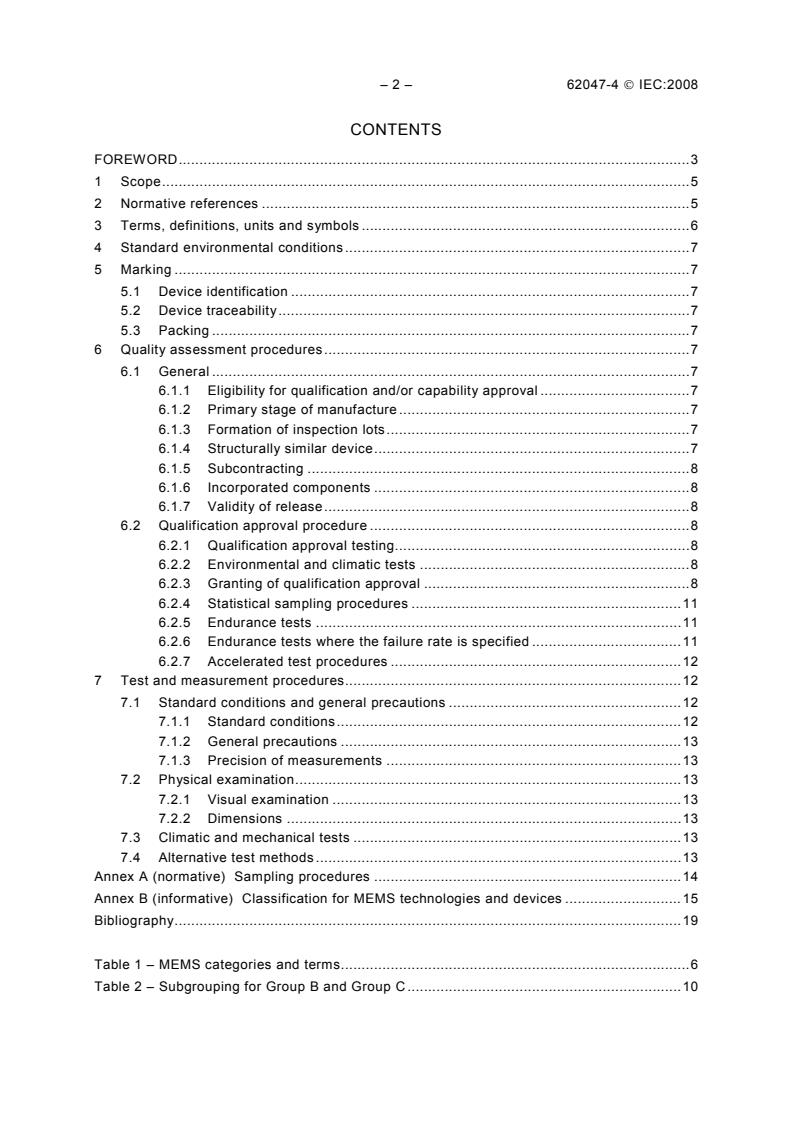
CONTENTS
FOREWORD.3
1 Scope.5
2 Normative references .5
3 Terms, definitions, units and symbols .6
4 Standard environmental conditions.7
5 Marking .7
5.1 Device identification .7
5.2 Device traceability.7
5.3 Packing .7
6 Quality assessment procedures.7
6.1 General .7
6.1.1 Eligibility for qualification and/or capability approval .7
6.1.2 Primary stage of manufacture.7
6.1.3 Formation of inspection lots.7
6.1.4 Structurally similar device.7
6.1.5 Subcontracting .8
6.1.6 Incorporated components .8
6.1.7 Validity of release.8
6.2 Qualification approval procedure .8
6.2.1 Qualification approval testing.8
6.2.2 Environmental and climatic tests .8
6.2.3 Granting of qualification approval .8
6.2.4 Statistical sampling procedures .11
6.2.5 Endurance tests .11
6.2.6 Endurance tests where the failure rate is specified .11
6.2.7 Accelerated test procedures .12
7 Test and measurement procedures.12
7.1 Standard conditions and general precautions .12
7.1.1 Standard conditions.12
7.1.2 General precautions .13
7.1.3 Precision of measurements .13
7.2 Physical examination.13
7.2.1 Visual examination .13
7.2.2 Dimensions .13
7.3 Climatic and mechanical tests .13
7.4 Alternative test methods .13
Annex A (normative) Sampling procedures .14
Annex B (informative) Classification for MEMS technologies and devices .15
Bibliography.19
Table 1 – MEMS categories and terms.6
Table 2 – Subgrouping for Group B and Group C .10
62047-4 © IEC:2008 – 3 –
INTERNATIONAL ELECTROTECHNICAL COMMISSION
––––––––––––
SEMICONDUCTOR DEVICES –
MICRO-ELECTROMECHANICAL DEVICES –
Part 4: Generic specification for MEMS
FOREWORD
1) The International Electrotechnical Commission (IEC) is a worldwide organization for standardization comprising
all national electrotechnical committees (IEC National Committees). The object of IEC is to promote
international co-operation on all questions concerning standardization in the electrical and electronic fields. To
this end and in addition to other activities, IEC publishes International Standards, Technical Specifications,
Technical Reports, Publicly Available Specifications (PAS) and Guides (hereafter referred to as “IEC
Publication(s)”). Their preparation is entrusted to technical committees; any IEC National Committee interested
in the subject dealt with may participate in this preparatory work. International, governmental and non-
governmental organizations liaising with the IEC also participate in this preparation. IEC collaborates closely
with the International Organization for Standardization (ISO) in accordance with conditions determined by
agreement between the two organizations.
2) The formal decisions or agreements of IEC on technical matters express, as nearly as possible, an international
consensus of opinion on the relevant subjects since each technical committee has representation from all
interested IEC National Committees.
3) IEC Publications have the form of recommendations for international use and are accepted by IEC National
Committees in that sense. While all reasonable efforts are made to ensure that the technical content of IEC
Publications is accurate, IEC cannot be held responsible for the way in which they are used or for any
misinterpretation by any end user.
4) In order to promote international uniformity, IEC National Committees undertake to apply IEC Publications
transparently to the maximum extent possible in their national and regional publications. Any divergence
between any IEC Publication and the corresponding national or regional publication shall be clearly indicated in
the latter.
5) IEC provides no marking procedure to indicate its approval and cannot be rendered responsible for any
equipment declared to be in conformity with an IEC Publication.
6) All users should ensure that they have the latest edition of this publication.
7) No liability shall attach to IEC or its directors, employees, servants or agents including individual experts and
members of its technical committees and IEC National Committees for any personal injury, property damage or
other damage of any nature whatsoever, whether direct or indirect, or for costs (including legal fees) and
expenses arising out of the publication, use of, or reliance upon, this IEC Publication or any other IEC
Publications.
8) Attention is drawn to the Normative references cited in this publication. Use of the referenced publications is
indispensable for the correct application of this publication.
9) Attention is drawn to the possibility that some of the elements of this IEC Publication may be the subject of
patent rights. IEC shall not be held responsible for identifying any or all such patent rights.
International Standard IEC 62047-4 has been prepared by subcommittee 47F: Micro-
electromechanical systems, of IEC technical committee 47: Semiconductor devices.
The text of this standard is based on the following documents:
FDIS Report on voting
47/1975/FDIS 47/1985/RVD
Full information on the voting for the approval on this standard can be found in the report on
voting indicated in the above table.
This publication has been drafted in accordance with the ISO/IEC Directives, Part 2.
– 4 – 62047-4 © IEC:2008
A list of all the parts in the IEC 62047 series, under the general title Semiconductor devices –
Micro-electromechanical devices, can be found on the IEC website.
The committee has decided that the contents of this publication will remain unchanged until
the maintenance result date indicated on the IEC web site under "http://webstore.iec.ch" in
the data related to the specific publication. At this date, the publication will be
• reconfirmed,
• withdrawn,
• replaced by a revised edition, or
• amended.
62047-4 © IEC:2008 – 5 –
SEMICONDUCTOR DEVICES –
MICRO-ELECTROMECHANICAL DEVICES –
Part 4: Generic specification for MEMS
1 Scope
This part of IEC 62047 describes generic specifications for micro-electromechanical systems
(MEMS) made by semiconductors, which are the basis for specifications given in other parts
of this series for various types of MEMS applications such as sensors, RF MEMS, excluding
optical MEMS, bio MEMS, micro TAS, and power MEMS. This standard specifies general
procedures for quality assessment to be used in IECQ-CECC systems and establishes
general principles for describing and testing of electrical, optical, mechanical and
environmental characteristics.
This part of IEC 62047 aids in the preparation of standards that define devices and systems
made by micromachining technology, including but not limited to, material characterization
and handling, assembly and testing, process control and measuring methods. MEMS
described in this standard are basically made of semiconductor material. However, the
statements made in this standard are also applicable to MEMS using materials other than
semiconductor, for example, polymers, glass, metals and ceramic materials.
2 Normative references
The following referenced documents are indispensable for the application of this document.
For dated references, only the edition cited applies. For undated references, the latest edition
of the referenced document (including any amendments) applies.
IEC 60027 (all parts), Letter symbols to be used in electrical technology
IEC 60068-2 (all parts), Environmental testing – Part 2: Tests
IEC 60617, Graphical symbols for diagrams
IEC 60747-1:2006, Semiconductor devices – Part 1: General
IEC 60749 (all parts), Semiconductor devices – Mechanical and climatic test methods
IEC 61193-2, Quality assessment systems – Part 2: Selection and use of sampling plans for
inspection of electronic components and packages
IEC 62047-1, Semiconductor devices – Micro-electromechanical devices – Part 1: Terms and
definitions
IEC QC 001002-3:2005, IEC Quality Assessment System for Electronic Components (IECQ) –
Rules of Procedure – Part 3: Approval procedures
ISO 1000, SI units and recommendations for the use of their multiples and of certain other
units
ISO 2859-1, Sampling procedures for inspection by attributes – Part 1: Sampling schemes
indexed by acceptance quality limit (AQL) for lot-by-lot inspection
– 6 – 62047-4 © IEC:2008
3 Terms, definitions, units and symbols
For the purposes of this document, terms shall, wherever possible, be taken from
IEC 62047-1; units, and graphical and letter symbols shall, wherever possible, be taken from
IEC 60027, IEC 60617 and ISO 1000.
Any other units, symbols or terminology peculiar to one of the devices covered by this generic
specification shall be taken from the relevant IEC or ISO standards (see Clause 2) or derived
in accordance with the principles of the standards listed above.
Table 1 shows the categories and terms on MEMS area.
Table 1 – MEMS categories and terms
Category Sub-category Terms
General MEMS, MST, micromachine, micromachine technology
Microscience and engineering, scale effect, mesotribology, microtribology,
Science and engineering
biomimetics, ciliary motion, self-organization
Material science Shape memory polymer, modification
Actuator, micro-actuator, electrostatic actuator, light driven actuator,
Actuator piezoelectric actuator, shape memory alloy actuator, sol-gel conversion
actuator, comb drive actuator, wobble motor
Functional Microsensor, biosensor, integrated microprobe, ion sensitive field effect
Sensor
element transistor (ISFET), accelerometer, micro-gyroscope
Diaphragm structure, microcantilever, microchannel, micromirror, scanning
Other mirror, microswitch, optical switch, microgripper, micropump, microvalve,
integrated mass flow controller, micro fuel cell, photoelectric transducer
General Micromachining
Silicon process, thick film technology, thin film technology, bulk micro-
Silicon process machining, surface micromachining, photolithography, electron beam
lithography, photomask, photoresist, silicon-on-insulator (SOI)
LIGA process LIGA process, UV-LIGA, X-ray lithography
Beam process
Beam processing, sputtering, focused ion beam machining
Etching process, wet etching, dry etching, isotropic etching, anisotropic
Machining Etching
etching, etch stop, lost wafer process, sacrificial etching, reactive ion etching
technology process
(RIE), DRIE, ICP
Deposition
Vapour deposition, physical vapour deposition process (PVD), electroforming
process
Other removal Micro-electro-discharge machining
process
Plastic working Hot embossing process
Other Micro-moulding, STM machining
Bonding, adhesive bonding, anodic bonding, diffusion bonding, silicon fusion
Bonding/
Bonding
bonding
assembling
technology
Other Micro-manipulator, non-contact handling, packaging, wafer level packaging
Scanning probe microscope (SPM), atomic force microscope (AFM), scanning
Microscope
Evaluation
tunneling microscope (STM), near-field microscope
technology
Other Aspect ratio, power-to-weight ratio
General Bio-MEMS, RF-MEMS, MOEMS, lab-on-a-chip, micro TAS, micro-reactor
Microscopic surgery (micro-surgery), active catheter, fibre endoscope, smart
Application
Biomedical use pill, bio-chip, DNA-chip, protein chip, cell handling, cell fusion, polymerase
technology
chain reaction (PCR)
Industrial use Microfactory
62047-4 © IEC:2008 – 7 –
4 Standard environmental conditions
Standard environmental conditions for the measurement of characteristics, tests and
operating conditions shall be at a temperature of 25 °C ± 3 °C, a relative humidity of 25 % to
85 %, and a pressure of 86 kPa to 106 kPa.
5 Marking
5.1 Device identification
The marking on the device shall have clear identification of the device and its quality level.
5.2 Device traceability
The device shall be provided with a traceability code which enables back-tracking of the
device to a certain production or inspection lot.
5.3 Packing
Marking on the packing shall state
a) the device identification code;
b) the traceability code(s) of the enclosed devices;
c) the number of enclosed devices;
d) the required precautions, if any.
This marking shall be in accordance with Customs regulations.
NOTE Additional requirements can be specified in the relevant detail specification.
6 Quality assessment procedures
6.1 General
When this standard, and related standards, are used for the purpose of a full quality
assessment system such as IEC Quality Assessment System for Electronic Components
(IECQ), this Clause 6 applies.
6.1.1 Eligibility for qualification and/or capability approval
A type of device becomes eligible for qualification and/or capability approval when the rules of
the following procedures as set out below, are satisfied.
Clause 3 of IEC QC 001002-3 describes the procedure for qualification approval (QA), the
release for delivery and validity of release.
6.1.2 Primary stage of manufacture
The primary stage of manufacture is defined in the sectional specification.
6.1.3 Formation of inspection lots
See 3.3.1 of IEC QC 001002-3.
6.1.4 Structurally similar device
See 3.3.2 of IEC QC 001002-3.
– 8 – 62047-4 © IEC:2008
6.1.5 Subcontracting
The use of subcontracting is permitted, unreservedly.
See 3.1.2.3 to 3.1.2.7 of IEC QC001002-3.
6.1.6 Incorporated components
See 5.2.3 of IEC QC 001002-3.
6.1.7 Validity of release
See 3.2.2 of IEC QC 001002-3.
6.2 Qualification approval procedure
6.2.1 Qualification approval testing
Method a), b) or c) of 3.1.4 of IEC QC 001002-3 may be used at the manufacturer's discretion
in accordance with the inspection requirements given in the sectional or blank detail
specifications.
Samples may be composed of appropriate structurally similar devices.
All measurements called for in the detail specification shall be recorded.
The qualification report shall include a summary of all the test results for each group and
subgroup, including number of devices tested and number of devices failed. This summary
shall be derived from the recorded data. The manufacturer shall retain all data for submission
to the NSI on demand.
6.2.2 Environmental and climatic tests
For environmental and climatic tests, refer to the IEC 60749 series.
6.2.3 Granting of qualification approval
See the rules of procedure given in 3.1.5 of IEC QC 001002-3.
Quality conformance tests are those tests which are performed on a lot-by-lot basis and
periodically on specimens taken from production to establish that the quality of the product is
being maintained. The sectional or detail specification shall prescribe those tests which have
to be performed.
Lot-by-lot tests are carried out on each inspection lot. The results are used to determine
whether the lot complies with the specified requirements.
Lot-by-lot tests may be divided into two groups:
– Group A, covering visual and dimensional inspection of the devices and the principal
characteristics of the devices (initial measurement);
– Group B, covering additional important characteristics.
Each group may be divided into two or more subgroups. The following subgroups are
recommended.
62047-4 © IEC:2008 – 9 –
Subgroup A1
This subgroup comprises a visual examination as specified in 6.2.1.
Subgroup A2
This subgroup comprises measurements of primary electrical characteristics of the device.
Subgroup A3
This subgroup comprises measurements of primary optical characteristics of the device.
Subgroup A4 and A5
These subgroups may not be required. They comprise measurements of secondary
characteristics of the device. The correct requirements for each device quality category are
given in the relevant sectional or blank detail specification. The choice between subgroups A4
or A5 for given measurements is essentially governed by the desirability of performing them at
a given quality level.
6.2.3.1 Periodic inspection
Periodic inspection is carried out on a sample drawn either from an individual lot or from a
number of lots. The lot(s) from which the sample is drawn shall have been shown to comply
with the requirements for lot-by-lot inspection. The results from tests in this category are used
to verify that the level of technical performance is being maintained.
Periodic tests are combined into Group C, which may be divided into two or more subgroups
as described in 6.2.3.
Group D may be added containing additional tests required for the maintenance of QA.
6.2.3.2 Division of Group B and Group C into subgroups
To enable comparison and to facilitate change from Group B to Group C and vice versa when
necessary, tests in these groups are divided among subgroups bearing the same number for
corresponding tests as shown in Table 2.
– 10 – 62047-4 © IEC:2008
Table 2 – Subgrouping for Group B and Group C
Subgroup Characteristics
B1/C1
Comprises measurements that control dimensional interchangeability of the devices.
B2/C2 Comprises measurements that assess the electrical properties of the device design
B3/C3 Comprises measurements that assess the optical properties of the device design
B4/C4 Comprises measurements that further assess some of the electrical and optical characteristics
of the device already measured in Group A by measurement under different voltage, current,
temperature or optical conditions
B5/C5 Comprises verification of ratings of the device, where appropriate
B6/C6 Comprises tests intended to assess mechanical robustness of the device
B7/C7 Comprises tests intended to assess interconnection ability of the device
B8/C8 Comprises tests intended to assess the ability of the device to withstand climatic stress, for
example change of temperature, sealing
B9/C9 Comprises tests intended to assess the ability of the device to withstand mechanical stresses,
for example vibration, shock
B10/C10
Comprises tests intended to assess the ability of the device to withstand long-term humidity
B11/C11 Comprises tests intended to assess electrical and optical properties of the device under storage
conditions at extremes of temperature
B12/C12 Comprises tests intended to assess performance of the device under different conditions of air
pressure
B13/C13 Comprise tests intended to assess failure characteristics of the device under endurance testing
B14/C14 Comprises tests on the permanence of marking
These subgroups may not all be required. The required subgroups are specified in the
relevant sectional or blank detail specification.
6.2.3.3 Inspection requirements
The statistical sampling procedures described in 6.2.4 shall be used.
6.2.3.3.1 Procedure in case of failure in periodic tests
When a group B failure occurs, the corresponding group C tests (see 6.2.3.3) are invalid. In
the event of failing periodic inspection tests, see the rules of procedure given in 3.1.8 of IEC
QC001002-3.
6.2.3.4 Switching rules for reduced inspection in Group C
The procedure is applicable to subgroups of Group C tests having a periodicity of 12 months
or less when specifically permitted by the sectional specification. It shall not be applied to
endurance tests unless otherwise prescribed in the relevant specification.
The relevant specification shall describe any limitations with respect to values, styles, etc., of
a device in the use of this procedure.
See the switching rules of procedure given in 3.2.8 of IEC QC 001002-3.
6.2.3.5 Delivery of device subjected to destructive or non-destructive tests
Tests considered as destructive are marked (D) in the sectional or blank detail specification.
Devices subjected to destructive tests shall not be included in the lot for delivery. Devices
subjected to non-destructive environmental tests may be delivered provided they are re-tested
according to Group A requirements and satisfy them.
62047-4 © IEC:2008 – 11 –
6.2.3.6 Delayed deliveries
Before delivery of lots which have been stored longer than the storage time, and in conditions
specified in the relevant sectional or blank detail specification, the lots or the quantities to be
delivered shall undergo the specified Group A inspection and Group B interconnection ability
tests.
6.2.4 Statistical sampling procedures
6.2.4.1 General
For Group A, B and C inspections, either the AQL sampling procedure or the zero-defects
sampling procedure shall be used. The detail specification shall specify which of the
procedures is to be used.
6.2.4.2 AQL sampling plans
See ISO 2859-1 and Annex A. There are three types of sampling plans: single, double and
multiple. When several types of plans are available for a given AQL and code letter, any one
may be used.
6.2.4.3 Zero-defects sampling plans
See IEC 61193-2 and Annex A.
6.2.5 Endurance tests
Endurance tests shall be specified in the detail specification.
6.2.6 Endurance tests where the failure rate is specified
6.2.6.1 General
Failure rate used in this standard is defined as a percentage per thousand hours. Endurance
tests with the specified failure rate shall be specified in the detail specification. Endurance
tests performed on devices at, or within, their maximum ratings shall be considered non-
destructive.
6.2.6.2 Selection of samples
Samples for endurance tests shall be selected at random from the inspection lot (see Annex
A). The sample size for a 1 000 h test shall be given in the detail specification (see 6.2.4).
The acceptance number shall be the one associated with the particular sample size chosen.
6.2.6.3 Failure
A device which fails at one or more of the end-point limits specified for endurance tests shall
be considered a failure. If the sample fails, the test may be terminated at the discretion of the
manufacturer.
6.2.6.4 Endurance test time and sample size
When the failure rate is specified, the endurance test time shall be 1 000 h initially. Once a lot
has passed the 1 000 h test, endurance tests can be reduced to a certain period, as specified
in the detail specification.
– 12 – 62047-4 © IEC:2008
6.2.6.5 Procedure to be used when the number of observed failures exceeds the
acceptance number
6.2.6.5.1 General
In the event that the number of failures observed on endurance tests exceeds the acceptance
number, the manufacturer shall choose one of the following options:
a) withdraw the entire lot;
b) add additional samples in accordance with 6.2;
c) extend the test time to 1 000 h in accordance with 6.2, if a time less than 1 000 h was
chosen;
d) rescreen the lot and submit or resubmit.
6.2.6.5.2 Additional samples
This option shall be used only once for each submission. When this option is chosen, a new
total sample size (initial plus added) shall be chosen by the manufacturer. A quantity of
additional devices sufficient to increase the sample to the newly chosen total sample size
shall be selected from the lot. The new acceptance number shall be the one associated with
new total sample size chosen. The added sample shall be subjected to the same endurance
test conditions and time period as the initial sample. If the total observed number of
defectives (initial plus added) does not exceed the acceptance number for the total sample,
the lot shall be accepted; if the observed number of defectives exceeds the new acceptance
number, the lot shall be rejected.
6.2.6.5.3 Extension of endurance test period
If an endurance test time periods less than 1 000 h is used and the number of failures
observed in the initial sample exceeds the acceptance number, the manufacturer may, instead
of adding additional samples, choose to extend the test time of the entire initial sample to
1 000 h and determine a new acceptance number. The new acceptance number shall be one
associated with the largest sample size in the specified column which is less than, or equal to,
the sample size being tested. A device which is a failure at the initial reading interval shall be
considered as such at the 1 000 h reading interval. If the observed number of defectives
exceeds this acceptance number, the lot shall not be accepted.
6.2.7 Accelerated test procedures
Accelerated test may be applied when the acceleration factor is defined in advance according
to the proper theoretical analysis or experimental data.
7 Test and measurement procedures
7.1 Standard conditions and general precautions
7.1.1 Standard conditions
Unless otherwise specified, all measurements are carried out under the following atmospheric
conditions:
− ambient temperature 25 °C ± 3 °C;
− relative humidity between 25 % and 85 %;
− atmospheric pressure between 86 kPa and 106 kPa.
Measurements may be carried out at other temperatures, provided the National Supervising
Inspectorate is satisfied that the device will conform to the detail specification when tested at
an ambient temperature of 25 °C ± 1 °C and relative humidity between 48 % and 52 % when
this is important.
62047-4 © IEC:2008 – 13 –
7.1.2 General precautions
Usual precautions should be taken to avoid damage to the device.
General precautions for electrostatic-sensitive devices are given in Clause 8 of IEC 60747-1.
7.1.3 Precision of measurements
The limits quoted in the detail specification are absolute. Measurement inaccuracies shall be
taken into account when determining the actual measurement limits.
7.2 Physical examination
7.2.1 Visual examination
Unless otherwise specified, visual examination shall be performed under normal lighting
conditions. Examination shall be made for correctness of the following elements:
a) marking and its legibility;
b) appearance of the device.
7.2.2 Dimensions
Dimensions shall be checked in accordance with the specified drawing.
7.3 Climatic and mechanical tests
Methods for climatic and mechanical tests shall be specified in the sectional specification or in
the blank detail specification in accordance with the IEC 60068-2 series. They shall be used
when required and as prescribed by the detail specification. They are indicated as
"destructive" or "non-destructive" according to 6.2.3.5.
When a mandatory sequence of testing is required, it shall be specified in the sectional
specification or in the blank detail specification.
7.4 Alternative test methods
All specified measurements should be performed by using the methods given in the detail
specification. In case alternative methods giving equivalent results have been used, it shall be
clearly noted on the reports that it has not been measured according to IEC specified
methods.
– 14 – 62047-4 © IEC:2008
Annex A
(normative)
Sampling procedures
A.1 General
The following specified procedures are suitable for all quality conformance requirements.
A.1.1 Selection of samples
Sample shall be randomly selected from the inspection lot. For continuous production, the
manufacturer, at his option, may select samples in a regular periodic manner during
manufacture, provided that the lot meets the requirements for the formation of lots.
A.1.2 Failures
Failure of a device for one or more tests of a subgroup shall be termed as a single failure.
A.2 Single-lot sampling method
Quality conformance inspection information (sample sizes and number of observed defectives)
shall be accumulated from a single inspection lot to demonstrate conformance to the
individual subgroup criteria.
A.2.1 Sample size
The sample size for each subgroup shall be determined in accordance with ISO 2859-1 or
IEC 61193-2. The manufacturer may, at his option, select a sample size greater than that
required; however, the number of failures permitted shall not exceed the acceptance number.
A.2.2 Acceptance procedure
An acceptance number shall be chosen and the associated number of sample devices
selected and tested. If the observed number of defectives from the sample is less than or
equal to the pre-selected acceptance number, the lot shall be accepted.
A.3 Multiple criteria
When one sample is used for more than one acceptance criterion, the entire sample for a
subgroup shall be used for all criteria within the subgroup.
A.4 100 % inspection
Inspection of 100 % of the lot shall be allowed, at the option of the manufacturer, for
subgroups other than those which are called destructive.
62047-4 © IEC:2008 – 15 –
Annex B
(informative)
Classification for MEMS technologies and devices
B.1 Manufacturing process technology
B.1.1 Basic technology
– Oxidation
– Photolithography
– Etching technology: wet etching, dry etching, etc.
– Deposition technology: evaporation, CVD, sputtering, etc.
B.1.2 Bulk micromachining technology
B.1.3 Surface micromachining technology
B.1.4 Assembly and packaging
Bonding technology: direct bonding, electrostatic bonding (anodic bonding), eutectic bonding
B.1.5 LIGA process
B.1.6 Laser micromachining
B.1.7 Micro moulding
B.1.8 Other
B.2 Assembly (interfacing) technology
B.3 Applications
B.3.1 Bio-medical
– DNA chip
– Protein chip
– AS
– Blood pressure sensor
– Muscle stimulators and drug delivery systems
– Implanted pressure sensors
– Prosthetics
– Miniature analytical instruments
– Pacemakers
B.3.2 Communications
B.3.2.1 RF
– Relay and switch
– Inductor
– Capacitor
– 16 – 62047-4 © IEC:2008
– Duplexer and filter
– VCO (voltage controlled oscillator)
– Splitter and coupler
B.3.2.2 Optical
– Micro-mirror
– VOA (variable optical attenuator)
– Switch
– Lens
– Filter
B.3.3 Consumer electronics
– Displays
– Storage
– Micro-cooler
– Microphones
– Gyroscopes
– Chemical sensors
B.3.4 Automotive
– Internal navigation sensors
– Air conditioning compressor sensor
– Brake force sensors
– Suspension control accelerometers
– Fuel level and vapour pressure sensors
– Airbag sensors
– Intelligent tyre sensor
– Pressure sensor
– Accelerate sensor
B.3.5 Environmental
– Temperature microsensor
– Humidity
– Gas sensor
– Micro-TAS
– Pressure
B.3.6 Defense and space
– Munitions guidance
– Surveillance
– Arming systems
– Embedded sensors as sensors
– Aircraft control
– Power control
– Data handling/processing
– Fluidic systems
– Micro actuators
62047-4 © IEC:2008 – 17 –
– Memories
B.3.7 Others
– NEMS (nano-electromechanical system), nanotechnology,
– Gear
– Valve
– Pump
– Micro-motor
B.4 Test and measurement procedures
B.4.1 Material properties
B.4.1.1 Mechanical
– Young’s modulus
– Poisson’s ratio
– Shear modulus
– Anisotropic behaviour
– Adhesion and bond strength
– Residual stresses
– Fatigue
– Surface forces and tribology
– CTE (coefficient of thermal expansion)
– Thermal conductance
B.4.1.2 Electrical
– Conductivity
– Resistivity
– Dielectric
– Loss tangent
– Piezoresistive
– Piezoelectric
– Current
– Voltage
B.4.1.3 Optical
– Transmittance
– Refractive index
– Reflective
B.4.1.4 Magnetic
B.4.1.5 Thermal
– Conductivity
– Emissivity
– Convectivity
– 18 – 62047-4 © IEC:2008
B.4.1.6 Thermo-fluids
B.4.2 Device and system characteristics
B.4.2.1 Bio-medical
B.4.2.2 Communications
– Insertion loss
– Isolation
– Return loss
– VSWR
– Switching speed
B.4.2.3 Consumer electronics
B.4.2.4 Automotive
B.4.2.5 Environmental
B.4.2.6 Defense and space
B.4.2.7 Others
– Sensitivity
– Resolution
– Temperature characteristics
– Repeatability
– Reliability, etc.
B.4.3 Other
62047-4 © IEC:2008 – 19 –
Bibliography
IEC 60410, Sampling plans and procedures for inspection by attributes
IEC 60721-2-1, Classification of environmental conditions − Part 2-1: Environmental
conditions appearing in nature − Temperature and humidity
IEC 60721-3-0, Classification of environmental conditions − Part 3: Classification of groups of
environmental parameters and their severities − Introduction
Amendment (1987)
IEC 60721-3-1, Classification of environmental conditions − Part 3: Classification of groups of
environmental parameters and their severities – Section 1: Storage
___________
– 20 – 62047-4 © CEI:2008
SOMMAIRE
AVANT-PROPOS.21
1 Domaine d'application .23
2 Références normatives.23
3 Termes, définitions, unités et symboles .24
4 Conditions d’environnement normales .26
5 Marquage .26
5.1 Identification de dispositif .26
5.2 Traçabilité du dispositif.26
5.3 Encapsulation.26
6 Procédures d’évaluation de la qualité .26
6.1 Généralités.26
6.1.1 Admissibilité pour la qualification et/ou l'agrément de savoir-faire.26
6.1.2 Étape principale de fabrication .26
6.1.3 Formation des lots soumis à l’examen .26
6.1.4 Modèles associables .27
6.1.5 Sous-traitance .27
6.1.6 Composants intégrés.27
6.1.7 Validité de la livraison .27
6.2 Procédure d’homologation.27
6.2.1 Essai d’homologation .27
6.2.2 Essais d’environnement et climatiques .27
6.2.3 Accord d’homologation .27
6.2.4 Procédures d’échantillonnage statistique.30
6.2.5 Essais d’endurance .30
6.2.6 Essais d’endurance où le taux de défaillance est spécifié.30
6.2.7 Procédures d’essai accéléré.31
...