

IEC 62610-5:2016
(Main)Mechanical structures for electrical and electronic equipment - Thermal management for cabinets in accordance with IEC 60297 and IEC 60917 series - Part 5: Cooling performance evaluation for indoor cabinets
General Information
- Abstract
IEC 62610-5:2016 specifies a method for evaluating the cooling capacity mainly for air convection cooling of empty cabinets in accordance with IEC 60297 and IEC 60917 series. The purpose of this standard is to classify the cooling methods of empty indoor cabinets, to simplify the thermal hydraulic formulae for the evaluation and classification of cabinet cooling performances, and to exemplify the cooling performances for representative cabinet sizes based on IEC 60917 or IEC 60297. This enables the users to select the appropriate cabinet cooling solutions for their applications. Key words: Indoor cabinets, Thermal management, Cooling performance
- Status
- Published
- Publication Date
- 19-Apr-2016
- Technical Committee
- SC 48D - Mechanical structures for electrical and electronic equipment
- Drafting Committee
- WG 5 - TC 48/SC 48D/WG 5
- Current Stage
- PPUB - Publication issued
- Start Date
- 20-Apr-2016
- Completion Date
- 15-Jun-2016
Buy Documents
IEC 62610-5:2016 - Mechanical structures for electrical and electronic equipment - Thermal management for cabinets in accordance with IEC 60297 and IEC 60917 series - Part 5: Cooling performance evaluation for indoor cabinets Released:4/20/2016
Overview
IEC 62610-5:2016 is an international standard published by the International Electrotechnical Commission (IEC) focused on thermal management of indoor electrical and electronic equipment cabinets. Part 5 of the IEC 62610 series specifically addresses the cooling performance evaluation of empty indoor cabinets designed according to IEC 60297 and IEC 60917 series standards. The document provides a standardized method to classify and evaluate the air convection cooling capacity of these cabinets, enabling users to select optimal cooling solutions tailored to their electronic equipment environments.
This standard is essential for manufacturers, designers, and end-users dealing with indoor cabinets in offices, laboratories, data centers, and industrial applications where effective temperature control ensures safe and efficient operation of electrical and electronic components.
Key Topics
1. Cooling Methods Classification
IEC 62610-5 classifies the primary cooling methods for empty indoor cabinets based on airflow mechanics:
- Natural convection cooling - relies on thermal buoyancy and radiation without mechanical air movement.
- Natural ventilation cooling - airflow caused by buoyancy effects, allowing ambient air to enter and replace internal air.
- Forced air cooling (forced ventilation) - employs air moving devices such as fans or blowers to induce airflow and enhance cooling.
2. Evaluation Methodology
The standard simplifies complex thermal hydraulic formulas to quantify the cooling performance of cabinets. It introduces:
- Temperature rise limits - defining maximum acceptable internal temperature increases relative to ambient.
- Formulas and calculation methods - to determine airflow velocities and cooling capacity depending on cabinet height and design.
3. Representative Examples
IEC 62610-5 provides example cooling performance data for typical cabinet sizes built to IEC 60297 or IEC 60917 specifications. These examples help users estimate cooling effectiveness for various configurations and employ suitable cabinet designs for specific applications.
4. Terminology and Definitions
Clear definitions of key terms are provided for consistency, including:
- Ventilation, buoyancy, natural ventilation, forced air cooling
- Air moving devices
- Sealed versus non-sealed cabinets
Applications
The standard serves a critical role in multiple industries and scenarios:
- Data Centers and IT Facilities: Optimizing the airflow and ensuring stable operating temperatures inside server racks and electronic enclosures.
- Industrial Automation: Selecting appropriate cabinet cooling methods to protect sensitive control and monitoring equipment from overheating in harsh environments.
- Laboratories and Clean Rooms: Ensuring reliable natural convection or ventilation cooling where forced airflow may not be suitable due to contamination concerns.
- Product Design and Manufacturing: Assisting equipment manufacturers in designing mechanical structures that meet recognized thermal management criteria.
- Facilities Management: Providing a basis for assessing existing cabinet cooling performance and planning upgrades or replacements to improve efficiency.
By adhering to IEC 62610-5:2016, stakeholders can reduce the risk of hardware failure due to thermal stress, improve energy efficiency by selecting optimal cooling strategies, and ensure compliance with international standards for electrical and electronic equipment enclosures.
Related Standards
IEC 62610-5 is part of a broader suite of standards focused on mechanical structures and thermal management for electrical and electronic equipment:
- IEC 60297 Series: Specifies mechanical dimensions and structures for subracks and cabinets widely used in electronics.
- IEC 60917 Series: Defines mechanical structures for cabinets including sizes and mounting arrangements for electrical and electronic equipment.
- Other Parts of IEC 62610 Series: Cover additional aspects of thermal management, including guidelines on heat dissipation and integration of cooling devices.
- Relevant HVAC and Environmental Standards: Complement these standards by addressing environmental conditions and air handling systems impacting cabinet cooling.
Keywords
Indoor cabinets, thermal management, cooling performance, air convection cooling, natural ventilation, forced air cooling, IEC 62610-5, IEC 60297, IEC 60917, electronic equipment cooling, electrical cabinets, cabinet cooling evaluation, temperature rise, air moving devices, sealed cabinet, non-sealed cabinet.
This standard empowers engineers and facility managers to efficiently evaluate and implement effective cooling solutions for indoor electrical and electronic cabinets, ensuring system reliability and longevity.
Buy Documents
IEC 62610-5:2016 - Mechanical structures for electrical and electronic equipment - Thermal management for cabinets in accordance with IEC 60297 and IEC 60917 series - Part 5: Cooling performance evaluation for indoor cabinets Released:4/20/2016
Get Certified
Connect with accredited certification bodies for this standard

ANCE
Mexican certification and testing association.

Intertek Slovenia
Intertek testing, inspection, and certification services in Slovenia.

LNE (Laboratoire National de Métrologie et d'Essais)
French national laboratory for metrology and testing.
Sponsored listings
Frequently Asked Questions
IEC 62610-5:2016 is a standard published by the International Electrotechnical Commission (IEC). Its full title is "Mechanical structures for electrical and electronic equipment - Thermal management for cabinets in accordance with IEC 60297 and IEC 60917 series - Part 5: Cooling performance evaluation for indoor cabinets". This standard covers: IEC 62610-5:2016 specifies a method for evaluating the cooling capacity mainly for air convection cooling of empty cabinets in accordance with IEC 60297 and IEC 60917 series. The purpose of this standard is to classify the cooling methods of empty indoor cabinets, to simplify the thermal hydraulic formulae for the evaluation and classification of cabinet cooling performances, and to exemplify the cooling performances for representative cabinet sizes based on IEC 60917 or IEC 60297. This enables the users to select the appropriate cabinet cooling solutions for their applications. Key words: Indoor cabinets, Thermal management, Cooling performance
IEC 62610-5:2016 specifies a method for evaluating the cooling capacity mainly for air convection cooling of empty cabinets in accordance with IEC 60297 and IEC 60917 series. The purpose of this standard is to classify the cooling methods of empty indoor cabinets, to simplify the thermal hydraulic formulae for the evaluation and classification of cabinet cooling performances, and to exemplify the cooling performances for representative cabinet sizes based on IEC 60917 or IEC 60297. This enables the users to select the appropriate cabinet cooling solutions for their applications. Key words: Indoor cabinets, Thermal management, Cooling performance
IEC 62610-5:2016 is classified under the following ICS (International Classification for Standards) categories: 31.240 - Mechanical structures for electronic equipment; 33.120.10 - Coaxial cables. Waveguides; 33.120.30 - RF connectors. The ICS classification helps identify the subject area and facilitates finding related standards.
IEC 62610-5:2016 is available in PDF format for immediate download after purchase. The document can be added to your cart and obtained through the secure checkout process. Digital delivery ensures instant access to the complete standard document.
Standards Content (Sample)
IEC 62610-5 ®
Edition 1.0 2016-04
INTERNATIONAL
STANDARD
NORME
INTERNATIONALE
colour
inside
Mechanical structures for electrical and electronic equipment – Thermal
management for cabinets in accordance with IEC 60297 and IEC 60917 series –
Part 5: Cooling performance evaluation for indoor cabinets
Structures mécaniques pour équipements électriques et électroniques – Gestion
thermique pour les armoires conformes aux séries IEC 60297 et IEC 60917 –
Partie 5: Évaluation des performances de refroidissement pour les baies
intérieures
All rights reserved. Unless otherwise specified, no part of this publication may be reproduced or utilized in any form
or by any means, electronic or mechanical, including photocopying and microfilm, without permission in writing from
either IEC or IEC's member National Committee in the country of the requester. If you have any questions about IEC
copyright or have an enquiry about obtaining additional rights to this publication, please contact the address below or
your local IEC member National Committee for further information.
Droits de reproduction réservés. Sauf indication contraire, aucune partie de cette publication ne peut être reproduite
ni utilisée sous quelque forme que ce soit et par aucun procédé, électronique ou mécanique, y compris la photocopie
et les microfilms, sans l'accord écrit de l'IEC ou du Comité national de l'IEC du pays du demandeur. Si vous avez des
questions sur le copyright de l'IEC ou si vous désirez obtenir des droits supplémentaires sur cette publication, utilisez
les coordonnées ci-après ou contactez le Comité national de l'IEC de votre pays de résidence.
IEC Central Office Tel.: +41 22 919 02 11
3, rue de Varembé Fax: +41 22 919 03 00
CH-1211 Geneva 20 info@iec.ch
Switzerland www.iec.ch
About the IEC
The International Electrotechnical Commission (IEC) is the leading global organization that prepares and publishes
International Standards for all electrical, electronic and related technologies.
About IEC publications
The technical content of IEC publications is kept under constant review by the IEC. Please make sure that you have the
latest edition, a corrigenda or an amendment might have been published.
IEC Catalogue - webstore.iec.ch/catalogue Electropedia - www.electropedia.org
The stand-alone application for consulting the entire The world's leading online dictionary of electronic and
bibliographical information on IEC International Standards, electrical terms containing 20 000 terms and definitions in
Technical Specifications, Technical Reports and other English and French, with equivalent terms in 15 additional
documents. Available for PC, Mac OS, Android Tablets and languages. Also known as the International Electrotechnical
iPad. Vocabulary (IEV) online.
IEC publications search - www.iec.ch/searchpub IEC Glossary - std.iec.ch/glossary
The advanced search enables to find IEC publications by a 65 000 electrotechnical terminology entries in English and
variety of criteria (reference number, text, technical French extracted from the Terms and Definitions clause of
committee,…). It also gives information on projects, replaced IEC publications issued since 2002. Some entries have been
and withdrawn publications. collected from earlier publications of IEC TC 37, 77, 86 and
CISPR.
IEC Just Published - webstore.iec.ch/justpublished
Stay up to date on all new IEC publications. Just Published IEC Customer Service Centre - webstore.iec.ch/csc
details all new publications released. Available online and If you wish to give us your feedback on this publication or
also once a month by email. need further assistance, please contact the Customer Service
Centre: csc@iec.ch.
A propos de l'IEC
La Commission Electrotechnique Internationale (IEC) est la première organisation mondiale qui élabore et publie des
Normes internationales pour tout ce qui a trait à l'électricité, à l'électronique et aux technologies apparentées.
A propos des publications IEC
Le contenu technique des publications IEC est constamment revu. Veuillez vous assurer que vous possédez l’édition la
plus récente, un corrigendum ou amendement peut avoir été publié.
Catalogue IEC - webstore.iec.ch/catalogue Electropedia - www.electropedia.org
Application autonome pour consulter tous les renseignements
Le premier dictionnaire en ligne de termes électroniques et
bibliographiques sur les Normes internationales,
électriques. Il contient 20 000 termes et définitions en anglais
Spécifications techniques, Rapports techniques et autres
et en français, ainsi que les termes équivalents dans 15
documents de l'IEC. Disponible pour PC, Mac OS, tablettes
langues additionnelles. Egalement appelé Vocabulaire
Android et iPad.
Electrotechnique International (IEV) en ligne.
Recherche de publications IEC - www.iec.ch/searchpub
Glossaire IEC - std.iec.ch/glossary
La recherche avancée permet de trouver des publications IEC 65 000 entrées terminologiques électrotechniques, en anglais
en utilisant différents critères (numéro de référence, texte, et en français, extraites des articles Termes et Définitions des
comité d’études,…). Elle donne aussi des informations sur les publications IEC parues depuis 2002. Plus certaines entrées
projets et les publications remplacées ou retirées. antérieures extraites des publications des CE 37, 77, 86 et
CISPR de l'IEC.
IEC Just Published - webstore.iec.ch/justpublished
Service Clients - webstore.iec.ch/csc
Restez informé sur les nouvelles publications IEC. Just
Published détaille les nouvelles publications parues. Si vous désirez nous donner des commentaires sur cette
Disponible en ligne et aussi une fois par mois par email. publication ou si vous avez des questions contactez-nous:
csc@iec.ch.
IEC 62610-5 ®
Edition 1.0 2016-04
INTERNATIONAL
STANDARD
NORME
INTERNATIONALE
colour
inside
Mechanical structures for electrical and electronic equipment – Thermal
management for cabinets in accordance with IEC 60297 and IEC 60917 series –
Part 5: Cooling performance evaluation for indoor cabinets
Structures mécaniques pour équipements électriques et électroniques – Gestion
thermique pour les armoires conformes aux séries IEC 60297 et IEC 60917 –
Partie 5: Évaluation des performances de refroidissement pour les baies
intérieures
INTERNATIONAL
ELECTROTECHNICAL
COMMISSION
COMMISSION
ELECTROTECHNIQUE
INTERNATIONALE
ICS 31.240 ISBN 978-2-8322-3308-5
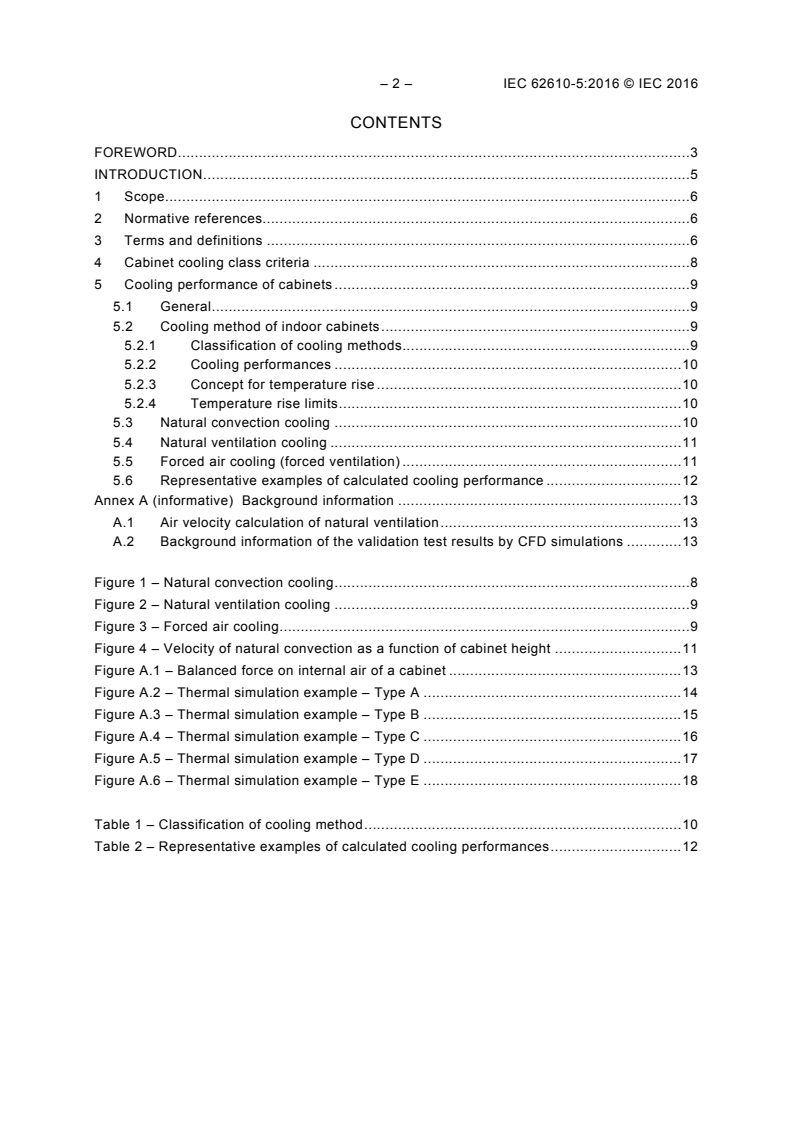
– 2 – IEC 62610-5:2016 © IEC 2016
CONTENTS
FOREWORD . 3
INTRODUCTION . 5
1 Scope . 6
2 Normative references. 6
3 Terms and definitions . 6
4 Cabinet cooling class criteria . 8
5 Cooling performance of cabinets . 9
5.1 General . 9
5.2 Cooling method of indoor cabinets . 9
5.2.1 Classification of cooling methods . 9
5.2.2 Cooling performances . 10
5.2.3 Concept for temperature rise . 10
5.2.4 Temperature rise limits . 10
5.3 Natural convection cooling . 10
5.4 Natural ventilation cooling . 11
5.5 Forced air cooling (forced ventilation) . 11
5.6 Representative examples of calculated cooling performance . 12
Annex A (informative) Background information . 13
A.1 Air velocity calculation of natural ventilation . 13
A.2 Background information of the validation test results by CFD simulations . 13
Figure 1 – Natural convection cooling . 8
Figure 2 – Natural ventilation cooling . 9
Figure 3 – Forced air cooling . 9
Figure 4 – Velocity of natural convection as a function of cabinet height . 11
Figure A.1 – Balanced force on internal air of a cabinet . 13
Figure A.2 – Thermal simulation example – Type A . 14
Figure A.3 – Thermal simulation example – Type B . 15
Figure A.4 – Thermal simulation example – Type C . 16
Figure A.5 – Thermal simulation example – Type D . 17
Figure A.6 – Thermal simulation example – Type E . 18
Table 1 – Classification of cooling method . 10
Table 2 – Representative examples of calculated cooling performances . 12
INTERNATIONAL ELECTROTECHNICAL COMMISSION
____________
MECHANICAL STRUCTURES FOR ELECTRICAL
AND ELECTRONIC EQUIPMENT –
THERMAL MANAGEMENT FOR CABINETS IN
ACCORDANCE WITH IEC 60297 AND IEC 60917 SERIES –
Part 5: Cooling performance evaluation for indoor cabinets
FOREWORD
1) The International Electrotechnical Commission (IEC) is a worldwide organization for standardization comprising
all national electrotechnical committees (IEC National Committees). The object of IEC is to promote
international co-operation on all questions concerning standardization in the electrical and electronic fields. To
this end and in addition to other activities, IEC publishes International Standards, Technical Specifications,
Technical Reports, Publicly Available Specifications (PAS) and Guides (hereafter referred to as “IEC
Publication(s)”). Their preparation is entrusted to technical committees; any IEC National Committee interested
in the subject dealt with may participate in this preparatory work. International, governmental and non-
governmental organizations liaising with the IEC also participate in this preparation. IEC collaborates closely
with the International Organization for Standardization (ISO) in accordance with conditions determined by
agreement between the two organizations.
2) The formal decisions or agreements of IEC on technical matters express, as nearly as possible, an international
consensus of opinion on the relevant subjects since each technical committee has representation from all
interested IEC National Committees.
3) IEC Publications have the form of recommendations for international use and are accepted by IEC National
Committees in that sense. While all reasonable efforts are made to ensure that the technical content of IEC
Publications is accurate, IEC cannot be held responsible for the way in which they are used or for any
misinterpretation by any end user.
4) In order to promote international uniformity, IEC National Committees undertake to apply IEC Publications
transparently to the maximum extent possible in their national and regional publications. Any divergence
between any IEC Publication and the corresponding national or regional publication shall be clearly indicated in
the latter.
5) IEC itself does not provide any attestation of conformity. Independent certification bodies provide conformity
assessment services and, in some areas, access to IEC marks of conformity. IEC is not responsible for any
services carried out by independent certification bodies.
6) All users should ensure that they have the latest edition of this publication.
7) No liability shall attach to IEC or its directors, employees, servants or agents including individual experts and
members of its technical committees and IEC National Committees for any personal injury, property damage or
other damage of any nature whatsoever, whether direct or indirect, or for costs (including legal fees) and
expenses arising out of the publication, use of, or reliance upon, this IEC Publication or any other IEC
Publications.
8) Attention is drawn to the Normative references cited in this publication. Use of the referenced publications is
indispensable for the correct application of this publication.
9) Attention is drawn to the possibility that some of the elements of this IEC Publication may be the subject of
patent rights. IEC shall not be held responsible for identifying any or all such patent rights.
International Standard IEC 62610-5 has been prepared by subcommittee 48D: Mechanical
structures for electrical and electronic equipment, of IEC technical committee 48:Electrical
connectors and mechanical structures for electrical and electronic equipment.
The text of this standard is based on the following documents:
CDV Report on voting
48D/591/CDV 48D/604/RVC
Full information on the voting for the approval of this standard can be found in the report on
voting indicated in the above table.
– 4 – IEC 62610-5:2016 © IEC 2016
This publication has been drafted in accordance with the ISO/IEC Directives, Part 2.
A list of all parts in the IEC 62610 series, published under the general title Mechanical
structures for electrical and electronic equipment – Thermal management for cabinets in
accordance with IEC 60297 and IEC 60917 series, can be found on the IEC website.
Future standards in this series will carry the new general title as cited above. Titles of existing
standards in this series will be updated at the time of the next edition.
The committee has decided that the contents of this publication will remain unchanged until
the stability date indicated on the IEC website under "http://webstore.iec.ch" in the data
related to the specific publication. At this date, the publication will be
• reconfirmed,
• withdrawn,
• replaced by a revised edition, or
• amended.
IMPORTANT – The 'colour inside' logo on the cover page of this publication indicates
that it contains colours which are considered to be useful for the correct
understanding of its contents. Users should therefore print this document using a
colour printer.
INTRODUCTION
Indoor cabinets containing electronic equipment in subrack(s) and/ or chassis provide cooling
by several different means, depending on the heat load of the equipment in the cabinet. In
most cases air convection is used for cooling. The cabinets can be sealed or non-sealed, and
may be equipped with fans for forced air cooling or rely on natural convention cooling without
fans. In addition the subrack(s) or chassis may contain their own fans or rely on natural
convention. Air convection systems are used to cool low to medium heat load applications.
Indoor cabinets containing subrack(s) and/ or chassis assembled with high heat load
electronic equipment typically are cooled by air to air heat exchangers or water supplied heat
exchangers, and are not considered in this standard.
Sealed cabinets are used for systems operated in an industrial atmosphere, to protect the
equipment against harsh environments, such as dust or water (IP), or provisions for EMC or
acoustic noise. Non-sealed cabinets are used in offices, laboratories or data centres, where
the environment is controlled.
The cooling performance of an electronic cabinet depends on the type of the cabinet, either
sealed or non-sealed, with or without air moving devices, ventilated or re-circulated, and also,
on the heat loads and the additional cooling systems (if any) of the equipment inside the
cabinet.
Therefore, it is difficult to determine properly the cooling capabilities of empty electronic
cabinets for various applications. This standard introduces a simplified method for an overall
cooling performance evaluation for empty indoor cabinets in accordance with IEC 60917 or
IEC 60297 series.
The purpose of this standard is to classify the cooling methods of empty indoor cabinets, to
simplify the thermal hydraulic formulae for the evaluation and classification of cabinet cooling
performances, and to exemplify the cooling performances for representative cabinet sizes
based on IEC 60917 or IEC 60297.
This enables the users to select the appropriate cabinet cooling solutions for their applications.
– 6 – IEC 62610-5:2016 © IEC 2016
MECHANICAL STRUCTURES FOR ELECTRICAL
AND ELECTRONIC EQUIPMENT –
THERMAL MANAGEMENT FOR CABINETS IN
ACCORDANCE WITH IEC 60297 AND IEC 60917 SERIES –
Part 5: Cooling performance evaluation for indoor cabinets
1 Scope
This part of IEC 62610 specifies a method for evaluating the cooling capacity mainly for air
convection cooling of empty cabinets in accordance with IEC 60297 and IEC 60917 series.
2 Normative references
Void.
3 Terms and definitions
For the purposes of this document, the following terms and definitions apply.
3.1
ventilation
movement of the air inside a cabinet, causing replacement of the inside air by the cabinet
external ambient air
3.2
buoyancy
force of air in the opposite direction of gravity that is produced by the difference in density
due to the temperature differences between the air inside and external to the cabinet
3.3
natural ventilation
air movement produced by buoyancy
3.4
forced air cooling
forced ventilation
ventilation by air moving devices
3.5
natural convection cooling
cooling by natural air convection and radiation
3.6
air moving device
device creating air movement, e.g. fans, blowers, and other forced air movement equipment
3.7
sealed cabinet, without air moving devices
cabinet not provided with ventilation holes, not equipped with air moving devices, where the
heat is transferred to the external environment by natural convection and radiation from the
external surfaces of the cabinet
Note 1 to entry: The internal air temperature gradually increases from the bottom to the top of the cabinet.
3.8
sealed cabinet, with air moving devices
cabinet not provided with ventilation holes, equipped with air moving devices for re-circulating
internal air, where the heat is transferred from the surface of the cabinet towards the outside
of the cabinet both by convection (forced inside, natural outside) and by radiation
Note 1 to entry: A sealed cabinet without air moving devices which contains subracks or chassis systems with air
moving devices may be equivalent to a sealed cabinet with air moving devices.
Note 2 to entry: The cooling performance of this type of cabinet is equal to that of "the sealed cabinet, without air
moving devices" because the heat transfer mechanism to the external environment is identical, however the
internal air temperature is equalized.
3.9
non-sealed cabinet, without air moving devices
cabinet where the heat is transferred by natural convection from the provided ventilation holes
and, in addition, the heat is transferred to the external environment by natural convection and
radiation from the external surfaces of the cabinet
Note 1 to entry: The source of the natural ventilation airflow is only by buoyancy of the cabinet internal air, even if
there are some subracks or chassis systems with air moving devices, except if the air moving devices airflow goes
directly outside of the cabinet.
3.10
non-sealed cabinet, with air moving devices
cabinet equipped with air moving devices and ventilation holes
Note 1 to entry: Two cooling modes, re-circulation and forced ventilation, are utilized for this type of cabinet,
depending on the location of the air moving devices.
3.11
air moving devices on the subrack
cabinet equipped with subracks and/or chassis with air moving devices
Note 1 to entry: The air inside the cabinet is re-circulated by subrack or chassis mounted fans, but is not
ventilated by the fans.
3.12
air moving devices on a cabinet
cabinet equipped with air moving devices on the top cover, bottom cover or the rear cover of
the cabinet, it does not matter if the fans are mounted internal or external to the cabinet
Note 1 to entry: The air moving devices force the air to exit the cabinet through ventilation holes. If the cabinet
mounted air moving devices airflow is larger than the combined airflow of the cabinet mounted subrack and/or
chassis systems the temperature rise inside the cabinet may be zero.
Note 2 to entry: If the cabinet mounted air moving devices airflow is smaller than the combined airflow of the
cabinet mounted subrack and/or chassis systems, this will cause cabinet internal air re-circulation. The maximum
cabinet internal air temperature will be equal to the maximum cabinet mounted subrack and/or chassis system air
exit temperature.
3.13
simplified cooling performance evaluation
method to estimate the heat load of a cabinet based upon the chosen cooling mechanism, the
cabinet internal temperature limit, typical ambient temperature / humidity, and the overall
cabinet size chosen for the application
Note 1 to entry: The criteria definition of conditions for the simplified cooling performance are shown in Clause 5.
Note 2 to entry: It is assumed that the cabinets are used in an standalone application. If cabinets are arranged
side-by-side, placed along a building wall or back to back the cooling performance may be reduced due to loss of
heat transfer surface area.
– 8 – IEC 62610-5:2016 © IEC 2016
3.14
typical temperature rise
cabinet with a 10 K internal temperature rise with respect to the cabinet external ambient
temperature
Note 1 to entry: This level should be applied for cabinets which do not contain high heat tolerant components in
subrack and/or chassis systems. The cabinet application would be installed in a relatively high ambient
temperature environment.
3.15
extended temperature rise
cabinet with a 20 K internal temperature rise with respect to the cabinet external ambient
temperature
Note 1 to entry: This level should be applied for cabinets which contain high heat tolerant components in subrack
and/or chassis systems. The cabinet application would be installed in a low ambient temperature environment
typically controlled by air conditioners.
4 Cabinet cooling class criteria
To be able to estimate the cooling performance of a cabinet the following criteria are used to
classify the type of cabinet.
• If the cabinet is sealed (Figure 1a and Figure 1b) or non-sealed (ventilated) (Figure 2a,
Figure 2b and Figure 3).
• If the cabinet has no air moving devices (Figure 1a, Figure 2a) or has air moving devices
(Figure 1b, Figure 2b and Figure 3).
• If the cabinet has air moving devices on the top cover or the rear cover (Figure 3).
Subrack
Subrack
∆T
∆T
Fan
Subrack
Subrack
Subrack
Subrack
Internal
Internal
Re-circulated by fan
temperature
temperature
IEC
IEC
Figure 1a – Sealed cabinet without air moving Figure 1b – Sealed cabinet with air moving devices –
devices – natural convection natural convection
Figure 1 – Natural convection cooling
Height
Height
Ventilation holes
Ventilation holes
∆T ∆T
Subrack
Subrack
Fan
Subrack
Subrack
Subrack
Subrack
Internal
temperature
Re-circulated by fan
Internal
IEC
temperature
IEC
Figure 2a – Non-sealed cabinet without air moving Figure 2b – Non-sealed cabinet with subrack and/or
devices – ventilated chassis system mounted air moving devices –
ventilated
Figure 2 – Natural ventilation cooling
Fan
∆T
Fan
Subrack
Fan
Subrack
Internal
temperature
IEC
Non-sealed cabinet mounted air moving devices and
with subrack and/or chassis system mounted air
moving devices – ventilated
Figure 3 – Forced air cooling
5 Cooling performance of cabinets
5.1 General
In this clause, the cooling methods of indoor cabinets are classified, and the calculation
procedures for each cooling performance of the cabinets are shown.
5.2 Cooling method of indoor cabinets
5.2.1 Classification of cooling methods
Classification of cooling methods is summarized as follows, see Table 1:
Height
Height
Height
– 10 – IEC 62610-5:2016 © IEC 2016
Table 1 – Classification of cooling method
Cooling method
Definitio Air moving Ventilatio Reference
Type Sealed and formula of cooling
n devices n figure
performance
A see 3.7 no Figure 1a natural convection
yes no
B see 3.8 yes Figure 1b see 5.3
C see 3.9 no Figure 2a natural ventilation
natural
D see 3.11 Figure 2b see 5.4
no
yes forced air cooling
E see 3.12 forced Figure 3
see 5.5
5.2.2 Cooling performances
The basic air-cooling calculation which is used in this standard is shown as follows.
Q = Q + Q
s v
where
Q is the cooling performance of the indoor cabinet;
Q is the heat dissipation from surfaces of the cabinet;
s
Q is the heat dissipation by ventilation.
v
5.2.3 Concept for temperature rise
Let ∆T be the temperature rise of the inside air of the cabinet. Let ∆T be the temperature rise
s
of the surface of the cabinet. The relation between the two can be estimated that ∆T is the
s
half of ∆T.
∆T = ∆T/2
s
In case of the sealed cabinet, the temperature rise inside the cabinet is to be measured by an
average temperature. In case of the non-sealed cabinet, the temperature rise is to be
measured at the cabinet air exit.
5.2.4 Temperature rise limits
The tolerated temperature rise of the cabinet depends on how components mounted inside
are tolerant to high temperature. The cabinet temperature rise should be classified into two
levels listed below:
typical temperature rise ∆T = 10 K
extended temperature rise ∆T = 20 K
5.3 Natural convection cooling
The cooling performance of natural convection is applicable to a sealed cabinet without air
moving devices and a sealed cabinet with air moving devices.
The cooling performance of natural convection is calculated with the following formula.
Q = h × A × ∆T
s s s
where
h is the heat transfer coefficient of the surface, the value of h shall be 8 W/m K;
s s
A is sum of the external surfaces area of the cabinet except the bottom.
NOTE The h value accounts for heat transfer due to both natural convection and radiation.
s
5.4 Natural ventilation cooling
The cooling performance of natural ventilation is applicable to a non-sealed cabinet without
air moving devices and a non-sealed cabinet with air moving devices on the subrack or
chassis (re-circulating). The cooling performance of natural convection is calculated with the
following formula.
Q = Q + Q
s v
Q = h × A × ∆T
s s s
Q = ρ × C × u × A × ∆T
v p p
where
ρ is the density of the ambient air, the value should be 1,2 kg/m ;
C is the specific heat of the ambient air at constant pressure, the value should be 1 005
p
J/kgK;
U is the air velocity of natural convection;
A is the surface area on top of the cabinet.
p
The velocity u varies according to the cabinet height and cabinet temperature rise. The value
of u is determined from Figure 4.
0,4
0,3
∆T = 20K
0,2
∆T = 10K
0,1
500 1 000 1 500 2 000 2 500
Cabinet height H, mm
IEC
Figure 4 – Velocity of natural convection as a function of cabinet height
The graph shows the velocity u of natural ventilation as a function of the cabinet height in the
typical temperature rise ∆T = 10K and the extended temperature rise ∆T = 20 K.
5.5 Forced air cooling (forced ventilation)
The cooling performance of the ventilated cabinet cooled via forced convection is calculated
with the following formula. The cooling performance of forced air cooling is applicable to a
non-sealed cabinet with air moving devices for ventilation on the top or rear of the cabinet.
Q = Q + Q
s v
Q = h × A × ∆T
s s s
Q = ρ × C × F × ∆T
v p
where
Velocity u, m/s
– 12 – IEC 62610-5:2016 © IEC 2016
ρ is the density of the ambient air, the value should be 1,2 kg/m ;
C is the specific heat of the ambient air at constant pressure, the value should be 1 005
p
J/kgK;
F is the flow rate of the cabinet fans.
5.6 Representative examples of calculated cooling performance
The cooling performance of a cabinet cooling method, typical and extended temperature rise
and cabinet size is shown in Table 2. According to the sealed cabinet, the temperature
increase of the air in the upper part of the cabinet may be higher than the value of ∆T, which
is the average temperature of the cabinet. The arrangement of subrack and chassis systems
should be considered.
Table 2 – Representative examples of calculated cooling performances
Typical temperature rise Extended temperature rise
Cabinet dimensions
∆T=10 K (see 5.2.4) ∆T=20 K (see 5.2.4)
mm
Natural Natural Forced air Natural Natural Forced air
convection ventilation cooling convection ventilation cooling
W D H
see 5.3 see 5.4 see 5.5 see 5.3 see 5.4 see 5.5
width depth height
W W W W W W
600 600 2 000 210 1 100 3 600 410 2 900 7 100
800 900 2 200 330 2 300 3 700 660 6 000 7 400
600 600 1 200 130 740 3 500 260 2 000 7 000
3 3
NOTE In the forced air cooling, the cooling performances are calculated at flow rate of 1 000 m /h (0,28m /s).
Annex A
(informative)
Background information
A.1 Air velocity calculation of natural ventilation
The graphs of Figure 4 come from the balanced force analysis. In a ventilated natural
convection cabinet, the velocity of air should be balanced by buoyancy against flow resistance
as shown in Figure A.1.
The buoyancy is proportional to cabinet height and temperature rise. Flow resistance is
mainly proportional to the ratio of the inlet and outlet openings of the cabinet. In this standard,
it is assumed that the bottom has a full opening and the top cover of the cabinet has a 50 %
opening.
Flow resistance ζ
Buoyancy
Internal air
Temperature T
Velocity u
Flow resistance
IEC
Figure A.1 – Balanced force on internal air of a cabinet
A.2 Background information of the validation test results by CFD simulations
The representative examples of thermal simulations in order to check the validation are shown
below (see Figures A.2 to A.6). The cabinet types are A to E, corresponding to the
classification in Table 1.
a) Sealed cabinet, without air moving devices, natural convection – type A
size: 600 mm × 600 mm × 2 000 mm
equipment: 7 subracks, 10 cards / subrack
thermal: 3 W / card, total heat dissipation 210 W
level: typical temperature rise (∆T = 10 K)
Cabinet height H
– 14 – IEC 62610-5:2016 © IEC 2016
Temperature (°C)
15K
81,3
73,1
64,8
10K
56,5
48,3
2K
3W / card × 10
Front view Right side
IEC
Figure A.2 – Thermal simulation example – Type A
b) Sealed cabinet, with air moving devices, natural convection – type B
size: 600 mm × 600 mm × 2 000 mm
equipment: 5 subracks, 3 W card × 10, total 30 W / subrack
1 subrack, 10 W card × 2, 4 W card × 10, total 60 W / subrack, with
fans
thermal: total heat dissipation 210 W
level: typical temperature rise (∆T = 10 K)
Temperature (°C)
11K
30W
96,5
82,4
10K
60W
68,3
54,1
30W
5K
Front view Right side
IEC
Figure A.3 – Thermal simulation example – Type B
c) Non-sealed cabinet, without air moving devices, natural ventilation – type C
size: 600 mm × 600 mm × 2 000 mm
equipment: 10 subracks, 11 W card × 10, total 110 W / subrack
thermal: total heat dissipation 1 100 W
level: typical temperature rise (∆T = 10 K)
– 16 – IEC 62610-5:2016 © IEC 2016
10K
Temperature (°C)
110W
99,5
1K
84,6
69,7
54,9
0K
Front view Right side
IEC
Figure A.4 – Thermal simulation example – Type C
d) Non-sealed cabinet, with air moving devices, natural ventilation – type D
size: 600 mm × 600 mm × 2 000 mm
equipment: 6 subracks, 11 W card × 10, total 110 W / subrack
2 subracks, 22 W card × 10, total 220 W / subrack, with fans
thermal: total heat dissipation 1 100 W
level: typical temperature rise (∆T = 10 K)
10K
110W
Temperature (°C)
220W 1K
87,3
71,5
55,8
110W
0K
Front view
Right side
IEC
Figure A.5 – Thermal simulation example – Type D
e) Non-sealed cabinet, with air moving devices, forced air cooling – type E
size: 600 mm × 600 mm × 2 000 mm
equipment: 2 ATCA shelves, 128,6 W card × 14, total 1 800 W / subrack, with fans
thermal: total heat dissipation 3 600 W
level: typical temperature rise (∆T = 10 K)
– 18 – IEC 62610-5:2016 © IEC 2016
10K
Temperature (°C)
1 800W
97,9
4K
83,4
68,9
1 800W
54,5
2K 40
Front view Right side
IEC
Figure A.6 – Thermal simulation example – Type E
___________
– 20 – IEC 62610-5:2016 © IEC 2016
SOMMAIRE
AVANT-PROPOS . 21
INTRODUCTION . 23
1 Domaine d’application. 24
2 Références normatives . 24
3 Termes et définitions . 24
4 Critères de classification de refroidissement de baie . 26
5 Performances de refroidissement des baies . 28
5.1 Généralités . 28
5.2 Méthode de refroidissement de baies intérieures . 28
5.2.1 Classification des méthodes de refroidissement . 28
5.2.2 Performances de refroidissement . 29
5.2.3 Concept d’échauffement . 29
5.2.4 Limites de l’échauffement . 29
5.3 Refroidissement par convection naturelle . 29
5.4 Refroidissement par ventilation naturelle . 30
5.5 Refroidissement par ventilation forcée (ventilation forcée) . 30
5.6 Exemples représentatifs des performances de refroidissement calculées . 31
Annexe A (informative) Informations de base . 32
A.1 Calcul de la vitesse de l’air de la ventilation naturelle . 32
A.2 Informations de base sur les résultats d’essai de validation par simulation
CFD . 32
Figure 1 – Refroidissement par convection naturelle . 27
Figure 2 – Refroidissement par ventilation naturelle . 27
Figure 3 – Refroidissement par ventilation forcée . 28
Figure 4 – Vitesse de la convection naturelle en fonction de la hauteur de la baie . 30
Figure A.1 – Force équilibrée sur l’air intérieur d’une baie . 32
Figure A.2 – Exemple de simulation thermique – Type A . 33
Figure A.3 – Exemple de simulation thermique – Type B . 34
Figure A.4 – Exemple de simulation thermique – Type C . 35
Figure A.5 – Exemple de simulation thermique – Type D . 36
Figure A.6 – Exemple de simulation thermique – Type E . 37
Tableau 1 – Classification des méthodes de refroidissement . 29
Tableau 2 – Exemples représentatifs des performances de refroidissement calculées . 31
COMMISSION ÉLECTROTECHNIQUE INTERNATIONALE
____________
STRUCTURES MÉCANIQUES POUR ÉQUIPEMENTS
ÉLECTRIQUES ET ÉLECTRONIQUES –
GESTION THERMIQUE POUR LES ARMOIRES
CONFORMES AUX SÉRIES IEC 60297 ET IEC 60917 –
Partie 5: Évaluation des performances
de refroidissement pour les baies intérieures
AVANT-PROPOS
1) La Commission Electrotechnique Internationale (IEC) est une organisation mondiale de normalisation
composée de l'ensemble des comités électrotechniques nationaux (Comités nationaux de l’IEC). L’IEC a pour
objet de favoriser la coopération internationale pour toutes les questions de normalisation dans les domaines
de l'électricité et de l'électronique. À cet effet, l’IEC – entre autres activités – publie des Normes internationales,
des Spécifications techniques, des Rapports techniques, des Spécifications accessibles au public (PAS) et des
Guides (ci-après dénommés "Publication(s) de l’IEC"). Leur élaboration est confiée à des comités d'études, aux
travaux desquels tout Comité national intéressé par le sujet traité peut participer. Les organisations
internationales, gouvernementales et non gouvernementales, en liaison avec l’IEC, participent également aux
travaux. L’IEC collabore étroitement avec l'Organisation Internationale de Normalisation (ISO), selon des
conditions fixées par accord entre les deux organisations.
2) Les décisions ou accords officiels de l’IEC concernant les questions techniques représentent, dans la mesure
du possible, un accord international sur les sujets étudiés, étant donné que les Comités nationaux de l’IEC
intéressés sont représentés dans chaque comité d’études.
3) Les Publications de l’IEC se présentent sous la forme de recommandations internationales et sont agréées
comme telles par les Comités nationaux de l’IEC. Tous les efforts raisonnables sont entrepris afin que l’IEC
s'assure de l'exactitude du contenu technique de ses publications; l’IEC ne peut pas être tenue responsable de
l'éventuelle mauvaise utilisation ou interprétation qui en est faite par un quelconque utilisateur final.
4) Dans le but d'encourager l'uniformité internationale, les Comités nationaux de l’IEC s'engagent, dans toute la
mesure possible, à appliquer de façon transparente les Publications de l’IEC dans leurs publications nationales
et régionales. Toutes divergences entre toutes Publications de l’IEC et toutes publications nationales ou
régionales correspondantes doivent être indiquées en termes clairs dans ces dernières.
5) L’IEC elle-même ne fournit aucune attestation de conformité. Des organismes de certification indépendants
fournissent des services d'évaluation de conformité et, dans certains secteurs, accèdent aux marques de
conformité de l’IEC. L’IEC n'est responsable d'aucun des services effectués par les organismes de certification
indépendants.
6) Tous les utilisateurs doivent s'assurer qu'ils sont en possession de la dernière édition de cette publication.
7) Aucune responsabilité ne doit être imputée à l’IEC, à ses administrateurs, employés, auxiliaires ou mandataires,
y compris ses experts particuliers et les membres de ses comités d'études et des Comités nationaux de l’IEC,
pour tout préjudice causé en cas de dommages corporels et matériels, ou de tout autre dommage de quelque
nature que ce soit, directe ou indirecte, ou pour supporter les coûts (y compris les frais de justice) et les
dépenses découlant de la publication ou de l'utilisation de cette Publication de l’IEC ou de toute autre
Publication de l’IEC, ou au crédit qui lui est accordé.
8) L'attention est attirée sur les références normatives citées dans cette publication. L'utilisation de publications
référencées est obligatoire pour une application correcte de la présente publication.
9) L’attention est attirée sur le fait que certains des éléments de la présente Publication de l’IEC peuvent faire
l’objet de droits de brevet. L’IEC ne saurait être tenue pour responsable de ne pas avoir identifié de tels droits
de brevets et de ne pas avoir signalé leur existence.
La Norme internationale IEC 62610-5 a été établie par le sous-comité 48D: Structures
mécaniques pour équipements électriques et électroniques, du comité d'études 48 de l’IEC:
Connecteurs électriques et structures mécaniques pour les équipements électriques et
électroniques.
– 22 – IEC 62610-5:2016 © IEC 2016
Le texte de cette norme est issu des documents suivants:
CDV Rapport de vote
48D/591/CDV 48D/604/RVC
Le rapport de vote indiqué dans le tableau ci-dessus donne toute information sur le vote ayant
abouti à l'approbation de cette norme.
Cette publication a été rédigée selon les Directives ISO/IEC, Partie 2.
Une liste de toutes les parties de la série IEC 62610, publiées sous le titre général Structures
mécaniques pour équipements électriques et électroniques – Gestion thermique pour les
armoires conformes aux séries IEC 60297 et IEC 60917, peut être consultée sur le site web
de l’IEC.
Les futures normes de cette série porteront dorénavant le nouveau titre général cité ci-dessus.
Les titres des normes existant déjà dans cet
...