

IEC 62272-2:2007
(Main)Digital radio mondiale (DRM) - Part 2: Digital radio in the bands below 30 MHz - Methods of measurement for DRM transmitters
General Information
- Abstract
IEC 62272-2:2007 describes the methods of measurement to assess the performance characteristics of digital modulated radio transmitters in the bands below 30 MHz for sound and/or data broadcasting in the LF, MF and HF bands, and to facilitate the comparison of measurements which are carried out by different personnel. This bilingual version (2012-05) corresponds to the monolingual English version, published in 2007-03.
- Status
- Published
- Publication Date
- 12-Mar-2007
- Technical Committee
- TC 103 - Transmitting and receiving equipment for radiocommunication
- Current Stage
- PPUB - Publication issued
- Start Date
- 13-Mar-2007
- Completion Date
- 15-Jul-2007
Buy Documents
IEC 62272-2:2007 - Digital radio mondiale (DRM) - Part 2: Digital radio in the bands below 30 MHz - Methods of measurement for DRM transmitters Released:3/13/2007
IEC 62272-2:2007 - Digital radio mondiale (DRM) - Part 2: Digital radio in the bands below 30 MHz - Methods of measurement for DRM transmitters Released:3/13/2007
Overview
IEC 62272-2:2007 - part of the Digital Radio Mondiale (DRM) family - specifies standardized methods of measurement for DRM transmitters operating in the bands below 30 MHz (LF, MF and HF). It defines how to measure key transmitter performance parameters for sound and data broadcasting so results are comparable when taken by different personnel or laboratories. This bilingual edition (2012-05) corresponds to the original English edition published in 2007.
Key topics
The standard focuses on measurement methods and required conditions rather than setting absolute performance limits. Major technical topics include:
- General measurement conditions: required ambient temperature/humidity considerations, nominal power-supply conditions and statement of operating mode.
- Test arrangements: input/output measurement diagrams and termination/impedance requirements for test equipment and connections.
- Output power and frequency: procedures for determining nominal, maximum and minimum continuous DRM mean power and frequency accuracy.
- Transmission performance:
- Spurious emissions measurements
- Out-of-band emissions and spectrum mask verification (see informative Annex B)
- Modulation Error Ratio (MER) and Bit Error Ratio (BER)
- Protection and safety: tests for protection against atmospheric discharge, acoustic noise and compliance with safety requirements.
- Measurement uncertainty: requirements to calculate and minimize uncertainty so results can be compared reliably.
- Test signal and equipment requirements: test signals must conform to the DRM system; measuring instruments must have adequate accuracy and dynamic range.
- Annexes: informative measuring arrangements (A), out-of-band emission limits (B), and additional measurement details (C).
Notable procedural details included in the standard:
- Test-load VSWR limits: not greater than 1.2:1 within the designated broadcast band and 1.5:1 outside the band up to 10× the highest frequency in the band.
- If a transmitter supports analogue modes, relevant IEC analogue transmitter measurement standards also apply.
Applications and users
IEC 62272-2 is intended for:
- Transmitter manufacturers - type approval and factory quality control tests.
- Test laboratories and certification bodies - standardized, repeatable measurement methods for compliance testing.
- Broadcasters and installation/maintenance engineers - on-site acceptance tests and performance verification.
- Regulators and spectrum managers - comparative data when assessing emissions and interference characteristics.
Typical uses: type approval testing, acceptance testing on site, production quality control, and comparative performance assessments for DRM transmitters in LF/MF/HF bands.
Related standards
- IEC 62272-1 (DRM system specification)
- IEC 60244‑1, IEC 60244‑15 (methods for broadcast transmitter measurements / AM transmitters)
- IEC 60215 (safety requirements)
- ITU Radio Regulations and ITU‑R Recommendation V.663
Keywords: IEC 62272-2, DRM, Digital Radio Mondiale, DRM transmitters, LF MF HF, transmitter measurement methods, MER, BER, spectrum mask, spurious emissions, type approval, broadcast testing.
Buy Documents
IEC 62272-2:2007 - Digital radio mondiale (DRM) - Part 2: Digital radio in the bands below 30 MHz - Methods of measurement for DRM transmitters Released:3/13/2007
IEC 62272-2:2007 - Digital radio mondiale (DRM) - Part 2: Digital radio in the bands below 30 MHz - Methods of measurement for DRM transmitters Released:3/13/2007
Get Certified
Connect with accredited certification bodies for this standard

ANCE
Mexican certification and testing association.

Intertek Slovenia
Intertek testing, inspection, and certification services in Slovenia.

LNE (Laboratoire National de Métrologie et d'Essais)
French national laboratory for metrology and testing.
Sponsored listings
Frequently Asked Questions
IEC 62272-2:2007 is a standard published by the International Electrotechnical Commission (IEC). Its full title is "Digital radio mondiale (DRM) - Part 2: Digital radio in the bands below 30 MHz - Methods of measurement for DRM transmitters". This standard covers: IEC 62272-2:2007 describes the methods of measurement to assess the performance characteristics of digital modulated radio transmitters in the bands below 30 MHz for sound and/or data broadcasting in the LF, MF and HF bands, and to facilitate the comparison of measurements which are carried out by different personnel. This bilingual version (2012-05) corresponds to the monolingual English version, published in 2007-03.
IEC 62272-2:2007 describes the methods of measurement to assess the performance characteristics of digital modulated radio transmitters in the bands below 30 MHz for sound and/or data broadcasting in the LF, MF and HF bands, and to facilitate the comparison of measurements which are carried out by different personnel. This bilingual version (2012-05) corresponds to the monolingual English version, published in 2007-03.
IEC 62272-2:2007 is classified under the following ICS (International Classification for Standards) categories: 33.060.20 - Receiving and transmitting equipment. The ICS classification helps identify the subject area and facilitates finding related standards.
IEC 62272-2:2007 is available in PDF format for immediate download after purchase. The document can be added to your cart and obtained through the secure checkout process. Digital delivery ensures instant access to the complete standard document.
Standards Content (Sample)
INTERNATIONAL IEC
STANDARD 62272-2
First edition
2007-03
Digital radio mondiale (DRM) –
Part 2:
Digital radio in the bands below 30 MHz –
Methods of measurement for DRM transmitters
Reference number
Publication numbering
As from 1 January 1997 all IEC publications are issued with a designation in the
60000 series. For example, IEC 34-1 is now referred to as IEC 60034-1.
Consolidated editions
The IEC is now publishing consolidated versions of its publications. For example,
edition numbers 1.0, 1.1 and 1.2 refer, respectively, to the base publication, the
base publication incorporating amendment 1 and the base publication incorporating
amendments 1 and 2.
Further information on IEC publications
The technical content of IEC publications is kept under constant review by the IEC,
thus ensuring that the content reflects current technology. Information relating to
this publication, including its validity, is available in the IEC Catalogue of
publications (see below) in addition to new editions, amendments and corrigenda.
Information on the subjects under consideration and work in progress undertaken
by the technical committee which has prepared this publication, as well as the list
of publications issued, is also available from the following:
• IEC Web Site (www.iec.ch)
• Catalogue of IEC publications
The on-line catalogue on the IEC web site (www.iec.ch/searchpub) enables you to
search by a variety of criteria including text searches, technical committees
and date of publication. On-line information is also available on recently issued
publications, withdrawn and replaced publications, as well as corrigenda.
• IEC Just Published
This summary of recently issued publications (www.iec.ch/online_news/ justpub)
is also available by email. Please contact the Customer Service Centre (see
below) for further information.
• Customer Service Centre
If you have any questions regarding this publication or need further assistance,
please contact the Customer Service Centre:
Email: custserv@iec.ch
Tel: +41 22 919 02 11
Fax: +41 22 919 03 00
INTERNATIONAL IEC
STANDARD 62272-2
First edition
2007-03
Digital radio mondiale (DRM) –
Part 2:
Digital radio in the bands below 30 MHz –
Methods of measurement for DRM transmitters
© IEC 2007 ⎯ Copyright - all rights reserved
No part of this publication may be reproduced or utilized in any form or by any means, electronic or
mechanical, including photocopying and microfilm, without permission in writing from the publisher.
International Electrotechnical Commission, 3, rue de Varembé, PO Box 131, CH-1211 Geneva 20, Switzerland
Telephone: +41 22 919 02 11 Telefax: +41 22 919 03 00 E-mail: inmail@iec.ch Web: www.iec.ch
PRICE CODE
Commission Electrotechnique Internationale R
International Electrotechnical Commission
МеждународнаяЭлектротехническаяКомиссия
For price, see current catalogue
– 2 – 62272-2 © IEC:2007(E)
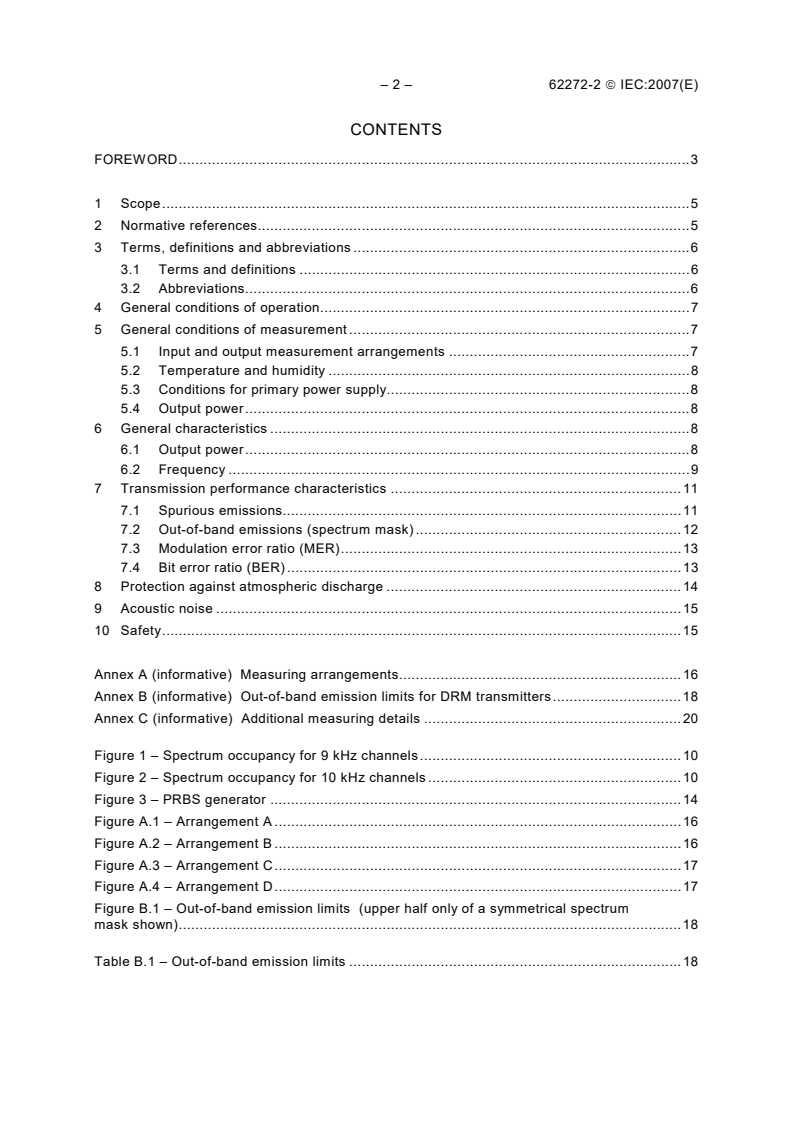
CONTENTS
FOREWORD.3
1 Scope.5
2 Normative references.5
3 Terms, definitions and abbreviations .6
3.1 Terms and definitions .6
3.2 Abbreviations.6
4 General conditions of operation.7
5 General conditions of measurement .7
5.1 Input and output measurement arrangements .7
5.2 Temperature and humidity .8
5.3 Conditions for primary power supply.8
5.4 Output power.8
6 General characteristics .8
6.1 Output power.8
6.2 Frequency .9
7 Transmission performance characteristics .11
7.1 Spurious emissions.11
7.2 Out-of-band emissions (spectrum mask) .12
7.3 Modulation error ratio (MER).13
7.4 Bit error ratio (BER) .13
8 Protection against atmospheric discharge .14
9 Acoustic noise .15
10 Safety.15
Annex A (informative) Measuring arrangements.16
Annex B (informative) Out-of-band emission limits for DRM transmitters.18
Annex C (informative) Additional measuring details .20
Figure 1 – Spectrum occupancy for 9 kHz channels.10
Figure 2 – Spectrum occupancy for 10 kHz channels .10
Figure 3 – PRBS generator .14
Figure A.1 – Arrangement A .16
Figure A.2 – Arrangement B .16
Figure A.3 – Arrangement C.17
Figure A.4 – Arrangement D.17
Figure B.1 – Out-of-band emission limits (upper half only of a symmetrical spectrum
mask shown).18
Table B.1 – Out-of-band emission limits .18
62272-2 © IEC:2007(E) – 3 –
INTERNATIONAL ELECTROTECHNICAL COMMISSION
____________
DIGITAL RADIO MONDIALE (DRM) –
Part 2: Digital radio in the bands below 30 MHz –
Methods of measurement for DRM transmitters
FOREWORD
1) The International Electrotechnical Commission (IEC) is a worldwide organization for standardization comprising
all national electrotechnical committees (IEC National Committees). The object of IEC is to promote
international co-operation on all questions concerning standardization in the electrical and electronic fields. To
this end and in addition to other activities, IEC publishes International Standards, Technical Specifications,
Technical Reports, Publicly Available Specifications (PAS) and Guides (hereafter referred to as “IEC
Publication(s)”). Their preparation is entrusted to technical committees; any IEC National Committee interested
in the subject dealt with may participate in this preparatory work. International, governmental and non-
governmental organizations liaising with the IEC also participate in this preparation. IEC collaborates closely
with the International Organization for Standardization (ISO) in accordance with conditions determined by
agreement between the two organizations.
2) The formal decisions or agreements of IEC on technical matters express, as nearly as possible, an international
consensus of opinion on the relevant subjects since each technical committee has representation from all
interested IEC National Committees.
3) IEC Publications have the form of recommendations for international use and are accepted by IEC National
Committees in that sense. While all reasonable efforts are made to ensure that the technical content of IEC
Publications is accurate, IEC cannot be held responsible for the way in which they are used or for any
misinterpretation by any end user.
4) In order to promote international uniformity, IEC National Committees undertake to apply IEC Publications
transparently to the maximum extent possible in their national and regional publications. Any divergence
between any IEC Publication and the corresponding national or regional publication shall be clearly indicated in
the latter.
5) IEC provides no marking procedure to indicate its approval and cannot be rendered responsible for any
equipment declared to be in conformity with an IEC Publication.
6) All users should ensure that they have the latest edition of this publication.
7) No liability shall attach to IEC or its directors, employees, servants or agents including individual experts and
members of its technical committees and IEC National Committees for any personal injury, property damage or
other damage of any nature whatsoever, whether direct or indirect, or for costs (including legal fees) and
expenses arising out of the publication, use of, or reliance upon, this IEC Publication or any other IEC
Publications.
8) Attention is drawn to the Normative references cited in this publication. Use of the referenced publications is
indispensable for the correct application of this publication.
9) Attention is drawn to the possibility that some of the elements of this IEC Publication may be the subject of
patent rights. IEC shall not be held responsible for identifying any or all such patent rights.
International Standard IEC 62272-2 has been prepared by IEC technical committee 103:
Transmitting equipment for radiocommunication.
The text of this standard is based on the following documents:
FDIS Report on voting
103/64/FDIS 103/66/RVD
Full information on the voting for the approval of this standard can be found in the report on
voting indicated in the above table.
This publication has been drafted in accordance with the ISO/IEC Directives, Part 2.
– 4 – 62272-2 © IEC:2007(E)
The committee has decided that the contents of this publication will remain unchanged until the
maintenance result date indicated on the IEC web site under "http://webstore.iec.ch" in the data
related to the specific publication. At this date, the publication will be
• reconfirmed;
• withdrawn;
• replaced by a revised edition, or
• amended.
A bilingual version of this publication may be issued at a later date.
62272-2 © IEC:2007(E) – 5 –
DIGITAL RADIO MONDIALE (DRM) –
Part 2: Digital radio in the bands below 30 MHz –
Methods of measurement for DRM transmitters
1 Scope
This part of IEC 62272 describes the methods of measurement to assess the performance
characteristics of digital modulated radio transmitters in the bands below 30 MHz for sound
and/or data broadcasting in the LF, MF and HF bands, and to facilitate the comparison of
measurements which are carried out by different personnel.
It contains details of specially selected methods for determining the most important
performance parameters of digital radio transmitters. The measurement methods described
apply to a limited number of performance parameters, i.e. those which can give rise to
ambiguous interpretation due to the use of different methods and conditions. They are neither
restrictive nor mandatory: measurements can be chosen for each particular case.
The measurement methods described in this standard are intended to be used for type
approval tests, quality control tests or acceptance test measurements in factories and on site.
Fewer or additional measurements may be carried out by agreement between customer and
supplier. Any additional test should comply with standards which have been established by
other study groups, subcommittees of the IEC or other international or suitably accredited
organizations.
This standard does not specify limiting values for acceptable performance as these are usually
given in the equipment specification or in requirements laid down by the responsible regulation
bodies. However, some values are quoted, where appropriate, for guidance in the presentation
of the results.
2 Normative references
The following referenced documents are indispensable for the application of this document. For
dated references, only the edition cited applies. For undated references, the latest edition of
the referenced document (including any amendments) applies.
IEC 60244-1, Methods of measurement for radio transmitters – Part 1: General characteristics
for broadcast transmitters
IEC 60244-15, Methods of measurement for radio transmitters – Part 15: Amplitude-modulated
transmitters for sound broadcasting
IEC 60215, Safety requirements for radio transmitting equipment
ITU Radio Regulations
ITU-R Recommendation V.663, Use of certain terms linked with physical quantities
– 6 – 62272-2 © IEC:2007(E)
3 Terms, definitions and abbreviations
3.1 Terms and definitions
For the purposes of this document, the following terms and definitions apply.
3.1.1
DRM standard
digital modulation standard for frequencies in the bands below 30 MHz for the purposes of
audio and data broadcasting
3.1.2
DRM transmitters
sound broadcasting transmitters operating in the bands below 30 MHz and incorporating digital
modulation in accordance with IEC 62272-1
3.1.3
power definitions
nominal output power is the continuous DRM mean power for which the transmitter is
designed
maximum output power is the maximum possible continuous DRM mean power which the
transmitter can deliver. The maximum output power might be concordant with the nominal
output power
minimum output power is the minimum possible continuous DRM mean power for which the
transmitter is designed
3.1.4
necessary bandwidth
for a given class of emission, the width of a frequency band which is just sufficient to ensure
the transmission of information at the rate and with the quality required under specified
conditions (ITU definition)
For the practical purposes of this standard, the necessary bandwidth for a DRM signal can be
considered to be the same as the allocated channel bandwidth, for example, 10 kHz for a
standard HF channel.
3.2 Abbreviations
BER Bit Error Ratio
BS Broadcasting Service
DRM Digital Radio Mondiale
FAC Fast Access Channel
HF High Frequency
IEC International Electrotechnical Commission
ISO International Organization for Standardization
ITU International Telecommunications Union
ITU-R International Telecommunications Union – Radiocommunications Sector
LF Low Frequency
MER Modulation Error Ratio
MF Medium Frequency
MLC Multi-Level Coding
MSC Main Service Channel
___________
IEC 62272-1, Digital radio mondiale – Part 1: System specification
62272-2 © IEC:2007(E) – 7 –
OFDM Orthogonal Frequency Division Multiplex
PRBS Pseudo-Random Bit Sequence
QAM Quadrature Amplitude Modulation
RF Radiofrequency
SDC Service Description Channel
SM Spectrum Management
Tx Transmitter
4 General conditions of operation
Any device for the suppression of unwanted signals, irrespective of whether or not the device is
located inside the transmitter, shall be considered as part of the transmitter for the purposes of
this standard.
Feeders and antennas to which the transmitter might be connected are not considered part of
the transmitter and therefore excluded.
Unless otherwise specified, the measurements shall be made under normal operating and
environmental conditions and at the nominal output power. If required, they shall be repeated
under extreme operating and environmental conditions and at any lower output power in
accordance with the equipment specification.
The transmitting mode and the measured output power of the transmitter under test shall be
stated.
The mains supply and the environmental conditions shall be stated with the measurement
results.
The transmitter shall be connected to a test load having a VSWR relative to the nominal load
impedance of the transmitter not greater than
– 1,2:1 at frequencies within the designated broadcast band;
– 1,5:1 at all frequencies outside the designated broadcast band up to a frequency of
10 times the highest frequency in the designated band.
If the transmitter includes devices to control the frequency band transmitted, all the
characteristics shall be measured with the devices in the circuit.
Measurement uncertainty should be calculated and techniques employed to minimize its range.
This uncertainty should be applied to the limit and any measurement falling below the range is
deemed acceptable.
If a digital transmitter can also operate in analogue mode, the requirements of IEC 60244-1
and IEC 60244-15 shall also apply, in addition to the requirements of this standard.
5 General conditions of measurement
5.1 Input and output measurement arrangements
For the purposes of measurement, the input and output signal arrangements are given in the
form of diagrams.
Where required, the impedance of the test equipment of the transmitter under test and of all
the connections between them shall be appropriately terminated, taking into account the
transmitter’s specification and the termination impedance of any test equipment.
– 8 – 62272-2 © IEC:2007(E)
These test procedures for DRM transmitters require that the test signals used shall conform to
the DRM standard and that the measuring equipment is sufficiently accurate and has the
necessary performance and dynamic range to provide error-free measurements of transmitter
performance parameters.
5.2 Temperature and humidity
Equipment to be measured shall be operated in an environment which meets the temperature
and humidity requirements as defined in their technical specifications. Temperature and
humidity must never be such as to cause condensation in or on the equipment during
measurements. In the absence of temperature and humidity requirements in the technical
specifications, the provisions of IEC 60244-1 shall apply.
5.3 Conditions for primary power supply
The measurements are carried out at the nominal voltage and the nominal frequency of the
power supply given in the relevant equipment specification.
During a series of measurements carried out as part of one test on one equipment, the voltage
and frequency of the power supply shall be set at the nominal values indicated in the
equipment
...
IEC 62272-2 ®
Edition 1.0 2007-03
INTERNATIONAL
STANDARD
NORME
INTERNATIONALE
colour
inside
Digital radio mondiale (DRM) –
Part 2: Digital radio in the bands below 30 MHz – Methods of measurement for
DRM transmitters
Digital radio mondiale (DRM) –
Partie 2: Radiodiffusion numérique sur des bandes inférieures à 30 MHz –
Méthodes de mesure applicables aux émetteurs DRM
All rights reserved. Unless otherwise specified, no part of this publication may be reproduced or utilized in any form
or by any means, electronic or mechanical, including photocopying and microfilm, without permission in writing from
either IEC or IEC's member National Committee in the country of the requester.
If you have any questions about IEC copyright or have an enquiry about obtaining additional rights to this publication,
please contact the address below or your local IEC member National Committee for further information.
Droits de reproduction réservés. Sauf indication contraire, aucune partie de cette publication ne peut être reproduite ni
utilisée sous quelque forme que ce soit et par aucun procédé, électronique ou mécanique, y compris la photocopie et les
microfilms, sans l'accord écrit de la CEI ou du Comité national de la CEI du pays du demandeur.
Si vous avez des questions sur le copyright de la CEI ou si vous désirez obtenir des droits supplémentaires sur cette
publication, utilisez les coordonnées ci-après ou contactez le Comité national de la CEI de votre pays de résidence.
IEC Central Office Tel.: +41 22 919 02 11
3, rue de Varembé Fax: +41 22 919 03 00
CH-1211 Geneva 20 info@iec.ch
Switzerland www.iec.ch
About the IEC
The International Electrotechnical Commission (IEC) is the leading global organization that prepares and publishes
International Standards for all electrical, electronic and related technologies.
About IEC publications
The technical content of IEC publications is kept under constant review by the IEC. Please make sure that you have the
latest edition, a corrigenda or an amendment might have been published.
Useful links:
IEC publications search - www.iec.ch/searchpub Electropedia - www.electropedia.org
The advanced search enables you to find IEC publications The world's leading online dictionary of electronic and
by a variety of criteria (reference number, text, technical electrical terms containing more than 30 000 terms and
committee,…). definitions in English and French, with equivalent terms in
It also gives information on projects, replaced and additional languages. Also known as the International
withdrawn publications. Electrotechnical Vocabulary (IEV) on-line.
IEC Just Published - webstore.iec.ch/justpublished Customer Service Centre - webstore.iec.ch/csc
Stay up to date on all new IEC publications. Just Published If you wish to give us your feedback on this publication
details all new publications released. Available on-line and or need further assistance, please contact the
also once a month by email. Customer Service Centre: csc@iec.ch.
A propos de la CEI
La Commission Electrotechnique Internationale (CEI) est la première organisation mondiale qui élabore et publie des
Normes internationales pour tout ce qui a trait à l'électricité, à l'électronique et aux technologies apparentées.
A propos des publications CEI
Le contenu technique des publications de la CEI est constamment revu. Veuillez vous assurer que vous possédez
l’édition la plus récente, un corrigendum ou amendement peut avoir été publié.
Liens utiles:
Recherche de publications CEI - www.iec.ch/searchpub Electropedia - www.electropedia.org
La recherche avancée vous permet de trouver des Le premier dictionnaire en ligne au monde de termes
publications CEI en utilisant différents critères (numéro de électroniques et électriques. Il contient plus de 30 000
référence, texte, comité d’études,…). termes et définitions en anglais et en français, ainsi que
Elle donne aussi des informations sur les projets et les les termes équivalents dans les langues additionnelles.
publications remplacées ou retirées. Egalement appelé Vocabulaire Electrotechnique
International (VEI) en ligne.
Just Published CEI - webstore.iec.ch/justpublished
Service Clients - webstore.iec.ch/csc
Restez informé sur les nouvelles publications de la CEI.
Just Published détaille les nouvelles publications parues. Si vous désirez nous donner des commentaires sur
Disponible en ligne et aussi une fois par mois par email. cette publication ou si vous avez des questions
contactez-nous: csc@iec.ch.
IEC 62272-2 ®
Edition 1.0 2007-03
INTERNATIONAL
STANDARD
NORME
INTERNATIONALE
colour
inside
Digital radio mondiale (DRM) –
Part 2: Digital radio in the bands below 30 MHz – Methods of measurement for
DRM transmitters
Digital radio mondiale (DRM) –
Partie 2: Radiodiffusion numérique sur des bandes inférieures à 30 MHz –
Méthodes de mesure applicables aux émetteurs DRM
INTERNATIONAL
ELECTROTECHNICAL
COMMISSION
COMMISSION
ELECTROTECHNIQUE
PRICE CODE
INTERNATIONALE
CODE PRIX R
ICS 33.060.20 ISBN 978-2-88912-904-1
– 2 – 62272-2 IEC:2007
CONTENTS
FOREWORD . 3
1 Scope . 5
2 Normative references. 5
3 Terms, definitions and abbreviations . 6
3.1 Terms and definitions . 6
3.2 Abbreviations . 6
4 General conditions of operation . 7
5 General conditions of measurement . 7
5.1 Input and output measurement arrangements . 7
5.2 Temperature and humidity . 8
5.3 Conditions for primary power supply . 8
5.4 Output power . 8
6 General characteristics . 8
6.1 Output power . 8
6.2 Frequency . 9
7 Transmission performance characteristics . 11
7.1 Spurious emissions. 11
7.2 Out-of-band emissions (spectrum mask) . 12
7.3 Modulation error ratio (MER) . 13
7.4 Bit error ratio (BER) . 13
8 Protection against atmospheric discharge . 14
9 Acoustic noise . 14
10 Safety . 15
Annex A (informative) Measuring arrangements . 16
Annex B (informative) Out-of-band emission limits for DRM transmitters . 18
Annex C (informative) Additional measuring details . 20
Figure 1 – Spectrum occupancy for 9 kHz channels . 10
Figure 2 – Spectrum occupancy for 10 kHz channels . 10
Figure 3 – PRBS generator . 14
Figure A.1 – Arrangement A . 16
Figure A.2 – Arrangement B . 16
Figure A.3 – Arrangement C . 17
Figure A.4 – Arrangement D . 17
Figure B.1 – Out-of-band emission limits (upper half only of a symmetrical spectrum
mask shown) . 18
Table B.1 – Out-of-band emission limits . 18
62272-2 IEC:2007 – 3 –
INTERNATIONAL ELECTROTECHNICAL COMMISSION
____________
DIGITAL RADIO MONDIALE (DRM) –
Part 2: Digital radio in the bands below 30 MHz –
Methods of measurement for DRM transmitters
FOREWORD
1) The International Electrotechnical Commission (IEC) is a worldwide organization for standardization comprising
all national electrotechnical committees (IEC National Committees). The object of IEC is to promote
international co-operation on all questions concerning standardization in the electrical and electronic fields. To
this end and in addition to other activities, IEC publishes International Standards, Technical Specifications,
Technical Reports, Publicly Available Specifications (PAS) and Guides (hereafter referred to as “IEC
Publication(s)”). Their preparation is entrusted to technical committees; any IEC National Committee interested
in the subject dealt with may participate in this preparatory work. International, governmental and non-
governmental organizations liaising with the IEC also participate in this preparation. IEC collaborates closely
with the International Organization for Standardization (ISO) in accordance with conditions determined by
agreement between the two organizations.
2) The formal decisions or agreements of IEC on technical matters express, as nearly as possible, an international
consensus of opinion on the relevant subjects since each technical committee has representation from all
interested IEC National Committees.
3) IEC Publications have the form of recommendations for international use and are accepted by IEC National
Committees in that sense. While all reasonable efforts are made to ensure that the technical content of IEC
Publications is accurate, IEC cannot be held responsible for the way in which they are used or for any
misinterpretation by any end user.
4) In order to promote international uniformity, IEC National Committees undertake to apply IEC Publications
transparently to the maximum extent possible in their national and regional publications. Any divergence
between any IEC Publication and the corresponding national or regional publication shall be clearly indicated in
the latter.
5) IEC provides no marking procedure to indicate its approval and cannot be rendered responsible for any
equipment declared to be in conformity with an IEC Publication.
6) All users should ensure that they have the latest edition of this publication.
7) No liability shall attach to IEC or its directors, employees, servants or agents including individual experts and
members of its technical committees and IEC National Committees for any personal injury, property damage or
other damage of any nature whatsoever, whether direct or indirect, or for costs (including legal fees) and
expenses arising out of the publication, use of, or reliance upon, this IEC Publication or any other IEC
Publications.
8) Attention is drawn to the Normative references cited in this publication. Use of the referenced publications is
indispensable for the correct application of this publication.
9) Attention is drawn to the possibility that some of the elements of this IEC Publication may be the subject of
patent rights. IEC shall not be held responsible for identifying any or all such patent rights.
International Standard IEC 62272-2 has been prepared by IEC technical committee 103:
Transmitting equipment for radiocommunication.
This bilingual version (2012-05) corresponds to the monolingual English version, published in
2007-03.
The text of this standard is based on the following documents:
FDIS Report on voting
103/64/FDIS 103/66/RVD
Full information on the voting for the approval of this standard can be found in the report on
voting indicated in the above table.
This publication has been drafted in accordance with the ISO/IEC Directives, Part 2.
– 4 – 62272-2 IEC:2007
The committee has decided that the contents of this publication will remain unchanged until the
maintenance result date indicated on the IEC web site under "http://webstore.iec.ch" in the data
related to the specific publication. At this date, the publication will be
• reconfirmed;
• withdrawn;
• replaced by a revised edition, or
• amended.
IMPORTANT – The 'colour inside' logo on the cover page of this publication indicates
that it contains colours which are considered to be useful for the correct understanding
of its contents. Users should therefore print this document using a colour printer.
62272-2 IEC:2007 – 5 –
DIGITAL RADIO MONDIALE (DRM) –
Part 2: Digital radio in the bands below 30 MHz –
Methods of measurement for DRM transmitters
1 Scope
This part of IEC 62272 describes the methods of measurement to assess the performance
characteristics of digital modulated radio transmitters in the bands below 30 MHz for sound
and/or data broadcasting in the LF, MF and HF bands, and to facilitate the comparison of
measurements which are carried out by different personnel.
It contains details of specially selected methods for determining the most important
performance parameters of digital radio transmitters. The measurement methods described
apply to a limited number of performance parameters, i.e. those which can give rise to
ambiguous interpretation due to the use of different methods and conditions. They are neither
restrictive nor mandatory: measurements can be chosen for each particular case.
The measurement methods described in this standard are intended to be used for type
approval tests, quality control tests or acceptance test measurements in factories and on site.
Fewer or additional measurements may be carried out by agreement between customer and
supplier. Any additional test should comply with standards which have been established by
other study groups, subcommittees of the IEC or other international or suitably accredited
organizations.
This standard does not specify limiting values for acceptable performance as these are usually
given in the equipment specification or in requirements laid down by the responsible regulation
bodies. However, some values are quoted, where appropriate, for guidance in the presentation
of the results.
2 Normative references
The following referenced documents are indispensable for the application of this document. For
dated references, only the edition cited applies. For undated references, the latest edition of
the referenced document (including any amendments) applies.
IEC 60244-1, Methods of measurement for radio transmitters – Part 1: General characteristics
for broadcast transmitters
IEC 60244-15, Methods of measurement for radio transmitters – Part 15: Amplitude-modulated
transmitters for sound broadcasting
IEC 60215, Safety requirements for radio transmitting equipment
ITU Radio Regulations
ITU-R Recommendation V.663, Use of certain terms linked with physical quantities
– 6 – 62272-2 IEC:2007
3 Terms, definitions and abbreviations
3.1 Terms and definitions
For the purposes of this document, the following terms and definitions apply.
3.1.1
DRM standard
digital modulation standard for frequencies in the bands below 30 MHz for the purposes of
audio and data broadcasting
3.1.2
DRM transmitters
sound broadcasting transmitters operating in the bands below 30 MHz and incorporating digital
modulation in accordance with IEC 62272-1
3.1.3
power definitions
nominal output power is the continuous DRM mean power for which the transmitter is
designed
maximum output power is the maximum possible continuous DRM mean power which the
transmitter can deliver. The maximum output power might be concordant with the nominal
output power
minimum output power is the minimum possible continuous DRM mean power for which the
transmitter is designed
3.1.4
necessary bandwidth
for a given class of emission, the width of a frequency band which is just sufficient to ensure
the transmission of information at the rate and with the quality required under specified
conditions (ITU definition)
For the practical purposes of this standard, the necessary bandwidth for a DRM signal can be
considered to be the same as the allocated channel bandwidth, for example, 10 Hz for a
standard HF channel.
3.2 Abbreviations
BER Bit Error Ratio
BS Broadcasting Service
DRM Digital Radio Mondiale
FAC Fast Access Channel
HF High Frequency
IEC International Electrotechnical Commission
ISO International Organization for Standardization
ITU International Telecommunications Union
ITU-R International Telecommunications Union – Radiocommunications Sector
LF Low Frequency
MER Modulation Error Ratio
MF Medium Frequency
MLC Multi-Level Coding
___________
IEC 62272-1, Digital radio mondiale – Part 1: System specification
62272-2 IEC:2007 – 7 –
MSC Main Service Channel
OFDM Orthogonal Frequency Division Multiplex
PRBS Pseudo-Random Bit Sequence
QAM Quadrature Amplitude Modulation
RF Radiofrequency
SDC Service Description Channel
SM Spectrum Management
Tx Transmitter
4 General conditions of operation
Any device for the suppression of unwanted signals, irrespective of whether or not the device is
located inside the transmitter, shall be considered as part of the transmitter for the purposes of
this standard.
Feeders and antennas to which the transmitter might be connected are not considered part of
the transmitter and therefore excluded.
Unless otherwise specified, the measurements shall be made under normal operating and
environmental conditions and at the nominal output power. If required, they shall be repeated
under extreme operating and environmental conditions and at any lower output power in
accordance with the equipment specification.
The transmitting mode and the measured output power of the transmitter under test shall be
stated.
The mains supply and the environmental conditions shall be stated with the measurement
results.
The transmitter shall be connected to a test load having a VSWR relative to the nominal load
impedance of the transmitter not greater than
– 1,2:1 at frequencies within the designated broadcast band;
– 1,5:1 at all frequencies outside the designated broadcast band up to a frequency of
10 times the highest frequency in the designated band.
If the transmitter includes devices to control the frequency band transmitted, all the
characteristics shall be measured with the devices in the circuit.
Measurement uncertainty should be calculated and techniques employed to minimize its range.
This uncertainty should be applied to the limit and any measurement falling below the range is
deemed acceptable.
If a digital transmitter can also operate in analogue mode, the requirements of IEC 60244-1
and IEC 60244-15 shall also apply, in addition to the requirements of this standard.
5 General conditions of measurement
5.1 Input and output measurement arrangements
For the purposes of measurement, the input and output signal arrangements are given in the
form of diagrams.
Where required, the impedance of the test equipment of the transmitter under test and of all
the connections between them shall be appropriately terminated, taking into account the
transmitter’s specification and the termination impedance of any test equipment.
– 8 – 62272-2 IEC:2007
These test procedures for DRM transmitters require that the test signals used shall conform to
the DRM standard and that the measuring equipment is sufficiently accurate and has the
necessary performance and dynamic range to provide error-free measurements of transmitter
performance parameters.
5.2 Temperature and humidity
Equipment to be measured shall be operated in an environment which meets the temperature
and humidity requirements as defined in their technical specifications. Temperature and
humidity must never be such as to cause condensation in or on the equipment during
measurements. In the absence of temperature and humidity requirements in the technical
specifications, the provisions of IEC 60244-1 shall apply.
5.3 Conditions for primary power supply
The measurements are carried out at the nominal voltage and the nominal frequency of the
power supply given in the relevant equipment specification.
During a series of measurements carried out as part of one test on one equipment, the voltage
and frequency of the power supply shall be set at the nominal values indicated in the
equipment specification.
If called for in the specification and if the power source is able to be adjusted, the test shall be
repeated at the extremes of voltage and frequency stipulated in the specification.
The conditions for primary power voltage and frequency shall be specified in the equipment
specification. If no voltage or frequency range is specified, the tests shall be carried out with
voltage within ±5 % of nominal and frequency within ±2 % of nominal.
5.4 Output power
The tests shall be carried out with the transmitter set to its nominal output power and, if
required, also at any other output power within the equipment specification.
6 General characteristics
6.1 Output power
6.1.1 Definition
For a digital signal with the OFDM modulation process, the power is distributed evenly through-
out the transmission channel. Hence, when taking power measurements on such a signal, the
total bandwidth occupied by the modulated signal shall be taken into account.
The output power of a digital modulated transmitter is defined as the mean power (thermal
power) delivered at its output port, measured during an interval of time sufficiently long
compared with the lowest frequency encountered in the modulation envelope, taken under
normal operating condition (continuous mean power).
6.1.2 Measuring arrangement
Figure A.1 shows the measuring set-up to be used.
In general, quantifying output power relies on measuring either the thermal effects of the power
dissipated in the test load or the RF voltage across it. The method chosen will depend largely
on power output.
Examples are as follows:
62272-2 IEC:2007 – 9 –
a) calorimetric methods;
b) temperature-dependent component;
c) RF power meter with thermal probe and directional coupler;
d) spectrum analyser with directional coupler or RF probe, all of which have been suitably
calibrated against a more direct measurement and for the types and combinations of
signals likely to be encountered.
6.1.3 Measuring procedure
Adjust the transmitter for the appropriate output power. Measure the mean power over a time
frame which is at least as long as the stabilization time of the instrumentation used for this
measurement.
Since the output power value is a fundamental reference point when quantifying non-linear
distortion parameters and spurious, it is recommended that the output power reading is
displayed by a calibrated measuring instrument throughout all the tests.
6.1.4 Presentation of results
The results shall be presented as a value stating the output power in watts or kilowatts.
6.2 Frequency
In order to achieve effective use of the RF spectrum and limit mutual interference caused by
radio services occupying adjacent channels, any departure from the channel assigned to a
transmission shall be kept within strictly observed limits. These are defined by the International
Telecommunication Union and are laid down in the Radio Regulations (see IEC 60244-1,
Annex C).
6.2.1 Definitions
6.2.1.1 Assigned frequency
The assigned frequency is the centre of the frequency band (channel) assigned to a station.
6.2.1.2 Characteristic frequency
The term ’characteristic frequency’ is used in this standard to denote the frequency component
in the DRM signal that is intended to be at the centre of (one of) the channel(s) occupied by the
DRM emission – the assigned frequency (see Figures 1 and 2).
Since there is usually no frequency component of the DRM signal at this frequency, it must be
assessed by an indirect method.
– 10 – 62272-2 IEC:2007
f
R
9 kHz
f assigned frequency
R
4,5 kHz carrier group containing FAC cells
4,5 kHz group of carriers
Frequency
IEC 316/07
Figure 1 – Spectrum occupancy for 9 kHz channels
f
R
10 kHz
f assigned frequency
R
5 kHz group containing FAC cells
5 kHz group of carriers
Frequency
IEC 317/07
Figure 2 – Spectrum occupancy for 10 kHz channels
6.2.1.3 Frequency error
The frequency error is the difference between the assigned frequency and the characteristic
frequency.
NOTE The maximum frequency error is expressed in hertz or in parts per million and should be compared with the
frequency tolerance in the ITU Radio Regulations, or with the relevant standard in the equipment specification. The
measurement may be carried out at any time or times within the time interval indicated in the equipment
specification.
6.2.1.4 Frequency tolerance
The frequency tolerance is the permissible frequency error, expressed in hertz or in parts per
million.
6.2.1.5 Frequency instability
The instability of an emission is the variation of frequency against a predetermined time scale.
62272-2 IEC:2007 – 11 –
NOTE A random departure from the assigned frequency is expressed as frequency error.
6.2.2 Measuring arrangement
Figure A.2 shows the measuring set-up to be used.
6.2.3 Measuring procedure
If the DRM modulator has a reference frequency output which corresponds to the characteristic
frequency, this reference frequency may be measured. If the DRM modulator does not have
such a reference frequency output it must be assessed by an indirect method. An informative
description of an indirect measuring method is given in Clause C.2.
The characteristic frequency, the frequency tolerance and the frequency error may be
measured with any suitable measuring device, such as a calibrated receiver and external
frequency standard, or other instrument with measurement accuracy better than 10 times that
of the equipment to be measured.
When the frequency is to be measured as a function of time (for example, frequency
instability), the measurements shall be made at intervals which are short enough to reveal the
presence of superimposed periodical variations. In this case, the measurement shall preferably
be made with a recording instrument.
The conditions of operation shall also be given, together with the characteristic frequency.
6.2.4 Presentation of the results
Tables or graphs shall be used for frequency-instability and frequency-error results.
The accuracy of the measuring method, if known, shall be stated with the results of the
measurements. If not known, an estimate should be given.
7 Transmission performance characteristics
7.1 Spurious emissions
7.1.1 Definition
A spurious emission is defined by the ITU as an emission on a frequency or frequencies which
are outside the necessary bandwidth and the level of which may be reduced without affecting
the corresponding transmission of information. Spurious emissions include harmonic
emissions, parasitic emissions, intermodulation products and frequency conversion products,
but exclude out-of-band emissions.
A detailed description of the different kind of spurious emissions is given in IEC 60244-1.
7.1.2 Measuring arrangement
Figure A.3 shows the measurement set-up to be used.
A directional coupler or an RF probe is inserted in the transmission line. The frequency
response of the probe shall be taken into account. If the dynamic range of the spectrum
analyser is not sufficient to provide measurements of sufficient accuracy, appropriate filters of
known frequency response shall be used.
– 12 – 62272-2 IEC:2007
7.1.3 Measuring procedure
Operate the transmitter at the appropriate output power. Measure the output power of the
transmitter. Measure the difference in dB between the in-band signal and the spurious
emission.
The resolution bandwidth of the spectrum analyser shall be 10 kHz for frequencies below
30 MHz and 100 kHz for frequencies between 30 MHz and 1 GHz.
7.1.4 Calculation and presentation of the results
The power of the spurious emission shall be calculated, taking into account the measured
attenuation on the spectrum analyser, the gain of the probe and the characteristic of the filter
(if filters are used).
The results shall be presented as absolute radiated power of the spurious emissions, in watts,
and/or the ratio of radiated power of the spurious emissions with respect to the mean power
level of the DRM transmission at the characteristic frequency, in dB.
7.2 Out-of-band emissions (spectrum mask)
7.2.1 Definition
An out-of-band emission is defined by the ITU as an emission on a frequency or frequencies
immediately outside the necessary bandwidth which results from the modulation process, but
excludes spurious emissions.
NOTE Since single-sideband phase noise and switching-frequency emissions result from the modulation process
they are considered to be out-of-band emissions.
For the purpose of this standard the out-of-band domain will be considered as the spectrum
within ±5 times the necessary bandwidth either side of the channel centre but excluding the in-
band signal.
7.2.2 Measuring arrangement
Figure A.3 shows the measuring set-up to be used, with the exception that no filter shall be
used in the measuring connection for this measurement.
7.2.3 Measuring procedure
The transmitter shall be operated at the appropriate output power. The resolution bandwidth of
the spectrum analyser shall be set to a value of not more than 100 Hz.
The level of the in-band signal is taken as the 0 dB reference for the spectrum mask. For the
DRM spectrum mask, see Annex B.
Averaging or a video bandwidth which is lower than the resolution bandwidth shall be used to
smooth the trace.
7.2.4 Presentation of the results
The ratio of the power in each sideband (in dB) relative to the mean level of the in-band signal
shall be given for each sideband in the form of a table or graph.
The DRM robustness mode, its spectrum occupancy and the resolution bandwidth of the
spectrum analyser shall be stated.
62272-2 IEC:2007 – 13 –
7.3 Modulation error ratio (MER)
7.3.1 Definition
The modulation error ratio (MER) is a measure of the total signal degradation in the transmitted
signal.
For the purposes of this standard, the MER is calculated as follows.
For each equalized main service channel (MSC) cell (only MSC cells, no FAC cells, no SDC
cells, no pilot cells), the error vector from the nearest ideal point of the constellation diagram is
measured. The squared magnitude of this error is found, and a mean of the squared errors is
calculated over (at least) five consecutive DRM transmission frames (2 s). The MER is the ratio
in dB of the mean of the squared magnitudes of the ideal constellation points of the
constellation diagram to the mean squared error. This gives an estimate of the ratio of the total
signal power to the total noise power at the input to the equalizer for channels with flat
frequency response.
s
∑ k
k
MER= 10log
s − r
k k
∑
k
where
s is the optimal point value of the QAM constellation diagram (from hard decision);
k
r is the received complex cells value after channel estimation.
k
7.3.2 Measuring arrangement
Measurements are taken on all carriers of the main service channel (MSC) with an averaging
of the MER over at least five consecutive DRM transmission frames (2 s) with a DRM test
receiver with an MER measuring device.
The set-up is shown in Figure A.4.
The confidence of the MER value may be checked by inserting a 10 dB attenuator before the
DRM test receiver. If the MER value measured by the DRM test receiver stays the same, then
the MER value is considered to have a sufficient confidence.
7.3.3 Measuring procedure
The test should be carried out with the transmitter operating at – at least – the maximum and
minimum power level at which it is specified to operate. If a range of power outputs is not
specified, the transmitter shall be operated at its specified output power. The MER shall be
measured at different MSC modes (signal constellation 64-QAM as well as signal constellation
16-QAM).
7.3.4 Calculation and presentation of the results
The results shall be presented in a table or graphs for the different modulation modes.
7.4 Bit error ratio (BER)
The BER is the primary parameter which describes the quality of a digital transmission system.
This parameter is used to analyse the transmitter performance and quantifies the modulator
performance and the transmitter quality.
– 14 – 62272-2 IEC:2007
7.4.1 Definition
For a binary digital signal, the BER is the ratio of the number of error bits received to the total
number of bits received over a given time interval (see ITU-R Recommendation V.662-3,
5.10).
For the purposes of this standard, the BER is defined as a part or as the total main service
channel (MSC) of the DRM signal.
7.4.2 Measuring arrangement
Figure A.4 shows the measuring set-up to be used.
A DRM signal source is connected to the DRM transmitter. The DRM source is switched to the
test mode which generates a PRBS in accordance with the PRBS generator shown in Figure 3.
For the measurement of the BER, the total part of the MSC or a part may be selected.
Initialization word
1 1 1 1 1 1 1 1 1
PRBS
IEC 318/07
Figure 3 – PRBS generator
The DRM test receiver used in this procedure measures the BER when it detects a PRBS
signal in the MSC.
7.4.3 Measuring procedure
The BER is measured after MLC by the use of a DRM test receiver suitable for making a direct
measurement of BER using the defined PRBS. The time of measuring shall last until a constant
BER value is displayed.
7.4.4 Calculation and presentation of the results
y
The measured value resulting from the BER measurement shall be stated as x parts in 10 .
The part of the MSC shall be stated.
8 Protection against atmospheric discharge
These measurements do not differ in any way from the measurements which are carried out on
analogue broadcasting equipment and, hence, they are made in conformity with IEC 60244-1.
9 Acoustic noise
These measurements do not differ in any way from the measurements which are carried out on
analogue broadcasting equipment and, hence, they are made in conformity with IEC 60244-1.
62272-2 IEC:2007 – 15 –
10 Safety
These measurements do not differ in any way from the measurements which are carried out on
analogue broadcasting equipment and, hence, they are made in conformity with IEC 60215.
– 16 – 62272-2 IEC:2007
Annex A
(informative)
Measuring arrangements
1 4
G Transmitter
IEC 319/07
Key
1 DRM signal source 5 Attenuator
2 Transmitter/device under test 6 Spectrum analyser
3 Directional coupler or RF probe 7 Oscilloscope
4 Test load/power measuring device
Figure A.1 – Arrangement A
1 4
Transmitter
G
Test
receiver
Hz
IEC 320/07
Key
1 DRM signal source 5 Attenuator
2 Transmitter/device under test 6 Spectrum analyser
3 Directional coupler or RF probe 7 DRM test receiver
4 Test load 8 Frequency counter
Figure A.2 – Arrangement B
62272-2 IEC:2007 – 17 –
1 4
G Transmitter
IEC 321/07
Key
1 DRM signal source 5 Attenuator
2 Transmitter/device under test 6 Notch filter
3 Directional coupler or RF probe 7 Spectrum analyser
4 Test load
Figure A.3 – Arrangement C
1 4
G Transmitter
Test
receiver
IEC 322/07
Key
1 DRM signal source 4 Test load
2 Transmitter/device under test 5 Attenuator
3 Directional coupler or RF probe 6 DRM test receiver with BER/MER measuring
device
Figure A.4 – Arrangement D
– 18 – 62272-2 IEC:2007
Annex B
(informative)
Out-of-band emission limits for DRM transmitters
–10
–20
–30
–40
–50
–60
–70
0 0,5 1,5 2,0 2,5 3,0 3,5
1,0
Relative frequency f/f
b
IEC 323/07
Figure B.1 – Out-of-band emission limits
(upper half only of a symmetrical spectrum mask shown)
Table B.1 – Out-of-band emission limits
Break points of the mask
Relative frequency Effective frequency (f) at the allocated channel bandwidth (f ) Out-of-band
b
f/f emission limit
b
f = 4,5 f = 5 f = 9 f = 10 f = 18 f = 20
b b b b b b
kHz kHz kHz kHz kHz kHz dB
0,00 0,00 0,00 0,00 0,00 0,00 0,00 0,00
0,50 2,25 2,50 4,50 5,00 9,00 10,00 0,00
0,53 2,39 2,65 4,77 5,30 9,54 10,60 –30,00
1,06 4,77 5,30 9,54 10,60 19,08 21,20 –42,04
2,12 9,54 10,6 19,08 21,20 38,16 42,40 –54,08
2,98 13,41 14,90 26,82 29,80 53,64 59,60 –60,00
>2,98 –60,00
The effective frequency (f) is the absolute value of the difference between the frequency and
the centre frequency of the DRM emission
If the frequency is plotted as the abscissa, in logarithmic units, and the power densities are
plotted as ordinates, in decibels, the curve representing the out-of-band spectrum should lie on
or below two straight lines starting at point (+0,5 f ; 0 dB) or (–0,5 f ; 0 dB), and finishing at
b b
point (+0,53 f ; –30 dB) or (–0,53 f ; –30 dB), respectively. Beyond these points and down to
b b
the level of –60 dB, this curve should lie below the straight lines starting from the latter points
Suppression dB
62272-2 IEC:2007 – 19 –
and having a slope of 12 dB per octave. Thereafter, the same curve should lie below the level
of –60 dB.
– 20 – 62272-2 IEC:2007
Annex C
(informative)
Additional measuring details
C.1 Caloric measuring method
The most common method of measuring the RF output power of a transmitter is by the
calorimetric method, a method which uses the very accurately known and measurable physical
and thermal characteristics of water or other similarly well-defined liquids.
Soda (Na CO ) water is known to have a thermal capacity of very close to 4 187 Joules per
2 3
degree Kelvin per kilogram weight at a mean temperature of 70 °C.
The power calculation is made as follows.
P = m × c × (T – T )
out in
where
P is the transmitter output power (thermal power);
m is the volume flow in l/s;
c is the thermal capacity 4 187 J/kg/K;
T is the output temperature of the soda water in K;
out
T is the inlet temperature of the soda water in K.
in
C.2 Method for measuring the frequency error by using the three continual
pilots
1) Connect the DRM transmitter to a spectrum analyser with an included frequency counter of
sufficient accuracy as shown in Figure A.2. Assure that the resolution bandwidth of the
spectrum analyser used for measuring the frequency is sufficiently low.
2) Measure the frequency of the first continual pilot tone, subtract 750 Hz from the frequency
value in order to get a first estimate E1 of the characteristic frequency.
3) Measure the frequency of the second continual pilot tone, subtract 1 500 Hz from the
frequency value in order to get a second estimate E2 of the characteristic frequency.
4) Measure the frequency of the third continual pilot tone, subtract 2 250 Hz from the
frequency value in order to get a first estimate E3 of the characteristic frequency.
5) The measurements E1, E2 and E3 may be averaged, in order to lower the standard
deviation of the frequency estimate.
E = (E1 + E2 + E3)/3,
averaged
where E is the averaged estimate of the characteristic frequency.
averaged
6) Subtract the assigned frequency from the frequency estimate E in order to get the
averaged
frequency error in Hz.
___________
– 22 – 62272-2 CEI:2007
SOMMAIRE
AVANT-PROPOS . 23
1 Domaine d'application . 25
2 Références normatives . 25
3 Termes, définitions et abréviations . 26
3.1 Termes et définitions . 26
3.2 Abréviations . 26
4 Conditions générales de fonctionnement . 27
5 Conditions générales de la prise de mesure . 28
5.1 Organisation des mesures d'entrée et de sortie . 28
5.2 Température et humidité . 28
5.3 Conditions applicables à l'alimentation primaire . 28
5.4 Puissance de sortie . 28
6 Caractéristiques générales . 29
6.1 Puissance de sortie . 29
6.2 Fréquence .
...