

IEC 61400-25-3:2015
(Main)Wind turbines - Part 25-3: Communications for monitoring and control of wind power plants - Information exchange models
General Information
- Abstract
IEC 61400-25-3:2015 specifies an abstract communication service interface describing the information exchange between a client and a server for:
- data access and retrieval,
- device control,
- event reporting and logging,
- self-description of devices (device data dictionary),
- data typing and discovery of data types.
Main changes with respect to the previous edition consist of:
- harmonization with newer editions of IEC 61850 standards;
- reduction of overlap between standards and simplification by increased referencing, etc.
- Status
- Published
- Publication Date
- 29-Jun-2015
- Technical Committee
- TC 88 - Wind energy generation systems
- Drafting Committee
- JWG 25 - TC 88/JWG 25
- Current Stage
- PPUB - Publication issued
- Start Date
- 30-Jun-2015
- Completion Date
- 15-Jul-2015
Buy Documents


IEC 61400-25-3:2015 RLV - Wind turbines - Part 25-3: Communications for monitoring and control of wind power plants - Information exchange models Released:6/30/2015


IEC 61400-25-3:2015 - Wind turbines - Part 25-3: Communications for monitoring and control of wind power plants - Information exchange models Released:6/30/2015
Overview
IEC 61400-25-3:2015 - part of the IEC 61400-25 series for wind turbines - defines the information exchange models and the Abstract Communication Service Interface (ACSI) used for communications between clients and servers in wind power plants. The standard covers the abstract services and data models for data access and retrieval, device control, event reporting and logging, device self‑description (device data dictionary), and data typing and discovery. It is protocol‑agnostic; mapping to specific communication stacks is handled in IEC 61400-25-4.
Key topics
- Abstract Communication Service Interface (ACSI): client–server service model for monitoring and control.
- Data access and retrieval: standardized methods for querying measurements, status and configuration.
- Device control models: control flows including Select‑Before‑Operate (SBO), time‑activated operate and security levels (normal/enhanced).
- Reporting and logging: models for event reporting, buffered and unbuffered reports, and log control blocks.
- Self‑description and data typing: device data dictionaries and discovery mechanisms to support interoperability.
- Management functions: user/access management, setup, time synchronization and diagnostic (self‑monitoring) models.
- Conformance and testability: ACSI conformance statements are provided (Annex D) for client and server implementations.
- Harmonization: editorial and technical alignment with newer editions of IEC 61850 to reduce overlap and simplify referencing.
Practical applications
IEC 61400-25-3:2015 is used to:
- Enable interoperability between wind turbine OEM equipment, SCADA systems and plant controllers.
- Define the abstract services required when designing communication interfaces for wind power plant monitoring and control.
- Support implementation of standardized reporting and logging for alarms, events and historical diagnostics.
- Provide a basis for testing and conformance (via the conformance statements) in vendor and integration testing.
- Guide system integrators and network engineers on data typing, discovery and device self‑description to simplify commissioning and lifecycle management.
Who uses this standard
- Wind farm operators and asset managers
- Turbine OEMs and control-system vendors
- SCADA, EMS and plant controller developers
- System integrators, test laboratories and certification bodies
- Network and OT security engineers working on turbine communications
Related standards
- IEC 61400-25 series (other parts covering mappings, info models and communication profiles)
- IEC 61400-25-4 (mapping the abstract models to specific communication stacks)
- IEC 61850 (service models and harmonization reference)
Keywords: IEC 61400-25-3:2015, wind turbines, information exchange models, ACSI, monitoring and control, device data dictionary, reporting and logging, IEC 61850.
Relations
- Effective Date
- 05-Sep-2023
Buy Documents
IEC 61400-25-3:2015 RLV - Wind turbines - Part 25-3: Communications for monitoring and control of wind power plants - Information exchange models Released:6/30/2015
IEC 61400-25-3:2015 - Wind turbines - Part 25-3: Communications for monitoring and control of wind power plants - Information exchange models Released:6/30/2015
Get Certified
Connect with accredited certification bodies for this standard

DNV
DNV is an independent assurance and risk management provider.

Lloyd's Register
Lloyd's Register is a global professional services organisation specialising in engineering and technology.
DNV Energy Systems
Energy and renewable energy certification.
Sponsored listings
Frequently Asked Questions
IEC 61400-25-3:2015 is a standard published by the International Electrotechnical Commission (IEC). Its full title is "Wind turbines - Part 25-3: Communications for monitoring and control of wind power plants - Information exchange models". This standard covers: IEC 61400-25-3:2015 specifies an abstract communication service interface describing the information exchange between a client and a server for: - data access and retrieval, - device control, - event reporting and logging, - self-description of devices (device data dictionary), - data typing and discovery of data types. Main changes with respect to the previous edition consist of: - harmonization with newer editions of IEC 61850 standards; - reduction of overlap between standards and simplification by increased referencing, etc.
IEC 61400-25-3:2015 specifies an abstract communication service interface describing the information exchange between a client and a server for: - data access and retrieval, - device control, - event reporting and logging, - self-description of devices (device data dictionary), - data typing and discovery of data types. Main changes with respect to the previous edition consist of: - harmonization with newer editions of IEC 61850 standards; - reduction of overlap between standards and simplification by increased referencing, etc.
IEC 61400-25-3:2015 is classified under the following ICS (International Classification for Standards) categories: 01 - GENERALITIES. TERMINOLOGY. STANDARDIZATION. DOCUMENTATION; 27.180 - Wind turbine energy systems. The ICS classification helps identify the subject area and facilitates finding related standards.
IEC 61400-25-3:2015 has the following relationships with other standards: It is inter standard links to IEC 61400-25-3:2006. Understanding these relationships helps ensure you are using the most current and applicable version of the standard.
IEC 61400-25-3:2015 is available in PDF format for immediate download after purchase. The document can be added to your cart and obtained through the secure checkout process. Digital delivery ensures instant access to the complete standard document.
Standards Content (Sample)
IEC 61400-25-3 ®
Edition 2.0 2015-06
REDLINE VERSION
INTERNATIONAL
STANDARD
colour
inside
Wind turbines –
Part 25-3: Communications for monitoring and control of wind power plants –
Information exchange models
All rights reserved. Unless otherwise specified, no part of this publication may be reproduced or utilized in any form
or by any means, electronic or mechanical, including photocopying and microfilm, without permission in writing from
either IEC or IEC's member National Committee in the country of the requester. If you have any questions about IEC
copyright or have an enquiry about obtaining additional rights to this publication, please contact the address below or
your local IEC member National Committee for further information.
IEC Central Office Tel.: +41 22 919 02 11
3, rue de Varembé Fax: +41 22 919 03 00
CH-1211 Geneva 20 info@iec.ch
Switzerland www.iec.ch
About the IEC
The International Electrotechnical Commission (IEC) is the leading global organization that prepares and publishes
International Standards for all electrical, electronic and related technologies.
About IEC publications
The technical content of IEC publications is kept under constant review by the IEC. Please make sure that you have the
latest edition, a corrigenda or an amendment might have been published.
IEC Catalogue - webstore.iec.ch/catalogue Electropedia - www.electropedia.org
The stand-alone application for consulting the entire The world's leading online dictionary of electronic and
bibliographical information on IEC International Standards, electrical terms containing more than 30 000 terms and
Technical Specifications, Technical Reports and other definitions in English and French, with equivalent terms in 15
documents. Available for PC, Mac OS, Android Tablets and additional languages. Also known as the International
iPad. Electrotechnical Vocabulary (IEV) online.
IEC publications search - www.iec.ch/searchpub IEC Glossary - std.iec.ch/glossary
The advanced search enables to find IEC publications by a More than 60 000 electrotechnical terminology entries in
variety of criteria (reference number, text, technical English and French extracted from the Terms and Definitions
committee,…). It also gives information on projects, replaced clause of IEC publications issued since 2002. Some entries
and withdrawn publications. have been collected from earlier publications of IEC TC 37,
77, 86 and CISPR.
IEC Just Published - webstore.iec.ch/justpublished
Stay up to date on all new IEC publications. Just Published IEC Customer Service Centre - webstore.iec.ch/csc
details all new publications released. Available online and If you wish to give us your feedback on this publication or
also once a month by email. need further assistance, please contact the Customer Service
Centre: csc@iec.ch.
IEC 61400-25-3 ®
Edition 2.0 2015-06
REDLINE VERSION
INTERNATIONAL
STANDARD
colour
inside
Wind turbines –
Part 25-3: Communications for monitoring and control of wind power plants –
Information exchange models
INTERNATIONAL
ELECTROTECHNICAL
COMMISSION
ICS 27.180 ISBN 978-2-8322-2783-1
– 2 – IEC 61400-25-3:2015 RLV © IEC 2015
CONTENTS
FOREWORD . 4
INTRODUCTION . 6
1 Scope . 7
2 Normative references . 8
3 Terms and definitions . 8
4 Abbreviated terms . 12
5 General . 12
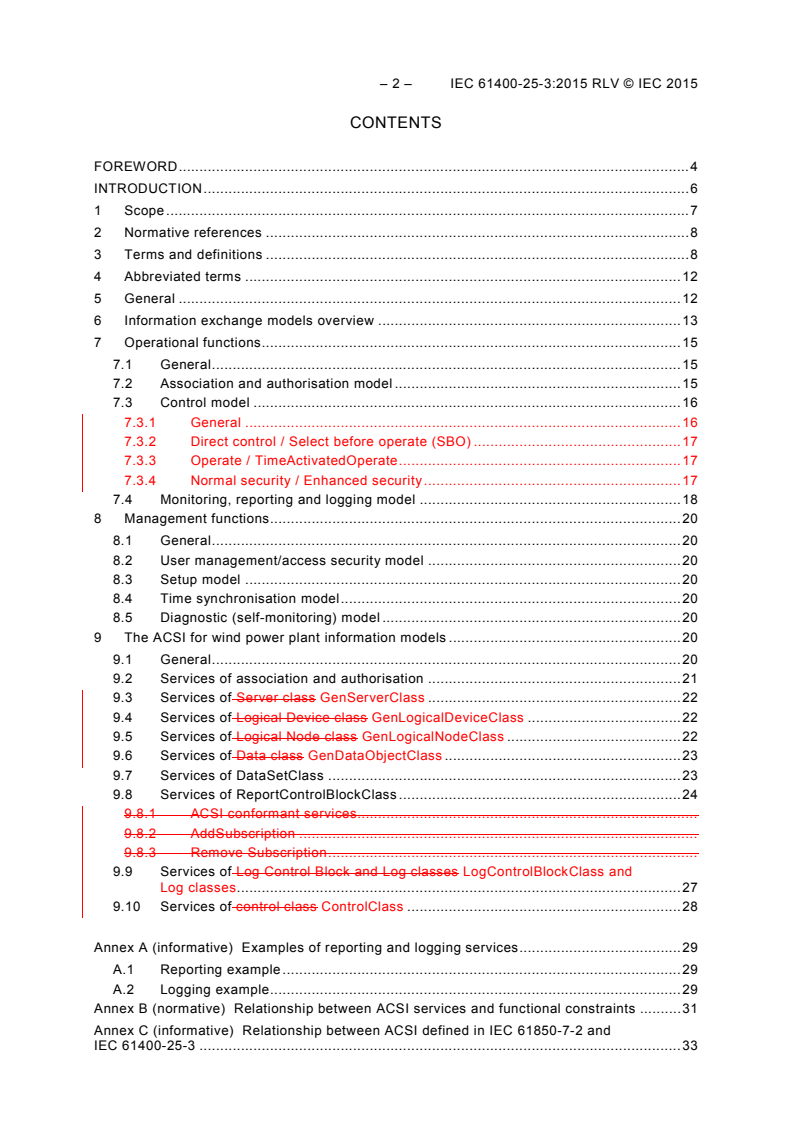
6 Information exchange models overview . 13
7 Operational functions . 15
7.1 General . 15
7.2 Association and authorisation model . 15
7.3 Control model . 16
7.3.1 General . 16
7.3.2 Direct control / Select before operate (SBO) . 17
7.3.3 Operate / TimeActivatedOperate . 17
7.3.4 Normal security / Enhanced security . 17
7.4 Monitoring, reporting and logging model . 18
8 Management functions . 20
8.1 General . 20
8.2 User management/access security model . 20
8.3 Setup model . 20
8.4 Time synchronisation model . 20
8.5 Diagnostic (self-monitoring) model . 20
9 The ACSI for wind power plant information models . 20
9.1 General . 20
9.2 Services of association and authorisation . 21
9.3 Services of Server class GenServerClass . 22
9.4 Services of Logical Device class GenLogicalDeviceClass . 22
9.5 Services of Logical Node class GenLogicalNodeClass . 22
9.6 Services of Data class GenDataObjectClass . 23
9.7 Services of DataSetClass . 23
9.8 Services of ReportControlBlockClass . 24
9.8.1 ACSI conformant services.
9.8.2 AddSubscription .
9.8.3 Remove Subscription .
9.9 Services of Log Control Block and Log classes LogControlBlockClass and
Log classes . 27
9.10 Services of control class ControlClass . 28
Annex A (informative) Examples of reporting and logging services . 29
A.1 Reporting example . 29
A.2 Logging example . 29
Annex B (normative) Relationship between ACSI services and functional constraints . 31
Annex C (informative) Relationship between ACSI defined in IEC 61850-7-2 and
IEC 61400-25-3 . 33
Annex D (normative) ACSI conformance statement . 35
D.1 General . 35
D.2 ACSI basic conformance statement . 35
D.3 ACSI models conformance statement . 35
D.4 ACSI service conformance statement . 37
Bibliography . 39
Figure 1 – Conceptual communication model of the IEC 61400-25 series . 8
Figure 2 – Association and authorisation model (conceptual) . 15
Figure 3 – Control model (conceptual) . 16
Figure 4 – Monitoring, reporting and logging model (conceptual) . 19
Figure 5 – Conceptual information exchange model for a wind power plant . 21
Figure 6 – Buffered report control block – conceptual . 25
Figure 7 – Log control block – conceptual . 28
Figure A.1 – Mapping of information models to data sets for reporting (example) . 29
Figure A.2 – Logging basics (example) . 30
Figure C.1 – Conceptual service model of the ACSI . 34
Table 1 – Information exchange models . 14
Table 2 – Comparison of the information retrieval methods . 19
Table 3 – Two-Party-Application-Association .
Table 4 – Server .
Table 5 – Logical Device .
Table 6 – Logical Node .
Table 7 – DATA .
Table 8 – DATA-SET .
Table 9 – REPORT-CONTROL .
Table 10 – AddSubscription service .
Table 11 – RemoveSubscription service .
Table 12 – LOG and LOG-CONTROL.
Table 13 3 – Data filter . 27
Table 14 – CONTROL . 26
Table B.1 – Relationship between ACSI Services and Functional Constraints . 31
Table D.1 – Basic conformance statement . 35
Table D.2 – ACSI models conformance statement. 36
Table D.3 – ACSI service conformance statement (1 of 2) . 37
Table D.4 – Time . 38
– 4 – IEC 61400-25-3:2015 RLV © IEC 2015
INTERNATIONAL ELECTROTECHNICAL COMMISSION
____________
WIND TURBINES –
Part 25-3: Communications for monitoring
and control of wind power plants –
Information exchange models
FOREWORD
1) The International Electrotechnical Commission (IEC) is a worldwide organization for standardization comprising
all national electrotechnical committees (IEC National Committees). The object of IEC is to promote
international co-operation on all questions concerning standardization in the electrical and electronic fields. To
this end and in addition to other activities, IEC publishes International Standards, Technical Specifications,
Technical Reports, Publicly Available Specifications (PAS) and Guides (hereafter referred to as “IEC
Publication(s)”). Their preparation is entrusted to technical committees; any IEC National Committee interested
in the subject dealt with may participate in this preparatory work. International, governmental and non-
governmental organizations liaising with the IEC also participate in this preparation. IEC collaborates closely
with the International Organization for Standardization (ISO) in accordance with conditions determined by
agreement between the two organizations.
2) The formal decisions or agreements of IEC on technical matters express, as nearly as possible, an international
consensus of opinion on the relevant subjects since each technical committee has representation from all
interested IEC National Committees.
3) IEC Publications have the form of recommendations for international use and are accepted by IEC National
Committees in that sense. While all reasonable efforts are made to ensure that the technical content of IEC
Publications is accurate, IEC cannot be held responsible for the way in which they are used or for any
misinterpretation by any end user.
4) In order to promote international uniformity, IEC National Committees undertake to apply IEC Publications
transparently to the maximum extent possible in their national and regional publications. Any divergence
between any IEC Publication and the corresponding national or regional publication shall be clearly indicated in
the latter.
5) IEC itself does not provide any attestation of conformity. Independent certification bodies provide conformity
assessment services and, in some areas, access to IEC marks of conformity. IEC is not responsible for any
services carried out by independent certification bodies.
6) All users should ensure that they have the latest edition of this publication.
7) No liability shall attach to IEC or its directors, employees, servants or agents including individual experts and
members of its technical committees and IEC National Committees for any personal injury, property damage or
other damage of any nature whatsoever, whether direct or indirect, or for costs (including legal fees) and
expenses arising out of the publication, use of, or reliance upon, this IEC Publication or any other IEC
Publications.
8) Attention is drawn to the Normative references cited in this publication. Use of the referenced publications is
indispensable for the correct application of this publication.
9) Attention is drawn to the possibility that some of the elements of this IEC Publication may be the subject of
patent rights. IEC shall not be held responsible for identifying any or all such patent rights.
This redline version of the official IEC Standard allows the user to identify the changes
made to the previous edition. A vertical bar appears in the margin wherever a change
has been made. Additions are in green text, deletions are in strikethrough red text.
International Standard IEC 61400-25-3 has been prepared by IEC technical committee 88:
Wind turbines.
The text of this standard is based on the following documents:
FDIS Report on voting
88/540/FDIS 88/552/RVD
Full information on the voting for the approval of this standard can be found in the report on
voting indicated in the above table.
This publication has been drafted in accordance with the ISO/IEC Directives, Part 2.
This second edition cancels and replaces the first edition published in 2006.
The scope of revision includes:
• Harmonization with service models in Edition 2 of IEC 61850-7-2.
• Reduction of overlap between standards and simplification by increased referencing.
This edition includes the following significant technical changes with respect to the previous
edition:
a) Add subscription and remove subscription services have been removed.
b) Tables in Clause 9 indicating expected services have been replaced by tables in a new
Annex D including ACSI conformance statements for clients and servers.
c) Technical issues (“Tissues”) for IEC 61850-7-2 edition 2 have been considered and
changes have been made accordingly.
Technical issues (“Tissues”), as collected by the IEC 61400-25 users group USE61400-25,
have been considered, but no technical issues were registered for edition 1.
A list of all parts of the IEC 61400 series, under the general title Wind turbines, can be found
on the IEC website.
The committee has decided that the contents of this publication will remain unchanged until
the stability date indicated on the IEC web site under "http://webstore.iec.ch" in the data
related to the specific publication. At this date, the publication will be
• reconfirmed,
• withdrawn,
• replaced by a revised edition, or
• amended.
IMPORTANT – The 'colour inside' logo on the cover page of this publication indicates
that it contains colours which are considered to be useful for the correct
understanding of its contents. Users should therefore print this document using a
colour printer.
– 6 – IEC 61400-25-3:2015 RLV © IEC 2015
INTRODUCTION
The IEC 61400-25 series defines communications for monitoring and control of wind power
plants. The modeling approach of the IEC 61400-25 series has been selected to provide
abstract definitions of classes and services such that the specifications are independent of
specific protocol stacks, implementations, and operating systems. The mapping of these
abstract classes and services to a specific communication profile is not inside the scope of
this part (IEC 61400-25-3) but inside the scope of IEC 61400-25-4 .
This part of IEC 61400-25 defines services of the model of the information exchange of
intelligent electronic devices in wind power plants. The services are referred to as the abstract
communication service interface (ACSI). The ACSI has been defined so as to be independent
of the underlying communication systems.
The information exchange model is defined in terms of
– a hierarchical class model of all information that can be accessed,
– information exchange services that operate on these classes,
– parameters associated with each information exchange service.
The ACSI description technique abstracts away from all the different approaches to implement
the cooperation of the various devices.
These abstract service definitions shall be are mapped into concrete object definitions that
are to be used for a particular protocol. Mapping to specific protocol stacks is specified in
IEC 61400-25-4.
NOTE 1 Abstraction in ACSI has two meanings. Firstly, only those aspects of a real device (for example, a rotor)
or a real function that are visible and accessible over a communication network are modelled. This abstraction
leads to the hierarchical class models and their behaviour defined in IEC 61400-25-2. Secondly, the ACSI abstracts
from the aspect of concrete definitions on how the devices exchange information; only a conceptual cooperation is
defined. The concrete information exchange is defined in IEC 61400-25-4.
NOTE 2 Performance of the IEC 61400-25 series implementations are application specific. The IEC 61400-25
series does not guarantee a certain level of performance. This is beyond the scope of the IEC 61400-25 series.
However, there is no underlying limitation in the communications technology to prevent high speed application
(millisecond level responses).
—————————
To be published.
WIND TURBINES –
Part 25-3: Communications for monitoring
and control of wind power plants –
Information exchange models
1 Scope
The focus of the IEC 61400-25 series is on the communications between wind power plant
components such as wind turbines and actors such as SCADA systems. Internal
communication within wind power plant components is outside the scope of the IEC 61400-25
series.
The IEC 61400-25 series is designed for a communication environment supported by a client-
server model. Three areas are defined, that are modelled separately to ensure the scalability
of implementations: (1) wind power plant information models, (2) information exchange model,
and (3) mapping of these two models to a standard communication profile.
The wind power plant information model and the information exchange model, viewed
together, constitute an interface between client and server. In this conjunction, the wind power
plant information model serves as an interpretation frame for accessible wind power plant
data. The wind power plant information model is used by the server to offer the client a
uniform, component-oriented view of the wind power plant data. The information exchange
model reflects the whole active functionality of the server. The IEC 61400-25 series enables
connectivity between a heterogeneous combination of client and servers from different
manufacturers and suppliers.
As depicted in Figure 1, the IEC 61400-25 series defines a server with the following aspects:
– information provided by a wind power plant component, e. g., “wind turbine rotor speed” or
“total power production of a certain time interval” is modelled and made available for
access. The information modelled in the IEC 61400-25 series is defined in
IEC 61400-25-2;
– services to exchange values of the modelled information defined in IEC 61400-25-3;
– mapping to a communication profile, providing a protocol stack to carry the exchanged
values from the modelled information (IEC 61400-25-4).
The IEC 61400-25 series only defines how to model the information, information exchange
and mapping to specific communication protocols. The IEC 61400-25 series excludes a
definition of how and where to implement the communication interface, the application
program interface and implementation recommendations. However, the objective of the
IEC 61400-25 series is that the information associated with a single wind power plant
component (such as a wind turbine) is accessible through a corresponding logical device.
This part of IEC 61400-25 specifies an abstract communication service interface describing
the information exchange between a client and a server for:
– data access and retrieval,
– device control,
– event reporting and logging,
– publisher/subscriber,
– self-description of devices (device data dictionary),
– data typing and discovery of data types.
– 8 – IEC 61400-25-3:2015 RLV © IEC 2015
IEC
Figure 1 – Conceptual communication model of the IEC 61400-25 series
2 Normative references
The following documents, in whole or in part, are normatively referenced in this document and
are indispensable for its application. For dated references, only the edition cited applies. For
undated references, the latest edition of the referenced document (including any
amendments) applies.
IEC 61400-25 (all parts), Wind turbines – Part 25: Communications for monitoring and control
of wind power plants
IEC 61400-25-1, Wind turbines – Part 25-1: Communications for monitoring and control of
wind power plants – Overall description of principles and models
IEC 61400-25-2:2015, Wind turbines – Part 25-2: Communications for monitoring and control
of wind power plants – Information models
IEC 61400-25-4:2008, Wind turbines – Part 25-4: Communications for monitoring and control
of wind power plants – Mapping to communication profile
IEC 61850-7-2:2003 2010, Communication networks and systems in substations for power
utility automation – Part 7-2: Basic information and communication structure for substations
and feeder equipment – Abstract communication service interface (ACSI)
3 Terms and definitions
For the purposes of this document, the following terms and definitions given in IEC 61400-25-1
as well as the following apply.
3.1
control object
data object instance of a controllable data object class who’s ctlModel DataAttribute is not set
to “status-only”
3.1
actor
role a system plays in the context of monitoring and control, while it is not directly involved in
wind power plant operation, such as Supervisory Control and Data Acquisition System
(SCADA)
NOTE There are many other designations, for example, Central Management System, Monitoring and Control
System, Remote Control System.
3.2
alarm
state information. Statement of safety intervention by the wind turbine control system (i.e
on/off)
3.3
command
controllable data for system behaviour (enable/disable, active/deactivate, etc.)
3.4
communication function
used by an actor to configure, perform and monitor the information exchange with wind power
plants, for example operational and management function
3.5
control
operational function used for changing and modifying, intervening, switching, controlling,
parameterisation and optimising of wind power plants
3.6
data retrieval
operational function used for collecting of wind power plant data
3.7
diagnostics
management function used to set up and provide for self-monitoring of the communication
system
3.8
event
state transition (status, alarm, command)
3.9
intelligent Electronic Device
IED
any device incorporating one or more processors, with the capability to receive data from an
external sender or to send data to an external receiver
NOTE For example, wind turbine controller. An IED may have connections as a client, or as a server, or both, with
other IED.
3.10
information
content of communication. Information is defined as data (usually processed and derived
data, and information describing other data). The basic element is raw data from the wind
power plant component, which should be processed into specified information according to
the IEC 61400-25 series
NOTE Wind power plant information categories: source information (analogue and state information), control
information, derived information (statistical and historical information).
– 10 – IEC 61400-25-3:2015 RLV © IEC 2015
3.11
information exchange
communication process between two systems, such as wind power component and actor, with
the goal to provide and to get relevant information. Requires specific communication
functions, consisting of one or more services
3.12
log
historical information. Chronological list of source information for a period of time
3.13
logging
operational function The praxis of recording sequential data often chronologically. The result
of the logging is a log
3.14
logical device
Entity that represent a set of typical wind power plant functions
3.15
management function
function required for the administration of the information exchange in a certain level
NOTE Management functions are user/access management, time synchronisation, diagnostics, and configuration.
3.16
mandatory
defined content shall be provided in compliance with the IEC 61400-25 series
3.17
measured data
sampled value of a process quantity with associated data attributes such as time stamp and
quality
3.18
meteorological system
component of a wind power plant responsible for the monitoring of the ambient conditions, for
example the wind speed, wind direction, pressure, temperature etc. It supplies data for
various purposes for example to correlate the meteorological data to the electrical energy
output by individual wind turbines to the potentially usable wind energy
3.19
monitoring
operational function used for local or remote observation of a system or a process for any
changes which may occur over time. The term can also be used for observation of the
behaviour of a data value or a group of data values
3.20
operational function
function to obtain information and to send instructions for the normal daily operation of wind
power plants. Types: monitoring, logging and reporting, data retrieval, control
3.21
optional
defined content can be optionally provided in compliance to the IEC 61400-25 series
3.22
parameter
controllable information intended for obtaining or correcting system behaviour
3.23
processed value
measured value, with the associated data attributes such as time stamp and quality, which
have been processed according the calculation method attribute (10m-average/…)
3.24
report
actual information sent by the function reporting
3.25
reporting
operational function to transfer data from a server to a client, initiated by a server application
process
3.26
Supervisory Control and Data Acquisition
SCADA
system based on a processor unit which receives information from IEDs, determines the
control requirements and sends commands to IEDs. A computer system that for example the
dispatchers use to monitor the power distribution throughout a service or control area
3.27
status
state condition of a component or system (st1/st2/.stn)
3.28
three phase data
measured value in a three phase electrical circuit with associated data attributes such as time
stamp, quality and calculation method
3.29
user/access management
management function used for setting up, modifying, deleting users (administratively),
assigning access rights (administratively) and monitoring access
3.30
wind power plant
complete system consisting of any number of technical subsystems referred to in the IEC
61400-25 series as wind power plant components, for example one or more wind turbines.
The main objective of a wind power plant is to generate electrical energy from the wind
3.31
wind power plant analogue information
continuous information concerning the actual condition or behaviour of a component or
system
NOTE Types are, for example, measured value, processed value, three phase value, setpoint, parameter.
3.32
wind power plant component
technical system employed in the operation of wind power plants, such as wind turbine,
meteorological, electrical and wind power plant management system
3.33
wind power plant management system
component of a wind power plant, which is responsible to ensure that the complete system
adapts itself to the static and dynamic conditions and requirements of the electrical power
connection (i.e., interoperation of the WTs with substation and other power network related
devices)
– 12 – IEC 61400-25-3:2015 RLV © IEC 2015
NOTE A wind power plant management system may include other functions (for example shadow control
functionality, noise or sound reduction, ice warning, lightning protection) not modelled in the IEC 61400-25 series.
3.34
wind turbine
main component of a wind power plant. It is responsible for generating energy and meets the
task of using the wind potential of a certain location that converts kinetic wind energy into
electric energy
4 Abbreviated terms
ACSI Abstract Communication Service Interface (defined for example in IEC 61850-7-2)
FCD Functionally Constrained Data
FCDA Functionally Constrained Data Attribute
IED Intelligent Electronic Device
IEM Information Exchange Model
LCB Log Control Block
LD Logical Device
LN Logical Node
LOG Log
LPHD Logical Node Physical Device
RCB Report Control Block
SCADA Supervisory Control and Data Acquisition
SCSM Specific Communication Service Mapping (defined for example in IEC 61850-8-1)
SG Setting Group
WPP Wind Power Plant
WT Wind Turbine
XML Extensible Mark-up Language
GUI Graphical User Interface
5 General
This part of IEC 61400-25 provides the information exchange models that can be applied by a
client and a server to access the content and structure of the wind power plant information
model defined in IEC 61400-25-2.
Clause 6 gives an overview of the information exchange models for operational functions and
management functions.
Clause 7 introduces the information exchange models for operational functions: authorisation,
control, monitoring, and reporting and logging.
Clause 8 gives an overview of the information exchange models for management functions.
Clause 9 provides the details of the services for the following service model classes:
• Application association,
• Server class,
• Logical Device class (retrieve the self-description, etc.),
• Logical Node class (retrieve the self-description, etc.),
• Data class (get values, set values, retrieve the self-description, etc.),
• DataSet class (get values, set values, create data sets, retrieve the self-description, etc.),
• Report Control Block class (get attributes, set attributes, report, etc.),
• Log Control Block and Log classes (get attributes, set attributes, retrieve log entries, etc.),
• Control class (select, operate, etc.).
Annex A provides examples of the reporting and logging services required.
Annex B provides relationship between ACSI services and functional Constraints.
Annex C provides relationship between ACSI defined in IEC 61850-7-2 and IEC 61400-25-3.
Annex D provides ACSI conformance statements for clients and servers.
6 Information exchange models overview
The information exchange models provide services for communication functions that are
grouped as follows:
• Operational functions,
• Management functions.
These two groups are introduced and described in more detail in Clause 7 and 8.
The mandatory services for each information exchange model are indicated in the
corresponding service tables in Clause D.4.
An instance of the wind power plant information model of a wind power plant (logical device,
logical node, data, data attributes and control block objects) shall be accessed by instances
of the information exchange models listed in Table 1. The first two columns of the table
enumerate the functional groups and their information exchange models, which are summarily
described in the third column. The fourth and fifth columns identify which data kinds and
transfer principles are applicable for each information exchange model. The last column
indicates the ACSI service models used for the corresponding information exchange models.
– 14 – IEC 61400-25-3:2015 RLV © IEC 2015
Table 1 – Information exchange models
Functional Information Short Information categories Transfer ACSI
group exchange description principles service
model models
Authentication and
Data transfer
restriction of
Authorisation on demand
access to
Short text messages ASSOCIATION
operational and
(see 7.2) Command
management
transfer
functions
Command
Setpoints
transfer
Control Commands CONTROL
Control of Set point
operational devices transfer
(see 7.3) Parameters
Parameters
transfer
Measured Data
Processed data
(Average Values,
Min/Max)
Status
Alarms
LOGICAL-
Events
DEVICE
Timer
Monitoring of
Monitoring LOGICAL-
current data and
Counter
NODE
change of data of
(see 7.4)
operational devices
Setpoints
DATA
Periodic data
Parameters
transfer (all DATA-SET
data or only
Commands
BUFFERED-
data that has
REPORT-
Time Series Data (i.e.
changed since
Alarm/Event Log, CONTROL
last transfer)
Command Log, Setpoint
UNBUFFERED-
Log) Data transfer
REPORT-
on demand
CONTROL
(Analogue Values,
Event driven
Binary Values)
LOG
data transfer
Histories (Logs)
(spontaneous)
LOG-
CONTROL
Reports
Trigger controlled
(see Clause 9
Statistics
Reporting and
continuous
for details of
logging
scanning and Curves
the ACSI
recording of values
services)
(see 7.4)
Trends
and events
Events
Short text messages
Monitoring, and
Diagnostics
Self-monitoring of reporting and logging
devices information categories
(see 8.5)
apply
User and
Setting up users,
access
access rights and System specific
management
monitoring access
(see 8.2)
Device
Setup
configuration System specific
(see 8.3)
management
Time
Synchronization of
synchronisation
SCSM specific
device clocks
(see 8.4)
Management (see Clause 8) Operational (see Clause 7)
The information exchange models shall be realised by the corresponding ACSI models and
associated services (as depicted in the last column in Table 1). The intent of the table is to
give an overview applying the commonly used terminology of the wind power plant domain.
7 Operational functions
7.1 General
The information exchange models for operational functions described in Clause 7 are as
follows:
• association and authorisation model,
• control model,
• monitoring, reporting and logging model.
Functional constraints of the ACSI services are specified in Annex B.
7.2 Association and authorisation model
The intention of the association and authorisation model is to provide a secure information
exchange via an association between a client and a server. The model provides client
authentication and controls the access to server functions. The conceptual mechanism is
shown in Figure 2.
secure
client server
association
local authorisation
association request
check requested
initiate remote
authorisation
authorisation
association opened
denied
(or denied)
Deny ?
wait for confirmation
granted
Grant
denied
ready to
?
receive requests
end granted
operational information
operational information
process requests from
...
exchange (Get, Set,
client
Control, .)
no need to
communicate
close association
close association
close association
IEC
Figure 2 – Association and authorisation model (conceptual)
The requirements to be fulfilled by an association between a client and a server are as
follows:
– authentication: determining the identity of the users/client,
– authorisation and access control: ensure that the entity has the proper access rights (a
minimum is to provide a user name and a password),
– 16 – IEC 61400-25-3:2015 RLV © IEC 2015
– integrity: messages and the computer infrastructure are protected against unauthorised
modification or destruction,
– confidentiality: objects of the wind power plant information model are protected and only
disclosed to appropriate users/clients,
– non-repudiation: preventing a user/client involved in a data exchange from denying that it
participated in the exchange,
– prevention of denial of device: preventing a client/server from blocking access to
authorised users.
The real services of the authorisation model are provided by the specific mappings given in
IEC 61400-25-4. Based on the specific mapping selected, the actual level of security and the
specific services supported might be different.
7.3 Control model
7.3.1 General
The control model defines the Information Exchange models for commands and controlling of
a group of set points contained in an operational device the information exchange for
operating commands. The control model can only be applied to control objects, i.e. to data
object instances of a controllable common data class (e.g. SPC, INC) whose DataAttribute
“ctlModel” is not set to “status-only”. The control model is mainly used to change the status of
a device (e.g. stop/start Turbine) or to change the value of a set point or parameter. The
conceptual mechanism of the control model is shown in Figure 3.
client server
SelectWithValue
check validity; SBO;
initiate control
reserve access to control optional
command
object for requesting
client
Ok
Operate
[TimeActivatedOperate]
issue control
check validity;
Ok [Ok]
command
process control
[Time
command
Activated
[check validity, activate
[[TTiimmeAeAccttiivvatatedOedOppereratatee Operate;
timer & wait until timer
optional]
TTerermmiinatnatiioon]n]
expires, process control
command]
enhanced
Report
supervise requested
security;
status or value change
optional
Command
termination
IEC
Figure 3 – Control model (conceptual)
NOTE The control model with its state transitions and services is described in more detail in IEC 61850-7-2:2010
(Clause 20).
The control model comprises the control of an operational device. Control functions might be
available to allow one client to have the exclusive right to control a device at a specific time.
The operate command “sets” the value of a controllable data (derived from controllable
common data classes).
NOTE The process to control the physical object is a local issue of the device that hosts the server. The IEC
61400-25 series defines just the external visible behaviour of the device. The control model as defined for the
server provides several parameters that determine the controlling process. The behaviour of the client is
complementary to the behaviour of the server.
The TimeActivatedOperate command is processed automatically by the server when the time
given by the service request is met.
IEC 61850-7-2:2010 describes different models for the control object:
– direct control or select before operate (SBO),
– normal security or enhanced security,
and as an extension
– operate or time activated operate.
The value of the control object’s dataAttribute “ctlModel” determines which of the supported
models can be applied to the control object.
Tracking of the control services is beyond the scope of this standard.
7.3.2 Direct control / Select before operate (SBO)
With direct control, the control object shall not be selected before sending the “Operate” (or
“TimeActivatedOperate”) command.
With SBO, the control object shall be selected before sending the “Operate” (or
“TimeActivatedOperate”) command. On receipt of a “SelectWithValue” request, the server
checks the validity of the command, issues a positive “SelectWithValue” response and starts a
deselect timer. The access to this control object is now restricted to this client and to the
requested action. The control object will be deselected for example if the deselect timer
expires or if the client sends a “Cancel” command.
7.3.3 Operate / TimeActivatedOperate
Within one control sequence, either Operate OR TimeActivatedOperate shall be used.
On receipt of an “Operate” request, the server checks the validity of the comman
...
IEC 61400-25-3 ®
Edition 2.0 2015-06
INTERNATIONAL
STANDARD
NORME
INTERNATIONALE
colour
inside
Wind turbines –
Part 25-3: Communications for monitoring and control of wind power plants –
Information exchange models
Eoliennes –
Partie 25-3: Communications pour la surveillance et la commande des centrales
éoliennes – Modèles d'échange d’information
All rights reserved. Unless otherwise specified, no part of this publication may be reproduced or utilized in any form
or by any means, electronic or mechanical, including photocopying and microfilm, without permission in writing from
either IEC or IEC's member National Committee in the country of the requester. If you have any questions about IEC
copyright or have an enquiry about obtaining additional rights to this publication, please contact the address below or
your local IEC member National Committee for further information.
Droits de reproduction réservés. Sauf indication contraire, aucune partie de cette publication ne peut être reproduite
ni utilisée sous quelque forme que ce soit et par aucun procédé, électronique ou mécanique, y compris la photocopie
et les microfilms, sans l'accord écrit de l'IEC ou du Comité national de l'IEC du pays du demandeur. Si vous avez des
questions sur le copyright de l'IEC ou si vous désirez obtenir des droits supplémentaires sur cette publication, utilisez
les coordonnées ci-après ou contactez le Comité national de l'IEC de votre pays de résidence.
IEC Central Office Tel.: +41 22 919 02 11
3, rue de Varembé Fax: +41 22 919 03 00
CH-1211 Geneva 20 info@iec.ch
Switzerland www.iec.ch
About the IEC
The International Electrotechnical Commission (IEC) is the leading global organization that prepares and publishes
International Standards for all electrical, electronic and related technologies.
About IEC publications
The technical content of IEC publications is kept under constant review by the IEC. Please make sure that you have the
latest edition, a corrigenda or an amendment might have been published.
IEC Catalogue - webstore.iec.ch/catalogue Electropedia - www.electropedia.org
The stand-alone application for consulting the entire The world's leading online dictionary of electronic and
bibliographical information on IEC International Standards, electrical terms containing more than 30 000 terms and
Technical Specifications, Technical Reports and other definitions in English and French, with equivalent terms in 15
documents. Available for PC, Mac OS, Android Tablets and additional languages. Also known as the International
iPad. Electrotechnical Vocabulary (IEV) online.
IEC publications search - www.iec.ch/searchpub IEC Glossary - std.iec.ch/glossary
The advanced search enables to find IEC publications by a More than 60 000 electrotechnical terminology entries in
variety of criteria (reference number, text, technical English and French extracted from the Terms and Definitions
committee,…). It also gives information on projects, replaced clause of IEC publications issued since 2002. Some entries
and withdrawn publications. have been collected from earlier publications of IEC TC 37,
77, 86 and CISPR.
IEC Just Published - webstore.iec.ch/justpublished
Stay up to date on all new IEC publications. Just Published IEC Customer Service Centre - webstore.iec.ch/csc
details all new publications released. Available online and If you wish to give us your feedback on this publication or
also once a month by email. need further assistance, please contact the Customer Service
Centre: csc@iec.ch.
A propos de l'IEC
La Commission Electrotechnique Internationale (IEC) est la première organisation mondiale qui élabore et publie des
Normes internationales pour tout ce qui a trait à l'électricité, à l'électronique et aux technologies apparentées.
A propos des publications IEC
Le contenu technique des publications IEC est constamment revu. Veuillez vous assurer que vous possédez l’édition la
plus récente, un corrigendum ou amendement peut avoir été publié.
Catalogue IEC - webstore.iec.ch/catalogue Electropedia - www.electropedia.org
Application autonome pour consulter tous les renseignements
Le premier dictionnaire en ligne de termes électroniques et
bibliographiques sur les Normes internationales,
électriques. Il contient plus de 30 000 termes et définitions en
Spécifications techniques, Rapports techniques et autres
anglais et en français, ainsi que les termes équivalents dans
documents de l'IEC. Disponible pour PC, Mac OS, tablettes
15 langues additionnelles. Egalement appelé Vocabulaire
Android et iPad.
Electrotechnique International (IEV) en ligne.
Recherche de publications IEC - www.iec.ch/searchpub
Glossaire IEC - std.iec.ch/glossary
La recherche avancée permet de trouver des publications IEC Plus de 60 000 entrées terminologiques électrotechniques, en
en utilisant différents critères (numéro de référence, texte, anglais et en français, extraites des articles Termes et
comité d’études,…). Elle donne aussi des informations sur les Définitions des publications IEC parues depuis 2002. Plus
projets et les publications remplacées ou retirées. certaines entrées antérieures extraites des publications des
CE 37, 77, 86 et CISPR de l'IEC.
IEC Just Published - webstore.iec.ch/justpublished
Service Clients - webstore.iec.ch/csc
Restez informé sur les nouvelles publications IEC. Just
Published détaille les nouvelles publications parues. Si vous désirez nous donner des commentaires sur cette
Disponible en ligne et aussi une fois par mois par email. publication ou si vous avez des questions contactez-nous:
csc@iec.ch.
IEC 61400-25-3 ®
Edition 2.0 2015-06
INTERNATIONAL
STANDARD
NORME
INTERNATIONALE
colour
inside
Wind turbines –
Part 25-3: Communications for monitoring and control of wind power plants –
Information exchange models
Eoliennes –
Partie 25-3: Communications pour la surveillance et la commande des centrales
éoliennes – Modèles d'échange d’information
INTERNATIONAL
ELECTROTECHNICAL
COMMISSION
COMMISSION
ELECTROTECHNIQUE
INTERNATIONALE
ICS 27.180 ISBN 978-2-8322-2722-0
– 2 – IEC 61400-25-3:2015 © IEC 2015
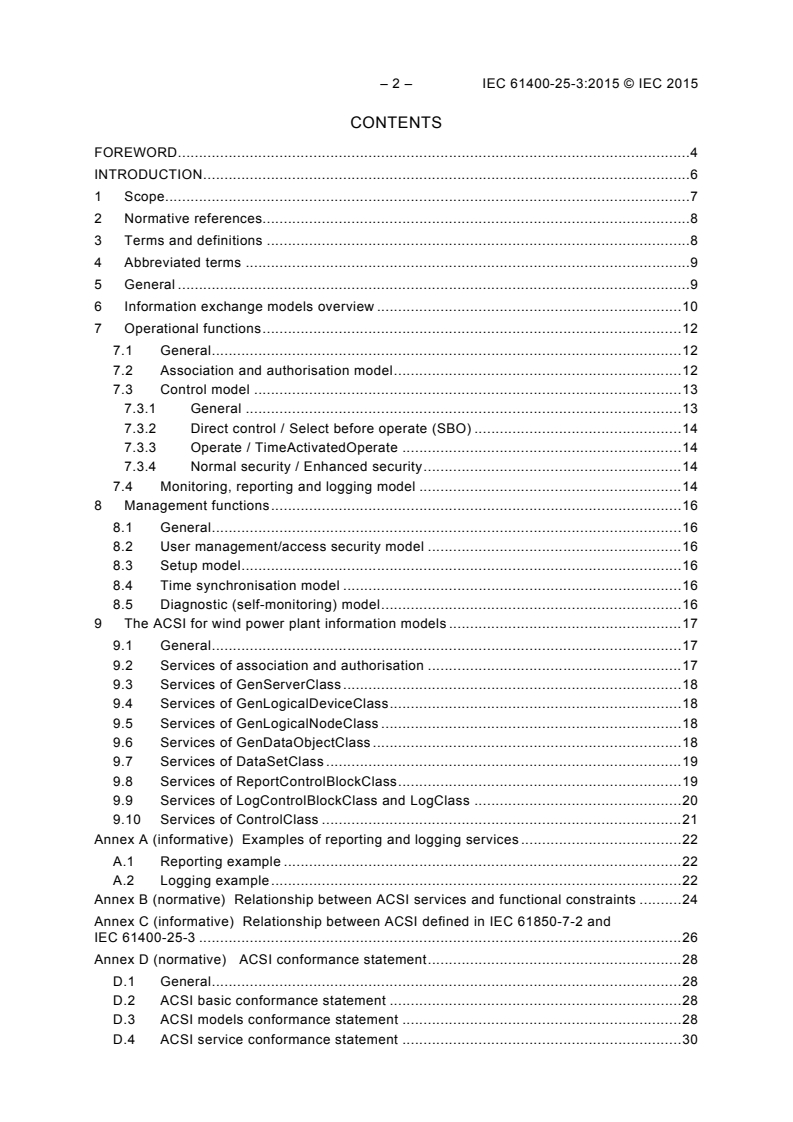
CONTENTS
FOREWORD . 4
INTRODUCTION . 6
1 Scope . 7
2 Normative references. 8
3 Terms and definitions . 8
4 Abbreviated terms . 9
5 General . 9
6 Information exchange models overview . 10
7 Operational functions . 12
7.1 General . 12
7.2 Association and authorisation model . 12
7.3 Control model . 13
7.3.1 General . 13
7.3.2 Direct control / Select before operate (SBO) . 14
7.3.3 Operate / TimeActivatedOperate . 14
7.3.4 Normal security / Enhanced security . 14
7.4 Monitoring, reporting and logging model . 14
8 Management functions . 16
8.1 General . 16
8.2 User management/access security model . 16
8.3 Setup model . 16
8.4 Time synchronisation model . 16
8.5 Diagnostic (self-monitoring) model . 16
9 The ACSI for wind power plant information models . 17
9.1 General . 17
9.2 Services of association and authorisation . 17
9.3 Services of GenServerClass . 18
9.4 Services of GenLogicalDeviceClass . 18
9.5 Services of GenLogicalNodeClass . 18
9.6 Services of GenDataObjectClass . 18
9.7 Services of DataSetClass . 19
9.8 Services of ReportControlBlockClass . 19
9.9 Services of LogControlBlockClass and LogClass . 20
9.10 Services of ControlClass . 21
Annex A (informative) Examples of reporting and logging services . 22
A.1 Reporting example . 22
A.2 Logging example . 22
Annex B (normative) Relationship between ACSI services and functional constraints . 24
Annex C (informative) Relationship between ACSI defined in IEC 61850-7-2 and
IEC 61400-25-3 . 26
Annex D (normative) ACSI conformance statement . 28
D.1 General . 28
D.2 ACSI basic conformance statement . 28
D.3 ACSI models conformance statement . 28
D.4 ACSI service conformance statement . 30
IEC 61400-25-3.2015 © IEC 2015 – 3 –
Bibliography . 32
Figure 1 – Conceptual communication model of the IEC 61400-25 series . 8
Figure 2 – Association and authorisation model (conceptual) . 12
Figure 3 – Control model (conceptual) . 13
Figure 4 – Monitoring, reporting and logging model (conceptual) . 15
Figure 5 – Conceptual information exchange model for a wind power plant . 17
Figure 6 – Buffered report control block – conceptual . 20
Figure 7 – Log control block – conceptual . 21
Figure A.1 – Mapping of information models to data sets for reporting (example) . 22
Figure A.2 – Logging basics (example) . 23
Figure C.1 – Conceptual service model of the ACSI . 27
Table 1 – Information exchange models . 11
Table 2 – Comparison of the information retrieval methods . 16
Table 3 – Data filter . 20
Table B.1 – Relationship between ACSI Services and Functional Constraints . 24
Table D.1 – Basic conformance statement . 28
Table D.2 – ACSI models conformance statement . 29
Table D.3 – ACSI service conformance statement (1 of 2) . 30
Table D.4 – Time . 31
– 4 – IEC 61400-25-3:2015 © IEC 2015
INTERNATIONAL ELECTROTECHNICAL COMMISSION
____________
WIND TURBINES –
Part 25-3: Communications for monitoring
and control of wind power plants –
Information exchange models
FOREWORD
1) The International Electrotechnical Commission (IEC) is a worldwide organization for standardization comprising
all national electrotechnical committees (IEC National Committees). The object of IEC is to promote
international co-operation on all questions concerning standardization in the electrical and electronic fields. To
this end and in addition to other activities, IEC publishes International Standards, Technical Specifications,
Technical Reports, Publicly Available Specifications (PAS) and Guides (hereafter referred to as “IEC
Publication(s)”). Their preparation is entrusted to technical committees; any IEC National Committee interested
in the subject dealt with may participate in this preparatory work. International, governmental and non-
governmental organizations liaising with the IEC also participate in this preparation. IEC collaborates closely
with the International Organization for Standardization (ISO) in accordance with conditions determined by
agreement between the two organizations.
2) The formal decisions or agreements of IEC on technical matters express, as nearly as possible, an international
consensus of opinion on the relevant subjects since each technical committee has representation from all
interested IEC National Committees.
3) IEC Publications have the form of recommendations for international use and are accepted by IEC National
Committees in that sense. While all reasonable efforts are made to ensure that the technical content of IEC
Publications is accurate, IEC cannot be held responsible for the way in which they are used or for any
misinterpretation by any end user.
4) In order to promote international uniformity, IEC National Committees undertake to apply IEC Publications
transparently to the maximum extent possible in their national and regional publications. Any divergence
between any IEC Publication and the corresponding national or regional publication shall be clearly indicated in
the latter.
5) IEC itself does not provide any attestation of conformity. Independent certification bodies provide conformity
assessment services and, in some areas, access to IEC marks of conformity. IEC is not responsible for any
services carried out by independent certification bodies.
6) All users should ensure that they have the latest edition of this publication.
7) No liability shall attach to IEC or its directors, employees, servants or agents including individual experts and
members of its technical committees and IEC National Committees for any personal injury, property damage or
other damage of any nature whatsoever, whether direct or indirect, or for costs (including legal fees) and
expenses arising out of the publication, use of, or reliance upon, this IEC Publication or any other IEC
Publications.
8) Attention is drawn to the Normative references cited in this publication. Use of the referenced publications is
indispensable for the correct application of this publication.
9) Attention is drawn to the possibility that some of the elements of this IEC Publication may be the subject of
patent rights. IEC shall not be held responsible for identifying any or all such patent rights.
International Standard IEC 61400-25-3 has been prepared by IEC technical committee 88:
Wind turbines.
The text of this standard is based on the following documents:
FDIS Report on voting
88/540/FDIS 88/552/RVD
Full information on the voting for the approval of this standard can be found in the report on
voting indicated in the above table.
This publication has been drafted in accordance with the ISO/IEC Directives, Part 2.
IEC 61400-25-3.2015 © IEC 2015 – 5 –
This second edition cancels and replaces the first edition published in 2006.
The scope of revision includes:
• Harmonization with service models in Edition 2 of IEC 61850-7-2.
• Reduction of overlap between standards and simplification by increased referencing.
This edition includes the following significant technical changes with respect to the previous
edition:
a) Add subscription and remove subscription services have been removed.
b) Tables in Clause 9 indicating expected services have been replaced by tables in a new
Annex D including ACSI conformance statements for clients and servers.
c) Technical issues (“Tissues”) for IEC 61850-7-2 edition 2 have been considered and
changes have been made accordingly.
Technical issues (“Tissues”), as collected by the IEC 61400-25 users group USE61400-25,
have been considered, but no technical issues were registered for edition 1.
A list of all parts of the IEC 61400 series, under the general title Wind turbines, can be found
on the IEC website.
The committee has decided that the contents of this publication will remain unchanged until
the stability date indicated on the IEC web site under "http://webstore.iec.ch" in the data
related to the specific publication. At this date, the publication will be
• reconfirmed,
• withdrawn,
• replaced by a revised edition, or
• amended.
IMPORTANT – The 'colour inside' logo on the cover page of this publication indicates
that it contains colours which are considered to be useful for the correct
understanding of its contents. Users should therefore print this document using a
colour printer.
– 6 – IEC 61400-25-3:2015 © IEC 2015
INTRODUCTION
The IEC 61400-25 series defines communications for monitoring and control of wind power
plants. The modeling approach of the IEC 61400-25 series has been selected to provide
abstract definitions of classes and services such that the specifications are independent of
specific protocol stacks, implementations, and operating systems. The mapping of these
abstract classes and services to a specific communication profile is not inside the scope of
this part (IEC 61400-25-3) but inside the scope of IEC 61400-25-4.
This part of IEC 61400-25 defines services of the model of the information exchange of
intelligent electronic devices in wind power plants. The services are referred to as the abstract
communication service interface (ACSI). The ACSI has been defined so as to be independent
of the underlying communication systems.
The information exchange model is defined in terms of
– a hierarchical class model of all information that can be accessed,
– information exchange services that operate on these classes,
– parameters associated with each information exchange service.
The ACSI description technique abstracts away from all the different approaches to implement
the cooperation of the various devices.
These abstract service definitions are mapped into concrete object definitions that are to be
used for a particular protocol. Mapping to specific protocol stacks is specified in
IEC 61400-25-4.
NOTE 1 Abstraction in ACSI has two meanings. Firstly, only those aspects of a real device (for example, a rotor)
or a real function that are visible and accessible over a communication network are modelled. This abstraction
leads to the hierarchical class models and their behaviour defined in IEC 61400-25-2. Secondly, the ACSI abstracts
from the aspect of concrete definitions on how the devices exchange information; only a conceptual cooperation is
defined. The concrete information exchange is defined in IEC 61400-25-4.
NOTE 2 Performance of the IEC 61400-25 series implementations are application specific. The IEC 61400-25
series does not guarantee a certain level of performance. This is beyond the scope of the IEC 61400-25 series.
However, there is no underlying limitation in the communications technology to prevent high speed application
(millisecond level responses).
IEC 61400-25-3.2015 © IEC 2015 – 7 –
WIND TURBINES –
Part 25-3: Communications for monitoring
and control of wind power plants –
Information exchange models
1 Scope
The focus of the IEC 61400-25 series is on the communications between wind power plant
components such as wind turbines and actors such as SCADA systems. Internal
communication within wind power plant components is outside the scope of the IEC 61400-25
series.
The IEC 61400-25 series is designed for a communication environment supported by a client-
server model. Three areas are defined, that are modelled separately to ensure the scalability
of implementations: (1) wind power plant information models, (2) information exchange model,
and (3) mapping of these two models to a standard communication profile.
The wind power plant information model and the information exchange model, viewed
together, constitute an interface between client and server. In this conjunction, the wind power
plant information model serves as an interpretation frame for accessible wind power plant
data. The wind power plant information model is used by the server to offer the client a
uniform, component-oriented view of the wind power plant data. The information exchange
model reflects the whole active functionality of the server. The IEC 61400-25 series enables
connectivity between a heterogeneous combination of client and servers from different
manufacturers and suppliers.
As depicted in Figure 1, the IEC 61400-25 series defines a server with the following aspects:
– information provided by a wind power plant component, e. g., “wind turbine rotor speed” or
“total power production of a certain time interval” is modelled and made available for
access. The information modelled in the IEC 61400-25 series is defined in
IEC 61400-25-2;
– services to exchange values of the modelled information defined in IEC 61400-25-3;
– mapping to a communication profile, providing a protocol stack to carry the exchanged
values from the modelled information (IEC 61400-25-4).
The IEC 61400-25 series only defines how to model the information, information exchange
and mapping to specific communication protocols. The IEC 61400-25 series excludes a
definition of how and where to implement the communication interface, the application
program interface and implementation recommendations. However, the objective of the
IEC 61400-25 series is that the information associated with a single wind power plant
component (such as a wind turbine) is accessible through a corresponding logical device.
This part of IEC 61400-25 specifies an abstract communication service interface describing
the information exchange between a client and a server for:
– data access and retrieval,
– device control,
– event reporting and logging,
– self-description of devices (device data dictionary),
– data typing and discovery of data types.
– 8 – IEC 61400-25-3:2015 © IEC 2015
IEC
Figure 1 – Conceptual communication model of the IEC 61400-25 series
2 Normative references
The following documents, in whole or in part, are normatively referenced in this document and
are indispensable for its application. For dated references, only the edition cited applies. For
undated references, the latest edition of the referenced document (including any
amendments) applies.
IEC 61400-25-1, Wind turbines – Part 25-1: Communications for monitoring and control of
wind power plants – Overall description of principles and models
IEC 61400-25-2:2015, Wind turbines – Part 25-2: Communications for monitoring and control
of wind power plants – Information models
IEC 61400-25-4:2008, Wind turbines – Part 25-4: Communications for monitoring and control
of wind power plants – Mapping to communication profile
IEC 61850-7-2:2010, Communication networks and systems for power utility automation –
Part 7-2: Basic information and communication structure – Abstract communication service
interface (ACSI)
3 Terms and definitions
For the purposes of this document, the terms and definitions given in IEC 61400-25-1 as well
as the following apply.
3.1
control object
data object instance of a controllable data object class who’s ctlModel DataAttribute is not set
to “status-only”
IEC 61400-25-3.2015 © IEC 2015 – 9 –
4 Abbreviated terms
ACSI Abstract Communication Service Interface (defined for example in IEC 61850-7-2)
FCD Functionally Constrained Data
FCDA Functionally Constrained Data Attribute
IED Intelligent Electronic Device
IEM Information Exchange Model
LCB Log Control Block
LD Logical Device
LN Logical Node
LOG Log
LPHD Logical Node Physical Device
RCB Report Control Block
SCADA Supervisory Control and Data Acquisition
SCSM Specific Communication Service Mapping (defined for example in IEC 61850-8-1)
SG Setting Group
WPP Wind Power Plant
WT Wind Turbine
XML Extensible Mark-up Language
GUI Graphical User Interface
5 General
This part of IEC 61400-25 provides the information exchange models that can be applied by a
client and a server to access the content and structure of the wind power plant information
model defined in IEC 61400-25-2.
Clause 6 gives an overview of the information exchange models for operational functions and
management functions.
Clause 7 introduces the information exchange models for operational functions: authorisation,
control, monitoring, and reporting and logging.
Clause 8 gives an overview of the information exchange models for management functions.
Clause 9 provides the details of the services for the following service model classes:
• Application association,
• Server class,
• Logical Device class (retrieve the self-description, etc.),
• Logical Node class (retrieve the self-description, etc.),
• Data class (get values, set values, retrieve the self-description, etc.),
• DataSet class (get values, set values, create data sets, retrieve the self-description, etc.),
• Report Control Block class (get attributes, set attributes, report, etc.),
• Log Control Block and Log classes (get attributes, set attributes, retrieve log entries, etc.),
• Control class (select, operate, etc.).
Annex A provides examples of the reporting and logging services required.
Annex B provides relationship between ACSI services and functional Constraints.
– 10 – IEC 61400-25-3:2015 © IEC 2015
Annex C provides relationship between ACSI defined in IEC 61850-7-2 and IEC 61400-25-3.
Annex D provides ACSI conformance statements for clients and servers.
6 Information exchange models overview
The information exchange models provide services for communication functions that are
grouped as follows:
• Operational functions,
• Management functions.
These two groups are introduced and described in more detail in Clause 7 and 8.
The mandatory services for each information exchange model are indicated in the
corresponding service tables in Clause D.4.
An instance of the wind power plant information model of a wind power plant (logical device,
logical node, data, data attributes and control block objects) shall be accessed by instances
of the information exchange models listed in Table 1. The first two columns of the table
enumerate the functional groups and their information exchange models, which are summarily
described in the third column. The fourth and fifth columns identify which data kinds and
transfer principles are applicable for each information exchange model. The last column
indicates the ACSI service models used for the corresponding information exchange models.
IEC 61400-25-3.2015 © IEC 2015 – 11 –
Table 1 – Information exchange models
Functional Information Short Information categories Transfer ACSI
group exchange description principles service
model models
Authentication and
Data transfer
restriction of
Authorisation on demand
access to
Short text messages ASSOCIATION
operational and
(see 7.2) Command
management
transfer
functions
Command
Setpoints
transfer
Control Commands CONTROL
Control of Set point
operational devices transfer
(see 7.3) Parameters
Parameters
transfer
Measured Data
Processed data
(Average Values,
Min/Max)
Status
Alarms
LOGICAL-
Events
DEVICE
Monitoring of
Timer
Monitoring
LOGICAL-
current data and
NODE
change of data of
Counter
(see 7.4)
operational devices
DATA
Setpoints
Periodic data
transfer (all DATA-SET
Parameters
data or only
BUFFERED-
data that has
Time Series Data (i.e.
REPORT-
changed since
Alarm/Event Log,
CONTROL
last transfer)
Command Log, Setpoint
Log)
UNBUFFERED-
Data transfer
REPORT-
(Analogue Values, on demand
CONTROL
Binary Values)
Event driven
LOG
data transfer
Histories (Logs)
(spontaneous)
LOG-
Reports
CONTROL
Trigger controlled
Statistics
Reporting and
(see Clause 9
continuous
logging
for details of
scanning and Curves
the ACSI
recording of values
(see 7.4)
Trends
services)
and events
Events
Short text messages
Monitoring, and
Diagnostics
Self-monitoring of reporting and logging
devices information categories
(see 8.5)
apply
User and
Setting up users,
access
access rights and System specific
management
monitoring access
(see 8.2)
Device
Setup
configuration System specific
(see 8.3)
management
Time
Synchronization of
synchronisation
SCSM specific
device clocks
(see 8.4)
Management (see Clause 8) Operational (see Clause 7)
– 12 – IEC 61400-25-3:2015 © IEC 2015
The information exchange models shall be realised by the corresponding ACSI models and
associated services (as depicted in the last column in Table 1). The intent of the table is to
give an overview applying the commonly used terminology of the wind power plant domain.
7 Operational functions
7.1 General
The information exchange models for operational functions described in Clause 7 are as
follows:
• association and authorisation model,
• control model,
• monitoring, reporting and logging model.
Functional constraints of the ACSI services are specified in Annex B.
7.2 Association and authorisation model
The intention of the association and authorisation model is to provide a secure information
exchange via an association between a client and a server. The model provides client
authentication and controls the access to server functions. The conceptual mechanism is
shown in Figure 2.
secure
client server
association
local authorisation
association request
check requested
initiate remote
authorisation
authorisation
association opened
denied
(or denied)
Deny ?
wait for confirmation
granted
Grant
denied
ready to
?
receive requests
granted
end
operational information
operational information
process requests from
...
exchange (Get, Set,
client
Control, .)
no need to
communicate
close association
close association
close association
IEC
Figure 2 – Association and authorisation model (conceptual)
The requirements to be fulfilled by an association between a client and a server are as
follows:
– authentication: determining the identity of the users/client,
– authorisation and access control: ensure that the entity has the proper access rights (a
minimum is to provide a user name and a password),
– integrity: messages and the computer infrastructure are protected against unauthorised
modification or destruction,
IEC 61400-25-3.2015 © IEC 2015 – 13 –
– confidentiality: objects of the wind power plant information model are protected and only
disclosed to appropriate users/clients,
– non-repudiation: preventing a user/client involved in a data exchange from denying that it
participated in the exchange,
– prevention of denial of device: preventing a client/server from blocking access to
authorised users.
The real services of the authorisation model are provided by the specific mappings given in
IEC 61400-25-4. Based on the specific mapping selected, the actual level of security and the
specific services supported might be different.
7.3 Control model
7.3.1 General
The control model defines the information exchange for operating commands. The control
model can only be applied to control objects, i.e. to data object instances of a controllable
common data class (e.g. SPC, INC) whose DataAttribute “ctlModel” is not set to “status-only”.
The control model is mainly used to change the status of a device (e.g. stop/start Turbine) or
to change the value of a set point or parameter. The conceptual mechanism of the control
model is shown in Figure 3.
server
client
SelectWithValue
check validity; SBO;
initiate control
reserve access to control optional
command
object for requesting
client
Ok
Operate
[TimeActivatedOperate]
issue control
check validity;
Ok [Ok]
command
process control
[Time
command
Activated
[check validity, activate
Operate;
[T[TiimmeeAAcctitivvaatedtedOOperperateate
timer & wait until timer
optional]
TTerermmiinanatition]on]
expires, process control
command]
enhanced
Report
supervise requested
security;
status or value change
optional
Command
termination
IEC
Figure 3 – Control model (conceptual)
NOTE The control model with its state transitions and services is described in more detail in IEC 61850-7-2:2010
(Clause 20).
– 14 – IEC 61400-25-3:2015 © IEC 2015
IEC 61850-7-2:2010 describes different models for the control object:
– direct control or select before operate (SBO),
– normal security or enhanced security,
and as an extension
– operate or time activated operate.
The value of the control object’s dataAttribute “ctlModel” determines which of the supported
models can be applied to the control object.
Tracking of the control services is beyond the scope of this standard.
7.3.2 Direct control / Select before operate (SBO)
With direct control, the control object shall not be selected before sending the “Operate” (or
“TimeActivatedOperate”) command.
With SBO, the control object shall be selected before sending the “Operate” (or
“TimeActivatedOperate”) command. On receipt of a “SelectWithValue” request, the server
checks the validity of the command, issues a positive “SelectWithValue” response and starts a
deselect timer. The access to this control object is now restricted to this client and to the
requested action. The control object will be deselected for example if the deselect timer
expires or if the client sends a “Cancel” command.
7.3.3 Operate / TimeActivatedOperate
Within one control sequence, either Operate OR TimeActivatedOperate shall be used.
On receipt of an “Operate” request, the server checks the validity of the command, issues a
positive “Operate” response and starts to process the requested action.
The “TimeActivatedOperate” command contains in addition a parameter “operTm” that holds
an absolute time at which the command shall be executed. On receipt of a
“TimeActivatedOperate” request, the server checks the validity of the command, activates a
timer and issues a positive “TimeActivatedOperate” response. At the specified time, the
server will automatically start to process the command and issue a “TimeActivatedOperate”
termination.
7.3.4 Normal security / Enhanced security
With normal security the requested status or value change may optionally be reported by the
Report service (see 7.4). If enhanced security is supported, the server supervises the
requested change of the status or value. As soon as the status or value has changed, the
server uses the Report service to report the new status or value (stVal) to the client and
issues a “CommandTermination” request.
7.4 Monitoring, reporting and logging model
The conceptual information exchange models for monitoring, reporting and logging are shown
in Figure 4. The models comprise three independent information retrieval methods:
1) Values can be retrieved on demand by a client (upper part of the figure). This is commonly
known as Get or Read; the response will be transmitted immediately.
2) Values can be reported to the client, following a publisher/subscriber reporting model (in
the middle of the figure). The server is configured (locally or by means of a service) to
transmit values spontaneously or periodically. The client receives messages (reports)
whenever trigger conditions are met at the server. The publisher/subscriber model may
IEC 61400-25-3.2015 © IEC 2015 – 15 –
buffer events in case the communication link is down and transmit all buffered events in
sequence once the link is operating again, in case of a buffered report. In the case of an
unbuffered report, the delivery of events, in the case of a communication link failure is not
guaranteed.
3) Values can be logged at the device. The logging model (at the bottom of the figure) allows
buffering and delivery of events in correct sequence. Logging values from multiple
sources of data (via configuration of Data Sets) may be logged and each source can be
configured independently of other sources. The client can query the log for entries
between two timestamps or for all entries after a certain entry.
The reporting and logging models include:
a) a Data Set class (DS), for referencing groups of data to be logged or reported,
b) a Control Block class (report control block class or log control block class), for controlling
the dynamic behaviour of the information logging or reporting, and
c) a Log class, for definition of log storage.
client server
request values,
send values
values on demand
receive values,
on demand
process values locally
subscribe to receive values
establish and
initiate subscription
enable subscription
monitor values for
wait for values,
change (periodic),
receive values,
produce events and
values on change or event
process and/or
send values
.
.
display values locally
.
periodic values send values to
subscriber periodically
RemoveSubscription
disable subscription disable subscription
query values
value
query time-series values
of a time-series
value
of data values
LOG
values
process values locally
value
time
IEC
Figure 4 – Monitoring, reporting and logging model (conceptual)
The retrieval methods have the characteristics given in Table 2.
– 16 – IEC 61400-25-3:2015 © IEC 2015
Table 2 – Comparison of the information retrieval methods
Retrieval method Time-critical Can lose Multiple Last Typical client
information changes (of clients to receive change of (but not
exchange sequence) information data stored exclusively)
by
Data on demand NO YES YES – Browser
Unbuffered YES YES YES – Real-time GUI
reporting
Reporting
Buffered YES NO YES Server Data concentrator
reporting
Logging NO NO YES Client Plant operation,
engineering
stations
Each of the retrieval methods has specific characteristics. There is no single method that
meets all application requirements. During system design, the designer shall analyse the
requirements and check them against the (implemented) methods provided by a device
compliant with the IEC 61400-25 series.
8 Management functions
8.1 General
The management function models described in Clause 8 are used to set-up or evolve
(maintain) a system. The system configuration and maintenance functions include the setting
and changing of configuration data and the retrieval of configuration information from the
system. The management function models described are as follows:
• user management/access security model,
• setup model,
• time synchronisation model,
• diagnostic (self-monitoring) model.
Functional constraints of the ACSI services are specified in Annex B.
8.2 User management/access security model
Apart from the service requirements given in 7.2, these functions are an implementation-
specific issue.
8.3 Setup model
Apart from the service requirements given in 7.2, these functions are an implementation-
specific issue.
8.4 Time synchronisation model
The synchronisation of the various clocks in a system is a matter of the specific mapping
selected and is specified in IEC 61400-25-4.
8.5 Diagnostic (self-monitoring) model
The diagnostic or self-monitoring functions are intended for detection of the system status for
example if a device is fully operational, partially operational, or not operational. The diagnosis
information is defined in the logical node LPHD defined in IEC 61400-25-2.
IEC 61400-25-3.2015 © IEC 2015 – 17 –
9 The ACSI for wind power plant information models
9.1 General
The information exchanges models specified in Clause 7 and 8 create an overview of the
models required to be compliant with the IEC 61400-25 series. Clause 9 contains the detailed
description of all service required.
The basic information exchange models are depicted in Figure 5, illustrating the various
components of the ACSI services. This figure is used to provide a narrative description of how
a typical device interacts with the outside world using these services.
Server
Logical device
Get/Set
nameplate, health Logical node
Data
Logical Node
Get/Set
Control
Data values
Data
Data
Get/Set
Data
Data
Set
Subscribe
set
Report control block
values on
values on
Reportchange, event,
change, event,
(values on change,
periodic
periodic
event, periodic)
Log control block
Query
Log
Authorisation Time synchronisation
reference
bidirectional information exchange
data flow
unidirectional information exchange
IEC
Figure 5 – Conceptual information exchange model for a wind power plant
The specification in Clause 9 provides a high level definition of services. The normative
definition of the details of the ACSI models and services are defined in IEC 61850-7-2.
9.2 Services of association and authorisation
The applicat
...