

IEC 60598-2-14:2009
(Main)Luminaires - Part 2-14: Particular requirements - Luminaires for cold cathode tubular discharge lamps (neon tubes) and similar equipment
General Information
- Abstract
IEC 60598-2-14:2009 applies to luminaires for cold cathode tubular discharge lamps and similar equipment, operating on a no-load rated output voltage over 1 000 V but not exceeding 10 000 V, mainly used for general lighting, for indoor or outdoor applications and for supply voltages up to 1 000 V. This publication is intended to be read in conjunction with IEC 60598-1: Luminaires - Part 1: General requirements and tests. It was established on the basis of the seventh edition (2008) of that standard.
This publication is intended to be read in conjunction with IEC 60598-1:2008.
- Status
- Published
- Publication Date
- 04-Feb-2009
- Technical Committee
- SC 34D - Luminaires
- Current Stage
- PPUB - Publication issued
- Start Date
- 05-Feb-2009
- Completion Date
- 28-Feb-2009
Overview
IEC 60598-2-14:2009 is an internationally recognized standard developed by the International Electrotechnical Commission (IEC) that specifies the particular requirements for luminaires designed for cold cathode tubular discharge lamps-commonly known as neon tubes-and similar equipment. This standard targets luminaires operating at no-load rated output voltages over 1,000 V and up to 10,000 V, suitable for both indoor and outdoor applications with supply voltages up to 1,000 V. It applies to fixed or portable luminaires that incorporate luminous-discharge tubes and their supply units utilizing transformers, inverters, or converters.
This part of IEC 60598 is designed to be used alongside IEC 60598-1: Luminaires – Part 1: General requirements and tests, ensuring a comprehensive framework for safety, construction, and performance.
Key Topics
Scope and Application
Focuses on luminaires with cold cathode tubular discharge lamps and similar equipment, operating above 1,000 V output voltage, and mainly used for general lighting purposes.Normative References
Incorporates related IEC standards such as IEC 60529 for enclosure protection (IP Code), IEC 61050 for neon transformers, and IEC 61347-2-10 for electronic inverters and converters.Safety and Construction Requirements
- High voltage insulation and creepage distances to prevent electric shock
- Protective devices such as earth leakage protective devices and open-circuit protective devices
- Durable construction materials capable of withstanding heat, fire, moisture, and dust ingress
- Proper earthing provisions and secure wiring, both internal and external
- Specific marking and labeling for safety compliance and user information
Testing Protocols
Adherence to general test requirements defined in IEC 60598-1, including routine testing recommended in the annexures, ensuring safety and reliable operation.Definitions and Terminology
Clear definitions of terms such as luminous-discharge tube, no-load rated output voltage, insulating sleeve, sensor, protective switch, and open-circuit condition facilitate consistent understanding and application of the standard.
Applications
Decorative and Architectural Lighting
Neon lighting that highlights architectural features with high-voltage cold cathode tubes for indoor and outdoor decor.Commercial and Retail Signage
Use in signage where vibrant, long-lasting illumination is needed, ensuring safety and reliability in various environmental conditions.Entertainment and Display Lighting
Special effects lighting requiring flashing, sequencing, or animated neon tube effects with flasher devices as per IEC 60598-2-14 specifications.Industrial Applications
High-voltage tubular discharge lamps in industrial environments where robustness and electrical safety are critical.
This standard benefits manufacturers, designers, and installers by providing strict guidelines to assure electrical safety, mechanical strength, and operational endurance of equipment using cold cathode tubular discharge lamps.
Related Standards
IEC 60598-1: Luminaires – Part 1: General requirements and tests
Provides the foundational tests and safety requirements for all types of luminaires and must be read in conjunction with IEC 60598-2-14.IEC 61050: Transformers for tubular discharge lamps
Defines safety and general requirements for neon transformers used as control gear in these luminaires.IEC 61347-2-10: Lamp controlgear – Particular requirements for electronic inverters and converters
Covers electronic control gear used for the high-frequency operation of cold cathode tubular discharge lamps.IEC 60529: Degrees of protection by enclosures (IP Code)
Specifies protection against ingress of solid objects and water, crucial for outdoor and industrial luminaires.
Adherence to IEC 60598-2-14 enhances compliance with global safety norms for high-voltage cold cathode luminaires, ensuring product reliability and consumer safety. For detailed technical guidance and up-to-date amendments, consult the full IEC publication and related IEC web resources.
Keywords: IEC 60598-2-14, cold cathode tubular discharge lamps, neon tube luminaires, high voltage luminaires, luminaire safety, IEC luminaires standard, high-voltage lighting, luminous discharge tube, electrical safety standards, IEC 60598, neon lighting standards.
Get Certified
Connect with accredited certification bodies for this standard

IMQ S.p.A. (Certification)
Italian electrical product certification.

SLG Prüf- und Zertifizierungs GmbH
German testing and certification body.

UL Solutions
Global safety science company with testing, inspection and certification.
Sponsored listings
Frequently Asked Questions
IEC 60598-2-14:2009 is a standard published by the International Electrotechnical Commission (IEC). Its full title is "Luminaires - Part 2-14: Particular requirements - Luminaires for cold cathode tubular discharge lamps (neon tubes) and similar equipment". This standard covers: IEC 60598-2-14:2009 applies to luminaires for cold cathode tubular discharge lamps and similar equipment, operating on a no-load rated output voltage over 1 000 V but not exceeding 10 000 V, mainly used for general lighting, for indoor or outdoor applications and for supply voltages up to 1 000 V. This publication is intended to be read in conjunction with IEC 60598-1: Luminaires - Part 1: General requirements and tests. It was established on the basis of the seventh edition (2008) of that standard. This publication is intended to be read in conjunction with IEC 60598-1:2008.
IEC 60598-2-14:2009 applies to luminaires for cold cathode tubular discharge lamps and similar equipment, operating on a no-load rated output voltage over 1 000 V but not exceeding 10 000 V, mainly used for general lighting, for indoor or outdoor applications and for supply voltages up to 1 000 V. This publication is intended to be read in conjunction with IEC 60598-1: Luminaires - Part 1: General requirements and tests. It was established on the basis of the seventh edition (2008) of that standard. This publication is intended to be read in conjunction with IEC 60598-1:2008.
IEC 60598-2-14:2009 is classified under the following ICS (International Classification for Standards) categories: 01 - GENERALITIES. TERMINOLOGY. STANDARDIZATION. DOCUMENTATION; 29.140.40 - Luminaires. The ICS classification helps identify the subject area and facilitates finding related standards.
IEC 60598-2-14:2009 is available in PDF format for immediate download after purchase. The document can be added to your cart and obtained through the secure checkout process. Digital delivery ensures instant access to the complete standard document.
Standards Content (Sample)
IEC 60598-2-14 ®
Edition 1.0 2009-02
INTERNATIONAL
STANDARD
NORME
INTERNATIONALE
Luminaires –
Part 2-14: Particular requirements – Luminaires for cold cathode tubular
discharge lamps (neon tubes) and similar equipment
Luminaires –
Partie 2-14: Règles particulières – Luminaires pour lampes à décharge tubulaire
à cathode froide (tubes néons) et équipements similaires
All rights reserved. Unless otherwise specified, no part of this publication may be reproduced or utilized in any form or by
any means, electronic or mechanical, including photocopying and microfilm, without permission in writing from either IEC or
IEC's member National Committee in the country of the requester.
If you have any questions about IEC copyright or have an enquiry about obtaining additional rights to this publication,
please contact the address below or your local IEC member National Committee for further information.
Droits de reproduction réservés. Sauf indication contraire, aucune partie de cette publication ne peut être reproduite
ni utilisée sous quelque forme que ce soit et par aucun procédé, électronique ou mécanique, y compris la photocopie
et les microfilms, sans l'accord écrit de la CEI ou du Comité national de la CEI du pays du demandeur.
Si vous avez des questions sur le copyright de la CEI ou si vous désirez obtenir des droits supplémentaires sur cette
publication, utilisez les coordonnées ci-après ou contactez le Comité national de la CEI de votre pays de résidence.
IEC Central Office
3, rue de Varembé
CH-1211 Geneva 20
Switzerland
Email: inmail@iec.ch
Web: www.iec.ch
About the IEC
The International Electrotechnical Commission (IEC) is the leading global organization that prepares and publishes
International Standards for all electrical, electronic and related technologies.
About IEC publications
The technical content of IEC publications is kept under constant review by the IEC. Please make sure that you have the
latest edition, a corrigenda or an amendment might have been published.
ƒ Catalogue of IEC publications: www.iec.ch/searchpub
The IEC on-line Catalogue enables you to search by a variety of criteria (reference number, text, technical committee,…).
It also gives information on projects, withdrawn and replaced publications.
ƒ IEC Just Published: www.iec.ch/online_news/justpub
Stay up to date on all new IEC publications. Just Published details twice a month all new publications released. Available
on-line and also by email.
ƒ Electropedia: www.electropedia.org
The world's leading online dictionary of electronic and electrical terms containing more than 20 000 terms and definitions
in English and French, with equivalent terms in additional languages. Also known as the International Electrotechnical
Vocabulary online.
ƒ Customer Service Centre: www.iec.ch/webstore/custserv
If you wish to give us your feedback on this publication or need further assistance, please visit the Customer Service
Centre FAQ or contact us:
Email: csc@iec.ch
Tel.: +41 22 919 02 11
Fax: +41 22 919 03 00
A propos de la CEI
La Commission Electrotechnique Internationale (CEI) est la première organisation mondiale qui élabore et publie des
normes internationales pour tout ce qui a trait à l'électricité, à l'électronique et aux technologies apparentées.
A propos des publications CEI
Le contenu technique des publications de la CEI est constamment revu. Veuillez vous assurer que vous possédez
l’édition la plus récente, un corrigendum ou amendement peut avoir été publié.
ƒ Catalogue des publications de la CEI: www.iec.ch/searchpub/cur_fut-f.htm
Le Catalogue en-ligne de la CEI vous permet d’effectuer des recherches en utilisant différents critères (numéro de référence,
texte, comité d’études,…). Il donne aussi des informations sur les projets et les publications retirées ou remplacées.
ƒ Just Published CEI: www.iec.ch/online_news/justpub
Restez informé sur les nouvelles publications de la CEI. Just Published détaille deux fois par mois les nouvelles
publications parues. Disponible en-ligne et aussi par email.
ƒ Electropedia: www.electropedia.org
Le premier dictionnaire en ligne au monde de termes électroniques et électriques. Il contient plus de 20 000 termes et
définitions en anglais et en français, ainsi que les termes équivalents dans les langues additionnelles. Egalement appelé
Vocabulaire Electrotechnique International en ligne.
ƒ Service Clients: www.iec.ch/webstore/custserv/custserv_entry-f.htm
Si vous désirez nous donner des commentaires sur cette publication ou si vous avez des questions, visitez le FAQ du
Service clients ou contactez-nous:
Email: csc@iec.ch
Tél.: +41 22 919 02 11
Fax: +41 22 919 03 00
IEC 60598-2-14 ®
Edition 1.0 2009-02
INTERNATIONAL
STANDARD
NORME
INTERNATIONALE
Luminaires –
Part 2-14: Particular requirements – Luminaires for cold cathode tubular
discharge lamps (neon tubes) and similar equipment
Luminaires –
Partie 2-14: Règles particulières – Luminaires pour lampes à décharge tubulaire
à cathode froide (tubes néons) et équipements similaires
INTERNATIONAL
ELECTROTECHNICAL
COMMISSION
COMMISSION
ELECTROTECHNIQUE
PRICE CODE
INTERNATIONALE
T
CODE PRIX
ICS 29.140.40 ISBN 978-2-88910-209-9
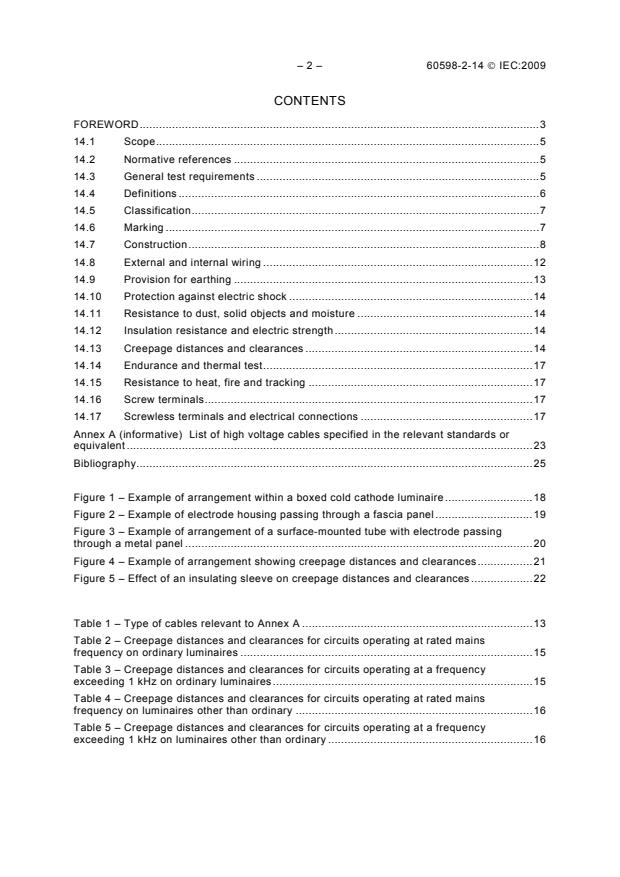
– 2 – 60598-2-14 © IEC:2009
CONTENTS
FOREWORD.3
14.1 Scope.5
14.2 Normative references .5
14.3 General test requirements .5
14.4 Definitions .6
14.5 Classification.7
14.6 Marking .7
14.7 Construction.8
14.8 External and internal wiring .12
14.9 Provision for earthing .13
14.10 Protection against electric shock .14
14.11 Resistance to dust, solid objects and moisture .14
14.12 Insulation resistance and electric strength.14
14.13 Creepage distances and clearances .14
14.14 Endurance and thermal test.17
14.15 Resistance to heat, fire and tracking .17
14.16 Screw terminals.17
14.17 Screwless terminals and electrical connections .17
Annex A (informative) List of high voltage cables specified in the relevant standards or
equivalent .23
Bibliography.25
Figure 1 – Example of arrangement within a boxed cold cathode luminaire .18
Figure 2 – Example of electrode housing passing through a fascia panel .19
Figure 3 – Example of arrangement of a surface-mounted tube with electrode passing
through a metal panel .20
Figure 4 – Example of arrangement showing creepage distances and clearances.21
Figure 5 – Effect of an insulating sleeve on creepage distances and clearances .22
Table 1 – Type of cables relevant to Annex A .13
Table 2 – Creepage distances and clearances for circuits operating at rated mains
frequency on ordinary luminaires .15
Table 3 – Creepage distances and clearances for circuits operating at a frequency
exceeding 1 kHz on ordinary luminaires.15
Table 4 – Creepage distances and clearances for circuits operating at rated mains
frequency on luminaires other than ordinary .16
Table 5 – Creepage distances and clearances for circuits operating at a frequency
exceeding 1 kHz on luminaires other than ordinary .16
60598-2-14 © IEC:2009 – 3 –
INTERNATIONAL ELECTROTECHNICAL COMMISSION
____________
LUMINAIRES –
Part 2-14: Particular requirements –
Luminaires for cold cathode tubular discharge
lamps (neon tubes) and similar equipment
FOREWORD
1) The International Electrotechnical Commission (IEC) is a worldwide organization for standardization comprising
all national electrotechnical committees (IEC National Committees). The object of IEC is to promote
international co-operation on all questions concerning standardization in the electrical and electronic fields. To
this end and in addition to other activities, IEC publishes International Standards, Technical Specifications,
Technical Reports, Publicly Available Specifications (PAS) and Guides (hereafter referred to as “IEC
Publication(s)”). Their preparation is entrusted to technical committees; any IEC National Committee interested
in the subject dealt with may participate in this preparatory work. International, governmental and non-
governmental organizations liaising with the IEC also participate in this preparation. IEC collaborates closely
with the International Organization for Standardization (ISO) in accordance with conditions determined by
agreement between the two organizations.
2) The formal decisions or agreements of IEC on technical matters express, as nearly as possible, an international
consensus of opinion on the relevant subjects since each technical committee has representation from all
interested IEC National Committees.
3) IEC Publications have the form of recommendations for international use and are accepted by IEC National
Committees in that sense. While all reasonable efforts are made to ensure that the technical content of IEC
Publications is accurate, IEC cannot be held responsible for the way in which they are used or for any
misinterpretation by any end user.
4) In order to promote international uniformity, IEC National Committees undertake to apply IEC Publications
transparently to the maximum extent possible in their national and regional publications. Any divergence
between any IEC Publication and the corresponding national or regional publication shall be clearly indicated in
the latter.
5) IEC provides no marking procedure to indicate its approval and cannot be rendered responsible for any
equipment declared to be in conformity with an IEC Publication.
6) All users should ensure that they have the latest edition of this publication.
7) No liability shall attach to IEC or its directors, employees, servants or agents including individual experts and
members of its technical committees and IEC National Committees for any personal injury, property damage or
other damage of any nature whatsoever, whether direct or indirect, or for costs (including legal fees) and
expenses arising out of the publication, use of, or reliance upon, this IEC Publication or any other IEC
Publications.
8) Attention is drawn to the Normative references cited in this publication. Use of the referenced publications is
indispensable for the correct application of this publication.
9) Attention is drawn to the possibility that some of the elements of this IEC Publication may be the subject of
patent rights. IEC shall not be held responsible for identifying any or all such patent rights.
International Standard IEC 60598-2-14 has been prepared by subcommittee 34D: Luminaires,
of IEC technical committee 34: Lamps and related equipment.
The text of this standard is based on the following documents:
FDIS Report on voting
34D/907/FDIS 34D/910/RVD
Full information on the voting for the approval of this standard can be found in the report on
voting indicated in the above table.
This publication has been drafted in accordance with the ISO/IEC Directives, Part 2.
– 4 – 60598-2-14 © IEC:2009
This publication is intended to be read in conjunction with IEC 60598-1: Luminaires – Part 1:
General requirements and tests. It was established on the basis of the seventh edition (2008)
of that standard.
A list of all parts of the IEC 60598 series, under the general title: Luminaires, can be found on
the IEC website
The committee has decided that the contents of this publication will remain unchanged until
the maintenance result date indicated on the IEC web site under "http://webstore.iec.ch" in
the data related to the specific publication. At this date, the publication will be
• reconfirmed,
• withdrawn,
• replaced by a revised edition, or
• amended.
60598-2-14 © IEC:2009 – 5 –
LUMINAIRES –
Part 2-14: Particular requirements –
Luminaires for cold cathode tubular discharge
lamps (neon tubes) and similar equipment
14.1 Scope
This part of IEC 60598 applies to luminaires for cold cathode tubular discharge lamps and
similar equipment, operating on a no-load rated output voltage over 1 000 V but not
exceeding 10 000 V, mainly used for general lighting, for indoor or outdoor applications and
for supply voltages up to 1 000 V.
NOTE In Japan, the output voltage of 15 000 V is acceptable.
It covers luminaires incorporating luminous-discharge tubes and supply units, of fixed or
portable type, supplied by high, mains or ELV voltages by transformers, inverters or
converters.
This standard does not cover luminaires for luminous-discharge tubes operating at rated
voltages not exceeding 1 000 V (pre-heated cathodes), for which reference is made to the
relevant part 2 of IEC 60598, and luminous discharge tube luminaires to be assembled in site
as an electrical lighting system, for which regional wiring rules apply.
This standard is read in conjunction with those sections of Part 1 to which reference is made.
14.2 Normative references
The following referenced documents are indispensable for the application of this document.
For dated references, only the edition cited applies. For undated references, the latest edition
of the referenced document (including any amendments) applies.
IEC 60529, Degrees of protection provided by enclosures (IP Code)
IEC 61050:1991, Transformers for tubular discharge lamps having a no-load output voltage
exceeding 1 000 V (generally called neon-transformers) – General and safety requirements
IEC 61347-2-10:2000, Lamp controlgear – Part 2-10: Particular requirements for electronic
invertors and convertors for high-frequency operation of cold start tubular discharge lamps
(neon tubes)
IEC 60417, Graphical symbols for use on equipment
14.3 General test requirements
The provisions in Section 0 of IEC 60598-1 apply.
NOTE This section of IEC 60598-1 covers complete products, on which routine tests according to Annex Q of
Part 1 can be made.
– 6 – 60598-2-14 © IEC:2009
14.4 Definitions
For the purposes of this document, the definitions given in Section 1 of IEC 60598-1 apply,
together with the following.
14.4.1
luminous-discharge tube
tube, or other vessel or device, which is constructed of translucent material, hermetically
sealed, and designed for the emission of light arising from the passage of an electric current
through a gas or vapour contained within it
NOTE The tube may be with or without a fluorescent coating.
14.4.2
no-load rated output voltage
maximum rated voltage between the terminals of the output winding(s) of the transformer, as
in 2.8 of IEC 61050, or maximum rated voltage between output terminals of
inverters/converters as in 3.2 of IEC 61347-2-10
14.4.3
insulating sleeve
envelope designed to be placed over the exposed high-voltage connections at tube electrodes
or over cable-end insulators
14.4.4
earth leakage protective device
device which will remove the output power from one or more control gear(s) in the event of a
short circuit between any relevant part of the output circuit and earth
NOTE The device may be in two parts, a sensor and a protective switch (see 14.7.3), or may be combined in units
(either inside or outside control gears).
14.4.5
open-circuit protective device
device which will remove the output power from one or more control gear(s) in the event of an
interruption of the secondary high voltage circuit
NOTE The device may be in two parts, a sensor and a protective switch (see 14.7.4), or may be combined in one
unit.
14.4.6
open-circuit condition
a disconnection or lamp fault in the output circuit that causes either the load current of, or the
mains supply current to, the control gear feeding the lamp circuit to fall below the respective
shut-down current limit
14.4.7
shut-down current limit
secondary load current of a transformer at which an open-circuit protective device operates
NOTE Although the shut-down current limit is specified in terms of the current flowing in the output circuit, the
manufacturer of the device may measure this by other than direct means. Such means might include, e.g.
measuring the current reflected into the primary winding of the transformer or measuring a change in circuit power
factor.
14.4.8
sensor
part of a protective device which detects the presence of a secondary earth fault and/or an
open circuit condition and provides a signal to operate the protective device
60598-2-14 © IEC:2009 – 7 –
14.4.9
protective switch
part of a protective device which disconnects the mains supply to the control gear or
otherwise removes the output power
It is operated by an electrical signal provided by the associated sensor.
14.4.10
flasher
device for automatically switching one or more output circuits on and off continuously
NOTE The sequence of switching of the various output circuits may be suitably arranged to provide the
impression of movement and other animated effects.
14.4.11
luminous-discharge tube luminaire
luminaire incorporating light source(s) which operate with no-load voltage over 1 000 V but
not exceeding 10 000 V, manufactured in factory (pre-assembled products)
14.4.12
portable cold cathode luminaire
luminaire designed for cold cathode lamp/s which may be easily moved during normal
operation and supplied with a non-detachable flexible cable and incorporating a transformer,
inverter or converter
NOTE It is designed to be installed and connected to the mains socket by the user.
14.4.13
boxed cold cathode luminaire
luminaire designed for cold cathode lamp/s with a translucent plate on which the wording may
be printed
14.5 Classification
Luminaires covered by this standard shall be classified in accordance with the provisions of
Section 2 of IEC 60598-1. In addition, the following applies.
• In accordance with the protection against electric shock: Class I or Class II only.
NOTE Portable cold cathode luminaires are classified as suitable to be mounted on normally flammable surfaces.
14.6 Marking
The provisions of Section 3 of IEC 60598-1 apply together with the following.
14.6.1 The warning symbol “caution, risk of electric shock”, in accordance with the symbol
IEC 60417-5036 (2002-10), shall be placed at points of access to any luminaire, luminous-
discharge tubes or enclosure of high voltage control gears.
NOTE 1 In order to make the symbol visible after installation with the luminous-discharge tube in position, it is
possible to increase the symbol dimensions or to place it in different points.
NOTE 2 In US, the following warnings are also required “Caution - risk of shock. Hazardous voltage will cause
shock, burn or death.”; “Caution - risk of fire. Do not connect any part of the output circuit to any ground metal.”
14.6.2 To facilitate maintenance of the luminous-discharge tube luminaire, the manufacturer
shall make available to the user the information from 1 4 .6 .2 .1 t o 14.6.3 on the product and/or
on the instructions; in particular:
– 8 – 60598-2-14 © IEC:2009
14.6.2.1 Simplified diagram of the circuit, identifying luminous-discharge tubes, control
gears.
14.6.2.2 Lamp maximum current, type of gas mixture + Hg or pure neon or other - and
luminous-discharge tubes length - linear length without electrodes.
14.6.2.3 No load output voltage, short circuit current of control gears for luminaires without
supply units.
14.6.2.4 Additional information as given in 7.2, item d) and e), of IEC 61050, if applicable.
14.6.2.5 For luminaires with transformers provided with open-circuit protective devices,
information on the shut-down current limit.
14.6.3 Information on being “suitable or non-suitable for installation within the arm’s reach
zone” (see 14 .7 . 2 ) .
14.7 Construction
The provisions of Section 4 of IEC 60598-1 apply together with the following requirements.
14.7.1 All the accessible high voltage connections of the luminous-discharge tubes shall be
protected by means of insulating sleeves made of suitable insulating material.
Replace the requirements of 4.9.2 of Part 1 by the following.
Insulating sleeves shall be made from one of the following:
a) glass having a minimum wall thickness of 1 mm; or
b) silicone rubber, having a breakdown voltage certified by the supplier as not less than twice
the no-load rated output voltage to earth of the control gear supplying the circuit, a wall
thickness of not less than 1 mm and an operating temperature of not less than 180 °C; or
c) material with insulating, resistance to UV radiation and ozone and heat-resistance
characteristics at least equivalent to those specified in b).
NOTE Silicon rubber suitability is checked with all the tests listed in this Part 2.
Compliance is checked by inspection.
14.7.2 The luminaire intended to be installed within the arm’s reach zones shall be provided
with open circuit protection according to 14.4.5 if accessibility of live parts of the secondary
circuit is possible in the event of a tube breakage.
Compliance is checked by inspection.
14.7.3 Earth leakage protections
14.7.3.1 The high voltage circuits supplied by inverters or converters other than type A, for
Class I luminaires, shall be protected by a device sensitive to earth leakage according to
IEC 61347-2-10. The high voltage circuits supplied by transformer, for Class I luminaires,
shall be protected according to 1 4 . 7. 3. 2 and 14.7.3.3. Following an earth leakage which
caused the protective devices operation, they shall remain live until the supply voltage circuit
is removed. If the leakage is still present during the switching on, the protective device shall
operate according to 14 .7 .3 .2 and 14 .7 .3. 3 .
60598-2-14 © IEC:2009 – 9 –
The performance of the device sensible to earth leakage according to 1 4. 7. 3.4 s h all be
assured.
14.7.3.2 The device shall disconnect the mains supply to the luminaire or otherwise remove
the output power, in case of accidental contact between the high voltage circuit and the earth.
If the switching of a single pole of the supply voltage is provided, such switching shall be
connected to the phase of the supply.
14.7.3.3 The fault condition detection (earth leakage) shall be made by means of suitable
sensors connected to the output circuit, which shall operate means arranged to disconnect the
supply circuit or remove the output power.
NOTE 1 Sensors and contacts of the device may be assembled in a single unit.
NOTE 2 The earth leakage device may be made in a way to protect more than one circuit of the luminaire.
14.7.3.4 The earth leakage protective device shall be as follows:
• If the sensor and/or the protective device which removes the output power is not
placed within the enclosure of the control gear, it shall operate correctly over a
temperature range –25° C to +65° C. In case the device is suitable to operate at
different temperatures, these shall be indicated on the instructions sheet.
• If a part of the sensor and/or contact or the device switching the output power is
installed within the control gear enclosure, such part shall operate correctly in the
temperature range provided within the enclosure. The maximum ambient temperature
of that part of the sensor and/or protective device shall not exceed the maximum
temperature allowed during the tests of 12.4 and 12.5 of IEC 60598-1.
• The rated current to operate the device shall be not more than the nominal secondary
load current of the transformer being protected and shall not exceed 25 mA.
NOTE 1 The effective current flowing through the sensor during earth discharge is determined by the circuit
impedance and by the output characteristics which supply this discharge. It cannot depend on the current flowing in
the protective device.
• The time for the device to remove the output shall be not more than 200 ms.
• The voltage across that part of a sensor which is detecting the earth-leakage current
shall not exceed 50 V.
The earth leakage protective device shall be tested according to the manufacturer’s
instructions concerning such devices. These tests shall assure that the units operate
correctly.
NOTE 2 The standards related to earth leakage protective devices should comply with the regional regulations.
NOTE 3 In the US and Canada, the operating current is equal to the rating of the control gear, if rated less than
15 mA, and must not otherwise exceed 15 mA. The time it takes the device to disable the output high voltage after
the earth leakage has exceeded 15 mA does not exceed 500 ms.
14.7.3.5 If the protective device is designed to disconnect the mains supply in case of earth
leakage, the relevant means shall have mechanical contacts. The use of switching by means
of semiconductors (tyristors, triacs, etc.) is not allowed.
14.7.3.6 If the circuit includes a flasher, any protective switch and its reset circuit shall be
installed on the mains-supply side of the flasher.
NOTE If the protective device and its reset circuit were placed on the load side of the flasher, the protective
switch would keep resetting and re-tripping during fault conditions.
14.7.3.7 If the circuit includes a flasher and the device(s) to remove the output power is
(are) incorporated within the housing of the control gear(s), either a protective switch shall be
connected on the mains-supply side of the flasher and the incorporated sensor circuits shall
– 10 – 60598-2-14 © IEC:2009
be capable of operating this second switch, or other means shall be provided to prevent the
protective device resetting every time the flasher switches the mains supply off and on again.
14.7.3.8 Sensors and protections shall be operationally compatible.
14.7.3.9 Compliance with 14.7.3.1 to 14.7.3.8 is checked by inspection, measurements and
tests as relevant.
14.7.4 Open circuit protections
If the converter has no built-in provision for open circuit protection, the separate open circuit
protection for the cases given in 14.7.2 shall comply with the tests according to 14.7.4.2 to
14.7.4.8
14.7.4.1 Following a switching of a secondary circuit which causes the operation of a
protective device, they shall remain live until the supply voltage is removed. If the open circuit
is still present during the switching on, the protective device shall operate according to
14 .7 .4. 2 an d 14.7.4.3. The operation of the open circuit device shall be assured according to
14 .7 .4. 4 .
14.7.4.2 In the event of either the load current or the mains-supply current falling below the
shut-down current limit (as specified in 14.6.2.5), the open-circuit protective device shall
remove the output voltage of the control gear. If the switching of a single supply voltage pole
is provided, such switching shall be connected in the phase lead of the supply.
14.7.4.3 The detection of the abnormal condition shall be made by suitable sensor
connected to the output circuit (or other similar devices), which shall operate the protective
switch to disconnect the supply circuit or remove the output power.
NOTE 1 Sensors and contacts of the device may be assembled in a single unit.
NOTE 2 The open circuit sensible device may be realized in a way to protect more than one circuit of the
luminaire.
14.7.4.4 The open circuit protective device shall comply with the following:
• If the sensor and/or the protective device which removes the output power is not
placed within the enclosure of the control gear, it shall operate correctly in the
temperature range between – 25 °C to + 65 °C. In case the device is suitable to
operate at different temperatures, these shall be indicated on the instructions sheets.
• If a part of the sensor and/or contact or the device switching the output power is
installed within the control gear enclosure, such part shall operate correctly in the
temperature range provided within the enclosure. The maximum ambient temperature
of that part of the sensor and/or protective device shall not exceed the maximum
temperature allowed during the tests of 12.4 and 12.5 of IEC 60598-1.
a) If the luminaire is switched on with an open-circuit fault condition existing in any part of
the output circuit or lamp load, the protective device shall start to operate in no more
than 5 s for all types of control gears.
b) If an open circuit occurs in any part of the output circuit or lamp load whilst the
installation is operating normally, the protective device shall start to operate in not
more than 5 s. If the mains supply is then switched off and switched on again, with the
open-circuit condition still persisting, the device shall start to operate as specified in
a).
NOTE Attention is drawn to the fact that some types of transformers, having output capacitive/semi-resonant
characteristics, are suitable to supply a greater load of luminous tubes than that of the transformer having the
same no load voltage but inductive output characteristics. However, luminous tubes supplied by this type of
transformers may be slow in the ignition, particularly at low temperatures. If the ignition is too slow, it may cause
an undue operation of the open circuit protective circuit.
60598-2-14 © IEC:2009 – 11 –
The open circuit protective circuit shall be tested according to the manufacturer’s instructions
of such devices. Such tests shall assure that the units operate correctly and that they are
correctly installed.
14.7.4.5 The sensor(s) shall be connected to the device(s) to remove the output power as
follows:
• connecting each sensor to its own device, which can be built into the control gear
enclosure, or
• connecting the sensors of some control gears to a single protective device connected
to their supply. The number of sensors, which may be connected to a device, shall be
according to the requirements of the protective device manufacturer.
14.7.4.6 If the circuit includes an intermittent device (flasher), suitable precautions intended
to assure the correct operation of the protection shall be taken.
NOTE The scope is to avoid that the device continues to reset and to switch on the circuit in the fault conditions.
14.7.4.7 Sensors and protections shall be operationally compatible.
14.7.4.8 Compliance with 14.7.4.1 to 14.7.4.7 is checked by inspection, measurements and
tests as relevant.
14.7.5 Inverters and converters
Inverters and converters shall comply with IEC 61347-2-10.
Compliance is checked by inspection.
14.7.6 Transformers
Transformers shall comply with IEC 61050.
Compliance is checked by inspection.
NOTE The no-load secondary rated voltage in Europe must not exceed 5 kV to earth and 10 kV between
terminals.
14.7.7 Luminous-discharge tube supports
14.7.7.1 Supports for luminous-discharge tubes shall be insulated from earth to withstand
the no-load rated output voltage of the control gear supplying those tubes.
NOTE They may be manufactured from metal which is mounted on an insulator or manufactured entirely from
insulating material.
Compliance is checked by inspection.
14.7.7.2 The supports shall be installed in such a way that they hold the tube securely
under normal service conditions without strain or damage to the tube.
NOTE Supports should include a means for adjustment to allow for manufacturing tolerance between the
discharge tube and its mounting.
Compliance is checked by inspection.
– 12 – 60598-2-14 © IEC:2009
14.7.7.3 The insulating material shall not deteriorate when subjected to the UV radiation
and ozone present in the vicinity of the tube. It shall have self-extinguishing flammability
characteristics as specified in 13.3 of Part 1.
NOTE Examples of suitable materials include glass, glazed ceramics and polycarbonates.
Compliance is checked by inspection.
14.7.8 High voltage connections
14.7.8.1 In addition to the requirements of 4.11 of IEC 60598-1, the connection of the
luminous-discharge tubes shall be made by terminals, wires or other means complying with
14 .7 .8. 2 .
14.7.8.2 The mechanical strength of the high voltage connections shall be adequate to the
normal use conditions. A connection between high voltage conductors and an electrode may
be:
• soldered;
• made by a proper device.
NOTE These systems cannot be required when the connection wires are twisted together with at least three
complete turns, with the excess of the single conductors ends of 13 mm max. and bent over the plait.
Compliance is checked by inspection.
Figures 1, 2 and 3 show examples of assembling the luminous-discharge tubes and the
relevant supports.
14.8 External and internal wiring
The provisions of Section 5 of IEC 60598-1 apply. In addition the following provisions apply
for high voltage circuits.
14.8.1 High voltage cables shall be chosen from the list of cables given in Annex A.
NOTE The use of PVC insulated cables for outdoor use is allowed, provided they comply with the requirements of
the relevant national standard or equivalent.
Compliance is checked by inspection.
14.8.2 All cables shall be appropriate to the environmental conditions intended for the
installation of the luminaire.
Compliance is checked by inspection.
14.8.3 Cables can be used without additional mechanical protections according to the
requirements of Table 1, taking care that they are not mechanically damaged.
60598-2-14 © IEC:2009 – 13 –
Table 1 – Type of cables relevant to Annex A
Type of cable Cables to be used
Within the protective enclosure Other situations
A X X
B X
C1 and C2 X X
D1 and D2 X X
E X X
F X X
G X
H X X
K X X
NOTE Examples of protective enclosures are luminaire enclosures boxes, steel tubes and flexible armoured
conduits.
Compliance is checked by inspection.
14.8.4 Cables of type ‘K’ shall be used only for continuous operation with voltages up to
2,5 kV to earth.
NOTE Cables from A to H can be used for voltages up to 5 kV to earth.
Compliance is checked by inspection.
14.8.5 High voltage cables shall be as short as possible.
Compliance is checked by measurement.
14.8.6 The cable between the output terminals of an inverter or converter and the luminous-
discharge tube shall be of a type specified by the manufacturer and shall be suitable for
operation:
• at high frequency;
• at the output voltage of the inverter or converter.
Compliance is checked by inspection.
14.8.7 Where control gears have only one high voltage terminal, the cable between the
luminous-discharge tube and the earth, or return, terminal of the control gear shall comply to
Table 1.
Compliance is checked by inspection.
14.9 Provision for earthing
The provisions of Section 7 of IEC 60598-1 apply together with the following.
– 14 – 60598-2-14 © IEC:2009
14.9.1 It is possible to use a high voltage screened cable, provided that the screen has a
total cross-sectional area not less than 1,5 mm . The connections to the screen shall be made
untwisting the plait and twisting it again to form a unique cable of adequate length to connect
to the earth terminal. The connection shall not be made by the ring springs which wind the
plait.
Compliance is checked by inspection.
14.9.2 The earthing terminals and contacts shall not be connected to the neutral terminal of
the main supply of the luminous discharge tube luminaire.
Compliance is checked by inspection.
14.10 Protection against electric shock
The provisions of Section 8 of IEC 60598-1 apply.
14.11 Resistance to dust, solid objects and moisture
The provisions of Section 9 of IEC 60598-1 apply.
14.12 Insulation resistance and electric strength
The provisions of Section 10 of IEC 60598-1 do not apply.
Instead, the provisions of Clause 15 of IEC 61050 and Clause 12 of IEC 61347-2-10, as
applicable, apply.
14.13 Creepage distances and clearances
The provisions of Section 11 of IEC 60598-1 apply. In addition, for the high voltage circuit, the
following applies.
14.13.1 Creepage distances and clearances between:
a) current-carrying parts with different polarity,
b) current-carrying parts and the earth, or which can be touched by the standard test finger
of IEC 60529,
shall comply with Tables 2, 3, 4 and 5 of this Part 2.
NOTE 1 The voltage given in Tables 2, 3, 4 and 5 are either the rated no-load output voltage between terminals
or the rated no-load output voltage between terminals and earth, as appropriate, of the control gear supplying the
high voltage circuit.
NOTE 2 In most situations, the manufacturer needs to consider the creepage distances and clearances between
live parts and earth, so the voltage in Tables 2 to 5 is the no-load output voltage to earth. The total no-load output
voltage has to be used only on the rare occasions when creepage distances and clearances between live terminals
are being considered. For example, for a transformer rated at 5 kV – E – 5 kV, creepage distances and clearances
for a voltage of 5 kV (not 10 kV) are taken from Tables 2 to 5, as applicable.
NOTE 3 An example of creepage distances and clearances is given in Figure 4.
The distances from an electrode connection to, for example, an earthed metal part, must be
measured along the shortest path through creepage and clearance distances (see Figure 5).
60598-2-14 © IEC:2009 – 15 –
The creepage distance and clearance between the glass wall of the tube or any metal clip
attached to the tube and earthed metalwork, in millimetres, shall be not less than the
following:
creepage distance D = U
clearance C = 0,75 × U
where
U is the no-load rated output voltage to earth of the control gear supplying the equipment, in
kilovolts.
Table 2 – Creepage distances and clearances for circuits
operating at rated mains frequency on ordinary luminaires
U Shortest creepage distances Shortest clearances
kV mm mm
11 8
> 1,00 – 1,75
13 9
> 1,75 – 2,25
> 2,25 – 3,00 16 11
> 3,00 – 4,00 19 13
23 15
> 4,00 – 5,00
27 17
> 5,00 – 6,00
> 6,00 – 8,00 32 20
> 8,00 – 10,0 40 25
Table 3 – Creepage distances and clearances for circuits operating
at a frequency exceeding 1 kHz on ordinary luminaires
U Shortest creepage distances Shortest clearances
kV mm mm
13 10
> 1,00 – 1,75
16 11
> 1,75 – 2,25
> 2,25 – 3,00 19 13
> 3,00 – 4,00 23 16
28 18
> 4,00 – 5,00
32 20
> 5,00 – 6,00
> 6,00 – 8,00 38 24
> 8,00 – 10,0 48 30
– 16 – 60598-2-14 © IEC:2009
Table 4 – Creepage distances and clearances for circuits operating at rated mains
frequency on luminaires other than ordinary
U Shortest creepage distances Shortest clearances
kV mm mm
17 11
> 1,00 – 1,75
> 1,75 – 2,25 21 13
> 2,25 – 3,00 25 15
31 18
> 3,00 – 4,00
37 21
> 4,00 – 5,00
> 5,00 – 6,00 44 24
> 6,00 – 8,00 53 28
65 34
> 8,00 – 10,0
Table 5 – Creepage distances and clearances for circuits operating at a frequency
exceeding 1 kHz on luminaires other than ordinary
U Shortest creepage distances Shortest clearances
kV mm mm
20 13
> 1,00 – 1,75
> 1,75 – 2,25 25 16
30 18
> 2,25 – 3,00
37 22
> 3,00 – 4,00
44 25
> 4,00 – 5,00
> 5,00 – 6,00 53 29
> 6,00 – 8,00 64 34
78 41
> 8,00 – 10,0
Compliance is checked by measurement.
14.13.2 If a possible path comprises creepage and clearances (see Figure 5), the total path
length shall be not less than the shortest clearance given in the relevant table.
NOTE An example would be a luminous discharge tube luminaire operating outdoors (Table 4) supplied from a
transformer having no-load rated output voltage of 10 kV (5 kV to earth). Adding up all the creepage distances and
clearances to earth, the total distances between the electrode connection and earth, as shown for example in
Figure 5, must be greater than 21 mm.
Compliance is checked by measurement.
60598-2-14 © IEC:2009 – 17 –
14.14 Endurance and thermal test
The provisions of Section 12 of IEC 60598-1 apply.
14.15 Resistance to heat, fire and tracking
The provisions of Section 13 of IEC 60598-1 apply.
14.16 Screw terminals
The provisions of Section 14 of IEC 60598-1 apply.
14.17 Screwless terminals and electrical connections
The provisions of Section 15 of IEC 60598-1 apply.
– 18 – 60598-2-14 © IEC:2009
1 2
3 4 5
IEC 127/09
Key
1 creepage distance and clearance in accordance with 14.13
2 luminous tube support in accordance with 14.7.7
3 insulating sleeve, in accordance with 14.7.1
4 connection in accordance with 14.7.8
5 cable
Figure 1 – Example of arrangement within a boxed cold cathode luminaire
60598-2-14 © IEC:2009 – 19 –
IEC 128/09
Key
1 luminous tube
2 luminous tube support, in accordance with 14.7.7
3 external surface of fascia panel
4 wire fixing clip
5 electrode housing
6 electrode with metal terminal cap
7 phosphor bronze contact spring
8 insulating cap
9 high voltage cable
Figure 2 – Example of electrode housing passing through a fascia panel
– 20 – 60598-2-14 © IEC:2009
IEC 129/09
Key
1 luminous tube
2 tube support in accordance with 14.7.7
3 metal envelope
4 sealing
5 creepage distances and clearances in accordance with 14.13
6 cable
7 connection, in accordance with 14.7.8
8 insulating sleeve, in accordance with 14.7.1
Figure 3 – Example of arrangement of a surface-m
...