


IEC 62236-2:2018
(Main)Railway applications - Electromagnetic compatibility - Part 2: Emission of the whole railway system to the outside world
General Information
- Abstract
IEC 62236-2:2018 defines the electromagnetic environment of the whole railway system including urban mass transit and light rail system. It describes the measurement method to verify the emissions, and gives the cartography values of the fields most frequently encountered. This document specifies the emission limits of the whole railway system to the outside world. This new edition includes the following significant technical changes with respect to the previous edition: clarification of certain parts of the standard.
- Status
- Published
- Publication Date
- 08-Feb-2018
- Technical Committee
- TC 9 - Electrical equipment and systems for railways
- Drafting Committee
- MT 62236 - TC 9/MT 62236
- Current Stage
- PPUB - Publication issued
- Start Date
- 09-Feb-2018
- Completion Date
- 23-Feb-2018
Buy Documents
IEC 62236-2:2018 RLV - Railway applications - Electromagnetic compatibility - Part 2: Emission of the whole railway system to the outside world Released:2/9/2018
IEC 62236-2:2018 - Railway applications - Electromagnetic compatibility - Part 2: Emission of the whole railway system to the outside world Released:2/9/2018
Overview
IEC 62236-2:2018 - "Railway applications - Electromagnetic compatibility - Part 2: Emission of the whole railway system to the outside world" defines how the electromagnetic emissions from an entire railway system (including urban mass transit and light rail) are quantified and limited at locations outside the railway. The standard specifies emission limits, measurement methods, and cartography values for commonly encountered electric and magnetic fields. It is part of the IEC 62236 series and is intended to be used together with IEC 62236-1 (general EMC provisions).
Key topics and technical requirements
- Scope and applicability: emissions from moving trains, rolling stock and traction substations affecting the outside world (including zones 10 m from track centerlines or substation fences).
- Emission limits: defined for the whole railway system to the outside world; limits refer to specified measuring points and vertical planes 10 m from the railway or substation.
- Measurement methods: detailed procedures to verify compliance, including:
- General measurement parameters and specific parameters for moving trains and substations.
- Acquisition methods such as fixed-frequency and frequency-sweeping techniques.
- Guidance on handling transients, multiple sources, weather and operational conditions (speed, traction power).
- Frequency ranges and cartography: includes radiated field considerations across the relevant spectrum (note: lower-frequency radiated H‑field values in the 9 kHz–150 kHz range are addressed in Annex C due to limited reproducibility).
- Antenna positions and conversion rules: defined positions for electric and magnetic field measurements and rules to convert results measured at other distances.
Practical applications and who uses this standard
IEC 62236-2 is used by professionals who design, operate, test or regulate railway electromagnetic compatibility:
- Railway infrastructure owners and operators (urban transit, regional and high‑speed lines) to ensure systems do not unduly disturb nearby equipment or services.
- Rolling stock and traction substation designers to verify emissions during design and commissioning.
- EMC engineers and test laboratories applying the specified measurement methods and report formats.
- Regulators and certification bodies assessing compliance of new or upgraded railway systems. Practical benefits include a common, international basis for setting emission requirements, planning mitigation measures, and producing EMC test plans for new systems.
Related standards
- IEC 62236-1 - General EMC provisions for railway applications
- IEC 62236-3-1 / 3-2 / 4 / 5 - Parts covering rolling stock, trackside equipment and other system elements
- CISPR 16-1-1 - Measurement apparatus and methods referenced for radio disturbance measurements
Keywords: IEC 62236-2, railway electromagnetic compatibility, emission limits, measurement method, traction substations, light rail EMC, railway EMC testing.
Relations
- Effective Date
- 05-Sep-2023
Buy Documents
IEC 62236-2:2018 RLV - Railway applications - Electromagnetic compatibility - Part 2: Emission of the whole railway system to the outside world Released:2/9/2018
IEC 62236-2:2018 - Railway applications - Electromagnetic compatibility - Part 2: Emission of the whole railway system to the outside world Released:2/9/2018
Get Certified
Connect with accredited certification bodies for this standard

IRIS Certification (UNIFE)
International Railway Industry Standard certification.

TÜV SÜD Rail GmbH
TÜV SÜD railway certification services.

ANCE
Mexican certification and testing association.
Sponsored listings
Frequently Asked Questions
IEC 62236-2:2018 is a standard published by the International Electrotechnical Commission (IEC). Its full title is "Railway applications - Electromagnetic compatibility - Part 2: Emission of the whole railway system to the outside world". This standard covers: IEC 62236-2:2018 defines the electromagnetic environment of the whole railway system including urban mass transit and light rail system. It describes the measurement method to verify the emissions, and gives the cartography values of the fields most frequently encountered. This document specifies the emission limits of the whole railway system to the outside world. This new edition includes the following significant technical changes with respect to the previous edition: clarification of certain parts of the standard.
IEC 62236-2:2018 defines the electromagnetic environment of the whole railway system including urban mass transit and light rail system. It describes the measurement method to verify the emissions, and gives the cartography values of the fields most frequently encountered. This document specifies the emission limits of the whole railway system to the outside world. This new edition includes the following significant technical changes with respect to the previous edition: clarification of certain parts of the standard.
IEC 62236-2:2018 is classified under the following ICS (International Classification for Standards) categories: 33.100 - Electromagnetic compatibility (EMC); 33.180.20 - Fibre optic interconnecting devices; 45.060.01 - Railway rolling stock in general. The ICS classification helps identify the subject area and facilitates finding related standards.
IEC 62236-2:2018 has the following relationships with other standards: It is inter standard links to IEC 62236-2:2008. Understanding these relationships helps ensure you are using the most current and applicable version of the standard.
IEC 62236-2:2018 is available in PDF format for immediate download after purchase. The document can be added to your cart and obtained through the secure checkout process. Digital delivery ensures instant access to the complete standard document.
Standards Content (Sample)
IEC 62236-2 ®
Edition 3.0 2018-02
REDLINE VERSION
INTERNATIONAL
STANDARD
colour
inside
Railway applications – Electromagnetic compatibility –
Part 2: Emission of the whole railway system to the outside world
All rights reserved. Unless otherwise specified, no part of this publication may be reproduced or utilized in any form
or by any means, electronic or mechanical, including photocopying and microfilm, without permission in writing from
either IEC or IEC's member National Committee in the country of the requester. If you have any questions about IEC
copyright or have an enquiry about obtaining additional rights to this publication, please contact the address below or
your local IEC member National Committee for further information.
IEC Central Office Tel.: +41 22 919 02 11
3, rue de Varembé info@iec.ch
CH-1211 Geneva 20 www.iec.ch
Switzerland
About the IEC
The International Electrotechnical Commission (IEC) is the leading global organization that prepares and publishes
International Standards for all electrical, electronic and related technologies.
About IEC publications
The technical content of IEC publications is kept under constant review by the IEC. Please make sure that you have the
latest edition, a corrigenda or an amendment might have been published.
IEC Catalogue - webstore.iec.ch/catalogue Electropedia - www.electropedia.org
The stand-alone application for consulting the entire The world's leading online dictionary of electronic and
bibliographical information on IEC International Standards, electrical terms containing 21 000 terms and definitions in
Technical Specifications, Technical Reports and other English and French, with equivalent terms in 16 additional
documents. Available for PC, Mac OS, Android Tablets and languages. Also known as the International Electrotechnical
iPad. Vocabulary (IEV) online.
IEC publications search - webstore.iec.ch/advsearchform IEC Glossary - std.iec.ch/glossary
The advanced search enables to find IEC publications by a 67 000 electrotechnical terminology entries in English and
variety of criteria (reference number, text, technical French extracted from the Terms and Definitions clause of
committee,…). It also gives information on projects, replaced IEC publications issued since 2002. Some entries have been
and withdrawn publications. collected from earlier publications of IEC TC 37, 77, 86 and
CISPR.
IEC Just Published - webstore.iec.ch/justpublished
Stay up to date on all new IEC publications. Just Published IEC Customer Service Centre - webstore.iec.ch/csc
details all new publications released. Available online and If you wish to give us your feedback on this publication or
also once a month by email. need further assistance, please contact the Customer Service
Centre: sales@iec.ch.
IEC 62236-2 ®
Edition 3.0 2018-02
REDLINE VERSION
INTERNATIONAL
STANDARD
colour
inside
Railway applications – Electromagnetic compatibility –
Part 2: Emission of the whole railway system to the outside world
INTERNATIONAL
ELECTROTECHNICAL
COMMISSION
ICS 33.100; 45.060.01 ISBN 978-2-8322-5392-2
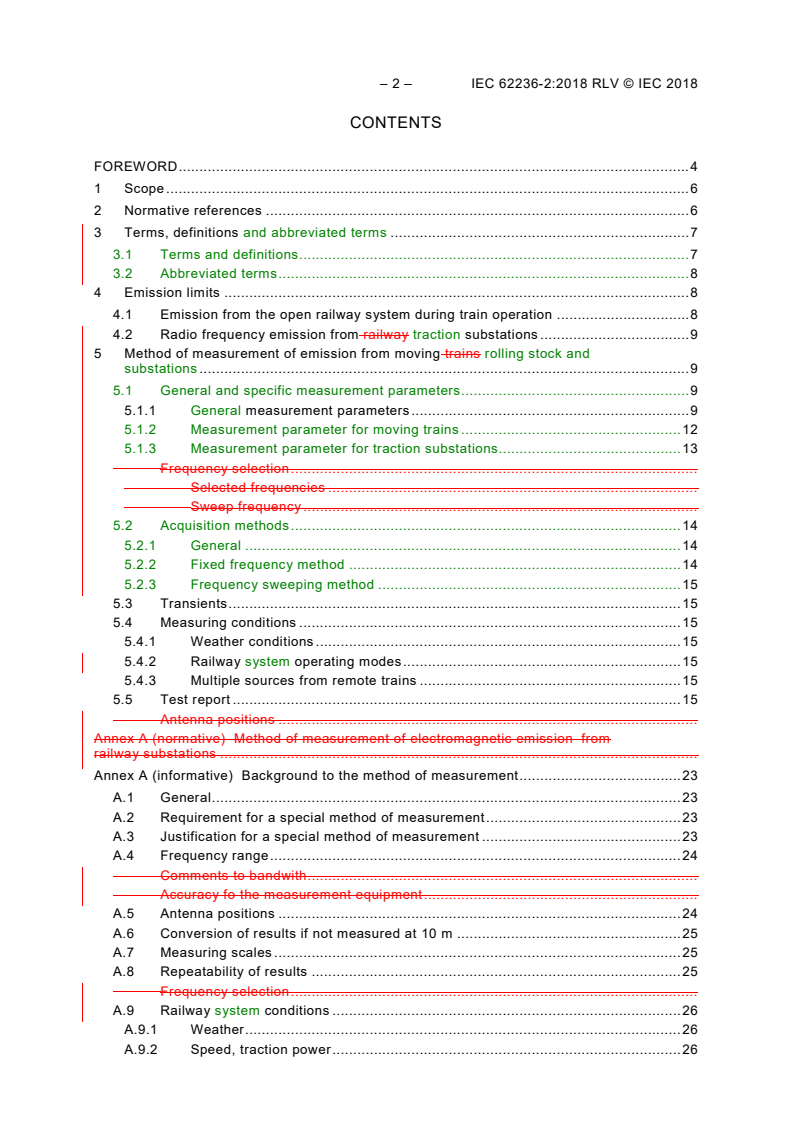
– 2 – IEC 62236-2:2018 RLV © IEC 2018
CONTENTS
FOREWORD . 4
1 Scope . 6
2 Normative references . 6
3 Terms, definitions and abbreviated terms . 7
3.1 Terms and definitions . 7
3.2 Abbreviated terms . 8
4 Emission limits . 8
4.1 Emission from the open railway system during train operation . 8
4.2 Radio frequency emission from railway traction substations . 9
5 Method of measurement of emission from moving trains rolling stock and
substations . 9
5.1 General and specific measurement parameters . 9
5.1.1 General measurement parameters . 9
5.1.2 Measurement parameter for moving trains . 12
5.1.3 Measurement parameter for traction substations. 13
Frequency selection .
Selected frequencies .
Sweep frequency .
5.2 Acquisition methods . 14
5.2.1 General . 14
5.2.2 Fixed frequency method . 14
5.2.3 Frequency sweeping method . 15
5.3 Transients . 15
5.4 Measuring conditions . 15
5.4.1 Weather conditions . 15
5.4.2 Railway system operating modes . 15
5.4.3 Multiple sources from remote trains . 15
5.5 Test report . 15
Antenna positions .
Annex A (normative) Method of measurement of electromagnetic emission from
railway substations .
Annex A (informative) Background to the method of measurement . 23
A.1 General . 23
A.2 Requirement for a special method of measurement . 23
A.3 Justification for a special method of measurement . 23
A.4 Frequency range . 24
Comments to bandwith .
Accuracy fo the measurement equipment .
A.5 Antenna positions . 24
A.6 Conversion of results if not measured at 10 m . 25
A.7 Measuring scales . 25
A.8 Repeatability of results . 25
Frequency selection .
A.9 Railway system conditions . 26
A.9.1 Weather . 26
A.9.2 Speed, traction power . 26
A.9.3 Multiple sources from remote trains . 26
A.10 Number of traction vehicles per train . 27
Annex B (informative) Cartography – Electric and magnetic fields at traction
frequencies . 28
Annex C (informative) Emission values for lower frequency range . 29
Bibliography . 32
Figure – Time variation of emissions from a moving train with many transient events.
Figure 1 – Emission limits in frequency range 9 150 kHz to 1 GHz . 17
Figure 2 – Emission limit for substations . 18
Figure 3 – Position of antenna for measurement of horizontal component of magnetic
field in the 9 150 kHz to 30 MHz frequency band . 19
Figure 4 – Position (vertical polarization) of antenna for measurement of electric field
in the 30 MHz to 300 MHz frequency band . 20
Figure 5 – Position (vertical polarization) of antenna for measurement of electric field
in the 300 MHz to 1 GHz frequency band . 21
Figure C.1 – Emission values for the open railway system route . 30
Figure C.2 – Emission values for substations . 31
Table 1 – Conversion factor n . 11
Table 2 – Scan rate . 14
Table B.1 – Typical maximum electric and magnetic field values at fundamental
frequency of different electrification systems . 28
– 4 – IEC 62236-2:2018 RLV © IEC 2018
INTERNATIONAL ELECTROTECHNICAL COMMISSION
____________
RAILWAY APPLICATIONS –
ELECTROMAGNETIC COMPATIBILITY –
Part 2: Emission of the whole railway system to the outside world
FOREWORD
1) The International Electrotechnical Commission (IEC) is a worldwide organization for standardization comprising
all national electrotechnical committees (IEC National Committees). The object of IEC is to promote
international co-operation on all questions concerning standardization in the electrical and electronic fields. To
this end and in addition to other activities, IEC publishes International Standards, Technical Specifications,
Technical Reports, Publicly Available Specifications (PAS) and Guides (hereafter referred to as “IEC
Publication(s)”). Their preparation is entrusted to technical committees; any IEC National Committee interested
in the subject dealt with may participate in this preparatory work. International, governmental and non-
governmental organizations liaising with the IEC also participate in this preparation. IEC collaborates closely
with the International Organization for Standardization (ISO) in accordance with conditions determined by
agreement between the two organizations.
2) The formal decisions or agreements of IEC on technical matters express, as nearly as possible, an international
consensus of opinion on the relevant subjects since each technical committee has representation from all
interested IEC National Committees.
3) IEC Publications have the form of recommendations for international use and are accepted by IEC National
Committees in that sense. While all reasonable efforts are made to ensure that the technical content of IEC
Publications is accurate, IEC cannot be held responsible for the way in which they are used or for any
misinterpretation by any end user.
4) In order to promote international uniformity, IEC National Committees undertake to apply IEC Publications
transparently to the maximum extent possible in their national and regional publications. Any divergence
between any IEC Publication and the corresponding national or regional publication shall be clearly indicated in
the latter.
5) IEC itself does not provide any attestation of conformity. Independent certification bodies provide conformity
assessment services and, in some areas, access to IEC marks of conformity. IEC is not responsible for any
services carried out by independent certification bodies.
6) All users should ensure that they have the latest edition of this publication.
7) No liability shall attach to IEC or its directors, employees, servants or agents including individual experts and
members of its technical committees and IEC National Committees for any personal injury, property damage or
other damage of any nature whatsoever, whether direct or indirect, or for costs (including legal fees) and
expenses arising out of the publication, use of, or reliance upon, this IEC Publication or any other IEC
Publications.
8) Attention is drawn to the Normative references cited in this publication. Use of the referenced publications is
indispensable for the correct application of this publication.
9) Attention is drawn to the possibility that some of the elements of this IEC Publication may be the subject of
patent rights. IEC shall not be held responsible for identifying any or all such patent rights.
This redline version of the official IEC Standard allows the user to identify the changes
made to the previous edition. A vertical bar appears in the margin wherever a change
has been made. Additions are in green text, deletions are in strikethrough red text.
International Standard IEC 62236-2 has been prepared by IEC technical committee 9:
Electrical equipment and systems for railways.
This third edition cancels and replaces the second edition published in 2008. It constitutes a
technical revision and has been developed on the basis of EN 50121-2:2015.
This edition includes the following significant technical changes with respect to the previous
edition:
a) clarification of scope (Clause 1);
b) combination of former Clause 5 and Annex A related to method of measurement for
moving trains and traction substations (5.1);
c) moving emission values for radiated H-fields in the frequency range 9 kHz to 150 kHz to
new Annex C due to the fact that:
– there are very few outside world victims;
– there is low reproducibility.
d) clarification of acquisition method (5.2).
This International Standard is to be read in conjunction with IEC 62236-1.
The text of this International Standard is based on the following documents:
FDIS Report on voting
9/2336/FDIS 9/2366/RVD
Full information on the voting for the approval of this International Standard can be found in
the report on voting indicated in the above table.
A list of all parts in the IEC 62236, published under the general title Railway applications –
Electromagnetic compatibility, can be found on the IEC website.
This document has been drafted in accordance with the ISO/IEC Directives, Part 2.
The committee has decided that the contents of this document will remain unchanged until the
stability date indicated on the IEC website under "http://webstore.iec.ch" in the data related to
the specific document. At this date, the document will be
• reconfirmed,
• withdrawn,
• replaced by a revised edition, or
• amended.
IMPORTANT – The “colour inside” logo on the cover page of this publication indicates
that it contains colours which are considered to be useful for the correct understanding
of its contents. Users should therefore print this publication using a colour printer.
– 6 – IEC 62236-2:2018 RLV © IEC 2018
RAILWAY APPLICATIONS –
ELECTROMAGNETIC COMPATIBILITY –
Part 2: Emission of the whole railway system to the outside world
1 Scope
This part of IEC 62236 sets is intended to define the emission limits from electromagnetic
environment of the whole railway system including urban vehicles for use in city streets mass
transit and light rail system. It describes the measurement method to verify the emissions,
and gives the cartography values of the fields most frequently encountered.
This document specifies the emission limits of the whole railway system to the outside world.
The limits emission parameters refer to the particular measuring points defined in Clause 5
and Annex A. These emissions should be are assumed to exist at all points in the vertical
planes which are 10 m from the centre lines of the outer electrified railway tracks, or 10 m
from the fence of the substations.
Also, the zones above and below the railway system may be affected by electromagnetic
emissions and particular cases shall be are considered individually.
These specific provisions are to be used in conjunction with the general provisions in
IEC 62236-1.
For existing railway lines, it is assumed that compliance with the emission requirements of
IEC 62236-3-1, IEC 62236-3-2, IEC 62236-4 and IEC 62236-5 will ensure the compliance with
the emission values given in this document.
For newly built railway systems, it is best practice to provide compliance to the emission limits
given in this document (to be defined in the EMC plan according to IEC 62236-1).
2 Normative references
The following documents are referred to in the text in such a way that some or all of their
content constitutes requirements of this document. For dated references, only the edition
cited applies. For undated references, the latest edition of the referenced document (including
any amendments) applies.
IEC 60050-161, International Electrotechnical Vocabulary (IEV) – Chapter 161:
Electromagnetic compatibility (EMC)
IEC 62236-1:2018, Railway applications – Electromagnetic compatibility – Part 1: General
IEC 62236-3-1, Railway applications – Electromagnetic compatibility – Part 3-1: Rolling stock
– Train and complete vehicle
CISPR 16-1-1:2015, Specification for radio disturbance and immunity measuring apparatus
and methods – Part 1-1: Radio disturbance and immunity measuring apparatus – Measuring
apparatus
CISPR 16-1-4:2010, Specification for radio disturbance and immunity measuring apparatus
and methods – Part 1-4: Radio disturbance and immunity measuring apparatus – Antennas
and test sites for radiated disturbance measurements
CISPR 16-1-4:2010/AMD1:2012
CISPR 16-1-4:2010/AMD2:2017
CISPR 22, Information technology equipment – Radio disturbance characteristics – Limits and
methods of measurement
3 Terms, definitions and abbreviated terms
For the purposes of this document, the following terms and definitions of IEC 60050-161 and
the following apply.
ISO and IEC maintain terminological databases for use in standardization at the following
addresses:
• IEC Electropedia: available at http://www.electropedia.org/
• ISO Online browsing platform: available at http://www.iso.org/obp
3.1 Terms and definitions
3.1.1
apparatus
electric or electronic product with an intrinsic function intended for implementation into a fixed
railway installation
device or assembly of devices which can be used as an independent unit for specific functions
[SOURCE: IEC 60050-151:2001, 151-11-22]
3.1.2
environment
the surrounding objects or region which may influence the behaviour of the system and/or
may be influenced by the system
surroundings in which a product or system exists, including air, water, land, natural resources,
flora, fauna, humans and their interrelation
[SOURCE: IEC Guide 109:2012, 3.3]
[SOURCE: IEC 60050-901:2013, 901-07-01]
3.3
external interface
boundary where a system interacts with any other or where a system interacts with its
environment
3.4
railway substation
installation the main function of which is to supply a contact line system at which the voltage
of a primary supply system, and in some cases the frequency, is transformed to the voltage
and frequency of the contact line
3.5
railway supply lines
conductors running within the boundary of the railway which supply power to only the railway
but are not energised at railway system voltage
– 8 – IEC 62236-2:2018 RLV © IEC 2018
3.1.3
traction substation,
substation,
substation the main function of which is to supply an electric traction system
Note 1 to entry: The synonym substation is used only when the context is clear.
[SOURCE: IEC 60050-811:2017, 811-36-02]
3.1.4
rolling stock
all vehicles with or without motors
Note 1 to entry: Examples of vehicles include a locomotive, a coach and a wagon.
[SOURCE: IEC 60050-811:2017, 811-02-01]
3.2 Abbreviated terms
AC Alternating current
BW Band width
DC Direct current
E Electric (field)
EMC Electromagnetic Compatibility
FFT Fast Fourier transform
H Magnetic (field)
HV High voltage
ITU International Telecommunication Union
r.m.s. root mean square
4 Emission limits
4.1 Emission from the open railway route system during train operation
The emission limits in the frequency range 9 150 kHz to 1 GHz are given in Figure 1 and the
measurement method is defined in Clause 5. For non-electrified lines, the limits are the same
as those given for 750 V d.c.
Annex B gives guidance values for typical maximum field values at fundamental frequency of
different electrification traction power systems which may can occur. They depend on
numerous geometrical and operational parameters which may can be obtained from the
infrastructure controller manager.
For urban vehicles operating in city streets, the emission limits given in Figure 1 for 750 V d.c.
conductor rail shall not be exceeded.
NOTE 1 There are very few external radio services operating in the range 9 kHz to150 kHz with which the railway
can interfere. If it can be demonstrated that no compatibility problem exists, any emission level exceeding the
relevant limits given in Figure 1 may be acceptable.
NOTE 2 It is not possible to undertake complete tests with quasi-peak detection due to the
reasons stated in Annex A.
There may be cases in which radio or other railway external services with working frequencies
below 150 kHz are in operation close to the railway system. The EMC management plan
covers these cases and an adequate level of emission from the railway system on these
working frequencies may be found in the values given in informative Annex C, hence no
guarantee can be given for an undisturbed operation.
4.2 Radio frequency emission from railway traction substations
Radio frequency noise emission from the railway traction substation to the outside
environment measured according to the method defined in Annex A Clause 5 shall not exceed
the limits in Figure 2.
The limits are defined as quasi-peak values and the bandwidths are those used in
CISPR 16-1-1:
Bandwidth
frequencies up to 150 kHz 200 Hz
Frequencies from 150 kHz to 30 MHz 9 kHz (BW 1)
Frequencies above 30 MHz 120 kHz (BW 2)
The distance of 10 m defined in Annex A Clause 5 shall be measured from the fence of the
substation. If no fence exists, the measurements shall be taken at 10 m from the apparatus or
from the outer surface of the enclosure if it is enclosed.
Emission of trains shall not enter into the measurement.
NOTE 1 There are very few external radio services operating in the range 9 kHz to 150 kHz with which the railway
can interfere. If it can be demonstrated that no compatibility problem exists, any emission level exceeding the
relevant limits given in Figure 2 may be acceptable.
NOTE 2 For other kinds of fixed installations like auto-transformers, the same limit and
measuring distance shall be applied.
There may be cases in which radio or other railway external services with working frequencies
below 150 kHz are in operation close to the traction substation. The EMC management plan
covers these cases and an adequate level of emission from traction substation on these
working frequencies may be found in the values given in informative Annex C, hence no
guarantee can be given for an undisturbed operation.
5 Method of measurement of emission from moving trains rolling stock and
substations
5.1 General and specific measurement parameters
NOTE The method of measurement is adapted from CISPR 16-1-1 16-2-3 to a railway system with moving
vehicles rolling stock and substations. The background to the method of measurement of moving rolling stock is
given in Annex A.
The electromagnetic fields generated by rail vehicles when operating on a railway network are
measured by means of field strength meters with several different set frequencies. The
horizontal component of the magnetic field perpendicular to the track and both the vertical
and horizontal (parallel to the track) components of the radiated electric field are measured.
5.1.1 General measurement parameters
5.1.1.1 Frequency bands
The peak measurement method is used. The duration at selected frequency shall be sufficient
to obtain an accurate reading. This is a function of the measuring set and the recommended
value is 50 ms.
– 10 – IEC 62236-2:2018 RLV © IEC 2018
Frequency bands and bandwidths at –6 dB used for measurements are in accordance with
CISPR 16-1-1.
These are:
Frequency 9-150 kHz 0,15 MHz to 30 MHz 30 MHz to 300 MHz 300 MHz to 1 GHz
bands:
Bandwidth: 200 Hz 9 kHz (BW 1) 120 kHz (BW 2) 120 kHz (BW 2)
When connected to the antenna, the error of measurement of the strength of a uniform sine-
wave field shall not differ more than ± 4,0 dB from CISPR 16-1-1 equipment.
Other bandwidth for peak measurement can be chosen according to CISPR 16-1-1. Data
measured with the reference bandwidth shall take precedence.
The noise may not attain its maximum value as the traction vehicle passes the measuring
point, but may occur when the vehicle is a long distance away. Therefore, the measuring set
shall be active for a sufficient duration before and after the vehicle passes by to ensure that
the maximum noise level is recorded.
5.1.1.2 Measurement uncertainty
The measurement uncertainty of the measuring equipment shall comply with the requirements
in CISPR 16-1-1 and CISPR 16-1-4.
Due to the measurement method, the normalized site attenuation may not be considered in
the measurement uncertainty.
5.1.1.3 Types of antennas
To cover the full frequency range, antennas of different design are required. Typical
equipment is described below:
– for 9 kHz to 30 MHz, a loop or frame antenna is used to measure H field (see Figure 3);
– for 150 kHz to 30 MHz, a loop or frame antenna is used to measure H field (see Figure 3);
– for 30 MHz to 300 MHz, a biconical dipole is used to measure E field (see Figure 4);
– for 300 MHz to 1,0 GHz, a log-periodic antenna is used to measure E field (see Figure 5).
For measurements in the frequency range of 30 MHz to 1 GHz a combined antenna may be
used.
Calibrated antenna factors are used to convert the terminal voltage of the antenna to field
strength.
5.1.1.4 Measurement distance and height
The preferred distance of the measuring antenna from the centreline of the track on which the
vehicle is moving (Test track) is 10 m. In the case of the log-periodic antenna, the 10 m
distance is measured to the mechanical centre of the array.
It is not considered necessary to carry out two tests to examine both sides of the vehicle,
even if it contains different apparatus on the two sides, since the majority of the emission is
produced by the sliding contact if the train is moving.
The preferred distance of the measuring antenna while measuring the emission of the
substation is 10 m from the outer fence of the substation, at the midpoints of the three sides,
excluding the side which faces the railway system, unless this side is more than 30 m from
the centre of the nearest electrified railway track. In this case all four sides shall be
measured. If the length of the side of the substation is more than 30 m, measurements shall
be taken additionally at the corners.
Where the tests are carried out at a site which meets all the recommended criteria except that
the antennas are not at 10 m from the track centreline, the results can be converted to an
equivalent 10 m value by using the following formula:
E = E + n x 20 × log (D/10)
10 x 10
where
E is the value at 10 m;
E is the measured value at D m;
x
n is a factor taken from Table 1 below.
Table 1 – Conversion factor n
Frequency range n
9 kHz to 150 kHz 2
0,15 MHz to 0,4 MHz 1,8
0,4 MHz to 1,6 MHz 1,65
1,6 MHz to 110 MHz 1,2
110 MHz to 1 000 MHz 1,0
The measured values (at the equivalent 10 m distance) shall not exceed the limits given in
Figure1 for the appropriate system voltage.
Where the physical layout of the railway totally prevents the use of reference distances, a
method shall be agreed to suit the particular circumstances. For example, if the railway is in
tunnel, miniature antennas can be used on the wall of the tunnel. In such a case, the limits
selected shall take into account the method of measurement.
No measurements are necessary for total underground railway systems with no surface
operation (no victim outside this railway system can be affected).
The height above rail reference level of the antenna centre shall be within the range 1,0 m to
2,0 m for the loop antenna, and within 2,5 m to 3,5 m to the centre of dipole or log-periodic
antennas measuring antenna above 30 MHz. One measuring height within the given range is
sufficient and it is not required to do measurements with several antenna heights within this
range. The selected height shall be noted in the test report.
The reference level for the substation is the ground.
The reference level for moving trains is the top of the rail.
If the actual level of the ground at the antenna differs from the top of the rail level by more
than 0,5 m, the actual value shall be noted in the test report.
It is accepted that the fixed antenna position may result in values being less than the absolute
maximum at some frequencies.
5.1.1.5 Values of measurement
The values measured are expressed as:
– 12 – IEC 62236-2:2018 RLV © IEC 2018
– dBµA/m for magnetic fields,
– dBµV/m for electric fields.
These are obtained by using the appropriate antenna factors and conversions.
5.1.1.6 Antenna position and orientation
The plane of the loop antenna shall be vertical and parallel to the line of the track positioned
to measure the horizontal component of the magnetic field perpendicular to the track
respectively to the wall of the substation. The biconical dipole shall be placed in the vertical
and horizontal axis. The log periodic antenna shall be arranged to measure the vertical and
horizontal polarization signal, with the antenna directed towards the track respectively to the
wall of the substation.
The test locations should whenever possible avoid objects with changing of field characteristic
like turnouts, walls and under bridges.
Figures 3, 4 and 5 show the positions and vertical alignments of the antennas as an example
for measurements at the track.
5.1.1.7 Ambient noise
At the beginning and at the end of the test series the ambient noise shall be recorded.
If at specific frequencies or in specific frequency ranges the ambient noise is higher than the
limit values less 6 dB (ambient noise > (emission limit – 6 dB)), the measurements at these
frequencies need not be considered. These frequencies shall be noted in the test report.
5.1.2 Measurement parameter for moving trains
This subclause summarizes the specific conditions for the measurement of moving rolling
stock.
– It is not considered necessary to carry out two tests to examine both sides of the rolling
stock, even if it contains different apparatus on the two sides, as in the majority of cases
the level of fields is due to the radiation of catenary and not to the direct radiation from the
train. For systems with a third rail, measurements have to be performed at the same side
of it.
– The peak measurement method is used. The duration at selected frequency shall be
sufficient to obtain an accurate reading. This is a function of the measuring set and the
recommended value is 50 ms.
– The noise may not attain its maximum value as the traction vehicle passes the measuring
point, but may occur when the vehicle is a long distance away. Therefore, the measuring
set shall be active for a sufficient duration before and after the vehicle passes by to
ensure that the maximum noise level is recorded.
– In the case of elevated railway systems, if the antenna heights specified above cannot be
achieved, the height of the antenna centre can be referenced to the level of the ground
instead of to the top of the rail level. The conversion formula in 5.1.1.4 shall be employed
where D is the slant distance between the train and the antenna. The train shall be visible
from the location of the antenna and the axis of the antenna shall be elevated to point
directly at the train. A measurement distance of 30 m from the track centreline is preferred
for highly elevated railways systems. Full details of the test configuration shall be noted in
the test report.
– If tests are being carried out on a railway system with overhead electrified supply, the
measuring point shall be at the mid-point midspan between the support masts of the
overhead contact line and not at a discontinuity of the contact wire. It is recognized that
resonance can exist in an overhead system at radio frequencies and this may require
changes in the values of frequency chosen for measurement. If resonance exists, this
should shall be noted in the test report.
The radio frequency emission will be affected by the state of the railway system supply
system. Switching of feeder stations and temporary works will influence the response of
the system. It is therefore necessary to note the condition of the system in the test record
and, if possible, all similar tests should be carried out within the same working day. Where
the railway system has a track-side conductor rail power supply, the test location should
be at least 100 m from gaps in the rail, to avoid inclusion of the transient fields associated
with the make and break of collector contact. The conductor rail and the antennas shall be
on the same side of the track.
– The test sites do not correspond to the definition of a completely clear site because they
are influenced by overhead structures, rails and the catenary. However, wherever
possible, antennas shall be placed installed well away from reflecting objects. If overhead
HV power lines are nearby, other than those which are part of the railway network, they
should be no closer than 100 m to the test site.
Background noise shall be measured at the test site in the absence of train effects. This will
give the noise values from the energised power supply conductors. If this is significant, it is
advisable to measure also at 100 m from the test site, to identify any high non-railway sources
of noise.
5.1.3 Measurement parameter for traction substations
This subclause summarizes the specific conditions for the measurement of substations.
– Test configurations: In view of the special geometry of a railway system traction supply
system, it is necessary to perform the measurement of emission of electromagnetic fields
under normal feeding configuration of the traction supply system.
– Substation load: A feature of traction substations is that the load can change widely in
short times. Since emission can be related to load, the actual loading of the substation
shall be noted during emission tests.
– Each measurement shall be started with a peak max hold sweep. If the limits are
exceeded due to the substation then it is required to take a measurement from a quasi-
peak over the specific frequency range where these limits have been overrun. It is known
that the load condition cannot be reproduced exactly during quasi-peak measurement,
hence these load conditions should be at least comparable.
5.2 Frequency selection
5.2.1 Selected frequencies
The selection of the actual frequencies to be measured will depend on the circumstances of
the test site.
If high signals exist, for example from public broadcasting stations, the selection of test
frequencies shall take this into account.
It is recommended that test frequencies are selected so that there are at least three
frequencies per decade.
5.2.2 Sweep frequency
In view of the short time available for measurement in one train passage, the use of a sweep
frequency measuring technique, in which the peak noise is measured with a peak-hold circuit
as the frequency is changed, may offer adequate information concerning generation of noise.
There will still remain problems of time because the rate of change of frequency is a function
of the bandwidth, due to considerations of accuracy. A sweep analyser will usually set its own
sweep rate to meet this requirement. If this method is used, sweep rate as well as bandwidth
shall be noted.
– 14 – IEC 62236-2:2018 RLV © IEC 2018
5.2 Acquisition methods
5.2.1 General
The electromagnetic disturbances generated by railway network including operating rolling
stock are measured by the two following methods:
a) the fixed frequency method;
b) the frequency sweeping method.
The measurement method shall be chosen according to the rolling stock operating modes
(see 5.4.2) depending on the train speed.
– For test at high speed the following has to be taken into account:
The fixed frequency method can be used, because it allows continuous monitoring at each
frequency.
Alternative methods are allowed if the equivalent scan rate is at least that defined in Table 2
which is sufficiently short for such a moving source.
This ensures that the frequency results are measured at least every 5 m of train movement.
At higher speeds a spectrum analysis swept frequency method is unlikely to be practical, but
FFT techniques may be feasible. The measurement equipment shall comply with
CISPR 16-1-1.
Table 2 – Scan rate
Speed of train Speed of train Time for an observation width
of 5 m (scan rate)
km/h m/s
s
60 16,67 0,300
100 27,78 0,180
200 55,56 0,090
300 83,33 0,060
320 88,89 0,056
NOTE Observation width is the part of rolling stock to be observed in given time.
– When the rolling stock will be moving at a slower speed with the maximum rated power
(see 5.4.2), the frequency sweeping method shall be used.
5.2.2 Fixed frequency method
The fixed frequency method consists of measuring the radiated emissions at only some
frequencies (it is recommended to take at least 3 frequencies per decade) using the zero span
mode of the spectrum analyser or setting the measuring receiver at the frequency to be
checked.
The fixed frequencies shall be chosen according to the ambient noise, i.e. in the areas where
the ambient field is the lowest.
The measurement of the field level shall be performed for each frequency during a complete
passage of the train.
5.2.3 Frequency sweeping method
For the frequency sweeping method, the frequency range shall be divided into several sub-
ranges according to the train speed in order to have a relevant sweep time in comparison with
the train speed.
The measurement of the field level shall be performed in each sub-range during a complete
passage of the train. The max-hold function of the spectrum analyser shall be used.
5.3 Transients
During the test, transients due to switching may be detected, such as those caused by
operation of power circuit breakers. These shall be disregarded when selecting the maximum
signal level found for the test.
5.4 Measuring conditions
5.4.1 Weather conditions
To minimize the possible effect of weather on the measured values, measurements should be
carried out in dry weather, (after 24 h during which not more than 0,1 mm rain has fallen), with
a minimum temperature of at least 5 °C, and a wind velocity of less than 10 m/s.
Humidity should be low enough to prevent condensation on the power supply conductors.
Since it is necessary to plan the tests before the weather conditions can be known, tests will
have to be carried out in the weather conditions which do not meet the target conditions
found. In these circumstances, the actual weather conditions shall be recorded with the test
results.
5.4.2 Railway system operating modes
Two test conditions are specified for the traction mode and are:
a) measurement at a speed of more than 90 % of the maximum service speed, (to ensure
that the dynamics of current collection are involved in the noise level) and at the maximum
power which can be delivered at that speed;
b) at the maximum rated power and at a selected speed, (particularly if the lower frequencies
are of concern).
If the vehicle is capable of electric braking, tests are required at a brake power of at least
80 % of the rated maximum brake power.
5.4.3 Multiple sources from remote trains
For the purpose of limits, the presence of “physically-remote but electrically-near” vehicles out
of the test zone is regarded as insignificant when considering radio noise.
5.5 Test report
The test report shall contain the following information:
– description of site;
– description of measuring system;
– description of railway vehicle (type, configuration and mode of electric braking);
– numerical results;
– graphical results where relevant (The results shall include information such as bandwidths,
date, time, ambient noise and excluded frequencies (see 5.1.1.7));
– 16 – IEC 62236-2:2018 RLV © IEC 2018
– weather conditions;
– name(s) or equivalent identification of person(s) in charge at site authorizing the test
report.
5.6 Antenna positions
Figure 3 shows the position of the antenna for measurement of the magnetic field in the
9 kHz to 30 MHz frequency band.
Figure 4 shows the position (vertical polarisation) of the antenna for measurement of the
electric field in the 30 MHz to 300 MHz frequency band. For the measurement of the
horizontal field parallel to the track, the antenna is turned by 90°.
Figure 5 shows t
...
IEC 62236-2 ®
Edition 3.0 2018-02
INTERNATIONAL
STANDARD
NORME
INTERNATIONALE
Railway applications – Electromagnetic compatibility –
Part 2: Emission of the whole railway system to the outside world
Applications ferroviaires – Compatibilité électromagnétique –
Partie 2: Émission du système ferroviaire dans son ensemble vers le monde
extérieur
All rights reserved. Unless otherwise specified, no part of this publication may be reproduced or utilized in any form
or by any means, electronic or mechanical, including photocopying and microfilm, without permission in writing from
either IEC or IEC's member National Committee in the country of the requester. If you have any questions about IEC
copyright or have an enquiry about obtaining additional rights to this publication, please contact the address below or
your local IEC member National Committee for further information.
Droits de reproduction réservés. Sauf indication contraire, aucune partie de cette publication ne peut être reproduite
ni utilisée sous quelque forme que ce soit et par aucun procédé, électronique ou mécanique, y compris la photocopie
et les microfilms, sans l'accord écrit de l'IEC ou du Comité national de l'IEC du pays du demandeur. Si vous avez des
questions sur le copyright de l'IEC ou si vous désirez obtenir des droits supplémentaires sur cette publication, utilisez
les coordonnées ci-après ou contactez le Comité national de l'IEC de votre pays de résidence.
IEC Central Office Tel.: +41 22 919 02 11
3, rue de Varembé info@iec.ch
CH-1211 Geneva 20 www.iec.ch
Switzerland
About the IEC
The International Electrotechnical Commission (IEC) is the leading global organization that prepares and publishes
International Standards for all electrical, electronic and related technologies.
About IEC publications
The technical content of IEC publications is kept under constant review by the IEC. Please make sure that you have the
latest edition, a corrigenda or an amendment might have been published.
IEC Catalogue - webstore.iec.ch/catalogue Electropedia - www.electropedia.org
The stand-alone application for consulting the entire The world's leading online dictionary of electronic and
bibliographical information on IEC International Standards, electrical terms containing 21 000 terms and definitions in
Technical Specifications, Technical Reports and other English and French, with equivalent terms in 16 additional
documents. Available for PC, Mac OS, Android Tablets and languages. Also known as the International Electrotechnical
iPad. Vocabulary (IEV) online.
IEC publications search - webstore.iec.ch/advsearchform IEC Glossary - std.iec.ch/glossary
The advanced search enables to find IEC publications by a 67 000 electrotechnical terminology entries in English and
variety of criteria (reference number, text, technical French extracted from the Terms and Definitions clause of
committee,…). It also gives information on projects, replaced IEC publications issued since 2002. Some entries have been
and withdrawn publications. collected from earlier publications of IEC TC 37, 77, 86 and
CISPR.
IEC Just Published - webstore.iec.ch/justpublished
Stay up to date on all new IEC publications. Just Published IEC Customer Service Centre - webstore.iec.ch/csc
details all new publications released. Available online and If you wish to give us your feedback on this publication or
also once a month by email. need further assistance, please contact the Customer Service
Centre: sales@iec.ch.
A propos de l'IEC
La Commission Electrotechnique Internationale (IEC) est la première organisation mondiale qui élabore et publie des
Normes internationales pour tout ce qui a trait à l'électricité, à l'électronique et aux technologies apparentées.
A propos des publications IEC
Le contenu technique des publications IEC est constamment revu. Veuillez vous assurer que vous possédez l’édition la
plus récente, un corrigendum ou amendement peut avoir été publié.
Catalogue IEC - webstore.iec.ch/catalogue Electropedia - www.electropedia.org
Application autonome pour consulter tous les renseignements
Le premier dictionnaire en ligne de termes électroniques et
bibliographiques sur les Normes internationales,
électriques. Il contient 21 000 termes et définitions en anglais
Spécifications techniques, Rapports techniques et autres
et en français, ainsi que les termes équivalents dans 16
documents de l'IEC. Disponible pour PC, Mac OS, tablettes
langues additionnelles. Egalement appelé Vocabulaire
Android et iPad.
Electrotechnique International (IEV) en ligne.
Recherche de publications IEC -
Glossaire IEC - std.iec.ch/glossary
webstore.iec.ch/advsearchform
67 000 entrées terminologiques électrotechniques, en anglais
La recherche avancée permet de trouver des publications IEC et en français, extraites des articles Termes et Définitions des
en utilisant différents critères (numéro de référence, texte, publications IEC parues depuis 2002. Plus certaines entrées
comité d’études,…). Elle donne aussi des informations sur les antérieures extraites des publications des CE 37, 77, 86 et
projets et les publications remplacées ou retirées. CISPR de l'IEC.
IEC Just Published - webstore.iec.ch/justpublished Service Clients - webstore.iec.ch/csc
Restez informé sur les nouvelles publications IEC. Just Si vous désirez nous donner des commentaires sur cette
Published détaille les nouvelles publications parues. publication ou si vous avez des questions contactez-nous:
Disponible en ligne et aussi une fois par mois par email. sales@iec.ch.
IEC 62236-2 ®
Edition 3.0 2018-02
INTERNATIONAL
STANDARD
NORME
INTERNATIONALE
Railway applications – Electromagnetic compatibility –
Part 2: Emission of the whole railway system to the outside world
Applications ferroviaires – Compatibilité électromagnétique –
Partie 2: Émission du système ferroviaire dans son ensemble vers le monde
extérieur
INTERNATIONAL
ELECTROTECHNICAL
COMMISSION
COMMISSION
ELECTROTECHNIQUE
INTERNATIONALE
ICS 33.100; 45.060.01 ISBN 978-2-8322-5307-6
– 2 – IEC 62236-2:2018 © IEC 2018
CONTENTS
FOREWORD . 4
1 Scope . 6
2 Normative references . 6
3 Terms, definitions and abbreviated terms . 6
3.1 Terms and definitions . 7
3.2 Abbreviated terms . 7
4 Emission limits . 8
4.1 Emission from the open railway system during train operation . 8
4.2 Radio frequency emission from traction substations . 8
5 Method of measurement of emission from moving rolling stock and substations . 8
5.1 General and specific measurement parameters . 8
5.1.1 General measurement parameters . 9
5.1.2 Measurement parameter for moving trains . 11
5.1.3 Measurement parameter for traction substations. 11
5.2 Acquisition methods . 12
5.2.1 General . 12
5.2.2 Fixed frequency method . 13
5.2.3 Frequency sweeping method . 13
5.3 Transients . 13
5.4 Measuring conditions . 13
5.4.1 Weather conditions . 13
5.4.2 Railway system operating modes . 13
5.4.3 Multiple sources from remote trains . 13
5.5 Test report . 14
Annex A (informative) Background to the method of measurement . 20
A.1 General . 20
A.2 Requirement for a special method of measurement . 20
A.3 Justification for a special method of measurement . 20
A.4 Frequency range . 21
A.5 Antenna positions . 21
A.6 Conversion of results if not measured at 10 m . 21
A.7 Measuring scales . 21
A.8 Repeatability of results . 22
A.9 Railway system conditions . 22
A.9.1 Weather . 22
A.9.2 Speed, traction power . 22
A.9.3 Multiple sources from remote trains . 22
A.10 Number of traction vehicles per train . 22
Annex B (informative) Cartography – Electric and magnetic fields at traction
frequencies . 23
Annex C (informative) Emission values for lower frequency range . 24
Bibliography . 27
Figure 1 – Emission limits in frequency range 150 kHz to 1 GHz . 15
Figure 2 – Emission limit for substations . 16
Figure 3 – Position of antenna for measurement of horizontal component of magnetic
field in the 150 kHz to 30 MHz frequency band . 17
Figure 4 – Position (vertical polarization) of antenna for measurement of electric field
in the 30 MHz to 300 MHz frequency band . 18
Figure 5 – Position (vertical polarization) of antenna for measurement of electric field
in the 300 MHz to 1 GHz frequency band . 19
Figure C.1 – Emission values for the open railway system route . 25
Figure C.2 – Emission values for substations . 26
Table 1 – Conversion factor n . 10
Table 2 – Scan rate . 12
Table B.1 – Typical maximum electric and magnetic field values at fundamental
frequency of different electrification systems . 23
– 4 – IEC 62236-2:2018 © IEC 2018
INTERNATIONAL ELECTROTECHNICAL COMMISSION
____________
RAILWAY APPLICATIONS –
ELECTROMAGNETIC COMPATIBILITY –
Part 2: Emission of the whole railway system to the outside world
FOREWORD
1) The International Electrotechnical Commission (IEC) is a worldwide organization for standardization comprising
all national electrotechnical committees (IEC National Committees). The object of IEC is to promote
international co-operation on all questions concerning standardization in the electrical and electronic fields. To
this end and in addition to other activities, IEC publishes International Standards, Technical Specifications,
Technical Reports, Publicly Available Specifications (PAS) and Guides (hereafter referred to as “IEC
Publication(s)”). Their preparation is entrusted to technical committees; any IEC National Committee interested
in the subject dealt with may participate in this preparatory work. International, governmental and non-
governmental organizations liaising with the IEC also participate in this preparation. IEC collaborates closely
with the International Organization for Standardization (ISO) in accordance with conditions determined by
agreement between the two organizations.
2) The formal decisions or agreements of IEC on technical matters express, as nearly as possible, an international
consensus of opinion on the relevant subjects since each technical committee has representation from all
interested IEC National Committees.
3) IEC Publications have the form of recommendations for international use and are accepted by IEC National
Committees in that sense. While all reasonable efforts are made to ensure that the technical content of IEC
Publications is accurate, IEC cannot be held responsible for the way in which they are used or for any
misinterpretation by any end user.
4) In order to promote international uniformity, IEC National Committees undertake to apply IEC Publications
transparently to the maximum extent possible in their national and regional publications. Any divergence
between any IEC Publication and the corresponding national or regional publication shall be clearly indicated in
the latter.
5) IEC itself does not provide any attestation of conformity. Independent certification bodies provide conformity
assessment services and, in some areas, access to IEC marks of conformity. IEC is not responsible for any
services carried out by independent certification bodies.
6) All users should ensure that they have the latest edition of this publication.
7) No liability shall attach to IEC or its directors, employees, servants or agents including individual experts and
members of its technical committees and IEC National Committees for any personal injury, property damage or
other damage of any nature whatsoever, whether direct or indirect, or for costs (including legal fees) and
expenses arising out of the publication, use of, or reliance upon, this IEC Publication or any other IEC
Publications.
8) Attention is drawn to the Normative references cited in this publication. Use of the referenced publications is
indispensable for the correct application of this publication.
9) Attention is drawn to the possibility that some of the elements of this IEC Publication may be the subject of
patent rights. IEC shall not be held responsible for identifying any or all such patent rights.
International Standard IEC 62236-2 has been prepared by IEC technical committee 9:
Electrical equipment and systems for railways.
This third edition cancels and replaces the second edition published in 2008. It constitutes a
technical revision and has been developed on the basis of EN 50121-2:2015.
This edition includes the following significant technical changes with respect to the previous
edition:
a) clarification of scope (Clause 1);
b) combination of former Clause 5 and Annex A related to method of measurement for
moving trains and traction substations (5.1);
c) moving emission values for radiated H-fields in the frequency range 9 kHz to 150 kHz to
new Annex C due to the fact that:
– there are very few outside world victims;
– there is low reproducibility.
d) clarification of acquisition method (5.2).
This International Standard is to be read in conjunction with IEC 62236-1.
The text of this International Standard is based on the following documents:
FDIS Report on voting
9/2336/FDIS 9/2366/RVD
Full information on the voting for the approval of this International Standard can be found in
the report on voting indicated in the above table.
A list of all parts in the IEC 62236, published under the general title Railway applications –
Electromagnetic compatibility, can be found on the IEC website.
This document has been drafted in accordance with the ISO/IEC Directives, Part 2.
The committee has decided that the contents of this document will remain unchanged until the
stability date indicated on the IEC website under "http://webstore.iec.ch" in the data related to
the specific document. At this date, the document will be
• reconfirmed,
• withdrawn,
• replaced by a revised edition, or
• amended.
– 6 – IEC 62236-2:2018 © IEC 2018
RAILWAY APPLICATIONS –
ELECTROMAGNETIC COMPATIBILITY –
Part 2: Emission of the whole railway system to the outside world
1 Scope
This part of IEC 62236 is intended to define the electromagnetic environment of the whole
railway system including urban mass transit and light rail system. It describes the
measurement method to verify the emissions, and gives the cartography values of the fields
most frequently encountered.
This document specifies the emission limits of the whole railway system to the outside world.
The emission parameters refer to the particular measuring points defined in Clause 5. These
emissions are assumed to exist at all points in the vertical planes which are 10 m from the
centre lines of the outer electrified railway tracks, or 10 m from the fence of the substations.
Also, the zones above and below the railway system may be affected by electromagnetic
emissions and particular cases are considered individually.
These specific provisions are used in conjunction with the general provisions in IEC 62236-1.
For existing railway lines, it is assumed that compliance with the emission requirements of
IEC 62236-3-1, IEC 62236-3-2, IEC 62236-4 and IEC 62236-5 will ensure the compliance with
the emission values given in this document.
For newly built railway systems, it is best practice to provide compliance to the emission limits
given in this document (to be defined in the EMC plan according to IEC 62236-1).
2 Normative references
The following documents are referred to in the text in such a way that some or all of their
content constitutes requirements of this document. For dated references, only the edition
cited applies. For undated references, the latest edition of the referenced document (including
any amendments) applies.
IEC 62236-1:2018, Railway applications – Electromagnetic compatibility – Part 1: General
CISPR 16-1-1:2015, Specification for radio disturbance and immunity measuring apparatus
and methods – Part 1-1: Radio disturbance and immunity measuring apparatus – Measuring
apparatus
CISPR 16-1-4:2010, Specification for radio disturbance and immunity measuring apparatus
and methods – Part 1-4: Radio disturbance and immunity measuring apparatus – Antennas
and test sites for radiated disturbance measurements
CISPR 16-1-4:2010/AMD1:2012
CISPR 16-1-4:2010/AMD2:2017
3 Terms, definitions and abbreviated terms
For the purposes of this document, the following terms and definitions apply.
ISO and IEC maintain terminological databases for use in standardization at the following
addresses:
• IEC Electropedia: available at http://www.electropedia.org/
• ISO Online browsing platform: available at http://www.iso.org/obp
3.1 Terms and definitions
3.1.1
apparatus
device or assembly of devices which can be used as an independent unit for specific functions
[SOURCE: IEC 60050-151:2001, 151-11-22]
3.1.2
environment
surroundings in which a product or system exists, including air, water, land, natural resources,
flora, fauna, humans and their interrelation
[SOURCE: IEC Guide 109:2012, 3.3]
[SOURCE: IEC 60050-901:2013, 901-07-01]
3.1.3
traction substation,
substation,
substation the main function of which is to supply an electric traction system
Note 1 to entry: The synonym substation is used only when the context is clear.
[SOURCE: IEC 60050-811:2017, 811-36-02]
3.1.4
rolling stock
all vehicles with or without motors
Note 1 to entry: Examples of vehicles include a locomotive, a coach and a wagon.
[SOURCE: IEC 60050-811:2017, 811-02-01]
3.2 Abbreviated terms
AC Alternating current
BW Band width
DC Direct current
E Electric (field)
EMC Electromagnetic Compatibility
FFT Fast Fourier transform
H Magnetic (field)
HV High voltage
ITU International Telecommunication Union
r.m.s. root mean square
– 8 – IEC 62236-2:2018 © IEC 2018
4 Emission limits
4.1 Emission from the open railway system during train operation
The emission limits in the frequency range 150 kHz to 1 GHz are given in Figure 1 and the
measurement method is defined in Clause 5.
Annex B gives guidance values for typical maximum field values at fundamental frequency of
different traction power systems which can occur. They depend on numerous geometrical and
operational parameters which can be obtained from the infrastructure manager.
It is not possible to undertake complete tests with quasi-peak detection due to the reasons
stated in Annex A.
There may be cases in which radio or other railway external services with working frequencies
below 150 kHz are in operation close to the railway system. The EMC management plan
covers these cases and an adequate level of emission from the railway system on these
working frequencies may be found in the values given in informative Annex C, hence no
guarantee can be given for an undisturbed operation.
4.2 Radio frequency emission from traction substations
Radio frequency emission from the traction substation to the outside environment measured
according to the method defined in Clause 5 shall not exceed the limits in Figure 2.
The limits are defined as quasi-peak values and the bandwidths are those used in
CISPR 16-1-1:
Bandwidth
Frequencies from 150 kHz to 30 MHz 9 kHz (BW 1)
Frequencies above 30 MHz 120 kHz (BW 2)
The distance of 10 m defined in Clause 5 shall be measured from the fence of the substation.
If no fence exists, the measurements shall be taken at 10 m from the apparatus or from the
outer surface of the enclosure if it is enclosed.
For other kinds of fixed installations like auto-transformers, the same limit and measuring
distance shall be applied.
There may be cases in which radio or other railway external services with working frequencies
below 150 kHz are in operation close to the traction substation. The EMC management plan
covers these cases and an adequate level of emission from traction substation on these
working frequencies may be found in the values given in informative Annex C, hence no
guarantee can be given for an undisturbed operation.
5 Method of measurement of emission from moving rolling stock and
substations
5.1 General and specific measurement parameters
NOTE The method of measurement is adapted from CISPR 16-2-3 to a railway system with moving rolling stock
and substations. The background to the method of measurement of moving rolling stock is given in Annex A.
5.1.1 General measurement parameters
5.1.1.1 Frequency bands
Frequency bands and bandwidths at –6 dB used for measurements are in accordance with
CISPR 16-1-1.
These are:
Frequency bands: 0,15 MHz to 30 MHz 30 MHz to 300 MHz 300 MHz to 1 GHz
Bandwidth: 9 kHz (BW 1) 120 kHz (BW 2) 120 kHz (BW 2)
Other bandwidth for peak measurement can be chosen according to CISPR 16-1-1. Data
measured with the reference bandwidth shall take precedence.
5.1.1.2 Measurement uncertainty
The measurement uncertainty of the measuring equipment shall comply with the requirements
in CISPR 16-1-1 and CISPR 16-1-4.
Due to the measurement method, the normalized site attenuation may not be considered in
the measurement uncertainty.
5.1.1.3 Types of antennas
To cover the full frequency range, antennas of different design are required. Typical
equipment is described below:
– for 150 kHz to 30 MHz, a loop or frame antenna is used to measure H field (see Figure 3);
– for 30 MHz to 300 MHz, a biconical dipole is used to measure E field (see Figure 4);
– for 300 MHz to 1,0 GHz, a log-periodic antenna is used to measure E field (see Figure 5).
For measurements in the frequency range of 30 MHz to 1 GHz a combined antenna may be
used.
Calibrated antenna factors are used to convert the terminal voltage of the antenna to field
strength.
5.1.1.4 Measurement distance and height
The preferred distance of the measuring antenna from the centreline of the track on which the
vehicle is moving (Test track) is 10 m. In the case of the log-periodic antenna, the 10 m
distance is measured to the mechanical centre of the array.
The preferred distance of the measuring antenna while measuring the emission of the
substation is 10 m from the outer fence of the substation, at the midpoints of the three sides,
excluding the side which faces the railway system, unless this side is more than 30 m from
the centre of the nearest electrified railway track. In this case all four sides shall be
measured. If the length of the side of the substation is more than 30 m, measurements shall
be taken additionally at the corners.
Where the antennas are not at 10 m, the results can be converted to an equivalent 10 m value
by using the following formula:
E = E + n x 20 × log (D/10)
10 x 10
– 10 – IEC 62236-2:2018 © IEC 2018
where
E is the value at 10 m;
E is the measured value at D m;
x
n is a factor taken from Table 1 below.
Table 1 – Conversion factor n
Frequency range n
0,15 MHz to 0,4 MHz 1,8
0,4 MHz to 1,6 MHz 1,65
1,6 MHz to 110 MHz 1,2
110 MHz to 1 000 MHz 1,0
The measured values (at the equivalent 10 m distance) shall not exceed the limits given in
Figure 1 for the appropriate system voltage.
No measurements are necessary for total underground railway systems with no surface
operation (no victim outside this railway system can be affected).
The height above reference level of the antenna centre shall be within the range 1,0 m to
2,0 m for the loop antenna, and within 2,5 m to 3,5 m to the centre of measuring antenna
above 30 MHz. One measuring height within the given range is sufficient and it is not required
to do measurements with several antenna heights within this range. The selected height shall
be noted in the test report.
The reference level for the substation is the ground.
The reference level for moving trains is the top of the rail.
If the actual level of the ground at the antenna differs from the top of the rail by more than
0,5 m, the actual value shall be noted in the test report.
It is accepted that the fixed antenna position may result in values being less than the absolute
maximum at some frequencies.
5.1.1.5 Values of measurement
The values measured are expressed as:
– dBµA/m for magnetic fields,
– dBµV/m for electric fields.
These are obtained by using the appropriate antenna factors and conversions.
5.1.1.6 Antenna position and orientation
The plane of the loop antenna shall be positioned to measure the horizontal component of the
magnetic field perpendicular to the track respectively to the wall of the substation. The
biconical dipole shall be placed in the vertical and horizontal axis. The log periodic antenna
shall be arranged to measure the vertical and horizontal polarization signal, with the antenna
directed towards the track respectively to the wall of the substation.
The test locations should whenever possible avoid objects with changing of field characteristic
like turnouts, walls and under bridges.
Figures 3, 4 and 5 show the positions and vertical alignments of the antennas as an example
for measurements at the track.
5.1.1.7 Ambient noise
At the beginning and at the end of the test series the ambient noise shall be recorded.
If at specific frequencies or in specific frequency ranges the ambient noise is higher than the
limit values less 6 dB (ambient noise > (emission limit – 6 dB)), the measurements at these
frequencies need not be considered. These frequencies shall be noted in the test report.
5.1.2 Measurement parameter for moving trains
This subclause summarizes the specific conditions for the measurement of moving rolling
stock.
– It is not considered necessary to carry out two tests to examine both sides of the rolling
stock, even if it contains different apparatus on the two sides, as in the majority of cases
the level of fields is due to the radiation of catenary and not to the direct radiation from the
train. For systems with a third rail, measurements have to be performed at the same side
of it.
– The peak measurement method is used. The duration at selected frequency shall be
sufficient to obtain an accurate reading. This is a function of the measuring set and the
recommended value is 50 ms.
– The noise may not attain its maximum value as the traction vehicle passes the measuring
point, but may occur when the vehicle is a long distance away. Therefore, the measuring
set shall be active for a sufficient duration before and after the vehicle passes by to
ensure that the maximum noise level is recorded.
– In the case of elevated railway systems, if the antenna heights specified above cannot be
achieved, the height of the antenna centre can be referenced to the level of the ground
instead of to the top of the rail. The conversion formula in 5.1.1.4 shall be employed where
D is the slant distance between the train and the antenna. The train shall be visible from
the location of the antenna and the axis of the antenna shall be elevated to point directly
at the train. A measurement distance of 30 m from the track centreline is preferred for
highly elevated railway systems. Full details of the test configuration shall be noted in the
test report.
– If tests are being carried out on a railway system with overhead electrified supply, the
measuring point shall be at midspan between the support masts of the overhead contact
line and not at a discontinuity of the contact wire. It is recognized that resonance can exist
in an overhead system at radio frequencies and this may require changes in the values of
frequency chosen for measurement. If resonance exists, this shall be noted in the test
report.
The radio frequency emission will be affected by the state of the railway system supply
system. Switching of feeder stations and temporary works will influence the response of
the system. It is therefore necessary to note the condition of the system in the test record
and, if possible, all similar tests should be carried out within the same working day. Where
the railway system has a track-side conductor rail power supply, the test location should
be at least 100 m from gaps in the rail, to avoid inclusion of the transient fields associated
with the make and break of collector contact. The conductor rail and the antennas shall be
on the same side of the track.
– The test sites do not correspond to the definition of a completely clear site because they
are influenced by overhead structures, rails and the catenary. However, wherever
possible, antennas shall be installed well away from reflecting objects. If HV power lines
are nearby, other than those which are part of the railway network, they should be no
closer than 100 m to the test site.
5.1.3 Measurement parameter for traction substations
This subclause summarizes the specific conditions for the measurement of substations.
– 12 – IEC 62236-2:2018 © IEC 2018
– Test configurations: In view of the special geometry of a railway system traction supply
system, it is necessary to perform the measurement of emission of electromagnetic fields
under normal feeding configuration of the traction supply system.
– Substation load: A feature of traction substations is that the load can change widely in
short times. Since emission can be related to load, the actual loading of the substation
shall be noted during emission tests.
– Each measurement shall be started with a peak max hold sweep. If the limits are
exceeded due to the substation then it is required to take a measurement from a quasi-
peak over the specific frequency range where these limits have been overrun. It is known
that the load condition cannot be reproduced exactly during quasi-peak measurement,
hence these load conditions should be at least comparable.
5.2 Acquisition methods
5.2.1 General
The electromagnetic disturbances generated by railway network including operating rolling
stock are measured by the two following methods:
a) the fixed frequency method;
b) the frequency sweeping method.
The measurement method shall be chosen according to the rolling stock operating modes
(see 5.4.2) depending on the train speed.
– For test at high speed the following has to be taken into account:
The fixed frequency method can be used, because it allows continuous monitoring at each
frequency.
Alternative methods are allowed if the equivalent scan rate is at least that defined in Table 2
which is sufficiently short for such a moving source.
This ensures that the frequency results are measured at least every 5 m of train movement.
At higher speeds a spectrum analysis swept frequency method is unlikely to be practical, but
FFT techniques may be feasible. The measurement equipment shall comply with
CISPR 16-1-1.
Table 2 – Scan rate
Speed of train Speed of train Time for an observation width
of 5 m (scan rate)
km/h m/s
s
60 16,67 0,300
100 27,78 0,180
200 55,56 0,090
300 83,33 0,060
320 88,89 0,056
NOTE Observation width is the part of rolling stock to be observed in given time.
– When the rolling stock will be moving at a slower speed with the maximum rated power
(see 5.4.2), the frequency sweeping method shall be used.
5.2.2 Fixed frequency method
The fixed frequency method consists of measuring the radiated emissions at only some
frequencies (it is recommended to take at least 3 frequencies per decade) using the zero span
mode of the spectrum analyser or setting the measuring receiver at the frequency to be
checked.
The fixed frequencies shall be chosen according to the ambient noise, i.e. in the areas where
the ambient field is the lowest.
The measurement of the field level shall be performed for each frequency during a complete
passage of the train.
5.2.3 Frequency sweeping method
For the frequency sweeping method, the frequency range shall be divided into several sub-
ranges according to the train speed in order to have a relevant sweep time in comparison with
the train speed.
The measurement of the field level shall be performed in each sub-range during a complete
passage of the train. The max-hold function of the spectrum analyser shall be used.
5.3 Transients
During the test, transients due to switching may be detected, such as those caused by
operation of power circuit breakers. These shall be disregarded when selecting the maximum
signal level found for the test.
5.4 Measuring conditions
5.4.1 Weather conditions
To minimize the possible effect of weather on the measured values, measurements should be
carried out in dry weather, (after 24 h during which not more than 0,1 mm rain has fallen), with
a minimum temperature of 5 °C, and a wind velocity of less than 10 m/s.
Humidity should be low enough to prevent condensation on the power supply conductors.
Since it is necessary to plan the tests before the weather conditions can be known, tests will
be carried out in the weather conditions found. In these circumstances, the actual weather
conditions shall be recorded with the test results.
5.4.2 Railway system operating modes
Two test conditions are specified for the traction mode and are:
a) measurement at a speed of more than 90 % of the maximum service speed, (to ensure
that the dynamics of current collection are involved in the noise level) and at the maximum
power which can be delivered at that speed;
b) at the maximum rated power and at a selected speed.
If the vehicle is capable of electric braking, tests are required at a brake power of at least
80 % of the rated maximum brake power.
5.4.3 Multiple sources from remote trains
For the purpose of limits, the presence of “physically-remote but electrically-near” vehicles out
of the test zone is regarded as insignificant when considering radio noise.
– 14 – IEC 62236-2:2018 © IEC 2018
5.5 Test report
The test report shall contain the following information:
– description of site;
– description of measuring system;
– description of railway vehicle (type, configuration and mode of electric braking);
– numerical results;
– graphical results where relevant (The results shall include information such as bandwidths,
date, time, ambient noise and excluded frequencies (see 5.1.1.7);
– weather conditions;
– name(s) or equivalent identification of person(s) authorizing the test report.
Peak values
dBµV/m
dBµA/m
120 120
A
B
C
A
B
C
1 MHz
10 MHz
100 MHz
150 kHz 1 GHz
30 MHz
BW 1
BW 2
E Field
H Field
A = 20/25 kV AC
B = 15 kV AC, 3 kV DC and 1,5 kV DC
C = 750 V and 600 V DC including tram / trolleybus systems
for use in city streets (catenary and conducor rail)
IEC
Values are 10 m from the railway track.
Figure 1 – Emission limits in frequency range 150 kHz to 1 GHz
– 16 – IEC 62236-2:2018 © IEC 2018
Quasi-peak values
dBµA/m dBµV/m
40 40
1 MHz
10 MHz
100 MHz
150 kHz 1 GHz
30 MHz
BW 1
BW 2
E Field
H Field
IEC
Figure 2 – Emission limit for substations
Sensor: Loop antenna for magnetic field H
Test track
10 m
to mechanical centre of antenna
Measurement
equipment
IEC
Figure 3 – Position of antenna for measurement of horizontal component
of magnetic field in the 150 kHz to 30 MHz frequency band
1 m to 2 m
– 18 – IEC 62236-2:2018 © IEC 2018
Sensor: Biconical dipole
Test track
10 m
to mechanical centre of antenna
Measurement
equipment
IEC
Figure 4 – Position (vertical polarization) of antenna for measurement of
electric field in the 30 MHz to 300 MHz frequency band
2,5 m to 3,5 m
X
Sensor: Log periodic antenna
X X
2 2
Test track
10 m
to mechanical centre of antenna
Measurement
equipment
IEC
Figure 5 – Position (vertical polarization) of antenna for measurement of
electric field in the 300 MHz to 1 GHz frequency band
2,5 m to 3,5 m
– 20 – IEC 62236-2:2018 © IEC 2018
Annex A
(informative)
Background to the method of measurement
A.1 General
This annex describes a method of measuring the electromagnetic noise emitted by a railway
network when railway vehicles are moving on the network. Existing methods are not
considered to be appropriate, because the vehicles may be moving at significant speeds. A
separate document (IEC 62236-3-1:2018) covers the case of stationary and slow moving
vehicles. Both traction and trailer vehicles should be examined since the trailers may contain
electric equipment which can emit noise. It is also necessary to test diesel traction vehicles
since they may contain sources of radio emission. The method allows an assessment to be
made of the disturbance which would be caused to other users of the electromagnetic
spectrum. The document describes a reference method of measurement.
A.2 Requirement for a special method of measurement
For frequencies above 150 kHz, there is a standard method of measuring radio fields and this
is described in CISPR 16-1-1.
A railway network has particular features which make necessary the use of a special method
of measurement. These features include a rapidly moving source and the possibility of
radiation from the long antenna formed by the electrical supply conductors of an electrified
railway system.
This method of measuring railway system noise does not always use the quasi-peak method
of CISPR 16-1-1 because measurements conducted on the basis of that method are not
sufficient (due to the moving source) to enable the full extent of the disturbances affecting
other systems in the vicinity to be identified.
It appears difficult to establish an exact link between the values obtained with the peak and
quasi-peak methods, in view of the fact that the disturbances created by the vehicle may be
almost constantly sinusoidal at the working frequency of some of the on-board ground-to-train
transmission equipment, or a series of repeated pulses for other sources, for example the
pantograph/overhead line contact. However, in all cases, the value measured with a peak
detection system will be greater than or equal to the value obtained with a quasi-peak system
in accordance with CISPR 16-1-1.
A.3 Justification for a special method of measurement
Fields are not measured using the method of CISPR 16-1-1, but with peak detection within a
short time window, 50 ms being recommended, at the selected frequency because:
– this gives a better representation of the effect on any system (electronic or computer),
whereas the weighting principles applied with quasi-peak detection are only representative
of interference in relation to radio transmission. The time window of 50 ms will capture the
peak emission from AC railway systems which tends to occur at current reversals. On
16,7 Hz, these reversals are 33 ms apart and one will always be detected within the 50 ms
window;
– it is also faster. For some quasi-peak detector systems up to 1 s is necessary because of
the requirements of galvanometer-type instruments. This is
...