

IEC 61010-2-201:2017
(Main)Safety requirements for electrical equipment for measurement, control, and laboratory use - Part 2-201: Particular requirements for control equipment
General Information
- Abstract
IEC 61010-2-201:2017 specifies safety requirements and related verification tests for any product performing the function of control equipment and/or their associated peripherals. In addition, these products have as their intended use the command and control of machines, automated manufacturing and industrial processes, e.g. discrete and continuous control.
This second edition cancels and replaces the first edition published in 2013. This edition constitutes a technical revision. This second edition includes the following significant technical changes with respect to the previous edition;
a) clarify, change, delete definitions which were causing confusion,
b) change and clarify the temperature testing methodology,
c) change documentation methodologies allowed,
d) change some terminal markings,
e) add clarity to some of the informative annexes,
f) add Annex E with changes,
g) add Annexes AA – FF.
- Status
- Published
- Publication Date
- 23-Mar-2017
- Technical Committee
- TC 65 - Industrial-process measurement, control and automation
- Drafting Committee
- JWG 13 - TC 65/JWG 13
- Current Stage
- DELPUB - Deleted Publication
- Start Date
- 24-Oct-2024
- Completion Date
- 28-Feb-2020
Buy Documents
IEC 61010-2-201:2017 RLV - Safety requirements for electrical equipment for measurement, control, and laboratory use - Part 2-201: Particular requirements for control equipment Released:3/24/2017
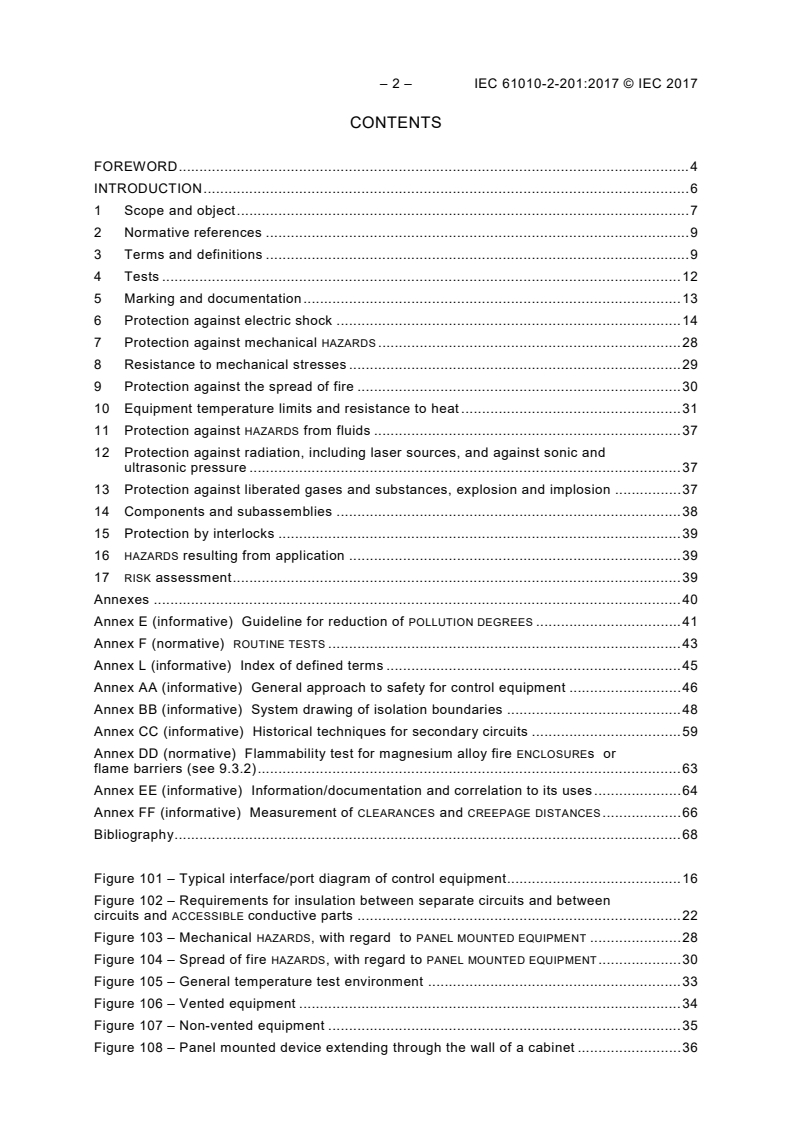
IEC 61010-2-201:2017 - Safety requirements for electrical equipment for measurement, control, and laboratory use - Part 2-201: Particular requirements for control equipment Released:3/24/2017
Overview
IEC 61010-2-201:2017 - part of the IEC 61010 family - defines particular safety requirements for control equipment used for measurement, control and laboratory use. It applies to products that perform the function of control equipment and their associated peripherals whose intended use is the command and control of machines, automated manufacturing and industrial processes (discrete and continuous control). This second edition (2017) is a technical revision of the 2013 edition and is intended to be used in conjunction with IEC 61010-1.
Key revision highlights:
- Clarified, amended or removed confusing definitions
- Revised and clarified temperature testing methodology
- Changed permissible documentation methodologies
- Updated some terminal markings and informative annexes
- Added Annex E and Annexes AA–FF for expanded guidance
Key topics and requirements
The standard supplements IEC 61010-1 with control-equipment–specific requirements, covering:
- Tests and verification: specified functional and safety tests and routine tests for production verification.
- Marking and documentation: required markings, terminal identification, and documentation practices for safe installation, operation and maintenance.
- Protection against electric shock: insulation, clearances, creepage distances and testing between mains, secondary and accessible parts.
- Mechanical safety: protection against mechanical hazards and resistance to mechanical stresses (drop, vibration).
- Fire and temperature: requirements for spread-of-fire, material flammability and equipment temperature limits with clarified temperature-test methods.
- Protection from fluids, radiation and gases: safeguards against hazardous fluids, UV/laser/sonic emissions and liberated dangerous substances.
- Interlocks and protective circuits: requirements for interlocks, protective impedance and over-current protection.
- Risk assessment: obligations for assessing hazards arising from typical applications of control equipment.
- Informative and normative annexes: guidance on pollution degree reduction, routine tests, enclosure practices, measurement of clearances/creepage and historical techniques.
Applications and who uses it
IEC 61010-2-201 is essential for:
- Design and safety engineers creating control panels, PLC cabinets, HMIs and industrial controllers
- Manufacturers of automation and control equipment seeking product safety compliance and certification
- Test laboratories and certification bodies performing type and routine testing
- System integrators and machine builders responsible for safe installation and documentation
- Compliance officers and procurement teams specifying safety requirements for industrial equipment
Practical benefits include clearer design rules for insulation and enclosure, consistent test procedures, improved documentation practices, and reduced ambiguity when applying safety measures to control equipment.
Related standards
- IEC 61010-1 (General requirements for electrical equipment for measurement, control and laboratory use) - to be used together with Part 2-201
- IEC 61131-2 (referenced cross‑links for programmable controllers)
Keywords: IEC 61010-2-201:2017, control equipment safety, electrical equipment for measurement control and laboratory use, insulation, creepage, clearances, temperature testing, risk assessment, industrial automation compliance.
Relations
- Effective Date
- 05-Sep-2023
- Effective Date
- 05-Sep-2023
Buy Documents
IEC 61010-2-201:2017 RLV - Safety requirements for electrical equipment for measurement, control, and laboratory use - Part 2-201: Particular requirements for control equipment Released:3/24/2017
IEC 61010-2-201:2017 - Safety requirements for electrical equipment for measurement, control, and laboratory use - Part 2-201: Particular requirements for control equipment Released:3/24/2017
Get Certified
Connect with accredited certification bodies for this standard

DVS-ZERT GmbH
German welding certification society.
IMP NDT d.o.o.
Non-destructive testing services. Radiography, ultrasonic, magnetic particle, penetrant, visual inspection.
Inštitut za kovinske materiale in tehnologije
Institute of Metals and Technology. Materials testing, metallurgical analysis, NDT.
Sponsored listings
Frequently Asked Questions
IEC 61010-2-201:2017 is a standard published by the International Electrotechnical Commission (IEC). Its full title is "Safety requirements for electrical equipment for measurement, control, and laboratory use - Part 2-201: Particular requirements for control equipment". This standard covers: IEC 61010-2-201:2017 specifies safety requirements and related verification tests for any product performing the function of control equipment and/or their associated peripherals. In addition, these products have as their intended use the command and control of machines, automated manufacturing and industrial processes, e.g. discrete and continuous control. This second edition cancels and replaces the first edition published in 2013. This edition constitutes a technical revision. This second edition includes the following significant technical changes with respect to the previous edition; a) clarify, change, delete definitions which were causing confusion, b) change and clarify the temperature testing methodology, c) change documentation methodologies allowed, d) change some terminal markings, e) add clarity to some of the informative annexes, f) add Annex E with changes, g) add Annexes AA – FF.
IEC 61010-2-201:2017 specifies safety requirements and related verification tests for any product performing the function of control equipment and/or their associated peripherals. In addition, these products have as their intended use the command and control of machines, automated manufacturing and industrial processes, e.g. discrete and continuous control. This second edition cancels and replaces the first edition published in 2013. This edition constitutes a technical revision. This second edition includes the following significant technical changes with respect to the previous edition; a) clarify, change, delete definitions which were causing confusion, b) change and clarify the temperature testing methodology, c) change documentation methodologies allowed, d) change some terminal markings, e) add clarity to some of the informative annexes, f) add Annex E with changes, g) add Annexes AA – FF.
IEC 61010-2-201:2017 is classified under the following ICS (International Classification for Standards) categories: 17.020 - Metrology and measurement in general; 19.020 - Test conditions and procedures in general; 25.040.40 - Industrial process measurement and control. The ICS classification helps identify the subject area and facilitates finding related standards.
IEC 61010-2-201:2017 has the following relationships with other standards: It is inter standard links to IEC 61010-2-201:2013, IEC 61010-2-201:2024. Understanding these relationships helps ensure you are using the most current and applicable version of the standard.
IEC 61010-2-201:2017 is available in PDF format for immediate download after purchase. The document can be added to your cart and obtained through the secure checkout process. Digital delivery ensures instant access to the complete standard document.
Standards Content (Sample)
IEC 61010-2-201 ®
Edition 2.0 2017-03
REDLINE VERSION
INTERNATIONAL
STANDARD
colour
inside
Safety requirements for electrical equipment for measurement, control, and
laboratory use –
Part 2-201: Particular requirements for control equipment
All rights reserved. Unless otherwise specified, no part of this publication may be reproduced or utilized in any form
or by any means, electronic or mechanical, including photocopying and microfilm, without permission in writing from
either IEC or IEC's member National Committee in the country of the requester. If you have any questions about IEC
copyright or have an enquiry about obtaining additional rights to this publication, please contact the address below or
your local IEC member National Committee for further information.
IEC Central Office Tel.: +41 22 919 02 11
3, rue de Varembé Fax: +41 22 919 03 00
CH-1211 Geneva 20 info@iec.ch
Switzerland www.iec.ch
About the IEC
The International Electrotechnical Commission (IEC) is the leading global organization that prepares and publishes
International Standards for all electrical, electronic and related technologies.
About IEC publications
The technical content of IEC publications is kept under constant review by the IEC. Please make sure that you have the
latest edition, a corrigenda or an amendment might have been published.
IEC Catalogue - webstore.iec.ch/catalogue Electropedia - www.electropedia.org
The stand-alone application for consulting the entire The world's leading online dictionary of electronic and
bibliographical information on IEC International Standards, electrical terms containing 20 000 terms and definitions in
Technical Specifications, Technical Reports and other English and French, with equivalent terms in 16 additional
documents. Available for PC, Mac OS, Android Tablets and languages. Also known as the International Electrotechnical
iPad. Vocabulary (IEV) online.
IEC publications search - www.iec.ch/searchpub IEC Glossary - std.iec.ch/glossary
The advanced search enables to find IEC publications by a 65 000 electrotechnical terminology entries in English and
variety of criteria (reference number, text, technical French extracted from the Terms and Definitions clause of
committee,…). It also gives information on projects, replaced IEC publications issued since 2002. Some entries have been
and withdrawn publications. collected from earlier publications of IEC TC 37, 77, 86 and
CISPR.
IEC Just Published - webstore.iec.ch/justpublished
Stay up to date on all new IEC publications. Just Published IEC Customer Service Centre - webstore.iec.ch/csc
details all new publications released. Available online and If you wish to give us your feedback on this publication or
also once a month by email. need further assistance, please contact the Customer Service
Centre: csc@iec.ch.
IEC 61010-2-201 ®
Edition 2.0 2017-03
REDLINE VERSION
INTERNATIONAL
STANDARD
colour
inside
Safety requirements for electrical equipment for measurement, control, and
laboratory use –
Part 2-201: Particular requirements for control equipment
INTERNATIONAL
ELECTROTECHNICAL
COMMISSION
ICS 17.020; 19.020; 25.040.40 ISBN 978-2-8322-4161-5
– 2 – IEC 61010-2-201:2017 RLV © IEC 2017
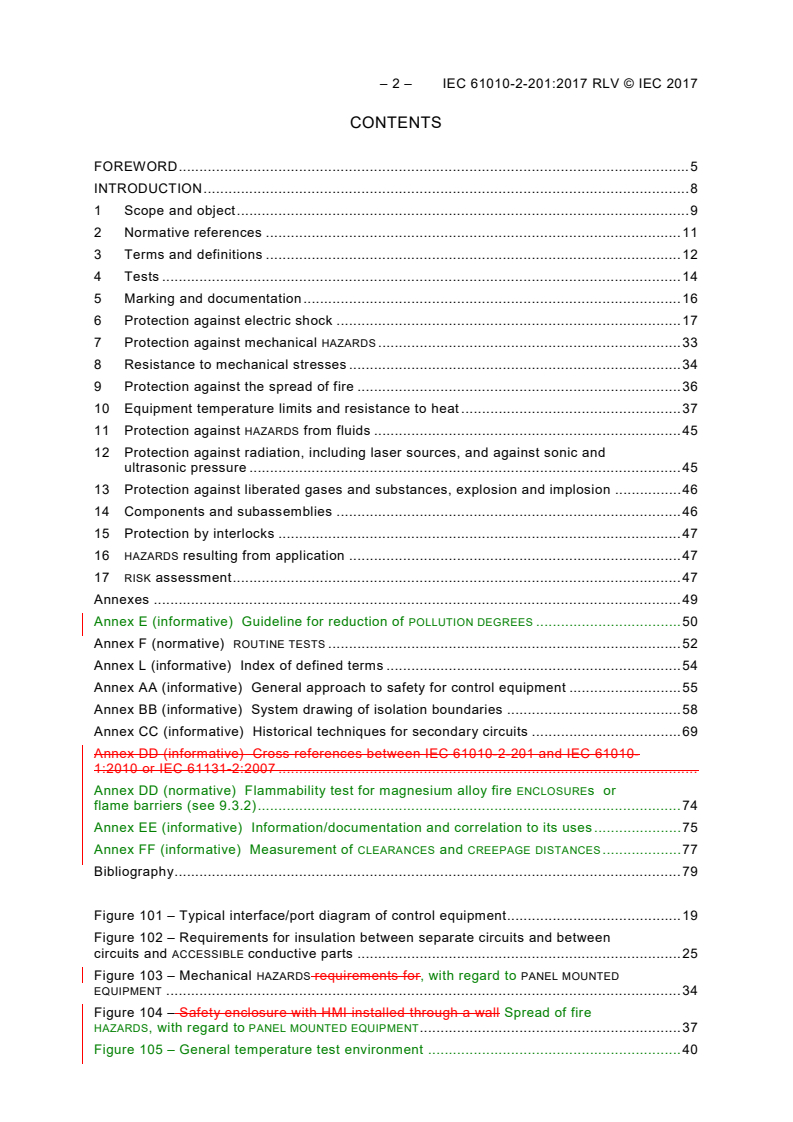
CONTENTS
FOREWORD . 5
INTRODUCTION . 8
1 Scope and object . 9
2 Normative references . 11
3 Terms and definitions . 12
4 Tests . 14
5 Marking and documentation . 16
6 Protection against electric shock . 17
7 Protection against mechanical HAZARDS . 33
8 Resistance to mechanical stresses . 34
9 Protection against the spread of fire . 36
10 Equipment temperature limits and resistance to heat . 37
11 Protection against HAZARDS from fluids . 45
12 Protection against radiation, including laser sources, and against sonic and
ultrasonic pressure . 45
13 Protection against liberated gases and substances, explosion and implosion . 46
14 Components and subassemblies . 46
15 Protection by interlocks . 47
16 HAZARDS resulting from application . 47
17 RISK assessment . 47
Annexes . 49
Annex E (informative) Guideline for reduction of POLLUTION DEGREES . 50
Annex F (normative) ROUTINE TESTS . 52
Annex L (informative) Index of defined terms . 54
Annex AA (informative) General approach to safety for control equipment . 55
Annex BB (informative) System drawing of isolation boundaries . 58
Annex CC (informative) Historical techniques for secondary circuits . 69
Annex DD (informative) Cross references between IEC 61010-2-201 and IEC 61010-
1:2010 or IEC 61131-2:2007 .
Annex DD (normative) Flammability test for magnesium alloy fire ENCLOSUREs or
flame barriers (see 9.3.2) . 74
Annex EE (informative) Information/documentation and correlation to its uses . 75
Annex FF (informative) Measurement of CLEARANCES and CREEPAGE DISTANCES . 77
Bibliography . 79
Figure 101 – Typical interface/port diagram of control equipment . 19
Figure 102 – Requirements for insulation between separate circuits and between
circuits and ACCESSIBLE conductive parts . 25
Figure 103 – Mechanical HAZARDS requirements for, with regard to PANEL MOUNTED
EQUIPMENT . 34
Figure 104 – Safety enclosure with HMI installed through a wall Spread of fire
HAZARDS, with regard to PANEL MOUNTED EQUIPMENT . 37
Figure 105 – General temperature test environment . 40
Figure 105 – Panel mounted HMI device extending through the wall of a cabinet .
Figure 106 – Vented equipment . 41
Figure 107 – Non-vented equipment . 42
Figure 108 – Panel mounted device extending through the wall of a cabinet . 43
Figure AA.1 – Control equipment access and safety concerns . 55
Figure BB.1 – Typical system ENCLOSURE layout . 59
Figure BB.2 – Simplified system schematic . 60
Figure BB.3 – HAZARD situation of the control equipment . 61
Figure BB.4 – Application of the standard to the control equipment safety drawing . 62
Figure BB.5 – Application of 6.7.1.5 items a) and b) to the control equipment safety
drawing . 62
Figure BB.6 – Application of 6.7.1.5 items a), b), c) and d) to the control equipment
safety drawing . 63
Figure BB.7 – REINFORCED INSULATION . 64
Figure BB.8 – BASIC INSULATION . 65
Figure BB.9 – REINFORCED INSULATION, BASIC INSULATION and limiting PROTECTIVE
IMPEDANCE . 66
Figure BB.10 – REINFORCED INSULATION from external power supplies . 67
Figure BB.11 – BASIC INSULATION from external power supplies . 68
Figure EE.1 – Information/documentation for component products . 75
Figure EE.2 – Information/documentation accumulation and segregation tree for an
example installation . 76
Figure FF.1 – The path a component mounted to a PWB (side view). 78
Figure FF.2 – The path a component mounted to a PWB (side view). 78
Table 101 – Overload test circuit values . 13
Table 102 – Endurance test circuit values . 14
Table 103 – OPERATOR accessibility ACCESSIBLE ports for open and ENCLOSED
EQUIPMENT . 18
Table 4 – CLEARANCE and CREEPAGE DISTANCES for MAINS CIRCUITs of OVERVOLTAGE
CATEGORY II up to 300 V. 25
Table 5 – Test voltages for solid insulation between MAINS and between MAINS and
d
secondary circuits OVERVOLTAGE CATEGORY II up to 300 V . 26
Table 6 – CLEARANCES and test voltages for secondary circuits derived from MAINS
CIRCUITs of OVERVOLTAGE CATEGORY II up to 300 V . 27
Table 104 – Minimum CREEPAGEs and CLEARANCEs in air of OVERVOLTAGE CATEGORY II
d,e
up to 1 000 V at FIELD-WIRING TERMINALS . 28
Table 105 – Drop tests .
Table 19 – Surface temperature limits, under NORMAL CONDITIONs . 34
Table E.1 – Environmental situations . 44
Table E.2 – Reduction of POLLUTION DEGREES (PD) . 45
Table CC.1 – Limits of output current and output power for inherently limited power
sources . 64
Table CC.2 – Limits of output current, output power and RATINGS for over-current
protective devices for non-inherently limited power sources . 65
Table DD.1 – Cross-references between IEC 61010-2-201 and IEC 61010-1 or
IEC 61131-2 .
– 4 – IEC 61010-2-201:2017 RLV © IEC 2017
Table FF.1 – Dimensions of X . 69
INTERNATIONAL ELECTROTECHNICAL COMMISSION
____________
SAFETY REQUIREMENTS FOR ELECTRICAL EQUIPMENT
FOR MEASUREMENT, CONTROL, AND LABORATORY USE –
Part 2-201: Particular requirements for control equipment
FOREWORD
1) The International Electrotechnical Commission (IEC) is a worldwide organization for standardization comprising
all national electrotechnical committees (IEC National Committees). The object of IEC is to promote
international co-operation on all questions concerning standardization in the electrical and electronic fields. To
this end and in addition to other activities, IEC publishes International Standards, Technical Specifications,
Technical Reports, Publicly Available Specifications (PAS) and Guides (hereafter referred to as “IEC
Publication(s)”). Their preparation is entrusted to technical committees; any IEC National Committee interested
in the subject dealt with may participate in this preparatory work. International, governmental and non-
governmental organizations liaising with the IEC also participate in this preparation. IEC collaborates closely
with the International Organization for Standardization (ISO) in accordance with conditions determined by
agreement between the two organizations.
2) The formal decisions or agreements of IEC on technical matters express, as nearly as possible, an international
consensus of opinion on the relevant subjects since each technical committee has representation from all
interested IEC National Committees.
3) IEC Publications have the form of recommendations for international use and are accepted by IEC National
Committees in that sense. While all reasonable efforts are made to ensure that the technical content of IEC
Publications is accurate, IEC cannot be held responsible for the way in which they are used or for any
misinterpretation by any end user.
4) In order to promote international uniformity, IEC National Committees undertake to apply IEC Publications
transparently to the maximum extent possible in their national and regional publications. Any divergence
between any IEC Publication and the corresponding national or regional publication shall be clearly indicated in
the latter.
5) IEC itself does not provide any attestation of conformity. Independent certification bodies provide conformity
assessment services and, in some areas, access to IEC marks of conformity. IEC is not responsible for any
services carried out by independent certification bodies.
6) All users should ensure that they have the latest edition of this publication.
7) No liability shall attach to IEC or its directors, employees, servants or agents including individual experts and
members of its technical committees and IEC National Committees for any personal injury, property damage or
other damage of any nature whatsoever, whether direct or indirect, or for costs (including legal fees) and
expenses arising out of the publication, use of, or reliance upon, this IEC Publication or any other IEC
Publications.
8) Attention is drawn to the Normative references cited in this publication. Use of the referenced publications is
indispensable for the correct application of this publication.
9) Attention is drawn to the possibility that some of the elements of this IEC Publication may be the subject of
patent rights. IEC shall not be held responsible for identifying any or all such patent rights.
This redline version of the official IEC Standard allows the user to identify the changes
made to the previous edition. A vertical bar appears in the margin wherever a change
has been made. Additions are in green text, deletions are in strikethrough red text.
– 6 – IEC 61010-2-201:2017 RLV © IEC 2017
International Standard IEC 61010-2-201 has been prepared by IEC technical committee 65:
Industrial-process measurement, control and automation.
The text of this standard is based on the following documents:
FDIS Report on voting
65/652/FDIS 65/657/RVD
Full information on the voting for the approval of this standard can be found in the report on
voting indicated in the above table.
This second edition cancels and replaces the first edition published in 2013. This edition
constitutes a technical revision.
This second edition includes the following significant technical changes with respect to the
previous edition;
a) clarify, change, delete definitions which were causing confusion,
b) change and clarify the temperature testing methodology,
c) change documentation methodologies allowed,
d) change some TERMINAL markings,
e) add clarity to some of the informative annexes,
f) add Annex E with changes,
g) add Annexes AA – FF.
This publication has been drafted in accordance with the ISO/IEC Directives, Part 2.
This Part 2-201 is intended to be used in conjunction with IEC 61010-1. It was established on
the basis of the third edition (2010) of that standard. Consideration may be given to future
editions of, or amendments to, IEC 61010-1.
This Part 2-201 supplements or modifies the corresponding clauses in IEC 61010-1 so as to
convert that publication into the IEC standard: Particular requirements for control equipment.
Where a particular subclause of Part 1 is not mentioned in this part 2, that subclause applies
as far as is reasonable. Where this part states “addition”, “modification”, “replacement”, or
“deletion”, the relevant requirement, test specification or NOTE in Part 1 should be adapted
accordingly.
In this standard, the following print types are used:
– requirements and definitions: in roman type;
– NOTES: in smaller roman type;
– conformity and tests: in italic type;
– terms used throughout this standard which have been defined in Clause 3: SMALL ROMAN
CAPITALS.
A list of all parts in the IEC 61010 series, published under the general title Safety
requirements for electrical equipment for measurement, control and laboratory use, can be
found on the IEC website.
The committee has decided that the contents of this publication will remain unchanged until
the stability date indicated on the IEC website under "http://webstore.iec.ch" in the data
related to the specific publication. At this date, the publication will be
• reconfirmed,
• withdrawn,
• replaced by a revised edition, or
• amended.
IMPORTANT – The 'colour inside' logo on the cover page of this publication indicates
that it contains colours which are considered to be useful for the correct
understanding of its contents. Users should therefore print this document using a
colour printer.
– 8 – IEC 61010-2-201:2017 RLV © IEC 2017
INTRODUCTION
IEC 61010-2-2xx documents are a planned series of standards on safety of industrial-process
measurement, control and automation equipment.
This part specifies the complete safety related requirements and related tests for control
equipment (e.g. programmable controller (PLC), the components of distributed control
systems (DCS), I/O devices, human machine interface (HMI)).
Safety terms of general use are defined in IEC 61010-1. More specific terms are defined in
each part of IEC 61010.
This part incorporates the safety related requirements of Programmable Controllers.
Annex DD provides a cross reference between clauses of this standard and those of
IEC 61010-1 or IEC 61131-2:2007.
SAFETY REQUIREMENTS FOR ELECTRICAL EQUIPMENT
FOR MEASUREMENT, CONTROL, AND LABORATORY USE –
Part 2-201: Particular requirements for control equipment
1 Scope and object
This clause of Part 1 is applicable, except as follows.
1.1.1 Equipment included in scope
Replacement:
• This part of IEC 61010 specifies safety requirements and related verification tests for any
product performing the function of control equipment of the following types which and/or
their associated peripherals. In addition, these products have as their intended use the
command and control of machines, automated manufacturing and industrial processes,
e.g. discrete and continuous control. Some equipment examples are: programmable logic
controller (PLC);
• programmable automation controller (PLC and PAC);
• the components of distributed control systems (DCS);
• the components of remote I/O – systems;
• industrial PC (computers) and panel PC;
• programming and debugging tools (PADTs);
• displays and human-machine interfaces (HMI);
• any product performing the function of control equipment and/or their associated
peripherals,
• positioners.
Components of the above named equipment and in the scope of this standard are:
• (auxiliary) stand-alone power supplies;
• peripherals such as digital and analogue I/O, remote-I/O;
• industrial network equipment.
Control equipment and their associated peripherals are intended to be used in an industrial
environment and may be provided as OPEN or ENCLOSED EQUIPMENT.
NOTE 1 Control equipment intended also for use in other environments or for other purposes (example: for use in
building installations to control light or other electrical installations, or for use on cars, trains or ships) can have
additional conformity requirements defined by the safety standard(s) for these applications. These requirements
can involve as example: insulation, spacings and power restrictions.
NOTE 2 Computing devices and similar equipment within the scope of IEC 60950 (planned to be replaced by
IEC 62368) and conforming to its requirements are considered to be suitable for use with control equipment within
the scope of this standard. However, some of the requirements of IEC 60950 for resistance to moisture and liquids
are less stringent than those in IEC 61010-1:2010, 5.4.4 second paragraph.
Control equipment covered in this standard is intended for use in OVERVOLTAGE CATEGORY II,
III and IV (IEC 60664-1) in low-voltage installations, where the RATED equipment supply
voltage does not exceed AC. 1 000 V r.m.s. (50/60 Hz), or DC 1 500 1 000 V.
NOTE 3 If equipment in the scope of this part is applied to overvoltage category III and IV installations, then the
requirements of Annex K of Part 1 apply.
– 10 – IEC 61010-2-201:2017 RLV © IEC 2017
The requirements of ISO/IEC Guide 51 and IEC Guide 104, as they relate to this part of
IEC 61010, are incorporated herein.
1.1.2 Equipment excluded from scope
Replacement:
This standard does not deal with aspects of the overall automated system, e.g. a complete
assembly line. Control equipment (e.g. DCS and PLC), their application program and their
associated peripherals are considered as components (components in this context are items
which perform no useful function by themselves) of an overall automated system.
Since control equipment (e.g. DCS and PLC) are component devices, safety considerations
for the overall automated system including installation and application are beyond the scope
of this standard. Refer to IEC 60364 series of standards or applicable national/local
regulations for electrical installation and guidelines.
1.2.1 Aspects included in scope
Replacement:
The purpose of the requirements of this standard is to ensure that all HAZARDs to the
OPERATOR, SERVICE PERSONNEL and the surrounding area are reduced to a tolerable level.
NOTE 1 By using the terms "OPERATOR" and "SERVICE PERSONNEL" this standard considers the perception of
HAZARDS depending on training and skills. Annex AA gives a general approach in this regard.
Requirements for protection against particular types of HAZARD are given in Clauses 6 to 17,
as follows:
a) electric shock or burn (see Clause 6);
b) mechanical HAZARDS (see Clauses 7 and 8);
c) spread of fire from the control equipment (see Clause 9);
d) excessive temperature (see Clause 10);
e) effects of fluids and fluid pressure (see Clause 11);
f) effects of radiation, including lasers sources, and sonic and ultrasonic pressure (see
Clause 12);
g) liberated gases, explosion and implosion (see Clause 13);
Requirements for protection against hazards
h) arising from REASONABLY FORESEEABLE MISUSE and ergonomic factors are specified in (see
Clause 16);
i) RISK assessment for HAZARDS or environments not fully covered above is specified in (see
Clause 17).
NOTE 2 Attention is drawn to the existence of additional requirements regarding the health and safety of labour
forces.
1.2.2 Aspects excluded from scope
Replacement:
This standard does not cover:
a) reliability, functionality, performance, or other properties of the control equipment not
related to safety;
b) mechanical or climatic requirements for operation, transport or storage;
c) EMC requirements (see e.g. IEC 61326 or IEC 61131-2);
d) protective measures for explosive atmospheres (see e.g. IEC 60079 series);
e) functional safety (see e.g. IEC 61508, IEC 61131-6).
2 Normative references
This clause of Part 1 is applicable, except as follows.
Addition:
IEC 60068-2-31:2008, Environmental testing – Part 2-31: Tests – Test Ec: Rough handling
shocks, primarily for equipment-type specimens
IEC 60384-14:2005, Fixed capacitors for use in electronic equipment – Part 14: Sectional
specification: Fixed capacitors for electromagnetic interference suppression and connection to
the supply mains
IEC 60664-1:2007, Insulation coordination for equipment within low-voltage systems – Part 1:
Principles, requirements and tests
IEC 60695-2-11:2000, Fire hazard testing – Part 2-11: Glowing/hot-wire based test methods –
Glow-wire flammability test method for end-products (GWEPT)
IEC 60695-11-3, Fire hazard testing – Part 11-3: Test flames – 500 W flames – Apparatus and
confirmational test methods
IEC 60947-5-1:2003, Low-voltage switchgear and controlgear – Part 5-1: Control circuit
devices and switching elements – Electromechanical control circuit devices
IEC 60947-7-1:2009, Low-voltage switchgear and controlgear – Part 7-1: Ancillary equipment
– Terminal blocks for copper conductors
IEC 61010-1:2010, Safety requirements for electrical equipment for measurement, control,
and laboratory use – Part 1: General requirements
IEC 61010-2-030, Safety requirements for electrical equipment for measurement, control, and
laboratory use – Part 2-030: Particular requirements for testing and measuring circuits
IEC 61051-2:1991, Varistors for use in electronic equipment – Part 2: Sectional specification
for surge suppression varistors
IEC 61643-21, Low voltage surge protective devices – Part 21: Surge protective devices
connected to telecommunications and signalling networks – Performance requirements and
testing methods
IEC 61643-311, Components for low-voltage surge protective devices – Part 311:
Performance requirements and test circuits for gas discharge tubes (GDT)
IEC 61643-321, Components for low-voltage surge protective devices – Part 321:
Specifications for avalanche breakdown diode (ABD)
IEC 61643-331, Components for low-voltage surge protective devices – Part 331:
Specification for metal oxide varistors (MOV)
– 12 – IEC 61010-2-201:2017 RLV © IEC 2017
3 Terms and definitions
This clause of Part 1 is applicable, except as follows.
3.2.3
PROTECTIVE CONDUCTOR TERMINAL
Modification:
In this part “PROTECTIVE CONDUCTOR TERMINAL” is replaced by “PROTECTIVE EARTH TERMINAL”.
Note 1 to entry: PROTECTIVE EARTH TERMINAL is most familiar to industrial users, manufacturers, etc. Therefore
since this part is targeted towards industrial use, the most familiar term is utilized.
3.5.11
OPERATOR
Addition:
Note 1 to entry: See definition in Part 1 and Annex AA.
Add the following terms and definitions:
3.101
AMBIENT TEMPERATURE
temperature, determined under prescribed conditions, of the air surrounding the equipment
3.102
ENCLOSED EQUIPMENT
equipment which includes an ENCLOSURE, having safety capability, or combination of an
ENCLOSURE, having safety capability, and installation provisions enclosing on all sides, with
the possible exception of its mounting surface, to prevent personnel from accidentally
touching HAZARDOUS LIVE, hot or moving parts contained therein and meeting requirements of
mechanical strength, flammability, and stability (where applicable)
Note 1 to entry: Examples are portable and HAND-HELD EQUIPMENT.
Note 2 to entry: This definition is related to IEC 60050-441:1990 2000, 441-12-02.
3.103
ENCLOSURE
housing affording the type and degree of protection suitable for the intended application
Note 1 to entry: An ENCLOSURE, in general, may or may not have any safety capabilities, which depend on its
application purpose and construction.
Note 2 to entry: In this standard an ENCLOSURE is assumed to have safety capability, unless specifically stated
otherwise.
[SOURCE: IEC 60050-195:1998, 195-02-35, modified – the notes to entry have been added]
3.104
EXTERNAL CIRCUIT
circuit connected by FIELD WIRING of the control equipment
3.105
FIELD WIRING
wiring of the control equipment, which is not installed by the user in the control equipment
manufacturer's facility
Note 1 to entry: Examples of FIELD WIRING are power supply, digital and analogue input and output wiring.
Note 2 to entry: Control equipment manufacturer’s, e.g. pre-assembled or molded cabling is not considered FIELD
WIRING.
3.104
hand-held equipment
equipment which is intended to be held in one hand while being operated with the other hand
3.106
MODULAR EQUIPMENT
equipment consisting of different modules such as a Rack, CPU, different I/O-modules,
network modules etc.
Note 1 to entry: MODULAR EQUIPMENT can:
a) be OPEN EQUIPMENT or ENCLOSED EQUIPMENT;
b) consist of modules that cannot operate alone or of a basic module that is operational alone and can be
enhanced in functions by additional modules;
c) vary in size and functionality depending on the combination and the number of modules;
d) be combined with operational equipment or enhanced in function by the addition of modules by the customer.
3.107
OPEN EQUIPMENT
equipment which does not protect personnel from accidentally touching HAZARDOUS LIVE or
moving parts contained therein nor meet requirements of mechanical strength, flammability
and stability (where applicable)
Note 1 to entry: See Annex AA.
3.108
OPERATOR
person, with appropriate training and awareness of the general hazards in an industrial
environment, commanding and monitoring, but not changing, a machine or process
Addition:
Note 1 to entry: The operator does not change e.g. the control equipment hardware configuration or install
software updates provided by the manufacturer. See definition in Part 1 and Annex AA of this document.
Note 2 to entry: The operator commands and monitors a machine or process e.g. through an HMI connected to
the equipment.
3.109
PANEL MOUNTED EQUIPMENT
equipment where a portion of the equipment may form part of the ENCLOSURE
Note 1 to entry: See Figure 103.
3.110
PORTABLE EQUIPMENT
equipment intended to be carried by hand and not fixed during NORMAL USE
3.111
PROTECTIVE EXTRA-LOW VOLTAGE CIRCUIT
PELV CIRCUIT
protective earth referenced electrical circuit in which the voltage cannot exceed a.c. 30 V
r.m.s., 42,4 V peak or d.c. 60 V in normal and single-fault condition, except earth faults in
other circuits the following:
NORMAL CONDITION and SINGLE FAULT CONDITION: The AC voltage levels are 30 V r.m.s., 42,4 V
peak and the DC voltage level is 60 V. For equipment intended for use in WET LOCATIONS, the
AC voltage levels are 16 V r.m.s., 22,6 V peak and the DC voltage level is 35 V.
– 14 – IEC 61010-2-201:2017 RLV © IEC 2017
Note 1 to entry: A PELV circuit incorporates a connection to protective earth. Without the protective earth
connection or if there is a fault in the protective earth connection the circuit voltages are not controlled.
Note 2 to entry: Derived from IEC 60050-826:2004, 826-12-32, PELV system
[SOURCE: IEC 60050-826-12-32:2004, modified – clarified and more fully described]
3.112
SAFETY EXTRA-LOW VOLTAGE CIRCUIT
SELV CIRCUIT
non-protective earth referenced electrical circuit in which the voltage cannot exceed a.c. 30 V
r.m.s., 42,4 V peak or d.c. 60 V in normal and single-fault condition, including earth faults in
other circuits the following:
NORMAL CONDITION and SINGLE FAULT CONDITION: The AC voltage levels are 30 V r.m.s., 42,4 V
peak and the DC voltage level is 60 V. For equipment intended for use in WET LOCATIONS, the
AC voltage levels are 16 V r.m.s., 22,6 V peak and the DC voltage level is 35 V.
Note 1 to entry: Derived from IEC 60050-826:2004, 826-12-31, SELV system.
[SOURCE: IEC 60050-826-12-31:2004, modified – clarified and more fully described]
3.113
SERVICE PERSONNEL
person, with the appropriate technical training, experience and awareness of HAZARDS and of
measures to minimize danger to themselves, other persons or to the control equipment, in an
industrial environment, changing or repairing the control equipment
Note 1 to entry: SERVICE PERSONNEL are persons having the appropriate technical training and experiences
necessary to be aware of HAZARDS – e.g. electrical HAZARDS, temperature HAZARDS, fire HAZARDS – to which they
are exposed in performing a task and of measures to minimize danger to themselves or to other persons or to the
control equipment, in an industrial environment.
Note 2 to entry: SERVICE PERSONNEL change or repair the control equipment e.g. hardware configuration or
installing software updates provided by the manufacturer.
4 Tests
This clause of Part 1 is applicable, except as follows.
4.1 General
Addition:
The product is verified to this standard in a test configuration, defined by the manufacturer,
which represents the least favourable configuration. See 4.3.
It is likely or possible that there are different test configurations which yield least favourable
test conditions. For example there may be a least favourable configuration for temperature
tests, a least favourable test configuration for electrical safety, and a different least favourable
test configuration for voltage test. If this is the case then these different least favourable test
configuration(s) shall be used in the test for which they are appropriate, the appropriate least
favourable test configuration(s) shall be used with regard to 4.3.2 and 4.4.
These least favourable test configurations and test conditions shall be practical and useful for
the intended applications.
Conformity verification: The selected test configuration(s) and test conditions shall be
documented with the rationale in the test report.
4.3.2 State of equipment
Addition:
The state of the control equipment shall take into account the least favourable rated
environmental conditions. This may be taken into account by the actual test environment of
the control equipment or by suitable analysis and correction of the results in a set of reference
test conditions.
4.4 Testing in single fault condition
Addition of first line after 4.4:
For test and verification conditions, see 4.1.
4.4.2 Application of fault conditions
Add the following subclause:
4.4.2.101 Switching devices tests
4.4.2.101.1 Overload test
Switching devices shall close and open a test circuit having the current, voltage, and power
factor values given in Table 101. Fifty cycles, each consisting of 1 closing and 1 opening,
shall be completed using a timing of 1 s ON, 9 s OFF. After completion of the 50 cycles, the
equipment shall be subjected to the endurance test in 4.4.2.101.2, if required by 14.102.
Table 101 – Overload test circuit values
Intended use load Current Voltage Power factor
AC general use RATED 0,75 to 0,80
1,5 × RATED
DC general use RATED 1,0 –
1,5 × RATED
AC resistance 1,5 × RATED RATED 1,0
DC resistance RATED 1,0 –
1,5 × RATED
a a
b
AC pilot duty RATED
1,1 × RATED <0,35
a a b
DC pilot duty RATED 1,1 × RATED 1,0 –
NOTE 1 Source IEC 61131-2:2007 60947-5-1.
NOTE 2 Pilot duty = RATING assigned to a relay or switch that controls the coil of another relay or switch.
a
Unless otherwise specified, the inrush current shall be 10 times the steady-state current.
b
Set up the EUT at its RATED voltage and current and then increase the voltage by 10 % without further
adjustment of the load.
Conformity, pass/fail, is determined by test completion without electrical/dielectric/mechanical
breakdown of the equipment and an additional dielectric voltage test.
4.4.2.101.2 Endurance test
After completion of the overload test in 4.4.2.101.1, the switching device is to close and open
a test circuit having the current, voltage, and power factor values given in Table 102. A total
of 6 000 cycles, consisting of 1 closing and 1 opening, shall be completed. The cycle timing
shall be 1 s ON and 9 s OFF, except for the first 1 000 cycles of the pilot duty test. The first
1 000 cycles of the pilot duty test shall be at a rate of 1 cycle per second except that the first
10 to 12 cycles are to be as fast as possible.
– 16 – IEC 61010-2-201:2017 RLV © IEC 2017
The endurance test need not be conducted on solid-state output devices for general or
resistive use.
Table 102 – Endurance test circuit values
Intended use load Current Voltage Power factor
AC general use RATED RATED 0,75 to 0,80
DC general use RATED RATED 1,0 –
AC resistance RATED RATED 1,0
DC resistance RATED RATED 1,0 –
a
AC pilot duty RATED RATED
<0,35
a
DC pilot duty RATED RATED 1,0 –
NOTE 1 Source IEC 61131-2:2007 60947-5-1.
NOTE 2 Pilot duty = RATING assigned to a relay or switch that controls the coil of another relay or switch.
a
The test circuit is identical to the overload test circuit except that the voltage is the RATED voltage.
Conformity, pass/fail, is determined by test completion without electrical/dielectric/mechanical
breakdown of the equipment and an additional dielectric voltage test.
5 Marking and documentation
This clause of Part 1 is applicable, except as follows.
5.1.5.2 TERMINALS
Modification:
Replace item a) as follows:
a) FUNCTIONAL EARTH TERMINALS (i.e. used for non-safety purposes such as interference
immunity improvement) shall be marked with one of the following symbols:
IEC 60417-5018 (2002-10) or
symbol 5 of Part 1, IEC 60417-5017 (2006-08).
Where a TERMINAL serves both as the PROTECTIVE CONDUCTOR TERMINAL and as a
FUNCTIONAL EARTH TERMINAL, symbol 6 and other requirements for PROTECTIVE CONDUCTOR
TERMINAL shall be applied. Where a TERMINAL serves both as an earth (bonding) TERMINAL
and FUNCTIONAL EARTH TERMINAL, symbol 5 and other requirements for earth TERMINALS
shall be applied.
5.1.8 FIELD WIRING TERMINAL boxes
Addition after first paragraph:
A FIELD WIRING TERMINAL need not be marked to indicate the temperature RATING if it is
intended for the connection of a control circuit conductor only.
A control circuit is any circuit that does not carry MAINS power and is generally limited to
15 A.
5.4.1 General
Addition:
For equipment intended to be installed by SERVICE PERSONNEL or trained installers, all
documentation may be provided by electronic media.
Where the documentation is provided by electronic media, this may be accomplished by
including the symbol No. 14 of Table 1 (ISO 7000-0434B: 2004-01), on the product, and the
location of the documentation, e.g. URL, QRcode, on the product, packaging or printed
information with the product.
5.4.3 Equipment installation
Addition:
h) OPEN EQUIPMENT: If the control equipment is classified as OPEN EQUIPMENT its
documentation shall specify the final safety ENCLOSURE characteristics that has to be
provided by the user, e.g. safety enclosure mechanical rigidity, IP RATING;
NOTE See also 7.1.101 and 8.1.101.
Modification:
Replace item d)1) as follows:
d) 1) supply and FIELD WIRING requirements, e.g. insulation, temperature RATING;
5.4.4 Equipment operation
Modification:
j) details of methods of reducing the RISKS of burns from surfaces permitted to exceed the
temperature limits of 10.1, Table 19.
6 Protection against electric shock
This clause of Part 1 is applicable, except as follows.
6.1.2 Exceptions
Replacement:
If it is not feasible for operating reasons to prevent the following parts being both ACCESSIBLE
and HAZARDOUS LIVE, they are permitted to be ACCESSIBLE to SERVICE PERSONNEL during
NORMAL USE while they are HAZARDOUS LIVE:
For example:
a) parts of lamps and lamp sockets after lamp removal:
b) parts intended to be replaced by SERVICE PERSONNEL (for example, batteries) and which
may be HAZARDOUS LIVE during the replacement or other SERVICE PERSONNEL action, but
only if they are ACCESSIBLE only by means of a TOOL and have a warning marking (see
5.2):
If any of the parts in examples a) and b) receive a charge from an internal capacitor, they
shall not be HAZARDOUS LIVE 10 s after interruption of the supply.
If a charge is received from an internal capacitor, conformity is checked by the measurements
of 6.3 to establish that the levels of 6.3.1 c) are not exceeded.
– 18 – IEC 61010-2-201:2017 RLV © IEC 2017
6.2.1 General
This subclause of Part 1 is applicable to ENCLOSED EQUIPMENT.
6.2.2 Examination
This subclause of Part 1 is applicable to ENCLOSED EQUIPMENT.
6.2.3 Openings above parts that are HAZARDOUS LIVE
This subclause of Part 1 is applicable to ENCLOSED EQUIPMENT.
6.2.4 Openings for pre-set controls
Addition:
First paragraph: This subclause of Part 1 is applicable to ENCLOSED EQUIPMENT. This
subclause applies to SERVICE PERSONNEL only.
Add the following subclauses:
IEC 61010-2-20
...
IEC 61010-2-201 ®
Edition 2.0 2017-03
INTERNATIONAL
STANDARD
NORME
INTERNATIONALE
colour
inside
Safety requirements for electrical equipment for measurement, control, and
laboratory use –
Part 2-201: Particular requirements for control equipment
Exigences de sécurité pour appareils électriques de mesurage, de régulation
et de laboratoire –
Partie 2-201: Exigences particulières pour les équipements de commande
All rights reserved. Unless otherwise specified, no part of this publication may be reproduced or utilized in any form
or by any means, electronic or mechanical, including photocopying and microfilm, without permission in writing from
either IEC or IEC's member National Committee in the country of the requester. If you have any questions about IEC
copyright or have an enquiry about obtaining additional rights to this publication, please contact the address below or
your local IEC member National Committee for further information.
Droits de reproduction réservés. Sauf indication contraire, aucune partie de cette publication ne peut être reproduite
ni utilisée sous quelque forme que ce soit et par aucun procédé, électronique ou mécanique, y compris la photocopie
et les microfilms, sans l'accord écrit de l'IEC ou du Comité national de l'IEC du pays du demandeur. Si vous avez des
questions sur le copyright de l'IEC ou si vous désirez obtenir des droits supplémentaires sur cette publication, utilisez
les coordonnées ci-après ou contactez le Comité national de l'IEC de votre pays de résidence.
IEC Central Office Tel.: +41 22 919 02 11
3, rue de Varembé Fax: +41 22 919 03 00
CH-1211 Geneva 20 info@iec.ch
Switzerland www.iec.ch
About the IEC
The International Electrotechnical Commission (IEC) is the leading global organization that prepares and publishes
International Standards for all electrical, electronic and related technologies.
About IEC publications
The technical content of IEC publications is kept under constant review by the IEC. Please make sure that you have the
latest edition, a corrigenda or an amendment might have been published.
IEC Catalogue - webstore.iec.ch/catalogue Electropedia - www.electropedia.org
The stand-alone application for consulting the entire The world's leading online dictionary of electronic and
bibliographical information on IEC International Standards, electrical terms containing 20 000 terms and definitions in
Technical Specifications, Technical Reports and other English and French, with equivalent terms in 16 additional
documents. Available for PC, Mac OS, Android Tablets and languages. Also known as the International Electrotechnical
iPad. Vocabulary (IEV) online.
IEC publications search - www.iec.ch/searchpub IEC Glossary - std.iec.ch/glossary
The advanced search enables to find IEC publications by a 65 000 electrotechnical terminology entries in English and
variety of criteria (reference number, text, technical French extracted from the Terms and Definitions clause of
committee,…). It also gives information on projects, replaced IEC publications issued since 2002. Some entries have been
and withdrawn publications. collected from earlier publications of IEC TC 37, 77, 86 and
CISPR.
IEC Just Published - webstore.iec.ch/justpublished
Stay up to date on all new IEC publications. Just Published IEC Customer Service Centre - webstore.iec.ch/csc
details all new publications released. Available online and If you wish to give us your feedback on this publication or
also once a month by email. need further assistance, please contact the Customer Service
Centre: csc@iec.ch.
A propos de l'IEC
La Commission Electrotechnique Internationale (IEC) est la première organisation mondiale qui élabore et publie des
Normes internationales pour tout ce qui a trait à l'électricité, à l'électronique et aux technologies apparentées.
A propos des publications IEC
Le contenu technique des publications IEC est constamment revu. Veuillez vous assurer que vous possédez l’édition la
plus récente, un corrigendum ou amendement peut avoir été publié.
Catalogue IEC - webstore.iec.ch/catalogue Electropedia - www.electropedia.org
Application autonome pour consulter tous les renseignements
Le premier dictionnaire en ligne de termes électroniques et
bibliographiques sur les Normes internationales,
électriques. Il contient 20 000 termes et définitions en anglais
Spécifications techniques, Rapports techniques et autres
et en français, ainsi que les termes équivalents dans 16
documents de l'IEC. Disponible pour PC, Mac OS, tablettes
langues additionnelles. Egalement appelé Vocabulaire
Android et iPad.
Electrotechnique International (IEV) en ligne.
Recherche de publications IEC - www.iec.ch/searchpub
Glossaire IEC - std.iec.ch/glossary
65 000 entrées terminologiques électrotechniques, en anglais
La recherche avancée permet de trouver des publications IEC
en utilisant différents critères (numéro de référence, texte, et en français, extraites des articles Termes et Définitions des
comité d’études,…). Elle donne aussi des informations sur les publications IEC parues depuis 2002. Plus certaines entrées
projets et les publications remplacées ou retirées. antérieures extraites des publications des CE 37, 77, 86 et
CISPR de l'IEC.
IEC Just Published - webstore.iec.ch/justpublished
Service Clients - webstore.iec.ch/csc
Restez informé sur les nouvelles publications IEC. Just
Published détaille les nouvelles publications parues. Si vous désirez nous donner des commentaires sur cette
Disponible en ligne et aussi une fois par mois par email. publication ou si vous avez des questions contactez-nous:
csc@iec.ch.
IEC 61010-2-201 ®
Edition 2.0 2017-03
INTERNATIONAL
STANDARD
NORME
INTERNATIONALE
colour
inside
Safety requirements for electrical equipment for measurement, control, and
laboratory use –
Part 2-201: Particular requirements for control equipment
Exigences de sécurité pour appareils électriques de mesurage, de régulation
et de laboratoire –
Partie 2-201: Exigences particulières pour les équipements de commande
INTERNATIONAL
ELECTROTECHNICAL
COMMISSION
COMMISSION
ELECTROTECHNIQUE
INTERNATIONALE
ICS 17.020; 19.020; 25.040.40 ISBN 978-2-8322-4009-0
– 2 – IEC 61010-2-201:2017 © IEC 2017
CONTENTS
FOREWORD . 4
INTRODUCTION . 6
1 Scope and object . 7
2 Normative references . 9
3 Terms and definitions . 9
4 Tests . 12
5 Marking and documentation . 13
6 Protection against electric shock . 14
7 Protection against mechanical HAZARDS . 28
8 Resistance to mechanical stresses . 29
9 Protection against the spread of fire . 30
10 Equipment temperature limits and resistance to heat . 31
11 Protection against HAZARDS from fluids . 37
12 Protection against radiation, including laser sources, and against sonic and
ultrasonic pressure . 37
13 Protection against liberated gases and substances, explosion and implosion . 37
14 Components and subassemblies . 38
15 Protection by interlocks . 39
16 HAZARDS resulting from application . 39
17 RISK assessment . 39
Annexes . 40
Annex E (informative) Guideline for reduction of POLLUTION DEGREES . 41
Annex F (normative) ROUTINE TESTS . 43
Annex L (informative) Index of defined terms . 45
Annex AA (informative) General approach to safety for control equipment . 46
Annex BB (informative) System drawing of isolation boundaries . 48
Annex CC (informative) Historical techniques for secondary circuits . 59
Annex DD (normative) Flammability test for magnesium alloy fire ENCLOSUREs or
flame barriers (see 9.3.2) . 63
Annex EE (informative) Information/documentation and correlation to its uses . 64
Annex FF (informative) Measurement of CLEARANCES and CREEPAGE DISTANCES . 66
Bibliography . 68
Figure 101 – Typical interface/port diagram of control equipment . 16
Figure 102 – Requirements for insulation between separate circuits and between
circuits and ACCESSIBLE conductive parts . 22
Figure 103 – Mechanical HAZARDS, with regard to PANEL MOUNTED EQUIPMENT . 28
Figure 104 – Spread of fire HAZARDS, with regard to PANEL MOUNTED EQUIPMENT . 30
Figure 105 – General temperature test environment . 33
Figure 106 – Vented equipment . 34
Figure 107 – Non-vented equipment . 35
Figure 108 – Panel mounted device extending through the wall of a cabinet . 36
Figure AA.1 – Control equipment access and safety concerns . 46
Figure BB.1 – Typical system ENCLOSURE layout . 49
Figure BB.2 – Simplified system schematic . 50
Figure BB.3 – HAZARD situation of the control equipment . 51
Figure BB.4 – Application of the standard to the control equipment safety drawing . 52
Figure BB.5 – Application of 6.7.1.5 items a) and b) to the control equipment safety
drawing . 52
Figure BB.6 – Application of 6.7.1.5 items a), b), c) and d) to the control equipment
safety drawing . 53
Figure BB.7 – REINFORCED INSULATION . 54
Figure BB.8 – BASIC INSULATION . 55
Figure BB.9 – REINFORCED INSULATION, BASIC INSULATION and PROTECTIVE IMPEDANCE . 56
Figure BB.10 – REINFORCED INSULATION from external power supplies . 57
Figure BB.11 – BASIC INSULATION from external power supplies . 58
Figure EE.1 – Information/documentation for component products . 64
Figure EE.2 – Information/documentation accumulation and segregation tree for an
example installation . 65
Figure FF.1 – The path a component mounted to a PWB (side view). 67
Figure FF.2 – The path a component mounted to a PWB (side view). 67
Table 101 – Overload test circuit values . 12
Table 102 – Endurance test circuit values . 13
Table 103 – OPERATOR ACCESSIBLE ports for open and ENCLOSED EQUIPMENT . 17
Table 4 – CLEARANCE and CREEPAGE DISTANCES for MAINS CIRCUITs of OVERVOLTAGE
CATEGORY II up to 300 V. 24
Table 5 – Test voltages for solid insulation between MAINS and between MAINS and
d
secondary circuits OVERVOLTAGE CATEGORY II up to 300 V . 25
Table 6 – CLEARANCES and test voltages for secondary circuits derived from MAINS
CIRCUITs of OVERVOLTAGE CATEGORY II up to 300 V . 26
Table 104 – Minimum CREEPAGE and CLEARANCE in air of OVERVOLTAGE CATEGORY II up
d, e
to 1 000 V at FIELD-WIRING TERMINALS . 27
Table 19 – Surface temperature limits, under NORMAL CONDITION . 31
Table E.1 – Environmental situations . 41
Table E.2 – Reduction of POLLUTION DEGREES (PD) . 42
Table CC.1 – Limits of output current and output power for inherently limited power
sources . 61
Table CC.2 – Limits of output current, output power and RATINGS for over-current
protective devices for non-inherently limited power sources . 62
Table FF.1 – Dimensions of X . 66
– 4 – IEC 61010-2-201:2017 © IEC 2017
INTERNATIONAL ELECTROTECHNICAL COMMISSION
____________
SAFETY REQUIREMENTS FOR ELECTRICAL EQUIPMENT
FOR MEASUREMENT, CONTROL, AND LABORATORY USE –
Part 2-201: Particular requirements for control equipment
FOREWORD
1) The International Electrotechnical Commission (IEC) is a worldwide organization for standardization comprising
all national electrotechnical committees (IEC National Committees). The object of IEC is to promote
international co-operation on all questions concerning standardization in the electrical and electronic fields. To
this end and in addition to other activities, IEC publishes International Standards, Technical Specifications,
Technical Reports, Publicly Available Specifications (PAS) and Guides (hereafter referred to as “IEC
Publication(s)”). Their preparation is entrusted to technical committees; any IEC National Committee interested
in the subject dealt with may participate in this preparatory work. International, governmental and non-
governmental organizations liaising with the IEC also participate in this preparation. IEC collaborates closely
with the International Organization for Standardization (ISO) in accordance with conditions determined by
agreement between the two organizations.
2) The formal decisions or agreements of IEC on technical matters express, as nearly as possible, an international
consensus of opinion on the relevant subjects since each technical committee has representation from all
interested IEC National Committees.
3) IEC Publications have the form of recommendations for international use and are accepted by IEC National
Committees in that sense. While all reasonable efforts are made to ensure that the technical content of IEC
Publications is accurate, IEC cannot be held responsible for the way in which they are used or for any
misinterpretation by any end user.
4) In order to promote international uniformity, IEC National Committees undertake to apply IEC Publications
transparently to the maximum extent possible in their national and regional publications. Any divergence
between any IEC Publication and the corresponding national or regional publication shall be clearly indicated in
the latter.
5) IEC itself does not provide any attestation of conformity. Independent certification bodies provide conformity
assessment services and, in some areas, access to IEC marks of conformity. IEC is not responsible for any
services carried out by independent certification bodies.
6) All users should ensure that they have the latest edition of this publication.
7) No liability shall attach to IEC or its directors, employees, servants or agents including individual experts and
members of its technical committees and IEC National Committees for any personal injury, property damage or
other damage of any nature whatsoever, whether direct or indirect, or for costs (including legal fees) and
expenses arising out of the publication, use of, or reliance upon, this IEC Publication or any other IEC
Publications.
8) Attention is drawn to the Normative references cited in this publication. Use of the referenced publications is
indispensable for the correct application of this publication.
9) Attention is drawn to the possibility that some of the elements of this IEC Publication may be the subject of
patent rights. IEC shall not be held responsible for identifying any or all such patent rights.
International Standard IEC 61010-2-201 has been prepared by IEC technical committee 65:
Industrial-process measurement, control and automation.
The text of this standard is based on the following documents:
FDIS Report on voting
65/652/FDIS 65/657/RVD
Full information on the voting for the approval of this standard can be found in the report on
voting indicated in the above table.
This second edition cancels and replaces the first edition published in 2013. This edition
constitutes a technical revision.
This second edition includes the following significant technical changes with respect to the
previous edition;
a) clarify, change, delete definitions which were causing confusion,
b) change and clarify the temperature testing methodology,
c) change documentation methodologies allowed,
d) change some TERMINAL markings,
e) add clarity to some of the informative annexes,
f) add Annex E with changes,
g) add Annexes AA – FF.
This publication has been drafted in accordance with the ISO/IEC Directives, Part 2.
This Part 2-201 is intended to be used in conjunction with IEC 61010-1. It was established on
the basis of the third edition (2010) of that standard. Consideration may be given to future
editions of, or amendments to, IEC 61010-1.
This Part 2-201 supplements or modifies the corresponding clauses in IEC 61010-1 so as to
convert that publication into the IEC standard: Particular requirements for control equipment.
Where a particular subclause of Part 1 is not mentioned in this part 2, that subclause applies
as far as is reasonable. Where this part states “addition”, “modification”, “replacement”, or
“deletion”, the relevant requirement, test specification or NOTE in Part 1 should be adapted
accordingly.
In this standard, the following print types are used:
– requirements and definitions: in roman type;
– NOTES: in smaller roman type;
– conformity and tests: in italic type;
– terms used throughout this standard which have been defined in Clause 3: SMALL ROMAN
.
CAPITALS
A list of all parts in the IEC 61010 series, published under the general title Safety
requirements for electrical equipment for measurement, control and laboratory use, can be
found on the IEC website.
The committee has decided that the contents of this publication will remain unchanged until
the stability date indicated on the IEC website under "http://webstore.iec.ch" in the data
related to the specific publication. At this date, the publication will be
• reconfirmed,
• withdrawn,
• replaced by a revised edition, or
• amended.
IMPORTANT – The 'colour inside' logo on the cover page of this publication indicates
that it contains colours which are considered to be useful for the correct
understanding of its contents. Users should therefore print this document using a
colour printer.
– 6 – IEC 61010-2-201:2017 © IEC 2017
INTRODUCTION
IEC 61010-2-2xx documents are a series of standards on safety of industrial-process
measurement, control and automation equipment.
This part specifies the complete safety related requirements and related tests for control
equipment (e.g. programmable controller (PLC), the components of distributed control
systems (DCS), I/O devices, human machine interface (HMI)).
Safety terms of general use are defined in IEC 61010-1. More specific terms are defined in
each part of IEC 61010.
SAFETY REQUIREMENTS FOR ELECTRICAL EQUIPMENT
FOR MEASUREMENT, CONTROL, AND LABORATORY USE –
Part 2-201: Particular requirements for control equipment
1 Scope and object
This clause of Part 1 is applicable, except as follows.
1.1.1 Equipment included in scope
Replacement:
• This part of IEC 61010 specifies safety requirements and related verification tests for any
product performing the function of control equipment and/or their associated peripherals.
In addition, these products have as their intended use the command and control of
machines, automated manufacturing and industrial processes, e.g. discrete and
continuous control. Some equipment examples are: programmable logic controller (PLC);
• programmable automation controller (PAC);
• distributed control systems (DCS);
• remote I/O;
• industrial PC (computers) and panel PC;
• programming and debugging tools (PADTs);
• displays and human-machine interfaces (HMI);
• positioners.
Components of the above named equipment and in the scope of this standard are:
• (auxiliary) stand-alone power supplies;
• peripherals such as digital and analogue I/O, remote-I/O;
• industrial network equipment.
Control equipment and their associated peripherals are intended to be used in an industrial
environment and may be provided as OPEN or ENCLOSED EQUIPMENT.
NOTE 1 Control equipment intended also for use in other environments or for other purposes (example: for use in
building installations to control light or other electrical installations, or for use on cars, trains or ships) can have
additional conformity requirements defined by the safety standard(s) for these applications. These requirements
can involve as example: insulation, spacings and power restrictions.
NOTE 2 Computing devices and similar equipment within the scope of IEC 60950 (planned to be replaced by
IEC 62368) and conforming to its requirements are considered to be suitable for use with control equipment within
the scope of this standard. However, some of the requirements of IEC 60950 for resistance to moisture and liquids
are less stringent than those in IEC 61010-1:2010, 5.4.4 second paragraph.
Control equipment covered in this standard is intended for use in OVERVOLTAGE CATEGORY II,
III and IV (IEC 60664-1) in low-voltage installations, where the RATED equipment supply
voltage does not exceed AC. 1 000 V r.m.s. (50/60 Hz), or DC 1 000 V.
The requirements of ISO/IEC Guide 51 and IEC Guide 104, as they relate to this part of
IEC 61010, are incorporated herein.
– 8 – IEC 61010-2-201:2017 © IEC 2017
1.1.2 Equipment excluded from scope
Replacement:
This standard does not deal with aspects of the overall automated system, e.g. a complete
assembly line. Control equipment (e.g. DCS and PLC), their application program and their
associated peripherals are considered as components (components in this context are items
which perform no useful function by themselves) of an overall automated system.
Since control equipment (e.g. DCS and PLC) are component devices, safety considerations
for the overall automated system including installation and application are beyond the scope
of this standard. Refer to IEC 60364 series of standards or applicable national/local
regulations for electrical installation and guidelines.
1.2.1 Aspects included in scope
Replacement:
The purpose of the requirements of this standard is to ensure that all HAZARDs to the
OPERATOR, SERVICE PERSONNEL and the surrounding area are reduced to a tolerable level.
NOTE 1 By using the terms "OPERATOR" and "SERVICE PERSONNEL" this standard considers the perception of
HAZARDS depending on training and skills. Annex AA gives a general approach in this regard.
Requirements for protection against particular types of HAZARD are given in Clauses 6 to 17,
as follows:
a) electric shock or burn (see Clause 6);
b) mechanical HAZARDS (see Clauses 7 and 8);
c) spread of fire from the control equipment (see Clause 9);
d) excessive temperature (see Clause 10);
e) effects of fluids and fluid pressure (see Clause 11);
f) effects of radiation, including lasers sources, and sonic and ultrasonic pressure (see
Clause 12);
g) liberated gases, explosion and implosion (see Clause 13);
h) arising from REASONABLY FORESEEABLE MISUSE and ergonomic factors are specified in (see
Clause 16);
i) RISK assessment for HAZARDS or environments not fully covered above (see Clause 17).
NOTE 2 Attention is drawn to the existence of additional requirements regarding the health and safety of labour
forces.
1.2.2 Aspects excluded from scope
Replacement:
This standard does not cover:
a) reliability, functionality, performance, or other properties of the control equipment not
related to safety;
b) mechanical or climatic requirements for operation, transport or storage;
c) EMC requirements (see e.g. IEC 61326 or IEC 61131-2);
d) protective measures for explosive atmospheres (see e.g. IEC 60079 series);
e) functional safety (see e.g. IEC 61508, IEC 61131-6).
2 Normative references
This clause of Part 1 is applicable, except as follows.
Addition:
IEC 60384-14, Fixed capacitors for use in electronic equipment – Part 14: Sectional
specification: Fixed capacitors for electromagnetic interference suppression and connection to
the supply mains
IEC 60664-1, Insulation coordination for equipment within low-voltage systems – Part 1:
Principles, requirements and tests
IEC 60695-2-11, Fire hazard testing – Part 2-11: Glowing/hot-wire based test methods –
Glow-wire flammability test method for end-products (GWEPT)
IEC 60695-11-3, Fire hazard testing – Part 11-3: Test flames – 500 W flames – Apparatus and
confirmational test methods
IEC 60947-5-1, Low-voltage switchgear and controlgear – Part 5-1: Control circuit devices
and switching elements – Electromechanical control circuit devices
IEC 61010-1:2010, Safety requirements for electrical equipment for measurement, control,
and laboratory use – Part 1: General requirements
IEC 61010-2-030, Safety requirements for electrical equipment for measurement, control, and
laboratory use – Part 2-030: Particular requirements for testing and measuring circuits
IEC 61051-2, Varistors for use in electronic equipment – Part 2: Sectional specification for
surge suppression varistors
IEC 61643-21, Low voltage surge protective devices – Part 21: Surge protective devices
connected to telecommunications and signalling networks – Performance requirements and
testing methods
IEC 61643-311, Components for low-voltage surge protective devices – Part 311:
Performance requirements and test circuits for gas discharge tubes (GDT)
IEC 61643-321, Components for low-voltage surge protective devices – Part 321:
Specifications for avalanche breakdown diode (ABD)
IEC 61643-331, Components for low-voltage surge protective devices – Part 331:
Specification for metal oxide varistors (MOV)
3 Terms and definitions
This clause of Part 1 is applicable, except as follows.
3.2.3
PROTECTIVE CONDUCTOR TERMINAL
Modification:
In this part “PROTECTIVE CONDUCTOR TERMINAL” is replaced by “PROTECTIVE EARTH TERMINAL”.
– 10 – IEC 61010-2-201:2017 © IEC 2017
Note 1 to entry: PROTECTIVE EARTH TERMINAL is most familiar to industrial users, manufacturers, etc. Therefore
since this part is targeted towards industrial use, the most familiar term is utilized.
3.5.11
OPERATOR
Addition:
Note 1 to entry: See definition in Part 1 and Annex AA.
Add the following terms and definitions:
3.101
AMBIENT TEMPERATURE
temperature, determined under prescribed conditions, of the air surrounding the equipment
3.102
ENCLOSED EQUIPMENT
equipment which includes an ENCLOSURE, having safety capability, or combination of an
ENCLOSURE, having safety capability, and installation provisions enclosing on all sides, with
the possible exception of its mounting surface, to prevent personnel from accidentally
touching HAZARDOUS LIVE, hot or moving parts contained therein and meeting requirements of
mechanical strength, flammability, and stability (where applicable)
Note 1 to entry: Examples are portable and HAND-HELD EQUIPMENT.
Note 2 to entry: This definition is related to IEC 60050-441:2000, 441-12-02.
3.103
ENCLOSURE
housing affording the type and degree of protection suitable for the intended application
Note 1 to entry: An ENCLOSURE, in general, may or may not have any safety capabilities, which depend on its
application and construction.
Note 2 to entry: In this standard an ENCLOSURE is assumed to have safety capability, unless specifically stated
otherwise.
[SOURCE: IEC 60050-195:1998, 195-02-35, modified – the notes to entry have been added]
3.104
EXTERNAL CIRCUIT
circuit connected by FIELD WIRING of the control equipment
3.105
FIELD WIRING
wiring of the control equipment, which is not installed in the control equipment manufacturer's
facility
Note 1 to entry: Examples of FIELD WIRING are power supply, digital and analogue input and output wiring.
Note 2 to entry: Control equipment manufacturer’s, e.g. pre-assembled or molded cabling is not considered FIELD
WIRING.
3.106
MODULAR EQUIPMENT
equipment consisting of different modules such as a Rack, CPU, different I/O-modules,
network modules etc.
Note 1 to entry: MODULAR EQUIPMENT can:
a) be OPEN EQUIPMENT or ENCLOSED EQUIPMENT;
b) consist of modules that cannot operate alone or of a basic module that is operational alone and can be
enhanced in functions by additional modules;
c) vary in size and functionality depending on the combination and the number of modules;
d) be combined with operational equipment or enhanced in function by the addition of modules by the customer.
3.107
OPEN EQUIPMENT
equipment which does not protect personnel from accidentally touching HAZARDOUS LIVE or
moving parts contained therein nor meet requirements of mechanical strength, flammability
and stability (where applicable)
Note 1 to entry: See Annex AA.
3.108
OPERATOR
Addition:
Note 1 to entry: See definition in Part 1 and Annex AA of this document.
3.109
PANEL MOUNTED EQUIPMENT
equipment where a portion of the equipment may form part of the ENCLOSURE
Note 1 to entry: See Figure 103.
3.110
PORTABLE EQUIPMENT
equipment intended to be carried by hand and not fixed during NORMAL USE
3.111
PROTECTIVE EXTRA-LOW VOLTAGE CIRCUIT
PELV CIRCUIT
protective earth referenced electrical circuit in which the voltage cannot exceed the following:
NORMAL CONDITION and SINGLE FAULT CONDITION: The AC voltage levels are 30 V r.m.s., 42,4 V
peak and the DC voltage level is 60 V. For equipment intended for use in WET LOCATIONS, the
AC voltage levels are 16 V r.m.s., 22,6 V peak and the DC voltage level is 35 V.
[SOURCE: IEC 60050-826-12-32:2004, modified – clarified and more fully described]
3.112
SAFETY EXTRA-LOW VOLTAGE CIRCUIT
SELV CIRCUIT
non-protective earth referenced electrical circuit in which the voltage cannot exceed the
following:
NORMAL CONDITION and SINGLE FAULT CONDITION: The AC voltage levels are 30 V r.m.s., 42,4 V
peak and the DC voltage level is 60 V. For equipment intended for use in WET LOCATIONS, the
AC voltage levels are 16 V r.m.s., 22,6 V peak and the DC voltage level is 35 V.
[SOURCE: IEC 60050-826-12-31:2004, modified – clarified and more fully described]
3.113
SERVICE PERSONNEL
person, with the appropriate technical training, experience and awareness of HAZARDS and of
measures to minimize danger to themselves, other persons or to the control equipment, in an
industrial environment, changing or repairing the control equipment
Note 1 to entry: SERVICE PERSONNEL are persons having the appropriate technical training and experiences
necessary to be aware of HAZARDS – e.g. electrical HAZARDS, temperature HAZARDS, fire HAZARDS – to which they
are exposed in performing a task and of measures to minimize danger to themselves or to other persons or to the
control equipment, in an industrial environment.
– 12 – IEC 61010-2-201:2017 © IEC 2017
Note 2 to entry: SERVICE PERSONNEL change or repair the control equipment e.g. hardware configuration or
installing software updates provided by the manufacturer.
4 Tests
This clause of Part 1 is applicable, except as follows.
4.1 General
Addition:
The product is verified to this standard in a test configuration, defined by the manufacturer,
which represents the least favourable configuration. See 4.3.
It is likely or possible that there are different test configurations which yield least favourable
test conditions. For example there may be a least favourable configuration for temperature
test, and a different least favourable test configuration for voltage test. If this is the case then
the appropriate least favourable test configuration(s) shall be used with regard to 4.3.2 and
4.4.
These least favourable test configurations and test conditions shall be practical and useful for
the intended applications.
Conformity verification: The selected test configuration(s) and test conditions shall be
documented with the rationale in the test report.
4.4.2 Application of fault conditions
Add the following subclause:
4.4.2.101 Switching devices tests
4.4.2.101.1 Overload test
Switching devices shall close and open a test circuit having the current, voltage, and power
factor values given in Table 101. Fifty cycles, each consisting of 1 closing and 1 opening,
shall be completed using a timing of 1 s ON, 9 s OFF. After completion of the 50 cycles, the
equipment shall be subjected to the endurance test in 4.4.2.101.2, if required by 14.102.
Table 101 – Overload test circuit values
Intended load Current Voltage Power factor
AC general use 1,5 × RATED RATED 0,75 to 0,80
DC general use RATED –
1,5 × RATED
AC resistance RATED 1,0
1,5 × RATED
DC resistance 1,5 × RATED RATED –
a a b
AC pilot duty RATED 1,1 × RATED <0,35
a a
b
DC pilot duty RATED –
1,1 × RATED
NOTE 1 Source IEC 60947-5-1.
NOTE 2 Pilot duty = RATING assigned to a relay or switch that controls the coil of another relay or switch.
a
Unless otherwise specified, the inrush current shall be 10 times the steady-state current.
b
Set up the EUT at its RATED voltage and current and then increase the voltage by 10 % without further
adjustment of the load.
Conformity, pass/fail, is determined by test completion without electrical/mechanical
breakdown of the equipment and an additional dielectric voltage test.
4.4.2.101.2 Endurance test
After completion of the overload test in 4.4.2.101.1, the switching device is to close and open
a test circuit having the current, voltage, and power factor values given in Table 102. A total
of 6 000 cycles, consisting of 1 closing and 1 opening, shall be completed. The cycle timing
shall be 1 s ON and 9 s OFF, except for the first 1 000 cycles of the pilot duty test. The first
1 000 cycles of the pilot duty test shall be at a rate of 1 cycle per second except that the first
10 to 12 cycles are to be as fast as possible.
The endurance test need not be conducted on solid-state output devices for general or
resistive use.
Table 102 – Endurance test circuit values
Intended load Current Voltage Power factor
AC general use RATED RATED 0,75 to 0,80
DC general use RATED RATED –
AC resistance RATED RATED 1,0
DC resistance RATED RATED –
a
AC pilot duty RATED RATED
<0,35
a
DC pilot duty RATED RATED –
NOTE 1 Source IEC 60947-5-1.
NOTE 2 Pilot duty = RATING assigned to a relay or switch that controls the coil of another relay or switch.
a
The test circuit is identical to the overload test circuit except that the voltage is the RATED voltage.
Conformity, pass/fail, is determined by test completion without electrical/mechanical
breakdown of the equipment and an additional dielectric voltage test.
5 Marking and documentation
This clause of Part 1 is applicable, except as follows.
5.1.5.2 TERMINALS
Modification:
Replace item a) as follows:
a) FUNCTIONAL EARTH TERMINALS (i.e. used for non-safety purposes such as interference
immunity improvement) shall be marked with one of the following symbols:
IEC 60417-5018 (2002-10) or
symbol 5 of Part 1, IEC 60417-5017 (2006-08).
Where a TERMINAL serves both as the PROTECTIVE CONDUCTOR TERMINAL and as a
FUNCTIONAL EARTH TERMINAL, symbol 6 and other requirements for PROTECTIVE CONDUCTOR
TERMINAL shall be applied. Where a TERMINAL serves both as an earth (bonding) TERMINAL
– 14 – IEC 61010-2-201:2017 © IEC 2017
and FUNCTIONAL EARTH TERMINAL, symbol 5 and other requirements for earth TERMINALS
shall be applied.
5.1.8 FIELD WIRING TERMINAL boxes
Addition after first paragraph:
A FIELD WIRING TERMINAL need not be marked to indicate the temperature RATING if it is
intended for the connection of a control circuit conductor only.
A control circuit is any circuit that does not carry MAINS power and is generally limited to
15 A.
5.4.1 General
Addition:
For equipment intended to be installed by SERVICE PERSONNEL or trained installers, all
documentation may be provided by electronic media.
Where the documentation is provided by electronic media, this may be accomplished by
including the symbol No. 14 of Table 1 (ISO 7000-0434B: 2004-01), on the product, and the
location of the documentation, e.g. URL, QRcode, on the product, packaging or printed
information with the product.
5.4.3 Equipment installation
Addition:
h) OPEN EQUIPMENT: If the control equipment is classified as OPEN EQUIPMENT its
documentation shall specify the ENCLOSURE that has to be provided by the user, e.g.
mechanical rigidity, IP RATING;
NOTE See also 7.1.101 and 8.1.101.
Modification:
Replace item d)1) as follows:
d) 1) supply and FIELD WIRING requirements, e.g. insulation, temperature RATING;
5.4.4 Equipment operation
Modification:
j) details of methods of reducing the RISKS of burns from surfaces permitted to exceed the
temperature limits of 10.1, Table 19.
6 Protection against electric shock
This clause of Part 1 is applicable, except as follows.
6.1.2 Exceptions
Replacement:
If it is not feasible for operating reasons to prevent the following parts being both ACCESSIBLE
and HAZARDOUS LIVE, they are permitted to be ACCESSIBLE to SERVICE PERSONNEL during
NORMAL USE while they are HAZARDOUS LIVE:
For example:
a) parts of lamps and lamp sockets after lamp removal:
b) parts intended to be replaced by SERVICE PERSONNEL (for example, batteries) and which
may be HAZARDOUS LIVE during the replacement or other SERVICE PERSONNEL action, but
only if they are ACCESSIBLE only by means of a TOOL and have a warning marking (see
5.2):
If any of the parts in examples a) and b) receive a charge from an internal capacitor, they
HAZARDOUS LIVE 10 s after interruption of the supply.
shall not be
If a charge is received from an internal capacitor, conformity is checked by the measurements
of 6.3 to establish that the levels of 6.3.1 c) are not exceeded.
6.2.1 General
This subclause of Part 1 is applicable to ENCLOSED EQUIPMENT.
6.2.2 Examination
This subclause of Part 1 is applicable to ENCLOSED EQUIPMENT.
6.2.3 Openings above parts that are HAZARDOUS LIVE
This subclause of Part 1 is applicable to ENCLOSED EQUIPMENT.
6.2.4 Openings for pre-set controls
Addition:
First paragraph: This subclause of Part 1 is applicable to ENCLOSED EQUIPMENT. This
subclause applies to SERVICE PERSONNEL only.
Add the following subclauses:
– 16 – IEC 61010-2-201:2017 © IEC 2017
6.2.101 Accessibility of TERMINALS and ports
IEC
Key
Al Communication interface/port for local extension rack
Ar Communication interface/port for remote I/O station, control network, fieldbus
Be Open communication interface/port, also open to third-party devices; e.g. PADT, personal computer used for
programming
Bi Internal communication interface/port for peripherals
C Interface/port for digital and analogue input signals
D Interface/port for digital and analogue output signals
E Serial or parallel communication interfaces/ports for data communication with third-party devices; e.g.
computers, printers
F Equipment power interface/port.
G PROTECTIVE EARTH TERMINAL/port
H FUNCTIONAL EARTH TERMINAL/port
J I/O power interface/port
K Auxiliary power output interface/port used to power sensors and actuators
Figure 101 – Typical interface/port diagram of control equipment
Table 103 defines whether ports of control equipment are OPERATOR ACCESSIBLE, and thus
require protection against electric shock. Other than for Ports Ar, Be and E, protection can be
achieved by making the HAZARDOUS LIVE parts within the port not ACCESSIBLE.
Table 103 – OPERATOR ACCESSIBLE ports for open and ENCLOSED EQUIPMENT
c
OPERATOR ACCESSIBLE
Port OPEN EQUIP
...