

IEC 60675-2:2020
(Main)Household electric direct-acting room heaters - Methods for measuring performance - Part 2: Additional provisions for the measurement of the radiant factor
General Information
- Abstract
IEC 60675-2:2020 applies to electric direct-acting room heaters.
This document defines performance characteristics related to the radiant effect and specifies methods for measuring the radiant factor for the information of users.
This document is used to measure the radiant factor of direct-acting room heaters.
This International Standard is to be used in conjunction with IEC 60675:1994, IEC 60675:1994/AMD1:1998 and IEC 60675:1994/AMD2:2018.
- Status
- Published
- Publication Date
- 03-Dec-2020
- Technical Committee
- SC 59C - Electrical heating appliances for household and similar purposes
- Drafting Committee
- WG 2 - TC 59/SC 59C/WG 2
- Current Stage
- PPUB - Publication issued
- Start Date
- 04-Dec-2020
- Completion Date
- 27-Dec-2020
Buy Documents
IEC 60675-2:2020 - Household electric direct-acting room heaters - Methods for measuring performance - Part 2: Additional provisions for the measurement of the radiant factor Released:12/4/2020
Overview
IEC 60675-2:2020 is an international standard developed by the International Electrotechnical Commission (IEC) that provides additional provisions for measuring the radiant factor of household electric direct-acting room heaters. It applies specifically to electric direct-acting room heaters, expanding on the general performance measurement methods defined in IEC 60675:1994 and its amendments. This part focuses on how to quantify the radiant effect emitted by these heaters for clear and consistent information to users and manufacturers.
Key Topics
Scope and Application
IEC 60675-2:2020 supplements the original IEC 60675 standards by defining performance characteristics related to radiant heat. It targets household electric direct-acting room heaters, specifying methods to evaluate the radiant factor-the proportion of radiant heat output compared to total energy input.Radiant Factor Measurement
The document outlines precise test methods and the design of measurement equipment such as radiometers and pyro-electric detectors essential for determining radiant heat output. It includes procedures for calibration and verification to ensure accuracy and repeatability.Performance Characteristics
The standard covers:- Determination of radiant factor (the ratio of infrared heat output to total electrical energy input).
- Measurement conditions such as temperature rises of external surfaces and air-outlet grilles.
- Recording warming-up times, stability of room temperature, and inrush current effects.
Normative References and Terms
It references related IEC 60675 documents and applies consistent electrotechnical terminology via IEC Electropedia and ISO Online browsing platform for clear definitions.
Applications
IEC 60675-2:2020 serves multiple practical purposes:
Manufacturers can use this standard to assess and report the radiant performance of their direct-acting room heaters, ensuring compliance with international quality benchmarks.
Testing laboratories can conduct repeatable and standardized performance measurements to provide verified data on radiant heat output for product certifications or comparative studies.
Consumers and end-users benefit from transparent, reliable information about the radiant heating efficiency, helping them make informed purchasing decisions for effective room heating solutions.
Regulatory authorities and certification bodies rely on this standard to incorporate objective criteria for approving electric heaters sold in various markets, ensuring safety and energy efficiency.
Related Standards
IEC 60675-2:2020 is designed to be used in conjunction with other parts of the IEC 60675 series, providing a comprehensive framework for measuring electric direct-acting room heaters:
IEC 60675:1994 – The primary standard on methods for measuring performance of household direct-acting room heaters.
IEC 60675:1994/AMD1:1998 and IEC 60675:1994/AMD2:2018 – Amendments refining the original measurement methods and conditions.
IEC 60675-3:2020 – Additional provisions specifically related to measuring radiation efficiency complementing the radiant factor measurement techniques in Part 2.
These standards together support robust, internationally harmonized testing procedures essential for product development, market access, and energy efficiency evaluation in the electric heating appliance sector.
Keywords: IEC 60675-2:2020, radiant factor measurement, electric direct-acting room heaters, performance methods, household heaters, radiant heat output, IEC standards, electric heater testing, radiation efficiency, electric heating performance
Buy Documents
IEC 60675-2:2020 - Household electric direct-acting room heaters - Methods for measuring performance - Part 2: Additional provisions for the measurement of the radiant factor Released:12/4/2020
Frequently Asked Questions
IEC 60675-2:2020 is a standard published by the International Electrotechnical Commission (IEC). Its full title is "Household electric direct-acting room heaters - Methods for measuring performance - Part 2: Additional provisions for the measurement of the radiant factor". This standard covers: IEC 60675-2:2020 applies to electric direct-acting room heaters. This document defines performance characteristics related to the radiant effect and specifies methods for measuring the radiant factor for the information of users. This document is used to measure the radiant factor of direct-acting room heaters. This International Standard is to be used in conjunction with IEC 60675:1994, IEC 60675:1994/AMD1:1998 and IEC 60675:1994/AMD2:2018.
IEC 60675-2:2020 applies to electric direct-acting room heaters. This document defines performance characteristics related to the radiant effect and specifies methods for measuring the radiant factor for the information of users. This document is used to measure the radiant factor of direct-acting room heaters. This International Standard is to be used in conjunction with IEC 60675:1994, IEC 60675:1994/AMD1:1998 and IEC 60675:1994/AMD2:2018.
IEC 60675-2:2020 is classified under the following ICS (International Classification for Standards) categories: 97.100.10 - Electric heaters. The ICS classification helps identify the subject area and facilitates finding related standards.
IEC 60675-2:2020 is available in PDF format for immediate download after purchase. The document can be added to your cart and obtained through the secure checkout process. Digital delivery ensures instant access to the complete standard document.
Standards Content (Sample)
IEC 60675-2 ®
Edition 1.0 2020-12
INTERNATIONAL
STANDARD
NORME
INTERNATIONALE
colour
inside
Household electric direct-acting room heaters – Methods for measuring
performance –
Part 2: Additional provisions for the measurement of the radiant factor
Appareils électrodomestiques de chauffage des locaux à action directe –
Méthodes de mesure de l'aptitude à la fonction –
Partie 2: Dispositions supplémentaires pour la mesure du coefficient de
rayonnement
All rights reserved. Unless otherwise specified, no part of this publication may be reproduced or utilized in any form
or by any means, electronic or mechanical, including photocopying and microfilm, without permission in writing from
either IEC or IEC's member National Committee in the country of the requester. If you have any questions about IEC
copyright or have an enquiry about obtaining additional rights to this publication, please contact the address below or
your local IEC member National Committee for further information.
Droits de reproduction réservés. Sauf indication contraire, aucune partie de cette publication ne peut être reproduite
ni utilisée sous quelque forme que ce soit et par aucun procédé, électronique ou mécanique, y compris la photocopie
et les microfilms, sans l'accord écrit de l'IEC ou du Comité national de l'IEC du pays du demandeur. Si vous avez des
questions sur le copyright de l'IEC ou si vous désirez obtenir des droits supplémentaires sur cette publication, utilisez
les coordonnées ci-après ou contactez le Comité national de l'IEC de votre pays de résidence.
IEC Central Office Tel.: +41 22 919 02 11
3, rue de Varembé info@iec.ch
CH-1211 Geneva 20 www.iec.ch
Switzerland
About the IEC
The International Electrotechnical Commission (IEC) is the leading global organization that prepares and publishes
International Standards for all electrical, electronic and related technologies.
About IEC publications
The technical content of IEC publications is kept under constant review by the IEC. Please make sure that you have the
latest edition, a corrigendum or an amendment might have been published.
IEC publications search - webstore.iec.ch/advsearchform Electropedia - www.electropedia.org
The advanced search enables to find IEC publications by a The world's leading online dictionary on electrotechnology,
variety of criteria (reference number, text, technical containing more than 22 000 terminological entries in English
committee,…). It also gives information on projects, replaced and French, with equivalent terms in 16 additional languages.
and withdrawn publications. Also known as the International Electrotechnical Vocabulary
(IEV) online.
IEC Just Published - webstore.iec.ch/justpublished
Stay up to date on all new IEC publications. Just Published IEC Glossary - std.iec.ch/glossary
details all new publications released. Available online and 67 000 electrotechnical terminology entries in English and
once a month by email. French extracted from the Terms and Definitions clause of
IEC publications issued since 2002. Some entries have been
IEC Customer Service Centre - webstore.iec.ch/csc collected from earlier publications of IEC TC 37, 77, 86 and
If you wish to give us your feedback on this publication or CISPR.
need further assistance, please contact the Customer Service
Centre: sales@iec.ch.
A propos de l'IEC
La Commission Electrotechnique Internationale (IEC) est la première organisation mondiale qui élabore et publie des
Normes internationales pour tout ce qui a trait à l'électricité, à l'électronique et aux technologies apparentées.
A propos des publications IEC
Le contenu technique des publications IEC est constamment revu. Veuillez vous assurer que vous possédez l’édition la
plus récente, un corrigendum ou amendement peut avoir été publié.
Recherche de publications IEC - Electropedia - www.electropedia.org
webstore.iec.ch/advsearchform Le premier dictionnaire d'électrotechnologie en ligne au
La recherche avancée permet de trouver des publications IEC monde, avec plus de 22 000 articles terminologiques en
en utilisant différents critères (numéro de référence, texte, anglais et en français, ainsi que les termes équivalents dans
comité d’études,…). Elle donne aussi des informations sur les 16 langues additionnelles. Egalement appelé Vocabulaire
projets et les publications remplacées ou retirées. Electrotechnique International (IEV) en ligne.
IEC Just Published - webstore.iec.ch/justpublished Glossaire IEC - std.iec.ch/glossary
Restez informé sur les nouvelles publications IEC. Just 67 000 entrées terminologiques électrotechniques, en anglais
Published détaille les nouvelles publications parues. et en français, extraites des articles Termes et Définitions des
Disponible en ligne et une fois par mois par email. publications IEC parues depuis 2002. Plus certaines entrées
antérieures extraites des publications des CE 37, 77, 86 et
Service Clients - webstore.iec.ch/csc CISPR de l'IEC.
Si vous désirez nous donner des commentaires sur cette
publication ou si vous avez des questions contactez-nous:
sales@iec.ch.
IEC 60675-2 ®
Edition 1.0 2020-12
INTERNATIONAL
STANDARD
NORME
INTERNATIONALE
colour
inside
Household electric direct-acting room heaters – Methods for measuring
performance –
Part 2: Additional provisions for the measurement of the radiant factor
Appareils électrodomestiques de chauffage des locaux à action directe –
Méthodes de mesure de l'aptitude à la fonction –
Partie 2: Dispositions supplémentaires pour la mesure du coefficient de
rayonnement
INTERNATIONAL
ELECTROTECHNICAL
COMMISSION
COMMISSION
ELECTROTECHNIQUE
INTERNATIONALE
ICS 97.100.10 ISBN 978-2-8322-9087-3
– 2 – IEC 60675-2:2020 © IEC 2020
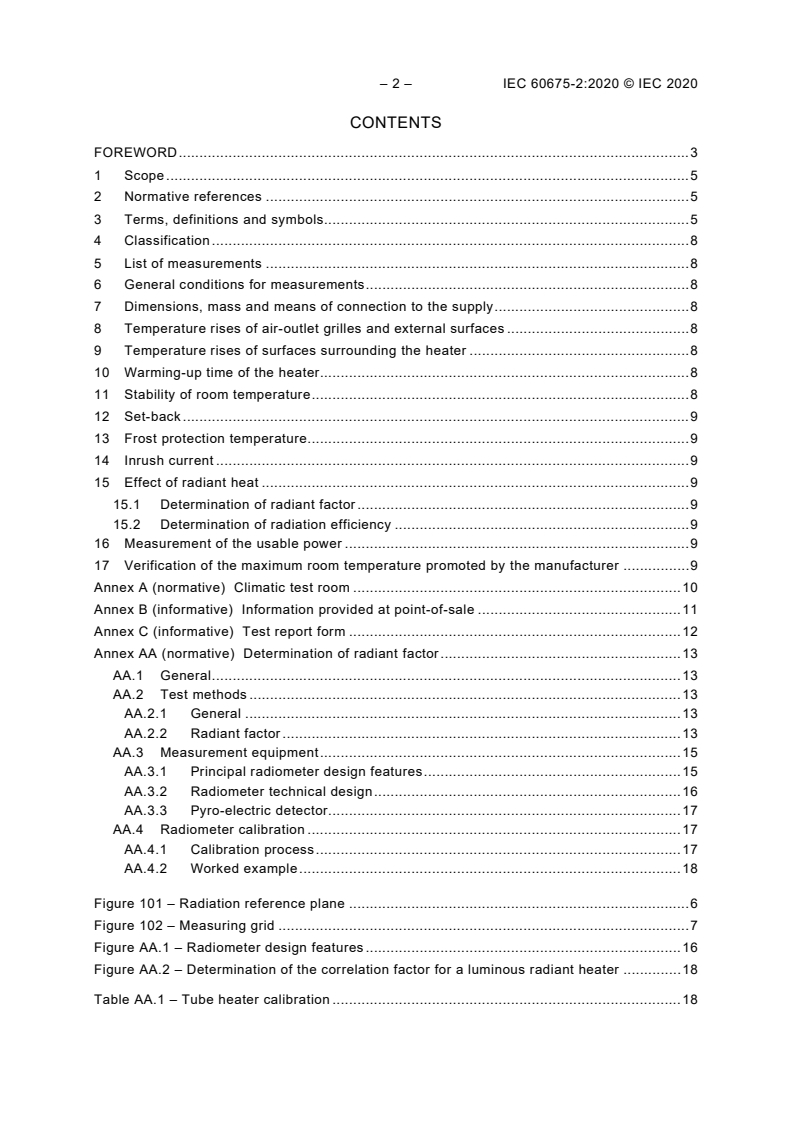
CONTENTS
FOREWORD . 3
1 Scope . 5
2 Normative references . 5
3 Terms, definitions and symbols. 5
4 Classification . 8
5 List of measurements . 8
6 General conditions for measurements . 8
7 Dimensions, mass and means of connection to the supply . 8
8 Temperature rises of air-outlet grilles and external surfaces . 8
9 Temperature rises of surfaces surrounding the heater . 8
10 Warming-up time of the heater. 8
11 Stability of room temperature . 8
12 Set-back . 9
13 Frost protection temperature . 9
14 Inrush current . 9
15 Effect of radiant heat . 9
15.1 Determination of radiant factor . 9
15.2 Determination of radiation efficiency . 9
16 Measurement of the usable power . 9
17 Verification of the maximum room temperature promoted by the manufacturer . 9
Annex A (normative) Climatic test room . 10
Annex B (informative) Information provided at point-of-sale . 11
Annex C (informative) Test report form . 12
Annex AA (normative) Determination of radiant factor . 13
AA.1 General . 13
AA.2 Test methods . 13
AA.2.1 General . 13
AA.2.2 Radiant factor . 13
AA.3 Measurement equipment . 15
AA.3.1 Principal radiometer design features . 15
AA.3.2 Radiometer technical design . 16
AA.3.3 Pyro-electric detector. 17
AA.4 Radiometer calibration . 17
AA.4.1 Calibration process . 17
AA.4.2 Worked example . 18
Figure 101 – Radiation reference plane . 6
Figure 102 – Measuring grid . 7
Figure AA.1 – Radiometer design features . 16
Figure AA.2 – Determination of the correlation factor for a luminous radiant heater . 18
Table AA.1 – Tube heater calibration . 18
INTERNATIONAL ELECTROTECHNICAL COMMISSION
____________
HOUSEHOLD ELECTRIC DIRECT-ACTING ROOM HEATERS –
METHODS FOR MEASURING PERFORMANCE –
Part 2: Additional provisions for the measurement
of the radiant factor
FOREWORD
1) The International Electrotechnical Commission (IEC) is a worldwide organization for standardization comprising
all national electrotechnical committees (IEC National Committees). The object of IEC is to promote international
co-operation on all questions concerning standardization in the electrical and electronic fields. To this end and
in addition to other activities, IEC publishes International Standards, Technical Specifications, Technical Reports,
Publicly Available Specifications (PAS) and Guides (hereafter referred to as "IEC Publication(s)"). Their
preparation is entrusted to technical committees; any IEC National Committee interested in the subject dealt with
may participate in this preparatory work. International, governmental and non-governmental organizations liaising
with the IEC also participate in this preparation. IEC collaborates closely with the International Organization for
Standardization (ISO) in accordance with conditions determined by agreement between the two organizations.
2) The formal decisions or agreements of IEC on technical matters express, as nearly as possible, an international
consensus of opinion on the relevant subjects since each technical committee has representation from all
interested IEC National Committees.
3) IEC Publications have the form of recommendations for international use and are accepted by IEC National
Committees in that sense. While all reasonable efforts are made to ensure that the technical content of IEC
Publications is accurate, IEC cannot be held responsible for the way in which they are used or for any
misinterpretation by any end user.
4) In order to promote international uniformity, IEC National Committees undertake to apply IEC Publications
transparently to the maximum extent possible in their national and regional publications. Any divergence between
any IEC Publication and the corresponding national or regional publication shall be clearly indicated in the latter.
5) IEC itself does not provide any attestation of conformity. Independent certification bodies provide conformity
assessment services and, in some areas, access to IEC marks of conformity. IEC is not responsible for any
services carried out by independent certification bodies.
6) All users should ensure that they have the latest edition of this publication.
7) No liability shall attach to IEC or its directors, employees, servants or agents including individual experts and
members of its technical committees and IEC National Committees for any personal injury, property damage or
other damage of any nature whatsoever, whether direct or indirect, or for costs (including legal fees) and
expenses arising out of the publication, use of, or reliance upon, this IEC Publication or any other IEC
Publications.
8) Attention is drawn to the Normative references cited in this publication. Use of the referenced publications is
indispensable for the correct application of this publication.
9) Attention is drawn to the possibility that some of the elements of this IEC Publication may be the subject of patent
rights. IEC shall not be held responsible for identifying any or all such patent rights.
International Standard IEC 60675-2 has been prepared by subcommittee 59C: Electrical
heating appliances for household and similar purposes, of IEC technical committee 59:
Performance of household and similar electrical appliances.
The text of this International Standard is based on the following documents:
FDIS Report on voting
59C/256/FDIS 59C/260/RVD
Full information on the voting for the approval of this International Standard can be found in the
report on voting indicated in the above table.
This document has been drafted in accordance with the ISO/IEC Directives, Part 2.
– 4 – IEC 60675-2:2020 © IEC 2020
This International Standard is to be used in conjunction with IEC 60675:1994,
IEC 60675:1994/AMD1:1998 and IEC 60675:1994/AMD2:2018. This document supplements or
modifies the corresponding clauses of IEC 60675:1994. Where the text indicates an "addition"
to or a "replacement" of the relevant provision of IEC 60675:1994, these changes are made to
the relevant text of IEC 60675:1994. Where no change is necessary, the words "This clause of
IEC 60675:1994 is applicable" are used. When a particular subclause of IEC 60675:1994 is not
mentioned in this part, that subclause applies as far as is reasonable.
Additional specific provisions to those in Part 1, given as individual clauses or subclauses, are
numbered starting from 101.
NOTE The following numbering system is used:
• subclauses, tables and figures that are numbered starting from 101 are additional to those in Part 1;
• unless notes are in a new subclause or involve notes in Part 1, they are numbered starting from 101, including
those in a replaced clause or subclause;
• additional annexes are lettered AA, BB, etc.
In this document, the following print types are used:
– terms listed in Clause 3 of this document and of IEC 60675:1994 and IEC 60675-3:2020:
Arial bold;
– test specifications: in italic type.
A list of all parts in the IEC 60675 series, published under the general title Household electric
direct-acting room heaters – Methods for measuring performance, can be found on the IEC
website.
The committee has decided that the contents of this document will remain unchanged until the
stability date indicated on the IEC website under "http://webstore.iec.ch" in the data related to
the specific document. At this date, the document will be
• reconfirmed,
• withdrawn,
• replaced by a revised edition, or
• amended.
IMPORTANT – The 'colour inside' logo on the cover page of this publication indicates
that it contains colours which are considered to be useful for the correct understanding
of its contents. Users should therefore print this document using a colour printer.
HOUSEHOLD ELECTRIC DIRECT-ACTING ROOM HEATERS –
METHODS FOR MEASURING PERFORMANCE –
Part 2: Additional provisions for the measurement
of the radiant factor
1 Scope
This clause of IEC 60675:1994 is applicable, with the following modification:
Replace the first paragraph with the following content:
This document applies to electric direct-acting room heaters .
This document defines performance characteristics related to the radiant effect and specifies
methods for measuring the radiant factor for the information of users.
This document is used to measure the radiant factor of direct-acting room heaters.
2 Normative references
Replace Clause 2 of IEC 60675:1994 with the following content:
The following documents are referred to in the text in such a way that some or all of their content
constitutes requirements of this document. For dated references, only the edition cited applies.
For undated references, the latest edition of the referenced document (including any
amendments) applies.
IEC 60675:1994, Household electric direct-acting room heaters – Methods for measuring
performance
IEC 60675:1994/AMD1:1998
IEC 60675:1994/AMD2:2018
IEC 60675-3:2020, Household electric direct-acting room heaters – Methods for measuring
performance – Part 3: Additional provisions for the measurement of radiation efficiency
3 Terms, definitions and symbols
Replace Clause 3 of IEC 60675:1994 with the following content:
For the purposes of this document, the terms and definitions given in IEC 60675:1994,
IEC 60675:1994/AMD1:1998, and IEC 60675-3:2020 and the following apply.
ISO and IEC maintain terminological databases for use in standardization at the following
addresses:
• IEC Electropedia: available at http://www.electropedia.org/
• ISO Online browsing platform: available at http://www.iso.org/obp
– 6 – IEC 60675-2:2020 © IEC 2020
Additional definitions:
3.101
radiant factor
ratio of the measured infrared heat output to the measured total energy input, expressed in %
Note 1 to entry: The radiant factor can be measured for panel heaters, convector heaters and radiant heaters
3.102
radiation efficiency
ratio of the heat flow into a (testing) chamber by radiation exchange between an active radiant
heating surface and the inner surfaces of the chamber to the nominal electric power of a heater
inside this testing chamber
Note 1 to entry: The radiant factor and the radiation efficiency are measured on different physical backgrounds
and not comparable.
3.103
radiation reference plane
flat surface bounded by the edge of the reflector or, in the case where radiant parts project
below this edge of the reflector, the flat surface touching the outermost radiant part
(see Figure 101)
Key
1 Reflector
2 Reference plane
Figure 101 – Radiation reference plane
3.104
irradiance
E
radiant power per unit area (W/m ) incident upon a surface
3.105
measuring plane
plane parallel to the radiation reference plane and 100 mm ± 3 mm away from it
3.106
measuring grid
regular arrangement in the measuring plane of straight lines running parallel and perpendicular
to the longitudinal axis of the appliance with sufficient precision (±1 mm)
Note 1 to entry: The nodal points of the measuring grid are located at the points of intersection of these lines (see
Figure 102) such that the distance between all adjacent nodes points on these lines is equidistant in each direction.
The size of the measuring plane is determined individually per heater by the provision that the radiant intensity
taken at the borders of the measuring plane is smaller than 1 % of the maximum value.
Key
1 Heater
2 Nodal point
3 Measuring cell F
ij
Figure 102 – Measuring grid
3.107 Symbols
The symbols shown in Table 101 are used in this document.
– 8 – IEC 60675-2:2020 © IEC 2020
Table 101 – Symbols
Symbol Title Unit
E Actual irradiance from radiant heater
W/m
E
Irradiance of the appliance measured at the nodal points of the measurement
W/m
ij
Average irradiance over the measurement grid F
W/m
ij
E
if
Q Measured radiant output W
(R)M
Q Measured electrical input in steady state conditions (rated power) W
M
R Radiant factor —
f(h/v)
h: measured in horizontal position
v: measured in vertical position
S Radiometer sensitivity
µV/(W/m )
U Sensor voltage v
4 Classification
This clause of IEC 60675:1994 is applicable.
5 List of measurements
This clause of IEC 60675:1994 and IEC 60675:1994/AMD1:1998 is applicable.
6 General conditions for measurements
This clause of IEC 60675:1994 and IEC 60675:1994/AMD1:1998 is applicable.
7 Dimensions, mass and means of connection to the supply
This clause of IEC 60675:1994 is applicable.
8 Temperature rises of air-outlet grilles and external surfaces
This clause of IEC 60675:1994 is applicable.
9 Temperature rises of surfaces surrounding the heater
This clause of IEC 60675:1994 is applicable.
10 Warming-up time of the heater
This clause of IEC 60675:1994 is applicable.
11 Stability of room temperature
This clause of IEC 60675:1994 and IEC 60675:1994/AMD1:1998 is applicable.
12 Set-back
This clause of IEC 60675:1994 is applicable.
13 Frost protection temperature
This clause of IEC 60675:1994 is applicable.
14 Inrush current
This clause of IEC 60675:1994 is applicable.
Replace Clause 15 of IEC 60675:1994 with the following content:
15 Effect of radiant heat
15.1 Determination of radiant factor
For panel heaters, convector heaters and radiant heaters, the radiant factor shall be
determined in accordance with Annex AA of this document.
15.2 Determination of radiation efficiency
For low temperature radiant heaters, the radiation efficiency may be determined in
accordance with Annex AA of IEC 60675-3:2020.
16 Measurement of the usable power
This clause of IEC 60675:1994/AMD1:1998 is applicable.
17 Verification of the maximum room temperature promoted by the
manufacturer
This clause of IEC 60675:1994/AMD2:2018 is applicable.
– 10 – IEC 60675-2:2020 © IEC 2020
Annex A
(normative)
Climatic test room
This annex of IEC 60675:1994 is applicable.
Annex B
(informative)
Information provided at point-of-sale
This annex of IEC 60675:1994 and the modifications in IEC 60675:1994/AMD1:1998 and
IEC 60675:1994/AMD2:2018 apply.
– 12 – IEC 60675-2:2020 © IEC 2020
Annex C
(informative)
Test report form
This annex of IEC 60675:1994 and the modifications in IEC 60675:1994/AMD1:1998 and
IEC 60675:1994/AMD2:2018 apply.
Annex AA
(normative)
Determination of radiant factor
AA.1 General
This annex is applicable to panel heaters, convector heaters and radiant heaters only.
AA.2 Test methods
AA.2.1 General
The test shall be carried out with the appliance mounted in accordance with the manufacturer’s
instructions set at the nominal output as declared by the manufacturer.
AA.2.2 Radiant factor
AA.2.2.1 Working area (requirements applicable to all methods of test)
The working area shall be of a size to allow installation of the appliance and shall:
a) have an ambient air temperature of 23 °C ± 2 °C;
b) allow the sensors to be positioned free from draughts (i.e. with a maximum air speed of 0,2
m/sec);
The radiometer temperature shall be checked during measurements and shall be 20,0 °C ±
0,5 °C.
AA.2.2.2 Measurements
AA.2.2.2.1 General
The appliance shall be installed horizontally or vertically, depending on the intended position in
accordance with the installation instructions with a minimal distance of 1,2 m to opposite
surfaces e.g. floor or wall. The position of the heater during the tests shall be mentioned with
the measured radiant factor.
If the installation instruction specifies both horizontal and vertical installation, the measurement
shall be performed in both positions.
AA.2.2.2.2 Test equipment
AA.2.2.2.2.1 General radiometer requirements
For the measurements, one or more radiometers may be used at the same time, each having a
sensitivity to irradiance in a minimum wavelength range of at least 0,8 µm to 20 µm.
Each radiometer shall be calibrated in accordance with the requirements of Clause AA.4.
Only radiometers that have thermostatically controlled water-cooling and nitrogen purge for the
integrating sphere shall be used.
NOTE An example of a proved and tested radiometer design is given in Clause AA.3.
– 14 – IEC 60675-2:2020 © IEC 2020
AA.2.2.2.2.2 Mechanical test equipment
Test equipment shall provide a stable mobile test arrangement enabling the radiometer to be
adjusted accurately in the measuring plane.
Adjustment may be achieved by hand or automatically.
AA.2.2.2.3 Radiometer measurement positions
Before commencing the test, the first and last node points (measurement points) shall be
established where the parallel and perpendicular lines intersect. This is achieved by measuring
the irradiance at the edge of the reflector and the crossover points, or nodes, are where
irradiation is smaller than 1 % of the maximum measured value under the appliance.
The radiometer shall be positioned at the nodal points of the measurement grid
(see Figure 102). The amount of the nodal points shall be calculated in that way, so that at least
20 points can be measured (equidistant for each parallel and perpendicular line) and their
distance shall be maximum 10 cm.
AA.2.2.3 Working area
The test shall be carried out in a working area having non-reflecting surfaces i.e. no uncoated
metals or mirrors.
AA.2.2.4 Test procedure
AA.2.2.4.1 Measuring principle
Radiant output is determined by means of a radiometric method in which the irradiance in the
measuring plane is measured and the measured values are integrated over the area of the
measuring grid.
AA.2.2.4.2 Measuring method
The radiometer is placed at each of the nodal points specified in 3.105 with a maximum
deviation (for each of the three axes) of 3 mm and a measurement of the irradiance is taken
as soon as the reading is stable.
The radiometer axis shall not be inclined by more than 2° from the perpendicular.
It is recommended that the measuring sequence is recorded using an automatic system.
AA.2.2.5 Calculation of radiant output
The radiant output (Q ) corresponds to the sum of all the products between the individual
(R)M
node surface and the arithmetic mean of the measured values of the irradiance of the four
nodes forming each node surface (Figure 102).
The appliance irradiance (E ) measured at the nodes is given by Equation (AA.1).
ij
E = U / S + C (AA.1)
ij
where:
U is the sensor voltage in μV;
S is the radiometer sensitivity in μV/W/m ;
C is an offset in W/m ;
and the average appliance irradiance ( E ) measured at the nodes is given by Equation (AA.2).
ij
E +++EEE
i−−11, j i−1,,j ij−1 ij,
E = W/m (AA.2)
ij
where:
in∈ 1, 2., and
( )
jk∈ 1, 2., .
( )
The radiant output (Q ) is then given by Equation (AA.3).
(R)M
(i=n)
jk=
( )
Q F× E (AA.3)
ij
(R)M ∑ ij
(i=1)
j=1
( )
where:
F is the area of the measurement cell in m (see Figure AA.2);
ij
E is the average irradiance of the measurement cell F in W/m .
ij ij
AA.2.2.6 Electrical input
The electrical input Q in W shall be measured in steady-state conditions calculated as the
M
average of the electrical input during the measurement of the radiant factor over the period
necessary for confirming steady-state conditions; steady-state conditions are reached when the
radiometer signal at the maximum point does not vary by more than 1 % over 10 min.
AA.2.2.7 Calculation of radiant factor
The radiant factor (R ) of the appliance is given by Equation (AA.4).
f(h/v)
Q
(RM)
R = (AA.4)
f h /v
( )
Q
M
where:
R is the radiant factor (either h: horizontally measured, or v: vertically measured);
f(h/v)
Q is the corrected radiant output in W;
(R)M
Q is the electrical input in W.
M
AA.3 Measurement equipment
AA.3.1 Principal radiometer design features
The principal design features of the radiometer are shown in Figure AA.1.
=
– 16 – IEC 60675-2:2020 © IEC 2020
Key
1 Nitrogen purge
2 Water inlet and outlet for cooling
3 Plate I (water-cooled)
4 Plate II
5 Pyroelectric detector
6 Plate III
7 Plate IV
Figure AA.1 – Radiometer design features
The radiation enters the radiometer through the upper orifice (in plate I) and is reflected several
times on the inner surface of the integrating sphere. The radiation is collected by the pyro-
electric detector. To avoid direct radiation being received by the detector, a horizontal, gold-
plated disc is installed in the centre of the integrating sphere. The upper orifice has sharp edges
and the sphere is internally gold coated so as to produce diffuse reflection (thickness of the
gold layer 5 µm to 10 µm) of the infrared radiation. The radiation received by the pyro-electric
detector is interrupted periodically by a chopper wheel. The output of the detector is controlled
electronically in order to achieve a continuous signal of between 0 V and 10 V.
AA.3.2 Radiometer technical design
Figure AA.1 shows a suitable design for the radiometer. This consists of four brass plates
screwed together to a unit.
The radiometer is required to be cooled by water to protect the electronics, the detector and
the chopper. The temperature of these parts needs to be maintained at (20 ± 0,5) °C. The
temperature of the cooling water should be controlled to avoid excess cooling or heating.
A thermometer (e.g. Pt100) is installed for the purpose of temperature control.
The internal parts should be vented continuously with dry nitrogen at a flow rate of about 2 l/h
in order to avoid the ingress of combustion products, dust, etc.
The frequency with which the chopper wheel interrupts the interruption of the radiation should
be adjusted in such a way as to avoid multiples of the mains frequency. This is necessary for
correct operation of the amplifier given by the frequency of the electrical mains supply.
AA.3.3 Pyro-electric detector
It is recommended to use a pyro-electric detector (e.g. LiTaO3) together with an adequate
window for transmission of the radiation (e.g. a window made of KBr with a protective layer)
with a spectral range of at least 2 µm to 10 µm. The pyro-electric detector is used in the voltage
mode. In this mode, the sensitivity of the detector depends on the frequency of the chopper
wheel. Normally, the detector can be used in a frequency range between 30 Hz to 4 kHz with a
positive polarity (the positive signal output increases with the irradiance). The installation and
use of the detector shall be in accordance with the manufacturer’s instructions. All electrical
wiring should be protected from external EMC influences.
The sensitivity of the detector can be changed by the frequency of the chopper wheel. Owing
to the influence of the frequency of the chopper wheel on the output signal, the frequency should
be kept as constant as possible.
AA.4 Radiometer calibration
AA.4.1 Calibration process
AA.4.1.1 General
Calibration of the radiometer shall be achieved against a so-called "black body". The irradiance
inside the black body (W/m ) is compared with the output signal (V). The calibration curve is a
straight line fitting the data from Table AA.1 in the coordinate system showing the output signal
(V) as a function of the irradiance (see Figure AA.2). For the calibration, the radiometer shall
be operated in the same mode as that used for measuring the radiation under the heater, using
the same wiring, amplifier and other components.
AA.4.1.2 Black body calibration method
This method uses a black-body radiator that can be heated at least to a temperature of 600 °C.
The radiator shall have an opening (aperture) of the same diameter as the radiometer to be
calibrated.
For the calibration, the radiometer is inserted into the black-body radiator. Irradiance from the
internal hot surface of the black body is transmitted to the radiometer and provides an adequate
output signal (V).
Calibration up to a black body temperature of 600 °C is sufficient.
The irradiance E (W/m ) at a temperature of T (K), referred to a radiometer temperature of
20 °C, is calculated using the Stefan-Boltzmann formula shown in Equation (AA.5).
E σT 293,− 15 (AA.5)
( )
=
– 18 – IEC 60675-2:2020 © IEC 2020
where:
−8 2 4
σ = 5,67 × 10 in W/(m T )
The calibration shall be carried out over the whole range of irradiances of the luminous radiant
heater (or tube heater). This is achieved by calibration at several temperatures of the black
body. For every temperature, the measurements shall be carried out at least three times and
the average of the values calculated. Thermal equilibrium shall be achieved at each of the
measurement temperatures prior to taking the measurements. The sensitivity for the whole
range of irradiances is determined from these individual sensitivities by using graphical
methods and statistical means. The irradiance is plotted against the voltage output of the
radiometer (see Figure AA.2). The correlation curve is given by the straight line of best fit (see
Equation AA.6). The calibration shall be carried out for irradiances up to at least
4 2
2,0 × 10 W/m .
AA.4.2 Worked example
Table AA.1 – Tube heater calibration
Black body Average Irradiance
temperature (°C) output
(W/m )
signal (V)
80 0,299 680
150 0,573 1 398
280 0,990 2 469
450 1,557 3 825
550 2,487 5 695
Key
x Average output signal (V)
y Irradiance (W/m )
Figure AA.2 – Determination of the correlation factor for a luminous radiant heater
In accordance with the graph, and using the best fitted linear regression of the data, points
Formula (AA.6) is calculated:
E = A × X + C (AA.6)
where:
A = 2 293,5 W/(m V);
C = 104,34 W/m ;
X = average output signal from radiometer, in V.
____________
– 20 – IEC 60675-2:2020 © IEC 2020
SOMMAIRE
AVANT-PROPOS . 21
1 Domaine d’application . 23
2 Références normatives . 23
3 Termes, définitions et symboles . 23
4 Classification . 26
5 Enumération des mesures . 26
6 Conditions générales d'exécution des mesures . 26
7 Dimensions, masse et moyens de raccordement au réseau d'alimentation. 26
8 Échauffements des grilles de sortie d'air et des surfaces extérieures . 26
9 Échauffements des surfaces autour de l'appareil de chauffage . 26
10 Temps de mise en régime de l'appareil de chauffage . 26
11 Stabilité de la température ambiante . 26
12 Abaissement . 27
13 Température hors-gel . 27
14 Courant d’appel . 27
15 Effet du rayonnement . 27
15.1 Détermination du coefficient de rayonnement . 27
15.2 Détermination du rendement de rayonnement . 27
16 Mesure de la puissance utile . 27
17 Vérification de la température ambiante maximale préconisée par le fabricant . 27
Annexe A (normative) Enceinte climatique . 28
Annexe B (informative) Informations disponibles au point de vente . 29
Annexe C (informative) Formulaire de rapport d'essais . 30
Annexe AA (normative) Détermination du coefficient de rayonnement . 31
AA.1 Généralités . 31
AA.2 Méthodes d’essais . 31
AA.2.1 Généralités . 31
AA.2.2 Coefficient de rayonnement . 31
AA.3 Equipement de mesure . 33
AA.3.1 Caractéristiques de la conception de principe du radiomètre . 33
AA.3.2 Conception technique du radiomètre . 34
AA.3.3 Détecteur pyroélectrique . 35
AA.4 Etalonnage du radiomètre . 35
AA.4.1 Processus d’étalonnage . 35
AA.4.2 Exemple élaboré . 36
Figure 101 – Plan de référence du rayonnement . 24
Figure 102 – Grille de mesurage . 25
Figure AA.1 – Caractéristiques de conception du radiomètre . 34
Figure AA.2 – Détermination du facteur de corrélation pour un appareil à rayonnement
lumineux . 37
Tableau AA.1 – Etalonnage du chauffe-tubes . 36
COMMISSION ÉLECTROTECHNIQUE INTERNATIONALE
____________
APPAREILS ÉLECTRODOMESTIQUES DE CHAUFFAGE
DES LOCAUX À ACTION DIRECTE –
MÉTHODES DE MESURE DE L'APTITUDE À LA FONCTION –
Partie 2: Dispositions supplémentaires pour la mesure
du coefficient de rayonnement
AVANT-PROPOS
1) La Commission Electrotechnique Internationale (IEC) est une organisation mondiale de normalisation composée
de l'ensemble des comités électrotechniques nationaux (Comités nationaux de l'IEC). L'IEC a pour objet de
favoriser la coopération internationale pour toutes les questions de normalisation dans les domaines de
l'électricité et de l'électronique. A cet effet, l'IEC – entre autres activités – publie des Normes internationales,
des Spécifications techniques, des Rapports techniques, des Spécifications accessibles au public (PAS) et des
Guides (ci-après dénommés "Publication(s) de l'IEC"). Leur élaboration est confiée à des comités d'études, aux
travaux desquels tout Comité national intéressé par le sujet traité peut participer. Les organisations
internationales, gouvernementales et non gouvernementales, en liaison avec l'IEC, participent également aux
travaux. L'IEC collabore étroitement avec l'Organisation Internationale de Normalisation (ISO), selon des
conditions fixées par accord entre les deux organisations.
2) Les décisions ou accords officiels de l'IEC concernant les questions techniques représentent, dans la mesure du
possible, un accord international sur les sujets étudiés, étant donné que les Comités nationaux de l'IEC intéressés
sont représentés dans chaque comité d'études.
3) Les Publications de l'IEC se présentent sous la forme de recommandations internationales et sont agréées
comme telles par les Comités nationaux de l'IEC. Tous les efforts raisonnables sont entrepris afin que l'IEC
s'assure de l'exactitude du contenu technique de ses publications; l'IEC ne peut pas être tenue responsable de
l'éventuelle mauvaise utilisation ou interprétation qui en est faite par un quelconque utilisateur final.
4) Dans le but d'encourager l'uniformité internationale, les Comités nationaux de l'IEC s'engagent, dans toute la
mesure possible, à appliquer de façon transparente les Publications de l'IEC dans leurs publications nationales
et régionales. Toutes divergences entre toutes Publications de l'IEC et toutes publications nationales ou
régionales correspondantes doivent être indiquées en termes clairs dans ces dernières.
5) L'IEC elle-même ne fournit aucune attestation de conformité. Des organismes de certification indépendants
fournissent des services d'évaluation de conformité et, dans certains secteurs, accèdent aux marques de
conformité de l'IEC. L'IEC n'est responsable d'aucun des services effectués par les organismes de certification
indépendants.
6) Tous les utilisateurs doivent s'assurer qu'ils sont en possession de la dernière édition de cette publication.
7) Aucune responsabilité ne doit être imputée à l'IEC, à ses administrateurs, employés, auxiliaires ou mandataires,
y compris ses expert
...