

IEC 61892-5:2014
(Main)Mobile and fixed offshore units - Electrical installations - Part 5: Mobile units
General Information
- Abstract
IEC 61892-5:2014 specifies the characteristics for electrical installations in mobile units, for use during transfer from one location to another and for use during the exploration and exploitation of petroleum resources. It applies to all installations, whether permanent, temporary, transportable or hand-held, to AC installations up to and including 35 000 V and DC installations up to and including 1 500 V (AC and DC voltages are nominal values). This third edition includes the following significant technical change with respect to the previous edition: the requirement to protection against flooding has been rewritten.
- Status
- Published
- Publication Date
- 05-Nov-2014
- Drafting Committee
- MT 18 - TC 18/MT 18
- Current Stage
- DELPUB - Deleted Publication
- Start Date
- 09-Apr-2019
- Completion Date
- 28-Aug-2026
Overview
IEC 61892-5:2014 is an International Standard developed by the International Electrotechnical Commission (IEC) that specifies requirements for electrical installations on mobile offshore units. This standard is particularly relevant to mobile platforms-such as drilling rigs and exploration vessels-used in the offshore petroleum industry. It covers electrical systems used during transfer between locations, as well as those operational during the exploration and exploitation of petroleum resources.
The standard applies to both alternating current (AC) installations up to and including 35,000 V and direct current (DC) installations up to and including 1,500 V. It is applicable to all types of installations, including permanent, temporary, transportable, and hand-held equipment. IEC 61892-5:2014 integrates provisions from the International Maritime Organization's MODU CODE and reflects current safety, reliability, and robustness standards for offshore electrical systems.
Key Topics
IEC 61892-5:2014 addresses critical areas to ensure the safe and effective operation of electrical installations on mobile offshore units:
- Protection Against Flooding: Requirements to ensure that essential electrical equipment operates safely even under partial flooding conditions.
- Rotating Machines: Installation and design guidelines to minimize adverse effects from vessel motion, including bearing design and lubrication for reliability.
- Main Switchboards: Subdivision and redundancy requirements for main switchboards to maintain power distribution in case of faults.
- Limits of Inclination: Operational guidelines for electrical equipment under varying angles of inclination and dynamic motion experienced offshore.
- Bilge Pumps and Emergency Power: Specifications for the power supply, cable protection, and control for emergency bilge pumps, enhancing survivability during critical events.
- Navigation and Safety Lights: Electrical requirements for navigation lights in compliance with international maritime regulations, ensuring visibility and safety.
- Steering and Propulsion Systems: Provisions for safe operation and control of main and auxiliary steering gear, electric propulsion, and dynamic positioning systems.
- Monitoring and Control: Stipulations for alarm, indication systems, and means of communication crucial for operational safety.
- Jacking, Anchoring, and Ballast Systems: Controls and protections for the stability and station-keeping of mobile units.
Applications
The practical value of IEC 61892-5:2014 lies in its application across various scenarios within the offshore petroleum sector:
- Design and Construction: Offshore unit designers and builders use this standard to ensure new units are compliant with the latest safety and functional requirements for electrical installations.
- Operation and Maintenance: Operators of mobile drilling rigs, accommodation platforms, and floating production units rely on the standard for guidelines relating to daily operational safety, fault prevention, and response to adverse conditions.
- Inspection and Compliance: Regulatory authorities and third-party inspectors evaluate installations against IEC 61892-5 to ensure ongoing compliance with international best practices.
- Upgrade and Retrofit Projects: The standard serves as a benchmark when updating older electrical systems to meet new performance, efficiency, and safety criteria.
Related Standards
IEC 61892-5:2014 is part of a broader family of standards covering electrical installations for offshore applications. Closely related standards include:
- IEC 61892-1: General requirements and conditions for electrical installations on offshore units.
- IEC 61892-2: System design principles for offshore electrical systems.
- IEC 61892-3: Specifications for electrical equipment on offshore units.
- IEC 61892-6: Installation requirements.
- IEC 60092 series: Electrical installations in ships, including electric propulsion and instrumentation.
- IEC 60034-1: Rotating electrical machines.
- MODU CODE (IMO): International standards for mobile offshore drilling unit safety and equipment.
By adhering to IEC 61892-5:2014, stakeholders in the offshore oil and gas industry can significantly enhance the performance, safety, and regulatory compliance of their mobile unit electrical installations. This contributes to safer operations, improved reliability, and alignment with worldwide maritime and offshore industry best practices.
Relations
- Revises
IEC 61892-5:2010 - Mobile and fixed offshore units - Electrical installations - Part 5: Mobile units - Effective Date
- 05-Sep-2023
- Revised
IEC 61892-5:2019 - Mobile and fixed offshore units - Electrical installations - Part 5: Mobile units - Effective Date
- 05-Sep-2023
Get Certified
Connect with accredited certification bodies for this standard

DNV
DNV is an independent assurance and risk management provider.

Lloyd's Register
Lloyd's Register is a global professional services organisation specialising in engineering and technology.

FSC International
Forest Stewardship Council certification.
Sponsored listings
Frequently Asked Questions
IEC 61892-5:2014 is a standard published by the International Electrotechnical Commission (IEC). Its full title is "Mobile and fixed offshore units - Electrical installations - Part 5: Mobile units". This standard covers: IEC 61892-5:2014 specifies the characteristics for electrical installations in mobile units, for use during transfer from one location to another and for use during the exploration and exploitation of petroleum resources. It applies to all installations, whether permanent, temporary, transportable or hand-held, to AC installations up to and including 35 000 V and DC installations up to and including 1 500 V (AC and DC voltages are nominal values). This third edition includes the following significant technical change with respect to the previous edition: the requirement to protection against flooding has been rewritten.
IEC 61892-5:2014 specifies the characteristics for electrical installations in mobile units, for use during transfer from one location to another and for use during the exploration and exploitation of petroleum resources. It applies to all installations, whether permanent, temporary, transportable or hand-held, to AC installations up to and including 35 000 V and DC installations up to and including 1 500 V (AC and DC voltages are nominal values). This third edition includes the following significant technical change with respect to the previous edition: the requirement to protection against flooding has been rewritten.
IEC 61892-5:2014 is classified under the following ICS (International Classification for Standards) categories: 29.240.20 - Power transmission and distribution lines; 33.200 - Telecontrol. Telemetering; 47.020.60 - Electrical equipment of ships and of marine structures. The ICS classification helps identify the subject area and facilitates finding related standards.
IEC 61892-5:2014 has the following relationships with other standards: It is inter standard links to IEC 61892-5:2010, IEC 61892-5:2019. Understanding these relationships helps ensure you are using the most current and applicable version of the standard.
IEC 61892-5:2014 is available in PDF format for immediate download after purchase. The document can be added to your cart and obtained through the secure checkout process. Digital delivery ensures instant access to the complete standard document.
Standards Content (Sample)
IEC 61892-5 ®
Edition 3.0 2014-11
INTERNATIONAL
STANDARD
NORME
INTERNATIONALE
Mobile and fixed offshore units – Electrical installations –
Part 5: Mobile units
Unités mobiles et fixes en mer – Installations électriques –
Partie 5: Unités mobiles
All rights reserved. Unless otherwise specified, no part of this publication may be reproduced or utilized in any form
or by any means, electronic or mechanical, including photocopying and microfilm, without permission in writing from
either IEC or IEC's member National Committee in the country of the requester. If you have any questions about IEC
copyright or have an enquiry about obtaining additional rights to this publication, please contact the address below or
your local IEC member National Committee for further information.
Droits de reproduction réservés. Sauf indication contraire, aucune partie de cette publication ne peut être reproduite
ni utilisée sous quelque forme que ce soit et par aucun procédé, électronique ou mécanique, y compris la photocopie
et les microfilms, sans l'accord écrit de l'IEC ou du Comité national de l'IEC du pays du demandeur. Si vous avez des
questions sur le copyright de l'IEC ou si vous désirez obtenir des droits supplémentaires sur cette publication, utilisez
les coordonnées ci-après ou contactez le Comité national de l'IEC de votre pays de résidence.
IEC Central Office Tel.: +41 22 919 02 11
3, rue de Varembé Fax: +41 22 919 03 00
CH-1211 Geneva 20 info@iec.ch
Switzerland www.iec.ch
About the IEC
The International Electrotechnical Commission (IEC) is the leading global organization that prepares and publishes
International Standards for all electrical, electronic and related technologies.
About IEC publications
The technical content of IEC publications is kept under constant review by the IEC. Please make sure that you have the
latest edition, a corrigenda or an amendment might have been published.
IEC Catalogue - webstore.iec.ch/catalogue Electropedia - www.electropedia.org
The stand-alone application for consulting the entire The world's leading online dictionary of electronic and
bibliographical information on IEC International Standards, electrical terms containing more than 30 000 terms and
Technical Specifications, Technical Reports and other definitions in English and French, with equivalent terms in 14
documents. Available for PC, Mac OS, Android Tablets and additional languages. Also known as the International
iPad. Electrotechnical Vocabulary (IEV) online.
IEC publications search - www.iec.ch/searchpub IEC Glossary - std.iec.ch/glossary
The advanced search enables to find IEC publications by a More than 55 000 electrotechnical terminology entries in
variety of criteria (reference number, text, technical English and French extracted from the Terms and Definitions
committee,…). It also gives information on projects, replaced clause of IEC publications issued since 2002. Some entries
and withdrawn publications. have been collected from earlier publications of IEC TC 37,
77, 86 and CISPR.
IEC Just Published - webstore.iec.ch/justpublished
Stay up to date on all new IEC publications. Just Published IEC Customer Service Centre - webstore.iec.ch/csc
details all new publications released. Available online and If you wish to give us your feedback on this publication or
also once a month by email. need further assistance, please contact the Customer Service
Centre: csc@iec.ch.
A propos de l'IEC
La Commission Electrotechnique Internationale (IEC) est la première organisation mondiale qui élabore et publie des
Normes internationales pour tout ce qui a trait à l'électricité, à l'électronique et aux technologies apparentées.
A propos des publications IEC
Le contenu technique des publications IEC est constamment revu. Veuillez vous assurer que vous possédez l’édition la
plus récente, un corrigendum ou amendement peut avoir été publié.
Catalogue IEC - webstore.iec.ch/catalogue Electropedia - www.electropedia.org
Application autonome pour consulter tous les renseignements
Le premier dictionnaire en ligne de termes électroniques et
bibliographiques sur les Normes internationales,
électriques. Il contient plus de 30 000 termes et définitions en
Spécifications techniques, Rapports techniques et autres
anglais et en français, ainsi que les termes équivalents dans
documents de l'IEC. Disponible pour PC, Mac OS, tablettes
14 langues additionnelles. Egalement appelé Vocabulaire
Android et iPad.
Electrotechnique International (IEV) en ligne.
Recherche de publications IEC - www.iec.ch/searchpub
Glossaire IEC - std.iec.ch/glossary
Plus de 55 000 entrées terminologiques électrotechniques, en
La recherche avancée permet de trouver des publications IEC
en utilisant différents critères (numéro de référence, texte, anglais et en français, extraites des articles Termes et
comité d’études,…). Elle donne aussi des informations sur les Définitions des publications IEC parues depuis 2002. Plus
projets et les publications remplacées ou retirées. certaines entrées antérieures extraites des publications des
CE 37, 77, 86 et CISPR de l'IEC.
IEC Just Published - webstore.iec.ch/justpublished
Service Clients - webstore.iec.ch/csc
Restez informé sur les nouvelles publications IEC. Just
Published détaille les nouvelles publications parues. Si vous désirez nous donner des commentaires sur cette
Disponible en ligne et aussi une fois par mois par email. publication ou si vous avez des questions contactez-nous:
csc@iec.ch.
IEC 61892-5 ®
Edition 3.0 2014-11
INTERNATIONAL
STANDARD
NORME
INTERNATIONALE
Mobile and fixed offshore units – Electrical installations –
Part 5: Mobile units
Unités mobiles et fixes en mer – Installations électriques –
Partie 5: Unités mobiles
INTERNATIONAL
ELECTROTECHNICAL
COMMISSION
COMMISSION
ELECTROTECHNIQUE
PRICE CODE
INTERNATIONALE
CODE PRIX W
ICS 47.020.60 ISBN 978-2-8322-1922-5
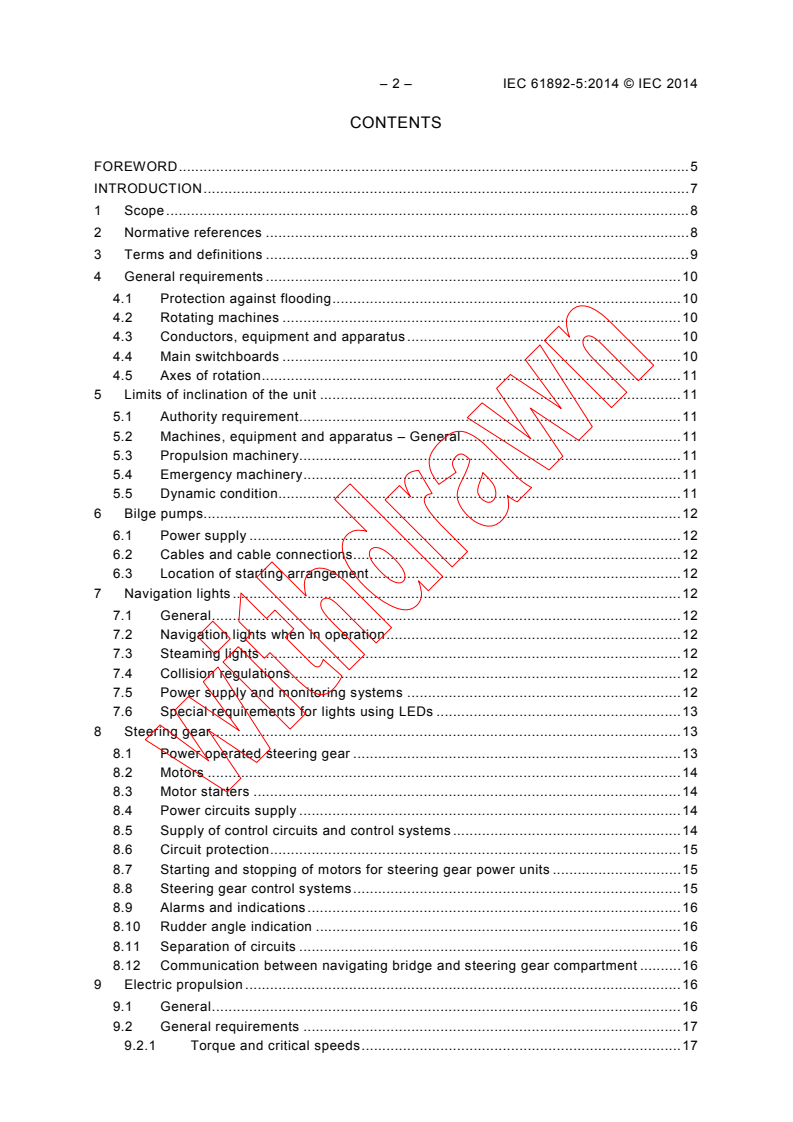
– 2 – IEC 61892-5:2014 © IEC 2014
CONTENTS
FOREWORD . 5
INTRODUCTION . 7
1 Scope . 8
2 Normative references . 8
3 Terms and definitions . 9
4 General requirements . 10
4.1 Protection against flooding . 10
4.2 Rotating machines . 10
4.3 Conductors, equipment and apparatus . 10
4.4 Main switchboards . 10
4.5 Axes of rotation . 11
5 Limits of inclination of the unit . 11
5.1 Authority requirement . 11
5.2 Machines, equipment and apparatus – General . 11
5.3 Propulsion machinery. 11
5.4 Emergency machinery . 11
5.5 Dynamic condition. 11
6 Bilge pumps. 12
6.1 Power supply . 12
6.2 Cables and cable connections. 12
6.3 Location of starting arrangement . 12
7 Navigation lights . 12
7.1 General . 12
7.2 Navigation lights when in operation . 12
7.3 Steaming lights . 12
7.4 Collision regulations. 12
7.5 Power supply and monitoring systems . 12
7.6 Special requirements for lights using LEDs . 13
8 Steering gear . 13
8.1 Power operated steering gear . 13
8.2 Motors . 14
8.3 Motor starters . 14
8.4 Power circuits supply . 14
8.5 Supply of control circuits and control systems . 14
8.6 Circuit protection . 15
8.7 Starting and stopping of motors for steering gear power units . 15
8.8 Steering gear control systems . 15
8.9 Alarms and indications . 16
8.10 Rudder angle indication . 16
8.11 Separation of circuits . 16
8.12 Communication between navigating bridge and steering gear compartment . 16
9 Electric propulsion . 16
9.1 General . 16
9.2 General requirements . 17
9.2.1 Torque and critical speeds . 17
9.2.2 Lubrication . 18
9.2.3 Prime movers . 18
9.3 Electromagnetic compatibility (EMC) and harmonic distortion . 19
9.3.1 General . 19
9.3.2 Total harmonic distortion, THD . 19
9.3.3 Radio frequency interference . 19
9.4 Harmonic filtering . 19
9.5 Generators, motors, semiconductor converters and electric slip-couplings . 20
9.5.1 Machine and equipment temperature and ventilation . 20
9.5.2 Accessibility and facilities for repair in situ . 20
9.5.3 Protection against moisture and condensate . 21
9.5.4 Sudden short circuits . 21
9.5.5 Overspeed of propulsion motors . 21
9.5.6 Exciter sets. 21
9.5.7 Semiconductor converter design data . 21
9.6 Protection against moisture and condensation . 22
9.7 Controlgear . 22
9.7.1 Location of manoeuvring controls . 22
9.7.2 Engine order systems . 22
9.7.3 Operation of manoeuvring controls . 22
9.7.4 Interlocking of the means of control . 23
9.8 Cables and wiring . 23
9.8.1 Conductors . 23
9.8.2 Internal wiring . 23
9.8.3 Bus-bars . 23
9.9 Main and control circuits . 24
9.9.1 Control . 24
9.9.2 Power management system . 24
9.9.3 Circuitry and components . 25
9.10 Protection of the system . 26
9.10.1 Protection . 26
9.10.2 Instrumentation . 27
9.11 Propulsion transformers . 28
9.12 Testing . 28
10 Dynamic positioning . 28
11 Ballast systems . 29
11.1 General . 29
11.2 Ballast pumps . 29
11.3 Control and indicating systems . 29
11.4 Internal communication . 30
11.5 Protection against flooding . 30
12 Jacking systems . 30
12.1 General . 30
12.2 Design . 31
12.3 Holding capacity . 31
12.4 Electric motor capacity . 31
12.5 Control and monitoring . 31
12.6 Jacking gear motors and motor controller. 32
12.6.1 General . 32
– 4 – IEC 61892-5:2014 © IEC 2014
12.6.2 Group installation . 32
12.6.3 Overcurrent protection . 32
12.6.4 Running protection . 32
12.6.5 Metering . 32
12.7 Testing on board . 32
13 Anchoring systems . 32
13.1 General . 32
13.2 Anchoring arrangements . 32
13.3 Control systems . 33
13.4 Thruster-assisted anchoring systems (TA) . 33
Annex A (informative) Enhanced system verification test (HIL test) for dynamic
positioned mobile units . 34
A.1 General . 34
A.2 Scope of HIL testing . 34
A.3 Schedule and work process . 35
A.4 Requirements to control systems manufacturer . 35
A.5 Documentation and approval . 35
Bibliography . 36
Figure 1 – Typical equipment (configuration) for unit with one or two propellers . 17
Figure 2 – Typical control configuration . 25
INTERNATIONAL ELECTROTECHNICAL COMMISSION
____________
MOBILE AND FIXED OFFSHORE UNITS –
ELECTRICAL INSTALLATIONS –
Part 5: Mobile units
FOREWORD
1) The International Electrotechnical Commission (IEC) is a worldwide organization for standardization comprising
all national electrotechnical committees (IEC National Committees). The object of IEC is to promote
international co-operation on all questions concerning standardization in the electrical and electronic fields. To
this end and in addition to other activities, IEC publishes International Standards, Technical Specifications,
Technical Reports, Publicly Available Specifications (PAS) and Guides (hereafter referred to as “IEC
Publication(s)”). Their preparation is entrusted to technical committees; any IEC National Committee interested
in the subject dealt with may participate in this preparatory work. International, governmental and non-
governmental organizations liaising with the IEC also participate in this preparation. IEC collaborates closely
with the International Organization for Standardization (ISO) in accordance with conditions determined by
agreement between the two organizations.
2) The formal decisions or agreements of IEC on technical matters express, as nearly as possible, an international
consensus of opinion on the relevant subjects since each technical committee has representation from all
interested IEC National Committees.
3) IEC Publications have the form of recommendations for international use and are accepted by IEC National
Committees in that sense. While all reasonable efforts are made to ensure that the technical content of IEC
Publications is accurate, IEC cannot be held responsible for the way in which they are used or for any
misinterpretation by any end user.
4) In order to promote international uniformity, IEC National Committees undertake to apply IEC Publications
transparently to the maximum extent possible in their national and regional publications. Any divergence
between any IEC Publication and the corresponding national or regional publication shall be clearly indicated in
the latter.
5) IEC itself does not provide any attestation of conformity. Independent certification bodies provide conformity
assessment services and, in some areas, access to IEC marks of conformity. IEC is not responsible for any
services carried out by independent certification bodies.
6) All users should ensure that they have the latest edition of this publication.
7) No liability shall attach to IEC or its directors, employees, servants or agents including individual experts and
members of its technical committees and IEC National Committees for any personal injury, property damage or
other damage of any nature whatsoever, whether direct or indirect, or for costs (including legal fees) and
expenses arising out of the publication, use of, or reliance upon, this IEC Publication or any other IEC
Publications.
8) Attention is drawn to the Normative references cited in this publication. Use of the referenced publications is
indispensable for the correct application of this publication.
9) Attention is drawn to the possibility that some of the elements of this IEC Publication may be the subject of
patent rights. IEC shall not be held responsible for identifying any or all such patent rights.
International Standard IEC 61892-5 has been prepared by IEC technical committee 18:
Electrical installations of ships and of mobile and fixed offshore units.
This third edition cancels and replaces the second edition published in 2010. This edition
constitutes a technical revision.
This third edition includes the following significant technical change with respect to the
previous edition:
The requirement to protection against flooding has been rewritten.
– 6 – IEC 61892-5:2014 © IEC 2014
The text of this standard is based on the following documents:
FDIS Report on voting
18/1424/FDIS 18/1439/RVD
Full information on the voting for the approval of this standard can be found in the report on
voting indicated in the above table.
This publication has been drafted in accordance with the ISO/IEC Directives, Part 2.
The requirements specified in this International Standard are based on the Code for the
Construction and Equipment of Mobile Offshore Drilling Units (1989 MODU CODE) published
by the International Maritime Organization (IMO), and might include additional provisions.
A list of all the parts in the IEC 61892 series, published under the general title Mobile and
fixed offshore units – Electrical installations, can be found on the IEC website.
The committee has decided that the contents of this publication will remain unchanged until
the stability date indicated on the IEC web site under "http://webstore.iec.ch" in the data
related to the specific publication. At this date, the publication will be
• reconfirmed,
• withdrawn,
• replaced by a revised edition, or
• amended.
INTRODUCTION
IEC 61892 forms a series of International Standards intended to ensure safety in the design,
selection, installation, maintenance and use of electrical equipment for the generation,
storage, distribution and utilization of electrical energy for all purposes in offshore units used
for exploration or exploitation of petroleum resources.
This part of IEC 61892 also incorporates and co-ordinates, as far as possible, existing rules
and forms a code of interpretation, where applicable, of the requirements laid down by the
International Maritime Organization, and constitutes a guide for future regulations which may
be prepared and a statement of practice for offshore unit owners, constructors and
appropriate organizations. This standard is based on equipment and practices which are in
current use, but it is not intended in any way to impede development of new or improved
techniques.
The ultimate aim has been to produce a set of International Standards exclusively for the
offshore petroleum industry.
– 8 – IEC 61892-5:2014 © IEC 2014
MOBILE AND FIXED OFFSHORE UNITS –
ELECTRICAL INSTALLATIONS –
Part 5: Mobile units
1 Scope
This part of IEC 61892 specifies the characteristics for electrical installations in mobile units,
for use during transfer from one location to another and for use during the exploration and
exploitation of petroleum resources.
It applies to all installations, whether permanent, temporary, transportable or hand-held, to AC
installations up to and including 35 000 V and DC installations up to and including 1 500 V.
(AC and DC voltages are nominal values).
NOTE Attention is drawn to further requirements concerning electrical installations on such mobile offshore units
contained in the MODU CODE of the International Maritime Organization (IMO).
2 Normative references
The following documents, in whole or in part, are normatively referenced in this document and
are indispensable for its application. For dated references, only the edition cited applies. For
undated references, the latest edition of the referenced document (including any
amendments) applies.
IEC 60034-1, Rotating electrical machines – Part 1: Rating and performance
IEC 60076 (all parts), Power transformers
IEC 60092-501:2013, Electrical installations in ships – Part 501: Special features – Electric
propulsion plant
IEC 60092-504, Electrical installations in ships – Part 504: Special features – Control and
instrumentation
IEC 60332-1-2, Tests on electric and optical fibre cables under fire conditions – Part 1-2: Test
for vertical flame propagation for a single insulated wire or cable – Procedure for 1 kW pre-
mixed flame
IEC 60332-3-22, Tests on electric cables under fire conditions – Part 3-22: Test for vertical
flame spread of vertically-mounted bunched wires or cables – Category A
IEC 61000-6-2:2005, Electromagnetic compatibility (EMC) – Part 6-2: Generic standards –
Immunity for industrial environments
IEC 61378-1, Converter transformers – Part 1: Transformers for industrial applications
IEC 61892-1, Mobile and fixed offshore units – Electrical installations – Part 1: General
requirements and conditions
IEC 61892-2, Mobile and fixed offshore units – Electrical installations – Part 2: System design
IEC 61892-3, Mobile and fixed offshore units – Electrical installations – Part 3: Equipment
IEC 61892-6, Mobile and fixed offshore units – Electrical installations – Part 6: Installation
International Convention for the Safety of Life at Sea (SOLAS):1974, Consolidated edition
IALA, International Association of Marine Aids to Navigation and Lighthouse Authorities,
Recommendation O-1239 On The Marking of Man-Made Offshore Structures, 2008
IMO Guidelines for vessels with dynamic positioning systems – see IMO/MSC/Circ. 645,
Annex, International Maritime Organization
IMO 904E, Convention on the International Regulations for Preventing Collisions at Sea,
International Maritime Organization (COLREG)
3 Terms and definitions
For the purposes of this document, the terms and definitions given in IEC 61892-1,
IEC 61892-2, IEC 61892-3, IEC 61892-6, as well as the following apply.
3.1
auxiliary steering gear
equipment, other than any part of the main steering gear, necessary to steer the unit in the
event of failure of the main steering gear but not including the tiller, quadrant or components
serving the same purpose
3.2
dynamic positioning system
DP system
equipment necessary to provide means of controlling the position and heading of a mobile unit
within predetermined limits by means of resultant vectored thrust
Note 1 to entry: This note applies to the French language only.
3.3
electric steering gear
power operated steering gear where an electric motor applies torque to the rudder stock
through mechanical means only
3.4
electrohydraulic steering gear
power operated steering gear where a hydraulic pump, driven by an electric motor, applies
torque to the rudder stock through hydraulic and mechanical means
3.5
main steering gear
machinery, rudder actuators, steering gear power units and ancillary equipment and the
means of applying torque to the rudder stock (for example tiller or quadrant) necessary for
effecting movement of the rudder for the purpose of steering the unit under normal service
conditions
3.6
propulsion machine
rotating machine normally intended to provide propulsive power
3.7
redundancy
in an item, existence of more than one means for performing a required function
– 10 – IEC 61892-5:2014 © IEC 2014
[SOURCE IEC 60050-191:1990, 191-15-01]
3.8
semiconductor converter
electronic power converter with semiconductor valve devices
Note 1 to entry: Similar terms are used for converters in general or for specific kinds of converters and for
converters with other or specific electronic valve devices, e.g. thyristor converter, transistor inverter.
[SOURCE IEC 60050-551:1998, 551-12-42]
3.9
steering gear control system
equipment by which orders are transmitted from the navigating bridge to the steering gear
power units
Note 1 to entry: Steering gear control systems comprise transmitters, receivers, hydraulic control pumps and their
associated motors, motor controllers, piping and cables, etc.
3.10
steering gear power unit
electric motor and its associated electrical and/or hydraulic equipment used to operate the
steering gear
4 General requirements
4.1 Protection against flooding
In every mobile unit in which electric power is used for the services necessary for the safety
of the unit, the generators, switchgear, motors and associated controlgear for such services,
with the exception of machinery in the platform of semi-submersibles, shall be so situated or
arranged that they continue to operate in the event of partial flooding of the unit, within
inclination limits referred in Clause 5.
The essential services for safety of personnel and unit including generators, switchgear,
motors and associated controlgear for such services should be located above the worst
damage waterline and be readily accessible.
4.2 Rotating machines
Rotating machines shall be installed to minimise the effects of motion. The design of bearings
of all machines and the arrangement for their lubrication shall be adequate to withstand the
motions encountered in heavy weather and operation for prolonged periods at the list and trim
specified in Clause 5 without the spillage of oil.
4.3 Conductors, equipment and apparatus
Conductors, equipment and apparatus shall be placed at such a distance from each magnetic
compass or shall be so disposed that the interfering external magnetic field is negligible; that
is, the total singular deviation shall not exceed 30 min when any combination of circuits is
switched on and off.
4.4 Main switchboards
The main switchboard shall be subdivided into at least two parts. The subdivision may be
effected by removable links, circuit-breakers or other suitable means so that the main
generators and any supplies to duplicated services which are directly connected to the
busbars are, as far as is practicable, equally divided between the sections.
4.5 Axes of rotation
For units where the requirements to dynamic conditions, as specified in 5.5 apply, horizontal
rotation machines shall to the extent possible be installed preferably with the shaft in the fore-
and-aft direction. Where a machine is installed athwartship, it shall be ensured that the design
of the bearings and the arrangements for lubrication are satisfactory to withstand the rolling
specified in Clause 5. The manufacturer shall be informed when a machine for installation
athwartship is ordered.
5 Limits of inclination of the unit
5.1 Authority requirement
Dependent upon the outcome of all studies relevant to the intact and damaged stability of the
unit, the appropriate authority may require or permit deviations from the angles stated in 5.2,
5.3 and 5.4.
5.2 Machines, equipment and apparatus – General
All machines, equipment and apparatus shall operate satisfactorily under all conditions with
the unit upright and when inclined up to the following angles from the normal:
– for column stabilized units, 15° in any direction;
– for self-elevating units, 10° in any direction;
– for surface units, 15° either way in list and simultaneously trimmed 5° by the bow or stern.
5.3 Propulsion machinery
Main propulsion machinery and all auxiliary machinery essential to the propulsion and safety
of the mobile unit shall be capable of operating under the static conditions specified in 5.2 and
the following dynamic conditions:
– for column stabilized units, 22° 30′ in any direction;
– for self-elevating units, 15° in any direction;
– for surface units, 22° 30′ rolling and simultaneously pitching 7° 30′ by the bow or stern.
5.4 Emergency machinery
Emergency machines, equipment and apparatus fitted in accordance with requirements from
the appropriate authority for emergency plant shall operate satisfactorily under all conditions
with the unit upright and when inclined up to the following maximum angles from the normal:
– for column stabilized units, 25° in any direction;
– for self-elevating units, 15° in any direction;
– for surface units, 22° 30′ about the longitudinal axis and/or when inclined 10° about the
transverse axis.
5.5 Dynamic condition
Where required by the appropriate authority, dynamic condition limits shall apply as follows:
– rotation about fore-and-aft axis (rolling), ±22° 30′;
– rotation about athwartship (pitching), ±7° 30′ .
NOTE These motions can occur simultaneously.
– 12 – IEC 61892-5:2014 © IEC 2014
6 Bilge pumps
6.1 Power supply
Motors of permanently installed emergency bilge pumps, if any, shall be connected to an
emergency switchboard.
6.2 Cables and cable connections
Cables and their connections to submersible pumps shall be capable of operating under a
head of water equal to their distance below the worst damaged condition waterline. The
cables shall either be armoured or mechanically protected by other means and shall not be
installed within the assumed extent of damage. They shall be installed in continuous lengths
from above the worst damaged condition waterline to the motor terminals, entering the air-bell
from its underside.
6.3 Location of starting arrangement
Under all circumstances it shall be possible to start the motor of a permanently installed bilge
pump from a convenient point above the worst damaged condition waterline and in a space
not within the assumed extent of damage.
NOTE Information regarding the worst damaged condition waterline and the spaces within the assumed extent of
damage is given in IMO requirements, for example in the MODU Code.
7 Navigation lights
7.1 General
Except when a unit is stationary and engaged in operations, IMO 904E applies.
7.2 Navigation lights when in operation
When a unit is stationary and engaged in operations, attention is drawn to the requirements
for the safety of navigation of the coastal state in whose territorial sea or on whose
continental shelf the unit is operating.
Unless otherwise required for the obstruction lighting by national authorities, the lighting is to
be in accordance with IALA Recommendation O-1239.
7.3 Steaming lights
All units shall be provided with "steaming lights" which comprise masthead, side, stern,
anchor, not-under-command and, if applicable, special-purpose lights. The construction and
installation of navigation lights shall be to the satisfaction of the appropriate authority.
7.4 Collision regulations
Attention is drawn to the collision regulations in relation to the provision of primary and
alternative lanterns for each of the navigation lights.
7.5 Power supply and monitoring systems
The following electrical arrangements relate only to the navigation lights referred to in 7.3 and
7.4.
– Each light shall be connected by a separate cable to a distribution board reserved solely
for navigation lights, fitted in an accessible place under the control of watchkeeping
personnel.
– There shall be two separate power supply systems to the distribution board, one being
from the main switchboard and one from the emergency switchboard. Where a transitional
source of emergency power is required by the Safety of Life at Sea (SOLAS) Convention,
the arrangements shall enable the lights to be supplied from this source in addition to the
emergency switchboard. An alarm shall be activated in the event of failure of a power
supply to the distribution board.
– As far as practicable, the arrangements should be such that a fire, a fault or mechanical
damage at any one point will not render both systems inoperative. It is, however, accepted
that the systems must come together at some point where the changeover can be
performed. This should, preferably, be at or near to the distribution board.
– Each light shall be controlled and protected in each insulated pole by a switch and fuse or
by a circuit-breaker mounted in the distribution board.
– Each light shall be provided with an automatic indicator to give an acoustic and/or optical
alarm in the event of complete extinction of the light. If an optical signal is used, which is
connected in series with the steaming light, means to prevent failure of the indicator
extinguishing the steaming light shall be provided. If an acoustic device alone is used it
shall be connected to an independent source of supply, for example a battery, and
provision shall be made for testing this supply.
The use of junction boxes in navigation light circuits, other than those provided for connecting
the lanterns to the fixed wiring of the electrical installation, should be avoided. Cables for
different circuits should not use the same junction box.
7.6 Special requirements for lights using LEDs
The luminous intensity of LEDs gradually decreases while the electricity consumption remains
unchanged. The rate of decrease of luminous intensity depends on the output of LEDs and
temperatures of LEDs. To prevent shortage of luminous intensity of LEDs, one of the following
solutions shall be used:
• An alarm function shall be activated to notify the Officer of the Watch that the luminous
intensity of the light reduces below the level required by COLREGs; or
• LEDs shall only be used within the lifespan (practical term of validity) specified by the
manufacturer to maintain the necessary luminous intensity of LEDs. The lifespan of LEDs
should be determined and clearly notified by the manufacturer based on the appropriate
test results on the decrease of luminous intensity of the LEDs under various temperature
conditions and on the temperature condition of LEDs in the light during operation, taking
the appropriate margin into account.
The manufacturer of the navigation light should give information regarding detection of low
illumination intensity.
8 Steering gear
8.1 Power operated steering gear
8.1.1 Electric and/or electrohydraulic steering gear shall be used for the power-operated
main and auxiliary steering gear required by the appropriate authorities.
8.1.2 The electrical systems of the main steering gear and auxiliary steering gear shall be
so arranged that any failure in one of the steering gears will not render inoperative the
electrical systems of the other steering gear.
When an auxiliary steering gear is not required by the appropriate authorities and the main
steering gear comprises two or more power units, the electrical system for each power unit
shall be so arranged that the failure of one of them will not render the other units inoperative.
– 14 – IEC 61892-5:2014 © IEC 2014
8.2 Motors
8.2.1 To determine the required characteristics of the electric motors for power units, the
breakaway torque and maximum working torque of the steering gear under all operating
conditions shall be used. The ratio of pull-out torque to rated torque shall be at least 1,6.
8.2.2 The rating shall be determined on the basis of the steering gear characteristics of the
subject unit as specified in 8.2.3 and 8.2.4.
Motors for steering gear power units may be rated for intermittent power demand.
8.2.3 For motors of electric steering gear power units the rating shall be as follows:
S3 – 40 % in accordance with lEC 60034-1.
8.2.4 For motors of electrohydraulic steering gear power units and for converters, the
rating shall be as follows:
S6 – 25 % in accordance with IEC 60034-1.
8.3 Motor starters
Each electric motor of a main or auxiliary steering gear power unit shall be provided with its
own separate motor starter gear, either located within the steering gear compartment or in the
supply switchboard rooms (see 8.1.2).
8.4 Power circuits supply
8.4.1 Each electric or electrohydraulic steering gear comprising one or more power units
should, except as otherwise permitted by the appropriate authorities, be served by at least
two excl
...