

IEC 60952-2:2013
(Main)Aircraft batteries - Part 2: Design and construction requirements
General Information
- Abstract
IEC 60952-2:2013 defines the physical design, construction and material requirements for nickel-cadmium and lead-acid aircraft batteries containing vented or valve-regulated cells or monoblocs. The batteries are used for both general purposes and specific aerospace applications. This third edition cancels and replaces the second edition published in 2004. This new edition includes those formats that can be standardized along with their connectors and electrical interfaces.
- Status
- Published
- Publication Date
- 08-Jul-2013
- Technical Committee
- SC 21A - Secondary cells and batteries containing alkaline or other non-acid electrolytes
- Drafting Committee
- MT 60952 - TC 21/MT 60952
- Current Stage
- PPUB - Publication issued
- Start Date
- 09-Jul-2013
- Completion Date
- 15-Aug-2013
Overview
IEC 60952-2:2013 is an international standard issued by the International Electrotechnical Commission (IEC) that specifies the design and construction requirements for aircraft batteries. This standard primarily covers nickel-cadmium and lead-acid batteries used in aerospace applications, including both vented and valve-regulated cell types and monobloc designs. As the third edition, this 2013 publication replaces the 2004 edition, introducing updated specifications, including standardized battery formats, connectors, and electrical interfaces.
The standard ensures that aircraft batteries meet stringent criteria for reliability, safety, and performance to support the critical power needs of modern aircraft systems. IEC 60952-2 serves as a key reference for manufacturers, aerospace engineers, and regulatory bodies involved in the development, certification, and maintenance of aircraft battery technologies.
Key Topics
- Physical Design & Construction
Detailed requirements on battery containers, cell jars, monobloc assemblies, and overall mechanical construction ensure robustness under in-flight conditions. - Safety & Workmanship
Guidelines address safety philosophies, corrosion prevention, dissimilar metal compatibility, leak prevention, and quality workmanship to uphold operational integrity. - Electrolyte Management
Specifications for electrolyte resistance, level monitoring, and leakage prevention enhance battery reliability and safety. - Venting Systems
Design criteria for vented and valve-regulated cells to manage gas release safely during operation. - Electrical Connections
Standards for inter-cell connectors in nickel-cadmium batteries and strength requirements for electrical connectors support secure electrical interfaces. - Marking & Identification
Requirements for battery and cell labeling including polarity and color coding facilitate clear identification and maintenance procedures. - Environmental Considerations
Provisions for storage, transportation, disposal, recycling, and temperature monitoring reflect lifecycle management best practices. - Standardized Formats & Connectors
Annexes include normative details on battery formats and connector types to promote interoperability across aerospace systems.
Applications
- Commercial and Military Aircraft
Compliance with IEC 60952-2 ensures aircraft batteries are dependable for general and mission-critical aerospace power needs. - Aircraft Power Supply Systems
Batteries designed per this standard support engine starts, emergency power, and onboard avionics systems. - Aviation Maintenance & Certification
Aircraft manufacturers and maintenance organizations apply the standard to validate battery safety, structural integrity, and electrical interfaces. - Battery Manufacturing
Producers of nickel-cadmium and lead-acid aerospace batteries utilize the design and construction requirements to meet international aerospace safety and quality standards.
Related Standards
- IEC 60952-1 – General requirements for aircraft batteries, complementing the detailed design aspects covered in Part 2.
- ISO/IEC Directives, Part 2 – Framework used in drafting IEC standards, including IEC 60952-2.
- Other IEC 60952 Series Parts – Covering testing methods, performance, and maintenance of aircraft batteries for comprehensive standardization.
By adhering to IEC 60952-2:2013, aviation stakeholders can ensure high-quality aircraft battery design, promoting safety, reliability, and performance consistency within global aerospace electrical systems. This standard plays a critical role in supporting the growing demand for efficient and robust energy storage solutions in modern aviation.
Relations
- Effective Date
- 05-Sep-2023
Get Certified
Connect with accredited certification bodies for this standard

BUREAU VERITAS Certification Germany
Bureau Veritas certification in Germany.

Element Materials Technology
Materials testing and product certification.

IMQ S.p.A. (Certification)
Italian electrical product certification.
Sponsored listings
Frequently Asked Questions
IEC 60952-2:2013 is a standard published by the International Electrotechnical Commission (IEC). Its full title is "Aircraft batteries - Part 2: Design and construction requirements". This standard covers: IEC 60952-2:2013 defines the physical design, construction and material requirements for nickel-cadmium and lead-acid aircraft batteries containing vented or valve-regulated cells or monoblocs. The batteries are used for both general purposes and specific aerospace applications. This third edition cancels and replaces the second edition published in 2004. This new edition includes those formats that can be standardized along with their connectors and electrical interfaces.
IEC 60952-2:2013 defines the physical design, construction and material requirements for nickel-cadmium and lead-acid aircraft batteries containing vented or valve-regulated cells or monoblocs. The batteries are used for both general purposes and specific aerospace applications. This third edition cancels and replaces the second edition published in 2004. This new edition includes those formats that can be standardized along with their connectors and electrical interfaces.
IEC 60952-2:2013 is classified under the following ICS (International Classification for Standards) categories: 29.220.20 - Acid secondary cells and batteries; 49.060 - Aerospace electric equipment and systems. The ICS classification helps identify the subject area and facilitates finding related standards.
IEC 60952-2:2013 has the following relationships with other standards: It is inter standard links to IEC 60952-2:2004. Understanding these relationships helps ensure you are using the most current and applicable version of the standard.
IEC 60952-2:2013 is available in PDF format for immediate download after purchase. The document can be added to your cart and obtained through the secure checkout process. Digital delivery ensures instant access to the complete standard document.
Standards Content (Sample)
IEC 60952-2 ®
Edition 3.0 2013-07
INTERNATIONAL
STANDARD
NORME
INTERNATIONALE
Aircraft batteries –
Part 2: Design and construction requirements
Batteries d’aéronefs –
Partie 2: Exigences de conception et de construction
All rights reserved. Unless otherwise specified, no part of this publication may be reproduced or utilized in any form
or by any means, electronic or mechanical, including photocopying and microfilm, without permission in writing from
either IEC or IEC's member National Committee in the country of the requester.
If you have any questions about IEC copyright or have an enquiry about obtaining additional rights to this publication,
please contact the address below or your local IEC member National Committee for further information.
Droits de reproduction réservés. Sauf indication contraire, aucune partie de cette publication ne peut être reproduite ni
utilisée sous quelque forme que ce soit et par aucun procédé, électronique ou mécanique, y compris la photocopie et les
microfilms, sans l'accord écrit de la CEI ou du Comité national de la CEI du pays du demandeur.
Si vous avez des questions sur le copyright de la CEI ou si vous désirez obtenir des droits supplémentaires sur cette
publication, utilisez les coordonnées ci-après ou contactez le Comité national de la CEI de votre pays de résidence.
IEC Central Office Tel.: +41 22 919 02 11
3, rue de Varembé Fax: +41 22 919 03 00
CH-1211 Geneva 20 info@iec.ch
Switzerland www.iec.ch
About the IEC
The International Electrotechnical Commission (IEC) is the leading global organization that prepares and publishes
International Standards for all electrical, electronic and related technologies.
About IEC publications
The technical content of IEC publications is kept under constant review by the IEC. Please make sure that you have the
latest edition, a corrigenda or an amendment might have been published.
Useful links:
IEC publications search - www.iec.ch/searchpub Electropedia - www.electropedia.org
The advanced search enables you to find IEC publications The world's leading online dictionary of electronic and
by a variety of criteria (reference number, text, technical electrical terms containing more than 30 000 terms and
committee,…). definitions in English and French, with equivalent terms in
It also gives information on projects, replaced and additional languages. Also known as the International
withdrawn publications. Electrotechnical Vocabulary (IEV) on-line.
IEC Just Published - webstore.iec.ch/justpublished Customer Service Centre - webstore.iec.ch/csc
Stay up to date on all new IEC publications. Just Published If you wish to give us your feedback on this publication
details all new publications released. Available on-line and or need further assistance, please contact the
also once a month by email. Customer Service Centre: csc@iec.ch.
A propos de la CEI
La Commission Electrotechnique Internationale (CEI) est la première organisation mondiale qui élabore et publie des
Normes internationales pour tout ce qui a trait à l'électricité, à l'électronique et aux technologies apparentées.
A propos des publications CEI
Le contenu technique des publications de la CEI est constamment revu. Veuillez vous assurer que vous possédez
l’édition la plus récente, un corrigendum ou amendement peut avoir été publié.
Liens utiles:
Recherche de publications CEI - www.iec.ch/searchpub Electropedia - www.electropedia.org
La recherche avancée vous permet de trouver des Le premier dictionnaire en ligne au monde de termes
publications CEI en utilisant différents critères (numéro de électroniques et électriques. Il contient plus de 30 000
référence, texte, comité d’études,…). termes et définitions en anglais et en français, ainsi que
Elle donne aussi des informations sur les projets et les les termes équivalents dans les langues additionnelles.
publications remplacées ou retirées. Egalement appelé Vocabulaire Electrotechnique
International (VEI) en ligne.
Just Published CEI - webstore.iec.ch/justpublished
Service Clients - webstore.iec.ch/csc
Restez informé sur les nouvelles publications de la CEI.
Just Published détaille les nouvelles publications parues. Si vous désirez nous donner des commentaires sur
Disponible en ligne et aussi une fois par mois par email. cette publication ou si vous avez des questions
contactez-nous: csc@iec.ch.
IEC 60952-2 ®
Edition 3.0 2013-07
INTERNATIONAL
STANDARD
NORME
INTERNATIONALE
Aircraft batteries –
Part 2: Design and construction requirements
Batteries d’aéronefs –
Partie 2: Exigences de conception et de construction
INTERNATIONAL
ELECTROTECHNICAL
COMMISSION
COMMISSION
ELECTROTECHNIQUE
PRICE CODE
INTERNATIONALE
CODE PRIX W
ICS 29.220.20; 49.060 ISBN 978-2-8322-0945-5
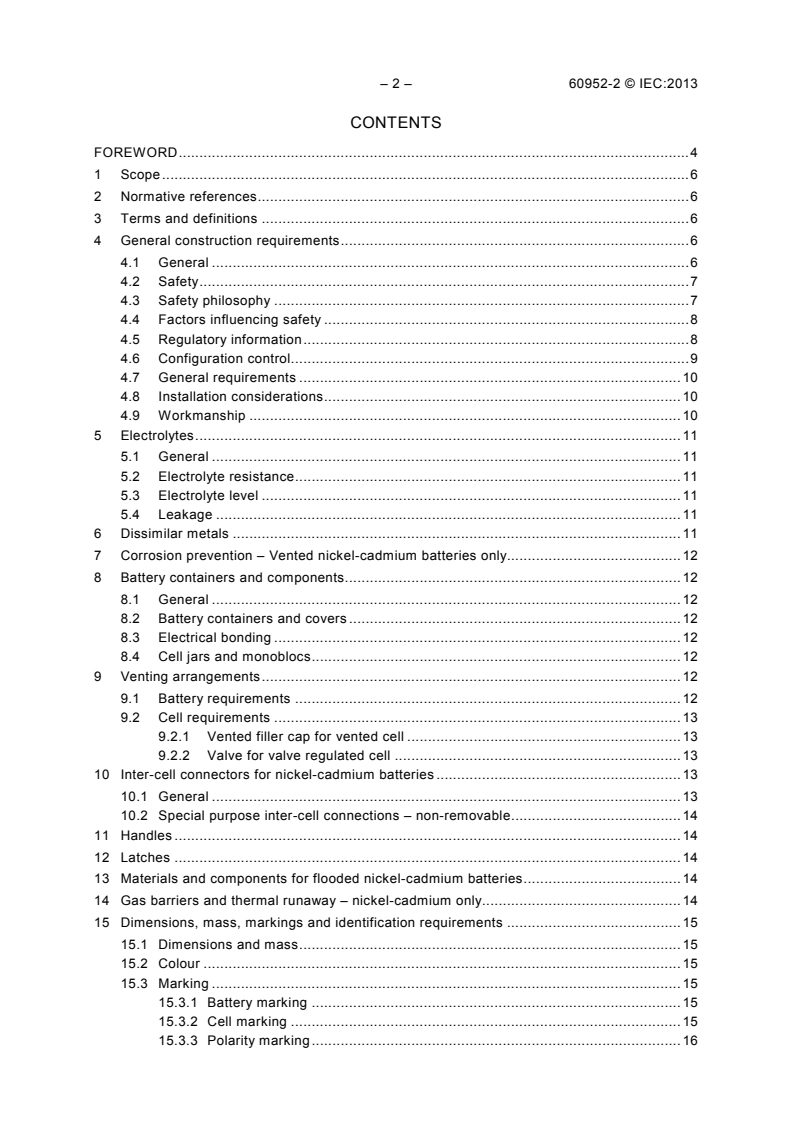
– 2 – 60952-2 © IEC:2013
CONTENTS
FOREWORD . 4
1 Scope . 6
2 Normative references . 6
3 Terms and definitions . 6
4 General construction requirements . 6
4.1 General . 6
4.2 Safety . 7
4.3 Safety philosophy . 7
4.4 Factors influencing safety . 8
4.5 Regulatory information . 8
4.6 Configuration control. 9
4.7 General requirements . 10
4.8 Installation considerations . 10
4.9 Workmanship . 10
5 Electrolytes . 11
5.1 General . 11
5.2 Electrolyte resistance . 11
5.3 Electrolyte level . 11
5.4 Leakage . 11
6 Dissimilar metals . 11
7 Corrosion prevention – Vented nickel-cadmium batteries only. 12
8 Battery containers and components. 12
8.1 General . 12
8.2 Battery containers and covers . 12
8.3 Electrical bonding . 12
8.4 Cell jars and monoblocs . 12
9 Venting arrangements . 12
9.1 Battery requirements . 12
9.2 Cell requirements . 13
9.2.1 Vented filler cap for vented cell . 13
9.2.2 Valve for valve regulated cell . 13
10 Inter-cell connectors for nickel-cadmium batteries . 13
10.1 General . 13
10.2 Special purpose inter-cell connections – non-removable . 14
11 Handles . 14
12 Latches . 14
13 Materials and components for flooded nickel-cadmium batteries . 14
14 Gas barriers and thermal runaway – nickel-cadmium only . 14
15 Dimensions, mass, markings and identification requirements . 15
15.1 Dimensions and mass . 15
15.2 Colour . 15
15.3 Marking . 15
15.3.1 Battery marking . 15
15.3.2 Cell marking . 15
15.3.3 Polarity marking . 16
60952-2 © IEC:2013 – 3 –
16 Heaters – Battery heating system . 16
17 Electrical connectors – Strength of receptacle . 16
18 Temperature monitoring . 16
19 Storage. 17
20 Transportation . 17
21 Disposal and recycling . 17
Annex A (normative) Battery formats . 18
Annex B (normative) Connectors . 31
Figure A.1 – Format A . 18
Figure A.2 – Format B . 19
Figure A.3 – Format C . 20
Figure A.4 – Format D . 21
Figure A.5 – Format E . 22
Figure A.6 – Format F . 23
Figure A.7 – Format G . 24
Figure A.8 – Format H . 25
Figure A.9 – Format I . 26
Figure A.10 – Format J . 27
Figure A.11 – Format K . 28
Figure A.12 – Format L . 29
Figure A.13 – Format M . 30
Figure B.1 – Connector Type A . 32
Figure B.2 – Connector Type B . 33
Figure B.3 – Connector Type C . 34
Figure B.4 – Connector Type Q . 35
Figure B.5 – Connector Type R . 36
Figure B.6 – Connector Type S . 37
Table 1 – Workmanship requirements . 11
– 4 – 60952-2 © IEC:2013
INTERNATIONAL ELECTROTECHNICAL COMMISSION
____________
AIRCRAFT BATTERIES –
Part 2: Design and construction requirements
FOREWORD
1) The International Electrotechnical Commission (IEC) is a worldwide organization for standardization comprising
all national electrotechnical committees (IEC National Committees). The object of IEC is to promote
international co-operation on all questions concerning standardization in the electrical and electronic fields. To
this end and in addition to other activities, IEC publishes International Standards, Technical Specifications,
Technical Reports, Publicly Available Specifications (PAS) and Guides (hereafter referred to as “IEC
Publication(s)”). Their preparation is entrusted to technical committees; any IEC National Committee interested
in the subject dealt with may participate in this preparatory work. International, governmental and non-
governmental organizations liaising with the IEC also participate in this preparation. IEC collaborates closely
with the International Organization for Standardization (ISO) in accordance with conditions determined by
agreement between the two organizations.
2) The formal decisions or agreements of IEC on technical matters express, as nearly as possible, an international
consensus of opinion on the relevant subjects since each technical committee has representation from all
interested IEC National Committees.
3) IEC Publications have the form of recommendations for international use and are accepted by IEC National
Committees in that sense. While all reasonable efforts are made to ensure that the technical content of IEC
Publications is accurate, IEC cannot be held responsible for the way in which they are used or for any
misinterpretation by any end user.
4) In order to promote international uniformity, IEC National Committees undertake to apply IEC Publications
transparently to the maximum extent possible in their national and regional publications. Any divergence
between any IEC Publication and the corresponding national or regional publication shall be clearly indicated in
the latter.
5) IEC itself does not provide any attestation of conformity. Independent certification bodies provide conformity
assessment services and, in some areas, access to IEC marks of conformity. IEC is not responsible for any
services carried out by independent certification bodies.
6) All users should ensure that they have the latest edition of this publication.
7) No liability shall attach to IEC or its directors, employees, servants or agents including individual experts and
members of its technical committees and IEC National Committees for any personal injury, property damage or
other damage of any nature whatsoever, whether direct or indirect, or for costs (including legal fees) and
expenses arising out of the publication, use of, or reliance upon, this IEC Publication or any other IEC
Publications.
8) Attention is drawn to the Normative references cited in this publication. Use of the referenced publications is
indispensable for the correct application of this publication.
9) Attention is drawn to the possibility that some of the elements of this IEC Publication may be the subject of
patent rights. IEC shall not be held responsible for identifying any or all such patent rights.
International Standard IEC 60952-2 has been prepared by IEC technical committee 21:
Secondary cells and batteries.
This third edition cancels and replaces the second edition published in 2004. This edition
constitutes a technical revision.
This edition includes the following significant technical changes with respect to the previous
edition: the inclusion of those formats that can be standardized along with their connectors and
electrical interfaces
The text of this standard is based on the following documents:
FDIS Report on voting
21/804/FDIS 21/815/RVD
60952-2 © IEC:2013 – 5 –
Full information on the voting for the approval of this standard can be found in the report on
voting indicated in the above table.
This publication has been drafted in accordance with the ISO/IEC Directives, Part 2.
A list of all the parts in the IEC 60952 series, published under the general title Aircraft batteries
can be found on the IEC website.
The committee has decided that the contents of this publication will remain unchanged until the
stability date indicated on the IEC web site under "http://webstore.iec.ch" in the data related to
the specific publication. At this date, the publication will be
• reconfirmed,
• withdrawn,
• replaced by a revised edition, or
• amended.
– 6 – 60952-2 © IEC:2013
AIRCRAFT BATTERIES –
Part 2: Design and construction requirements
1 Scope
This part of IEC 60952 series defines the physical design, construction and material
requirements for nickel-cadmium and lead-acid aircraft batteries containing vented or valve-
regulated cells or monoblocs. The batteries are used for both general purposes and specific
aerospace applications.
The specific topics addressed in this part serve to establish acceptable quality standards
required to qualify a battery as airworthy as defined in Clause 3 of IEC 60952-1:2013.
A preferred range of aircraft batteries is specified in Annex A, but this part of IEC 60952 series
may be used for other battery sizes, arrangements and ratings. For particular applications,
other design requirements may be stipulated. These will be in addition to the requirements of
this part and will be covered by specific documents.
It is recognised that additional data may be required by other organisations (national standards
bodies, AECMA, SAE, etc.). The present standard can be used as a framework to devise tests
for generation of the required data.
2 Normative references
The following documents, in whole or in part, are normatively referenced in this document and
are indispensable for its application. For dated references, only the edition cited applies. For
undated references, the latest edition of the referenced document (including any amendments)
applies.
IEC 60952-1:2013, Aircraft batteries – Part 1: General test requirements and performance
levels
3 Terms and definitions
For the purposes of this document, the terms and definitions given in IEC 60952-1:2013 apply.
4 General construction requirements
4.1 General
Batteries complying with this standard shall be capable of meeting the requirements of
IEC 60952-1 upon commissioning in accordance with manufacturer instructions or as specified
in the product specification. Batteries designed for utilisation in the aerospace environment
shall be sufficiently robust and shall withstand the rigors of normal application, handling,
manoeuvres and the full range of operating conditions permitted for the aircraft concerned.
Proper integration of nickel-cadmium, and lead-acid batteries into aviation-related equipment
requires cooperation between the battery supplier, aircraft designer, and the avionic equipment
designer. Only through this cooperative exchange of the aircraft performance requirements and
the battery's capabilities and limitations can an effective pairing of aircraft, avionics equipment
and battery be realised.
60952-2 © IEC:2013 – 7 –
Overall, the stated requirements and guidelines contained in this document are generic in
nature, and serve only as a baseline for the design and test for specific battery and equipment
pairings.
Below are general requirements pertinent to the safety, quality control, configuration control,
qualification, storage, shipping, and disposal of nickel-cadmium, nickel metal-hydride, and
lead-acid aircraft batteries.
4.2 Safety
Safety is the prime consideration in the use of nickel-cadmium, and lead acid batteries on
aircrafts. The training of installers, end users and personnel involved in the assembly,
handling, installation, maintenance and disposal of nickel-cadmium, nickel metal hydride, and
lead-acid batteries with respect to their special characteristics is a necessary safety element.
Extreme care shall be taken in the handling, shipping, and storage of nickel-cadmium, nickel
metal-hydride, and lead-acid aircraft batteries. Safety concerns include the possibility of fire,
explosion, and corrosive nature of the electrolyte and the venting of toxic or flammable gases.
The battery shall be constructed so as to avoid the occurrence of short-circuiting of the battery
and its components.
Terminals of batteries should be covered with non-conductive protection to avoid possibility of
shorting during handling, shipping, and storage.
The battery shall be constructed such that there will be no ignition source inside the battery
sufficient to cause ignition of hydrogen/oxygen mixtures in the event of failure of the venting
system. All auxiliary equipment such as thermal sensors, thermostats, heaters and switching
devices shall be so designed that they cannot be the source of an explosion. The current-
carrying components of the battery shall be dimensioned and constructed so as to provide no
ignition source under any external short circuit conditions.
The battery shall be so constructed that any debris due to any internal explosion failure shall be
contained within the casing.
The battery should be constructed of materials that, in the absence of externally supplied
energy, will not support combustion.
4.3 Safety philosophy
Aircraft designers must ensure that operational parameters and the environment in which the
battery is to be used are not more severe than that to which it has been designed and tested.
Operation at discharge rates and temperatures exceeding design limits, improper maintenance,
and improper storage may result in dangerous battery failure. Additionally, the improper
application of batteries may compromise the safety of the aircraft by it not being capable of
delivering adequate power during an emergency to support aircraft essential loads for the
design duration.
Nickel-cadmium, nickel metal-hydride, and lead-acid batteries and the aircraft equipment for
which they are the power source must be designed such that no single failure in either can
cause a safety hazard to the passengers or crew of the aircraft.
– 8 – 60952-2 © IEC:2013
4.4 Factors influencing safety
The battery application and design should be such to avoid the occurrence of short-circuiting of
the battery and its components. The battery shall be constructed to minimise ignition sources
inside the battery. The battery should be constructed of self-extinguishing materials.
Installers and users of nickel-cadmium, nickel metal-hydride, and lead-acid batteries must be
informed that cells and batteries other than those authorized/approved for a particular
application shall not be substituted even though they may be of the same physical dimensions,
capacity, and voltage.
Safe use of nickel-cadmium, nickel metal-hydride, and lead-acid batteries involves more than
battery selection and testing. Other design and operation factors can have a similar impact on
safe use. For example:
a) Multiple batteries – In general, the use of a single battery is preferred over the use of a
number of batteries in series and/or parallel. However, in many aircraft applications due to
either handling requirements (weight) or space restriction, separation into more than one
battery case may be necessary.
b) Mixing of cells or batteries – Mixing of cells or batteries from different manufacturers is not
an acceptable practice. Cells or batteries of different capacities in series connection will
result in the lower capacity battery(ies) being driven into deep discharge (forced discharge).
Cells or batteries may have different capacities on account of their differences in design,
manufacturing process, storage, use, age or history. Therefore, mixing cells or batteries
with different part numbers, made by different manufacturers or from different sources,
shall not be allowed. Refer to the OEM maintenance manuals for proper replacement of
each manufacturer's cells within a battery.
c) Battery polarity – Installing one or more batteries incorrectly, with the battery output
terminals reversed, will result in the reversed battery being charged by other batteries in the
circuit during discharge and discharged by the charging system during charge.
d) Exposed terminals – Batteries should be designed and/or packaged in such a way as to
prevent short circuits, and assure proper battery installation. Leaving battery output
terminals or leads exposed may result in external short-circuiting of the battery during
shipping, handling, testing and installation. Terminals of batteries should be covered with
non-conductive protective device to avoid any possibility of shorting during handling,
shipping, and storage. Aircraft vibration and/or contact oxidation may result in poor
electrical connections. Proper connector design and maintenance procedures are
necessary.
e) High terminal voltage – Batteries supplying 50 V or above present a personal safety hazard
due to the possibility of lethal shock and shall be labelled to clearly indicate the hazard.
4.5 Regulatory information
Regulation of equipment installed in aircraft, and component parts of that equipment, are the
responsibility of the Federal Aviation Administration (FAA) and the European Aviation Safety
Agency (EASA). In the case of equipment installed in aircraft at the time of manufacture of the
aircraft, the aircraft's Type Certificate (TC) specifies the approved aircraft type design including
any battery equipment. Amendments, Supplemental Type Certificates (STC) and Part
Manufacturer Approval (PMA) may be approved subsequent to the original issue of a TC. It is
also possible to obtain FAA regional or field approval for modification or addition of equipment
mounted in aircraft. It is to note that although PMA is acceptable for a complete OEM battery
replacement, it is not acceptable for individual cells.
___________
This subclause is non-normative and is added for information only.
60952-2 © IEC:2013 – 9 –
The distinction should be made based on whether equipment containing nickel-cadmium, nickel
metal-hydride, and lead-acid batteries are installed as part of the aircraft's equipment or are
carried as cargo: in the former case, the FAA regulates, and in the latter case, regulation is by
the Office of Hazardous Materials Transportation.
The following references apply:
Title 14 Code of Federal Regulations for Aeronautics and Space, I, I, I-59 Federal Aviation
Administration, Department of Transportation
Part 23 Airworthiness Standards: Normal Utility, Acrobatic, and commuter category Airplanes
Section 23-1301 Function and installation, 23-1309 Equipment, systems, and installations, and
23-1353 Electrical equipment and installations including Advisory Circular 23.1309-1C
Part 25 Airworthiness Standards: Transport Category Airplanes Sect ion 25-1301 Function and
installation, 25-1309 Equipment, systems, and installations, and 25-1353 Electrical equipment
and installations including Advisory Circular 25. 1309-IA
Part 27 Airworthiness Standards: Normal Category Rotorcraft Section 27-1301 Function and
installation, 27-1309 Equipment, systems, and installations, and 27-1353 Electrical equipment
and installations including Advisory Circular 27 – IA
Part 29 Airworthiness Standards: Transport Category Rotorcraft Section 29-1301 Function and
installation, 29-1309 Equipment, systems, and installations, and 29-1353 Electrical equipment
and installations including Advisory Circular 29 – 2C
Part 21 Certification Procedures for Products and Parts Section 21.303 – Replacement and
Modification Parts Section 21.143 – Quality Control Data Requirement – Prime Manufacturer
4.6 Configuration control
After qualification, the manufacturer shall maintain configuration control on all parts, processes
and materials to ensure consistent performance. All design changes shall be processed in
accordance with 14 Code of Federal Regulation (CFR) 21.611.
Change is deemed as any modification to:
a) drawing lists,
b) outline drawings,
c) manufacturing drawings,
d) master parts list or bill of materials,
e) processes and specifications,
f) acceptance test procedures, functional test requirements, or test instruction sheets
agreement,
g) software (if any),
h) identification markings,
i) installation instructions and limitations.
– 10 – 60952-2 © IEC:2013
4.7 General requirements
The following requirements apply:
: Any change from the original battery manufacturer’s design and construction
a) WARNING
requires re-qualification. During maintenance, do not mix cells or components of different
construction or manufacturers in the same battery as this could result in a safety issue.
b) The terminal arrangements should be such as to obviate the possibility of incorrect
connection. The type of arrangement shall be selected from the examples shown in
Annex B.
c) The containers shall be constructed of impervious material. The battery manufacturer shall
declare the flammability characteristics of the outer containers.
4.8 Installation considerations
The following installation requirements apply:
a) Location: Batteries and their containers shall be securely fixed in positions such that they
are easily accessible for inspection, replacement and necessary tests.
b) Temperature of electrolyte: The method of installation shall ensure that, under normal
operating conditions, the temperature of the electrolyte is maintained within the limits
necessary for satisfactory operation. This shall normally be achieved by suitable location of
the batteries within the aircraft.
c) Ventilation: Ventilation adequate for the prevention of dangerous concentrations of ignitable
or toxic gases shall be provided for the battery and compartment in which batteries are
installed. These arrangements shall take account of the quantities of gas likely to be
released under conditions of thermal instability of the battery.
d) Corrosion: Batteries should be accommodated on a tray which is resistant to corrosion, by
the electrolyte. This tray should be so installed that it will not normally be removed with the
battery.
e) Flammability: Battery case material requirements may vary according to the location of the
battery within the aircraft. For example, batteries located within an area which may be
subject to a fuel fire shall be fire proof, batteries in crew or passenger compartments shall
be flame resistant, while batteries installed in flame resistant or fireproof battery boxes may
be flammable. Consideration shall be given to toxic fumes given off by many flame
retardant materials when they burn.
4.9 Workmanship
The battery shall be manufactured in such a manner as to be uniform in quality and shall be
free from defects that will affect life, functioning, and appearance. Batteries shall not have
loose contacts, improper moulding or fabrication, damaged or improperly assembled contacts,
peeling, flaking or chipping of plating or finish, mechanical damage due to testing
environments, nicks or burrs of metal parts of surfaces, nor improper or incorrect marking. A
description of the requirements is shown in Table 1. Upon delivery, prior to testing and
following testing, the batteries shall be examined for compliance.
60952-2 © IEC:2013 – 11 –
Table 1 – Workmanship requirements
Number Description Inspection method
1 Electrical contact surfaces obstructed by insulation compounds Visual
2 Pitting or blow holes on the external cell container Visual
3 Electrolyte leakage Visual
4 Location and polarity of terminals not as specified Visual
5 Terminal and identification markings not as specified Visual
6 Terminal seals missing or defective Visual
7 Corrosion Visual
8 Particles of foreign material Visual
9 Welds containing blow holes, cracks, or slag inclusions Visual
10 Burrs on battery container or cover Visual
11 Improper colour on outside of container and cover Visual
5 Electrolytes
5.1 General
Those batteries designated as sealed do not require the addition of distilled/de-ionised water to
the electrolyte during use or qualification testing. Maintainable types require the electrolyte to
be adjusted to a certain level within the cell. The addition of distilled/de-ionised water should
only be made when the battery is fully charged, as the level will vary depending upon its state
of charge. The manufacturer shall define the procedure for determining and adjusting the
electrolyte levels.
a) Potassium hydroxide electrolyte: nickel-cadmium batteries shall use an electrolyte
consisting of an aqueous solution of potassium hydroxide.
b) Sulphuric acid electrolyte: the electrolyte shall be an aqueous solution of sulphuric acid.
5.2 Electrolyte resistance
Components used inside the battery shall demonstrate resistance to electrolyte as required by
IEC 60952-1.
5.3 Electrolyte level
The cells of all flooded batteries shall have a clearly defined means of identifying the proper
electrolyte fill level. This may be by means of a permanent index mark in the filler neck, step,
notch, slot or some other obvious method. A specific method may be defined in the product
specification.
5.4 Leakage
Electrolyte leakage of batteries and components shall be evaluated according to the
requirements of IEC 60952-1.
6 Dissimilar metals
Where dissimilar metals are used in intimate contact, suitable protection against galvanic
corrosion shall be applied.
– 12 – 60952-2 © IEC:2013
7 Corrosion prevention – Vented nickel-cadmium batteries only
After the battery has been assembled, all exposed metal surfaces of the cells, inter-cell
connectors, and associated hardware shall be coated with an electrolyte resistant, corrosion
preventive compound. Vent valve rubber sleeves, vent openings, and the interfaces between
current carrying surfaces shall not be exposed to the corrosion preventive film. The coating
shall be applied evenly and without voids.
8 Battery containers and components
8.1 General
The dimensions and locations of receptacles, hold-downs and vent tubes shall conform to the
format examples in Annex A.
8.2 Battery containers and covers
The battery container and cover shall be free of rough spots, pits, blowholes and other
deformations. The product specification may specify whether the lid shall be removable.
8.3 Electrical bonding
Where metallic hold downs are used, provision shall be made to provide a bare conductive
surface on all hold down bars, brackets, or attachment points, for electrical bonding with the
airframe unless detailed otherwise in the product specification. This may be accomplished by
leaving part of the outer 22 mm of the hold down bar uncoated or by spot facing the coating to
bare metal.
8.4 Cell jars and monoblocs
The cell container and cover shall be free of rough spots, pits, blowholes and other
deformations.
They shall be made from insulating material, which is resistant to the operating conditions.
Where it is necessary to join components together, this shall be achieved by a permanent weld
or an adhesive, which is resistant to atmospheric pressure.
The cell container utilised in nickel-cadmium batteries shall be made of self-extinguishing
non-porous, alkali-resistant material, such as polyamide.
The cell container utilised in lead acid batteries shall be made of non-porous, acid-resistant
material, such as polypropylene, polystyrene and polycarbonate.
9 Venting arrangements
9.1 Battery requirements
The design of the battery shall employ a method of ambient air dilution of the gases generated
during overcharge. The purging system may be either by natural ventilation or by assisted
ventilation.
In natural ventilation, the battery container and/or cover shall have sufficient holes or louvers to
ensure gas dissipation in still air. Such holes or louvers shall be adequately protected to
prevent access by foreign objects.
60952-2 © IEC:2013 – 13 –
For assisted ventilation, the liberated gases from all the cells shall pass into a venting
chamber, having ports for the purging air. The battery manufacturer shall declare compliance
with the appropriate clause in IEC 60952-1. There are two preferred methods of achieving a
purging airflow.
a) The entry of air into the battery is via an entry housing with an integral non-return valve. It
shall not be possible to connect a pipe to the inlet side of the valve. The air is taken from
the battery by a pipe connection.
b) The air is taken to and from the battery by pipe connections and the direction of ventilation
is immaterial.
The manufacturer shall declare compliance with 6.5 of IEC 60952-1:2013.
9.2 Cell requirements
9.2.1 Vented filler cap for vented cell
Each cell shall be fitted with a vent filler cap made of non-conductive material, which is
resistant to electrolyte and equipped with a sealing device.
The vent filler cap shall contain a device to permit the escape of gas. For aerobatic use,
specified vent filler caps can be used to prevent the escape of liquid when the battery is
inverted.
The vent filler cap shall fulfil its function in all specified tests, at the pressure defined by the
manufacturer.
9.2.2 Valve for valve regulated cell
Each cell shall be fitted with a valve designed to allow the escape of gas in case of abusive
conditions.
10 Inter-cell connectors for nickel-cadmium batteries
10.1 General
Exposed inter-cell connections shall be designed and installed in such a way as not to interfere
with the removal of the cell vented filler caps. Epoxy or other plastics shall not be used to cover
the internal connectors or their fasteners. The manufacturer shall provide details of the correct
torque setting for the inter-cell connectors for each type of battery supplied.
Inter-cell connectors may be designed to be either removable or non-removable at the request
of the purchaser. Non-removable connecting links are described in 10.2. All inter-cell
connectors shall conform to the following guidelines:
a) be constructed of adequate size to match the current capabilities of the battery;
b) be constructed so as to not create corrosion or reactions from dissimilar metals; and
c) be capable of withstanding exposure to electrolyte.
– 14 – 60952-2 © IEC:2013
10.2 Special purpose inter-cell connections – non-removable
Certain styles of low-maintenance, limited-repair nickel-cadmium batteries may be requested
with non-removable inter-cell connectors. The mounting hardware for this type of application
prevents the removal of the individual cells for maintenance. The inter-cell connections shall
not interfere with the removal of removable charger harnesses and tamper-resistant hardware
shall not be used on receptacles or harnesses. To impede cell removal, the inter-cell
connectors used in limited repair batteries shall be attached to the cell posts by the use of
tamper-resistant means, such as tamper-resistant fasteners, that shall be difficult to remove
but which shall not damage the cell upon removal. Rivets, welding, or adhesive methods shall
not be used to attach the inter-cell connectors of limited repair batteries.
11 Handles
Each handle shall be capable of supporting the weight of the battery by a factor of at least 1,5
times the weight of the battery.
WARNING: Battery vent tubes are not intended for use as lifting handles.
Other requirements for battery lifting handles, if required, shall be defined in the product
specification and shall detail appropriate human factors such as sufficient space for cold
weather protection as well as providing clearance for ancillary equipment.
12 Latches
Latches may be used to fasten the battery cover to the container body by a system of catches
mounted on the container body and strikes mounted on the cover. The position of the latches
and mounting method may be defined in the product specification.
13 Materials and components for flooded nickel-cadmium batteries
For flooded nickel-cadmium batteries, aluminium, polycarbonate, or polyester shall not be used
in the construction of any nickel-cadmium battery, cell or component covered by this standard.
Except for the hold-down pad, neoprene shall not be used in the construction of any nickel-
cadmium battery, cell, or component covered by this specification. When specified by the
procuring activity or the qualification activity, the manufacturer shall supply a certification of
conformity of the material or component. In the absence of certification from the source, a
certificate of analysis or certified inspection data will be required.
14 Gas barriers and thermal runaway – nickel-cadmium only
Microporous polypropylene film or other non-cellulosic ion permeable thin film gas barriers
have proven, through extensive testing and field experience, to prevent thermal runaway due to
gas barrier degradation.
The cell plate separator usually consists of a gas barrier sandwiched between two layers of
absorbent cloth-like material and is folded between the plates of the cell to insulate them
electrically and mechanically
...