

IEC/IEEE 63184:2025
(Main)Assessment methods of the human exposure to electric and magnetic fields from wireless power transfer systems – Models, instrumentation, measurement and computational methods and procedures (frequency range of 3 kHz to 30 MHz)
General Information
- Abstract
IEC/IEEE 63184:2025 specifies methods to assess human exposure to electromagnetic fields generated by stationary wireless power transfer (WPT) in terms of specific absorption rate (SAR), internal electric fields[1] or current density, and contact currents. The frequency range covered by this document is from 3 kHz to 30 MHz. This document focuses on exposures from inductive WPT systems and specifies:
general compliance assessment procedures; measurement methods; computational assessment methods and assessment combining measurement and computational methods.
This document does not consider the immunity of cardiac implantable electrical devices to radiated disturbances from WPT systems.
This first edition of IEC/IEEE 63184 cancels and replaces the first edition of IEC PAS 63184 published in 2021. This edition constitutes a technical revision.
This edition includes the following significant technical changes with respect to the previous edition:
a) lower frequency bound changed from 1 kHz to 3 kHz;
b) clarified contact currents as indirect effects in assessment procedures;
c) in measurement methods applied the formulas of SAR and internal electric field;
d) in computational assessment methods added specifications for averaging of current density and internal E-field;
e) updated uncertainty of computational methods;
f) introduced test reporting contents guidance.
- Status
- Published
- Publication Date
- 24-Feb-2025
- Technical Committee
- TC 106 - Methods for the assessment of electric, magnetic and electromagnetic fields associated with human exposure
- Drafting Committee
- JWG 63184 - TC 106/JWG 63184
- Current Stage
- PPUB - Publication issued
- Start Date
- 25-Feb-2025
- Completion Date
- 24-Jan-2025
Buy Documents
IEC/IEEE 63184:2025 - Assessment methods of the human exposure to electric and magnetic fields from wireless power transfer systems – Models, instrumentation, measurement and computational methods and procedures (frequency range of 3 kHz to 30 MHz) Released:2/25/2025
Overview
IEC/IEEE 63184:2025 is the international standard published by the IEC that defines the assessment methods for evaluating human exposure to electric and magnetic fields produced by stationary wireless power transfer (WPT) systems. Targeting a frequency range of 3 kHz to 30 MHz, the standard addresses exposure metrics such as the specific absorption rate (SAR), internal electric fields, current density, and contact currents. It focuses on exposures primarily from inductive WPT technology, commonly used in applications like electric vehicle charging and consumer electronics.
The standard provides structured procedures for:
- General compliance assessment
- Measurement methods
- Computational assessment methods
- Combined measurement and computational procedures
IEC/IEEE 63184:2025 replaces the former IEC PAS 63184 and introduces several technical updates, including a revised lower frequency bound, more detailed contact current assessment, enhanced methods for computational averaging, updated uncertainty estimates, and new guidance for test reporting.
Key Topics
IEC/IEEE 63184:2025 covers a comprehensive set of topics concerning the safe operation and assessment of exposure from WPT systems:
Assessment Procedures:
- Multi-tiered approach from coil current evaluation to detailed assessment of internal electric fields and SAR.
- Procedures for analyzing both direct and indirect effects (such as contact currents).
Measurement Methods:
- Techniques and instrumentation for measuring incident electric and magnetic fields in proximity to WPT systems.
- SAR assessment using appropriate phantoms and probes.
Computational Methods:
- Guidance for numerical simulation of internal electric fields and current density, including averaging and uncertainty evaluation.
- Recommendations for code verification, model validation, and reporting.
Combined Approaches:
- Combining measured and simulated data for comprehensive exposure assessment in complex scenarios.
Uncertainty and Reporting:
- Detailed instructions for quantifying and reporting measurement and computational uncertainties.
- Specified data recording and documentation requirements for exposure compliance reports.
Applications
IEC/IEEE 63184:2025 is principally valuable in areas where inductive wireless power transfer is used and where human exposure to electromagnetic fields must be managed and documented according to international best practices. Key application scenarios include:
Electric Vehicle (EV) Wireless Charging:
- Compliance assessment for users and bystanders at public or private EV charging stations utilizing WPT.
- Operator and passenger exposure analysis in vehicles using integrated inductive charging pads.
Industrial Wireless Power Transfer:
- Safety assessment for workers near industrial WPT stations.
- Exposure management in automated guided vehicles (AGVs) and robotic platforms.
Consumer Electronics and Robotics:
- Exposure assessment for wireless charging of handheld devices and service robots.
Aerospace and Research Environments:
- Evaluating exposure in scenarios such as remotely piloted aircraft or laboratory environments with stationary inductive power links.
Related Standards
For those implementing or needing further guidance on electromagnetic field (EMF) safety, measurement, and compliance, consider referencing these related standards:
- IEC 62233 - Measurement methods for electromagnetic fields of household appliances and similar apparatus.
- IEC 62311 - Assessment of electronic and electrical equipment related to human exposure restrictions for electromagnetic fields.
- IEC 62764 series - Measurement procedures for electric vehicles with respect to EMF exposure.
- IEEE C95.1 - Safety levels with respect to human exposure to electric and magnetic fields, 3 kHz to 300 GHz.
- IEC 60990 - Methods of measurement of touch current and protective conductor current.
Adhering to IEC/IEEE 63184:2025 ensures a robust, globally recognized approach to human EMF exposure assessment in wireless power transfer systems, supporting product safety, regulatory compliance, and public trust.
Relations
- Effective Date
- 05-Sep-2023
Buy Documents
IEC/IEEE 63184:2025 - Assessment methods of the human exposure to electric and magnetic fields from wireless power transfer systems – Models, instrumentation, measurement and computational methods and procedures (frequency range of 3 kHz to 30 MHz) Released:2/25/2025
Get Certified
Connect with accredited certification bodies for this standard

BSMI (Bureau of Standards, Metrology and Inspection)
Taiwan's standards and inspection authority.
Sponsored listings
Frequently Asked Questions
IEC/IEEE 63184:2025 is a standard published by the International Electrotechnical Commission (IEC). Its full title is "Assessment methods of the human exposure to electric and magnetic fields from wireless power transfer systems – Models, instrumentation, measurement and computational methods and procedures (frequency range of 3 kHz to 30 MHz)". This standard covers: IEC/IEEE 63184:2025 specifies methods to assess human exposure to electromagnetic fields generated by stationary wireless power transfer (WPT) in terms of specific absorption rate (SAR), internal electric fields[1] or current density, and contact currents. The frequency range covered by this document is from 3 kHz to 30 MHz. This document focuses on exposures from inductive WPT systems and specifies: general compliance assessment procedures; measurement methods; computational assessment methods and assessment combining measurement and computational methods. This document does not consider the immunity of cardiac implantable electrical devices to radiated disturbances from WPT systems. This first edition of IEC/IEEE 63184 cancels and replaces the first edition of IEC PAS 63184 published in 2021. This edition constitutes a technical revision. This edition includes the following significant technical changes with respect to the previous edition: a) lower frequency bound changed from 1 kHz to 3 kHz; b) clarified contact currents as indirect effects in assessment procedures; c) in measurement methods applied the formulas of SAR and internal electric field; d) in computational assessment methods added specifications for averaging of current density and internal E-field; e) updated uncertainty of computational methods; f) introduced test reporting contents guidance.
IEC/IEEE 63184:2025 specifies methods to assess human exposure to electromagnetic fields generated by stationary wireless power transfer (WPT) in terms of specific absorption rate (SAR), internal electric fields[1] or current density, and contact currents. The frequency range covered by this document is from 3 kHz to 30 MHz. This document focuses on exposures from inductive WPT systems and specifies: general compliance assessment procedures; measurement methods; computational assessment methods and assessment combining measurement and computational methods. This document does not consider the immunity of cardiac implantable electrical devices to radiated disturbances from WPT systems. This first edition of IEC/IEEE 63184 cancels and replaces the first edition of IEC PAS 63184 published in 2021. This edition constitutes a technical revision. This edition includes the following significant technical changes with respect to the previous edition: a) lower frequency bound changed from 1 kHz to 3 kHz; b) clarified contact currents as indirect effects in assessment procedures; c) in measurement methods applied the formulas of SAR and internal electric field; d) in computational assessment methods added specifications for averaging of current density and internal E-field; e) updated uncertainty of computational methods; f) introduced test reporting contents guidance.
IEC/IEEE 63184:2025 is classified under the following ICS (International Classification for Standards) categories: 17.220.20 - Measurement of electrical and magnetic quantities; 17.240 - Radiation measurements. The ICS classification helps identify the subject area and facilitates finding related standards.
IEC/IEEE 63184:2025 has the following relationships with other standards: It is inter standard links to IEC PAS 63184:2021. Understanding these relationships helps ensure you are using the most current and applicable version of the standard.
IEC/IEEE 63184:2025 is available in PDF format for immediate download after purchase. The document can be added to your cart and obtained through the secure checkout process. Digital delivery ensures instant access to the complete standard document.
Standards Content (Sample)
IEC/IEEE 63184 ®
Edition 1.0 2025-02
INTERNATIONAL
STANDARD
NORME
INTERNATIONALE
Assessment methods of the human exposure to electric and magnetic fields from
wireless power transfer systems – Models, instrumentation, measurement and
computational methods and procedures (frequency range of 3 kHz to 30 MHz)
Méthodes d'évaluation de l'exposition humaine aux champs électriques et
magnétiques produits par les systèmes de transfert de puissance sans fil –
Modèles, instrumentation, méthodes et procédures de mesure et de calcul (Plage
de fréquences comprise entre 3 kHz et 30 MHz)
All rights reserved. Unless otherwise specified, no part of this publication may be reproduced or utilized in any form or
by any means, electronic or mechanical, including photocopying and microfilm, without permission in writing being
secured. Requests for permission to reproduce should be addressed to either IEC at the address below or IEC’s
member National Committee in the country of the requester or from IEEE.
IEC Secretariat Institute of Electrical and Electronics Engineers, Inc.
3, rue de Varembé 3 Park Avenue
CH-1211 Geneva 20 New York, NY 10016-5997
Switzerland United States of America
Tel.: +41 22 919 02 11 stds.ipr@ieee.org
info@iec.ch www.ieee.org
www.iec.ch
About the IEC
The International Electrotechnical Commission (IEC) is the leading global organization that prepares and publishes
International Standards for all electrical, electronic and related technologies.
About IEC publications
The technical content of IEC publications is kept under constant review by the IEC. Please make sure that you have the
latest edition, a corrigendum or an amendment might have been published.
IEC publications search - webstore.iec.ch/advsearchform IEC Products & Services Portal - products.iec.ch
The advanced search enables to find IEC publications by a Discover our powerful search engine and read freely all the
variety of criteria (reference number, text, technical publications previews, graphical symbols and the glossary.
committee, …). It also gives information on projects, replaced With a subscription you will always have access to up to date
and withdrawn publications. content tailored to your needs.
IEC Just Published - webstore.iec.ch/justpublished
Electropedia - www.electropedia.org
Stay up to date on all new IEC publications. Just Published
The world's leading online dictionary on electrotechnology,
details all new publications released. Available online and once
containing more than 22 500 terminological entries in English
a month by email.
and French, with equivalent terms in 25 additional languages.
Also known as the International Electrotechnical Vocabulary
IEC Customer Service Centre - webstore.iec.ch/csc
(IEV) online.
If you wish to give us your feedback on this publication or need
further assistance, please contact the Customer Service
Centre: sales@iec.ch.
A propos de l'IEC
La Commission Electrotechnique Internationale (IEC) est la première organisation mondiale qui élabore et publie des
Normes internationales pour tout ce qui a trait à l'électricité, à l'électronique et aux technologies apparentées.
A propos des publications IEC
Le contenu technique des publications IEC est constamment revu. Veuillez vous assurer que vous possédez l’édition la
plus récente, un corrigendum ou amendement peut avoir été publié.
Recherche de publications IEC - Découvrez notre puissant moteur de recherche et consultez
webstore.iec.ch/advsearchform gratuitement tous les aperçus des publications, symboles
La recherche avancée permet de trouver des publications IEC graphiques et le glossaire. Avec un abonnement, vous aurez
en utilisant différents critères (numéro de référence, texte, toujours accès à un contenu à jour adapté à vos besoins.
comité d’études, …). Elle donne aussi des informations sur les
projets et les publications remplacées ou retirées. Electropedia - www.electropedia.org
Le premier dictionnaire d'électrotechnologie en ligne au monde,
IEC Just Published - webstore.iec.ch/justpublished
avec plus de 22 500 articles terminologiques en anglais et en
Restez informé sur les nouvelles publications IEC. Just
français, ainsi que les termes équivalents dans 25 langues
Published détaille les nouvelles publications parues.
additionnelles. Egalement appelé Vocabulaire
Disponible en ligne et une fois par mois par email.
Electrotechnique International (IEV) en ligne.
Service Clients - webstore.iec.ch/csc
Si vous désirez nous donner des commentaires sur cette
publication ou si vous avez des questions contactez-nous:
sales@iec.ch.
IEC Products & Services Portal - products.iec.ch
IEC/IEEE 63184 ®
Edition 1.0 2025-02
INTERNATIONAL
STANDARD
NORME
INTERNATIONALE
Assessment methods of the human exposure to electric and magnetic fields
from wireless power transfer systems – Models, instrumentation, measurement
and computational methods and procedures (frequency range of 3 kHz to 30
MHz)
Méthodes d'évaluation de l'exposition humaine aux champs électriques et
magnétiques produits par les systèmes de transfert de puissance sans fil –
Modèles, instrumentation, méthodes et procédures de mesure et de calcul
(Plage de fréquences comprise entre 3 kHz et 30 MHz)
INTERNATIONAL
ELECTROTECHNICAL
COMMISSION
COMMISSION
ELECTROTECHNIQUE
INTERNATIONALE
ICS 17.220.20; 17.240 ISBN 978-2-8327-0139-3
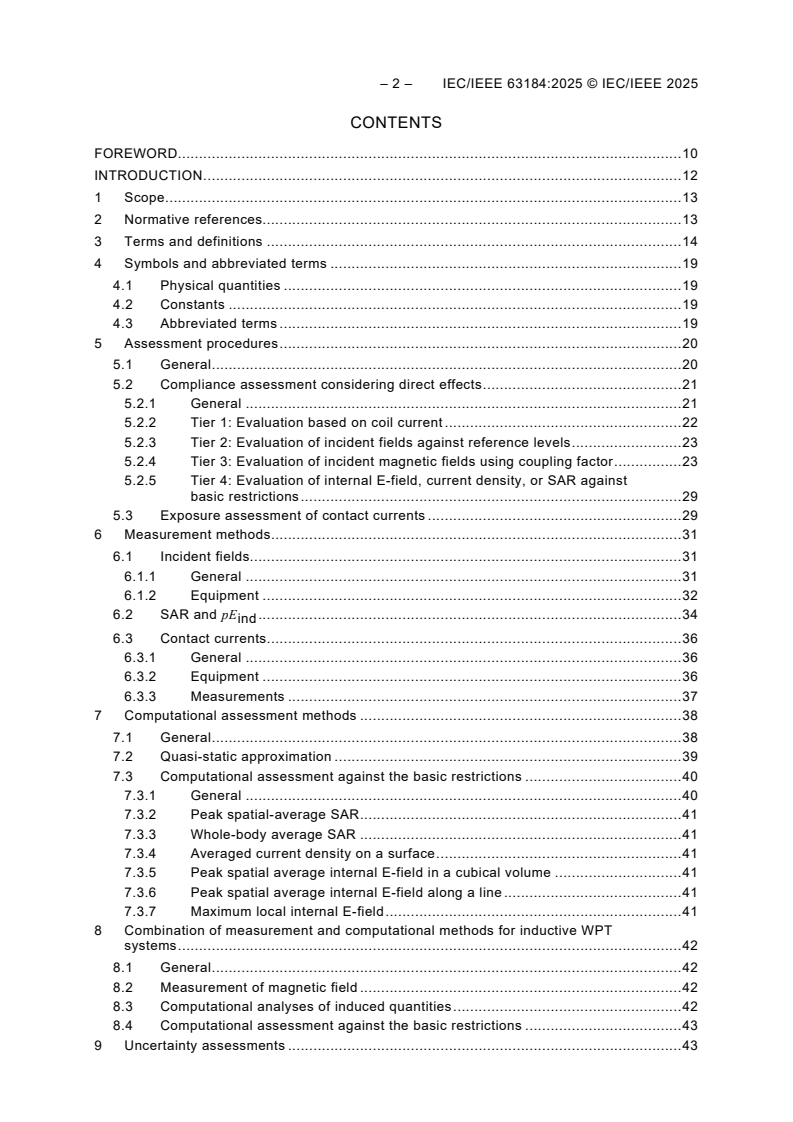
– 2 – IEC/IEEE 63184:2025 © IEC/IEEE 2025
CONTENTS
FOREWORD . 10
INTRODUCTION . 12
1 Scope . 13
2 Normative references. 13
3 Terms and definitions . 14
4 Symbols and abbreviated terms . 19
4.1 Physical quantities . 19
4.2 Constants . 19
4.3 Abbreviated terms . 19
5 Assessment procedures . 20
5.1 General . 20
5.2 Compliance assessment considering direct effects . 21
5.2.1 General . 21
5.2.2 Tier 1: Evaluation based on coil current . 22
5.2.3 Tier 2: Evaluation of incident fields against reference levels . 23
5.2.4 Tier 3: Evaluation of incident magnetic fields using coupling factor . 23
5.2.5 Tier 4: Evaluation of internal E-field, current density, or SAR against
basic restrictions . 29
5.3 Exposure assessment of contact currents . 29
6 Measurement methods . 31
6.1 Incident fields. 31
6.1.1 General . 31
6.1.2 Equipment . 32
6.2 SAR and pE . 34
ind
6.3 Contact currents . 36
6.3.1 General . 36
6.3.2 Equipment . 36
6.3.3 Measurements . 37
7 Computational assessment methods . 38
7.1 General . 38
7.2 Quasi-static approximation . 39
7.3 Computational assessment against the basic restrictions . 40
7.3.1 General . 40
7.3.2 Peak spatial-average SAR . 41
7.3.3 Whole-body average SAR . 41
7.3.4 Averaged current density on a surface . 41
7.3.5 Peak spatial average internal E-field in a cubical volume . 41
7.3.6 Peak spatial average internal E-field along a line . 41
7.3.7 Maximum local internal E-field . 41
8 Combination of measurement and computational methods for inductive WPT
systems . 42
8.1 General . 42
8.2 Measurement of magnetic field . 42
8.3 Computational analyses of induced quantities . 42
8.4 Computational assessment against the basic restrictions . 43
9 Uncertainty assessments . 43
9.1 General . 43
9.2 Measurement methods . 43
9.2.1 Measurement uncertainty budget . 43
9.2.2 Amplitude calibration uncertainty . 44
9.2.3 Probe anisotropy . 45
9.2.4 Probe dynamic range linearity . 45
9.2.5 Probe frequency domain response . 45
9.2.6 Modulation response . 45
9.2.7 Spatial averaging (maximum gradient) . 45
9.2.8 Gradient assessment uncertainty . 45
9.2.9 Parasitic E-field and H-field sensitivity . 45
9.2.10 Detection limit . 45
9.2.11 Readout electronics . 46
9.2.12 Response time . 46
9.2.13 Probe positioning . 46
9.2.14 Signal postprocessing . 46
9.2.15 Nominal position . 46
9.2.16 Repeatability . 46
9.2.17 DUT . 46
9.3 Computational methods . 46
9.3.1 Computational uncertainty budget . 46
9.3.2 Grid resolution . 48
9.3.3 Tissue parameters . 48
9.3.4 Exposure position . 48
9.3.5 Convergence . 48
9.3.6 Power budget . 49
9.3.7 Boundary conditions . 49
9.3.8 Quasi-static approximation . 49
9.3.9 Model parts and geometry . 49
9.3.10 Dielectric parameters . 49
9.3.11 Ferrite parameters . 50
9.3.12 Positioning of transmit and receive coils . 50
9.3.13 Coupling of transmit and receive coils . 50
9.3.14 Exposure sources other than the coils . 50
9.3.15 Loading of the coil . 50
9.4 Assessment of combining measurement and computational methods. 50
10 Reporting . 51
10.1 General . 51
10.2 Items to be recorded in exposure compliance assessment reports . 51
10.3 Additional items to be included for evaluation measurements . 52
10.4 Additional items to be included for numerical and combined numerical and
measurement evaluations . 53
Annex A (normative) Exposure evaluations using approximations . 54
A.1 Limit on current for a WPT coil . 54
A.2 Induced field quantities for comparison with basic restrictions . 55
A.3 Enhancement or coverage factor . 57
Annex B (normative) Calibration methods . 58
B.1 General . 58
B.2 E-field and H-field calibration . 58
– 4 – IEC/IEEE 63184:2025 © IEC/IEEE 2025
B.2.1 Standard field generation methods . 58
B.2.2 Characteristics to be measured . 58
B.2.3 Frequency domain calibration . 60
B.2.4 E-field calibration . 63
B.3 Gradient response verification . 67
B.3.1 General . 67
B.3.2 H-field gradient verification: Main steps . 67
B.3.3 Uncertainty for H-field gradient verification . 67
B.4 Dosimetric probe calibration . 68
B.4.1 General . 68
B.4.2 Calibration with short dipole antennas via transmit antenna factor . 69
B.4.3 Uncertainty . 72
Annex C (normative) Verification and validation methods for measurements . 73
C.1 General . 73
C.2 Objective . 73
C.3 Measurement setup and procedure for system verification and system
validation . 73
C.3.1 General . 73
C.3.2 Measurement system verification: test procedure . 74
C.3.3 Measurement system validation: test procedure . 75
Annex D (informative) Case study on the dependency of SAR on phantom properties
and size. 76
D.1 Phantom properties . 76
D.2 Phantom size . 79
Annex E (informative) Extrapolation methods of SAR measurement . 82
E.1 General . 82
E.2 Measurement and interpolation of electric field inside a phantom . 82
E.2.1 General . 82
E.2.2 Extrapolation functions . 82
E.2.3 Three steps for determination of spatial-peak SAR . 83
E.2.4 Validation of measurement methods using extrapolation . 83
E.2.5 Uncertainty . 86
Annex F (informative) Computational methods . 88
F.1 General . 88
F.2 Quasi-static finite element method . 88
F.3 Scalar potential finite difference method . 89
F.4 Impedance method . 90
F.5 Finite-difference time-domain method . 91
F.6 Hybrid technique of MoM and FDTD method . 91
F.7 Hybrid technique of FEM and SPFD method . 93
Annex G (informative) Averaging algorithms . 94
G.1 Current density averaging over an area . 94
G.1.1 General . 94
G.1.2 Calculation of the current density in a Cartesian voxel . 94
G.1.3 Calculation of the current density in a tetrahedron . 95
G.1.4 Calculation of J . 95
av
G.2 Internal E-field . 96
G.2.1 General . 96
G.2.2 E-field averaging in a cubical volume . 96
G.2.3 E-field averaging along an averaging distance . 97
G.2.4 Maximum local E-field . 99
Annex H (normative) Code verification and model validations . 100
H.1 Code verification . 100
H.1.1 General . 100
H.1.2 Quasi-static codes . 100
H.1.3 Quasi-static codes for the calculation of the incident magnetic field . 101
H.1.4 Averaging algorithms . 103
H.2 Model validation . 104
H.2.1 General . 104
H.2.2 Recommendations for the development of the computational model . 105
H.2.3 Determining the validity of the field source . 105
Annex I (informative) Use cases of magnetic field exposure assessment . 107
I.1 EV WPT – electric passenger car . 107
I.1.1 General . 107
I.1.2 Determination of user position . 107
I.1.3 Assessment procedures considering direct effects for WPT system for EV . 108
I.1.4 Assessment procedures for contact currents of WPT systems for EV . 114
I.2 Heavy duty vehicle EMF measurement procedure . 119
I.2.1 General . 119
I.2.2 Step 1 . 119
I.2.3 Step 2 . 121
I.2.4 Step 3 . 121
I.3 Remotely piloted aircraft . 122
I.3.1 General . 122
I.3.2 Assessment procedures of WPT system for RPA . 122
Annex J (informative) Examples of magnetic field exposure assessment . 126
J.1 General . 126
J.2 Assessment procedure of heavy-duty WPT EV system . 126
J.2.1 Outline of assessment procedure . 126
J.2.2 Test condition . 126
J.2.3 Test result 1 . 127
J.2.4 Test result 2 . 127
J.2.5 Test result 3 . 127
J.3 Remotely piloted aircraft . 127
J.3.1 General . 127
J.3.2 Description of WPT system for RPA . 128
J.3.3 Measurement of magnetic field around the WPT system for RPA . 128
J.3.4 Modelling for the WPT system for RPA . 129
J.3.5 Evaluation of incident field against basic restrictions . 129
J.3.6 Evaluation of current density, internal electric field, and SAR against
basic restrictions . 132
J.4 Combined method of measurement and computational analysis . 132
J.4.1 General . 132
J.4.2 Measurement of magnetic field . 132
J.4.3 Computational analyses of induced quantities . 133
J.4.4 Example of exposure assessment for WPT systems using combined
method . 133
– 6 – IEC/IEEE 63184:2025 © IEC/IEEE 2025
J.5 SAR measurement for WPT system . 137
Annex K (informative) Proximity detection sensor considerations for exposure
assessment . 139
K.1 General . 139
K.2 Phantom specification . 139
K.2.1 Phantom for the stationary living object detection . 139
K.2.2 Phantom for the proximity living object detection . 139
K.3 Procedures for determining proximity detection sensor triggering distance . 140
K.4 Testing areas . 140
K.5 Procedures for determining stationary living objects . 141
Bibliography . 143
Figure 1 – Flowchart for the assessment procedure . 20
Figure 2 – Flowchart for the assessment procedure considering direct effects . 21
Figure 3 – The gradient G is determined at the surface and normal to the surface, i.e.
n
in the direction of the axis shown . 26
Figure 4 – Coupling factors k of Formula (7) through Formula (11) as a function of the
normalized magnetic field gradient [13] . 29
Figure 5 – Two exposure situations for ungrounded and grounded metal objects . 30
Figure 6 – Flowchart for assessment procedures for contact currents . 31
Figure 7 – Human body equivalent circuit proposed in IEC 60990 [30] . 37
Figure 8 – Impedance frequency characteristics of adult male and equivalent circuits
proposed in IEC 60990 [30] and evaluated values [31], [32], [33], [34] . 37
Figure 9 – Example of contact current measurement equipment . 37
Figure A.1 – Comparison of the H-field with number of turns n at 1 cm from a circular
coil calculated with Biot-Savart and with the approximation of Formula (A.1) . 55
Figure B.1 – H-field and E-field generation setup for probe calibration . 60
Figure B.2 – H-field generation setup for dynamic range calibration . 62
Figure B.3 – E-field generation setup for frequency response calibration . 64
Figure B.4 – E-field generation setup for dynamic range calibration . 65
Figure B.5 – Illustration of the transmit antenna factor evaluation setup [51] . 71
Figure B.6 – Illustration of the sensitivity coefficients evaluation setup [51] . 71
Figure C.1 – Recommended test setups for measurement system verification and
validation . 74
Figure D.1 – Simulation model of large WPT system operating close to a) elliptical
phantom and b) human body model . 77
Figure D.2 – Different exposure conditions for human body model . 77
Figure D.3 – Calculated SAR for circular coils with a 50 cm diameter operating at 6 cm
from the elliptical phantom and heterogeneous human model . 78
Figure D.4 – Simulation model of small WPT system operating close to a) elliptical
phantom and b) human body model . 78
Figure D.5 – Calculated SAR for the small square coils with dimensions 10 cm × 10 cm
operating at 2 cm from the elliptical phantom and heterogeneous human model . 79
Figure D.6 – Layout of large WPT system for exposure condition of a) case A and b)
case C with respect to the elliptical phantom surface . 80
Figure D.7 – Calculated 10 g-averaged SAR versus the smaller axis of elliptical
phantom v normalized by coil outer diameter D for a) case A (f = 7,54 MHz) and b)
high
case C (f = 6,14 MHz, f = 7,18 MHz) . 80
low high
Figure D.8 – Layout of small WPT system for exposure conditions of case C with
respect to a) elliptical phantom and b) rectangular phantom . 81
Figure D.9 – Calculated 10 g-averaged SAR versus the smaller axis v or width W
normalized by square coil diagonal K for a) elliptical phantom (f = 6,6 MHz,
low
f = 7,64 MHz) and b) rectangular phantom (f = 6,59 MHz) . 81
high low
Figure E.1 – Schematic diagram of measurement system . 84
Figure E.2 – Measurement system . 85
Figure E.3 – Measured and simulated electric field distributions in the measurement
plane 25 mm away from the phantom boundary with solenoid-type WPT system
positioned parallel to the phantom wall . 85
Figure E.4 – Measured and simulated electric field distributions in the measurement
plane 25 mm away from the phantom boundary with flat-spiral-type WPT system
positioned parallel to the phantom wall . 86
Figure E.5 – 10 g averaged SAR obtained by measurement, and extrapolation and
MoM-derived 10 g averaged SAR . 86
Figure G.1 – Field components on voxel edges . 95
Figure H.1 – Coordinate system and angles . 102
Figure I.1 – Example for regions of protection, for ground mounted systems
(vehicle) [78] . 107
Figure I.2 – Example for regions of protection, for ground mounted systems (using
vehicle mimic plate) . 108
Figure I.3 – Flowchart for EV and vehicle mimic plate assessment (direct effect) . 109
Figure I.4 – Region 2 measurement positions (WPT) . 110
Figure I.5 – Region 3 measurement positions . 111
Figure I.6 – Region 2 measurement positions of vehicle mimic plate (WPT) . 112
Figure I.7 – Region 3 measurement positions of vehicle mimic plate (WPT) . 113
Figure I.8 – Flowchart for EV use and vehicle mimic plate assessment (contact
currents) . 114
Figure I.9 – Configuration example of contact current with grounded condition: (1) with
vehicle . 116
Figure I.10 – Configuration example of contact current with grounded condition:
(2) with vehicle mimic plate . 116
Figure I.11 – Configuration example of contact current with ungrounded condition:
(1) with vehicle . 118
Figure I.12 – Configuration example of contact current with ungrounded condition:
(2) with vehicle mimic plate . 119
Figure I.13 – EMF measurement for heavy duty vehicle: top view . 120
Figure I.14 – EMF measurement for heavy duty vehicle: side view . 120
Figure I.15 – Measurement points on the inside floor of WPT bus . 121
Figure I.16 – Measurement position . 123
Figure J.1 – EMF test of an electric bus (2015 August 7, Sejong City) . 126
Figure J.2 – Test result 1 from side-view . 127
Figure J.3 – Geometry and measurement position of WPT system for RPA . 128
– 8 – IEC/IEEE 63184:2025 © IEC/IEEE 2025
Figure J.4 – Measured magnetic field strength . 129
Figure J.5 – Measured and computed magnetic field strength . 129
Figure J.6 – Measurement system for the magnetic near-field of WPT systems [83] . 133
Figure J.7 – Schematic view and picture of the fabricated magnetic-field probes [83] . 133
Figure J.8 – Schematic view (left) and picture (right) of WPT systems [83] . 135
Figure J.9 – Exposure conditions for WPT coils [83] . 135
Figure J.10 – Amplitude and phase distributions of magnetic fields measured near
WPT systems without (w/o) and with (w/) ferrite tiles [83] . 136
Figure J.11 – Distribution of the internal electric field strength with adult male model
for an input power of 7,7 kW [83] . 137
Figure J.12 – WPT system operating at 6,78 MHz . 138
Figure J.13 – SAR distribution on a plane at 25 mm from the bottom of the phantom . 138
Figure K.1 – Test side consideration drawing . 141
Figure K.2 – Positioning of the phantom and the DUT WPT for determining the
detection sensor triggering distance, an example of charging an electric vehicle with a
WPT system . 141
Table 1 – List of symbols used in the formulas of 5.2.4.2 and 5.2.4.3 . 24
Table 2 – Dielectric properties of the tissue-equivalent medium liquid . 35
Table 3 – Dielectric properties of the tissue-equivalent medium NaCl solution of
0,074 mol/L . 35
Table 4 – Computational methods . 39
Table 5 – Example of uncertainty evaluation of the the E-field and H-field exposure
assessment using measurement methods . 43
Table 6 – Example of uncertainty evaluation of computational methods . 47
Table 7 – Example of uncertainty evaluation of the exposure assessment combining
measurements and computational methods . 51
Table B.1 – EM field generation setups for probe and sensor calibrations . 58
Table B.2 – Main components of H-field and E-field generation setups for frequency
response calibration . 60
Table B.3 – Template for uncertainty in frequency response calibration . 61
Table B.4 – Main components of H-field generation setup for dynamic range calibration . 62
Table B.5 – Template for uncertainty in H-field dynamic range calibration . 62
Table B.6 – Main components of E-field generation setup for frequency response
calibration. 64
Table B.7 – Template for uncertainty in E-field frequency response calibration . 64
Table B.8 – Main components of E-field generation setup for dynamic range calibration . 65
Table B.9 – Template for the uncertainty of the E-field dynamic range . 66
Table B.10 – Template for uncertainty of the H-field gradient verification . 68
Table B.11 – Uncertainty template for evaluation of average internal electric field
produced by short dipole antenna via transmit antenna factor . 72
Table E.1 – Measurement uncertainty of 10 g averaged SAR . 87
Table H.1 – Interpolation and superposition of vector field components for loop
currents I and phase offsets ξ . 103
Table J.1 – Computed coupling factor k . 130
L
Table J.2 – Evaluation results using coupling factor k . 130
L
Table J.3 – Evaluation results using coupling factor k . 131
G
Table J.4 – Computational results of current density (J), internal electric field (E), and
spatial peak 10 g average SAR (SAR ) . 132
10 g
– 10 – IEC/IEEE 63184:2025 © IEC/IEEE 2025
ASSESSMENT METHODS OF THE HUMAN EXPOSURE TO ELECTRIC AND
MAGNETIC FIELDS FROM WIRELESS POWER TRANSFER SYSTEMS –
MODELS, INSTRUMENTATION, MEASUREMENT AND
COMPUTATIONAL METHODS AND PROCEDURES
(FREQUENCY RANGE OF 3 kHz TO 30 MHz)
FOREWORD
1) The International Electrotechnical Commission (IEC) is a worldwide organization for standardization comprising
all national electrotechnical committees (IEC National Committees). The object of IEC is to promote international
co-operation on all questions concerning standardization in the electrical and electronic fields. To this end and
in addition to other activities, IEC publishes International Standards, Technical Specifications, Technical Reports,
Publicly Available Specifications (PAS) and Guides (hereafter referred to as "IEC document(s)"). Their
preparation is entrusted to technical committees; any IEC National Committee interested in the subject dealt with
may participate in this preparatory work. International, governmental and non-governmental organizations liaising
with the IEC also participate in this preparation.
IEEE Standards documents are developed within IEEE Societies and subcommittees of IEEE Standards
Association (IEEE SA) Board of Governors. IEEE develops its standards through an accredited consensus
development process, which brings together volunteers representing varied viewpoints and interests to achieve
the final product. IEEE standards are documents developed by volunteers with scientific, academic, and industry-
b
...