

IEC 60679-1:2007
(Main)Quartz crystal controlled oscillators of assessed quality - Part 1: Generic specification
General Information
- Abstract
IEC 60679-1:2007 specifies the methods of test and general requirements for quartz crystal controlled oscillators of assessed quality using either capability approval or qualification approval procedures. It represents a step in a revision of all parts of the IEC 60679 series to include the test requirements of the IECQ system. This edition is based on the relevant standards of that system.
- Status
- Published
- Publication Date
- 10-Apr-2007
- Technical Committee
- TC 49 - Piezoelectric, dielectric and electrostatic devices and associated materials for frequency control, selection and detection
- Drafting Committee
- WG 7 - TC 49/WG 7
- Current Stage
- DELPUB - Deleted Publication
- Start Date
- 26-Jul-2017
- Completion Date
- 28-Aug-2026
Buy Documents
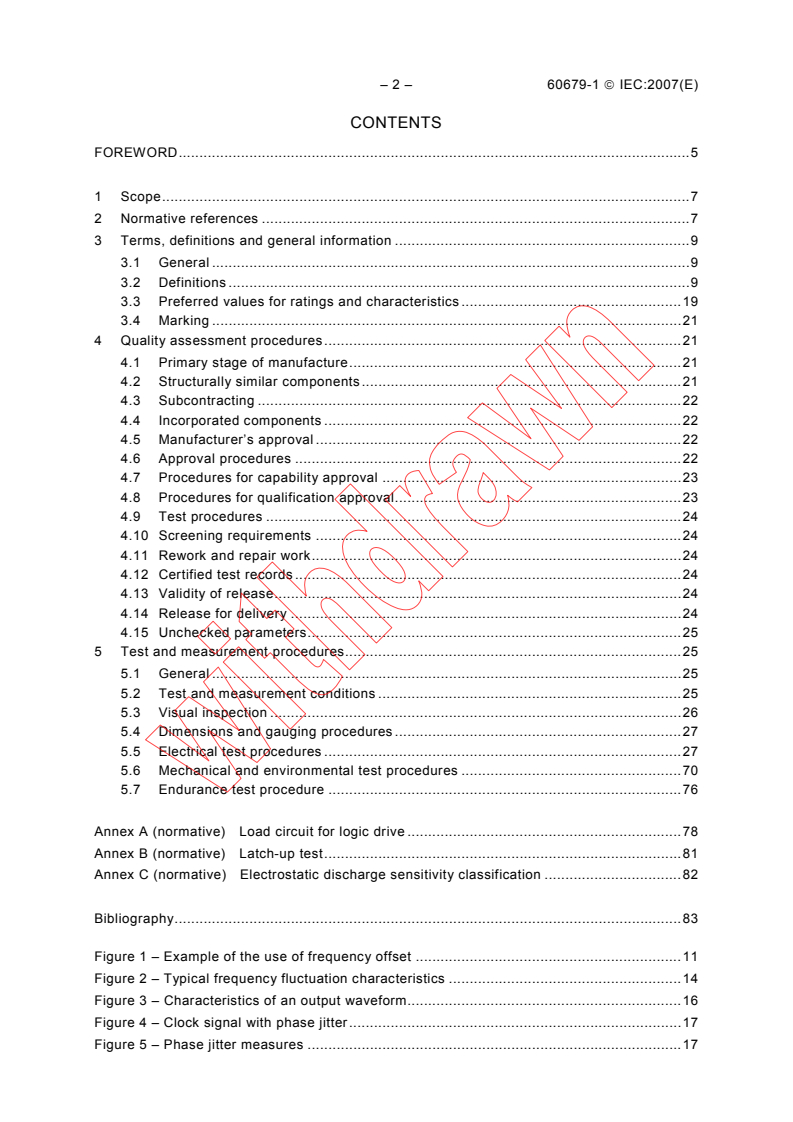
IEC 60679-1:2007 - Quartz crystal controlled oscillators of assessed quality - Part 1: Generic specification Released:4/11/2007
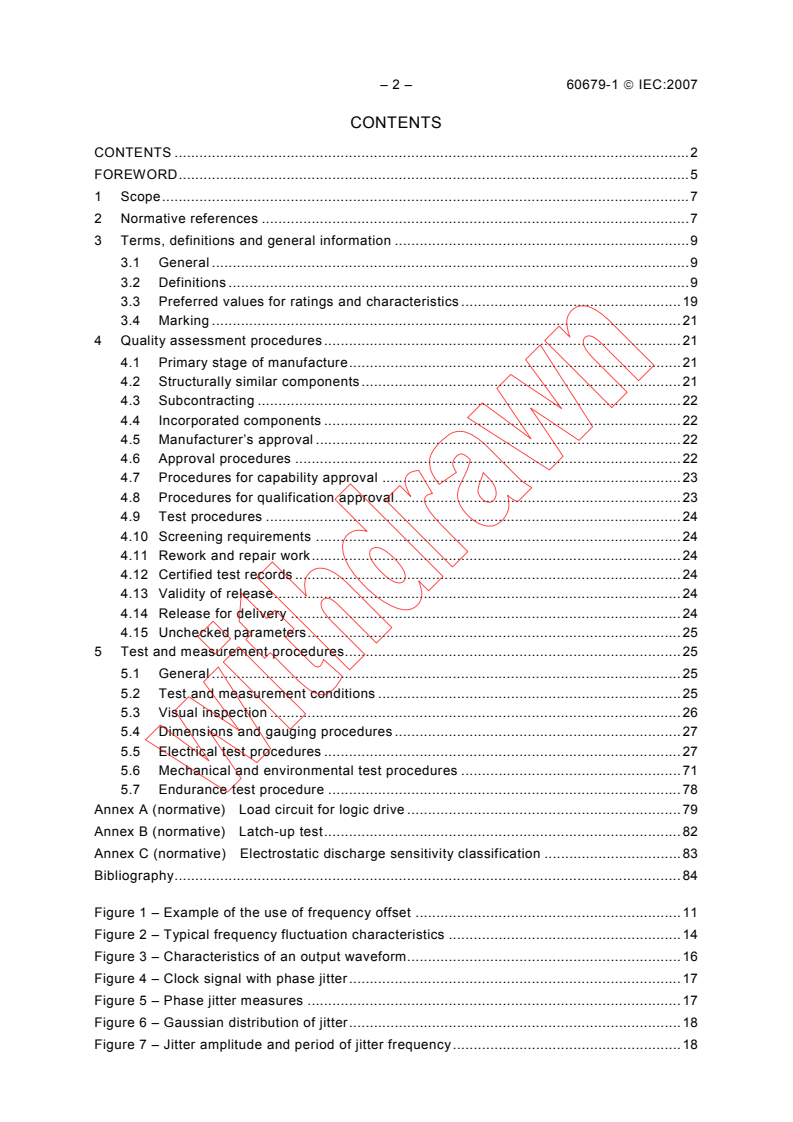
IEC 60679-1:2007 - Quartz crystal controlled oscillators of assessed quality - Part 1: Generic specification Released:4/11/2007
Overview
IEC 60679-1:2007 is an internationally recognized standard published by the International Electrotechnical Commission (IEC). This document establishes the general requirements and test methods for quartz crystal controlled oscillators of assessed quality. These oscillators, commonly referred to as crystal oscillators, are crucial in providing highly stable frequency references in a wide variety of electronic equipment. IEC 60679-1 applies to quartz oscillators that undergo systematic quality assessment, using either capability approval or qualification approval procedures, supporting global harmonization and quality assurance under the IECQ system.
Key Topics
IEC 60679-1:2007 focuses on the following core subjects:
- Scope and Definitions: Clarifies the scope of the standard, terminology, and types of oscillators covered (such as SPXO, VCXO, TCXO, and OCXO).
- Quality Assessment: Details procedures for assessing manufacturing quality, including capability and qualification approvals.
- Test and Measurement Procedures: Outlines general and specific methods for mechanical, electrical, and environmental testing. This includes frequency stability, tolerance, load effects, and endurance testing.
- Marking and Traceability: Specifies requirements for marking oscillators to ensure traceability and compliance.
- Test Circuit Examples: Provides guidance and circuit diagrams for particular measurements like frequency offset, harmonic distortion, and phase noise.
- Environmental Testing: References to prevalent IEC environmental test methods for vibration, thermal shock, humidity, free fall, and other conditions.
- Documentation Requirements: Describes obligations for certified test records and manufacturer documentation to demonstrate compliance.
Applications
Quartz crystal controlled oscillators standardized under IEC 60679-1 are fundamental in diverse electronic applications where frequency precision and reliability are critical. Typical application areas include:
- Telecommunications: Used for timing and synchronization in network infrastructure, including SDH, SONET, and digital radio systems.
- Measurement and Test Equipment: Ensures accuracy in electronic measurement instruments and test benches.
- Industrial Electronics: Provides reliable clock sources for controllers, automated systems, and process equipment.
- Consumer Electronics: Embedded in devices requiring stable timing, such as computers, digital watches, and audio/video equipment.
- Aerospace and Defense: Serves in navigation, communication, and guidance systems, where quality assessment and reliability are mandatory.
By relying on the procedures and requirements in IEC 60679-1:2007, manufacturers and system integrators can select and supply oscillators that meet rigorous international benchmarks for performance, traceability, and resilience. This enhances system design robustness and ensures interoperability in global markets.
Related Standards
To ensure comprehensive quality management and interoperability, IEC 60679-1:2007 references several related standards, including:
- IEC 60027 - Letter symbols for electrical technology.
- IEC 60068 series - Environmental test methods, including vibration, temperature cycling, shock, and humidity tests.
- IEC 60679-5 - Sectional specification for qualification approval of quartz crystal controlled oscillators.
- IECQ 01 and IEC QC 001002-2/3 - IEC Quality Assessment System for Electronic Components.
- ITU-T G.810, G.811, G.812, G.813 - Synchronization requirements for telecommunication systems.
- ANSI T1.101, T1.105.03 - Synchronization standards within North America.
- ETSI EN 300 462 - European requirements for synchronization networks.
- Telcordia GR-253 - SONET transport systems criteria.
By aligning with IEC 60679-1 and its referenced standards, organizations benefit from internationally accepted methodologies that foster global compatibility, product reliability, and effective regulatory compliance in the field of electronic frequency control.
Relations
- Effective Date
- 05-Sep-2023
- Effective Date
- 05-Sep-2023
- Effective Date
- 05-Sep-2023
- Effective Date
- 05-Sep-2023
Buy Documents
IEC 60679-1:2007 - Quartz crystal controlled oscillators of assessed quality - Part 1: Generic specification Released:4/11/2007
IEC 60679-1:2007 - Quartz crystal controlled oscillators of assessed quality - Part 1: Generic specification Released:4/11/2007
Frequently Asked Questions
IEC 60679-1:2007 is a standard published by the International Electrotechnical Commission (IEC). Its full title is "Quartz crystal controlled oscillators of assessed quality - Part 1: Generic specification". This standard covers: IEC 60679-1:2007 specifies the methods of test and general requirements for quartz crystal controlled oscillators of assessed quality using either capability approval or qualification approval procedures. It represents a step in a revision of all parts of the IEC 60679 series to include the test requirements of the IECQ system. This edition is based on the relevant standards of that system.
IEC 60679-1:2007 specifies the methods of test and general requirements for quartz crystal controlled oscillators of assessed quality using either capability approval or qualification approval procedures. It represents a step in a revision of all parts of the IEC 60679 series to include the test requirements of the IECQ system. This edition is based on the relevant standards of that system.
IEC 60679-1:2007 is classified under the following ICS (International Classification for Standards) categories: 31.140 - Piezoelectric devices. The ICS classification helps identify the subject area and facilitates finding related standards.
IEC 60679-1:2007 has the following relationships with other standards: It is inter standard links to IEC 60679-1:1997/AMD2:2003, IEC 60679-1:1997/AMD1:2002, IEC 60679-1:2017, IEC 60679-1:1997. Understanding these relationships helps ensure you are using the most current and applicable version of the standard.
IEC 60679-1:2007 is available in PDF format for immediate download after purchase. The document can be added to your cart and obtained through the secure checkout process. Digital delivery ensures instant access to the complete standard document.
Standards Content (Sample)
INTERNATIONAL IEC
STANDARD 60679-1
Third edition
2007-04
Quartz crystal controlled oscillators
of assessed quality –
Part 1:
Generic specification
Reference number
All rights reserved. Unless otherwise specified, no part of this publication may be reproduced or utilized in any form
or by any means, electronic or mechanical, including photocopying and microfilm, without permission in writing from
either IEC or IEC's member National Committee in the country of the requester.
If you have any questions about IEC copyright or have an enquiry about obtaining additional rights to this publication,
please contact the address below or your local IEC member National Committee for further information.
IEC Central Office
3, rue de Varembé
CH-1211 Geneva 20
Switzerland
Email: inmail@iec.ch
Web: www.iec.ch
About the IEC
The International Electrotechnical Commission (IEC) is the leading global organization that prepares and publishes
International Standards for all electrical, electronic and related technologies.
About IEC publications
The technical content of IEC publications is kept under constant review by the IEC. Please make sure that you have the
latest edition, a corrigenda or an amendment might have been published.
ƒ Catalogue of IEC publications: www.iec.ch/searchpub
The IEC on-line Catalogue enables you to search by a variety of criteria (reference number, text, technical committee,…).
It also gives information on projects, withdrawn and replaced publications.
ƒ IEC Just Published: www.iec.ch/online_news/justpub
Stay up to date on all new IEC publications. Just Published details twice a month all new publications released. Available
on-line and also by email.
ƒ Customer Service Centre: www.iec.ch/webstore/custserv
If you wish to give us your feedback on this publication or need further assistance, please visit the Customer Service
Centre FAQ or contact us:
Email: csc@iec.ch
Tel.: +41 22 919 02 11
Fax: +41 22 919 03 00
INTERNATIONAL IEC
STANDARD 60679-1
Third edition
2007-04
Quartz crystal controlled oscillators
of assessed quality –
Part 1:
Generic specification
PRICE CODE
Commission Electrotechnique Internationale
XC
International Electrotechnical Commission
МеждународнаяЭлектротехническаяКомиссия
For price, see current catalogue
– 2 – 60679-1 © IEC:2007(E)
CONTENTS
FOREWORD.5
1 Scope.7
2 Normative references .7
3 Terms, definitions and general information .9
3.1 General .9
3.2 Definitions .9
3.3 Preferred values for ratings and characteristics .19
3.4 Marking .21
4 Quality assessment procedures.21
4.1 Primary stage of manufacture.21
4.2 Structurally similar components.21
4.3 Subcontracting .22
4.4 Incorporated components .22
4.5 Manufacturer’s approval .22
4.6 Approval procedures .22
4.7 Procedures for capability approval .23
4.8 Procedures for qualification approval.23
4.9 Test procedures .24
4.10 Screening requirements .24
4.11 Rework and repair work.24
4.12 Certified test records .24
4.13 Validity of release.24
4.14 Release for delivery .24
4.15 Unchecked parameters.25
5 Test and measurement procedures.25
5.1 General .25
5.2 Test and measurement conditions .25
5.3 Visual inspection .26
5.4 Dimensions and gauging procedures .27
5.5 Electrical test procedures .27
5.6 Mechanical and environmental test procedures .70
5.7 Endurance test procedure .76
Annex A (normative) Load circuit for logic drive .78
Annex B (normative) Latch-up test.81
Annex C (normative) Electrostatic discharge sensitivity classification .82
Bibliography.83
Figure 1 – Example of the use of frequency offset .11
Figure 2 – Typical frequency fluctuation characteristics .14
Figure 3 – Characteristics of an output waveform.16
Figure 4 – Clock signal with phase jitter.17
Figure 5 – Phase jitter measures .17
60679-1 © IEC:2007(E) – 3 –
Figure 6 – Gaussian distribution of jitter.18
Figure 7 – Jitter amplitude and period of jitter frequency.18
Figure 8 – Jitter tolerance according to ITU-T G.825, ANSI T1.105.03, Telcordia
GR-253 and ETSI EN 300462 .19
Figure 9 – Test circuits for insulation resistance measurements.27
Figure 10 – Test circuit for voltage proof test .28
Figure 11 – Test circuit for oscillator input power measurement .28
Figure 12 – Test circuit for oven and oscillator input power measurement.29
Figure 13 – Test circuit for measurement of output frequency, method1.30
Figure 14 – Test circuit for measurement of output frequency, method 2.30
Figure 15 – Test circuit for measurement of frequency/temperature characteristics.31
Figure 16 – Thermal transient behaviour of typical oscillator .33
Figure 17 – Generalized oscillator circuit .34
Figure 18 – Test circuit for start-up behaviour and start-up time measurement .35
Figure 19 – Typical start-up behaviour with slow supply voltage ramp.35
Figure 20 – Definition of start-up time .37
Figure 21 – Supply voltage waveform for periodical t measurement .37
SU
Figure 22 – Typical oscillator stabilization characteristic .38
Figure 23 – Example of retrace characteristic .39
Figure 24 – Test circuit for the measurement of output voltage .39
Figure 25 – Test circuit for the measurement of pulse outputs .40
Figure 26 – Test circuit for harmonic distortion measurement .40
Figure 27a – Symmetrical .40
Figure 27b – Large odd harmonic content .40
Figure 27c – Large even harmonic content .41
Figure 27 – Quasi-sinusoidal output waveforms .41
Figure 28a – Ideal spectrum .41
Figure 28b – Spectrum showing severe harmonic distortion .41
Figure 28 – Frequency spectrum for harmonic distortion .41
Figure 29 – Test circuit for the determination of isolation between output ports.44
Figure 30 – Test circuit for measuring suppression of gated oscillators.44
Figure 31 – Test circuit for tri-state disable mode output current.45
Figure 32 – Test circuit for output gating time – tri-state .46
Figure 33 – Test circuit for modulation index measurement.46
Figure 34 – Modulation waveform for index calculation .47
Figure 35 – Logarithmic signal amplitude scale.47
Figure 36 – Test circuit to determine amplitude modulation sensitivity .49
Figure 37 – Frequency spectrum of amplitude modulation distortion .49
Figure 38 – Test circuit to determine pulse amplitude modulation .50
Figure 39 – Pulse modulation characteristic.50
Figure 40 – Test circuit for the determination of modulation input impedance.51
Figure 41 – Test circuit for the measurement of f.m. deviation .52
Figure 42 – Test circuit for the measurement of f.m. sensitivity.54
– 4 – 60679-1 © IEC:2007(E)
Figure 43a – Static test.54
Figure 43b – Dynamic test .55
Figure 43 – Test circuit for the measurement of frequency modulation distortion.55
Figure 44 – Test circuit for the measurement of single-sideband phase noise .56
Figure 45 – Typical noise pedestal spectrum .57
Figure 46 – Test circuit for the measurement of incidental frequency modulation .59
Figure 47 – Test circuit for method 1.60
Figure 48 – Test circuit for method 2.61
Figure 49 – Circuit modifications for methods 1 and 2.62
Figure 50 – Time-domain short-term frequency stability of a typical 5 MHz precision
oscillator .63
Figure 51a – Typical arrangement for radiated interference tests, 30 MHz and above.64
Figure 51b – Typical arrangement for radiated interference tests, below 30 MHz .64
Figure 51 – Radiated interference tests .64
Figure 52 – Characteristics of line impedance of stabilizing network .65
Figure 53 – Circuit diagram of line impedance of stabilizing network.66
Figure 54 – Phase jitter measurement with sampling oscilloscope .67
Figure 55 – Block diagram of a jitter and wander analyzer according to ITU-T O.172 .69
Figure A.1 – Circuit for TTL.78
Figure A.2 – Circuit for schottky logic.78
Table 1 – Measuring sets bandwidth .66
Table 2 – Fourier frequency range for phase noise test.68
Table 3 – Standard bit rates for various applications.70
Table 4 – Tensile force .70
Table 5 – Thrust force.71
Table 6 – Bending force.71
Table 7 – Torque force.72
Table A.1 – Value to be using when calculating R and R .79
1 2
60679-1 © IEC:2007(E) – 5 –
INTERNATIONAL ELECTROTECHNICAL COMMISSION
___________
QUARTZ CRYSTAL CONTROLLED OSCILLATORS
OF ASSESSED QUALITY –
Part 1: Generic specification
FOREWORD
1) The International Electrotechnical Commission (IEC) is a worldwide organization for standardization comprising
all national electrotechnical committees (IEC National Committees). The object of IEC is to promote
international co-operation on all questions concerning standardization in the electrical and electronic fields. To
this end and in addition to other activities, IEC publishes International Standards, Technical Specifications,
Technical Reports, Publicly Available Specifications (PAS) and Guides (hereafter referred to as “IEC
Publication(s)”). Their preparation is entrusted to technical committees; any IEC National Committee interested
in the subject dealt with may participate in this preparatory work. International, governmental and
non-governmental organizations liaising with the IEC also participate in this preparation. IEC collaborates
closely with the International Organization for Standardization (ISO) in accordance with conditions determined
by agreement between the two organizations.
2) The formal decisions or agreements of IEC on technical matters express, as nearly as possible, an international
consensus of opinion on the relevant subjects since each technical committee has representation from all
interested IEC National Committees.
3) IEC Publications have the form of recommendations for international use and are accepted by IEC National
Committees in that sense. While all reasonable efforts are made to ensure that the technical content of IEC
Publications is accurate, IEC cannot be held responsible for the way in which they are used or for any
misinterpretation by any end user.
4) In order to promote international uniformity, IEC National Committees undertake to apply IEC Publications
transparently to the maximum extent possible in their national and regional publications. Any divergence
between any IEC Publication and the corresponding national or regional publication shall be clearly indicated in
the latter.
5) IEC provides no marking procedure to indicate its approval and cannot be rendered responsible for any
equipment declared to be in conformity with an IEC Publication.
6) All users should ensure that they have the latest edition of this publication.
7) No liability shall attach to IEC or its directors, employees, servants or agents including individual experts and
members of its technical committees and IEC National Committees for any personal injury, property damage or
other damage of any nature whatsoever, whether direct or indirect, or for costs (including legal fees) and
expenses arising out of the publication, use of, or reliance upon, this IEC Publication or any other IEC
Publications.
8) Attention is drawn to the Normative references cited in this publication. Use of the referenced publications is
indispensable for the correct application of this publication.
9) Attention is drawn to the possibility that some of the elements of this IEC Publication may be the subject of
patent rights. IEC shall not be held responsible for identifying any or all such patent rights.
International Standard IEC 60679-1 has been prepared by IEC technical committee 49:
Piezoelectric and dielectric devices for frequency control and selection.
This third edition cancels and replaces the second edition published in 1997 and its
Amendments 1 (2002) and 2 (2003) and constitutes a technical revision. It represents a step
in a revision of all parts of the IEC 60679 series to include the test requirements of the IECQ
system. This edition is based on the relevant standards of that system.
The text of this standard is based on the following documents:
FDIS Report on voting
49/769/FDIS 49/776/RVD
Full information on the voting for the approval of this standard can be found in the report on
voting indicated in the above table.
– 6 – 60679-1 © IEC:2007(E)
A list of all parts of the IEC 60679 series, published under the general title Quartz crystal
controlled oscillators of assessed quality, can be found on the IEC website.
The committee has decided that the contents of this publication will remain unchanged until
the maintenance result date indicated on the IEC web site under "http://webstore.iec.ch" in
the data related to the specific publication. At this date, the publication will be
• reconfirmed;
• withdrawn;
• replaced by a revised edition, or
• amended.
A bilingual version of this publication may be issued at a later date.
60679-1 © IEC:2007(E) – 7 –
QUARTZ CRYSTAL CONTROLLED OSCILLATORS
OF ASSESSED QUALITY –
Part 1: Generic specification
1 Scope
This part of IEC 60679 specifies the methods of test and general requirements for quartz
crystal controlled oscillators of assessed quality using either capability approval or
qualification approval procedures.
2 Normative references
The following referenced documents are indispensable for the application of this document.
For dated references, only the edition cited applies. For undated references, the latest edition
of the referenced document (including any amendments) applies.
IEC 60027 (all parts), Letter symbols to be used in electrical technology
IEC 60050-561, International Electrotechnical Vocabulary (IEV) – Part 561: Piezoelectric
devices for frequency control and selection
IEC 60068-1:1988, Environmental testing – Part 1: General and guidance
Amendment 1 (1992)
IEC 60068-2-1, Environmental testing – Part 2: Tests – Tests A: Cold
IEC 60068-2-2, Environmental testing – Part 2: Tests – Tests B: Dry heat
IEC 60068-2-6, Environmental testing – Part 2: Tests – Test Fc: Vibration (sinusoidal)
IEC 60068-2-7, Environmental testing – Part 2: Tests – Test Ga and guidance: Acceleration,
steady state
IEC 60068-2-10, Environmental testing – Part 2-10: Tests – Test J and guidance: Mould
growth
IEC 60068-2-13, Environmental testing – Part 2: Tests – Test M: Low air pressure
IEC 60068-2-14, Environmental testing – Part 2: Tests – Test N: Change of temperature
IEC 60068-2-17, Environmental testing – Part 2: Tests – Test Q: Sealing
IEC 60068-2-20, Environmental testing – Part 2: Tests – Test T: Soldering
IEC 60068-2-21, Environmental testing – Part 2-21: Tests – Test U: Robustness of
terminations and integral mounting devices
IEC 60068-2-27, Environmental testing – Part 2: Tests – Test Ea and guidance: Shock
IEC 60068-2-29, Environmental testing – Part 2: Tests – Test Eb and guidance: Bump
– 8 – 60679-1 © IEC:2007(E)
IEC 60068-2-30, Environmental testing – Part 2-30: Tests – Test Db: Damp heat, cyclic (12h +
12 h cycle)
IEC 60068-2-32, Environmental testing – Part 2: Tests – Test Ed: Free fall
IEC 60068-2-45, Environmental testing – Part 2: Tests – Test XA and guidance: Immersion in
cleaning solvents
IEC 60068-2-52, Environmental testing – Part 2: Tests – Test Kb: Salt mist, cyclic (sodium
chloride solution)
IEC 60068-2-58, Environmental testing – Part 2-58: Tests – Test Td: Test methods for
solderability, resistance to dissolution of metallization and to soldering heat of surface
mounting devices (SMD)
IEC 60068-2-64, Environmental testing – Part 2: Test methods – Test Fh: Vibration,
broad-band random (digital control) and guidance
IEC 60068-2-78:2001, Environmental testing – Part 2-78: Tests – Test Cab: Damp heat,
steady state
IEC 60469-1:1987, Pulse techniques and apparatus – Part 1: Pulse terms and definitions
IEC 60617-DB: 2001 , Graphical symbols for diagrams
IEC 60679-5, Quartz crystal controlled oscillators of assessed quality – Part 5: Sectional
specification – Qualification approval
IEC 61000-4-2, Electromagnetic compatibility (EMC) – Part 4-2: Testing and measurement
techniques - Electrostatic discharge immunity test
IECQ 01, IEC Quality Assessment System for Electronic Components (IECQ) – Basic Rules
IEC QC 001002-2:1998, IEC Quality Assessment System for Electronic Components (IECQ) –
Rules of Procedure – Part 2: Documentation
IEC QC 001002-3:1998, IEC Quality Assessment System for Electronic Components (IECQ) –
Rules of Procedure – Part 3: Approval procedures
ISO 1000, SI units and recommendations for the use of their multiples and of certain other
units
ITU-T G.810, Definitions and terminology for synchronization networks
ITU-T G.811: Timing characteristics of primary reference clocks
ITU-T G.812, Timing requirements of slave clocks suitable for use as node clocks in
synchronization networks
ITU-T G.813, Timing characteristics of SDH equipment slave clocks (SEC)
ITU-T G.825, The control of jitter and wander within digital networks which are based on the
synchronous digital hierarchy (SDH)
___________
“DB” refers to the IEC on-line database.
60679-1 © IEC:2007(E) – 9 –
ANSI T1.101, Synchronization Interface Standard
ANSI T1.105.03, Synchronous Optical Network (SONET) – Jitter and Wander at Network
Equipment Interfaces
ETSI EN 300 462 (all parts), Transmission and Multiplexing (TM); Generic requirements for
synchronization networks
Telcordia GR-253, Synchronous Optical Network (SONET) Transport Systems: Common
Generic Criteria
• Order of precedence
Where any discrepancies occur for any reason, documents shall rank in the following order of
precedence:
– detail specification;
– sectional specification;
– generic specification;
– any other international documents (for example of the IEC) to which reference is made.
The same order of precedence shall apply to equivalent national documents.
3 Terms, definitions and general information
3.1 General
Units, graphical symbols, letter symbols and terminology shall, wherever possible, be taken
from the following standards:
IEC 60027
IEC 60050-561
IEC 60469-1
IEC 60617
ISO 1000
3.2 Definitions
For the purposes of this document, the following definitions apply.
3.2.1
simple packaged crystal oscillator
SPXO
crystal controlled oscillator having no means of temperature control or compensation,
exhibiting a frequency/temperature characteristic determined substantially by the piezoelectric
resonator employed
[IEV 561-04-01]
3.2.2
overtone crystal controlled oscillator
oscillator designed to operate with the controlling piezoelectric resonator functioning in a
specified mechanical overtone order of vibration
[IEV 561-04-02]
– 10 – 60679-1 © IEC:2007(E)
3.2.3
crystal cut
orientation of the crystal element with respect to the crystallographic axes of the crystal
NOTE This definition is included as it may be desirable to specify the cut (and hence the general form of the
frequency/temperature performance) of a crystal unit used in an oscillator application. The choice of the crystal cut
will imply certain attributes of the oscillator which may not otherwise appear in the detail specification.
3.2.4
voltage controlled crystal oscillator
VCXO
crystal controlled oscillator, the frequency of which can be deviated or modulated according to
a specified relation, by application of a control voltage
[IEV 561-04-03]
3.2.5
temperature compensated crystal oscillator
TCXO
crystal controlled oscillator whose frequency deviation due to temperature is reduced by
means of a compensation system, incorporated in the device
[IEV 561-04-04]
3.2.6
oven controlled crystal oscillator
OCXO
crystal controlled oscillator in which at least the piezoelectric resonator is temperature
controlled
[IEV 561-04-05]
NOTE This mode of operation ensures that the oscillator frequency will remain sensibly constant over the
operating temperature range of the OCXO, therefore independent of the frequency/temperature characteristic of
the crystal unit.
3.2.7
nominal frequency
frequency used to identify the crystal controlled oscillator
[IEV 561-04-06]
3.2.8
frequency tolerance
maximum permissible deviation of the oscillator frequency from a specified nominal value
when operating under specified conditions
[IEV 561-04-07]
NOTE Frequency tolerances are often assigned separately to specified ambient effects, namely electrical,
mechanical and environmental. When this approach is used, it is necessary to define the values of other operating
parameters as well as the range of the specified variable, that is to say:
– deviation from the frequency at the specified reference temperature due to operation over the specified
temperature range, other conditions remaining constant;
– deviation from the frequency at the specified supply voltage due to supply voltage changes over the specified
range, other conditions remaining constant;
– deviation from the initial frequency due to ageing, other conditions remaining constant;
– deviation from the frequency with specified load conditions due to changes in load impedance over the
specified range, other conditions remaining constant.
In some cases, an overall frequency tolerance may be specified, due to any/all combinations of operating
parameters, during a specified lifetime.
60679-1 © IEC:2007(E) – 11 –
3.2.9
frequency offset
frequency difference, positive or negative, which should be added to the specified nominal
frequency of the oscillator, when adjusting the oscillator frequency under a particular set of
operating conditions in order to minimize its deviation from nominal frequency over the
specified range of operating conditions
[IEV 561-04-08]
EXAMPLE In order to minimize the frequency deviation from nominal over the entire temperature range, a
frequency offset may be specified for adjustment at the reference temperature (see Figure 1).
F(T) with offset =ΔF at 25 °C
ΔF
Nominal frequency
F(T) with zero offset
Adjustment temperature
Operating temperature
–20 °C 70 °C
25 °C
ΔF
–ΔF
Operating temperature
–20 °C 25 °C
70 °C
during adjustment
IEC 445/07
Figure 1 – Example of the use of frequency offset
3.2.10
adjustment frequency
frequency to which an oscillator must be adjusted, under a particular combination of operating
conditions, in order to meet the frequency tolerance specification over the specified range of
operating conditions, i.e. adjustment frequency = nominal frequency + frequency offset
[IEV 561-04-09]
3.2.11
frequency adjustment range
range over which the oscillator frequency may be varied by means of some variable element,
for the purpose of:
Frequency offset Frequency
– 12 – 60679-1 © IEC:2007(E)
a) setting the frequency to a particular value, or
b) to correct the oscillator frequency to a prescribed value after deviation due to ageing, or
other changed conditions.
[IEV 561-04-10]
3.2.12
storage temperature range
minimum and maximum temperatures as measured on the enclosure at which the crystal
controlled oscillator may be stored without deterioration or damage to its performance
3.2.13
operating temperature range
range of temperature over which the oscillator will function, maintaining frequency and other
output signal characteristics within specified tolerances
[IEV 561-04-11]
3.2.14
operable temperature range
range of temperature over which the oscillator will continue to provide an output signal,
though not necessarily within the specified tolerances of frequency, level, waveform, etc.
[IEV 561-04-12]
3.2.15
reference temperature
temperature at which certain oscillator performance parameters are measured, normally 25 °C
± 2 °C
3.2.16
reference point temperature
temperature measured at a specific reference point relative to the oscillator
3.2.17
thermal transient frequency stability
oscillator frequency time response when ambient temperature is changed from one specific
temperature to another with a specific rate
3.2.18
stabilization time
time, measured from the initial application of power, required for a crystal controlled oscillator
to stabilize its operation within specified limits
[IEV 561-04-13]
3.2.19
frequency/voltage coefficient
fractional change in output frequency resulting from an incremental change in supply voltage,
other parameters remaining unchanged
[IEV 561-04-14]
NOTE In the case of OCXOs, a considerable time may elapse before the full effect of a supply voltage change is
observed, as the temperature of the oven may drift gradually to a new value following the voltage perturbation.
3.2.20
frequency/load coefficient
fractional change in output frequency resulting from an incremental change in electrical load
impedance, other parameters remaining unchanged
60679-1 © IEC:2007(E) – 13 –
[IEV 561-04-15]
3.2.21
long-term frequency stability (frequency ageing)
relationship between oscillator frequency and time. This long-term frequency drift is caused
by secular changes in the crystal unit and/or other elements of the oscillator circuit, and
should be expressed as fractional change in mean frequency per specified time interval.
3.2.22
short-term frequency stability
random fluctuations of the frequency of an oscillator over short periods of time
[IEV 561-04-16]
3.2.23
Allan variance of fractional frequency fluctuation
unbiased estimate of the preferred definition in the time domain of the short-term stability
characteristic of the oscillator output frequency:
M −1
(Y − Y )
2 1
k + k
σ (τ ) ≅
y ∑
M − 1 2
k =1
where
Y are the average fractional frequency fluctuations obtained sequentially, with no systematic
k
dead time between measurements;
τ is the sample time over which measurements is averaged;
M is the number of measurements.
The confidence of the estimate improves as M increases.
3.2.24
r.m.s. fractional frequency fluctuation
measure in the time domain of the short-term frequency stability of an oscillator, based on the
statistical properties of a number of frequency measurements, each representing an average
of the frequency over the specified sampling interval τ. The preferred measure of fractional
frequency fluctuation is:
M −1 2
⎡ ⎤
ΔF 1
2 2
()τσ= ()YY− = (τ)
rms ⎢ ∑ k +1 k ⎥ []y
FM21()−
⎣ k =1 ⎦
3.2.25
phase noise
frequency-domain measure of the short-term frequency stability of an oscillator, normally
expressed as the power spectral density of the phase fluctuations, Sφ(f), where the phase
fluctuation function is φ(t)=2π Ft-2πF t. The spectral density of phase fluctuation can be
directly related to the spectral density of frequency fluctuation by
⎛ ⎞
F
2
Sf() = Sf()
⎜ ⎟ rad /Hz
ϕ y
⎝ f⎠
where
F is the oscillator frequency;
F is the average oscillator frequency;
f is the Fourier frequency.
– 14 – 60679-1 © IEC:2007(E)
3.2.26
spectral purity
measure of frequency stability in the frequency domain usually represented as the signal side
noise power spectrum expressed in decibels relative to total signal power, per hertz
bandwidth. It includes non-deterministic noise power, harmonic distortion components and
spurious single frequency interferences
3.2.27
incidental frequency modulation
optional measure of frequency stability in the frequency domain, best described in terms of
the spectrum of the resultant base-band signal obtained by applying the oscillator signal to an
ideal discriminator circuit of specified characteristics. lf the detection bandwidth is adequately
specified, the incidental frequency modulation may be expressed as a fractional proportion of
–8
the output frequency (for example 2×10 r.m.s. in a 10 kHz band)
3.2.28
amplitude modulation distortion
non-linear distortion in which the relative magnitudes of the spectral components of the
modulating signal waveform are modified. It is also commonly known as frequency distortion,
amplitude distortion and amplitude/ frequency distortion
3.2.29
linearity of frequency modulation deviation
measure of the transfer characteristic of a modulation system as compared to an ideal
(straight line) function, usually expressed as an allowable non-linearity in per cent of the
specified full range deviation. Modulation linearity can also be expressed in terms of the
permissible distortion of base-band signals produced by the modulation device (for example,
intermediation and harmonic distortion products not to exceed –40 dB relative to the total
modulating signal power)
EXAMPLE: Figure 2 is a plot of the output frequency of a typical modulated oscillator specified to have a
modulation characteristic of 133,3 Hz/V over a range of ± 3 V, with an allowed non-linearity of ± 5 %. Curve D is
the actual characteristic compared with the ideal (curve A) and the limits (curves B and C).
D
Center frequency
C
A
–200
B
–400
–3 –2 0–1 123
Voltage V
IEC 446/07
Figure 2 – Typical frequency fluctuation characteristics
Frequency fluctuation Hz
60679-1 © IEC:2007(E) – 15 –
3.2.30
harmonic distortion
non-linear distortion characterized by the generation of undesired spectral components
harmonically related to the desired signal frequency. Each harmonic component is usually
expressed as a power ratio (in decibels) relative to the output power of the desired signal
3.2.31
spurious oscillations
discrete frequency spectral components, non-harmonically related to the desired output
frequency, appearing at the output terminal of an oscillator. These components may appear
as symmetrical sidebands or as signal spectral components, depending upon the mode of
generation. Spurious components in the output spectrum are usually expressed as a power
ratio (in decibels) with respect to the output signal power
3.2.32
pulse duration
duration between pulse start time and pulse stop time (see Figure 3)
[IEC 60469-1, definition 3.3.2]
3.2.33
rise time
time interval required for the leading edge of a waveform to change between two defined
levels. These levels may be two logic levels V and V or 10 % to 90 % of its maximum
OL OH
amplitude (V – V ), or any other ratio defined in the detail specification (see Figure 3)
HI LO
where
V is the low level output voltage;
OL
V is the high level output voltage;
OH
V is the upper flat voltage of the pulse waveform;
HI
V is the low flat voltage of the pulse waveform.
LO
3.2.34
decay (or fall) time
time interval required for the trailing edge of a waveform to change between two defined
levels. These levels may be two logic levels V and V or 90 % to 10 % of its maximum
OH OL
amplitude (V – V ), or any other ratio as defined in the detail specification (see Figure 3)
HI LO
3.2.35
tri-state output
output stage which may be enabled or disabled by the application of an input control signal. In
the disable mode, the output impedance of the gate is set to a high level permitting the
application of test signals to following stages
3.2.36
symmetry (mark/space ratio or duty cycle)
ratio between the time (t ), in which the output voltage is above a specified level, and the time
(t ), in which the output voltage is below the specified level, in percent of the duration of the
full signal period. The specified level may be the arithmetic mean between levels V and V ,
OL OH
or 50 % of the peak-to-peak amplitude (see Figure 3).
– 16 – 60679-1 © IEC:2007(E)
Pulse duration (t )
1 Pulse duration (t )
(mark)
(space)
V
HI
V upper limit 90 %
OH
Arithmetic mean
of limit
V Lower limit 10 %
OL
V
LO
Time
Decay time
Rise time
IEC 447/07
Figure 3 – Characteristics of an output waveform
The ratio is expressed as:
100 t 100 t
1 2
:
t + t t + t
1 2 1 2
3.2.37
retrace characteristics
ability of an oscillator to return, after a specified time period, to a previously stabilized
frequency, following a period in the energized condition
3.2.38
start-up time
time difference t between the application of the supply voltage to the oscillator and the time
SU
when the r.f. output signal of desired frequency controlled by the quartz resonator fulfils
specific conditions which are given below
a) Quasi-sinusoidal waveforms
The signal envelope is 90 % of the steady-state peak-to-peak amplitude (see Figure 20).
b) Pulse waveforms
The output pulse sequence is periodical near the steady-state frequency while its low level
V remains below V and its high level V exceeds V permanently, where V and
LO
OL HI OH OH
V are defined by the applicable logic family.
OL
Precaution
The output signal may show spurious oscillations prior to the appearance of the steady-state
signal.
3.2.39
phase jitter
short-term variation of the zero crossings of the oscillator output signal from their ideal
position in time. The phase variation Δφ with frequency components greater than or equal to
10 Hz. Variations slower than 10 Hz are called “wander”. Excessive jitter can increase the bit
error rate (BER) of a communication signal by incorrectly transmitting a data-stream and can
cause synchronization problems
Voltage
60679-1 © IEC:2007(E) – 17 –
The corresponding variation of the period length
ΔT = Δϕ /(2π f )
c
is called “period jitter” (f is the clock frequency).
c
T
ref
Trigger-point
Peak-to-peak
jitter
IEC 448/07
Key
T is the period of an ideal reference signal.
ref.
Figure 4 – Clock signal with phase jitter
The jitter amplitude is usually referred to the Unit Interval (UI) of one data bit-width (e.g.
UI = 6,43 ns for 155,52 Mbit/s for STM-1/OC-3) or defined as absolute time variation (in
nanoseconds, picoseconds or femtoseconds). It is quantified either as the peak-to-peak value,
or as the r.m.s. value thereof.
“Higher confidence levels are required for some applications, so the peak-to-peak jitter can be
specified as a larger range of σ in these cases.”
NRZ-signal
peak-to-peak
peak peak
peak
– +
+ peak
Time
– peak
UI
Observation time
Clock
Period
IEC 449/07
Figure 5 – Phase jitter measures
For random type jitter the r.m.s. value is defined as the standard deviation σ (sigma) of the
underlying Gaussian distribution. The peak-to-peak jitter is then the range covered by 7σ (i.e.
–6
±3,5σ), according to a confidence level of 99,95348 % (i.e. 465 × 10 tail).
Jitter amplitude
– 18 – 60679-1 © IEC:2007(E)
0,4
0,3
0,2
0,1
–4 –3 –2 –1 1 2 3 4
μ – σ μ μ + σ
IEC 450/07
Figure 6 – Gaussian distribution of jitter
Ideal NRZ-signal
Jitter amplitude
IEC 451/07
Figure 7 – Jitter amplitude and period of jitter frequency
In the case of subharmonics involved in the signal generation, phase jitter may contain
non-random spectral components due to periodical change of the duty cycle. This causes a
non-Gaussian distribution, i.e. the 7σ-rule for peak-to-peak values no longer applies. In such
cases, only peak-to-peak values are meaningful. However, the determination of peak-to-peak
values depends upon observation time. The recommended observation time for peak-to-peak
jitter is 1 min. Longer times required when higher confidence is needed (i.e. when a larger
range of σ is used to define peak-to-peak random jitter).
For the characterization of jitter, it is important to define the considered Fourier frequency
range, i.e. the frequency components of the jitter itself. This is defined by the application (see
standards ITU-T G.825, ANSI T1.105.03, Telcordia GR-253 and ETSI EN 300462).
Period of jitter
frequency(f )
t
60679-1 © IEC:2007(E) – 19 –
Maximum jitter tolerance
UI
UI pp
pp
622 156 39
A3
15 15 15 15
1,5 1,5 1,5
A2
1,5 1,5 1,5 1,5
0,15 0,15 0,15
A1
0,15 0,15 0,15 0,15
Jitter
f f f f f
0 1 2 3
frequency f
OC-1
30 Hz 300 Hz 2 kHz 20 kHz 400 kHz
19,3 Hz 500 Hz 6,5 kHz 65 kHz 1,3 MHz
STM-1
30 Hz 300 Hz 6,5 kHz 65 kHz 1,3 MHz
OC-3
9,65 Hz 1 kHz 25 kHz 250 kHz 5 MHz
STM-4
30 Hz 300 Hz 25 kHz 250 kHz 5 MHz
OC-12
12,1 Hz 5 kHz 100 kHz 1 MHz 20 MHz
STM-16
600 Hz 6 kHz 100 kHz 1 MHz 20 MHz
OC-48
IEC 452/07
Figure 8 – Jitter tolerance according to ITU-T G.825, ANSI T1.105.03,
Telcordia
...
IEC 60679-1 ®
Edition 3.0 2007-04
INTERNATIONAL
STANDARD
NORME
INTERNATIONALE
Quartz crystal controlled oscillators of assessed quality –
Part 1: Generic specification
Oscillateurs pilotés par quartz sous assurance de la qualité –
Partie 1: Spécification générique
All rights reserved. Unless otherwise specified, no part of this publication may be reproduced or utilized in any form or by
any means, electronic or mechanical, including photocopying and microfilm, without permission in writing from either IEC or
IEC's member National Committee in the country of the requester.
If you have any questions about IEC copyright or have an enquiry about obtaining additional rights to this publication,
please contact the address below or your local IEC member National Committee for further information.
Droits de reproduction réservés. Sauf indication contraire, aucune partie de cette publication ne peut être reproduite
ni utilisée sous quelque forme que ce soit et par aucun procédé, électronique ou mécanique, y compris la photocopie
et les microfilms, sans l'accord écrit de la CEI ou du Comité national de la CEI du pays du demandeur.
Si vous avez des questions sur le copyright de la CEI ou si vous désirez obtenir des droits supplémentaires sur cette
publication, utilisez les coordonnées ci-après ou contactez le Comité national de la CEI de votre pays de résidence.
IEC Central Office
3, rue de Varembé
CH-1211 Geneva 20
Switzerland
Email: inmail@iec.ch
Web: www.iec.ch
About the IEC
The International Electrotechnical Commission (IEC) is the leading global organization that prepares and publishes
International Standards for all electrical, electronic and related technologies.
About IEC publications
The technical content of IEC publications is kept under constant review by the IEC. Please make sure that you have the
latest edition, a corrigenda or an amendment might have been published.
Catalogue of IEC publications: www.iec.ch/searchpub
The IEC on-line Catalogue enables you to search by a variety of criteria (reference number, text, technical committee,…).
It also gives information on projects, withdrawn and replaced publications.
IEC Just Published: www.iec.ch/online_news/justpub
Stay up to date on all new IEC publications. Just Published details twice a month all new publications released. Available
on-line and also by email.
Electropedia: www.electropedia.org
The world's leading online dictionary of electronic and electrical terms containing more than 20 000 terms and definitions
in English and French, with equivalent terms in additional languages. Also known as the International Electrotechnical
Vocabulary online.
Customer Service Centre: www.iec.ch/webstore/custserv
If you wish to give us your feedback on this publication or need further assistance, please visit the Customer Service
Centre FAQ or contact us:
Email: csc@iec.ch
Tel.: +41 22 919 02 11
Fax: +41 22 919 03 00
A propos de la CEI
La Commission Electrotechnique Internationale (CEI) est la première organisation mondiale qui élabore et publie des
normes internationales pour tout ce qui a trait à l'électricité, à l'électronique et aux technologies apparentées.
A propos des publications CEI
Le contenu technique des publications de la CEI est constamment revu. Veuillez vous assurer que vous possédez
l’édition la plus récente, un corrigendum ou amendement peut avoir été publié.
Catalogue des publications de la CEI: www.iec.ch/searchpub/cur_fut-f.htm
Le Catalogue en-ligne de la CEI vous permet d’effectuer des recherches en utilisant différents critères (numéro de référence,
texte, comité d’études,…). Il donne aussi des informations sur les projets et les publications retirées ou remplacées.
Just Published CEI: www.iec.ch/online_news/justpub
Restez informé sur les nouvelles publications de la CEI. Just Published détaille deux fois par mois les nouvelles
publications parues. Disponible en-ligne et aussi par email.
Electropedia: www.electropedia.org
Le premier dictionnaire en ligne au monde de termes électroniques et électriques. Il contient plus de 20 000 termes et
définitions en anglais et en français, ainsi que les termes équivalents dans les langues additionnelles. Egalement appelé
Vocabulaire Electrotechnique International en ligne.
Service Clients: www.iec.ch/webstore/custserv/custserv_entry-f.htm
Si vous désirez nous donner des commentaires sur cette publication ou si vous avez des questions, visitez le FAQ du
Service clients ou contactez-nous:
Email: csc@iec.ch
Tél.: +41 22 919 02 11
Fax: +41 22 919 03 00
IEC 60679-1 ®
Edition 3.0 2007-04
INTERNATIONAL
STANDARD
NORME
INTERNATIONALE
Quartz crystal controlled oscillators of assessed quality –
Part 1: Generic specification
Oscillateurs pilotés par quartz sous assurance de la qualité –
Partie 1: Spécification générique
INTERNATIONAL
ELECTROTECHNICAL
COMMISSION
COMMISSION
ELECTROTECHNIQUE
PRICE CODE
INTERNATIONALE
CODE PRIX XC
ICS 31.140 ISBN 978-2-88912-616-3
– 2 – 60679-1 IEC:2007
CONTENTS
CONTENTS . 2
FOREWORD . 5
1 Scope . 7
2 Normative references . 7
3 Terms, definitions and general information . 9
3.1 General . 9
3.2 Definitions . 9
3.3 Preferred values for ratings and characteristics . 19
3.4 Marking . 21
4 Quality assessment procedures . 21
4.1 Primary stage of manufacture . 21
4.2 Structurally similar components . 21
4.3 Subcontracting . 22
4.4 Incorporated components . 22
4.5 Manufacturer’s approval . 22
4.6 Approval procedures . 22
4.7 Procedures for capability approval . 23
4.8 Procedures for qualification approval . 23
4.9 Test procedures . 24
4.10 Screening requirements . 24
4.11 Rework and repair work . 24
4.12 Certified test records . 24
4.13 Validity of release . 24
4.14 Release for delivery . 24
4.15 Unchecked parameters . 25
5 Test and measurement procedures . 25
5.1 General . 25
5.2 Test and measurement conditions . 25
5.3 Visual inspection . 26
5.4 Dimensions and gauging procedures . 27
5.5 Electrical test procedures . 27
5.6 Mechanical and environmental test procedures . 71
5.7 Endurance test procedure . 78
Annex A (normative) Load circuit for logic drive . 79
Annex B (normative) Latch-up test . 82
Annex C (normative) Electrostatic discharge sensitivity classification . 83
Bibliography . 84
Figure 1 – Example of the use of frequency offset . 11
Figure 2 – Typical frequency fluctuation characteristics . 14
Figure 3 – Characteristics of an output waveform. 16
Figure 4 – Clock signal with phase jitter . 17
Figure 5 – Phase jitter measures . 17
Figure 6 – Gaussian distribution of jitter . 18
Figure 7 – Jitter amplitude and period of jitter frequency . 18
60679-1 IEC:2007 – 3 –
Figure 8 – Jitter tolerance according to ITU-T G.825, ANSI T1.105.03, Telcordia
GR-253 and ETSI EN 300462 . 19
Figure 9 – Test circuits for insulation resistance measurements . 27
Figure 10 – Test circuit for voltage proof test . 28
Figure 11 – Test circuit for oscillator input power measurement . 28
Figure 12 – Test circuit for oven and oscillator input power measurement . 29
Figure 13 – Test circuit for measurement of output frequency, method1 . 30
Figure 14 – Test circuit for measurement of output frequency, method 2 . 30
Figure 15 – Test circuit for measurement of frequency/temperature characteristics . 31
Figure 16 – Thermal transient behaviour of typical oscillator . 33
Figure 17 – Generalized oscillator circuit . 34
Figure 18 – Test circuit for start-up behaviour and start-up time measurement . 35
Figure 19 – Typical start-up behaviour with slow supply voltage ramp . 35
Figure 20 – Definition of start-up time . 37
Figure 21 – Supply voltage waveform for periodical t measurement . 37
SU
Figure 22 – Typical oscillator stabilization characteristic . 38
Figure 23 – Example of retrace characteristic . 39
Figure 24 – Test circuit for the measurement of output voltage . 39
Figure 25 – Test circuit for the measurement of pulse outputs . 40
Figure 26 – Test circuit for harmonic distortion measurement . 40
Figure 27a – Symmetrical . 40
Figure 27b – Large odd harmonic content . 40
Figure 27c – Large even harmonic content . 41
Figure 27 – Quasi-sinusoidal output waveforms . 41
Figure 28a – Ideal spectrum . 41
Figure 28b – Spectrum showing severe harmonic distortion . 41
Figure 28 – Frequency spectrum for harmonic distortion . 41
Figure 29 – Test circuit for the determination of isolation between output ports . 44
Figure 30 – Test circuit for measuring suppression of gated oscillators . 44
Figure 31 – Test circuit for tri-state disable mode output current . 45
Figure 32 – Test circuit for output gating time – tri-state . 46
Figure 33 – Test circuit for modulation index measurement . 46
Figure 34 – Modulation waveform for index calculation . 47
Figure 35 – Logarithmic signal amplitude scale . 47
Figure 36 – Test circuit to determine amplitude modulation sensitivity . 49
Figure 37 – Frequency spectrum of amplitude modulation distortion . 49
Figure 38 – Test circuit to determine pulse amplitude modulation . 50
Figure 39 – Pulse modulation characteristic . 51
Figure 40 – Test circuit for the determination of modulation input impedance . 52
Figure 41 – Test circuit for the measurement of f.m. deviation . 52
Figure 42 – Test circuit for the measurement of f.m. sensitivity . 54
Figure 43a – Static test . 55
Figure 43b – Dynamic test . 55
– 4 – 60679-1 IEC:2007
Figure 43 – Test circuit for the measurement of frequency modulation distortion . 55
Figure 44 – Test circuit for the measurement of single-sideband phase noise . 56
Figure 45 – Typical noise pedestal spectrum . 58
Figure 46 – Test circuit for the measurement of incidental frequency modulation . 60
Figure 47 – Test circuit for method 1 . 61
Figure 48 – Test circuit for method 2 . 62
Figure 49 – Circuit modifications for methods 1 and 2 . 63
Figure 50 – Time-domain short-term frequency stability of a typical 5 MHz precision
oscillator . 64
Figure 51a – Typical arrangement for radiated interference tests, 30 MHz and above . 65
Figure 51b – Typical arrangement for radiated interference tests, below 30 MHz . 65
Figure 51 – Radiated interference tests . 65
Figure 52 – Characteristics of line impedance of stabilizing network . 66
Figure 53 – Circuit diagram of line impedance of stabilizing network . 67
Figure 54 – Phase jitter measurement with sampling oscilloscope . 69
Figure 55 – Block diagram of a jitter and wander analyzer according to ITU-T O.172 . 71
Figure A.1 – Circuit for TTL . 79
Figure A.2 – Circuit for schottky logic . 79
Table 1 – Measuring sets bandwidth . 67
Table 2 – Fourier frequency range for phase noise test. 70
Table 3 – Standard bit rates for various applications . 71
Table 4 – Tensile force . 72
Table 5 – Thrust force . 72
Table 6 – Bending force . 73
Table 7 – Torque force . 73
Table A.1 – Value to be using when calculating R and R . 80
1 2
60679-1 IEC:2007 – 5 –
INTERNATIONAL ELECTROTECHNICAL COMMISSION
___________
QUARTZ CRYSTAL CONTROLLED OSCILLATORS
OF ASSESSED QUALITY –
Part 1: Generic specification
FOREWORD
1) The International Electrotechnical Commission (IEC) is a worldwide organization for standardization comprising
all national electrotechnical committees (IEC National Committees). The object of IEC is to promote
international co-operation on all questions concerning standardization in the electrical and electronic fields. To
this end and in addition to other activities, IEC publishes International Standards, Technical Specifications,
Technical Reports, Publicly Available Specifications (PAS) and Guides (hereafter referred to as “IEC
Publication(s)”). Their preparation is entrusted to technical committees; any IEC National Committee interested
in the subject dealt with may participate in this preparatory work. International, governmental and
non-governmental organizations liaising with the IEC also participate in this preparation. IEC collaborates
closely with the International Organization for Standardization (ISO) in accordance with conditions determined
by agreement between the two organizations.
2) The formal decisions or agreements of IEC on technical matters express, as nearly as possible, an international
consensus of opinion on the relevant subjects since each technical committee has representation from all
interested IEC National Committees.
3) IEC Publications have the form of recommendations for international use and are accepted by IEC National
Committees in that sense. While all reasonable efforts are made to ensure that the technical content of IEC
Publications is accurate, IEC cannot be held responsible for the way in which they are used or for any
misinterpretation by any end user.
4) In order to promote international uniformity, IEC National Committees undertake to apply IEC Publications
transparently to the maximum extent possible in their national and regional publications. Any divergence
between any IEC Publication and the corresponding national or regional publication shall be clearly indicated in
the latter.
5) IEC itself does not provide any attestation of conformity. Independent certification bodies provide conformity
assessment services and, in some areas, access to IEC marks of conformity. IEC is not responsible for any
services carried out by independent certification bodies.
6) All users should ensure that they have the latest edition of this publication.
7) No liability shall attach to IEC or its directors, employees, servants or agents including individual experts and
members of its technical committees and IEC National Committees for any personal injury, property damage or
other damage of any nature whatsoever, whether direct or indirect, or for costs (including legal fees) and
expenses arising out of the publication, use of, or reliance upon, this IEC Publication or any other IEC
Publications.
8) Attention is drawn to the Normative references cited in this publication. Use of the referenced publications is
indispensable for the correct application of this publication.
9) Attention is drawn to the possibility that some of the elements of this IEC Publication may be the subject of
patent rights. IEC shall not be held responsible for identifying any or all such patent rights.
International Standard IEC 60679-1 has been prepared by IEC technical committee 49:
Piezoelectric and dielectric devices for frequency control and selection.
This third edition cancels and replaces the second edition published in 1997 and its
Amendments 1 (2002) and 2 (2003) and constitutes a technical revision. It represents a step
in a revision of all parts of the IEC 60679 series to include the test requirements of the IECQ
system. This edition is based on the relevant standards of that system.
This bilingual version (2011-08) replaces the English version.
The text of this standard is based on the following documents:
FDIS Report on voting
49/769/FDIS 49/776/RVD
– 6 – 60679-1 IEC:2007
Full information on the voting for the approval of this standard can be found in the report on
voting indicated in the above table.
The French version of this standard has not been voted upon.
This publication has been drafted in accordance with the ISO/IEC Directives, Part 2.
A list of all parts of the IEC 60679 series, published under the general title Quartz crystal
controlled oscillators of assessed quality, can be found on the IEC website.
The committee has decided that the contents of this publication will remain unchanged until
the stability date indicated on the IEC web site under "http://webstore.iec.ch" in the data
related to the specific publication. At this date, the publication will be
• reconfirmed,
• withdrawn,
• replaced by a revised edition, or
• amended.
60679-1 IEC:2007 – 7 –
QUARTZ CRYSTAL CONTROLLED OSCILLATORS
OF ASSESSED QUALITY –
Part 1: Generic specification
1 Scope
This part of IEC 60679 specifies the methods of test and general requirements for quartz
crystal controlled oscillators of assessed quality using either capability approval or
qualification approval procedures.
2 Normative references
The following referenced documents are indispensable for the application of this document.
For dated references, only the edition cited applies. For undated references, the latest edition
of the referenced document (including any amendments) applies.
IEC 60027 (all parts), Letter symbols to be used in electrical technology
IEC 60050-561, International Electrotechnical Vocabulary (IEV) – Part 561: Piezoelectric
devices for frequency control and selection
IEC 60068-1:1988, Environmental testing – Part 1: General and guidance
Amendment 1 (1992)
IEC 60068-2-1, Environmental testing – Part 2: Tests – Tests A: Cold
IEC 60068-2-2, Environmental testing – Part 2: Tests – Tests B: Dry heat
IEC 60068-2-6, Environmental testing – Part 2: Tests – Test Fc: Vibration (sinusoidal)
IEC 60068-2-7, Environmental testing – Part 2: Tests – Test Ga and guidance: Acceleration,
steady state
IEC 60068-2-10, Environmental testing – Part 2-10: Tests – Test J and guidance: Mould
growth
IEC 60068-2-13, Environmental testing – Part 2: Tests – Test M: Low air pressure
IEC 60068-2-14, Environmental testing – Part 2: Tests – Test N: Change of temperature
IEC 60068-2-17, Environmental testing – Part 2: Tests – Test Q: Sealing
IEC 60068-2-20, Environmental testing – Part 2: Tests – Test T: Soldering
IEC 60068-2-21, Environmental testing – Part 2-21: Tests – Test U: Robustness of
terminations and integral mounting devices
IEC 60068-2-27, Environmental testing – Part 2: Tests – Test Ea and guidance: Shock
IEC 60068-2-29, Environmental testing – Part 2: Tests – Test Eb and guidance: Bump
– 8 – 60679-1 IEC:2007
IEC 60068-2-30, Environmental testing – Part 2-30: Tests – Test dB: Damp heat, cyclic (12h +
12 h cycle)
IEC 60068-2-32, Environmental testing – Part 2: Tests – Test Ed: Free fall
IEC 60068-2-45, Environmental testing – Part 2: Tests – Test XA and guidance: Immersion in
cleaning solvents
IEC 60068-2-52, Environmental testing – Part 2: Tests – Test Kb: Salt mist, cyclic (sodium
chloride solution)
IEC 60068-2-58, Environmental testing – Part 2-58: Tests – Test Td: Test methods for
solderability, resistance to dissolution of metallization and to soldering heat of surface
mounting devices (SMD)
IEC 60068-2-64, Environmental testing – Part 2: Test methods – Test Fh: Vibration,
broad-band random (digital control) and guidance
IEC 60068-2-78:2001, Environmental testing – Part 2-78: Tests – Test Cab: Damp heat,
steady state
IEC 60469-1:1987, Pulse techniques and apparatus – Part 1: Pulse terms and definitions
IEC 60617-DB: 2001 , Graphical symbols for diagrams
IEC 60679-5, Quartz crystal controlled oscillators of assessed quality – Part 5: Sectional
specification – Qualification approval
IEC 61000-4-2, Electromagnetic compatibility (EMC) – Part 4-2: Testing and measurement
techniques - Electrostatic discharge immunity test
IECQ 01, IEC Quality Assessment System for Electronic Components (IECQ) – Basic Rules
IEC QC 001002-2:1998, IEC Quality Assessment System for Electronic Components (IECQ) –
Rules of Procedure – Part 2: Documentation
IEC QC 001002-3:1998, IEC Quality Assessment System for Electronic Components (IECQ) –
Rules of Procedure – Part 3: Approval procedures
ISO 1000, SI units and recommendations for the use of their multiples and of certain other
units
ITU-T G.810, Definitions and terminology for synchronization networks
ITU-T G.811: Timing characteristics of primary reference clocks
ITU-T G.812, Timing requirements of slave clocks suitable for use as node clocks in
synchronization networks
ITU-T G.813, Timing characteristics of SDH equipment slave clocks (SEC)
ITU-T G.825, The control of jitter and wander within digital networks which are based on the
synchronous digital hierarchy (SDH)
___________
“DB” refers to the IEC on-line database.
60679-1 IEC:2007 – 9 –
ANSI T1.101, Synchronization Interface Standard
ANSI T1.105.03, Synchronous Optical Network (SONET) – Jitter and Wander at Network
Equipment Interfaces
ETSI EN 300 462 (all parts), Transmission and Multiplexing (TM); Generic requirements for
synchronization networks
Telcordia GR-253, Synchronous Optical Network (SONET) Transport Systems: Common
Generic Criteria
• Order of precedence
Where any discrepancies occur for any reason, documents shall rank in the following order of
precedence:
– detail specification;
– sectional specification;
– generic specification;
– any other international documents (for example of the IEC) to which reference is made.
The same order of precedence shall apply to equivalent national documents.
3 Terms, definitions and general information
3.1 General
Units, graphical symbols, letter symbols and terminology shall, wherever possible, be taken
from the following standards:
IEC 60027
IEC 60050-561
IEC 60469-1
IEC 60617
ISO 1000
3.2 Definitions
For the purposes of this document, the following definitions apply.
3.2.1
simple packaged crystal oscillator
SPXO
crystal controlled oscillator having no means of temperature control or compensation,
exhibiting a frequency/temperature characteristic determined substantially by the piezoelectric
resonator employed
[IEV 561-04-01]
3.2.2
overtone crystal controlled oscillator
oscillator designed to operate with the controlling piezoelectric resonator functioning in a
specified mechanical overtone order of vibration
[IEV 561-04-02]
– 10 – 60679-1 IEC:2007
3.2.3
crystal cut
orientation of the crystal element with respect to the crystallographic axes of the crystal
NOTE This definition is included as it may be desirable to specify the cut (and hence the general form of the
frequency/temperature performance) of a crystal unit used in an oscillator application. The choice of the crystal cut
will imply certain attributes of the oscillator which may not otherwise appear in the detail specification.
3.2.4
voltage controlled crystal oscillator
VCXO
crystal controlled oscillator, the frequency of which can be deviated or modulated according to
a specified relation, by application of a control voltage
[IEV 561-04-03]
3.2.5
temperature compensated crystal oscillator
TCXO
crystal controlled oscillator whose frequency deviation due to temperature is reduced by
means of a compensation system, incorporated in the device
[IEV 561-04-04]
3.2.6
oven controlled crystal oscillator
OCXO
crystal controlled oscillator in which at least the piezoelectric resonator is temperature
controlled
[IEV 561-04-05]
NOTE This mode of operation ensures that the oscillator frequency will remain sensibly constant over the
operating temperature range of the OCXO, therefore independent of the frequency/temperature characteristic of
the crystal unit.
3.2.7
nominal frequency
frequency used to identify the crystal controlled oscillator
[IEV 561-04-06]
3.2.8
frequency tolerance
maximum permissible deviation of the oscillator frequency from a specified nominal value
when operating under specified conditions
[IEV 561-04-07]
NOTE Frequency tolerances are often assigned separately to specified ambient effects, namely electrical,
mechanical and environmental. When this approach is used, it is necessary to define the values of other operating
parameters as well as the range of the specified variable, that is to say:
– deviation from the frequency at the specified reference temperature due to operation over the specified
temperature range, other conditions remaining constant;
– deviation from the frequency at the specified supply voltage due to supply voltage changes over the specified
range, other conditions remaining constant;
– deviation from the initial frequency due to ageing, other conditions remaining constant;
– deviation from the frequency with specified load conditions due to changes in load impedance over the
specified range, other conditions remaining constant.
In some cases, an overall frequency tolerance may be specified, due to any/all combinations of operating
parameters, during a specified lifetime.
60679-1 IEC:2007 – 11 –
3.2.9
frequency offset
frequency difference, positive or negative, which should be added to the specified nominal
frequency of the oscillator, when adjusting the oscillator frequency under a particular set of
operating conditions in order to minimize its deviation from nominal frequency over the
specified range of operating conditions
[IEV 561-04-08]
EXAMPLE In order to minimize the frequency deviation from nominal over the entire temperature range, a
frequency offset may be specified for adjustment at the reference temperature (see Figure 1).
F(T) with offset =∆F at 25 °C
∆F
Nominal frequency
F(T) with zero offset
Adjustment temperature
Operating temperature
–20 °C 70 °C
25 °C
∆F
–∆F
25 °C Operating temperature
–20 °C 70 °C
during adjustment
IEC 445/07
Figure 1 – Example of the use of frequency offset
3.2.10
adjustment frequency
frequency to which an oscillator must be adjusted, under a particular combination of operating
conditions, in order to meet the frequency tolerance specification over the specified range of
operating conditions, i.e. adjustment frequency = nominal frequency + frequency offset
[IEV 561-04-09]
3.2.11
frequency adjustment range
range over which the oscillator frequency may be varied by means of some variable element,
for the purpose of:
Frequency offset Frequency
– 12 – 60679-1 IEC:2007
a) setting the frequency to a particular value, or
b) to correct the oscillator frequency to a prescribed value after deviation due to ageing, or
other changed conditions.
[IEV 561-04-10]
3.2.12
storage temperature range
minimum and maximum temperatures as measured on the enclosure at which the crystal
controlled oscillator may be stored without deterioration or damage to its performance
3.2.13
operating temperature range
range of temperature over which the oscillator will function, maintaining frequency and other
output signal characteristics within specified tolerances
[IEV 561-04-11]
3.2.14
operable temperature range
range of temperature over which the oscillator will continue to provide an output signal,
though not necessarily within the specified tolerances of frequency, level, waveform, etc.
[IEV 561-04-12]
3.2.15
reference temperature
temperature at which certain oscillator performance parameters are measured, normally
25 °C ± 2 °C
3.2.16
reference point temperature
temperature measured at a specific reference point relative to the oscillator
3.2.17
thermal transient frequency stability
oscillator frequency time response when ambient temperature is changed from one specific
temperature to another with a specific rate
3.2.18
stabilization time
time, measured from the initial application of power, required for a crystal controlled oscillator
to stabilize its operation within specified limits
[IEV 561-04-13]
3.2.19
frequency/voltage coefficient
fractional change in output frequency resulting from an incremental change in supply voltage,
other parameters remaining unchanged
[IEV 561-04-14]
NOTE In the case of OCXOs, a considerable time may elapse before the full effect of a supply voltage change is
observed, as the temperature of the oven may drift gradually to a new value following the voltage perturbation.
3.2.20
frequency/load coefficient
fractional change in output frequency resulting from an incremental change in electrical load
impedance, other parameters remaining unchanged
60679-1 IEC:2007 – 13 –
[IEV 561-04-15]
3.2.21
long-term frequency stability (frequency ageing)
relationship between oscillator frequency and time. This long-term frequency drift is caused
by secular changes in the crystal unit and/or other elements of the oscillator circuit, and
should be expressed as fractional change in mean frequency per specified time interval.
3.2.22
short-term frequency stability
random fluctuations of the frequency of an oscillator over short periods of time
[IEV 561-04-16]
3.2.23
Allan variance of fractional frequency fluctuation
unbiased estimate of the preferred definition in the time domain of the short-term stability
characteristic of the oscillator output frequency:
M −1
(Y −Y )
k +1 k
σ (τ ) ≅
y ∑
M −1 2
k =1
where
Y are the average fractional frequency fluctuations obtained sequentially, with no systematic
k
dead time between measurements;
τ is the sample time over which measurements is averaged;
M is the number of measurements.
The confidence of the estimate improves as M increases.
3.2.24
r.m.s. fractional frequency fluctuation
measure in the time domain of the short-term frequency stability of an oscillator, based on the
statistical properties of a number of frequency measurements, each representing an average
of the frequency over the specified sampling interval τ. The preferred measure of fractional
frequency fluctuation is:
M −1 2
∆F 1
2 2
(τ ) = (Y − Y ) = σ (τ )
rms ∑ k+1 k [ y ]
F 2( M − 1)
0 k=1
3.2.25
phase noise
frequency-domain measure of the short-term frequency stability of an oscillator, normally
expressed as the power spectral density of the phase fluctuations, Sφ(f), where the phase
fluctuation function is φ(t)=2π Ft-2πF t. The spectral density of phase fluctuation can be
directly related to the spectral density of frequency fluctuation by
F
2
S ( f ) = S ( f )
rad /Hz
ϕ y
f
where
F is the oscillator frequency;
F is the average oscillator frequency;
f is the Fourier frequency.
– 14 – 60679-1 IEC:2007
3.2.26
spectral purity
measure of frequency stability in the frequency domain usually represented as the signal side
noise power spectrum expressed in decibels relative to total signal power, per hertz
bandwidth. It includes non-deterministic noise power, harmonic distortion components and
spurious single frequency interferences
3.2.27
incidental frequency modulation
optional measure of frequency stability in the frequency domain, best described in terms of
the spectrum of the resultant base-band signal obtained by applying the oscillator signal to an
ideal discriminator circuit of specified characteristics. lf the detection bandwidth is adequately
specified, the incidental frequency modulation may be expressed as a fractional proportion of
–8
the output frequency (for example 2×10 r.m.s. in a 10 kHz band)
3.2.28
amplitude modulation distortion
non-linear distortion in which the relative magnitudes of the spectral components of the
modulating signal waveform are modified. It is also commonly known as frequency distortion,
amplitude distortion and amplitude/ frequency distortion
3.2.29
linearity of frequency modulation deviation
measure of the transfer characteristic of a modulation system as compared to an ideal
(straight line) function, usually expressed as an allowable non-linearity in per cent of the
specified full range deviation. Modulation linearity can also be expressed in terms of the
permissible distortion of base-band signals produced by the modulation device (for example,
intermediation and harmonic distortion products not to exceed –40 dB relative to the total
modulating signal power)
EXAMPLE: Figure 2 is a plot of the output frequency of a typical modulated oscillator specified to have a
modulation characteristic of 133,3 Hz/V over a range of ± 3 V, with an allowed non-linearity of ± 5 %. Curve D is
the actual characteristic compared with the ideal (curve A) and the limits (curves B and C).
D
Center frequency
C
A
–200
B
–400
–3 –2 –1 0 1 2 3
Voltage V
IEC 446/07
Figure 2 – Typical frequency fluctuation characteristics
Frequency fluctuation Hz
60679-1 IEC:2007 – 15 –
3.2.30
harmonic distortion
non-linear distortion characterized by the generation of undesired spectral components
harmonically related to the desired signal frequency. Each harmonic component is usually
expressed as a power ratio (in decibels) relative to the output power of the desired signal
3.2.31
spurious oscillations
discrete frequency spectral components, non-harmonically related to the desired output
frequency, appearing at the output terminal of an oscillator. These components may appear
as symmetrical sidebands or as signal spectral components, depending upon the mode of
generation. Spurious components in the output spectrum are usually expressed as a power
ratio (in decibels) with respect to the output signal power
3.2.32
pulse duration
duration between pulse start time and pulse stop time (see Figure 3)
[IEC 60469-1, definition 3.3.2]
3.2.33
rise time
time interval required for the leading edge of a waveform to change between two defined
levels. These levels may be two logic levels V and V or 10 % to 90 % of its maximum
OL OH
amplitude (V – V ), or any other ratio defined in the detail specification (see Figure 3)
HI LO
where
V is the low level output voltage;
OL
V is the high level output voltage;
OH
V is the upper flat voltage of the pulse waveform;
HI
V is the low flat voltage of the pulse waveform.
LO
3.2.34
decay (or fall) time
time interval required for the trailing edge of a waveform to change between two defined
levels. These levels may be two logic levels V and V or 90 % to 10 % of its maximum
OH OL
amplitude (V – V ), or any other ratio as defined in the detail specification (see Figure 3)
HI LO
3.2.35
tri-state output
output stage which may be enabled or disabled by the application of an input control signal. In
the disable mode, the output impedance of the gate is set to a high level permitting the
application of test signals to following stages
3.2.36
symmetry (mark/space ratio or duty cycle)
ratio between the time (t ), in which the output voltage is above a specified level, and the time
(t ), in which the output voltage is below the specified level, in percent of the duration of the
full signal period. The specified level may be the arithmetic mean between levels V and V ,
OL OH
or 50 % of the peak-to-peak amplitude (see Figure 3).
– 16 – 60679-1 IEC:2007
Pulse duration (t )
1 Pulse duration (t )
(mark)
(space)
V
HI
V upper limit 90 %
OH
Arithmetic mean
of limit
V Lower limit 10 %
OL
V
LO
Time
Decay time
Rise time
IEC 447/07
Figure 3 – Characteristics of an output waveform
The ratio is expressed as:
100t 100t
1 2
:
t + t t + t
1 2 1 2
3.2.37
retrace characteristics
ability of an oscillator to return, after a specified time period, to a previously stabilized
frequency, following a period in the energized condition
3.2.38
start-up time
time difference t between the application of the supply voltage to the oscillator and the time
SU
when the r.f. output signal of desired frequency controlled by the quartz resonator fulfils
specific conditions which are given below
a) Quasi-sinusoidal waveforms
The signal envelope is 90 % of the steady-state peak-to-peak amplitude (see Figure 20).
b) Pulse waveforms
The output pulse sequence is periodical near the steady-state frequency while its low level
V remains below V and its high level V exceeds V permanently, where V and
LO
OL HI OH OH
V are defined by the applicable logic family.
OL
Precaution
The output signal may show spurious oscillations prior to the appearance of the steady-state
signal.
3.2.39
phase jitter
short-term variation of the zero crossings of the oscillator output signal from their ideal
position in time. The phase variation Δφ with frequency components greater than or equal to
10 Hz. Variations slower than 10 Hz are called “wander”. Excessive jitter can increase the bit
error rate (BER) of a communication signal by incorr
...