

IEC 61347-2-9:2000
(Main)Lamp controlgear - Part 2-9: Particular requirements for ballasts for discharge lamps (excluding fluorescent lamps)
General Information
- Abstract
This part of IEC 61347 specifies particular safety requirements for ballasts for discharge lamps such as high-pressure mercury vapour, low-pressure sodium vapour, high-pressure sodium vapour and metal halide lamps. The standard covers inductive-type ballasts for use on a.c. supplies up to 1 000 V at 50 Hz or 60 Hz, associated with discharge lamps, having rated wattages, dimensions and characteristics as specified in IEC 60188, IEC 60192 and IEC 60662. This first edition of IEC 61347-2-9, together with IEC 61347-1, cancels and replaces the second edition of IEC 60922, published in 1997, and constitutes a minor revision. This standard shall be used in conjunction with IEC 61347-1. It was established on the basis of the first edition (2000) of that standard.
- Status
- Published
- Publication Date
- 12-Oct-2009
- Technical Committee
- SC 34C - Auxiliaries for lamps
- Drafting Committee
- WG 1 - TC 34/SC 34C/WG 1
- Current Stage
- DELPUB - Deleted Publication
- Start Date
- 30-Oct-2012
- Completion Date
- 28-Aug-2026
Buy Documents
IEC 61347-2-9:2000 - Lamp controlgear - Part 2-9: Particular requirements for ballasts for discharge lamps (excluding fluorescent lamps) Released:10/13/2000
IEC 61347-2-9:2000+AMD1:2003+AMD2:2006 CSV - Lamp controlgear - Part 2-9: Particular requirements for ballasts for discharge lamps (excluding fluorescent lamps) Released:10/13/2009
IEC 61347-2-9:2000+AMD1:2003 CSV - Lamp controlgear - Part 2-9: Particular requirements for ballasts for discharge lamps (excluding fluorescent lamps) Released:11/12/2003
Overview
IEC 61347-2-9:2000 is the international standard that specifies the particular safety requirements for ballasts used with discharge lamps, excluding fluorescent lamps. Published by the International Electrotechnical Commission (IEC), this standard targets inductive-type ballasts employed for lamps such as high-pressure mercury vapour, low-pressure sodium vapour, high-pressure sodium vapour, and metal halide lamps. It applies to ballasts operating on AC supplies up to 1000 V at 50 Hz or 60 Hz. The standard ensures that ballasts meet stringent safety, construction, and performance criteria consistent with electrical equipment regulations worldwide.
This standard is part of the broader IEC 61347 series on lamp controlgear, and complements the general requirements outlined in IEC 61347-1. The IEC 61347-2-9 document serves as a critical reference for manufacturers, testing agencies, and regulatory bodies aiming to certify ballast equipment for use in lighting systems.
Key Topics
Scope and Application
Covers ballasts for discharge lamps such as high-pressure mercury vapour, sodium vapour, and metal halide lamps. Excludes fluorescent lamp ballasts (covered separately by IEC 61347-2-8).Safety Requirements
Includes requirements for electrical insulation, moisture resistance, thermal endurance, robust construction, and protection against accidental contact with live parts.Design and Construction Features
Addresses capacitor integration, thermally protected ballasts, and component requirements including reactors, transformers, and capacitors.Testing Protocols
Specifies various test methods such as electric strength tests, high-voltage impulse testing, thermal endurance under normal and abnormal conditions, and fault condition simulations.Markings and Documentation
Details mandatory markings on ballasts for safety compliance and provides information guidelines for manufacturers and users.Compliance and Normative References
Relies on related IEC standards such as IEC 60188, IEC 60192, and IEC 60662 which define lamp characteristics and dimensions.
Applications
The standard applies fundamentally to manufacturers and designers of ballast controlgear for discharge lamps used in:
- Public Lighting: Streetlights utilizing high-pressure sodium vapour lamps that require reliable and safe ballast controlgear compliant with IEC 61347-2-9.
- Industrial and Commercial Lighting: Facilities employing metal halide lamps for efficient and high-quality illumination in factories, warehouses, and sports arenas.
- Specialized Lighting Systems: Areas requiring high-intensity discharge lamps, including some horticultural lighting setups and outdoor architectural lighting.
- Replacement and Retrofit: Ensuring new ballasts meet international safety standards when replacing legacy systems, enhancing operational safety and performance.
Ballasts designed to the IEC 61347-2-9 standard guarantee consistent performance while addressing safety risks related to overheating, electrical shocks, and fire hazards.
Related Standards
- IEC 61347-1: General and safety requirements for lamp controlgear - a foundational document setting the base requirements referenced by IEC 61347-2-9.
- IEC 61347-2-8: Particular requirements for ballasts for fluorescent lamps - complementary standard focusing on fluorescent lamp ballasts.
- IEC 60188: High-pressure mercury vapour lamps - defines lamp characteristics relevant to ballast design.
- IEC 60192: Low-pressure sodium vapour lamps - for standardizing ballasts used with low-pressure sodium lamps.
- IEC 60662: High-pressure sodium vapour lamps - essential for understanding lamp and ballast interactions.
- IEC 60923: Performance requirements for ballasts for discharge lamps - for quality and operational benchmarks.
Adherence to IEC 61347-2-9 in conjunction with these standards provides a comprehensive framework for ensuring ballast controlgear safety and reliability in various discharge lamp applications.
Keywords: IEC 61347-2-9, ballast safety standard, discharge lamp ballasts, high-pressure mercury vapour lamp, sodium vapour lamp ballasts, metal halide lamp ballasts, lamp controlgear, electrical safety requirements, inductive ballasts, IEC lamp ballast standard, electrical ballast testing, lamp ballast certification.
Relations
- Effective Date
- 05-Sep-2023
- Effective Date
- 05-Sep-2023
- Effective Date
- 05-Sep-2023
- Effective Date
- 05-Sep-2023
Buy Documents
IEC 61347-2-9:2000 - Lamp controlgear - Part 2-9: Particular requirements for ballasts for discharge lamps (excluding fluorescent lamps) Released:10/13/2000
IEC 61347-2-9:2000+AMD1:2003+AMD2:2006 CSV - Lamp controlgear - Part 2-9: Particular requirements for ballasts for discharge lamps (excluding fluorescent lamps) Released:10/13/2009
IEC 61347-2-9:2000+AMD1:2003 CSV - Lamp controlgear - Part 2-9: Particular requirements for ballasts for discharge lamps (excluding fluorescent lamps) Released:11/12/2003
Get Certified
Connect with accredited certification bodies for this standard

IMQ S.p.A. (Certification)
Italian electrical product certification.

SLG Prüf- und Zertifizierungs GmbH
German testing and certification body.

UL Solutions
Global safety science company with testing, inspection and certification.
Sponsored listings
Frequently Asked Questions
IEC 61347-2-9:2000 is a standard published by the International Electrotechnical Commission (IEC). Its full title is "Lamp controlgear - Part 2-9: Particular requirements for ballasts for discharge lamps (excluding fluorescent lamps)". This standard covers: This part of IEC 61347 specifies particular safety requirements for ballasts for discharge lamps such as high-pressure mercury vapour, low-pressure sodium vapour, high-pressure sodium vapour and metal halide lamps. The standard covers inductive-type ballasts for use on a.c. supplies up to 1 000 V at 50 Hz or 60 Hz, associated with discharge lamps, having rated wattages, dimensions and characteristics as specified in IEC 60188, IEC 60192 and IEC 60662. This first edition of IEC 61347-2-9, together with IEC 61347-1, cancels and replaces the second edition of IEC 60922, published in 1997, and constitutes a minor revision. This standard shall be used in conjunction with IEC 61347-1. It was established on the basis of the first edition (2000) of that standard.
This part of IEC 61347 specifies particular safety requirements for ballasts for discharge lamps such as high-pressure mercury vapour, low-pressure sodium vapour, high-pressure sodium vapour and metal halide lamps. The standard covers inductive-type ballasts for use on a.c. supplies up to 1 000 V at 50 Hz or 60 Hz, associated with discharge lamps, having rated wattages, dimensions and characteristics as specified in IEC 60188, IEC 60192 and IEC 60662. This first edition of IEC 61347-2-9, together with IEC 61347-1, cancels and replaces the second edition of IEC 60922, published in 1997, and constitutes a minor revision. This standard shall be used in conjunction with IEC 61347-1. It was established on the basis of the first edition (2000) of that standard.
IEC 61347-2-9:2000 is classified under the following ICS (International Classification for Standards) categories: 29.140.99 - Other standards related to lamps. The ICS classification helps identify the subject area and facilitates finding related standards.
IEC 61347-2-9:2000 has the following relationships with other standards: It is inter standard links to IEC 60922:1997, IEC 61347-2-9:2000/AMD2:2006, IEC 61347-2-9:2000/AMD1:2003, IEC 61347-2-9:2012. Understanding these relationships helps ensure you are using the most current and applicable version of the standard.
IEC 61347-2-9:2000 is available in PDF format for immediate download after purchase. The document can be added to your cart and obtained through the secure checkout process. Digital delivery ensures instant access to the complete standard document.
Standards Content (Sample)
NORME CEI
INTERNATIONALE IEC
61347-2-9
INTERNATIONAL
Première édition
STANDARD
First edition
2000-10
Appareillages de lampes –
Partie 2-9:
Prescriptions particulières pour les ballasts
pour lampes à décharge (à l'exclusion des lampes
fluorescentes)
Lamp controlgear –
Part 2-9:
Particular requirements for ballasts
for discharge lamps (excluding fluorescent lamps)
Numéro de référence
Reference number
CEI/IEC 61347-2-9:2000
Numérotation des publications Publication numbering
Depuis le 1er janvier 1997, les publications de la CEI As from 1 January 1997 all IEC publications are
sont numérotées à partir de 60000. Ainsi, la CEI 34-1 issued with a designation in the 60000 series. For
devient la CEI 60034-1. example, IEC 34-1 is now referred to as IEC 60034-1.
Editions consolidées Consolidated editions
Les versions consolidées de certaines publications de la The IEC is now publishing consolidated versions of its
CEI incorporant les amendements sont disponibles. Par publications. For example, edition numbers 1.0, 1.1
exemple, les numéros d’édition 1.0, 1.1 et 1.2 indiquent and 1.2 refer, respectively, to the base publication,
respectivement la publication de base, la publication de the base publication incorporating amendment 1 and
base incorporant l’amendement 1, et la publication de the base publication incorporating amendments 1
base incorporant les amendements 1 et 2. and 2.
Informations supplémentaires Further information on IEC publications
sur les publications de la CEI
Le contenu technique des publications de la CEI est The technical content of IEC publications is kept
constamment revu par la CEI afin qu'il reflète l'état under constant review by the IEC, thus ensuring that
actuel de la technique. Des renseignements relatifs à the content reflects current technology. Information
cette publication, y compris sa validité, sont dispo- relating to this publication, including its validity, is
nibles dans le Catalogue des publications de la CEI available in the IEC Catalogue of publications
(voir ci-dessous) en plus des nouvelles éditions, (see below) in addition to new editions, amendments
amendements et corrigenda. Des informations sur les and corrigenda. Information on the subjects under
sujets à l’étude et l’avancement des travaux entrepris consideration and work in progress undertaken by the
par le comité d’études qui a élaboré cette publication, technical committee which has prepared this
ainsi que la liste des publications parues, sont publication, as well as the list of publications issued,
également disponibles par l’intermédiaire de: is also available from the following:
• Site web de la CEI (www.iec.ch) • IEC Web Site (www.iec.ch)
• Catalogue des publications de la CEI • Catalogue of IEC publications
Le catalogue en ligne sur le site web de la CEI The on-line catalogue on the IEC web site
(www.iec.ch/catlg-f.htm) vous permet de faire des (www.iec.ch/catlg-e.htm) enables you to search
recherches en utilisant de nombreux critères, by a variety of criteria including text searches,
comprenant des recherches textuelles, par comité technical committees and date of publication. On-
d’études ou date de publication. Des informations line information is also available on recently
en ligne sont également disponibles sur les issued publications, withdrawn and replaced
nouvelles publications, les publications rempla- publications, as well as corrigenda.
cées ou retirées, ainsi que sur les corrigenda.
• IEC Just Published
• IEC Just Published
Ce résumé des dernières publications parues
This summary of recently issued publications
(www.iec.ch/JP.htm) est aussi disponible par
(www.iec.ch/JP.htm) is also available by email.
courrier électronique. Veuillez prendre contact
Please contact the Customer Service Centre (see
avec le Service client (voir ci-dessous) pour plus
below) for further information.
d’informations.
• Service clients
• Customer Service Centre
Si vous avez des questions au sujet de cette
If you have any questions regarding this
publication ou avez besoin de renseignements
publication or need further assistance, please
supplémentaires, prenez contact avec le Service
contact the Customer Service Centre:
clients:
Email: custserv@iec.ch
Email: custserv@iec.ch
Tél: +41 22 919 02 11
Tel: +41 22 919 02 11
Fax: +41 22 919 03 00
Fax: +41 22 919 03 00
.
NORME CEI
INTERNATIONALE IEC
61347-2-9
INTERNATIONAL
Première édition
STANDARD
First edition
2000-10
Appareillages de lampes –
Partie 2-9:
Prescriptions particulières pour les ballasts
pour lampes à décharge (à l'exclusion des lampes
fluorescentes)
Lamp controlgear –
Part 2-9:
Particular requirements for ballasts
for discharge lamps (excluding fluorescent lamps)
IEC 2000 Droits de reproduction réservés Copyright - all rights reserved
Aucune partie de cette publication ne peut être reproduite ni No part of this publication may be reproduced or utilized in
utilisée sous quelque forme que ce soit et par aucun procédé, any form or by any means, electronic or mechanical,
électronique ou mécanique, y compris la photocopie et les including photocopying and microfilm, without permission in
microfilms, sans l'accord écrit de l'éditeur. writing from the publisher.
International Electrotechnical Commission 3, rue de Varembé Geneva, Switzerland
Telefax: +41 22 919 0300 e-mail: inmail@iec.ch IEC web site http://www.iec.ch
CODE PRIX
Commission Electrotechnique Internationale
S
PRICE CODE
International Electrotechnical Commission
Pour prix, voir catalogue en vigueur
For price, see current catalogue
– 2 – 61347-2-9 CEI:2000
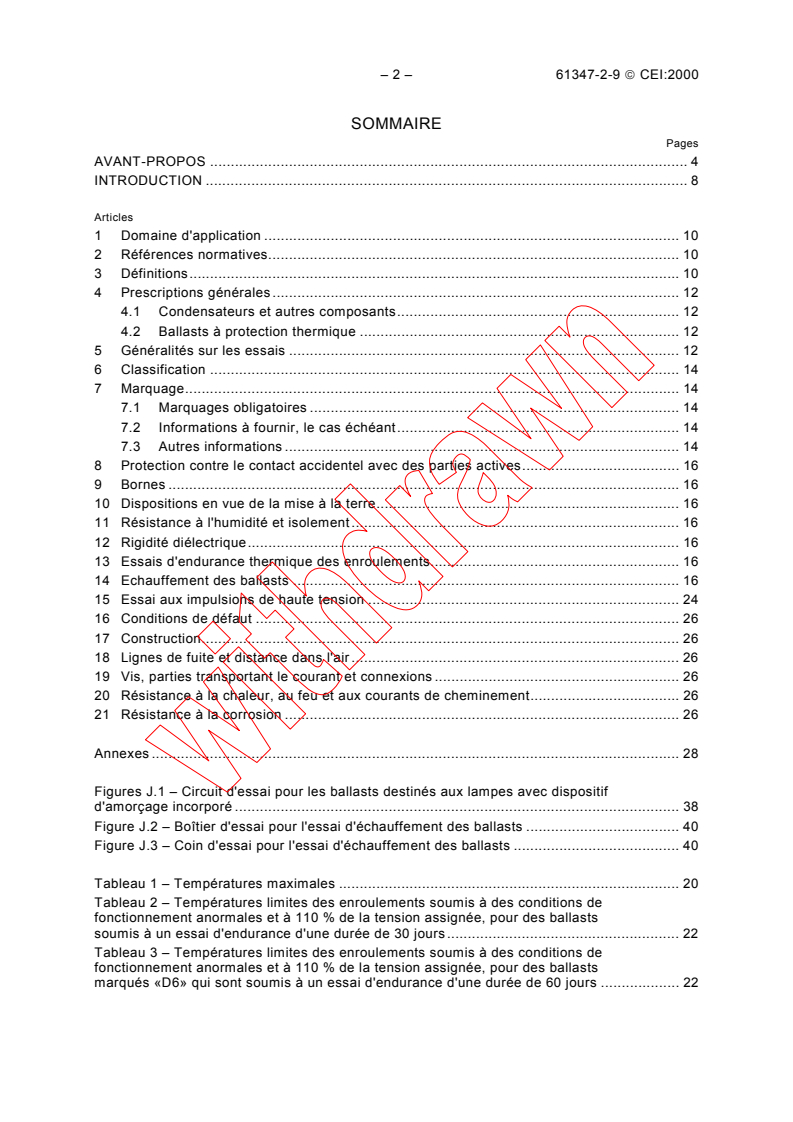
SOMMAIRE
Pages
AVANT-PROPOS . 4
INTRODUCTION .8
Articles
1 Domaine d'application . 10
2 Références normatives. 10
3 Définitions. 10
4 Prescriptions générales . 12
4.1 Condensateurs et autres composants. 12
4.2 Ballasts à protection thermique . 12
5 Généralités sur les essais . 12
6 Classification .14
7 Marquage.14
7.1 Marquages obligatoires . 14
7.2 Informations à fournir, le cas échéant. 14
7.3 Autres informations . 14
8 Protection contre le contact accidentel avec des parties actives. 16
9 Bornes . 16
10 Dispositions en vue de la mise à la terre. 16
11 Résistance à l'humidité et isolement . 16
12 Rigidité diélectrique. 16
13 Essais d'endurance thermique des enroulements. 16
14 Echauffement des ballasts . 16
15 Essai aux impulsions de haute tension . 24
16 Conditions de défaut . 26
17 Construction. 26
18 Lignes de fuite et distance dans l'air . 26
19 Vis, parties transportant le courant et connexions . 26
20 Résistance à la chaleur, au feu et aux courants de cheminement. 26
21 Résistance à la corrosion . 26
Annexes . 28
Figures J.1 – Circuit d'essai pour les ballasts destinés aux lampes avec dispositif
d'amorçage incorporé . 38
Figure J.2 – Boîtier d'essai pour l'essai d'échauffement des ballasts . 40
Figure J.3 – Coin d'essai pour l'essai d'échauffement des ballasts . 40
Tableau 1 – Températures maximales . 20
Tableau 2 – Températures limites des enroulements soumis à des conditions de
fonctionnement anormales et à 110 % de la tension assignée, pour des ballasts
soumis à un essai d'endurance d'une durée de 30 jours. 22
Tableau 3 – Températures limites des enroulements soumis à des conditions de
fonctionnement anormales et à 110 % de la tension assignée, pour des ballasts
marqués «D6» qui sont soumis à un essai d'endurance d'une durée de 60 jours . 22
61347-2-9 IEC:2000 – 3 –
CONTENTS
Page
FOREWORD . 5
INTRODUCTION .9
Clause
1 Scope . 11
2 Normative references . 11
3 Definitions. 11
4 General requirements. 13
4.1 Capacitors and other components . 13
4.2 Thermally protected ballasts. 13
5 General notes on tests . 13
6 Classification .15
7 Marking. 15
7.1 Mandatory markings. 15
7.2 Information to be provided, if applicable . 15
7.3 Other information . 15
8 Protection against accidental contact with live parts. 17
9 Terminals. 17
10 Provisions for earthing. 17
11 Moisture resistance and insulation. 17
12 Electric strength .17
13 Thermal endurance test for windings . 17
14 Ballast heating .17
15 High-voltage impulse testing. 25
16 Fault conditions.27
17 Construction. 27
18 Creepage distances and clearances . 27
19 Screws, current-carrying parts and connections . 27
20 Resistance to heat, fire and tracking. 27
21 Resistance to corrosion. 27
Annexes . 29
Figure J.1 – Test circuit for ballasts for lamps with integral starting devices. 39
Figure J.2 – Test hood for ballast heating test. 41
Figure J.3 – Test corner for ballast heating . 41
Table 1 – Maximum temperatures. 21
Table 2 – Limiting temperatures of windings under abnormal operating conditions and
at 110 % of rated voltage for ballasts subjected to an endurance test duration of 30 days. 23
Table 3 – Limiting temperatures of windings under abnormal operating conditions and
at 110 % of rated voltage for ballasts marked “D6” which are subjected to an endurance
test duration of 60 days .23
– 4 – 61347-2-9 CEI:2000
COMMISSION ÉLECTROTECHNIQUE INTERNATIONALE
–––––––––––
APPAREILLAGES DE LAMPES –
Partie 2-9: Prescriptions particulières pour les ballasts
pour lampes à décharge (à l’exclusion des lampes fluorescentes)
AVANT-PROPOS
1) La CEI (Commission Électrotechnique Internationale) est une organisation mondiale de normalisation composée
de l'ensemble des comités électrotechniques nationaux (Comités nationaux de la CEI). La CEI a pour objet de
favoriser la coopération internationale pour toutes les questions de normalisation dans les domaines de
l'électricité et de l'électronique. A cet effet, la CEI, entre autres activités, publie des Normes internationales.
Leur élaboration est confiée à des comités d'études, aux travaux desquels tout Comité national intéressé par le
sujet traité peut participer. Les organisations internationales, gouvernementales et non gouvernementales, en
liaison avec la CEI, participent également aux travaux. La CEI collabore étroitement avec l'Organisation
Internationale de Normalisation (ISO), selon des conditions fixées par accord entre les deux organisations.
2) Les décisions ou accords officiels de la CEI concernant les questions techniques représentent, dans la mesure
du possible, un accord international sur les sujets étudiés, étant donné que les Comités nationaux intéressés
sont représentés dans chaque comité d’études.
3) Les documents produits se présentent sous la forme de recommandations internationales. Ils sont publiés
comme normes, spécifications techniques, rapports techniques ou guides et agréés comme tels par les Comités
nationaux.
4) Dans le but d'encourager l'unification internationale, les Comités nationaux de la CEI s'engagent à appliquer de
façon transparente, dans toute la mesure possible, les Normes internationales de la CEI dans leurs normes
nationales et régionales. Toute divergence entre la norme de la CEI et la norme nationale ou régionale
correspondante doit être indiquée en termes clairs dans cette dernière.
5) La CEI n’a fixé aucune procédure concernant le marquage comme indication d’approbation et sa responsabilité
n’est pas engagée quand un matériel est déclaré conforme à l’une de ses normes.
6) L’attention est attirée sur le fait que certains des éléments de la présente Norme internationale peuvent faire
l’objet de droits de propriété intellectuelle ou de droits analogues. La CEI ne saurait être tenue pour
responsable de ne pas avoir identifié de tels droits de propriété et de ne pas avoir signalé leur existence.
La Norme internationale CEI 61347-2-9 a été établie par le sous-comité 34C: Appareils
auxiliaires pour lampes, du comité d’études 34 de la CEI: Lampes et équipements associés.
Cette première édition de la CEI 61347-2-9, conjointement avec la CEI 61347-1, annule et
remplace la deuxième édition de la CEI 60922, parue en 1997, dont elle constitue une révision
mineure.
Cette norme doit être utilisée conjointement avec la CEI 61347-1. Elle a été établie sur la base
de la première édition (2000) de cette norme.
La présente partie 2 complète ou modifie les articles correspondants de la CEI 61347-1 de
façon à la transformer en norme CEI: Prescriptions particulières pour les ballasts pour lampes
à décharge (à l'exclusion des lampes fluorescentes).
NOTE Dans la présente norme, les caractères suivants sont employés:
– Prescriptions proprement dites: caractères romains.
– Modalités d'essais: caractères italiques.
– Notes: petits caractères romains.
61347-2-9 IEC:2000 – 5 –
INTERNATIONAL ELECTROTECHNICAL COMMISSION
___________
LAMP CONTROLGEAR –
Part 2-9: Particular requirements for ballasts for discharge lamps
(excluding fluorescent lamps)
FOREWORD
1) The IEC (International Electrotechnical Commission) is a worldwide organization for standardization comprising
all national electrotechnical committees (IEC National Committees). The object of the IEC is to promote
international co-operation on all questions concerning standardization in the electrical and electronic fields. To
this end and in addition to other activities, the IEC publishes International Standards. Their preparation is
entrusted to technical committees; any IEC National Committee interested in the subject dealt with may
participate in this preparatory work. International, governmental and non-governmental organizations liaising
with the IEC also participate in this preparation. The IEC collaborates closely with the International Organization
for Standardization (ISO) in accordance with conditions determined by agreement between the two
organizations.
2) The formal decisions or agreements of the IEC on technical matters express, as nearly as possible, an
international consensus of opinion on the relevant subjects since each technical committee has representation
from all interested National Committees.
3) The documents produced have the form of recommendations for international use and are published in the form
of standards, technical specifications, technical reports or guides and they are accepted by the National
Committees in that sense.
4) In order to promote international unification, IEC National Committees undertake to apply IEC International
Standards transparently to the maximum extent possible in their national and regional standards. Any
divergence between the IEC Standard and the corresponding national or regional standard shall be clearly
indicated in the latter.
5) The IEC provides no marking procedure to indicate its approval and cannot be rendered responsible for any
equipment declared to be in conformity with one of its standards.
6) Attention is drawn to the possibility that some of the elements of this International Standard may be the subject
of patent rights. The IEC shall not be held responsible for identifying any or all such patent rights.
International Standard IEC 61347-2-9 has been prepared by subcommittee 34C: Auxiliaries for
lamps, of IEC technical committee 34: Lamps and related equipment.
This first edition of IEC 61347-2-9, together with IEC 61347-1, cancels and replaces the
second edition of IEC 60922, published in 1997, and constitutes a minor revision.
This standard shall be used in conjunction with IEC 61347-1. It was established on the basis of
the first edition (2000) of that standard.
This part 2 supplements or modifies the corresponding clauses in IEC 61347-1, so as to
convert that publication into the IEC Standard: Particular requirements for ballasts for
discharge lamps (excluding fluorescent lamps).
NOTE In this standard, the following print types are used:
– Requirements proper: in roman type.
– Test specifications: in italic type.
– Explanatory matter: in smaller roman type.
– 6 – 61347-2-9 CEI:2000
Le texte de cette norme est issu des documents suivants:
FDIS Rapport de vote
34C/506/FDIS 34C/520/RVD
Le rapport de vote indiqué dans le tableau ci-dessus donne toute information sur le vote ayant
abouti à l'approbation de cette norme.
Cette publication a été rédigée selon les Directives ISO/CEI, Partie 3.
Les annexes A, B, D, E, F, H, et I font partie intégrante de cette norme.
L’annexe J est donnée uniquement à titre d’information.
La CEI 61347 comprend les parties suivantes, présentées sous le titre général Appareillages
de lampes:
– Partie 1: Prescriptions générales et prescriptions de sécurité
– Partie 2-1: Prescriptions particulières pour les dispositifs d'amorçage (autres que starters à
lueur)
– Partie 2-2: Prescriptions particulières pour les convertisseurs abaisseurs électroniques
alimentés en courant continu ou alternatif pour lampes à incandescence
– Partie 2-3: Prescriptions particulières pour les ballasts électroniques alimentés en courant
alternatif pour lampes fluorescentes
– Partie 2-4: Prescriptions particulières pour les ballasts électroniques alimentés en courant
continu pour l'éclairage général
– Partie 2-5: Prescriptions particulières pour les ballasts électroniques alimentés en courant
continu pour l'éclairage des transports en commun
– Partie 2-6: Prescriptions particulières pour les ballasts électroniques alimentés en courant
continu pour l'éclairage des aéronefs
– Partie 2-7: Prescriptions particulières pour les ballasts électroniques alimentés en courant
continu pour l'éclairage de secours
– Partie 2-8: Prescriptions particulières pour les ballasts pour lampes fluorescentes
– Partie 2-9: Prescriptions particulières pour les ballasts pour lampes à décharge (à
l'exclusion des lampes fluorescentes)
– Partie 2-10: Prescriptions particulières pour les onduleurs et les convertisseurs
électroniques destinés à l’alimentation en haute fréquence des lampes tubulaires à
décharge à démarrage à froid (tubes néon)
– Partie 2-11: Prescriptions particulières pour les circuits électroniques divers pour usage
1)
avec les luminaires
Le comité a décidé que le contenu de cette publication ne sera pas modifié avant 2003. A cette
date, la publication sera
• reconduite;
• supprimée;
• remplacée par une édition révisée; ou
• amendée.
___________
1)
A publier.
61347-2-9 IEC:2000 – 7 –
The text of this standard is based on the following documents:
FDIS Report on voting
34C/506/FDIS 34C/520/RVD
Full information on the voting for the approval of this standard can be found in the report on
voting indicated in the above table.
This publication has been drafted in accordance with the ISO/IEC Directives, Part 3.
Annexes A, B, D, E, F, H and I form an integral part of this standard.
Annex J is for information only.
IEC 61347 consists of the following parts, under the general title Lamp controlgear:
– Part 1: General and safety requirements
– Part 2-1: Particular requirements for starting devices (other than glow starters)
– Part 2-2: Particular requirements for d.c. or a.c. supplied electronic step-down convertors
for filament lamps
– Part 2-3: Particular requirements for a.c. supplied electronic ballasts for fluorescent lamps
– Part 2-4: Particular requirements for d.c. electronic ballasts for general lighting
– Part 2-5: Particular requirements for d.c. supplied electronic ballasts for public transport
lighting
– Part 2-6: Particular requirements for d.c. supplied electronic ballasts for aircraft lighting
– Part 2-7: Particular requirements for d.c. supplied electronic ballasts for emergency lighting
– Part 2-8: Particular requirements for ballasts for fluorescent lamps
– Part 2-9: Particular requirements for ballasts for discharge lamps (excluding fluorescent
lamps)
– Part 2-10: Particular requirements for electronic invertors and convertors for high-frequency
operation of cold start tubular discharge lamps (neon tubes)
– Part 2-11: Particular requirements for miscellaneous electronic circuits used with
1)
luminaires
The committee has decided that the contents of this publication will remain unchanged until
2003. At this date, the publication will be
• reconfirmed;
• withdrawn;
• replaced by a revised edition; or
• amended.
___________
1)
To be published.
– 8 – 61347-2-9 CEI:2000
INTRODUCTION
Cette première édition de la CEI 61347-2-9, publiée conjointement avec la CEI 61347-1,
constitue une modification éditoriale de la CEI 60922. La présentation en parties publiées
séparément facilitera les futures modifications et révisions. Des prescriptions supplémentaires
seront ajoutées si et quand le besoin en sera reconnu.
La présente norme, et les parties qui composent la CEI 61347-2, en faisant référence à un
quelconque des articles de la CEI 61347-1, spécifient le domaine dans lequel cet article est
applicable et l'ordre dans lequel les essais sont à effectuer; elles incluent aussi des
prescriptions supplémentaires, si nécessaire. Toutes les parties composant la CEI 61347-2
sont autonomes et, par conséquent, ne contiennent pas de références les unes aux autres.
Quand les prescriptions de l'un quelconque des articles de la CEI 61347-1 sont citées en
référence dans la présente partie par la phrase «Les prescriptions de l'article n de la
CEI 61347-1 s'appliquent», cette phrase s'interprète comme signifiant que toutes les pres-
criptions de cet article de la partie 1 s'appliquent, excepté celles qui d'évidence ne s'appliquent
pas au type particulier d'appareillage de lampe considéré dans cette partie spécifique de la
CEI 61347-2.
61347-2-9 IEC:2000 – 9 –
INTRODUCTION
This first edition of IEC 61347-2-9, published in conjunction with IEC 61347-1, represents an
editorial review of IEC 60922. The formatting into separately published parts provides for ease
of future amendments and revisions. Additional requirements will be added as and when a
need for them is recognized.
This standard, and the parts which make up IEC 61347-2, in referring to any of the clauses of
IEC 61347-1, specify the extent to which such a clause is applicable and the order in which the
tests are to be performed; they also include additional requirements, as necessary. All parts
which make up IEC 61347-2 are self-contained and, therefore, do not include references to
each other.
Where the requirements of any of the clauses of IEC 61347-1 are referred to in this standard
by the phrase "The requirements of clause n of IEC 61347-1 apply", this phrase is interpreted
as meaning that all requirements of the clause in question of part 1 apply, except any which are
clearly inapplicable to the specific type of lamp controlgear covered by this particular part of
IEC 61347-2.
– 10 – 61347-2-9 CEI:2000
APPAREILLAGES DE LAMPES –
Partie 2-9: Prescriptions particulières pour les ballasts
pour lampes à décharge (à l’exclusion des lampes fluorescentes)
1 Domaine d'application
La présente partie de la CEI 61347 donne les prescriptions particulières de sécurité pour les
ballasts pour lampes à décharge telles que lampes à vapeur de mercure à haute pression,
lampes à vapeur de sodium à basse pression, lampes à vapeur de sodium à haute pression et
lampes aux halogénures métalliques. La présente norme traite des ballasts inductifs, pour
utilisation en courant alternatif jusqu'à 1 000 V à 50 Hz ou 60 Hz, associés à des lampes à
décharge dont les puissances nominales, les dimensions et les caractéristiques sont indiquées
dans la CEI 60188, la CEI 60192 et la CEI 60662.
Elle est applicable aux ballasts complets ainsi qu'à leurs éléments constitutifs, tels
qu'inductances, transformateurs et condensateurs. Les prescriptions particulières pour les
ballasts à protection thermique sont données à l’annexe B.
NOTE 1 Pour certains types de lampe à décharge, un amorceur est nécessaire.
NOTE 2 Les ballasts pour lampes fluorescentes sont couverts par la CEI 61347-2-8.
Les prescriptions de performances font l’objet de la CEI 60923.
2 Références normatives
Pour les besoins de la présente partie de la CEI 61347, les références normatives données à
l’article 2 de la CEI 61347-1 et qui sont mentionnées dans la présente norme s’appliquent,
conjointement avec les références normatives suivantes.
CEI 60188, Lampes à décharge à vapeur de mercure à haute pression
CEI 60192, Lampes à vapeur de sodium à basse pression
CEI 60662, Lampes à vapeur de sodium à haute pression
CEI 60923, Appareils auxiliaires pour lampes – Ballasts pour lampes à décharge (à l’exclusion
des lampes tubulaires à fluorescence) – Prescriptions de performance
CEI 61347-1, Appareillages de lampes – Partie 1: Prescriptions générales et prescriptions de
sécurité
CEI 61347-2-1, Appareillages de lampes – Partie 2-1: Prescriptions particulières pour les
dispositifs d’amorçage (autres que starters à lueur)
3 Définitions
Pour les besoins de la présente partie de la CEI 61347, les définitions de l’article 3 de la
CEI 61374-1 s'appliquent, avec les suivantes:
61347-2-9 IEC:2000 – 11 –
LAMP CONTROLGEAR –
Part 2-9: Particular requirements for ballasts for discharge lamps
(excluding fluorescent lamps)
1 Scope
This part of IEC 61347 specifies particular safety requirements for ballasts for discharge lamps
such as high-pressure mercury vapour, low-pressure sodium vapour, high-pressure sodium
vapour and metal halide lamps. The standard covers inductive-type ballasts for use on
a.c. supplies up to 1 000 V at 50 Hz or 60 Hz, associated with discharge lamps, having
rated wattages, dimensions and characteristics as specified in IEC 60188, IEC 60192 and
IEC 60662.
This standard applies to complete ballasts and to their component parts such as reactors,
transformers and capacitors. Particular requirements for thermally protected ballasts are given
in annex B.
NOTE 1 For certain types of discharge lamps, an ignitor is required.
NOTE 2 Ballasts for fluorescent lamps are covered by IEC 61347-2-8.
Performance requirements are the subject of IEC 60923.
2 Normative references
For the purpose of this part of IEC 61347, the normative references given in clause 2 of
IEC 61347-1 which are mentioned in this standard apply, together with the following normative
references.
IEC 60188, High-pressure mercury vapour lamps
IEC 60192, Low-pressure sodium vapour lamps
IEC 60662, High-pressure sodium vapour lamps
IEC 60923, Auxiliaries for lamps – Ballasts for discharge lamps (excluding tubular fluorescent
lamps) – Performance requirements
IEC 61347-1, Lamp controlgear – Part 1: General and safety requirements
IEC 61347-2-1, Lamp controlgear – Part 2-1: Particular requirements for starting devices (other
than glow starters)
3 Definitions
For the purpose of this part of IEC 61347, the definitions given in clause 3 of IEC 61347-1
apply, together with the following:
– 12 – 61347-2-9 CEI:2000
3.1
échauffement nominal d'un enroulement de ballast ∆t
échauffement d'un enroulement déclaré par le fabricant comme étant celui qui se produit
lorsque le ballast fonctionne sous les conditions spécifiées dans la présente norme
NOTE Les spécifications d'alimentation et les conditions de montage du ballast sont données à l’annexe H.
3.2
impulsion de haute tension
tension transitoire apériodique appliquée intentionnellement qui monte rapidement à une valeur
de crête et qui descend ensuite vers zéro, généralement plus lentement. Une telle impulsion
est, en général, bien représentée par la somme de deux exponentielles
NOTE Le terme «impulsion» est à distinguer du terme «tension de choc», qui désigne des phénomènes
transitoires se produisant en service dans l’équipement électrique ou sur les réseaux.
4 Prescriptions générales
Les prescriptions de l’article 4 de la CEI 61347-1 s'appliquent, avec l'adjonction des
prescriptions suivantes:
4.1 Condensateurs et autres composants
Les condensateurs et autres composants incorporés au ballast doivent satisfaire aux pres-
criptions des normes de la CEI qui leur correspondent.
4.2 Ballasts à protection thermique
Les ballasts à protection thermique doivent satisfaire aux exigences de l’annexe B.
5 Généralités sur les essais
Les prescriptions de l’article 5 de la CEI 61347-1 s'appliquent, avec l'adjonction des prescrip-
tions suivantes:
5.1
L'essai de type est effectué sur un échantillon comprenant huit ballasts présentés à cet effet.
Sept ballasts sont soumis à l'essai d'endurance et un ballast à tous les autres essais. Pour les
conditions d'acceptation de l'essai d'endurance, voir l’article 13.
En plus, six ballasts sont exigés pour l'essai d'impulsion de haute tension conformément à
l’article 15 ci-dessous, pour les ballasts pour lampes aux halogénures métalliques et lampes à
sodium à haute pression. Il ne doit pas y avoir de défaillances pendant l’essai.
5.2
Les essais sont effectués dans les conditions spécifiées à l’annexe H de la CEI 61347-1. En
général, tous les essais sont effectués sur chaque type de ballast ou, s'il s'agit d'une gamme
de ballasts similaires, pour chaque puissance nominale de la gamme ou sur une sélection
représentative de la gamme en accord avec le fabricant. Une réduction du nombre de ballasts
soumis à l'essai d'endurance selon l’article 13 et la vérification de l'usage de constantes S
différant de 4 500 selon l’annexe E, ou même l'omission de ces essais est permise dans le cas
où des ballasts de même conception mais de caractéristiques différentes sont soumis en
même temps à l'homologation, ou si les rapports d'essai émanant du fabricant ou d'une autre
instance sont acceptés par l'autorité de contrôle.
61347-2-9 IEC:2000 – 13 –
3.1
rated temperature rise of a ballast winding ∆t
temperature rise assigned by the manufacturer under the conditions specified in this standard
NOTE The specifications for the supply and mounting conditions of the ballast are given in annex H.
3.2
high-voltage impulse
intentionally applied aperiodic transient voltage which rises rapidly to a peak value and then
falls, usually less rapidly, to zero. Such an impulse is, in general, well represented by the sum
of two exponentials
NOTE The term "impulse" is to be distinguished from the term "surge", which refers to transients occurring in
electrical equipment or networks in service.
4 General requirements
The requirements of clause 4 of IEC 61347-1 apply, together with the following additional
requirements:
4.1 Capacitors and other components
Capacitors and other components incorporated in ballasts shall comply with the requirements
of the appropriate IEC standard.
4.2 Thermally protected ballasts
Thermally protected ballasts shall comply with the requirements of annex B.
5 General notes on tests
The requirements of clause 5 of IEC 61347-1 apply, together with the following additional
requirements:
5.1
The type test is carried out on one sample consisting of eight ballasts submitted for the
purpose of the type test. Seven ballasts are for the endurance test and one for all other tests.
For conditions of compliance for the endurance test, see clause 13.
In addition, six ballasts are required for the high-voltage impulse testing according to clause 15
below, for ballasts for metal halide and high-pressure sodium lamps. There shall be no failure
during the test.
5.2
The tests are made under the conditions specified in annex H of IEC 61347-1. In general, all
the tests are carried out on each type of ballast or, where a range of similar ballasts is
involved, on each rated wattage in the range, or on a representative selection from the range
as agreed with the manufacturer. A reduction in the number of samples for the endurance test
according to clause 13 and including the use of constant S other than 4 500 as shown in
annex E, or even the omission of these tests, is allowed when ballasts of the same
construction but with different characteristics are submitted together for approval, or when test
reports from the manufacturer or other authority are accepted by the testing station.
– 14 – 61347-2-9 CEI:2000
6 Classification
Les prescriptions de l’article 6 de la CEI 61347-1 s'appliquent.
7 Marquage
Les ballasts qui forment une partie intégrée dans le luminaire n’ont pas besoin d’être marqués.
Pour les ballasts prévus pour être montés dans un compartiment en pied de candélabre, tous
les marquages nécessaires selon 7.1 et 7.2 doivent se trouver sur le ballast. Les prescriptions
de 7.2 de la CEI 61347-1 s’appliquent.
7.1 Marquages obligatoires
Les ballasts autres que les ballasts intégrés doivent être marqués d’une manière claire et
durable, avec les marquages obligatoires suivants:
– points a), b), e), f) et g) de 7.1 de la CEI 61347-1, conjointement avec,
– dans le cas où les ballasts sont prévus pour être utilisés avec des amorceurs (CEI 61347-2-1),
les bornes ou sorties soumises à la tension d’impulsion doivent être marquées sur le
ballast.
NOTE Ce marquage peut prendre la forme d’un schéma de câblage. Les ballasts à simple réactance qui ont
plusieurs emplois, par exemple pour l’alimentation des lampes à vapeur de mercure à haute pression, de certaines
lampes aux halogénures métalliques, etc., n’ont pas besoin d’être marquées de la sorte.
7.2 Informations à fournir, le cas échéant
En plus des marquages obligatoires ci-dessus, les informations suivantes, si elles s’appliquent,
doivent être données sur le ballast ou figurer sur le catalogue du fabricant ou sur un document
équivalent:
– points c), h), i), j), k), o), p) et q) de 7.1 de la CEI 61347-1, conjointement avec
– pour les ballasts destinés à être utilisés avec des lampes à vapeur de sodium à haute
pression ou aux halogénures métalliques:
1) la tension de crête maximale de l’impulsion de tension à laquelle le ballast est soumis,
si cette valeur dépasse 1 500 V;
2) la référence dans le catalogue du ou des amorceurs qui peuvent être utilisés avec le
ballast.
– Si le ballast est constitué de plus d'un élément séparé, celui ou ceux qui renferment
l'enroulement contrôlant le courant inductif doivent porter dans leur marquage l'indication
des caractéristiques essentielles du ou des autres éléments séparés et/ou des
condensateurs essentiels.
– Si le ballast inductif est utilisé avec un condensateur séparé monté en série autre qu'un
condensateur d'antiparasitage, l'indication de la tension nominale, de la capacité et de la
tolérance du condensateur doit figurer aussi.
– Conseil à l’installateur pour éviter la surchauffe des ballasts et des équipements associés
dans une installation à plusieurs ballasts placés dans des mâts, des boîtes, etc.
7.3 Autres informations
Le fabricant peut fournir l'information facultative suivante, si elle est disponible:
–échauffement nominal de l'enroulement, à la suite du symbole ∆t, les valeurs croissant par
multiples de 5 K.
61347-2-9 IEC:2000 – 15 –
6 Classification
The requirements of clause 6 of IEC 61347-1 apply.
7 Marking
Ballasts which form an integral part of the luminaire need not be marked. For ballasts intended
to be mounted in the base compartment of a column, all necessary markings according to 7.1
and 7.2 shall be on the ballast. The requirements of 7.2 of IEC 61347-1 apply.
7.1 Mandatory markings
Ballasts, other than integral ballasts, shall be clearly and durably marked with the following
mandatory markings:
– items a), b), e), f) and g) of 7.1 of IEC 61347-1 together with,
– in the case of ballasts intended to be used with ignitors (IEC 61347-2-1), the
terminals/terminations subjected to the pulse voltage shall be marked on the ballast.
NOTE This marking may be in the form of a wiring diagram. Simple reactor ballasts which have several uses, for
example, for controlling high-pressure mercury vapour lamps, certain metal halide lamps, etc., need not be marked
in this way.
7.2 Information to be provided, if applicable
In addition to the above mandatory markings, the following information, if applicable, shall be
given either on the ballast, or be made available in the manufacturer’s catalogue or similar:
– items c), h), i), j), k), o), p) and q) of 7.1 of IEC 61347-1, together with
– for ballasts for use with high-pressure sodium vapour or metal halide lamps:
1) the maximum peak value of the pulse voltage to which the ballast can be subjected if
this value exceeds 1 500 V;
2) the catalogue reference of the ignitor(s) which may be used with the ballast.
– In the case of a ballast consisting of more than one separate unit, the current-controlling
inductive element(s) marked with the essential details of the other unit(s) and/or essential
capacitors.
– In the case of an inductive ballast used with a separate series capacitor other than a radio
interference suppression capacitor, repetition of the marking of rated voltage, capacitance
and tolerance.
– Advice to the installer to prevent overheating of ballasts and associated components in a
multi-ballast installation mounted in poles, boxes, etc.
7.3 Other information
Manufacturers may provide the following non-mandatory information, if available:
– the rated temperature rise of the winding following the symbol ∆t, values increasing in
multiples of 5 K.
– 16 – 61347-2-9 CEI:2000
8 Protection contre le contact accidentel avec des parties actives
Les prescriptions de l’article 10 de la CEI 61347-1 s'appliquent.
9 Bornes
Les prescriptions de l’article 8 de la CEI 61347-1 s'appliquent.
10 Dispositions en vue de la mise à la terre
Les prescriptions de l’article 9 de la CEI 61347-1 s'appliquent.
11 Résistance à l'humidité et isolement
Les prescriptions de l’article 11 de la CEI 61347-1 s'appliquent.
12 Rigidité diélectrique
Les prescriptions de l’article 12 de la CEI 61347-1 s'appliquent.
13 Essai d'endurance thermique des enroulements
Les prescriptions de l’article 13 de la CEI 61347-1 s'appliquent.
14 Echauffement des ballasts
Les ballasts ou leurs surfaces de montage ne doivent pas atteindre une température mettant
en cause la sécurité.
La conformité est vérifiée par les essais de
...
IEC 61347-2-9 ®
Edition 1.2 2009-10
INTERNATIONAL
STANDARD
NORME
INTERNATIONALE
Lamp controlgear –
Part 2-9: Particular requirements for ballasts for discharge lamps (excluding
fluorescent lamps)
Appareillages de lampes –
Partie 2-9: Prescriptions particulières pour les ballasts pour lampes à décharge
(à l'exclusion des lampes fluorescentes)
All rights reserved. Unless otherwise specified, no part of this publication may be reproduced or utilized in any form or by
any means, electronic or mechanical, including photocopying and microfilm, without permission in writing from either IEC or
IEC's member National Committee in the country of the requester.
If you have any questions about IEC copyright or have an enquiry about obtaining additional rights to this publication,
please contact the address below or your local IEC member National Committee for further information.
Droits de reproduction réservés. Sauf indication contraire, aucune partie de cette publication ne peut être reproduite
ni utilisée sous quelque forme que ce soit et par aucun procédé, électronique ou mécanique, y compris la photocopie
et les microfilms, sans l'accord écrit de la CEI ou du Comité national de la CEI du pays du demandeur.
Si vous avez des questions sur le copyright de la CEI ou si vous désirez obtenir des droits supplémentaires sur cette
publication, utilisez les coordonnées ci-après ou contactez le Comité national de la CEI de votre pays de résidence.
IEC Central Office
3, rue de Varembé
CH-1211 Geneva 20
Switzerland
Email: inmail@iec.ch
Web: www.iec.ch
About the IEC
The International Electrotechnical Commission (IEC) is the leading global organization that prepares and publishes
International Standards for all electrical, electronic and related technologies.
About IEC publications
The technical content of IEC publications is kept under constant review by the IEC. Please make sure that you have the
latest edition, a corrigenda or an amendment might have been published.
ƒ Catalogue of IEC publications: www.iec.ch/searchpub
The IEC on-line Catalogue enables you to search by a variety of criteria (reference number, text, technical committee,…).
It also gives information on projects, withdrawn and replaced publications.
ƒ IEC Just Published: www.iec.ch/online_news/justpub
Stay up to date on all new IEC publications. Just Published details twice a month all new publications released. Available
on-line and also by email.
ƒ Electropedia: www.electropedia.org
The world's leading online dictionary of electronic and electrical terms containing more than 20 000 terms and definitions
in English and French, with equivalent terms in additional languages. Also known as the International Electrotechnical
Vocabulary online.
ƒ Customer Service Centre: www.iec.ch/webstore/custserv
If you wish to give us your feedback on this publication or need further assistance, please visit the Customer Service
Centre FAQ or contact us:
Email: csc@iec.ch
Tel.: +41 22 919 02 11
Fax: +41 22 919 03 00
A propos de la CEI
La Commission Electrotechnique Internationale (CEI) est la première organisation mondiale qui élabore et publie des
normes internationales pour tout ce qui a trait à l'électricité, à l'électronique et aux technologies apparentées.
A propos des publications CEI
Le contenu technique des publications de la CEI est constamment revu. Veuillez vous assurer que vous possédez
l’édition la plus récente, un corrigendum ou amendement peut avoir été publié.
ƒ Catalogue des publications de la CEI: www.iec.ch/searchpub/cur_fut-f.htm
Le Catalogue en-ligne de la CEI vous permet d’effectuer des recherches en utilisant différents critères (numéro de référence,
texte, comité d’études,…). Il donne aussi des informations sur les projets et les publications retirées ou remplacées.
ƒ Just Published CEI: www.iec.ch/online_news/justpub
Restez informé sur les nouvelles publications de la CEI. Just Published détaille deux fois par mois les nouvelles
publications parues. Disponible en-ligne et aussi par email.
ƒ Electropedia: www.electropedia.org
Le premier dictionnaire en ligne au monde de termes électroniques et électriques. Il contient plus de 20 000 termes et
définitions en anglais et en français, ainsi que les termes équivalents dans les langues additionnelles. Egalement appelé
Vocabulaire Electrotechnique International en ligne.
ƒ Service Clients: www.iec.ch/webstore/custserv/custserv_entry-f.htm
Si vous désirez nous donner des commentaires sur cette publication ou si vous avez des questions, visitez le FAQ du
Service clients ou contactez-nous:
Email: csc@iec.ch
Tél.: +41 22 919 02 11
Fax: +41 22 919 03 00
IEC 61347-2-9 ®
Edition 1.2 2009-10
INTERNATIONAL
STANDARD
NORME
INTERNATIONALE
Lamp controlgear –
Part 2-9: Particular requirements for ballasts for discharge lamps (excluding
fluorescent lamps)
Appareillages de lampes –
Partie 2-9: Prescriptions particulières pour les ballasts pour lampes à décharge
(à l'exclusion des lampes fluorescentes)
INTERNATIONAL
ELECTROTECHNICAL
COMMISSION
COMMISSION
ELECTROTECHNIQUE
PRICE CODE
INTERNATIONALE
CJ
CODE PRIX
ICS 29.140.99 ISBN 978-2-88910-509-0
– 2 – 61347-2-9 © IEC:2000+A1:2003
+A2:2006
CONTENTS
FOREWORD.3
INTRODUCTION.5
1 Scope.6
2 Normative references.6
3 Definitions .6
4 General requirements .7
4.1 Capacitors and other components.7
4.2 Thermally protected ballasts .7
5 General notes on tests.7
6 Classification .8
7 Marking .8
7.1 Mandatory markings .8
7.2 Information to be provided, if applicable .8
7.3 Other information.8
8 Protection against accidental contact with live parts .9
9 Terminals .9
10 Provisions for earthing .9
11 Moisture resistance and insulation .9
12 Electric strength.9
13 Thermal endurance test for windings.9
14 Ballast heating.9
15 High-voltage impulse testing .13
16 Fault conditions .14
17 Construction .14
18 Creepage distances and clearances.14
19 Screws, current-carrying parts and connections .14
20 Resistance to heat, fire and tracking .14
21 Resistance to corrosion .14
22 No-load output voltage.14
Annexes.15
Figure J.1 – Test circuit for ballasts for lamps with integral starting devices .20
Figure J.2 – Test hood for ballast heating test .21
Figure J.3 – Test corner for ballast heating .21
Table 1 – Maximum temperatures .11
Table 2 – Limiting temperatures of windings under abnormal operating conditions and
at 110 % of rated voltage for ballasts subjected to an endurance test duration of 30 days .12
Table 3 – Limiting temperatures of windings under abnormal operating conditions and
at 110 % of rated voltage for ballasts marked “D6” which are subjected to an endurance
test duration of 60 days .12
61347-2-9 © IEC:2000+A1:2003 – 3 –
+A2:2006
INTERNATIONAL ELECTROTECHNICAL COMMISSION
____________
LAMP CONTROLGEAR –
Part 2-9: Particular requirements for ballasts for discharge lamps
(excluding fluorescent lamps)
FOREWORD
1) The International Electrotechnical Commission (IEC) is a worldwide organization for standardization comprising
all national electrotechnical committees (IEC National Committees). The object of IEC is to promote
international co-operation on all questions concerning standardization in the electrical and electronic fields. To
this end and in addition to other activities, IEC publishes International Standards, Technical Specifications,
Technical Reports, Publicly Available Specifications (PAS) and Guides (hereafter referred to as “IEC
Publication(s)”). Their preparation is entrusted to technical committees; any IEC National Committee interested
in the subject dealt with may participate in this preparatory work. International, governmental and non-
governmental organizations liaising with the IEC also participate in this preparation. IEC collaborates closely
with the International Organization for Standardization (ISO) in accordance with conditions determined by
agreement between the two organizations.
2) The formal decisions or agreements of IEC on technical matters express, as nearly as possible, an international
consensus of opinion on the relevant subjects since each technical committee has representation from all
interested IEC National Committees.
3) IEC Publications have the form of recommendations for international use and are accepted by IEC National
Committees in that sense. While all reasonable efforts are made to ensure that the technical content of IEC
Publications is accurate, IEC cannot be held responsible for the way in which they are used or for any
misinterpretation by any end user.
4) In order to promote international uniformity, IEC National Committees undertake to apply IEC Publications
transparently to the maximum extent possible in their national and regional publications. Any divergence
between any IEC Publication and the corresponding national or regional publication shall be clearly indicated in
the latter.
5) IEC itself does not provide any attestation of conformity. Independent certification bodies provide conformity
assessment services and, in some areas, access to IEC marks of conformity. IEC is not responsible for any
services carried out by independent certification bodies.
6) All users should ensure that they have the latest edition of this publication.
7) No liability shall attach to IEC or its directors, employees, servants or agents including individual experts and
members of its technical committees and IEC National Committees for any personal injury, property damage or
other damage of any nature whatsoever, whether direct or indirect, or for costs (including legal fees) and
expenses arising out of the publication, use of, or reliance upon, this IEC Publication or any other IEC
Publications.
8) Attention is drawn to the Normative references cited in this publication. Use of the referenced publications is
indispensable for the correct application of this publication.
9) Attention is drawn to the possibility that some of the elements of this IEC Publication may be the subject of
patent rights. IEC shall not be held responsible for identifying any or all such patent rights.
International Standard IEC 61347-2-9 has been prepared by subcommittee 34C: Auxiliaries for
lamps, of IEC technical committee 34: Lamps and related equipment.
This part 2 supplements or modifies the corresponding clauses in IEC 61347-1, so as to
convert that publication into the IEC Standard: Particular requirements for ballasts for
discharge lamps (excluding fluorescent lamps).
This standard shall be used in conjunction with IEC 61347-1. It was established on the basis of
the first edition (2000) of that standard.
This consolidated version of IEC 61347-2-9 consists of the first edition (2000) [documents
34C/506/FDIS and 34C/520/RVD], its amendment 1 (2003) [documents 34C/605/FDIS and
34C/617/RVD] and its amendment 2 (2006) [documents 34C/735/FDIS and 34C/750/RVD].
The technical content is therefore identical to the base edition and its amendments and has
been prepared for user convenience.
– 4 – 61347-2-9 © IEC:2000+A1:2003
+A2:2006
It bears the edition number 1.2.
A vertical line in the margin shows where the base publication has been modified by
amendments 1 and 2.
Annexes A, B, D, E, F, H, I and K form an integral part of this standard.
Annex J is for information only.
NOTE In this standard, the following print types are used:
– Requirements proper: in roman type.
– Test specifications: in italic type.
– Explanatory matter: in smaller roman type.
IEC 61347 consists of the following parts, under the general title Lamp controlgear:
– Part 1: General and safety requirements
– Part 2-1: Particular requirements for starting devices (other than glow starters)
– Part 2-2: Particular requirements for d.c. or a.c. supplied electronic step-down convertors
for filament lamps
– Part 2-3: Particular requirements for a.c. supplied electronic ballasts for fluorescent lamps
– Part 2-4: Particular requirements for d.c. electronic ballasts for general lighting
– Part 2-5: Particular requirements for d.c. supplied electronic ballasts for public transport
lighting
– Part 2-6: Particular requirements for d.c. supplied electronic ballasts for aircraft lighting
– Part 2-7: Particular requirements for d.c. supplied electronic ballasts for emergency lighting
– Part 2-8: Particular requirements for ballasts for fluorescent lamps
– Part 2-9: Particular requirements for ballasts for discharge lamps (excluding fluorescent
lamps)
– Part 2-10: Particular requirements for electronic invertors and convertors for high-frequency
operation of cold start tubular discharge lamps (neon tubes)
– Part 2-11: Particular requirements for miscellaneous electronic circuits used with luminaires
The committee has decided that the contents of the base publication and its amendments will
remain unchanged until the maintenance result date indicated on the IEC web site under
"http://webstore.iec.ch" in the data related to the specific publication. At this date,
the publication will be
• reconfirmed,
• withdrawn,
• replaced by a revised edition, or
• amended.
61347-2-9 © IEC:2000+A1:2003 – 5 –
+A2:2006
INTRODUCTION
This first edition of IEC 61347-2-9, published in conjunction with IEC 61347-1, represents an
editorial review of IEC 60922. The formatting into separately published parts provides for ease
of future amendments and revisions. Additional requirements will be added as and when a
need for them is recognized.
This standard, and the parts which make up IEC 61347-2, in referring to any of the clauses of
IEC 61347-1, specify the extent to which such a clause is applicable and the order in which the
tests are to be performed; they also include additional requirements, as necessary. All parts
which make up IEC 61347-2 are self-contained and, therefore, do not include references to
each other.
Where the requirements of any of the clauses of IEC 61347-1 are referred to in this standard
by the phrase "The requirements of clause n of IEC 61347-1 apply", this phrase is interpreted
as meaning that all requirements of the clause in question of part 1 apply, except any which are
clearly inapplicable to the specific type of lamp controlgear covered by this particular part of
IEC 61347-2.
– 6 – 61347-2-9 © IEC:2000+A1:2003
+A2:2006
LAMP CONTROLGEAR –
Part 2-9: Particular requirements for ballasts for discharge lamps
(excluding fluorescent lamps)
1 Scope
This part of IEC 61347 specifies particular safety requirements for ballasts for discharge lamps
such as high-pressure mercury vapour, low-pressure sodium vapour, high-pressure sodium
vapour and metal halide lamps. The standard covers inductive-type ballasts for use on
a.c. supplies up to 1 000 V at 50 Hz or 60 Hz, associated with discharge lamps, having
rated wattages, dimensions and characteristics as specified in IEC 60188, IEC 60192 and
IEC 60662.
This standard applies to complete ballasts and to their component parts such as reactors,
transformers and capacitors. Particular requirements for thermally protected ballasts are given
in annex B.
NOTE 1 For certain types of discharge lamps, an ignitor is required.
NOTE 2 Ballasts for fluorescent lamps are covered by IEC 61347-2-8.
Performance requirements are the subject of IEC 60923.
2 Normative references
For the purpose of this part of IEC 61347, the normative references given in clause 2 of
IEC 61347-1 which are mentioned in this standard apply, together with the following normative
references.
IEC 60188, High-pressure mercury vapour lamps
IEC 60192, Low-pressure sodium vapour lamps
IEC 60662, High-pressure sodium vapour lamps
IEC 60923, Auxiliaries for lamps – Ballasts for discharge lamps (excluding tubular fluorescent
lamps) – Performance requirements
IEC 61347-1, Lamp controlgear – Part 1: General and safety requirements
IEC 61347-2-1, Lamp controlgear – Part 2-1: Particular requirements for starting devices (other
than glow starters)
3 Definitions
For the purpose of this part of IEC 61347, the definitions given in clause 3 of IEC 61347-1
apply, together with the following:
61347-2-9 © IEC:2000+A1:2003 – 7 –
+A2:2006
3.1
rated temperature rise of a ballast winding Δt
temperature rise assigned by the manufacturer under the conditions specified in this standard
NOTE The specifications for the supply and mounting conditions of the ballast are given in annex H.
3.2
high-voltage impulse
intentionally applied aperiodic transient voltage which rises rapidly to a peak value and then
falls, usually less rapidly, to zero. Such an impulse is, in general, well represented by the sum
of two exponentials
NOTE The term "impulse" is to be distinguished from the term "surge", which refers to transients occurring in
electrical equipment or networks in service.
4 General requirements
The requirements of clause 4 of IEC 61347-1 apply, together with the following additional
requirements:
4.1 Capacitors and other components
Capacitors and other components incorporated in ballasts shall comply with the requirements
of the appropriate IEC standard.
4.2 Thermally protected ballasts
Thermally protected ballasts shall comply with the requirements of annex B.
5 General notes on tests
The requirements of clause 5 of IEC 61347-1 apply, together with the following additional
requirements:
5.1
The type test is carried out on one sample consisting of eight ballasts submitted for the
purpose of the type test. Seven ballasts are for the endurance test and one for all other tests.
For conditions of compliance for the endurance test, see clause 13.
In addition, six ballasts are required for the high-voltage impulse testing according to clause 15
below, for ballasts for metal halide and high-pressure sodium lamps. There shall be no failure
during the test.
5.2
The tests are made under the conditions specified in annex H of IEC 61347-1. In general, all
the tests are carried out on each type of ballast or, where a range of similar ballasts is
involved, on each rated wattage in the range, or on a representative selection from the range
as agreed with the manufacturer. A reduction in the number of samples for the endurance test
according to clause 13 and including the use of constant S other than 4 500 as shown in
annex E, or even the omission of these tests, is allowed when ballasts of the same
construction but with different characteristics are submitted together for approval, or when test
reports from the manufacturer or other authority are accepted by the testing station.
– 8 – 61347-2-9 © IEC:2000+A1:2003
+A2:2006
6 Classification
The requirements of clause 6 of IEC 61347-1 apply.
7 Marking
Ballasts which form an integral part of the luminaire need not be marked. For ballasts intended
to be mounted in the base compartment of a column, all necessary markings according to 7.1
and 7.2 shall be on the ballast. The requirements of 7.2 of IEC 61347-1 apply.
7.1 Mandatory markings
Ballasts, other than integral ballasts, shall be clearly and durably marked with the following
mandatory markings:
– items a), b), e), f), g) and r) of 7.1 of IEC 61347-1, together with,
– in the case of ballasts intended to be used with ignitors (IEC 61347-2-1), the
terminals/terminations subjected to the pulse voltage shall be marked on the ballast.
NOTE This marking may be in the form of a wiring diagram. Simple reactor ballasts which have several uses, for
example, for controlling high-pressure mercury vapour lamps, certain metal halide lamps, etc., need not be marked
in this way.
7.2 Information to be provided, if applicable
In addition to the above mandatory markings, the following information, if applicable, shall be
given either on the ballast, or be made available in the manufacturer’s catalogue or similar:
– items c), h), i), j), k), o), p) and q) of 7.1 of IEC 61347-1, together with
– for ballasts for use with high-pressure sodium vapour or metal halide lamps:
1) the maximum peak value of the pulse voltage to which the ballast can be subjected if
this value exceeds 1 500 V;
2) the catalogue reference of the ignitor(s) which may be used with the ballast.
– In the case of a ballast consisting of more than one separate unit, the current-controlling
inductive element(s) marked with the essential details of the other unit(s) and/or essential
capacitors.
– In the case of an inductive ballast used with a separate series capacitor other than a radio
interference suppression capacitor, repetition of the marking of rated voltage, capacitance
and tolerance.
– Advice to the installer to prevent overheating of ballasts and associated components in a
multi-ballast installation mounted in poles, boxes, etc.
7.3 Other information
Manufacturers may provide the following non-mandatory information, if available:
– the rated temperature rise of the winding following the symbol Δt, values increasing in
multiples of 5 K.
61347-2-9 © IEC:2000+A1:2003 – 9 –
+A2:2006
8 Protection against accidental contact with live parts
The requirements of clause 10 of IEC 61347-1 apply.
9 Terminals
The requirements of clause 8 of IEC 61347-1 apply.
10 Provisions for earthing
The requirements of clause 9 of IEC 61347-1 apply.
11 Moisture resistance and insulation
The requirements of clause 11 of IEC 61347-1 apply.
12 Electric strength
The requirements of clause 12 of IEC 61347-1 apply.
Additionally for ballasts using ignitors where the pulse voltage is generated within the ballast an
electric strength test shall be conducted across insulation barriers subject to the ignition
voltage. The test voltage shall be (U = working voltage):
Pulse voltage ≤ 4 U × 1,414 Pulse voltage > 4 U × 1,414
Double or reinforced insulation 4 U + 2 750 V U /1,414 + 2 750 V
pmax
Basic or supplementary insulation 2 U + 1 000 V U /2 × 1,414 + 1 000 V
pmax
13 Thermal endurance test for windings
The requirements of clause 13 of IEC 61347-1 apply.
14 Ballast heating
Ballasts, or their mounting surfaces, shall not attain a temperature which would impair safety.
Compliance is checked by the tests of 14.1 to 14.2 and H.12 of IEC 61347-1.
14.1
When the ballast is tested in accordance with the requirements of 14.2, the temperature shall
not exceed the appropriate values given in table 1 for the test under normal and abnormal
conditions, if applicable.
– 10 – 61347-2-9 © IEC:2000+A1:2003
+A2:2006
Before the test, the following shall be checked and measured:
a) the ballast shall start and operate the lamp(s) normally;
b) the resistance of each winding shall be measured, if required, at the ambient temperature.
After this heating test, the ballast shall be allowed to cool to room temperature and then shall
comply with the following conditions:
a) the ballast marking shall still be legible;
b) the ballast shall withstand without damage a dielectric strength test according to clause 12,
the test voltage, however, being reduced to 75 % of the values given in table 1 of
IEC 61347-1, but not less than 500 V.
14.2
Ballasts are tested under normal and, if required, under abnormal conditions in accordance
with the following details: at 110 % of rated supply voltage and at rated frequency, until steady
temperatures are attained, except that the verification of the Δt marking, if any, shall be carried
out at the rated supply voltage.
For the tests under normal conditions, ballasts are operated with appropriate lamps which are
placed in such a way that the heat generated does not contribute to the heating of the ballast.
Lamps are deemed to be appropriate if they pass, under the prescribed test conditions, a
current within the tolerances of the current a reference lamp would pass.
For the tests under abnormal conditions, simulating the case of a circuit which under abnormal
conditions can short-circuit the ballast, the ballast is directly connected to the supply, with the
lamp terminals short-circuited.
NOTE It is permitted, at the manufacturer’s discretion, for a reactor ballast (simple choke impedance in series with
the lamp), that the test and measurement be made without a lamp, provided that the current is adjusted to the same
value as found with the lamp at 110 % of rated supply voltage. With a non-reactor type ballast, it is necessary to
ensure that representative losses are obtained.
NOTE If it is required to measure the temperature rise of the ballast winding (this is non-mandatory), then this is
measured when steady temperature has been attained after operating the ballast with an appropriate lamp at rated
supply voltage and at rated frequency. In such a case, with a reactor type ballast (simple choke impedance in
series with the lamp), the test and measurement may be made without a lamp, providing that the current is adjusted
to the same value as found with the lamp at rated supply voltage.
61347-2-9 © IEC:2000+A1:2003 – 11 –
+A2:2006
Table 1 – Maximum temperatures
Maximum temperature
°C
Normal operation Normal operation Abnormal
Parts at 100 % of rated at 106 % of rated operation at 110 %
voltage voltage of rated voltage
a
Ballast windings with declared
temperature rise Δt
b
Ballast windings with declared
temperature under abnormal conditions
Ballast case adjacent to capacitor, if any
(incorporated in ballast enclosure)
– without temperature declaration 50
– with indication of t t
c c
Parts made of
– wood-filled phenolic mouldings 110
– mineral-filled phenolic mouldings 145
– urea mouldings 90
– melamine mouldings 100
– laminated, resin-bonded paper 110
– rubber 70
c
– thermoplastic materials
NOTE 1 If materials or manufacturing methods are used other than those indicated in the table, they must
not be operated at temperatures higher than those which are proved to be permissible for those materials.
NOTE 2 The temperatures in this table shall not be exceeded when the ballast is operated at its maximum
declared ambient temperature. The values in the table are based on an ambient temperature of 25 °C.
a
The measurement of the temperature rise of the windings under normal conditions at 100 % of rated
voltage, i.e. verification of a declared value so as to provide information for luminaire design, is non-
mandatory and its measurement is only performed when marked on the ballast or otherwise claimed in the
catalogue.
b
This measurement is only mandatory for circuits which may produce abnormal conditions. The declared
limiting temperature of the windings under abnormal conditions (if any) is not measured but should
correspond to a number of days at least equal to two-thirds of the theoretical endurance test period so as to
provide information for luminaire design (see table 3).
c
The temperature of thermoplastic material, other than that used for the insulation of the wiring, which
provides protection against contact with live parts or supporting such parts, is also measured. Values thus
obtained serve to establish the conditions of the test of 18.1 of IEC 61347-1.
– 12 – 61347-2-9 © IEC:2000+A1:2003
+A2:2006
Table 2 – Limiting temperatures of windings under abnormal
operating conditions and at 110 % of rated voltage for ballasts
subjected to an endurance test duration of 30 days
Constant S Limiting temperature
°C
S4,5 S5 S6 S8 S11 S16
For t = 90 171 161 147 131 119 110
w
95 178 168 154 138 125 115
100 186 176 161 144 131 121
105 194 183 168 150 137 126
110 201 190 175 156 143 132
115 209 198 181 163 149 137
120 217 205 188 169 154 143
125 224 212 195 175 160 149
130 232 220 202 182 166 154
135 240 227 209 188 172 160
140 248 235 216 195 178 166
145 256 242 223 201 184 171
150 264 250 230 207 190 177
Table 3 – Limiting temperatures of windings under abnormal operating conditions
and at 110 % of rated voltage for ballasts marked “D6” which are subjected
to an endurance test duration of 60 days
Constant S Limiting temperature
°C
S4,5 S5 S6 S8 S11 S16
For t = 90 158 150 139 125 115 107
w
95 165 157 145 131 121 112
100 172 164 152 137 127 118
105 179 171 158 144 132 123
110 187 178 165 150 138 129
115 194 185 171 156 144 134
120 201 192 178 162 150 140
125 208 199 184 168 155 145
130 216 206 191 174 161 151
135 223 213 198 180 167 156
140 231 220 204 186 173 162
145 238 227 211 193 179 168
150 246 234 218 199 184 173
61347-2-9 © IEC:2000+A1:2003 – 13 –
+A2:2006
15 High-voltage impulse testing
Ballasts for metal halide and ballasts for high-pressure sodium vapour lamps, which are
intended for circuits in which high-voltage impulses occur on the ballast, shall be subjected to
the test of either 15.1 or 15.2 below.
Ballasts designed for operating in a circuit with a starting device external to the lamp shall be
subjected to the test of 15.1.
Ballasts designed for operating lamps with an internal starting device shall be subjected to the
test of 15.2. The manufacturer shall state which test his product has undergone.
15.1
With a load capacitance of 20 pF, the six ballasts mentioned in 5.1 are operated with the ignitor
and the impulse voltage measured. The ignitor is then removed and the dielectric strength of
components subjected to impulse voltage is then tested as follows.
The ballast is operated with another similar ignitor at 1,1 times the rated voltage, without load
capacitance and without a lamp, for a period of 30 days. Should the ignitor break down before
the 30 days have elapsed, it shall be replaced as often as breakdown occurs until the test
duration of 30 days has been completed.
Ballasts which are marked for exclusive use with an ignitor having a time-delay device
(see 7.2.2), are subjected to the same test, but for a period consisting of 250 on/off cycles,
keeping an off period of at least 2 min.
Following this test, the voltage test of clause 12 is carried out whereby the individual
terminations, with the exception of the earthing conductor, are connected with each other. In
doing so, no sparkover or flashover shall occur. The impulse voltage is then measured again
with the original ignitor and the same load capacitance of 20 pF. Deviation from the original
value shall not be more than 10 %.
15.2
Using the six samples in 5.1, three samples are subjected to the moisture resistance and
dielectric strength test specified in clauses 11 and 12, respectively.
The remaining three samples are heated in an oven until they attain the t rating temperature
w
marked on the ballast.
Immediately following these pre-conditioning tests, all six samples shall withstand the high-
voltage impulse test.
The ballast under test, together with a variable resistor and a suitable circuit-breaker with a
pull-in time (bounce time excluded) between 3 ms and 15 ms (for example, a vacuum switch
type H16 or VR 312/412), is connected by a d.c. supply in such a way that, by adjusting the
current and operating the circuit-breaker, voltage pulses will be induced in the ballast. The
current is then adjusted slowly, increasing so that the peak voltage marked on the ballast is
reached. The measurement of the voltage pulses is made directly at the ballast terminations
and in accordance with annex J and figure J.1.
NOTE 1 If electronic circuit-breakers with a very short pull-in time are used, care must be taken against producing
a highly induced pulse voltage.
– 14 – 61347-2-9 © IEC:2000+A1:2003
+A2:2006
The value of the d.c. current at which the starting voltage is reached is noted. The samples are
then operated with this current for 1 h and the current is interrupted during this time, 10 times
for 3 s within every minute.
Immediately after the test, all six ballasts shall withstand the moisture resistance and dielectric
strength test specified in clauses 11 and 12, respectively.
NOTE 2 The use of this test for other than simple reactor type ballasts is under consideration.
16 Fault conditions
The requirements of clause 14 of IEC 61347-1 are not applicable.
17 Construction
The requirements of clause 15 of IEC 61347-1 apply.
18 Creepage distances and clearances
The requirements of clause 16 of IEC 61347-1 apply, together with the following additional
requirement:
In open-core ballasts, enamel, or similar material, which forms the insulation for a wire and
withstands the voltage test for grade 1 or grade 2 of IEC 60317-0-1 (clause 13) is judged to
contribute 1 mm to the values given in tables 3 and 4 of IEC 61347-1 between enamelled wires
of different windings or from enamelled wire to covers, iron cores, etc. However, this applies
only in the situation where creepage distances and clearances are not less than 2 mm in
addition to the enamelled layers.
19 Screws, current-carrying parts and connections
The requirements of clause 17 of IEC 61347-1 apply.
20 Resistance to heat, fire and tracking
The requirements of clause 18 of IEC 61347-1 apply.
21 Resistance to corrosion
The requirements of clause 19 of IEC 61347-1 apply.
22 No-load output voltage
The requirements of Clause 20 of IEC 61347-1 apply.
___________
Clause 20 will be introduced in IEC 61347-1, see positively voted document 34C/689/CDV and 34C/719/RVC.
61347-2-9 © IEC:2000+A1:2003 – 15 –
+A2:2006
Annex A
(normative)
Test to establish whether a conductive part is a live part
which may cause an electric shock
The requirements of annex A of IEC 61347-1 apply.
Annex B
(normative)
Particular requirements for thermally protected lamp controlgear
The requirements of annex B of IEC 61347-1 apply, together with the following additional
requirement:
For type test purposes, specially prepared samples shall be supplied by the ballast
manufacturer.
Annex C
(normative)
Particular requirements for electronic lamp controlgear
with means of protection against overheating
The requirements of annex C of IEC 61347-1 are not applicable.
Annex D
(normative)
Requirements for carrying out the heating tests
of thermally protected lamp controlgear
The requirements of annex D of IEC 61347-1 apply.
– 16 – 61347-2-9 © IEC:2000+A1:2003
+A2:2006
Annex E
(normative)
Use of constant S other than 4 500 in t tests
w
The requirements of annex E of IEC 61347-1 apply.
Annex F
(normative)
Draught-proof enclosure
The requirements of annex F of IEC 61347-1 apply.
Annex G
(normative)
Explanation of the derivation of the values of pulse voltages
The requirements of annex G of IEC 61347-1 are not applicable.
Annex H
(normative)
Tests
The requirements of annex H of IEC 61347-1 apply.
61347-2-9 © IEC:2000+A1:2003 – 17 –
+A2:2006
Annex I
(normative)
Method for selection of varistors
I.1 General
In order to avoid voltage variations during measurement of voltage pulses, a number of
varistors in series is connected in parallel to the ballast under test.
Due to the energy involved, the smallest types of varistors are sufficient for this purpose.
The voltage built up within the ballast depends not only on its inductance, the d.c. current and
the capacitance C , but also on the quality of the vacuum switch, as part of the energy stored
in the ballast will be discharged via the spark occurring at the switch.
Therefore, it is necessary to select the varistors together with the switch used for the circuit.
Due to the fact that the varistors have tolerances which may add or compensate themselves,
an individual selection is necessary for each type of ballast to be tested.
I.2 Selection of the varistors
The ballast current is first adjusted so that the voltage across C is approximately 15 % to
20 % higher than the foreseen test voltage.
The voltage is then reduced to the intended value by means of varistors connected in series.
It is advisable to take two or three high-voltage varistors to cover the greatest part of the test
voltage and to use one or two varistors of lower voltage to cover the rest of the test voltage.
The fine adjustment of the test voltage can then be made by varying the current through the
ballast.
Approximate values for the voltage of the single varistors can be chosen from the voltage
current characteristics given in the relevant varistor data sheets (for example, voltage value at
I = 10 mA).
– 18 – 61347-2-9 © IEC:2000+A1:2003
+A2:2006
Annex J
(informative)
Explanation of ballast temperatures
NOTE This annex does not introduce any new proposal but reflects the current state of the requirements.
The object of ballast temperature requirements is to verify that the ballast functions safely
during its intended life.
Ballast life is determined by the quality of the wire insulation connected with the ballast
construction.
The thermal behaviour of a ballast is thus characterized by the following aspects:
a) endurance;
b) ballast heating;
c) test arrangement.
The following explanation applies to coil-type ballasts.
J.1 Endurance
The starting point is the claimed ballast winding temperature t , denoting the temperature
w
which gives a life expectancy of at least 10 years continuous operation at that temperature.
The relation between winding temperature and ballast life can be calculated from the following
equation (see figure 1 of IEC 61347-1):
1 1
log L = log L + S ( − ) (J.1)
o
T T
w
where
L is the objective test life in days, 30 days being the standard, but the manufacturer may ask
for a longer testing time at a related lower temperature;
L = 3 652 days (10 years);
o
T is the theoretical test temperature (t + 273) K;
T is the rated maximum operating temperature (t + 273) K;
w w
S is the constant depending on the design of the ballast and the winding insulation used. If
no claim is made to the contrary, S is taken to be 4 500, but a manufacturer may claim the
use of other values if this is justified by the relevant tests.
Consequently, the endurance test can be carried out in a much shorter time than 10 years at a
related higher winding temperature. The standard endurance test period is 30 days, but longer
test durations, up to 120 days, are permitted.
61347-2-9 © IEC:2000+A1:2003 – 19 –
+A2:2006
J.2 Ballast heating
For ballasts designed to be built into a luminaire, it should be checked that the assigned ballast
winding temperature (t ) in the luminaire is not exceeded under normal operating conditions, in
w
accordance with the luminaire standard.
Moreover, under abnormal operating conditions such as a short-circuited starter in a
fluorescent lamp circuit, the luminaire shall be checked to see that the relevant limit which has
to be marked on the ballast is not exceeded. This limit is specified as the temperature
corresponding to a life of two-thirds of the test time for the ballast endurance test. This
requirement is based on and derived from the tables with limiting temperatures and theoretical
test temperatures for a ballast subject to an endurance test duration of 30 days and based
on the assumption that a t 90 ballast is comparable, in requirements, to ballast without
w
temperature marking and with layers separated by paper.
The above information means that the limiting temperature under abnormal conditions is,
for example, the temperature corresponding to a 20-day life span for a ballast subjected to a
30-day endurance test. This relation is based on the traditional limits for the limiting
tempera
...
NORME CEI
INTERNATIONALE
IEC
61347-2-9
INTERNATIONAL
Edition 1.1
STANDARD
2003-11
Edition 1:2000 consolidée par l'amendement 1:2003
Edition 1:2000 consolidated with amendment 1:2003
Appareillages de lampes –
Partie 2-9:
Prescriptions particulières pour les ballasts
pour lampes à décharge
(à l'exclusion des lampes fluorescentes)
Lamp controlgear –
Part 2-9:
Particular requirements for ballasts
for discharge lamps
(excluding fluorescent lamps)
Numéro de référence
Reference number
CEI/IEC 61347-2-9:2000+A1:2003
Numérotation des publications Publication numbering
Depuis le 1er janvier 1997, les publications de la CEI As from 1 January 1997 all IEC publications are
sont numérotées à partir de 60000. Ainsi, la CEI 34-1 issued with a designation in the 60000 series. For
devient la CEI 60034-1. example, IEC 34-1 is now referred to as IEC 60034-1.
Editions consolidées Consolidated editions
Les versions consolidées de certaines publications de la The IEC is now publishing consolidated versions of its
CEI incorporant les amendements sont disponibles. Par publications. For example, edition numbers 1.0, 1.1
exemple, les numéros d’édition 1.0, 1.1 et 1.2 indiquent and 1.2 refer, respectively, to the base publication,
respectivement la publication de base, la publication de the base publication incorporating amendment 1 and
base incorporant l’amendement 1, et la publication de the base publication incorporating amendments 1
base incorporant les amendements 1 et 2. and 2.
Informations supplémentaires Further information on IEC publications
sur les publications de la CEI
Le contenu technique des publications de la CEI est The technical content of IEC publications is kept
constamment revu par la CEI afin qu'il reflète l'état under constant review by the IEC, thus ensuring that
actuel de la technique. Des renseignements relatifs à the content reflects current technology. Information
cette publication, y compris sa validité, sont dispo- relating to this publication, including its validity, is
nibles dans le Catalogue des publications de la CEI available in the IEC Catalogue of publications
(voir ci-dessous) en plus des nouvelles éditions, (see below) in addition to new editions, amendments
amendements et corrigenda. Des informations sur les and corrigenda. Information on the subjects under
sujets à l’étude et l’avancement des travaux entrepris consideration and work in progress undertaken by the
par le comité d’études qui a élaboré cette publication, technical committee which has prepared this
ainsi que la liste des publications parues, sont publication, as well as the list of publications issued,
également disponibles par l’intermédiaire de: is also available from the following:
• Site web de la CEI (www.iec.ch) • IEC Web Site (www.iec.ch)
• Catalogue des publications de la CEI • Catalogue of IEC publications
Le catalogue en ligne sur le site web de la CEI The on-line catalogue on the IEC web site
(www.iec.ch/searchpub) vous permet de faire des (www.iec.ch/searchpub) enables you to search by a
recherches en utilisant de nombreux critères, variety of criteria including text searches,
comprenant des recherches textuelles, par comité technical committees and date of publication. On-
d’études ou date de publication. Des informations en line information is also available on recently
ligne sont également disponibles sur les nouvelles issued publications, withdrawn and replaced
publications, les publications remplacées ou retirées, publications, as well as corrigenda.
ainsi que sur les corrigenda.
• IEC Just Published • IEC Just Published
Ce résumé des dernières publications parues This summary of recently issued publications
(www.iec.ch/online_news/justpub) est aussi dispo- (www.iec.ch/online_news/justpub) is also available
nible par courrier électronique. Veuillez prendre by email. Please contact the Customer Service
contact avec le Service client (voir ci-dessous) Centre (see below) for further information.
pour plus d’informations.
• Service clients • Customer Service Centre
Si vous avez des questions au sujet de cette If you have any questions regarding this
publication ou avez besoin de renseignements publication or need further assistance, please
supplémentaires, prenez contact avec le Service contact the Customer Service Centre:
clients:
Email: custserv@iec.ch Email: custserv@iec.ch
Tél: +41 22 919 02 11 Tel: +41 22 919 02 11
Fax: +41 22 919 03 00 Fax: +41 22 919 03 00
.
NORME CEI
INTERNATIONALE
IEC
61347-2-9
INTERNATIONAL
Edition 1.1
STANDARD
2003-11
Edition 1:2000 consolidée par l'amendement 1:2003
Edition 1:2000 consolidated with amendment 1:2003
Appareillages de lampes –
Partie 2-9:
Prescriptions particulières pour les ballasts
pour lampes à décharge
(à l'exclusion des lampes fluorescentes)
Lamp controlgear –
Part 2-9:
Particular requirements for ballasts
for discharge lamps
(excluding fluorescent lamps)
IEC 2003 Droits de reproduction réservés Copyright - all rights reserved
Aucune partie de cette publication ne peut être reproduite ni No part of this publication may be reproduced or utilized in any
utilisée sous quelque forme que ce soit et par aucun procédé, form or by any means, electronic or mechanical, including
électronique ou mécanique, y compris la photocopie et les photocopying and microfilm, without permission in writing from
microfilms, sans l'accord écrit de l'éditeur. the publisher.
International Electrotechnical Commission, 3, rue de Varembé, PO Box 131, CH-1211 Geneva 20, Switzerland
Telephone: +41 22 919 02 11 Telefax: +41 22 919 03 00 E-mail: inmail@iec.ch Web: www.iec.ch
CODE PRIX
CG
Commission Electrotechnique Internationale
PRICE CODE
International Electrotechnical Commission
Международная Электротехническая Комиссия
Pour prix, voir catalogue en vigueur
For price, see current catalogue
– 2 – 61347-2-9 CEI:2000+A1:2003
SOMMAIRE
AVANT-PROPOS . 4
INTRODUCTION .8
1 Domaine d'application.10
2 Références normatives.10
3 Définitions.10
4 Prescriptions générales.12
4.1 Condensateurs et autres composants.12
4.2 Ballasts à protection thermique .12
5 Généralités sur les essais .12
6 Classification.14
7 Marquage.14
7.1 Marquages obligatoires.14
7.2 Informations à fournir, le cas échéant.14
7.3 Autres informations.14
8 Protection contre le contact accidentel avec des parties actives.16
9 Bornes.16
10 Dispositions en vue de la mise à la terre .16
11 Résistance à l'humidité et isolement.16
12 Rigidité diélectrique.16
13 Essais d'endurance thermique des enroulements .16
14 Echauffement des ballasts .16
15 Essai aux impulsions de haute tension .24
16 Conditions de défaut .26
17 Construction.26
18 Lignes de fuite et distance dans l'air.26
19 Vis, parties transportant le courant et connexions.26
20 Résistance à la chaleur, au feu et aux courants de cheminement .26
21 Résistance à la corrosion .26
Annexes.28
Figure J.1 – Circuit d'essai pour les ballasts destinés aux lampes avec dispositif
d'amorçage incorporé .38
Figure J.2 – Boîtier d'essai pour l'essai d'échauffement des ballasts .40
Figure J.3 – Coin d'essai pour l'essai d'échauffement des ballasts .40
Tableau 1 – Températures maximales .20
Tableau 2 – Températures limites des enroulements soumis à des conditions de
fonctionnement anormales et à 110 % de la tension assignée, pour des ballasts
soumis à un essai d'endurance d'une durée de 30 jours.22
Tableau 3 – Températures limites des enroulements soumis à des conditions de
fonctionnement anormales et à 110 % de la tension assignée, pour des ballasts
marqués «D6» qui sont soumis à un essai d'endurance d'une durée de 60 jours .22
61347-2-9 IEC:2000+A1:2003 – 3 –
CONTENTS
FOREWORD . 5
INTRODUCTION .9
1 Scope.11
2 Normative references.11
3 Definitions.11
4 General requirements.13
4.1 Capacitors and other components .13
4.2 Thermally protected ballasts.13
5 General notes on tests .13
6 Classification.15
7 Marking.15
7.1 Mandatory markings.15
7.2 Information to be provided, if applicable .15
7.3 Other information.15
8 Protection against accidental contact with live parts.17
9 Terminals.17
10 Provisions for earthing .17
11 Moisture resistance and insulation.17
12 Electric strength.17
13 Thermal endurance test for windings .17
14 Ballast heating.17
15 High-voltage impulse testing .25
16 Fault conditions.27
17 Construction.27
18 Creepage distances and clearances .27
19 Screws, current-carrying parts and connections.27
20 Resistance to heat, fire and tracking.27
21 Resistance to corrosion.27
Annexes .29
Figure J.1 – Test circuit for ballasts for lamps with integral starting devices .39
Figure J.2 – Test hood for ballast heating test.41
Figure J.3 – Test corner for ballast heating .41
Table 1 – Maximum temperatures.21
Table 2 – Limiting temperatures of windings under abnormal operating conditions and
at 110 % of rated voltage for ballasts subjected to an endurance test duration of 30 days.23
Table 3 – Limiting temperatures of windings under abnormal operating conditions and
at 110 % of rated voltage for ballasts marked “D6” which are subjected to an endurance
test duration of 60 days .23
– 4 – 61347-2-9 © CEI:2000+A1:2003
COMMISSION ÉLECTROTECHNIQUE INTERNATIONALE
____________
APPAREILLAGES DE LAMPES –
Partie 2-9: Prescriptions particulières pour les ballasts
pour lampes à décharge (à l’exclusion des lampes fluorescentes)
AVANT-PROPOS
1) La Commission Electrotechnique Internationale (CEI) est une organisation mondiale de normalisation composée
de l'ensemble des comités électrotechniques nationaux (Comités nationaux de la CEI). La CEI a pour objet de
favoriser la coopération internationale pour toutes les questions de normalisation dans les domaines de
l'électricité et de l'électronique. A cet effet, la CEI – entre autres activités – publie des Normes internationales,
des Spécifications techniques, des Rapports techniques, des Spécifications accessibles au public (PAS) et des
Guides (ci-après dénommés "Publication(s) de la CEI"). Leur élaboration est confiée à des comités d'études,
aux travaux desquels tout Comité national intéressé par le sujet traité peut participer. Les organisations
internationales, gouvernementales et non gouvernementales, en liaison avec la CEI, participent également aux
travaux. La CEI collabore étroitement avec l'Organisation Internationale de Normalisation (ISO), selon des
conditions fixées par accord entre les deux organisations.
2) Les décisions ou accords officiels de la CEI concernant les questions techniques représentent, dans la mesure
du possible, un accord international sur les sujets étudiés, étant donné que les Comités nationaux de la CEI
intéressés sont représentés dans chaque comité d’études.
3) Les Publications de la CEI se présentent sous la forme de recommandations internationales et sont agréées
comme telles par les Comités nationaux de la CEI. Tous les efforts raisonnables sont entrepris afin que la CEI
s'assure de l'exactitude du contenu technique de ses publications; la CEI ne peut pas être tenue responsable de
l'éventuelle mauvaise utilisation ou interprétation qui en est faite par un quelconque utilisateur final.
4) Dans le but d'encourager l'uniformité internationale, les Comités nationaux de la CEI s'engagent, dans toute la
mesure possible, à appliquer de façon transparente les Publications de la CEI dans leurs publications
nationales et régionales. Toutes divergences entre toutes Publications de la CEI et toutes publications
nationales ou régionales correspondantes doivent être indiquées en termes clairs dans ces dernières.
5) La CEI n’a prévu aucune procédure de marquage valant indication d’approbation et n'engage pas sa
responsabilité pour les équipements déclarés conformes à une de ses Publications.
6) Tous les utilisateurs doivent s'assurer qu'ils sont en possession de la dernière édition de cette publication.
7) Aucune responsabilité ne doit être imputée à la CEI, à ses administrateurs, employés, auxiliaires ou
mandataires, y compris ses experts particuliers et les membres de ses comités d'études et des Comités
nationaux de la CEI, pour tout préjudice causé en cas de dommages corporels et matériels, ou de tout autre
dommage de quelque nature que ce soit, directe ou indirecte, ou pour supporter les coûts (y compris les frais
de justice) et les dépenses découlant de la publication ou de l'utilisation de cette Publication de la CEI ou de
toute autre Publication de la CEI, ou au crédit qui lui est accordé.
8) L'attention est attirée sur les références normatives citées dans cette publication. L'utilisation de publications
référencées est obligatoire pour une application correcte de la présente publication.
9) L’attention est attirée sur le fait que certains des éléments de la présente Publication de la CEI peuvent faire
l’objet de droits de propriété intellectuelle ou de droits analogues. La CEI ne saurait être tenue pour
responsable de ne pas avoir identifié de tels droits de propriété et de ne pas avoir signalé leur existence.
La Norme internationale CEI 61347-2-9 a été établie par le sous-comité 34C: Appareils
auxiliaires pour lampes, du comité d’études 34 de la CEI: Lampes et équipements associés.
La présente partie 2 complète ou modifie les articles correspondants de la CEI 61347-1 de
façon à la transformer en norme CEI: Prescriptions particulières pour les ballasts pour lampes
à décharge (à l'exclusion des lampes fluorescentes).
Cette norme doit être utilisée conjointement avec la CEI 61347-1. Elle a été établie sur la base
de la première édition (2000) de cette norme.
La présente version consolidée de la CEI 61347-2-9 comprend la première édition (2000)
[documents 34C/506/FDIS et 34C/520/RVD] et son amendement 1 (2003) [documents
34C/605/FDIS et 34C/617/RVD].
Le contenu technique de cette version consolidée est donc identique à celui de l'édition de
base et à son amendement; cette version a été préparée par commodité pour l'utilisateur.
Elle porte le numéro d'édition 1.1.
61347-2-9 © IEC:2000+A1:2003 – 5 –
INTERNATIONAL ELECTROTECHNICAL COMMISSION
____________
LAMP CONTROLGEAR –
Part 2-9: Particular requirements for ballasts for discharge lamps
(excluding fluorescent lamps)
FOREWORD
1) The International Electrotechnical Commission (IEC) is a worldwide organization for standardization comprising
all national electrotechnical committees (IEC National Committees). The object of IEC is to promote
international co-operation on all questions concerning standardization in the electrical and electronic fields. To
this end and in addition to other activities, IEC publishes International Standards, Technical Specifications,
Technical Reports, Publicly Available Specifications (PAS) and Guides (hereafter referred to as “IEC
Publication(s)”). Their preparation is entrusted to technical committees; any IEC National Committee interested
in the subject dealt with may participate in this preparatory work. International, governmental and non-
governmental organizations liaising with the IEC also participate in this preparation. IEC collaborates closely
with the International Organization for Standardization (ISO) in accordance with conditions determined by
agreement between the two organizations.
2) The formal decisions or agreements of IEC on technical matters express, as nearly as possible, an international
consensus of opinion on the relevant subjects since each technical committee has representation from all
interested IEC National Committees.
3) IEC Publications have the form of recommendations for international use and are accepted by IEC National
Committees in that sense. While all reasonable efforts are made to ensure that the technical content of IEC
Publications is accurate, IEC cannot be held responsible for the way in which they are used or for any
misinterpretation by any end user.
4) In order to promote international uniformity, IEC National Committees undertake to apply IEC Publications
transparently to the maximum extent possible in their national and regional publications. Any divergence
between any IEC Publication and the corresponding national or regional publication shall be clearly indicated in
the latter.
5) IEC provides no marking procedure to indicate its approval and cannot be rendered responsible for any
equipment declared to be in conformity with an IEC Publication.
6) All users should ensure that they have the latest edition of this publication.
7) No liability shall attach to IEC or its directors, employees, servants or agents including individual experts and
members of its technical committees and IEC National Committees for any personal injury, property damage or
other damage of any nature whatsoever, whether direct or indirect, or for costs (including legal fees) and
expenses arising out of the publication, use of, or reliance upon, this IEC Publication or any other IEC
Publications.
8) Attention is drawn to the Normative references cited in this publication. Use of the referenced publications is
indispensable for the correct application of this publication.
9) Attention is drawn to the possibility that some of the elements of this IEC Publication may be the subject of
patent rights. IEC shall not be held responsible for identifying any or all such patent rights.
International Standard IEC 61347-2-9 has been prepared by subcommittee 34C: Auxiliaries for
lamps, of IEC technical committee 34: Lamps and related equipment.
This part 2 supplements or modifies the corresponding clauses in IEC 61347-1, so as to
convert that publication into the IEC Standard: Particular requirements for ballasts for
discharge lamps (excluding fluorescent lamps).
This standard shall be used in conjunction with IEC 61347-1. It was established on the basis of
the first edition (2000) of that standard.
This consolidated version of IEC 61347-2-9 consists of the first edition (2000) [documents
34C/506/FDIS and 34C/520/RVD] and its amendment 1 (2003) [documents 34C/605/FDIS and
34C/617/RVD].
The technical content is therefore identical to the base edition and its amendment and has
been prepared for user convenience.
It bears the edition number 1.1.
– 6 – 61347-2-9 CEI:2000+A1:2003
Une ligne verticale dans la marge indique où la publication de base a été modifiée par
l'amendement 1.
Les annexes A, B, D, E, F, H, et I font partie intégrante de cette norme.
L’annexe J est donnée uniquement à titre d’information.
NOTE Dans la présente norme, les caractères suivants sont employés:
– Prescriptions proprement dites: caractères romains.
– Modalités d'essais: caractères italiques.
– Notes: petits caractères romains.
La CEI 61347 comprend les parties suivantes, présentées sous le titre général Appareillages
de lampes:
– Partie 1: Prescriptions générales et prescriptions de sécurité
– Partie 2-1: Prescriptions particulières pour les dispositifs d'amorçage (autres que starters à
lueur)
– Partie 2-2: Prescriptions particulières pour les convertisseurs abaisseurs électroniques
alimentés en courant continu ou alternatif pour lampes à incandescence
– Partie 2-3: Prescriptions particulières pour les ballasts électroniques alimentés en courant
alternatif pour lampes fluorescentes
– Partie 2-4: Prescriptions particulières pour les ballasts électroniques alimentés en courant
continu pour l'éclairage général
– Partie 2-5: Prescriptions particulières pour les ballasts électroniques alimentés en courant
continu pour l'éclairage des transports en commun
– Partie 2-6: Prescriptions particulières pour les ballasts électroniques alimentés en courant
continu pour l'éclairage des aéronefs
– Partie 2-7: Prescriptions particulières pour les ballasts électroniques alimentés en courant
continu pour l'éclairage de secours
– Partie 2-8: Prescriptions particulières pour les ballasts pour lampes fluorescentes
– Partie 2-9: Prescriptions particulières pour les ballasts pour lampes à décharge (à
l'exclusion des lampes fluorescentes)
– Partie 2-10: Prescriptions particulières pour les onduleurs et les convertisseurs
électroniques destinés à l’alimentation en haute fréquence des lampes tubulaires à
décharge à démarrage à froid (tubes néon)
– Partie 2-11: Prescriptions particulières pour les circuits électroniques divers pour usage
avec les luminaires
Le comité a décidé que le contenu de la publication de base et de son amendement 1 ne sera
pas modifié avant 2005. A cette date, la publication sera
• reconduite;
• supprimée;
• remplacée par une édition révisée, ou
• amendée.
61347-2-9 IEC:2000+A1:2003 – 7 –
A vertical line in the margin shows where the base publication has been modified by
amendment 1.
Annexes A, B, D, E, F, H and I form an integral part of this standard.
Annex J is for information only.
NOTE In this standard, the following print types are used:
– Requirements proper: in roman type.
– Test specifications: in italic type.
– Explanatory matter: in smaller roman type.
IEC 61347 consists of the following parts, under the general title Lamp controlgear:
– Part 1: General and safety requirements
– Part 2-1: Particular requirements for starting devices (other than glow starters)
– Part 2-2: Particular requirements for d.c. or a.c. supplied electronic step-down convertors
for filament lamps
– Part 2-3: Particular requirements for a.c. supplied electronic ballasts for fluorescent lamps
– Part 2-4: Particular requirements for d.c. electronic ballasts for general lighting
– Part 2-5: Particular requirements for d.c. supplied electronic ballasts for public transport
lighting
– Part 2-6: Particular requirements for d.c. supplied electronic ballasts for aircraft lighting
– Part 2-7: Particular requirements for d.c. supplied electronic ballasts for emergency lighting
– Part 2-8: Particular requirements for ballasts for fluorescent lamps
– Part 2-9: Particular requirements for ballasts for discharge lamps (excluding fluorescent
lamps)
– Part 2-10: Particular requirements for electronic invertors and convertors for high-frequency
operation of cold start tubular discharge lamps (neon tubes)
– Part 2-11: Particular requirements for miscellaneous electronic circuits used with luminaires
The committee has decided that the contents of the base publication and its amendments will
remain unchanged until 2005. At this date, the publication will be
• reconfirmed;
• withdrawn;
• replaced by a revised edition, or
• amended.
– 8 – 61347-2-9 CEI:2000+A1:2003
INTRODUCTION
Cette première édition de la CEI 61347-2-9, publiée conjointement avec la CEI 61347-1,
constitue une modification éditoriale de la CEI 60922. La présentation en parties publiées
séparément facilitera les futures modifications et révisions. Des prescriptions supplémentaires
seront ajoutées si et quand le besoin en sera reconnu.
La présente norme, et les parties qui composent la CEI 61347-2, en faisant référence à un
quelconque des articles de la CEI 61347-1, spécifient le domaine dans lequel cet article est
applicable et l'ordre dans lequel les essais sont à effectuer; elles incluent aussi des
prescriptions supplémentaires, si nécessaire. Toutes les parties composant la CEI 61347-2
sont autonomes et, par conséquent, ne contiennent pas de références les unes aux autres.
Quand les prescriptions de l'un quelconque des articles de la CEI 61347-1 sont citées en
référence dans la présente partie par la phrase «Les prescriptions de l'article n de la
CEI 61347-1 s'appliquent», cette phrase s'interprète comme signifiant que toutes les pres-
criptions de cet article de la partie 1 s'appliquent, excepté celles qui d'évidence ne s'appliquent
pas au type particulier d'appareillage de lampe considéré dans cette partie spécifique de la
CEI 61347-2.
61347-2-9 IEC:2000+A1:2003 – 9 –
INTRODUCTION
This first edition of IEC 61347-2-9, published in conjunction with IEC 61347-1, represents an
editorial review of IEC 60922. The formatting into separately published parts provides for ease
of future amendments and revisions. Additional requirements will be added as and when a
need for them is recognized.
This standard, and the parts which make up IEC 61347-2, in referring to any of the clauses of
IEC 61347-1, specify the extent to which such a clause is applicable and the order in which the
tests are to be performed; they also include additional requirements, as necessary. All parts
which make up IEC 61347-2 are self-contained and, therefore, do not include references to
each other.
Where the requirements of any of the clauses of IEC 61347-1 are referred to in this standard
by the phrase "The requirements of clause n of IEC 61347-1 apply", this phrase is interpreted
as meaning that all requirements of the clause in question of part 1 apply, except any which are
clearly inapplicable to the specific type of lamp controlgear covered by this particular part of
IEC 61347-2.
– 10 – 61347-2-9 CEI:2000+A1:2003
APPAREILLAGES DE LAMPES –
Partie 2-9: Prescriptions particulières pour les ballasts
pour lampes à décharge (à l’exclusion des lampes fluorescentes)
1 Domaine d'application
La présente partie de la CEI 61347 donne les prescriptions particulières de sécurité pour les
ballasts pour lampes à décharge telles que lampes à vapeur de mercure à haute pression,
lampes à vapeur de sodium à basse pression, lampes à vapeur de sodium à haute pression et
lampes aux halogénures métalliques. La présente norme traite des ballasts inductifs, pour
utilisation en courant alternatif jusqu'à 1 000 V à 50 Hz ou 60 Hz, associés à des lampes à
décharge dont les puissances nominales, les dimensions et les caractéristiques sont indiquées
dans la CEI 60188, la CEI 60192 et la CEI 60662.
Elle est applicable aux ballasts complets ainsi qu'à leurs éléments constitutifs, tels
qu'inductances, transformateurs et condensateurs. Les prescriptions particulières pour les
ballasts à protection thermique sont données à l’annexe B.
NOTE 1 Pour certains types de lampe à décharge, un amorceur est nécessaire.
NOTE 2 Les ballasts pour lampes fluorescentes sont couverts par la CEI 61347-2-8.
Les prescriptions de performances font l’objet de la CEI 60923.
2 Références normatives
Pour les besoins de la présente partie de la CEI 61347, les références normatives données à
l’article 2 de la CEI 61347-1 et qui sont mentionnées dans la présente norme s’appliquent,
conjointement avec les références normatives suivantes.
CEI 60188, Lampes à décharge à vapeur de mercure à haute pression
CEI 60192, Lampes à vapeur de sodium à basse pression
CEI 60662, Lampes à vapeur de sodium à haute pression
CEI 60923, Appareils auxiliaires pour lampes – Ballasts pour lampes à décharge (à l’exclusion
des lampes tubulaires à fluorescence) – Prescriptions de performance
CEI 61347-1, Appareillages de lampes – Partie 1: Prescriptions générales et prescriptions de
sécurité
CEI 61347-2-1, Appareillages de lampes – Partie 2-1: Prescriptions particulières pour les
dispositifs d’amorçage (autres que starters à lueur)
3 Définitions
Pour les besoins de la présente partie de la CEI 61347, les définitions de l’article 3 de la
CEI 61347-1 s'appliquent, avec les suivantes:
61347-2-9 IEC:2000+A1:2003 – 11 –
LAMP CONTROLGEAR –
Part 2-9: Particular requirements for ballasts for discharge lamps
(excluding fluorescent lamps)
1 Scope
This part of IEC 61347 specifies particular safety requirements for ballasts for discharge lamps
such as high-pressure mercury vapour, low-pressure sodium vapour, high-pressure sodium
vapour and metal halide lamps. The standard covers inductive-type ballasts for use on
a.c. supplies up to 1 000 V at 50 Hz or 60 Hz, associated with discharge lamps, having
rated wattages, dimensions and characteristics as specified in IEC 60188, IEC 60192 and
IEC 60662.
This standard applies to complete ballasts and to their component parts such as reactors,
transformers and capacitors. Particular requirements for thermally protected ballasts are given
in annex B.
NOTE 1 For certain types of discharge lamps, an ignitor is required.
NOTE 2 Ballasts for fluorescent lamps are covered by IEC 61347-2-8.
Performance requirements are the subject of IEC 60923.
2 Normative references
For the purpose of this part of IEC 61347, the normative references given in clause 2 of
IEC 61347-1 which are mentioned in this standard apply, together with the following normative
references.
IEC 60188, High-pressure mercury vapour lamps
IEC 60192, Low-pressure sodium vapour lamps
IEC 60662, High-pressure sodium vapour lamps
IEC 60923, Auxiliaries for lamps – Ballasts for discharge lamps (excluding tubular fluorescent
lamps) – Performance requirements
IEC 61347-1, Lamp controlgear – Part 1: General and safety requirements
IEC 61347-2-1, Lamp controlgear – Part 2-1: Particular requirements for starting devices (other
than glow starters)
3 Definitions
For the purpose of this part of IEC 61347, the definitions given in clause 3 of IEC 61347-1
apply, together with the following:
– 12 – 61347-2-9 CEI:2000+A1:2003
3.1
échauffement nominal d'un enroulement de ballast ΔΔt
ΔΔ
échauffement d'un enroulement déclaré par le fabricant comme étant celui qui se produit
lorsque le ballast fonctionne sous les conditions spécifiées dans la présente norme
NOTE Les spécifications d'alimentation et les conditions de montage du ballast sont données à l’annexe H.
3.2
impulsion de haute tension
tension transitoire apériodique appliquée intentionnellement qui monte rapidement à une valeur
de crête et qui descend ensuite vers zéro, généralement plus lentement. Une telle impulsion
est, en général, bien représentée par la somme de deux exponentielles
NOTE Le terme «impulsion» est à distinguer du terme «tension de choc», qui désigne des phénomènes
transitoires se produisant en service dans l’équipement électrique ou sur les réseaux.
4 Prescriptions générales
Les prescriptions de l’article 4 de la CEI 61347-1 s'appliquent, avec l'adjonction des
prescriptions suivantes:
4.1 Condensateurs et autres composants
Les condensateurs et autres composants incorporés au ballast doivent satisfaire aux pres-
criptions des normes de la CEI qui leur correspondent.
4.2 Ballasts à protection thermique
Les ballasts à protection thermique doivent satisfaire aux exigences de l’annexe B.
5 Généralités sur les essais
Les prescriptions de l’article 5 de la CEI 61347-1 s'appliquent, avec l'adjonction des prescrip-
tions suivantes:
5.1
L'essai de type est effectué sur un échantillon comprenant huit ballasts présentés à cet effet.
Sept ballasts sont soumis à l'essai d'endurance et un ballast à tous les autres essais. Pour les
conditions d'acceptation de l'essai d'endurance, voir l’article 13.
En plus, six ballasts sont exigés pour l'essai d'impulsion de haute tension conformément à
l’article 15 ci-dessous, pour les ballasts pour lampes aux halogénures métalliques et lampes à
sodium à haute pression. Il ne doit pas y avoir de défaillances pendant l’essai.
5.2
Les essais sont effectués dans les conditions spécifiées à l’annexe H de la CEI 61347-1. En
général, tous les essais sont effectués sur chaque type de ballast ou, s'il s'agit d'une gamme
de ballasts similaires, pour chaque puissance nominale de la gamme ou sur une sélection
représentative de la gamme en accord avec le fabricant. Une réduction du nombre de ballasts
soumis à l'essai d'endurance selon l’article 13 et la vérification de l'usage de constantes S
différant de 4 500 selon l’annexe E, ou même l'omission de ces essais est permise dans le cas
où des ballasts de même conception mais de caractéristiques différentes sont soumis en
même temps à l'homologation, ou si les rapports d'essai émanant du fabricant ou d'une autre
instance sont acceptés par l'autorité de contrôle.
61347-2-9 IEC:2000+A1:2003 – 13 –
3.1
rated temperature rise of a ballast winding ΔΔt
ΔΔ
temperature rise assigned by the manufacturer under the conditions specified in this standard
NOTE The specifications for the supply and mounting conditions of the ballast are given in annex H.
3.2
high-voltage impulse
intentionally applied aperiodic transient voltage which rises rapidly to a peak value and then
falls, usually less rapidly, to zero. Such an impulse is, in general, well represented by the sum
of two exponentials
NOTE The term "impulse" is to be distinguished from the term "surge", which refers to transients occurring in
electrical equipment or networks in service.
4 General requirements
The requirements of clause 4 of IEC 61347-1 apply, together with the following additional
requirements:
4.1 Capacitors and other components
Capacitors and other components incorporated in ballasts shall comply with the requirements
of the appropriate IEC standard.
4.2 Thermally protected ballasts
Thermally protected ballasts shall comply with the requirements of annex B.
5 General notes on tests
The requirements of clause 5 of IEC 61347-1 apply, together with the following additional
requirements:
5.1
The type test is carried out on one sample consisting of eight ballasts submitted for the
purpose of the type test. Seven ballasts are for the endurance test and one for all other tests.
For conditions of compliance for the endurance test, see clause 13.
In addition, six ballasts are required for the high-voltage impulse testing according to clause 15
below, for ballasts for metal halide and high-pressure sodium lamps. There shall be no failure
during the test.
5.2
The tests are made under the conditions specified in annex H of IEC 61347-1. In general, all
the tests are carried out on each type of ballast or, where a range of similar ballasts is
involved, on each rated wattage in the range, or on a representative selection from the range
as agreed with the manufacturer. A reduction in the number of samples for the endurance test
according to clause 13 and including the use of constant S other than 4 500 as shown in
annex E, or even the omission of these tests, is allowed when ballasts of the same
construction but with different characteristics are submitted together for approval, or when test
reports from the manufacturer or other authority are accepted by the testing station.
– 14 – 61347-2-9 CEI:2000+A1:2003
6 Classification
Les prescriptions de l’article 6 de la CEI 61347-1 s'appliquent.
7 Marquage
Les ballasts qui forment une partie intégrée dans le luminaire n’ont pas besoin d’être marqués.
Pour les ballasts prévus pour être montés dans un compartiment en pied de candélabre, tous
les marquages nécessaires selon 7.1 et 7.2 doivent se trouver sur le ballast. Les prescriptions
de 7.2 de la CEI 61347-1 s’appliquent.
7.1 Marquages obligatoires
Les ballasts autres que les ballasts intégrés doivent être marqués d’une manière claire et
durable, avec les marquages obligatoires suivants:
– points a), b), e), f) et g) de 7.1 de la CEI 61347-1, conjointement avec,
– dans le cas où les ballasts sont prévus pour être utilisés avec des amorceurs (CEI 61347-2-1),
les bornes ou sorties soumises à la tension d’impulsion doivent être marquées sur le
ballast.
NOTE Ce marquage peut prendre la forme d’un schéma de câblage. Les ballasts à simple réactance qui ont
plusieurs emplois, par exemple pour l’alimentation des lampes à vapeur de mercure à haute pression, de certaines
lampes aux halogénures métalliques, etc., n’ont pas besoin d’être marquées de la sorte.
7.2 Informations à fournir, le cas échéant
En plus des marquages obligatoires ci-dessus, les informations suivantes, si elles s’appliquent,
doivent être données sur le ballast ou figurer sur le catalogue du fabricant ou sur un document
équivalent:
– points c), h), i), j), k), o), p) et q) de 7.1 de la CEI 61347-1, conjointement avec
– pour les ballasts destinés à être utilisés avec des lampes à vapeur de sodium à haute
pression ou aux halogénures métalliques:
1) la tension de crête maximale de l’impulsion de tension à laquelle le ballast est soumis,
si cette valeur dépasse 1 500 V;
2) la référence dans le catalogue du ou des amorceurs qui peuvent être utilisés avec le
ballast.
– Si le ballast est constitué de plus d'un élément séparé, celui ou ceux qui renferment
l'enroulement contrôlant le courant inductif doivent porter dans leur marquage l'indication
des caractéristiques essentielles du ou des autres éléments séparés et/ou des
condensateurs essentiels.
– Si le ballast inductif est utilisé avec un condensateur séparé monté en série autre qu'un
condensateur d'antiparasitage, l'indication de la tension nominale, de la capacité et de la
tolérance du condensateur doit figurer aussi.
– Conseil à l’installateur pour éviter la surchauffe des ballasts et des équipements associés
dans une installation à plusieurs ballasts placés dans des mâts, des boîtes, etc.
7.3 Autres informations
Le fabricant peut fournir l'information facultative suivante, si elle est disponible:
– échauffement nominal de l'enroulement, à la suite du symbole Δt, les valeurs croissant par
multiples de 5 K.
61347-2-9 IEC:2000+A1:2003 – 15 –
6 Classification
...