

IEC 61506:1997
(Main)Industrial-process measurement and control - Documentation ofapplication software
General Information
- Abstract
Defines the requirements for the documentation of software in industrial process measurement and control systems.
- Status
- Published
- Publication Date
- 27-Feb-1997
- Technical Committee
- TC 65 - Industrial-process measurement, control and automation
- Current Stage
- PPUB - Publication issued
- Start Date
- 28-Feb-1997
- Completion Date
- 28-Feb-1997
IEC 61506:1997 Overview
IEC 61506:1997 is an international standard published by the International Electrotechnical Commission (IEC) that establishes the requirements for the documentation of application software used in industrial-process measurement and control systems. Released in 1997, this standard ensures consistent and comprehensive documentation practices essential for quality assurance, verification, validation, and lifecycle management of software in industrial environments.
The primary focus of IEC 61506 is to provide guidelines to improve software quality and reliability through structured documentation. This standard is key for developers, engineers, and quality managers involved in the design, deployment, and maintenance of software applications within industrial process control, helping them comply with international best practices and regulatory demands.
Key Topics Covered
IEC 61506 addresses the following critical aspects of software documentation for industrial process measurement and control:
Quality Assurance and Validation
Emphasizes thorough verification and validation processes, including configuration management and change procedures to ensure software integrity and traceability.Documentation Structure and Tailoring
Defines flexible documentation structures that align with the software life cycle and project-specific needs, distinguishing between system software and application software documentation.Requirement Specifications
Details how to document software requirements effectively to ensure clarity of objectives and scope.Functional and Design Descriptions
Guides the preparation of comprehensive functional specifications and design documents that assist developers and stakeholders in understanding application processes.Code Listings
Advocates for maintaining clear, accessible lists of source codes as part of documentation to support troubleshooting and audits.Operational and Maintenance Documentation
Specifies the creation of operation manuals, maintenance instructions, and training materials to facilitate software lifecycle management and user support.Testing Documentation
Covers test plans, specifications, execution reports, and test logs which are crucial for verifying software performance in real-world conditions.Training Documentation
Stipulates guidelines for documentation aimed at user and maintenance training to promote safe and effective software use.
Practical Applications
IEC 61506:1997 is highly relevant to industries that rely on automated control systems for manufacturing, utilities, chemical processing, and other industrial sectors. Its applications include:
Software Development Lifecycle Management
Assisting development teams in structuring documentation aligned with quality and regulatory standards for industrial control software.Compliance and Auditing
Providing a standardized framework used by auditors and regulators to assess software documentation for conformity and quality assurance.Maintenance and Support
Enabling efficient software updates, troubleshooting, and training through well-organized and complete documentation sets.Project Management
Facilitating clearer communication between stakeholders by specifying documentation content and format tailored to project needs and software types.Risk Reduction
Enhancing software reliability by mandating comprehensive verification, validation, and configuration control documents.
Related Standards
IEC 61506:1997 aligns with and references other IEC publications and international standards that cover electrotechnical vocabulary, graphical symbols, and quality management principles. Important related standards and resources include:
IEC 50 - International Electrotechnical Vocabulary (IEV)
Provides terminology harmonization to ensure consistency across documentation.IEC 27, IEC 417, IEC 617, IEC 878
Standards for graphical and letter symbols used in electrical and software documentation.ISO/IEC 12207 - Software Life Cycle Processes
Complements IEC 61506 by defining processes for software development and maintenance.IEC Quality Assurance Standards
Covering systematic approaches to verification, validation, and configuration management.
By following IEC 61506:1997, organizations involved in industrial process control software ensure robust, clear, and compliant software documentation that supports product reliability, safety, and regulatory compliance. This comprehensive documentation framework contributes significantly to successful project delivery and operational excellence in industrial automation.
Get Certified
Connect with accredited certification bodies for this standard

DVS-ZERT GmbH
German welding certification society.
CARES (UK Certification Authority for Reinforcing Steels)
UK certification for reinforcing steels and construction.
EWF/IIW (European/International Welding Federation)
International welding personnel certification.
Sponsored listings
Frequently Asked Questions
IEC 61506:1997 is a standard published by the International Electrotechnical Commission (IEC). Its full title is "Industrial-process measurement and control - Documentation ofapplication software". This standard covers: Defines the requirements for the documentation of software in industrial process measurement and control systems.
Defines the requirements for the documentation of software in industrial process measurement and control systems.
IEC 61506:1997 is classified under the following ICS (International Classification for Standards) categories: 01 - GENERALITIES. TERMINOLOGY. STANDARDIZATION. DOCUMENTATION; 25.040.40 - Industrial process measurement and control. The ICS classification helps identify the subject area and facilitates finding related standards.
IEC 61506:1997 is available in PDF format for immediate download after purchase. The document can be added to your cart and obtained through the secure checkout process. Digital delivery ensures instant access to the complete standard document.
Standards Content (Sample)
NORME CEI
INTERNATIONALE
IEC
INTERNATIONAL
Première édition
STANDARD
First edition
1997-02
Mesure et commande dans
les processus industriels –
Documentation des logiciels d'application
Industrial-process measurement
and control –
Documentation of application software
Numéro de référence
Reference number
CEI/IEC 61506: 1997
Validité de la présente publication Validity of this publication
Le contenu technique des publications de la CEI est cons- The technical content of IEC publications is kept under
tamment revu par la CEI afin qu'il reflète l'état actuel de constant review by the IEC, thus ensuring that the content
la technique. reflects current technology.
Des renseignements relatifs à la date de reconfirmation de Information relating to the date of the reconfirmation of the
la publication sont disponibles auprès du Bureau Central de publication is available from the IEC Central Office.
la CEI.
Les renseignements relatifs à ces révisions, à l'établis- Information on the revision work, the issue of revised
sement des éditions révisées et aux amendements peuvent editions and amendments may be obtained from IEC
être obtenus auprès des Comités nationaux de la CEI et National Committees and from the following IEC
dans les documents ci-dessous: sources:
• Bulletin de la CEI • IEC Bulletin
• Annuaire de la CEI • IEC Yearbook
Publié annuellement Published yearly
• Catalogue des publications de la CEI • Catalogue of IEC publications
Publié annuellement et mis à jour régulièrement Published yearly with regular updates
Terminologie Terminology
En ce qui concerne la terminologie générale, le lecteur se For general terminology, readers are referred to IEC 50:
reportera à la CEI 50: Vocabulaire Electrotechnique Inter- International Electrotechnical Vocabulary (IEV), which is
national (VEI), qui se présente sous forme de chapitres issued in the form of separate chapters each dealing
séparés traitant chacun d'un sujet défini. Des détails with a specific field. Full details of the IEV will be
complets sur le VEI peuvent être obtenus sur demande. supplied on request. See also the IEC Multilingual
Voir également le dictionnaire multilingue de la CEI. Dictionary.
Les termes et définitions figurant dans la présente publi- The terms and definitions contained in the present publi-
cation ont été soit tirés du VEI, soit spécifiquement cation have either been taken from the IEV or have been
approuvés aux fins de cette publication. specifically approved for the purpose of this publication.
Symboles graphiques et littéraux Graphical and letter symbols
Pour les symboles graphiques, les symboles littéraux et les For graphical symbols, and letter symbols and signs
signes d'usage général approuvés par la CEI, le lecteur approved by the IEC for general use, readers are referred to
consultera: publications:
– la CEI 27: Symboles littéraux à utiliser en – IEC 27: Letter symbols to be used in electrical
électrotechnique; technology;
– la CEI 417: Symboles graphiques utilisables – IEC 417: Graphical symbols for use on
sur le matériel. Index, relevé et compilation des equipment. Index, survey and compilation of the
feuilles individuelles; single sheets;
– la CEI 617: Symboles graphiques pour schémas; – IEC 617: Graphical symbols for diagrams;
et pour les appareils électromédicaux, and for medical electrical equipment,
– la CEI 878: Symboles graphiques pour – IEC 878: Graphical symbols for electromedical
équipements électriques en pratique médicale. equipment in medical practice.
Les symboles et signes contenus dans la présente publi- The symbols and signs contained in the present publication
cation ont été soit tirés de la CEI 27, de la CEI 417, de la have either been taken from IEC 27, IEC 417, IEC 617
CEI 617 et/ou de la CEI 878, soit spécifiquement approuvés and/or IEC 878, or have been specifically approved for the
aux fins de cette publication. purpose of this publication.
Publications de la CEI établies par le IEC publications prepared by the same
même comité d'études technical committee
L'attention du lecteur est attirée sur les listes figurant à la fin The attention of readers is drawn to the end pages of this
de cette publication, qui énumèrent les publications de la publication which list the IEC publications issued by the
CEI préparées par le comité d'études qui a établi la technical committee which has prepared the present
présente publication. publication.
NORME
CEI
INTERNATIONALE
IEC
INTERNATIONAL
Première édition
STANDARD
First edition
1997-02
Mesure et commande dans
les processus industriels –
Documentation des logiciels d'application
Industrial-process measurement
and control –
Documentation of application software
IEC 1997 Droits de reproduction réservés Copyright - all rights reserved
Aucune partie de cette publication ne peut être reproduite ni utilisée No part of this publication may be reproduced or utilized in
sous quelque forme que ce soit et par aucun procédé, électronique any form or by any means, electronic or mechanical, including
ou mécanique, y compris la photocopie et les microfilms, sans photocopying and microfilm, without permission in writing from
l'accord écrit de l'éditeur. the publisher.
International Electrotechnical Commission 3, rue de Varembé Geneva, Switzerland
Telefax: +41 22 919 0300 e-mail: inmail@iec.ch IEC web site http: //www.iec.ch
CODE PRIX
Commission Electrotechnique Internationale
PRICE CODE XA
International Electrotechnical Commission
Pour prix, voir catalogue en vigueur
For price, see current catalogue
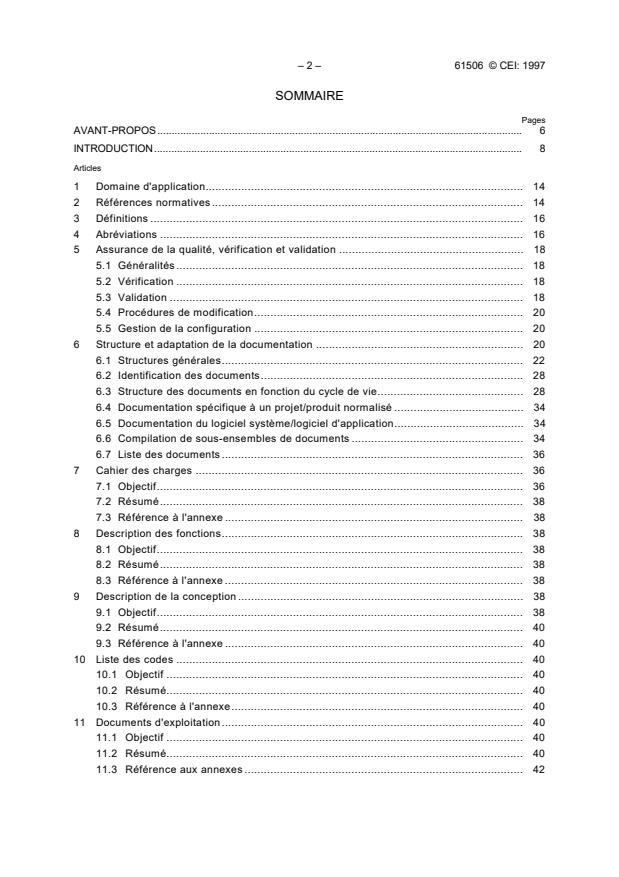
– 2 – 61506 © CEI: 1997
SOMMAIRE
Pages
AVANT-PROPOS. 6
INTRODUCTION. 8
Articles
1 Domaine d'application. 14
2 Références normatives . 14
3 Définitions . 16
4 Abréviations . 16
5 Assurance de la qualité, vérification et validation . 18
5.1 Généralités. 18
5.2 Vérification . 18
5.3 Validation . 18
5.4 Procédures de modification. 20
5.5 Gestion de la configuration . 20
6 Structure et adaptation de la documentation . 20
6.1 Structures générales. 22
6.2 Identification des documents. 28
6.3 Structure des documents en fonction du cycle de vie. 28
6.4 Documentation spécifique à un projet/produit normalisé . 34
6.5 Documentation du logiciel système/logiciel d'application. 34
6.6 Compilation de sous-ensembles de documents . 34
6.7 Liste des documents . 36
7 Cahier des charges . 36
7.1 Objectif. 36
7.2 Résumé. 38
7.3 Référence à l'annexe . 38
8 Description des fonctions. 38
8.1 Objectif. 38
8.2 Résumé. 38
8.3 Référence à l'annexe . 38
9 Description de la conception . 38
9.1 Objectif. 38
9.2 Résumé. 40
9.3 Référence à l'annexe . 40
10 Liste des codes . 40
10.1 Objectif . 40
10.2 Résumé. 40
10.3 Référence à l'annexe. 40
11 Documents d'exploitation. 40
11.1 Objectif . 40
11.2 Résumé. 40
11.3 Référence aux annexes . 42
61506 © IEC: 1997 – 3 –
CONTENTS
Page
FOREWORD . 7
INTRODUCTION. 9
Clause
1 Scope. 15
2 Normative references . 15
3 Definitions . 17
4 Abbreviations . 17
5 Quality assurance, verification and validation. 19
5.1 General. 19
5.2 Verification. 19
5.3 Validation. 19
5.4 Modification procedures . 21
5.5 Configuration management . 21
6 Documentation structure and tailoring. 21
6.1 General structures. 23
6.2 Identification of documents. 29
6.3 Life cycle related document structure. 29
6.4 Project specific versus standard product documentation. 35
6.5 Documentation of system software versus application software. 35
6.6 Compilation of document subsets . 35
6.7 List of documents . 37
7 Requirement specification . 37
7.1 Objective. 37
7.2 Summary . 39
7.3 Reference to annex . 39
8 Function description. 39
8.1 Objective. 39
8.2 Summary . 39
8.3 Reference to annex . 39
9 Design description . 39
9.1 Objective. 39
9.2 Summary . 41
9.3 Reference to annex . 41
10 Code list. 41
10.1 Objective. 41
10.2 Summary . 41
10.3 Reference to annex .41
11 Operational documents . 41
11.1 Objective. 41
11.2 Summary . 41
11.3 Reference to annexes . 43
– 4 – 61506 © CEI: 1997
12 Documents de test. 42
12.1 Objectif . 42
12.2 Résumé. 42
12.3 Référence aux annexes . 44
13 Documents de maintenance. 44
13.1 Objectif . 44
13.2 Résumé. 44
13.3 Référence aux annexes . 44
14 Documents de formation. 46
14.1 Objectif . 46
14.2 Résumé. 46
14.3 Référence à l'annexe. 46
Annexes
A Cahier des charges . 48
B Description des fonctions. 62
C Description de la conception . 70
D Liste des codes . 78
E Consignes d'exploitation . 82
F Journal d'exploitation. 86
G Spécification de test . 90
H Compte rendu de test . 94
J Journal de test. 98
K Instruction de maintenance. 102
L Journal de maintenance et de modification. 108
M Description de la formation . 112
N Bibliographie . 118
61506 © IEC: 1997 – 5 –
12 Test documents . 43
12.1 Objective. 43
12.2 Summary . 43
12.3 Reference to annexes . 45
13 Maintenance documents. 45
13.1 Objective. 45
13.2 Summary . 45
13.3 Reference to annexes . 45
14 Training documents . 47
14.1 Objective. 47
14.2 Summary . 47
14.3 Reference to annex .47
Annexes
A Requirement specification . 49
B Function description. 63
C Design description . 71
D Code list. 79
E Operating instructions. 83
F Operational log. 87
G Test specification. 91
H Test report . 95
J Test log . 99
K Maintenance instruction. 103
L Maintenance and modification log . 109
M Training description . 113
N Bibliography . 119
– 6 – 61506 © CEI: 1997
COMMISSION ÉLECTROTECHNIQUE INTERNATIONALE
_____________
MESURE ET COMMANDE DANS LES PROCESSUS INDUSTRIELS –
DOCUMENTATION DES LOGICIELS D’APPLICATION
AVANT-PROPOS
1) La CEI (Commission Electrotechnique Internationale) est une organisation mondiale de normalisation composée
de l'ensemble des comités électrotechniques nationaux (Comités nationaux de la CEI). La CEI a pour objet de
favoriser la coopération internationale pour toutes les questions de normalisation dans les domaines de
l'électricité et de l'électronique. A cet effet, la CEI, entre autres activités, publie des Normes Internationales.
Leur élaboration est confiée à des comités d'études, aux travaux desquels tout Comité national intéressé par le
sujet traité peut participer. Les organisations internationales, gouvernementales et non gouvernementales, en
liaison avec la CEI, participent également aux travaux. La CEI collabore étroitement avec l'Organisation
Internationale de Normalisation (ISO), selon des conditions fixées par accord entre les deux organisations.
2) Les décisions ou accords officiels de la CEI concernant les questions techniques, représentent, dans la mesure
du possible un accord international sur les sujets étudiés, étant donné que les Comités nationaux intéressés
sont représentés dans chaque comité d’études.
3) Les documents produits se présentent sous la forme de recommandations internationales. Ils sont publiés
comme normes, rapports techniques ou guides et agréés comme tels par les Comités nationaux.
4) Dans le but d'encourager l'unification internationale, les Comités nationaux de la CEI s'engagent à appliquer de
façon transparente, dans toute la mesure possible, les Normes internationales de la CEI dans leurs normes
nationales et régionales. Toute divergence entre la norme de la CEI et la norme nationale ou régionale
correspondante doit être indiquée en termes clairs dans cette dernière.
5) La CEI n’a fixé aucune procédure concernant le marquage comme indication d’approbation et sa responsabilité
n’est pas engagée quand un matériel est déclaré conforme à l’une de ses normes.
6) L’attention est attirée sur le fait que certains des éléments de la présente Norme internationale peuvent faire
l’objet de droits de propriété intellectuelle ou de droits analogues. La CEI ne saurait être tenue pour
responsable de ne pas avoir identifié de tels droits de propriété et de ne pas avoir signalé leur existence.
La Norme internationale CEI 61506 a été établie par le comité d'études 65 de la CEI: Mesure et
commande dans les processus industriels.
Le texte de cette norme est issu des documents suivants :
FDIS Rapport de vote
65/210/FDIS 65/212/RVD
Le rapport de vote indiqué dans le tableau ci-dessus donne toute information sur le vote ayant
abouti à l'approbation de cette norme.
Les annexes A, B, C, D, E, F, G, H, J, K, L, M font partie intégrante de cette norme.
L’annexe N est donnée uniquement à titre d’information.
61506 © IEC: 1997 – 7 –
INTERNATIONAL ELECTROTECHNICAL COMMISSION
––––––––
INDUSTRIAL-PROCESS MEASUREMENT AND CONTROL –
DOCUMENTATION OF APPLICATION SOFTWARE
FOREWORD
1) The IEC (International Electrotechnical Commission) is a worldwide organization for standardization comprising
all national electrotechnical committees (IEC National Committees). The object of the IEC is to promote
international co-operation on all questions concerning standardization in the electrical and electronic fields. To
this end and in addition to other activities, the IEC publishes International Standards. Their preparation is
entrusted to technical committees; any IEC National Committee interested in the subject dealt with may
participate in this preparatory work. International, governmental and non-governmental organizations liaising
with the IEC also participate in this preparation. The IEC collaborates closely with the International Organization
for Standardization (ISO) in accordance with conditions determined by agreement between the two
organizations.
2) The formal decisions or agreements of the IEC on technical matters express, as nearly as possible, an
international consensus of opinion on the relevant subjects since each technical committee has representation
from all interested National Committees.
3) The documents produced have the form of recommendations for international use and are published in the form
of standards, technical reports or guides and they are accepted by the National Committees in that sense.
4) In order to promote international unification, IEC National Committees undertake to apply IEC International
Standards transparently to the maximum extent possible in their national and regional standards. Any
divergence between the IEC Standard and the corresponding national or regional standard shall be clearly
indicated in the latter.
5) The IEC provides no marking procedure to indicate its approval and cannot be rendered responsible for any
equipment declared to be in conformity with one of its standards.
6) Attention is drawn to the possibility that some of the elements of this International Standard may be the subject
of patent rights. The IEC shall not be held responsible for identifying any or all such patent rights.
International Standard IEC 61506 has been prepared by IEC technical committee 65: Industrial
process measurement and control.
The text of this standard is based on the following documents:
FDIS Report on voting
65/210/FDIS 65/212/RVD
Full information on the voting for the approval of this standard can be found in the report on
voting indicated in the above table.
Annexes A, B, C, D, E, F, G, H, J, K, L, M form an integral part of this standard.
Annex N is for information only.
– 8 – 61506 © CEI: 1997
INTRODUCTION
Les logiciels sont rapidement devenus un élément essentiel des systèmes de mesure et de
commande de processus industriels. Les fonctions de ces systèmes sont mises en oeuvre en
code dans des systèmes électroniques programmables (PES). Les logiciels sont utilisés pour
réaliser des fonctions de mesure et de commande dans les processus industriels. Le système
peut également assurer des fonctions telles que l'optimisation des processus, l'information de
la direction, la logistique, la fabrication et l'ordonnancement.
La technologie logicielle est une discipline en plein développement qui élabore ses propres
traditions de documentation dans une large mesure en fonction des besoins des
programmeurs. La documentation des fonctions de commande de processus s'est par ailleurs
développée à partir de la réalisation matérielle des fonctions. Il existe en outre des normes CEI
bien établies, tandis que d'autres sont en cours de développement.
Des efforts ont été faits dans différentes normes internationales et nationales afin de définir
des règles de documentation des logiciels. Ces efforts n'étant pas coordonnés, ils ont conduit
à des difficultés dans la coordination de la documentation des systèmes de mesure et de
commande de processus. La terminologie concernant la documentation n'est pas établie, ce
qui entraîne des confusions, des problèmes de compréhension et une mauvaise qualité des
systèmes.
L'objet de la présente Norme internationale est de définir des structures pour la documentation
des logiciels des systèmes de mesure et de commande de processus et de définir des «types
de documents» (future CEI 61355, voir bibliographie). La documentation doit être structurée de
manière à s'intégrer naturellement à la documentation complète des équipements et des
usines. Il doit être possible de suivre les signaux et les informations issues du processus à
travers le matériel, dans le logiciel, puis vers l'interface homme-machine et vice versa.
Il existe différentes catégories de logiciels à différents niveaux de la hiérarchie des logiciels
système. La présente norme n'a pas pour objet la documentation des logiciels des systèmes
informatiques, sauf au niveau de leur interface avec le logiciel de la fonction de commande de
processus.
Les fonctions des logiciels des systèmes informatiques sont par exemple
– le système d'exploitation;
– les communications avec l'opérateur de l'ordinateur (pas l'opérateur du système de
commande et de processus);
– les fonctions de diagnostic de l'ordinateur;
– le système de gestion de base de données;
– les modules de commande de périphériques du système d'exploitation (par exemple
modules de gestion d'imprimantes, d'écrans de contrôle, de lecteurs de disques);
– le mécanisme de communication avec le processus;
– le mécanisme de communication avec d'autres ordinateurs;
– les compilateurs;
– les assembleurs.
La présente norme porte sur le niveau immédiatement supérieur de la structure logicielle, à
savoir le logiciel d'application.
61506 © IEC: 1997 – 9 –
INTRODUCTION
Software has rapidly become an essential element in industrial process measurement and
control systems. The functions in these systems are implemented by code in programmable
electronic systems (PES). The software is used to realise measurement and control functions
in industrial processes. The system may also provide functions such as process optimisation,
management information, logistics, manufacturing and scheduling.
Software technology is an immature discipline building up its own tradition in documentation
based very much on the programmers' needs. Documentation of process control functions, on
the other hand, has developed from the hardware realization of the functions, and well
established IEC standards exist and are still being developed.
Some effort has been made in different international and national standards to define rules for
documentation of software. These efforts have not been coordinated which leads to difficulties
in coordination of documentation in process measurement and control systems. The
terminology concerning the documentation is not established, which leads to confusion,
misunderstandings and poor system quality.
The purpose of this international standard is to define structures for the documentation of
software in process measurement and control systems, and to define "document kinds" (future
IEC 61355, see bibliography). The documentation shall be so structured that it will be a natural
part of the total documentation of the equipments and plants. It shall be possible to follow
signals and information from the process through the hardware into the software and then to
the man-machine interface and vice versa.
There are different categories of software at different levels in the system software hierarchy.
This standard is not concerned with the documentation of the computer system software,
except at its interface with the process control function software.
Examples of computer system software functions are:
− kernel;
− communication with computer operator (not the process and control system operator);
− computer diagnostic functions;
− database management system;
− operating system device drivers (e.g. handlers for printers, monitors, disc drivers);
− mechanism for process communication;
− communication mechanism for communication with other computers;
− compilers;
− assemblers.
This standard is concerned with the next level in the software structure, the application
software.
– 10 – 61506 © CEI: 1997
Les fonctions des logiciels d'application sont par exemple
– les fonctions de logique combinatoire et séquentielle comme le ET, le OU, le OU
EXCLUSIF et la fonction mémoire SET-RESET;
– la commande analogique, contenant des fonctions arithmétiques normalisées;
– l’interface homme-machine;
– la commande des séquences batch;
– le SCADA (supervisory control and data acquisition: système de supervision et
d'acquisition de données);
– les systèmes de gestion d'énergie;
– les logiciels d'application spécifiques à l'utilisateur.
Le système peut contenir une bibliothèque de ces fonctions et des solutions fixes pour des
fonctions telles que l'entraînement par moteur, les fonctions des pompes, la régulation par
action PID, etc.
Il n'existe pas dans les systèmes de mesure et de commande de processus de frontière
précise entre la documentation des fonctions proprement dites et celle du matériel et du
logiciel mettant en oeuvre ces fonctions. Il peut s'avérer difficile d'isoler les exigences
logicielles des exigences de la fonction de mesure et de commande remplies par le reste du
système. La documentation de la fonction et de sa mise en oeuvre est intégrée par exemple
dans des descriptions textuelles, dans des diagrammes en échelle ou dans des schémas
fonctionnels. Si le PES utilisé n'a pas de bibliothèque de fonctions, il peut être nécessaire que
les personnes impliquées dans la conception du système aient des compétences en
programmation informatique et des connaissances en fonctions de processus. Si le PES
contient une bibliothèque de fonctions, aucune compétence spécifique en programmation
informatique ne sera en général nécessaire.
Les fonctions de mesure et de commande de processus mises en oeuvre seront normalement
structurées en fonction de l'entreprise et des fonctions de l'usine et des équipements à
commander, compte tenu des structures organisationnelles. Il convient que ces fonctions
soient documentées et présentées en fonction de cette structure. L'exécution du programme
mettant en oeuvre les fonctions peut toutefois être structurée différemment, en sous-
programmes et traitements, etc., adaptés à l'exécution. Cette structure interne du programme
peut nécessiter sa propre documentation, à savoir une documentation de conception du
programme.
La présente norme traite de toutes ces questions.
Il existe dans un système de mesure et de commande de processus différentes structures
d'information. Elles représentent différents points de vue et différents groupes d'utilisateurs.
Par exemple, les documents peuvent être structurés par zones de l'usine. Ou bien, une
décomposition orientée fonction peut être adoptée.
Les documents peuvent également être regroupés de différentes manières en fonction de leur
utilisation, par exemple
– l’exploitation du système;
– la maintenance (localisation de défauts, mise à jour);
– la production pour installation;
– la mise en service.
La présente norme utilise le terme «document» au sens d'un ensemble d'informations. Cela ne
signifie pas que les informations doivent être représentées sous forme imprimée. Elles peuvent
être produites sur tout support à partir duquel elles peuvent être présentées sous forme lisible.
61506 © IEC: 1997 – 11 –
Examples of application software functions are:
− combinatorial and sequential logic functions such as AND, OR, EXCLUSIVE OR and
SET-RESET function memory;
− "analogue control" containing standard arithmetic functions;
− man-machine interface;
− batch sequence control;
− SCADA (supervisory control and data acquisition);
− energy management systems;
− user specific application software.
The system may contain a library of these functions and fixed solutions for functions such as
motor drives, pump functions, PID (proportional integral derivative) control etc.
In a process measurement and control system, there is no natural border line between the
documentation of the function itself and the hardware and the software implementing the
functions. It may be difficult to isolate the software requirements from the measurement and
control function requirements for the rest of the system. The documentation of the function and
its implementation is integrated in textual descriptions, in ladder diagrams, or in function block
diagrams, for example. If the PES used has no library of functions, the persons designing the
system may need computer programming skills and process function knowledge; if the PES
contains a library of functions, they will normally not need specific computer programming
skills.
The implemented process measurement and control functions will normally be structured
according to the organization and the functions in the plant and equipment under control, with
due regard to organizational structures. They should be documented and presented according
to that structure. The execution of the program implementing the functions may, however, be
structured in another way, in subroutines and processes, etc, suited for the execution. This
internal program structure may need its own documentation, namely a program design
documentation.
This international standard considers these questions.
Different information structures exist in a process measurement and control system. They
represent different views and different user groups. For example, documents might be
structured on a plant area basis. Alternatively, a function oriented breakdown might be
adopted.
Documents may also be collated in different ways according to use, for example:
− operation of the system;
− maintenance (fault tracing, updating);
− production for installation;
− commissioning.
This standard uses the term "document" to mean "a set of information". This does not mean
that the information has to be presented on paper. It can be on any medium from which it can
be presented in a readable form.
– 12 – 61506 © CEI: 1997
La documentation peut se présenter sous forme de textes, de schémas, de tableaux, etc. Les
différentes formes de présentation peuvent être combinées pour assurer une clarté totale.
Il est commode d'utiliser un modèle de cycle de vie qui soit une définition des différentes
phases de la vie du système, de sa conception à sa réforme, ainsi qu'une description des
activités recouvertes par chaque phase.
Dans la présente norme, les annexes traitent de la structure, du contenu et du format standard
des documents particuliers exigés pour les systèmes de mesure et de commande de
processus.
Les articles 7 à 14 inclus proposent une présentation générale de la documentation nécessaire
lors des phases consécutives du cycle de vie d'un système. L'objectif de chaque document y
est également indiqué. L'annexe correspondante liste alors les points devant être documentés
et sert de gabarit au document concerné.
L'objet de la présente norme est donc de constituer un point de départ bien établi, commun à
toutes les parties prenantes impliquées dans la définition, la création, l'installation et
l'utilisation de systèmes de commande de processus à base logicielle.
La maintenance d'une bonne documentation est l'un des impératifs clés de la «gestion de la
qualité», décrite à l'article 6.
Le modèle de cycle de vie donné dans le tableau 1 identifie quel document doit être prévu pour
une phase particulière. L'annexe correspondante précise quelles informations doivent être
couvertes par ledit document.
Dans la présente norme, des synonymes tels que les verbes «fournir», «décrire», «donner»,
«contenir», «couvrir» sont utilisés de manière interchangeable, afin de faciliter la lecture et
sans leur donner un sens différent.
61506 © IEC: 1997 – 13 –
The documentation may be in form of text, diagrams, tables, etc. The different forms of
presentation can be combined in order to achieve complete clarification.
It is convenient to use a life cycle model which is a definition of the different phases of the
system's life from conception through decommissioning, together with a description of the
activities in each phase.
In this standard, the annexes cover the standard structure, content and format for particular
documents required for process measurement and control systems.
Clause 7 up to and including clause 14 give the overview of the documentation needed in
consecutive phases of the system life cycle. The objective of each document is described
there. The appropriate annex then lists the items to be documented and serves as a template
for the document concerned.
The intended purpose of this standard is thus to have a solid common starting point for all
parties involved in defining, creating, installing and using software-based process control
systems.
Maintenance of good documentation is one of the key features of "quality management", which
is described in clause 6.
The life cycle model in table 1 identifies which document shall be available for a particular
phase. The specific annex clarifies what information shall be covered.
In this standard, synonyms such as "provide", "describe", "give", "contain", "cover" are used
interchangeably to make it more readable: no distinction in meaning is intended.
– 14 – 61506 © CEI: 1997
MESURE ET COMMANDE DANS LES PROCESSUS INDUSTRIELS –
DOCUMENTATION DES LOGICIELS D’APPLICATION
1 Domaine d'application
La présente Norme internationale définit les exigences applicables à la documentation des
logiciels des systèmes industriels de mesure et de commande de processus afin de permettre
– l'acquisition,
– l'alimentation,
– la conception et la mise au point,
– la production,
– l'installation,
– la mise en service,
– l'exploitation,
– la maintenance,
– la réforme
du système. Cette norme est applicable aux systèmes individuels ainsi qu'à plusieurs systèmes
regroupés au sein d'un réseau.
La documentation des logiciels est intégrée au reste de la documentation de l'usine. Il s'agit
par exemple des descriptions du matériel, des plans et des consignes nécessaires pour
l'acquisition, l'alimentation, la conception, la production, l'installation, la mise en service,
l'exploitation et la maintenance du système dans son ensemble.
La présente norme s'applique aux logiciels d'application et aux données de configuration. Elle
ne s'applique pas a
...